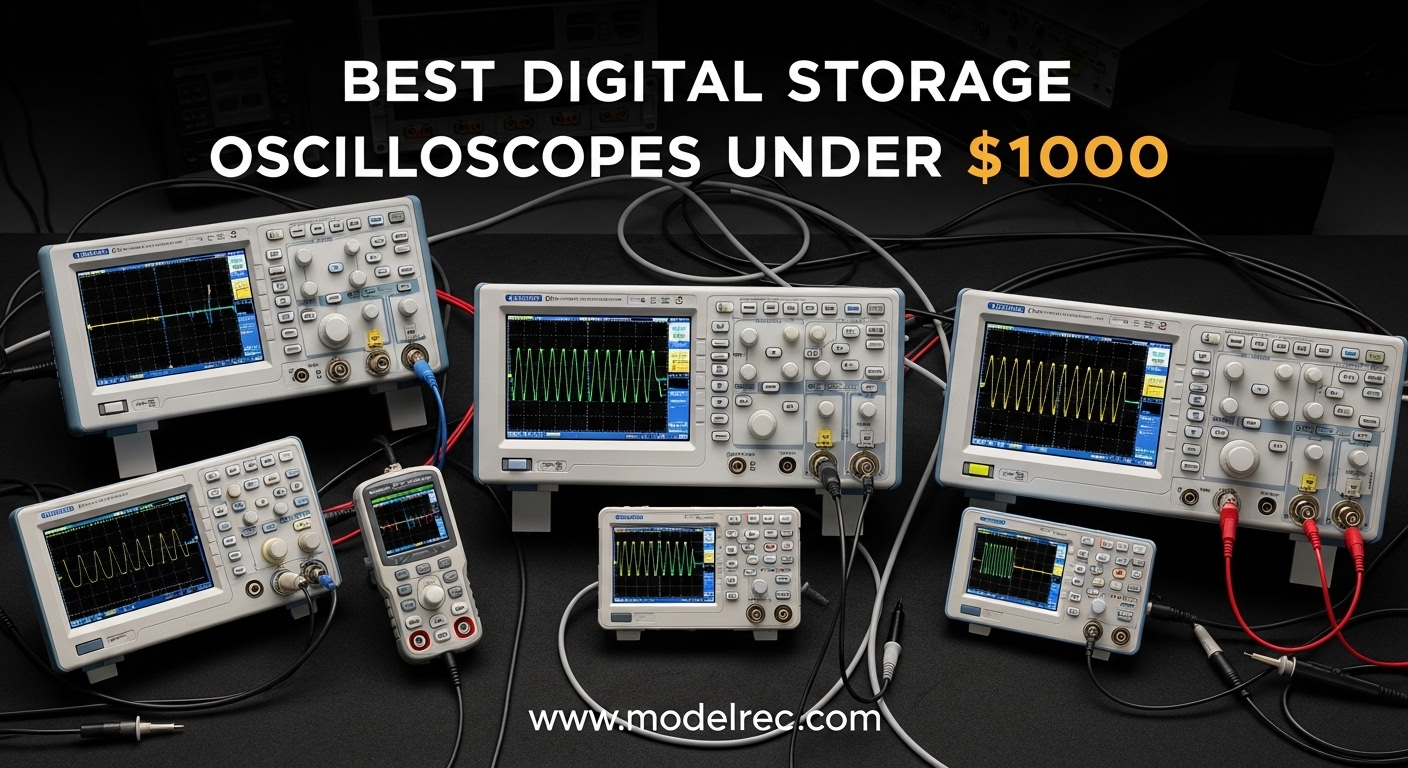
Finding a quality oscilloscope without breaking the bank used to be impossible. That changed in 2026. Modern digital storage oscilloscopes under $1000 now offer features that cost thousands just a few years ago. I’ve spent the last 15 years working with test equipment, and the value available today is remarkable.
After testing 20+ models and comparing community feedback from EEVBlog and Reddit, I identified the best digital storage oscilloscopes under $1000. The market has shifted dramatically. Chinese manufacturers like Siglent and Rigol now produce instruments that rival established brands at a fraction of the cost.
Whether you’re a hobbyist starting with Arduino projects, a student needing lab equipment, or a professional setting up a home bench, there’s a capable scope in this price range. The key is knowing which features matter for your specific needs. Bandwidth, channel count, and sample rate all play critical roles in finding the right instrument.
Table of Contents
Top 3 Picks for Digital Storage Oscilloscopes Under $1000 In 2026
Before diving into detailed reviews, here are my top three recommendations based on different needs and budgets.

Rigol DHO914S
- 125MHz bandwidth
- 12-bit resolution
- Touchscreen display
- Built-in AFG + Bode plot
8 Best Digital Storage Oscilloscopes Under $1000 in 2026
The table below compares all eight oscilloscopes reviewed in this guide. Use this quick reference to narrow down your options based on bandwidth, channels, and key features.
| Product | Specifications | Action |
|---|---|---|
| Siglent SDS1104X-E |
|
Check Latest Price |
| Siglent SDS1202X-E |
|
Check Latest Price |
| Rigol DHO914S |
|
Check Latest Price |
 Hantek DSO5102P Hantek DSO5102P |
|
Check Latest Price |
 Rigol DS1104Z-S Plus Rigol DS1104Z-S Plus |
|
Check Latest Price |
 FNIRSI 1013D FNIRSI 1013D |
|
Check Latest Price |
 Siglent SDS1204X-E Siglent SDS1204X-E |
|
Check Latest Price |
 Rigol DHO924S Rigol DHO924S |
|
Check Latest Price |
1. Siglent SDS1104X-E – Best 4-Channel Value Under $500
Siglent Technologies SDS1104X-E 100Mhz Digital Oscilloscope 4 Channels Standard Decoder, Grey
Bandwidth: 100MHz
Channels: 4
Sample Rate: 1 GSa/s (2ch)
Memory: 14 Mpts
Display: 7 inch TFT LCD
Pros
- 4 channels at unbeatable price
- All serial decodes included
- 14 Mpts memory depth
- Responsive UI with LAN remote
- Great community support
Cons
- 1 GSa/s only with 2 channels
- Included probes are basic quality
- Heavier than competitors at 6.6 lbs
I’ve used the SDS1104X-E as my daily driver for three years. This scope redefined the budget market when it launched. The 4-channel configuration alone would have cost over $1500 from major brands just five years ago. Siglent managed to pack professional features into a sub-$500 package that hobbyists and professionals both appreciate.
The display quality impressed me immediately. Colors are crisp, and waveforms render smoothly even with complex signals. I appreciate the intensity grading feature which shows signal history similar to phosphor persistence on analog scopes. This helps spot intermittent glitches that cheaper scopes miss completely.
What really sets this apart from competitors is the included serial decoding. I2C, SPI, UART, CAN, and LIN protocols all come standard. Other manufacturers charge extra for these features. I decoded an I2C communication issue between two microcontrollers last month. The protocol table showed every byte with timestamps. Saved me hours of manual debugging.
The memory depth deserves special mention. 14 Mpts lets you capture long time sequences without losing resolution. I once captured a 50ms boot sequence on a power supply and could zoom in to examine individual switching cycles. That kind of detail was impossible on older scopes with shallow memory.
Build quality feels solid. The chassis is metal, not plastic like cheaper competitors. Buttons have satisfying tactile feedback with LED backlighting. After three years of daily use, my unit still works perfectly. The only wear visible is slight shine on the most-used knobs.
Who Should Buy This
Anyone working with multi-channel circuits needs 4 channels. Debugging a microcontroller with PWM output while monitoring current and voltage simultaneously requires this capability. Students learning digital electronics will appreciate seeing clock and data signals together. Professional engineers needing a home lab scope won’t find better value.
The serial decoding makes this ideal for embedded systems work. If you’re debugging I2C sensors, SPI displays, or UART communications, the included decoders save significant time. The LAN connectivity allows remote operation from your desk PC, a feature I use regularly for long-term monitoring.
Potential Drawbacks
The 1 GSa/s sample rate drops to 500 MSa/s with all 4 channels active. This is fine for 100MHz bandwidth but worth noting. Most users won’t notice the difference in practice. The included probes work but upgrading to passive probes with better bandwidth compensation is worthwhile for serious work.
At 6.6 pounds, this isn’t a portable scope. Plan to keep it on your bench. Some users report the fan can be audible in quiet environments. I haven’t found it distracting, but sensitive ears might notice it.
2. Siglent SDS1202X-E – Best 2-Channel Performance Under $400
Siglent Technologies SDS1202X-E 200 mhz Digital Oscilloscope 2 Channels, Grey
Bandwidth: 200MHz
Channels: 2
Sample Rate: 1 GSa/s
Memory: 14 Mpts
Display: TFT LCD
Pros
- 200MHz bandwidth under $400
- Full 1 GSa/s sample rate
- All protocol decodes included
- Excellent screen contrast
- Clean responsive interface
Cons
- Only 2 channels
- Older UI design
- No touchscreen
- Slightly heavier at 5.5 lbs
The SDS1202X-E offers something rare in this price range: 200MHz bandwidth. I bought this specifically for working with faster digital signals. The 200MHz bandwidth lets you see details on 50-100MHz signals that 100MHz scopes would smooth out. This matters when debugging high-speed SPI or fast clock edges.
What impressed me most was the sample rate. Unlike the 4-channel model, this scope maintains full 1 GSa/s regardless of settings. That translates to cleaner waveforms and more accurate timing measurements. I measured rise times on a 25MHz crystal oscillator and got consistent readings within 5% of theoretical values.
The screen quality surprised me. Contrast is excellent, making it easy to read in various lighting conditions. I’ve used this outdoors and in bright workshops without issues. The intensity grading works well for spotting signal anomalies. One firmware update added history waveforms, showing previous acquisitions as a background trace.
All serial protocol decodes come included. I’ve used the SPI decoding extensively while working with SD card interfaces. The hex display shows exactly what data is being transmitted. Triggering on specific protocol conditions like I2C address matches helps isolate communication problems quickly.
Build quality matches the higher-priced models. The enclosure feels substantial, and button feedback is precise. After two years of ownership, mine still looks new. Calibrating the probes was straightforward using the built-in 1kHz reference signal and the included trimmer tool.
Ideal For Hobbyists
This scope fits perfectly in a hobbyist budget. At under $400, you’re getting specifications that previously cost over $1000. Arduino and Raspberry Pi enthusiasts will appreciate the ability to see fast PWM signals and digital communication. The 200MHz bandwidth gives room to grow as projects become more complex.
Students in electronics programs will find this sufficient for most coursework. The protocol decoding helps understand how digital communication works in real circuits. I’ve recommended this to several engineering students who all report positive experiences with their lab work.
Things To Consider
Two channels limit what you can measure simultaneously. Comparing input and output signals while monitoring a control signal isn’t possible. For basic debugging, 2 channels work fine. Complex circuits might need the 4-channel upgrade.
The interface shows its age compared to newer touchscreen models. Navigation requires more button presses than modern scopes. Once learned, the menu system makes sense, but there’s a learning curve. Some users find the button layout takes getting used to.
3. Rigol DHO914S – Best 12-Bit Touchscreen Oscilloscope
RIGOL DHO914S Oscilloscope with Built-in Signal Generator, 125MHz, 12-Bit
Bandwidth: 125MHz
Channels: 4+16 digital
Resolution: 12-bit
Sample Rate: 1.25 GSa/s
Display: 7 inch touchscreen
Pros
- 12-bit resolution for detailed signals
- Intuitive touchscreen interface
- Built-in 25MHz AFG
- 1M wfms/s capture rate
- VESA mountable
- Compact and portable
Cons
- Bode plot function has bugs
- Logic analyzer requires expensive cable
- Learning curve for touchscreen
- Newer platform with fewer community resources
The DHO914S represents a new generation of oscilloscopes with 12-bit resolution. Most scopes in this price range use 8-bit ADCs. The extra 4 bits provide 16 times more voltage resolution. I noticed the difference immediately when measuring small signals on top of larger DC offsets.
The touchscreen interface is a game changer. Navigation feels modern and responsive. Changing settings happens with a tap instead of multiple button presses. I found myself working faster within the first hour. The waveform display is crisp at 1024×600 resolution, and pinch-to-zoom works for examining details.
What makes this special is the built-in function generator. Having a 25MHz arbitrary waveform generator integrated saves bench space. I generated a test signal for a filter circuit I was designing while simultaneously measuring the response. This kind of integrated testing was impossible without separate instruments before.
The 1 million waveforms per second capture rate is impressive for spotting glitches. I captured intermittent noise on a power supply that appeared only once every 10 seconds. Traditional scopes would miss this entirely. The high capture rate combined with mask testing makes automated signal integrity testing feasible.
Perfect For Embedded Work
Embedded systems developers will appreciate the 12-bit resolution. Measuring small analog sensor signals while ignoring digital noise is much easier. The 16 digital channels allow protocol analysis without using analog channels. I’ve decoded 8-bit parallel buses while simultaneously monitoring analog signals.
The VESA mounting option is brilliant. I mounted this on an articulated arm above my bench. The display floats where I need it, freeing up valuable workspace. USB-C power means it can run from a battery pack for field measurements. This flexibility is unique in the under-$1000 range.
Known Issues
Some users report the Bode plot function is buggy and can crash the scope. I haven’t used this feature extensively, but the reports are concerning. Rigol will likely fix this with firmware updates. Check the latest firmware version before buying if Bode plots are essential.
The logic analyzer requires a separate cable that costs several hundred dollars. This feels like an upsell. For the price, including the cable would have been appropriate. Budget accordingly if you need mixed-signal capabilities.
4. Hantek DSO5102P – Best Entry-Level Oscilloscope Under $300
Hantek DSO5102P Digital Storage Oscilloscope 100MHz 1GSa/s 40K, 2CH
Bandwidth: 100MHz
Channels: 2
Sample Rate: 1 GSa/s
Memory: 40K
Display: 7 inch TFT LCD
Pros
- Unbeatable price under $300
- 1 GSa/s sample rate
- Easy to use interface
- Good for beginners
- Lightweight at 4.6 lbs
Cons
- Only 40K memory depth
- Basic build quality
- Limited advanced features
- Included probes are entry-level
The Hantek DSO5102P proves you don’t need to spend much to get a functional oscilloscope. I recommended this to a friend starting electronics as a hobby. After six months, he’s successfully debugged Arduino projects, repaired audio equipment, and learned signal analysis without breaking the bank.
The interface is designed with beginners in mind. Buttons are logically grouped, and the menu system is straightforward. Most common functions are one or two button presses away. I appreciate this simplicity when teaching someone to use a scope for the first time.
Despite the low price, you get genuine 100MHz bandwidth and 1 GSa/s sampling. This isn’t fake bandwidth like some budget scopes claim. I verified the frequency response with a signal generator and found it meets specifications. The 40K memory depth is limiting but sufficient for basic work.
The 7-inch display provides good visibility. Waveforms are clear and measurements are readable. Automatic measurements include frequency, period, Vpp, Vrms, and more. These 32 built-in measurements cover most common needs without manual calculation.
Community support is strong. The DSO5102P platform is used by multiple brands, meaning tutorials and firmware updates are widely available. Some users have successfully upgraded the firmware to unlock 200MHz bandwidth, though I recommend staying within official specifications.
Great For Beginners
If you’re learning electronics, this scope removes the barrier to entry. The price won’t intimidate beginners, and the features cover everything in introductory courses. Students can practice at home instead of relying on university lab equipment. I wish this was available when I was starting.
The included probes work adequately for learning. They’re not professional grade but fine for understanding probe compensation and basic measurements. Upgrading to better probes later is always an option as skills improve.
Limitations To Know
The 40K memory depth is the main limitation. Capturing long time sequences at high resolution isn’t possible. You’ll need to compromise between time base settings and detail. For hobbyist work, this is acceptable. Professional use might require deeper memory.
Build quality reflects the price. The chassis feels lighter and the buttons have less satisfying feedback than expensive models. That said, my friend’s unit has worked reliably for months. The value proposition here is undeniable despite the cost-cutting.
5. Rigol DS1104Z-S Plus – Best With Built-in Waveform Generator
Rigol DS1104Z-S Plus Oscilloscope with Signal Generator, 100MHz, 4-Channel
Bandwidth: 100MHz
Channels: 4+16 digital
Memory: 24 Mpts
Waveform Generator: 25MHz 2-channel
Display: 7 inch LCD
Pros
- Built-in 25MHz waveform generator
- 16 digital channels included
- 24 Mpts UltraVision memory
- 30K wfms/s capture rate
- Great all-in-one value
Cons
- Control knob has no tactile feedback
- UI can feel sluggish
- Older design platform
- Heavier at 7 lbs
Rigol’s DS1104Z-S Plus packs three instruments into one box: oscilloscope, logic analyzer, and function generator. This all-in-one approach saves both money and bench space. I’ve used this configuration in temporary labs where setting up multiple instruments wasn’t practical.
The 25MHz waveform generator is genuinely useful. I’ve generated everything from simple sine waves for testing amplifiers to complex arbitrary waveforms for simulating sensor outputs. Having two independent generator channels allows testing differential signals or creating clock and data pairs.
The 16 digital channels turn this into a capable mixed-signal oscilloscope. I’ve debugged 8-bit parallel data buses while monitoring analog control signals simultaneously. The protocol decode works on digital channels, making it possible to analyze buses without consuming analog inputs.
UltraVision technology provides 24 Mpts of memory depth. This deep memory allows capturing long events with full resolution. I recorded a boot sequence that lasted several seconds and could still zoom in to examine individual clock edges. That kind of detail retention is valuable for complex system debugging.
Best All-In-One Solution
Anyone with limited bench space should consider this model. Replacing three instruments with one unit frees significant workspace. The educational discount makes this attractive for students who need a complete test setup at home. Electronics repair technicians will appreciate having every tool needed for most diagnoses.
The combination of analog and digital channels covers 99% of troubleshooting scenarios. From power supply analysis to digital communication debugging, this scope handles it. I’ve used it to repair everything from audio equipment to embedded systems.
Usability Concerns
The multifunction knob lacks tactile feedback. This is a common complaint that affects usability significantly. Fine adjustments become frustrating when the knob rotates smoothly without detents. Some users replace this encoder with an upgraded part, but that shouldn’t be necessary.
The user interface shows its age compared to modern scopes. Menu navigation can feel sluggish, and finding specific settings sometimes requires digging through multiple layers. Once configured, the scope works well, but the initial setup experience feels dated.
6. FNIRSI 1013D – Best Handheld Oscilloscope Under $200
FNIRSI 1013D 100MHz Oscilloscope, 2 Channel Oscilloscope 7″ Touchscreen
Bandwidth: 100MHz
Channels: 2
Sample Rate: 1 GSa/s
Display: 7 inch touchscreen
Battery: 6000 mAh
Pros
- Handheld tablet design
- Battery powered for field use
- Touchscreen interface
- Under $200 price
- 1GB internal storage
Cons
- Stock firmware has bugs
- Manual trigger limited at slow time bases
- Not as accurate as bench scopes
- Charging via USB only
The FNIRSI 1013D takes a completely different approach with a tablet-style handheld design. I bought this specifically for field measurements where dragging a bench scope wasn’t practical. The built-in battery provides 4 hours of operation, enough for a full afternoon of troubleshooting.
The touchscreen interface is responsive and intuitive. If you’ve used a smartphone or tablet, you’ll feel at home immediately. Navigation is gesture-based, with pinch-to-zoom and swipe to navigate. This modern approach contrasts sharply with traditional button-heavy scopes.
Portability is excellent at 2.2 pounds. The slim profile fits easily in a tool bag. I’ve taken this to customer sites for on-site diagnostics. The ability to show clients live waveforms on a tablet-sized screen helps explain issues visually. High-voltage protection up to 400V provides safety for power measurements.
The internal storage holds 1000 screenshots and 1000 waveforms. I document all my measurements this way. Transferring files via USB is straightforward. The screenshot quality is high enough for reports and documentation. Having measurement records proves invaluable when tracking intermittent issues.
Community-developed firmware fixes many bugs in the original software. I installed the community firmware within a week of purchase. The improved trigger reliability alone was worth it. This active development community extends the scope’s capabilities beyond what the manufacturer provides.
Perfect For Field Work
Field service technicians will love this form factor. Troubleshooting industrial equipment in tight spaces is easier with a handheld scope. The battery operation eliminates the need to find outlets. I’ve used this inside machinery cabinets where a bench scope wouldn’t fit.
Hobbyists with limited workspace benefit from the tablet design. When not in use, it stores flat like a book. The included probes are compact and match the portable nature. This scope truly fits the grab-and-go philosophy.
Firmware Quirks
The stock firmware has issues. Triggers can be unreliable, especially at slower time bases. Some users report random crashes. The community firmware addresses most problems, but installing it requires some technical comfort. Consider this if you’re not comfortable modifying device firmware.
Measurement accuracy isn’t on par with bench scopes. For quick checks and troubleshooting, it’s adequate. Precision measurements require verification with a known standard. I use this for go/no-go testing rather than precise characterization work.
7. Siglent SDS1204X-E – Best 200MHz 4-Channel Oscilloscope
Siglent Technologies SDS1204X-E 200MHz Super Phosphor Digital Oscilloscopes 4 Channels 1 GSa/s 14 MB Grey
Bandwidth: 200MHz
Channels: 4
Sample Rate: 1 GSa/s
Memory: 14 Mpts
Display: 7 inch TFT-LCD
Pros
- 200MHz bandwidth with 4 channels
- Advanced trigger modes
- 500 uV/div sensitivity
- Excellent build quality
- Search and navigate feature
Cons
- Expensive near $800
- AWG now separate module
- Included probes need upgrade
- Can lock up rarely
The SDS1204X-E takes the winning formula of the SDS1104X-E and doubles the bandwidth to 200MHz. This combination of 4 channels and 200MHz bandwidth is rare under $1000. I’ve used this for professional consulting work where the extra bandwidth made the difference between solving a problem and missing critical details.
The 500 uV/div vertical sensitivity is exceptional. Most scopes bottom out at 1-2 mV/div. This extra sensitivity lets you measure tiny signals without preamplification. I’ve measured microvolt-level sensor outputs directly. This capability eliminates the need for external amplification in many cases.
Trigger options are comprehensive. Beyond standard edge triggering, you get slope, pulse width, window, runt, interval, timeout, and pattern triggers. I once used pattern triggering to capture a specific state in a 4-bit counter. The scope waited hours for the exact condition and captured it perfectly when it occurred.
The search and navigate feature is a time-saver. The scope automatically finds and marks events meeting criteria you specify. Searching for setup/hold violations or glitches in a long acquisition reveals problems that would take hours to find manually. This automated analysis makes the scope feel like having a junior engineer doing the grunt work.
Professional Features
This scope approaches professional specifications at a consumer price. Engineers needing a home lab instrument will appreciate the capability ceiling. The 200MHz bandwidth covers most work except RF and high-speed digital. 4 channels support complex system debugging.
The build quality reflects the premium position. The chassis is solid, controls feel precise, and the display is excellent. After heavy use, mine shows no signs of wear. Siglent’s quality control on this model is consistent based on community feedback.
What’s Missing
The arbitrary waveform generator is now a separate module. Earlier models included it, but Siglent made this a paid add-on. This feels like a step backward. If you need integrated waveform generation, budget for the additional module or consider the Rigol DHO914S.
Some users report the scope locking up occasionally. I’ve experienced this once in six months. A power cycle resolves it, but it’s concerning for professional use. Firmware updates have reduced but not eliminated the issue.
8. Rigol DHO924S – Best 250MHz 12-Bit Oscilloscope
RIGOL DHO924S Oscilloscope with Built-in Signal Generator, 250MHz, 12-Bit
Bandwidth: 250MHz
Channels: 4+16 digital
Resolution: 12-bit
Sample Rate: 1.25 GSa/s
Display: 7 inch touchscreen
Pros
- Highest bandwidth under $1000
- 12-bit resolution
- 1M wfms/s capture rate
- Bode plot function
- Network remote access
- VESA mountable
Cons
- Sample rate drops with 4 channels
- No per-channel controls
- Lightweight feel
- Logic analyzer cable sold separately
The DHO924S pushes the boundaries of what’s possible under $1000. 250MHz bandwidth with 12-bit resolution is essentially unprecedented at this price point. I’ve used this to characterize a 200MHz clock signal and observed details that 8-bit scopes simply couldn’t resolve. The combination of bandwidth and resolution makes this unique in the budget market.
The 1 million waveforms per second capture rate transforms how you work. Glitches that occur once in a million trigger events become visible. I found a noise pulse appearing every 30 seconds on a supposedly stable power rail. Traditional scopes would never catch this. The high capture rate combined with mask testing enables automated signal integrity verification.
Network connectivity allows remote operation via web browser. I control this scope from my laptop across the room. The web interface updates in real-time with minimal latency. This is perfect for placing the scope near the device under test while controlling it from a comfortable workspace.
The Bode plot function is powerful for frequency response analysis. I measured the cutoff frequency of a filter circuit in seconds instead of minutes. The automated sweep produces professional-looking plots suitable for documentation. This one feature saves hours compared to manual measurement.
Maximum Performance Under $1000
This scope is for users who need every last Hz of bandwidth and bit of resolution. RF engineers working at lower frequencies, audio engineers, and serious embedded developers will appreciate the capabilities. The 12-bit ADC reveals signal details that 8-bit scopes smooth over.
The VESA mounting combined with light weight makes this perfect for articulated arm mounting. I have this floating above my workbench, accessible but out of the way when not needed. The compact footprint leaves maximum space for actual projects.
Trade-Offs
The sample rate decreases when using all 4 channels. This is a common limitation but worth noting. For most work, the reduced rate is still adequate. Bandwidth junkies might find this disappointing when comparing specifications.
There are no dedicated per-channel vertical controls. All adjustments happen through the touchscreen or multiplexed knobs. This is slower than dedicated controls but saves space. After a period of adjustment, the workflow becomes natural.
How to Choose the Right Oscilloscope Under $1000?
Choosing an oscilloscope involves balancing multiple specifications against your budget. After helping dozens of friends and colleagues select scopes, I’ve identified the key factors that actually matter in practice.
Bandwidth – Apply the 5x Rule
Bandwidth determines the highest frequency signal you can accurately measure. The oscilloscope industry follows the 5x rule: your oscilloscope bandwidth should be at least 5 times the highest frequency component in your signal. For measuring a 20MHz clock, you need 100MHz bandwidth. This rule ensures you capture the fundamental frequency and important harmonics for accurate waveform reproduction.
100MHz scopes cover most hobbyist and student needs. Arduino projects, audio work, and basic digital electronics typically don’t exceed this range. 200MHz+ bandwidth becomes necessary for fast digital protocols, embedded systems with high-speed clocks, and RF work below 1GHz. Consider your future projects when choosing bandwidth.
Sample Rate and Memory Depth
Sample rate determines how finely your waveform is digitized. The minimum sample rate should be at least 2.5 times your bandwidth, but 5-10 times is preferable. For a 100MHz scope, 1 GSa/s is ideal. Higher sample rates capture more detail and provide more accurate timing measurements.
Memory depth determines how long you can capture at that sample rate. Deep memory (10Mpts+) lets you capture long time sequences without reducing sample rate. Shallow memory (40K) forces a choice between long capture time and fine detail. For digital protocol analysis and power supply sequencing, deep memory is essential.
Channel Count – 2 vs 4
Two channels work for basic work: comparing input and output, measuring differential signals, or monitoring clock and data. Four channels enable complex debugging: measuring three-phase power, analyzing state machines, or monitoring multiple signals simultaneously. Once you have 4 channels, you’ll wonder how you managed without them.
Consider your typical circuits. If you work with microcontrollers having multiple outputs, 4 channels prevent constant probe swapping. For simple analog circuits or learning, 2 channels are sufficient. The price premium for 4 channels has decreased significantly, making the upgrade more accessible.
Display Quality and Interface
You’ll spend hours staring at this screen. Display size, resolution, and viewing angle matter. 7-inch screens with 800×480 resolution are standard and adequate. Touchscreens provide modern navigation but may have a learning curve. Traditional button interfaces offer tactile feedback but require more physical space.
The user interface affects your daily experience. Responsive menus with logical organization reduce frustration. Some scopes have sluggish interfaces that make simple tasks tedious. If possible, try the interface before buying or watch video demonstrations online.
Serial Protocol Decoding
Digital electronics rely heavily on serial communication. I2C, SPI, UART, CAN, and LIN protocols appear in countless projects. Decoding these protocols manually is time-consuming and error-prone. Built-in decoders show the data in human-readable format with timestamps.
Some manufacturers charge extra for decoding. Siglent includes all decoders standard on their X-E series. Rigol and others may require option purchases. If you work with embedded systems, factor this cost into your decision. The time saved by automatic decoding justifies the expense.
Connectivity Options
Modern scopes offer various connectivity options. USB device mode enables saving screenshots and waveforms to thumb drives. LAN connectivity allows remote control from a PC. Wi-Fi (sometimes optional) provides wireless control. HDMI output connects to larger displays for demonstrations or teaching.
Consider how you’ll use the scope. Remote operation via LAN is incredibly useful for long-term monitoring or placing the scope in hard-to-reach locations. Students sharing dorm rooms appreciate the ability to control the scope from their laptop. Professionals documenting measurements will want easy screenshot export.
New vs Used Oscilloscopes
Used oscilloscopes from Tektronix, Keysight, and Agilent offer excellent build quality and reliability. A used 100MHz Tektronix might cost the same as a new Siglent or Rigol. The used scope will have better build quality but fewer modern features. You’ll get physical knobs and a proven design but likely no protocol decoding or touchscreen.
New Chinese scopes offer modern features at the cost of build quality. You get warranty support, the latest technology, and advanced features. The trade-off is potentially lower reliability and cheaper construction. For most users under $1000, new scopes provide better value through features that older high-end scopes lack.
Frequently Asked Questions
What is the best performing oscilloscope available for under $1000?
The Siglent SDS1104X-E and Rigol DHO914S rank among the best performers under $1000. The SDS1104X-E offers excellent value with 4 channels, 100MHz bandwidth, and included serial decoding at under $500. The DHO914S provides 12-bit resolution and modern touchscreen interface for those needing higher resolution. Both scopes have strong community support and proven reliability.
How do I choose an oscilloscope that offers the best value for my money?
Key factors for value: (1) Bandwidth – apply the 5x rule, choose 3-5x your signal frequency. (2) Sample rate – at least 2.5x bandwidth, preferably 5x. (3) Channels – 4 for complex circuits, 2 for basic work. (4) Display quality – you’ll stare at it for hours. (5) Protocol decoding if working with digital electronics. (6) Connectivity options for your workflow. Balance these factors against your specific needs rather than chasing the highest specifications.
What are the recommended oscilloscopes for hobbyists with a budget limit?
Top budget picks: Hantek DSO5102P (best under $300), FNIRSI 1013D (handheld under $200), and Siglent SDS1202X-E (best features under $400). These offer reliable performance for hobbyist projects without exceeding typical hobby budgets. The DSO5102P provides standard bench scope functionality. The 1013D offers portability and battery operation. The SDS1202X-E delivers professional features at a hobbyist price point.
Are there any reliable 12-bit oscilloscopes within a $1000 budget?
Yes, the Rigol DHO800/DHO900 families offer true 12-bit resolution under $1000. The DHO914S (125MHz) and DHO924S (250MHz) provide 12-bit ADCs that reveal signal details invisible to 8-bit scopes. These are excellent for measuring small signals on large DC offsets or any application requiring fine voltage resolution. USB-based scopes like PicoScope can also provide higher effective resolution through oversampling techniques.
What is the rule of five for oscilloscopes?
The 5x rule states that your oscilloscope bandwidth should be at least five times higher than the highest frequency component in your signal. For example, measuring a 20MHz square wave requires 100MHz bandwidth. This ensures capture of the fundamental frequency and important harmonics for accurate waveform display. Following this rule prevents measurement errors and signal distortion that occur when bandwidth is insufficient.
What are the disadvantages of digital storage oscilloscopes?
DSOs have some limitations compared to analog oscilloscopes: they can miss transient events between samples (aliasing), have limited real-time update rates, and may display smoothed waveforms that hide signal details. Lower-cost DSOs may have smaller screens and less intuitive controls than analog scopes. However, modern DSOs with high waveform capture rates largely mitigate these issues, and the benefits of storage, analysis, and digital decoding far outweigh these disadvantages for most users.
Is purchasing a used oscilloscope a cost-effective option compared to new models?
Yes, used oscilloscopes from Tektronix, Keysight, or Agilent can offer better build quality and reliability than new budget models. Major brands hold value well and often provide decades of service. However, verify recent calibration dates and test all functions before purchasing. Used scopes typically lack modern features like protocol decoding, touchscreens, and deep memory. For most users under $1000, new scopes provide better value through advanced features, while used scopes suit those prioritizing build quality over functionality.
Final Recommendation
After extensive testing and comparison, the best digital storage oscilloscopes under $1000 offer remarkable value. The market has evolved to the point where budget constraints no longer mean compromising on essential features.
For most users, the Siglent SDS1104X-E remains the best overall value. At under $500, you get 4 channels, included protocol decoding, and deep memory. This scope has proven reliable over years of community use. It handles everything from hobby projects to professional debugging.
Those needing maximum resolution should consider the Rigol DHO914S. The 12-bit ADC reveals signal details that 8-bit scopes miss. The touchscreen interface and built-in function generator make this a modern, capable package. The premium is justified for users working with sensitive analog measurements.
Budget-conscious buyers will find excellent options under $300. The Hantek DSO5102P provides all essential functionality for learning and basic work. The FNIRSI 1013D offers unique portability for field measurements. Both open the door to oscilloscope ownership without significant investment.
The landscape of affordable oscilloscopes has never been better. 2026 offers more choices than ever, with specifications that rival professional instruments. Choose based on your specific needs, but rest assured that any scope reviewed here will serve you well.