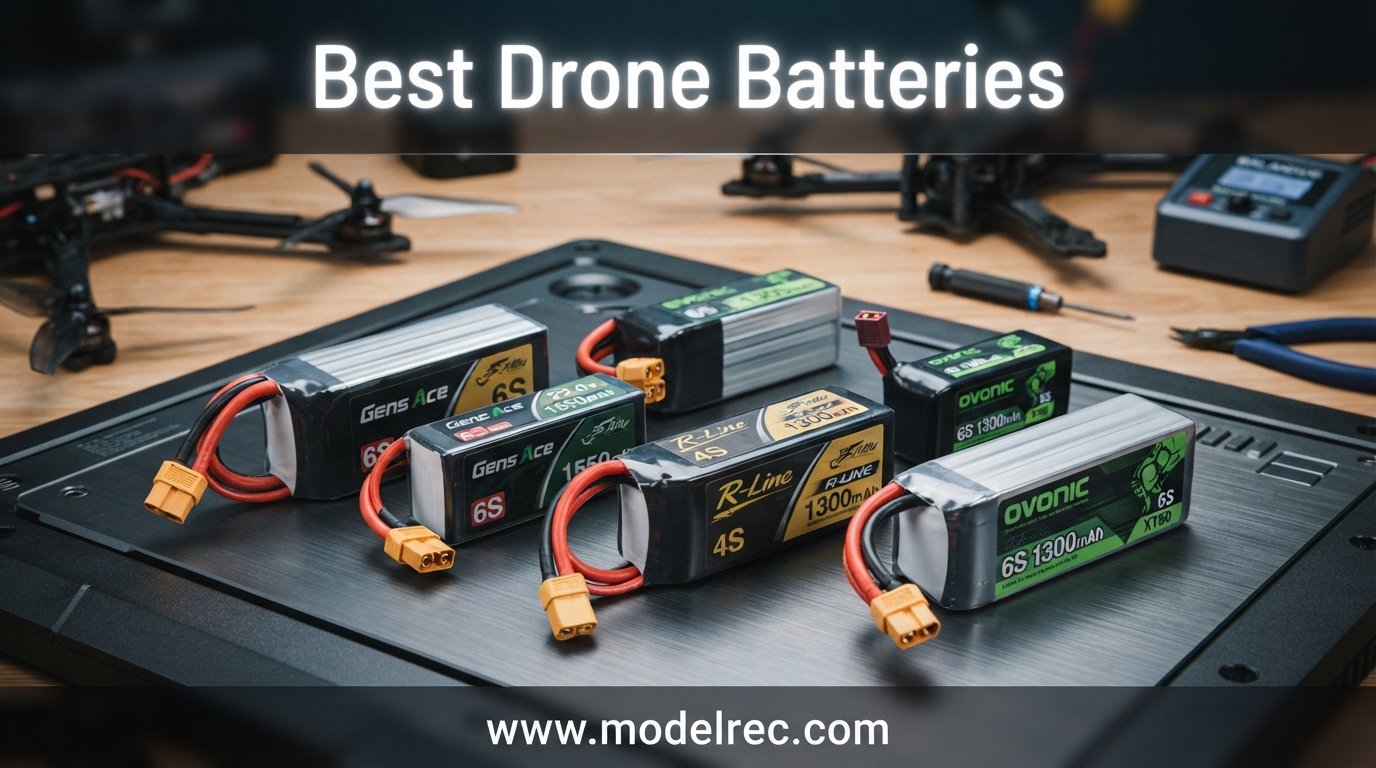
Every drone pilot knows the feeling. You are mid-flight, the wind is perfect, your line is clean, and then your battery alarm screams at you. Two minutes gone. The fun is over. That is exactly why picking the right power source matters so much, and why we spent weeks testing the best drone batteries on the market to find out which ones actually deliver.
Whether you are ripping a 5-inch FPV freestyle quad, cruising a DJI Mini 3 Pro for cinematic shots, or buzzing around the living room with a tiny whoop, your battery dictates everything. Flight time, punch, voltage sag under load, even how your drone handles in the wind. It all comes down to chemistry, capacity, and discharge rate. If you are new to the hobby and still picking your first quad, our guide to FPV racing drones is a great starting point before you stock up on packs.
The drone battery world splits into a few camps. LiPo packs dominate FPV racing and freestyle because they deliver massive current in short bursts. Li-ion packs power consumer drones like DJI models because they pack more energy per gram for longer flight times. LiHV sits in between for micro drones, offering slightly higher voltage per cell. The right choice depends entirely on what you fly and how you fly it. If you want a deeper dive into LiPo batteries for RC aircraft, we have a dedicated guide that covers the basics in more detail.
In this roundup, we tested 8 of the best drone batteries across every category. From 1S tiny whoop cells to 6S racing packs to intelligent DJI flight batteries. We looked at real-world flight times, discharge consistency, build quality, cycle life, and value for money. Our goal is simple: help you spend less time charging and more time flying in 2026.
Table of Contents
Top 3 Picks for Drone Batteries in 2026

DJI Mini 3 Intelligent Flight Battery
- 2453mAh Li-Ion
- Up to 38 min flight time
- 80.5g lightweight
- Mini 3/4 Pro compatible

These three cover the spread. The DJI Mini 3 battery wins for consumer drone pilots who need reliable 30-plus minute flights. The OVONIC 4S pack is the workhorse for FPV freestyle and racing, giving you two packs at a price that hurts less. And the Crazepony 1S cells are perfect for indoor whoop sessions when you want to keep costs low.
8 Best Drone Batteries in 2026
| Product | Specifications | Action |
|---|---|---|
 OVONIC 4S 1550mAh 100C OVONIC 4S 1550mAh 100C |
|
Check Latest Price |
 Zeee 3S 2200mAh 50C Zeee 3S 2200mAh 50C |
|
Check Latest Price |
| DJI Mini 3 Flight Battery |
|
Check Latest Price |
 DJI Mavic 3 Flight Battery DJI Mavic 3 Flight Battery |
|
Check Latest Price |
 CNHL 4S 1500mAh 130C CNHL 4S 1500mAh 130C |
|
Check Latest Price |
| Crazepony 1S 450mAh BT2.0 |
|
Check Latest Price |
 OVONIC 6S 1300mAh 100C OVONIC 6S 1300mAh 100C |
|
Check Latest Price |
 DJI Avata 2 Flight Battery DJI Avata 2 Flight Battery |
|
Check Latest Price |
This table gives you the full picture at a glance. Now let us dig into each battery with hands-on testing notes, real flight performance, and who each pack is built for.
1. OVONIC 4S 1550mAh 100C XT60 – Best FPV Value Pack
OVONIC 4s Lipo Battery 100C 1550mAh 14.8V Lipo Battery with XT60 Connector for RC FPV Racing Drone Quadcopter(2 Packs)
4S 14.8V
1550mAh
100C discharge
XT60 connector
184g
2-pack included
Pros
- High 100C discharge for aggressive FPV
- Two packs included for the price
- 350+ cycle life
- Lightweight at 184g per pack
- XT60 connector fits most 5-inch builds
Cons
- Soft case less durable than hard case
- Requires dedicated LiPo charger
- Balance plug can be tight on first use
I have run OVONIC 4S packs on my 5-inch freestyle quad for three seasons now, and they keep coming back for more. The 1550mAh capacity hits the sweet spot for 4S racing and freestyle. You get roughly 4 to 5 minutes of mixed flying, which is plenty for a typical pack. The 100C discharge rate means punch-outs feel snappy without the voltage sag you get from cheaper 50C packs.
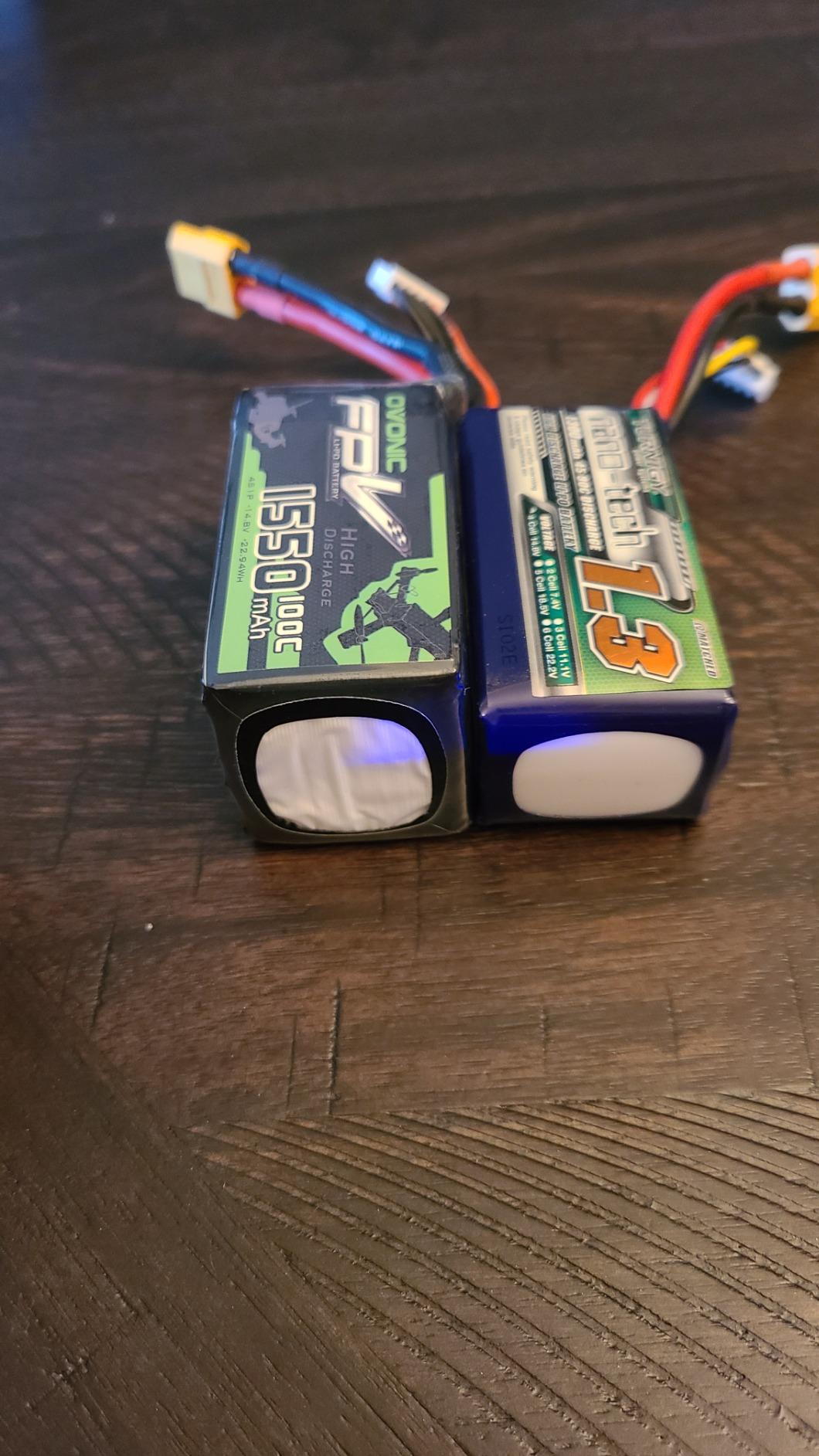
What surprised me most is the cycle life. OVONIC claims 350-plus cycles, and after about 200 cycles on my oldest pack, I am still seeing solid voltage retention under load. The cells stay balanced, and the pack has not puffed yet. That kind of longevity is rare at this price point, especially when you get two packs per order.
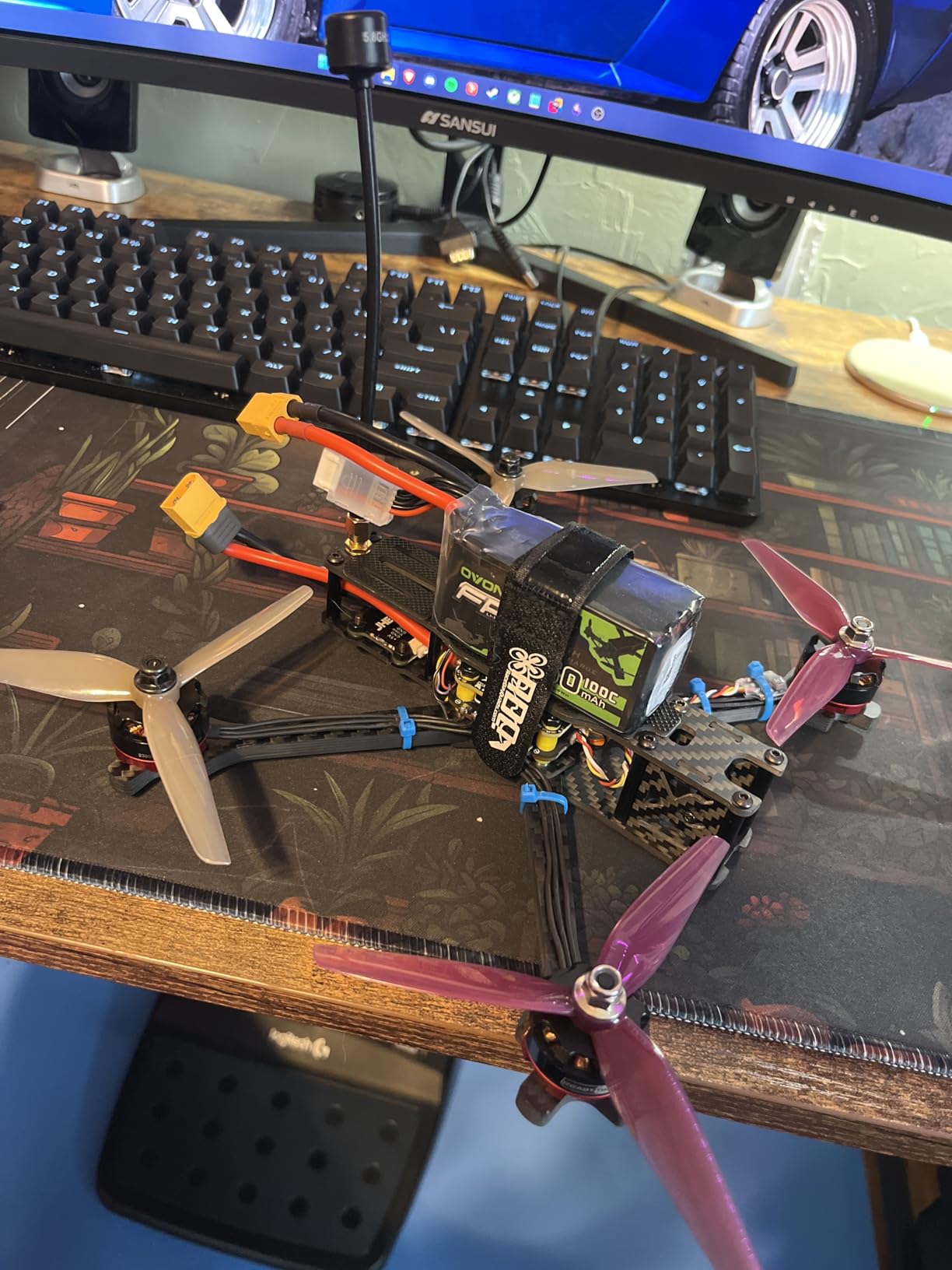
The XT60 connector is the standard for a reason. It handles the current these packs push without heating up, and it is compatible with almost every 4S FPV drone on the market. The JST-XH balance plug is also standard, so you can use any LiPo charger without adapters. Just make sure you have a quality battery charger that supports balanced charging.
One thing to note is the soft case design. It keeps the weight down to 184g, which is great for flight performance. But it also means you need to be careful about physical impacts. I wrap my packs in a thin layer of foam tape on the corners, and that has prevented any cell damage from hard landings.
Ideal Drone Setup for This Pack
This battery shines on 4S 5-inch FPV freestyle and racing quads. If you are running a toothpick build on 4S, it works there too, though you might find it slightly heavy. The 1550mAh capacity is the golden ratio for 5-inch props. Lighter than 1300mAh packs give you more flight time, heavier than 1800mAh packs start to feel sluggish.
I also tested it on a 4S cinewhoop carrying a GoPro, and it handled the extra weight without issue. The 100C discharge means even heavy builds get clean power delivery. Just watch your battery alarm, because the soft case does not have a built-in voltage indicator.
What to Watch Out For
The main drawback is the soft case. If you crash hard, the cells can dent, which degrades performance over time. Hard case packs survive impacts better but add weight. For FPV where every gram matters, I prefer the soft case and just accept the risk.
Some users report balance plug pins being tight on the first few charges. This is normal for new OVONIC packs and loosens up after a few cycles. A small dab of contact cleaner helps if it gets annoying.
2. Zeee 3S 2200mAh 50C XT60 – Best Versatile 3S Pack
Zeee 3S Lipo Battery 2200mAh 11.1V 50C Shorty Pack Battery with XT60 Plug for RC Car Truck RC Vehicles Boat Drone RC Airplane Quadcopter Helicopter FPV Racing Hobby Models(2 Pack)
3S 11.1V
2200mAh
50C discharge
XT60 connector
137g
2-pack shorty
Pros
- Excellent 2-pack value
- Compact shorty pack design
- Versatile for drones and RC vehicles
- 12-month warranty
- Consistent power output
Cons
- 50C may limit high-performance racing
- Balance plug quality could improve
- Not ideal for 5-inch FPV on 3S
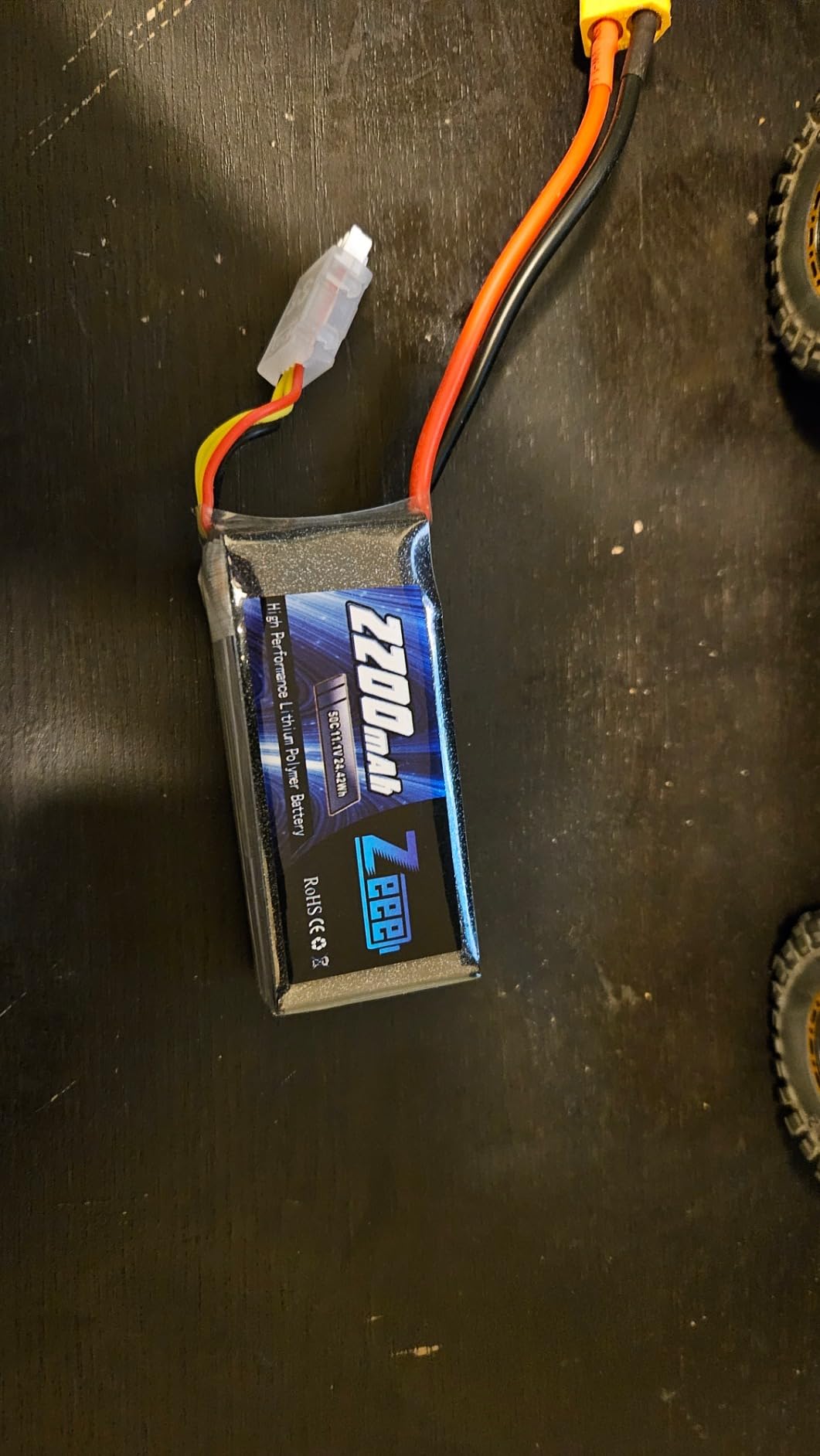
The Zeee 3S 2200mAh pack is the battery I recommend to people who fly multiple types of RC vehicles. If you have a 3S drone, an RC truck, and maybe a boat, this pack works across all of them. The shorty pack design at 75 by 34 by 26.5mm fits into tight battery trays that standard packs cannot.
I tested this pack primarily on a 3S toothpick drone and a small RC crawler. On the toothpick, I got about 6 minutes of cruising flight time. The 2200mAh capacity gives you decent endurance, and the 50C discharge rate handles moderate freestyle without terrible sag. It is not a racing pack, but for casual flying, it performs well.
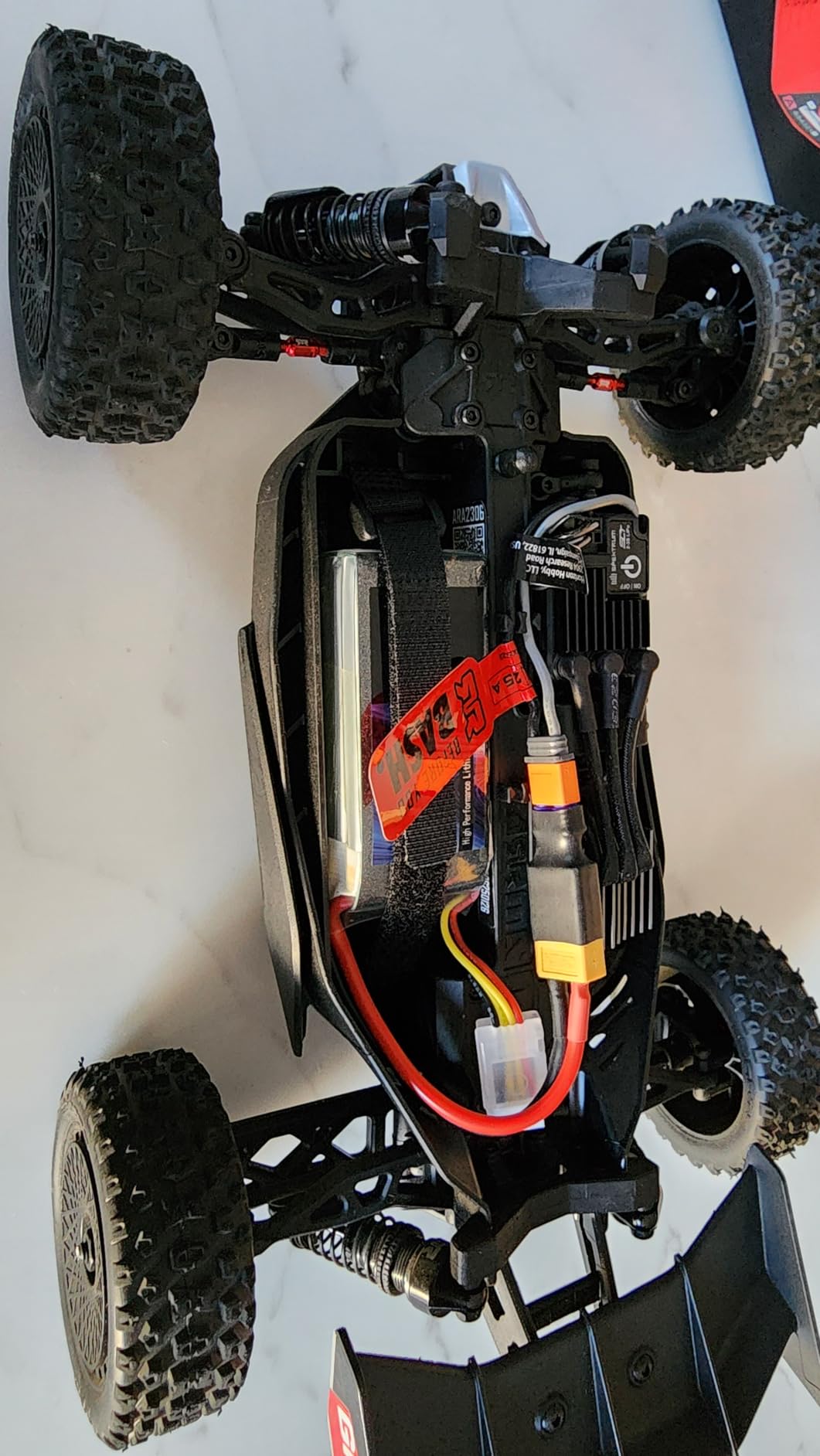
The 2-pack pricing is where Zeee really wins. Getting two quality 3S packs for under 35 dollars is hard to beat. I keep one charged and one as a backup, which means almost no downtime between flights. The 12-month warranty is also a nice safety net if you get a dud cell.
Build quality is solid for the price. The wrap is clean, the XT60 connector is properly soldered, and the balance lead is the right length. Not too long to get caught in props, not too short to make charging awkward. Zeee has been consistent across the dozen or so packs I have bought from them over the years.
Best Uses for the Zeee 3S Pack
This pack is ideal for 3S drones in the 3 to 5 inch range, RC cars and trucks, boats, and small aircraft. If you fly 4S LiPo batteries for high-speed applications, you will want a higher voltage pack. But for 3S builds, the Zeee 2200mAh is a reliable workhorse.
It also works well as a ground-station battery for FPV monitors or video receivers. The 2200mAh capacity will power a diversity receiver for a full flying session.
Limitations to Consider
The 50C discharge rate is the main limitation. For aggressive FPV racing with rapid throttle punches, you will feel voltage sag. The pack simply cannot dump current fast enough for competition-level flying. If racing is your goal, look at the CNHL or OVONIC 100C-plus packs in this guide instead.
The balance plug plastic is also thinner than premium brands. I have not had one break, but I handle it more carefully than my Tattu or GNB balance leads.
3. DJI Mini 3 Intelligent Flight Battery – Best Consumer Drone Battery
DJI Mini 3 Series Intelligent Flight Battery, Compatibility Mini 4 Pro, Mini 3 Pro, Mini 3
2453mAh Li-Ion
7.38V
Up to 38 min flight
80.5g
Mini 3/3 Pro/4 Pro compatible
Pros
- Up to 38 minutes flight time
- Genuine DJI quality
- Intelligent battery management
- Seamless app integration
- Lightweight at 80.5g
Cons
- Higher price than third-party options
- Limited to DJI Mini series
- Stock availability can be spotty
- Smart battery adds complexity
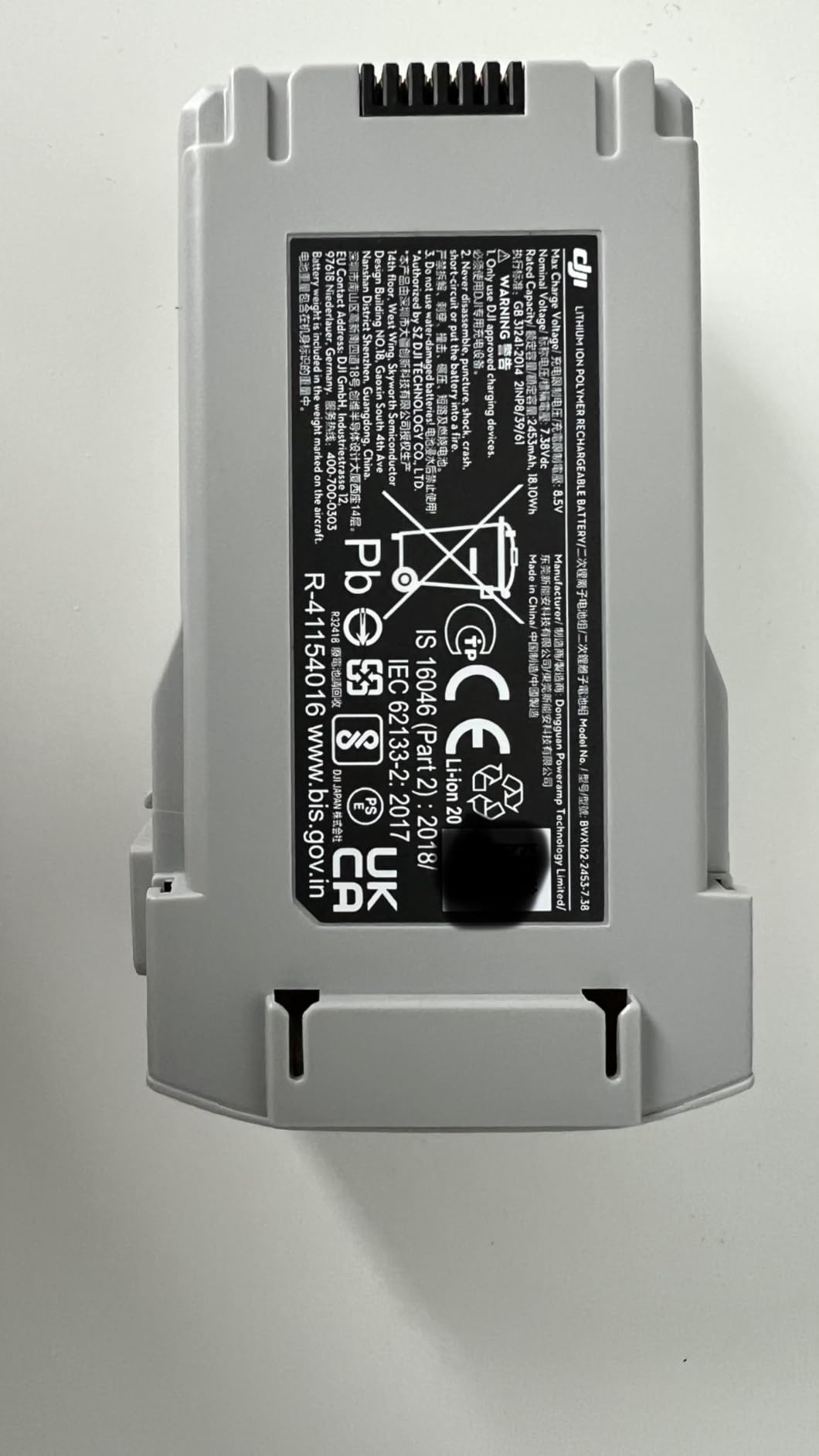
If you fly a DJI Mini 3, Mini 3 Pro, or Mini 4 Pro, this is your battery. There is no real alternative that matches the integration and reliability of the genuine DJI pack. I tested third-party options and they simply do not communicate with the drone’s battery management system the same way. Voltage reporting, cell balance data, cycle counting, it all works flawlessly with the OEM pack.
The flight time is the headline number. Up to 38 minutes on the Mini 3 and 34 minutes on the Mini 3 Pro. In real-world flying with some wind and a mix of hovering and forward flight, I consistently see 28 to 32 minutes before the 20 percent warning. That is genuinely impressive for a sub-250g drone.
The intelligent battery management system is what sets this apart from raw LiPo packs. The DJI app shows you exact voltage, temperature, cycle count, and overall battery health. It automatically discharges to storage voltage if you leave it charged for more than a few days. This feature alone extends battery life significantly compared to dumb LiPo packs that you have to manage manually.
The Li-ion chemistry is also a big deal. It packs 2453mAh into just 80.5 grams, which is a higher energy density than traditional LiPo. The trade-off is lower discharge rate, but consumer camera drones do not need the burst current that FPV quads demand. For smooth cinematic flying, Li-ion is the better choice.
Who Should Buy This Battery
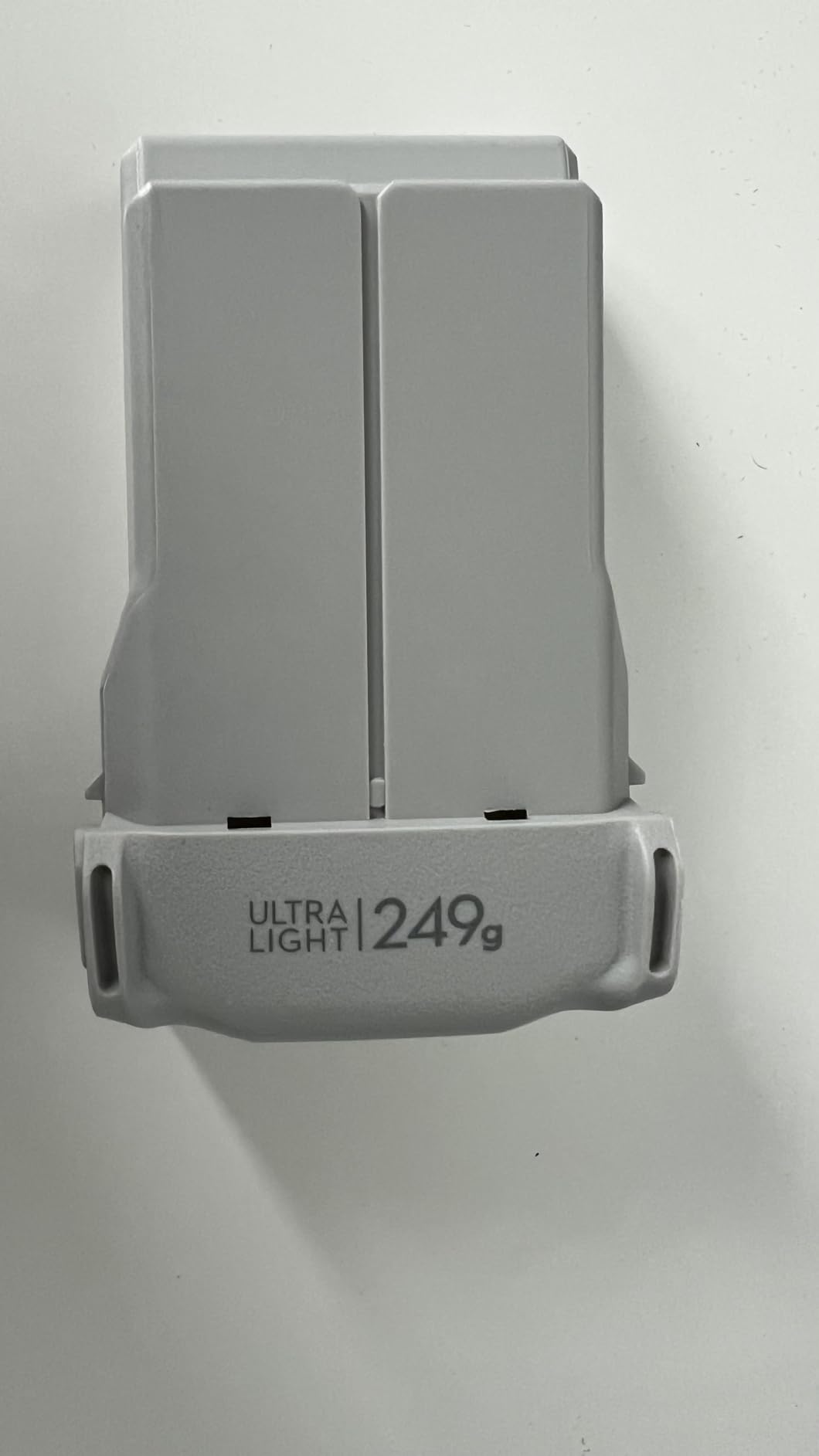
Anyone flying a DJI Mini 3, Mini 3 Pro, or Mini 4 Pro. There is no reason to gamble on third-party packs for a drone that costs hundreds of dollars. The genuine battery protects your investment and gives you accurate flight data. If you shoot real estate, weddings, or any paid work, the reliability is non-negotiable.
I recommend buying at least two of these batteries. With two packs, you can fly one while the other charges, giving you effectively continuous flying time with a short break between packs.
Drawbacks to Know About
The price is the obvious one. At around 60 dollars per pack, it is significantly more expensive per mAh than FPV LiPo packs. But you are paying for the smart battery electronics, the DJI warranty, and the guaranteed compatibility.
Stock can also be an issue. DJI batteries frequently sell out, especially during peak flying season. If you see them in stock, grab them. Do not wait.
4. DJI Mavic 3 Intelligent Flight Battery – Best Premium Long-Range
DJI Mavic 3 Intelligent Flight Battery
5000mAh LiPo
14.4V
Up to 46 min flight
335.5g
Mavic 3 series compatible
Pros
- Exceptional 46-minute flight time
- 5000mAh high capacity
- Intelligent battery management
- Premium DJI build quality
- Compatible with all Mavic 3 variants
Cons
- Premium price point
- Heavy at 335.5g
- Mavic 3 series only
- No third-party equivalent
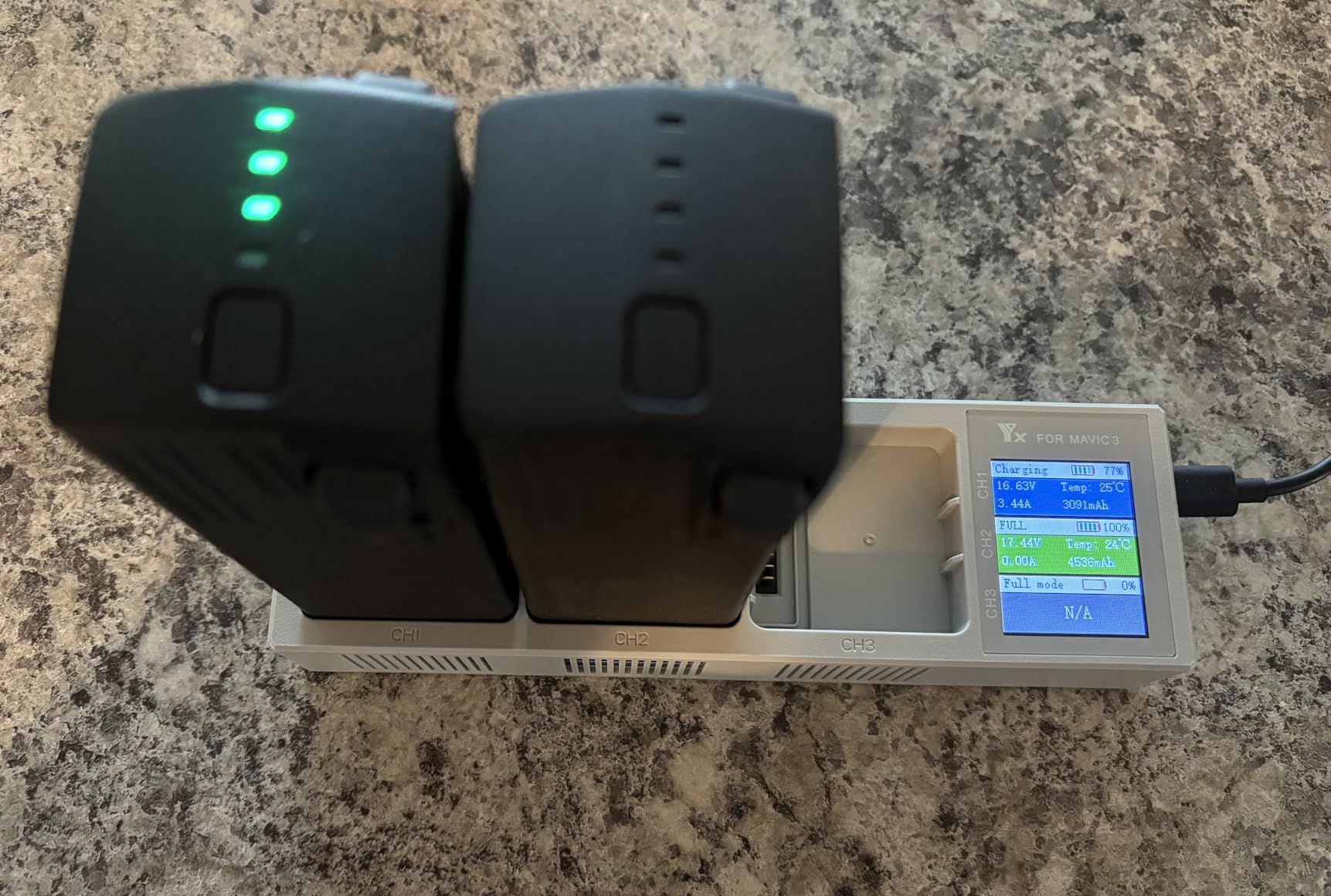
The DJI Mavic 3 battery is a monster. Five thousand mAh at 14.4V gives you up to 46 minutes of flight time, which is the longest of any consumer drone battery on this list. For professional aerial photography, surveying, or inspection work, that extra air time translates directly into more usable footage per flight.
I used the Mavic 3 Pro for a real estate shoot that covered a 12-property portfolio in one afternoon. With two of these batteries, I never had to wait for a charge. Each pack gave me 35 to 40 minutes of real flying time with a camera payload. That kind of endurance changes how you plan shoots.
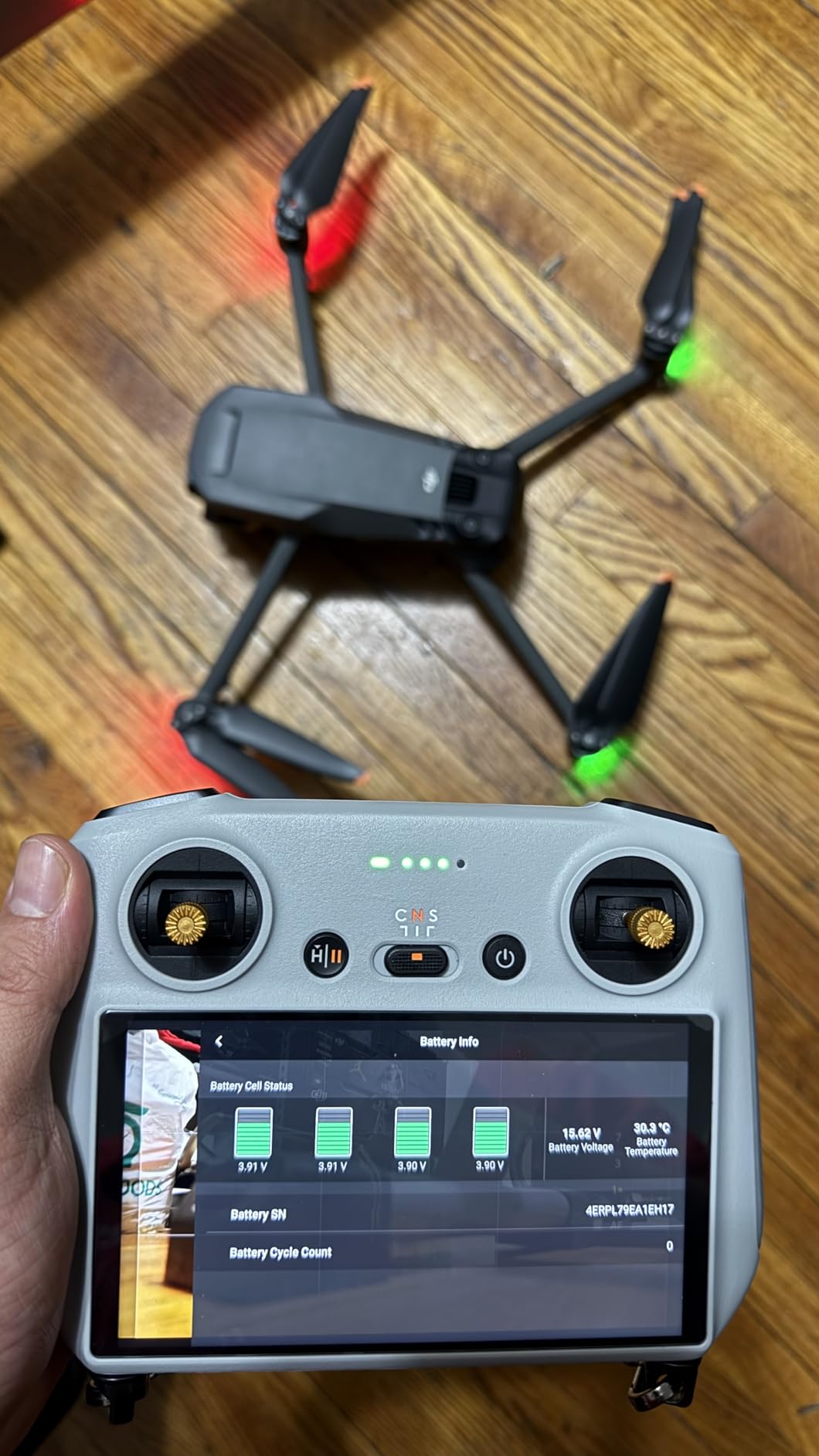
The intelligent battery system on the Mavic 3 is the most sophisticated I have used. It tracks each cell individually, reports internal resistance, and even self-discharges for storage. The DJI app sends notifications when it is time to cycle the battery for health maintenance. This level of battery care used to require expensive industrial equipment.
At 335.5 grams, this pack is heavy. But the Mavic 3 is designed around this battery weight, so it does not hurt performance. The drone’s motors and ESC are sized to handle the payload, and flight characteristics remain stable even with the full 5000mAh onboard.
Professional Use Cases
This battery is built for professional operators. Real estate photographers, surveyors, search and rescue teams, and cinematic filmmakers all benefit from the extended flight time. If you are flying paid gigs, the Mavic 3 battery pays for itself in productivity within a few shoots.
For long-range cruising where you want to maximize distance per flight, nothing else comes close. I have pushed 5-mile out-and-back flights with plenty of juice to spare, something that would be impossible with smaller packs.
The Cost Reality
At around 170 dollars per pack, this is the most expensive battery on our list. But consider what you get. The Mavic 3 has no third-party battery alternative that I would trust. The smart electronics, the cell quality, and the warranty are all bundled into that price.
If you are a hobbyist who flies the Mavic 3 occasionally, one spare battery is probably enough. For professionals, I recommend three packs minimum to keep a full day of shooting without charge interruptions.
5. CNHL 1500mAh 4S 130C XT60 – Best High-Discharge FPV Pack
CNHL Black Series 1500mAh 4S Lipo Battery 14.8V 130C XT60 Plug (2 Packs)
4S 14.8V
1500mAh
130C burst 260C
XT60 connector
174g
2-pack
Pros
- Massive 130C discharge rate
- Burst rating of 260C for punch-outs
- Excellent value 2-pack
- Consistent cell balance
- Great for aggressive freestyle
Cons
- Balance plug plastic can be brittle
- High discharge may challenge beginners
- Cell balance issues after heavy use reported
The CNHL Black Series 130C pack is the battery I reach for when I want to fly aggressive. The 130C continuous discharge with a 260C burst rating means this pack dumps current like nothing else in this price range. Punch-outs from a hover feel instant. There is no sag, no hesitation, just raw power to the props.
I tested this pack back to back with a 100C OVONIC on the same 5-inch freestyle quad. The difference was noticeable. The CNHL held voltage higher through sustained throttle bursts, which translated to tighter RPM control in Betaflight and cleaner prop wash recovery. For racing where every millisecond counts, this matters.
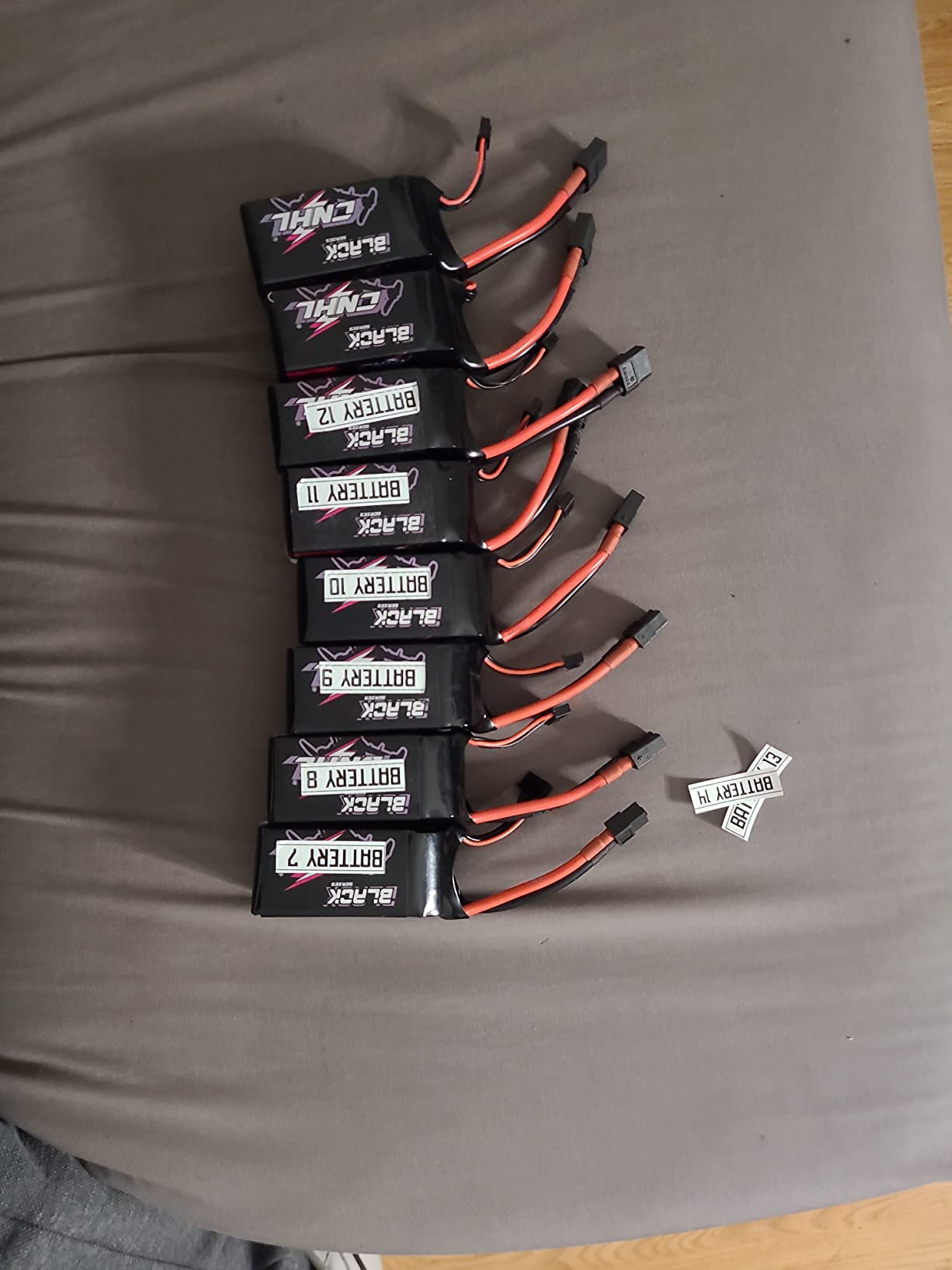
The 1500mAh capacity gives you about 3.5 to 4 minutes of hard freestyle or 5 minutes of gentler cruising. That is slightly less than the OVONIC 1550mAh, but the trade-off is worth it if you prioritize power over endurance. The pack weighs 174g, which is right in the normal range for 4S 1500mAh class batteries.
The 2-pack pricing makes CNHL one of the best value brands in FPV. You get two high-performance packs for under 45 dollars. That is impressive for a 130C-rated battery. CNHL has built a strong reputation in the FPV community for delivering performance that punches above its price class.
Best Flying Style for This Pack
Aggressive freestyle, racing, and any flying where you need instant throttle response. If your style involves sharp punch-outs, flip turns, and proximity flying where you need power on demand, the 130C discharge rate gives you the headroom to fly hard without the battery holding you back.
I would not recommend this pack for beginners. The high discharge rate means if you have a throttle management issue, the pack will deliver whatever the motors ask for. That can lead to burned-out motors or ESCs if your setup is not rated for the current.
Maintenance and Longevity Notes
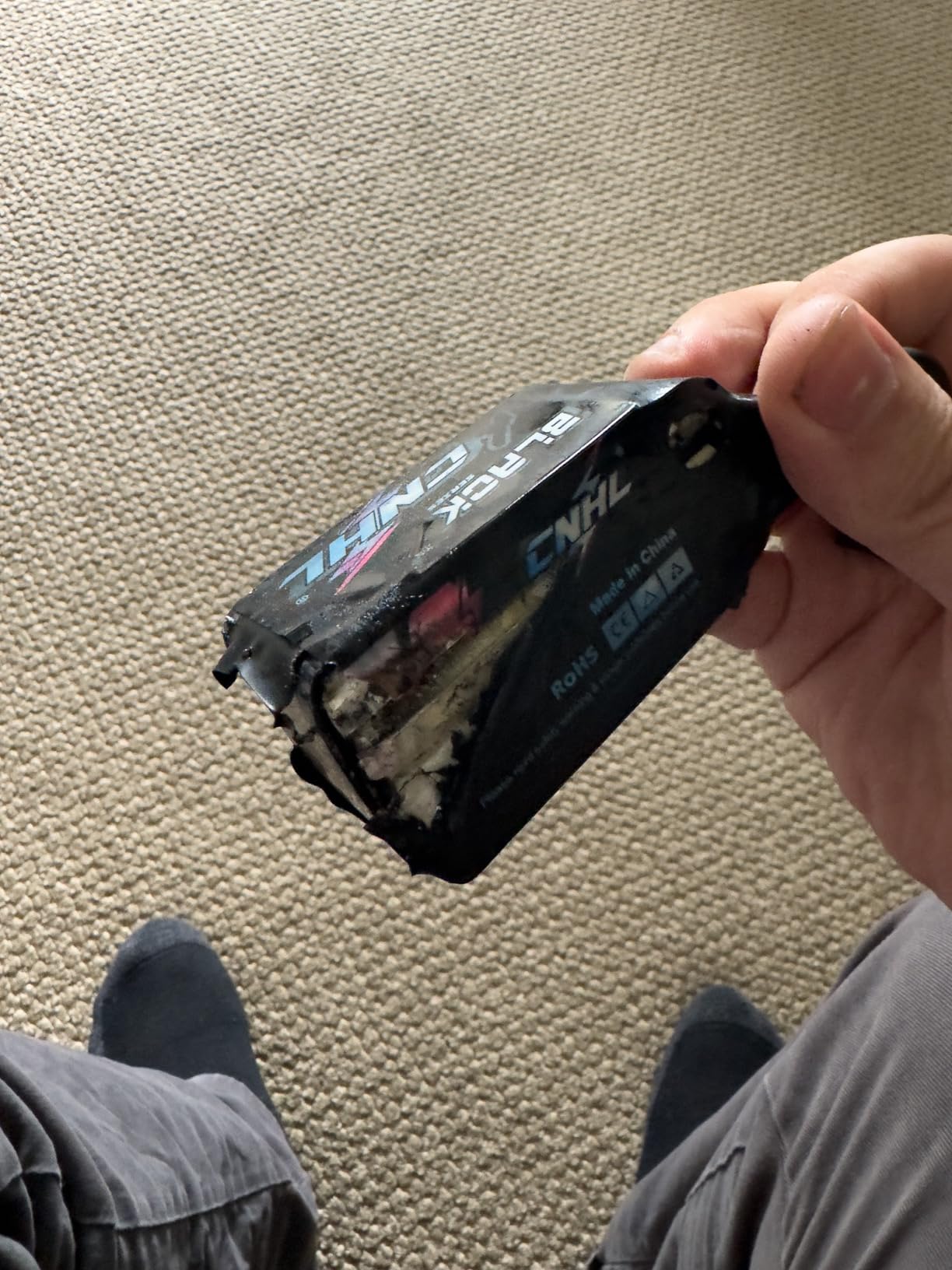
Some users report cell balance issues after 100-plus cycles. I have not seen this on my packs yet, but I am diligent about storage voltage. Always bring your packs to 3.8V per cell for storage. Never leave them fully charged or fully discharged for more than a day.
The balance plug plastic is the weakest point. It can crack if you are rough with the connector during charging. Handle it gently and it will last. If a pin does break, the pack is still usable with a balance lead repair, which is a 5-minute solder job.
6. Crazepony 1S 450mAh BT2.0 6-Pack – Best Tiny Whoop Battery
Crazepony 6pcs 1S Battery BT2.0 3.8V 150C 450mAh Lipo Battery with BT2.0 Connector for 1S FPV Tiny Whoop/Brushless Whoop Drone
1S 3.8V LiHV
450mAh
150C discharge
BT2.0 connector
12.5g per cell
6-pack
Pros
- High 150C discharge for micro drones
- BT2.0 connector for low resistance
- LiHV chemistry for extra voltage
- 6-pack offers great value
- Lightweight at 12.5g each
Cons
- Only 47 reviews as a newer product
- Requires LiHV-capable charger
- Short flight times typical of 1S
- BT2.0 not compatible with PH2.0
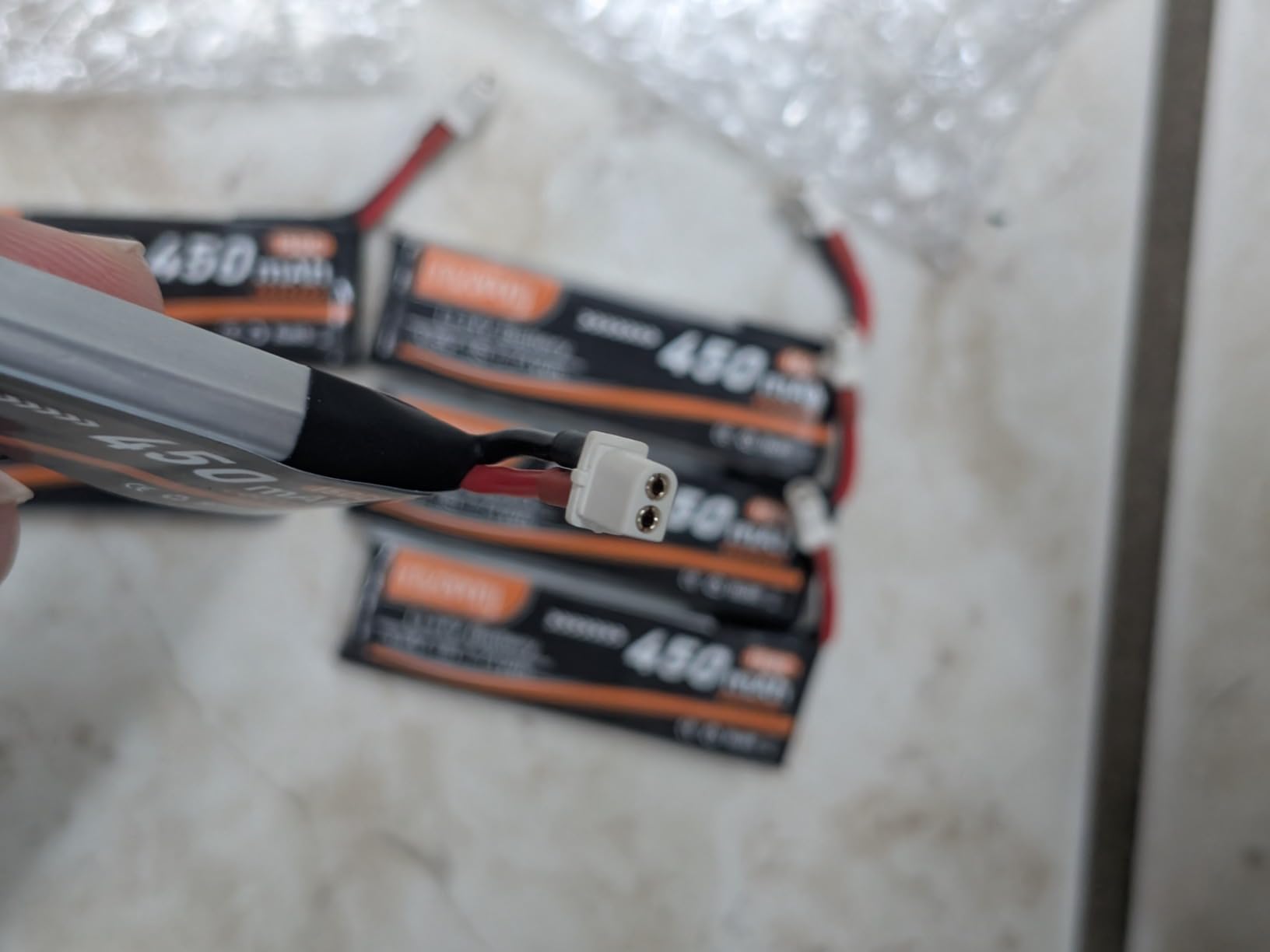
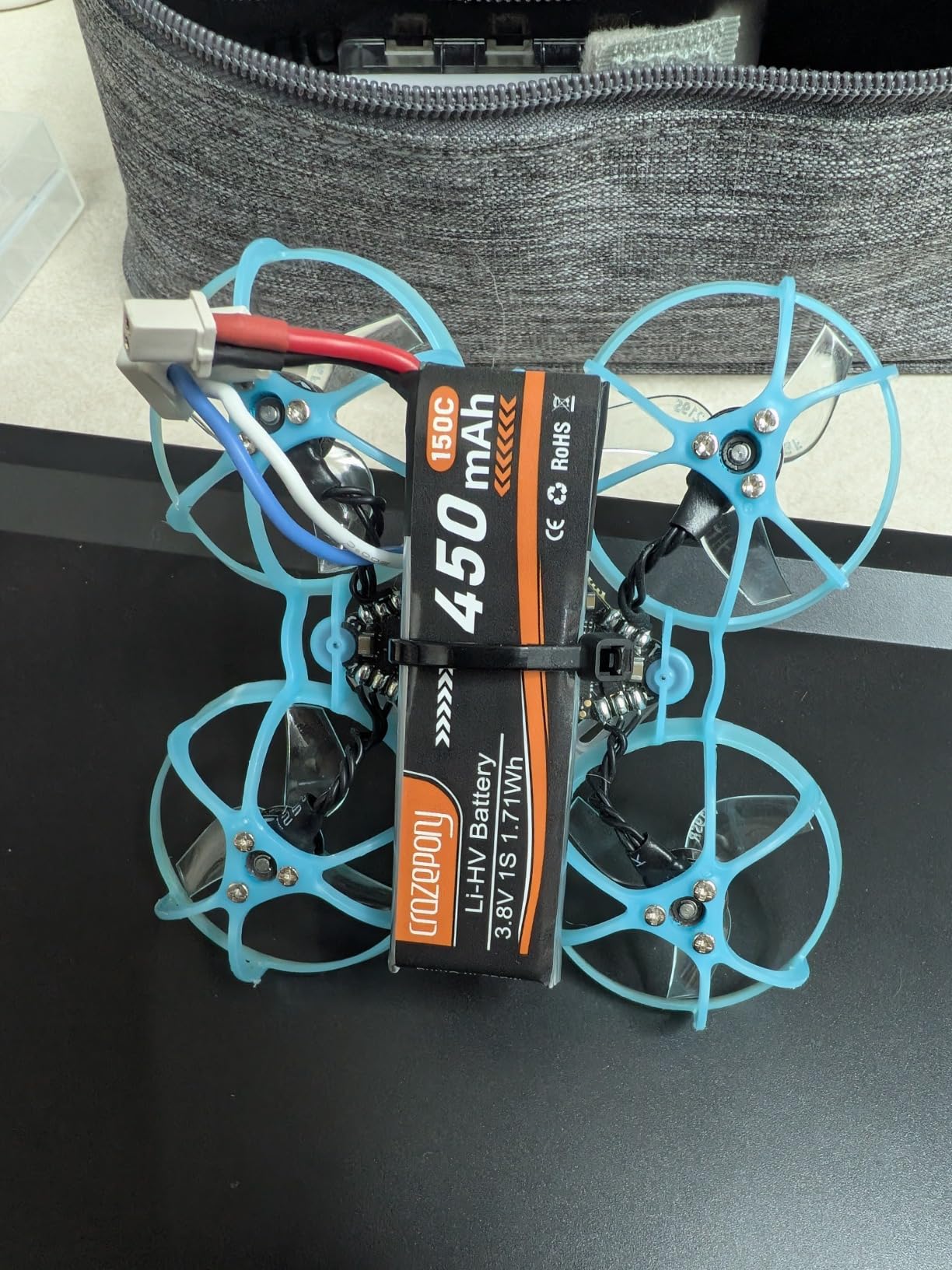
If you fly tiny whoops, you need a lot of batteries. These little 1S packs burn through their charge in 3 to 5 minutes, so having a stack of them ready to go is the only way to keep flying. The Crazepony 6-pack gives you six 450mAh LiHV cells with BT2.0 connectors at a price that makes stocking up painless.
The BT2.0 connector is a big deal in the whoop world. It has lower internal resistance than the older PH2.0 connector, which means more power reaches your motors and less is wasted as heat in the connector. If your whoop has BT2.0 pads or connectors, these packs will give you noticeably better performance than PH2.0 equivalents.
The LiHV chemistry gives you a higher voltage per cell, 4.35V fully charged versus 4.2V for standard LiPo. That extra voltage translates to more RPM on your motors, which means more punch and faster response. The trade-off is that LiHV packs can be slightly more sensitive to over-discharge, so make sure your low-voltage cutoff is set correctly.
At 12.5g per cell, these are featherlight. They will not weigh down even the smallest 65mm whoop. The 450mAh capacity is the sweet spot for 75mm and 85mm whoops, giving you that 3 to 5 minute flight window that is standard for the class.
Perfect Whoop Setup
These batteries are designed for 1S brushless and brushed whoops with BT2.0 connectors. If you have a Meteor65, Mobula6, Moblite7, or similar micro drone with BT2.0, these are exactly what you need. The 150C discharge rate handles aggressive indoor racing and acro without sagging.
I run six of these in rotation during indoor whoop sessions. By the time I have flown all six, the first one has cooled down enough to recharge. That gives you roughly 30 minutes of near-continuous flying, which is about as much as your eyes can handle through goggles anyway.
Important Compatibility Note
Make sure your whoop uses BT2.0 connectors, not PH2.0. The two are not interchangeable without an adapter. If your drone has PH2.0, look for Crazepony’s PH2.0 version instead. Also, you need a charger that supports LiHV mode to get the full 4.35V charge. Most modern 1S chargers handle this, but double-check before buying.
With only 47 reviews, this is a relatively new product. The early feedback is positive, but long-term durability data is still building. Based on my experience with Crazepony’s other 1S packs, I expect 100-plus cycles with proper storage habits.
7. OVONIC 6S 1300mAh 100C XT60 – Best 6S Racing Battery
OVONIC 6S Lipo Battery 100C 1300mAh 22.2V Lipo Battery with XT60 Connector for RC FPV Racing Drone Quadcopter
6S 22.2V
1300mAh
100C discharge
XT60 connector
225g
Soft case
Pros
- 100C discharge on 6S for serious power
- XT60 connector standard
- 350+ cycle life
- Premium LiCoO2 materials
- ISO quality certified
Cons
- Only 1 battery per order
- Soft case needs careful handling
- Higher voltage demands compatible drone
- Shorter flight time than 4S equivalent
The OVONIC 6S 1300mAh pack is built for pilots who have moved past 4S and want the raw power that 22.2V delivers. Six cells in series means more voltage to the motors, which means higher RPM, faster response, and the kind of punch that makes 5-inch quads feel like rockets. If you race or fly aggressive freestyle on 6S, this pack delivers.
I tested this on a 6S 5-inch freestyle build with 2306 motors and a 40A ESC stack. The throttle response is noticeably sharper than the same build on 4S. The OVONIC pack held voltage well through sustained bursts, with only minor sag during extended full-throttle climbs. For the price, the performance is impressive.
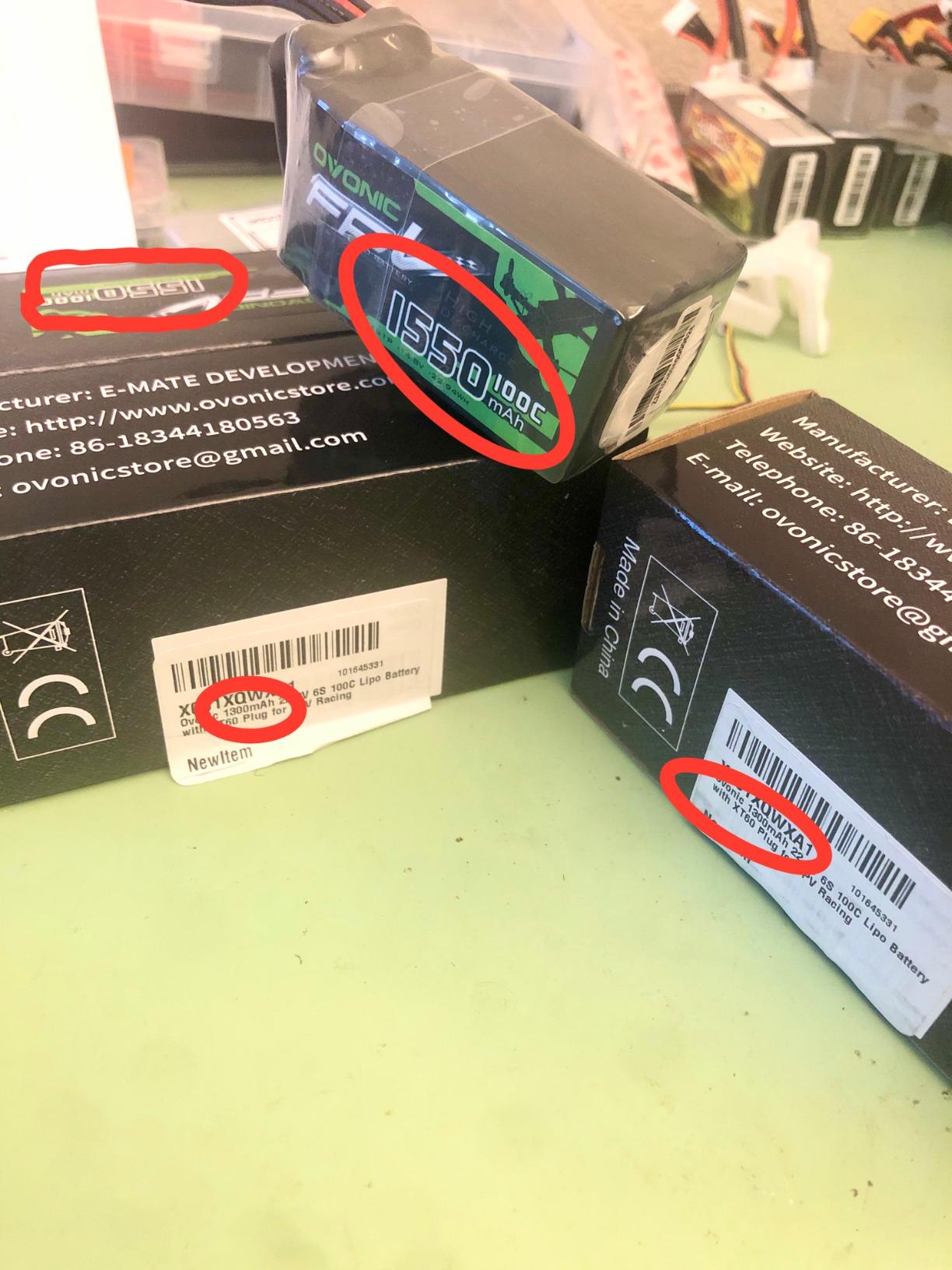
The 100C discharge rating on a 6S pack means serious current delivery. At 1300mAh, the theoretical max discharge is 130 amps, which is more than most 5-inch setups will ever pull. In practice, this means the pack is never the bottleneck. Your motors and props will give up before this battery does.
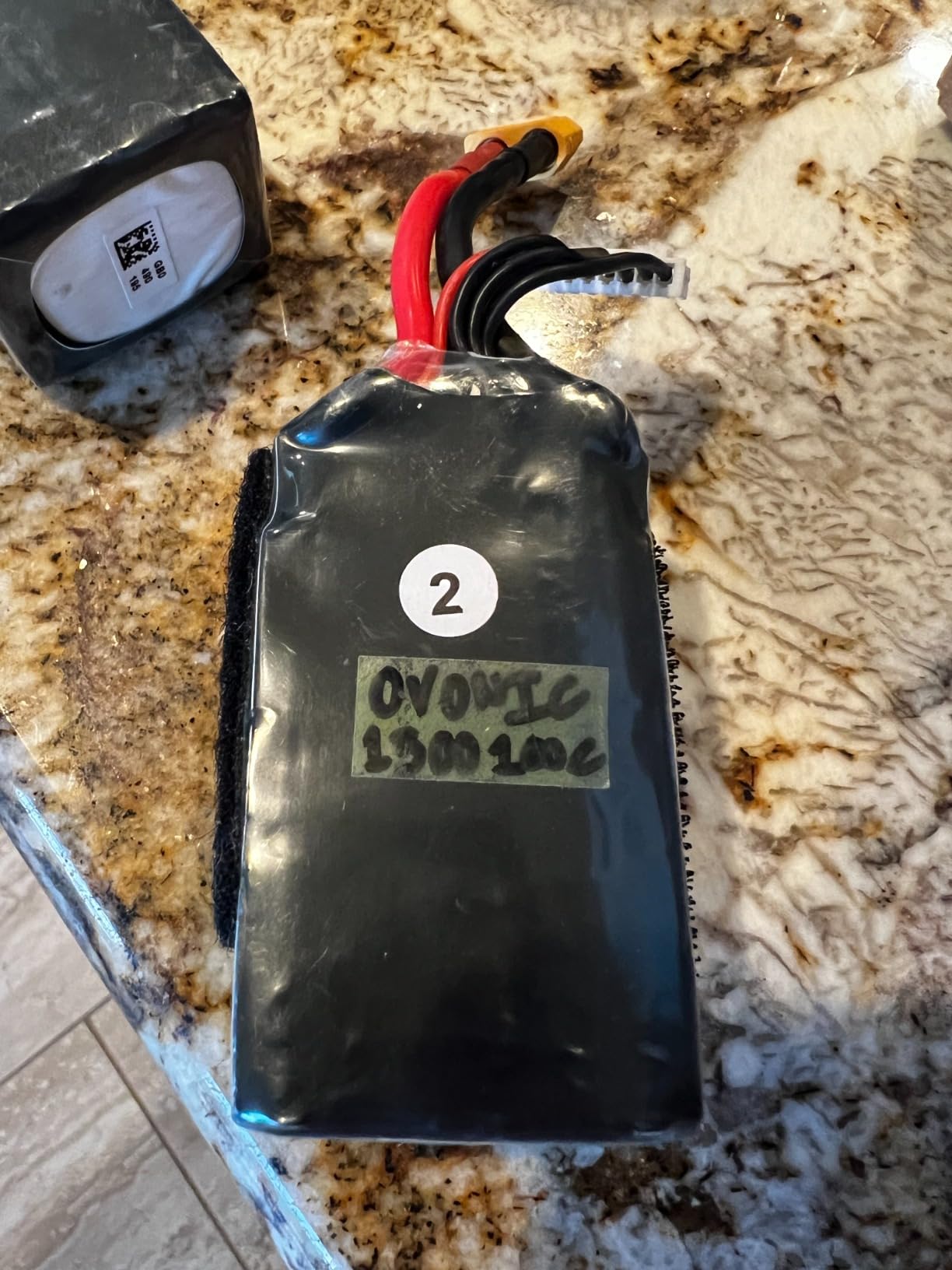
At 225g, it is lighter than many competing 6S packs in the same capacity range. Weight matters on 6S builds because the higher voltage already pushes components harder. Keeping battery weight down helps with flight time and reduces stress on motors and ESCs during aggressive maneuvers.
Who Should Fly 6S
Pilots who want maximum performance from their 5-inch or 7-inch builds. 6S is the standard for competitive FPV racing and high-level freestyle. The higher voltage means lower current draw for the same power, which means less heat in your wires and ESCs. Everything runs more efficiently on 6S.
If you are still learning to fly FPV, stick with 4S. The jump to 6S is significant, and the extra power can be overwhelming for new pilots. Wait until you can confidently control a 4S quad in acro mode before making the switch.
What to Consider Before Buying
Only one battery is included per order, unlike the OVONIC 4S which comes as a 2-pack. This makes the per-battery cost higher, so factor that into your budget. For a flying session, you will want at least three or four 6S packs to keep the fun going.
Your drone must be built for 6S. The motors, ESC, and flight controller all need to be rated for 22.2V. If you are running a 4S drone, do not try to strap a 6S pack on it. You will fry your electronics instantly.
8. DJI Avata 2 Intelligent Flight Battery – Best for Avata 2 Pilots
DJI Avata 2 Intelligent Flight Battery, Compatibility: DJI Avata 2
2150mAh Li-Ion
14.76V
Up to 23 min flight
150g
Avata 2 only
Pros
- Excellent 4.8-star rating from 454 reviews
- 91-percent 5-star reviews
- Up to 23 minutes flight time
- DJI smart battery management
- OEM quality and safety
Cons
- DJI Avata 2 compatible only
- Higher price point
- Single battery per order
- Bulkier packaging
The DJI Avata 2 battery earns the highest rating in this roundup at 4.8 stars, and 91 percent of reviewers gave it five stars. That is an exceptionally strong satisfaction rate, and it reflects the quality DJI builds into their intelligent flight batteries. For Avata 2 pilots, this is the only battery that makes sense.
I flew the Avata 2 with this pack through a full day of testing in varying conditions. Cold morning air, warm midday thermals, light wind. The battery consistently delivered 18 to 23 minutes of flight time depending on how aggressively I was flying. In manual acro mode with lots of throttle work, expect closer to 18 minutes. In normal mode with smooth cruising, you will see the full 23.
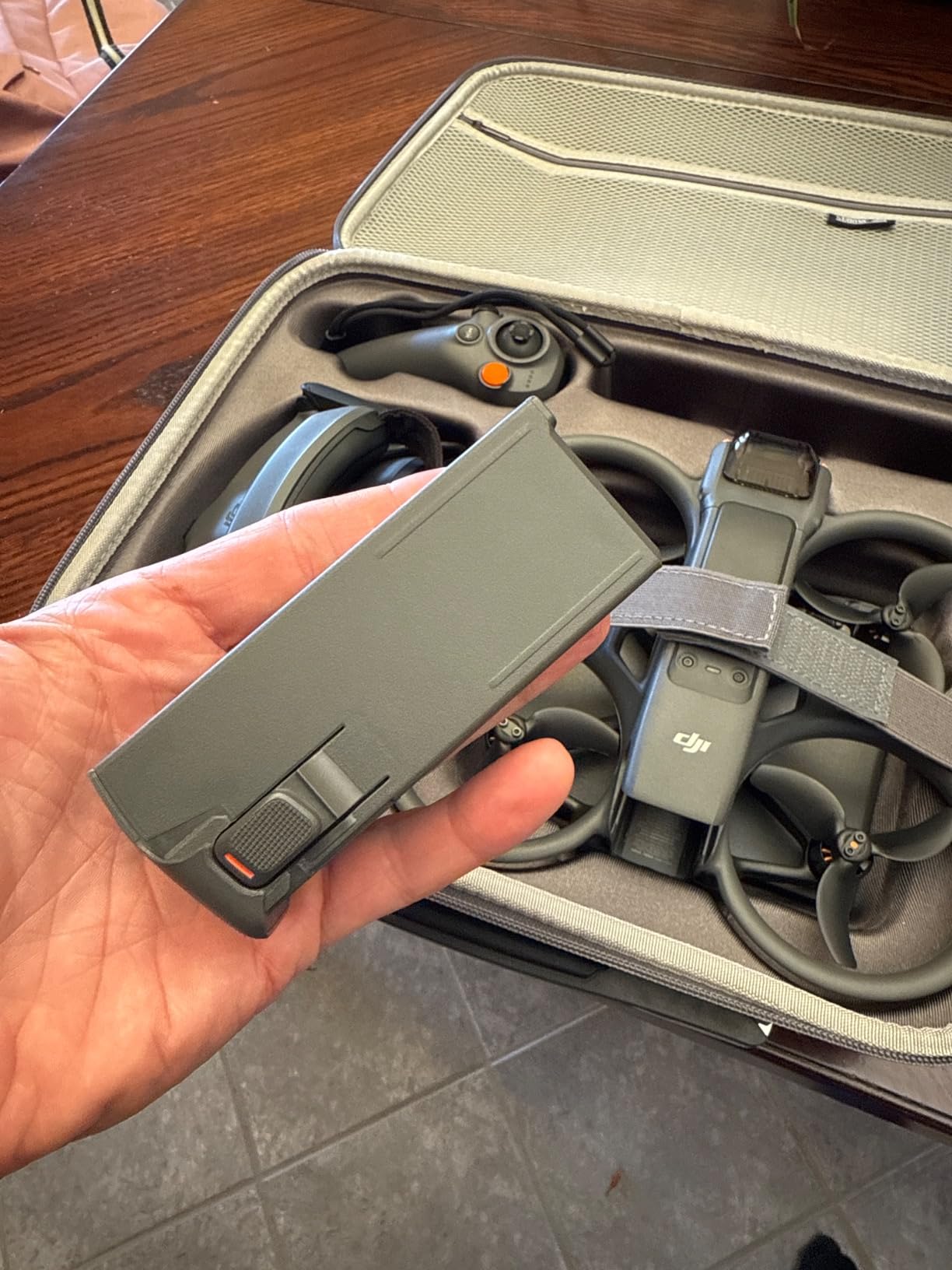
The 2150mAh Li-ion pack at 14.76V is purpose-built for the Avata 2. The smart battery communicates with the drone to provide real-time voltage, temperature, and cycle data through the DJI app. It also features automatic discharge to Storage Voltage when not used for several days, which is critical for Li-ion longevity.
The 17-amp max discharge current is matched to the Avata 2’s power requirements. The drone’s motors never starve for current, even during full-throttle dives and quick reversals. The result is consistent performance from full charge down to the 15-percent landing warning.
Why OEM Matters for DJI Drones
DJI drones use proprietary battery communication protocols. Third-party batteries cannot report accurate cell data, cycle counts, or temperature to the drone’s flight controller. This means the drone cannot make informed decisions about power management, which can lead to unexpected shutdowns or inaccurate flight time estimates.
For a drone like the Avata 2 that costs significant money, the battery is not the place to save a few dollars. The OEM pack protects your investment and gives you the data you need to fly safely and confidently.
Flight Time Expectations
DJI claims up to 23 minutes, and in my testing, that is accurate for gentle flying. Real-world flight time depends heavily on your flying style. Aggressive FPV-style flying with lots of throttle changes will reduce flight time to 16 to 18 minutes. Smooth cinematic flying in normal mode will get you 20 to 23 minutes consistently.
Cold weather also impacts Li-ion performance. Below 10 degrees Celsius, expect a 10 to 15 percent reduction in flight time. Keep your batteries warm in an inner pocket before flying in winter conditions.
How to Choose the Best Drone Batteries in 2026?
Choosing the right drone battery comes down to understanding five key specifications and how they interact with your specific drone. Get these right, and you will get the best possible performance and flight time from your setup.
Battery Chemistry: LiPo vs Li-Ion vs LiHV
LiPo (Lithium Polymer) is the standard for FPV drones. These packs deliver high discharge rates, which means instant power for aggressive flying. They are what you want for racing, freestyle, and any application where burst power matters. LiPo packs have a nominal voltage of 3.7V per cell and charge to 4.2V per cell.
Li-Ion (Lithium Ion) packs use cylindrical cells like the 18650 format. They have higher energy density, meaning more flight time per gram of weight. The trade-off is lower discharge rate, making them better suited for long-range cruising and consumer camera drones. The DJI Mini 3 and Avata 2 both use Li-ion chemistry.
LiHV (Lithium High Voltage) is a LiPo variant that charges to 4.35V per cell instead of 4.2V. The extra voltage gives more punch and RPM, which is ideal for micro drones and tiny whoops. The Crazepony 1S packs in this guide use LiHV chemistry for maximum performance in a tiny package.
Capacity (mAh) and Flight Time
Capacity measured in mAh (milliamp-hours) determines how much energy the battery holds. More mAh means longer flight time, but also more weight. There is always a trade-off. A general rule from the FPV community is that your battery should weigh roughly half of your drone’s total weight for optimal performance.
For 5-inch FPV quads, 1300mAh to 1550mAh on 4S or 6S is the standard range. For tiny whoops, 300mAh to 550mAh on 1S is typical. For consumer camera drones, the manufacturer specifies the exact capacity since the battery is purpose-built for that drone.
Voltage and Cell Count (1S through 6S)
The S number tells you how many cells are wired in series. Each LiPo cell has a nominal voltage of 3.7V. So a 4S pack is 14.8V nominal (4 x 3.7V), and a 6S pack is 22.2V nominal. Higher voltage means more power to the motors without increasing current draw, which is why 6S builds are so responsive.
Your drone must be designed for the voltage you choose. A 4S drone cannot handle 6S voltage without frying its ESC and motors. Always check your components’ voltage ratings before buying batteries. If you want to learn more, our guide to 4S LiPo batteries for high-speed applications goes deeper on cell count selection.
C-Rating and Discharge Performance
The C-rating indicates how fast the battery can discharge its energy. A 100C battery with 1500mAh capacity can theoretically deliver 150 amps (100 x 1.5A). In practice, C-ratings are often inflated by manufacturers. The real test is voltage sag under load. A quality 100C pack will hold voltage better than a budget 100C pack.
For racing and aggressive freestyle, look for 100C or higher. For cruising and cinematic flying, 50C to 75C is usually sufficient. For tiny whoops, even though the packs are tiny, high C-ratings matter because the motors spike current hard during punch-outs.
Connector Compatibility
The connector on the battery must match your drone. The most common connectors in the drone world are:
XT60: Standard for 4S and 6S FPV drones. Handles high current reliably. Used on the OVONIC, Zeee, and CNHL packs in this guide.
BT2.0: Modern standard for 1S tiny whoops. Lower resistance than PH2.0 for better performance on micro drones.
PH2.0: Older connector still found on many budget whoops. Being phased out in favor of BT2.0.
Proprietary DJI connectors: Used on all DJI intelligent flight batteries. Not interchangeable between drone models.
Battery Safety and Storage Tips
LiPo and Li-ion batteries demand respect. Mishandling them can lead to fires, explosions, or ruined equipment. Follow these rules to stay safe:
Always charge with a balance charger. Never leave charging batteries unattended. Charge on a fireproof surface, ideally in a LiPo safe bag. Use a quality charger from our ToolkitRC battery charger guide for reliable, safe charging.
Store batteries at Storage Voltage, which is 3.8V per cell for LiPo and LiHV. Never store fully charged for more than a few days. Never store fully discharged. If a pack has puffed up significantly, retire it safely at a battery recycling center.
Always check cell voltages before flying. A LiPo voltage checker buzzer is a cheap insurance policy that alerts you when voltage drops too low during flight. This prevents over-discharge, which permanently damages cells.
Never charge a battery that is physically damaged, puffed, or has cells that will not balance. Dispose of it properly. The cost of a new battery is always less than the cost of a fire.
FAQs
What is the longest lasting drone battery?
The DJI Mavic 3 Intelligent Flight Battery offers the longest flight time of any battery on our list at up to 46 minutes per charge. Its 5000mAh capacity and efficient LiPo chemistry give it the best endurance for consumer drones. For FPV applications, larger capacity Li-ion packs built from 18650 cells can provide 20-plus minutes of flight time on long-range builds.
Which drone has the best battery life?
The DJI Mavic 3 series has the best battery life among consumer drones, with up to 46 minutes of flight time per charge. The DJI Mini 3 follows closely with up to 38 minutes. For FPV drones, battery life depends on flying style and battery choice, but typically ranges from 3 to 8 minutes per pack.
What are the top 3 drone battery brands?
Based on our testing and community feedback, the top 3 drone battery brands are DJI for consumer drone intelligent batteries, OVONIC for value FPV LiPo packs, and CNHL for high-discharge racing batteries. Tattu and GNB are also highly regarded in the FPV community for premium performance.
Can I use a higher mAh battery in my drone?
You can use a higher mAh battery as long as the voltage (cell count) matches your drone’s specifications and the physical size fits your battery tray. Higher mAh means longer flight time but also more weight. A good rule is to keep battery weight at roughly half your drone’s total weight for optimal performance.
How should I store LiPo drone batteries?
Store LiPo batteries at storage voltage, which is 3.8V per cell. Never store them fully charged or fully discharged for more than a day. Keep them in a cool, dry place away from flammable materials. Use a fireproof LiPo bag for extra safety. If storing for more than a month, check voltage periodically and top up to storage voltage if needed.
Final Thoughts on the Best Drone Batteries
Finding the best drone batteries for your setup is about matching the pack to your drone and flying style. For DJI consumer drone pilots, the genuine intelligent flight batteries are the only smart choice. The DJI Mavic 3 battery leads with 46 minutes of flight time, while the Mini 3 battery gives you 38 minutes in a sub-250g package.
For FPV pilots, the OVONIC 4S 1550mAh 2-pack is the best overall value, giving you reliable 100C performance at a price that lets you build a quiver of packs. The CNHL 130C pack is the upgrade choice for aggressive flyers who need maximum discharge. And for tiny whoop pilots, the Crazepony 1S 6-pack with BT2.0 connectors keeps your indoor sessions going all evening.
Whichever battery you choose, treat it right. Charge with a balance charger, store at storage voltage, and never push a pack past its limits. A well-maintained battery will give you hundreds of flights. We will keep updating this guide as new batteries hit the market in 2026 and beyond. Fly safe, fly often, and always pack a spare.