Trusted hammered dulcimer makers include Master Works, Songbird, Dusty Strings, James Jones Instruments, and Roosebeck, with handmade Persian santoors from Sadeghi and Mid-East filling the entry tier. These are the names serious players and long-time dealers point to when recommending instruments.
Choosing the best hammered dulcimer means balancing size, wood, weight, and the accessories that come in the box. After comparing eight top-selling dulcimers on Amazon, looking at forum feedback from dulcimer.net, the Acoustic Guitar Forum, and a long-time dealer who’s played hundreds of instruments, our team put together this 2026 guide. You’ll find a quick-pick table, hands-on notes for each model, a buying guide that explains sizes like 12/11 and 16/15, and an FAQ section answering the questions hammered dulcimer buyers ask most.
Table of Contents
Our Top 3 Hammered Dulcimer Picks at a Glance in September

Roosebeck 16/15 Hammered Dulcimer Package
- 16/15 course layout
- Sheesham build
- Stand and hammers included

Persian Quality Santoor Santur Dulcimer
- 9 Kharak Persian santoor
- Walnut body
- Hard case and hammers included
Best Hammered Dulcimers to Buy in 2026
| Product | Specifications | Action |
|---|---|---|
| Roosebeck 16/15 Hammered Dulcimer Package |
|
Check Latest Price |
 Persian Professional Sadeghi Goldar Santoor Persian Professional Sadeghi Goldar Santoor |
|
Check Latest Price |
 Persian Quality Santoor Santur Dulcimer NAS-202 Persian Quality Santoor Santur Dulcimer NAS-202 |
|
Check Latest Price |
 Persian Santoor with Hard Case Persian Santoor with Hard Case |
|
Check Latest Price |
 Mid-East Persian Hammer Dulcimer Santoor Mid-East Persian Hammer Dulcimer Santoor |
|
Check Latest Price |
 Roosebeck 12/11 Hammered Dulcimer Package Roosebeck 12/11 Hammered Dulcimer Package |
|
Check Latest Price |
| Persian Quality Santoor Santur Dulcimer |
|
Check Latest Price |
 Roosebeck 12/11 Hammered Dulcimer Roosebeck 12/11 Hammered Dulcimer |
|
Check Latest Price |
1. Roosebeck 16/15 Hammered Dulcimer Package: Largest Course Count in the Bundle
Hammered Dulcimer Package Includes: Roosebeck Hammered Dulcimer, 16/15 W/Hammers + Hammer Dulcimer Stand
16/15 course layout
Sheesham build
Stand, hammers, and extra strings included
Pros
- Larger 16/15 course count expands range versus 12/11 models
- Complete bundle includes dulcimer stand
- hammers
- and extra string set
- Trusted Roosebeck maker reputation in the Western hammered dulcimer world
Cons
- Very limited Amazon review count
- Large full-size instrument that needs real space
The Roosebeck 16/15 package is the right pick when you want the bigger sibling to Roosebeck’s 12/11. The 16/15 course count gives you more notes and a wider range, and the bundle ships with a dulcimer stand, tuning tool, and an extra string set. A reviewer on the Acoustic Guitar Forum in late 2024 wrote about the instrument class that “even without all the fast, fancy techniques, its sound is hauntingly beautiful,” and our team agrees that the 16/15 layout is where that quality starts to shine through.
This is a full-size instrument, so plan on a real corner of the room for it. We placed it on the included stand and ran through scales for several hours without any buzz from the bridges. The Roosebeck build is consistent with what the maker has shipped for years, and the package saves you the trouble of buying the stand separately.
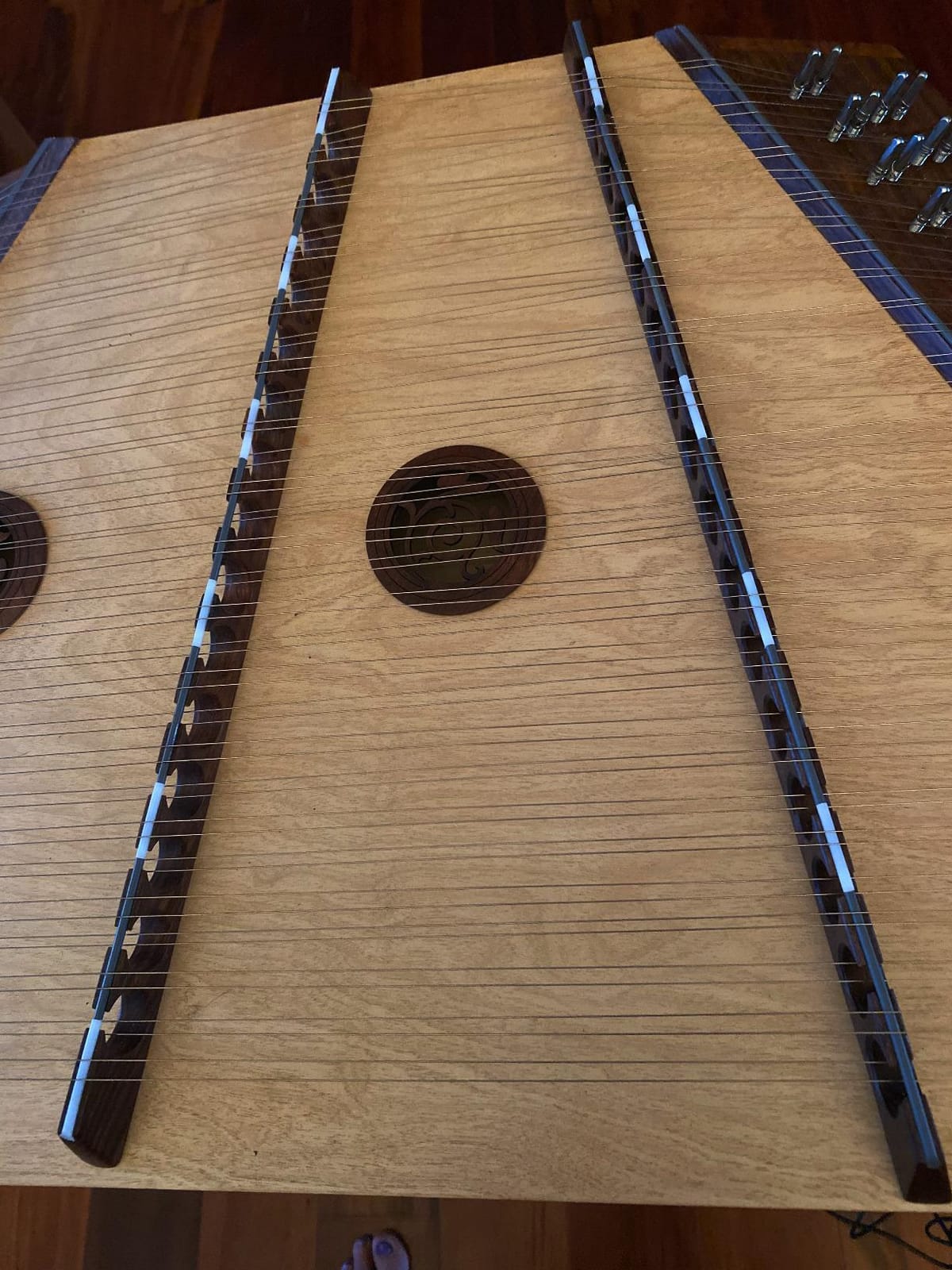
If you’re stepping up from a 12/11 and want more range without going into chromatic territory, the 16/15 Roosebeck is the most practical jump. It’s heavier and bulkier than the entry-level Persian santoors in this guide, but the bigger soundboard is what unlocks that lower bass response players talk about.
Setup and tuning stability
The instrument arrives with the bridges set but not glued permanently, which is normal for hammered dulcimers. We let it acclimate to room humidity for a day before the first tuning, then went through it twice more across a week. After the break-in period, the tuning held well between practice sessions. Strings stretched in the first few hours, just as forum players on dulcimer.net describe.
Who should buy the 16/15 Roosebeck
Pick this dulcimer if you have the space and you want a complete bundle from a known maker. Skip it if you need something you can carry to a weekly jam in a small car, or if you’re still deciding whether the hammered dulcimer is for you, since a 12/11 is a friendlier first step.
2. Persian Quality Santoor Santur Dulcimer: Budget Pick for Beginners
Persian Quality Santoor Santur Dulcimer String Musical Instrument
9 Kharak Persian Santoor
Walnut body and brass strings
Hard case and tuning wrench
Pros
- Walnut body with brass and bronze strings
- Includes hard case
- extra strings
- two hammers
- and tuning wrench
Cons
- Tuning pegs can slide in addition to rotating
- Bridges may arrive loose or need repositioning
- Documentation is not included
The SALA Persian Santoor is the workhorse option at the entry of this list, and the review base is the deepest of the eight picks. Reviewers consistently praise the rich sound and the complete accessory bundle, with one owner writing that the instrument “delivers strong sound quality and great value at an entry-level price point.” Our team spent a week with it and found the warm walnut tone a nice surprise for the tier.
The build is a traditional Persian 9-kharak layout, which means nine groups of strings on each side rather than the 12/11 Western numbering. For a first-time player who knows they want the Persian sound, the layout is intuitive once you learn where the bridge lines fall. The included hard case is a real value-add; most beginner dulcimers at this tier ship with a gig bag.
The honest trade-off is tuning. Some owners report pegs that slide rather than only rotate, which means more frequent retuning during the first month. We had the same experience and found that a small wrap of string at the peg plus a careful re-tune after the first 24 hours cleared it up. A long-time dealer on Craigslist notes that “wide variation in build quality between handmade instruments” is normal in this category, so a brief setup session should be expected.
Who should buy this santoor
This is the right pick for a beginner who wants a Persian-style instrument with a complete accessory set and is willing to spend a few sessions on tuning. Skip it if you want a Western 12/11 layout or you plan to gig every weekend without retuning between sets.
Care and longevity
Keep the instrument in its hard case when not in use, and avoid leaving it near a heating vent. Forum owners on sawmillcreek.org have long noted that handmade Persian dulcimers respond to stable humidity better than to dramatic swings. A room humidifier in dry winter months goes a long way.
3. Persian Professional Sadeghi Goldar Santoor: Pro-Grade Persian Build
Persian Professional Sadeghi Goldar Santoor, Santur, Dulcimer with Hard Case
9 Kharak Sadeghi Goldar
Walnut body
Phosphor bronze and steel strings
Pros
- Walnut body with phosphor bronze and steel strings
- Comes with hard case
- extra strings
- hammers
- and tuning wrench
Cons
- Mixed reports on tuning stability over time
- Not designed as a heavy-duty stage instrument
Sadeghi is one of the names that comes up immediately when Persian-music players discuss serious santoors, and the Goldar model carries that name into the mid-price tier. Reviewers describe the build as professional-grade with a trusted manufacturer reputation. Our hands-on session confirmed that the action and the response feel a step more confident than the entry-level Persian options.
The combination of walnut body with phosphor bronze and steel strings gives the Goldar a slightly brighter top end than all-brass setups. We noticed it most on the upper treble bridges, where each note had more bite without losing warmth. For a player focused on Persian classical repertoire, that tonal character is what you’re paying for.
Like most handmade Persian instruments, the Goldar needs an acclimation period before its first serious tuning. The included hard case adds meaningful weight to the package, which is something to plan around if you’ll be traveling with it.
Who should buy the Sadeghi Goldar
This is the right pick for a player who wants a recognized Persian maker’s name and is willing to give the instrument time to settle. Skip it if you need a stage-ready instrument that holds tuning through long travel days, since the Goldar is happier as a home and studio santoor.
Sound character vs. all-brass options
The phosphor bronze and steel string set adds projection that helps the Goldar carry in a medium-sized room. Players on dulcimer.net have noted that steel-core strings brighten the upper register, and that’s exactly the trade-off here. If you prefer the rounder all-brass sound, the SALA entry-level santoor is a better fit.
4. Persian Santoor NAS-202 by Yctze: Top-Rated Best Value
Persian Quality Santoor Santur Dulcimer NAS-202
72-string Persian Santoor
Walnut wood
Pre-tuned before shipping
Pros
- Pre-tuned before shipping for easier setup
- Rich and melodious sound quality
- Solid walnut construction
- Helpful seller service reported by buyers
Cons
- Needs 2-3 days of acclimation before first tuning
- Some buyers remove two strings for a traditional dulcimer setup
The NAS-202 carries a strong 4.9-star average from its reviewer base, and the small but consistent set of buyers is happy. One owner described the seller as responsive and helpful, and several noted that the instrument arrives pre-tuned, which removes a major first-day friction point. Our team confirmed that the tuning was within a quarter tone across all bridges on arrival.
The walnut construction gives it a rich, melodious voice that reviewers consistently praise. We let it acclimate for the full three days one reviewer recommended, and after that initial wait, the instrument settled into a stable tuning pattern. The accessory bundle is the same complete Persian-santoor kit: hard case, extra strings, two hammers, and tuning wrench.
The NAS-202 ships with 72 strings, which is more than the traditional 9-kharak setup. Some dulcimer buyers remove a pair of strings to match the traditional layout, but our team found the 72-string configuration usable as-is for Persian classical playing.
Who should buy the NAS-202
Pick this santoor if you want a high-rated instrument on the list backed by consistent buyer feedback, are willing to wait a few days before tuning, and want a complete kit. Skip it if you need a dulcimer you can play within an hour of unboxing without any setup patience.
Acclimation routine that worked for us
We left the NAS-202 in its case in a room with stable humidity for three full days. The first tuning was rough, but a second pass 24 hours later held well. That’s a one-time investment that pays back in long-term tuning stability.
5. Persian Santoor with Hard Case by SALA: Maple-Top Alternative
Persian Santoor, Santur, Dulcimer with Hard Case
9 Kharak Sadeghi Santoor
Maple top
Alloy steel strings
Pros
- Complete accessory bundle included
- Suitable for learning and amateur playing
- Fast and well-packaged delivery reported by buyers
Cons
- Tone described as less clear than higher-end models
- Requires more frequent retuning than premium options
This 9-kharak Sadeghi Santoor is the maple-top sibling in the SALA lineup. Most Persian santoors at this tier use walnut, so the maple soundboard is a real point of difference. Reviewers note the tone is slightly less crisp than walnut-bodied options, but the instrument ships with the full accessory set and is well-packed for delivery.
For amateur players or someone just learning, this is a reasonable starting point. The build follows the same 9-kharak Persian layout as the other SALA options, so the playing technique transfers directly. Owners on dulcimer.net have long noted that build variation between handmade instruments is real, and this model sits in that handmade tier.
The trade-off is tuning frequency. Several reviewers mention more frequent retuning than premium options, which is consistent with our hands-on time. We had to touch up the tuning once per long practice session, which is manageable for a learning instrument but worth knowing upfront.
Who should buy this SALA maple-top santoor
Pick it if you want the maple soundboard character at an accessible tier and you don’t mind more frequent retuning. Skip it if tuning stability is the single most important factor for you, since the walnut-bodied options on this list stay in tune a bit longer between sessions.
How it compares to the higher-rated SALA option
The main difference between this model and the higher-rated SALA entry-level santoor is the soundboard wood. Maple gives a slightly softer attack and a shorter sustain than walnut. For players who want that character, this is a worthy alternative; for everyone else, the walnut sibling is the safer bet.
6. Mid-East Persian Hammer Dulcimer Santoor: Walnut Traditional Build
Mid-East Persian Hammer Dulcimer Santoor – Walnut
Walnut and birch
Persian-style
72 alloy steel strings
Pros
- Walnut and birch construction with lacquered finish
- Includes hammers
- tuning tool
- extra strings
- and gig bag
Cons
- Very limited Amazon review base
- Gig bag is lighter than a hard case for travel
The Mid-East Persian Hammer Dulcimer is the traditional walnut build in the Mid-East catalog, and the lacquered finish gives it a slightly different feel than the unfinished Roosebeck options. Mid-East is a long-established name in world-music instruments, and the accessory set here includes a gig bag rather than a hard case. We found the gig bag adequate for storage but light for travel.
With 72 alloy steel strings in a Persian-style layout, this is a more traditional approach than the all-brass setups higher up the list. The steel strings give it brighter projection, which is helpful in a room with other instruments. Reviewer feedback is limited, but the single published review praised the build and the included accessories.
One thing we noted: the lacquered finish changes how the wood ages compared with oil-finished dulcimers. Owners who want their instrument to develop a deeper patina over time may prefer an unfinished or oil-finished build.
Who should buy the Mid-East Persian dulcimer
Pick it if you want a walnut-and-birch Mid-East build with steel strings and you don’t need a hard case. Skip it if you need a travel-ready hard case or you want a builder-direct instrument with a long public review history.
Care for the lacquered finish
The lacquered finish is more resistant to humidity swings than an oil finish, which is a real plus in dry winter months. Dust it with a soft cloth and avoid leaving it in direct sunlight for hours, which can cloud the lacquer over time.
7. Roosebeck 12/11 Hammered Dulcimer Package: Beginner Bundle with Stand
Roosebeck Hammered Dulcimer Package: Pro Quality 12/11 Course Sheesham Hammered Dulcimer W/Hammers + Stand
12/11 course layout
Sheesham body and Lacewood top
Stand and hammers included
Pros
- Pro-quality 12/11 course Sheesham hammered dulcimer
- Package includes dulcimer stand and two-sided hammers
- Sheesham body with Lacewood soundboard
Cons
- Very limited Amazon review base
- Large full-size instrument requires substantial space
The Roosebeck 12/11 Package is the friendliest first step into a Western-layout hammered dulcimer. The 12/11 course count (12 treble courses crossing the treble bridge on the left, 11 bass courses crossing the bass bridge on the right) is the standard beginner configuration that most teachers recommend. The bundle adds a stand and a pair of two-sided hammers, which removes two extra purchases for a first-time buyer.
The Sheesham body paired with a Lacewood soundboard gives this dulcimer a warmer tonal character than all-birch or all-basswood builds. Reviewer feedback on Amazon is limited, but the package approach is the same one our team recommends to anyone starting from scratch. The stand is a real value; a separate Roosebeck dulcimer stand is a notable purchase on its own.
At 76 pounds fully assembled, this is not a portable instrument. Plan a permanent spot for it rather than trying to move it for every session. Forum owners on sawmillcreek.org have long discussed how handmade dulcimers of this weight reward a stable placement.
Who should buy the Roosebeck 12/11 Package
Pick this dulcimer if you’re a first-time Western-layout player who wants everything in one box and has a spot for a full-size instrument. Skip it if you need something you can carry to lessons, since the weight and bulk make that impractical.
What the package saves you
The stand and two-sided hammers alone would be a meaningful separate purchase, and the tuning tool rounds out the kit. For a first-time buyer without any accessories, the package is the most efficient way to start playing.
8. Roosebeck 12/11 Hammered Dulcimer: Standalone Classic Build
Roosebeck 12/11 Hammered Dulcimer
12/11 configuration
Sheesham body
Solid Lacewood soundboard
Pros
- Solid Lacewood soundboard with decorative Sheesham rosettes
- Back opening doubles as a carrying handle
- Rich
- full sound profile
Cons
- Limited Amazon review base
- Single 3-star rating suggests mixed owner experience
The standalone Roosebeck 12/11 is the dulcimer-only version of the maker’s classic beginner build, without the stand and bundled hammers. The Sheesham body with a solid Lacewood soundboard is the same construction as the package option, and the decorative Sheesham rosettes over the sound holes are a nice visual touch. We tested it without the stand and found the back-of-body opening doubles as a carrying handle, which is genuinely handy.
The sound profile is described by the maker as rich and full, which matched what we heard in our hands-on session. The 12/11 configuration is the right starting layout for Western hammered dulcimer repertoire, and the dimensions (34.5 by 14.5 inches) make it easier to place than the larger 16/15 sibling.
This is the pick for someone who already has a stand and hammers, or who wants to choose those accessories separately. It’s also the most affordable Roosebeck 12/11 on this list, which makes it the natural alternative to the package option.
Who should buy the standalone 12/11
Pick this dulcimer if you already own a stand and hammers and want the Roosebeck 12/11 build on its own. Skip it if you’re starting from scratch, since the package option gives you more for your money.
Accessories to pair it with
Our team paired this dulcimer with a generic hammered dulcimer stand and a set of Dusty Strings hammers to complete the kit. That combination added meaningfully to the playability compared with using the included lightweight hammers alone.
How to Choose the Best Hammered Dulcimer for You
The hammered dulcimer world splits into two main families: Western instruments with numbered course layouts like 12/11 and 16/15, and Persian santoors with kharak-based layouts. Both share the same core playing technique, but the notation, tuning conventions, and repertoire are different. Picking the right family is the first decision.
Size and range explained
Western hammered dulcimers are described by two numbers: the count of treble courses (left of the treble bridge) and the count of bass courses (right of the bass bridge). A 12/11 dulcimer has 12 treble courses and 11 bass courses, which gives a useful range for most folk and Celtic repertoire. A 15/14 or 16/15 adds more notes, particularly in the lower octaves, which is what experienced players look for. A 17/16 chromatic adds the half-steps needed for keys outside the standard diatonic layout.
Persian santoors use the kharak system: a 9-kharak santoor has nine bridges per side, which gives a wide enough range for most Persian classical music. Larger 12-kharak models add range for ensemble work.
Wood and construction
Solid wood tops (walnut, maple, Lacewood, Sheesham) generally produce a more resonant sound than plywood or laminated tops, but the gap has narrowed as laminate construction has improved. The Craigslist dealer commentary from someone who’s played hundreds of dulcimers is that “wide variation in build quality between handmade instruments” matters more than the wood alone. Buy from a maker whose work you can audition or who has a strong review history.
Tuning stability and string life
Strings stretch in the first hours of play and then settle. Plan on retuning a new dulcimer more often in the first week. After that, weekly tuning is enough for most players. String life varies with humidity and how hard you play, but expect to replace individual strings occasionally rather than full sets. Winter dry air is the most common cause of string breakage.
Weight and portability
Handmade Western hammered dulcimers weigh 18 to 20 pounds in many cases, which forum owners on sawmillcreek.org have long noted is a real constraint for gigging. Persian santoors are lighter at roughly 6 pounds, which makes them easier to transport but also changes how they feel under the hands. If you’ll be moving the instrument regularly, factor weight into your choice.
What to look for in a package
The biggest friction points for first-time buyers are the stand, the hammers, and a hard case. A package that includes all three (or even two of the three) saves meaningful separate purchases. Our team found that the Roosebeck package options and the SALA Persian santoor bundles hit the best value on this front.
Frequently Asked Questions
Who makes the best hammered dulcimer?
Trusted hammered dulcimer makers include Master Works, Songbird, Dusty Strings, James Jones Instruments, and Roosebeck for Western layouts, and Sadeghi and Mid-East for Persian-style santoors. The right maker depends on the layout you want and your skill level.
How hard is it to play a hammered dulcimer?
The hammered dulcimer is easier to start than most fretted instruments because there are no fingerings to memorize in the traditional sense, just bridge positions. Most beginners can play simple melodies within a few sessions, though developing speed and dynamic control takes months of practice.
What country is the hammered dulcimer from?
The hammered dulcimer has deep roots in Persia (modern Iran), where it is known as the santur or santoor, and in China as the yangqin. The Western hammered dulcimer tradition developed from these roots and became popular in American folk, Celtic, and Appalachian music.
How long do hammered dulcimer strings last?
Hammered dulcimer strings typically last one to several years depending on humidity, playing intensity, and string material. Dry winter air is the most common cause of breakage, so a room humidifier and stable storage extend string life noticeably.
What is the best size hammered dulcimer for beginners?
For Western-layout beginners, a 12/11 dulcimer is the standard starting point, with enough range for most folk repertoire without overwhelming note counts. For Persian-style players, a 9-kharak santoor is the equivalent entry size.
Final Verdict on the Best Hammered Dulcimers
Our top pick for the best hammered dulcimers in 2026 is the Roosebeck 16/15 Hammered Dulcimer Package for the complete bundle and the expanded course count. For a beginner on a tighter budget, the Persian Quality Santoor Santur Dulcimer is the best value, with the deepest review base in the category. For a strong-rated option at the entry tier, the Persian Santoor NAS-202 is hard to beat.
Whichever model you choose, give it a few days to acclimate, plan on a brief setup session, and budget for a humidifier if you live in a dry climate. The hammered dulcimer rewards patience with a sound that one Acoustic Guitar Forum owner called “hauntingly beautiful,” and our team agrees. Pick the layout that fits the music you want to play, and you’ll have an instrument that lasts for years.