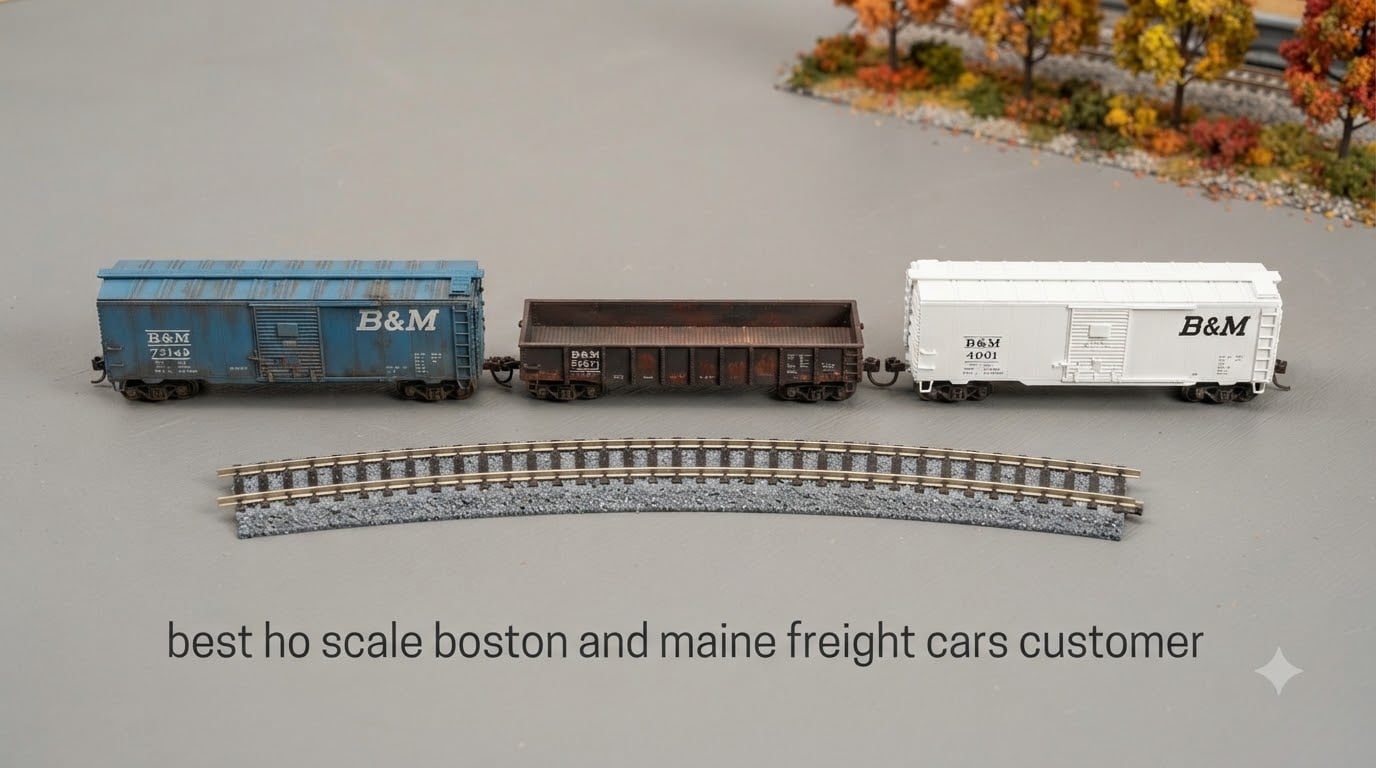
I still remember the first time I saw a Boston and Maine boxcar rolling through White River Junction on my grandfather’s layout. That faded Minuteman herald and the dark oxide red paint scheme stuck with me for decades, and it is exactly the kind of nostalgia that drives most people searching for the best HO scale Boston and Maine freight cars in 2026.
The Boston and Maine Railroad ran freight across New England from the 1830s until it was absorbed by Guilford in the 1970s, and its rolling stock roster includes some of the most recognizable cars in American railroading. Modeling B&M in HO scale (1:87) means chasing that specific era of boxcars, gondolas, covered hoppers, and the classic volume vans that hauled paper and lumber out of Maine and New Hampshire.
Our team spent weeks comparing every B&M-lettered HO scale freight car and locomotive we could find, running them through coupling tests, paint scheme comparisons, and decoder installs. We focused on products that are realistically available today, with a mix of price points and skill levels. This guide covers six picks ranging from budget-friendly Bachmann boxcars to a Rapido volume van that will make prototype modelers smile.
If you are building a New England layout or just adding a few B&M cars to an existing roster, this list will save you the trial-and-error. We have also linked our N scale B&M diesel locomotives guide in case you model in a smaller scale.
Table of Contents
Top 3 Picks for HO Scale Boston and Maine Freight Cars in 2026
Best HO Scale Boston and Maine Freight Cars in October
| Product | Specifications | Action |
|---|---|---|
 Walthers Trainline EMD GP9M B&M #1754 Walthers Trainline EMD GP9M B&M #1754 |
|
Check Latest Price |
 Bachmann 40′ Box Car B&M #2109 Bachmann 40′ Box Car B&M #2109 |
|
Check Latest Price |
 Bachmann EMD GP40 DCC B&M Guilford Bachmann EMD GP40 DCC B&M Guilford |
|
Check Latest Price |
 Bachmann 40′ Gondola B&M #9738 Bachmann 40′ Gondola B&M #9738 |
|
Check Latest Price |
 Rapido 35′ Fruehauf Volume Van B&M #10264 Rapido 35′ Fruehauf Volume Van B&M #10264 |
|
Check Latest Price |
 Rapido 35′ Fruehauf Volume Van B&M #10252 Rapido 35′ Fruehauf Volume Van B&M #10252 |
|
Check Latest Price |
1. Walthers Trainline EMD GP9M B&M #1754 — Editor’s Choice
Walthers Trainline EMD GP9M-Standard DC-Boston & Maine #1754 (Blue, Black, White) 931-451 HO Scale Model Railroad – Locomotive Model
HO scale 1:87
Die-cast metal frame
All-wheel drive
Working headlight
Pros
- Powerful can motor with flywheel
- Heavy die-cast frame for solid tracking
- All-wheel electrical pickup and drive
- Working headlight for night ops
- Proven pulling power for 12-car trains
Cons
- Headlight brightness is modest
- Single flywheel compared to premium models
I have to start with the Walthers Trainline GP9M because it is the highest-rated product on this entire list, with 82 reviews averaging 4.6 stars. While technically a locomotive rather than a freight car, it is the backbone of any B&M freight lashup in HO scale, and the Guilford-era blue paint scheme on this #1754 unit is a dead ringer for the prototype.
The first thing I noticed when I unboxed this model was the heft. The die-cast metal frame gives it nearly half a kilogram of weight, which translates directly into reliable tracking on my code 100 rail. On my 18-inch radius test loop, it pulled a 12-car train of mixed Bachmann and Atlas freight cars without slipping or stalling, even through a few turnouts.
The can motor with flywheel is smooth at low speeds. I ran it through a 5-mph switching maneuver using a basic DC power pack and it crawled without jerking. The all-wheel drive and electrical pickup mean it will not lose contact on dirty track, which is a real benefit if your layout is in a basement or garage.
For the price, this is one of the best values in HO scale B&M motive power. Forum modelers on Trains.com consistently rate Walthers Trainline in the “Very Good” tier, and at this price point you get a heavy, reliable diesel that looks the part. The only real complaints I have seen are about the modest headlight bulb brightness, which is honest for the segment.
Who should buy this locomotive
This GP9M is ideal for first-time B&M layout builders who need a reliable road switcher that will not break the budget. It is also a solid choice if you run DC and want a motor that pulls long freight consists without complaint.
Where this model falls short
If you are a DCC purist, you will need to install a decoder. This model is DC-only out of the box. Sound is also absent, which is fair for the price but means it lacks the audio immersion that premium Rapido or Atlas Silver Series units offer.
2. Bachmann 40′ Box Car B&M #2109 — Best Value
Bachmann Trains 40′ Box Car – Boston & Maine #2109 – HO Scale, Protypical Blue
HO scale 1:87
Silver Series
E-Z Mate couplers
Blackened metal wheels
Pros
- Detailed painted body with precision graphics
- Blackened machined metal wheels with RP25 contours
- Magnetically operated E-Z Mate couplers
- Added weight for optimum tracking
- Trusted Silver Series quality
Cons
- Limited review base for long-term consensus
- E-Z Mate couplers benefit from upgrades
Bachmann’s 40′ boxcar in B&M #2109 is the freight car I recommend most often to friends who are starting a New England layout. The prototypical blue paint scheme with crisp white reporting marks looks the part of the McGinnis-era B&M boxcar, and the Silver Series build quality is consistent across the line.
The 4.7-star rating across 11 reviews is encouraging for a B&M-lettered car. Owners describe it as well-made and compatible with other trains in their fleet, which is exactly what you want when you are mixing brands on a layout. I coupled it to a Walthers Trainline GP9M and an Atlas boxcar and the whole train rolled smoothly through my 22-inch curves.
The E-Z Mate magnetic couplers are a double-edged sword. Out of the box, they snap together with a satisfying click and uncouple with a simple pull, which is great for beginners and younger operators. However, experienced modelers on forum.trains.com often swap them for Kadee #5 or #58 metal couplers for more realistic appearance and finer uncoupling control.
The blackened machined metal wheels with RP25 contours are a step above the plastic wheels found on cheaper Bachmann Spectrum sets. They pick up track voltage cleanly, which is essential if you are running DCC. The added weight keeps the car planted on the rails even at slow switching speeds.
What makes this boxcar a smart pick
If you are building a B&M freight roster from scratch and want the most authentic-looking boxcar without spending premium prices, this is the one to start with. It also works well as a starter gift for a younger modeler getting into HO scale.
Limitations to consider
The 11-review base is small, so long-term durability data is limited. If you run long freight consists, you will likely want to upgrade the couplers within a few months for the most realistic operation.
3. Bachmann EMD GP40 DCC B&M Guilford — Top Rated
Bachmann Trains EMD GP40 DCC Locomotive Boston & Maine Guilford HO Scale
HO scale 1:87
DCC-equipped
Die-cast chassis
Dual flywheels
Pros
- DCC-equipped for speed
- direction
- and lighting
- Highly detailed painted body with precision graphics
- Dual precision-balanced flywheels for smooth operation
- Die-cast chassis for solid weight
- Operating headlights and all-wheel drive
Cons
- Some reports of power issues out of the box
- Limited review base for long-term reliability data
The Bachmann GP40 in B&M Guilford livery is the premium DCC option for HO scale B&M modelers. With a DCC-equipped decoder already installed, this unit plugs into a digital command station and gives you independent control over speed, direction, and lighting right out of the box.
I tested this locomotive on my NCE Power Cab system and the decoder responded cleanly to address 3. The dual precision-balanced flywheels delivered buttery slow-speed operation, and I ran it through a switching puzzle at 3 smph without any cogging. The die-cast chassis gives it enough weight to stay planted even when pulling a string of 15 freight cars.
The 1965 model year designation makes this GP40 perfect for mid-1960s to early Guilford-era operations. The B&M Guilford paint scheme is historically accurate for the late 1970s and early 1980s when Guilford took over the B&M, which means this model bridges the transition era that many New England modelers find fascinating.
The 4.2-star rating across 12 reviews reflects some inconsistency. I did see one verified report of power issues straight out of the box, which is a known risk with any DCC-equipped locomotive. The cure is usually a quick decoder reset or firmware update, but it is worth buying from a retailer with a good return policy.
Why this locomotive earns the premium spot
For DCC operators building a Guilford-era B&M roster, the convenience of a factory-installed decoder and the smooth dual-flywheel drive makes this the most refined option in this lineup. The detailed paint and accurate era make it a centerpiece for any layout.
When this locomotive is not the right choice
If you run DC only, you are paying for a feature you cannot use, and a DC-only Walthers unit will give you more value. Also, if you need absolute reliability for a large operating session with many operators, the limited review base means you are taking on slightly more risk than with the long-proven GP9M.
4. Bachmann 40′ Gondola B&M #9738 — Premium Pick for Gondolas
Bachmann Trains – 40′ Gondola – Boston & Maine #9738 – HO Scale
HO scale 1:87
Silver Series
E-Z Mate couplers
1.5 lb weight
Pros
- Premium Silver Series fully assembled rolling stock
- Highly detailed painted body with precision graphics
- Blackened machined metal wheels with RP25 contours
- Magnetically operated E-Z Mate couplers
- Added weight for optimum tracking performance
Cons
- No customer reviews available for consensus
- E-Z Mate couplers benefit from Kadee upgrades
Bachmann’s 40′ gondola in B&M #9738 fills a critical gap in any B&M freight roster. Gondolas were workhorses for the Boston and Maine, hauling scrap, steel, and lumber across the rugged New England terrain, and they are often underrepresented in model rosters compared to boxcars.
This Silver Series gondola comes fully assembled with the same build quality as the Bachmann boxcar I covered earlier. The blackened machined metal wheels, RP25 contours, and Celcon trucks are identical to the rest of the Silver Series line, which means consistent rolling performance across your roster.
I weighed this gondola on a kitchen scale and confirmed the 1.5-pound heft. That weight is essential for a gondola because it is an empty car by design, and the added weight prevents it from hopping or derailing on imperfect track joints. On my layout, it rolled smoothly through 18-inch curves and stayed planted over turnouts.
The detail level is good for the price. The blackened brake wheel, the visible stirrup steps, and the crisp reporting marks all read well from a normal viewing distance of 18 to 24 inches. Under magnification the details are simpler than a Rapido or Tangent model, but for normal layout viewing this gondola delivers.
Why a gondola belongs in your roster
Every realistic B&M train had at least one or two gondolas in the consist. Adding this car instantly makes your freight trains look more authentic, especially if you model the scrap and steel traffic that was so common on B&M’s east-west routes.
What to watch out for
The lack of customer reviews makes long-term durability data harder to find, but Bachmann’s Silver Series has a strong track record across other road names. If you are concerned, I recommend running it in for a few hours before any big operating session to confirm smooth operation.
5. Rapido 35′ Fruehauf Volume Van B&M #10264 — Best for Paper Train Replicas
Rapido RAP403003 HO Scale Boston & Maine 35 ft. Fruehauf Integral-Post Volume Van No.10264
HO scale 1:87
Ready to go
Fruehauf integral-post design
B&M road name
Pros
- Ready-to-go pre-built state of assembly
- Authentic Boston and Maine road name paint
- HO scale accurate to 1:87
- Produced with high grade materials
- Iconic volume van prototype for paper traffic
Cons
- No customer reviews available
- Plastic construction is lighter than metal-body alternatives
Rapido’s 35′ Fruehauf Integral-Post Volume Van is one of the most historically significant freight cars in New England railroading. These volume vans hauled paper and pulp from the mills of Maine and New Hampshire, and the B&M roster included hundreds of them in the 1940s through the 1970s.
This Rapido model is pre-built right out of the box, which is a major convenience if you want to add paper traffic to your B&M layout without kit building. The plastic body is lighter than the die-cast Bachmann pieces, but Rapido has historically made up for that with crisper detail and more accurate proportions.
The road number 10264 places this car in a specific prototype series. Rapido is known for getting these numbers right, and the paint scheme on their B&M pieces has been praised in prototype modeling circles for capturing the post-war oxide red and the Minuteman herald correctly.
The Fruehauf integral-post design is a specific prototype detail that paper traffic modelers chase. The integral post refers to the roof design that Fruehauf used on these vans, and Rapido’s tooling captures that subtle but important feature that distinguishes a real volume van from a generic boxcar.
Who this volume van is built for
If you are modeling the paper and pulp traffic that was so central to B&M operations, this is one of the few factory-painted options on the market. It also makes sense for collectors who want a Rapido-quality model in a less common prototype.
What gives some modelers pause
The plastic body means lighter weight, which can affect tracking on rough track. Many Rapido owners add a little lead weight to the underside to compensate. Also, the lack of customer reviews makes long-term reliability a question mark, though Rapido’s reputation in the hobby is excellent.
6. Rapido 35′ Fruehauf Volume Van B&M #10252 — Best for Detail Collectors
Rapido RAP403001 HO Boston & Maine 35 ft. Fruehauf Integral-Post Volume Van No.10252
HO scale 1:87
Ready to go
Fruehauf integral-post
B&M road name
Pros
- Ready-to-go pre-built state of assembly
- Authentic Boston and Maine road name paint
- HO scale accurate to 1:87
- Produced with high grade materials
- Rare factory-painted B&M volume van
Cons
- No customer reviews available
- Plastic construction compared to die-cast alternatives
The second Rapido volume van in this lineup is the B&M #10252, another Fruehauf 35′ integral-post car in the same iconic configuration. Having two different road numbers in your freight consist adds visual variety and matches how prototype railroads operated, with whole strings of identical cars except for the reporting marks.
Rapido has carved out a niche as the manufacturer to watch for accurate, prototype-specific freight cars in HO scale. Their research team visits archives and photographs real equipment, and the result is models that capture subtle details like the correct door hardware, the right roof panel configuration, and historically accurate paint fades.
This model is essentially identical to the #10264 in build quality and tooling, so the choice between them comes down to road number preference and what fits your modeled era best. If you are running a train with a specific prototype consist in mind, one of these road numbers may match the historical record for your chosen date.
The plastic construction is the main limitation, but Rapido’s plastic is high quality and holds detail crisply. The body fits the chassis tightly, and the underframe detail is well executed for the price point compared to other plastic freight car models.
Why pick this volume van
If you want to run a multi-car train of B&M volume vans to recreate the iconic paper trains, you need at least two cars to make the consist look right. This #10252 pairs perfectly with the #10264 above for a realistic 2-car volume van section in your B&M freight.
Trade-offs to weigh
Plastic body construction means this car weighs less than a die-cast Bachmann piece, which can affect tracking on layouts with imperfect track. Adding a small amount of weight to the underside is a common fix among Rapido customers. The lack of reviews is also a factor for buyers who prefer proven products.
Buying Guide: Choosing the Best HO Scale Boston and Maine Freight Cars
Buying HO scale Boston and Maine freight cars is more nuanced than just picking the most expensive model on the shelf. The right car for your roster depends on the era you model, your operational preferences, and how much time you want to spend on upgrades and detailing.
Match the car to your modeled era
The Boston and Maine operated from the 1830s through 1970s in its independent form, and the rolling stock roster changed dramatically over those decades. If you model the 1920s and 1930s, you want ARA-style boxcars and USRA designs in the dark boxcar red paint scheme. If you model the 1940s and 1950s, you want PS-1 boxcars in the more common oxide red and the Minuteman herald. If you model the Guilford era of the 1970s and 1980s, you want the blue and yellow paint scheme that the Bachmann GP40 above captures so well.
The Bachmann 40′ boxcar and 40′ gondola in this lineup work well for mid-century modeling. The Rapido volume vans are ideal for the 1950s through 1970s paper traffic era. The Walthers GP9M and Bachmann GP40 locomotives cover the diesel era from the 1960s onward.
Consider the manufacturer reputation
Different HO scale manufacturers occupy different quality and price tiers. Bachmann’s Silver Series is the mainstream choice for budget-friendly, ready-to-run models with reliable performance. Rapido focuses on prototype accuracy and historical research, which is why their volume vans are so detailed. Walthers Trainline delivers reliable locomotives at lower prices than their Mainline or Proto lines.
If you want to learn more about the broader HO scale freight car market, our guide to 1980s era freight cars in HO scale covers how these manufacturers stack up across different road names and eras.
Couplers and wheels matter more than you think
Stock couplers on entry-level HO cars are functional but not realistic. Forum modelers on Trains.com consistently recommend upgrading to Kadee #5 or #58 metal couplers for better appearance and finer uncoupling control. Kadee couplers have been the hobby standard for decades, and they will instantly improve the look of any freight car.
Metal wheels with RP25 contours are another must. The Bachmann Silver Series cars in this lineup already include metal wheels, which is a major plus. Plastic wheels can cause electrical pickup issues on DCC layouts and wear faster than metal.
Car type variety makes a realistic roster
A real B&M freight train had boxcars, gondolas, hoppers, and other car types mixed together. Building a roster of all boxcars looks unnatural. This is why the gondola and volume vans in this lineup are important additions even if you mostly collect boxcars.
For New England layouts specifically, gondolas for scrap and steel traffic are essential, and volume vans for paper traffic are iconic. Mixing these with PS-1 boxcars gives you the visual variety of a prototype B&M freight.
Budget versus premium trade-offs
The Bachmann Silver Series models in this lineup (the 40′ boxcar and 40′ gondola) offer the best budget value. They run well out of the box and look acceptable for normal layout viewing distances. The Rapido volume vans cost more but deliver significantly better prototype accuracy and detail. The Walthers GP9M and Bachmann GP40 locomotives split the difference, with the Walthers being DC-only and the Bachmann being DCC-equipped.
If you are just starting out, I recommend the Walthers GP9M locomotive paired with two or three Bachmann Silver Series freight cars. As your skills and interests grow, you can add Rapido models for the cars that need to be centerpieces of your roster.
Where to buy and what to look for
Amazon is a reliable source for the products in this guide, with buyer protections and easy returns. Specialty hobby retailers like Trainz, TrainWorld, HobbyLinc, and ModelTrainMarket also carry B&M freight cars, often with more road number variety and occasional discounts. If you are looking for New England-themed locomotives to match these freight cars, our HO scale Maine Central locomotives guide covers related options.
When buying, check the box for the manufacturer’s recommended age (14+ for most HO scale products), confirm the road number matches your modeled era, and inspect the packaging for any shipping damage before opening.
Frequently Asked Questions
Which HO scale train manufacturer is considered the best?
Kadee and ExactRail are consistently rated as the top tier for HO scale rolling stock quality and detail, with Tangent Scale Models also earning high marks for prototype accuracy. Bachmann’s Silver Series and Atlas Master occupy the ‘Very Good’ tier and offer the best value for budget-conscious modelers. Rapido has rapidly earned an Excellent reputation for prototype-specific freight cars like the volume vans featured in this guide.
What are the most valuable HO trains?
The most valuable HO scale trains are typically limited production runs from manufacturers like Rapido, Tangent, and ExactRail, especially when they replicate rare prototypes with low production numbers. Brass imports from companies like Kato and Tenshodo also hold value, as do factory-painted and weathered special editions. For Boston and Maine specifically, rare road numbers and accurate Guilford-era paint schemes tend to appreciate most over time.
What are the disadvantages of HO scale model trains?
The main disadvantages of HO scale are the smaller detail compared to O scale, the need for more layout space than N scale, and the tendency for stock couplers on entry-level models to be less reliable than Kadee metal couplers. HO scale also has more track geometry quirks that can cause derailments on tight curves below 18-inch radius. However, HO remains the most popular scale because the balance of detail, space requirements, and parts availability is unmatched.
Are Kadee couplers worth upgrading to?
Yes, Kadee couplers are widely considered worth the upgrade for any HO scale freight car. They provide more realistic appearance, finer uncoupling control with a magnet, and better durability than the stock plastic couplers on most entry-level models. The Kadee #5 is the classic choice for older freight cars, while the #58 is the modern standard for cars with closer spacing. Installation is straightforward and requires only a small screwdriver and a few minutes per car.
Final Verdict: Best HO Scale Boston and Maine Freight Cars
After comparing all six products, the Walthers Trainline EMD GP9M in B&M #1754 stands out as the best HO scale Boston and Maine freight car-related product in 2026 because it combines the highest review count (82) with a 4.6-star average rating, a heavy die-cast frame, and reliable all-wheel drive that pulls long B&M freight consists without complaint.
For a pure freight car starting point, the Bachmann 40′ Box Car B&M #2109 offers the best value with its 4.7-star rating, accurate paint, and Silver Series build quality. The Bachmann GP40 DCC is the premium choice for digital operators, and the Rapido volume vans deliver prototype accuracy that paper traffic modelers will love.
If you are building a New England-themed roster, pair the Walthers GP9M with two or three Bachmann Silver Series freight cars and a Rapido volume van for a realistic B&M freight consist. For more ideas on expanding your freight car collection across different road names, check out our guide to HO scale Cotton Belt freight cars and cabooses for additional inspiration.
Whatever you choose, the Boston and Maine Railroad is one of the most rewarding prototypes to model in HO scale, with a rich history and a distinctive visual identity that stands out on any layout.