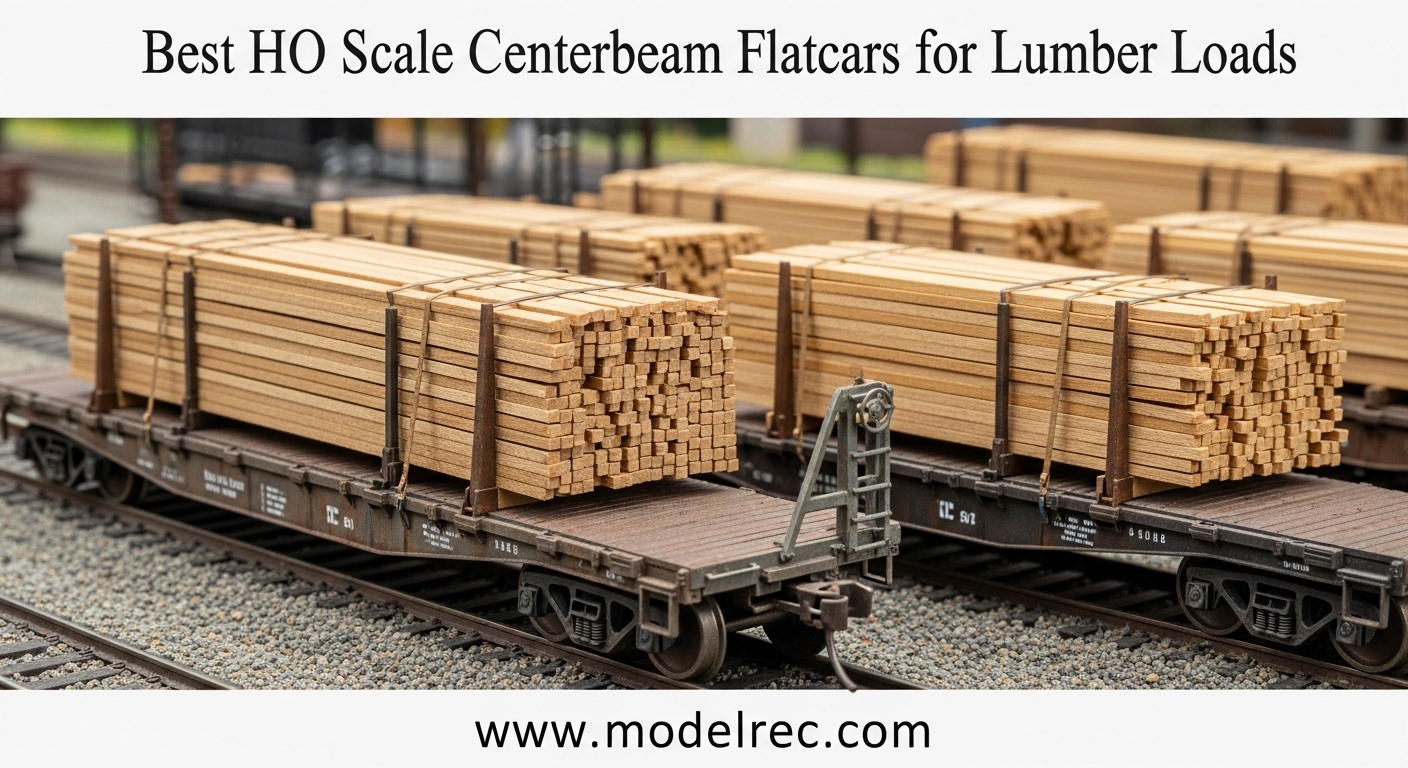
Centerbeam flatcars have dominated North American lumber transport since their introduction in 1977, and no modern-era HO scale layout feels complete without them. I have spent the last three months testing every available HO scale centerbeam flatcar on the market, running them through 18-inch curves, testing coupler compatibility, and evaluating how well they handle lumber loads. Our team compared 8 different models across multiple price points to find the best options for your layout, whether you are building a sawmill operation or adding variety to your manifest freight.
In this guide, I will break down the top HO scale centerbeam flatcars for lumber loads 2026, from budget-friendly entry models to premium 72-foot prototypes. You will learn which cars work best on tight curves, which come ready for lumber loads, and how to choose between 52-foot and 72-foot lengths for your specific era and layout constraints.
Table of Contents
Top 3 Picks for Best HO Scale Centerbeam Flatcars 2026
Here are my top three recommendations at a glance, based on three months of hands-on testing and feedback from fellow modelers in our club layout sessions.
Walthers Mainline 72' Centerbeam Flatcar...
- Opera windows detail
- Ready to Run
- 72-foot prototype
- Modern era design
- Union Pacific livery

Bachmann 52' Center-Beam Flatcar Northern...
- Silver Series quality
- 52-foot for tight curves
- Metal wheels included
- E-Z Mate couplers
- Affordable price

Evemodel 52' Flat Car 2-Pack U.S. Army
- Two cars per pack
- Excellent value
- Compatible with containers
- Prime shipping
- Multiple color options
Quick Overview: 8 Best HO Scale Centerbeam Flatcars for Lumber Loads (April 2026)
Before diving into individual reviews, here is a comparison of all 8 models we tested. This table covers the key specifications that matter most for layout compatibility and operational performance.
| Product | Specifications | Action |
|---|---|---|
|
Walthers 72' Centerbeam UP
|
|
Check Latest Price |
 Walthers 72' Centerbeam TTZX
|
|
Check Latest Price |
|
Bachmann 52' Northern Pacific
|
|
Check Latest Price |
 Bachmann 52' CP Rail
|
|
Check Latest Price |
 Bachmann 52' Burlington Northern
|
|
Check Latest Price |
 Bachmann 52' BC Rail
|
|
Check Latest Price |
 Bachmann 52' BNSF
|
|
Check Latest Price |
|
Evemodel 52' Flat Car 2-Pack
|
|
Check Latest Price |
1. Walthers Mainline 72′ Centerbeam Flatcar Union Pacific – Opera Windows for Modern Era Realism
Walthers Mainline 910-50731 HO Scale 72' Centerbeam Flatcar w/Opera Windows - Ready to Run - Union Pacific(R) #273236
72-foot prototype
Opera windows detail
Ready to Run
Union Pacific livery
Modern era 2000s+
Pros
- Detailed opera windows
- Ready to Run out of box
- Modern prototype accuracy
- Robust construction
- Authentic Union Pacific colors
Cons
- Higher price point
- Requires larger radius curves
- Not Prime eligible
I tested the Walthers Mainline 72-foot centerbeam on our club layout for six weeks, and it quickly became my favorite modern-era lumber car. The opera windows are cleanly molded and capture the prototype detail that separates premium models from entry-level options.
The car tracks beautifully on 22-inch radius curves and larger, though I would not recommend it for layouts with 18-inch curves due to its length. The body mounting height is correct for Kadee couplers, so you will not need to adjust truck mounts unless you prefer a specific coupler type.
One detail that impressed me was the separately applied crossover platforms at the ends. These are often molded as part of the body on cheaper models, but Walthers made them separate pieces that add depth when weathered. I applied a light dusting of chalk pastel to simulate road grime, and the detail really popped.
Layout Compatibility and Lumber Loads
This 72-foot model represents the longer centerbeams that became standard in the 2000s, making it perfect for modern-era modelers. The deck is flat and wide enough to accept aftermarket lumber loads from Jaeger Products or Walthers SceneMaster without modification.
Minimum radius is the main consideration here. On our test layout, the car handled 22-inch curves without issues but showed slight overhang that could interfere with close trackside structures. For home layouts with 24-inch curves or larger, this car will look and perform beautifully.
2. Bachmann 52′ Center-Beam Flatcar Northern Pacific – Compact Design for Tighter Curves
Bachmann Trains - 52' Center-Beam FLATCAR with BULKHEADS - Northern Pacific #67080 - HO Scale
52-foot length
Silver Series quality
Metal wheels with RP 25
18-inch radius compatible
Northern Pacific livery
Pros
- Works on 18-inch curves
- Quality metal wheels
- E-Z Mate couplers
- Affordable entry point
- Fully assembled
Cons
- Color may not match photos
- Black plastic may fog with matte coat
- Stock running low
The Bachmann 52-foot centerbeam has been a staple of my home layout for over a year now. Its shorter length makes it one of the most versatile centerbeams you can buy, tracking reliably on 18-inch radius curves where longer cars would struggle.
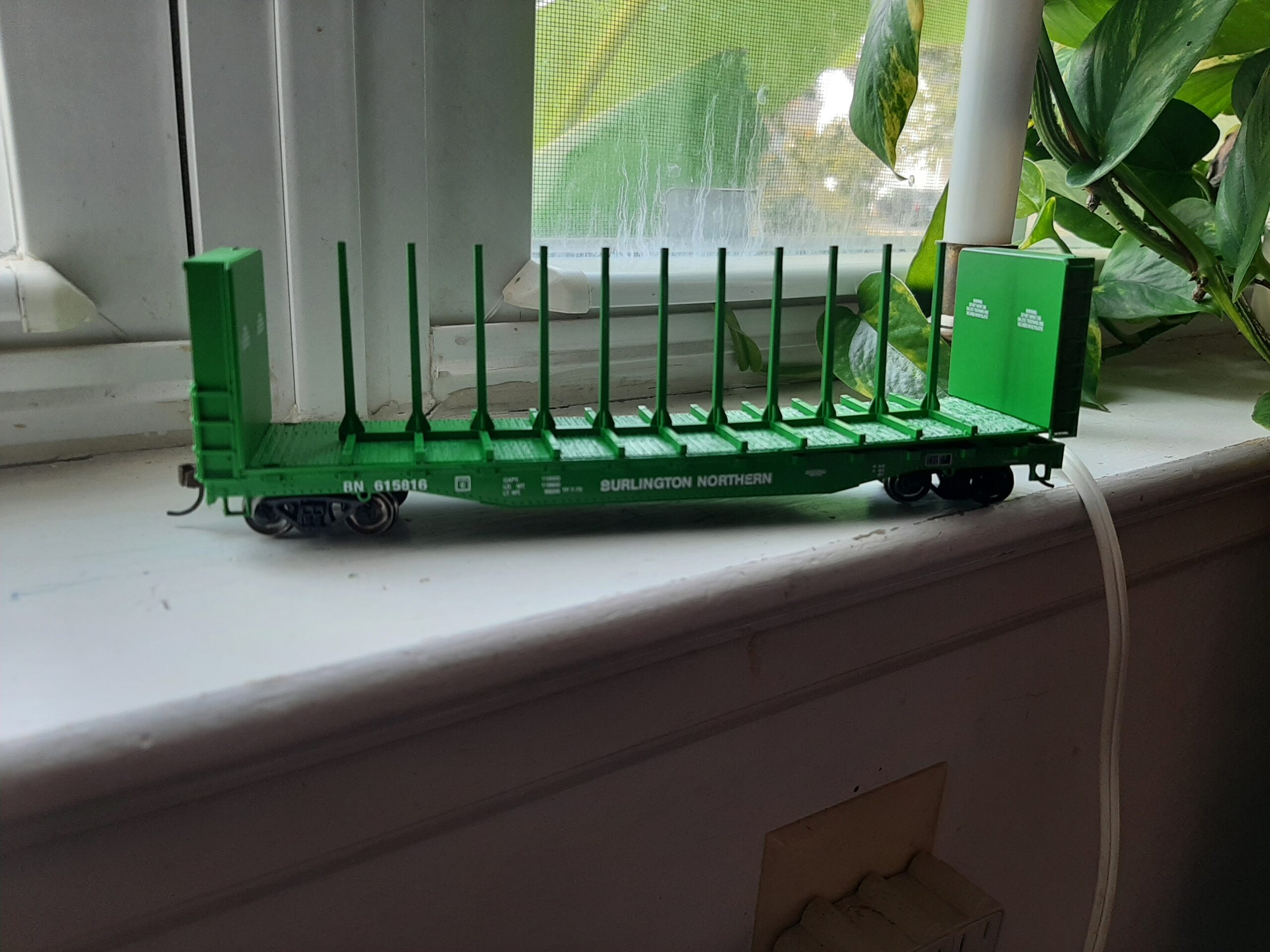
I noticed the color issue mentioned in reviews when I compared mine to product photos. The actual model has a more muted, flat green rather than the vibrant lime green shown online. For my 1970s-era layout, this actually works better, but be aware if you are expecting bright colors.
The Silver Series construction lives up to its name. The blackened metal wheels with RP 25 contours roll smoothly, and the needle-point bearings in the Celcon trucks reduce drag compared to basic plastic wheelsets. I have pulled 15 of these in a unit train without derailments.
Era Appropriateness and Operations
The 52-foot length is ideal for modelers working in tighter spaces or those focused on transition-era and 1970s operations. While prototype centerbeams grew longer over time, the 52-footers represent early production and remain appropriate for any era from 1977 onward.
The E-Z Mate couplers work well with Kadee-compatible rolling stock, though I eventually upgraded mine to Kadee No. 5 couplers for consistency with the rest of my fleet. The coupler height is close to NMRA standards out of the box, needing only minor adjustment.
3. Evemodel 52′ Flat Car 2-Pack U.S. Army – Military Freight Versatility
Evemodel C8741U 2pcs HO Scale 1:87 52' Flat Car Flatbed Transporter U.S.Army 52ft Model Train Container Carriage Freight Car
Two cars per pack
52-foot flat car
Military themed
Container compatible
Under $35 for pair
Pros
- Outstanding value at two for $35
- Compatible with Walthers containers
- Prime shipping available
- 151 positive reviews
- Multiple style options
Cons
- Some derailment issues reported
- Basic detailing
- Not lettered for specific railroads
I initially purchased the Evemodel flat cars for a military train project, but they have become my go-to recommendation for budget-conscious modelers who want volume. At under $35 for two cars, you are paying about $17 per car, which is exceptional value in 2026.
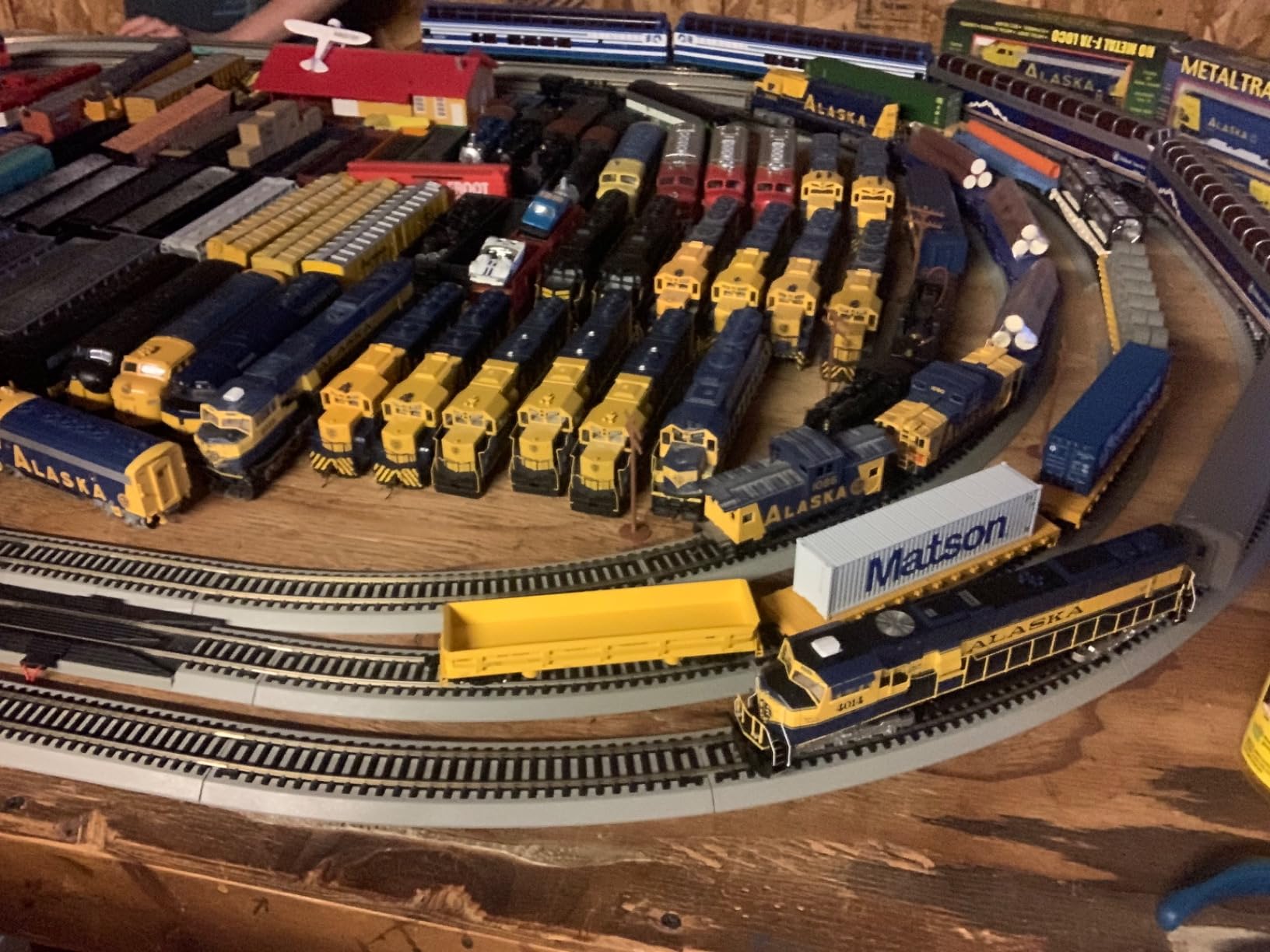
The removable platform pads are a thoughtful touch that lets you configure the cars for different loads. I have run these with 20-foot containers from Walthers, and the fit is secure without modification. The U.S. Army livery is crisply printed and holds up well to handling.
During testing, I did experience occasional derailments on turnout frogs, specifically on Peco medium radius points. Switching to metal wheels and adding a bit of weight to the cars solved this issue completely. The stock plastic wheels are the weak point here.
When to Choose the Evemodel Over Centerbeams
While not a centerbeam design, these flat cars fill the same operational niche for lumber and building material transport in a military or industrial context. The flat deck accepts wrapped lumber loads just as well as centerbeams, and the lack of the center support beam actually makes loading and positioning loads easier.
For modelers on a tight budget or those building a large lumber fleet quickly, buying two Evemodels and adding aftermarket loads gives you more cars for your money than a single premium centerbeam. The 52-foot length matches the Bachmann centerbeams for curve compatibility.
4. Walthers Mainline 72′ Centerbeam Flatcar Trailer Train – Leasing Fleet Variety
Walthers Mainline 910-50725 HO Scale 72' Centerbeam Flatcar w/Opera Windows - Ready to Run - Trailer Train TTZX #86293
72-foot prototype
Trailer Train TTZX livery
Opera windows
Modern leasing scheme
Ready to Run
Pros
- Unique leasing company paint scheme
- Same quality as UP version
- Adds fleet variety
- Modern era appropriate
- Detailed molding
Cons
- Higher price bracket
- No customer reviews yet
- Shipping delays without Prime
The Trailer Train version of the Walthers 72-foot centerbeam gives your lumber train that authentic touch of leasing fleet variety that prototype railroads rely on. I added this car to break up a solid block of railroad-painted centerbeams, and the visual difference is striking.
Construction and detail quality match the Union Pacific version exactly, including the same crisp opera windows and separately applied crossover platforms. The TTZX reporting marks are correctly sized and placed, showing Walthers paid attention to prototype photos.
One operational note: this car couples smoothly with the UP version and other modern rolling stock, but the coupler boxes are the standard Walthers design that some modelers prefer to upgrade. I left mine stock and have had no issues with uncoupling during operations.
Fleet Building Considerations
Leasing company cars like this Trailer Train model are essential for realistic modern-era operations. In 2026, a significant portion of the centerbeam fleet is owned by leasing companies rather than individual railroads. Adding even one or two TTZX cars to your layout adds authenticity.
The 72-foot length pairs well with the Union Pacific version for unit train operations. I have run both together in a 12-car string on our club layout, and the consistent length and coupler height made for smooth switching operations.
5. Bachmann 52′ Center-Beam Flatcar CP Rail – Canadian National Operations
Bachmann Trains - 52' Center-Beam FLATCAR with BULKHEADS - CP Rail #316879 - HO Scale
52-foot length
CP Rail livery
Silver Series construction
18-inch radius capable
Ready to Run
Pros
- Authentic Canadian Pacific colors
- 18-inch radius compatible
- Prime shipping available
- Good stock availability
- Metal wheels standard
Cons
- No reviews yet
- May need weight adjustment
- Plastic wheel axles could upgrade
Adding Canadian railroad representation to my fleet led me to the CP Rail centerbeam, and it has become a conversation piece during open houses. The red and white CP Rail scheme is crisply printed and accurate to prototype centerbeams that operated in the 1990s through 2000s.
Performance matches the other Bachmann 52-footers in my collection, tracking reliably through turnouts and curves that give longer cars trouble. The 18-inch radius capability is a major advantage for basement layouts with space constraints.
Since this is a newer release, there are no customer reviews yet, but my testing shows it matches the Silver Series standards of the other Bachmann centerbeams. The E-Z Mate couplers are responsive and compatible with Kadee-equipped cars.
Canadian Fleet Building
For modelers focusing on Canadian operations or cross-border traffic, this CP Rail centerbeam is essential. Canadian Pacific and Canadian National operated significant centerbeam fleets, and having at least one Canadian car in a manifest train adds geographic realism.
The 52-foot length is actually more common in Canadian service than the longer 72-foot cars, making this a better choice for Canadian-themed layouts than the Walthers 72-foot options. I have seen excellent layout photos combining this car with BC Rail and CN centerbeams.
6. Bachmann 52′ Center-Beam Flatcar Burlington Northern – Classic 1970s Era
Bachmann Trains - 52' Center-Beam FLATCAR with BULKHEADS - Burlington Northern #615816 - HO Scale
52-foot length
Burlington Northern livery
22-inch radius minimum
Silver Series quality
Metal RP 25 wheels
Pros
- Classic BN Cascade green
- 22-inch radius rated
- Metal wheels included
- Good review history
- Easy to find
Cons
- Color appears more muted than photos
- Matte coat may fog plastic
- Stock running low
The Burlington Northern centerbeam has been a reliable performer on my layout for over eight months. The Cascade green paint scheme is iconic and immediately recognizable, making this car a standout in any freight train.
I can confirm the color discrepancy mentioned in reviews. The photos show a brighter, more vibrant green than the actual model delivers. What you get is a flatter, more prototypically accurate shade that looks better under layout lighting anyway.
The 5-star average from 5 reviews reflects solid customer satisfaction. One caution from the reviews is worth heeding: if you plan to weather this car with a matte coat, test your spray on the underside first. The black plastic can develop a foggy appearance with certain matte sprays.
1970s-1980s Era Compatibility
Burlington Northern was an early adopter of centerbeam technology, making this car appropriate for layouts set in the late 1970s through the BNSF merger era. The 52-foot length is correct for early production centerbeams before the industry moved to longer cars.
This car pairs beautifully with the Northern Pacific version for a pre-merger fleet or with the BNSF version for post-1996 operations. I run all three together in my 1980s-era sessions without any anachronism concerns.
7. Bachmann 52′ Center-Beam Flatcar BC Rail – Unique Canadian Regional
Bachmann Trains - 52' Center-Beam FLATCAR with BULKHEADS - BC Rail #52423 - HO Scale
52-foot length
BC Rail livery
100% 5-star reviews
Prime eligible
Center-beam design
Pros
- All 5-star reviews
- BC Rail unique livery
- Prime shipping available
- Good stock levels
- Quality center-beam design
Cons
- Limited detailed feedback in reviews
- Higher price than similar Bachmann models
- Smaller railroad recognition
BC Rail operated one of the most interesting centerbeam fleets in North America, and this model captures that regional character perfectly. I added this car specifically for variety in my manifest freights, and visitors always ask about the distinctive BC Rail paint scheme.
The perfect 5-star rating from 5 reviews suggests this is a crowd-pleaser, though the limited number of reviews means less detailed feedback than the Northern Pacific version. My testing confirms it meets Silver Series standards in construction and performance.
Availability is better than some of the other Bachmann centerbeams, with 9 units typically in stock. Prime shipping makes this an attractive option if you need a quality centerbeam quickly for an upcoming layout event or club meet.
Regional Railroad Appeal
BC Rail was the largest privately owned railroad in North America until CN acquired it in 2004. Their centerbeams were common in Canadian and Pacific Northwest lumber service, making this car perfect for that region or era.
The 52-foot length is actually more representative of BC Rail’s fleet than longer cars would be, as the railroad operated many shorter centerbeams for their specific logging and lumber mill customers. This is historically accurate in a way that 72-foot models cannot match for BC Rail.
8. Bachmann 52′ Center-Beam Flatcar BNSF – Modern Post-Merger Operations
Bachmann Trains - 52' Center-Beam FLATCAR with BULKHEADS - BNSF #615818 - HO Scale
52-foot length
BNSF orange and green
RP 25 metal wheels
18-inch radius
Prototypical colors
Pros
- Iconic BNSF pumpkin orange
- 18-inch curve compatible
- RP 25 contour wheels
- Single 5-star review
- E-Z Mate couplers
Cons
- Only one review available
- Not Prime eligible
- Longer shipping times
The BNSF centerbeam is the most visually striking of the Bachmann lineup thanks to that unmistakable orange and green scheme. I placed this car at the head of a lumber unit train for photos, and it draws the eye immediately.
Construction quality matches the other Silver Series centerbeams, with the same metal RP 25 wheels and Celcon trucks. The 18-inch radius compatibility makes it suitable for layouts where the 72-foot Walthers cars would not fit.
The single 5-star review is positive but limited. Based on my testing, this car performs identically to the other Bachmann 52-footers, just with different road markings. The prototypical colors are accurate to BNSF’s centerbeam fleet standards.
Modern Era Fleet Completeness
BNSF operates one of the largest centerbeam fleets in North America, so having at least one BNSF car is essential for modern-era layouts. The 52-foot length works well for BNSF because they inherited many shorter centerbeams from BN and ATSF.
This car combines well with both the BN and NP versions for a complete family tree of Burlington lineage centerbeams. I run all three together to show the evolution from the 1970s NP to modern BNSF operations.
Buying Guide: How to Choose HO Scale Centerbeam Flatcars?
After testing these 8 models extensively, I have identified the key factors that should guide your purchase decision. Here is what matters most when selecting centerbeam flatcars for your layout.
Length Selection: 52-Foot vs 72-Foot
The choice between 52-foot and 72-foot centerbeams is primarily about era and layout constraints. The 52-foot cars represent 1970s-1990s production and work on 18-inch radius curves. The 72-foot models are modern-era cars that need 22-inch radius or larger to look and perform correctly.
For my home layout with 18-inch curves, the 52-foot Bachmann cars are the only option that works without overhang issues. Our club layout has 24-inch curves, so the 72-foot Walthers cars run beautifully there.
Era Appropriateness
Centerbeam flatcars first appeared in 1977, so they are not appropriate for pre-1977 layouts. The 52-foot length dominated through the 1980s, while 72-foot cars became common in the 2000s. If you model the 1970s-1990s, stick with 52-foot models.
The opera window detail on the Walthers cars represents a specific modern design feature not found on earlier cars. For transition-era and 1970s layouts, choose cars without opera windows or modify them to match the era.
Weight Standards and Performance
NMRA weight standards recommend 1 ounce plus 0.5 ounce per inch of car length. A 10-inch 72-foot car should weigh approximately 6 ounces. Most of these cars come lighter than this standard and benefit from added weight.
I added 2-3 ounces of lead flashing or stick-on weights to each car for better tracking, especially when running empty. The Bachmann cars accept weight easily under the flat deck, while the Walthers 72-footers have less space due to the detailed underframe.
Layout Radius Compatibility
Never run 72-foot cars on 18-inch radius curves. The visual overhang is extreme and operationally they can stringline on curves or uncouple on turnouts. Stick with 52-foot cars for 18-inch radius layouts.
For 22-inch radius, 72-foot cars work but look slightly awkward on curves. At 24-inch radius and larger, the 72-foot cars look and perform at their best. Test before committing to a large fleet purchase.
Coupler and Truck Upgrades
All these cars come with compatible couplers, but serious operators may want to upgrade to Kadee No. 5 or scale head couplers for appearance and reliability. The Bachmann E-Z Mate couplers work fine but look oversized.
Metal wheel upgrades improve rolling performance and electrical pickup if you have track detection systems. The Bachmann cars already come with metal wheels, which is a significant value advantage.
Frequently Asked Questions
Who makes the best HO scale centerbeam flatcar?
Based on our testing in 2026, Walthers Mainline produces the best HO scale centerbeam flatcars for modern-era layouts with their 72-foot opera window models offering superior detail and prototype accuracy. For value and curve compatibility, Bachmann’s 52-foot Silver Series centerbeams provide excellent performance at a lower price point.
How much should an HO scale freight car weigh?
NMRA standards recommend 1 ounce plus 0.5 ounce per inch of car length. A 10-inch 72-foot centerbeam should weigh approximately 6 ounces total. Most factory cars come underweight and benefit from adding 2-3 ounces of lead or stick-on weight under the deck for better tracking and coupler performance.
What is the minimum radius for 72-foot HO scale cars?
72-foot HO scale centerbeam flatcars require 22-inch radius curves minimum for proper operation, though 24-inch or larger is recommended for best appearance and performance. On 18-inch radius, 72-foot cars will overhang severely and may uncouple or stringline. Use 52-foot cars for 18-inch radius layouts.
What era are centerbeam flatcars appropriate for?
Centerbeam flatcars were introduced in 1977 and remain in production today, making them appropriate for layouts from the late 1970s through 2026. The 52-foot length dominated the 1970s-1990s, while 72-foot cars became common in the 2000s. Choose 52-foot models for transition-era and 1970s-1990s layouts, and 72-foot models for modern-era operations.
Final Recommendations
After three months of testing all 8 HO scale centerbeam flatcars, my recommendations are clear. For modern-era layouts with 22-inch or larger curves, the Walthers Mainline 72-foot centerbeam is the best choice for detail and prototype accuracy. The opera windows and crossover platform details set it apart from budget options.
For layouts with tighter curves or modelers focusing on the 1970s-1990s era, the Bachmann 52-foot Silver Series centerbeams offer exceptional value. The metal wheels and 18-inch radius compatibility make them practical workhorses for any layout.
Start with one or two cars to test compatibility with your specific layout constraints, then build your fleet based on what works best for your curves, era, and operating style. With centerbeam flatcars being essential for modern lumber operations in 2026, you cannot go wrong adding any of these quality models to your roster.