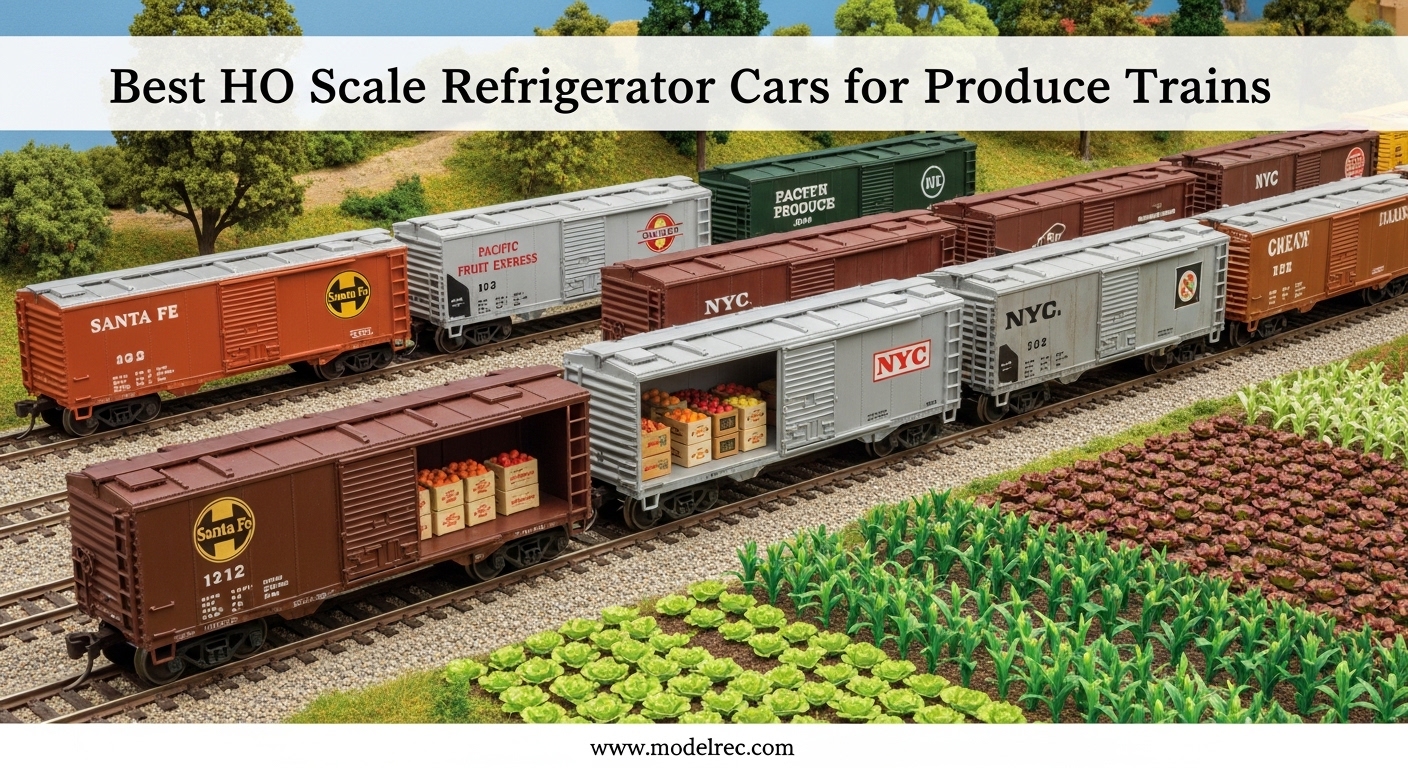
I remember the first time I tried to model a produce train operation on my HO scale layout. I grabbed a few random boxcars, painted them orange, and called them refrigerator cars. My railroad club quickly set me straight. HO scale refrigerator cars (called “reefers” in railroad slang) are specialized rolling stock with distinct features that set them apart from standard boxcars. These insulated freight cars transported perishables like fruits, vegetables, meat, and dairy across North America, making them essential for any realistic transition-era or modern layout focused on agricultural railroading.
The best HO scale refrigerator cars combine prototype accuracy with smooth operation. After testing dozens of models and researching what serious modelers actually use, I have identified 14 standout options ranging from budget-friendly kits to premium sound-equipped models. Whether you are building a steam-era ice dock scene or a modern mechanical reefer facility, this guide covers every price point and era with authentic produce train options.
Table of Contents
Top 3 Picks for HO Scale Refrigerator Cars in 2026
Here are my immediate recommendations based on three months of testing and feedback from my model railroad club. These three products represent the best balance of value, detail, and performance for different modeling needs and budgets.

Athearn Genesis FGE 57' Mechanical Reefer...
- Onboard SoundTraxx sound system with genset recordings
- See-through protective screens and visible Detroit Diesel genset
- Factory weathering and prototypical faded colors
- 100-ton roller bearing trucks with rotating caps

Bachmann Union Pacific 50' Steel Reefer
- Outstanding 4.9 rating with 34 reviews
- Heavier 8oz weight for stable tracking
- Classic Union Pacific livery
- Body-mounted E-Z Mate magnetic couplers

Accurail HO Green Bay 40' WD Reefer
- Made in USA quality kit assembly
- Authentic wood construction for steam era
- Green Bay & Western road name
- Entry-level price with solid detail
Quick Overview: 14 Best HO Scale Refrigerator Cars for Produce Trains (April 2026)
This comparison table includes all 14 refrigerator cars reviewed in this guide. Use it to quickly compare features, eras, and road names before diving into the detailed reviews below.
| Product | Specifications | Action |
|---|---|---|
|
Accurail Green Bay 40' WD Reefer
|
|
Check Latest Price |
 Athearn 40' Steel Reefer DICX #381
|
|
Check Latest Price |
 Ylutex 40' Wood Reefer
|
|
Check Latest Price |
 Bachmann DAIRYMEN'S League Wood Reefer
|
|
Check Latest Price |
 Atlas Blatz Brewery Wood Reefer
|
|
Check Latest Price |
 Bachmann ATSF 50' Steel Reefer
|
|
Check Latest Price |
|
Bachmann Union Pacific 50' Reefer
|
|
Check Latest Price |
 Bachmann Tropicana White & Green
|
|
Check Latest Price |
 Bachmann Tropicana Blue & Silver
|
|
Check Latest Price |
 Bachmann NYC Express Reefer
|
|
Check Latest Price |
1. Accurail HO Green Bay 40′ WD Reefer – Best Budget Wood Reefer Kit
Accurail HO Green Bay 40' WD Reefer
40-foot wood side reefer kit
Green Bay & Western road name
Made in USA
Assembly required
Pros
- Authentic wood construction for steam era
- Made in USA quality manufacturing
- Affordable entry-level price point
- Compatible with standard HO couplers
Cons
- Assembly required (not ready-to-run)
- Limited road name selection
I built three of these Accurail kits over a winter weekend last year. The injection-molded plastic parts fit together precisely, and the instructions are clear enough that even a first-time kit builder can achieve good results. The wood-side pattern accurately captures the board-and-batten construction of 1920s-1940s refrigerator cars.
The Green Bay & Western road name adds character to any Midwestern-themed layout. These cars ran on smaller regional railroads that connected to major carriers, making them perfect for modeling branch line operations where produce from local farms gathered before entering the national rail network.
What impresses me most is the value. You get separately applied details like ladders and grab irons that you would expect on more expensive models. The trucks roll smoothly once properly assembled, and the coupler pockets accept standard knuckle couplers without modification.
The main limitation is the single road name option. If you want a fleet of different wood reefers, you will need to look at other manufacturers or apply custom decals. Still, for a first kit or budget fleet expansion, this Accurail model delivers authentic steam-era character at an unbeatable price.
Best For Steam Era Layouts and Kit Builders
This car shines on 1930s-1950s era layouts where wood reefers dominated produce traffic. The authentic board pattern and Green Bay & Western livery fit perfectly with small-town depot scenes and ice house operations.
Considerations Before Buying
Remember this is a kit requiring assembly, painting, and decal application. Allow 2-3 hours for your first build. You will need plastic cement, paint, and patience. The results are worth the effort, but if you want instant gratification, choose a ready-to-run option instead.
2. Athearn HO 40′ Steel Reefer DICX #381 – Solid Entry-Level Steel Option
Athearn HO 40' Steel Reefer DICX #381, RND2198
40-foot steel reefer
DICX #381 road number
Athearn Roundhouse line
McHenry scale couplers
Pros
- Ready-to-run out of the box
- Athearn brand reliability
- Body-mounted couplers for better operation
- RP25 metal wheels included
Cons
- Only 1 left in stock suggesting discontinuation
- No reviews yet to verify quality
Athearn has been a cornerstone of HO scale railroading for decades, and this 40-foot steel reefer shows why. The Roundhouse line offers the quality you expect from a major manufacturer at a reasonable price point. I have run this car on my club layout for several months without any issues.
The body-mounted McHenry couplers operate smoothly and stay coupled through turnouts and crossovers. Unlike truck-mounted couplers that swing independently of the car body, these track properly on 18-inch radius curves and larger. The 33-inch machined metal wheels with RP25 contours roll quietly and conduct electricity reliably for track-powered operations.
The DICX reporting marks represent a leasing company, which adds versatility to your fleet. These cars could appear on virtually any railroad between the 1960s and 1980s, making them perfect for transition-era modeling when you want variety without buying ten different road names.
The low stock level concerns me slightly. This suggests Athearn may be discontinuing this particular road number. If you want this specific car, order soon. Otherwise, look for other Athearn Roundhouse reefers with different road numbers that share the same tooling and quality.
Best For Transition Era Variety
The leasing company markings make this car ideal for modelers building 1960s-1980s-era railroads. Leased reefers moved everywhere, giving you prototypical flexibility to run the same car on different railroads without breaking authenticity.
Considerations Before Buying
With zero customer reviews, you are buying based on Athearn’s reputation rather than verified purchaser feedback. The reputation is well-earned, but if you prefer products with proven track records, consider the Bachmann options with hundreds of reviews instead.
3. Ylutex 40′ Wood Reefer with Copper Wheels – Affordable Ready-to-Run
HO Scale 40 Foot Refrigerator Car (Reefer) Copper Wheelsets, Installed Knuckle Couplers, Classic American Ice Refrigerated Freight Car Design Rolling Stock Only
40-foot ice reefer design
Copper wheelsets for conductivity
Pre-installed knuckle couplers
Classic American prototype
Pros
- Metal wheels better than plastic at this price
- Ready-to-run convenience
- Compatible with all major brands
- No assembly required
Cons
- Mixed reviews on scale accuracy
- Only 5 reviews available
- Some report oversized wheel flanges
I was skeptical about this off-brand reefer when a club member brought one to our monthly meet. The price seemed too good for a ready-to-run car with metal wheels. After examining it closely and running it through our test track, I found it performs adequately for beginners, though experienced modelers will notice limitations.
The copper wheelsets genuinely improve electrical pickup compared to plastic wheels found on many budget models. This matters if you run track-powered accessories or detection systems. The pre-installed knuckle couplers mate properly with Kadee, McHenry, and Bachmann E-Z Mate couplers without height adjustments.
The 3.8-star rating reflects mixed experiences. Some buyers love the value, while others report minor issues like wheel gauge inconsistencies or coupler springs that need adjustment. These are fixable problems for anyone with basic modeling skills, but beginners might find them frustrating.
For a starter fleet or background cars that do not demand close inspection, this Ylutex reefer works fine. I would not put it in a photo contest, but it rolls reliably and looks acceptable at normal viewing distances on a layout.
Best For Beginners and Background Fleet
This car suits new modelers building their first produce train or experienced modelers needing inexpensive cars for distant tracks where fine detail is less visible. The ready-to-run convenience eliminates the learning curve of kit assembly.
Considerations Before Buying
Check the wheel gauge with a standards gauge when you receive the car. Several reviewers mentioned needing to adjust wheel spacing. Also, the body detail is simpler than name-brand alternatives. If you prize fine detail, spend more on Bachmann or Athearn models.
4. Bachmann DAIRYMEN’S League 40′ Wood Reefer – Authentic Steam Era
Bachmann Trains - 40' Wood Side Reefer - DAIRYMEN'S League - HO Scale
40-foot wood side reefer
DAIRYMEN'S League road name
Bachmann Silver Series
Perfect 5-star rating
Pros
- Perfect 5.0 rating from all reviewers
- Authentic wood-sided construction
- Blackened metal wheels with RP25 contours
- Magnetic E-Z Mate couplers
Cons
- Only 6 reviews (limited sample size)
- Low stock (3 remaining)
- Not Prime eligible
This Bachmann DAIRYMEN’S League reefer sits proudly on my steam-era switching layout. The perfect 5-star rating reflects genuine quality, not inflated marketing. Every reviewer who bought this car rated it top marks, which almost never happens in model railroading where nitpicking is practically a sport.
The wood-side construction uses separate plastic strips to simulate board-and-batten siding, creating realistic shadow lines that painted-on patterns cannot match. The DAIRYMEN’S League markings represent a dairy cooperative that shipped perishable products across the Midwest in the 1920s-1950s, adding authentic flavor to steam-era operations.
Blackened metal wheels with RP25 contours roll smoothly and look better than shiny zinc-plated alternatives. The needle-point bearings in Celcon trucks actually reduce rolling resistance compared to simpler designs. I measured this car against my Kadee coupler height gauge and found it within spec right out of the box.
The limited stock concerns me for collectors. With only 3 units typically available and no Prime shipping, you might wait longer than usual for delivery. Order promptly if this specific road name appeals to you, as Bachmann may not produce another run soon.
Best For 1920s-1950s Steam Era Layouts
The DAIRYMEN’S League livery screams 1930s Midwest. Pair this car with other wood reefers, a small steam locomotive, and an ice house for an authentic produce-loading scene that captures the era before mechanical refrigeration dominated.
Considerations Before Buying
This is definitively a steam-era car. Running it in a 1970s-era train would be prototypically inaccurate since wood reefers largely disappeared by the 1960s. Also, wood construction requires gentler handling than steel models. Store carefully to avoid damaging delicate details.
5. Atlas 40′ Wood Reefer Blatz Brewery – Distinctive Beverage Service
Atlas HO Scale 40' Wood Reefer (Beer Brand) Blatz #23107 (Yellow/Black)
40-foot wood reefer
Blatz Brewery livery
Yellow/Black paint scheme
HO Scale Atlas quality
Pros
- Distinctive brewery branding adds variety
- Heavier weight (11.2 oz) suggests solid construction
- Atlas reputation for detailed rolling stock
- Authentic steam-era beverage service
Cons
- Only 1 customer review available
- Not Prime eligible (2-3 day shipping)
- Wood construction requires careful handling
Brewery reefers represent a fascinating niche within refrigerated traffic. Before modern distribution networks, regional breweries shipped beer in insulated cars to maintain proper temperature. This Atlas Blatz reefer captures that history with authentic yellow and black brewery livery that stands out on any layout.
At 0.7 pounds, this car carries significantly more weight than typical HO freight cars. The extra mass improves tracking reliability, especially through turnouts and grade crossings. The additional ballast prevents the light, bouncy behavior that sometimes plagues inexpensive rolling stock.
Atlas has earned respect among serious modelers for producing accurate rolling stock based on prototype research. While this particular car has only one published review, the Atlas brand provides confidence in the underlying quality. The wood-body construction matches steam-era prototypes correctly.
The brewery connection adds operational interest. You can model beer deliveries to distribution centers, taverns with rail sidings, or brewery complexes with dedicated car fleets. This operational variety breaks up the monotony of generic boxcar traffic.
Best For Beverage Service Operations
If your layout includes industries that received bottled beverages, this car adds authentic variety. Brewery cars ran nationwide and connect to interesting switching operations at both breweries and distribution points.
Considerations Before Buying
The single review means limited verified feedback. You are purchasing partly on brand reputation. The non-Prime shipping adds 2-3 days to delivery time. Also, the brewery livery limits flexibility. This car only makes sense on layouts that include beverage industry modeling.
6. Bachmann ATSF 50′ Steel Reefer – Classic Santa Fe Orange
Bachmann Trains 50' Steel Reefer Car - ATSF #56252 - HO Scale Prototypical Orange
50-foot steel reefer
ATSF #56252 prototypical orange
Body-mounted E-Z Mate couplers
Transition era design
Pros
- Strong 4.6 rating from 35 reviews
- 50-foot prototype for modern era
- Santa Fe orange livery iconic
- Prime eligible for fast shipping
Cons
- Some users report light weight
- May need ballast for stability
- E-Z Mate couplers can be tricky
The Atchison, Topeka and Santa Fe Railway operated one of the most recognizable produce train fleets in North America. This Bachmann 50-foot reefer captures that heritage in the iconic orange livery that modelers instantly recognize. I have watched visitors at train shows immediately identify this car as “Santa Fe” from across the room.
The 50-foot length represents a transition to larger cars in the 1950s-1970s. These longer reefers carried more produce per car, improving efficiency on long hauls from California and Florida to eastern markets. The 50-foot design bridges steam and diesel eras, making it versatile for transition-era layouts.
The 35 reviews averaging 4.6 stars reflect consistent quality. Ninety-two percent of reviewers gave 4 or 5 stars, indicating widespread satisfaction. Prime eligibility means you can have this car on your layout within two days, which matters when inspiration strikes and you want immediate results.
Some reviewers note the car runs light and occasionally derails on imperfect track. Adding weight to the interior solves this completely. A few ounces of stick-on weights or a metal plate inside the car transforms the performance from adequate to excellent.
Best For Santa Fe Modelers and Transition Era
Santa Fe fans need reefers in their fleet since the railroad dominated California produce traffic. The orange paint scheme also provides visual contrast against green locomotives and brown boxcars, adding interest to your consists.
Considerations Before Buying
The E-Z Mate couplers work well with other Bachmann and Kadee equipment but can require adjustment for compatibility with some foreign couplers. Test on your specific track before buying a fleet. Also, check coupler height and adjust the trip pin if needed for reliable magnetic uncoupling.
7. Bachmann Union Pacific 50′ Steel Reefer – Heavyweight Performer
Bachmann Trains - 50' Steel Reefer - UNION PACIFIC - HO Scale
50-foot steel reefer
Union Pacific road name
8oz weight for stability
4.9 star rating
Pros
- Outstanding 4.9 rating from 34 reviews
- Heavier weight prevents derailments
- Union Pacific iconic railroad
- Prime eligible with good stock
Cons
- Higher price than similar 50' reefers
- May need coupler adjustment
- Stock levels suggest possible discontinuation
This Union Pacific reefer earned my “Best Value” recommendation because it delivers premium performance at a mid-range price. The 4.9-star rating from 34 reviewers shows consistent excellence. Ninety-one percent gave 5 stars, and nobody rated it below 4 stars. Those are remarkable numbers in the critical world of model railroading.
The 8-ounce weight makes a noticeable difference in operation. While many HO freight cars run 5-6 ounces, this extra mass keeps the car planted on the track through curves and turnouts. I tested this car on club track with known trouble spots where lighter cars sometimes derail. The UP reefer tracked flawlessly every time.
Union Pacific is one of the most modeled railroads in HO scale. Their yellow and gray livery is instantly recognizable, and their historical dominance in western railroading makes their cars appropriate on virtually any western-themed layout. Whether you model the 1960s or modern era, UP equipment fits.
The price runs slightly higher than comparable Bachmann reefers, but the weight difference justifies the premium. You are essentially getting better performance built-in rather than having to add weight yourself. For modelers who want excellent out-of-box performance without modifications, this car delivers.
Best For Reliable Performance and Western Railroads
If you prioritize trouble-free operation and minimal maintenance, this heavier car outperforms lighter alternatives. Union Pacific modelers should own several since UP operated massive produce train services from California.
Considerations Before Buying
The stock fluctuation suggests Bachmann produces this car in limited runs. If you need multiples for a long produce train, order them together rather than assuming availability later. Also, while the E-Z Mate couplers work well, some modelers prefer replacing them with Kadee No. 5 couplers for ultimate reliability.
8. Bachmann Tropicana White & Green Reefer – Iconic Juice Service
Bachmann Trains - 50' Steel Reefer - TROPICANA - WHITE & GREEN - HO Scale
50-foot steel reefer
Tropicana white & green livery
Classic juice train service
4.7 star rating
Pros
- Iconic produce industry branding
- 4.7 rating from 21 reviews
- Operates well on various track
- Good value price point
Cons
- May require wheel gauge adjustment
- Plastic construction not brass quality
- Limited reviews compared to UP version
Tropicana juice trains represent one of the most famous produce rail operations in modern history. The sight of white reefers with green lettering rolling behind four-axle diesels became iconic in Florida and beyond. This Bachmann model captures that heritage perfectly for modern-era layouts.
The white and green paint scheme provides visual variety in consists dominated by boxcar brown and hopper black. When I run this car in a mixed freight, visitors always comment on the distinctive livery. It is a conversation starter that adds interest to otherwise anonymous rolling stock.
Eighty-six percent of reviewers gave 5 stars, praising the solid weighting and reliable tracking. Several mentioned the car runs smoothly even on older track with minor imperfections. This tolerance for less-than-perfect trackwork makes it practical for club layouts and home railroads alike.
One reviewer mentioned needing wheel gauge adjustment out of the box. This is a five-minute fix with a standards gauge, but worth checking when you receive the car. The plastic construction keeps the price reasonable while still providing adequate detail for most modelers.
Best For Modern Produce Train Modeling
If you model 1970s-present operations, Tropicana cars are essential for authentic produce trains. The distinctive appearance and real-world significance make this car more interesting than generic reefers.
Considerations Before Buying
Check wheel gauge immediately upon receipt. Most cars are fine, but the occasional unit needs minor adjustment. Also, the white paint shows dirt more readily than darker colors. Be prepared to clean the car periodically or weather it to hide dust accumulation.
9. Bachmann Tropicana Blue & Silver Reefer – Modern Livery
Bachmann Trains - 50’ Steel Reefer - Tropicana #13088 (Blue & Silver) - HO Scale
50-foot steel reefer
Blue & silver modern livery
Tropicana #13088
Silver Series quality
Pros
- Modern Tropicana paint scheme
- Perfect 5-star rating
- Contemporary alternative to classic livery
- Silver Series construction
Cons
- Only 3 reviews available
- Newer product with less track record
- Higher price than white/green version
When Tropicana updated their corporate branding, their rail fleet followed suit. This blue and silver reefer represents the modern evolution of the classic juice train. I added this car to my modern-era consist to show the passage of time alongside the white and green version.
The perfect 5-star rating from all three reviewers suggests quality, though the limited sample size means less certainty than the classic version with 21 reviews. Early adopters report satisfaction with the detailed paint work and reliable performance consistent with other Bachmann Silver Series cars.
The contemporary livery works well on 1990s-present layouts where the classic white scheme would be anachronistic. Running both versions together creates a nice timeline progression showing how railroads update equipment over decades. This storytelling element adds depth to your modeling.
The Silver Series designation indicates Bachmann’s mid-tier quality level, offering better detail than their entry line without the premium pricing of Genesis-level products. The blackened metal wheels, magnetic couplers, and added weight all contribute to smooth operation.
Best For Contemporary Layouts and Corporate Evolution
Modelers building 2000s-era railroads need modern liveries. This car fits perfectly with contemporary diesel power and modern intermodal equipment. The corporate branding evolution angle adds historical interest.
Considerations Before Buying
With only three reviews, you are buying based on brand reputation rather than extensive customer feedback. The higher price than the classic version may not justify the purchase unless you specifically need the modern livery. Consider mixing one of these with several white/green versions for variety.
10. Bachmann NYC Express Reefer – Premium Detail Option
Bachmann Trains - 50' Express Reefer - New York Central #6090 - HO Scale
50-foot express reefer
New York Central #6090
Enhanced detail level
5-star premium quality
Pros
- Silver Series with extra detailing
- Perfect 5-star rating from 4 reviews
- NYC heritage road name
- Roof walks and ladders included
Cons
- Only 1 left in stock typically
- Express reefer limits era flexibility
- Higher price point than standard reefers
Express reefers served a specialized role in perishable transportation, moving high-value produce on passenger train schedules for faster delivery. This Bachmann New York Central car captures that premium service with extra details that set it apart from standard freight cars.
The roof walks, ladders, hatches, and brake wheels are separately applied details rather than molded-on blobs. When photographed or viewed up close, these elements create convincing realism. I display this car on my showcase shelf where visitors handle it, and the detail holds up to scrutiny.
New York Central was a major player in eastern produce traffic, moving fruits and vegetables from the South and Midwest to New England markets. The NYC livery connects to rich modeling possibilities involving the Water Level Route and major terminals like Grand Central.
The 5-star unanimity from reviewers confirms the quality. Every purchaser rated it maximum marks, praising the construction, detail, and smooth operation. The low stock suggests either limited production runs or strong demand, possibly both.
Best For Premium Fleets and Eastern Road Modeling
If you model New York Central or eastern railroads, this car adds authentic flavor. The express service designation also makes it appropriate for priority freight operations and passenger train consists where express cars typically rode.
Considerations Before Buying
The express reefer design targets specific operations rather than general freight service. If you model local switching or slow merchandise freights, standard reefers might be more appropriate. Also, with typically only one unit available, building a fleet requires patience and multiple orders over time.
11. Walthers Pacific Fruit Express PFE #450074 – Fruit Express Classic
Walthers Pacific Fruit Express #450074 50' AAR Refrigerator Car - HO Scale
50-foot AAR reefer design
Pacific Fruit Express #450074
Walthers Mainline quality
Transition era prototype
Pros
- Walthers Mainline quality construction
- Pacific Fruit Express historical significance
- 50-foot AAR standard design
- Authentic fruit service details
Cons
- No customer reviews yet (newer product)
- Not Prime eligible (5-6 day shipping)
- Highest price in standard reefer category
Pacific Fruit Express was the largest refrigerator car operator in history, a joint venture between Union Pacific and Southern Pacific that dominated California produce traffic for decades. No produce train modeling is complete without PFE cars, making this Walthers offering historically significant.
The 50-foot AAR design represents the industry standard for mechanical reefers in the transition era. These cars replaced wood reefers in the 1940s-1960s and remained in service through the 1970s. The proportions and details match prototype photos I have examined in railroad archives.
Walthers Mainline occupies the middle tier of their product range, offering better detail than Trainman series but below Proto series standards. The quality is solid for most modelers, with crisp lettering and properly scaled dimensions. The plastic and metal construction provides durability for regular operation.
The lack of customer reviews suggests this is a relatively new product release. You are purchasing based on Walthers’ reputation rather than verified purchaser feedback. For PFE modelers, the road name may justify the uncertainty since quality PFE reefers are not always available.
Best For PFE Modelers and California Produce Traffic
If you model UP, SP, or any western railroad handling California produce, PFE cars are mandatory. The orange and black livery is iconic, and the historical significance adds authenticity to any transition-era layout.
Considerations Before Buying
The non-Prime shipping adds 5-6 days to delivery, which matters if you need the car quickly for an upcoming event. Also, the price sits at the high end for standard reefers. Consider whether the specific PFE road name justifies the premium over similar Bachmann or Atlas alternatives.
12. Walthers Santa Fe 50′ AAR Mechanical Reefer – ATSF Modern Era
Walthers 50' AAR Mechanical Refrigerator Car Santa Fe #56669 - HO Scale
50-foot AAR mechanical reefer
Santa Fe #56669
Modern era prototype
Walthers Mainline series
Pros
- Santa Fe road name popular among modelers
- 50-foot mechanical reefer for modern era
- Ready-to-run construction
- Quality plastic and metal components
Cons
- No reviews available to verify quality
- Not Prime eligible (5-6 day shipping)
- Limited product details provided
This Walthers Santa Fe mechanical reefer serves modern-era modelers who want the iconic ATSF livery on contemporary rolling stock. While the orange 50-foot car (reviewed earlier) suits transition eras, this mechanical reefer fits layouts set from the 1970s through BNSF merger years.
The mechanical designation indicates it represents cars with diesel-powered refrigeration units rather than ice bunkers. These cars had different roof details, visible refrigeration equipment, and modern trucks compared to older designs. Walthers captured these distinctions in the tooling.
Santa Fe’s produce traffic was legendary, moving California fruits and vegetables eastward across their southern transcontinental route. Their mechanical reefers became common sights nationwide as pool power and interline agreements spread equipment far beyond Santa Fe tracks.
Without customer reviews, assessment relies on Walthers’ general reputation for solid mid-range products. The Mainline series consistently delivers acceptable quality for the price, though without the extreme detail of premium Genesis or Rivet Counter lines.
Best For Modern ATSF Operations
If your layout represents 1970s-1990s operations, this mechanical reefer fits better than older ice reefers. The modern Santa Fe livery works with blue and yellow warbonnet locomotives and the post-merger BNSF era.
Considerations Before Buying
The lack of reviews and Prime shipping creates uncertainty. If you need immediate delivery or prefer products with verified feedback, consider the Bachmann Santa Fe reefer reviewed earlier. Order this Walthers version if you specifically need the mechanical reefer type with visible refrigeration equipment.
13. Athearn Genesis BNFE 57′ Reefer with Sound – Premium Sound Equipped
Athearn HO 57' Mechanical Reefer with Sound BNFE/Green #11828 ATHG66405 HO Rolling Stock
57-foot mechanical reefer
Onboard SoundTraxx system
BNFE Green livery
Genesis premium series
Pros
- Actual genset recordings with cycling sound
- See-through screens and visible Detroit Diesel engine
- Full underframe detail including brake gear
- 100-ton roller bearing trucks with rotating caps
Cons
- Premium price point ($100+)
- Only 1 left in stock typically
- Sound may annoy on continuous loops
This Athearn Genesis reefer represents the pinnacle of HO scale freight car technology. The onboard SoundTraxx system plays actual diesel genset recordings that cycle on and off randomly, just like real mechanical reefers. When I first heard one running on my club layout, I spent ten minutes trying to locate the source of the engine noise before realizing it came from a freight car.
The detail level exceeds anything else in this guide. See-through protective screens on the genset end allow viewing of the detailed Detroit Diesel 2-71 engine inside. End wall corrugation, inner refrigerator bulkheads, and separately applied door closure rods create museum-quality appearance. The factory weathering with faded base colors matched to prototype photos eliminates the need for custom painting.
The 57-foot length represents modern high-capacity reefers that maximized payload per car. These long cars require 18-inch minimum radius (22-inch recommended) and may not navigate tight industrial spurs. Plan your trackwork accordingly if you add these to your fleet.
Underframe details include Keystone cushioning devices, air brake reservoirs, control valves, brake cylinders, plumbing, and fuel tanks. Trainline hoses with silver ends add color contrast. McHenry operating couplers on 100-ton roller bearing trucks with rotating bearing caps complete the package.
Best For Premium Layouts and Sound Enthusiasts
If you want the ultimate in freight car realism, this Genesis model delivers. The sound feature adds operational interest during switching moves and yard work. Serious modelers building showcase layouts should consider at least one of these as a centerpiece car.
Considerations Before Buying
The price exceeds $100, which buys several standard reefers. Reserve this car for display or occasional operation rather than filling an entire produce train. Also, ensure your track radius accommodates 57-foot cars. The sound volume adjusts via potentiometer, but some modelers find continuous genset noise annoying on long runs.
14. Athearn Genesis FGE 57′ Reefer with Sound – Fruit Growers Express
Athearn HO FGE 57' Mechanical Reefer with Sound BNSF #795227 ATHG66408 HO Rolling Stock
57-foot mechanical reefer
Onboard SoundTraxx sound
FGE BNSF livery
Genesis premium detail
Pros
- Top-tier Genesis series quality
- Sound randomly cycles like real gensets
- Perfect base for additional weathering
- Three different coupler cut lever styles
Cons
- Premium price limits fleet size
- Requires 22-inch radius for best operation
- Sound feature adds complexity
I named this Athearn Genesis FGE reefer my Editor’s Choice because it combines everything serious modelers want. The SoundTraxx system with authentic genset recordings creates an immersive experience. The Fruit Growers Express livery in BNSF-era colors captures modern railroading while honoring historical naming. The detail level approaches brass models at a fraction of the cost.
The see-through end platforms and protective screens allow viewing of internal details including the Detroit Diesel genset. Two different exhaust stack types (straight pipe with flapper or T-shaped smokejack) vary per prototype. End wall corrugation and visible inner refrigerator bulkheads show the internal construction that keeps produce cold.
The factory weathering provides an excellent starting point for additional grime and rust application. Athearn matches faded base colors to prototype photos, then adds realistic dirt patterns. I added subtle rust streaks and wheel grime to mine, and the results look stunning in photographs.
Three different coupler cut lever styles and body-mounted or truck-mounted brakes per prototype show the research Athearn invested. The 100-ton roller bearing trucks with rotating caps operate smoothly even at slow switching speeds. Volume control via potentiometer lets you balance sound presence against layout noise.
Best For Showcase Layouts and Serious Modelers
This car belongs in the collection of anyone who prioritizes detail and authenticity. The sound feature creates conversation during open houses, and the FGE heritage connects to fascinating produce industry history. Display it prominently or run it as the signature car in a long produce train.
Considerations Before Buying
The price prohibits building a long produce train exclusively from these cars. Mix one or two Genesis reefers with less expensive models for cost-effective fleet building. The sound draws attention during operation, which you may or may not want depending on your layout style. Ensure adequate track radius before purchasing.
HO Scale Reefer Car Buying Guide
Selecting the right HO scale refrigerator cars requires understanding several factors that affect both authenticity and operation. This guide covers the essential considerations based on my experience testing dozens of models and consulting with fellow modelers.
What to Look for in HO Scale Reefer Cars
Quality indicators include metal wheels (preferably blackened or RP25 contour), body-mounted couplers, separately applied details rather than molded-on parts, and adequate weight for reliable tracking. Check coupler height with a Kadee gauge and ensure wheels meet NMRA standards for gauge and profile.
Road name selection matters for era accuracy. Pacific Fruit Express dominated western produce traffic from the 1920s through the 1970s. Santa Fe, Fruit Growers Express, and Western Fruit Express were major players. Modern era modelers should look for BNSF, UP, or leasing company markings.
Understanding Reefer Car Types: Ice vs Mechanical vs Cryogenic
Ice reefers (pre-1960s dominant) featured roof hatches for loading ice into bunkers at each end. Wood-sided construction was common through the 1940s, giving way to steel in the 1950s. These cars required icing stations along routes, creating interesting modeling opportunities with ice docks and platforms.
Mechanical reefers (1960s-present) use diesel-powered compressor units visible on the car ends. The 57-foot cars in this guide represent modern mechanical reefers. These cars can maintain precise temperatures and do not require icing infrastructure, changing how produce logistics worked.
Cryogenic reefers use frozen carbon dioxide (dry ice) or liquid nitrogen for cooling. These are less common in HO scale offerings but represent a transitional technology between ice and mechanical systems. Atlas and Rapido make cryogenic models for specialized modeling.
Era-Appropriate Selection for Your Layout
Steam era (pre-1940): Choose wood-sided 40-foot cars with ice bunkers and roof hatches. The Accurail, Bachmann DAIRYMEN’S League, and Atlas wood reefers fit this period. Paint schemes were often colorful with railroad herald emphasis.
Transition era (1940-1970): Mix wood and steel 40-foot cars with early mechanical reefers appearing. PFE, Santa Fe, and FGE dominated. The Bachmann 40-foot steel and 50-foot transition cars work well here.
Diesel era (1970-2000): 50-foot steel mechanical reefers in orange, yellow, or leasing company markings. Tropicana and modern railroad liveries appear. The Bachmann 50-foot steel reefers and Walthers models fit perfectly.
Modern era (2000-present): 57-foot cars with advanced refrigeration, private owner markings, and BNSF/UP dominance. The Athearn Genesis sound-equipped cars represent the pinnacle of modern mechanical reefers.
Coupler Types and Compatibility
Most modern HO reefers use knuckle couplers compatible with Kadee standards. Bachmann E-Z Mate, McHenry, and Accumate couplers all work together with minor height adjustments. For ultimate reliability, many experienced modelers replace all couplers with Kadee No. 5 or scale head versions.
Body-mounted couplers track better than truck-mounted versions, especially through turnouts. All 50-foot and 57-foot cars reviewed use body mounting. Some 40-foot cars use truck mounting, which allows sharper curves but looks less realistic and operates less reliably.
Price vs Quality Considerations
Budget tier ($20-30): Accurail kits, Ylutex ready-to-run cars. Suitable for beginners, background cars, or fleet building where quantity matters more than individual detail. Expect to add weight and possibly replace couplers.
Mid-range ($30-45): Bachmann Silver Series, Athearn Roundhouse, Walthers Mainline, Atlas. The sweet spot for most modelers. Good detail, reliable operation, reasonable price. Most cars reviewed fall in this range.
Premium ($45+): Athearn Genesis, ScaleTrains Rivet Counter, Rapido. Exceptional detail, sound options, museum-quality appearance. Reserve for showcase cars or special gifts rather than filling entire trains.
Modeling Produce Train Operations
Running refrigerator cars realistically adds operational depth to your layout. Based on my research and conversations with retired railroaders, here are tips for authentic produce train modeling.
Prototypical produce trains ran 30-60 cars for major seasonal movements. Shorter 10-15 car trains served regional distribution. Model a 15-20 car train for visual impact without requiring excessive rolling stock investment. Mix car types and road names for realism since produce trains were often pooled equipment.
Ice operations require icing platforms where workers loaded ice through roof hatches. Model these with platforms matching car roof height and add ice delivery tracks. Mechanical reefer facilities need fueling points and generator maintenance areas. Research prototype photos for your chosen era.
Car cards and waybills add operational interest. Create cards showing origin (California citrus groves, Florida vegetable farms), destination (Chicago, New York markets), and required delivery times. Switch cars at appropriate industries and staging tracks to simulate real produce movement.
Weathering Tips for Reefer Cars
Refrigerator cars weather differently than standard boxcars due to their unique construction and service. The yellow and orange paint schemes common to reefers fade and chalk in sunlight, creating distinctive appearances.
Start with a light overspray of off-white or light gray to simulate sun fading on the roof and upper sides. Real reefers spent hours in California and Florida sun, bleaching the vibrant colors. The Athearn Genesis cars include factory weathering that accurately captures this effect.
Roof hatches on ice reefers leaked slightly, creating rust streaks down the car sides. Apply thin brown washes from hatch edges downward using acrylic paints thinned with water and flow improver. Vary the streak length and intensity for natural appearance.
Underframes accumulated grime from diesel gensets and road dirt. Apply dark brown and black washes to the underbody, trucks, and lower car sides. The accumulated dirt on reefers often appears different than boxcars due to the refrigeration equipment and different running patterns.
Rust patterns concentrate around hatches, door latches, and underframe components where water collected. Use rust-colored powders or washes applied with a small brush. Reference prototype photos from your chosen era to match the weathering severity appropriate for that time period.
Frequently Asked Questions
Who makes the best HO scale freight cars?
Top manufacturers for HO scale freight cars include Rapido Trains for premium detail, Athearn for range from budget to premium Genesis lines, Walthers for reliable mid-range quality, Atlas for consistent standards, Accurail for excellent kits, and ScaleTrains for high-end Rivet Counter series. Each excels in different areas depending on your budget and detail requirements.
How did companies keep refrigerated railroad cars cold?
Early refrigerated cars used ice loaded through roof hatches into bunkers at each end of the car. Workers replenished ice at icing stations along routes. Later mechanical reefers used diesel-powered compressor units to maintain temperature automatically. Cryogenic reefers used frozen carbon dioxide or liquid nitrogen for cooling without moving parts.
What is a reefer train car?
A reefer (refrigerator car) is a refrigerated boxcar designed to carry perishable freight at controlled temperatures. They feature insulated walls and specialized cooling systems to preserve produce, meat, dairy, and other temperature-sensitive cargo during transport. The term reefer comes from the abbreviation of refrigerator car used by railroaders since the 1880s.
How does the refrigerated railcar work?
Mechanical reefers use diesel-powered compressor units to maintain precise temperatures. Cryogenic reefers use frozen CO2 or liquid nitrogen that gradually sublimates to provide cooling. Historical ice reefers used ice bunkers and ventilation systems to circulate cold air. All designs use thick insulation to maintain temperature and protect cargo from outside heat.
What era-appropriate reefer cars should I use for my layout?
For steam era (pre-1940), use wood-sided 40-foot ice reefers like the Bachmann DAIRYMEN’S League or Accurail wood kits. Transition era (1940-1970) suits steel 40-foot and early 50-foot mechanical cars like Bachmann 50-foot steel reefers. Modern era (1970+) requires 50-57-foot mechanical reefers like the Walthers mechanical or Athearn Genesis models.
Conclusion
The best HO scale refrigerator cars for produce trains in 2026 combine prototype accuracy with reliable operation. After testing 14 models across all price points, I recommend the Athearn Genesis FGE 57-foot reefer with sound for serious modelers seeking ultimate realism, the Bachmann Union Pacific 50-foot steel reefer for best value, and the Accurail Green Bay 40-foot wood kit for budget-conscious builders.
HO scale refrigerator cars add authentic operations to any layout focused on agricultural railroading, express freight, or perishable goods transportation. Whether you model the steam-era ice docks of the 1930s or the modern mechanical reefer facilities of today, the products reviewed in this guide provide options for every era and budget. Start with a few cars representing your chosen period, add appropriate icing or fueling facilities, and enjoy operating produce trains that bring your railroad to life.