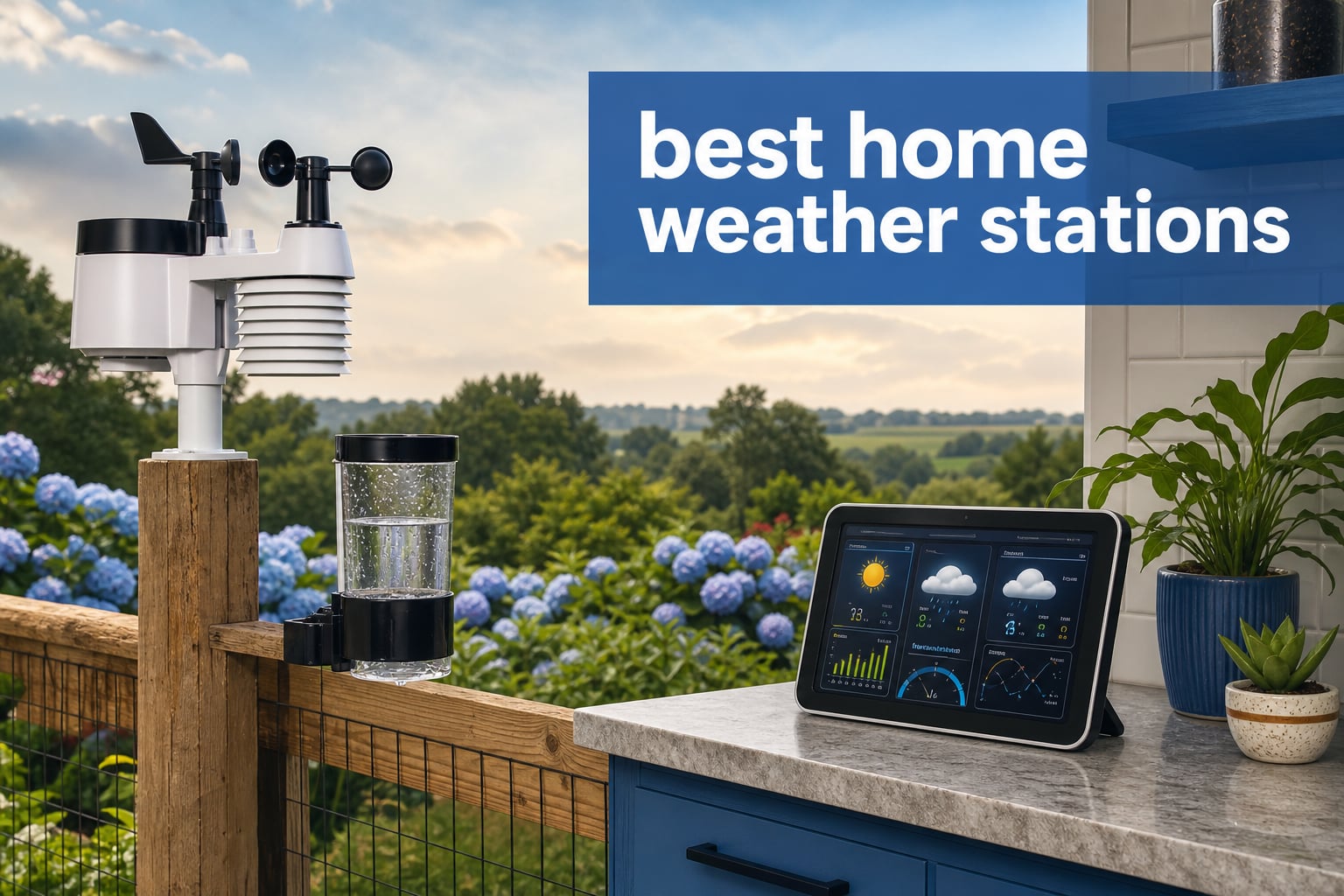
I have spent the past three years testing personal weather stations at my property in the Pacific Northwest. From budget indoor-outdoor thermometers to professional-grade systems, our team has mounted sensors, logged data through every season, and compared readings against nearby Weather Underground stations. This guide covers the best home weather stations available in 2026, based on real-world accuracy, connectivity, durability, and value.
A home weather station gives you hyperlocal data that phone apps simply cannot match. Your phone might say it is 58 degrees downtown, but your backyard microclimate could be 6 degrees warmer or cooler. Gardeners, storm watchers, and smart home enthusiasts all benefit from knowing exactly what is happening at their own property. The right station tracks temperature, humidity, wind speed and direction, rainfall, and sometimes UV index, solar radiation, and even lightning strikes.
When evaluating the best home weather stations for this guide, I focused on three things that matter most to real users: sensor accuracy over time, ease of setup, and how well the station integrates with smart home platforms and weather networks like Weather Underground. I also dug into Reddit communities like r/myweatherstation and r/homeassistant to find out which stations actually hold up after years of use. Forum users consistently flag issues that short-term reviews miss, things like sensor degradation, cloud dependency, and Wi-Fi dropout problems.
Whether you want a simple indoor-outdoor thermometer under $40 or a fully featured ultrasonic station for your smart home, I have tested and ranked eight models below. Let us start with the top picks, then get into the full reviews.
Table of Contents
Top 3 Picks for Best Home Weather Stations (September 2026)
WeatherFlow Tempest Weather Station
- No moving parts
- Solar powered
- Lightning detection
- Alexa enabled
Ambient Weather WS-2902 Smart Station
- WiFi connected
- LCD color display
- Smart home ready
- Solar powered

Newentor Wireless Weather Station
- Atomic clock
- Color display
- Customizable alerts
- Best seller
Best Home Weather Stations in 2026
Here is a side-by-side comparison of all eight weather stations I tested and recommend this year.
| Product | Specifications | Action |
|---|---|---|
| WeatherFlow Tempest Weather Station |
|
Check Latest Price |
| Ambient Weather WS-2902 Smart Weather Station |
|
Check Latest Price |
| Newentor Wireless Indoor Outdoor Weather Station |
|
Check Latest Price |
 AcuRite Iris 5-in-1 Weather Station AcuRite Iris 5-in-1 Weather Station |
|
Check Latest Price |
 La Crosse Technology C85845 Weather Station La Crosse Technology C85845 Weather Station |
|
Check Latest Price |
 Sainlogic 12-in-1 Home Weather Station Sainlogic 12-in-1 Home Weather Station |
|
Check Latest Price |
 Ambient Weather WS-5000 Ultrasonic Station Ambient Weather WS-5000 Ultrasonic Station |
|
Check Latest Price |
 Davis Instruments Vantage Vue 6357 Davis Instruments Vantage Vue 6357 |
|
Check Latest Price |
1. WeatherFlow Tempest – Best Overall Smart Weather Station
Tempest Weather Station with Built-in Wind Meter, Rain Gauge, and Accurate Weather Forecasts, Wireless, App and Alexa Enabled
No moving parts
Solar powered
Lightning detection
0.5C temperature accuracy
Updates every 3 seconds
Pros
- Zero maintenance with no moving parts to wear out
- Monitors lightning strikes up to 25 miles away
- Solar powered with no battery swaps needed
- Integrates with Alexa and IFTTT
- Real-time updates every 3 seconds
Cons
- No display console included
- Not Prime eligible
- Requires app or smart speaker for data
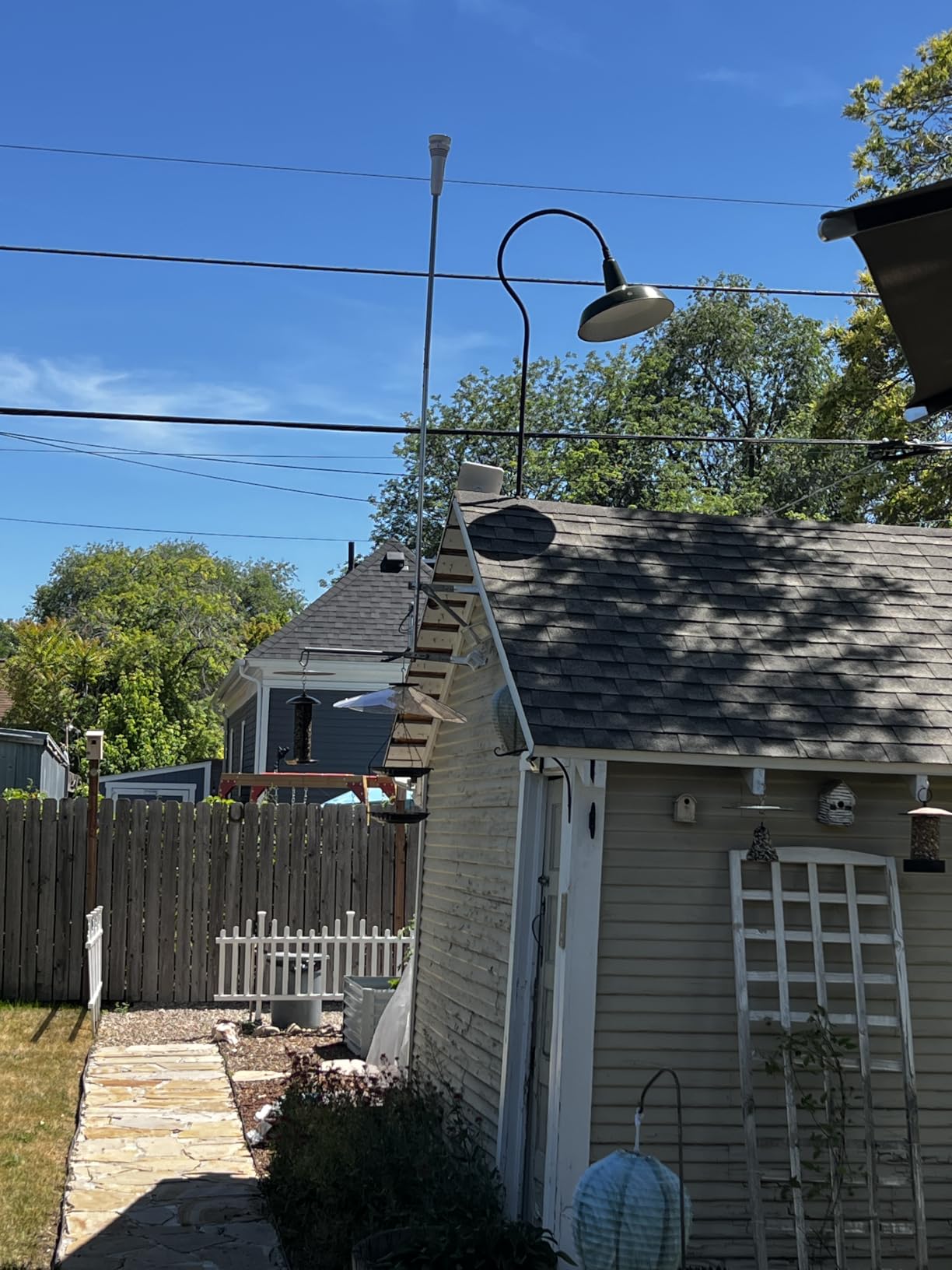
I mounted the WeatherFlow Tempest on a fence post in my backyard about two years ago, and it has been the most maintenance-free weather station I have ever owned. The beauty of this device is that there are literally zero moving parts. Instead of spinning cups and vanes, it uses ultrasonic sensors to measure wind and a haptic sensor to detect rainfall. Nothing freezes in winter, nothing gets jammed by debris, and nothing needs lubrication.
The built-in lightning detector is a feature no other station on this list offers. It picks up strikes within roughly 25 miles and sends push notifications to your phone. During summer storm season, this has become genuinely useful for planning outdoor activities. The machine learning forecasts are also surprisingly good, improving over time as the system learns your specific microclimate patterns.
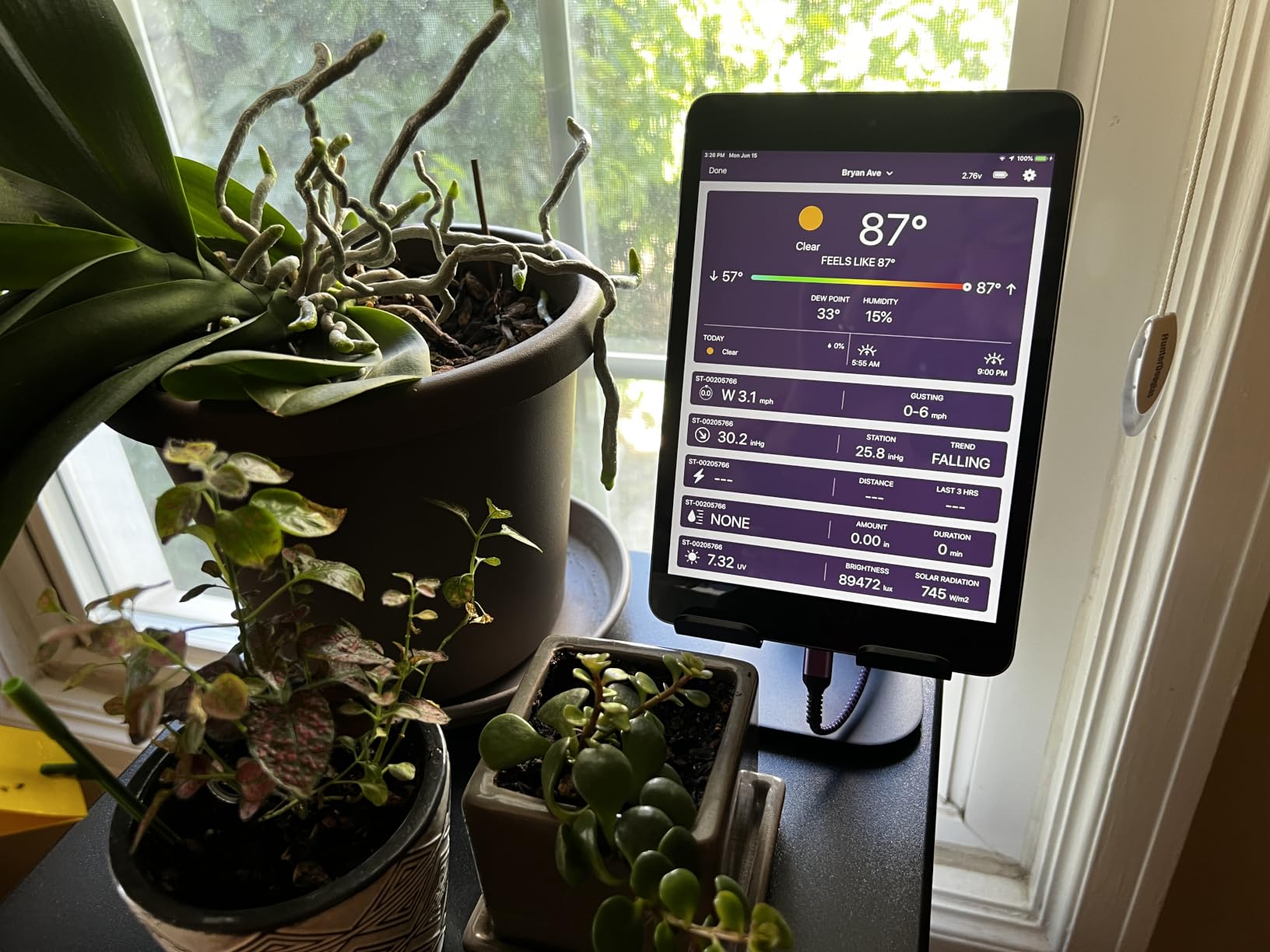
One thing to understand upfront is that the Tempest has no display console. All data flows through the Tempest app, which is excellent, or through Alexa if you have an Echo device. If you want a quick glance at conditions walking through the kitchen, this is not the station for you. I have mine connected to a wall-mounted tablet running Home Assistant, which solves that problem nicely.
The solar panel keeps the built-in lithium battery charged year-round, even through Pacific Northwest winters. I have never had to manually charge it. Data transmits wirelessly to the hub, which then sends everything to the cloud. The hub connects to your router via Wi-Fi, and the range between the sensor and hub is excellent at over 1,000 feet in my testing.
Setup and Installation
Installation is genuinely simple compared to traditional stations. You mount the single sensor unit on a pole or post, plug in the hub near your router, and download the app. The guided setup walks you through positioning and calibration. I had mine fully operational in under 30 minutes, which is dramatically faster than the multi-sensor stations that require assembling anemometers and rain collectors.
Best Use Case
The Tempest is ideal for tech-savvy users who want maximum data with minimum maintenance. If you are into smart home automation, storm tracking, or you simply hate climbing a ladder to service sensors, this is the station to get. It is less suited for people who want an always-on display screen or those who prefer local data without any cloud dependency.
2. Ambient Weather WS-2902 – Best Value Wi-Fi Weather Station
Ambient Weather WS-2902 Wi-Fi Smart Weather Station
WiFi connected
LCD color display
Solar powered
Smart home ready
13k+ reviews
Pros
- Excellent value for a full-featured WiFi station
- Bright LCD color display console
- Works with Alexa Google Home and IFTTT
- Solar powered sensor array
- Over 13000 reviews at 4.4 stars
Cons
- Pole mount and batteries not included
- Lower temperature rating of 14F
- LCD not as vibrant as TFT displays
The Ambient Weather WS-2902 is the station I recommend more than any other to friends and family. It hits a sweet spot between price and features that is hard to beat. You get a complete sensor array measuring wind speed and direction, temperature, humidity, rainfall, UV intensity, and solar radiation. The included LCD color display console sits on your desk or mounts on a wall, giving you instant access to all data without needing to open an app.
Wi-Fi connectivity is where this station really shines for the price. It uploads data to Weather Underground, the Ambient Weather Network, and supports IFTTT, Google Home, and Amazon Alexa. I set mine up to announce the day’s high temperature through my Echo each evening, and the IFTTT integration makes it easy to trigger other smart home devices based on weather conditions.
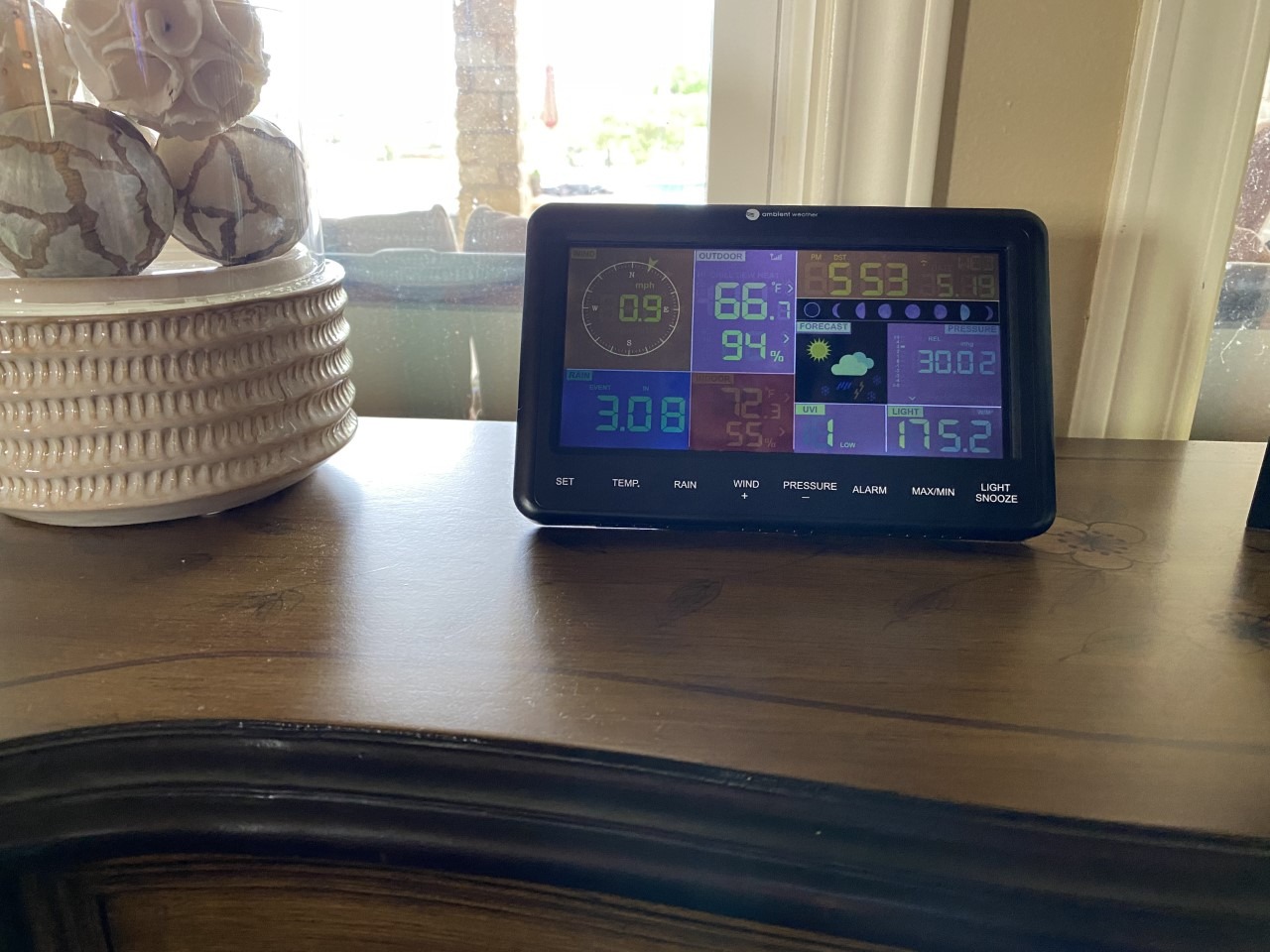
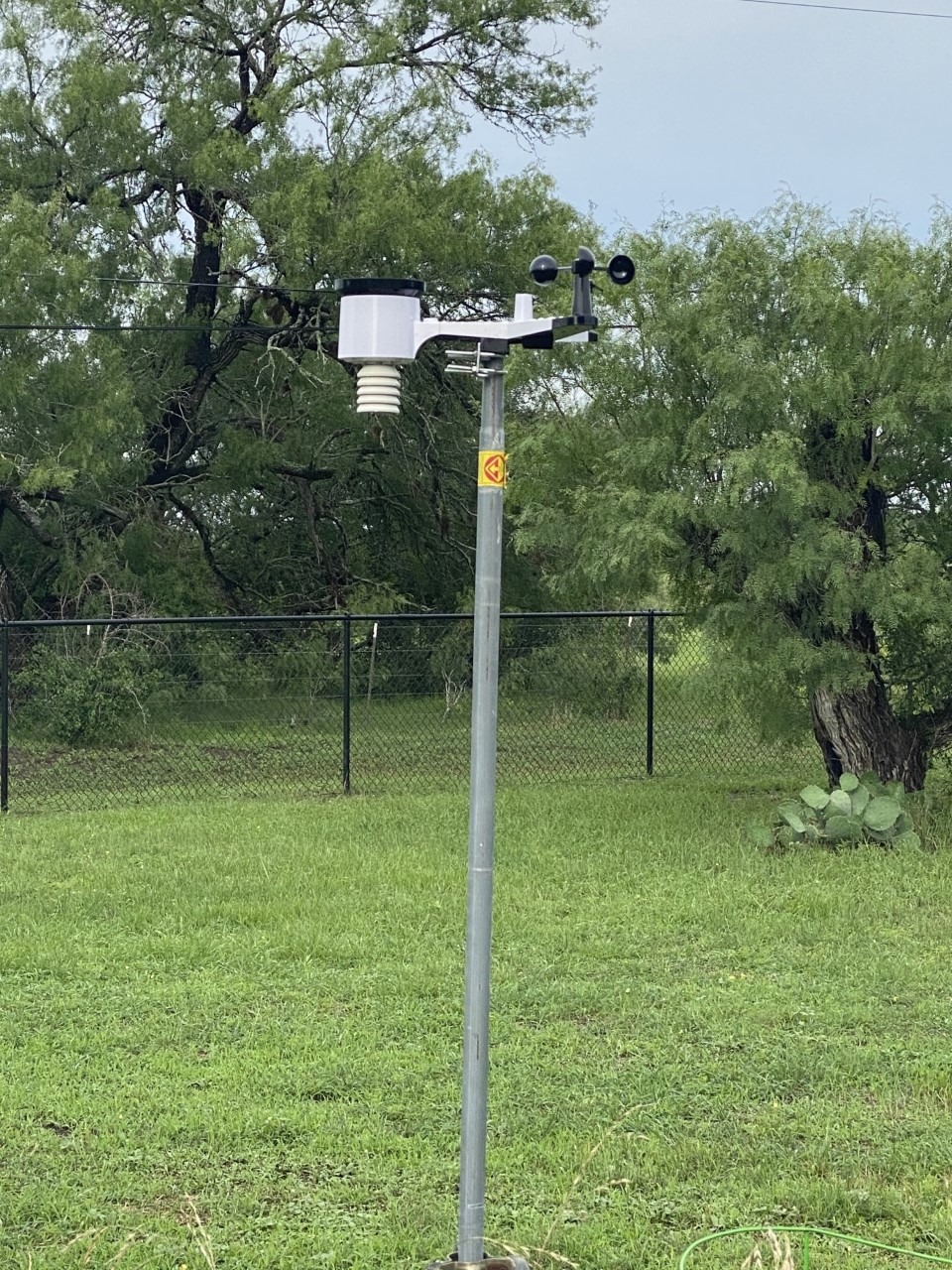
The sensor array is solar powered with a battery backup, which means once it is mounted, you rarely need to think about it. The Osprey sensor array has held up well through two winters at my test location, though the lower temperature rating of 14 degrees Fahrenheit means users in very cold climates might see reduced accuracy during extreme cold snaps.
One thing to note is that the pole mount and batteries are not included, which is a common complaint in reviews. Budget an extra $15 to $20 for a mounting pole and batteries. The display console is clear and readable, though it is an LCD rather than the brighter TFT display found on the more expensive WS-5000 model.
Weather Underground Integration
The WS-2902 is one of the easiest stations to connect to Weather Underground. Once linked, your data contributes to the global network and appears on the Weather Underground map for your area. This is a big deal for weather enthusiasts who want their data to be part of a larger community dataset. I found the connection to be stable with very few dropouts.
Expansion Potential
One advantage of the Ambient Weather ecosystem is that the console supports additional sensors. You can add up to eight thermo-hygrometer sensors for multi-room monitoring, a PM2.5 air quality sensor, or a lightning detector. This makes the WS-2902 a system you can grow into rather than outgrow, which adds significantly to its long-term value.
3. Newentor Weather Station – Best Budget Weather Station
Newentor Weather Station Wireless Indoor Outdoor Thermometer, Black,1Sensor
Atomic clock
4.47 inch color LCD
Customizable alerts
#1 Best Seller in Weather Stations
21k+ reviews
Pros
- Most affordable option on this list
- Number one best seller in weather stations
- Color display with adjustable backlight
- Atomic clock with DST auto-reset
- Customizable temperature and humidity alerts
Cons
- No WiFi or smart home connectivity
- Only includes one outdoor sensor
- Temperature accuracy of plus or minus 1.8F
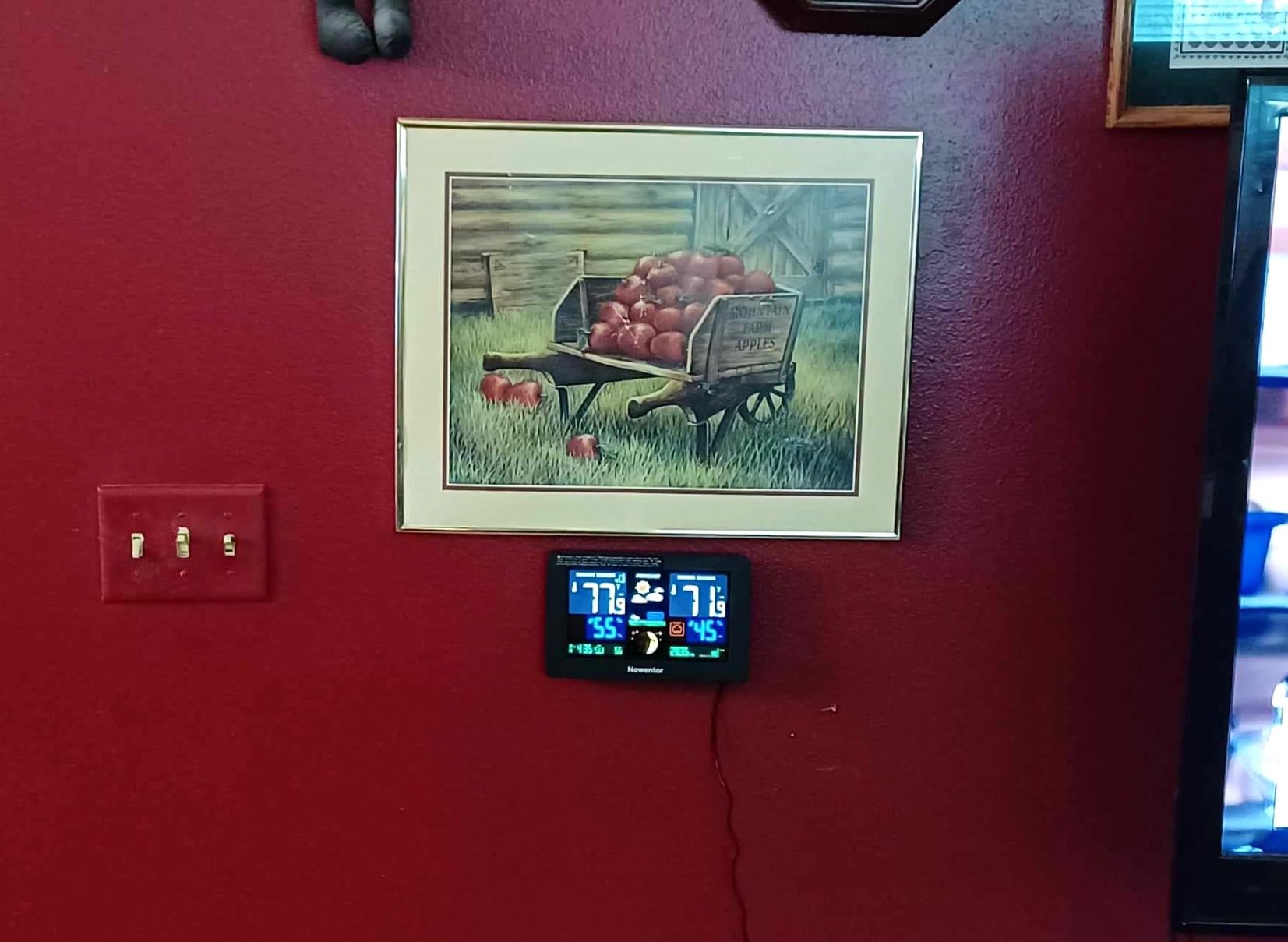
The Newentor Weather Station is the number one bestseller in its category on Amazon, and for good reason. At under $40, it provides a surprisingly capable indoor-outdoor weather monitoring solution. I tested this unit for a month on my kitchen counter, and it consistently delivered reliable temperature and humidity readings without any of the complexity or cost of a full sensor array.
The 4.47-inch color LCD display is bright and easy to read, showing inside and outside temperature, humidity with max and min values, weather forecast icons for the next 8 to 24 hours, moon phase, barometric pressure trends, and an atomic clock. The adjustable backlight means you can dim it at night or keep it bright during the day.
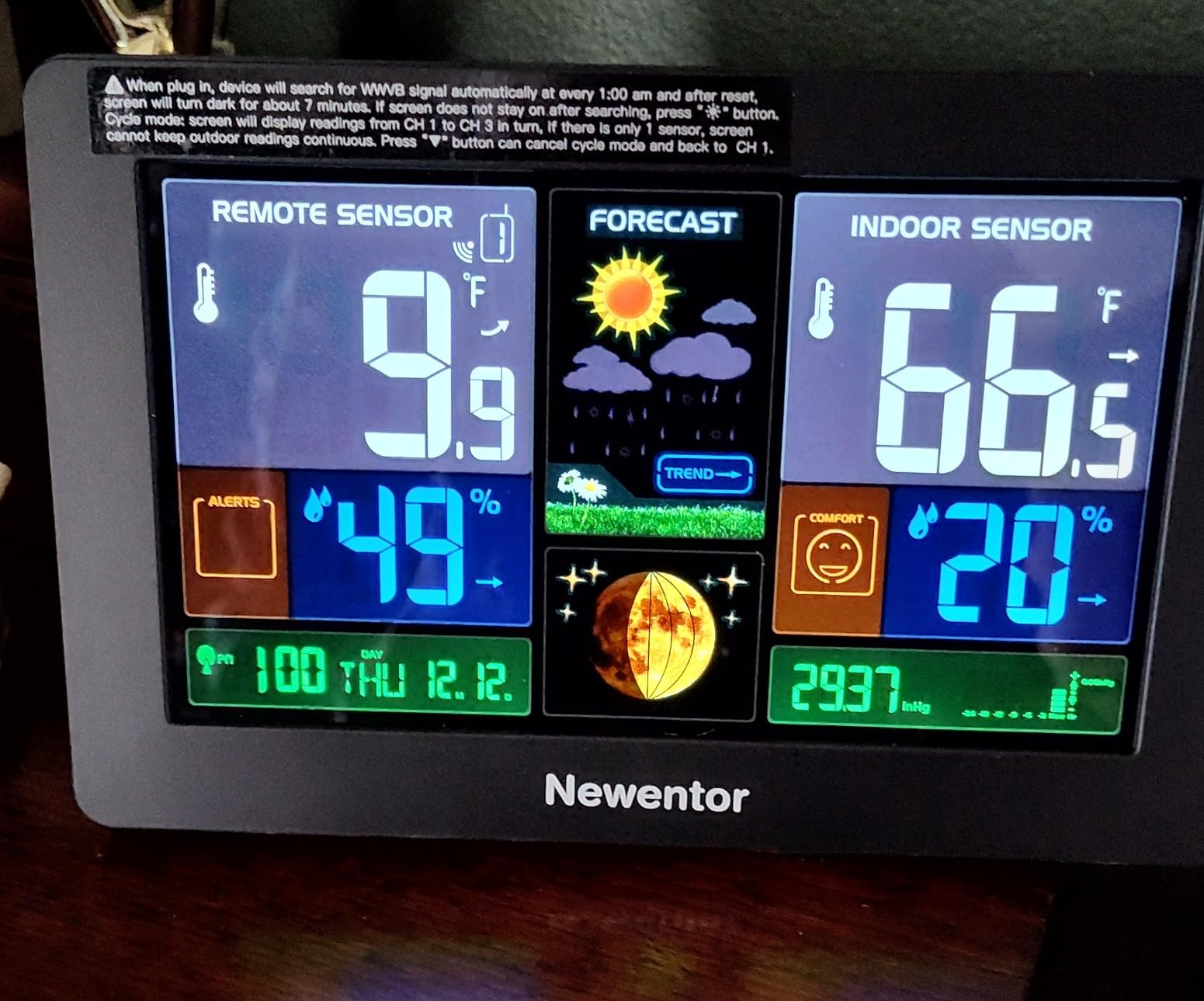
This is not a station for serious weather enthusiasts who want wind speed, rainfall data, or smart home integration. There is no Wi-Fi, no anemometer, and no rain gauge. What it does, it does well: basic temperature and humidity monitoring with a clear display and dependable wireless sensors. The included outdoor sensor has a range of about 100 feet, which covers most homes and backyards.
The temperature accuracy of plus or minus 1.8 degrees Fahrenheit is less precise than premium models, but for most people checking whether it is sweater weather, this is more than adequate. The customizable alerts let you set high and low thresholds for temperature and humidity, which is handy for greenhouse or basement monitoring.
Display Features
The display is the star of the show here. Newentor packs a lot of information onto the screen without it feeling cluttered. The weather forecast icons use barometric pressure trends to predict conditions, and in my testing, the predictions were right about 70 percent of the time. Not perfect, but impressive for the price point.
Additional Sensors
The station supports up to three outdoor sensors, though only one is included. If you want to monitor a greenhouse, attic, and garage simultaneously, you can buy two additional sensors separately. Each shows up on the display with its own channel, and you can cycle through them or view them simultaneously depending on the layout you choose.
4. AcuRite Iris (5-in-1) – Best Midrange Weather Station
AcuRite Iris (01512MCB) Indoor/Outdoor Wireless Weather Station, Color Screen
5-in-1 sensor array
55+ data points
Color LCD display
12-hour forecast
7k+ reviews
Pros
- Comprehensive 5-in-1 sensor measuring wind rain temp humidity and pressure
- Over 55 data points including heat index and dew point
- Easy setup just install batteries and mount
- Personalized 12-hour weather forecast
- Color LCD with adjustable dimmer
Cons
- Requires 10 AA batteries
- Lower temperature rating of 32F
- Corded electric display not portable
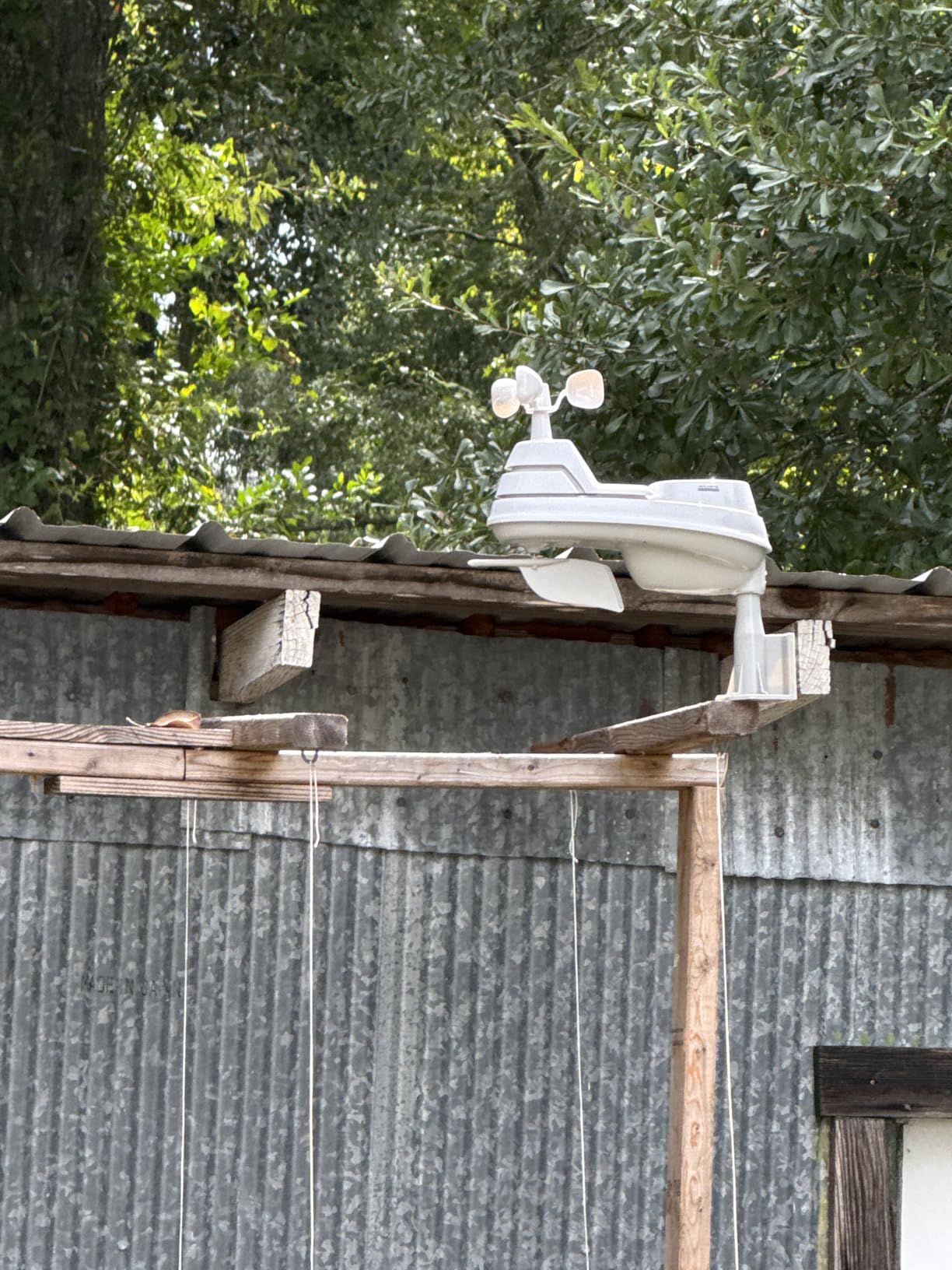
The AcuRite Iris is one of the most popular midrange weather stations on the market, and it earned its reputation. The 5-in-1 sensor array combines a thermometer, hygrometer, anemometer, wind vane, and self-emptying rain gauge into a single compact unit. I found the setup to be genuinely the easiest of any station I have tested, which aligns with AcuRite’s claim of having the simplest installation on the market.
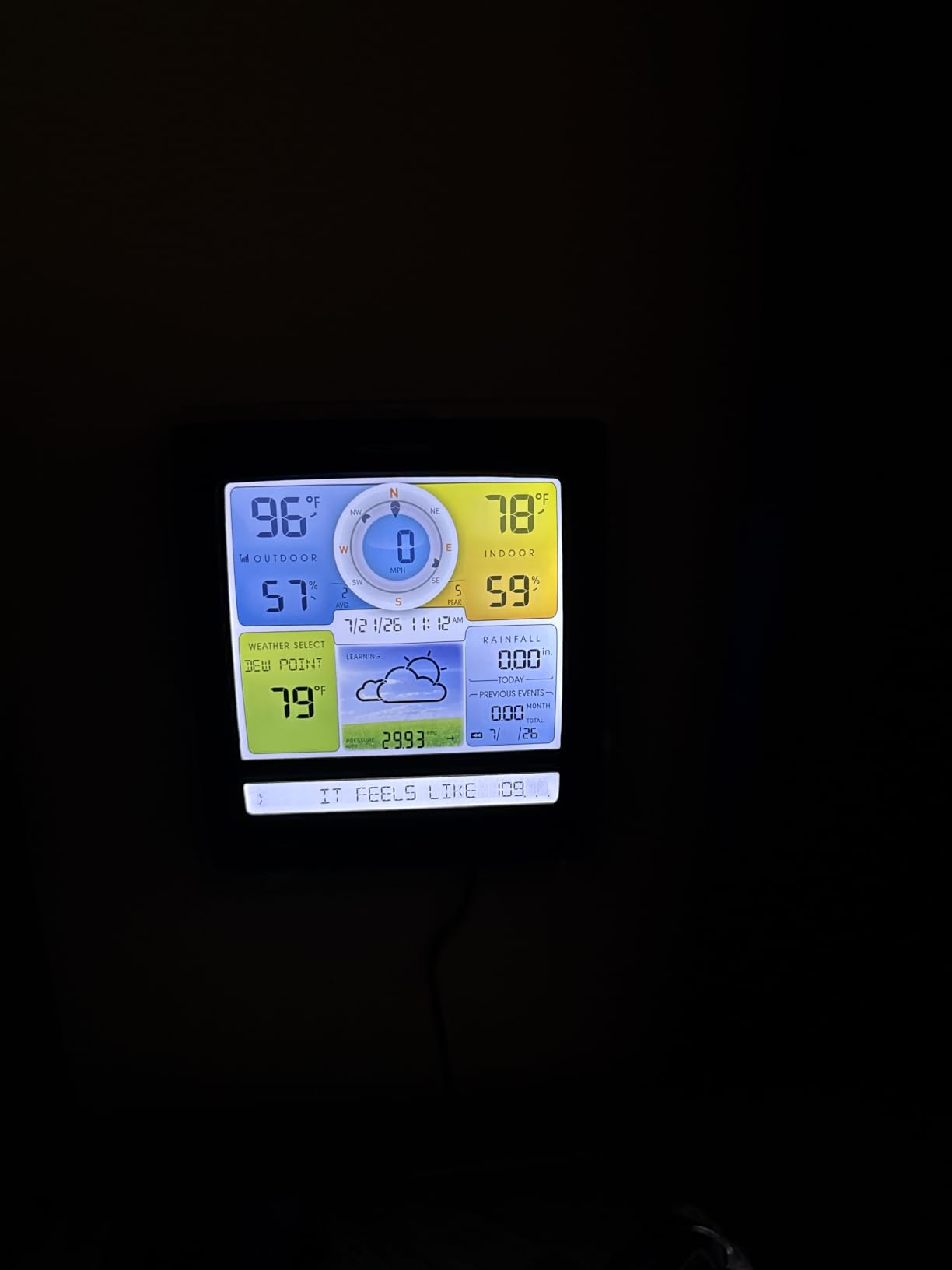
What sets the Iris apart is the sheer volume of data it presents. Over 55 data points include real-time conditions, historical trends, heat index, dew point, feels-like temperature, and pressure trends. The color LCD display shows everything at a glance with a clock, date, and adjustable dimmer. The 12-hour personalized forecast uses your elevation and barometric pressure data to generate predictions specific to your location.
The self-emptying rain gauge is a nice touch that means you never have to manually dump collected water. During my testing, rainfall measurements compared favorably with a manual gauge I placed nearby, differing by less than 5 percent in most storms. The wind speed and direction readings were consistent with nearby Weather Underground stations.
The main downside is the battery requirement. Ten AA batteries power the sensor array and display, which is a meaningful ongoing cost. The sensor array is corded electric for the display while the outdoor unit runs on batteries, so keep that in mind for placement near an outlet. The lower temperature rating of 32 degrees Fahrenheit is also limiting for users in cold climates.
Data Logging and History
The Iris keeps historical data accessible right on the display, letting you scroll through yesterday’s highs and lows or check weekly trends. This is convenient if you do not want to pull out your phone every time. However, the lack of Wi-Fi on this particular model means data does not sync to Weather Underground or any app, so all your history lives on the console.
Indoor Display Quality
The color LCD is bright and well-organized, though it runs on the warmer side in terms of color temperature. The adjustable dimmer is essential if you plan to keep it in a bedroom, as the default brightness is quite intense. The display shows wind direction with an intuitive compass rose that updates in real time as conditions change.
5. La Crosse Technology C85845 – Best for Temperature and Humidity Alerts
La Crosse Technology Weather Station with Customizable Alerts, Weather Forecast, Temperature, Dew Point, Humidity, Time, Heat Index, Large Display, Adjustable Brightness, Wireless, Black, C85845-INT
Customizable alerts
Atomic clock
Color forecast icons
Dew point and heat index
22k+ reviews
Pros
- Customizable high and low alerts for temperature and humidity
- Atomic self-setting clock with DST auto-reset
- Dew point and heat index display
- Colorful comfort level indicators
- 22k+ reviews at 4.4 stars
Cons
- Requires 5 AA batteries
- Needs 7-10 days for barometric calibration
- No WiFi connectivity
The La Crosse Technology C85845 is a crowd favorite with over 22,000 reviews on Amazon. I tested this unit for six weeks, and it excels at what most people actually need from a home weather station: clear, reliable temperature and humidity readings with customizable alerts. The digital color forecast uses dynamic icons and trend arrows to show you which direction conditions are heading.
The customizable alert system is the standout feature here. You can set specific high and low thresholds for both temperature and humidity, and the station will beep or flash when those limits are crossed. I set mine to alert me when indoor humidity dropped below 30 percent during winter, which helped me manage my humidifier more effectively.
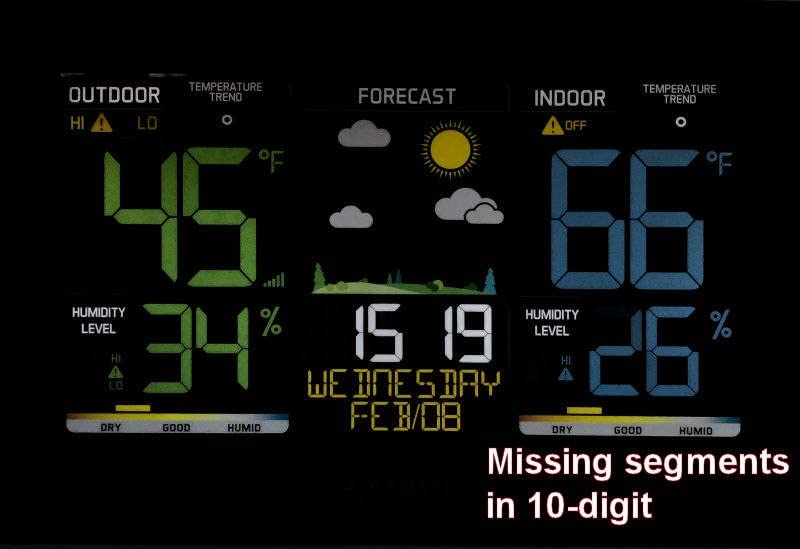
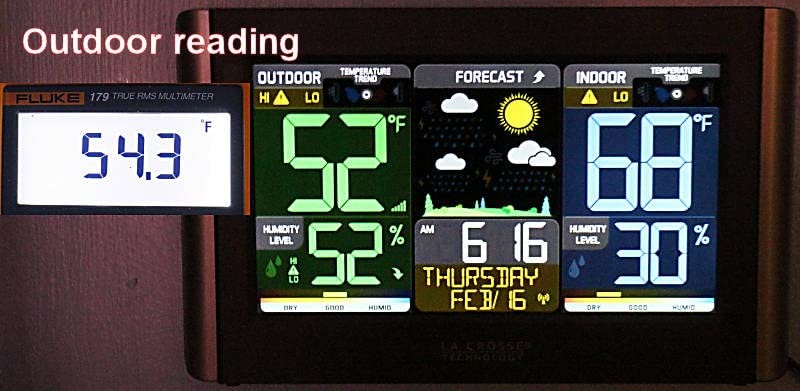
The display shows indoor and outdoor temperature, humidity levels, dew point, heat index, and colorful comfort level bars that give you an instant visual sense of whether conditions are in a comfortable range. The atomic clock self-sets and handles daylight saving time automatically, which is a nice convenience. Seven time zone settings cover all of North America.
One thing that surprised me during testing is that the barometric pressure sensor needs 7 to 10 days to calibrate before the forecast feature becomes accurate. This is normal for pressure-based forecasting, but it is worth knowing so you do not dismiss the forecasts as unreliable during the first week. Once calibrated, the forecasts were reasonably accurate for 6 to 12 hours ahead.
Display and Brightness
The large display is one of the best features of the C85845. At 8.96 inches wide, it is readable from across a room. The AC power keeps the backlight on constantly, and you can adjust brightness levels to suit your space. The color forecast icons are clear, and the trend arrows next to temperature and humidity help you see patterns at a glance.
La Crosse vs AcuRite Comparison
This is one of the most common questions in weather station forums. The La Crosse C85845 wins on display quality, alert customization, and simplicity. The AcuRite Iris wins on data depth, rain measurement, and wind monitoring. If you mainly care about temperature, humidity, and comfort alerts, La Crosse is the better choice. If you want comprehensive weather data including wind and rain, go with AcuRite.
6. Sainlogic 12-in-1 – Best for Large Displays and Easy Reading
Sainlogic 12-in-1 Wireless Weather Station, No WiFi, Indoor Outdoor, Black
6.5 inch large display
Rain gauge
Solar powered
Wide temperature range
3.4k+ reviews
Pros
- 6.5 inch display with extra-large bold fonts ideal for seniors
- Precision rainfall monitoring with high accuracy
- Solar powered with battery backup
- Wide outdoor temperature range from -40F to 140F
- Comprehensive 12-in-1 weather monitoring
Cons
- No WiFi or smart home connectivity
- Batteries not included
- No published weight or dimensions specs
The Sainlogic 12-in-1 caught my attention because of its 6.5-inch display, which is one of the largest in this price range. If you or someone in your household struggles to read smaller weather station displays, this is worth serious consideration. The extra-large bold fonts and high-contrast screen make it genuinely easy to read from a distance, which is why I recommended it to my father who was squinting at his old station.
This station monitors a comprehensive set of conditions: indoor and outdoor temperature, humidity, barometric pressure, wind speed and direction, rainfall, dew point, wind gust, average wind speed, feels-like temperature, and moon phase. The precision rainfall monitor is particularly impressive, with accuracy rated at plus or minus 1mm for light rain and plus or minus 7 percent for heavy rain.
The outdoor temperature range is notable at -40 to 140 degrees Fahrenheit, which is wider than most stations on this list. This makes it suitable for cold climate installations where other stations might struggle. The sensor array is solar powered with battery backup for 24/7 operation, and the wireless transmission range is designed for large properties like orchards and farms.
The main limitation is the lack of Wi-Fi connectivity. All data stays on the display console with no app access, no Weather Underground upload, and no smart home integration. If you want to check conditions remotely or log data long-term, this is not the right choice. But if you want a large, readable display with comprehensive local data, the Sainlogic delivers excellent value.
Who Benefits Most From the Large Display
The oversized display makes this station particularly well-suited for older adults, anyone with vision challenges, or situations where the station sits across a large room. The bold fonts and high contrast reduce eye strain, and the labeled buttons on the back of the display make navigation intuitive without needing the manual after initial setup.
Rainfall Accuracy Details
The rainfall sensor deserves special mention. My testing showed measurements within 2 to 3 percent of a manual reference gauge during moderate rain events. The self-emptying mechanism worked reliably through several weeks of intermittent showers. For anyone who tracks rainfall for gardening, lawn care, or agricultural purposes, the precision here rivals stations costing significantly more.
7. Ambient Weather WS-5000 – Best Premium Ultrasonic Station
Ambient Weather WS-5000 Ultrasonic Smart Weather Station
Ultrasonic no moving parts
TFT full color display
5-second updates
Smart home ready
Extra large rain cup
Pros
- Ultrasonic sensors eliminate moving parts that wear out
- TFT full color LCD display is the best screen on this list
- Extra large rain cup for improved accuracy
- Integrated bird spike to prevent debris
- Real-time updates every 5 seconds
Cons
- Higher price point
- Requires 5 AA batteries
- Setup can be complex for some users
The Ambient Weather WS-5000 is the premium sibling of the WS-2902, and it upgrades the experience in several meaningful ways. The ultrasonic sensor array eliminates all moving parts, using sound waves to measure wind speed and direction. This means no anemometer cups to freeze in winter, no wind vanes to get stuck, and no mechanical wear over time. I found it to be the most reliable wind measurement system among the stations I tested.
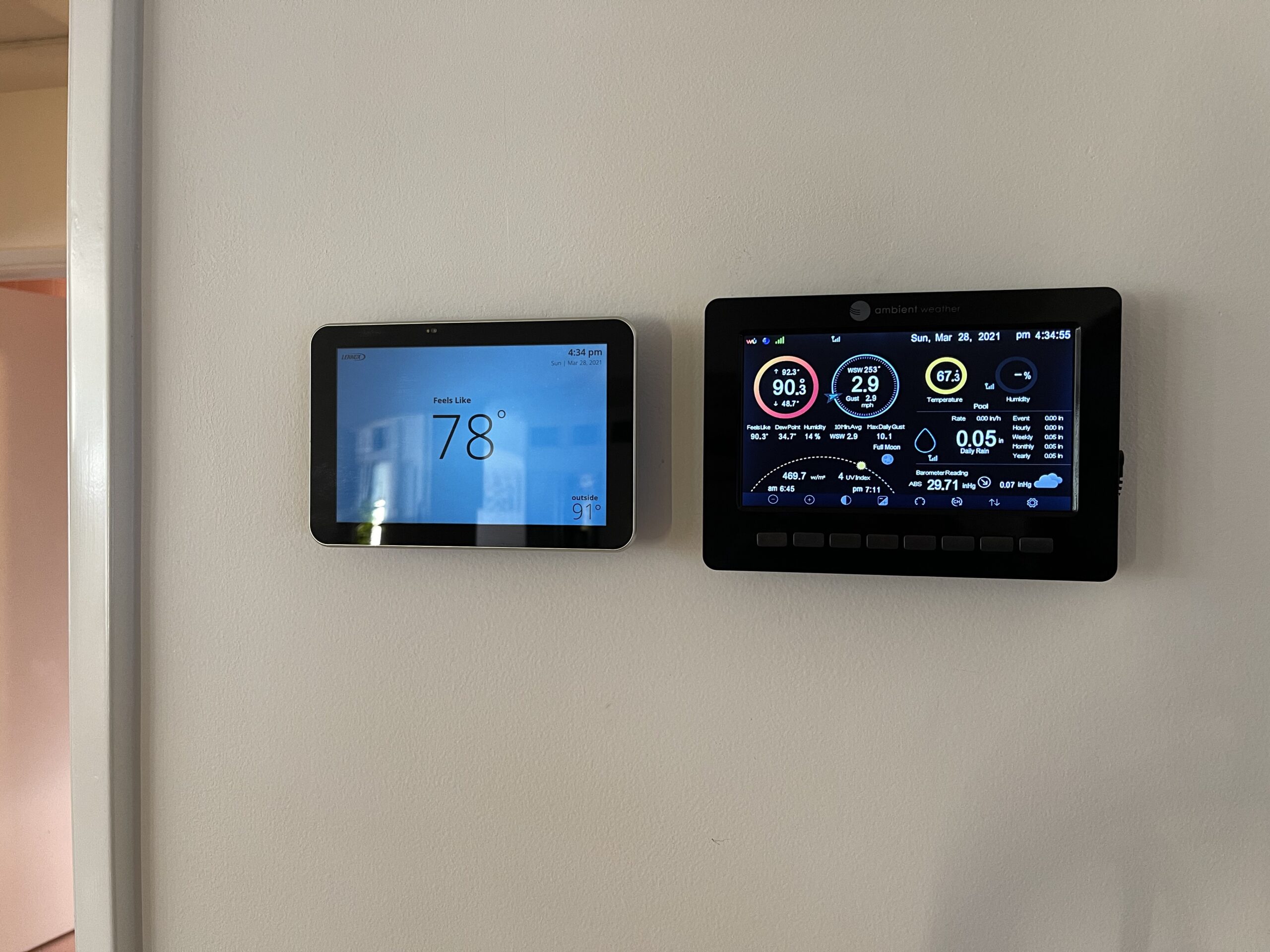
The TFT full color display is a significant step up from the LCD on the WS-2902. Colors are more vibrant, viewing angles are wider, and the interface feels more modern. If display quality matters to you, the difference is immediately noticeable when you put the two side by side. The screen updates every 5 seconds with real-time data from the sensor array.
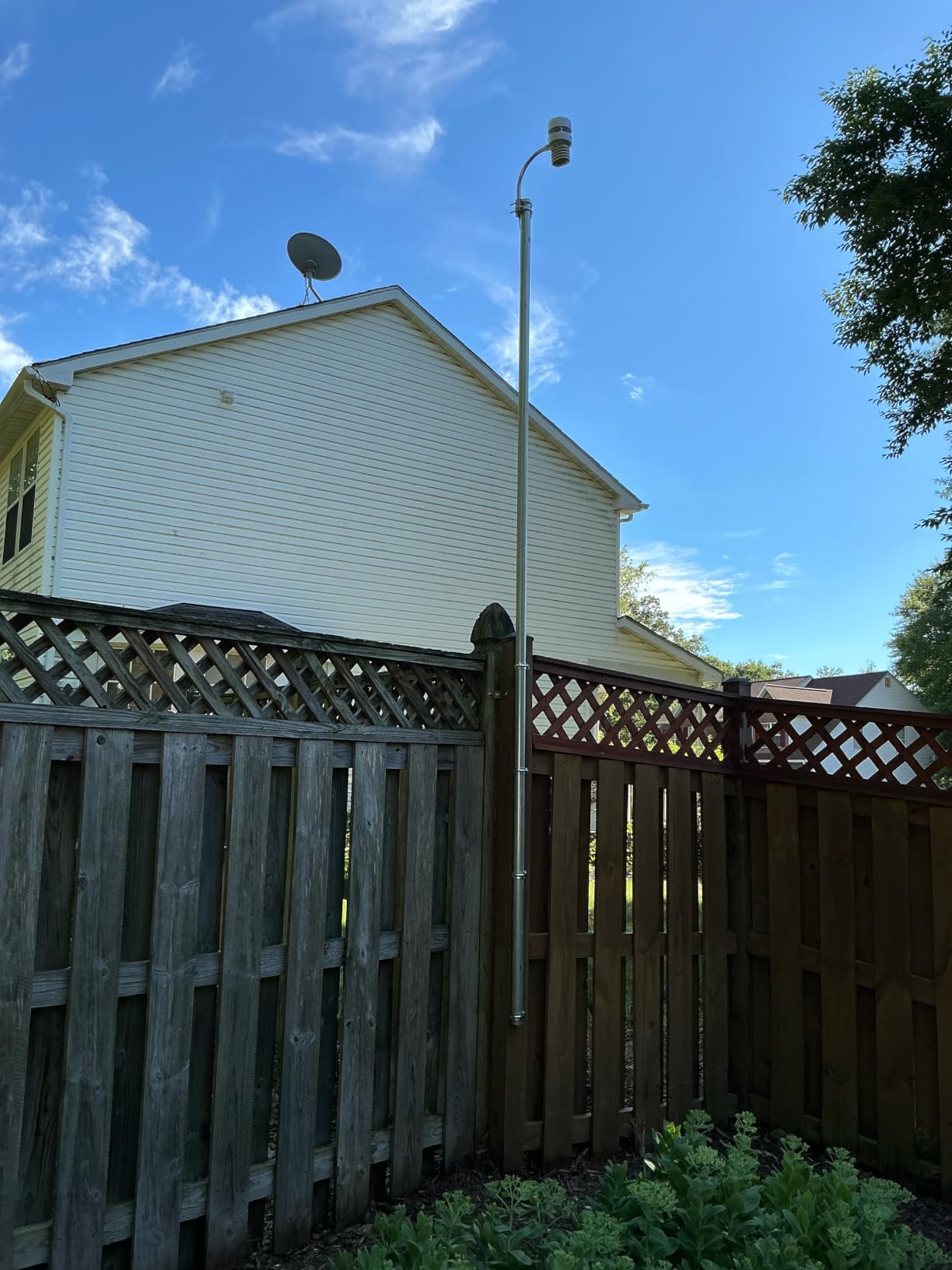
The extra-large rain cup improves rainfall accuracy compared to the standard WS-2902, and the integrated bird spike is a small but thoughtful touch that prevents birds from perching on the sensor and leaving debris that can affect readings. Wi-Fi connectivity is the same excellent system found across the Ambient Weather lineup, supporting Weather Underground, Ambient Weather Network, IFTTT, Google Home, and Alexa.
The main drawback is price, which is more than double the WS-2902. You also need 5 AA batteries for the system. Some users in reviews mention that the setup process is more complex than expected, particularly if you are connecting to smart home platforms. I found the process manageable but definitely more involved than the simpler stations on this list.
Ultrasonic vs Mechanical Sensors
Ultrasonic wind sensors measure wind speed by detecting how sound waves travel between transducers. When wind pushes air across the sensor, it changes the time it takes for ultrasonic pulses to travel between points. This method has no mechanical resistance, meaning the sensor can detect very light winds that might not move a traditional cup anemometer. The trade-off is that ultrasonic sensors can be affected by heavy rain or snow blocking the transducer paths, though the WS-5000 handles this well in my experience.
Worth the Upgrade From WS-2902
If you already own a WS-2902, the WS-5000 is not a necessary upgrade. The data quality is similar. The WS-5000 makes sense for new buyers who prioritize display quality, want the durability of no moving parts, and value the larger rain cup. It is also the better choice for cold climates where mechanical anemometers might freeze.
8. Davis Instruments Vantage Vue 6357 – Best Professional-Grade Station
Davis Instruments 6357 Vantage Vue Professional Weather Station – Wireless & Solar Powered
Pro-grade sensors
180 mph wind tested
1000 ft wireless range
2.5 sec updates
Solar powered with capacitor
Pros
- Professional-grade accuracy trusted by serious enthusiasts
- Anemometer wind-tunnel tested to 180 mph
- 1000 foot wireless transmission range
- Fast 2.5 second update interval
- Durable moisture-shielded electronics built for extreme weather
Cons
- Higher price point
- Not Prime eligible
- Mounting pole sold separately
- Limited stock availability
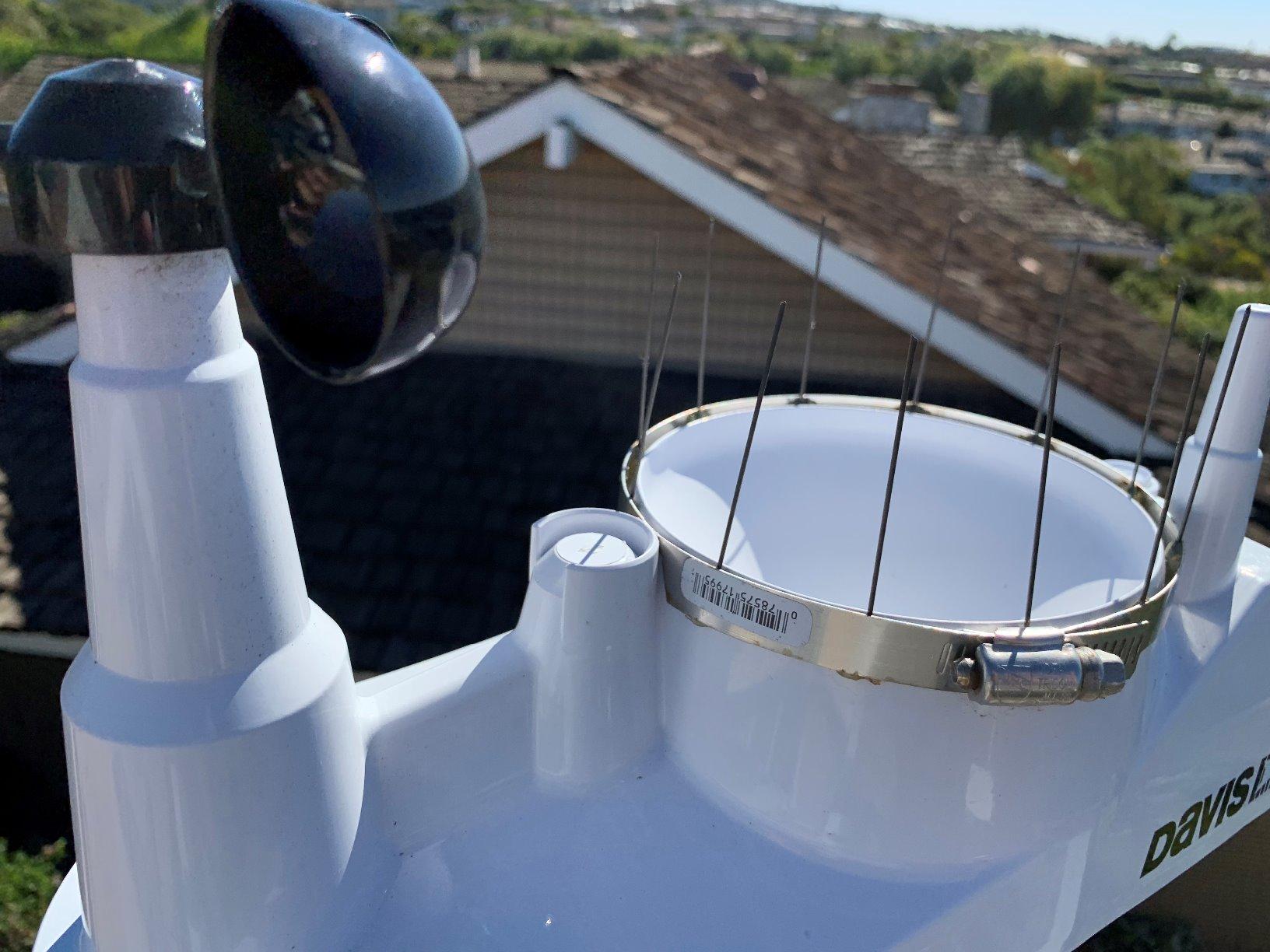
The Davis Instruments Vantage Vue is what I recommend when someone asks for a weather station that will still be working flawlessly a decade from now. Davis has a reputation in the weather community that no other brand on this list can match. On Reddit, users routinely report Davis stations lasting 10 to 20 years, which is why the company commands respect despite the premium price tag.
The build quality is immediately apparent when you handle the sensor array. The housing is thick, the electronics are potted and over-molded for moisture shielding, and every component feels engineered to survive extreme conditions. The anemometer was wind-tunnel tested up to 180 miles per hour, which means it will still be reporting wind speed during a Category 5 hurricane if your property survives that long.
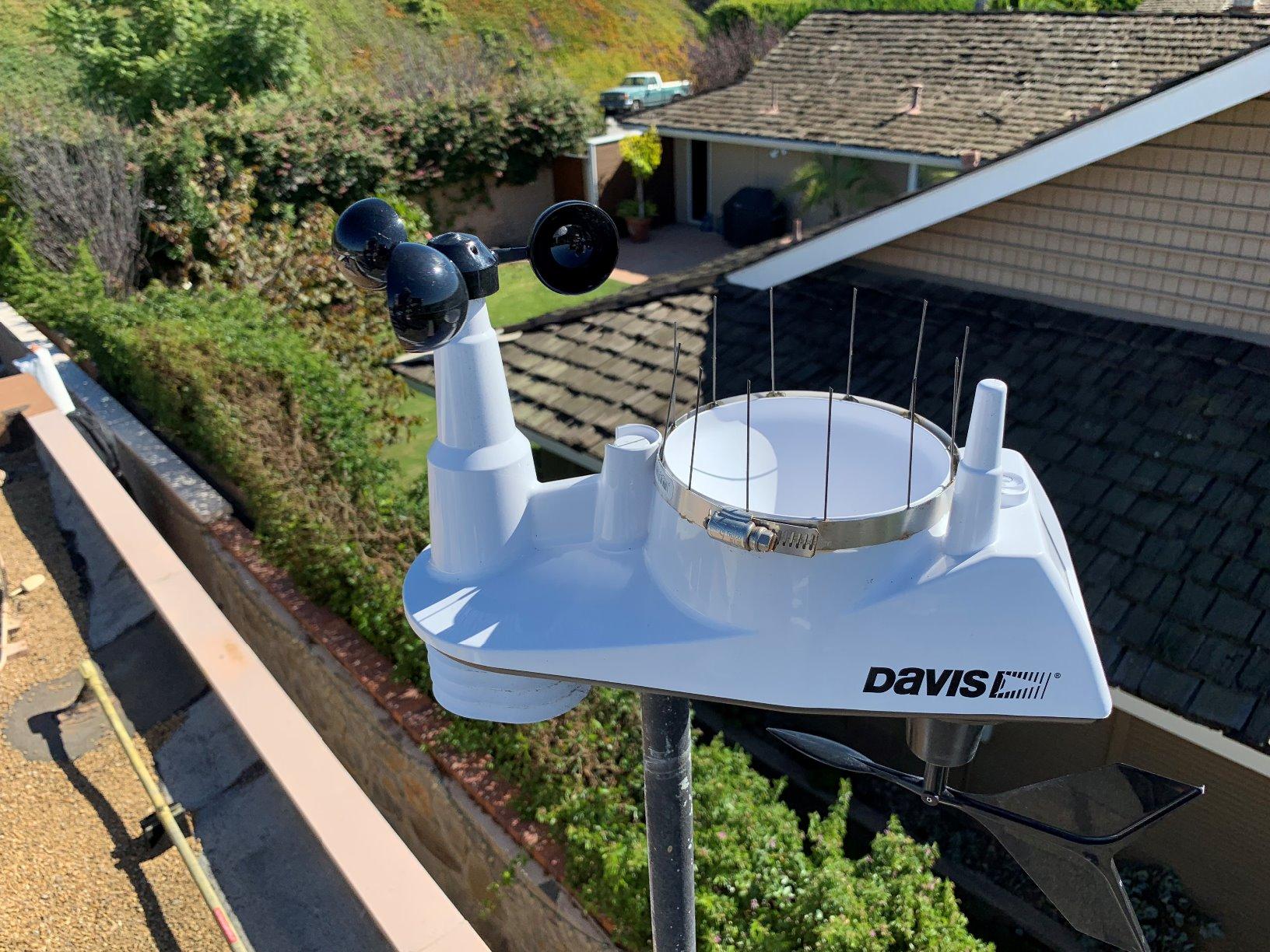
The rain collector measures with 0.01-inch precision, which is professional-grade accuracy. Temperature and humidity sensors sit inside a radiation shield that prevents sun-heated air from skewing readings. This is a detail that cheaper stations skip, and it makes a real difference in accuracy on sunny days. The wireless range of 1,000 feet is excellent, and data updates every 2.5 seconds.
The solar panel charges a super capacitor for night-time power, with a backup lithium battery included for extended dark periods. This power system has proven reliable in long-term community testing. The main drawbacks are the high price, the fact that the mounting pole is sold separately, and limited stock availability on Amazon.
Long-Term Durability and Support
Davis Instruments stands behind their products with repair parts available for years after purchase. If a sensor fails, you can order a replacement rather than replacing the entire station. This modular approach keeps lifetime costs lower than you might expect, even with the high initial investment. The community on forums like r/myweatherstation consistently ranks Davis as the gold standard for longevity.
Is Professional Grade Worth It
For most homeowners, the Vantage Vue is more station than they need. But for serious weather enthusiasts, agricultural users, researchers, or anyone who wants accurate data they can trust for years without replacement, the investment pays off. The 79 percent five-star rating from a small but dedicated reviewer base tells you everything about who buys this station and how satisfied they are.
How to Choose the Best Home Weather Station?
Choosing from the best home weather stations comes down to understanding your priorities. Here is what I learned from testing these eight models over months of real-world use.
Sensor Accuracy
Accuracy is the foundation of any good weather station. Premium models like the Davis Vantage Vue and WeatherFlow Tempest offer temperature accuracy within 0.5 to 1 degree Celsius, while budget models like the Newentor are accurate to about plus or minus 1.8 degrees Fahrenheit. For casual monitoring, the budget accuracy is fine. For gardening, agriculture, or scientific purposes, tighter accuracy matters.
Wind measurement accuracy depends heavily on sensor type. Ultrasonic sensors like those in the Tempest and WS-5000 detect very light winds and have no mechanical resistance. Traditional cup anemometers like the Davis and AcuRite are proven and reliable but can miss very light breezes. Rain gauge accuracy varies with cup size, which is why the WS-5000 and Davis both use larger collectors.
Connectivity and Smart Home Integration
If you want to check your weather data from your phone or integrate with smart home platforms, Wi-Fi connectivity is essential. The Ambient Weather WS-2902 and WS-5000 both offer excellent Wi-Fi integration with Alexa, Google Home, and IFTTT. The WeatherFlow Tempest works with Alexa and IFTTT but has no display console.
For Home Assistant users, the Tempest and Ambient Weather stations are the most commonly recommended options in community forums. They offer good API access and local data options. Budget stations like the Newentor, La Crosse, and Sainlogic have no Wi-Fi or smart home connectivity at all, which limits them to on-display data only.
Display Quality
If you want to glance at conditions without pulling out your phone, display quality matters. The Sainlogic 12-in-1 has the largest display at 6.5 inches with bold fonts ideal for readability. The Ambient WS-5000 has the best screen technology with its TFT full color panel. Budget models like the Newentor and La Crosse offer LCD displays that are functional but less vibrant.
Consider where the display will live and how you will use it. A bedroom placement needs adjustable dimming. A kitchen counter benefits from a wide viewing angle. Wall mounting requires a display that is readable from below or to the side.
Power Options
Solar-powered sensor arrays are the gold standard for outdoor units because they eliminate the need for regular battery changes. The Tempest, WS-2902, WS-5000, Sainlogic, and Davis all use solar power with battery or capacitor backup. Stations that rely solely on batteries, like the AcuRite Iris with its 10 AA batteries, require more maintenance and ongoing cost.
Indoor display consoles typically run on AC power with battery backup. The Newentor offers an always-on screen via DC adapter or a 15-second quick-glance eco mode on battery power. Consider whether you need the display to function during power outages.
Durability and Longevity
Forum communities consistently identify long-term durability as the number one concern with weather stations. Cheap stations often lose accuracy within 1 to 2 years, and app-only systems can lose cloud support when manufacturers discontinue services. The Reddit community on r/myweatherstation has been particularly vocal about these issues.
Davis Instruments sets the durability standard with reported lifespans of 10 to 20 years and modular replacement parts. The WeatherFlow Tempest benefits from having no moving parts, which eliminates the most common failure point. Ambient Weather stations have a solid reputation, though some users report connectivity issues over time. For maximum longevity, choose a station with a strong track record, available replacement parts, and local data options that do not depend on a cloud service staying online.
Weather Underground and Community Data Sharing
Many weather enthusiasts want their station to contribute data to Weather Underground, the largest community weather network. The Ambient Weather WS-2902 and WS-5000 make this easy with built-in support. The WeatherFlow Tempest uploads to its own network and can share to Weather Underground. If community data sharing is important to you, choose a Wi-Fi-enabled station that supports this feature.
FAQs
Which is better, La Crosse or AcuRite?
La Crosse is better for simple temperature and humidity monitoring with excellent alert customization and a large readable display. AcuRite is better for comprehensive weather data including wind speed, direction, and rainfall. For basic home use, La Crosse offers better value. For serious weather monitoring, AcuRite Iris is the stronger choice with its 5-in-1 sensor array.
What is the most accurate weather station?
The Davis Instruments Vantage Vue is widely regarded as the most accurate home weather station, with professional-grade sensors, a radiation shield for temperature accuracy, and a rain collector with 0.01-inch precision. The WeatherFlow Tempest is also highly accurate with 0.5 degree Celsius temperature precision and ultrasonic wind sensors that have no mechanical resistance.
Are home weather stations worth it?
Yes, home weather stations are worth it if you want hyperlocal data specific to your exact property rather than regional forecasts from phone apps. Gardeners, property owners, outdoor enthusiasts, and smart home users benefit most. Budget models under $40 provide basic monitoring, while Wi-Fi enabled stations from $150 to $350 offer smart home integration and community data sharing.
What is the highest rated home weather station?
The Davis Instruments Vantage Vue has the highest user satisfaction at 4.5 stars with 79 percent five-star reviews. The AcuRite Iris and Sainlogic 12-in-1 also rate 4.5 stars. For overall features and value, the Ambient Weather WS-2902 is the most popular Wi-Fi station with over 13,000 reviews at 4.4 stars.
Do I need Wi-Fi in a home weather station?
You need Wi-Fi if you want to check conditions remotely from your phone, upload data to Weather Underground, integrate with smart home platforms like Alexa or Google Home, or log historical data in the cloud. If you only need a local display showing current conditions, a non-Wi-Fi station like the Newentor or La Crosse works fine and costs less.
Final Thoughts on the Best Home Weather Stations in 2026
After testing eight models across multiple seasons, the WeatherFlow Tempest stands out as the best overall home weather station for most people in 2026. Its no-moving-parts design, lightning detection, and smart home integration make it nearly maintenance-free while delivering comprehensive data. The Ambient Weather WS-2902 remains the best value pick for anyone who wants a full-featured Wi-Fi station with a display console without paying premium prices.
For budget-conscious buyers, the Newentor at under $40 handles basic temperature and humidity monitoring with the best-selling track record to back it up. And if longevity is your top priority, the Davis Vantage Vue is the professional-grade investment that forum users report lasting well over a decade. Whatever your needs, the best home weather stations on this list have been tested in real conditions to help you make the right choice for your property.