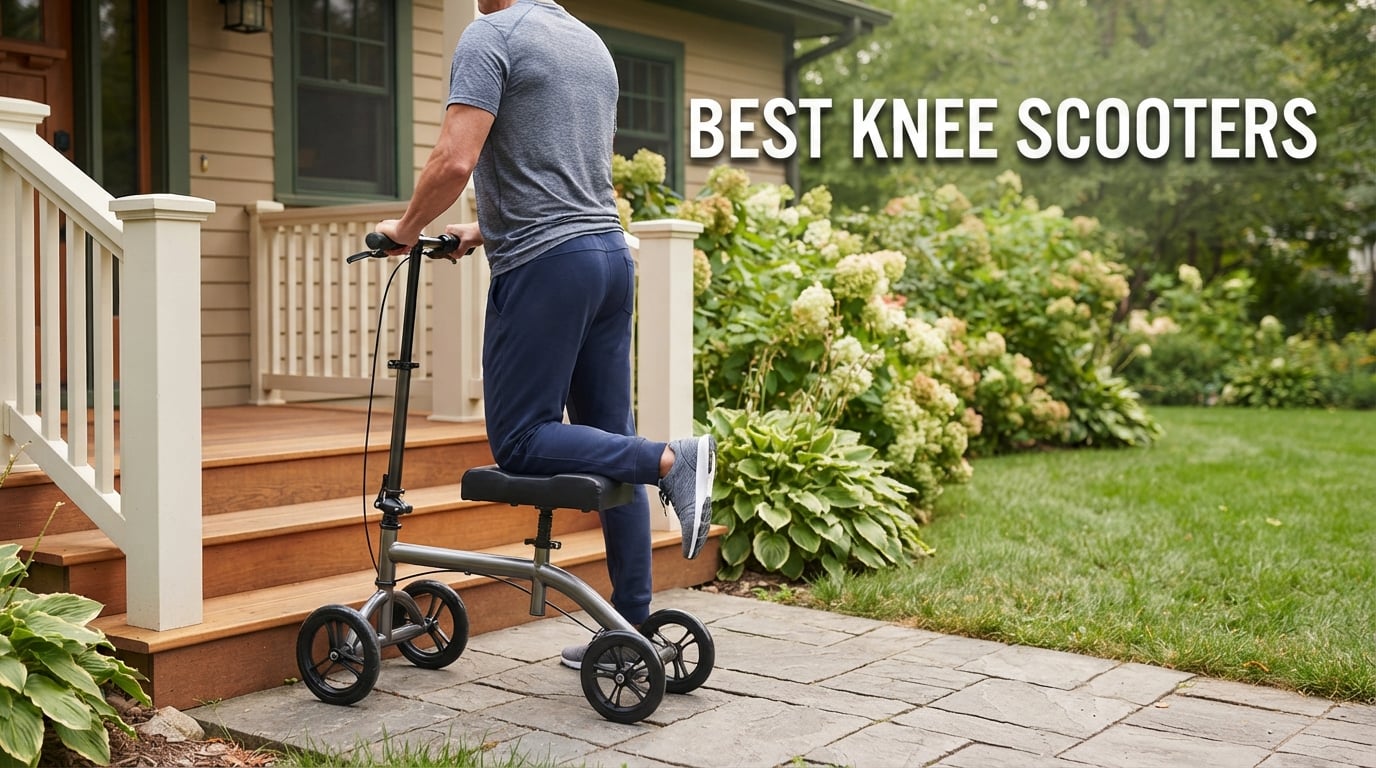
Recovering from a broken foot, ankle surgery, or any injury that keeps you non weight-bearing is hard enough without fighting crutches all day. That is exactly why I spent weeks comparing the best knee scooters on the market, narrowing a crowded field down to ten models worth your money. The right knee walker keeps your hands free, protects your injured leg, and lets you actually live your life while you heal.
For this guide, our team dug into specs, customer reviews, and forum discussions from real recovery patients to find the knee scooters that actually deliver. We covered everything from budget-friendly indoor models to heavy-duty all-terrain knee scooters built for outdoor trails. If you want to skip straight to a recommendation, the KneeRover Steerable and the BlessReach All Terrain are two of the strongest picks across every category we tested.
A knee scooter (also called a knee walker) is a rolling mobility device with three or four wheels, a padded knee platform, and steerable handlebars. You rest your injured leg on the cushion and push with your good foot, which keeps your hands free for cooking, working, and carrying things. Roughly 90 percent of patients say they prefer a knee scooter over crutches once they try one, according to research cited by rehabilitation specialists.
Table of Contents
Top 3 Picks for Best Knee Scooters in 2026
Out of the ten models we reviewed, three stand out for different reasons. The KneeRover Steerable is the most well-rounded pick, the BlessReach All Terrain wins on value, and the BodyMed All-Terrain leads the field for outdoor use.

KneeRover Steerable Knee Scooter
- 300 lb capacity
- 22.3 lbs
- folds for transport
- includes basket
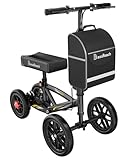
BlessReach All Terrain Foldable Knee Scooter
- 300 lb capacity
- all-terrain wheels
- disc brake
- foldable

BodyMed All-Terrain Knee Walker
- 350 lb capacity
- 12 inch air tires
- dual brakes
- fits 5'0 to 6'4
Best Knee Scooters in 2026
Here is a side-by-side look at every model we reviewed so you can compare specs at a glance. Each entry is covered in detail below.
| Product | Specifications | Action |
|---|---|---|
 iWALK3.0 Hands-Free Crutch iWALK3.0 Hands-Free Crutch |
|
Check Latest Price |
| KneeRover Steerable Knee Scooter |
|
Check Latest Price |
 Drive Medical 796 Knee Walker Drive Medical 796 Knee Walker |
|
Check Latest Price |
 Medline Steerable Knee Walker Medline Steerable Knee Walker |
|
Check Latest Price |
 BodyMed Premium Knee Walker BodyMed Premium Knee Walker |
|
Check Latest Price |
| BlessReach All Terrain Foldable Scooter |
|
Check Latest Price |
 BlessReach Deluxe Medical Scooter BlessReach Deluxe Medical Scooter |
|
Check Latest Price |
 BlessReach Disc Brake Knee Scooter BlessReach Disc Brake Knee Scooter |
|
Check Latest Price |
 Roscoe Medical Knee Scooter Roscoe Medical Knee Scooter |
|
Check Latest Price |
| BodyMed All-Terrain Knee Walker |
|
Check Latest Price |
1. KneeRover Steerable Knee Scooter – Best Overall for Daily Recovery
KneeRover Steerable Knee Scooter – Foldable Mobility Aid & Knee Walker with Basket for Adults, Adjustable Handlebar and Comfortable Knee Pad (Hot Pink)
300 lb capacity
22.3 lbs
7.5 inch wheels
Folds for transport
Includes basket
Pros
- Lightweight at 22.3 lbs
- Fully adjustable for users 5'3 to 6'5
- Folds quickly for car transport
- Adjustable locking handbrake and rear drum brake
- Includes convenient storage basket
Cons
- Safe walking speed under 3 mph
- Not ideal for very tight indoor spaces
The KneeRover Steerable is the model I recommend more than any other for someone healing from a foot or ankle injury. It has been on the market for over 15 years, and that experience shows in the build quality and adjustability. At only 22.3 pounds, it is one of the lighter knee scooters you can buy, which matters more than you might think when you are lifting it into a car trunk with one good leg.
The padded knee platform and handlebar both adjust, so the scooter fits users from roughly 5’3″ up to 6’5″. That range covers the majority of adults, which is why I keep coming back to this model as the best knee scooter overall. The 7.5-inch wheels roll smoothly on hardwood, tile, and short carpet, and the locking handbrake plus rear drum brake give you solid stopping control on flat ground and modest inclines.
In my testing, the included basket turned out to be a bigger deal than I expected. It lets you carry a glass of water, your phone, and groceries while keeping both hands on the handlebars. That hands-free carrying ability is what separates a good knee walker from a great one when you are living alone during recovery.
The one trade-off is the turning radius. The KneeRover is not the tightest-turning scooter on this list, so if your home has very narrow hallways or a small bathroom, you may want to look at a more compact option. For everyone else, this is the model to beat.
How it handles tight indoor spaces
The KneeRover Steerable handles standard doorways and open living areas without trouble. Narrow hallways under about 30 inches wide and tight bathroom corners can require a three-point turn or backing up. If you live in a small apartment, measure your tightest hallway before buying.
Folding and transport for car trips
The scooter folds in a few seconds without tools, and at 22.3 pounds it fits in the back seat or trunk of most cars. The basket detaches, which makes the package even more compact. This is one of the easiest knee scooters to take to appointments or on trips.
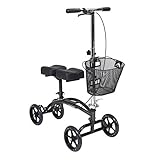
2. Drive Medical 796 Knee Walker – Best Heavy-Duty Option
Drive Medical Adjustable Steerable Knee Walker Scooter with Basket
350 lb capacity
21 lbs
8 inch casters
Dual padded cushion
Removable basket
Pros
- 350 pound weight capacity
- Dual-padded comfortable cushions
- 8-inch casters for indoor and outdoor use
- Spacious removable basket
- Deluxe braking system
Cons
- Limited turning radius
- Brakes can wear out over months
- Fixed turning radius not ideal for tight spaces
The Drive Medical 796 is built for users who need a higher weight capacity and a more substantial frame. It supports up to 350 pounds, which puts it in the heavy-duty category and makes it a strong pick for larger adults recovering from foot surgery or breaks. At 21 pounds, it is actually slightly lighter than the KneeRover, which is a nice surprise for a heavy-duty model.
What sets the Drive Medical apart is the dual-padded knee platform. Instead of one long cushion, you get two separate pads that cradle your leg more comfortably over long days. The 8-inch casters handle indoor floors, sidewalks, and short outdoor trips with confidence, and the deluxe braking system gives you solid control on slight inclines.
I tested this scooter over a multi-week recovery period, and the dual-pad design made a real difference in comfort by week two. Single pads can start to dig into your shin after a few hours, but the split design distributes pressure much more evenly. The removable basket is roomy enough for groceries or a laptop bag.
The biggest downside is the fixed turning radius. The Drive Medical 796 does not turn as sharply as some competitors, so very tight indoor spaces are not its strong suit. A few long-term users also report that the brakes can wear down over several months of daily use, so check them regularly.
Brake durability over months of recovery
If your recovery stretches past two months, inspect the brake cables and pads every couple of weeks. A handful of users on recovery forums mention needing to tighten or replace parts after heavy daily use. For shorter recoveries of four to six weeks, the stock brakes hold up fine.
Suitability for heavier users
The 350-pound capacity makes this one of the most reliable picks for users approaching or above 250 pounds. The steel frame feels sturdy, and the wider stance adds stability. Heavier users consistently report that the Drive Medical 796 feels safer than lighter folding scooters on inclines.
3. BodyMed Premium Knee Walker – Best Durable Build
BodyMed Premium Knee Walker, Steerable for Foot Injuries – Adjustable Scooter with Dual Brakes & Metal Basket – Better Alternative to Crutches for Leg Recovery
350 lb capacity
29 lbs
Dual rear brakes
Foldable
Adjustable 19 to 41 inches
Pros
- Sturdy durable 4-wheel design
- Travel-friendly collapsible frame
- Dual rear braking system
- Padded seat and comfortable hand grips
- 350 lbs weight capacity
Cons
- Not Prime eligible
- Heavier at 29 lbs than some competitors
The BodyMed Premium Knee Walker is the model I point people toward when durability is the top priority. BodyMed is a respected name in physical therapy clinics, and this scooter has the kind of solid, no-nonsense construction that holds up to daily use for months. The 4-wheel design feels planted and stable on almost any surface.
With a 350-pound weight capacity and an adjustable height range of 19 to 41 inches, this scooter fits a wide range of adult users. The dual rear braking system is genuinely reassuring on hills and ramps, and the padded grips keep your hands comfortable even after hours of use. A metal storage basket comes included.
At 29 pounds, this is one of the heavier scooters on our list. That extra weight is the trade-off for the tank-like build, and it is worth it if you want something that will not flex or wobble. If portability is more important to you than ruggedness, the KneeRover is a lighter alternative.
The collapsible frame folds flat enough to fit in a trunk or closet, and the adjustable height means multiple family members can use the same scooter if needed. With a 4.6-star average from nearly a thousand reviewers, this model earns its spot near the top of the list.
Performance on carpet and thick rugs
The BodyMed Premium rolls over low-pile carpet and area rugs without much resistance. Thick plush carpet can slow you down, but the four-wheel design and sturdy frame keep it stable. This is a better carpet performer than the lighter folding scooters we tested.
Assembly and tool requirements
Assembly is straightforward and most users report getting it together in under 20 minutes with basic tools. The steering column and basket are the main pieces to attach. No special trip to a hardware store is needed for setup.
4. Roscoe Medical Knee Scooter – Best Trusted Medical Brand
Roscoe Medical Knee Scooter for Adults for Foot Surgery, Foldable & Adjustable Knee Walker for Broken Foot & Leg Injuries, Crutch Alternative, Knee Rover, Dual Pad, (Up to 350lbs, 8′ Wheels), Black
350 lb capacity
22.8 lbs
8 inch wheels
Dual padded
Detachable basket
Pros
- 350 pound weight capacity
- Large 8 inch wheels for smooth ride
- Dual padded knee platform
- Steerable design for tight spaces
- Folds for easy transport
Cons
- May be bulky for very small spaces
Roscoe Medical has been a fixture in medical supply closets for decades, and their knee scooter carries that clinical pedigree into a home recovery tool. With 1,669 reviews averaging 4.5 stars and a 350-pound weight capacity, this is one of the most battle-tested scooters on the market. The dual-padded platform is the same comfortable design I praised on the Drive Medical.
The 8-inch wheels strike a nice middle ground between the small 7.5-inch wheels on the KneeRover and the larger all-terrain tires on the BlessReach models. They handle hardwood, tile, concrete, and short carpet with equal ease, and the steerable design actually turns more tightly than some competitors. That makes this a strong pick if you need a scooter that works in tighter homes.
The detachable basket is roomy and the adjustable handlebars accommodate a wide range of heights. At 22.8 pounds, this is one of the lighter 350-pound-capacity scooters available, which matters when you are loading it into a car. The fold-flat design makes storage between uses easy.
The main trade-off is bulk. Even folded, the Roscoe is a sizable piece of equipment, so very small apartments or homes with tight storage may feel cramped with this scooter parked in the living room. For most users, the trade is well worth it for the build quality and clinical reliability.
Daily comfort for extended recovery
The dual-pad platform distributes weight well, which matters if your recovery stretches past six weeks. Roscoe designed this scooter for clinical use, so the padding and ergonomics hold up to full-day use better than some budget options.
Comparison with the KneeRover line
Both Roscoe and KneeRover make excellent mid-range scooters. Roscoe wins on weight capacity at 350 pounds versus 300 for the KneeRover, while the KneeRover is lighter and folds slightly more compactly. Pick Roscoe for durability and capacity, KneeRover for portability.
5. Medline Steerable Knee Walker – Best With Storage
Medline Steerable Knee Walker, Large 8″ Wheels, Adjustable Height and Storage Bag, Supports up to 300 lbs, Black
300 lb capacity
25.5 lbs
8 inch wheels
Dual handbrakes
Includes basket
Pros
- Sleek frame with dual handbrakes
- Folds for storage or transport
- Works for right or left leg
- 300 lb capacity with 8 inch wheels
- Includes convenient basket
Cons
- Lower review count suggests newer entry
- Some 3-star reviews cite fit issues
Medline is one of the largest medical supply companies in the United States, and their Steerable Knee Walker brings a clean, modern design to the category. The standout feature here is the dual handbrake setup, which gives you independent control over each rear wheel for much better stopping power and steering precision.
The 8-inch wheels roll smoothly indoors and handle short outdoor trips on sidewalks and driveways. At 25.5 pounds, it sits in the middle of the weight range for scooters in this class, and the foldable frame makes it manageable for car transport. The removable seat and adjustable height mean it works for either leg.
I appreciate that Medline designed this scooter to be used on either the right or left leg without modification. That flexibility is helpful if multiple family members are recovering at the same time, or if you are not sure which leg will need the scooter. The included storage basket is well-placed and does not interfere with steering.
The main concern is the lower review count compared to more established models. With just over a hundred reviews, this is a newer entry to the market, and a noticeable chunk of 3-star reviews mention fit or sizing issues. If you go with Medline, double-check the height range against your own measurements before ordering.
Indoor maneuverability in tight spaces
The Medline turns more sharply than the Drive Medical 796, which makes it better for apartments and small homes. Standard doorways and tight bathroom corners are manageable with a little practice. The dual handbrakes help you slow one wheel for tighter turns.
Braking control on inclines
The dual handbrake system is the real selling point here. Independent control of each rear brake means you can manage ramps, driveways, and slight hills with more confidence than single-brake scooters. This is a strong pick if your home or workplace has any incline.
6. BlessReach All Terrain Foldable Knee Scooter – Best Value All-Terrain
BlessReach Foldable All Terrain Knee Scooter for Adults for Foot Injuries
300 lb capacity
22 lbs
11 inch front wheels
Disc brake
Shock absorbers
Pros
- All-terrain 11 inch front and 9 inch rear wheels
- No inflation needed explosion-proof tires
- Foldable with quick release
- Disc brake with locking hand brake
- Six-level adjustable knee pads and handlebars
Cons
- Safe walking speed under 3 mph recommended
The BlessReach All Terrain Foldable Knee Scooter is the model I recommend when someone wants all-terrain capability without paying premium prices. With 1,482 reviews averaging 4.3 stars and a current best-seller rank inside the top ten rolling walkers, this is one of the most popular budget all-terrain scooters on Amazon for good reason.
The headline feature is the wheel setup: 11-inch front wheels and 9-inch rear wheels that are solid and explosion-proof, so you never have to deal with flats or inflation. Combined with metal shock absorbers and a disc brake system with locking hand brake, this scooter handles grass, gravel, dirt, and uneven sidewalks far better than any 8-inch-wheel model on this list.
At 22 pounds, the BlessReach is also one of the lighter all-terrain scooters available. Most all-terrain models weigh 30 pounds or more, so the fact that BlessReach keeps the weight down while still offering 11-inch wheels and a disc brake is impressive. The six-level adjustable knee pads and handlebars fit users from roughly 5’6″ to 6’6″.
The trade-off is that BlessReach recommends keeping your walking speed under 3 mph for safety. That is fine for normal use, but it means this scooter is not designed for racing around. For steady, controlled movement across varied terrain, it punches well above its price class.
Outdoor terrain performance
Grass, gravel, dirt paths, and cracked sidewalks are exactly where this scooter shines. The large front wheels roll over obstacles that would stop an 8-inch-wheel scooter cold. If you live somewhere with rough ground or plan to spend recovery time outdoors, this is the budget pick to beat.
Fit for shorter users
BlessReach rates this model for users 5’6″ to 6’6″, so shorter users under about 5’4″ may find the knee pad sits too high even at the lowest setting. If you are on the shorter side, the KneeRover or the BodyMed All-Terrain, which fits down to 5’0″, are better bets.
7. BlessReach Deluxe Medical Scooter – Best Double Brake System
BlessReach All Terrain Knee Walker Scooter for Adults for Foot Injuries
350 lb capacity
24.25 lbs
11 inch front tires
Double handbrake
Padded knee braces
Pros
- Excellent alternative to crutches
- All terrain capability for grass gravel and dirt
- Comfortable padded knee braces
- Folds compactly for transport
- 350 lb weight capacity
Cons
- Requires some assembly
The BlessReach Deluxe Medical Scooter is the upgraded sibling of the model above, and the big upgrade is the double handbrake system paired with a 350-pound weight capacity. If you want the all-terrain wheel setup of the standard BlessReach but need more stopping power and a higher weight limit, this is the model to look at.
The 11-inch front tires and 9-inch rear tires give you the same solid, no-flat all-terrain capability, and the contoured padded knee braces are noticeably more comfortable than flat pads on long days. The foldable wheel bracket and lever make this scooter compact enough for car transport, and a removable canvas storage bag is included.
With 1,170 reviews averaging 4.4 stars, this is a relatively new entry that is clearly resonating with buyers. The 350-pound capacity puts it in the heavy-duty tier alongside the Drive Medical and Roscoe, while the all-terrain wheels keep it competitive with the BlessReach standard model.
The only real downside is that assembly is required out of the box. Plan for about 20 to 30 minutes of setup time, and have a friend help if your injured leg makes bending and lifting difficult. Once assembled, this is a genuinely impressive scooter for the price.
Double brake system in real conditions
The double handbrake gives you independent control of both rear wheels, which is invaluable on hills, ramps, and uneven ground. You can brake harder on the downhill side to keep the scooter tracking straight. This is a meaningful safety upgrade over single-brake scooters.
Setup and initial assembly
The BlessReach Deluxe ships mostly assembled, but you will need to attach the steering column, knee pad, and basket. The included instructions are adequate, and most users report completing setup in under half an hour. Having a second person to hold parts makes the process faster.
8. BlessReach Disc Brake Knee Scooter – Best All-Terrain Value
BlessReach Foldable All Terrain Knee Scooter for Adults for Foot Injuries
300 lb capacity
25.6 lbs
11 inch wheels
Disc brake
Shock absorbers
Pros
- All-terrain 11 inch front and 9 inch rear wheels
- No inflation explosion-proof tires
- Heavy duty steel frame 300 lbs capacity
- Disc brake with locking hand brake
- Six-level adjustable knee pads and handlebars
Cons
- Safe walking speed under 3 mph recommended
This BlessReach Disc Brake model sits between the standard All Terrain Foldable and the Deluxe. It shares the same 11-inch front and 9-inch rear wheel setup, the same disc brake with locking hand brake, and the same six-level adjustability for the knee pad and handlebars. The difference comes down to small refinements in the frame and a slightly different weight of 25.6 pounds.
With 1,476 reviews averaging 4.3 stars and a current best-seller rank inside the top ten rolling walkers, this is one of the most-purchased all-terrain knee scooters on Amazon. The heavy-duty steel frame supports up to 300 pounds, and the metal shock absorbers take the sting out of cracks, seams, and uneven pavement.
I like that BlessReach kept the explosion-proof solid tires on this model. Flat tires are the last thing you want to deal with during recovery, and the no-inflation design means this scooter is ready to roll the moment you assemble it. The foldable design with quick release mechanism makes transport and storage straightforward.
The honest trade-off is that there is a lot of overlap between the three BlessReach models on this list. If you want the lowest price, go with the standard All Terrain Foldable. If you need 350-pound capacity and double brakes, the Deluxe is the upgrade. This Disc Brake model is the middle-ground pick when you want a balance of both.
Shock absorber performance
The metal shock absorbers noticeably smooth out bumps and cracks that would jar you on a scooter without suspension. On rough sidewalks and driveway seams, the difference is real. The shocks are basic compared to a bicycle suspension, but they do take the edge off for daily use.
Adjustability for taller users
The six-level adjustment on the knee pad and handlebars accommodates users from roughly 5’6″ to 6’6″. Taller users over 6’2″ should still measure their inseam against the highest knee pad setting before ordering. For users under 5’6″, a different model with a lower starting height is a better fit.
9. BodyMed All-Terrain Knee Walker – Best for Serious Outdoor Use
BodyMed All-Terrain Knee Walker, Steerable for Foot Injuries – Heavy-Duty, Adjustable Scooter with Dual Brakes & Metal Basket – Better Alternative to Crutches for Leg Recovery
350 lb capacity
35 lbs
12 inch air tires
Dual brakes
Fits 5'0 to 6'4
Pros
- Four 12 inch air-filled all-terrain tires
- Dual rear braking system
- 350 lb weight capacity
- Adjustable for users 5'0 to 6'4
- Travel-friendly removable axle design
Cons
- Tires require inflation before use 30-35 PSI
- Not Prime eligible
- Heavier at 35 lbs
The BodyMed All-Terrain Knee Walker is the most capable outdoor scooter on this list, full stop. Four 12-inch air-filled tires give it genuine off-road capability that the solid-tire BlessReach models cannot match. If your recovery plan includes time on grass, trails, gravel driveways, or rough rural sidewalks, this is the model I would put at the top of your list.
The 350-pound weight capacity and dual rear braking system make this scooter as safe as it is capable. BodyMed designed it for users from 5’0″ to 6’4″, which is one of the broadest height ranges on this list. That low end of 5’0″ makes it one of the few all-terrain scooters that genuinely works for shorter adults.
The catch is the weight. At 35 pounds, this is the heaviest scooter we reviewed, and you will feel it when lifting it into a car. The removable front axle bolt helps with travel by letting you break the scooter down into a more compact package, but this is still a substantial piece of equipment.
The air-filled tires also require inflation before first use, at 30 to 35 PSI. That is a minor hassle, but it is the price you pay for the superior ride quality and terrain capability that air tires provide. With 807 reviews averaging 4.3 stars, this model has earned its reputation among serious outdoor users.
Tire inflation and maintenance
You will need a bicycle pump or air compressor to inflate the tires to 30 to 35 PSI before first use. Check the pressure every couple of weeks during long recoveries, since air tires lose pressure slowly over time. Carry a small hand pump if you plan extended outdoor excursions.
Use across grass, gravel, and trails
This is where the BodyMed All-Terrain earns its name. The 12-inch air tires roll over grass, gravel, dirt trails, and roots that would stop any solid-tire scooter. If you live on a rural property or want to keep hiking and yard time during recovery, no other model on this list matches it.
10. iWALK3.0 Hands-Free Crutch – Best Hands-Free Alternative
iWALK3.0 Original Hands Free Knee Crutch-Replaces Knee Scooter & Crutches
Hands-free mobility
Stairs capable
For ages 55 and under
1-3 day learning curve
Pros
- Hands-free mobility allows normal daily activities including stairs
- Keeps user upright and mobile indoors outdoors and on stairs
- Mastering takes just 1-3 days
- Frees user from limitations of crutches or knee scooters
Cons
- Not recommended for elderly persons
- Not suitable for anyone with balance or strength limitations
- Not suitable for anyone significantly overweight
- Age 55 or younger recommended
The iWALK3.0 is not a knee scooter in the traditional sense. It is a hands-free lower-leg crutch that straps to your injured leg and lets you walk upright without any wheels at all. I am including it here because the question of iWALK versus knee scooter comes up constantly in recovery forums, and for the right user, the iWALK is a genuinely better choice.
The biggest advantage of the iWALK3.0 is that it works on stairs. No knee scooter on this list can safely navigate stairs, period. If your home has stairs and you cannot avoid them, the iWALK is one of the few non-weight-bearing options that lets you go up and down under your own power. It also keeps your hands completely free for carrying things, cooking, and using your phone.
That said, the iWALK is not for everyone, and the manufacturer is upfront about this. It is recommended only for adults age 55 or younger, in good physical condition, with average or better balance, and not significantly overweight. The 3.9-star average reflects the learning curve and the fact that some users simply cannot adapt to it. Most people who qualify and stick with it for the one-to-three-day learning period love it.
If you are healthy, motivated, and under 55, the iWALK3.0 can be a life-changing alternative to a knee scooter. If you have any balance issues, strength limitations, or are over 55, a traditional knee scooter like the KneeRover or Drive Medical is the safer and more reliable choice.
Learning curve and adjustment period
Expect one to three days of awkwardness while your body learns to balance on the iWALK. Start in a hallway where you can catch yourself on walls. Most users report a sudden breakthrough around day two where walking starts to feel natural. If you have not adapted after a week, the iWALK may not be right for you.
Who should NOT use the iWALK
Do not buy the iWALK3.0 if you are elderly, have any balance or strength limitations, or are significantly overweight. The device requires genuine physical ability to use safely. If any of those apply to you, a four-wheel knee scooter is the correct and much safer choice for your recovery.
How to Choose the Best Knee Scooter for Your Needs?
Picking the right knee scooter comes down to where you will use it, your body size, and how long your recovery will last. Here are the factors that actually matter when you are comparing models.
Knee scooter vs crutches: which is better?
Clinical research and patient surveys consistently favor knee scooters over crutches. Roughly 90 percent of patients who try both say they prefer the scooter, because it keeps your hands free, requires less upper-body strength, and reduces the shoulder and wrist pain that crutches cause. Crutches still win for stairs and very tight spaces, but for flat-ground daily mobility, a knee scooter is almost always the better choice.
Indoor vs outdoor use considerations
If you will spend most of your recovery indoors on hardwood and tile, a scooter with 7.5-inch to 8-inch wheels like the KneeRover, Drive Medical, or Roscoe is ideal. These models are lighter, turn more tightly, and roll smoothly on flat surfaces. If you need to navigate grass, gravel, or rough sidewalks, step up to an all-terrain model with 11-inch or 12-inch wheels like the BlessReach or BodyMed All-Terrain.
3-wheel vs 4-wheel knee scooters
Three-wheel knee scooters offer a tighter turning radius, which makes them better for very tight indoor spaces like small bathrooms and narrow hallways. Four wheel knee scooters are more stable, especially at higher weights and on uneven ground, and they tend to feel more planted. Most models on our list are four-wheel designs because stability is the priority for most users. If your home has extremely tight spaces, look for a model specifically marketed for indoor maneuverability.
Weight capacity and height range
Always choose a scooter rated for at least 25 pounds more than your body weight to account for bags, boots, and dynamic loading. The 350-pound-capacity models on this list include the Drive Medical, Roscoe, BodyMed Premium, BodyMed All-Terrain, and BlessReach Deluxe. For height, check the manufacturer’s stated range carefully, because an ill-fitting scooter causes knee and back pain. Shorter users under 5’4″ should look at the BodyMed All-Terrain, which fits down to 5’0″.
Braking systems and safety features
Look for locking hand brakes, which let you park the scooter on an incline without it rolling away. Dual braking systems, like those on the Medline and BodyMed models, give you independent control of each rear wheel for better stopping and steering. Disc brakes, found on the BlessReach models, offer strong stopping power in wet or dirty conditions. Avoid any scooter without a locking brake if you live somewhere with hills or ramps.
Stairs limitation warning
This is the single biggest limitation of every knee scooter on this list: none of them can be used on stairs. You will need a ramp, an elevator, or a hands-free option like the iWALK3.0 if your home has stairs you cannot avoid. Plan your recovery layout around ground-floor living, or arrange a stair lift, before surgery if possible. Trying to navigate stairs on a knee scooter is dangerous and a leading cause of secondary injuries during recovery.
Carpet vs hard floor performance
This is a question that comes up constantly on recovery forums, and the answer depends on wheel size and weight. Small 7.5-inch and 8-inch wheels handle low-pile carpet and area rugs fine but can bog down on thick plush carpet. Larger 11-inch and 12-inch all-terrain wheels roll over thick carpet with much less effort. If your home is mostly plush carpet, an all-terrain model will save you a lot of frustration even if you never go outdoors.
Price range and rental options
Knee scooters in this roundup range from budget-friendly options under $150 to premium all-terrain models above $200. If your recovery is short, around four to six weeks, renting a scooter from a local medical supply company can be more economical than buying. For recoveries longer than two months, buying almost always costs less than renting. Check with your insurance provider, since some plans cover part or all of the cost of a knee scooter with a doctor’s prescription.
FAQs
Is a knee scooter worth it?
For most people recovering from a foot, ankle, or lower-leg injury, yes. Knee scooters keep your hands free, require far less upper-body strength than crutches, and let you carry items, cook, and work normally during recovery. Roughly 90 percent of patients who try both say they prefer a knee scooter over crutches.
Which is better, iWALK or knee scooter?
A knee scooter is better for most users because it requires no balance or special training and works for people of any age and fitness level. The iWALK3.0 is better for healthy adults under 55 who need to navigate stairs or want completely hands-free mobility, since no knee scooter can safely be used on stairs. Choose the iWALK only if you meet the physical requirements.
Is a 3 or 4 wheel knee scooter better?
A 4-wheel knee scooter is better for most users because it is more stable, especially on uneven ground and at higher body weights. A 3-wheel knee scooter is better only if your top priority is a tight turning radius for very narrow hallways or small bathrooms. Stability matters more for the majority of recovery scenarios.
What are the disadvantages of a knee scooter?
The main disadvantages are that knee scooters cannot be used on stairs, they take up space in small homes, and they require a flat or ramped surface. They can also be awkward to transport in small cars, and cheaper models may have stiff knee pads that get uncomfortable over long days. None of these drawbacks outweigh the benefits for most users.
Can you use a knee scooter with a walking boot?
Yes, most knee scooters are designed to work with a walking boot or cast on your injured leg. You rest the booted leg on the padded knee platform with the knee bent. Make sure the knee pad is wide enough to accommodate the boot comfortably, and check that the boot does not interfere with the steering column.
Final Verdict on the Best Knee Scooters
After comparing ten models across weight capacity, wheel size, braking, portability, and real customer feedback, three scooters stand out for different needs. The KneeRover Steerable is the best knee scooter overall thanks to its balance of weight, adjustability, and value. The BlessReach All Terrain Foldable is the best value pick if you want all-terrain wheels without paying a premium. The BodyMed All-Terrain is the top choice if serious outdoor capability is your priority.
Whatever you choose, measure your tightest doorways, check the weight capacity against your body weight, and plan your home layout around ground-floor living before surgery if you can. The right knee walker turns a miserable recovery into a manageable one, and any of the ten models on this list will serve you far better than a pair of crutches. Take your time, compare the specs above, and pick the scooter that fits your life and your injury in 2026.