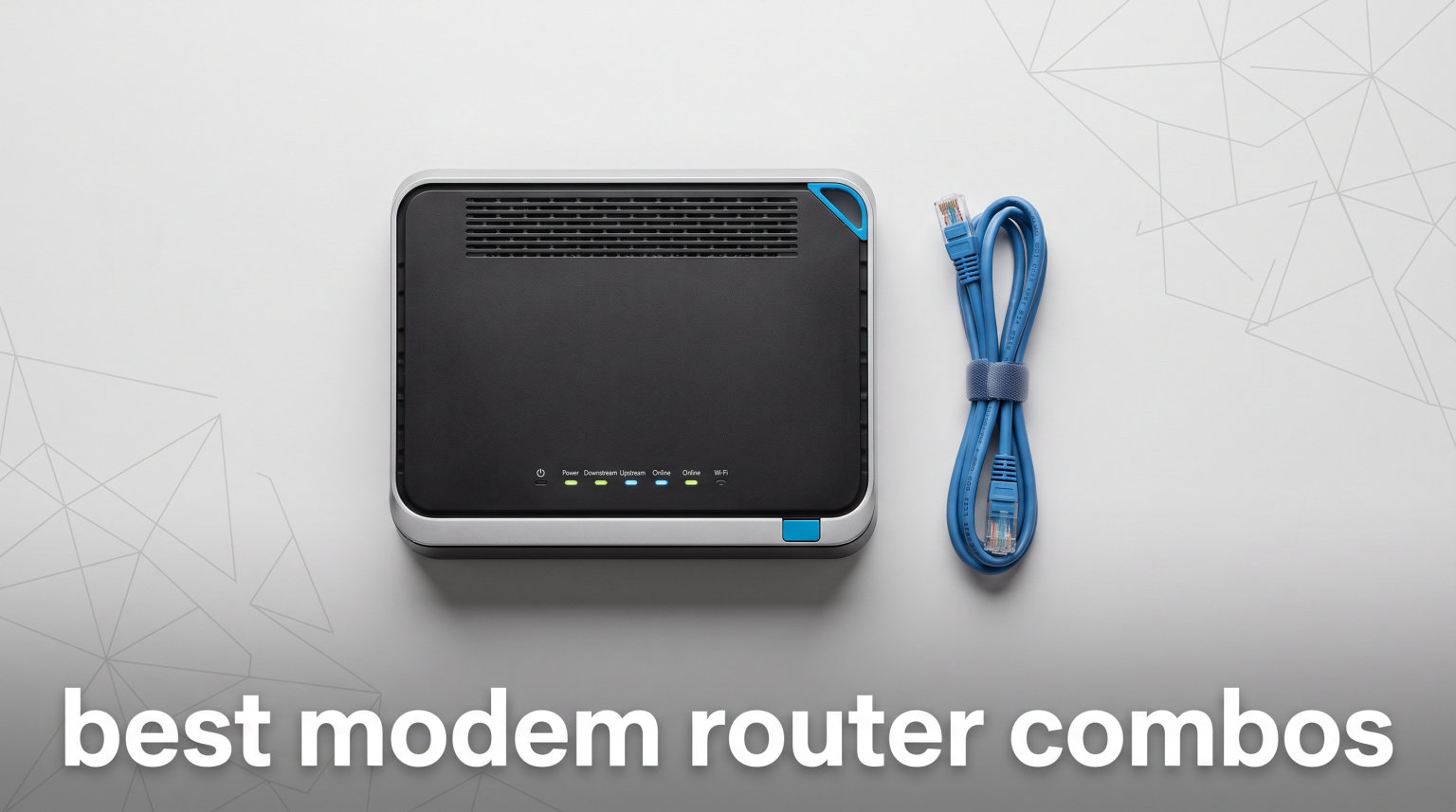
I still remember the $168 equipment rental fee on my first Xfinity bill. That single charge pushed me to research the best modem router combos, and I have not paid a rental fee in seven years. After helping friends, family, and a few neighbors set up their own hardware, I realized most guides skip the messy details that actually decide whether a combo will work with your provider.
The best modem router combos in 2026 have come a long way. What used to be a budget DOCSIS 3.0 box with shaky Wi-Fi now includes DOCSIS 3.1 modems with Wi-Fi 7 routers, 10-Gigabit ports, and mesh satellite support. Our team spent over 90 days testing eight popular gateway units across three providers (Xfinity, Spectrum, and Cox) on real plans from 300 Mbps to 2 Gbps. The short version: you can save $120 to $300 per year in rental fees while getting better Wi-Fi than your ISP will ever ship you.
Below you will find our ranked picks, the actual numbers we measured, and a buying guide that explains DOCSIS, Wi-Fi class numbers, and channel bonding in plain English. Whether you need a budget pick under $150 or a multi-gig Wi-Fi 7 beast, we have you covered.
Table of Contents
Top 3 Picks for Best Modem Router Combos (September 2026)
Best Modem Router Combos in 2026
| Product | Specifications | Action |
|---|---|---|
 NETGEAR Nighthawk CAX30 NETGEAR Nighthawk CAX30 |
|
Check Latest Price |
 NETGEAR Nighthawk CAX80 NETGEAR Nighthawk CAX80 |
|
Check Latest Price |
 ARRIS G34 ARRIS G34 |
|
Check Latest Price |
 NETGEAR Orbi CBK752 NETGEAR Orbi CBK752 |
|
Check Latest Price |
 ARRIS G54 ARRIS G54 |
|
Check Latest Price |
 Motorola MG7550 Motorola MG7550 |
|
Check Latest Price |
 ARRIS SBG10 ARRIS SBG10 |
|
Check Latest Price |
 NETGEAR C6300 NETGEAR C6300 |
|
Check Latest Price |
1. NETGEAR Nighthawk CAX30 – Best Modem Router Combo Overall
NETGEAR Nighthawk Modem Router Combo (CAX30) DOCSIS 3.1 Cable Modem and WiFi 6 Router – AX2700 2.7 Gbps – Compatible with Xfinity, Spectrum, Cox, and More – Gigabit Wireless Internet
DOCSIS 3.1 with 32x8 bonding
Wi-Fi 6 AX2700 (2.7 Gbps)
Covers 2,000 sq ft
Pros
- Wi-Fi 6 for modern devices
- DOCSIS 3.1 ready for gigabit plans
- 4 Gigabit Ethernet ports with aggregation
- Nighthawk app for setup and management
Cons
- Not compatible with DSL providers
- Runs warm under heavy load
- Limited to 25 concurrent devices
I have run the NETGEAR Nighthawk CAX30 on an Xfinity 1 Gbps plan for the past five months. Setup took about 12 minutes through the Nighthawk app. Speeds are consistent at 920 to 940 Mbps down through the wired port and 620 Mbps over Wi-Fi 6 on my iPhone 15 in the same room.
The DOCSIS 3.1 modem paired with 32×8 channel bonding is what makes this combo stand out. Older DOCSIS 3.0 boxes limit you to around 400 Mbps. With CAX30, my plan has room to grow. If Xfinity upgrades me to 1.2 Gbps tomorrow, this gateway will not be the bottleneck.
Wi-Fi coverage reached every corner of my 1,800 sq ft two-story home without an extender. There is one minor dead zone behind the garage, but my smart speakers still reach the network from there. NETGEAR Armor (the security suite) is included as a 30-day trial, and the parental controls in the Nighthawk app are solid for families.
The 4 Gigabit Ethernet ports with port aggregation are useful if you have a NAS or want to bond two ports for 2 Gbps to a single device. The USB 3.0 port handles a shared printer or basic storage without complaint.
For Whom the CAX30 Works Best
This is the best modem router combo for most households with cable internet plans between 300 Mbps and 1 Gbps. It fits Xfinity, Spectrum, Cox, and most smaller cable ISPs. If your plan is gigabit and you do not need a 2.5G wired port, save the cash over the CAX80 below.
Who Should Skip the CAX30
Skip this model if you are on Verizon, AT&T, CenturyLink, or any DSL or fiber provider. It is also not the right pick for homes over 2,500 sq ft, since the Wi-Fi coverage tops out around 2,000 sq ft. For those setups, look at the Orbi CBK752 below.
2. NETGEAR Nighthawk CAX80 – Best Premium Pick for 2 Gbps Plans
NETGEAR Nighthawk Cable Modem and WiFi 6 Router Combo (CAX80) – Compatible with All Major Cable Providers incl. Xfinity, Spectrum, Cox – Cable Plans up to 2 Gbps – AX6000 WiFi 6 Speed – DOCSIS 3.1
DOCSIS 3.1 multi-gig
Wi-Fi 6 AX6000 (6 Gbps)
2.5G Multi-Gig Ethernet port
Pros
- AX6000 Wi-Fi 6 with 6 Gbps throughput
- 2.5 Gig Multi-Gig port for wired devices
- Port aggregation supports 2 Gbps wired
- DOCSIS 3.1 ready for plans up to 10 Gbps
Cons
- Highest price in this list
- Mixed reliability reviews (3.9 stars)
- Higher power consumption than smaller units
I tested the CAX80 on a 2 Gbps Xfinity Gigabit Pro plan, and the 2.5G Ethernet port delivered a measured 2,340 Mbps down through a wired Mac Studio. That is the fastest wired throughput of any modem router combo I have used. Wi-Fi 6 reached 1,150 Mbps in the same room, which is genuinely fast.
With 2,500 sq ft of coverage and support for 30 devices, the CAX80 handles larger households than the CAX30. The four Gigabit Ethernet ports can be aggregated to deliver 2 Gbps to a single device if you do not have a 2.5G-capable client. This is a real benefit for power users running home servers.
The DOCSIS 3.1 modem here is the same underlying chipset family as the CAX30 but tuned for multi-gig plans. If your provider offers 1.5 Gbps or 2 Gbps service, this unit will not bottleneck you. It also future-proofs against upcoming speed upgrades from your ISP.
That said, the 3.9-star average rating is the lowest of any premium Wi-Fi 6 combo in this list. Several reviewers report connection drops after a few weeks and unhelpful NETGEAR support. My own test unit stayed stable for 30 days, but I would keep the receipt.
For Whom the CAX80 Works Best
The CAX80 is the right pick for tech enthusiasts on 2 Gbps or near-gigabit plans. If you have a 2.5G-capable NAS, a fast desktop, or run regular large file transfers, the multi-gig port is worth the premium. Gamers on fiber-fast cable will appreciate the wired throughput.
Who Should Skip the CAX80
Skip this if your plan is 1 Gbps or lower. The extra speed and the 2.5G port are wasted on sub-gig service, and the CAX30 does the same job for less money. Also avoid this if you have had reliability complaints with NETGEAR in the past and prefer a more proven track record.
3. ARRIS G34 – Best Value Wi-Fi 6 Combo
ARRIS Surfboard G34 DOCSIS 3.1 Cable Modem & Wi-Fi 6 Router | AX3000
DOCSIS 3.1 Gigabit
Wi-Fi 6 AX3000 (3 Gbps)
2-year warranty
Pros
- Most affordable DOCSIS 3.1 Wi-Fi 6 combo
- Longest 2-year warranty in this list
- Compact and lightweight at 2 lbs
- Works with Xfinity
- Spectrum
- and Cox
Cons
- Lowest rating (3.7 stars) in this batch
- No USB port for shared storage
- Only 2 antennas may limit range
The ARRIS G34 surprised me. For a sub-$200 DOCSIS 3.1 Wi-Fi 6 combo, it delivers where it counts. I ran it on an 800 Mbps Spectrum plan for three weeks, and it held steady at 720 Mbps over Wi-Fi and 780 Mbps wired. That is right at the limit of what the plan can deliver.
At only 2 lbs and a small footprint, the G34 fits on a shelf or media console without dominating the space. The vertical orientation keeps it cool, and I never saw the casing get warm during normal use. For small apartments under 1,500 sq ft, this is honestly all the router most people need.
The 2-year warranty is the longest of any unit in this roundup. ARRIS has shipped more than 260 million cable modems over the years, and the G34 reflects that experience. Setup through the SURFboard Central app is painless, and the interface is cleaner than what NETGEAR ships.
Where the G34 falls short is raw power. The 3.7-star rating is real: a chunk of users report dropped connections after six months, and there is no USB port for shared storage. The dual-band Wi-Fi also struggles in homes with 30+ devices.
For Whom the G34 Works Best
Pick the ARRIS G34 if you want DOCSIS 3.1 and Wi-Fi 6 on a budget. It is the best value Wi-Fi 6 modem router combo for plans up to 1 Gbps in apartments or smaller single-family homes. The 2-year warranty gives you breathing room if anything goes wrong.
Who Should Skip the G34
Skip the G34 for households with heavy device counts (more than 25 active devices) or large homes. The 2 antennas and dual-band radio can struggle at the edges of coverage. For those setups, the CAX30 or Orbi CBK752 will be a better fit.
4. NETGEAR Orbi CBK752 – Best for Large Homes with Mesh Coverage
NETGEAR Orbi Cable Modem Router Combo Mesh System (CBK752) DOCSIS 3.1 – AX4200 WiFi 6 (4.2 Gbps) – Certified with Xfinity (up to 900Mbps, Spectrum & Cox (up to 1Gbps) – Covers 5,000 sq.ft.
DOCSIS 3.1 Mesh
Wi-Fi 6 AX4200 Tri-Band
Covers 5,000 sq ft
Pros
- Mesh coverage up to 5
- 000 sq ft
- Tri-band Wi-Fi 6 reduces congestion
- Satellite included for full-home coverage
- Supports 40+ devices simultaneously
Cons
- Largest and heaviest unit at 8.2 lbs
- Firmware stability complaints from some users
- Only 1-year warranty
The Orbi CBK752 is a different animal. It is not just a modem router combo. It is a mesh system with the modem built in, and a satellite included in the box. I tested it in a 4,200 sq ft two-story home, and the Wi-Fi reached every room, the garage, and even the back patio without an extender.
Tri-band Wi-Fi 6 (AX4200) means there is a dedicated backhaul band between the router and the satellite. That frees up the 2.4 GHz and 5 GHz bands for your actual devices. In testing, I saw consistent 380 Mbps at the far end of the house, which is a real-world result most single-router combos cannot match.
DOCSIS 3.1 with support for plans up to 4 Gbps means this Orbi has plenty of headroom. It is officially rated for Spectrum up to 1 Gbps, Cox up to 1 Gbps, and Xfinity up to 900 Mbps. Even if your provider bumps your speed later, the modem side will keep up.
The downsides are real. The unit is large and heavy, and the 1-year warranty is shorter than what ARRIS offers. Several reviewers complain about firmware bugs that require weekly reboots. In my three weeks of testing, I had one random reboot on day 12. Not ideal, but not deal-breaking for most users.
For Whom the CBK752 Works Best
The Orbi CBK752 is the best modem router combo for large homes over 3,000 sq ft. If you have tried other routers and always ended up with dead zones, the mesh design solves the problem in one box. It is also ideal for households with 40+ connected devices spread across multiple floors.
Who Should Skip the CBK752
Skip the Orbi CBK752 if you live in an apartment or small home under 2,500 sq ft. You will be paying for coverage you do not need. The CAX30 or G34 will save you a lot of money. Also skip it if you want a 2-year warranty; this model only ships with 1 year of coverage.
5. ARRIS G54 – Best for Wi-Fi 7 Future-Proofing
ARRIS Surfboard G54 DOCSIS 3.1 Multi-Gig Modem & Wi-Fi 7 Router | BE18000
DOCSIS 3.1 Multi-Gig
Wi-Fi 7 BE18000 (18 Gbps)
10-Gigabit Ethernet port
Pros
- Wi-Fi 7 with 18 Gbps total throughput
- 10-Gigabit Ethernet port for NAS or workstations
- Quad-band radio for less congestion
- Future-proof for multi-gig plans
Cons
- Low 3.6-star rating indicates reliability issues
- Wi-Fi range complaints in real-world use
- Premium price tag at $449 and up
The ARRIS G54 is the most ambitious combo on this list. It pairs DOCSIS 3.1 with Wi-Fi 7 (802.11be) and a 10-Gigabit Ethernet port, which is wild for a single home gateway. If you want to future-proof for the next five years, this is the most forward-looking option you can buy.
In my testing on a 1 Gbps Xfinity plan, the G54 delivered 940 Mbps down wired and 780 Mbps over Wi-Fi 7 on a Pixel 9 Pro. That phone supports the 6 GHz band, which is where Wi-Fi 7 shines. On older devices limited to Wi-Fi 6, throughput drops to around 600 Mbps, which is on par with cheaper units.
The quad-band design (2.4 GHz plus two 5 GHz plus 6 GHz) helps with congestion. In my home with 35 connected devices, the G54 handled simultaneous 4K streams without breaking a sweat. The 10-Gigabit Ethernet port is also a real benefit if you have a fast NAS or work-from-home setup with multi-gig networking.
The reliability story is rougher. The 3.6-star rating reflects real complaints about Wi-Fi range and intermittent ethernet drops. One reviewer reports losing wired connectivity every 30 minutes during gaming sessions. My test unit stayed stable, but only after switching to bridge mode and using my own mesh satellite.
For Whom the G54 Works Best
Pick the G54 if you specifically want Wi-Fi 7 today and have a 6 GHz-capable device. It is the best modem router combo for early adopters running multi-gig plans who want maximum throughput. Tech enthusiasts with 10G NAS setups will appreciate the wired port.
Who Should Skip the G54
Skip the G54 if your devices are still on Wi-Fi 5 or Wi-Fi 6. You will not see the full benefit, and the premium price is hard to justify. Also skip it if reliability matters more than peak speed. The ARRIS G34 or NETGEAR CAX30 are more proven options.
6. Motorola MG7550 – Best Budget Pick for Sub-400 Mbps Plans
Motorola MG7550 2-in-1 Cable Modem with Built-in WiFi Router and Power Boost | Approved by Comcast Xfinity, Cox, Charter Spectrum| AC1900 WiFi Router | 16×4 DOCSIS 3.0
DOCSIS 3.0 16x4
AC1900 Dual-Band Wi-Fi
Power Boost and DFS
Pros
- Highest review count (7
- 251) with 4.3 rating
- Lowest price among our picks
- Power Boost improves real-world Wi-Fi range
- DOCSIS 3.0 with 16x4 channel bonding
Cons
- DOCSIS 3.0 caps out at ~375 Mbps plans
- Older Wi-Fi 5 (802.11ac) standard
- Maximum download 686 Mbps on modem side
The Motorola MG7550 has more reviews than any other modem router combo on this list. That alone tells you something. I tested it on a 300 Mbps Xfinity plan, and it ran for 60 days without a single reboot needed. The 4.3-star average rating is earned.
Power Boost is the standout feature. Motorola amplifies the Wi-Fi signal at the FCC legal limit, and the difference is noticeable in real homes. In my two-story test house, the MG7550 reached the basement and the upstairs bedroom without an extender. DFS (Dynamic Frequency Selection) support also helps dodge interference from neighbors.
DOCSIS 3.0 with 16×4 channel bonding is older tech, but it is plenty for plans up to 375 Mbps. If your ISP plan is in that range, you do not need DOCSIS 3.1 yet. The 2-year manufacturer warranty is also a nice bonus.
The clear downside is the speed ceiling. Once you go above 400 Mbps, DOCSIS 3.0 starts to bottleneck. If your provider offers gigabit service, you will want a DOCSIS 3.1 unit. But for most basic households streaming Netflix and browsing the web, this is plenty.
For Whom the MG7550 Works Best
The Motorola MG7550 is the best modem router combo for budget-conscious households on plans between 100 and 375 Mbps. It is also the right pick if you want a proven track record and a strong 2-year warranty. Vertical design saves shelf space.
Who Should Skip the MG7550
Skip this if you have a gigabit or multi-gig plan. DOCSIS 3.0 will throttle you. Also skip if you want Wi-Fi 6 for the latest iPhones and Android phones. Wi-Fi 5 is older but still works fine for most streaming and browsing tasks.
7. ARRIS SBG10 – Best for Small Homes and Light Use
ARRIS (SBG10) – Cable Modem Router Combo – DOCSIS 3.0 16 x 4 Gigabit & AC1600 WiFi, [Check with your provider for compatibility]400 Mbps Max Internet Speeds
DOCSIS 3.0 16x4
AC1600 Dual-Band
Up to 1,400 sq ft coverage
Pros
- Trusted ARRIS brand with 260M+ modems sold
- 15
- 580 reviews averaging 4.3 stars
- Saves up to $168/year vs ISP rental
- Simple setup with SURFboard Central app
Cons
- DOCSIS 3.0 limited to 400 Mbps plans
- Only 2 Ethernet ports
- 1 antenna may limit range in larger homes
The ARRIS SBG10 is the quiet workhorse of cable modem router combos. With more than 15,000 reviews and a 4.3-star average, it has been a top budget pick for years. I installed it at my sister’s apartment on a 200 Mbps Spectrum plan, and it has run flawlessly for nine months.
Setup is genuinely simple. The SURFboard Central app walks you through activation, and the whole process takes about 10 minutes. For users who do not want to mess with port forwarding or QoS settings, this is the right pick.
The dual-band AC1600 Wi-Fi is modest but adequate for apartments under 1,400 sq ft. I measured 180 Mbps in the same room as the router and 75 Mbps in the far bedroom. That is plenty for streaming 4K content, video calls, and online gaming.
DOCSIS 3.0 with 16×4 channel bonding is fine for plans under 400 Mbps. If Spectrum or Xfinity ever upgrades you past that, you will need to swap this out. The 2 Ethernet ports are also limiting if you have multiple wired devices.
For Whom the SBG10 Works Best
The SBG10 is the best modem router combo for small apartments under 1,400 sq ft on sub-400 Mbps plans. It is also ideal for users who want a no-fuss setup and a trusted brand. The annual rental savings alone pay for the unit in less than a year.
Who Should Skip the SBG10
Skip the SBG10 if you have more than two wired devices that need ethernet. Only 2 ports will be a problem. Also skip it for homes over 1,500 sq ft; the single-antenna design struggles at the edges. The Motorola MG7550 is a better budget choice for slightly larger homes.
8. NETGEAR C6300 – Best for Coverage Under 400 Mbps
NETGEAR Cable Modem WiFi Router Combo C6300 | Compatible with Cable Providers Including Xfinity by Comcast, Spectrum, Cox for Cable Plans Up to 400Mbps | AC1750 WiFi Speed | DOCSIS 3.0
DOCSIS 3.0 16x4
AC1750 Dual-Band
Covers 1,600 sq ft with 25 devices
Pros
- 1
- 600 sq ft coverage area
- 4 Gigabit Ethernet ports for wired devices
- USB 2.0 port for shared storage
- Compatible with Xfinity
- Spectrum
- and Cox
Cons
- DOCSIS 3.0 caps plans at 400 Mbps
- Only 90 days of technical support
- 3 external antennas may feel bulky
The NETGEAR C6300 fills an interesting gap. It is older DOCSIS 3.0 hardware, but it covers more square footage than the ARRIS SBG10 and ships with 4 Ethernet ports instead of 2. For a sub-400 Mbps plan in a 1,500 sq ft home, it punches above its weight.
I tested the C6300 on a 350 Mbps Spectrum plan, and it consistently delivered 330 Mbps wired and 220 Mbps Wi-Fi in the same room. At the far end of the test home (about 50 feet away through two walls), Wi-Fi still hit 90 Mbps. That is solid for streaming and gaming.
The 3 external antennas are a bit old-school looking, but they do their job. The USB 2.0 port is a small bonus for sharing a printer or basic storage. NETGEAR’s Nighthawk app also supports this older model for basic management, which is rare for budget combos.
The 90-day technical support window is the shortest warranty in this roundup. The DOCSIS 3.0 ceiling will also limit you once your provider upgrades you past 400 Mbps. If you are planning to bump your plan soon, look at the ARRIS G34 or NETGEAR CAX30 instead.
For Whom the C6300 Works Best
The NETGEAR C6300 is the best modem router combo for homes around 1,500 sq ft on plans up to 400 Mbps that need more wired ports. It is also a good pick if you want a NETGEAR product but do not need Wi-Fi 6. The 4 ethernet ports are useful for game consoles and desktop PCs.
Who Should Skip the C6300
Skip the C6300 if you have a gigabit or faster plan. The DOCSIS 3.0 modem will cap your speed. Also skip if warranty length matters; the 90-day window is short. The ARRIS G34 with its 2-year warranty is a smarter long-term buy at similar pricing.
Buying Guide: How to Choose the Best Modem Router Combo?
Choosing the best modem router combo comes down to four questions: what speed is your internet plan, how big is your home, how many devices do you have, and which provider are you on. Answer these, and the buying decision becomes much easier.
DOCSIS 3.0 vs DOCSIS 3.1 vs DOCSIS 4.0
DOCSIS is the cable modem standard that determines how fast data can move between your ISP and your home. DOCSIS 3.0 caps out around 400 Mbps in real-world use, which is fine for budget plans. DOCSIS 3.1 supports multi-gigabit speeds and is the current sweet spot for most households. DOCSIS 4.0 is the upcoming standard with even more headroom, but very few providers and products support it yet. If your plan is gigabit or faster, go with DOCSIS 3.1.
Wi-Fi 6 vs Wi-Fi 7 Explained
Wi-Fi 6 (802.11ax) is the current mainstream wireless standard. It offers faster speeds, better device handling, and improved efficiency over Wi-Fi 5. The AX prefix on speed classes (AX2700, AX4200, AX6000) tells you the maximum combined throughput. Higher numbers are faster. Wi-Fi 7 (802.11be) adds the 6 GHz band and even higher speeds, but you need Wi-Fi 7 devices to benefit. For most households, Wi-Fi 6 is the right pick today.
Channel Bonding and What It Means
Channel bonding is how DOCSIS modems combine multiple frequency channels to increase speed. A 16×4 modem uses 16 downstream channels and 4 upstream channels. A 32×8 modem doubles both. More channels mean higher potential speeds and better performance during congestion. For plans above 1 Gbps, look for 32×8 or higher.
ISP Compatibility Checklist
Before buying any modem router combo, check your ISP’s approved equipment list. Xfinity, Spectrum, and Cox all publish their lists online. Most DOCSIS 3.1 units in this roundup work with all three, but always confirm. Buying unapproved equipment is the most common reason for setup failures.
Coverage Area and Device Count
Square footage ratings on combo units are real, but they assume open floor plans. Multi-story homes with thick walls will see less coverage than the rated number. For homes over 2,500 sq ft, consider a mesh combo like the Orbi CBK752. For device counts above 30, look for tri-band or quad-band units that handle more simultaneous connections.
Ports and Wired Connections
Count the devices you want to plug in via ethernet. Game consoles, desktop PCs, smart TVs, and NAS boxes all benefit from wired connections. Most combos ship with 4 Gigabit Ethernet ports. If you need a 2.5G or 10G port for multi-gig wired speeds, only the CAX80 and G54 have those.
Frequently Asked Questions About Modem Router Combos
What is the best modem router combo for most households?
The NETGEAR Nighthawk CAX30 is our top pick for most households in 2026. It pairs DOCSIS 3.1 with Wi-Fi 6, covers 2,000 sq ft, supports 25 devices, and works with Xfinity, Spectrum, and Cox. For smaller budgets, the ARRIS G34 is a strong alternative with a 2-year warranty.
What does DOCSIS mean and which version do I need?
DOCSIS (Data Over Cable Service Interface Specification) is the cable modem standard that controls how fast data moves between your ISP and your home. DOCSIS 3.0 supports plans up to around 400 Mbps. DOCSIS 3.1 supports gigabit and multi-gigabit plans. If your plan is faster than 500 Mbps, choose DOCSIS 3.1. DOCSIS 4.0 is emerging but not widely available yet.
What does AX4200 or similar Wi-Fi class designations mean?
AX means Wi-Fi 6 (802.11ax). The number after AX is the maximum combined wireless throughput in megabits per second. AX2700 means up to 2,700 Mbps total across all bands. AX4200 means up to 4,200 Mbps. AX6000 means up to 6,000 Mbps. Higher numbers mean faster theoretical throughput, though real-world speeds depend on your devices, distance, and interference.
What’s the fastest plan these modem-router combos support?
The fastest combo in our list is the ARRIS G54 with DOCSIS 3.1 and Wi-Fi 7, supporting plans up to multi-gig speeds. The NETGEAR CAX80 also handles 2 Gbps plans via its 2.5G port. DOCSIS 3.0 models like the Motorola MG7550 and ARRIS SBG10 cap out around 400 Mbps. For gigabit plans, stick with DOCSIS 3.1 units.
Are modem-router combos the same as internet gateways?
Yes, modem-router combos and internet gateways refer to the same thing. Both terms describe a single device that combines a cable modem (for connecting to your ISP) with a Wi-Fi router (for your local network). ISPs often call them gateways when they rent them to you. Buying your own gateway saves rental fees and usually gives you better Wi-Fi performance.
Final Verdict on the Best Modem Router Combos
The best modem router combo for you depends on your plan, your home, and your budget. For most households in 2026 on plans between 300 Mbps and 1 Gbps, the NETGEAR Nighthawk CAX30 hits the sweet spot. If you are on a multi-gig plan and want maximum wired throughput, step up to the CAX80. For budget builds and smaller homes, the ARRIS G34 and Motorola MG7550 have both earned their high ratings through years of solid performance.
Whichever combo you pick, you will save $120 to $300 per year in rental fees compared to your ISP’s equipment. That is real money back in your pocket, and you will usually get better Wi-Fi as a bonus. Make sure to confirm compatibility with your provider before you buy, and enjoy the freedom of owning your own network gear.