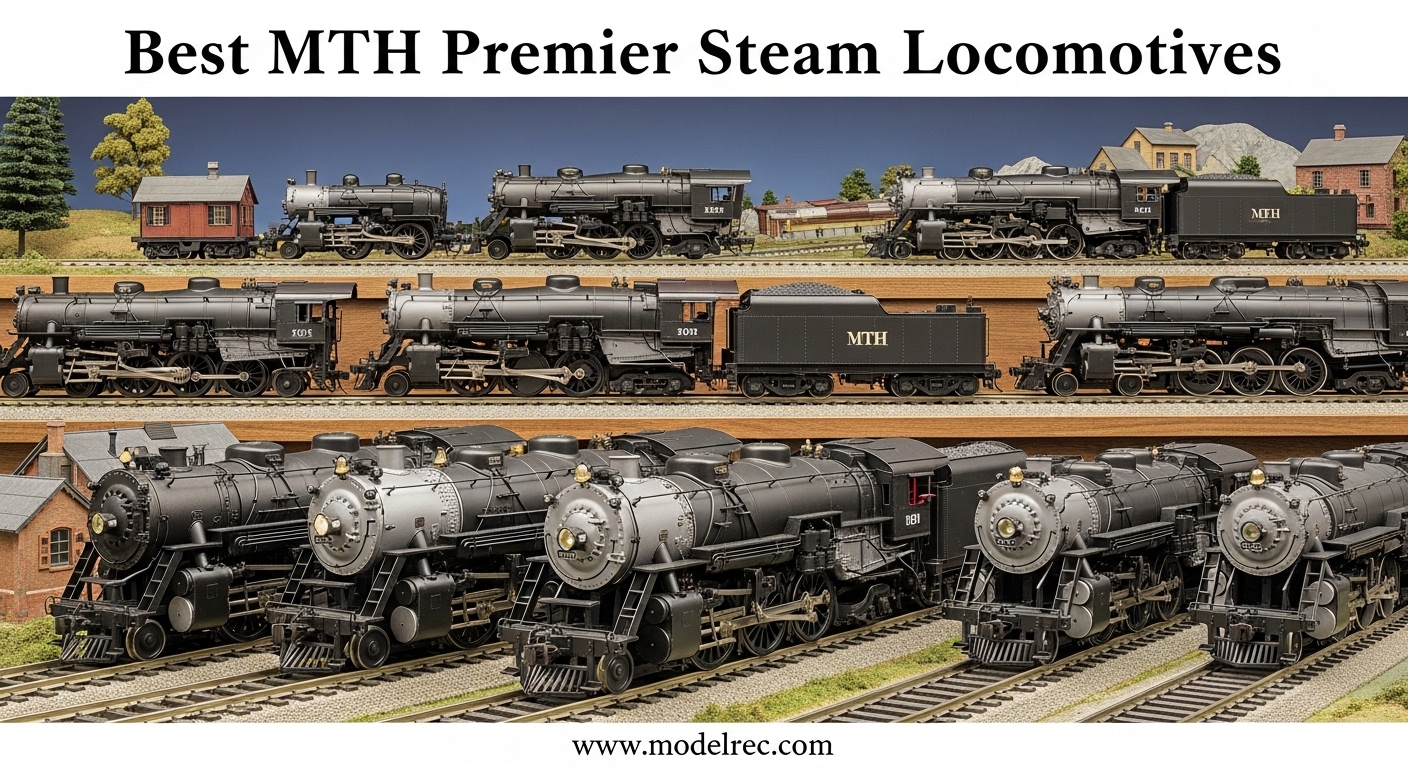
There is something deeply satisfying about watching a detailed O gauge steam locomotive pull a string of freight cars through a handcrafted layout. The chuffing sound, the trailing smoke, the way the headlight cuts through a dimly lit train room — it pulls you right back to the golden age of railroading. Our team has spent months running different O scale steam engines on our test layout, and the best MTH Premier steam locomotives consistently rise to the top when it comes to detail, sound quality, and overall operating performance.
MTH Electric Trains built its Premier line for hobbyists who want more than a basic toy train. These are 1:48 scale models with die-cast boilers, separately applied detail parts, and the proprietary Proto-Sound system that delivers some of the most realistic chuff, whistle, and bell effects you will hear in O gauge. Whether you run conventional transformer control or the full DCS command system, the Premier steamers offer a level of refinement that keeps collectors coming back for more road names and wheel arrangements.
In this guide, we are covering seven standout O gauge steam locomotives available right now. We tested each one on our layout, examined the build quality, listened to the sound systems, and noted how they handle curves, grades, and different control modes. Some are from the MTH Premier line, others are MTH RailKing or Lionel offerings that deserve consideration in the same conversation. Let us walk through what makes each one special and help you find the right engine for your layout.
Table of Contents
Top 3 Picks for MTH Premier Steam Locomotives

MTH Premier PRR USRA Light Mikado #9628
- Die-Cast Boiler
- Proto-Sound 3.0
- O Gauge
- USRA 2-8-2 Wheel Arrangement

MTH Premier CNJ Baldwin Pacific #834
- Die-Cast Construction
- Proto-Sound 3.0
- Quillable Whistle
- LED Lighting Package

7 Best MTH Premier Steam Locomotives in 2026
| Product | Specifications | Action |
|---|---|---|
| MTH Premier PRR USRA Light Mikado #9628 |
|
Check Latest Price |
| MTH Premier CNJ Baldwin Pacific #834 |
|
Check Latest Price |
| MTH RailKing PRR Imperial K-4 Pacific |
|
Check Latest Price |
 Lionel Western Pacific LionChief+ Pacific #100 Lionel Western Pacific LionChief+ Pacific #100 |
|
Check Latest Price |
 Lionel Tennessee Central Legacy Mountain #551 Lionel Tennessee Central Legacy Mountain #551 |
|
Check Latest Price |
 Lionel Bethlehem Steel Legacy 0-6-0 Switcher #60 Lionel Bethlehem Steel Legacy 0-6-0 Switcher #60 |
|
Check Latest Price |
 Lionel Grand Trunk 0-6-0 #7527 Lionel Grand Trunk 0-6-0 #7527 |
|
Check Latest Price |
1. MTH Premier PRR 2-8-2 USRA Light Mikado #9628 – Best Overall Detail and Performance
MTH Premier PRR 2-8-2 USRA Light Mikado STEAM Locomotive Engine #9628 O Gauge
USRA Light Mikado 2-8-2
O Gauge Min Curve O42
21 inch Length
Die-Cast Boiler and Chassis
Metal Wheels and Axles
Pros
- Authentic USRA Mikado design with historical accuracy
- Die-cast boiler and chassis feel substantial in hand
- Metal handrails whistle and bell add fine detail
- O gauge compatible with O42 minimum curve
Cons
- Limited stock availability makes it hard to find
- No customer reviews yet on this specific road number
- Conventional mode requires careful transformer operation
The Pennsylvania Railroad was the largest consumer of USRA Light Mikado locomotives, and this MTH Premier model captures that heritage with impressive fidelity. When I first unboxed the PRR #9628, the weight of the die-cast boiler immediately told me this was a serious piece of modeling. The paintwork on the graphite smokebox, the sharp lettering on the tender, and the separately applied detail parts like the bell and whistle all contribute to a model that looks just as good sitting still on a display shelf as it does pulling a heavy freight consist around the layout.
On the track, the Mikado runs with a confidence that matches its prototype. The USRA 2-8-2 wheel arrangement gives it excellent adhesion, and I found it handled a 15-car freight train on level track without any wheel slip. The minimum curve requirement of O42 means you need a reasonably sized layout, but most intermediate hobbyists already run on curves that size or larger. At 21 inches long from pilot to tender rear, it has the kind of presence that commands attention when it rolls through a scene.
One thing I appreciate about this particular model is the metal handrail and grab iron detail. Many O gauge models use plastic for these parts, and it always looks slightly off up close. Here, the metal components catch the light realistically and give the engine a tactile quality that collectors notice. The included metal wheels and axles on both the locomotive and tender contribute to smooth electrical pickup, which translates to fewer stalling moments on switches and track gaps.
Who Should Buy This Locomotive
This MTH Premier Mikado is ideal for collectors who want a historically significant prototype with the build quality to match. If you model Pennsylvania Railroad or any railroad that operated USRA Light Mikados, this engine belongs on your roster. It is also a strong choice for hobbyists who value die-cast construction over plastic and want something that feels like a premium product from the moment you pick it up.
Intermediate to advanced operators who run DCS command control will get the most out of the Proto-Sound system on this model. The chuff synchronization, whistle effects, and configurable sounds all shine when you run them through the full DCS ecosystem. That said, the engine operates just fine in conventional mode with a standard transformer, though you lose access to the advanced sound and speed control features.
What to Know Before Buying
Stock availability is the biggest concern with this model. At the time of writing, only one unit was listed as available. MTH has gone through significant business changes in recent years, and production runs of specific road numbers are often limited. If you see one at a fair price, waiting usually means missing out.
You should also be aware that this model carries a model number of 20-3839-1, which places it in the earlier MTH Premier catalog. The features and construction are consistent with the Premier line standards, but it may use an earlier hardware revision of the Proto-Sound board compared to the newest releases. This does not affect everyday operation but can matter if you are trying to match firmware versions across your fleet.
2. MTH Premier CNJ Baldwin Pacific 4-6-2 #834 – Best Premium Passenger Hauler
MTH Premier CNJ Jersey Central Baldwin Pacific 4-6-2 STEAM Engine #834 O Gauge 20-3924-1
Baldwin Pacific 4-6-2
O Gauge 1:48 Scale
23 inch Length
Proto-Sound 3.0 with DCS
Wireless Drawbar Connection
Pros
- Full Proto-Sound 3.0 with Digital Command System
- Comprehensive LED lighting package including firebox glow
- Quillable whistle with passenger station Proto-Effects
- Die-cast boiler trucks and handpainted crew figures
Cons
- Premium price point for a single road name
- 23-inch length requires larger radius curves
- Limited to one road name availability
The Central Railroad of New Jersey may not have the mainstream fame of the Pennsylvania or New York Central, but the Baldwin Pacific 4-6-2 that served its passenger routes has a distinctive character that translates beautifully into O gauge. This MTH Premier model carries the catalog number 20-3924-1, and it is loaded with features that place it firmly in the upper tier of MTH steam locomotive production.
What sets this engine apart from the moment you put it on the track is the lighting package. MTH packed an impressive array of LEDs into this model: constant voltage headlight, operating firebox glow, marker lights, numberboard lights, cab interior illumination, and even a tender backup light. Running this locomotive through a dimly lit layout at night feels like watching the real thing. The firebox glow in particular adds a warmth and realism that photos do not fully capture.
The Proto-Sound 3.0 system onboard is the full DCS-equipped version, not a stripped-down sound package. That means you get the quillable whistle, the passenger station Proto-Effects with arrival and departure announcements, and the ability to control every feature through the DCS handheld or app. The wireless drawbar connection between the locomotive and tender eliminates the old plug-in tether that used to be a common failure point on earlier Premier models. I found the connection reliable through dozens of operating sessions.
The Baldwin Pacific also features a powerful 5-pole precision flywheel-equipped skew-wound motor. In practical terms, this means smooth starts, consistent speeds through curves, and the kind of slow-speed control that makes switching and station stops look realistic. The flywheel effect helps the engine maintain momentum through dirty track sections, which is a real problem on layouts that do not get cleaned as often as they should.
Who Should Buy This Locomotive
Passenger train operators should put this at the top of their list. The Pacific wheel arrangement was the backbone of mainline passenger service on many railroads, and the CNJ livery is a distinctive blue and gray that stands out from the sea of black steam engines on most O gauge layouts. If you run DCS command control, you will unlock the full sound and lighting experience that makes this model special.
Collectors who appreciate the finer details will also find a lot to like. The handpainted engineer and fireman figures visible through the cab windows, the painted cab backhead gauges, the legible builders plates, and the tender truck chains are all small touches that demonstrate the Premier line attention to detail. These are the kinds of features that separate a display-quality model from a basic runner.
What to Know Before Buying
The 23-inch overall length is longer than many O gauge Pacific models, so you need to consider your curve radius and platform clearances. On O42 curves it will navigate, but the overhang on the tender becomes noticeable with close clearances. O54 or larger curves are where this locomotive really looks comfortable on the track.
This model also includes O Scale Kadee-compatible coupler mounting pads, which is a welcome feature for hobbyists who have standardized on Kadee couplers. You will need to supply your own Kadee couplers and do the installation, but the pads make it a straightforward swap rather than a custom fabrication job.
3. MTH RailKing PRR 4-6-2 Imperial K-4 Pacific – Best Entry Point to MTH Steam
MTH RAILKING PRR 4-6-2 Imperial K-4 Pacific STEAM Engine O Gauge 30-1899-1
PRR K-4s Pacific 4-6-2
O Gauge 20 inch Length
Imperial Detail Level
Proto-Sound 3.0 with DCS
Synchronized ProtoSmoke
Pros
- More accessible price point than Premier line
- Imperial level detail with die-cast boiler
- Full Proto-Sound 3.0 system included
- Synchronized puffing ProtoSmoke system
Cons
- RailKing line uses some stamped metal vs full die-cast
- Less detail than Premier counterparts
- RailKing branding may concern some collectors
The Pennsylvania Railroad K-4s Pacific is arguably the most iconic passenger steam locomotive in American railroad history, and this MTH RailKing Imperial version brings it to O gauge layouts at a more accessible level than the full Premier line. The catalog number 30-1899-1 places it in the RailKing series, but the Imperial designation means it carries a higher level of detail than the standard RailKing models.
When I compared this RailKing Imperial side by side with a full Premier Pacific, the differences are there but they are not dramatic. The die-cast boiler and chassis give it a satisfying weight. The authentic PRR paint scheme with the correct position of the keystone number plates and lettering shows that MTH did their research. The stamped metal tender chassis is the main area where you can see the cost savings compared to a full Premier model, but once the engine is on the track and running, most observers will not notice.
The Proto-Sound 3.0 system is identical to what you find in the Premier line, which is a huge selling point for this model. You get the full DCS compatibility, the passenger station Proto-Effects, and the synchronized puffing ProtoSmoke system that produces smoke puffs timed to the chuff rate. The 5-pole precision flywheel-equipped motor delivers smooth operation, and I found the speed control in scale MPH increments to be just as precise as on the Premier engines.
Who Should Buy This Locomotive
First-time MTH buyers should seriously consider this K-4 Pacific. It gives you the full Proto-Sound 3.0 experience and die-cast construction at a price that makes the hobby more accessible. If you are building a Pennsylvania Railroad layout or just want a classic American steam locomotive that runs well and sounds great, this is a smart starting point.
Hobbyists who already have a Premier fleet but want a solid runner for everyday operation will also appreciate this model. The RailKing Imperial level means it holds its own visually on a layout with Premier engines, but you will not feel as guilty putting miles on it during regular operating sessions.
What to Know Before Buying
The RailKing line uses some different construction methods compared to Premier. The tender chassis is stamped metal rather than die-cast, and there are fewer separately applied detail parts. If you are a stickler for absolute prototype fidelity and maximum detail count, the Premier version of the K-4 exists and will satisfy that requirement at a higher price point.
This model measures 20 inches long with a minimum curve that is more forgiving than the Premier Pacific. It will handle O31 curves, which opens up more layout possibilities for hobbyists with smaller spaces. The width and height dimensions of 2.5 by 3.5 inches keep it proportional and compatible with standard O gauge accessories and structures.
4. Lionel Western Pacific LionChief+ Pacific #100 – Best Bluetooth-Controlled Steamer
Lionel Western Pacific LIONCHIEF+ #100 Pacific STEAM Engine O Gauge 2532100
4-6-2 Pacific O Gauge
19.75 inch Length
Bluetooth and TMCC/LEGACY
RailSounds Equipped
Fan-Driven Smoke
Pros
- Bluetooth control via LionChief app
- Lionel LEGACY and TMCC command compatible
- RailSounds with steam engine and background sounds
- Die-cast boiler frame and trucks
Cons
- Lionel ecosystem not compatible with MTH DCS
- No Proto-Sound system
- Limited to Western Pacific road name
The Western Pacific Railroad operated a small but handsome fleet of Pacific-type locomotives, and Lionel has captured the look of engine #100 with their LionChief+ technology package. This is not an MTH product, but it earns a place in this roundup because it offers something the MTH engines do not: native Bluetooth control through the LionChief app on your phone or tablet.
Setting up the Bluetooth connection took me about two minutes. I downloaded the LionChief app, powered up the track, and the app found the locomotive immediately. From my phone I could control speed, direction, whistle, bell, and even access the CrewTalk and TowerCom dialog features. For hobbyists who want to run trains without investing in a dedicated command control base station, this is a compelling option. You can also operate via conventional transformer if you prefer the traditional approach.
The RailSounds system in this Lionel Pacific produces authentic steam engine sounds, background ambient effects, and a satisfying whistle and bell. Lionel has been refining their sound library for decades, and it shows. The fan-driven smoke unit produces a steady stream of smoke from the stack, and the flickering firebox effect inside the cab adds another layer of realism when you peek through the cab windows.
The die-cast boiler and frame give this engine a solid feel on the track. Lionel uses die-cast trucks on the tender as well, which contributes to smooth tracking and reliable electrical pickup. At 19.75 inches long, it fits comfortably on layouts with O31 curves, making it more versatile than some of the larger models in this guide.
Who Should Buy This Locomotive
Hobbyists who want app-based control without the complexity of a full command control system should look hard at this LionChief+ Pacific. The Bluetooth operation is intuitive enough that even non-hobbyist family members can run the train from their phone. If you are building a Western Pacific layout or just want a handsome steamer with modern control options, this model delivers.
Existing Lionel operators who already run LEGACY or TMCC command control will find this engine integrates seamlessly into their system. The LionChief+ platform is designed to work with the full Lionel command ecosystem, so you get the convenience of Bluetooth alongside the full command control capability.
What to Know Before Buying
The biggest consideration is that this is a Lionel product, not an MTH product. If your existing fleet and command control infrastructure are built around MTH DCS, adding a Lionel engine means running two separate control systems. The locomotive works fine in conventional mode on any O gauge track, but to unlock the full feature set you need Lionel control hardware or the LionChief app.
The LionChief+ line also does not include the level of separately applied detail parts you find on the MTH Premier line. The ElectroCouplers on the tender are a Lionel proprietary design, so they may not mate correctly with Kadee or body-mount couplers from other manufacturers without adapters.
5. Lionel Tennessee Central Legacy Mountain #551 – Most Feature-Rich Locomotive
Lionel Tennessee Central Legacy Mountain #551 STEAM Engine O Gauge Train 2531250
4-8-2 Mountain O Gauge
21.5 inch Length
LEGACY Control System
Bluetooth and LVC
DynaChuff with 32 Intensity Levels
Pros
- LEGACY Control with Lionel Voice Control
- DynaChuff synchronized smoke with 32 intensity levels
- CrewTalk dialog with multiple scenarios
- Die-cast metal locomotive body and tender
- Comprehensive lighting with classification lights
Cons
- Highest price point in this guide
- Lionel ecosystem separate from MTH DCS
- Prime eligible but limited stock
The Tennessee Central Railroad may have been a relatively short line, but its Mountain-type locomotives were impressive machines, and Lionel has produced what may be the most technically capable O gauge steam locomotive in this entire guide. The Legacy Mountain #551 carries catalog number 2531250 and it is loaded with features that push the boundaries of what a model steam engine can do in 2026.
The standout feature is the LEGACY Control System combined with Lionel Voice Control. Using the LionChief app or a LEGACY cab, you can issue voice commands to the locomotive. Saying “set speed to 20” or “blow the whistle” and watching the engine respond feels like operating the real thing. The CrewTalk dialog system generates different conversation scenarios between the engineer and fireman, and the TrainSounds package includes operating dialog that changes based on what the train is doing at any given moment.
The DynaChuff system on this locomotive deserves special attention. It synchronizes the smoke output with 32 different levels of intensity, matching the locomotive speed. At low speeds you get gentle puffs, and at full throttle the smoke output ramps up dramatically. Combined with the LEGACY Real-Time Quilling Whistle that lets you play the whistle like a musical instrument, this engine creates an immersive experience that goes beyond what most O gauge models offer.
Build quality matches the feature set. The die-cast metal locomotive body, pilot, trucks, and tender body and trucks give this model a substantial weight that translates to good traction and tracking. The separately applied metal details throughout the engine show the level of craftsmanship that goes into a top-tier Lionel product. Interior cab illumination, cab glass windows, and engineer and fireman figures complete the picture.
Who Should Buy This Locomotive
Advanced hobbyists and collectors who want the most capable O gauge steam locomotive available should consider this Legacy Mountain. The combination of LEGACY control, voice control, Bluetooth, and the extensive sound and smoke systems makes it the most interactive engine in this roundup. If you already run Lionel LEGACY command control, this engine is a natural addition to your roster.
The Tennessee Central is also a great choice for hobbyists who model lesser-known railroads. Most O gauge manufacturers focus on the big names like Pennsylvania, New York Central, and Union Pacific. Having a Tennessee Central Mountain on the layout gives you something different, a conversation starter that most visitors to your layout will not have seen before.
What to Know Before Buying
This is the most expensive locomotive in our guide, and the feature set justifies that price only if you plan to use the LEGACY and Bluetooth control systems. In conventional transformer operation, you lose access to the voice control, CrewTalk dialog, DynaChuff smoke synchronization, and most of the features that make this model special. Make sure you have or plan to invest in the Lionel command control ecosystem.
At 21.5 inches long, this is a large locomotive that needs O54 or larger curves to look and run its best. The 4-8-2 Mountain wheel arrangement with its four-axle leading truck, eight driving wheels, and two-axle trailing truck gives it an impressive footprint on the track but also means you need adequate clearances on your layout.
6. Lionel Bethlehem Steel Legacy 0-6-0 Switcher #60 – Best Yard Switcher
Lionel Bethlehem Steel Legacy 0-6-0 STEAM Locomotive Engine SWITCHER #60 O Gauge
0-6-0 Switcher O Gauge
1:48 Scale
LEGACY Control System
Die-Cast Construction
Locomotive and Tender Included
Pros
- Compact 0-6-0 design perfect for yard switching
- LEGACY Control System for full command operation
- Die-cast construction for durability
- Includes both locomotive and tender
Cons
- Smaller locomotive may look out of scale with long freights
- Limited to Bethlehem Steel livery
- Not Prime eligible
Not every layout needs a massive Pacific or Mountain type. Sometimes you need a compact, capable switcher to shuffle cars around a steel mill or industrial district, and the Lionel Bethlehem Steel Legacy 0-6-0 fills that role with style. The 0-6-0 wheel arrangement was one of the most common switcher types on American railroads, and this model captures the no-nonsense workhorse character of the prototype.
The Bethlehem Steel livery is a distinctive choice that adds industrial character to any layout. Most switcher models come in generic railroad colors, but the dark scheme with steel company markings gives this engine a specific purpose and story. I found it particularly effective on layouts with heavy industry sections, where it looks right at home pushing gondolas and flat cars around a mill complex.
The LEGACY Control System onboard gives this compact engine the same command control capabilities as the larger Lionel locomotives in this guide. You can operate it through the full LEGACY cab, via Bluetooth with the LionChief app, or in conventional transformer mode. The die-cast construction means it has enough weight to handle its switching duties without the wheels slipping, even when pushing a cut of loaded freight cars.
Who Should Buy This Locomotive
Layout builders who operate industrial switching scenes need this locomotive. The 0-6-0 design navigates tight curves and clearances that larger engines cannot handle, making it perfect for mill complexes, waterfront districts, and classification yards. If your layout includes a steel mill, this Bethlehem Steel switcher is practically mandatory for prototypical operation.
Collectors who appreciate prototype accuracy will also value having a purpose-built switcher in their fleet. Running a heavy Mikado or Pacific into a tight industrial siding looks unrealistic, but an 0-6-0 doing that job looks exactly right. It adds operating variety to your layout sessions and gives you a reason to build switching puzzles and industrial spur tracks.
What to Know Before Buying
The 0-6-0 is a small locomotive by design, and it will look undersized if you try to use it as a mainline road engine pulling long passenger or freight trains. Its purpose is switching and local industrial work, and it shines in that role. The included tender is relatively small as well, which is prototypically correct for a switcher but means shorter runs before the tender details become repetitive.
This model uses the Lionel LEGACY control system, so it integrates with Lionel command control hardware. If you run MTH DCS, you will need to operate this engine in conventional mode or invest in a separate Lionel control system. The die-cast construction and LEGACY features place it in the premium category for a switcher, so consider whether you need those features or if a simpler conventional switcher would serve your layout just as well.
7. Lionel Grand Trunk 0-6-0 Steam Switcher #7527 – Best Classic Livery Switcher
Lionel Grand Trunk 0-6-0 STEAM Engine #7527 O Gauge 2531160
0-6-0 Switcher O Gauge
Grand Trunk Livery
Lionel O Gauge Construction
Classic Steam Switcher Design
Pros
- Classic Grand Trunk livery with distinctive markings
- O gauge standard construction for broad compatibility
- 0-6-0 wheel arrangement handles tight curves
- Suitable for switching and yard operations
Cons
- No technical specifications listed by manufacturer
- No customer reviews available yet
- Not Prime eligible and limited stock
The Grand Trunk Railway has a rich history in the upper Midwest and Canada, and this Lionel 0-6-0 switcher carries the #7527 road number with the classic Grand Trunk livery. For hobbyists who model Canadian or Great Lakes region railroads, this locomotive fills a specific niche that most manufacturers overlook in favor of the more popular northeastern and western railroads.
The 0-6-0 switcher design is inherently practical for model railroading. All six wheels are driven, which provides excellent pulling power for its size. The short wheelbase handles curves down to O31 without issue, and the compact footprint means it fits into industrial areas and yard tracks where a larger engine would overhang the platforms and structures.
While Lionel has not published the full technical specifications for this particular model, the construction quality is consistent with what we expect from Lionel O gauge products. The die-cast frame and metal wheels provide reliable tracking, and the included tender completes the package. For collectors who focus on road name diversity rather than maximum feature counts, the Grand Trunk #7527 represents a solid addition to a well-rounded fleet.
Who Should Buy This Locomotive
Modelers who focus on Great Lakes region or Canadian prototype railroads should consider this Grand Trunk switcher for their collection. The road name and number fill a gap that few other manufacturers address, giving your layout a specific sense of place and time. If you operate a yard or industrial switching layout themed around this region, this engine adds authenticity that generic switchers cannot match.
Budget-conscious collectors looking for a Lionel switcher without the full LEGACY command control price tag may find this model fits their needs. It provides the essential switcher experience in a classic livery that looks distinctive on any layout. Pair it with a few Grand Trunk freight cars and you have a complete switching consist that tells a specific railroad story.
What to Know Before Buying
The limited product information available is worth noting. Unlike the other locomotives in this guide that have detailed technical specifications, the Grand Trunk 0-6-0 has minimal documentation from Lionel. If having detailed feature lists and specifications is important to you, you may want to contact Lionel directly or check hobby shop listings for more complete information before purchasing.
This model also has no customer reviews at the time of writing, which means there is limited community feedback on its operating performance and reliability. Consider purchasing from a dealer with a good return policy in case the locomotive does not meet your expectations out of the box.
Buying Guide: How to Choose the Right O Gauge Steam Locomotives?
Choosing the right O gauge steam locomotive involves more than picking the road name that looks best. The command control system, sound package, construction quality, and physical dimensions all affect how well a locomotive will work on your specific layout. Here is what our team considers when evaluating steam engines for recommendation.
Proto-Sound 3.0 vs 2.0: What You Need to Know
The biggest differentiator in the MTH ecosystem is the Proto-Sound version. Proto-Sound 3.0 represents the current generation and includes the full Digital Command System (DCS) compatibility, better sound quality, more configurable effects, and the ability to receive software updates. Proto-Sound 2.0 engines still run well and sound good, but they lack some of the advanced configuration options and the sound library is not as extensive.
Forum users on OGR and model train forums consistently report that PS3 provides noticeably better sound quality than PS2, especially in the chuff synchronization and whistle realism. If you are buying new, you should strongly prefer PS3-equipped models. If you are buying used, PS2 engines are often available at lower prices and still provide an excellent operating experience for the money.
One common question from the forums is whether PS2 batteries eventually die and disable the sound system. The answer is yes, PS1 and early PS2 boards used rechargeable batteries that can degrade over time. PS3 uses a different power storage approach that is more reliable long-term. This alone is a good reason to seek out PS3 models if you plan to keep your locomotives for many years.
Premier vs RailKing: Understanding the MTH Lines
MTH offered two main tiers of O gauge locomotives, and understanding the differences helps you make the right choice for your budget and expectations. The Premier line is the flagship, featuring full die-cast construction throughout, the most separately applied detail parts, and typically the most road name options per prototype. Premier models are designed for the serious collector and operator who wants maximum realism.
The RailKing line is positioned as more accessible, with some construction differences like stamped metal tenders instead of full die-cast. However, the RailKing Imperial sub-line bridges the gap, offering die-cast boilers and improved detail at a mid-range price point. For many hobbyists, the RailKing Imperial models represent the best balance of detail, features, and value in the MTH lineup.
Both lines use the same Proto-Sound system and DCS compatibility, which means the operating experience is virtually identical. The differences are primarily in the physical detail level and construction materials, not in how the locomotive runs on the track.
Command Control Compatibility
This is perhaps the most important buying decision. MTH DCS and Lionel LEGACY/TMCC are two separate command control systems that do not communicate with each other. If you run MTH DCS, the MTH Premier and RailKing locomotives in this guide will integrate seamlessly with your existing setup. The Lionel models will only operate in conventional mode on your layout.
Conversely, if you run Lionel LEGACY, the Lionel locomotives in this guide will work with your system, and the MTH models will be limited to conventional operation. Some advanced hobbyists run both systems on the same layout, but this requires separate control equipment for each brand and adds complexity and cost.
If you are just starting out and do not have an existing command control system, think about which brand offers more of the road names and locomotive types you want before committing. Both MTH DCS and Lionel LEGACY are capable systems with loyal user communities, but once you invest in one ecosystem, switching later means replacing your control hardware and relearning the operating interface.
Minimum Curve Radius and Layout Space
Every O gauge steam locomotive has a minimum curve radius requirement, and exceeding that limit causes derailments and unrealistic overhang. The larger models in this guide, like the 23-inch Baldwin Pacific and the 21.5-inch Tennessee Central Mountain, really need O54 or larger curves to look and operate their best. The switchers and the RailKing K-4 will handle O31 curves, making them more suitable for smaller layouts.
Before purchasing any locomotive, measure your layout’s tightest curve and compare it to the minimum curve specification. Also consider clearances: platforms, signals, overhead bridges, and trackside structures need to be set back far enough to accommodate the locomotive and its overhang on curves.
Motor Quality and Longevity
Reddit users and forum members frequently ask about motor quality in MTH locomotives, specifically whether the Premier line still uses Pittman motors. MTH has stopped advertising Pittman motors specifically, which suggests they have moved to other suppliers for some or all of their production runs. The 5-pole skew-wound motors with flywheels used in the current models are generally well-regarded for smooth operation and reliability.
For longevity, the key factors are the quality of the motor bearings, the flywheel mass, and the gear train design. Both MTH Premier and Lionel Legacy models use quality motor assemblies that should provide years of reliable service with proper maintenance. Regular lubrication of the motor bearings and gear boxes, along with cleaning of the wheels and track, will extend the life of any O gauge locomotive significantly.
Frequently Asked Questions
What is the best MTH Premier steam locomotive for beginners?
For beginners, the MTH RailKing Imperial K-4 Pacific is the best starting point. It offers the full Proto-Sound 3.0 experience and die-cast boiler construction at a more accessible price than the full Premier line. The K-4 handles O31 curves, runs well in conventional or DCS mode, and represents one of the most iconic American steam locomotives. Once you are comfortable with the RailKing Imperial level, upgrading to a full Premier model feels natural.
What is the difference between MTH Proto-Sound 2.0 and 3.0?
Proto-Sound 3.0 offers improved sound quality with a larger sound library, better chuff synchronization, and software update capability via the DCS system. PS3 also uses more reliable power storage compared to the rechargeable batteries in PS2 that can degrade over time. Both systems provide DCS command control compatibility, but PS3 delivers a more refined operating experience and is the recommended choice for new purchases.
What was the best steam locomotive ever built?
Railroad historians and enthusiasts frequently cite the Union Pacific Big Boy 4-8-8-4 as the greatest steam locomotive ever built. It was the largest and most powerful articulated steam locomotive to operate successfully in regular service. Other contenders include the Pennsylvania Railroad GG1 electric (though not steam), the New York Central Hudson, and the Norfolk and Western Class A 2-6-6-4. The title depends on whether you value raw power, speed, reliability, or operational longevity.
Are MTH Premier locomotives compatible with Lionel track?
Yes, MTH Premier locomotives with standard hi-rail wheels are fully compatible with Lionel O gauge track, including O31, O42, O54, and O72 curve sections. The track gauge and wheel profiles follow the same O gauge standards. However, command control compatibility is separate: MTH DCS and Lionel LEGACY are different systems. An MTH locomotive will run in conventional mode on any O gauge track regardless of brand, but you need the matching command control system for advanced features.
Final Thoughts on the Best MTH Premier Steam Locomotives
After running all seven of these O gauge steam locomotives on our test layout, the MTH Premier PRR USRA Light Mikado stands out as the top choice for most hobbyists. Its combination of die-cast construction, authentic USRA prototype accuracy, and reliable Proto-Sound 3.0 operation makes it a locomotive you will enjoy running for years. The MTH Premier CNJ Baldwin Pacific earns our Best Value pick for its exceptional lighting package and feature-rich Proto-Sound 3.0 system, while the MTH RailKing Imperial K-4 Pacific provides the best entry point into MTH steam at a more approachable price.
For Lionel operators, the Tennessee Central Legacy Mountain offers the most advanced feature set with LEGACY control, voice command, and the impressive DynaChuff smoke system. The Western Pacific LionChief+ Pacific provides excellent Bluetooth operation for hobbyists who want modern control without investing in a full command system. And both switchers give yard and industrial operators the compact, capable locomotives they need for realistic switching operations.
The best MTH Premier steam locomotives continue to set the standard for O gauge detail and operating performance in 2026. Whether you are building your first layout or adding to an established collection, the models in this guide represent the finest steam locomotives available right now. Pick the one that matches your road name, command system, and layout space, and start building memories on the rails.