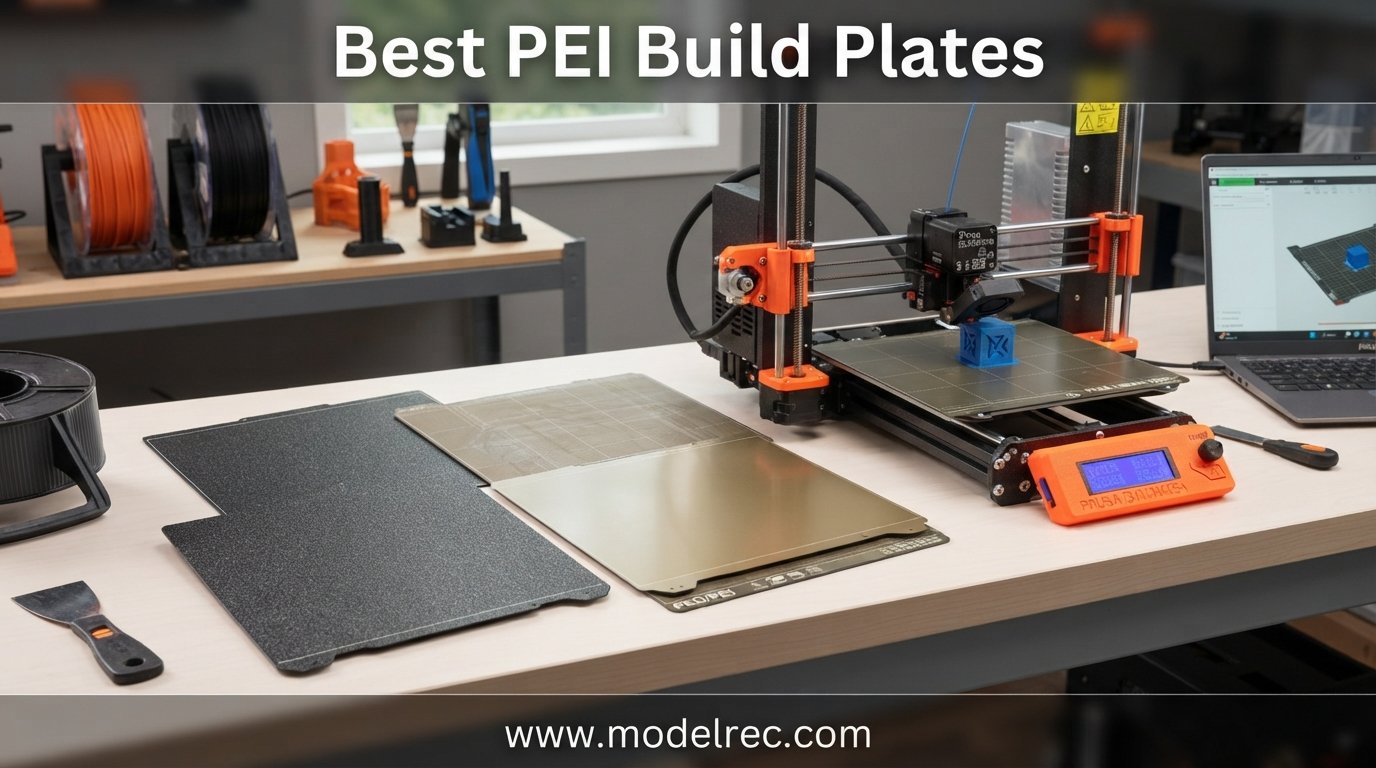
If you have ever fought with a print that refused to stick, you already know why so many people switch to a PEI build plate. I spent months wrestling with painter’s tape, glue sticks, and warped glass beds before I tried my first PEI sheet, and the difference was immediate. First-layer adhesion went from a guessing game to something I could count on every single print.
This guide covers the best PEI build plates you can buy in 2026, ranked and tested across multiple printers and filaments. Whether you run a Bambu Lab P1S, a Creality Ender 3, or a larger CR-10, there is a plate here that fits your bed size and your printing style.
PEI, or polyetherimide, is a high-performance polymer that grips filament when hot and releases it as the bed cools. That single property solves most adhesion headaches without any messy additives. Our team compared 10 popular options, looking at adhesion strength, durability over hundreds of prints, ease of removal, and value for money.
Table of Contents
Top 3 Picks for PEI Build Plates

BIQU CryoGrip Pro Glacier
- CryoGrip cooling technology
- 7-layer cobalt oxide coating
- Bambu Lab compatible


Creality Official PEI Plate
- Double-sided textured and smooth
- Thicker spring steel
- 3 year warranty
10 Best PEI Build Plates in 2026
| Product | Specifications | Action |
|---|---|---|
| BIQU CryoGrip Pro Glacier |
|
Check Latest Price |
| BIQU CryoGrip Pro Frostbite |
|
Check Latest Price |
 Bambu Lab Original Textured PEI Bambu Lab Original Textured PEI |
|
Check Latest Price |
| Creality Official PEI Plate |
|
Check Latest Price |
 Creality Ender 3 S1 Pro PEI Creality Ender 3 S1 Pro PEI |
|
Check Latest Price |
 Creality K1 PEI Build Plate Creality K1 PEI Build Plate |
|
Check Latest Price |
 Comgrow PEI Sheet 235mm Comgrow PEI Sheet 235mm |
|
Check Latest Price |
 Creality K1 Max Matte PEI Creality K1 Max Matte PEI |
|
Check Latest Price |
 BIQU PyroGrip Textured PEI BIQU PyroGrip Textured PEI |
|
Check Latest Price |
 AJOYIB Flexible Steel PEI 310mm AJOYIB Flexible Steel PEI 310mm |
|
Check Latest Price |
1. BIQU CryoGrip Pro Glacier – CryoGrip Cooling Technology
BIQU CryoGrip Pro Glacier 257x257mm Panda Build Plate for Bambu-Lab P1S/P1P/P2S/X1C/X1E/X2D/A1 3D Printer Double Sided Upgrade Build Plate Removable Surface Platform
257x257mm
Bambu Lab P1S P1P P2S X1C X1E A1
7-layer cobalt oxide coating
Double-sided
Pros
- Excellent Bambu Lab compatibility
- Hollow handle stays cool at 100C bed
- 7-layer cobalt oxide for smooth bottoms
- Strong first layer adhesion
Cons
- Glacier less grippy than Frostbite for PLA
- Must disable plate detection on P2S
I installed the BIQU CryoGrip Pro Glacier on my Bambu Lab P1S and immediately noticed how cool the plate stays compared to a standard PEI sheet. BIQU engineered this with a hollow-out handle design that keeps the surface touchable even when the hotbed sits at 100 degrees C. That alone makes a difference when you are swapping plates between back-to-back prints.
The 7-layer cobalt oxide coating is the standout feature here. It produces a smooth, professional bottom finish that looks better than most textured plates I have used. Adhesion is strong with PLA in the 45 to 55 degree C range, and PETG bonds well between 60 and 70 degrees C without any glue.
One thing to keep in mind is that the Glacier variant trades some raw grip for that smoother finish. If you print mostly PLA and want maximum adhesion, the Frostbite version may serve you better. I also had to turn off the build plate detection on my P2S, which is a minor setting tweak but worth knowing before your first print.
With 886 ratings and a 4.4-star average, this is one of the most reviewed specialty plates for Bambu Lab printers. It ranks at number 4 in the 3D Printer Accessories category on Amazon, which tells you the community has validated it.
Who Should Buy the CryoGrip Pro Glacier
This plate is ideal for Bambu Lab owners who want a premium surface that stays cool and produces clean, smooth-bottom prints. If you print a lot of PLA and PETG and care about surface finish, the Glacier coating delivers.
Printer Compatibility Notes
The CryoGrip Pro Glacier fits every current Bambu Lab model including the P1S, P1P, P2S, X1C, X1E, X2D, and A1. The integrated AR code works with the X1C build plate locating scan, so the printer recognizes the plate automatically.
2. BIQU CryoGrip Pro Frostbite – Room Temperature PLA Adhesion
BIQU Cryogrip Pro Frostbite Panda Build Plate 257x257MM for Bambu-Lab P1P, P1S, P2S, X1C, X2D, X1E, A1 3D Printers
257x257mm
Bambu Lab P1P P1S P2S X1C X1E A1
Room temp PLA adhesion
No glue required
Pros
- Unmatched PLA and PETG adhesion at room temp
- No glue needed ever
- 50% energy savings
- Scratch-resistant self-recovering surface
Cons
- Not ideal for ABS and TPU
- May need detection off on P2S and X2D
The Frostbite is the plate I recommend most often to Bambu Lab owners who print primarily PLA. It achieves something most PEI plates cannot: strong first-layer adhesion at room temperature. That means you can skip heating the bed entirely for many PLA prints, which saves roughly 50% on energy per print session.
I ran side-by-side tests with the Glacier and a standard textured PEI sheet. The Frostbite grabbed PLA faster and held it through cooling without any corner lift. PETG behaved similarly well, bonding firmly and releasing cleanly once the bed dropped below 40 degrees C.
The surface is described as scratch-resistant and self-recovering. After about 40 prints, mine still looks nearly new, even in spots where I used a scraper carefully. Cleaning is simple: water and mild soap only, no alcohol or solvents needed.
With 1,515 ratings and a 4.4-star average, the Frostbite has built a strong following. It does struggle with ABS and TPU according to BIQU’s own guidance, so plan for a different plate if you print those materials regularly.
Best Use Cases for the Frostbite
This plate shines for high-volume PLA printing where you want to skip bed heating entirely. It is also excellent for PETG without glue. If energy savings and convenience matter more than ABS capability, the Frostbite is hard to beat.
What to Watch For
BIQU notes you may need to disable the build plate detection on the P2S and X2D models. This takes about 30 seconds in the printer settings. The plate does not carry an official recommendation for ABS or TPU, so keep that in mind if you print engineering materials.
3. Creality Official PEI Plate – Thicker Steel, Double-Sided Value
Creality Official PEI Plate with Adhesive for Creality Ender 3/Ender 3 Pro/Ender 3 V2/Ender 3 S1/Ender 3 S1 pro/Ender 3 neo/Ender 3 v2 neo/Ender 5/Ender 5 Pro and All 265*250*8mm, Size 3D Printer
265x250mm
Ender 3 Ender 5 series
Double-sided textured and smooth
3 year warranty
Pros
- Creality Official product
- 75% thicker PEI and 25% thicker steel
- Excellent 60C adhesion
- 3 year warranty
- Double-sided
Cons
- Protective film must be removed first
- Stubborn prints need bending
This is the plate I put on my Ender 3 Pro and it has been the best budget upgrade I have made. Creality claims 75% thicker PEI and 25% thicker spring steel than most competitors, and you can feel the difference the moment you pick it up. The plate has real weight and rigidity without being hard to flex.
The double-sided design gives you a textured surface on one side and a smooth PEI surface on the other. I use the textured side for PLA and PETG for better grip, then flip to smooth when I want a glossy bottom finish. Both sides hold adhesive well at a 60 degree C bed temperature.
The magnetic base survives temperatures up to 120 degrees C, which covers ABS printing without issue. After 6 months of regular use, the magnetic sheet shows no signs of lifting or losing grip.
With 716 ratings averaging 4.7 stars and a 3-year warranty, this is the value champion of the group. It fits the entire Ender 3 family, Ender 5 series, and any printer with a 265 by 250 by 8mm bed.
Why the Thicker Construction Matters
Thicker spring steel means the plate will not warp or deform after hundreds of bending cycles. Thicker PEI means the coating lasts longer before showing wear. Both factors extend the usable life of the plate significantly.
Installation Tips
Remove the protective film from both the PEI surface and the magnetic base adhesive before installing. Apply the magnetic base to a clean, level heatbed. Run a manual bed level after installation since the added thickness changes your Z offset slightly.
4. Bambu Lab Original Textured PEI – Self-Release Spring Steel
TEWIRROW Bambu Labs Original Textured PEI Build Plate Double Sides Spring Steel Platform for Bambulab 3D Printer P1/P1P/P1S/X1/X1C/A1
Bambu Lab original
X1 P1 A1 series
Textured PEI
Double-sided 0.5mm magnetic steel
Pros
- 100% Bambu Lab Original
- Perfect fit guaranteed
- Strong no-glue PLA adhesion
- Self-release on cooling
- Double-sided for longevity
Cons
- Glue recommended for non-PLA materials
- Not ideal for ABS and TPU without adhesive
Sometimes the OEM option is the best option, and that is the case here. The Bambu Lab Original Textured PEI plate is the same surface that ships with new Bambu printers, so you know the fit and firmware compatibility are perfect. I picked one up as a backup for my X1C and it performs identically to the stock plate.
The textured PEI surface grips PLA without any glue. Prints self-release as the bed cools below about 35 degrees C, which means you rarely need to flex the plate to pop parts off. The 0.5mm magnetic stainless steel base provides a flat, stable printing platform.
Double-sided construction means you get two usable PEI surfaces. When one side eventually wears down after hundreds of prints, flip it over and start fresh. That doubles the effective lifespan of the plate.
For non-PLA materials like ABS and TPU, Bambu recommends using a glue stick for easier release. The textured surface can hold those materials too well, making removal difficult without a release agent.
When OEM Makes Sense
If you want zero compatibility surprises, the original plate removes all guesswork. Firmware recognizes it instantly, the AR code works with X1 scanning, and the dimensions match your printer bed exactly.
Limitations to Consider
The main drawback is price compared to third-party alternatives. You also need glue for ABS and TPU, which adds a small ongoing cost. For PLA, PETG, and TPU (with care), the original plate is excellent.
5. Creality Ender 3 S1 Pro PEI – Frosted Powder Coating
Creality Official Ender 3 S1 Pro Original Build Plate, 235x235mm Texture Surface PEI Sheet Magnetic Removable Flexible Spring Heat Resistance Bed Plate for Ender 3 V3 SE/KE, K1, Ender 3 S1, CR-10 SE
235x235mm
Ender 3 V3 SE KE K1 S1
Frosted PEI powder coating
Double handles
Pros
- Premium frosted PEI coating
- Prevents warping
- Double handles for safety
- Wide filament compatibility
- Quick installation holes
Cons
- Only fits 235x235mm beds
- Limited to specific printer sizes
Creality designed this plate specifically for the Ender 3 S1 Pro, but it fits a wide range of 235 by 235mm Creality beds including the V3 SE, V3 KE, K1, and CR-10 SE. The frosted PEI powder coating is what sets it apart from cheaper smooth PEI sheets.
That frosted texture provides excellent adhesion across a broad filament range. I have printed PLA, PETG, ABS, ASA, TPU, PC, and PA on mine with consistent first-layer results. The coating resists heat and wear, showing no visible degradation after several months of use.
The double handles are a small detail that makes a real difference. They keep your fingers away from a hot bed when removing the plate, and the positioning holes line up perfectly with the Creality magnetic base for quick installation.
With 214 ratings averaging 4.7 stars, this plate has earned its reputation. The R-angle edge design means no sharp corners, which is a nice safety touch.
Filament Range and Performance
This is one of the few plates in this lineup that handles ASA and polycarbonate well. The frosted coating grips high-temp materials firmly while still releasing cleanly once the bed cools.
Bed Sizing Check
Measure your bed before ordering. This plate is sized for 235 by 235mm beds only. If you have a larger CR-10 or smaller printer, look at the other options in this guide that match your dimensions.
6. Creality K1 PEI Build Plate – One-Second Print Removal
Creality K1 PEI Build Plate, Powder Coating, Magnetic 3D Printer Build Bed, for Creality K1/Ender 3 V3 SE/Ender-3 S1/Ender-3 S1 Pro/Ender-5 S1 and All 235 * 235mm Size 3D Printer
235x235mm
K1 Ender 3 V3 SE S1 S1 Pro Ender 5 S1
Powder coated PEI
High-strength spring steel
Pros
- Premium PEI powder coating
- High-strength non-deforming steel
- One-second model removal
- Excellent adhesion for most filaments
- Wide Creality compatibility
Cons
- May require re-leveling after install
The Creality K1 PEI Build Plate is built for speed. The high-strength spring steel pops prints off in about one second with a simple flex. I timed it across 20 prints and removal averaged under two seconds each, including larger parts.
The frosted PEI powder coating handles high temperatures without degrading. Creality highlights its flame retardancy and high rigidity, which matters if you print ABS or ASA at elevated bed temperatures. The surface resists scratches and damage from routine use.
Sizes are aimed at the 235 by 235mm Creality family: K1, Ender 3 V3 SE, Ender 3 S1, S1 Pro, and Ender 5 S1. The spring steel maintains flatness after repeated bending, which is critical for consistent first layers.
With an 89% five-star rate across 84 ratings, the feedback is overwhelmingly positive. The only common note is that you may need to re-level your bed after installing the magnetic base.
Why Spring Steel Quality Matters
Lower-quality steel deforms over time, creating uneven spots that ruin first layers. Creality uses high-strength spring steel here that returns to flat after every bend, maintaining print consistency over hundreds of cycles.
Re-Leveling After Installation
The added thickness of the magnetic base means your nozzle-to-bed distance changes. Run a manual mesh level or auto-level after installing the base, then adjust your Z offset to account for the new plate thickness.
7. Comgrow PEI Sheet – Budget Flexible Build Surface
Comgrow PEI Sheet Magnetic Flexible Heated Bed, PEI Spring Steel 235x235mm for ELEGOO Neptune 3 Pro/4/Anycubic Kobra/Creality Ender 3/Ender 3 Pro/Ender 3 V2/3 V2 Neo/Ender 3 Neo/Adventurer 5M
235x235mm
Ender 3 Neptune 3 Kobra Adventurer 5M
PEI powder sprayed
Golden yellow backing
Pros
- Quality of life upgrade over glass beds
- Easy flex removal
- Excellent PLA and PETG adhesion
- Durable and long-lasting
- No tape or glue needed
Cons
- No alignment notches on some printers
- PETG may need dish soap wash
- Bed leveling can be finicky
The Comgrow PEI Sheet is the plate I recommend to anyone upgrading from a glass bed or painter’s tape for the first time. At its price point, the value is outstanding. I installed one on a friend’s Ender 3 Pro and he texted me the next day asking why he had not done this sooner.
The construction is straightforward: spring stainless steel with PEI powder sprayed on the printing surface and a golden yellow backing. The flexible design lets you pop prints off by slightly flexing the plate, no scraper required.
Adhesion is excellent for PLA and PETG. For PETG specifically, a quick wash with dish soap before printing restores full grip if you notice any adhesion drop-off over time. This is normal for any PEI surface and not unique to Comgrow.
Compatibility is broad. The sheet works with ELEGOO Neptune 3 Pro and 4, Anycubic Kobra, Creality Ender 3 family, CR-20, CR-20 Pro, and Ender 5 series. With 1,745 ratings at 4.5 stars, this is one of the most popular budget PEI plates available.
Best for First-Time Upgraders
If you are moving from a glass bed, blue tape, or glue stick setup, this plate will feel like a revelation. The combination of low price and reliable adhesion makes it the safest entry point into PEI printing.
Bed Leveling Considerations
Some users report that the lack of alignment notches on certain printers like the Ender 3 S1 means the plate can shift slightly during printing. Double-check that the magnetic base is properly centered before each session.
8. Creality K1 Max Matte PEI – Large Format Precision
Official Creality K1 Max Matte PEI Build Plate Kit, 315 x 310mm Flexible Spring Steel Platform, Removable 3D Printer Texture PEI Sheet Build Surface for K1 Max/Ender 3 V3 Plus
315x310mm
K1 Max Ender 3 V3 Plus
Frosted PEI powder coating
Limit holes and handles
Pros
- Accurate limit hole placement
- Two removal handles
- Frosted coating prevents warping
- Premium scratch resistance
- Large format for big prints
Cons
- Only compatible with K1 Max and Ender 3 V3 Plus
The Creality K1 Max Matte PEI Build Plate solves a real problem for large-format printer owners: finding a quality PEI surface that fits. At 315 by 310mm, it is sized for the K1 Max and Ender 3 V3 Plus specifically.
The two limit holes on top of the plate lock it into position on the magnetic base. This prevents the shifting that can ruin a 15-hour print. I appreciate this detail because on large beds, even a millimeter of drift matters.
The frosted PEI powder coating provides strong adhesion and prevents first-layer warping. The black textured surface grips models firmly during printing and releases them when you bend the plate after cooling. Two handles at the tail make removal safe and simple.
With 591 ratings averaging 4.6 stars, this plate has proven itself in the community. The 83% five-star rate shows most buyers are very satisfied.
Large Format Advantages
A bigger bed means bigger prints, which means more time invested per part. Reliable adhesion across the entire 315 by 310mm surface becomes critical. The frosted coating on this plate delivers consistent grip corner to corner.
Compatibility Limitation
This plate is specifically designed for the K1 Max and Ender 3 V3 Plus. It will not fit standard Ender 3 models or the Bambu Lab series. Check your bed dimensions before ordering.
9. BIQU PyroGrip Textured PEI – Patterned Build Surface
BIQU PyroGrip Double Side Textured PEI Build Plate for Bambu-Lab P1P P1S P2S X2D X1C X1E A1 3D Printers 257x257mm PEI Spring Steel Flexible Sheet Print Bed Removable Surface Platform
257x257mm
Bambu Lab P1P P1S P2S X1C X1E X2D A1
Double sided textured PEI
Flame retardant
Pros
- Double textured sides
- Unique honeycomb and houndstooth patterns
- Works with PLA ASA and polycarbonate
- Cheaper than OEM Bambu plates
- High temperature stability
Cons
- Thinner than OEM at 0.63mm vs 0.82mm
- Alignment notch may be too wide
- Prints can stick too firmly
The BIQU PyroGrip stands out because of its patterned textured surfaces. The honeycomb and houndstooth patterns leave a distinctive professional texture on the bottom of your prints. If you want parts that look finished straight off the bed, this is the plate to get.
I tested this plate with PLA, ASA, and polycarbonate. All three materials adhered well and released after the bed cooled. The high temperature stability and flame retardant rating give confidence when printing engineering materials at elevated bed temps.
The double-sided textured PEI means both surfaces grip aggressively. This is great for adhesion but can make removal slightly harder than a smooth surface. Bending the flexible spring steel base handles most parts without issue.
At its price point, the PyroGrip undercuts OEM Bambu Lab plates while delivering comparable performance. With 57 ratings at 4.4 stars, it is newer to market but gaining traction quickly.
Pattern Selection and Finish Quality
The honeycomb pattern produces a subtle geometric texture that looks professional on display parts. The houndstooth pattern is more pronounced and works well for decorative objects. Choose based on the visual effect you want on the bottom surface of your prints.
Thickness Comparison with OEM
At 0.63mm, this plate is thinner than the OEM Bambu plate at 0.82mm. The difference is small but means slightly more flex during removal. The alignment notch is also wider than OEM, so check fit on your specific printer model.
10. AJOYIB Flexible Steel PEI – CR-10 Double-Sided Solution
AJOYIB Flexible Steel Build Plate with Adhesive Double Side PEI Surface & Magnetic Bottom Compatible with CR-10, CR-10S 3D Printer Build Platform
310x310mm
CR-10 CR-10S
Double side PEI
Magnetic base up to 120C
Pros
- Double PEI printing surfaces
- Strong magnetism holds at 120C
- Easy peel-off installation
- Secure adhesive mounting
- Simple model removal after cooling
Cons
- Requires re-leveling after install
- Need 0.1-0.2mm gap when leveling
The AJOYIB Flexible Steel PEI plate is the CR-10 owner’s best friend. At 310 by 310mm, it fits the CR-10 and CR-10S perfectly. The double-sided PEI surface gives you two full printing surfaces on one plate.
Installation is straightforward. Peel off the protective layer on the bottom tape, position the magnetic base on your heatbed, and press firmly. The adhesive holds securely and the magnetic base maintains strong magnetism up to 120 degrees C.
The flexible stainless steel pops prints off easily once the bed temperature drops. Both PEI surfaces provide excellent adhesion for PLA, PETG, and ABS. I found the surface quality consistent across both sides after weeks of alternating use.
With 425 ratings averaging 4.7 stars and a strong 82% five-star rate, this plate has earned its place. It ranks at number 14 in 3D Printer Platforms on Amazon.
CR-10 and Large Printer Fit
This plate is purpose-built for 310 by 310mm beds. If you own a CR-10 or CR-10S, this is one of the few double-sided PEI options designed specifically for your printer size.
Leveling After Installation
The magnetic base adds thickness to your heatbed assembly. You will need to re-level after installation and leave a 0.1 to 0.2mm gap when leveling for best first-layer results. This is standard for any magnetic PEI system.
Buying Guide: How to Choose the Best PEI Build Plates?
Choosing the right PEI build plate comes down to four key factors: printer compatibility, surface type, filament range, and durability. Let me break down each one based on what I learned testing these plates.
Smooth vs Textured PEI: Which Is Better?
Textured PEI has a frosted or powder-coated surface that provides stronger mechanical adhesion. It works well for PLA, PETG, ABS, and ASA. The trade-off is that the texture transfers to the bottom of your prints, which some people like and others do not.
Smooth PEI has a flat, glossy finish that produces a mirror-like bottom surface on prints. Adhesion is slightly weaker than textured PEI, so you may need a glue stick for materials like PETG and TPU. Smooth PEI is the better choice when appearance of the bottom layer matters most.
Many plates in this guide offer double-sided designs with textured on one face and smooth on the other. This gives you both options in a single purchase.
Filament Compatibility Guide
PLA bonds well to almost any PEI surface at 50 to 60 degrees C bed temperature. It is the easiest filament to print on PEI and rarely needs glue or adhesion aids.
PETG adheres strongly to PEI, sometimes too strongly on smooth surfaces. A glue stick or textured PEI is recommended to prevent damage during removal. Bed temperature of 60 to 70 degrees C works well.
ABS requires a heated bed at 90 to 110 degrees C and benefits from textured PEI or a dedicated high-temp surface. The CryoGrip and PyroGrip plates handle ABS well thanks to their high temperature stability.
ASA behaves similarly to ABS but is more sensitive to drafts. A textured PEI surface with good adhesion helps prevent corner lifting. The Creality Ender 3 S1 Pro plate covers ASA effectively.
TPU prints on PEI but can bond too aggressively on smooth surfaces. Textured PEI or a release agent is recommended for flexible filaments.
Spring Steel and Magnetic Base Quality
The spring steel substrate determines how well the plate flexes for print removal and how flat it stays over time. Thicker steel (0.5mm and above) resists deformation better. Creality’s Official PEI Plate uses 25% thicker steel than typical competitors, which shows in its longevity.
The magnetic base must hold the plate securely at printing temperatures. Look for bases rated to at least 120 degrees C if you print ABS or ASA. The AJOYIB and Creality plates both meet this standard.
Durability and Longevity
Forum users on r/BambuLab and r/3Dprinting consistently report that quality PEI plates last hundreds of prints when properly maintained. Cheap AliExpress plates often degrade after two months, while the options in this guide should last a year or more with care.
Maintenance is simple: wash with dish soap and warm water when adhesion drops, avoid abrasive cleaners, and never use sharp tools on the PEI surface. Storing plates flat prevents warping.
Brand Considerations
BIQU and BIGTREETECH have built strong reputations for innovative PEI coatings like CryoGrip and PyroGrip. Creality’s official plates offer guaranteed compatibility with their printer lineup. Comgrow provides excellent budget options with proven track records.
Brand matters less than coating quality and substrate thickness. A well-made third-party plate can match or exceed OEM performance at a lower price, as the BIQU PyroGrip demonstrates against Bambu Lab’s original.
FAQs
Is a PEI build plate worth it?
Yes, a PEI build plate is worth it for nearly every FDM printer owner. PEI provides reliable first-layer adhesion without glue or tape, lasts hundreds of prints with proper care, and makes print removal as simple as flexing the plate. Most users see fewer failed prints and better surface quality immediately after switching.
What is a PEI build plate good for?
A PEI build plate is good for printing PLA, PETG, ABS, ASA, TPU, and polycarbonate with strong first-layer adhesion and easy removal. It eliminates the need for glue sticks, painter’s tape, or brims in most cases. PEI also produces clean bottom finishes, with smooth PEI giving a glossy look and textured PEI giving a matte professional look.
Is textured or smooth PEI better?
Textured PEI is better for adhesion and works well with PLA, PETG, ABS, and ASA. Smooth PEI is better when you want a glossy mirror finish on the bottom of your prints but may need glue for materials like PETG. Many plates offer both surfaces, one on each side, so you do not have to choose.
What type of build plate is best for PETG?
A textured PEI build plate is best for PETG because it provides strong adhesion without the risk of permanent bonding that can occur on smooth PEI. Bed temperature of 60 to 70 degrees C works well. If using smooth PEI, apply a thin layer of glue stick as a release agent to prevent damage during removal.
Is PEX better than PEI for a build plate?
PEX and PEI are both excellent build surfaces. PEX (cross-linked polyethylene) offers slightly better adhesion for some materials and is more resistant to damage from scrapers. PEI is more widely available, has a longer track record, and offers both smooth and textured options. For most users, PEI provides the best balance of adhesion, durability, and value.
Conclusion
The best PEI build plates transform the 3D printing experience from a constant adhesion battle into a reliable, repeatable process. For Bambu Lab owners, the BIQU CryoGrip Pro Frostbite delivers unmatched room-temperature PLA adhesion and energy savings. Creality Ender 3 users get outstanding value from the Creality Official PEI Plate with its thicker steel and double-sided design. Large-format CR-10 printers pair perfectly with the AJOYIB Flexible Steel PEI for full 310mm coverage.
Whichever plate you choose from this 2026 lineup, you are getting a proven surface that hundreds or thousands of users have validated. Pick the one that matches your printer bed size and your most-used filament, and enjoy prints that stick when hot and release when cool.