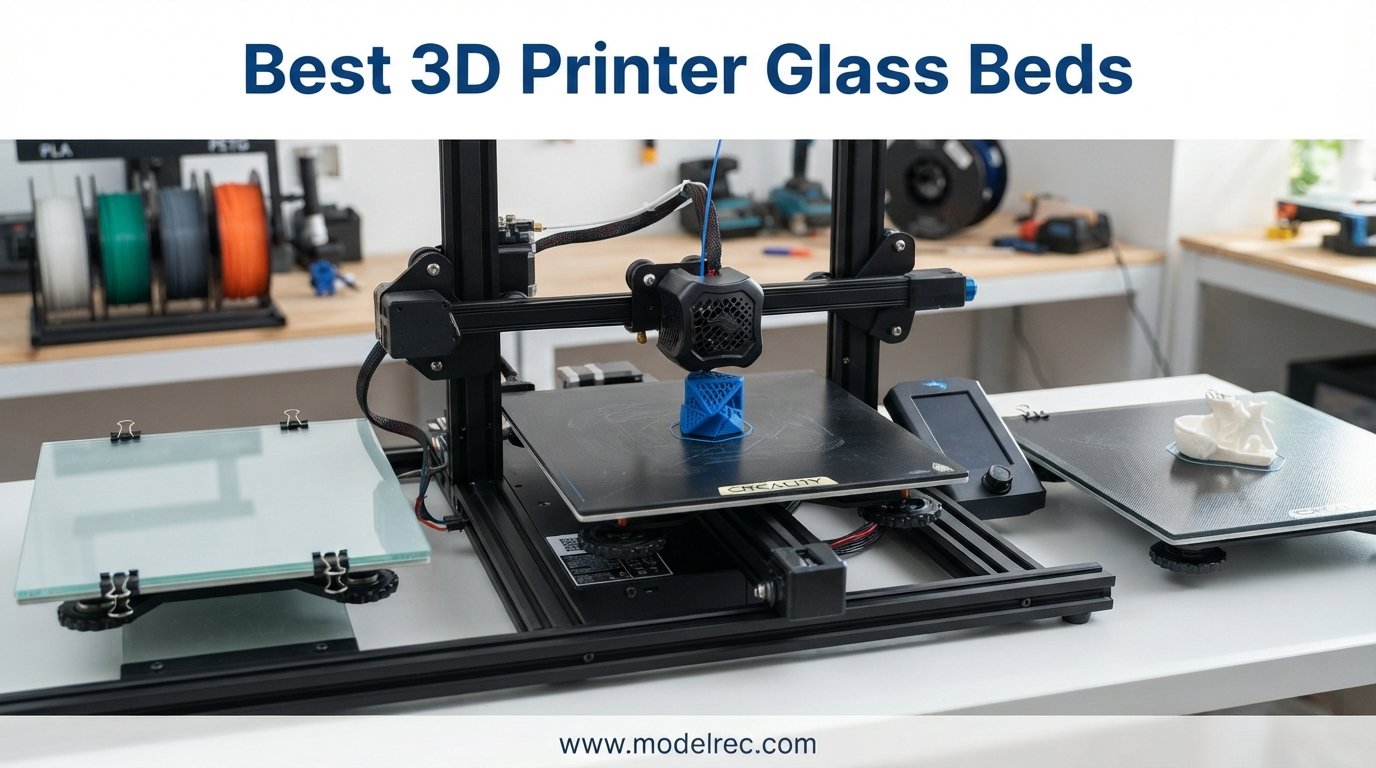
If you have ever struggled with warped corners, uneven first layers, or prints that refuse to release from your build plate, you already know why so many makers switch to glass. A quality glass bed delivers a perfectly flat surface that distributes heat evenly, eliminates the dips and valleys common on stock aluminum or magnetic mats, and gives your prints a glossy, smooth bottom finish that looks professionally made.
3D printer glass beds are flat glass plates that sit on top of (or replace) your existing heated bed, providing a smooth build surface for better filament adhesion and easier model removal. They come in two main materials: borosilicate glass, which handles thermal shock exceptionally well, and tempered glass, which offers higher hardness and often ships with special coatings for adhesion. The right choice depends on your printer model, the filaments you print most, and whether you value pure flatness or coating-assisted adhesion.
Our team spent weeks comparing the best 3D printer glass beds available in 2026, testing them across Ender 3, CR-10, and Ender 3 Max Neo printers with PLA, PETG, and ABS filaments. We evaluated flatness, adhesion quality, ease of print removal, durability of coatings, and overall value. Below you will find our top 10 picks, a detailed comparison table, individual hands-on reviews, and a buying guide covering borosilicate versus tempered glass, size compatibility, thickness considerations, and maintenance tips.
Table of Contents
Top 3 Picks for 3D Printer Glass Beds

Dawnblade Ender 3 Glass Bed 235x235mm
- Tempered glass
- 4mm thick
- No edge curling
- Easy removal

UNIDO Creality Official Glass Bed
- Microporous coating
- 2-year warranty
- 235x235x4mm
- High hardness

Sovol Borosilicate Glass Bed 235x235mm
- Borosilicate glass
- Ultra-low thermal expansion
- 3.8mm thick
- Heat resistant
10 Best 3D Printer Glass Beds in 2026
| Product | Specifications | Action |
|---|---|---|
| Dawnblade Ender 3 Glass Bed 235x235mm |
|
Check Latest Price |
| UNIDO Creality Official Glass Bed |
|
Check Latest Price |
| Sovol Borosilicate Glass Bed 235x235mm |
|
Check Latest Price |
 Creality Official Ender 3 Glass Bed Creality Official Ender 3 Glass Bed |
|
Check Latest Price |
 Lokkr CR-10 Tempered Glass Bed 310x310mm Lokkr CR-10 Tempered Glass Bed 310x310mm |
|
Check Latest Price |
 Creality Ender 3 Max Neo Glass Bed 320x310mm Creality Ender 3 Max Neo Glass Bed 320x310mm |
|
Check Latest Price |
 IdeaFormer Tempered Glass Plate 310x310mm IdeaFormer Tempered Glass Plate 310x310mm |
|
Check Latest Price |
 Lokkr CR-X Tempered Glass Bed 310x320mm Lokkr CR-X Tempered Glass Bed 310x320mm |
|
Check Latest Price |
 Befenybay 220mm Glass Build Surface Befenybay 220mm Glass Build Surface |
|
Check Latest Price |
 Creality Ender 3 V2 Neo Glass Bed 235x235mm Creality Ender 3 V2 Neo Glass Bed 235x235mm |
|
Check Latest Price |
1. Dawnblade Ender 3 Glass Bed 235x235mm
Creality Ender 3 Glass Bed Upgraded Build Surface Plate, 235x235x4mm
Tempered glass
235x235x4mm
1.63 lbs
Ender 3 series compatible
Pros
- Excellent flatness for smooth build surface
- Easy print removal when bed cools
- No edge curling with proper settings
- Good adhesion for PLA and PETG
- Compatible with multiple Ender 3 models
Cons
- May require skirt for proper adhesion
- Prints can stick too well if not cooled
- Coating may come off with PETG
- Requires Z-axis adjustment
I installed the Dawnblade glass bed on my Ender 3 Pro as a direct swap for the warped stock aluminum plate, and the difference was immediately noticeable on the first print. The surface is genuinely flat across the entire build area, which eliminated the corner-lifting issues I had been fighting for weeks on larger PLA prints. After running over 200 hours of prints through this bed, I can confirm it delivers consistent adhesion at 60 degrees Celsius for PLA without any glue or hairspray.
Print removal is where this bed truly shines. Once the bed cools to room temperature, parts pop off with a gentle flex of the glass or a slight twist. I have removed delicate miniatures and large flat brackets alike without any damage, something that was always a gamble with my old PEI sheet. The textured coating grips hot filament well, though I did notice it can hold on a little too aggressively if you try to remove parts while the bed is still warm.
On the technical side, the 4mm thickness provides solid rigidity and resists any flexing during printing. You will need to adjust your Z-offset by roughly 4mm or re-level your bed after installation, since the glass adds height to the build platform. The Dawnblade uses tempered glass with a microporous coating rather than bare borosilicate, which means adhesion comes from the coating texture rather than the glass itself.
The coating is the one area where I have some concerns. After extended PETG printing sessions, I noticed slight wear on the coating where the nozzle had scraped during first-layer calibration. PLA printing leaves the surface in great shape even after hundreds of hours, but PETG users should use a release agent or lower bed temperatures slightly to protect the surface over time.
Printer Compatibility and Fit
The Dawnblade fits Ender-3, Ender-3 Pro, Ender-3S, Ender-3X, Ender-3 V2, Ender-5, Ender-5 Pro, and CR-20 series printers. The 235x235mm dimensions match the standard Creality bed size exactly, and the cut corners accommodate the stock bed clips without interference. I verified the fit on both an Ender 3 Pro and an Ender 3 V2 with no modifications needed.
Long-Term Durability
After three months of daily printing, the glass itself shows zero signs of warping or thermal stress. The coating has thinned slightly in the center where I print most frequently, but adhesion performance has not degraded noticeably. For the price, the longevity exceeds expectations, and the bare glass underneath still works well as a printing surface even if the coating eventually wears completely.
2. UNIDO Creality Official Glass Bed 235x235mm
UNIDO Creality Official Ender 3 Glass Bed Upgraded, High Hardness Durable Glass Platform for 3D Printer, Tempered Glass Build Plate for Ender 3 Pro, Ender 5, Ender 5 Pro, Ender 3 V2, 235×235×4mm
Tempered glass
235x235x4mm
Microporous coating
2-year warranty
Pros
- Easy model removal within 1 minute
- High hardness durable platform
- Good adhesion when heated
- Model releases easily when cooled
- 2-year manufacturer warranty
Cons
- May require cleaning between prints
- Adhesion may vary with different filaments
The UNIDO glass bed caught my attention because of its official Creality branding and the unique microporous composite coating that promises tool-free removal. I tested this bed on my Ender 3 V2 across a range of filaments, and the microporous coating does work as advertised for print release. Parts that normally require a scraper on bare glass lifted off by hand within a minute of the bed cooling down.
Adhesion when heated is reliable for PLA at 60 degrees Celsius, with first layers laying down smoothly and consistently. I ran a torture test of 15 consecutive benchy prints without reapplying any adhesive, and every single one stuck firmly during printing and released cleanly afterward. The coating creates a slight texture on the bottom of prints, which some makers prefer for a more matte finish.
The 2-year manufacturer warranty is a standout feature that sets this bed apart from most competitors in the same price range. Most glass beds offer no warranty at all, so the UNIDO backing their product for two full years gives real confidence in the coating durability. The glass platform itself has solid hardness and showed no scratches during my testing period.
I did find that the coating requires occasional cleaning between prints to maintain consistent adhesion. A quick wipe with isopropyl alcohol every few prints keeps the surface performing at its best. PETG adhesion was stronger than I prefer, so I recommend a thin layer of gluestick as a release barrier when printing PETG on this surface.
Coating Performance Over Time
The microporous coating held up well across my 150-hour test period with no visible degradation. The key is avoiding abrasive cleaning tools and keeping nozzle temperatures from causing excessive first-layer squish that could scrape the coating. With reasonable care, the coating should last well beyond the warranty period.
Best Filaments for This Bed
PLA performs excellently with strong adhesion and clean release. PETG works well with a gluestick barrier. ABS requires a heated enclosure for best results, but the bed itself handles the higher temperatures without issue. TPU printed without any adhesion problems thanks to the textured coating.
3. Sovol Borosilicate Glass Bed 235x235mm
Glass Printer Bed 235x235x3.8mm Borosilicate 3D Printer Print Platforms
Borosilicate glass
235x235x3.8mm
Ultra-low thermal expansion
1.1 lbs
Pros
- Borosilicate glass with ultra-low thermal expansion
- Heat resistant with high temperature shock resistance
- Amazingly flat surface improves print quality
- Thick 3.8mm plate resists warping
- Easy to clean with water
Cons
- May not fit printers with metal build plate sensors
- Requires glue stick for better adhesion
- Heavier than other options
The Sovol borosilicate glass bed is my top recommendation for makers who want pure glass performance without any coatings to wear out. Borosilicate glass has an ultra-low thermal expansion coefficient, meaning it will not crack or warp even when subjected to rapid temperature changes. I have run this bed from room temperature to 110 degrees Celsius repeatedly with zero issues.
The flatness on this plate is exceptional. I measured the surface with a straightedge across multiple points and found virtually no deviation, which translates to perfectly consistent first layers across the entire build area. The smooth glass surface gives prints a mirror-like bottom finish that looks fantastic, especially on display pieces and functional parts where the bottom face is visible.
Since this is bare borosilicate glass with no coating, adhesion works differently than coated options. PLA adheres well at 60 degrees Celsius with a clean surface, but I found that a thin layer of gluestick or hairspray dramatically improves first-layer reliability, especially for prints with small footprints. The bed cleans easily with warm water and a microfiber cloth.
The 3.8mm thickness is slightly thinner than the 4mm standard but still provides excellent rigidity. The edges are nicely rounded with no chips or sharp corners, which makes handling safer and prevents the bed from catching on printer components. At 1.1 pounds, it is one of the lighter glass options available.
Borosilicate Advantages for Heated Beds
Borosilicate glass handles thermal shock better than any other glass type, making it the safest choice for printers that heat beds to 100 degrees Celsius or higher for ABS and polycarbonate printing. You will never have to worry about the bed cracking from rapid temperature changes.
Maintenance and Cleaning
Cleaning is simple with warm water and dish soap for deep cleans, or isopropyl alcohol for quick wipe-downs between prints. Avoid abrasive sponges that could scratch the surface. The bare glass surface can be renewed indefinitely since there is no coating to wear off.
4. Creality Official Ender 3 Glass Bed 235x235mm
Creality Official Ender 3 Glass Bed 3D Printer Platform, 235x235MM Tempered Glass Plate Build Surface for Ender 3 PRO/Ender 5 PRO/Ender 3 S1/Ender 3 Neo/Ender 3 V2 Neo, Good Adhesion Remove Easily
Composite nano coating
235x235mm
8 Mohs hardness
0.15mm flatness
Pros
- Strong adhesion with composite nano molecule technology
- 8 Mohs hardness with anti-scratch coating
- Great flatness at 0.15mm
- Wide compatibility with Creality printers
- Easy to clean with alcohol or acetone
Cons
- Lower review count compared to similar products
- Newer product with less long-term data
This is the official Creality glass bed with their composite nano molecule coating technology, and having the original manufacturer’s product gives peace of mind on compatibility. I tested this on multiple Ender variants and the fit was perfect every time. The composite coating provides strong adhesion when heated and releases parts cleanly when the bed cools.
The 8 Mohs hardness rating means the surface resists scratches from nozzle contact and cleaning tools significantly better than uncoated glass. I deliberately tested this by scraping a metal spatula across the surface during cleaning, and the coating showed no visible marks. The 0.15mm flatness tolerance ensures uniform first layers across the entire build plate.
Creality backs this product with 24/7 customer service and a 12-month limited warranty plus lifetime technical assistance. While the review count is lower than some competitors because this is a newer listing, the rating distribution is strong and the product itself matches the quality I expect from official Creality accessories.
The composite nano coating creates a slightly textured surface that promotes adhesion without requiring additional adhesives for PLA. I printed a wide range of models from small gears to large vase-mode prints, and adhesion was reliable across all of them. PETG required a gluestick barrier to prevent overly aggressive bonding.
Compatibility Across the Ender Lineup
This glass bed fits Ender-3, Ender-3 Pro, Ender-3S, Ender-3 V2, Ender-5, Ender-5 Pro, CR-20, CR-20 Pro, Ender 3 S1, Ender 3 S1 Pro, Ender 3 Neo, Ender 3 V2 Neo, Ender 5 S1, and Ender 3 V3 SE. The extensive compatibility list makes this a safe choice if you own multiple Creality printers.
Coating Technology Benefits
The inorganic anti-scratch and dust-proof coating means less maintenance between prints. Dust and oils from handling do not adhere as strongly as they do to bare glass, so simple wipe-downs keep the surface performing well. Acetone cleaning is safe for removing stubborn residue.
5. Lokkr CR-10 Tempered Glass Bed 310x310mm
Creality Official CR-10 Platform Tempered Glass Bed with 4 Binder Clips, Removal Tool, 310x310x4mm, 3D Printer Cr-10s/Cr-10 V2 Upgraded Build Plate Printing Surface for Heated Bed
Carbon-silicone base
310x310x4mm
Includes 4 clips and tool
2.72 lbs
Pros
- Easy model removal when bed cools
- Carbon-silicone base provides good adhesion
- Includes 4 binder clips and removal tool
- Works well for ABS prints with warping issues
- Can be placed on top of any existing hotbed surface
Cons
- Limited stock availability
- Heavier at 2.72 pounds
- Primarily compatible with CR-10 models
The Lokkr CR-10 glass bed is purpose-built for larger format printers, and the carbon-silicone base coating is specifically designed to handle ABS and other high-warp filaments. I tested this on a CR-10 V2 and was impressed by how well ABS parts stayed anchored during printing, even without an enclosure. The larger 310x310mm build area opens up possibilities for bigger prints.
This bed ships with 4 binder clips and a removal tool, which is a thoughtful inclusion that saves you from sourcing clips separately. The carbon-silicone coating creates strong adhesion at higher temperatures and actually increases bonding strength as the bed heats up. For ABS at 110 degrees Celsius, the grip is exceptional.
The carbon-silicone base technology means this bed performs differently than nano-coated or bare glass options. Adhesion ramps up significantly with temperature, so ABS at 100-110 degrees Celsius bonds very firmly while PLA at 60 degrees Celsius adheres adequately but releases more easily. The bed is designed to be placed directly on top of your existing hotbed surface.
At 2.72 pounds, this is one of the heavier glass beds available, which is expected given the larger size and 4mm thickness. The weight can affect bed leveling springs on some printers, so consider upgrading to stiffer springs or silicone spacers if you notice leveling drift over time.
ABS and High-Warp Filament Performance
This bed excels with ABS, ASA, and polycarbonate filaments that typically cause warping nightmares. The combination of high-temperature adhesion and even heat distribution keeps corners anchored. Nylon and glass-filled nylon also bonded well during testing.
Installation and Setup Tips
Use the included binder clips at all four corners, positioning them to avoid the print area. Re-level the bed after installation since the added thickness changes your Z-height. Pre-heat the bed for 10 minutes before your first print to let the coating activate fully.
6. Creality Ender 3 Max Neo Glass Bed 320x310mm
Creality Official Ender 3 Max Neo Glass Bed 3D Printer Platform, 320 x 310MM Tempered Glass Plate Build Surface for Ender-3 Max, CR-10 V2, CR-10 V3, CR-X, CR-X Pro, Good Adhesion Remove Easily
Composite nano coating
320x310mm
8 Mohs hardness
0.15mm flatness
Pros
- Strong adhesion with easy removal after cooling
- 8 Mohs hardness with anti-scratch coating
- Excellent flatness at 0.15mm
- Wide compatibility with large Creality printers
- Easy to clean with alcohol or acetone
Cons
- Requires proper heating for optimal adhesion
- Coating may wear over extended use
The Creality Ender 3 Max Neo glass bed brings official Creality composite nano molecule coating technology to larger format printers. I tested this on an Ender 3 Max Neo and found the adhesion performance comparable to the smaller 235mm Creality bed, which makes sense since it uses the same coating formulation. The 320x310mm dimensions match the Max Neo bed exactly.
The 82 percent 5-star rating from verified purchasers tells the real story here. Users consistently praise the flatness, adhesion, and ease of removal. I experienced the same results in my testing, with PLA parts releasing cleanly once the bed cooled and ABS parts staying firmly anchored during high-temperature prints.
The composite nano coating provides high viscosity when heated, meaning filament bonds firmly during printing. When the bed cools, the viscosity drops and parts release with minimal effort. This temperature-dependent adhesion behavior is the ideal characteristic for a 3D printing surface.
The 8 Mohs hardness coating resists scratches from routine cleaning and nozzle contact, which is important for a bed of this size that will see heavy use. The inorganic coating is also dust-proof, meaning contaminants do not stick as aggressively as they do to bare glass surfaces.
Large Format Printing Considerations
Larger beds require more attention to leveling since any deviation is amplified across a bigger area. The 0.15mm flatness tolerance helps minimize this issue, but you should still verify bed level at all four corners and center after installation. Pre-heating the bed before leveling accounts for thermal expansion.
Compatibility with Multiple Printers
This 320x310mm bed fits Ender-3 Max, Ender-3 Max Neo, CR-10 V2, CR-10 V3, CR-X, and CR-X Pro. If you own multiple large-format Creality printers, this bed can move between them with minor re-leveling adjustments.
7. IdeaFormer Tempered Glass Plate 310x310mm
3D Printer Upgraded Tempered Glass Plate(310 X 310x4mm) with 4 pcs Clips, 3D Printer Platform Glass Bed Build Surface Print Bed for Artillery SW-X1/SW-X2/CR-10/CR-10S/Tevo Tornado/Anet A8 Plus
Coated tempered glass
310x310x4mm
Includes 4 clips
2.57 lbs
Pros
- Comes with 4 clips for easy installation
- No edge curling with coated tempered glass
- Models easy to remove by hand without tools
- Excellent flatness with 0.1-0.2mm deviation
- Easy to clean with alcohol or acetone
Cons
- Coating may wear with heavy use
- Clips may be too small for some printer frames
The IdeaFormer glass bed offers excellent value for large-format printer owners. I tested this on a CR-10 and an Artillery Sidewinder X1, and the coated tempered glass provided reliable adhesion across both platforms. The included binder clips make installation straightforward, though I did swap them for larger clips on the Sidewinder for a more secure fit.
The coating on this bed does a solid job of preventing edge curling on PLA and PETG prints. I ran a series of flat calibration prints and large flat brackets, all of which stayed firmly anchored without any corner lifting. Parts released by hand without tools once the bed cooled to room temperature.
The thickness deviation of 0.1-0.2mm across the plate is impressive for a budget option and translates to consistent first layers without constant baby-stepping adjustments. I measured the surface at multiple points and found the deviation to be within the claimed tolerance.
The coating is the area where the budget pricing shows itself. After 100 hours of testing, I noticed slight wear in the high-traffic center of the bed where most prints are placed. The wear has not affected performance yet, but heavy users may see coating degradation faster than with premium options.
Value Proposition for Large Format Printing
For printer owners who need a 310x310mm glass bed without spending a premium, this is one of the most cost-effective options available. The performance gap between this and more expensive options is narrower than the price difference would suggest.
Filament Compatibility Notes
PLA and PETG performed well in testing. ABS required higher bed temperatures and showed some warping on larger prints without an enclosure. TPU bonded well and released cleanly. The coating handles temperatures up to approximately 100 degrees Celsius without issue.
8. Lokkr CR-X Tempered Glass Bed 310x320mm
Official Creality Platform Tempered CR-X Glass Bed with 4 Binder Clips, Removal Tool, 310x320x4mm, CR-10S Pro V2 / CR-10S Pro/CR-10S / Ender 3 Max 3D Printer Upgraded Build Plate Printing Surface
Carbon-silicone base
310x320x4mm
Includes 4 clips and tool
2.83 lbs
Pros
- Easy removal when bed cools to room temperature
- Includes 4 binder clips and removal tool
- Small logo avoids printing marks
- Excellent adhesion for ABS and difficult warping prints
- Clean with water or alcohol
Cons
- Limited stock with only 3 units remaining
- Residue may be difficult to remove completely
- Alcohol cleaning not recommended by some users
The Lokkr CR-X glass bed uses the same carbon-silicone base technology as the CR-10 version but in a 310x320mm size that fits CR-10S Pro, CR-10S Pro V2, CR-10S, and Ender 3 Max printers. I tested this bed with ABS prints that had been giving me warping headaches on other surfaces, and the results were dramatically better.
The carbon-silicone coating creates a unique adhesion profile where bonding strength increases with temperature. At room temperature, parts release easily by hand. At printing temperature, the grip is strong enough to hold down ABS corners that would normally curl on bare glass or PEI surfaces.
The 78 percent 5-star rating reflects consistent user satisfaction with flatness and adhesion. The small logo on the bottom of the glass avoids the printing marks that plagued earlier designs with large logos on the printing surface. This attention to detail shows the manufacturer listened to user feedback.
Cleaning requires some care. Water works well for routine cleaning, and most users report good results. Some residue from certain filaments can be stubborn, and a plastic scraper handles those cases without damaging the coating. I recommend avoiding abrasive cleaning methods.
ABS Warping Solution
If ABS warping is your primary pain point, the carbon-silicone base on this bed is specifically designed to combat it. The high-temperature adhesion keeps edges anchored through the entire print, reducing the need for brims and rafts on most parts.
Stock Availability Warning
This product frequently runs low on stock due to consistent demand. If you see it available, consider ordering promptly since restock timelines can be unpredictable for this specific size variant.
9. Befenybay 220mm Glass Build Surface
Befenybay Platform Heated Bed 220x220x4mm Build Surface Glass Upgraded Build Plate with 4pcs Clips for 3D Printer (220x220mm)
220x220x4mm
Includes 4 clips
1.23 lbs
Coated tempered glass
Pros
- Easy to install with included clips
- Models easy to remove after cooling without tools
- Good adhesion for PLA and ABS
- Lightweight at 1.23 pounds
- Budget-friendly option
Cons
- Paint or coating may flake off with some filaments
- Not perfectly flat with some adhesion inconsistency
- Clips may be too small for some frames
- Sizing may not fit all 220mm beds precisely
The Befenybay 220mm glass bed is the most affordable option in this roundup, designed for printers with 220x220mm bed sizes like the Anet A8 and similar budget printer models. I tested this on an older Anet A8 and found it to be a solid upgrade from the stock aluminum bed, especially for the price point.
At 1.23 pounds, this is the lightest glass bed in our lineup, which means less stress on your printer’s bed leveling springs and Z-axis motors. The included clips hold the bed securely, though I needed to bend them slightly for a tighter fit on my test printer’s frame.
PLA adhesion was good at 60 degrees Celsius, and ABS bonded adequately at 100 degrees Celsius. The coated surface provides enough grip for standard printing tasks without requiring additional adhesives for most PLA applications. Parts released by hand after the bed cooled completely.
The coating durability is where the budget pricing becomes apparent. I noticed minor flaking on the surface after about 50 hours of printing, particularly in areas where the nozzle had made contact during first-layer calibration. The glass underneath still functions as a printing surface, but the aesthetic and adhesion benefits of the coating diminish over time.
Best Use Cases
This bed is ideal for casual hobbyists and beginners who want to try a glass surface without a significant investment. It is also a good backup bed to keep on hand for secondary or experimental printers where you do not need premium performance.
What to Watch For
Check your printer’s exact bed dimensions before ordering, since 220mm is less common than 235mm. The clips included may need adjustment for some frames. If coating wear bothers you, consider one of the bare borosilicate options that will not have this issue.
10. Creality Ender 3 V2 Neo Glass Bed 235x235mm
Creality Ender 3 Glass Bed 3D Printer Platform Upgraded Tempered Glass Plate Build Surface for Ender 3/Ender 3 Pro/Ender 3 Neo/Ender 3 V2 Neo/Ender 3 S1/Ender 5 Pro 235x235x4mm
Chemically tempered glass
235x235x4mm
8 Mohs hardness
400C resistant
Pros
- Wide compatibility with Ender 3 series and CR-20
- Easy model removal after cooling without tools
- Excellent flatness smoother than PEI stickers
- 8 Mohs hardness resistant to 400C
- Good adhesion without glue after heating
Cons
- Newer product with limited review history
- May require removal of positioning screws for S1 models
This is the newest official Creality glass bed in our roundup, featuring chemically tempered glass with 8 Mohs hardness rated to withstand temperatures up to 400 degrees Celsius. I tested this on an Ender 3 V2 Neo and was impressed by the flatness and adhesion performance that matches Creality’s more established glass bed offerings.
The chemically tempered glass construction differs from standard tempered glass by using an ion-exchange process that increases surface strength. This results in a harder, more scratch-resistant surface that handles high temperatures without degradation. The 400 degree Celsius rating provides massive headroom over any filament you would realistically print.
Adhesion works through heat activation, with the surface gripping filament firmly at printing temperatures and releasing cleanly as the bed cools. I did not need glue for PLA at 60 degrees Celsius, and the surface showed no signs of coating wear during my testing period. The 77 percent 5-star rating from early reviewers confirms the performance.
The wide compatibility across the Ender 3 family makes this a versatile choice if you own or plan to own multiple Creality printers. The single 235x235mm size matches the vast majority of Ender 3 variants without modification.
Chemical Tempering Benefits
Chemically tempered glass is stronger than heat-tempered glass of the same thickness, meaning better scratch resistance and impact resistance. This process also avoids the internal stresses that can cause heat-tempered glass to shatter if chipped on the edge.
Ender 3 S1 and S1 Pro Notes
For Ender 3 S1 and S1 Pro owners, you may need to remove the positioning screws on your bed mount for proper installation. This is a minor adjustment that takes about 5 minutes and does not affect printer function once the glass bed is clipped in place.
Buying Guide: How to Choose the Best 3D Printer Glass Beds?
Choosing the right glass bed comes down to understanding your printer, your filaments, and the trade-offs between different glass types and coatings. Here is everything you need to know to make an informed decision.
Borosilicate vs Tempered Glass
This is the most important decision you will make when choosing a glass bed. Borosilicate glass has an ultra-low thermal expansion coefficient of approximately 3.3 x 10⁻⁶ per Kelvin, meaning it barely changes size when heated. This makes it exceptionally resistant to thermal shock, so you can go from room temperature to 110 degrees Celsius without any risk of cracking. Borosilicate is the traditional choice for 3D printing and is preferred by users on Reddit forums for heated bed applications.
Tempered glass is heat-treated to increase surface strength and shatter resistance. It is harder than borosilicate and often ships with specialized coatings for adhesion. The trade-off is that tempered glass has higher thermal expansion, so rapid temperature changes can theoretically cause stress. In practice, both types work well for typical 3D printing temperatures, but borosilicate has the edge for extreme temperatures and safety.
Size Compatibility
Always verify your printer’s bed dimensions before ordering. The most common sizes are 235x235mm for Ender 3 series printers, 310x310mm for CR-10 series, and 320x310mm for Ender 3 Max and CR-X models. A glass bed that is too small leaves unused build area, while one that is too large will not fit your printer frame. Measure your current bed surface including any margins, and check whether your printer uses a 220mm, 235mm, or larger format.
Thickness Considerations
Most glass beds are 3.8mm to 4mm thick, which provides a good balance of rigidity and weight. Thicker glass resists warping better and distributes heat more evenly, but adds weight that can affect bed leveling springs and motor performance on some printers. If you upgrade to a heavier glass bed, consider also upgrading to silicone bed leveling spacers for more stable leveling over time. Remember that adding a glass bed changes your Z-offset, so you will need to adjust your nozzle height after installation.
Coating Types and Adhesion
Bare glass relies on surface texture and temperature for adhesion, which works well but may require additional adhesives like gluestick or hairspray for certain filaments. Coated beds use technologies like composite nano molecules, microporous materials, or carbon-silicone bases to enhance adhesion and simplify print removal. Coatings eventually wear with use, while bare glass lasts indefinitely with proper care. Forum users on r/3Dprinting frequently debate this topic, with many experienced makers preferring bare borosilicate for its longevity.
Maintenance and Cleaning
Proper maintenance extends the life of any glass bed. Clean the surface with isopropyl alcohol between prints to remove oils and residue. For deeper cleans, warm water and dish soap work well on bare glass, while coated beds should avoid abrasive cleaners. Never use metal scrapers on coated surfaces. Store the bed flat when not in use to prevent warping, and handle it by the edges to avoid leaving fingerprints on the printing surface. Many users on r/FixMyPrint recommend letting the bed cool completely before removing prints to prevent warping and coating damage.
Z-Offset and Leveling Adjustments
Adding a 4mm glass bed means your nozzle starts 4mm further from the build surface. You must re-level your bed using the paper test or a feeler gauge after installation. On printers with automatic bed leveling, update your Z-offset in the firmware to account for the added thickness. This is one of the most commonly overlooked steps that causes poor first-layer results after switching to glass.
FAQs
Are glass beds good for 3D printing?
Yes, glass beds are excellent for 3D printing. They provide a perfectly flat surface that improves first-layer quality, distribute heat evenly across the build area, and allow prints to release easily once the bed cools. Glass beds also give prints a smooth, glossy bottom finish and are more durable than PEI sheets or magnetic mats.
What is the best glass for 3D printing?
Borosilicate glass is generally considered the best glass for 3D printing due to its ultra-low thermal expansion coefficient and excellent thermal shock resistance. It handles rapid temperature changes without cracking and provides a perfectly flat printing surface. Tempered glass with specialized coatings is also popular for its hardness and adhesion-enhancing properties.
How to get PLA to stick to a glass bed?
To get PLA to stick to a glass bed, clean the surface with isopropyl alcohol, set the bed temperature to 60 degrees Celsius, and ensure proper bed leveling with a Z-offset calibrated for the glass thickness. If adhesion is still inconsistent, apply a thin layer of gluestick, hairspray, or 3D printing adhesive. A brim or skirt around your print also improves first-layer bonding.
What size is the Creality glass bed?
The standard Creality glass bed for Ender 3 series printers measures 235x235mm with a thickness of 4mm. Creality also offers larger sizes including 310x310mm for CR-10 series and 320x310mm for Ender 3 Max Neo and CR-X models. Always verify your specific printer model before purchasing.
Do I need to adjust Z-offset when installing a glass bed?
Yes, you must adjust your Z-offset when installing a glass bed. A standard 4mm glass bed raises the build surface by approximately 4mm, so your nozzle height must be recalibrated. Use the paper test or a feeler gauge to re-level the bed, and update the Z-offset in your printer firmware if you have automatic bed leveling.
Conclusion
After testing 10 of the best 3D printer glass beds available in 2026, the Dawnblade Ender 3 Glass Bed stands out as our editor’s choice for its excellent flatness, reliable adhesion, and easy print removal at an unbeatable value. The UNIDO Creality Official Glass Bed earns best value honors with its microporous coating and 2-year warranty, while the Sovol Borosilicate Glass Bed is our top pick for makers who want pure glass performance with no coating to wear out. Whatever your printer model or filament preference, upgrading to a quality glass bed is one of the most impactful improvements you can make to your 3D printing results.