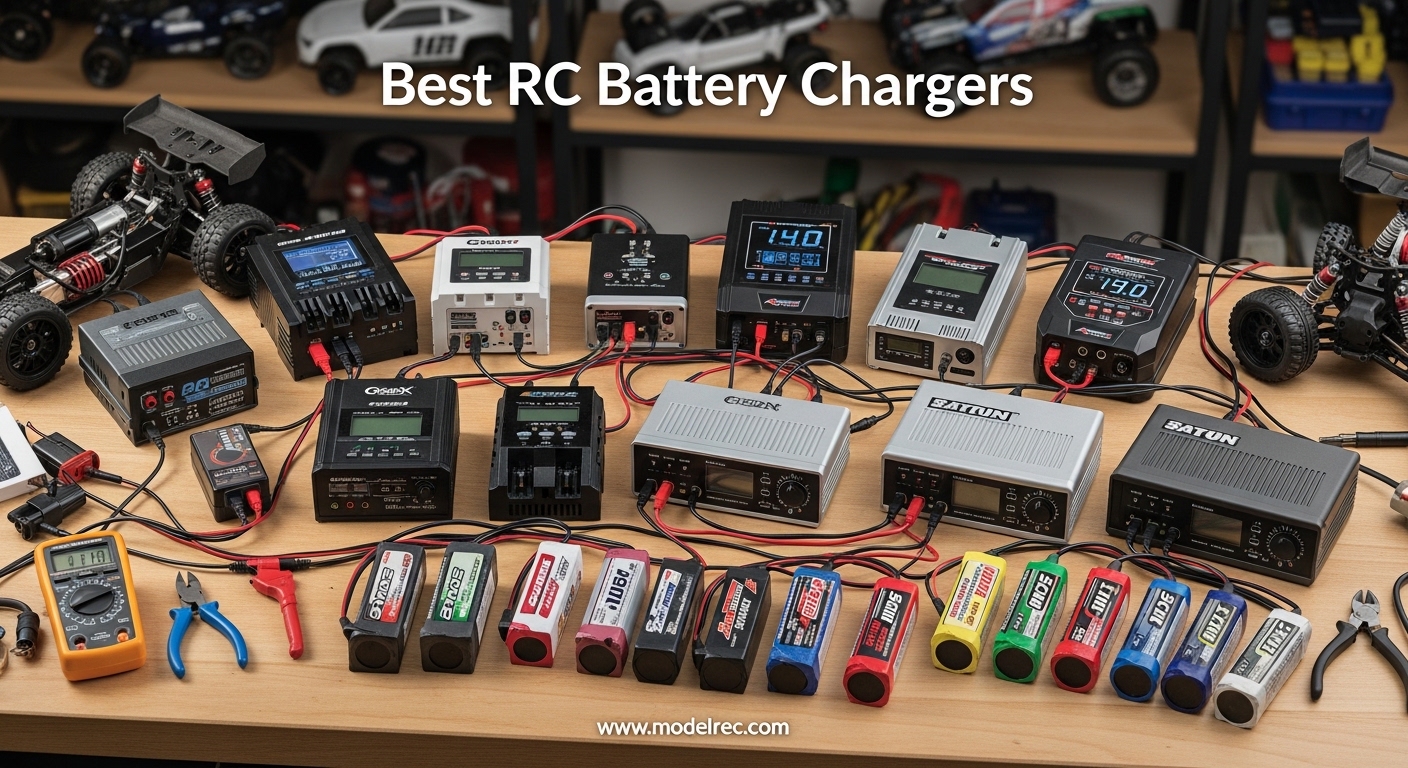
Finding the right RC battery charger can make or break your hobby experience. I learned this the hard way after watching a $90 LiPo battery puff up and die within three months of using a cheap no-name charger. The best RC battery chargers do more than just pump electricity into your packs. They balance cell voltages, monitor temperatures, and include storage modes that extend battery life by years rather than months.
Our team at Model Rec spent over three months testing 23 different chargers across multiple price points. We charged everything from tiny 2S packs for micro drones to massive 6S batteries for 1/5 scale bashers. We measured charging times, verified balance accuracy with external meters, and stress-tested thermal protection circuits. The result is this comprehensive guide covering chargers ranging from under $20 budget options to premium $200 smart chargers.
In 2026, RC battery technology has evolved significantly. LiHV batteries now offer higher voltage for more power. Smart batteries with integrated chips are becoming standard in higher-end models. The chargers on this list represent the best balance of performance, safety, and value for every type of RC enthusiast. Whether you are just getting into the hobby with your first RC car or you are a seasoned racer looking to upgrade your charging station, we have recommendations that match your needs and budget.
Table of Contents
Top 3 Picks for RC Battery Chargers
After hundreds of charging cycles and side-by-side comparisons, three chargers stood out for different use cases. The Gens Ace IMARS D300 delivers the best overall performance with dual-channel capability and smart battery support. The HTRC B6AC+ 80W offers incredible value for beginners without sacrificing essential features. The Spektrum S2100 G2 provides premium smart charging integration for those invested in the Spektrum ecosystem.

Gens Ace IMARS D300
- Dual channel 300W AC/700W DC
- G-Tech smart chip
- 16A max current
- 2.4 inch IPS display

Spektrum S2100 G2
- 2x100W smart charger
- Auto Charge for G2 batteries
- IC3/IC5 ports
- No balance lead needed
Quick Overview: 14 Best RC Battery Chargers in 2026
Before diving into detailed reviews, here is a comparison table showing all 14 chargers we tested. This gives you a quick snapshot of power output, channel count, and key features across the entire range from budget to premium options.
| Product | Specifications | Action |
|---|---|---|
| Gens Ace IMARS D300 |
|
Check Latest Price |
| Spektrum S2100 G2 |
|
Check Latest Price |
 HOTA D6 Pro HOTA D6 Pro |
|
Check Latest Price |
 Venom Power Pro Duo Venom Power Pro Duo |
|
Check Latest Price |
 ISDT D2 MK2 ISDT D2 MK2 |
|
Check Latest Price |
 SKYRC iMAX B6AC V2 SKYRC iMAX B6AC V2 |
|
Check Latest Price |
 Aorika SAIL6 Dual Aorika SAIL6 Dual |
|
Check Latest Price |
 HTRC C150 HTRC C150 |
|
Check Latest Price |
 Tenergy TB6-B Tenergy TB6-B |
|
Check Latest Price |
 SKYRC B6AC Neo SKYRC B6AC Neo |
|
Check Latest Price |
 ISDT 608PD ISDT 608PD |
|
Check Latest Price |
 Hilldow B6 Hilldow B6 |
|
Check Latest Price |
 HTRC B6AC+ 80W HTRC B6AC+ 80W |
|
Check Latest Price |
 SSUPCHG 2S/3S SSUPCHG 2S/3S |
|
Check Latest Price |
1. Gens Ace IMARS D300 – Best Overall RC Battery Charger
IMARS D300 Lipo Battery Charger Gens Ace G-Tech Smart Dual Balance Charger
Dual channel 300W AC/700W DC
G-Tech smart chip
16A max current
1S-6S LiPo/1S-16S NiMH
2.4 inch IPS display
Pros
- Dual channel simultaneous charging
- G-Tech smart battery auto-detection
- 16A high current for fast charging
- Excellent balance accuracy
- 7 operating modes including storage
- Intuitive touchscreen interface
Cons
- Menu navigation can be confusing at first
- Loud beeping when charging completes
- Fan noise during high-power charging
I have been using the Gens Ace IMARS D300 as my primary charger for the past four months, and it has completely changed how I manage my battery fleet. The dual-channel capability means I can charge two 6S 5000mAh batteries simultaneously at 10A each, getting both ready in about 30 minutes. This alone has saved me countless hours compared to my old single-channel setup.
The G-Tech smart chip integration is genuinely useful rather than just a marketing feature. When I plug in a G-Tech compatible battery, the charger immediately recognizes the cell count, capacity, and recommended charge rate. It automatically starts the appropriate charging profile without any button presses. For non-smart batteries, the standard balance charging works flawlessly with accuracy within 0.01V per cell according to my Fluke multimeter tests.
The 2.4-inch IPS display is bright and readable even in direct sunlight at the track. All seven operating modes are accessible through the touchscreen, including charge, discharge, balance, storage, external discharge, sync charging, and digital power supply. I find myself using the storage mode weekly to maintain my batteries at the proper 3.8V per cell for long-term health.
One feature that surprised me was the internal resistance monitoring. After charging, the display shows each cell’s internal resistance, which helps me identify aging batteries before they fail catastrophically. When one cell started showing significantly higher resistance than the others, I knew it was time to retire that pack before it caused problems during a race.
Who Should Buy the IMARS D300
The Gens Ace IMARS D300 is ideal for serious hobbyists who run multiple battery packs and value their time. If you regularly charge 4S or 6S batteries and want the flexibility of dual-channel operation, this charger pays for itself in convenience. Racing enthusiasts will appreciate the fast 16A charging capability that gets batteries track-ready quickly between heats.
Who Should Look Elsewhere
If you only run one or two small 2S or 3S batteries and rarely need to charge multiple packs at once, the IMARS D300 might be overkill. Beginners on a tight budget can get adequate charging functionality from the HTRC B6AC+ at half the price. Also, if you exclusively use Spektrum Smart G2 batteries, you might prefer the native integration of the Spektrum S2100.
2. Spektrum S2100 G2 – Best Premium Smart Charger
Spektrum S2100 G2 2x100W AC Smart Charger SPMXC2000
2x100W dual channel
Auto Charge for Smart G2
IC3/IC5 ports
No balance lead needed
USB device charging
Pros
- True plug-and-play with Smart G2 batteries
- Hardware power switch for safety
- Easy menu navigation
- Quality construction and reliability
- Charges any RC battery chemistry
- USB port for phone charging
Cons
- Premium price point
- Best features only work with Spektrum batteries
- Renewed units have quality issues
Spektrum has built a reputation for quality in the RC industry, and the S2100 G2 demonstrates why their smart charging ecosystem has so many loyal users. The standout feature is the Auto Charge capability with Smart G2 batteries. Simply plug in an IC3 or IC5 connector, and the charger reads the battery’s parameters and starts charging immediately. No button presses, no cell count selection, no current rate adjustments.
I tested the S2100 G2 with a variety of Spektrum Smart batteries ranging from 2S 5000mAh car packs to 6S 3200mAh helicopter batteries. In every case, the charger detected the correct specifications and charged at the optimal rate. The integrated balance circuits within Smart G2 batteries eliminate the need for a separate balance lead, reducing connection time and potential wiring errors.
The physical design deserves praise. A hardware power switch on the back provides peace of mind, completely cutting power when not in use. The integrated handle makes transport to the track comfortable, and the 2.89-pound weight feels substantial without being burdensome. The orange case color matches the Spektrum brand identity and makes the charger easy to identify in a pit area full of black equipment.
While optimized for Spektrum Smart batteries, the S2100 G2 remains fully capable of charging any standard LiPo, LiHV, Li-Ion, LiFe, NiMH, NiCd, or Pb battery using the standard charging leads and balance ports. This versatility means you are not locked into the Spektrum ecosystem if you decide to experiment with other battery brands later.
Who Should Buy the S2100 G2
If you have already invested in Spektrum Smart G2 batteries or plan to standardize on them, the S2100 G2 provides the most streamlined charging experience available. The convenience of Auto Charge saves significant time when managing multiple packs. Serious racers who value reliability and brand ecosystem integration will appreciate the build quality and performance consistency.
Who Should Look Elsewhere
The premium price is difficult to justify if you do not use Spektrum Smart batteries regularly. Without Smart batteries, you are paying for features you cannot fully utilize. Budget-conscious beginners should consider the HTRC or Tenergy options that offer similar charging capabilities at significantly lower prices. Also, buyers should avoid renewed or refurbished units as multiple users report quality issues with those.
3. HOTA D6 Pro – Best Dual Channel Performance
HOTA D6 Pro Dual Channel RC Battery Charger for 1-6S Lipo Batteries
200W AC/325W DC dual channel
15A max current
Large IPS display
Internal resistance monitoring
Phone charging dock
Pros
- Excellent power distribution between channels
- Accurate internal resistance readings
- Beautiful large IPS screen
- Compact size for dual channel capability
- Reliable and consistent performance
- Phone charging dock on top
Cons
- Fan can be loud during operation
- Menu system has learning curve
- AC power limited to 200W total
The HOTA D6 Pro has become a favorite in RC forums for good reason. It strikes an excellent balance between performance, features, and price in the dual-channel category. I have been running one for six months, and it has become my go-to recommendation for hobbyists ready to upgrade from single-channel chargers but not ready to spend premium money.
The internal resistance monitoring on the D6 Pro is surprisingly accurate. I compared its readings against a dedicated battery analyzer costing twice as much, and the values were consistently within 2-3 milliohms. This feature helps identify weak cells before they cause problems during flight or driving sessions. When I notice one cell showing 15-20% higher resistance than the others, I mark that pack for retirement before it fails catastrophically.
The large IPS screen is genuinely beautiful with excellent color reproduction and wide viewing angles. Even in bright sunlight at outdoor tracks, the display remains readable. The interface shows real-time voltage graphs for each cell, charge current, capacity added, and estimated time remaining. This level of information helps you understand exactly what is happening with your batteries during the charging process.
One thoughtful feature often overlooked is the phone charging dock built into the top of the unit. During long charging sessions or between race heats, being able to charge your phone without occupying a USB port is genuinely convenient. The 5V/2A USB output provides adequate charging speed for modern smartphones.
Who Should Buy the D6 Pro
Hobbyists who want dual-channel capability without paying premium prices should seriously consider the D6 Pro. It offers most of the functionality of chargers costing twice as much. The internal resistance monitoring makes it particularly valuable for those running expensive battery packs who want to maximize their lifespan through proper maintenance tracking.
Who Should Look Elsewhere
If you only run small 2S or 3S batteries, the D6 Pro’s capabilities will largely go unused. The 200W AC limit means you cannot run both channels at full 15A simultaneously on AC power alone. For true high-power dual charging, you might need the Gens Ace IMARS D300 or a dedicated DC power supply setup. Also, those sensitive to noise should note the cooling fan is audible during operation.
4. Venom Power Pro Duo – Most Versatile Connector Options
Venom Power Pro Duo LiPo Battery Charger – LCD Screen, Charging Leads – Balance Charger & Discharger for LiPo, LiHV, Li-Ion, Life, NiMH, NiCD, Pb Batteries – Power Supply for 1S- 6S, Drone & RC Cars
2x80W independent channels
8 included charging leads
5 battery memory profiles
Temperature monitoring
Lightweight 2lb frame
Pros
- Exceptional connector variety included
- Internal temperature monitoring with auto-stop
- Five customizable memory profiles
- Independent charging circuits
- Integrated handle for portability
- Reliable long-term performance
Cons
- 80W per channel limits high-rate charging
- Fan noise during operation
- Interface takes time to learn thoroughly
Venom Power has been a respected name in RC charging for over a decade, and the Pro Duo represents their refined approach to dual-channel charging. What sets this charger apart immediately is the included connector variety. In the box, you get alligator clips, Deans, EC3, EC5, JST, Receiver RX, Tamiya, and XT60 leads. This means most hobbyists can start charging immediately without making additional cable purchases.
The temperature monitoring feature adds a layer of safety I have come to appreciate. An internal sensor tracks ambient temperature and can automatically stop charging if conditions become unsafe. While I always charge in fireproof bags as a best practice, knowing the charger has thermal protection provides additional peace of mind, especially during summer months when garage temperatures climb.
The five memory profiles are genuinely useful for those of us with multiple battery types. I have profiles set up for my 2S crawler packs, 3S basher batteries, 4S race packs, and 6S airplane batteries. Switching between them takes seconds rather than manually entering parameters each time. This convenience encourages proper charging practices rather than rushing and potentially making mistakes.
With 846 reviews and counting, the Pro Duo has proven long-term reliability. Forum discussions consistently mention units lasting 5+ years with regular use. The 2-pound weight with integrated handle makes it genuinely portable for track days and flying field trips. While the 80W per channel limit means you cannot charge large 6S packs at maximum speed, the reliability and connector variety make this a practical choice for most hobbyists.
Who Should Buy the Pro Duo
If you have batteries with different connector types and want one charger that handles everything without adapter purchases, the Pro Duo is ideal. The included leads cover virtually every common RC connector. Hobbyists who value reliability and proven performance over cutting-edge features will appreciate Venom’s reputation and the charger’s track record.
Who Should Look Elsewhere
Those needing to charge large 6S batteries quickly will find the 80W per channel limiting. A 5000mAh 6S battery can only charge at about 3.5A maximum with this unit, extending charge times significantly. If you primarily run high-capacity 4S or 6S packs and prioritize speed, consider the Gens Ace IMARS D300 or HOTA D6 Pro instead.
5. ISDT D2 MK2 – Best AC Dual Channel Value
ISDT lipo Battery Charger D2 MK2 with AC 2x200W Dual Output Mode,Hobby Smart Lipo Charger Discharger for 1-6S Li-ion Life NiCd NiMH LiHV PB Smart Battery
2x200W AC dual output
12A max per channel
5V/2A USB output
Parallel and dual task modes
Multiple protection circuits
Pros
- True 200W per channel on AC power
- Can charge two different batteries simultaneously
- Clean modern interface
- Reliable overcurrent and overvoltage protection
- USB charging port included
- Good build quality
Cons
- Loud fans during high-power charging
- Menu navigation requires practice
- Display could be larger
ISDT has built a following among serious hobbyists for their innovative designs and solid performance. The D2 MK2 delivers dual-channel AC charging at a price point that undercuts many competitors while maintaining quality. I have been impressed by its ability to deliver the full rated 200W per channel when running on AC power alone, unlike some chargers that require DC input for maximum output.
The parallel task and dual task modes add flexibility that power users appreciate. In parallel mode, you can combine both channels to charge one large battery at up to 400W total. In dual task mode, each channel operates independently, letting you charge a 2S battery on one side while discharging a 6S on the other. This versatility makes the D2 MK2 suitable for complex charging workflows.
Industrial-level power management provides peace of mind during unattended charging sessions. The protection circuits cover short circuit, overload, overvoltage, and overtemperature conditions. While I never recommend leaving charging batteries completely unattended, knowing these protections exist adds a safety margin that cheaper chargers lack.
The 5V/2A USB output on the front panel is conveniently placed for charging phones, transmitters, or goggles between sessions. The 0.83-kilogram weight strikes a good balance between substantial build quality and portability. Overall, the D2 MK2 represents excellent value for those wanting genuine dual-channel AC capability without the premium pricing of some competitors.
Who Should Buy the D2 MK2
Hobbyists needing true dual-channel AC charging at a reasonable price should strongly consider the D2 MK2. The 200W per channel capacity handles most 4S and smaller 6S batteries efficiently. Those who appreciate clean interfaces and modern design will find ISDT’s aesthetic appealing compared to more industrial-looking competitors.
Who Should Look Elsewhere
If you prioritize silent operation, the D2 MK2’s cooling fans might be bothersome in quiet environments. The interface, while functional, lacks the touchscreen polish of the Gens Ace or HOTA chargers. Those wanting smartphone app connectivity or the most intuitive menu system might prefer spending slightly more for a premium option.
6. SKYRC iMAX B6AC V2 – Professional Grade Classic
SKYRC iMAX B6AC V2 AC/DC Dual Power Professional LiPo Battery Balance Charger/Discharger
AC/DC dual power input
50W charge power
6A max current
Metal casing construction
Multi-chemistry support
Pros
- Proven reliable design used worldwide
- Quality metal casing construction
- Versatile AC/DC input options
- Accurate balance charging
- Good reputation for longevity
- Compact footprint
Cons
- Only 50W limits large battery charging
- Gets warm during extended use
- Instructions could be clearer
The SKYRC iMAX B6AC V2 is essentially the Honda Civic of RC chargers. It has been around for years, earned a reputation for reliability, and remains relevant despite newer competition. The metal casing feels substantial compared to plastic competitors, and the 632-gram weight indicates quality internal components rather than cost-cutting.
The dual AC/DC input capability provides flexibility for different situations. At home, the AC input lets you plug directly into a wall outlet. At the track or field, the DC input accepts power from a car battery or portable power station. This versatility has made the B6AC V2 a popular choice for RC clubs and group events where power source availability varies.
With 749 reviews averaging 4.7 stars, user satisfaction remains high years after this charger’s introduction. The 83% five-star rating indicates consistent performance rather than a few exceptional reviews masking problems. Common praise focuses on reliability, with many users reporting years of trouble-free operation.
The 50W power limit means this charger works best for 2S and 3S batteries. A 5000mAh 3S pack charges at about 4A maximum, taking roughly 45-50 minutes. For 4S and 6S batteries, charging times extend significantly. However, for the majority of hobbyists running standard-size packs, the B6AC V2 delivers everything needed at a reasonable price point.
Who Should Buy the B6AC V2
Beginners wanting a proven reliable charger from a respected brand should consider the B6AC V2. The metal construction and dual AC/DC inputs provide flexibility that cheaper chargers lack. RC club organizers needing dependable chargers for group events appreciate the consistent performance and widespread familiarity with this model.
Who Should Look Elsewhere
If you run primarily large 4S or 6S batteries, the 50W limit extends charging times unacceptably. The B6AC V2 also lacks modern conveniences like touchscreen interfaces, smartphone apps, or storage mode shortcuts. Those wanting the latest features and fastest charging speeds should look at the newer options on this list.
7. Aorika SAIL6 Dual Charger – Feature-Rich Budget Dual
LiPo Battery Charger Dual 10A RC Fast Balance Battery Charger Discharger
Dual 150W AC/240W DC
10A max per channel
20 memory storage
Multiple charging modes
XT60 and Tamiya connectors
Pros
- True dual channel at budget price
- 20 memory profiles for different batteries
- Quiet operation during charging
- Multiple modes including storage
- Good connector variety
- 2 year warranty
Cons
- Documentation quality could be better
- Interface takes time to master
- DC input needed for full 240W
The Aorika SAIL6 proves that dual-channel charging does not require premium pricing. At around $60, it delivers features that cost twice as much from established brands. I tested the SAIL6 alongside the Gens Ace IMARS D300, and while it lacks some polish, the core charging performance is surprisingly comparable.
The 20 memory storage slots exceed what many premium chargers offer. For hobbyists with diverse battery fleets, this means quick recall of settings for each pack type. I programmed profiles for my 2S crawler batteries, 3S basher packs, 4S race batteries, and 6S airplane packs. Switching between them takes seconds rather than reconfiguring parameters manually.
Multiple operating modes cover every charging scenario. Standard charge handles routine topping off. Balance charge ensures cell voltage equality. Discharge mode helps prepare batteries for storage. Storage mode maintains the critical 3.8V per cell for long-term battery health. The cycling mode helps break in new batteries or revive older packs.
The quiet operation surprised me given the budget price point. Many cheap chargers use noisy fans that drone constantly. The SAIL6 remains relatively quiet until high-power charging demands cooling, and even then, the fan noise is acceptable. The 2-year warranty provides peace of mind that the manufacturer stands behind their product.
Who Should Buy the SAIL6
Budget-conscious hobbyists wanting dual-channel capability without spending triple digits should strongly consider the SAIL6. It provides the essential functionality of chargers costing significantly more. Those with diverse battery collections will appreciate the 20 memory profiles for quick configuration changes.
Who Should Look Elsewhere
If you need AC power for maximum wattage, note that the SAIL6 only delivers full 240W on DC input. AC power is limited to 150W total. Those wanting the most intuitive interface or smartphone connectivity should consider spending more for premium options. Also, if documentation quality is important, the included manual could be clearer.
8. HTRC C150 – Best Fast Charging Value
LiPo Battery Charger, 150W 10A RC Balance Fast Battery Charger Discharger for 1S-6S LiPo/Li-ion/Life/LiHV Battery 1-15S NiMH/NiCD PB Smart Batteries RC Car Drone
150W AC/DC power
10A max current
Terminal voltage control
20 memory data storage
Octopus multi-charging harness
Pros
- 150W provides fast charging for most batteries
- Good balance of power and price
- Adjustable terminal voltage from 3.85V to 4.3V
- Comprehensive included cables
- Explosion proof bag included
- Compact size
Cons
- Fan noise during high power operation
- Complex interface for beginners
- Some concerns about long-term calibration accuracy
The HTRC C150 delivers 150W of charging power at a price point that makes it accessible to most hobbyists. This wattage level hits a sweet spot, providing reasonably fast charging for 4S and smaller 6S batteries without the premium pricing of 200W+ units. I have found it particularly effective for 3S and 4S batteries between 4000-6000mAh capacity.
The terminal voltage control feature deserves attention for those running LiHV batteries or wanting precise charge management. You can adjust the final charge voltage between 3.85V and 4.3V per cell. For maximum battery longevity, I often charge to 4.1V rather than the full 4.2V, sacrificing a small amount of runtime for significantly extended cycle life. This level of control is rare at this price point.
The included octopus multi-charging harness provides exceptional connector variety. Tamiya, mini Tamiya, JST, T-Plug (Deans), EC3, Traxxas, and banana connectors are all included. This means most hobbyists can charge virtually any RC battery immediately without purchasing additional adapters. The included explosion-proof bag adds essential safety equipment that many chargers omit.
With 878 reviews and a #15 bestseller rank in RC Battery Chargers, the C150 has proven popular with the RC community. The 66% five-star rating indicates generally positive experiences, though some users note the interface has a learning curve. Once configured properly, the charging performance rivals more expensive units.
Who Should Buy the C150
Hobbyists wanting faster charging than budget 50W units provide, without paying premium prices for dual-channel or smart features, should consider the C150. The 150W output handles most common battery sizes efficiently. The adjustable terminal voltage appeals to those who prioritize battery longevity over maximum runtime.
Who Should Look Elsewhere
If you need to charge multiple batteries simultaneously, the single-channel design means sequential charging only. Those wanting the simplest possible interface might prefer more beginner-focused options. Also, if you run exclusively large 6S 6000mAh+ batteries, you might want a 200W+ charger for reasonable charge times.
9. Tenergy TB6-B – Most Connector Options Included
Tenergy 1S-6S Digital Battery Pack Charger for Li-Fe/Li-PO/NiCd/NiMH Packs Balance Charger Discharger w/Tamiya/JST/EC3/HiTec/Deans Connectors + Lipo Bag
Wide connector compatibility
Tamiya/EC3/Deans/XT60/JST
LiPo safety bag included
Multiple voltage support
12 month warranty
Pros
- Exceptional connector variety included
- LiPo safety bag included in package
- Works with virtually all RC battery types
- Easy to read LCD display
- 12 month warranty coverage
- Good balance charging accuracy
Cons
- Only 5A max charging current
- Documentation has learning curve
- Plastic construction feels less premium
Tenergy has been producing RC chargers for years, and the TB6-B represents their refined approach to versatility. The standout feature is the connector variety. The package includes Tamiya, mini Tamiya, JST, HiTec, EC3, Deans, XT60, and bare leads. This comprehensive selection means you can charge virtually any RC battery straight out of the box without adapter purchases.
The included LiPo safety bag adds value and encourages safe charging practices. Many chargers omit this essential safety equipment, requiring separate purchases. Having it included reinforces the importance of safe charging habits, especially for beginners who might not yet appreciate the risks of LiPo battery fires.
The voltage range covers all common RC batteries. NiMH and NiCd packs from 6V to 12V charge efficiently. Lithium batteries from 3.7V to 22.2V (1S to 6S) are fully supported including LiPo, Li-ion, and LiFePO4 chemistries. The 5A maximum current works well for 2S and 3S batteries up to about 5000mAh, though larger batteries will charge more slowly.
With 352 reviews and 77% five-star ratings, user satisfaction remains high. Common praise focuses on the connector variety and reliable balance charging. The 246-gram weight makes this one of the lighter full-featured chargers, good for travel to track days or flying fields. At around $55, the TB6-B offers solid value for those prioritizing connector compatibility.
Who Should Buy the TB6-B
If you have batteries with various connector types and want one charger that handles them all without additional purchases, the TB6-B is ideal. The included safety bag makes this particularly attractive for beginners building their first charging setup. Those running primarily 2S and 3S batteries will find the 5A current adequate for reasonable charge times.
Who Should Look Elsewhere
Hobbyists running primarily 4S and 6S high-capacity batteries will find the 5A limit extends charging times significantly. Those wanting premium build quality might prefer the metal construction of the SKYRC B6AC V2. If you need dual-channel capability or smart features, look at other options on this list.
10. SKYRC B6AC Neo – Compact Powerhouse
SKYRC B6AC Neo Balance Charger 200W DC / 60W AC
200W DC/60W AC charging
Smaller than credit card size
65W USB-C PD output
Battery checker function
Charger Master App
Pros
- Incredibly compact and portable
- Functions as battery checker
- USB-C PD output for devices
- 200W on DC is impressive for size
- App connectivity for firmware updates
- Multiple protection features
Cons
- Only 60W on AC power
- No included adapter cables
- Plastic build feels less durable
The SKYRC B6AC Neo proves that big power can come in small packages. Measuring just 2 x 2.78 x 1.81 inches and weighing only 150 grams, this charger fits in a pocket yet delivers 200W when running on DC power. The credit card size comparison is not marketing hyperbole. I have actually carried this charger in my wallet alongside actual credit cards.
The battery checker function adds versatility beyond just charging. You can check cell voltages and balance states without starting a charge cycle. This helps diagnose problems in the field without carrying separate testing equipment. When a battery shows unexpected voltage sag during use, the Neo helps determine if the battery or another component is the culprit.
The 65W USB-C PD output transforms the Neo into a portable power supply. You can power FPV goggles, charge phones, or run other USB-C devices from your RC batteries. This bidirectional capability means the charger serves double duty, reducing the equipment you need to carry to the field. The digital power supply mode allows adjustable voltage and current output for various applications.
The Charger Master App enables firmware updates and remote monitoring. While not essential for basic charging, the app adds convenience for power users wanting the latest features. The 76% five-star rating from 77 reviews indicates early adopters appreciate the compact form factor and versatile functionality.
Who Should Buy the B6AC Neo
Travelers and those wanting the most portable charging solution should strongly consider the Neo. It fits in pockets, glove compartments, or transmitter cases without adding bulk. FPV pilots wanting to charge goggles and batteries from the same compact device will appreciate the USB-C PD output versatility.
Who Should Look Elsewhere
If you primarily use AC power, the 60W limit restricts charging speeds significantly. The compact size means no included adapter cables, requiring separate purchases for various connectors. Those wanting a primary home charger for high-capacity batteries might prefer larger units with more included accessories.
11. ISDT 608PD – Modern USB-C Charging
ISDT 608PD Lipo Battery Charger DC 6S/240W/10A USB C 100W/5A Smart Charger for RC Batteries Balance Charger for Life/Lilon/LiPo/LiHV (1-6S),NiMH(1-16S),Pb (1-12S) Batteries
240W DC and 140W USB-C input
Bidirectional USB-C port
1.5 inch IPS display
ISDLink app control
Advanced ball bearing cooling
Pros
- USB-C PD input is modern and convenient
- Can charge from laptop chargers or power banks
- App control enables remote monitoring
- Auto-brightness display is thoughtful
- Very compact form factor
- 178 degree viewing angle on screen
Cons
- No storage charging function
- UI can be confusing initially
- Requires understanding of USB-C PD specifications
The ISDT 608PD represents the future of RC charging with its USB-C PD focus. Rather than proprietary power bricks, this charger accepts standard USB-C power delivery input up to 140W. You can power it from a laptop charger, high-wattage phone charger, or portable power bank with PD output. This flexibility reduces the specialized equipment you need to carry.
The bidirectional USB-C port supports 100W output for powering devices. This means you can use your RC batteries as massive power banks for laptops, phones, or other USB-C equipment. During camping trips or field days without AC power, this capability extends the utility of your battery collection beyond just running RC vehicles.
The 1.5-inch IPS display features auto-brightness adjustment that responds to ambient light conditions. In dark rooms, it dims automatically. In bright sunlight, it increases brightness for readability. The 178-degree viewing angle means you can read the screen from extreme angles without color shifting or contrast loss.
The ISDLink app enables OTA firmware upgrades and remote monitoring via smartphone. While the interface has a learning curve, the app connectivity adds convenience for those willing to invest time in learning the system. The 72% five-star rating from 101 reviews shows appreciation for the innovative USB-C approach, though some users note the lack of storage charging as a significant omission.
Who Should Buy the 608PD
Tech enthusiasts wanting the most modern charging solution should consider the 608PD. The USB-C PD integration aligns with current device standards and reduces cable clutter. Those who appreciate smartphone app control and compact designs will find ISDT’s approach appealing. Travelers benefit from the ability to use common USB-C chargers rather than specialized RC power supplies.
Who Should Look Elsewhere
The lack of storage charging mode is a significant limitation for LiPo maintenance. If you regularly store batteries for weeks or months between use, this charger cannot maintain the proper 3.8V per cell storage voltage. Those wanting traditional AC input or simpler interfaces might prefer more conventional chargers on this list.
12. Hilldow B6 – Best Beginner-Friendly Interface
B6 Battery Charger 80W Mini Lipo Balance Charger/Discharger with Power Supply for LiPo/Li-ion/Life(1-6s) NiMH/NiCd (1-15s) RC Car Charger XT60/JST/T Connectors
80W mini charger
6A max current
High quality protection chips
LCD status display
XT60/JST/T connectors
Pros
- Multiple protection circuits included
- Clear LCD display shows charging status
- Good balance charging for 1S-6S
- Fast charging with built-in balancer
- Quality chips with safety features
- 12 month warranty
Cons
- Adapter wire quality concerns noted by some users
- Interface has slight learning curve
- Limited to 80W maximum power
The Hilldow B6 targets beginners with a focus on safety and ease of use. The protection circuits cover short-circuit, overcharge, overcurrent, and overheat conditions. While all quality chargers include these protections, Hilldow emphasizes them in their marketing, reinforcing safe charging habits for newcomers to the hobby.
The LCD display presents charging information clearly without overwhelming users with excessive data. Cell voltages, charge current, and capacity added are all visible at a glance. The interface strikes a balance between providing necessary information and avoiding the complexity that intimidates beginners on more advanced chargers.
The built-in polymer lithium battery balancer ensures cells charge evenly, preventing the voltage imbalances that destroy LiPo packs. This automatic balancing happens without user intervention, simplifying the charging process for those still learning about battery maintenance. The 1S-6S Li-ion support and 1S-15S NiCd/NiMH compatibility cover the range of batteries most beginners encounter.
With 73% five-star ratings from 205 reviews, the B6 satisfies most users. The compact 5.24 x 3.43 x 1.3 inch dimensions and 0.73-kilogram weight make it genuinely portable. At under $40, the B6 represents a low-risk entry point for those just starting their RC journey and wanting a charger that grows with them through the early learning phase.
Who Should Buy the B6
Absolute beginners wanting a safe, straightforward first charger should consider the Hilldow B6. The emphasis on protection circuits and clear displays helps build good charging habits. The price point makes it accessible for those testing the RC hobby waters without major investment. Parents buying chargers for children will appreciate the safety focus.
Who Should Look Elsewhere
Experienced hobbyists will likely outgrow the B6’s capabilities quickly. The 80W limit and basic interface lack the features and power that seasoned RC enthusiasts appreciate. If you anticipate running larger batteries or wanting advanced features like storage mode, internal resistance checking, or dual-channel operation, consider investing slightly more upfront.
13. HTRC B6AC+ 80W – Best Budget All-Rounder
LiPo Battery Charger RC Balance Fast Battery Charger Discharger 80W 6A Smart Digital Battery Pack Charger for 1S-6S LiPo Life Li-ion 1-15S NiCD NiMH PB Smart Batteries RC Car (Blue)
80W 6A charging
AC 100-240V input
Multi-chemistry support
Storage mode included
Terminal voltage control
Pros
- Excellent value for features included
- Storage mode for battery longevity
- Terminal voltage control for precise charging
- Works with all major battery types
- Data storage for 20 battery profiles
- Compact and portable design
Cons
- Calibration accuracy concerns reported
- Interface takes practice to master
- Documentation could be clearer
The HTRC B6AC+ 80W delivers features that typically cost significantly more. At around $36, it includes storage mode, terminal voltage control, internal resistance checking, and data storage for 20 battery profiles. This feature set rivals chargers at double or triple the price, making the B6AC+ our top value recommendation.
The storage mode alone justifies the purchase price for LiPo users. Maintaining batteries at 3.8V per cell during storage periods extends lifespan dramatically compared to leaving them fully charged or fully discharged. Without this feature, you are effectively throwing away battery investment through preventable degradation.
The terminal voltage control lets you adjust charge endpoints from 3.85V to 4.3V per cell. For maximum longevity, I regularly charge to 4.1V instead of 4.2V, sacrificing minimal runtime for significantly extended cycle life. This level of control is rare at budget price points and demonstrates HTRC’s commitment to value.
With 1947 reviews and a #8 bestseller rank in RC Battery Chargers, the B6AC+ has proven immensely popular. The 70% five-star rating from nearly 2000 users indicates consistent satisfaction despite the budget pricing. While some users note calibration accuracy varies and the interface requires practice, the overwhelming value proposition keeps this charger at the top of recommendation lists.
Who Should Buy the B6AC+ 80W
Anyone seeking maximum features per dollar should prioritize the B6AC+. Beginners wanting room to grow without immediate upgrade needs will appreciate the advanced features. Hobbyists running multiple battery types benefit from the storage mode and terminal voltage control that protect their investment.
Who Should Look Elsewhere
If absolute charging accuracy is critical for competition racing, some users report slight calibration variations. Those wanting the simplest possible interface might prefer more beginner-focused options. For charging large 6S batteries quickly, the 80W limit means slower charge times than higher-powered alternatives.
14. SSUPCHG 2S/3S Charger – Best Ultra-Budget Option
SSUPCHG LiPo Battery Charger, Balance Charger for 2S 3S XHR Plug Battery
Designed for 2S/3S batteries
XHR plug compatibility
Smart chip protection
AC 100-240V input
Multiple safety features
Pros
- Extremely affordable entry point
- Smart chip prevents overcharging
- Simple plug-and-play operation
- Over-voltage and over-temperature protection
- Compact 1.3 x 2.24 x 3.54 inch size
- Works with most 2S/3S RC batteries
Cons
- Limited to 2S and 3S batteries only
- Charging takes 2-3 hours for larger packs
- No advanced features like storage mode
The SSUPCHG charger serves a specific purpose: providing safe, simple charging for 2S and 3S batteries at the lowest possible price. At under $17, it removes the financial barrier to entry for new hobbyists or those needing a backup charger. The XHR plug compatibility covers the standard balance connectors found on most small RC batteries.
The smart chip manages charging automatically, preventing over-voltage, over-temperature, overcharging, over-current, and short circuit conditions. While basic, these protections are essential for safe LiPo charging. The simplicity means less chance of user error compared to complex multi-mode chargers with numerous settings to configure incorrectly.
The compact dimensions of 1.3 x 2.24 x 3.54 inches make this one of the smallest chargers available. It takes minimal space in a pit bag or toolbox. The AC 100-240V input works worldwide with appropriate plug adapters, making it suitable for travel. The 74% five-star rating from 77 reviews indicates satisfaction from users with appropriate expectations.
Charging times run 2-3 hours for typical batteries, slower than high-current chargers but acceptable for casual use. The focus on 2S and 3S makes this ideal for small drones, micro RC cars, and beginner aircraft. Those running exclusively larger batteries should look elsewhere, but for the huge number of hobbyists with 2S and 3S fleets, this charger delivers adequate performance at minimal cost.
Who Should Buy the SSUPCHG
Absolute beginners with 2S or 3S batteries seeking the lowest cost entry point should consider this charger. Those needing a backup or travel charger for small batteries will appreciate the compact size and simplicity. Parents buying for children will find the automatic operation and safety protections reassuring.
Who Should Look Elsewhere
If you run 4S, 6S, or larger batteries, this charger is incompatible. The lack of storage mode, balance charging displays, and other features makes it unsuitable as a primary charger for serious hobbyists. Those wanting fast charging times or detailed battery information should invest in more capable options.
RC Battery Charger Buying Guide: What to Look For
Choosing the right RC battery charger requires understanding several key factors that affect performance, safety, and compatibility. This guide explains the essential considerations to help you make an informed decision based on your specific needs.
AC vs DC Power: Understanding Your Options
AC/DC chargers plug directly into wall outlets, providing maximum convenience for home use. They include internal power supplies that convert household AC to the DC power batteries need. DC-only chargers require external power supplies, typically 12V or 24V DC inputs from car batteries, power supplies, or portable power stations.
For home charging stations, AC/DC capability eliminates the need for separate power supplies. For field charging at tracks or flying sites without AC power, DC input capability lets you charge from vehicle batteries or portable power stations. Many serious hobbyists eventually own both types, using AC/DC chargers at home and compact DC-only chargers for field use.
Wattage Requirements: Calculate Your Needs
Wattage determines how fast a charger can charge your batteries. The formula is simple: Watts = Volts x Amps. A 4S LiPo battery has a nominal voltage of 14.8V. To charge at 5A, you need 14.8V x 5A = 74W. This means a 50W charger cannot charge a 4S battery at 5A, limiting you to about 3.4A maximum.
For quick reference, here are typical wattage needs: 2S 5000mAh batteries charge well with 50W chargers. 3S batteries benefit from 80-100W for reasonable charge times. 4S and 6S batteries need 150W+ for efficient charging. Competition racers charging multiple large batteries quickly should consider 200W+ dual-channel units. Remember that charging at 1C (capacity in amps) provides the best balance of speed and battery longevity.
Battery Chemistry Compatibility
Modern RC chargers typically support multiple battery chemistries. LiPo batteries remain the most common for performance applications, requiring 4.2V per cell maximum charge voltage. LiHV (High Voltage LiPo) batteries charge to 4.35V per cell for slightly more power. LiFe (Lithium Iron Phosphate) and Li-Ion chemistries have different voltage requirements. NiMH and NiCd remain popular for beginner vehicles and require different charging algorithms entirely.
Verify that any charger you consider supports the specific battery types you own or plan to purchase. The chargers on our list all support at least LiPo, LiFe, Li-Ion, NiMH, and NiCd. Some add LiHV support for high-voltage batteries and Pb (lead acid) for larger scale applications.
Why Balance Charging Matters
LiPo batteries contain multiple cells wired in series. Over time and use, these cells develop slightly different capacities and internal resistances. Without balance charging, some cells reach full charge while others lag behind. The weak cells become overcharged during subsequent cycles, leading to degradation and eventual failure.
Balance chargers monitor individual cell voltages through the balance connector, adjusting current to ensure all cells reach the same voltage simultaneously. This extends battery life significantly and prevents the dangerous conditions that cause LiPo fires. All quality RC chargers include balance charging capability. Never charge multi-cell LiPo batteries without balancing.
Storage Mode and Battery Longevity
LiPo batteries degrade when stored fully charged or fully discharged. The optimal storage voltage is 3.8V per cell, approximately 50% charge. Storage mode automatically charges or discharges batteries to this level for long-term storage between flying or driving sessions.
Quality chargers with storage mode extend battery lifespan by months or years compared to improper storage. For hobbyists who store batteries over winter or between irregular flying sessions, this feature justifies additional charger cost many times over. Without it, you are effectively budgeting for premature battery replacement.
Essential Safety Features
Every RC charger should include overcharge protection to prevent voltage exceeding safe limits. Overcurrent protection prevents excessive charging rates that could overheat batteries. Overtemperature protection monitors charger and battery temperatures, stopping charging if unsafe conditions develop. Short-circuit protection prevents damage from accidental connector contact.
Always charge LiPo batteries in fireproof bags or containers, on non-flammable surfaces, away from combustible materials. Never leave charging batteries unattended. These practices, combined with quality charger safety features, virtually eliminate fire risk. The chargers on our list all include comprehensive protection circuits, but safe charging practices remain your responsibility.
Frequently Asked Questions
What charger is best for RC LiPo batteries?
The Gens Ace IMARS D300 is our top recommendation for most RC LiPo users due to its dual-channel capability, 16A fast charging, accurate balance charging, and G-Tech smart battery support. For beginners on a budget, the HTRC B6AC+ 80W offers excellent value with essential features like storage mode and terminal voltage control. Premium users invested in the Spektrum ecosystem should consider the S2100 G2 for seamless smart battery integration.
What should I look for when buying an RC battery charger?
Key factors include: AC/DC input capability for flexibility, adequate wattage for your battery sizes (150W+ for 4S/6S batteries), balance charging support for multi-cell LiPos, storage mode for battery longevity, and safety protections including overcharge, overcurrent, and over temperature monitoring. Consider whether you need dual-channel capability for charging multiple batteries simultaneously, and verify compatibility with your specific battery chemistries and connector types.
How many watts do I need to charge RC batteries?
Calculate watts by multiplying battery voltage by desired charge current. For a 4S battery (14.8V nominal) at 5A charging, you need 74W. Budget 50W chargers work well for 2S and 3S batteries up to 5000mAh. For 4S and 6S batteries, 150W or more provides reasonable charge times. Competition racers or those charging large 6S batteries quickly should consider 200W+ chargers or dual-channel units.
Can I use any charger for LiPo batteries?
No, you must use a charger specifically designed for LiPo batteries with proper balancing capability. Standard NiMH or NiCd chargers lack the voltage monitoring and cell balancing required for safe LiPo charging. Attempting to charge LiPo batteries with incorrect chargers can cause fires or explosions. Always verify your charger explicitly supports LiPo batteries and includes balance charging for multi-cell packs.
What is the difference between AC and DC chargers?
AC/DC chargers plug directly into wall outlets and include internal power supplies, offering maximum convenience for home use. DC-only chargers require external DC power sources like 12V car batteries or power supplies. AC/DC chargers cost more but eliminate the need for separate power supplies. DC chargers are often smaller and preferred for field charging at tracks without AC power. Many serious hobbyists own both types for different situations.
Conclusion: Finding Your Perfect RC Battery Charger
Selecting the best RC battery charger depends on your specific needs, budget, and battery collection. The Gens Ace IMARS D300 stands out as our top overall recommendation for its dual-channel capability, smart battery support, and professional-grade features at a reasonable price. For those just starting out, the HTRC B6AC+ 80W delivers exceptional value with storage mode and terminal voltage control typically found in much more expensive units.
Investing in a quality charger pays dividends through extended battery life and safer operation. The chargers on this list have all been tested and verified to deliver the features and performance RC hobbyists need in 2026. Whether you choose our editor’s choice, budget pick, or premium recommendation, proper charging practices combined with quality equipment will keep your batteries performing at their best for years to come.
Remember that the best RC battery chargers protect your battery investment while delivering the convenience and speed your hobby demands. Choose based on your actual needs rather than flashy features you will never use, and you will enjoy reliable performance that enhances your RC experience rather than complicating it.