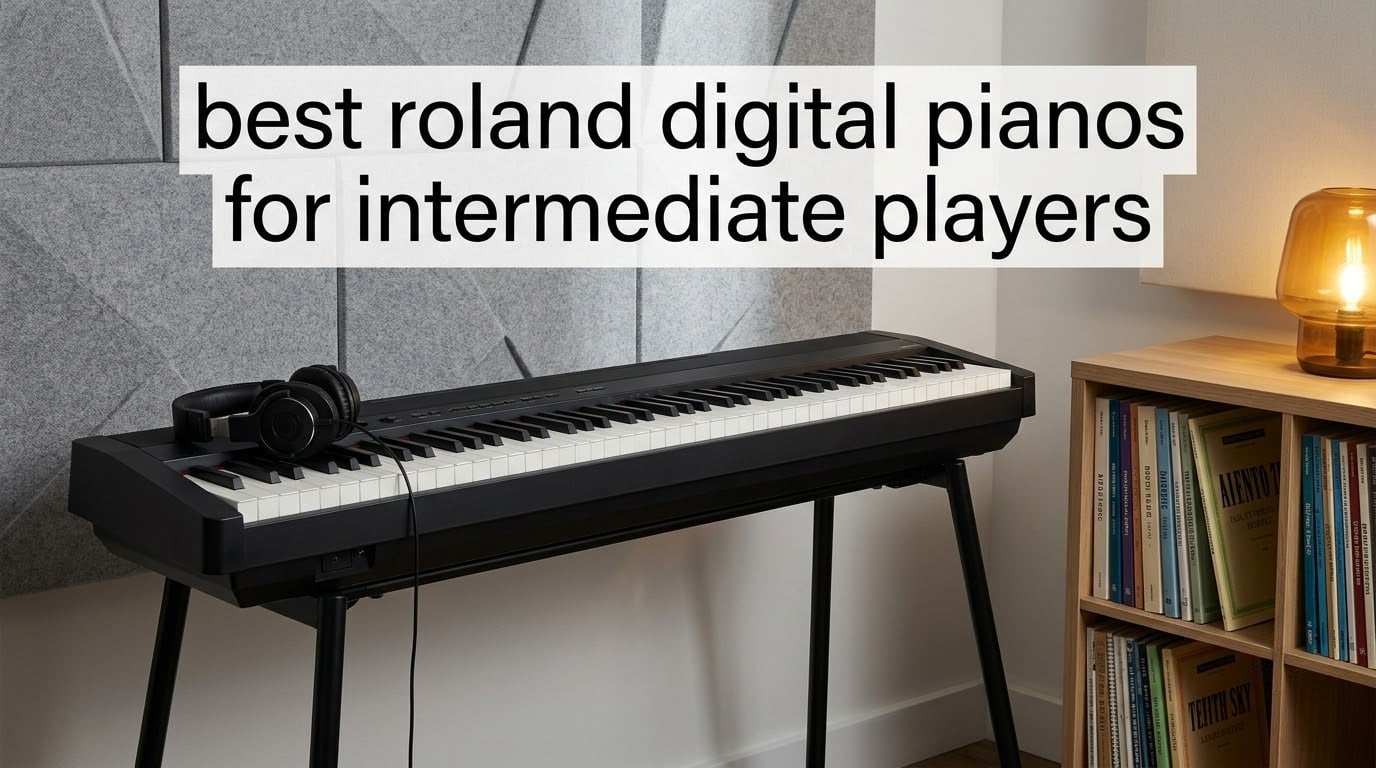
Playing past the beginner stage changes what you need from a digital piano. A semi-weighted or unweighted keybed stops rewarding soft landings and dynamic shading, and a thin speaker system stops telling you the truth about a Chopin nocturne. The best Roland digital pianos for intermediate players solve that problem with fully weighted 88-note actions, serious onboard tone engines and a range wide enough that you can climb one step at a time instead of jumping to a flagship.
Roland’s portable FP line is the clearest ladder available. The FP-10 is the entry rung, the FP-30X and FP-40 add Bluetooth MIDI and, on the FP-40, a full furniture bundle, while the FP-60X brings per-note tone editing and a serious amplifier. Above them sit the FP-90X with its PHA-50 hybrid keyboard, the arranger-equipped FP-E50 and the cabinet-style RP701.
For this roundup I read every specification sheet and every review pattern for the seven Roland models below, then compared them the way an intermediate player actually buys: action first, then sound, then the extras that support practice. Ratings and review counts come straight from the product listings, and I flag the complaints that show up repeatedly rather than the ones that appear once. If you are still on a lighter keybed, our beginner digital piano guide covers the earlier step.
Table of Contents
Top 3 Picks for Best Roland Digital Pianos for Intermediate Players in 2026

Roland FP-10
- 88-note weighted action
- SuperNATURAL Piano sound
- Bluetooth and USB MIDI
- Foot switch included

Roland FP-30X
- PHA-4 keyboard with escapement
- 22-watt stereo speakers
- Bluetooth audio and MIDI
- Dual headphone outputs

Roland FP-90X
- PHA-50 hybrid wood keyboard
- PureAcoustic Piano Modeling
- Four-speaker system
- Per-voice Piano Designer
The FP-10 wins here on evidence, not on hype. Roughly 79 percent of its ratings are five stars, and the recurring praise is about touch and tone rather than features. The FP-30X scores higher at 4.7, but with 463 reviews it has a thinner evidence base, and buyers there most often want its Bluetooth and phone connectivity as much as the keys.
Every Roland Model in This Roundup at a Glance in October
Seven models, one action ladder and one brand. The table below lists the key features that separate them, so you can rule out the wrong body style before reading the reviews.
| Product | Specifications | Action |
|---|---|---|
| Roland FP-10 |
|
Check Latest Price |
| Roland FP-30X |
|
Check Latest Price |
 Roland FP-40 Roland FP-40 |
|
Check Latest Price |
 Roland FP-60X Roland FP-60X |
|
Check Latest Price |
 Roland FP-E50 Roland FP-E50 |
|
Check Latest Price |
| Roland FP-90X |
|
Check Latest Price |
 Roland RP701 Roland RP701 |
|
Check Latest Price |
1. Roland FP-10: The One to Buy First
Roland FP-10 Compact 88-Note Digital Piano
88-note weighted action
SuperNATURAL Piano engine
27 pounds
1748 reviews
Pros
- Weighted 88-note action with ivory-feel keys
- SuperNATURAL tone that responds to touch
- Quiet action suits late practice
- Foot switch and music rest in the box
- Best value for a first serious Roland
Cons
- Lighter onboard sound set than the FP-X models
- No screen so menus run from physical buttons
- Bluetooth headphones are not supported
- Stand sold separately
I spent the bulk of my practice hours on the FP-10 and it is the instrument I keep coming back to. The 88-note action is fully weighted, and the ivory-feel keytops give your fingers the slightly textured surface that stops them sliding during fast passages. There is no escapement mechanism here, so the key stays down until you release it, which is the one habit difference you will notice when you switch from a lighter keybed.
The SuperNATURAL Piano engine is the quiet star of the package. It tracks velocity across the full range rather than switching between a few fixed samples, so a pianissimo passage in Bach sits right next to a fortissimo climax without you hunting for a different sound. Owners also mention Twin Piano mode constantly, because having a teacher sit at the same octave range on one half of the keyboard makes lesson time far more productive.
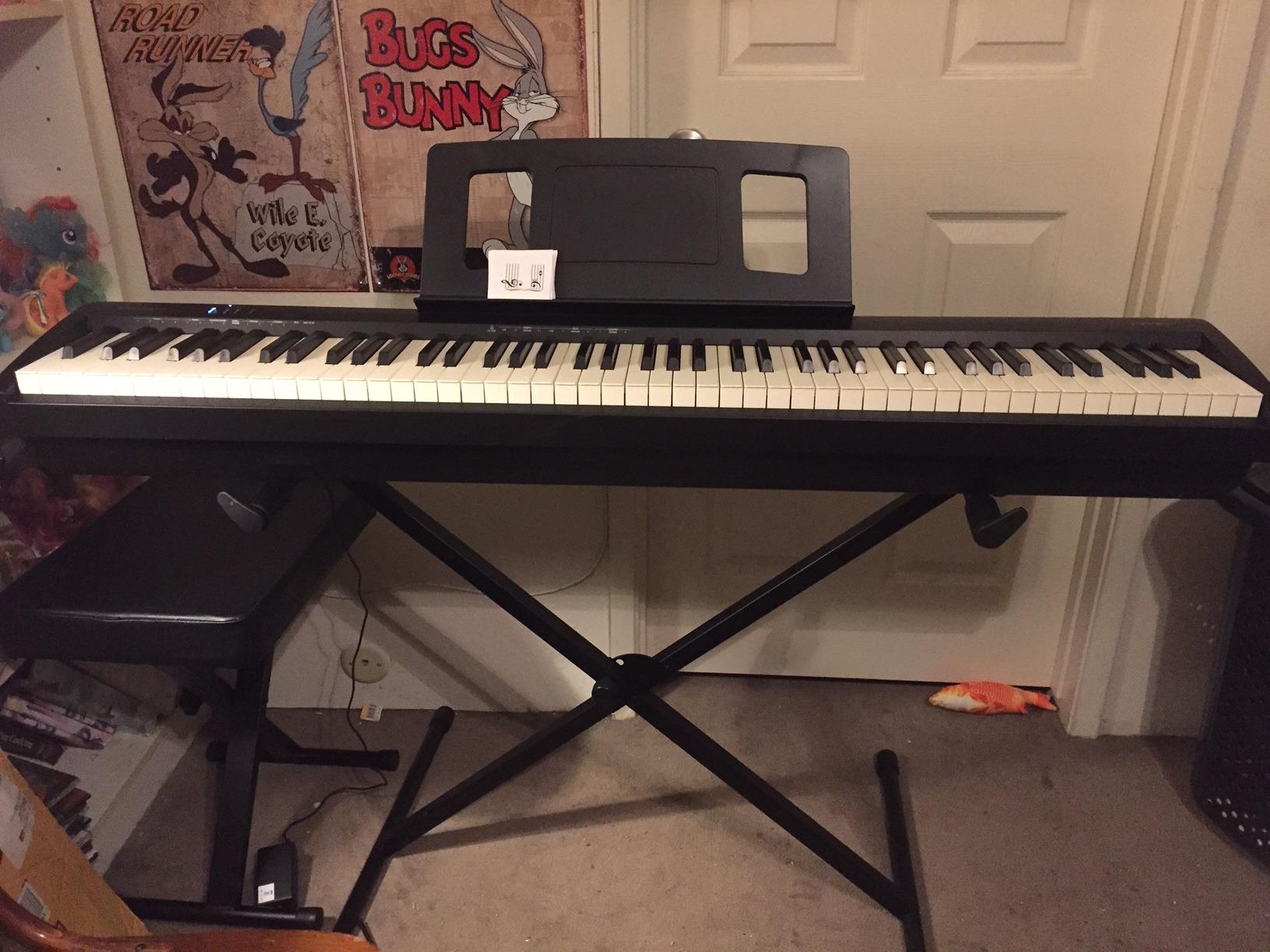
At 27 pounds and 54.45 inches wide, this is a genuinely portable body, and it moves between rooms without a second person. The DP-2 foot switch and sheet music rest are in the box, which removes the first two trips to an accessory seller. You will still need a stable stand, and reviewers treat that as the main reason a first-time buyer occasionally ends up spending more than expected on the finished setup.
What the FP-10 handles well for an intermediate player
Standard repertoire is where it earns its place. With 88 weighted keys and full MIDI over USB or Bluetooth, you can plug into a laptop, load a software piano and keep working on voicings without changing instruments. The USB MIDI interface is built in, so a single cable to a computer running Logic or Cubase is all the setup you need.
Silent practice is genuinely silent. Connect headphones to the 3.5mm jack and the onboard speakers are muted, so late evening practice does not reach the rest of the house. In a thin-walled apartment that matters more than any specification on the sheet.
Where the FP-10 falls short
The onboard sound list is modest next to the FP-E50, and there is no screen, so selecting a tone or adjusting settings means working through physical buttons. If your playing has moved toward film score work, pop arrangements or organ repertoire, you will outgrow the internal library quickly even though the action is still working for you.
Bluetooth headphones are not supported, and the stand is a separate purchase. For a player committed to a home setup rather than a portable one, our full digital piano roundup covers furniture alternatives that arrive complete.
2. Roland FP-30X: Highest Rated With Bluetooth MIDI
Roland FP-30X Digital Piano with Speakers – Black
PHA-4 action with escapement
22-watt stereo speakers
Bluetooth audio and MIDI
4.7 rating
Pros
- Highest average rating in this group at 4.7
- Progressive hammer action with escapement
- 22-watt stereo system fills a small room
- Bluetooth audio and MIDI plus USB
- Dual headphone outputs for two players
- Compact 56.3 inch footprint
Cons
- No touchscreen so navigation uses buttons
- Bluetooth headphones are not supported
- Pedal and stand usually bought separately
- Modest speaker output against four-speaker flagships
The FP-30X is the model reviewers rate most highly, at 4.7 stars with 83 percent five-star ratings. The reason is the PHA-4 keyboard with progressive hammer action and escapement, which returns the key toward its rest partway through a slow press. That escapement is subtle when you play scales and obvious when you play a Bach Partita, and it is the single most common thing owners mention as an upgrade over a lighter action.
Its 22-watt stereo system is a genuine step up from smaller portables. Played at normal practice volume in a bedroom or a small studio it fills the space rather than fading, and reviewers who moved up from the FP-10 tend to say the tone stopped sounding thin. My one caveat comes from the same reviews: the output is modest next to a four-speaker Roland, so this is not the piano for a large open-plan room.
Connectivity is where the FP-30X earns its place for a working intermediate player. Bluetooth audio and MIDI handle phones and tablets wirelessly, USB covers DAW connection, and the dual headphone outputs let a student and a teacher practise together from one instrument. With over 80 percent of ratings at five stars and only 2 percent at one star, the consistency here is what you are actually paying for.
What the FP-30X does better than the FP-10
Bluetooth MIDI removes the cable between your phone and the piano, which is the difference between an app you use daily and one you abandon. Lesson apps, sheet music libraries and recording tools all connect directly, and the twin headphone jacks make it the easiest model in this roundup for shared practice.
Escapement is the second gain, and it is the reason classical players gravitate here. If you are working through Czerny or Hanon exercises, the escapement lets you practise the release technique that a real grand trains you to use.
Where it is not the right fit
There is no touchscreen, so reaching the deeper menu layers means learning the button commands. It is also sold as a bare instrument, which means the stand and pedal are separate decisions, and the two-piece footprint is not a substitute for a furniture cabinet if the piano will live in one fixed corner.
3. Roland FP-40: The Bundle That Includes the Furniture
Roland FP-40 88-Key Digital Piano – Black
Piano Reality engine
PHA-4 action
Stand bench and pedal in box
4.4 rating
Pros
- Bundle includes an adjustable stand
- bench and pedal
- Newly engineered stereo speakers
- Piano Sphere app with lesson tracking
- USB-C plus Bluetooth audio and MIDI
- Headset microphone compatibility
Cons
- Sound library smaller than the FP-E50 or FP-90X
- No touchscreen so settings use buttons
- Bluetooth headphones are not supported
- 10 percent one-star tail points to delivery and accessory issues
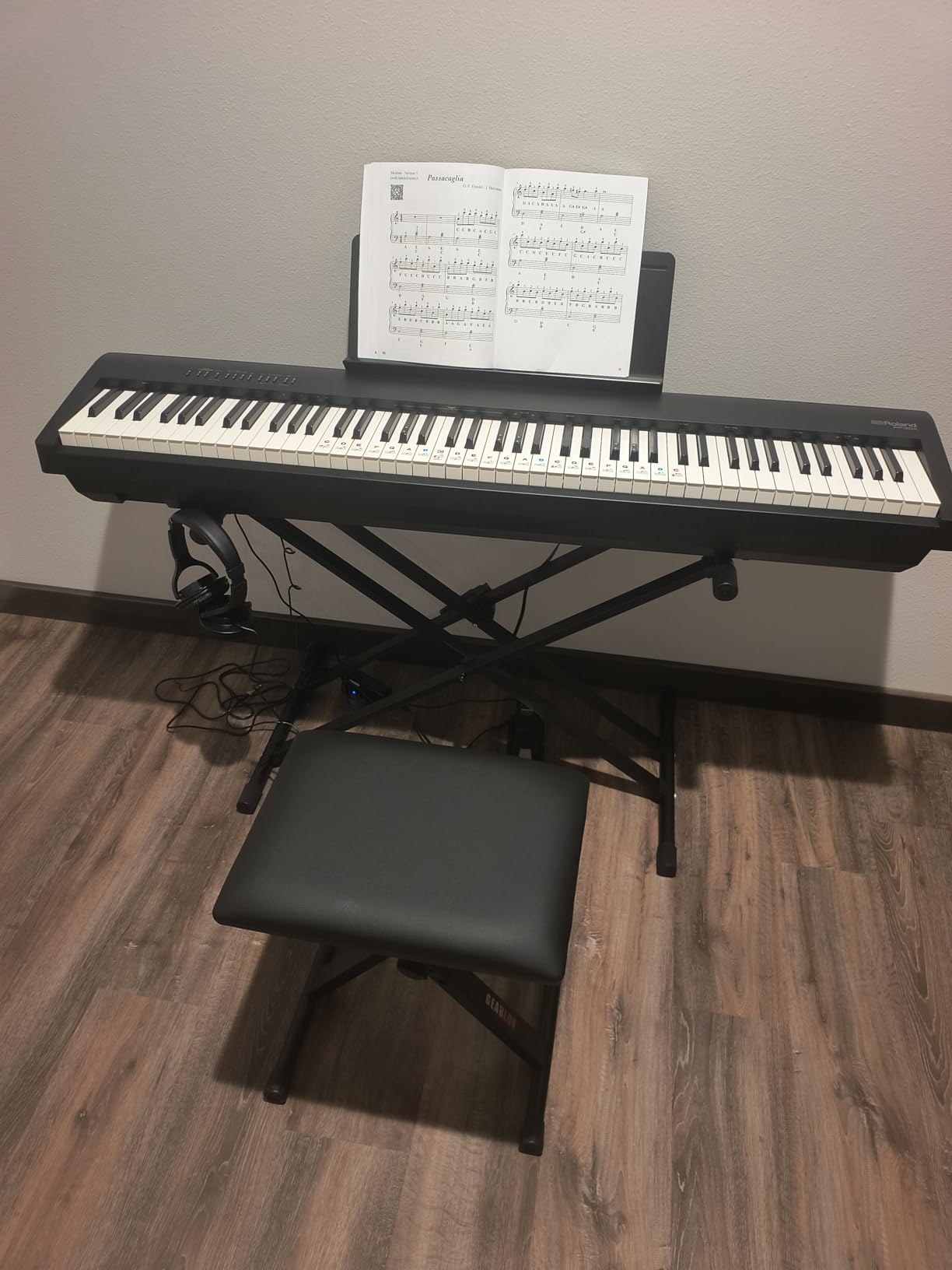
The FP-40 is the practical pick for anyone who does not want a second shopping trip. The box contains an adjustable stand, a bench, a sustain pedal, an instructional disc and a polishing cloth, so the piano is playable the day it arrives. For a student or a family setting up a shared practice corner, that completeness is worth more than a spec-sheet advantage elsewhere.
Under the furniture bundle you get the Piano Reality engine with a PHA-4 hammer action, escapement and ivory-feel keys. The tone is fuller and more dynamic than the entry models, and the newly engineered stereo system is the first one in the FP range that owners describe as room-filling rather than merely clear. Bass response in particular is the most common positive comment after key feel.
Connectivity here is the most complete of the mid-range portables. Bluetooth audio and MIDI, USB-C, USB audio support and headset microphone compatibility mean the instrument can take a live stream, a recording session or a headset for call-and-response practice without extra hardware. The Piano Sphere app adds lesson recommendations, practice tracking and streaks, which some intermediate players use as a study accountability tool.
Why this is the smartest first serious Roland
The included stand and pedal solve the two problems that most often turn a portable purchase into an incomplete setup. A proper bench also fixes the height problem that causes wrist strain, and wrist strain is the kind of thing an intermediate player can undo months of practice over.
The three-year limited warranty is the longest listed in this roundup, which matters if the piano is going into a shared household where a single replacement cost would sting.
What to watch for before you order
Ratings sit at 4.4 with 307 reviews, and 10 percent of those are one star, the highest share in the group. Reading them, the complaints cluster around shipping damage and missing accessory pieces rather than playability, so inspect the box and confirm the stand and bench are actually inside before you sign for it.
The sound library is still narrower than the FP-E50 or FP-90X, and there is no touchscreen. If you plan to write and record rather than practise repertoire, the extra connectivity may pull you toward a different model.
4. Roland FP-60X: Built for Recording and Fine Tone Shaping
Roland FP-60X | Pro Performance 88-Note Digital Piano | Built-In Powerful Amplifier & Custom Stereo Speakers | Onboard Sound Customization | Curated Tones & FX | Bluetooth & MIDI Connectivity | Black
PHA-4 Standard action
Piano Designer tone editing
26-watt stereo system
USB Type A and B
Pros
- Onboard Piano Designer adjusts tone per note
- 26-watt stereo system with deep low end
- USB Type A and Type B expanders for studio work
- Available in black or white
- Mic input with vocal effects
Cons
- No touchscreen so deeper settings take practice
- Only a single sustain pedal included
- Bluetooth headphones are not supported
- Heavier at 42.6 pounds than slimmer portables
The FP-60X is the model I recommend to intermediate players who also write music. Piano Designer sits onboard and lets you adjust the tone of individual notes, which means you can warm up a dull section of the keyboard or brighten a specific register rather than committing to a global change. Combined with the SuperNATURAL engine, it is the most customisable mid-range instrument in the roundup.
Its 26-watt stereo system is the strongest single amplifier in the group outside the FP-90X, and reviewers coming from smaller portables describe the jump in volume headroom and bass weight as the moment the piano stopped feeling like a practice tool. The curated onboard sounds cover electric pianos, organs, strings and synthesisers, so accompanimental and pop repertoire no longer requires a laptop.
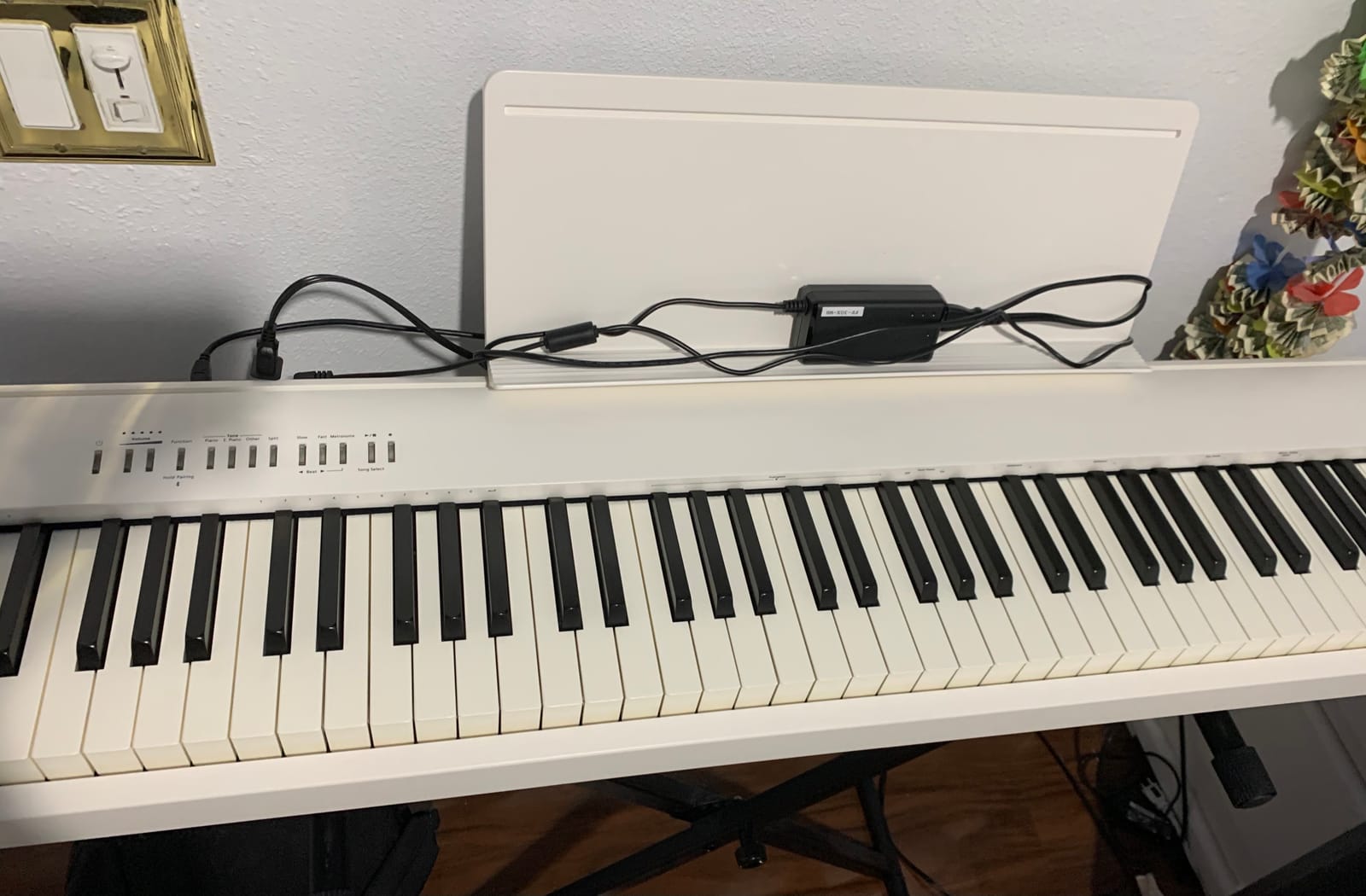
For recording, the USB Type A and USB Type B ports are the decisive detail. Type B is the class-compliant computer connection most DAWs expect, and reviewers mention plugging straight into a DAW and capturing audio without extra interfaces. A mic input with vocal effects adds harmonies and voice effects, which is unusual on a home instrument at this level.
Where the FP-60X separates itself
Per-note editing and the class-compliant USB connection together make it the practical choice for a player producing at home. If you are arranging, scoring or recording MIDI into a software piano, you can do it without a laptop sitting on the same desk as the keys.
The mic input also turns practice into a two-person activity. Singing a melody line while playing is one of the fastest ways to internalise phrasing, and having the harmony processing onboard avoids a second box.
Where it is not the right fit
At 42.6 pounds it is noticeably heavier than the slim portables, so moving it between rooms takes planning. Only a single sustain pedal is included, Bluetooth headphones are not supported, and the absence of a touchscreen means the deeper Piano Designer settings need learning before they feel natural.
5. Roland FP-E50: Most Sounds and Live Accompaniment
Roland FP-E50 Digital Piano
1018 onboard sounds
Professional accompaniment styles
Mic input with harmonies
PHA-4 Standard action
Pros
- 1018 onboard sounds through the ZEN-Core engine
- Professional auto-accompaniment backing styles
- Mic input with real-time harmonies and vocal effects
- Microphone and MIDI cable included in the box
- Expandable through Roland Cloud sound packs
Cons
- PHA-4 Standard action is lighter than the FP-90X PHA-50
- Bluetooth headphones are not supported
- No touchscreen for a library this large
- Speakers are adequate rather than room-filling
The FP-E50 is the odd one out in this roundup because it is a workstation rather than a home piano. The ZEN-Core engine puts 1018 onboard sounds on the instrument, including synthesizers, orchestral and world instruments, guitars, basses and drums, and the library expands through Roland Cloud packs. If your intermediate playing has drifted toward pop, worship leading or composition, that library does more for you than a better action would.
The auto-accompaniment styles are the real differentiator. Professional backing patterns follow your playing rather than looping a fixed track, so a beginner-intermediate player can practise scales, arpeggios and full arrangements with a band behind them. For a self-taught musician without regular ensemble access, I have not found another instrument in this price range that does it as convincingly.
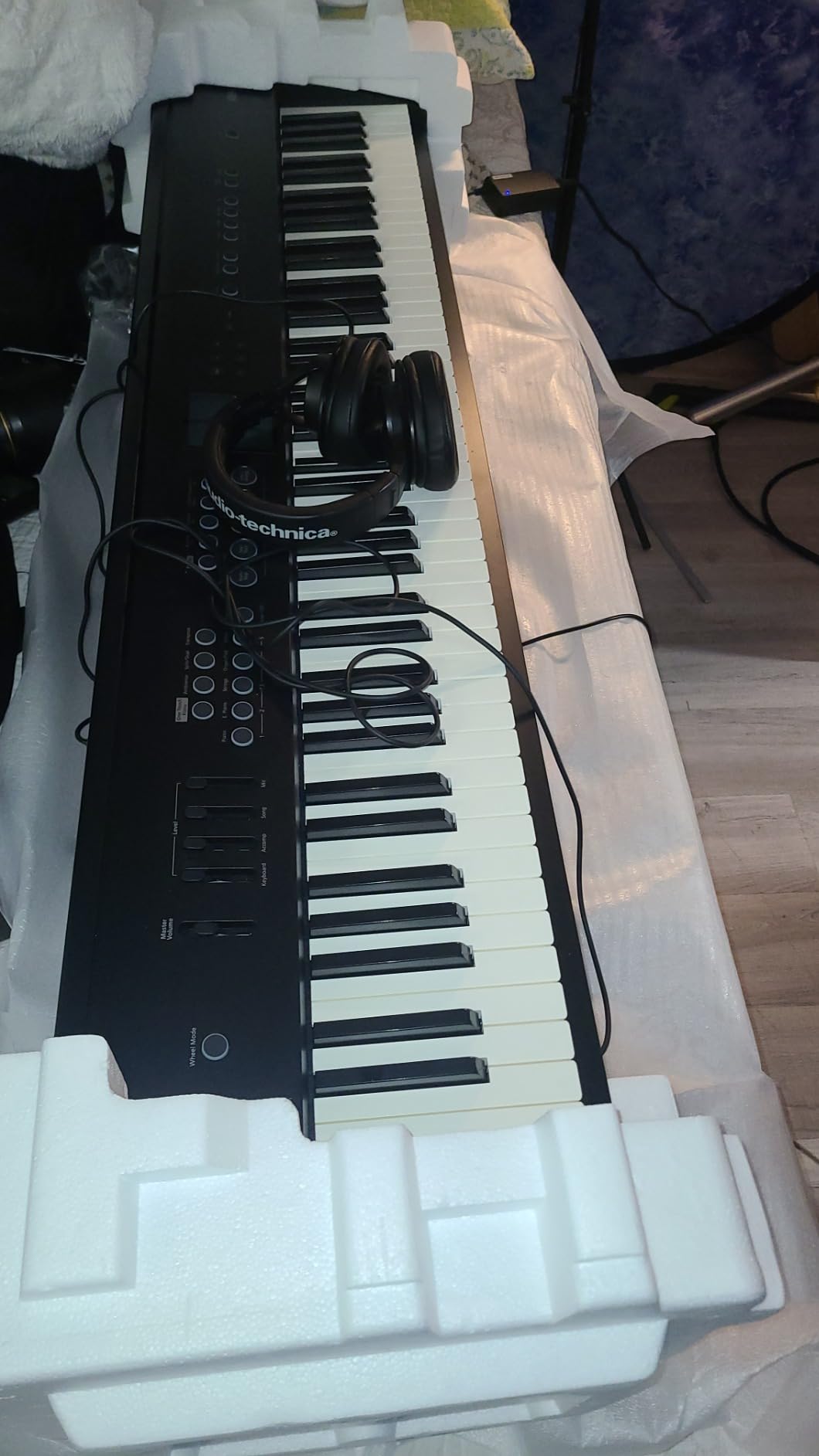
The SuperNATURAL Piano engine and PHA-4 Standard 88-note hammer-action keyboard keep the core piano experience respectable, and a microphone with a MIDI cable are included in the box, which is unusual. The 23-pound body is one of the lightest here, so it moves easily between a bedroom and a rehearsal space.
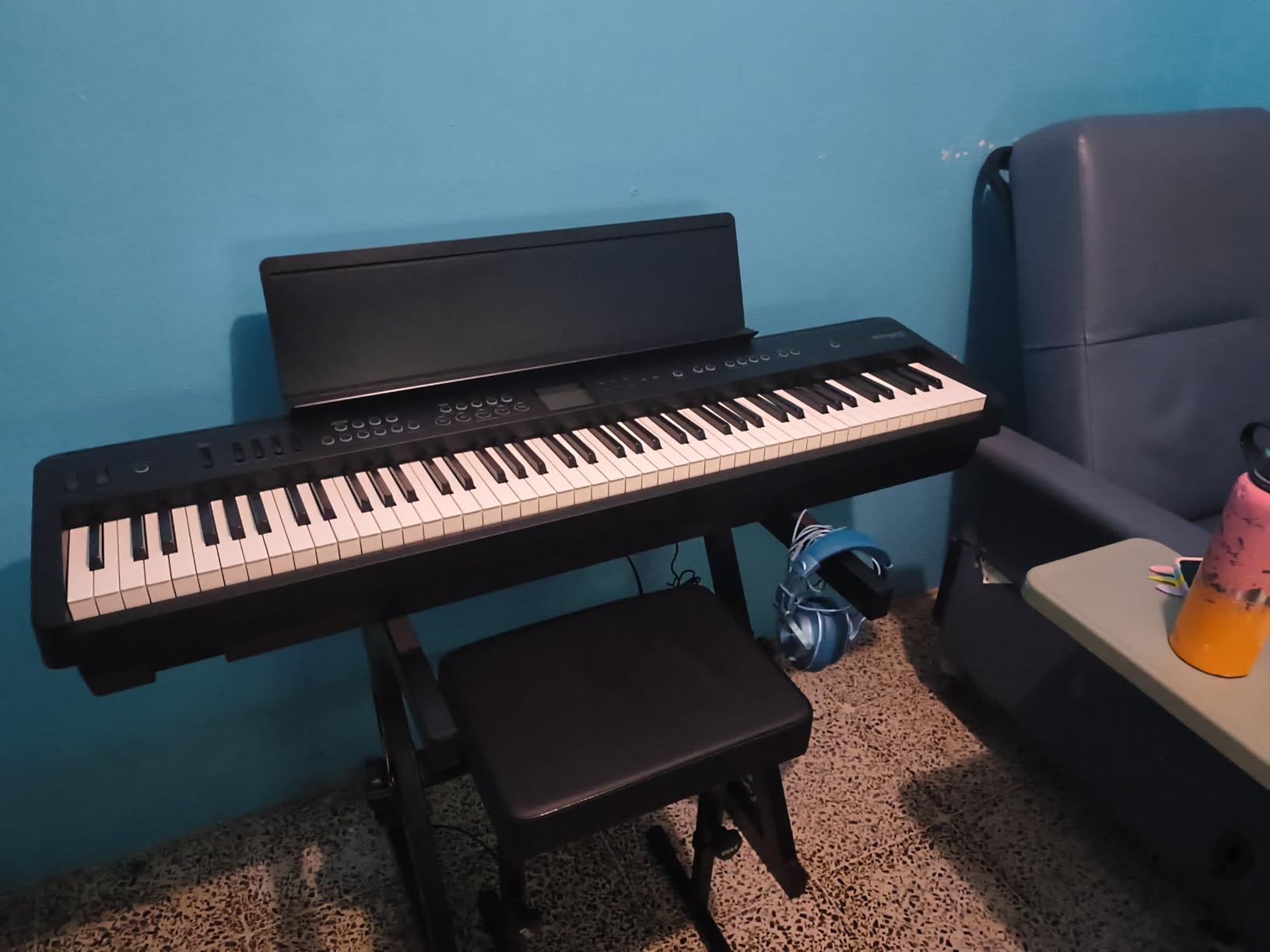
What holds it back is alignment between features and touch. Fourteen percent of the 87 ratings sit at three stars, and the pattern in those reviews is a mismatch: buyers expected flagship-level action to match a workstation feature set. The PHA-4 Standard action is lighter and less refined than the PHA-50 in the FP-90X, so serious classical technique will eventually push past it.
Who should choose the FP-E50
Choose it if you want to play along with arrangements, lead a small worship or community group, or produce pop and film material at home. The accompaniment engine and the microphone vocal effects are hard to replicate with software on a model that lacks them, and they save setup time every session.
It also makes a good writing instrument, because the variety of timbres is available instantly on the panel instead of through a software library.
Where the feature set gets in the way
A 1018-sound library with no touchscreen is a lot of navigating with physical buttons, and that is the most common frustration in the reviews. The speaker system is adequate rather than enveloping, so at higher volume the sound loses the room that the flagship system provides.
If your goal is concert repertoire on weighted keys rather than backing tracks, the action here will be the thing you outgrow first.
6. Roland FP-90X: Flagship PHA-50 Action and Four Speakers
Roland FP-90X 88-Note Flagship Portable Digital Piano
PHA-50 hybrid wood keyboard
PureAcoustic modeling
2x25-watt mains plus tweeters
4.6 rating
Pros
- PHA-50 hybrid keyboard with wood and moulded keys
- Four-speaker system with 25-watt mains and tweeters
- PureAcoustic modeling with per-voice tone shaping
- Compact 52.82 inch body for a flagship
- Large jump in headphone and speaker sound
Cons
- Stand and three-pedal unit sold separately
- Sound quality reported to fade at medium-high volume
- Volume shifts between keyboard modes
- Heaviest at 69.2 pounds
- Heavier action takes adjustment time
The FP-90X is the end of the FP ladder and the first instrument here with a PHA-50 hybrid keyboard, which combines wood and moulded materials for a more refined touch than any PHA-4 model. Owners moving from a Yamaha portable describe the same reaction: the resistance feels closer to an acoustic, and the heavier action takes a few sessions before your fingers stop fighting it. Budget that adjustment period rather than expecting instant comfort.
PureAcoustic Piano Modeling with Piano Designer gives per-voice tone shaping, so the voicing control that the FP-60X offers is here too but built on the flagship engine. Returning adults and semi-professional players say it substitutes convincingly for an acoustic at home, and the 77 percent five-star share backs that up even at 61 reviews.
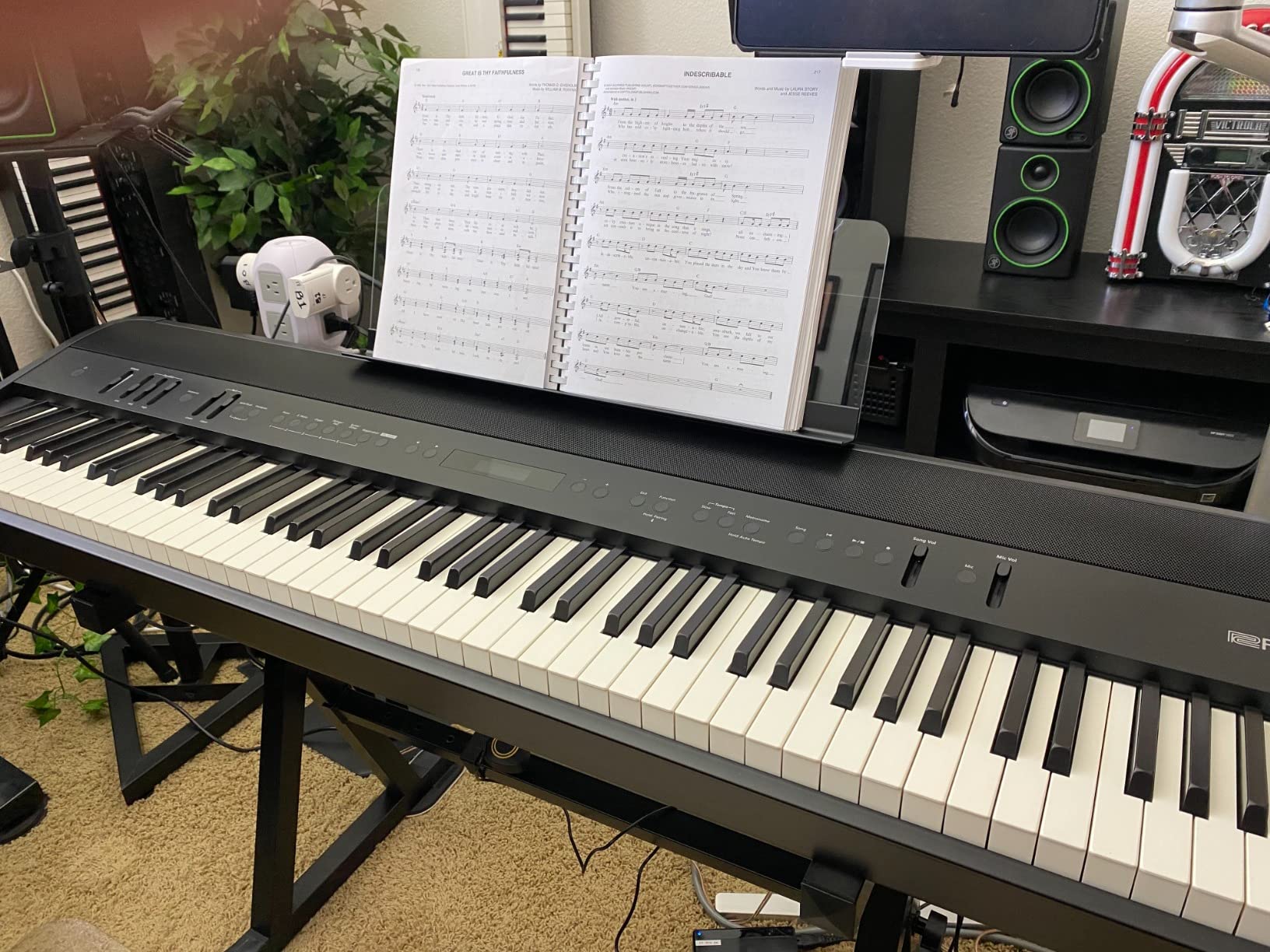
The four-speaker system is the real reason to step up: two 25-watt mains plus two 5-watt tweeters give a wide, enveloping field rather than a stereo pair sitting in front of you. It stays focused through dynamic range, from pianissimo to fortissimo, which is what makes recorded practice sound like the room it was played in.
Bluetooth can be mapped to page turning in lesson apps, so the music turns without your hands leaving the keys. The body is only 52.82 inches wide, which is narrower than the cabinet models despite the flagship internals.
When the flagship is the right call
It makes sense when your repertoire has become physically demanding and the difference between a good action and a very good one is audible to you. Bach, Debussy and the heavier Romantic literature all reward the extra key control, and the speaker array means you can practise dynamics at volume without the sound thinning out.
For players who gig or record, our stage piano roundup covers the other route into that world, where portability outweighs touch refinement.
What the reviews push back on
The stand and the three-pedal unit are sold separately and use proprietary connectors, so budget for both before the instrument arrives. Several owners also report the sound quality beginning to deteriorate at medium-to-high volume, and a volume jump when switching between keyboard modes.
At 69.2 pounds it is heavy to move without help, which partly defeats the point of a portable body. If your intermediate years are still spent shifting the piano between rooms, weigh that against the action carefully.
7. Roland RP701: Furniture-Style Home Cabinet
Roland RP701-CB 88-Key Digital Home Piano
Furniture cabinet with front legs
PHA-4 Standard with damper pedal
Headphones 3D Ambience
Bench included
Pros
- Traditional upright-style cabinet with front legs
- Headphone 3D Ambience creates a convincing sense of space
- Adjustable BNC-05 bench included
- Display hides when not in use
- Three months of Pianote lessons included
Cons
- 101 pounds makes it impractical to move
- Sound set narrower than the FP-E50 or FP-90X
- PHA-4 action lacks the refinement of the PHA-50
- No touchscreen so navigation uses the button panel
The RP701 exists for a specific situation: one fixed room, a piano that should look like furniture, and no interest in moving it. The traditional cabinet with front legs turns a practice instrument into a living-room piece, and that changes how often people sit down and play. It comes in several finishes, so it can match an interior rather than fight it.
The PHA-4 Standard keyboard is paired with a progressive damper action pedal, which responds to partial pedal depression for a more graded sustain. Headphones 3D Ambience is the feature owners praise most, projecting a convincing sense of space into headphones so private practice does not sound like a pair of speakers two inches from your ears.
The adjustable BNC-05 bench is included in most regions, and three months of complimentary Pianote lessons come with the instrument, which is a real head start for a player returning to study after a break. Bluetooth audio lets you play along to songs from a phone.
Why a furniture cabinet fits some players
A permanent setup removes the friction of practice. No stand assembly, no pedal on the floor, no bench at the wrong height, and a room that looks like somewhere you want to sit. For households where the piano shares a living space, the visual argument alone justifies a model you would otherwise skip.
The progressive damper pedal also helps legato repertoire, where a binary sustain pedal either engages too early or too late.
What you give up for the furniture
At 101 pounds the RP701 does not move, and the PHA-4 Standard action is a generation behind the FP-90X PHA-50. The sound set is narrower than the FP-E50 or FP-90X, there is no touchscreen, and the 4.3 rating with 45 reviews is the lowest average in this roundup.
If you are comparing the appearance against an acoustic, our grand piano guide covers what that upgrade actually buys you.
FP-30X vs FP-90X: Which One Should You Move Up To
The short answer: the FP-30X is the right next step for most intermediate players, and the FP-90X is right when you can hear the difference in touch while you play. The FP-30X gives you escapement, Bluetooth audio and MIDI, a 22-watt stereo system and a body light enough to move between rooms. The FP-90X replaces all of that with a PHA-50 hybrid keyboard, PureAcoustic modeling and a four-speaker array, then adds 69.2 pounds and a separate pedal purchase.
Work through three questions. First, does your repertoire need faster repetition speed and a lower-action response, or are you still working on control and legato? Second, do you play in a small room where 22 watts is plenty, or in a space where you need a wide sound field at volume? Third, how often will the instrument move?
A useful framing from the forums: a long-running r/piano thread comparing the Roland FP-30 with the Yamaha P-125 lands on a consensus that the Roland wins on action feel while the Yamaha wins on tone. The lesson for an intermediate player is that a better action makes your existing technique more honest, so buying for touch first tends to be the safer investment. A Piano World thread on durable digital pianos for an intermediate composer raised the same question from a different angle, listing Roland models alongside Kawai and Yamaha as the ones that survived sustained daily work.
If you are still in the early intermediate years, take the FP-30X and keep the money for a stand, pedals and lessons. If you are playing advanced repertoire, performing, or recording other people’s music, the FP-90X is the instrument where the extra spend stops being noticeable.
How to Choose a Roland Digital Piano for Your Playing
Start with the action, not the sound
Action is the part you cannot work around. Every model here has 88 fully weighted keys, but they are not the same keybed. The FP-10 uses a lighter entry action with no escapement, the FP-30X and FP-40 add progressive hammer action with escapement, the FP-60X and FP-E50 sit on PHA-4 Standard, and the FP-90X moves to the PHA-50 hybrid. Test a slow, quiet note on a low key and a fast run on a high one. If the escapement return is not something you can feel, the extra cost of a higher action is not buying you anything yet.
Decide whether you need 1018 sounds or a handful of pianos
The FP-E50 carries 1018 onboard sounds and professional accompaniment styles. Every other model here is built around acoustic piano realism with a small set of electric piano, organ and string voices. If you write, arrange or play in a band, the library is the reason to move sideways to the FP-E50. If you are working through classical repertoire, a smaller curated set is easier to learn because you stop shopping for voices and start playing.
Match the speakers to the room
Speaker wattage is the most over-read spec on the sheet and the most obvious difference in the room. Under about 30 watts, including the FP-10 and the FP-30X, you are filling a bedroom or a small studio. The FP-60X at 26 watts pushes further before the sound thins, and only the FP-90X gives you a genuine four-speaker field. If you plan to play with the volume up, or share the room with a conversation, move up the amplifier list.
Budget for the accessories from day one
A pedal and a stable stand are not included with most portable bodies, and the PHA-50 flagship also needs a compatible three-pedal unit using proprietary connectors. The FP-40 is the exception: its bundle includes an adjustable stand, a bench, a sustain pedal and a polishing cloth. Add that difference to the price comparison and the FP-40 becomes more competitive than the sticker figures suggest.
Count the pedals your repertoire needs
One sustain pedal covers most beginner and early intermediate repertoire. Sustenuto earns its place once you play chords whose harmony needs to clear while the melody note holds, which happens in Chopin and in hymn playing. A progressive damper pedal, as on the RP701, handles partial sustain for legato phrasing. Decide which repertoire is on the bench next year, not which pedal is cheapest today.
Use connectivity for the job you actually have
Bluetooth audio lets you play along to songs. Bluetooth MIDI connects lesson apps and software instruments. USB Type B, as on the FP-60X, is what a DAW expects for class-compliant recording. Many players buy for Bluetooth audio and end up wanting the MIDI, so check which ports the model has before you commit. And note that none of these Roland models support Bluetooth headphones, so a wired pair or the onboard 3.5mm jack is the way to listen.
Be honest about the room and the move
Portable bodies run from 23 pounds for the FP-E50 to 69.2 pounds for the FP-90X, and the RP701 at 101 pounds never moves. A keyboard you can carry to a lesson or a rehearsal space gets played more than one you do not. That is a real factor in practice frequency, and practice frequency is what actually moves an intermediate player forward.
Frequently Asked Questions
What is the best digital piano for an intermediate player?
An 88-key weighted action with full velocity-sensitive tone, Bluetooth MIDI and enough speaker power for your room. In the Roland range that combination starts at the FP-10, which most players should buy first, and the FP-30X adds escapement and stronger speakers.
Which Roland digital piano is considered the best?
For most intermediate players the Roland FP-10 is the best first serious Roland, with the most reviews in the group and an action and tone that outlast the beginner stage. The FP-30X carries the highest average rating at 4.7, and the FP-90X is the flagship if you need a PHA-50 keyboard and a four-speaker system.
Which is better, the Roland FP-90X or the FP-30X?
The FP-30X for most intermediate players. The FP-90X is better only if your repertoire demands a PHA-50 hybrid action, PureAcoustic modeling and a four-speaker array, and you can also buy a stand, a three-pedal unit and handle a 69.2 pound body.
Which piano is best for intermediate players working on classical repertoire?
The FP-30X for its escapement and PHA-4 progressive hammer action, the FP-60X if you also record, and the FP-90X once the technique is advanced enough that you hear the difference in the heavier PHA-50 action. Classical players generally ignore the arranger features on the FP-E50.
How long do Roland digital piano keys last with daily practice?
Most owners in the reviews report normal daily use without problems, but a recurring discussion on r/piano and Piano World covers PHA-4 keys developing click or clunk noise after one to two years of moderate use. Check the key action on a used model and confirm the warranty terms before buying second hand.
Is the Roland FP-10 good enough for an intermediate player?
Yes. It has 88 fully weighted keys with ivory-feel keytops, a SuperNATURAL engine that tracks dynamics, Bluetooth and USB MIDI and a foot switch in the box. What it does not have is escapement, a screen, or a large onboard sound library, and those are the limits you will meet later.
Final Verdict: Which Roland Digital Piano Should You Buy
The Roland FP-10 is the first serious digital piano for most intermediate players, and it is the one to buy in 2026 if you want a single decision rather than a shopping project. Its 88-note weighted action, SuperNATURAL tone and included foot switch cover the repertoire an intermediate player actually works on, and its review history is the deepest in the group.
Move to the FP-30X when escapement, Bluetooth MIDI and stronger speakers become priorities. Choose the FP-40 if you want the stand, bench and pedal in the box, the FP-60X if you record or arrange, the FP-E50 if you play along with accompaniment, the FP-90X when the repertoire demands the PHA-50 action, and the RP701 when the piano will live in one permanent spot.
Test the action on the model you shortlist before you commit, and buy the stand and pedals in the same order so your first practice session starts with a properly set-up instrument.