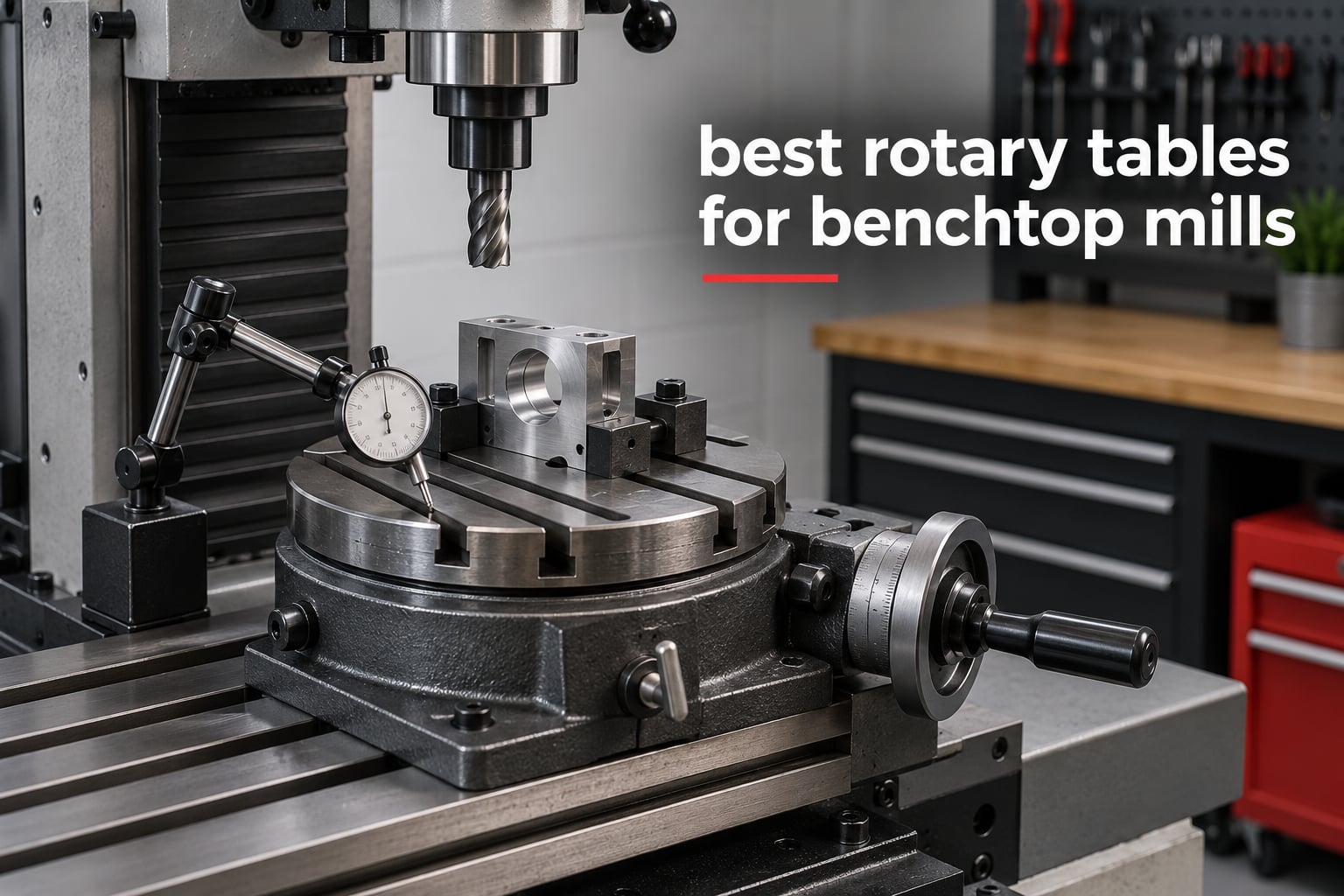
A rotary table is a precision indexing turntable that bolts to your mill table, quill, or tilt and rotates a workpiece through exact angles, so circles, arcs, bolt patterns, and slots come out right without re-fixturing by hand. On a benchtop mill it is the single cheapest upgrade that turns a hobby machine into one that can hold a repeatable tolerance.
The catch is height, not diameter. Every rotary table you mount steals quill travel from the machine underneath it, and on a small mill every millimeter of Z-axis travel counts. Buy a table that is too tall and you lose deep-pocket capacity permanently, so this roundup leads with published heights rather than marketing.
We compared ten tables for the best rotary tables for benchtop mills, from 3 inch indexers that sit under a Sherline or Taig up to a 6 inch cast iron model with a graduated 360 degree plate. If your machine is new, our benchtop jointer comparison covers the shop setup around it.
Table of Contents
Top 3 Picks for Best Rotary Tables for Benchtop Mills in 2026

VEVOR 6 Inch Horizontal Vertical Table
- Cast iron body
- 6 inch table
- Graduated 360 degree plate
- H and V use

VEVOR 4 Inch Table with 3-Jaw Chuck
- 4 inch table
- 80 mm 3-jaw chuck
- 1:36 worm gear
- H and V use

4 Inch Tilting Rotary Table with Chuck
- Tilts 0 to 90 degrees
- 1:36 worm gear
- 65 mm 3-jaw chuck
- Cast iron
Best Rotary Tables for Benchtop Mills in October
| Product | Specifications | Action |
|---|---|---|
| VEVOR 6 Inch Horizontal Vertical Rotary Table |
|
Check Latest Price |
| VEVOR 4 Inch Rotary Table with 3-Jaw Chuck |
|
Check Latest Price |
| 4 Inch Tilting Rotary Table with Small Chuck |
|
Check Latest Price |
 HHIP 4-3/8 Inch Horizontal Vertical Rotary Table HHIP 4-3/8 Inch Horizontal Vertical Rotary Table |
|
Check Latest Price |
 3 Inch Rotary Table with M6 Clamp Kit 3 Inch Rotary Table with M6 Clamp Kit |
|
Check Latest Price |
 RAHISH 3 Inch Horizontal Vertical Rotary Table RAHISH 3 Inch Horizontal Vertical Rotary Table |
|
Check Latest Price |
 RAHISH 3 Inch Tilting Mini Rotary Table RAHISH 3 Inch Tilting Mini Rotary Table |
|
Check Latest Price |
 MachEl 4 Inch Rotary Table with 4 Slots MachEl 4 Inch Rotary Table with 4 Slots |
|
Check Latest Price |
 MachEl 3 Inch Horizontal Vertical Rotary Table MachEl 3 Inch Horizontal Vertical Rotary Table |
|
Check Latest Price |
 OMEX 3 Inch Horizontal Vertical Rotary Table OMEX 3 Inch Horizontal Vertical Rotary Table |
|
Check Latest Price |
1. VEVOR 6 Inch Horizontal Vertical Rotary Table – Best Overall for Benchtop Mills
VEVOR Rotary Table 6inch(150mm) Horizontal Vertical Milling Table 2/5inch(10mm) 4-Slot Milling Rotary Table MT-2 Rotary Table for Milling with Indexing Plate Set for Precision Milling Drilling
6 inch/150 mm cast iron table
H and V mounting
Graduated 360 degree indexing plate
Pros
- Smooth handwheel with minimal backlash
- Cast iron body damps vibration well
- Works horizontal and vertical
- Sharp machined edges out of the box
- Graduated table with resettable dial
Cons
- T-slots measure slightly under the stated 14 mm
- Locating lugs arrive oversize and need fitting
- Manual is thin and hard to read
This is the one I keep coming back to. The cast iron body has the mass to stay put under a facing cut, and the 6 inch plate gives you real room for a bolt circle instead of cramming three small holes onto a 3 inch disc.
Reviewers single out the handwheel. It turns smoothly with minimal backlash, which matters because backlash shows up directly as chatter when you cut a radius.
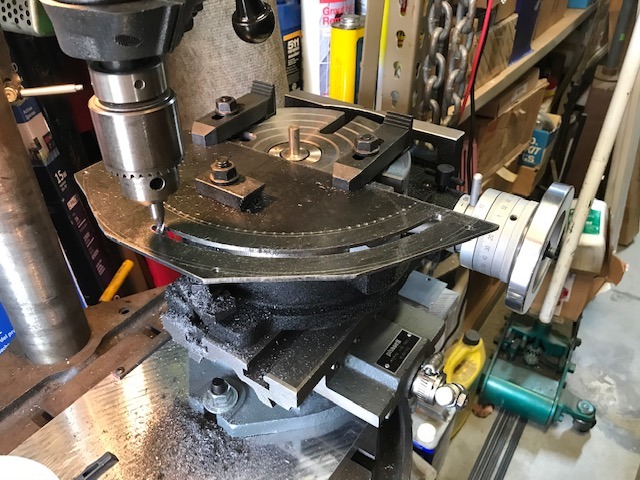
Two fitting jobs are worth knowing before it arrives. The T-slots measure a little under the stated 14 mm, and the supplied alignment lugs are oversize, so expect to trim them to your mill table before first use.
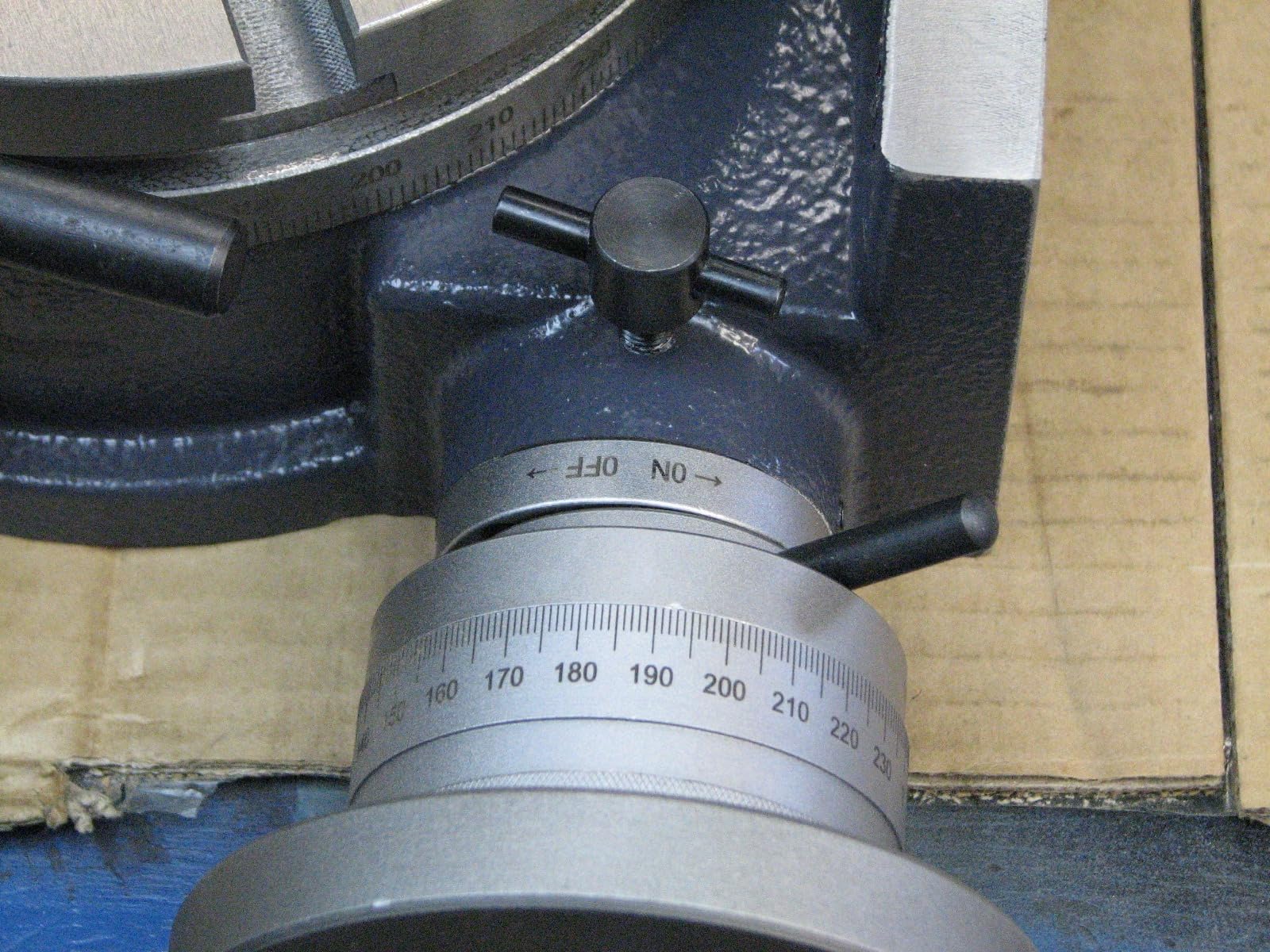
The dial and table face are graduated 360 degrees with a resettable zero, and the plate carries four slots for a 10 mm bolt pattern. The cast iron absorbs vibration rather than ringing like an aluminum table would.
How much Z-travel does this table cost you?
The listed dimensions are 9.5 x 3.1 x 7.7 inches, so the tall dimension sets what you lose. Measure from your mill table surface to the top of the raised table before you mount it, and subtract that figure from your quill travel.
It weighs 40 pounds, which is honest cast iron mass and also the reason you will want a second pair of hands lifting it onto the table.
Who should skip this table
If your mill is a Sherline, Taig, or a small X-mill with short quill travel, a 6 inch table is a luxury you cannot pay for in lost depth. Save your Z-axis for the actual cut and pick a 3 inch low-profile model instead.
The manual is also a genuine weak point, with poor diagrams. Budget an evening reading it alongside a dial indicator setup rather than trusting the paper.
2. VEVOR 4 Inch Rotary Table with 3-Jaw Chuck – Best Value
VEVOR Rotary Table for Milling Machines, 4”/ 100 mm, Horizontal Vertical Model Precision Milling Rotary Table, with 3.1”/80 mm 3-Jaw Chuck M10 T-Bolts Nuts, for Milling Engineering Indexing Tools
4 inch/100 mm table
80 mm 3-jaw chuck included
1:36 worm gear
Pros
- Good price-to-quality ratio
- Chuck grips small workpieces firmly
- Scales make angle setting easy
- Fits horizontal and vertical
- HT250 cast iron body
Cons
- Usually needs disassembly and deburring before use
- Some report a chuck lock screw that vibrates loose
- Graduation markings can be hard to read
This is the table most benchtop owners should look at first. You get a 4 inch plate, a 1:36 worm gear, and an 80 mm three-jaw chuck in the same box, which is more than many bare tables offer.
The clamping ranges are useful numbers. External jaws grip 2 to 25 mm and internal jaws take 25 to 70 mm, so small pins and bored stock both seat without a soft jaw.
Owners treat it as a tune-before-you-cut table. It typically arrives needing disassembly, deburring of sharp edges, and lubrication before the first serious cut.
What does 1:36 ratio give you in practice
One full turn of the handwheel moves the table 10 degrees. The handwheel is graduated in 100 divisions and the table face is marked 360 degrees, so you can index to 10 minute steps comfortably.
It weighs 11.7 pounds and stands 4.7 inches tall with the chuck in horizontal use. Chuck center height in vertical position is 3.4 inches, which is the number that matters for a short-travel machine.
Where the value breaks down
A minority of owners report a chuck lock screw that vibrates loose and a spindle bore that runs slightly loose enough to introduce runout. One reviewer measured about 0.01 mm runout after adjustment, which is fine for hobby bolt circles but not for precision gear work.
If backlash is your main concern, this is not the table. Small imported tables of this size carry slop that has to be worked around rather than adjusted out.
3. 4 Inch Tilting Rotary Table with Small Chuck – Best for Tilting Work
Precision Quality 4″/ 100 Mm Tilting Milling Indexing Rotary Table With Small Chuck, Back Plate & Fixing T Nuts Bolts-metalworking Engineering Machine Tools (With 65 MM 3 Jaw Self Centering)
Tilts and locks 0 to 90 degrees
1:36 worm gear
65 mm self-centering chuck
Pros
- Tilts and locks at any angle
- Chuck back plate and T-nuts supplied
- 10 degrees per handle revolution
- Cast iron body
Cons
- Only 11 reviews to judge by
- 24 percent of ratings sit at 2 stars
- Manufacturer warranty is 3 months
Most rotary tables only mount flat or on the quill. This one tilts and locks at any angle from 0 to 90 degrees, which opens up compound and bevel work that a fixed plate cannot reach.
The package includes a 65 mm three-jaw self-centering chuck, a back plate, and fixing T-nuts with bolts, so you are not hunting for mounting hardware after delivery.
Drive is 1:36, so one handle revolution equals 10 degrees. That is the same ratio as the fixed tables here, and it is enough for angle indexing rather than gear tooth spacing.
Is a tilting table worth the extra height
On a machine with generous quill travel, yes. On a small mill, add the base thickness to the 4 inch plate diameter before you commit, because a tilted base does not sit as low as a flat one.
The rating spread here is the caution. A 24 percent two-star group points squarely at the tilt lock, so test the lock under load before you rely on it for a bevel cut.
Who this suits
Model engine builders and anyone cutting compound angles will value the 90 degree range. Straightforward bolt circle work does not need the tilt, and a fixed table will stay stiffer there.
The 3 month manufacturer warranty is unusually short. Inspect the casting and the lock carefully on arrival, since a warranty claim afterward will be slow.
4. HHIP 4-3/8 Inch Horizontal Vertical Rotary Table – Best for Compact Mills
HHIP 3906-2304 4″/110mm Horizontal/Vertical Rotary Table
110 mm table diameter
86 mm center height
280 mm length with handle
Pros
- Compact diameter suits mini mills
- Works horizontal and vertical
- Center height matches common mill geometry
- Short overall length fits small table tops
Cons
- Only 2 reviews available
- No feature or accessory details published
- Heavy for its 110 mm size at 19.8 pounds
This is the smallest footprint here, and it publishes the numbers most listings hide. Table diameter 110 mm, horizontal overall height 80 mm, vertical overall height 152 mm, center height 86 mm.
That 86 mm center height is the useful figure. It matches common mill table geometry, so the table sits square without shimming, which is not always true of imported tables.
Overall length including the handle is 280 mm, short enough to sit on a small mill table without overhanging the ways.
Can you judge it on two reviews
No, and we will not pretend otherwise. Both reviews are 5 star, which tells you very little. The published dimensions are the only real basis for a decision.
At 19.8 pounds it is heavy for a 110 mm table, which is a reasonable sign that the body is cast rather than stamped.
When compact geometry wins
If your mill has a short table, the 280 mm length matters more than diameter. A longer 4 inch table with a protruding handle can overhang the edge and lose rigidity.
Check the vertical overall height of 152 mm against your quill travel before ordering. That figure includes the base that lets it work on its side.
5. 3 Inch Rotary Table with M6 Clamp Kit – Best for Drill Press Work
3″ Inch (80 mm) Rotary Table with M6 Clamp Kit milling machine Indexing Table
80 mm table with 4 T-slots
5 degree graduated scale
M6 clamp kit included
Pros
- Matching M6 clamp kit included
- 5 degree scale in both positions
- Compact base fits small mills
- Ground finish tool steel and cast body
Cons
- Some play or slop in the rotation
- Only 7 reviews to go on
- Clamp kit fits only the 3 and 4 inch AD tables
This is the one to look at if you want to index a drill press or a mill drill rather than a full milling machine. The included M6 clamp kit means you can mount it without sourcing step blocks separately.
The kit contains two step blocks, two tee bolts with M6 flanged nuts, and two clamps, with bolt length 55 mm overall. Four T-slots at 5/16 inch take the workpiece bolts.
The table face is calibrated in 5 degree increments, which is coarser than the 10 minute scales on some alternatives but plenty for evenly spaced holes.
Is slop going to ruin your bolt circle
It depends how you work. Reviewers note some play in the rotation that has to be accounted for, so tighten the lock and take up the slack consistently from one direction rather than feeling for zero.
Always rotate in the same direction. If you approach an angle from different directions, backlash will give you different results on nominally identical cuts.
What the size limits
An 80 mm plate works for bolt circles on small parts and hobby fixtures. Once the workpiece approaches the edge of the plate, runout and any slop show up directly in the hole pattern.
Base measures 4-1/8 x 3-1/4 inches and the body weighs 5.35 pounds, so it moves between machines without being a nuisance.
6. RAHISH 3 Inch Horizontal Vertical Rotary Table – Best for 10-Minute Indexing
HV Rotary Table, Horizontal & Vertical, 4 Slots, 1:36 Gear Ratio, 3″
80 mm 4-slot table
1:36 worm gear
10 minute divisions that are zeroable
Pros
- Handwheel graduated in 10 minute divisions
- Resettable to zero
- Cast iron and tool steel build
- Graduated 360 degree face
- H and V positions
Cons
- Vertical center height is only about 66 mm
- Only 8 reviews available
- Some 3 star ratings report finishing needs work
The resettable 10 minute handwheel is the feature that sets this apart. Zero the dial at your starting angle and every subsequent handle turn lands on a repeatable ten minute step.
Drive is 1:36, so one full handle rotation turns the table 10 degrees. Combined with the zeroable wheel that gives clean indexing without re-reading the table face each time.
Construction is cast iron body with tool steel components, and the table carries four slots on an 80 mm plate. It works flat on the mill table or on its side.
What the 66 mm center height means
In vertical position without a chuck the center height is about 66 mm, which is the most compact vertical geometry in this group. That is exactly what a short-travel machine needs.
The tradeoff is straightforward. A low center height means less room between the table and the part, so plan your workholding around a low profile setup.
Where it falls short
With only 8 reviews there is limited long-term data, and a 19 percent three-star group suggests some examples need finishing work out of the box.
It weighs 4.56 pounds, so it is easy to carry between a mill and a drill press. That is the practical advantage over the heavier cast iron tables here.
7. RAHISH 3 Inch Tilting Mini Rotary Table – Best for Low-Profile Tilting
Tilting Mini Rotary Table with Chuck, 36:1 Worm Gear Ratio, 3″
Table height 42 mm
95 mm with chuck
36:1 worm gear
Pros
- Only 42 mm table height
- Supplied chuck
- 10 minute handwheel divisions
- Seasoned casting with gun metal gear and EN8D worm
Cons
- Only 2 reviews available
- 3 inch capacity limits workpiece size
- No published weight to judge heft
This is the tilt table for a machine where Z-travel is genuinely scarce. Table height is 42 mm, and 95 mm with the chuck fitted, which is the lowest profile tilting option here.
A chuck is included, so round stock can be held without a separate purchase. The 36:1 worm drive turns the table 10 degrees per handle revolution.
Material specification lists a seasoned cast body, a gun metal gear, and an EN8D worm, which describes the drive train more precisely than most listings at this size.
Does a 42 mm height actually help
Yes, if quill travel is your constraint. Compare that figure to the 66 mm vertical center height on fixed 3 inch tables and you gain usable depth on short-travel machines.
The trade is capacity. A 3 inch plate handles small pins and hobby parts well, but a larger workpiece will overhang the table and lose support.
What the review data cannot tell you
Two reviews and no negative ratings is a thin basis for any conclusion. We rate it on published geometry, which is why the specification list matters more than the star average here.
Before committing to any small tilting table, run a dial indicator on the table face as you rotate it through the range. Tilt locks that are not ground true show up as runout at odd angles.
8. MachEl 4 Inch Rotary Table with 4 Slots – Most Versatile
MachEl 4-Inch Rotary Table with 4 Slots – Precision Milling and Machining (100 mm)
100 mm 4-slot table
Cast iron and tool steel
Hand powered rotation
Pros
- Four slots give flexible clamping
- 100 mm diameter suits small projects
- Cast iron and tool steel rigidity
- Smooth accurate rotation
Cons
- Single review only
- Gear ratio and graduations not published
- No chuck or clamp kit in the box
A 100 mm plate with four slots, cast iron and tool steel construction, and a hand powered drive. That is the whole specification, and it is enough if your work is clamped into the slots rather than held in a chuck.
Four slots give you more clamping positions than a plain top, which means step blocks, hold-downs, and strap clamps all fit without hunting for a single bolt location.
It weighs 9.24 pounds, which is substantial for a 4 inch table and a reasonable indicator of cast construction.
Why the missing specs matter
The listing does not publish a gear ratio or graduation detail. Without a stated ratio you cannot predict backlash or indexing resolution, and that is the main reason we rank it below the documented alternatives.
One 5-star review is not evidence of quality. Treat the score as decorative and buy on the format and the construction instead.
Who should consider it
If you already own clamps and step blocks, the missing clamp kit costs you nothing and the four-slot top is genuinely useful for irregular workpieces.
If you need a chuck or a graduated dial, pick one of the tables here that publishes those numbers. You will spend less time second-guessing the result.
9. MachEl 3 Inch Horizontal Vertical Rotary Table – Best for Small Bolt Circles
MachEL 3″ (80mm) Rotary Table for Milling Machines – Horizontal & Vertical Precision Indexing Table, 4 Slots
80 mm table
36:1 gear ratio
4 x 5/16 inch T-slots
Pros
- Fully documented 36:1 ratio
- 5 degree graduated scale
- Four 5/16 inch T-slots
- Mounts horizontal or vertical
- Rigid cast iron base
Cons
- Only one review
- 3 inch capacity limits larger workpieces
- No chuck or clamp kit included
The rare small table that publishes its gear ratio. At 36:1, one full handle rotation moves the table 10 degrees, which is documented rather than assumed.
Four T-slots at 5/16 inch give you clamping options across the top, and the base measures 4-1/8 x 3-1/4 inches. It works horizontal or vertical on the same footprint.
The build is a rigid cast iron base with a precision ground tool steel table surface, and the scale is graduated in 5 degree steps for repeatable indexing.
How to index without a chuck
Use a pin and a step block. Drill a center hole in the workpiece, seat it on a dowel, and clamp across the slots. That setup is more rigid than a small chuck for light bolt circles.
Mark the starting angle on the 5 degree scale, then count handle revolutions. Ten degrees per turn means a 40 degree bolt circle is four turns.
Honest limitations
No chuck or clamp kit is included, so plan on sourcing your own workholding. The 80 mm capacity also limits you to smaller parts.
With one review on file, the specification sheet is doing all the work. Verified dimension data matters more than a single rating.
10. OMEX 3 Inch Horizontal Vertical Rotary Table – Best Documented Entry-Level Table
OMEX New Rotary Table 3 Inch – 75MM Horizontal & Vertical Model – Milling Machine
75 mm table
H and V orientation
4.45 pound body
Pros
- Most reviews among small 3 inch tables
- Compact 75 mm size with H and V use
- Light enough to move between machines
- Long-standing listing owners keep returning to
Cons
- Lowest average rating here at 3.8 stars
- 12 percent of reviews are 1 star
- Almost no technical specification published
- Brand shown as AI rather than OMEX
OMEX has the longest-standing listing and the deepest review base of any sub-4 inch table here, at 35 reviews. If you want to know what owners actually say rather than guess from a specification sheet, this is the one with the data.
The body weighs 4.45 pounds, making it the easiest to move between machines in this roundup. It works in horizontal and vertical orientation on a 75 mm plate.
The review distribution is wide. Forty-four percent of ratings are 5 star and 12 percent are 1 star, which is a much wider spread than the other tables here.
What the 1-star ratings describe
Owners who rate it low report rough finishes and accuracy or durability problems. That is consistent with the general view that the very cheapest tables carry slop in the rotation.
Check backlash with a dial indicator before committing to a bolt circle. If the handle rocks through more than a hair’s width of rotation, expect variation between cuts.
Should you buy the cheapest option
For practice work and learning the indexing habit, yes. A 3 inch table teaches you the technique at low cost, and you can move up to a 4 or 6 inch model later.
For production part numbers, pick a table with a published ratio and a cast iron body. The listing here gives almost no technical detail, which is why we rank it last despite the review volume.
Buying Guide: Sizing a Rotary Table to Your Benchtop Mill
Match the table to the machine class first, then to the workpiece. A mill drill or a small X-mill class machine has short quill travel, and that single fact eliminates more tables than any other consideration.
Mill drill and small knee mills: a 3 inch or 4 inch table with a low profile. Keep the total added height under what you can afford to lose from Z travel.
Sherline, Taig, and X-mill class: favour the 42 mm tilting model or an 80 mm fixed table with a 66 mm vertical center height.
Jet, JPM, and PMT style machines: a 4 inch or 6 inch cast iron table fits comfortably and the quill can absorb the height.
Heavier Bridgeport style mills: a 6 inch horizontal vertical table gives you a usable bolt circle area and cast iron damping.
Work out the Z-height before you buy
Measure the distance from your mill table surface to the top of the raised rotary table, then subtract it from published quill travel. On the 6 inch table here the tallest listed dimension is 7.7 inches, which is a lot to give up.
Do the same for vertical center height if you plan to use the table on its side. The 86 mm figure on the HHIP model and the 66 mm figure on the 3 inch RAHISH table are directly comparable numbers.
Gear ratio decides your indexing resolution
A 1:36 ratio means one handle revolution turns the table 10 degrees. Divide that by the handwheel graduations and you get your step size, which is 10 minutes on the tables with a 100-division wheel.
For finer work, a 90:1 ratio gives 4 degrees per turn, which divides into one minute of arc or better. None of the tables in this roundup reach 90:1, so this is where you step up to a larger imported table.
Horizontal, vertical, or tilting
Horizontal is drilling bolt circles and face work. Vertical mounting uses the quill or a tailstock and is the right choice for circular milling on the side of a workpiece. Tilting adds compound and bevel angles at the cost of height and lock rigidity.
Why the cheapest 4 inch tables disappoint
Review scores do not predict backlash. Machinists repeatedly describe the smallest tables as having slop in the rotation, and the common conclusion is that the teardown work is unnecessary unless you are chasing arc-minute tolerances.
That is the honest dividing line. If you need positional repeatability rather than approximate angles, buy a heavier cast body with a published ratio and accept the extra Z-height cost.
Used or new
Used tables are common because a 40 pound casting is awkward and expensive to move, and several owners say they buy heavy tables locally for that reason. When buying used, check backlash with an indicator, run the table through a full revolution watching for binding, inspect the T-slots for burrs, and confirm the lock engages positively.
Also verify total height before you commit. Owners report regretting 8 inch tables on machines with a 9-1/2 x 32 table, where the footprint alone becomes the problem.
Rotary Table vs Dividing Head vs Powered 4th Axis
A rotary table indexes position. A dividing head indexes between centres and can drive a workpiece between centres for gear cutting and tooth spacing. A powered 4th axis adds a fourth CNC or manual axis to the machine itself.
If your work is bolt circles, arcs, and curved slots, a rotary table is the cheapest and simplest answer. A dividing head earns its cost when you cut gears or need work held between centres.
Advice for benchtop users generally steers toward mills that already support a rotary 4th axis if automation is the goal. Buying a rotary table first and a servo-driven table later is a common upgrade path.
Before you commit to any of this, make sure the machine itself is sound. Our benchtop multimeter guide covers the electrical checks worth doing before you power up a mill, and our rolling mill comparison helps you shape stock for round work first.
Frequently Asked Questions
What size rotary table do I need?
For a mill drill or Sherline and Taig class machine, choose a 3 inch or low-profile 4 inch table and keep added height under the quill travel you can afford to lose. A Jet, JPM, or PMT class machine takes a 4 inch or 6 inch cast iron table comfortably.
What is a rotary table in machining?
A rotary table is a precision indexing turntable that mounts on a mill table, quill, or tilt and rotates a workpiece around a horizontal or vertical axis so circles, arcs, bolt patterns, and angles are machined accurately without manual re-fixturing.
What are the two main types of rotary tables?
The two main types are horizontal and vertical rotary tables, which mount flat on the mill table or on the quill to rotate the workpiece about a vertical axis. Tilting models add a third option, swinging the work through 0 to 90 degrees for compound and bevel cuts.
Can a 4 inch rotary table hold heavy workpieces?
A 4 inch cast iron table holds light to moderate workpieces well, and the rigidity comes from the body weight rather than the plate diameter. Keep the workpiece inside the slots and close to the center, and expect less support as the part approaches the table edge.
Is a used rotary table worth buying?
Used tables are common because heavy cast iron tables are awkward and costly to move. Check backlash with a dial indicator, rotate through a full turn watching for binding, inspect T-slots for burrs, confirm the lock engages positively, and measure total height before committing.
How much Z-height does a rotary table use?
Measure from the mill table surface to the top of the raised rotary table, then subtract that figure from your published quill travel. The tallest dimension here is 7.7 inches on the 6 inch table, while low-profile 3 inch models sit at 42 mm table height.
Conclusion
The VEVOR 6 inch horizontal vertical table is our pick for the best rotary tables for benchtop mills overall, thanks to its cast iron damping, smooth low-backlash handwheel, and the deepest review base here. Its 40 pound weight and 7.7 inch height are the price you pay, so check your quill travel first.
On a short-travel machine, step down to a 3 inch low-profile table instead. Measure the added height, buy the largest plate that still fits your Z travel, and always rotate in one direction.