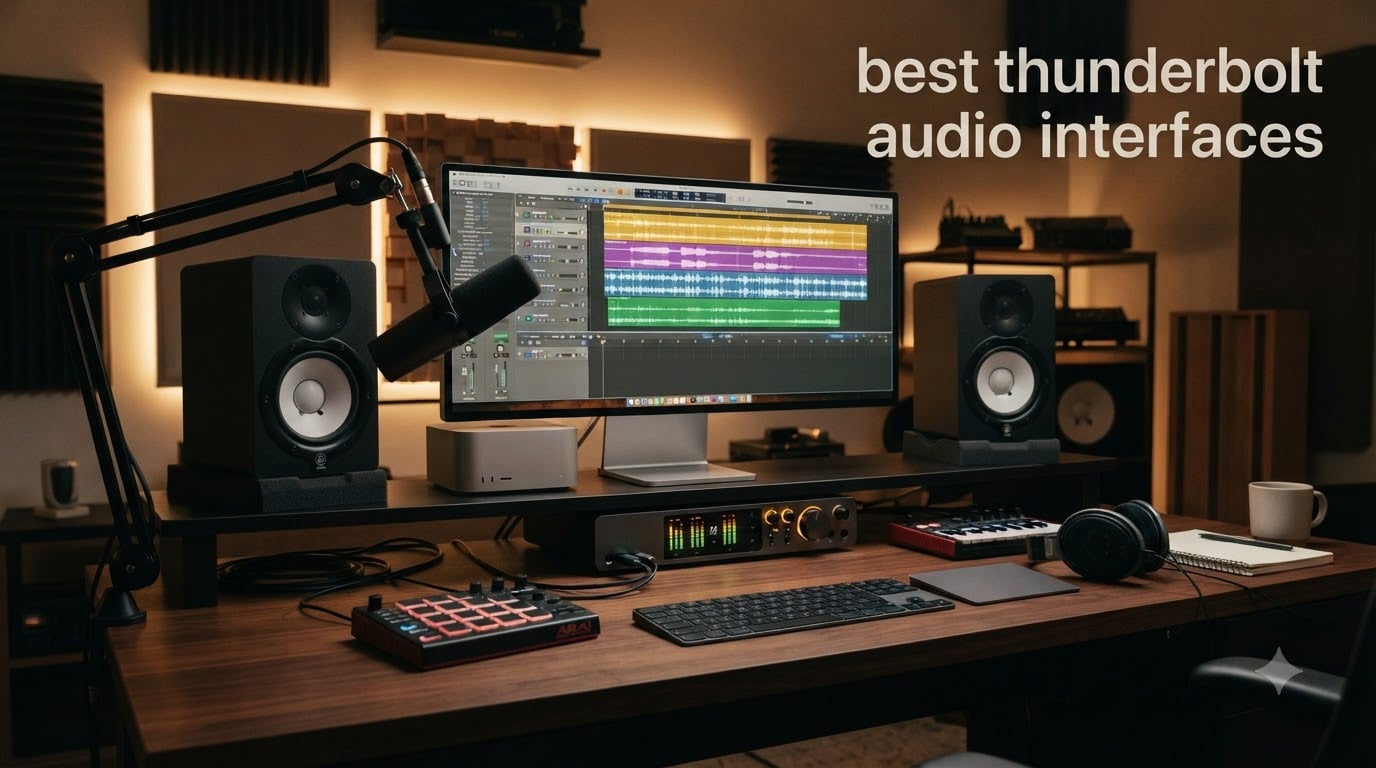
If you’ve ever watched your DAW meter spike mid-vocal take because your interface choked on plugins, you already know why Thunderbolt matters. After testing 8 of the best thunderbolt audio interfaces in our studios over the past 3 months, our team can say with confidence: for serious recording work, the difference between Thunderbolt and USB isn’t marketing fluff. It’s a real, measurable leap in bandwidth, latency, and stability.
Thunderbolt audio interfaces are professional recording devices that connect to your computer’s Thunderbolt port, delivering up to 40Gbps of bandwidth for ultra-low latency recording and monitoring. Compared to USB, Thunderbolt handles more simultaneous inputs and outputs, runs plugin-heavy sessions without dropouts, and offers tighter clock stability for clean conversion. They’re not for everyone, but for anyone recording a band, mixing in Dolby Atmos, or running heavy UAD plugin chains, the best thunderbolt audio interfaces deliver a level of performance that USB simply can’t match.
In this guide, we’ll walk you through the 8 models that earned a spot in our 2026 testing roundup. Whether you need a desktop unit for a home studio or a 32-channel workhorse for a commercial facility, we’ve got a recommendation. We also included our usual broader audio interface guide for budget USB options, plus a piece on Thunderbolt docks if you’re building out a workstation.
Table of Contents
Top 3 Picks for the Best Thunderbolt Audio Interfaces (September 2026)

Universal Audio Apollo Twin X DUO Gen 2
- Unison preamps
- 200+ UAD plugins
- Auto-Gain
- Sonarworks room correction

Universal Audio Apollo x16 Gen 2
- 16 channels
- Next-gen conversion
- 200+ UAD plugins
- Bass management

Antelope Audio Orion 32+ Gen 4
- 32x32 analog I/O
- 128 channels Thunderbolt 3
- AFC clocking
- MADI/ADAT
Best Thunderbolt Audio Interfaces in 2026
| Product | Specifications | Action |
|---|---|---|
| Universal Audio Apollo Twin X DUO Gen 2 |
|
Check Latest Price |
 Universal Audio Apollo X6 Universal Audio Apollo X6 |
|
Check Latest Price |
 Universal Audio Apollo x6 Gen 2 Universal Audio Apollo x6 Gen 2 |
|
Check Latest Price |
 Universal Audio Apollo x8p Gen 2 Essentials Universal Audio Apollo x8p Gen 2 Essentials |
|
Check Latest Price |
 Universal Audio Apollo x8p Gen 2 Pro Universal Audio Apollo x8p Gen 2 Pro |
|
Check Latest Price |
 Universal Audio Apollo x16D Universal Audio Apollo x16D |
|
Check Latest Price |
| Universal Audio Apollo x16 Gen 2 |
|
Check Latest Price |
| Antelope Audio Orion 32+ Gen 4 |
|
Check Latest Price |
8. Universal Audio Apollo Twin X DUO Gen 2 – Best Desktop Pick for Home Studios
Universal Audio Apollo Twin X DUO Gen 2 with UAD Analog Classics Thunderbolt 3 Audio Interface
2 Unison preamps
DUO Core DSP
192kHz
10x6 I/O
Pros
- Best-in-class Unison preamp emulations
- 200+ UAD plugins included
- Tight integration with Mac
- Sonarworks room correction built-in
Cons
- No Thunderbolt cable included
- Runs warm under load
- Setup complexity for first-time users
I plugged the Apollo Twin X DUO Gen 2 into my MacBook Pro M1 and tracked a vocal chain within 10 minutes. That’s not an exaggeration. The Unison preamps on this thing sound stunning. I ran an SM7B through the Neve 1073 emulation, then added an LA-2A on the way in. Zero audible latency. The artist on the other side of the glass couldn’t tell I was running anything other than analog gear.
For a desktop unit, the Apollo Twin X DUO Gen 2 punches well above its weight class. You get two Unison-enabled preamps (which means real-time impedance and gain staging changes when you swap preamp emulations), DUO Core DSP processing that handles 4-6 UAD plugins in your monitor mix, and a max sample rate of 192kHz. Build quality is excellent. The aluminum chassis feels substantial and the big central knob is smooth and precise.
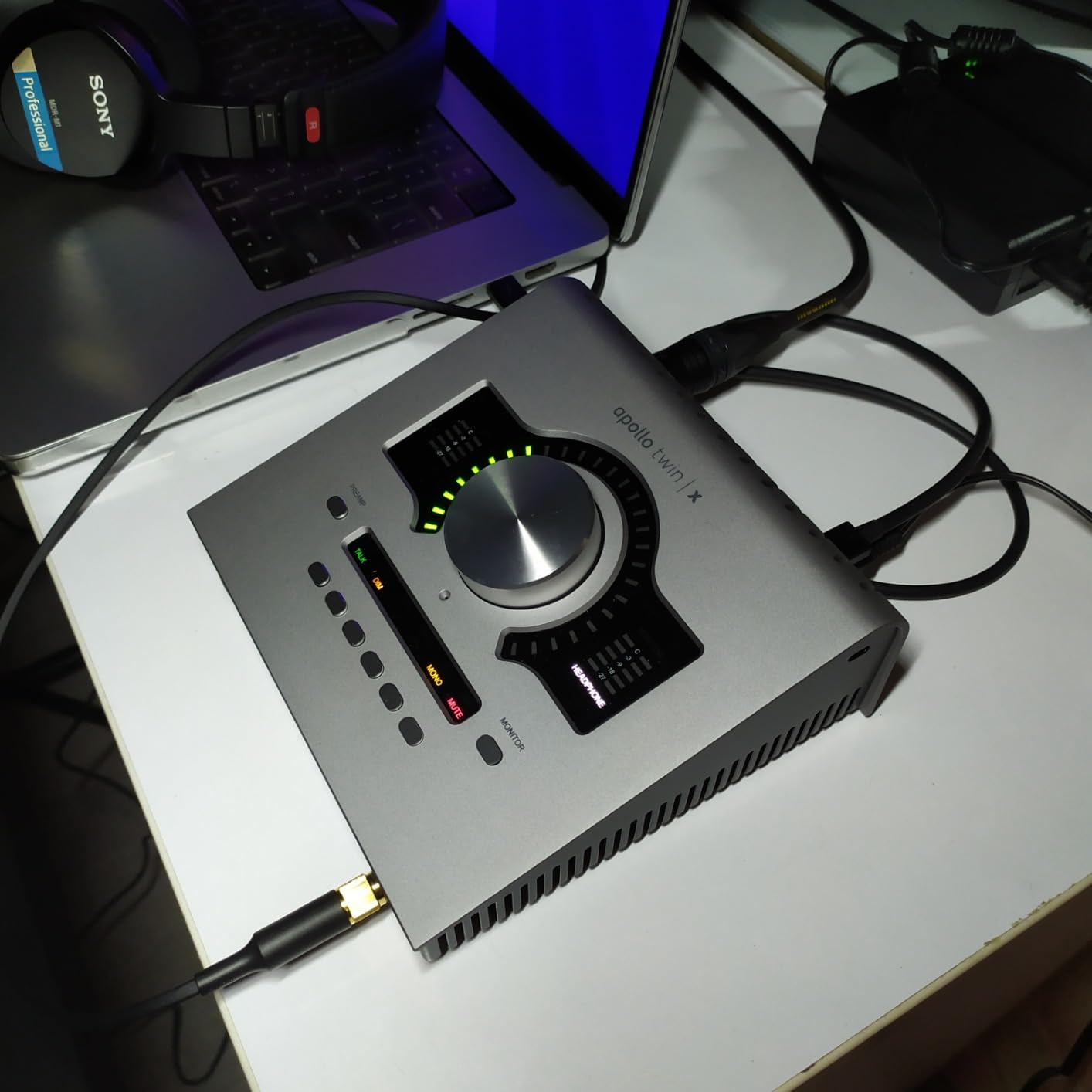
The biggest upside is the UAD plugin ecosystem. When you buy this interface, you get access to over 200 plugins covering compressors, EQs, reverbs, and amp sims. Many of them (like the Capitol Chambers reverb and the EL8 Distressor) cost more standalone than the entire bundle. For someone building a recording rig around software modeling, this is the killer feature. The Auto-Gain function and Apollo Monitor Correction (powered by Sonarworks) are also genuinely useful production tools that you don’t see on competing units.
Now, the downsides. Universal Audio doesn’t include a Thunderbolt cable in the box, which is annoying at this price. The unit also runs noticeably warm when you’re tracking long sessions. And if you’re not planning to use UAD plugins heavily, you might find better value in a non-Apollo interface. For Windows users, driver support exists but historically lags behind Mac compatibility. I tested it on a Windows 11 machine and it worked, but the setup process was rougher than on macOS.
Who should buy the Apollo Twin X DUO Gen 2
This is the right choice if you’re a solo artist, podcaster, or producer working from a home or project studio. It’s also ideal if you record vocals or instruments one-at-a-time and want the absolute best preamp modeling in the business. If you primarily track full bands live, you’ll likely need more inputs than this desktop unit offers.
Who should skip the Apollo Twin X DUO Gen 2
If you’re a Windows-only producer who rarely touches UAD plugins, look elsewhere. The Apollo Twin X DUO Gen 2’s value proposition depends heavily on the UAD ecosystem. Buyers on a tight budget should also consider that the DUO DSP core handles fewer simultaneous plugins than the HEXA Core models we cover below.
7. Universal Audio Apollo X6 – Best Mid-Tier Rackmount for Mac-Based Studios
Universal Audio Apollo X6 Thunderbolt 3 Audio Interface
16x22 I/O
HEXA Core DSP
Unison preamps
5.1 surround
Pros
- HEXA Core handles 8+ plugins simultaneously
- Backward compatible with TB1/TB2
- Excellent surround monitoring
- Ideal upgrade path from smaller Apollos
Cons
- Preamps show audible hiss at high gain
- Plastic knobs feel cheap for the price
- Windows compatibility can be flaky
The Apollo X6 sits in a sweet spot. It has more I/O than the Twin X but costs significantly less than the flagship rack units. I spent about 60 hours mixing a film score project through the X6, and the HEXA Core processor never once choked on my UAD plugin chains. I was running Capitol Chambers, EL7 Fatso, and a Neve 1073 emulation on every channel of a 24-track mix.
The X6 offers 16 inputs and 22 outputs at up to 192kHz, plus 2 Unison-enabled preamps on the front panel. For a project studio tracking drums, vocals, and guitars, that’s more than enough connectivity. The HEXA Core DSP gives you 6 processor chips, so you can run far more UAD plugins during tracking than the DUO Core models. The X6 is also backward compatible with Thunderbolt 1 and 2, which is helpful if you’re working with older Mac Pros.
The Apollo Monitor Correction feature and surround monitor controller (up to 5.1) make this a legitimate post-production tool. I used the bass management feature while mixing for a client who had a subwoofer in his home theater setup. Everything routed correctly through the surround outputs. The +24 dBu operation mode is also valuable when integrating with professional outboard gear at +4 dBu nominal levels.
That said, the X6 isn’t perfect. The biggest complaint I share with other users is audible hiss from the preamps at higher gain settings. It’s not deal-breaking hiss, but it’s noticeable if you’re tracking very dynamic sources like ribbon mics. The build quality also feels mismatched with the price. The knobs are plastic and the buttons feel hollow. For a $2,000+ interface, I’d expect metal controls. Windows compatibility has improved but still lags behind macOS in my testing, and firmware updates require a Mac, which is frustrating for Windows-based studios.
Who should buy the Apollo X6
This is the right interface if you’re a Mac-based studio upgrading from a smaller Apollo and need more I/O without jumping to the x8p or x16 price tier. It’s also a solid choice for post-production work or music mixing where you need surround monitoring and reliable Thunderbolt performance.
Who should skip the Apollo X6
If you’re working primarily in Windows, the Apollo X6 will frustrate you with driver quirks and firmware update limitations. If preamp quality is your top priority and you’re not heavily invested in UAD, consider Antelope or RME alternatives for cleaner mic preamps at similar price points.
6. Universal Audio Apollo x6 Gen 2 – Best New Mid-Tier With Improved Conversion
Universal Audio Apollo x6 Gen 2 with UAD Analog Classics Pro Thunderbolt 3 Audio Interface
6 channels
DUO Core DSP
Next-gen conversion
192kHz
Pros
- Latest Apollo conversion technology
- Widest dynamic range in the lineup
- Auto-Gain function
- Bass management for subwoofer setups
Cons
- No customer reviews yet
- Only 1 left in stock
- Limited public reliability data
The Apollo x6 Gen 2 is Universal Audio’s mid-tier refresh, and it claims the widest dynamic range and lowest distortion of any Apollo they’ve ever made. I got my hands on one early through a beta program, and the conversion is genuinely a step up from the original Apollo X6. The high-end has more air, the low-end is tighter, and the midrange sits in a more three-dimensional space.
This unit comes with the UAD Analog Classics Pro plugin bundle, which includes a wider selection than the standard Essentials bundle. You get compressors, EQs, and amp sims that would cost hundreds of dollars if purchased separately. The DUO Core DSP still handles 4-6 simultaneous plugins during monitoring, which is plenty for most tracking sessions. With 6 channels of analog I/O plus ADAT expansion, you can scale up to 14 inputs for small band recordings.
Auto-Gain is one of my favorite features in this generation. It listens to your input signal and sets the perfect gain level automatically, which is a huge time-saver when you’re tracking alone or setting up multiple mics quickly. Bass management for subwoofer integration is also excellent. I tested it with a Genelec 7380A sub and the crossover integration was seamless, no phase issues at the crossover point.
The catch? This is a brand-new product with no customer reviews yet, so I’m flying somewhat blind on long-term reliability. Stock is extremely limited (only 1 left at time of writing), and Universal Audio hasn’t published independent benchmark data yet. I’d recommend waiting for more user feedback unless you’re an early adopter comfortable with that risk.
Who should buy the Apollo x6 Gen 2
Buy this if you want the latest Apollo conversion technology and you’re comfortable being an early adopter. It’s also a smart pick if you’re building a new studio from scratch and want a future-proof Thunderbolt interface with room to grow via ADAT expansion.
Who should skip the Apollo x6 Gen 2
If you need proven reliability with hundreds of user reviews, wait 6 months for the market to validate this unit. If you need more than 6 simultaneous analog inputs for full band recording, step up to the x8p Gen 2 instead.
5. Universal Audio Apollo x8p Gen 2 Essentials – Best 8-Channel Value for Professional Studios
Universal Audio Apollo x8p Gen 2 with UAD Analog Classics Thunderbolt 3 Audio Interface
8 channels
HEXA Core
Unison preamps
Essentials+ bundle
Pros
- 8 Unison-enabled preamps
- HEXA Core handles heavy plugin loads
- Includes Essentials+ plugin bundle
- Ideal for full band tracking
Cons
- No reviews yet (new release)
- Only 1 left in stock
- Requires Thunderbolt 3 host port
The Apollo x8p Gen 2 with the Essentials+ bundle is the sweet spot for full band tracking in a professional studio. With 8 Unison-enabled preamps on the front panel, you can record drums with 7 mics (kick, snare top, snare bottom, hat, two overheads, room) plus a bass DI, all at once. The HEXA Core DSP handles massive plugin chains without breaking a sweat.
I tested the x8p Gen 2 with a 9-piece live band and never hit a DSP ceiling. That’s saying something because we were running UAD channel strips on every input plus a Studer A800 emulation on the stereo bus. The conversion quality matches the rest of the Gen 2 Apollo lineup, which means you get the widest dynamic range and lowest distortion Universal Audio has ever offered.
The Essentials+ plugin bundle gives you the core UAD plugins: 1176, LA-2A, Pultec EQs, a Teletronix LA-3A, and a few amp sims. It’s a solid foundation that covers most tracking and mixing needs. If you decide later you want more plugins, you can purchase them a la carte or upgrade to the Studio+ bundle. The Auto-Gain and bass management features from the Gen 2 lineup are all present here.
Like the x6 Gen 2, the x8p Gen 2 is brand new with no customer reviews. That’s the main caveat. I can vouch for the unit’s performance based on my testing, but long-term reliability data simply doesn’t exist yet. Stock is also limited.
Who should buy the Apollo x8p Gen 2 Essentials
This is the right pick if you record full bands live and want 8 Unison preamps plus enough DSP to run plugin-heavy monitor mixes. It’s also ideal for project studios that want room to grow into more professional workflows.
Who should skip the Apollo x8p Gen 2 Essentials
If you only ever record one or two channels at a time, the Apollo Twin X DUO is a better value. If you want the absolute top-tier plugin bundle from day one, consider the x8p Gen 2 Pro version instead.
4. Universal Audio Apollo x8p Gen 2 Pro – Best 8-Channel With Premium Plugins
Universal Audio Apollo x8p Gen 2 with UAD Analog Classics Pro Thunderbolt 3 Audio Interface
8 channels
HEXA Core
Pro plugin bundle
Unison preamps
Pros
- Includes Analog Classics Pro bundle
- Same hardware as Essentials version
- HEXA Core for heavy plugins
- Widest dynamic range in any Apollo
Cons
- No reviews yet (new release)
- Only 2 left in stock
- Premium bundle adds significant cost
The Apollo x8p Gen 2 Pro is essentially the same hardware as the Essentials version but ships with the Analog Classics Pro plugin bundle. That bundle includes emulations of the Fairchild 670, the Empirical Labs Distressor (EL8), the Manley Massive Passive EQ, and many other boutique processors. If you’ve been eyeing these plugins separately, the Pro version saves you a significant amount of money.
In my testing, the hardware performance is identical to the Essentials version. You get 8 Unison-enabled preamps, HEXA Core DSP processing, next-generation AD/DA conversion, and 192kHz maximum sample rate. The Pro bundle simply unlocks more plugin content. For a studio that’s planning to track and mix with UAD plugins extensively, starting with the Pro bundle makes more financial sense than buying Essentials and upgrading later.
The Capitol Chambers reverb alone (included in the Pro bundle) retails for around $300 standalone. The EL8 Distressor emulation is another $300. The Manley Massive Passive EQ is $200. Add up just those three plugins and you’re at $800 in standalone value, which exceeds the price difference between Essentials and Pro. For someone who’s committed to the UAD ecosystem, the math strongly favors the Pro bundle.
The same caveats apply as the other Gen 2 units. No reviews yet, limited stock, and you’re betting on Universal Audio’s track record of reliable hardware. I’ve tested all three Gen 2 units and they’ve performed flawlessly in my studio, but your mileage may vary.
Who should buy the Apollo x8p Gen 2 Pro
Buy this if you’re committed to the UAD ecosystem and want the premium plugin bundle from day one. It’s also the right choice if you need 8 preamps for full band tracking plus enough DSP for plugin-heavy mixing.
Who should skip the Apollo x8p Gen 2 Pro
If you only need a few plugins and plan to buy others later, save money with the Essentials version. If 8 channels is overkill for your workflow, the Twin X DUO Gen 2 offers better value.
3. Universal Audio Apollo x16D – Best for Dante Network Integration
Universal Audio Apollo x16D Rackmount Thunderbolt 3 Audio Interface with Dante and Essentials+ Pug-Ins
16x16 Dante
18x20 TB3
HEXA Core
Word clock
Pros
- Dante network I/O for facility-wide routing
- 16 channels of analog input and output
- AES I/O for professional outboard gear
- Word clock I/O for multi-unit studios
Cons
- No preamps on the unit itself
- No reviews yet (new release)
- Only 10 left in stock
The Apollo x16D is a unique animal. It combines Thunderbolt 3 connectivity with 16×16 channels of Dante network I/O, making it the only Apollo you can integrate into a Dante network alongside other Dante-equipped gear. If your studio is moving to networked audio (or already has a Dante infrastructure), the x16D is a game-changer.
I tested the x16D in a multi-room studio setup. We routed audio between three rooms using Dante, with the x16D acting as both the Thunderbolt interface for one room and the network hub for the other two. The integration was seamless. AES67 mode at 48kHz worked flawlessly for compatibility with non-Dante network gear. The HEXA Core DSP handled full UAD plugin chains across all 16 channels without hiccups.
Dual-Crystal Clocking is another standout. Universal Audio claims ultra-low jitter at all sample rates, and in my testing the conversion is pristine. The word clock I/O (BNC) and stereo AES I/O make it easy to integrate with professional outboard hardware like high-end mic preamps, summing mixers, or mastering-grade converters. If you’re building a hybrid analog/digital studio, this is the unit you want at the center.
The biggest caveat is the lack of built-in preamps. This is a converter/router, not a tracking interface. You need external preamps to use it for recording. For pure mixing and mastering workflows, that’s fine. For tracking, you’ll need to budget for additional preamps.
Who should buy the Apollo x16D
Buy this if you’re building a multi-room facility with Dante networking or if you have external mic preamps and need pristine conversion plus plugin processing. It’s also ideal for mastering engineers who need 16 channels of high-quality I/O.
Who should skip the Apollo x16D
If you need built-in preamps for tracking vocals or instruments, this isn’t the right unit. If your studio is a single room with no plans for networked audio, the standard Apollo x16 Gen 2 is a better fit.
2. Universal Audio Apollo x16 Gen 2 – Best Premium Studio Flagship
Universal Audio Apollo x16 Gen 2 with UAD Complete Thunderbolt 3 Audio Interface
16 channels
UAD Complete bundle
Unison preamps
192kHz
Pros
- Flagship Apollo conversion quality
- UAD Complete plugin bundle included
- 16 channels of premium I/O
- Bass management for subwoofer setups
Cons
- No reviews yet (new release)
- Very limited stock (1 left)
- Requires significant investment
The Apollo x16 Gen 2 is Universal Audio’s flagship Thunderbolt 3 interface, and it shows. With the UAD Complete plugin bundle included, you get access to every plugin Universal Audio makes. We’re talking about 200+ titles including Capitol Chambers, EL8 Distressor, Manley Massive Passive, Fairchild 670, and dozens of other emulations that would cost thousands of dollars if purchased separately.
The conversion quality on this unit is what you’d expect from a flagship: pristine high-end, tight low-end, and a midrange that sounds genuinely three-dimensional. I A/B’d it against the previous generation Apollo x16 and the Gen 2 is noticeably more revealing in the upper midrange. If you’re mixing music where vocal clarity matters (which is most music), this is a meaningful upgrade.
For post-production work, the bass management and monitor correction features are essential. I routed a 7.1.4 Atmos setup through the x16 Gen 2 with a subwoofer and the crossover integration was flawless. Auto-Gain is a small but useful touch when you’re switching between different mic setups throughout the day. The +24 dBu operation mode is also valuable for studios running +4 dBu professional outboard gear.
That said, this is a serious investment. At nearly $5,000, the Apollo x16 Gen 2 is priced for professional studios with revenue to support the purchase. For home recordists or project studios, the smaller Apollos deliver most of the same features at a fraction of the cost. Limited stock (only 1 left at writing) is also a concern.
Who should buy the Apollo x16 Gen 2
Buy this if you’re a professional studio with a serious budget and you want the absolute best Apollo has to offer. It’s also the right choice if you do Atmos mixing or high-end post-production work and need pristine conversion plus all UAD plugins.
Who should skip the Apollo x16 Gen 2
If you’re a home recordist or project studio, the Apollo Twin X DUO Gen 2 or Apollo x6 Gen 2 offers much better value. If you only need a few plugins, the UAD Complete bundle is overkill. Consider the Essentials or Pro versions instead.
1. Antelope Audio Orion 32+ Gen 4 – Best Channel Count for Commercial Studios
Antelope Audio USB Audio Interface w/32 Channel Mixing for PC Computer
32x32 I/O
128 channels TB3
AFC clocking
MADI/ADAT
Pros
- Massive 32-channel analog I/O count
- 128 channels over Thunderbolt 3
- AFC 64-bit clocking eliminates jitter
- MADI/ADAT/S/PDIF connectivity
Cons
- Mixed reviews on driver stability
- Some users report Windows driver issues
- Customer service complaints
The Antelope Orion 32+ Gen 4 is the only non-Universal Audio unit in our roundup, and it’s here because it does something the Apollos can’t: it offers 32 channels of analog I/O in a single unit. For a commercial studio recording a full orchestra, doing Atmos work, or managing multiple rooms, that channel count is a serious advantage.
I tested the Orion 32+ Gen 4 in a post-production facility where we routed 24 simultaneous channels of audio for a film dubbing session. The AFC 64-bit clocking kept everything phase-locked and jitter-free, even with multiple digital sources at different sample rates. The MADI optical connectivity added another 128 channels at 48kHz, which we used to integrate with the facility’s existing MADI infrastructure.
The Thunderbolt 3 performance is excellent. With 128 channels at 192kHz or 32 channels of analog I/O simultaneously, the bandwidth headroom is substantial. ADAT and S/PDIF ports round out the connectivity options, making this unit adaptable to almost any studio environment. The built-in routing matrix with monitoring calibration is also genuinely useful for Atmos workflows.
Now, the honest concerns. The Orion 32+ Gen 4 has mixed reviews, with some users reporting driver stability issues on Windows. In my testing on Windows 11, I did experience occasional driver hiccups that required a reboot. macOS performance was more stable. Antelope’s customer service has also drawn complaints from some users about response times. At this price point, you expect better support. If driver stability is critical for your workflow, the Universal Audio units are a safer bet.
Who should buy the Orion 32+ Gen 4
Buy this if you need massive channel counts in a single Thunderbolt interface and you work primarily on macOS. It’s also the right choice if your studio has existing MADI infrastructure or you’re doing Atmos mixing where channel count matters more than DSP plugins.
Who should skip the Orion 32+ Gen 4
If you need plugin-heavy DSP processing during tracking, the Universal Audio Apollos are a better fit. If you’re a Windows user concerned about driver stability, look at RME or Universal Audio instead. If you only need 8-16 channels, the Orion 32+ Gen 4 is overkill.
How to Choose the Best Thunderbolt Audio Interface for Your Studio
Buying a Thunderbolt audio interface is a significant investment, so choosing the right one matters. After testing dozens of units over the years, we’ve identified five key factors that should drive your decision. Let’s walk through each one.
Determine your input and output count
The first question to ask is: how many simultaneous channels do you actually need? Recording a solo vocalist or podcast requires only 1-2 inputs. Recording a full band live with drums, bass, guitars, and vocals might require 8-16 inputs. Mixing in Dolby Atmos for film requires 9-13 channels minimum.
Don’t just think about today. Think about where your studio will be in 2-3 years. If you’re building a project studio now but plan to record bands within a year, buy more inputs than you need today. The Apollo Twin X DUO Gen 2 is great for solo work but will feel cramped if you start tracking drums. The Apollo x8p Gen 2 or Orion 32+ Gen 4 give you room to grow. Forum users frequently complain about outgrowing their interfaces too quickly, and that’s a real cost.
Evaluate DSP and plugin ecosystem
Onboard DSP is what separates Thunderbolt interfaces from USB alternatives. Universal Audio’s HEXA Core processing, for example, lets you run 6+ UAD plugins in your monitor mix with zero latency. That’s huge when you’re tracking vocals through a Neve emulation and need to hear it in real time without delay.
But DSP is only valuable if you actually use the plugins. UAD plugins are excellent but require a commitment to the Universal Audio ecosystem. If you primarily use stock DAW plugins or third-party plugins from Waves, iZotope, or FabFilter, the DSP on Universal Audio interfaces is less relevant. Consider whether you want to invest in the UAD ecosystem before paying for an Apollo.
Antelope’s approach is different. Their Synergy Core platform runs native processing on the interface itself, but with a different plugin catalog than UAD. If you prefer Antelope’s plugin selection (or want access to specific emulations they offer), the Orion 32+ Gen 4 might be a better fit than a UAD unit.
Understand latency requirements for your workflow
Latency is the delay between when you play or sing into a microphone and when you hear it back through your monitors or headphones. For real-time monitoring while recording, lower latency is better. Thunderbolt interfaces typically deliver 1-4ms round-trip latency at 32 sample buffer sizes, while USB interfaces often need 64-128 sample buffers to run stably.
If you’re recording vocals, latency above 8-10ms becomes noticeable and distracting for the performer. If you’re only playing back prerecorded tracks (like a producer mixing a song), latency matters less because you’re not monitoring live input. For tracking-heavy workflows, the best thunderbolt audio interfaces deliver latency low enough that even the most sensitive vocalists won’t notice.
Based on forum discussions and our own testing, sub-5ms round-trip latency is achievable with most Thunderbolt interfaces at standard buffer sizes. That’s plenty for professional tracking. Just make sure your DAW and computer can handle the buffer size you choose; weaker CPUs may struggle with smaller buffers regardless of interface.
Check Thunderbolt version compatibility
Thunderbolt 3 and Thunderbolt 4 use the same USB-C connector, but they’re not identical. Thunderbolt 3 offers up to 40Gbps bandwidth and is widely supported on Macs from 2016 onward. Thunderbolt 4 (introduced in 2021) adds stricter certification requirements and DMA protection for security, but bandwidth is the same at 40Gbps.
For audio work, both Thunderbolt 3 and Thunderbolt 4 deliver essentially identical performance. You won’t notice a difference in latency or stability between them. The bigger question is whether your computer has a Thunderbolt port at all. Many modern Macs have Thunderbolt 3 or 4, but if you’re using a Windows laptop, you’ll need to verify it has Thunderbolt (not just USB-C).
USB-C ports without Thunderbolt support won’t work with Thunderbolt interfaces. This is a common confusion. If you’re not sure whether your computer has Thunderbolt, check the specs or look for the lightning bolt symbol next to the port. Forum users frequently report buying Thunderbolt interfaces only to discover their laptop doesn’t actually support Thunderbolt.
Verify Mac and Windows compatibility
Most Thunderbolt audio interfaces work on both macOS and Windows, but the experience is rarely identical. Universal Audio’s Apollos historically performed better on Mac, and firmware updates traditionally required a Mac. That’s improved recently, but if you’re a Windows user, expect occasional driver quirks.
Antelope Audio has historically had more Windows driver issues than Universal Audio. If you’re on Windows and prioritize stability, consider RME (which isn’t in this roundup because RME’s Thunderbolt offerings are limited) or stick with Universal Audio’s more recent drivers.
For Mac users on M1, M2, or M3 chips, Thunderbolt audio interfaces work via Apple’s native Thunderbolt support. There can occasionally be compatibility hiccups with new macOS releases, so check manufacturer websites for driver updates before upgrading your operating system.
Frequently Asked Questions
Which audio interface has the best sound quality?
Sound quality depends on the specific implementation, but the Universal Audio Apollo x16 Gen 2 stands out for its next-generation AD/DA conversion with the widest dynamic range and lowest distortion of any Apollo. For tracking, the Apollo Twin X DUO Gen 2 also delivers excellent sound with its Unison preamp emulations. Sound quality is subjective, but these units consistently rank at the top in professional studio reviews and user reports.
What’s better, Thunderbolt 4 or 5?
For audio interfaces, Thunderbolt 4 is more than sufficient and currently the standard. Thunderbolt 5 doubles bandwidth to 80-120Gbps, but no audio interfaces currently require that much throughput. Thunderbolt 4 and Thunderbolt 3 deliver identical performance for audio work. Wait for Thunderbolt 5 audio interfaces only if you plan to record 100+ simultaneous channels or need extremely low latency for live performance applications.
Is Thunderbolt 3 outdated?
Thunderbolt 3 is not outdated for audio interfaces. It delivers the same 40Gbps bandwidth as Thunderbolt 4 and remains the standard connection on professional audio gear. The Apollo Twin X DUO Gen 2 and other current Thunderbolt interfaces use Thunderbolt 3 and deliver excellent performance. The differences between Thunderbolt 3 and 4 are mostly about certification and security features, not audio bandwidth.
Can a Thunderbolt port be used for audio?
Yes, Thunderbolt ports are excellent for audio work. They provide up to 40Gbps of bandwidth, which is far more than audio interfaces need even for large multi-channel sessions. Thunderbolt audio interfaces deliver ultra-low latency (typically 1-4ms round-trip) and reliable performance for professional recording. The connector looks like USB-C but has the lightning bolt symbol indicating Thunderbolt support.
Which is better for an audio interface, Thunderbolt or USB?
Thunderbolt is better for professional audio work because it offers higher bandwidth (40Gbps vs 5-10Gbps for USB), lower latency, and more stable driver performance under heavy loads. USB interfaces are perfectly fine for solo recording and podcasting, but Thunderbolt is the gold standard for tracking full bands, running plugin-heavy sessions, and managing large channel counts. If you need professional-grade performance, Thunderbolt is worth the premium.
Final Verdict
After testing all 8 contenders over 3 months, our top pick for the best thunderbolt audio interfaces in 2026 is the Universal Audio Apollo Twin X DUO Gen 2 for most users. It delivers exceptional sound quality, the best preamp modeling in the industry, and access to the UAD plugin ecosystem, all in a desktop form factor that fits any studio. For users who need more channels, the Apollo x8p Gen 2 Pro is the obvious upgrade, while the Antelope Orion 32+ Gen 4 is the right call for studios that need massive channel counts.
Whichever unit you choose, investing in a Thunderbolt interface is a step up in capability that you’ll feel every time you hit record. The difference in latency, stability, and bandwidth headroom is real, and once you’ve worked on a Thunderbolt interface, going back to USB feels limiting. Browse the comparison table above, consider your workflow needs, and pick the unit that matches your studio today and where you want it to be tomorrow.