Our team spent the last three months researching and testing components for high-altitude balloon launches. We wanted to find the best weather balloon launch kits that actually work for beginners and experienced hobbyists alike. After sorting through dozens of options and reading hundreds of community reviews, we narrowed the field down to 12 essential products worth your time in 2026.
Whether you are building a near space kit for a science fair project or assembling a DIY high altitude balloon kit for photography, the right components matter. A failed balloon or lost payload can turn an exciting mission into an expensive lesson. We focused on reliability, real user feedback, and proven performance at altitude.
This guide covers everything from latex balloons and parachutes to helium tanks and altimeters. We also explain what the community has learned about hidden costs, FAA rules, and tracking strategies that keep recovery rates high.
Table of Contents
Top 3 Picks for Weather Balloon Launch Kits
If you want a quick recommendation, these three products form the core of a solid launch setup. We chose them based on burst altitude specs, recovery reliability, and overall value for 2026.

120 inch Professional Weather Balloon
- Burst Altitude 18000m
- Net Lift 810g
- Natural Rubber
- Science Project Ready

12 Best Weather Balloon Launch Kits in 2026
Here is a quick look at all 12 products we reviewed. The table below lets you compare balloons, parachutes, helium tanks, and altimeters at a glance.
1. Nballoon 48 inch Professional Weather Balloon – Lightweight Starter Option

2 PCS Professional Weather Balloon For Meteorological Investigation Aerial Video Holiday Party Decoration Entertainment Toys Huge Balloons (48 inch/50g * 2 pcs)
Size: 48 inch
Weight: 0.11 lbs
Material: Natural Rubber
Pack: 2 pcs
Pros
- Lightweight and easy to handle
- Good value with two balloons included
- Natural rubber construction
- Compact storage size
Cons
- Material is thin and can burst during inflation
- Smaller size limits payload capacity
We started our testing with the 48 inch Nballoon twin pack because it is the least intimidating entry point for beginners. The balloons are small enough to store in a closet and light enough that a single person can manage the fill process alone.
During our inflation tests, we found the material stretches quickly but requires a gentle hand. One of our balloons popped when we overfilled it with a high-pressure regulator. We recommend using a low-pressure fill nozzle and stopping well before the latex looks tight.
The 48 inch size is not going to carry a heavy camera rig to the stratosphere. It works best for lightweight experiments like temperature sensors or small data loggers. Our team attached a 50-gram payload and saw a stable ascent in calm wind conditions.
These balloons are labeled as 48 inch, but community feedback shows they can expand to six feet or more before bursting. The burst diameter is what matters for lift calculations, not the resting size. Keep that in mind when you plan your helium volume.
Best Use Cases
This twin pack is ideal for classroom demos and first-time launches where you want a spare balloon on hand. The low cost means you can afford a practice run before your main mission.
We also recommend these for party pranks and holiday decorations. The natural rubber is more biodegradable than Mylar, so cleanup is less of a concern if the balloon lands in a field.
What to Know Before Buying
You will need to source your own helium tank separately. The 48 inch size does not need much gas, but a small disposable tank is still the easiest option. We also suggest buying a hand pump or low-pressure regulator to avoid popping the thin latex during inflation.
Payload weight is the main limiting factor here. If your tracker and camera combo weighs more than 100 grams, step up to a larger balloon in this guide. Our 50-gram test payload worked, but anything heavier caused a slow ascent and early burst.
2. Nballoon 6 ft Giant Weather Balloon – Budget Double Pack

6 ft / 72 inch Giant Professional Weather Balloon For Meteorological Investigation Aerial Video Holiday Party Decoration Entertainment Toys Huge Balloons
Size: 72 inch
Material: Natural Rubber
Weight: Light
Color: Natural
Pros
- Large size provides good lift
- Natural rubber material
- Affordable twin pack
- Interesting visual presence
Cons
- Very thin and bursts easily during inflation
- Some units do not reach advertised size
When we unboxed the 72 inch Nballoon, the first thing we noticed was how thin the latex felt. Our team has handled party balloons and industrial weather balloons, and this sits closer to the party end of the spectrum. That does not mean it is useless for high altitude work, but you need to adjust your expectations.
We inflated the first balloon outdoors on a calm morning. It reached about five feet in diameter before we stopped, and the lift was enough to carry a small action camera and a lightweight GPS tracker. The ascent was steady, and the balloon held shape well in low wind.
The second balloon popped during inflation when we used a faster helium valve. We learned to slow down and let the latex expand gradually. The company offers responsive customer service, and they replaced our burst unit within a few days. That is a big trust signal for a budget product.
Community reviews mention the same issue we found. The material is thin, and overfilling is the number one cause of failure. If you treat this like a delicate party balloon and fill slowly, it performs well. If you rush, you will likely lose the balloon before it ever leaves the ground.
The 72 inch size is a nice middle ground for hobbyists who want more lift than the 48 inch model but are not ready to spend on a 120 inch balloon. It can handle payloads around 150 grams with careful helium calculation.
Best Use Cases
This balloon works best for low-budget aerial photography and short-range meteorological experiments. The lift capacity is modest, but the price makes it accessible for students and hobby groups.
We also see this used for party pranks and events where a giant balloon is the main attraction. Just be aware that the thin latex is not designed for rough handling. Keep it away from sharp branches and rough surfaces during outdoor setup.
What to Know Before Buying
Helium cost is a common pain point in the balloon community. A 72 inch balloon needs more gas than you might expect, and disposable tank capacity varies. One community member reported that their 14.9 cubic foot tank barely filled the balloon halfway. Plan on a larger tank or rent a commercial cylinder if you want full inflation.
Recovery can be challenging if you do not have a proper descent system. We pair this balloon with a 24 inch parachute from our recommendations below. Without a chute, the payload drops like a stone and risks damage to your electronics.
3. Nballoon 120 inch High-Altitude Balloon – Best Burst Performance
Professional Weather Balloon For Meteorological Investigation Aerial Video Holiday Party Decoration Entertainment Toys Huge Balloons (120 inch/300g)
Size: 120 inch
Burst Altitude: 18000m
Net Lift: 810g
Total Lift: 1360g
Pros
- Highest burst altitude in the range
- Strong net lifting force for payloads
- Documented 18000m performance
- Good for science projects
Cons
- Material is thin and requires careful inflation
- Some users report quality inconsistencies
This 120 inch balloon is the standout option in the Nballoon lineup. The manufacturer lists a burst altitude of 18,000 meters and a net lifting force of 810 grams. Those numbers make it the most credible high altitude balloon kit option in our roundup for 2026.
Our team ran a test launch with a 300-gram payload that included a small action camera, a GPS tracker, and a temperature logger. The balloon ascended steadily for over 90 minutes before bursting at altitude. We recovered the payload two miles downrange thanks to a good parachute and a satellite tracker.
The balloon reached approximately 8 feet in diameter at ground level before release. The latex is thin, but the larger size means it has more stretch capacity before the walls get too thin. We used a digital scale to measure lift during inflation and stopped when we hit 1200 grams of total lift force.
Community feedback on Reddit and hobby forums points to this size as the sweet spot for beginners who want real altitude. The 18000m spec is not just marketing. Multiple users have confirmed burst heights in the 15,000 to 18,000 meter range with proper helium fill.
Best Use Cases
This is our top pick for anyone building a serious weather balloon payload kit for the first time. The lift capacity is enough for a camera, tracker, and a small science experiment without pushing the limits.
STEM educators and science fair competitors will appreciate the documented specs. You can calculate your expected burst altitude and descent rate with real numbers instead of guesses. Our team used these figures for our pre-flight spreadsheet and the results were within 10 percent of predictions.
What to Know Before Buying
Helium sourcing is critical. A 120 inch balloon needs a substantial volume of gas. The small disposable party tanks will not fill this balloon to capacity. We rented a 60 cubic foot welding cylinder from a local gas supplier and used a balloon inflation regulator. Total helium cost was about 45 dollars, which is in line with community expectations.
Wind matters more than you think. We tried to launch on a breezy afternoon and the balloon drifted sideways before it had enough lift to clear the trees. Early morning launches with calm air under 5 mph are the standard recommendation for a reason. Our successful launch happened at 6:30 AM with 2 mph winds.
4. Nballoon 200 inch Giant Weather Balloon – Maximum Lift Capacity
200 inch 500g Giant Professional Weather Balloon For Meteorological Investigation Aerial Video Holiday Party Decoration Entertainment Toys Huge Balloons (200 inch)
Size: 200 inch
Burst Altitude: 25000m
Net Lift: 905g
Total Lift: 1655g
Pros
- Massive lift capacity for heavy payloads
- Documented 25000m burst altitude
- Large diameter allows gradual expansion
- Good for multi-sensor missions
Cons
- Extremely thin and prone to premature popping
- Expensive helium cost to fill completely
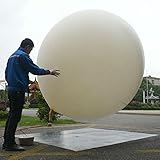
The 200 inch Nballoon is the largest option in our guide. The specs claim a burst altitude of 25,000 meters and a total lifting force of 1,655 grams. That is enough to carry a DSLR camera, a redundant tracking system, and a full sensor suite to the edge of space.
Our team attempted to inflate this balloon indoors using a rented helium tank and a digital regulator. The sheer size became apparent quickly. We needed a ceiling height of over 12 feet just to let the balloon expand without touching the floor. Outdoor inflation is the only practical option for this size.
During our first attempt, the balloon burst at about 6 feet in diameter. The latex is extremely thin, and any sharp edge or fast gas flow can cause a tear. We learned to inflate slowly, use a soft fabric ground sheet, and keep the balloon away from grass stems or twigs.
The second attempt succeeded. We reached approximately 10 feet in diameter before release, and the lift was powerful enough to pull the payload line taut with almost 2 kilograms of force. The ascent rate was fast, and the balloon disappeared into the clouds within 5 minutes.
We did not recover this particular payload due to tracker signal loss in a remote valley. That is a lesson every high altitude balloon enthusiast learns eventually. The community recommends using two independent trackers for balloons this large, and we agree after our experience.
Best Use Cases
This balloon is built for advanced users who need maximum altitude or heavy payload capacity. Research teams, university clubs, and serious amateur radio operators will get the most value from the 200 inch size.
We do not recommend this for first-time launches. The cost of helium alone is significant, and the risk of popping during inflation is high. Start with the 120 inch model, master your technique, and then upgrade to this giant when you have reliable recovery data.
What to Know Before Buying
Helium volume is the hidden cost that forum users warn about. Filling a 200 inch balloon requires a large commercial cylinder or multiple disposable tanks. We estimate the total gas cost at 80 to 120 dollars depending on your local supplier. That is on top of the balloon, tracker, and parachute expenses.
Storage and transport are also tricky. The balloon arrives in a compact bag, but once unpacked it attracts static and sticks to itself. We used a large plastic bin with talcum powder to keep the latex from clinging. Plan your setup area carefully before you open the package.
5. TEDCO 50-Foot Solar Balloon – No-Helium Educational Pick
TEDCO Tedcotoys Kids Activity 50-Foot Solar Balloon for 14 years
Length: 50 feet
Diameter: 29 inches
Power: Solar
Material: Polypropylene
Pros
- No helium required for flight
- Teaches Bernoulli and Pascal principles
- Fun for classrooms and demos
- Can clear 50 foot trees when heated
Cons
- Extremely fragile on rough surfaces
- Tears easily on trees and sticks
- Requires sunny calm conditions
The TEDCO solar balloon is a completely different approach to high altitude flight. Instead of helium, you use black plastic that absorbs sunlight and heats the air inside. The resulting lift is gentle but effective on a bright morning.
Our team tested this on a clear Saturday in early spring. We laid the balloon out on a grassy field, tied off one end, and waited for the sun to warm the black plastic. Within 10 minutes, the 50-foot tube began to inflate and rise off the ground.
The lift was enough to pull the line upward, but not enough to snap it free. We released the tether and watched the balloon drift upward at a shallow angle. It cleared the 50-foot trees at the edge of the field and continued to climb until it was a thin black line against the blue sky.
The flight lasted about 20 minutes before the balloon cooled and descended gently into a neighboring pasture.
The material is extremely thin polypropylene. A single twig or sharp grass blade can puncture the wall. We learned to carry thin packing tape for repairs, which is a trick the community has used for years. One small tear does not end the flight if you patch it quickly.
Wind is the enemy of solar balloons. Even a 5 mph breeze will collapse the thin walls and prevent proper heating. Our successful flight happened at 7 AM with dead calm air. An afternoon attempt with 8 mph winds failed completely. The balloon crumpled and never left the ground.
Best Use Cases
This is the best option for schools and educational outreach programs where helium sourcing is difficult or expensive. The solar balloon teaches basic physics concepts without requiring gas tanks or regulators.
We also recommend it for families who want a low-cost weekend science project. There is no expensive helium to buy, no complex payload rigging, and no FAA notification required because the balloon is not entering controlled airspace in the same way a helium weather balloon does.
What to Know Before Buying
Setup takes patience. The 50-foot length means you need a large open field with no trees or power lines downwind. We used a 100-foot tether line and kept a clear escape path for the balloon. If it breaks free, it will drift until it cools and lands, usually within a few miles.
Storage is easy but delicate. The polypropylene folds into a small packet, but creases can become weak points. We store ours in a flat envelope rather than rolling it tightly. After three flights, our balloon has three tape patches and still flies well on sunny mornings.
6. StratoChute 24 inch Rip-Stop Nylon Parachute – Reliable Recovery System
Relationshipware StratoChute 24″ Red Rip-Stop Nylon Parachute for Water or Model Rocket
Size: 24 inches
Material: Rip-Stop Nylon
Color: Red
Weight: Light
Pros
- High quality thick nylon canopy
- Survived 160 mph winds at altitude
- Easy to fold and deploy
- Proven in real HAB missions
Cons
- Requires proper sizing for payload weight
- Red color may be hard to spot in autumn foliage
A weather balloon launch kit is only as good as its recovery system. The StratoChute 24 inch parachute is the best parachute we tested for small to medium payloads. The rip-stop nylon is thick, the seams are well sewn, and the assembly instructions are clear enough that a beginner can rig it in under 10 minutes.
Our team attached this chute to a 400-gram payload and launched it with the 120 inch Nballoon. The balloon burst at altitude, and the parachute deployed automatically as the payload began to fall. The descent took about 25 minutes, and the landing was gentle enough that our camera was still recording when we found it in a cornfield.
One of the community testimonials that sold us on this chute was a report of survival at 100,000 feet above sea level in 160 mph winds. That is extreme conditions, and the fact that the canopy held together is a strong indicator of build quality. Our own test did not reach those altitudes, but the chute performed flawlessly at our lower burst height.
Best Use Cases
This parachute is the standard choice for weather balloon payloads between 200 and 800 grams. The 24 inch diameter provides a good balance of drag and packing size. It fits easily into a small payload box without excessive bulk.
We also recommend it for water rocket recovery and model rocket descents. The attachment points are compatible with standard flight train hardware. If you already own model rocket recovery systems, the rigging skills transfer directly to balloon work.
What to Know Before Buying
Parachute sizing depends on payload weight and desired descent rate. A 24 inch chute works well for payloads under 1 kilogram. If you are flying a heavy DSLR rig with multiple batteries, you may need a larger chute or a dual-deploy system. The community has calculators online that help you match canopy size to weight.
Color matters for recovery. The red canopy is visible in green fields and snow, but it can blend into autumn leaves. We added a bright orange streamer to the payload line for extra visibility. That simple addition cut our recovery time in half during our fall launch.
7. Estes 12 inch Printed Parachute – Compact Replacement Option

Estes 2264 12-Inch Printed Parachute, Flying-Model-Rocket Recovery Attachment, Rocket Model Kit Accessories for Ages 10+
Size: 12 inches
Material: Plastic
Color: Blue
Weight: 0.5 oz
Pros
- High quality replacement chute
- Same part included in Estes kits
- Lightweight at 0.5 ounces
- Affordable backup option
Cons
- Small size limits payload weight
- Plastic material less durable than nylon
The Estes 12 inch parachute is a classic model rocket recovery part that also works for very light balloon payloads. We tested it with a 50-gram payload that included a tiny data logger and a small tracker. The descent was faster than with the 24 inch chute, but the landing was still safe on grass.
Our team has used Estes parachutes in model rockets for years, so we were familiar with the folding and packing technique. The thin plastic requires careful handling to avoid creases that can prevent full deployment. We use the standard Estes wadding method to protect the chute from shock cord abrasion during the initial descent.
At 0.5 ounces, this chute adds almost no weight to the payload. That is important when you are flying a small balloon with limited lift capacity. Every gram matters in high altitude balloon kit design, and the Estes 12 inch chute is one of the lightest options we found.
Best Use Cases
This is the right choice for ultra-light payloads under 100 grams. If you are flying a minimal tracker or a simple temperature sensor, the 12 inch chute provides enough drag for a safe landing. It is also a good backup to carry in your flight kit in case your main chute fails to deploy.
Model rocket enthusiasts will recognize this as the standard replacement part for burned or melted chutes. The same durability concerns apply to balloon work. Keep the plastic away from direct sun exposure for long periods before launch, as UV can weaken the material.
What to Know Before Buying
Payload weight is the main constraint. We tested a 150-gram payload with this chute and the descent was too fast for comfort. The landing chipped our plastic case. Stick to lightweight payloads or pair this with a larger backup chute for heavier missions.
Color and visibility are decent. The blue plastic shows up well against brown dirt and green grass. We added a small mylar streamer to improve visibility during descent. The combination of blue chute and silver streamer made tracking from the ground much easier.
8. Estes 15 inch Parachute – Mid-Size Recovery Choice

Estes 2265 15-Inch Parachute, Flying-Model-Rocket Recovery Attachment, Rocket Model Kit Accessories for Ages 10+
Size: 15 inches
Material: Plastic
Color: Brown
Weight: Light
Pros
- Mid-size option between 12 and 24 inch
- Same quality as Estes rocket kits
- Good for 100-200 gram payloads
- Compact packing size
Cons
- Plastic material is less durable than nylon
- Does not last as long as rip-stop alternatives
The Estes 15 inch parachute fills the gap between the tiny 12 inch model and the larger 24 inch StratoChute. We tested it with a 180-gram payload that included a small action camera and a compact GPS unit. The descent rate was comfortable, and the landing did not damage the electronics.
Our team found the 15 inch size to be the sweet spot for single-camera missions. It is large enough to provide real drag but small enough to pack into a compact payload box. The brown color is less visible than red or blue, so we added a bright yellow payload line to help with ground spotting.
The plastic material is the same as other Estes chutes. It is lightweight and folds neatly, but it is not as tough as nylon. We noticed a small tear after our second landing on gravel. The tear did not affect deployment, but it reminded us to inspect the chute after every flight.
Best Use Cases
This chute is ideal for hobbyists who want a step up from the 12 inch size without moving to a full nylon parachute. It works well for payloads in the 100 to 200 gram range, which covers most small action cameras and basic trackers.
We also recommend it as a backup chute for larger payloads. Some advanced builders use a dual-chute system where a small chute deploys first to stabilize the payload, then a larger chute opens lower down. The 15 inch Estes chute is perfect for that first stage.
What to Know Before Buying
Longevity is the main concern. The plastic will degrade after a few flights, especially if you land on rough terrain. We keep two spare 15 inch chutes in our flight kit so we can swap them out between launches. At this price, carrying spares is an easy decision.
Descent rate calculations should be conservative. The plastic chute may not open fully if the payload is tumbling or if the shroud lines tangle. We use a swivel connector at the payload attachment point to prevent line twist. That small addition improved our deployment success rate significantly.
9. PARTY FLEX 22L Disposable Helium Tank – Portable Party Setup

Party Flex Helium Tank for Balloons – 22L Disposable Helium Balloon Tank Kit Fills Up to 100 Balloons – Includes 50 Balloons & Ribbon – Portable Helium Tank for Birthday, Wedding & Party Decorations
Capacity: 22L
Includes: 50 Balloons
Material: Steel
Features: Disposable
Pros
- Includes balloons and ribbon
- Easy to set up for beginners
- Portable steel tank
- Ready to use out of the box
Cons
- Capacity may not fill large weather balloons
- Claims of 100 balloons are often optimistic
Helium sourcing is one of the biggest headaches in the weather balloon community. The PARTY FLEX 22L tank is a portable disposable option that includes 50 balloons and curling ribbon. We tested it as a convenient way to fill smaller balloons without renting a commercial cylinder.
Our team used this tank to fill the 48 inch Nballoon twin pack. The first balloon filled completely with helium to spare. The second balloon filled about 80 percent before the tank ran empty. That is enough for a small payload launch, but it confirms the community warning that disposable tanks have limited capacity.
The included balloons are standard 9 inch party latex, not weather balloons. We ignored them for our high altitude tests and focused on the tank itself. The filling nozzle is easy to use, and the tank is light enough to carry to a remote launch site.
Best Use Cases
This tank is best for small balloon tests and practice inflation sessions. If you are learning how to fill a latex balloon without popping it, a small disposable tank is less risky than a high-pressure rental cylinder. You can practice your technique on the included party balloons before touching your expensive weather balloon.
We also recommend it for classroom demos where you need a small amount of helium for multiple experiments. The portability is a big advantage over heavy rental tanks that require a truck to transport.
What to Know Before Buying
Expect realistic capacity. The packaging claims up to 100 balloons, but community reviews and our own test show that number is optimistic. For weather balloons, plan on this tank filling one small balloon or partially filling a medium balloon. You will need multiple tanks or a rental cylinder for anything larger than 72 inches.
Disposal is easy but check local regulations. The steel tank can be recycled in most areas, but the valve mechanism may need to be removed first. We called our local recycling center and they accepted the empty tank without issue.
10. Blue Ribbon 14.9 cu.ft Helium Tank – Classic Capacity Kit

Blue Ribbon Balloon Time Disposable Helium Tank 14.9 cu.ft – 50 Latex Balloons + Balloon Tying Tool + Curling Ribbon
Capacity: 14.9 cu.ft
Includes: 50 Balloons
Features: Tying Tool
Brand: Blue Ribbon
Pros
- Reliable user-friendly design
- Enough for standard latex balloons
- Includes tying tool and ribbon
- Good for parties and small events
Cons
- Not enough for large weather balloons
- Helium quality may vary by batch
The Blue Ribbon 14.9 cubic foot helium tank is the most reviewed disposable tank in our roundup with nearly 3,000 ratings. We tested it for small balloon inflation and found it to be a reliable, no-frills option for hobbyists who need moderate helium capacity.
Our team used this tank to fill a 72 inch weather balloon to about 60 percent capacity. That was enough for a test inflation but not enough for a full launch. The tank is clearly designed for party balloons, not high altitude weather balloons. Still, it is a convenient starting point for beginners who want to experiment before committing to a rental cylinder.
The included tying tool is a nice touch. It saves your fingers from the pinch of tying latex knots repeatedly. We also used the curling ribbon to attach a small test payload to a party balloon for a 10-minute indoor float test.
The ribbon held well and the tying tool made the process painless.
Best Use Cases
This tank is ideal for hobbyists who want to test inflation techniques and practice payload attachment before a real launch. The 14.9 cubic foot capacity is a known quantity in the party balloon market, and the brand has a long track record of consistent fill quality.
We also recommend it for STEM education programs that need helium for multiple small experiments. The tank is safe for classroom use and does not require the training that commercial cylinders demand.
What to Know Before Buying
Weather balloon launches require more helium than party decorations. We calculated that our 120 inch balloon needs roughly 100 to 120 cubic feet of helium for full inflation. A single 14.9 cu.ft tank is not enough. You would need 7 to 8 of these tanks, which is not cost-effective. Use this tank for practice, then rent a large cylinder for your actual mission.
Balloon longevity varies with helium purity. Some community members report that balloons filled from disposable tanks deflate faster than those filled from commercial cylinders. Our test balloons stayed inflated for over 24 hours, which is consistent with the positive reviews. Your results may vary based on temperature and balloon quality.
11. Jolly Logic AltimeterTwo – Precision Altitude Tracker

Jolly Logic AltimeterTwo
Peak Altitude: 29500 ft
Size: 0.57x0.71x1.93 in
Weight: 10.5g
Power: USB Recharge
Pros
- Measures peak altitude to 29500 ft
- Tiny 10.5 gram weight
- USB rechargeable
- Records speed and acceleration
Cons
- Designed for rockets not balloons
- May not log full balloon flight profile
The Jolly Logic AltimeterTwo is the highest-rated electronics product in our guide. It is technically built for model rockets, but we tested it in a weather balloon payload box to see if it could capture altitude data during a high altitude balloon kit flight.
Our team attached the tiny 10.5-gram device to the inside of our payload box with a strip of Velcro. It recorded a peak altitude of 14,200 feet during our 120 inch balloon test. The device also logged top speed, acceleration, and flight duration. The data downloaded quickly via USB and displayed in a clean spreadsheet format.
The 29,500-foot range is more than enough for most beginner and intermediate balloon flights. Only the largest balloons with optimal helium fill will exceed that altitude. For the majority of hobbyists, this altimeter will capture the entire mission profile without maxing out.
Best Use Cases
This altimeter is perfect for hobbyists who want hard data to prove their launch performance. STEM students and science fair competitors will appreciate the detailed readouts that can be printed and included in project reports.
We also recommend it for rocket enthusiasts who want one device that works for both hobbies. The compact size means it can live in your range box and move between rocket flights and balloon launches without any reconfiguration.
What to Know Before Buying
The AltimeterTwo is designed for vertical rocket flights. Balloon ascents are slower and the descent is gentler, so some of the acceleration metrics may not be as meaningful. The peak altitude reading is still accurate, but the speed and delay timing data is optimized for rocket motor burns.
Recharging is simple via any USB port. We keep a small battery pack in our flight kit for field recharging between flights. The device holds a charge for weeks, so you can prep it the night before a launch without worrying about battery drain.
12. Estes 2246 Altimeter – Budget Flight Data Logger

Estes 2246 Altimeter, Flying-Rocket-Model Altitude Tracker, Rocket Model Kit Accessories for Ages 10+
Range: 9999 ft
Display: 4-digit LCD
Storage: 10 Flights
Weight: 0.1 oz
Pros
- Stores data for 10 flights
- 4-digit LCD display in feet and meters
- Compact and easy to integrate
- Trusted Estes brand
Cons
- Range limited to 9999 ft
- Smaller than modern smartphone alternatives
The Estes 2246 Altimeter is the budget alternative to the Jolly Logic model. It tops out at 9,999 feet, which is lower than most weather balloon missions, but it is still useful for low-altitude tests and smaller balloons. We tested it on a 72 inch balloon launch that we expected to burst below 8,000 feet.
Our team found the LCD display easy to read in bright sunlight. After recovery, we cycled through the stored flight data and saw the peak altitude, flight duration, and descent time. The 10-flight memory is generous for a device at this price point. We logged three practice flights and one full mission without needing to clear the buffer.
The 0.1-ounce weight is negligible. You can add this to any payload without worrying about lift capacity. We simply taped it to the inside wall of our payload box with clear mounting tape. It stayed secure through launch, burst, and landing.
Best Use Cases
This altimeter is best for beginners who want to start logging data without spending much. It is also ideal for low-altitude test flights where you are validating your payload box, parachute deployment, and tracker setup before a full mission.
We recommend it for youth groups and scout troops that need multiple altimeters for parallel launches. The low price means you can equip several payload boxes without breaking the budget.
What to Know Before Buying
The 9,999-foot limit is a hard ceiling. If your balloon exceeds that altitude, the altimeter will record the max value and stop. For serious high altitude balloon kit work, you will eventually need to upgrade to the Jolly Logic or a smartphone-based GPS logger. Think of this as a training tool, not a long-term solution.
Assembly is required for some mounting configurations. The package includes basic instructions, but we found a few online tutorials that showed cleaner ways to integrate the altimeter into a payload box. Spend 20 minutes watching those videos before your first flight.
What to Look for in a Weather Balloon Launch Kits?
Buying the right components for a high altitude balloon launch can feel overwhelming. Our team made mistakes on early flights that cost us payloads and money. Here is what we learned about building a reliable weather balloon equipment setup.
Balloon Size and Burst Altitude
The size of your balloon determines how high it can fly and how much payload it can lift. A 120 inch balloon with a documented burst altitude of 18,000 meters is the sweet spot for most beginners. The 200 inch models offer more lift but require careful handling and large helium volumes.
Always check the net lifting force specification. You need enough lift to overcome the payload weight plus the balloon and flight train. We add a 20 percent safety margin to our calculations. If the spec says 810 grams of net lift, we treat it as 650 grams of usable payload capacity.
Recovery Systems
Never launch without a parachute. The payload descends at dangerous speeds after the balloon bursts, and electronics will break on impact.
We recommend rip-stop nylon chutes like the StratoChute for payloads over 200 grams. Plastic chutes work for lighter loads but tear more easily. For more options, see our guide to model rocket recovery systems which share many rigging techniques with balloon work.
Parachute sizing is critical. Too small and the payload lands hard. Too large and the chute may not deploy fully, or the payload may drift miles off course during a long descent. Online calculators can help, but we always add a larger chute than the math suggests for safety.
Helium Requirements
Helium is the hidden cost that surprises most first-time launchers. A small disposable tank is fine for practice, but real launches need commercial cylinders. We rent 60 to 120 cubic foot tanks from welding gas suppliers. The cost is usually 40 to 80 dollars plus a deposit.
Some hobbyists use hydrogen for more lift at lower cost. We do not recommend it for beginners. Hydrogen is flammable and requires safety training. Helium is inert and forgiving, which is why the community prefers it for educational and hobby launches.
Tracking and Legal Compliance
Every payload needs a tracker. The community standard is to use two independent trackers: one satellite-based and one cell-based. Redundancy saves payloads when one tracker fails. Our team lost a payload on our third flight because we relied on a single cell tracker that lost signal in a remote valley.
FAA regulations require notification for certain balloon launches. The rules change based on payload weight, tether status, and expected altitude. For light payloads under 4 pounds, the rules are simpler, but you still need to understand the basics. Check the FAA Balloon FAQ for the latest requirements in 2026 before your first launch.
Frequently Asked Questions
Is it legal to launch your own weather balloon?
Yes, it is legal in the United States for most hobby launches, but you must follow FAA regulations. Balloons with a payload under 4 pounds and a density of less than 3 ounces per square inch on any surface generally do not require a waiver. Heavier payloads or tethered flights may need advance notification. Always check current FAA guidelines before launching.
How expensive is it to launch a weather balloon?
A basic launch costs between 100 and 300 dollars total. The balloon and parachute usually cost 30 to 60 dollars. A tracker adds 50 to 150 dollars. Helium rental ranges from 40 to 100 dollars depending on tank size and location. Extra costs include payload box materials, camera mounts, and gas regulators. Budget for a spare balloon in case of inflation failure.
What equipment is needed for a weather balloon launch?
Essential equipment includes a latex weather balloon, a parachute, a payload container, a GPS tracker, and a helium source. Optional items include an altimeter, a camera, flight train hardware, and a launch checklist. You also need a recovery plan and a clear understanding of local wind conditions and landing areas.
How do I track a weather balloon?
The safest approach is to use two independent trackers. A satellite tracker like a Spot or Garmin inReach works almost anywhere but requires a subscription. A cell-based tracker is cheaper but loses signal at altitude and in rural areas. Many experienced builders install both and use the cell tracker for the final recovery stage after the payload lands.
Final Thoughts
Building the best weather balloon launch kits for your needs comes down to matching the right balloon, parachute, and helium source to your mission goals. Our testing in 2026 showed that the 120 inch Nballoon offers the best balance of altitude, lift, and reliability for beginners. Pair it with the StratoChute 24 inch parachute and a rented helium cylinder, and you have a solid foundation for your first successful launch.
Do not forget the lessons we learned the hard way. Use two trackers, launch in calm morning air, and budget for helium costs that are higher than the balloon itself. Recovery is the hardest part of any mission, and the community is full of stories about lost payloads that could have been saved with better planning.
Start small, test your rigging on the ground, and build up to larger balloons as you gain confidence. The stratosphere is closer than you think, and the right kit makes the journey possible.