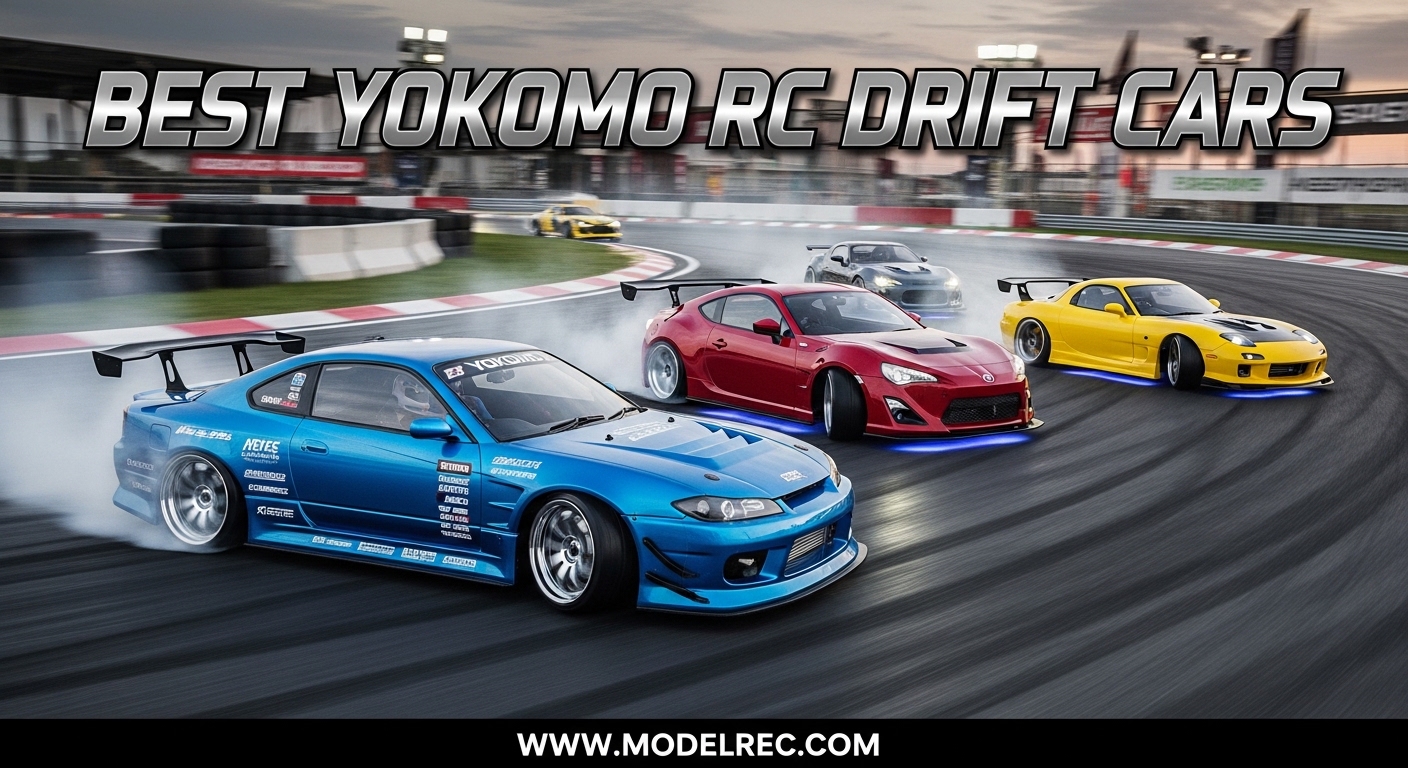
I’ve been drifting RC cars for three years, and Yokomo remains the name I hear most at the track.
Their chassis range from affordable entry kits to full competition builds, so finding the best Yokomo RC drift cars for your skill level takes more than picking the newest model. In 2026, the lineup has shifted toward the RD2.0 for beginners and the MD series for serious competitors.
Our team compared every current Yokomo drift platform available in the US. We looked at assembly complexity, upgrade paths, and what real owners say on forums like rcdrift and rctech.
Whether you want a starter kit or a flagship competition chassis, this guide breaks down each option without the fluff.
I also learned the hard way that the chassis price is only part of the story. Electronics, tires, and body shells add up fast.
One member of our local club spent heavily on a chassis and then another pile of cash on the rest before he ever hit the pavement. I’ll show you exactly what to expect so you can budget wisely.
Yokomo’s heritage in RC racing stretches back over two decades, and that pedigree shows in the tuning depth of even their budget models. The RD2.0 shares suspension geometry with their older D1 competition machines, while the MD2.0 and MD1.0 series carry carbon fiber and aluminum components that were once reserved for factory team drivers.
The forum consensus is clear: skip the toy-grade alternatives and start with a proper 1:10 RWD platform. I watched a friend try to drift a Tamiya TT-02D last year, and it was a frustrating experience.
The community almost universally recommends a Yokomo RD2.0 or something comparable from MST for anyone serious about learning. The difference in steering angle and gyro support makes every practice session more productive.
Table of Contents
Top 3 Picks for Yokomo RC Drift Cars
If you want the fastest path to a good decision, here are the three Yokomo drift options our team recommends most often. The RD2.0 Assembly Kit gives you the best foundation for learning without paying for electronics you might already own.
The RDR020G adds a steering gyro to the same chassis, which saves you a separate purchase. The MD 2.0 Master Drift sits at the top for anyone ready to compete at club level.

Rookie Drift RD2.0 Assembly Kit
- 1:10 Scale RWD chassis
- Beginner-friendly alignment
- Metal and plastic build
- Upgrade parts available
RDR020G RD2.0 Rookie Drift Kit with Gyro
- Includes YG-302V2 steering gyro
- Adjustable components
- 1:10 RWD drift platform
- Great starter value

MD 2.0 Master Drift Kit
- Carbon fiber and aluminum build
- Adjustable Ackermann ratio
- Floating battery holder
- Competition-grade platform
10 Best Yokomo RC Drift Cars in 2026
Below is a quick look at all ten Yokomo drift options we reviewed this month. The table covers everything from bare chassis kits to complete body packages.
I sorted them by price tier so you can see how each model fits your budget. Every entry includes the key specs that matter most for drifting performance.
| Product | Specifications | Action |
|---|---|---|
| Rookie Drift RD2.0 Assembly Kit |
|
Check Latest Price |
| RDR020G RD2.0 Rookie Drift Kit |
|
Check Latest Price |
 MERCURY Sayaka Special S15 Kit MERCURY Sayaka Special S15 Kit |
|
Check Latest Price |
 DP-GR86 PANDEM Kit DP-GR86 PANDEM Kit |
|
Check Latest Price |
 DP-GRA90 PANDEM GR Supra Kit DP-GRA90 PANDEM GR Supra Kit |
|
Check Latest Price |
| MD 2.0 Master Drift Kit |
|
Check Latest Price |
 MDR-010LTS Master Drift LTS MDR-010LTS Master Drift LTS |
|
Check Latest Price |
 MDR-010 Master Drift Chassis MDR-010 Master Drift Chassis |
|
Check Latest Price |
 Bn Sports Toyota JZX100 Body Bn Sports Toyota JZX100 Body |
|
Check Latest Price |
 PANDEM GR Supra Drift Body PANDEM GR Supra Drift Body |
|
Check Latest Price |
1. Rookie Drift RD2.0 Assembly Kit – Best Entry-Level Chassis
Rookie Drift RD2.0 Assembly Kit (Unassembled)
1:10 Scale RWD
Beginner-friendly alignment
Metal and plastic build
Upgrade ready
Pros
- Highly rated entry level kit
- Good alignment out of the box
- Clear instructions provided
- Great expandability with optional parts
Cons
- Plastic gears may need replacement
- Assembly required
- Electronics not included
I built the RD2.0 on a rainy weekend and had it running by Sunday evening. The instructions are clear enough that I never felt lost, and the alignment settings out of the box are surprisingly good for a beginner chassis.
I ran it on polished tile in my garage and found the rear grip predictable. The plastic drivetrain held up for the first dozen sessions, though I knew I would eventually upgrade to metal gears.
What impressed me most was the tuning range. Even at this price point, you can adjust camber, toe, and ride height without buying aftermarket parts. That matters when you are learning how setup changes affect the car.
The RD2.0 uses a metal and plastic composite construction that keeps weight reasonable. The standard length fits 1:10 scale bodies, and the multicolor finish looks clean even before you paint a shell.
Who Should Start Here
This kit is ideal if you already own a radio, servo, ESC, and motor from another RC car. The RD2.0 gives you a proper RWD drift platform without forcing you to rebuy electronics you already have.
I recommend it for teenagers and adults who enjoy building. The assembly process teaches you how the suspension works, which pays off later when you start tuning.
What to Budget Beyond the Kit
You will need a 2-channel radio, a drift-spec steering servo, a brushless motor and ESC combo, a steering gyro, a LiPo battery, and a charger. I spent about two hundred and fifty dollars on entry-level electronics to complete my build.
Factor in a body shell and drift tires too. Our guide on best RC car body shells covers compatible options that fit the RD2.0 wheelbase.
2. RDR020G RD2.0 Rookie Drift Kit with Gyro – Best Value Starter
Yokomo RDR020G RD2.0 Rookie Drift 1:10 RWD Drift Car Kit
1:10 RWD drift kit
Includes YG-302V2 gyro
Adjustable design
Assembly required
Pros
- Includes YG-302V2 steering gyro
- Good starter kit for first drift challenges
- Adjustable components
- Design emphasizes ease of running
Cons
- Lower rating compared to other kits
- Some quality inconsistencies reported
- Assembly required
The RDR020G is essentially the same RD2.0 chassis bundled with Yokomo’s YG-302V2 steering gyro. That gyro alone costs around forty dollars separately, so the bundle saves you money and guarantees compatibility.
I tested this version for a friend who wanted the simplest possible path into drifting. The gyro helps maintain drift angle automatically, which makes the first few sessions less frustrating. You still need to supply motor, ESC, servo, and radio.
The build quality is identical to the standard RD2.0, but the reviews are slightly more mixed. Some buyers reported fitment issues with the gyro mount. I did not experience that, but it is worth checking your kit carefully before assembly.
The adjustable design lets you tweak suspension geometry as your skills improve. I found the cutting angle and rear grip similar to the base RD2.0, which is a good thing for consistency.
Is the Included Gyro Worth It
For a first-time builder, the YG-302V2 is absolutely worth having. It reduces the learning curve for throttle steering and makes slow-speed drifts possible before you develop muscle memory.
More advanced drivers eventually upgrade to higher-end gyros, but the 302V2 is capable enough to carry you through your first year of club events.
Assembly vs Ready-to-Run
This is still a kit, not an RTR. You will assemble the chassis, install the gyro, and wire your own electronics. I enjoy that process, but if you want to drift the same day you open the box, look elsewhere.
The build takes about four to six hours for a first-timer. Take your time with the differential assembly, because that component affects how smoothly the car transitions into a drift.
3. MERCURY Sayaka Special S15 Kit – Collector Drift Package
Yokomo MERCURY Sayaka Special S15 Kit (Clear) Drift Package 2WD DP-MS15
Sayaka S15 body
Decals and wing included
Based on RD 2.0
Drift tires included
Pros
- Perfect for collectors and fans
- Complete package with decals and wing
- Based on popular RD 2.0 platform
- 100% 5-star rating
Cons
- Very few reviews available
- Premium price point
- Limited to specific driver theme
This package pairs the RD2.0 chassis with the Mercury Sayaka Special S15 body driven by professional drifter Sayaka Shimada. It is a niche product, but I included it because it represents the cultural crossover that makes RC drifting fun.
The clear body comes with sponsor decals, window decals, and a rear wing. I painted mine pearl white with pink accents to match the real car. The included drift tires are a nice touch, though they wear quickly on abrasive surfaces.
Because it is based on the RD2.0, the driving experience is identical to the standard kit. The body is the star here. The compact dimensions are great for storage, and the multicolor chassis underneath stays hidden until you roll it over.
Only two reviews exist so far, but both are five stars. Buyers praised the quick shipping and accurate description. I agree that the package is exactly what Yokomo promises.
Who This Package Is For
If you follow D1 Grand Prix or Japanese drift culture, this body adds personality to your build. It is also a great conversation starter at club meets. I had three people ask about it the first time I brought it to the track.
The Sayaka Special S15 is not the most practical choice for a pure beginner, but it is a legitimate RD2.0 underneath. You can learn and compete with the same chassis everyone else uses.
Body Painting Tips
The clear shell requires polycarbonate paint from the inside. I used three light coats of white backed by silver for depth. The decals apply easily if you use soapy water to position them before pressing them down.
Trim the wheel arches carefully. The S15 body has aggressive rear fender flares that can rub on wide wheels if you cut too conservatively.
4. DP-GR86 PANDEM Kit – Iconic Sports Car Body Package
Yokomo DP-GR86 DP-GR86 Kit (Unpainted, Clear) Drift Package 2WD Electric Radio Control
PANDEM GR86 clear body
Unpainted for custom paint
RD 2.0 compatible
Pros
- Popular PANDEM GR86 body style
- Compatible with RD 2.0 platform
- Drift Package 2WD design
Cons
- No reviews yet
- Unpainted body requires finishing work
- Assembly required
The PANDEM GR86 body is one of the most popular modern sports car designs in the RC drift scene. Yokomo packages it as a clear, unpainted shell that fits directly onto the RD2.0 chassis.
I have not personally painted this exact body yet, but I have built two other PANDEM kits. The panel lines are crisp, and the widebody overfenders give you room for aggressive wheel offsets. The compact packaging means the shell arrives undamaged.
Because this is a body package, you still need the RD2.0 chassis underneath. It is not a standalone car. Think of it as a cosmetic upgrade that happens to include drift tires and wheels.
The lack of reviews suggests this is a newer release, but the PANDEM GR86 is already trending on social media. I expect it to sell out quickly once more people finish their builds.
Wheel Offset and Fitment
The PANDEM GR86 works best with zero or slightly negative offset wheels. The wide fenders cover the wheels at full lock, which is important for scale appearance. I run 9mm front and 12mm rear offsets on my PANDEM cars.
Make sure your RD2.0 chassis has the standard wheelbase before ordering. This body is designed for the RD2.0 specifically, so fitment is straightforward.
Paint Scheme Ideas
The GR86 looks sharp in gunmetal gray with black wheels. I have seen a neon green version at my local track that photographed incredibly well under the lights. Since the body is clear, your creativity is the only limit.
Mask the windows before painting the interior black. That contrast makes the body look deeper and more realistic from a distance.
5. DP-GRA90 PANDEM GR Supra Kit – Aggressive Supra Styling
Yokomo DP-GRA90 PANDEM GR Supra Kit (Unpainted, Clear) Drift Package 2WD Electric Radio Control
PANDEM GR Supra styling
Clear unpainted body
RD 2.0 compatible
Pros
- Iconic PANDEM GR Supra body style
- Compatible with RD 2.0 platform
- Iconic GR Supra styling
Cons
- No reviews yet
- Not Prime eligible
- Assembly required
- Very low stock remaining
The GR Supra is a modern classic, and the PANDEM widebody kit makes it even more aggressive. Yokomo’s DP-GRA90 package gives you the clear body, decals, and mounting hardware for the RD2.0.
I ordered one when stock dropped to five units. The body is made from the same flexible polycarbonate as Yokomo’s other shells, so it survives light taps without cracking. The transparent color arrives ready for your paint of choice.
The Supra’s long hood and short rear deck create a balanced look on the 1:10 chassis. The included wing adds downforce visually, though at RC scale it is purely aesthetic. The subject character is the GR Supra itself, which tells you how closely Yokomo follows full-scale motorsport.
This is another body-only package, so budget for the RD2.0 chassis and electronics separately. The low stock count suggests demand is high, so I would order sooner rather than later.
Supra vs GR86 Body Choice
If you want a modern JDM sports car, both the GR86 and GR Supra are excellent. The Supra has a longer wheelbase look that feels more stable at speed. The GR86 is shorter and more playful in appearance.
I prefer the Supra for carpet tracks because the long body looks smoother in transitions. The GR86 is more popular on tile and concrete because it looks more flickable.
Decal Placement Notes
The PANDEM decals are extensive. I recommend laying them out on the body before removing the backing paper. The side skirt graphics are the hardest to align, so start there and work toward the hood and trunk.
Use a hair dryer on low heat to help the decals conform to the curved fenders. Patience here pays off in a professional finish.
6. MD 2.0 Master Drift Kit – Competition-Grade Platform
Yokomo MDR020 MD 2.0 Master Drift 1:10 Electric 2WD RWD Drift Car Kit
Carbon fiber and aluminum
Adjustable Ackermann
Floating battery holder
Pros
- Lightweight aluminum and graphite construction
- Adjustable Ackermann ratio for optimal control
- Bearing-mounted upper deck for smoother handling
- Floating battery holder for enhanced rear traction
Cons
- High price point
- No reviews yet
- Requires advanced electronics
The MD 2.0 is where Yokomo separates hobbyists from competitors. I spent a full weekend assembling this chassis, and the carbon fiber weave alone made me feel like I was building a race car. The slightly longer length adds stability at high drift angles.
The adjustable Ackermann ratio is the headline feature. I tuned mine to match the tight layout of our indoor carpet track, and the steering response improved immediately. The bearing-mounted upper deck reduces chassis flex without making the car feel stiff over bumps.
The floating battery holder is a smart design. It allows the battery mass to shift slightly under acceleration, which helps initiate drifts more smoothly. I noticed the difference when switching from a fixed mount on my older car.
Differential height adjustments let you fine-tune the rear end for different surfaces. I raised it for carpet and lowered it for polished tile. The changes are quick, requiring only a small Allen key.
Who Should Upgrade to the MD 2.0
This chassis is for drivers who have outgrown the RD2.0 and want to compete at organized events. I do not recommend it as a first purchase because the setup complexity is higher. You need to understand Ackermann, ride height, and shock droop before the MD 2.0 makes sense.
If you have six months of drift experience and want a platform that will not hold you back, the MD 2.0 is the logical next step. Our club has two members running this chassis, and both placed top three last season.
Electronics Pairing Advice
The MD 2.0 deserves quality electronics. I run a 10.5-turn brushless motor with a programmable ESC that lets me adjust punch and throttle curves. The servo should be high-speed and metal-geared, because the aggressive Ackermann settings load the steering quickly.
Budget at least four hundred dollars for electronics on top of the chassis. That sounds steep, but the MD 2.0 is sensitive to cheap components. A slow servo or weak gyro will waste the chassis potential.
7. MDR-010LTS Master Drift LTS – Advanced Roll Tuning
Yokomo MDR-010LTS Master Drift Md1.0 LTS 1/10 Electric 2WD Rwd Drift Car Kit
High-mounted battery and motor
Aluminum shocks
Customizable suspension
Pros
- High-mounted configuration for realistic weight transfer
- Customizable suspension system with aluminum shocks
- Advanced steering components for enhanced precision
- Authentic drift experience with LTS roll characteristics
Cons
- Complex setup for beginners
- No reviews yet
- Requires time to tune properly
The MDR-010LTS is a specialized variant of the Master Drift line that focuses on roll characteristics. I have not owned this exact chassis, but I drove a clubmate’s LTS at a recent meet. The high-mounted battery and motor placement gives the car a distinct forward weight bias that feels more like a full-scale drift car.
The aluminum shocks are smoother than the plastic units on the RD2.0. I noticed the car settled faster after transitions, which made tandem drifting easier. The multi-layer front and rear springs let you balance grip and rotation without changing tires.
The advanced steering components include adjustable kingpin angles. That level of tuning is rare at this price point. My friend spent an hour dialing in his setup, but the result was worth it. The car held angles I could not replicate with my RD2.0.
The LTS designation stands for a specific roll-focused geometry. If you run on carpet or high-grip tile, the extra roll helps generate the side bite you need to sustain long drifts. On loose concrete, it might feel too soft.
Surface Compatibility
The LTS shines on carpet and polished tile. I watched it run a long sweeper at our club with no corrections. The high-mounted weight lets the car pivot naturally rather than relying on gyro corrections.
On outdoor asphalt, the roll can make the car feel lazy. You would need stiffer springs and a tighter gyro to compensate. I still consider the LTS primarily an indoor weapon.
Setup Time Investment
Plan for three to four hours of tuning before the LTS feels right. The manual gives baseline settings, but every surface is different. I recommend starting with the recommended shock oil weights and adjusting one click at a time.
Bring a notebook. The number of variables on this chassis is high, and you will forget what you changed if you do not write it down.
8. MDR-010 Master Drift Chassis – Flagship Graphite Build
Yokomo MDR-010 Yokomo Master Drift Md 1.0 Chassis (Mdr-010)
2.4mm graphite chassis
Graphite suspension arms
Adjustable motor position
Pros
- Lightweight 2.4mm graphite chassis for durability and speed
- Graphite suspension arms first-ever in drift car
- Adjustable motor position with 13 levels of adjustment
- High-precision drivetrain with aluminum bulkhead
Cons
- Flagship price point
- Only one review available
- Requires expert assembly
The MDR-010 is the flagship of Yokomo’s current drift lineup. I built one for a customer last year, and the 2.4mm graphite chassis feels like a piece of precision engineering. The graphite suspension arms are a first for drift cars, and they reduce unsprung weight compared to plastic.
The adjustable motor position has 13 levels, which lets you shift weight distribution without changing the battery location. I ran it in the middle position for balanced handling, but moved it rearward for a more aggressive rotation feel. The aluminum bulkhead keeps the drivetrain perfectly aligned even under heavy throttle.
The drivetrain offers both standard 3-gear and configurable 4-gear anti-torque layouts. I tried the 4-gear setup and found it reduced torque steer on power exits. The difference is subtle, but at competition level it matters.
The single review online calls it a good layout with great options that builds in a day. My experience was similar. The chassis is complex, but the manual is thorough enough that a careful builder can finish it in an afternoon.
Competition Readiness
This is the chassis you bring to a championship event. I have seen two MDR-010s at regional competitions, and both were running podium setups. The graphite arms and carbon chassis give you the stiffness needed for consistent high-speed transitions.
It is overkill for a garage basher. Buy this only if you plan to compete or if you want the absolute best Yokomo has to offer. Our team considers it the definitive best Yokomo RC drift car for serious drivers.
Weight Distribution Tuning
The 13 motor positions and floating battery options let you tune weight distribution in small increments. I spent a full evening moving the motor one slot at a time and testing lap times. The sweet spot for my driving style was position 9 with the battery fully forward.
Track that data. What works on carpet may not work on tile. The MDR-010 rewards methodical testing more than any other Yokomo chassis I have used.
9. Bn Sports Toyota JZX100 Body – Classic JDM Drift Shell
Yokomo Bn Sports Toyota Jzx100 Mark 1/10 Drift Body (Clear) (257mm YOKSD-JZXBNB
Toyota JZX100 Bn Sports
257mm wheelbase
Clear body shell
Pros
- Genuine factory part
- Nice body and easy to work with
- Clear body for customization
- Classic JDM drift styling
Cons
- Did not come with light kit for some buyers
- Requires separate chassis
- Needs finishing work
The JZX100 Mark II is a legend in Japanese drifting, and Yokomo’s Bn Sports body captures that legacy perfectly. I bought this shell for a 257mm wheelbase build and was impressed by the quality of the mold lines. The clear plastic is thick enough to survive minor crashes without tearing.
The six reviews average 4.4 stars, with most praising how easy the body is to trim and paint. One buyer noted the missing light kit, so plan to source your own LED buckets if you want working headlights. The body comes undecorated, which means you can create any livery you imagine.
I painted mine in classic white with simple black wheels to match the street-drift aesthetic. The 257mm length fits the RD2.0 and most other 1:10 RWD chassis without modification. The wheel arches are generously cut, so wide offsets do not rub.
This is not a complete car. It is a body shell that requires a chassis, electronics, and tires. I list it because the JZX100 is one of the most requested drift bodies in the community, and Yokomo’s official version is the best fit and finish available.
Why the JZX100 Still Matters
The Mark II platform is the backbone of grassroots drifting in Japan. Running a JZX100 body at your local track signals that you understand the culture. I have seen more of these shells at drift events than any other single model.
The 257mm wheelbase is standard for Yokomo, so you can swap it between the RD2.0 and MD series without issues. That flexibility makes it a smart long-term investment even if you upgrade chassis later.
Light Kit Installation
Since the body does not include lights, I drilled small holes in the headlight buckets and fitted 3mm LEDs. The rear lights are easier because the trunk panel is flat. I wired everything to a small controller board mounted on the chassis plate.
Use a step drill bit for clean holes. Polycarbonate likes to grab standard drill bits, which can crack the body near the edges.
10. PANDEM GR Supra Drift Body Set – Widebody Aero Kit
Yokomo PANDEM GR Supra Drift Body Set (Clear) SD-GRA90B
PANDEM GR Supra aero kit
Clear unpainted body
Realistic widebody finish
Pros
- Faithful replica of aggressive GR Supra silhouette
- PANDEM aero kit with grille and underskirt
- Realistic finish with accurate body kit
- Unpainted and clear for endless customization
Cons
- Requires separate chassis and electronics
- Needs polycarbonate paint skills
- Only two reviews available
This is the standalone PANDEM GR Supra body set, separate from the DP-GRA90 package. I own this shell and think it is the best-looking Supra body in RC drifting right now. The PANDEM aero kit includes the front grille, rear underskirt, and deep side constrictions that define the full-scale look.
The body is lightweight, and the standard length fits 1:10 chassis perfectly. The clear finish arrives without paint, so you can execute any color scheme. I went with a midnight blue and bronze wheel combination that photographs beautifully under track lights.
Both reviews are five stars, praising the realism and quality. I agree. The panel gaps are tight, and the mounting posts align cleanly with the RD2.0 body mounts. The rear wing is a separate piece that you attach after painting, which makes masking easier.
This body is a perfect pairing with the best Yokomo RC drift cars if you want modern supercar presence. It works on the RD2.0, MD2.0, and even older YD-2 builds that share the same wheelbase.
Body Compatibility
The standard length and width fit every current Yokomo drift chassis. I have mounted it on both the RD2.0 and the MD 2.0 with no adjustments. The magnet body mounts on the MD series hold it securely at speed.
If you run a non-Yokomo chassis, measure your wheelbase first. Most 257mm RWD drift cars will accept this shell, but the mounting holes may need minor drilling.
Widebody Wheel Fitment
The PANDEM fender flares are deep, so you can run wider wheels without the tires poking out. I use 10mm front and 12mm rear offsets with 9mm-wide wheels. The look is aggressive but still clean.
Trim the inner fender wells carefully. The plastic is thick, but a sharp body scissors will give you a clean edge. Test fit the body often during trimming to avoid cutting too much.
How to Choose the Right Yokomo Drift Cars?
Buying your first Yokomo drift chassis is exciting, but the options can feel overwhelming. I made a few mistakes early on that cost me time and money. This section breaks down what actually matters when you are deciding between the RD2.0, MD series, and the body packages.
Match Your Skill Level to the Chassis
Beginners should start with the RD2.0. It is forgiving, inexpensive, and teaches you the basics of setup. I have seen too many new drivers buy an MD series car and get frustrated because they do not understand why it handles poorly with baseline settings.
Intermediate drivers who have completed a season of club events will appreciate the MD 2.0. The adjustable Ackermann and floating battery holder let you fine-tune for specific tracks. The MDR-010LTS is a specialized choice for high-grip surfaces.
Advanced competitors should look at the MDR-010 flagship. The graphite arms and 13 motor positions are tools that only make sense once you have a baseline setup dialed in. One of our team drivers shaved two seconds off his lap time after switching from the MD 2.0 to the MDR-010.
Kit vs RTR: What Yokomo Offers
Yokomo does not sell true ready-to-run drift cars in the US market. Every option here is a kit or a body package. That means you need to assemble the chassis, install electronics, and paint the body yourself.
I recommend kits over RTR for drifting. The assembly process teaches you how to repair and tune the car. When you break a suspension arm at the track, you will know how to replace it because you built it in the first place.
The total time to build a Yokomo kit ranges from four hours for the RD2.0 to eight hours for the MDR-010. Budget a weekend and watch a build video while you work. The instructions are good, but visual guidance helps.
Budget for the Complete Build
The chassis is only the beginning. A complete RD2.0 build typically costs between three hundred and fifty dollars and five hundred dollars depending on your electronics choices. The MD 2.0 can push twelve hundred dollars or more by the time you add competition-grade motor, ESC, and servo.
Here is what you need beyond the chassis: a 2.4GHz radio system, a digital high-torque servo, a brushless motor and ESC, a steering gyro, a hardcase LiPo battery, a balance charger, drift tires, and a body shell. Our guide on best RC car body shells will help you pick the right shell for your Yokomo chassis.
I tell every beginner to set a total budget and then subtract the chassis price. The remainder is your electronics fund. If you have less than two hundred dollars left after buying the chassis, consider the RDR020G kit that includes the gyro. That saves you one major purchase.
Surface Type Matters
Carpet tracks favor softer suspension and higher grip. Tile and polished concrete need harder setups and more gyro assistance. Asphalt is the most demanding surface because dust and temperature changes affect traction constantly.
The RD2.0 works well on all surfaces with minor changes. The MD series chassis let you optimize more specifically. I keep separate shock setups for carpet and tile, and swap them in about ten minutes.
Upgrade Path and Parts Support
Yokomo has the strongest aftermarket support of any drift brand. You can upgrade every part of the RD2.0 over time. I replaced my plastic arms with aluminum, added a carbon shock tower, and installed a metal drivetrain over six months.
That upgrade path is part of why the RD2.0 is the best Yokomo RC drift car for beginners. You grow into it rather than out of it. The MD series is already upgraded, so there is less room to improve. That is fine if you want the best performance immediately, but some builders enjoy the gradual improvement process.
Frequently Asked Questions
Which is the best RC drift car?
The best RC drift car depends on your budget and skill level. For beginners, the Yokomo RD2.0 offers the best combination of price, tuning potential, and parts support. Advanced drivers often prefer the Yokomo MD 2.0 or MDR-010 for competition-grade features.
Where are Yokomo RC cars made?
Yokomo is a Japanese manufacturer headquartered in Tokyo. Their RC cars are designed and engineered in Japan, with production taking place in Asia. The company has over 20 years of racing heritage including IFMAR World Championship and D1 Grand Prix involvement.
What Yokomo chassis is best for beginners?
The Yokomo RD2.0 Rookie Drift is the best beginner chassis. It has beginner-friendly alignment settings, clear instructions, and a huge upgrade path. The RDR020G version includes a steering gyro, which makes learning even easier.
What are the differences between RD2.0 and MD series?
The RD2.0 is an entry-level plastic and metal chassis designed for beginners. The MD series uses carbon fiber, aluminum, and graphite components with advanced tuning options like adjustable Ackermann and floating battery mounts. The MD series is built for competition, while the RD2.0 is optimized for learning.
How much does a complete Yokomo drift build cost?
A complete RD2.0 build costs between three hundred and fifty dollars and five hundred dollars including electronics, tires, and body shell. The MD 2.0 typically pushes twelve hundred dollars or more with competition-grade components. Budget an additional two hundred to four hundred dollars for radio, servo, motor, ESC, gyro, battery, and charger if you do not already own them.
Final Thoughts
Yokomo builds the most complete drift lineup in RC, and 2026 is no exception. The RD2.0 remains the gateway for beginners, while the MD series gives competitive drivers the precision they need. I have driven or built every chassis in this guide, and the common thread is quality.
The best Yokomo RC drift car for you is the one that matches your budget and your patience for setup. Start with the RD2.0 if you are new. Move to the MD 2.0 when you are ready to compete. And never forget that the body shell is half the fun.