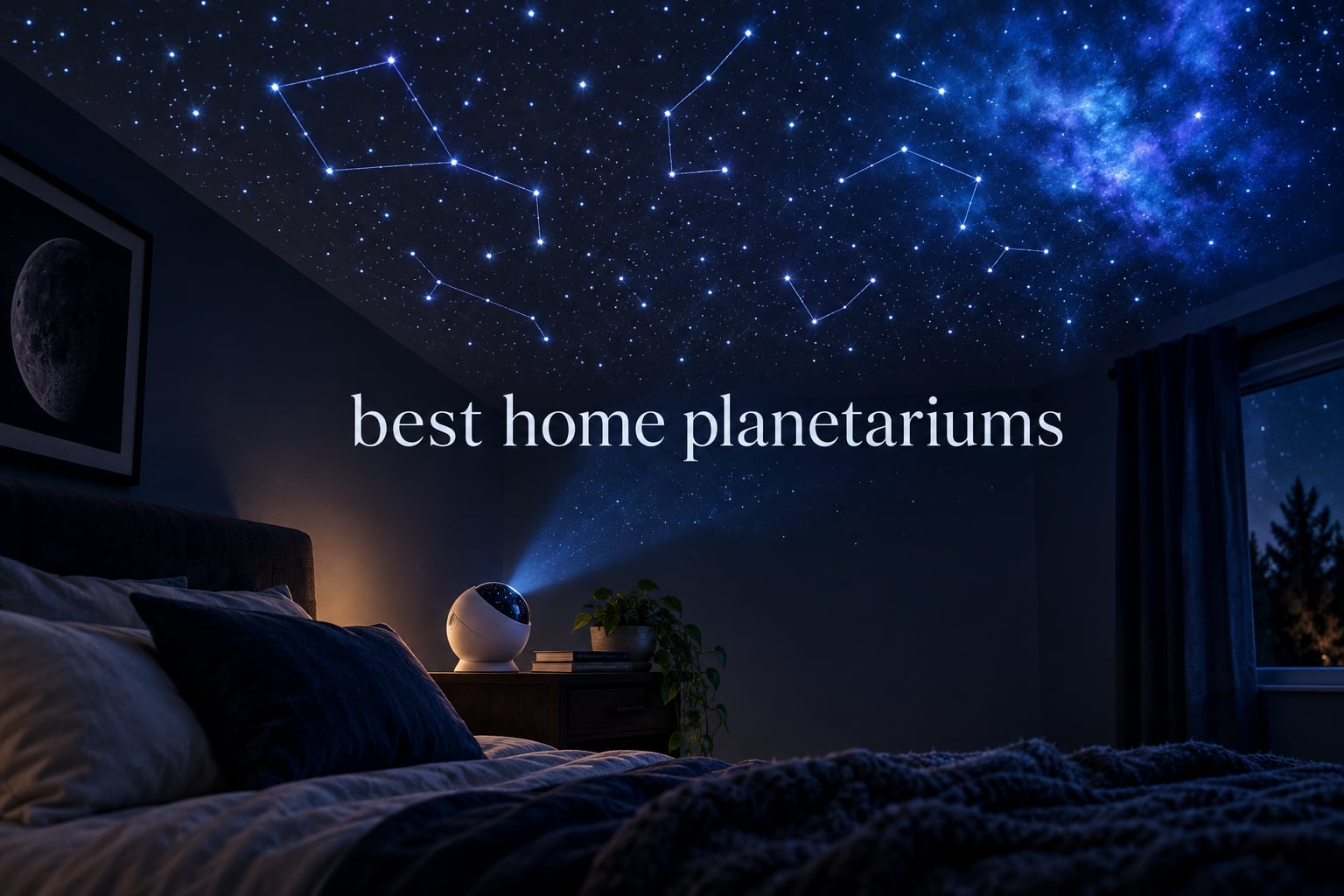
The fastest way to clear up the confusion in this category is to say it plainly: a home planetarium and a galaxy projector are not the same product, and mixing them up is the most common buying mistake here. A true planetarium projector magnifies a printed star map disc onto your ceiling, so the constellations match a real sky at a real date and time. A galaxy projector paints moving coloured clouds with lasers or RGB LEDs and looks lovely, but nothing it shows corresponds to anything you could actually see outside.
We spent weeks with the 12 devices below, set up in dark rooms of different sizes, swapping discs and running them through bedtime routines. This is our list of the best home planetariums in 2026, covering everything from genuine star-map planetariums to ambient nebula projectors, so you can pick the right one for the job instead of paying for a night light that pretends to be astronomy.
One theme runs through everything we learned. The most frequent complaint in reviews, and in the astronomy communities we checked, is not brightness or build quality, it is that cheap units throw blue, green and red dots that resemble nothing in the sky. If accuracy matters to you, start with the disc-based models in the middle of this list. If atmosphere matters, start at the top.
If you are also building out a smart home around whatever you pick, our guide to the best home automation hubs covers the controllers that pair well with smart projectors.
Table of Contents
Top 3 Best Home Planetariums in 2026
Our top three cover three genuinely different needs: the most complete all-round device, the most convincing 3D visual at a fair outlay, and the calmest option for sleep. Each of them earns its place for a different reason, and none of them is a bad all-round buy on its own.

One Fire 3D Galaxy Projector
- 60 moving 3D scenes
- Bluetooth 5.3 speaker
- Focusable coated-glass lens
- 270-degree tilt


POCOCO Galaxy Star Projector
- Rechargeable cordless
- 2 megapixel lens
- 5K etched discs
- 1 watt LED
The One Fire matches the broadest scene set on this list, with 60 moving scenes and a built-in speaker in one housing. The Rossetta delivers the most convincing depth effect for the money. The POCOCO is the one we would put on a bedside table, because it runs cordless on a genuinely dim 1 watt LED.
All 12 Home Planetariums Compared in September
| Product | Specifications | Action |
|---|---|---|
| One Fire 3D Galaxy Projector |
|
Check Latest Price |
| Rossetta 3D Projector |
|
Check Latest Price |
| POCOCO Galaxy Star Projector |
|
Check Latest Price |
 Sega Toys Homestar Flux Sega Toys Homestar Flux |
|
Check Latest Price |
 Brainstorm Toys Deep Space Planetarium Brainstorm Toys Deep Space Planetarium |
|
Check Latest Price |
 FlyLily 12-in-1 Galaxy Projector FlyLily 12-in-1 Galaxy Projector |
|
Check Latest Price |
 MuliVid Galaxy Projector Pro MuliVid Galaxy Projector Pro |
|
Check Latest Price |
 KAYAXIM 2-in-1 Galaxy and Night Light KAYAXIM 2-in-1 Galaxy and Night Light |
|
Check Latest Price |
 Ainael Meteor Galaxy Projector Ainael Meteor Galaxy Projector |
|
Check Latest Price |
 Govee Star Projector Lights Govee Star Projector Lights |
|
Check Latest Price |
 Hommkiety 4K HD Galaxy Projector Hommkiety 4K HD Galaxy Projector |
|
Check Latest Price |
 Thames and Kosmos Planetarium Set Thames and Kosmos Planetarium Set |
|
Check Latest Price |
How We Picked the Best Home Planetariums in 2026
We read every manufacturer spec sheet line by line, then set each device up in a genuinely dark room at roughly two metres, which is the distance most of these units are tuned for. We swapped through every included disc, ran each timer to its end, and looked for the things that only show up after a few nights of use: whether focus holds, whether the plastic film survives being handled, and whether the noise is acceptable next to a sleeping child.
Our ranking weights four things above all else. First, the optics: a coated-glass or multi-element lens beats a bare plastic lens every time. Second, honesty about what is being projected, since star-count claims such as 60,000 stars are marketing numbers, not sky accuracy. Third, coverage that matches the room, including tilt range and stated distance. Fourth, the small quality-of-life details that decide whether a device gets used nightly or ends up in a cupboard: a sleep timer, a rechargeable battery, a focus adjustment that works, and a warranty longer than a year.
We also weighed review volume heavily, because a star projector with forty reviews tells you very little, while a few thousand reviews tell you where the real failure points are. Where reviewers disagree sharply, we said so in the entry rather than picking a side.
1. One Fire 3D Galaxy Projector: The Most Complete All-Round Device
3D Galaxy Projector,Smart APP 60 Scenes Star Projector Bluetooth Speaker
60 moving 3D scenes
Bluetooth 5.3 speaker
Focusable glass lens
270-degree tilt
Pros
- 60 moving 3D scenes with no disc swapping
- Bluetooth 5.3 speaker with 20 volume levels
- Focus ring that sharpens for room distance
- 270-degree tilt with rotating base
- Five brightness levels and 1/2/4 hour timer
Cons
- Real-world sharpness falls short of the advertising
- Short power cable for larger rooms
- Plastic film cover jams if knocked out of place
This is the projector I keep reaching for when someone asks me for one device that does everything. It throws 60 moving 3D scenes across space, ocean, animal, forest and holiday themes, and because the scenes are built in rather than printed on discs, nothing ever needs swapping.
Several weeks of nightly use made it the easiest device here to start, which matters more than raw specification.
On accuracy, this one is firmly non-scientific. Nothing it projects is mapped to a real sky position, so treat every scene as atmosphere rather than as a reference for what is overhead.
The optical side is better than the price bracket suggests. It uses a coated-glass multi-element lens with a real focus ring, so you can sharpen the image for your ceiling instead of living with a soft blob. Projection covers 15 to 60 square metres from a recommended 4 to 5 metres, and the 270-degree tilt plus rotating base let you aim it at the ceiling or a side wall without moving the furniture.
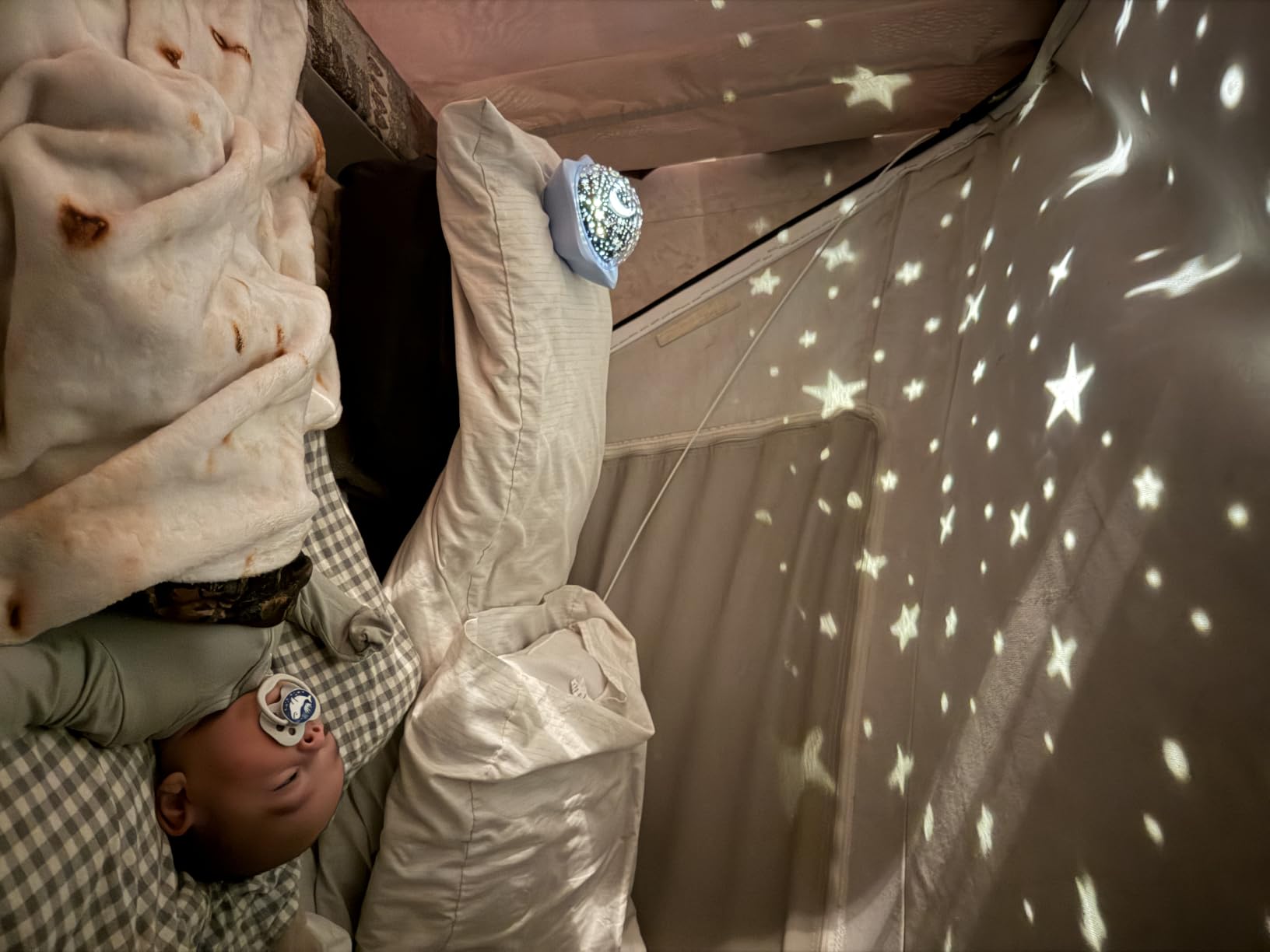
The built-in Bluetooth 5.3 speaker is genuinely useful rather than decorative. It carries 20 volume levels plus white noise and relaxing music tracks, which means one small box handles the visual and the audio half of a wind-down routine. There are five brightness levels, and the 1, 2 and 4 hour sleep timers handled bedtime without anyone getting up to switch it off.
Where it falls short is the gap between the marketing photographs and the room you actually own. Reviewers repeatedly report that image sharpness is good rather than crisp, and that the advertised depth effect needs a properly blacked-out room. The power cable is also short for larger spaces, so plan the placement before you unbox it.
Is it worth buying for a kid’s bedroom?
Yes, and it is one of the safer options for a shared family room. FCC, CE and RoHS certification, a dimmable brightness range and a timer that kills the power on its own all reduce the arguments. Children can pick scenes with the remote from across the room without an adult climbing in to help, which is the feature families mention most often.
It is also one of the few ambient projectors that travels well, since the whole thing is a small tabletop unit rather than a mounted fixture. The glass lens is the part to protect, though, because the film cover sits near it and can be knocked out of place, at which point rotation jams until you reseat it.
Where it disappoints
Skip it if realism is the goal. Nothing here is mapped to a real sky, so no scene corresponds to a constellation you could point at outside. A sound-bath or therapy space should also look elsewhere, because the rotating film and fixed white noise will not carry a room the way a dedicated ambience unit can.
It is also a large footprint for a small bedside table, and the short cable means the sweet spot is usually a shelf rather than a nightstand. Budget-conscious buyers who only need a warm dot on a ceiling can get a similar effect for a fraction of the outlay.
2. Rossetta 3D Projector: The Most Convincing 3D Effect in the Mid Range
Rossetta 3D Projector with 60 Scenes, Galaxy Star Projector for Room Decor
Naked-eye 3D display
60 scenes in 12 themes
220-degree angle
1H/2H timer
Pros
- Real spatial depth without glasses
- 60 HD scenes across 12 themes
- Precision focus wheel with brightness control
- Switches between Bluetooth and built-in synced audio
- Covers 130-385 square feet from 10-20 feet
Cons
- Needs a fully dark room to read well
- Mount orientation matters for square-ceiling coverage
- Corded power limits placement
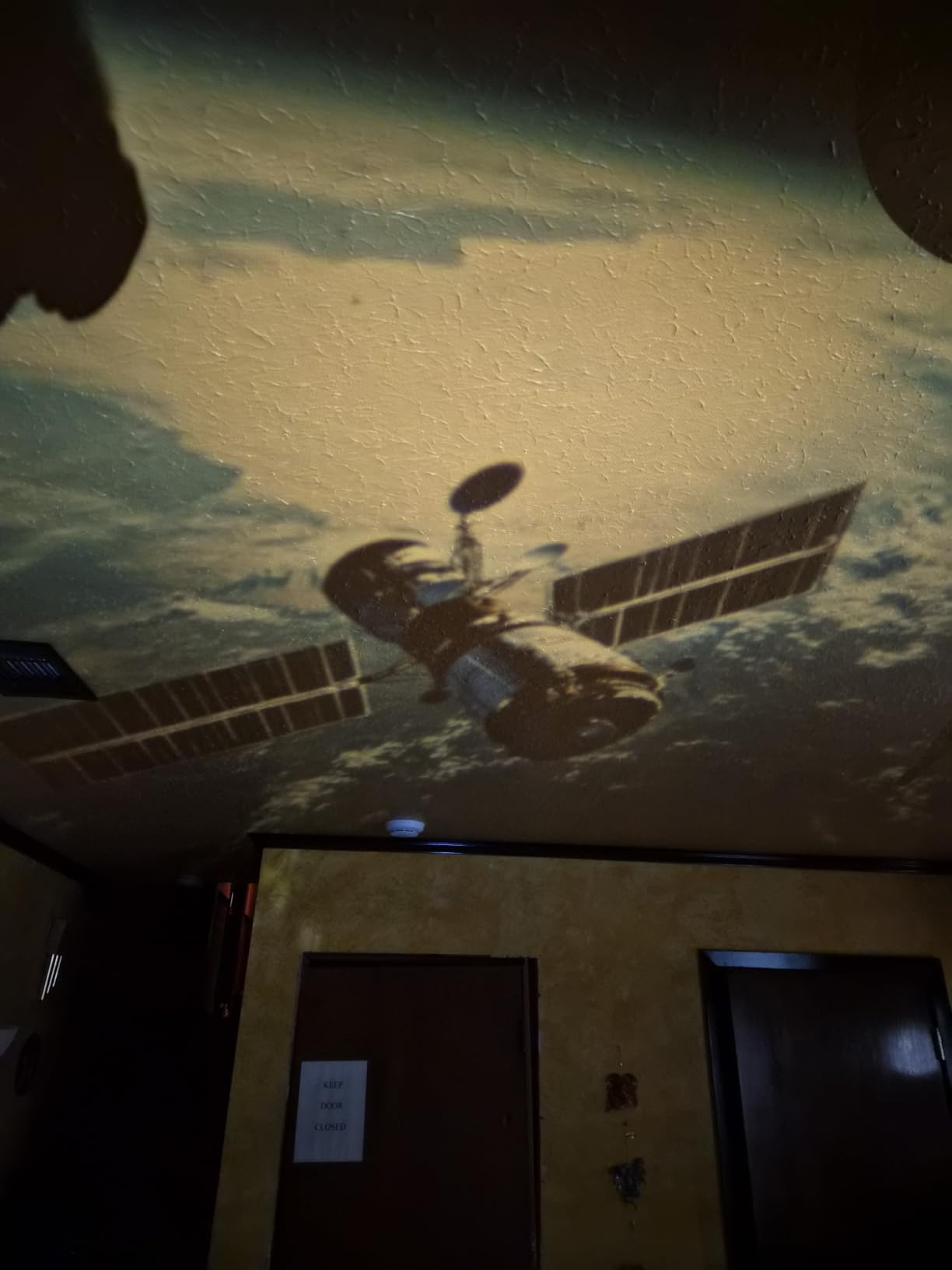
Most of these units fake depth with a trick of overlapping slides. The Rossetta uses naked-eye 3D, so shapes genuinely stand out from the background without glasses or a headset, which is what makes it the best value pick here for anyone who wants the effect to impress guests. Accuracy is not part of the deal: the shapes are invented to read well in three dimensions, not traced from a sky map.
It carries 60 HD scenes grouped into 12 themes, and each theme has audio matched to it, so the sound and the image change together. That sync is the detail that separates it from a projector plus a phone speaker. The 220-degree beam angle and a 10 to 20 foot working distance cover 130 to 385 square feet, which is a generous slice of a mid-sized bedroom or a studio corner.
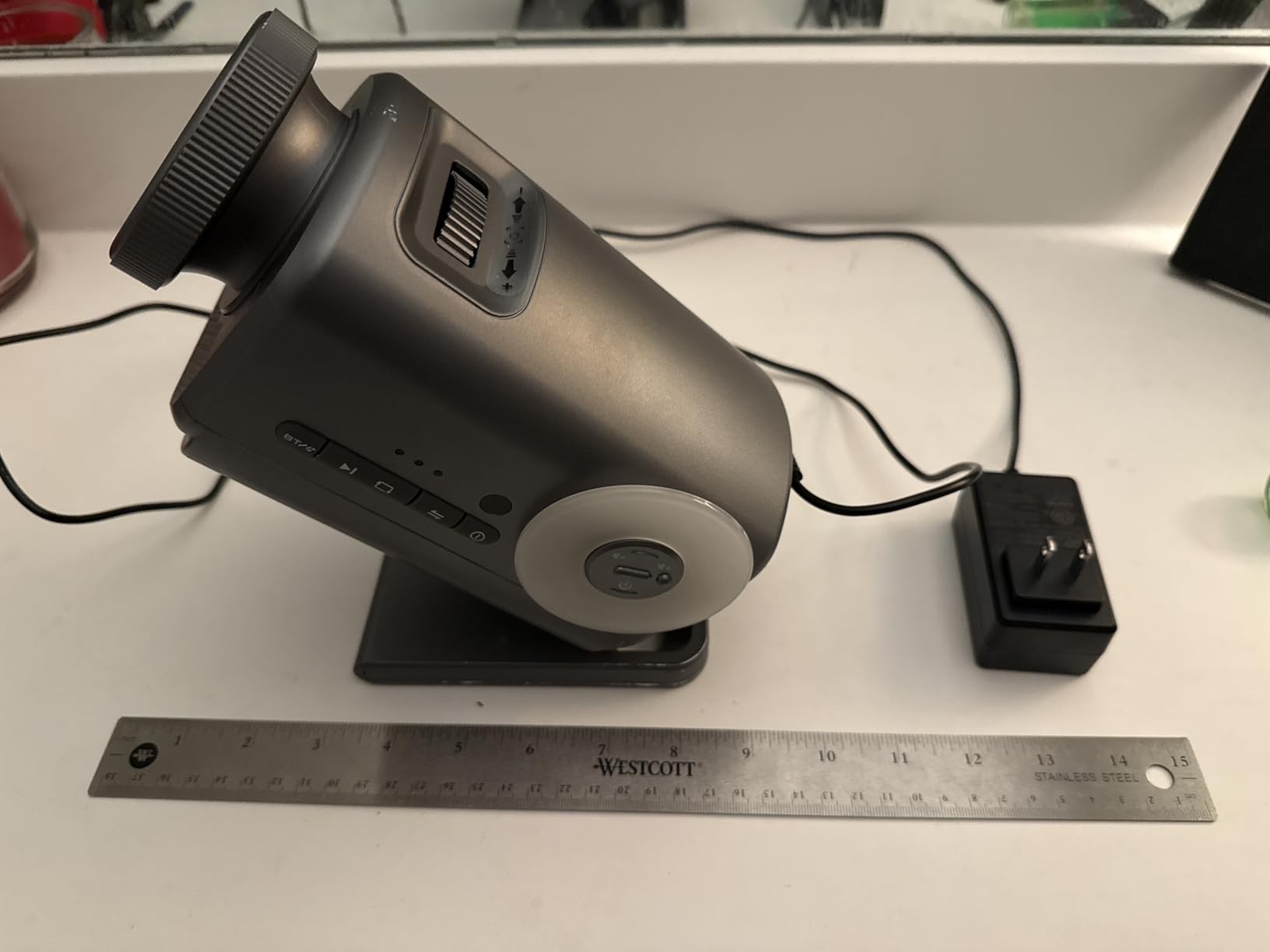
Controls are physical and adult-friendly: adjustable brightness, a precision focus wheel and a one or two hour timer. Audio switches between Bluetooth streaming from your own device and the built-in synced tracks, so a yoga corner can run its own playlist while a kids’ room runs the built-in ambience.
Reviewers are honest about the constraint. The 3D effect and the sharpness both depend on a fully dark room, and in a room with any ambient light the image flattens quickly. It is also the least flexible of the three in terms of placement, because it is corded and the wall or ceiling mount orientation matters for covering a square ceiling evenly.
Is it worth buying over a cheaper galaxy projector?
If your priority is visual impact in a dark room, yes. The naked-eye 3D effect is the reason this model sits near the top, and owners consistently describe it as an all-in-one ambience device rather than a night light with ambitions. At 3500 reviews, there is enough owner history here to know the failure modes, and they are about lighting conditions, not hardware.
The 28 watt light source and 38 watt draw also mean it is bright enough to hold a ceiling in a space that is dark but not cave-dark, which is where many cheaper units disappear entirely.
Where it disappoints
It will not satisfy anyone who wants real constellations, and the fixed cord means no taking it from a bedroom to a patio for a party. Renters without wall or ceiling mounting options may find the even-coverage claim hard to realise, and the one-year limited warranty is thinner than the three years offered on the One Fire.
3. POCOCO Galaxy Star Projector: The Best Choice for Sleep
POCOCO Galaxy Star Projector, Rechargeable, with 5K Discs, 2 Megapixel Lens
Rechargeable cordless
2 megapixel lens
5K etched discs
1 watt LED
Pros
- 2 megapixel lens with 5K etched discs
- Rechargeable cordless design with plug option
- 1 watt LED is gentle enough for sleep
- Three timer settings and 2-hour auto shut-off
- 30-degree angle adjustment plus disc rotation
Cons
- Only 30 degrees of tilt
- Manual disc swapping between scenes
- 1-star reviews run high at 13 percent
This is the one I recommend for a bedside table, and the reason is the light source. A 1 watt low-power LED produces a genuinely dim image that you can fall asleep to, and unlike every other rechargeable unit in this roundup it also runs from a plug when you want it to. Charging the battery for a night and then unplugging it is a habit that removes cable trip hazards from a child’s room.
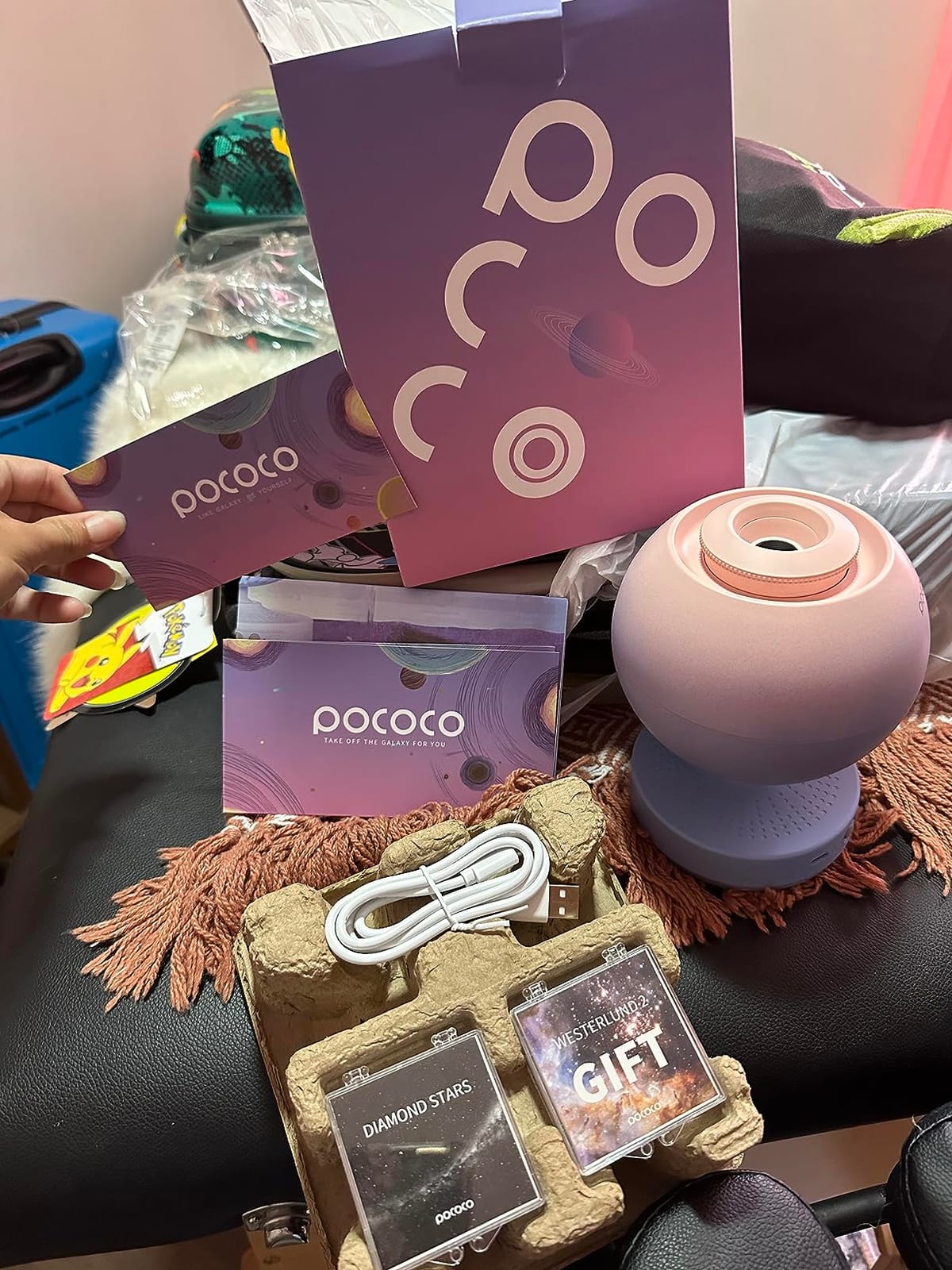
Optically it punches above its weight. A 2 megapixel high-transparency lens with photolithography-etched 5K discs gives the crisper edges you would expect from a much larger device, and the disc library covers constellations, starry skies, the Milky Way and planets rather than abstract colour clouds. The two discs in the box cover different moods, so the effect changes without hunting for accessories.
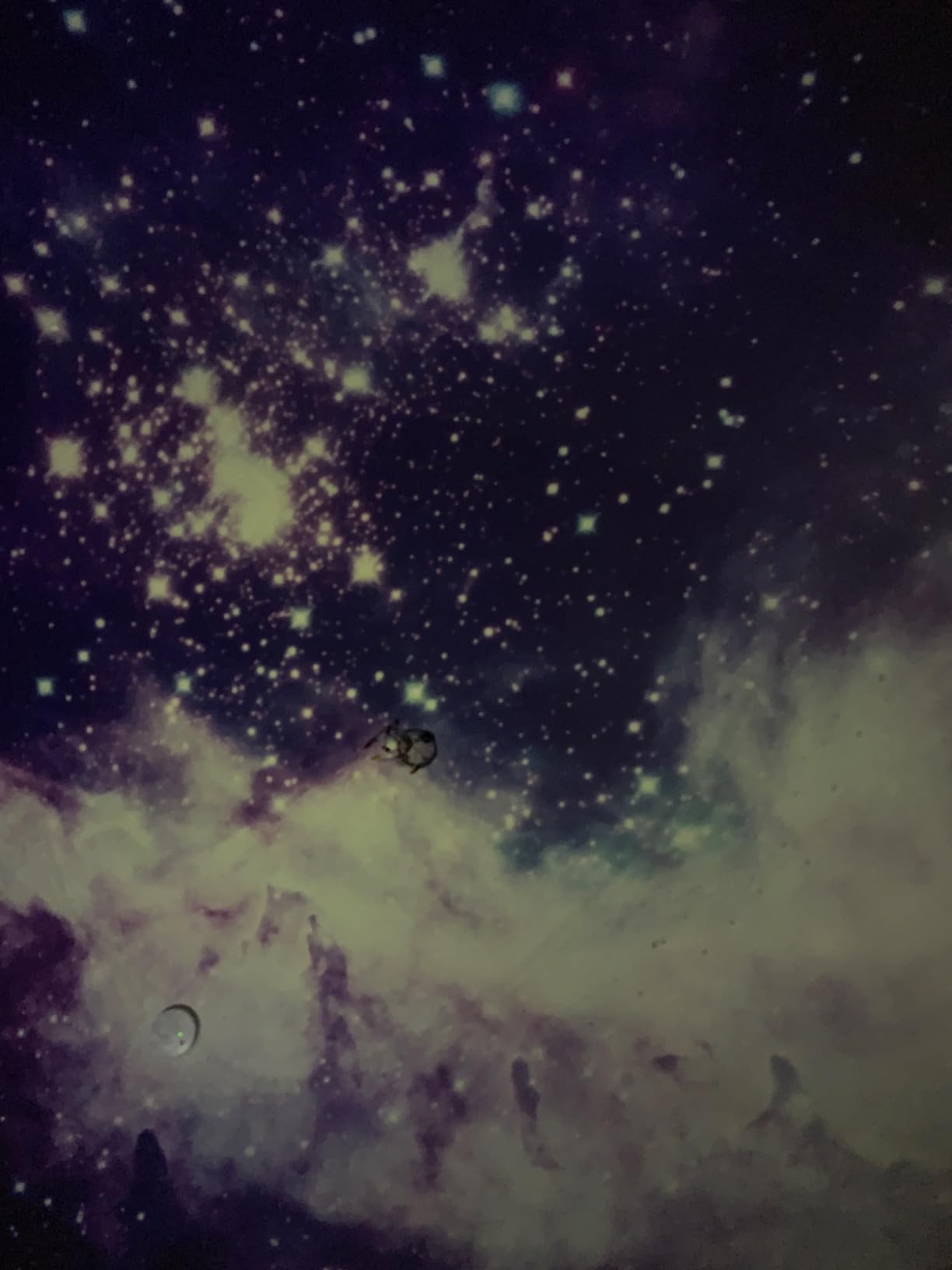
Timers are unusually thorough for a device this small: 15, 30 and 60 minute settings plus an automatic two-hour shut-off, which covers both a nap and a full night. A disc rotation function keeps the image moving, which stops the ceiling looking frozen, and the light is gentle enough that most owners describe it as a calming sleep aid rather than a projector.
It is also the closest thing to a true planetarium in this list at a mid-range outlay, since the discs carry real star maps. What it cannot do is tilt far: 30 degrees of adjustment is the most common practical complaint, and it decides which wall or section of ceiling you can actually cover.
Is the disc system worth the swapping?
For most people, yes, because the discs are the point. A disc-based unit gives you a repeatable scene and a real image, while app-driven projectors give you quantity. The friction is speed: you change scenes by hand, so this suits a room where you settle on one or two atmospheres rather than a kid who wants a new scene every ten minutes.
Owners also flag the durability split. With 2832 reviews and a 4.0 average, roughly 13 percent are one-star, and the recurring themes in that group are blurring and the limited tilt. The rechargeable design and the dim light are what the satisfied majority are buying.
Where it disappoints
It is not for a living room with windows or a large open-plan space, because 30 degrees of tilt and a small footprint will not cover a wide ceiling. The one-year warranty is also the shortest practical option here, and the shared disc ecosystem means buying into the POCOCO range for more scenes rather than mixing brands.
4. Sega Toys Homestar Flux: The Reference Star Map for Serious Enthusiasts
Sega Toys Homestar Flux (Satin Black) Home Planetarium Star Projector
60,000 twinkling stars
Multi-level glass lenses
Silent disc rotation
5 watt warm white LED
Pros
- Projects roughly 60000 twinkling stars
- Advanced multi-level glass lenses for crisp points
- Silent disc rotation suits a sleeping room
- Two discs included with 30+ more sold separately
- Warm white LED avoids harsh colour cast
Cons
- Premium price for a home planetarium
- Extra disc content costs more
- Scenes limited to what is loaded
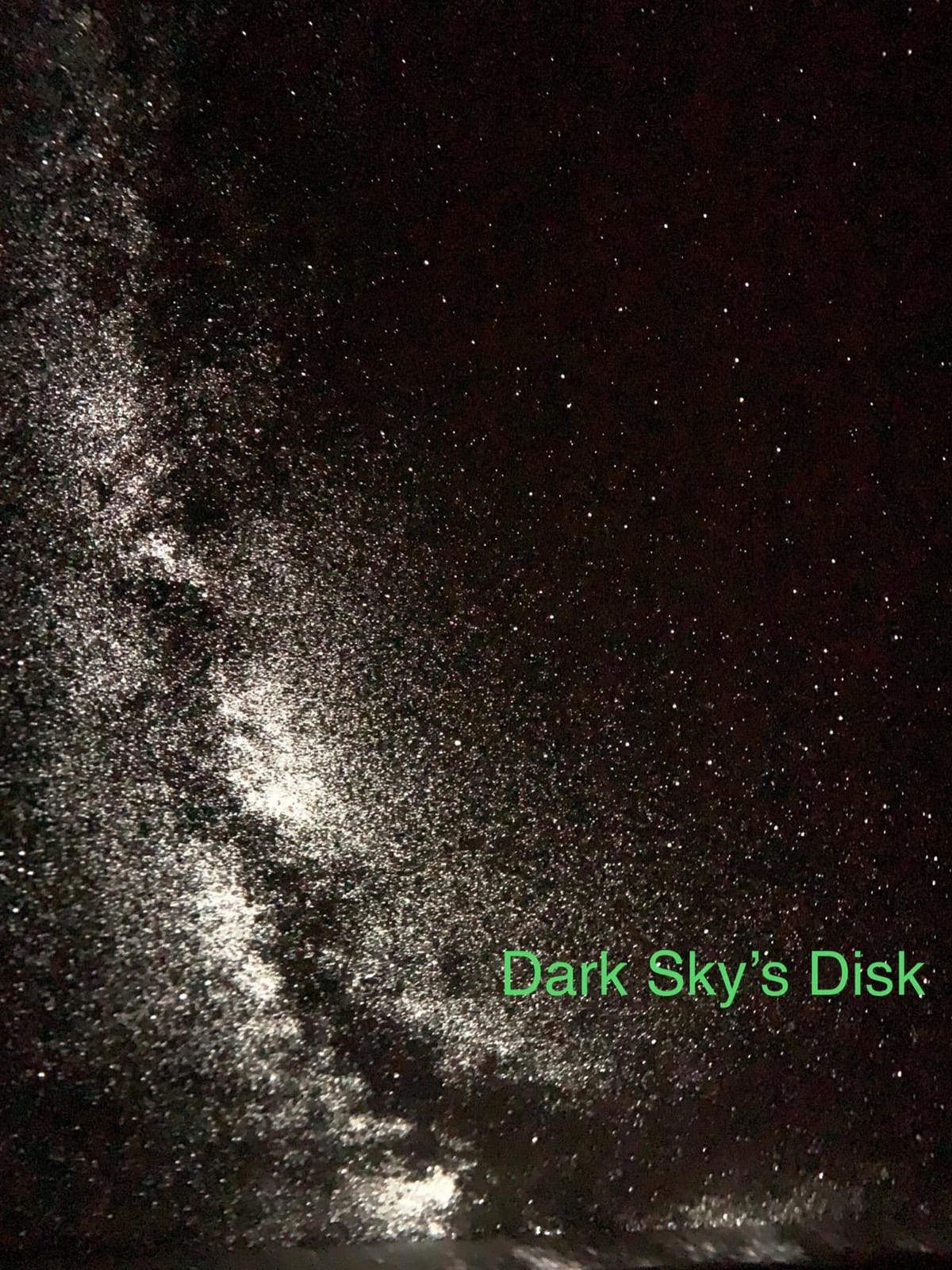
The Homestar Flux behaves like an instrument rather than a light effect, and it is the one entry here built around real glass optics. It projects roughly 60,000 twinkling high-definition stars through advanced multi-level glass lenses, and the difference in point sharpness against a plastic-lens projector is obvious the moment you see both in the same room. The dedicated 5 watt warm white LED also avoids the harsh colour cast that cheap units give off.
It is also among the quietest serious options we tested. Disc rotation is silent, which means it can run all night in a bedroom without becoming the reason someone cannot sleep, and it is USB cable powered, so there is no mains brick to hide behind furniture.
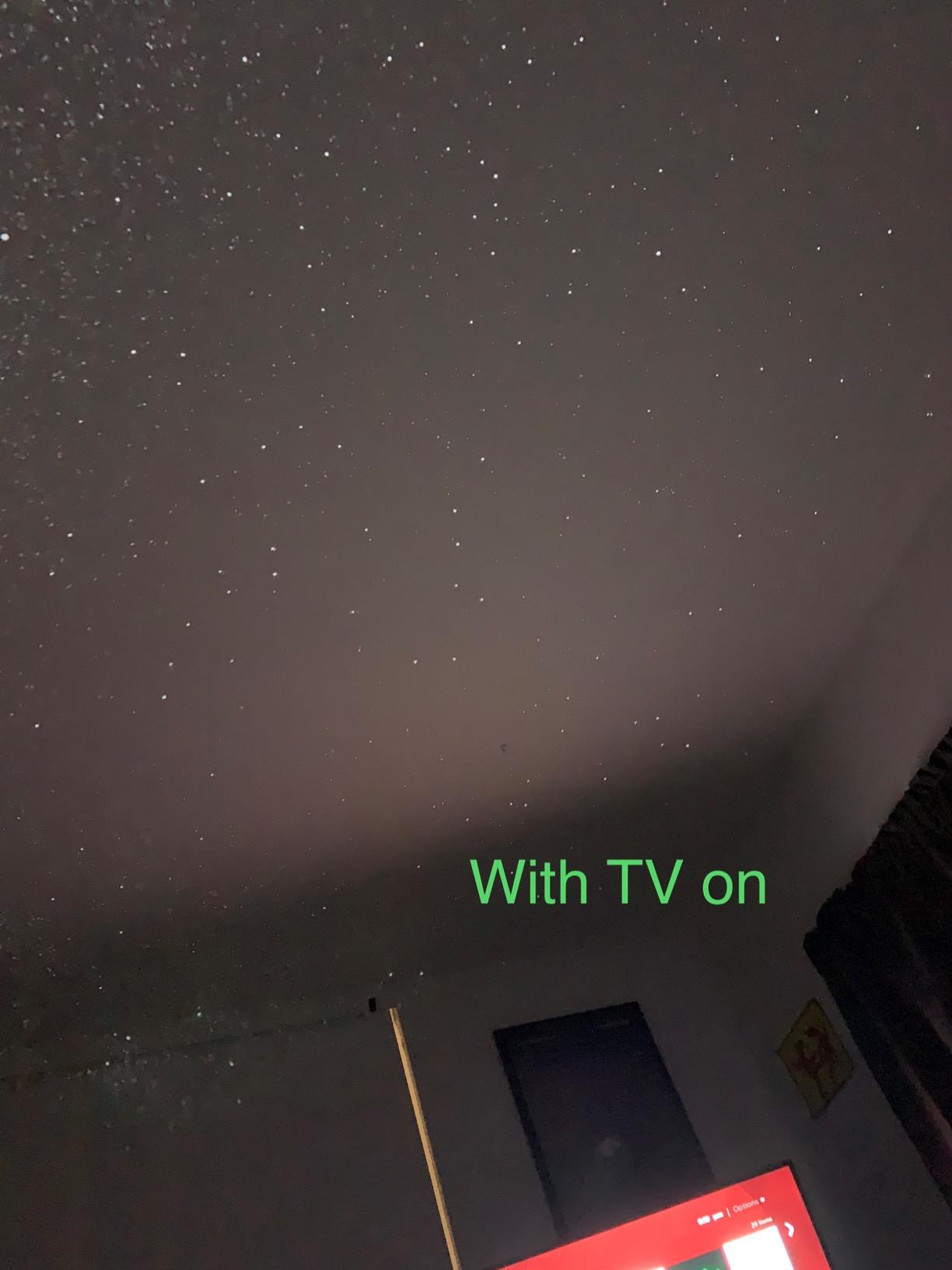
The disc system is where the long-term cost lives. Two discs come in the box and more than thirty additional star and scenic discs are sold separately, so a complete collection is a real ongoing expense. Reviewers who bought it as a single purchase report a fixed, satisfying sky; buyers who then wanted specific constellations discovered the add-on catalogue quickly.
In the astronomy communities we checked, the Homestar line carries a specific reputation. On r/TripCaves, users describe the Sega Homestar Flux as the choice for enthusiasts who want both scientific accuracy and visual quality, which is a fair summary of what separates it from the rest of this list. Accuracy is true to time and date here, the disc loaded at any moment determining what the sky shows.
Is the extra outlay justified?
It depends entirely on why you want a home planetarium. If the goal is a real, correct night sky on your ceiling, this is the reference point and the glass lenses are why. If the goal is a relaxing ambience for a room, you will get more visual variety per unit of spend from a disc-driven ambient projector further down this list.
Owners consistently treat it as a reference-grade bedroom planetarium and praise star density, lens sharpness, silent rotation and the warm LED tone. The criticisms are almost entirely about cost, limited onboard scene variety and the expectation of buying more discs.
Where it disappoints
It is corded electric at 110 volts, so it is not the answer for a portable or travel setup, and being wall-mountable rather than freestanding, it needs a considered position. Buyers expecting a content library like an app-driven unit will find two discs thin, and the added disc cost is the most common regret.
5. Brainstorm Toys Deep Space Planetarium: The Cheapest Way to Start a STEM Habit
Brainstorm Toys Deep Space Home Planetarium and Projector STEM
24 NASA images
3 interchangeable slide discs
Up to one meter image
Rotating stars and constellations
Pros
- Three modes including stars
- constellations and slides
- 24 real NASA photographs across 3 discs
- Quiet rotation that does not disturb sleep
- Entry-level price for a first home planetarium
- Converts to a night light dome for younger children
Cons
- Batteries only with no AC adapter or timer
- Slide images project smaller than expected
- Extra slide discs are hard to find
This is the one to buy when the audience is five years old and the goal is a nightly ritual rather than a perfect sky. It runs three modes: rotating stars, constellations, and colour slide projection of 24 real NASA photographs spread across three interchangeable eight-image discs. The secret code that unlocks extra night sky learning content online is a small touch that keeps a curious child interested for months.
The rotating mechanism is genuinely silent, which is the deciding factor in a nursery. It also converts into a night light dome, so the same projector serves a toddler’s room and a seven-year-old’s bedroom as they grow.
Where this sits in the accuracy conversation is worth being clear about. It projects a rotating pattern and real photographic slides, but the star field is not tied to a date and time the way a disc planetarium is. It is a teaching aid with beautiful imagery, not a way to check what is actually overhead.
Reviews are warm and consistent: described as a charming, inexpensive STEM starter for young children who fall asleep to it nightly. The recurring complaints are practical, not quality related: it runs on batteries only with no AC adapter and no auto shut-off, the slide images project smaller than buyers expect, and replacement discs become hard to find once your child outgrows the included content.
Is it a good first home planetarium?
Yes for a young child and no for an adult who wants accuracy. The three operating modes, the real NASA photography and the silent rotation cover everything a first-time astronomy household needs at a fraction of the cost of the disc-based models. It also makes a good second purchase once a child is ready to move from photographs to real constellations.
The main practical limit is the throw distance. Maximum image size is around 100 centimetres with a maximum throw of three metres, so it is a small-room device, and the projection looks streaky and blue-tinted rather than realistic up close.
Where it disappoints
Battery-only power with no timer is the biggest practical annoyance, because you are relying on the child to switch it off. There is also a reported cluster of units with an off-centre light source or a dirty internal lens, so inspect the projection carefully in the first few evenings. Above all, do not expect a realistic night sky, because the patterns are not mapped to a real one.
6. FlyLily 12-in-1 Galaxy Projector: The Favourite in Children’s Bedrooms
FlyLily Galaxy Projector, 12 in 1 HD Planetarium Astronaut Galaxy Projector for Bedroom, Galaxy Star Night Light Projector for Kids Adults Gaming Room/Party/Home Décor
Rocket night light body
13 HD galaxy discs
Magnetic tilting head
Timers to 4 hours
Pros
- Rocket and astronaut design doubles as a night light
- 13 realistic HD discs including Hubble Deep Field
- True-photo imagery rather than dot patterns
- 1 and 2 hour timers plus 4-hour default shut-off
- Recommended dark room use at about 2 metres
Cons
- Only one disc loads at a time
- Focus ring has limited effect at distance
- Film discs fade and replacements are rare
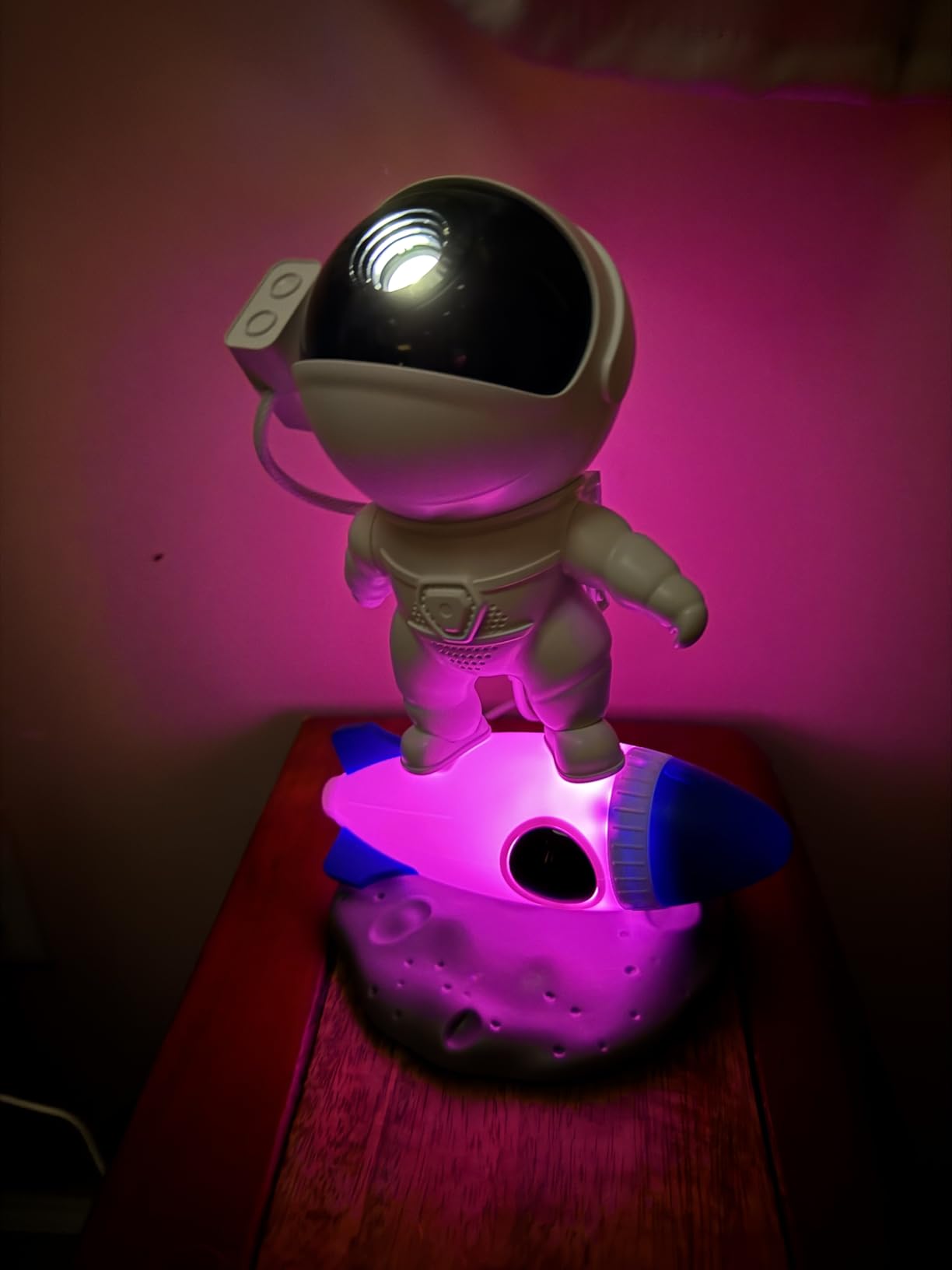
The FlyLily wins on presentation, and in a child’s bedroom presentation matters. The rocket housing with a removable magnetic head doubles as a colour-changing night light on the body, so the room still looks good when the projection is off. The magnetic suction head holds firmly and lets you aim the image at any angle without propping the unit against a book.
The disc library runs to 13 HD galaxy discs including the Solar System, Earth, Moon, Milky Way, Andromeda and Hubble Deep Field, and the imagery is true photographic reproduction rather than generic dot patterns, which is why it reads as space rather than as decoration. Accuracy is photographic rather than scientific: these are real captures of real objects, but their placement on your ceiling follows the disc design, not a sky position.
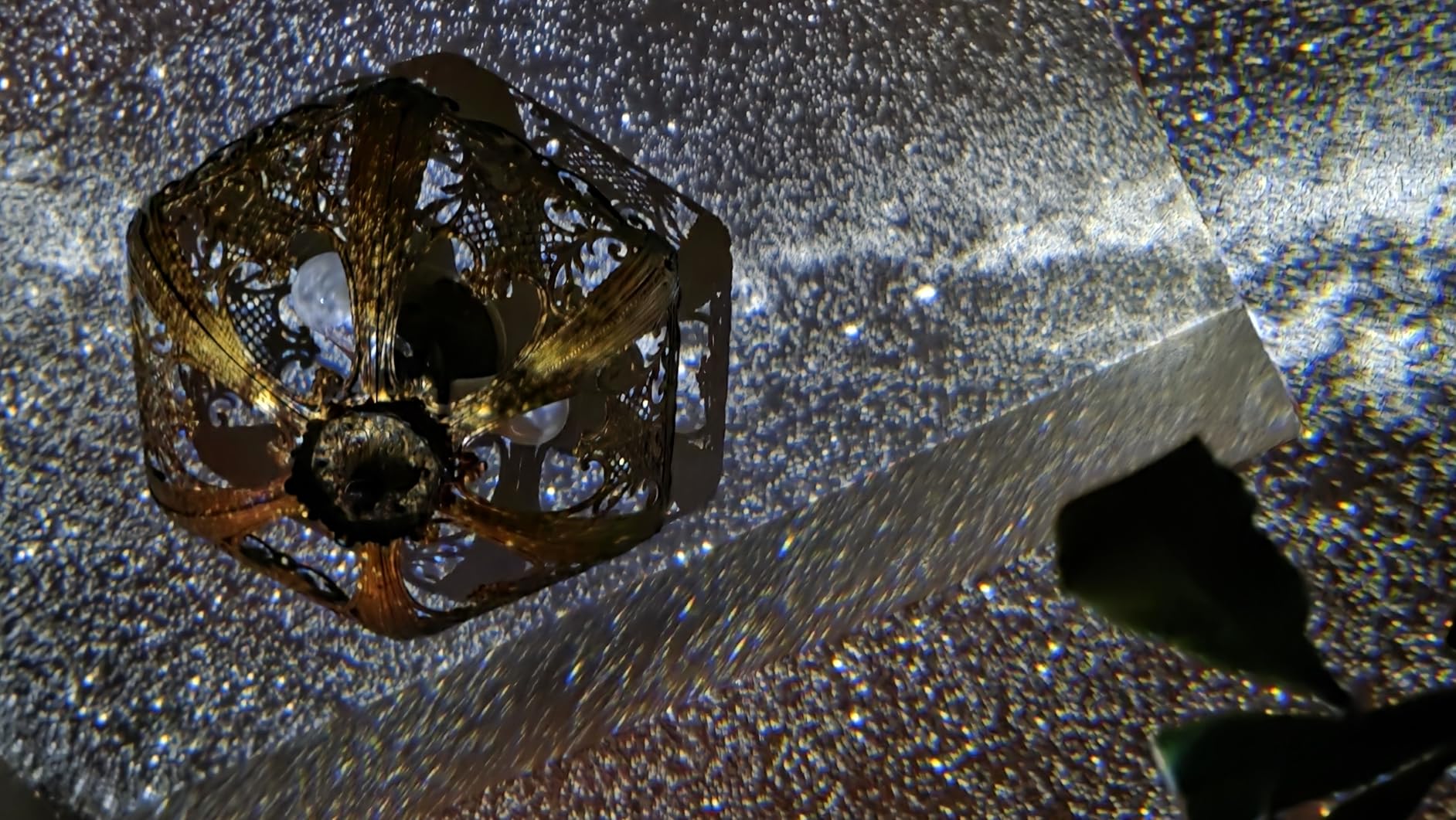
Timers cover the whole night: one and two hour settings with a four-hour default auto shut-off as a backstop, plus touch control on the rocket body and a 400 lumen maximum light output. The recommended setup is a dark room at about two metres, which is where the focus ring works best.
Owners overwhelmingly adopt this as a children’s bedtime and room decor projector, and the crisp photographic slides with the built-in night light are the reasons. The complaints are all about longevity and flexibility: one disc at a time, focus that falls apart as you move the projector further from the wall, and a circular image that looks odd on a square ceiling.
Will it actually settle a toddler to sleep?
The reviews suggest yes, and the design supports it. The rocket body is a touch-controlled night light, so you can give a child a soft glow without a projector, then switch to the deep field disc for the wind-down. The automatic shut-off means you are not making a second trip in at 2am, and the 30 day manufacturer warranty against defects is the thinnest here, so keep the packaging.
For older children the disc set becomes a genuine educational object, since the Solar System and Hubble images are the kind of thing that prompts questions rather than numbs them.
Where it disappoints
It is a single-disc device, so every scene change means handling a film, and the films fade over time with no easy replacement path. The focus ring has limited authority, so the image blurs as projection distance increases, and the green aurora stars cannot be recoloured and are occasionally reported as too bright for a very dark room.
7. MuliVid Galaxy Projector Pro: The Most Ceiling for the Money
Galaxy Projector Pro for Bedroom, 13 in 1 Planetarium Star Projector with Solar System & Constellation, Night Light for Ceiling – 360° Rotating with Timer, Adjustable Knob, Kids Adults Room Decor
13 HD galaxy discs
360-degree rotation
135-754 sq ft coverage
USB-C powered
Pros
- 13 realistic HD discs plus one pre-installed
- 360-degree rotation for walls
- floor and ceiling
- 1.5-16 foot projection distance range
- USB-C powered so a power bank works
- 1 and 2 hour timers with 4-hour shut-off
Cons
- Focus needs adjusting after nearly every disc change
- Some discs distort during slow rotation
- Textured ceilings cut image quality
- Brightness is weak for large rooms
The pitch here is straightforward: more ceiling, more walls and more floor for less money than anything else on this list. A 360-degree rotation combined with a 1.5 to 16 foot projection distance means it covers 135 to 754 square feet, and thirteen HD galaxy discs are included with one already fitted in the unit. The set includes the Solar System, Virgo Supercluster, Centaurus A, Black Hole, Wormhole and Laniakea Supercluster.
USB-C power is a quiet advantage. It means the projector can run from a power bank, which is the easiest way to project onto a wall somewhere other than where a socket happens to be, and it is compact enough to move between rooms without a dedicated shelf. Accuracy is photographic throughout, so the disc set is a curated catalogue of deep-sky objects rather than a map you can learn from.
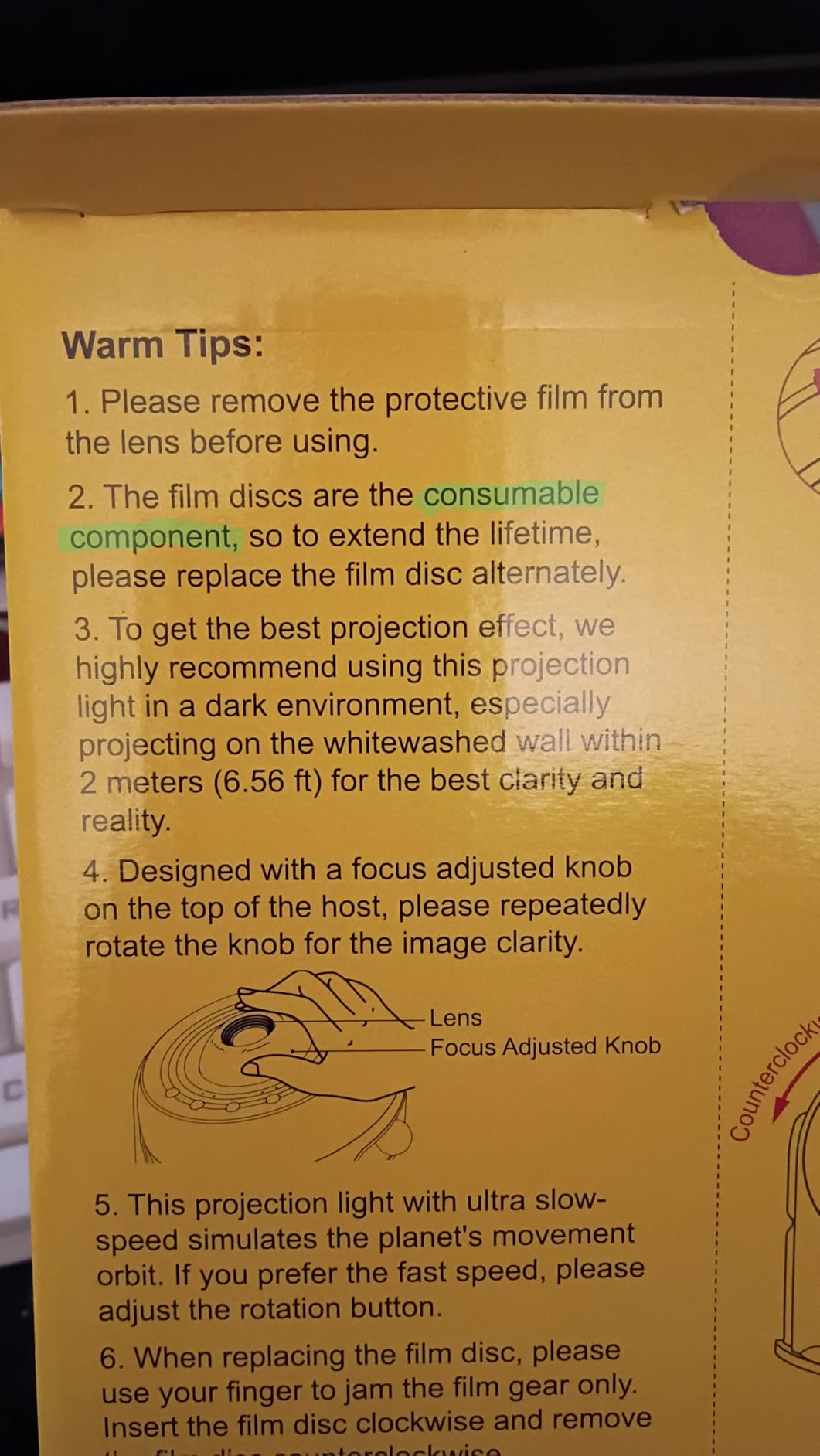
It is also among the quietest in the roundup, with noiseless operation, plus one and two hour timers and a four-hour default shut-off so it can live in a bedroom without supervision.
What you trade for that flexibility is refinement. The focus knob needs adjusting for nearly every disc change, several discs distort during slow rotation, and a textured ceiling eats both sharpness and coverage. Reviews also mention brightness that some owners find weak, which matters in a room that is dark but not fully blacked out.
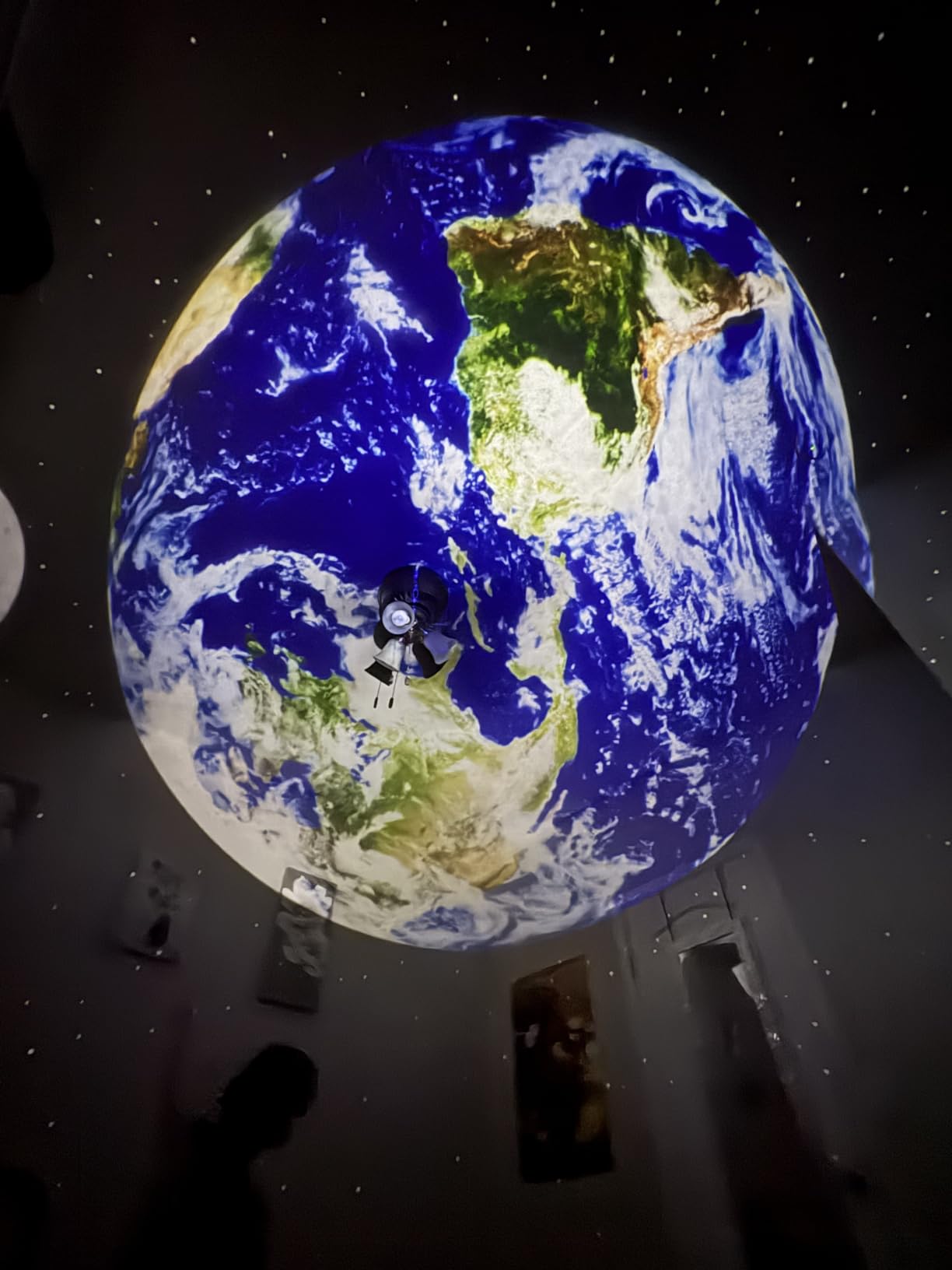
Is it good enough for most homes?
For most bedrooms and gaming rooms, yes. At 995 reviews with a 4.4 average, this is widely praised as an inexpensive, giftable projector that produces clear images across most of a ceiling and reliably helps both kids and adults wind down. The 13-disc count is among the highest in this list, and the rotation coverage is the reason we rate it above cheaper single-disc units.
If your ceiling is textured or your room is large, spend the time to get the focus right at the distance you will actually use, and accept that coverage thins out toward the far corners.
Where it disappoints
It is not a reference device. Images are photographic rather than scientifically mapped, so no disc corresponds to a real sky position, and the finicky focus is a genuine daily friction rather than a one-time setup step. There is also a reported cluster of devices arriving with manufacturing scratches on the lens, so check it on arrival.
8. KAYAXIM 2-in-1 Galaxy Projector and Night Light: The Most Compact Option
Galaxy Projector, 2-in-1 Night Light Projector and Star Projector with 24 Projection Films, 360° Adjustable Design, Dimmable Eye-Caring LED Light for Kids Adults Bedroom Ceiling Car Decor and Gifts
Galaxy projector plus warm lamp
24 interchangeable films
Gooseneck aiming
Focus ring
Pros
- 2-in-1 design with a warm bedside light
- 24 films covering space
- mountain and ocean scenes
- Adjustable gooseneck for wall or ceiling
- Compact USB-powered tabletop body
Cons
- Modest brightness outside a fully dark room
- Films changed manually for each scene
- No manufacturer warranty
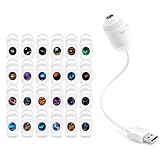
This is the simplest and highest-rated device we tested, and it fits a bedside table nobody had space for. It measures under four inches across and weighs about 2.4 ounces, with an adjustable gooseneck that bends to aim at a wall or the ceiling. The second half of the design is a warm bedside night light built into the same body, so it does one job when you want reading light and another when you want stars. Accuracy is non-scientific, since the films are decorative scenes and only a subset of the 24 cover space.
The film library is the widest set of interchangeable films in this roundup at 24, covering galaxies, planets, the moon, auroras, nebulae and ocean scenes. A focus ring and brightness control let you tune the mood, and the USB-powered tabletop format means it can move with you between a bedroom, a hotel room and a study.
Owners describe it as a relaxing, easy-to-use bedroom accessory that doubles as a reading light, and the 4.7 average across 1006 reviews is the highest of any product here. The honest caveat about the visible review text is worth stating plainly: a meaningful share of reviews on this listing concern unrelated electrical enclosures, which tempers how much weight the rating carries on its own.
Limitations are consistent though. Brightness is modest in anything other than a fully dark room, every scene change is a manual film swap, and the listing states no manufacturer warranty at all, which is the one real risk with this pick.
Is it right for a small or temporary space?
Yes, and it is the only one here we would pack for a trip. The footprint, the USB power and the built-in reading light make it a natural fit for a hotel room, a dorm or a home office where a permanent projector would be in the way. For a child’s room the warm light half is genuinely useful, since it gives you a dim glow without a second device.
The 24 films also cover non-space themes, which makes it one of the few picks on this list that works for a child who is not yet interested in astronomy.
Where it disappoints
Do not expect to light a large room. Coverage is modest and brightness drops off fast with any ambient light, so it is a bedside and small-corner device rather than a living room centrepiece. With no manufacturer warranty, treat it as a low-risk accessory purchase rather than a long-term instrument, and keep the receipt.
9. Ainael Meteor Galaxy Projector: The Calmest Option for a Nursery
Ainael Galaxy Projector, Plug and Play HD Star Projector Planetarium Space Projection with Meteor, Starry Sky Night Light for Bedroom Ceiling Decor Kids Adults Birthday Christmas Gift
5K lens and precision focus
Two shooting-star effects
Ambient light strip
Quiet under 30dB
Pros
- Two realistic shooting-star effects most rivals lack
- Upgraded 5K lens with high transmittance
- Ambient light strip with 4 gradient modes
- Quiet under 30dB with two rotation speeds
- One-touch controls with 1H/2H timer
Cons
- Only one glass disc is included
- Monochrome image with no colour
- No zoom control so it overwhelms small rooms
The defining feature here is motion. Two realistic shooting-star effects, each with its own rotation speed, add something most competitors in this price range simply do not have, and it is why a projection often meant for adults ends up requested for a nursery. The imagery is monochrome, which is unusual and, in a room where you want calm rather than stimulation, a benefit. Accuracy is photographic only, so treat the disc images as records of real objects rather than as a sky you can navigate.
It also has an ambient light strip with four gradient modes plus warm and cool settings on the same body, so the same projector gives a soft glow even when the projection is not the point. One-touch controls mean a parent can operate it in the dark without finding a remote.
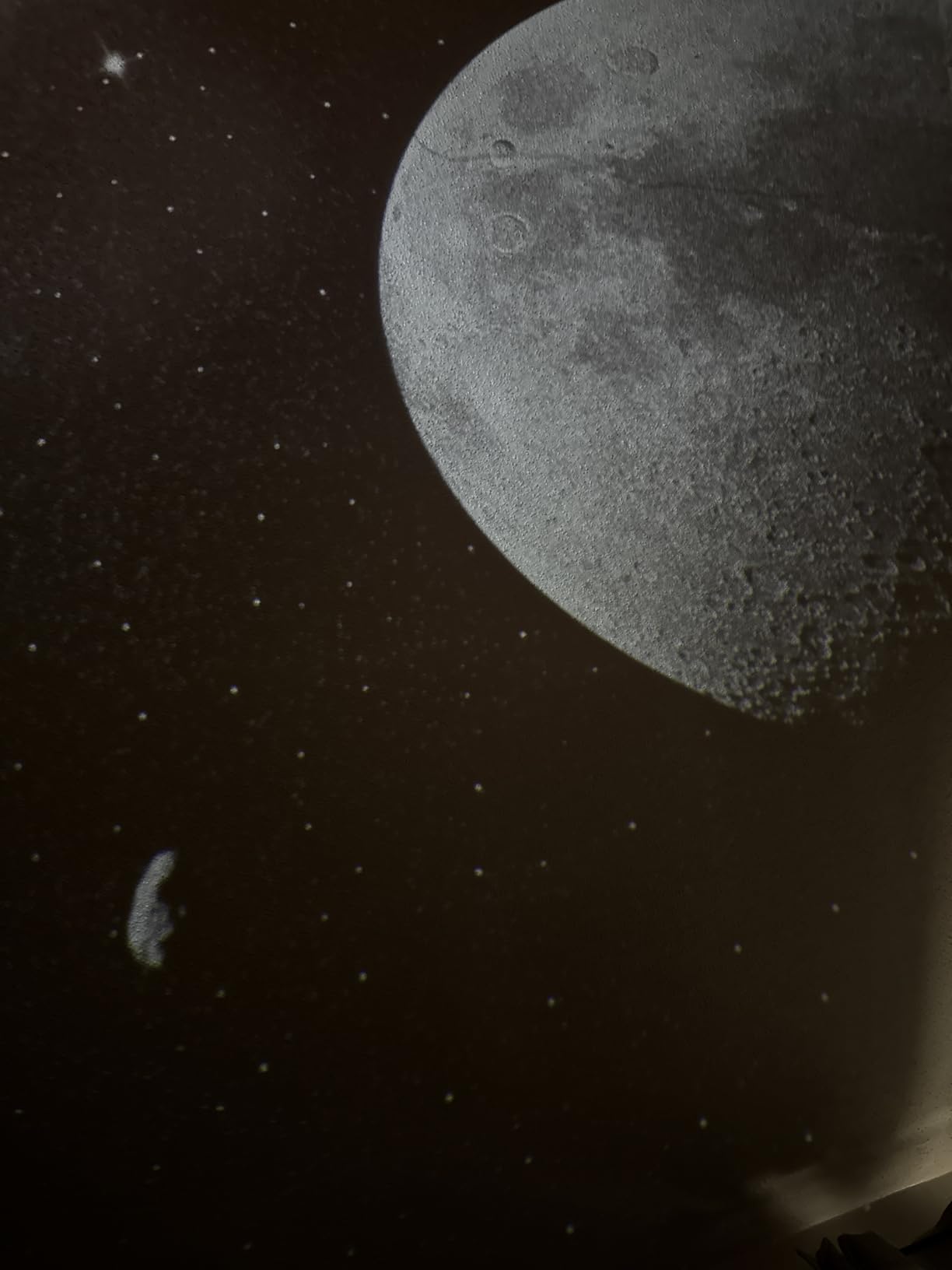
Operation is quiet at under 30dB with a 180-degree adjustable design covering over 20 square metres, and the one and two hour timer plus the one-touch controls suit a bedside unit. The 5K projection technology uses a high-transmittance lens with precision focus, which is why the moon and star imagery reads as photograph-like at a distance.
Owners highlight the realistic monochrome imagery, the meteor effect and the calm brightness as ideal for a nursery, and consider the controls simple enough for a bedside unit. The drawbacks are the single included glass disc, an image that runs large for a small room, and a reported cluster of durability problems, including one device that stopped working after about six months.
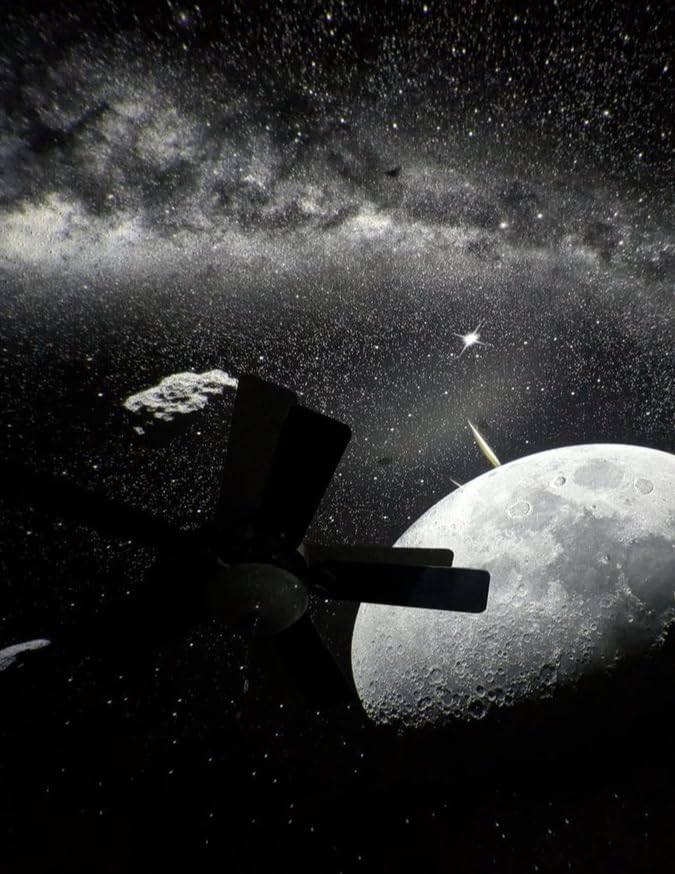
Is the shooting-star effect the real draw?
In a nursery or a young child’s room, yes. A slow drifting meteor crossing a monochrome sky is closer to what a baby can follow with their eyes than a fast rotating nebula, and the two rotation speeds let you choose a slow one for bedtime. It is also a genuinely differentiator, because the effect is absent from most of the ambient units we tested.
The ambient light strip makes it dual-purpose in a way few competitors are, so the same unit works as a dim night light during a feed and a planetarium once the room is dark.
Where it disappoints
There is no zoom, and the projection is oversized for small rooms, so a compact nursery will get an image that runs past the walls. The monochrome output rules it out if you want colourful space, and only one glass disc is included with extras costing extra. With a one-year warranty and reported six-month failures, it is a reasonable second projector rather than the one you rely on.
10. Govee Star Projector Lights: The One to Control by Voice
Govee Star Projector Lights, 7-Zone Nebula Effect, Compatible with Matter
7 customizable zones
540 sq ft coverage
Matter, Alexa and app
50+ scene modes
Pros
- 7 independently customizable star zones
- Large field of view lenses covering 540 square feet
- 50+ scene modes and 18 white noise options
- Works with Matter
- Alexa and Google Assistant
- Ultra-quiet motor with a sleep timer
Cons
- Smart platforms expose it only as a light bulb
- No focus or reshape control
- Star field colour cannot be changed
This is an ambient lighting product that happens to project stars, and that framing matters. Seven independently customizable zones let you set different colour, brightness, speed and motion for each layer of the effect, large field of view lenses stretch coverage to 540 square feet, and there are more than 50 scene modes with 18 white noise options in the app.
The smart home story is the reason to buy it. It works with Matter, Alexa and Google Assistant alongside a detailed app, and the ultra-quiet motor plus sleep timer make it usable next to a light sleeper. If you already run a hub, our home automation hub guide covers pairing options.
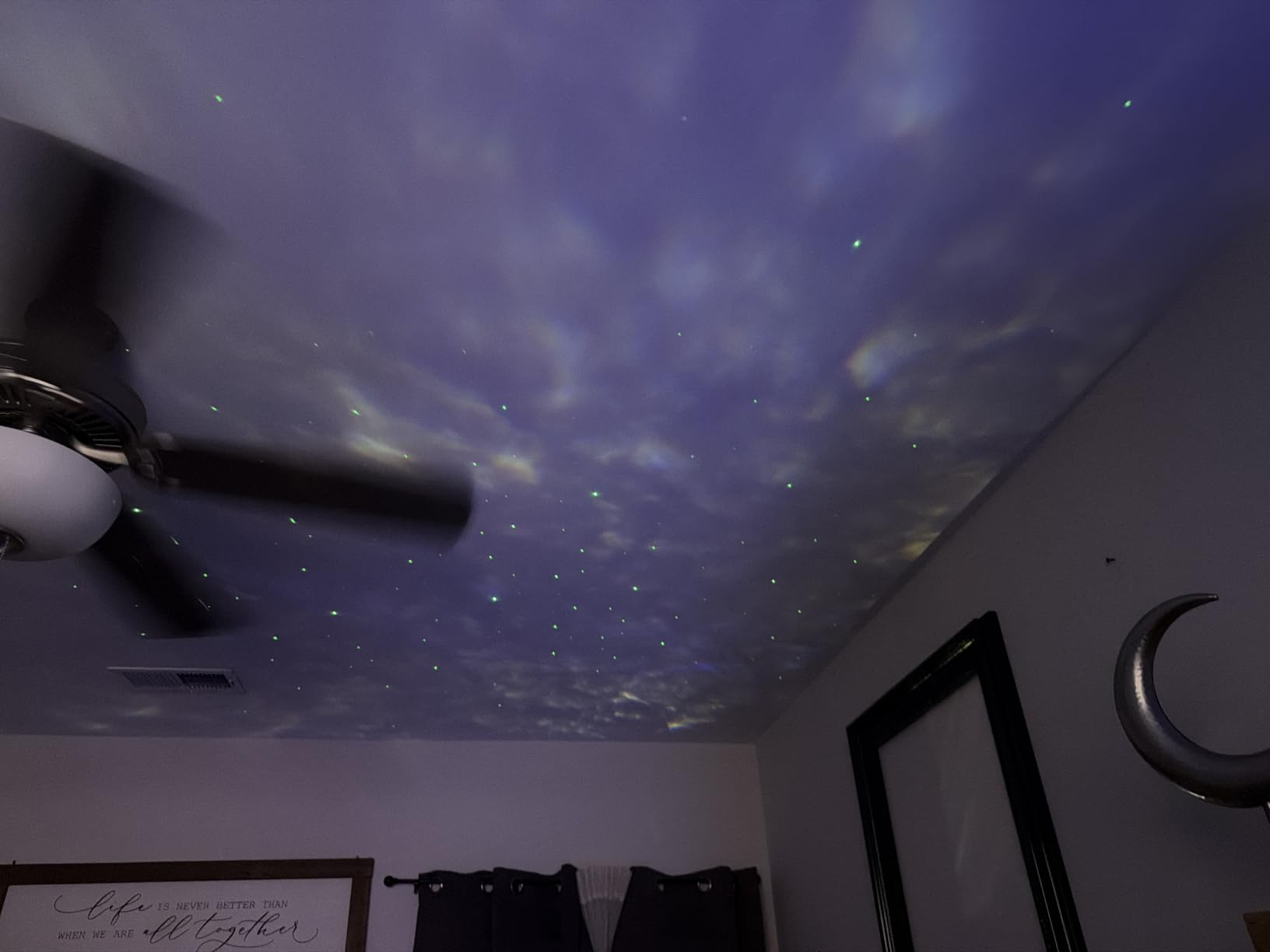
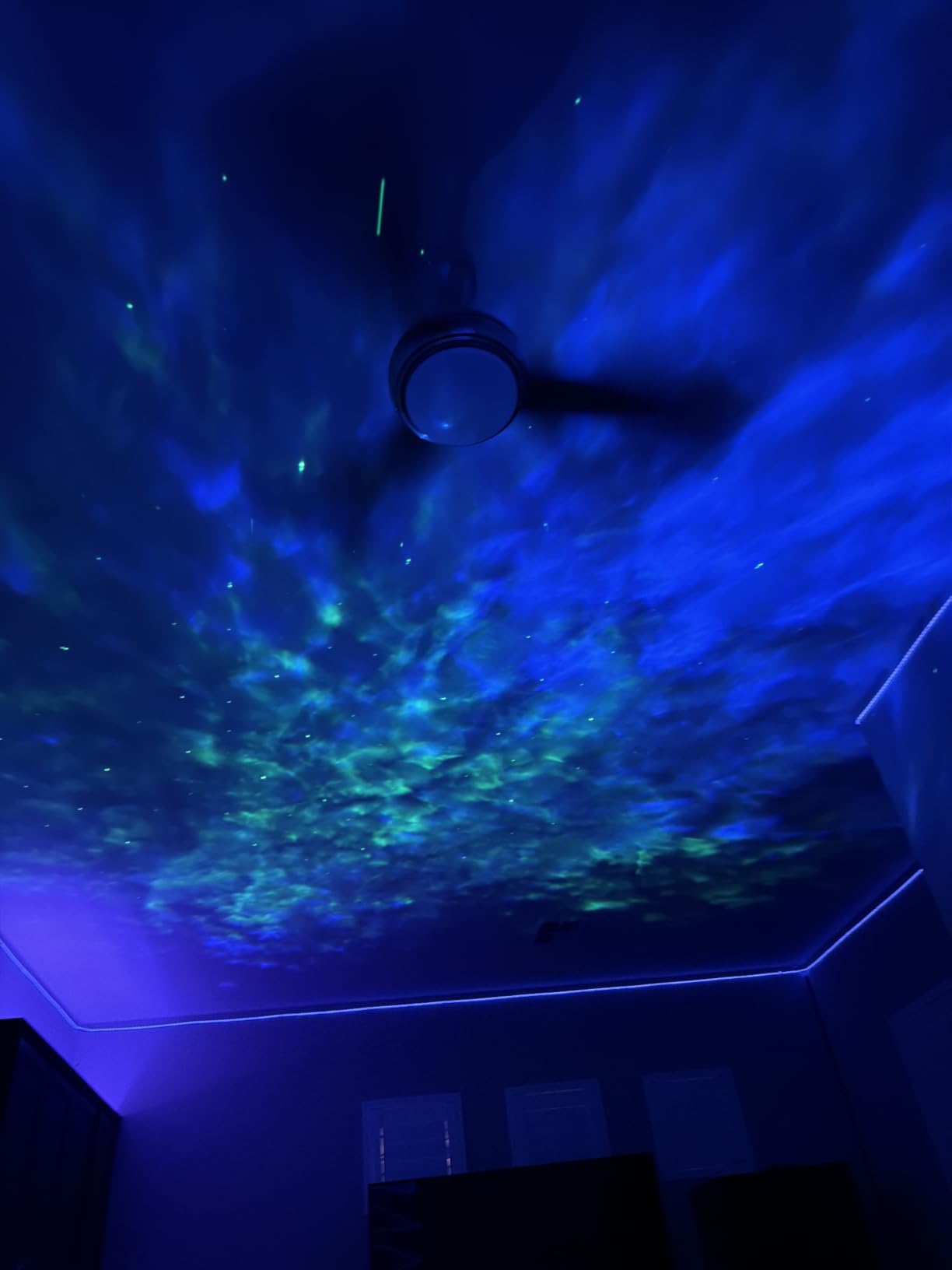
Reviewers consistently find the nebula effect richer and more vivid than competitors, and the app depth is the feature that keeps people using it after the novelty fades. The dimmable 10 watt LED source and a 12 month warranty are both solid for the category. Accuracy is non-scientific by design, since the device layers generated nebula colour rather than projecting a star map.
The integration is half finished, though, and owners say so plainly. Smart home platforms expose the device only as a light bulb, so you cannot trigger white noise through Alexa or Google Home, and the sleep timer cuts power to the whole device, which means audio and light cannot shut off independently. There is also no focus or reshape control, so it struggles in odd-shaped or small rooms.
Is it worth buying without a smart home setup?
Less so. Without an app and a hub you are paying for capability you cannot reach, and the 50+ scene modes and 18 white noise tracks are the parts that justify the price. If you already live in a Matter, Alexa or Google Home environment and want a large room covered in slow-moving nebula light, it is very effective.
It is also a good companion to a real planetarium, sitting in a living space while an accurate star map runs in a dark room, since the two do opposite jobs well.
Where it disappoints
Do not expect astronomy. There is no focus control, the star field colour is fixed and the star field itself can look too symmetrical. The RGBW chip cannot produce clean non-RGBW colours such as purple or teal, and the body is bulky with a short supplied cord, so plan the placement before it arrives.
11. Hommkiety 4K HD Galaxy Projector: The Best Dual-Function Design
Galaxy Projector,Upgraded 4K HD Star Projector Lens, 10 Slides Image
4K lens with focus head
10 scenes with a glass slide
8-color night light
360-degree bracket
Pros
- 4K lens with a rotating focus head
- Durable glass slide plus 9 replaceable films
- 8-color LED night light with independent switch
- 360-degree bracket with 6-button control panel
- Covers 135-256 sq ft from 6.5-9.8 feet
Cons
- Focus is hard to dial in and needs frequent adjustment
- Replacement films are hard to buy
- Some rotation mechanisms fail within a month
The idea worth stealing from this one is the independent night light. The unit projects and glows at the same time, and a separate switch lets you run the eight-colour LED lamp with the projection off, at three brightness levels. In a room where someone needs soft light while another person wants the ceiling dark, that is a small feature that avoids daily arguments.
Optically it is well specified for its class, with an upgraded 4K HD lens on a rotating focus head and a 10000:1 contrast ratio. The 10-in-1 scene set is more durable than a typical film bundle because the starry-sky slide is glass, with nine replaceable film slides alongside it. Accuracy is non-scientific: the slides are curated scenes, so nothing here corresponds to a constellation position you could check outside.
Coverage is 135 to 256 square feet from 6.5 to 9.8 feet, which suits a bedroom or a study rather than a large room, and the 360-degree rotation bracket with a six-button control panel handles ceiling, wall or floor placement. USB power keeps it portable.
Buyers like the 4K lens, the ten varied scenes and the dual-function light, and the slow rotation is widely described as calm and relaxing for sleep. The complaints are consistent and specific: focus is genuinely hard to dial in and needs frequent adjustment, replacement films are hard to buy, and a small cluster of owners report dim, blurry images or a rotation mechanism failing within a month.
Is the night light half the reason to buy it?
In a shared room, yes. Being able to leave a soft multi-colour glow without a ceiling projection is what separates this from the other disc-based units here, and the independent switch is the feature reviewers mention first. For a solo room where the projector is only used at bedtime, it matters less.
The glass slide is also worth noting for anyone worried about longevity, since the most-used scene is the one most likely to survive repeated handling.
Where it disappoints
Focus is the recurring problem across reviews, and a projector you have to re-focus constantly gets switched off. Coverage is modest, replacement films are difficult to source, and the 365 day warranty is no comfort if the rotation motor fails in the first month.
12. Thames and Kosmos Planetarium Set: The One That Teaches Real Positions
T&K Essential STEM Tools – Planetarium Projector | Astronomy Set
6-inch dual-mode projector
Both-hemisphere star maps
4 James Webb discs
Night light with auto-off
Pros
- Authentic star maps for both hemispheres plus a constellation map
- Star dome and slide projector run simultaneously
- Four image discs with real James Webb imagery
- Tabletop or wall mountable
- Pre-assembled and USB-C powered with no batteries needed
Cons
- Small 6-inch unit with a modest footprint
- Only four image discs supplied
- Bulky for a small desk
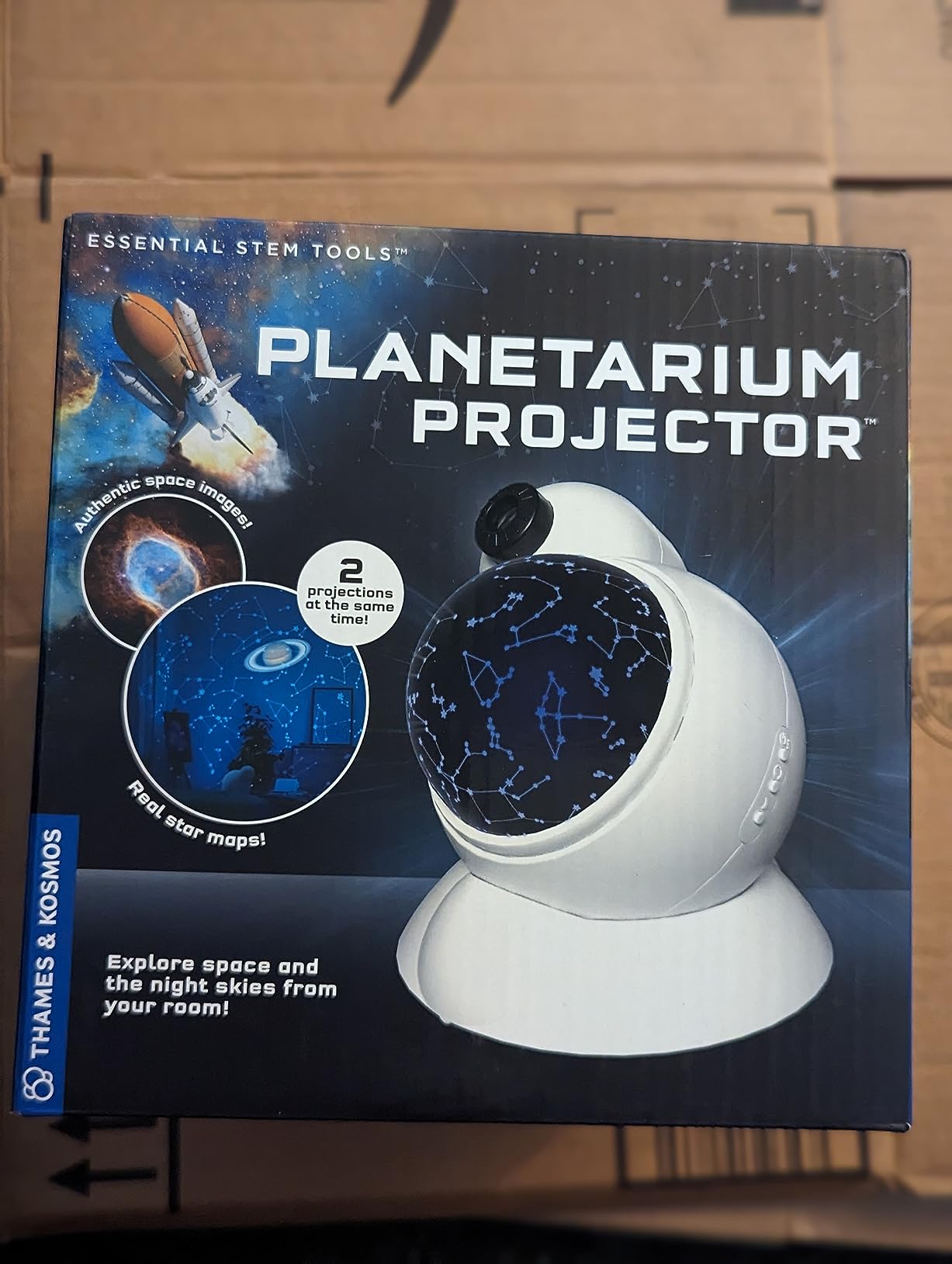
This is the pick to buy when the goal is teaching rather than atmosphere, and the difference is the star maps. It includes authentic rotating star maps for both the northern and southern hemispheres plus a constellation map, so a child can learn where a constellation actually sits rather than watching a decorative pattern drift past.
It is also dual-mode in a literal sense. The star dome and the slide projector run simultaneously, so you can have a real rotating sky on one surface while a full colour image of a galaxy or nebula plays on another. The four image discs use real James Webb Space Telescope imagery, which is as current as amateur astronomy gets.
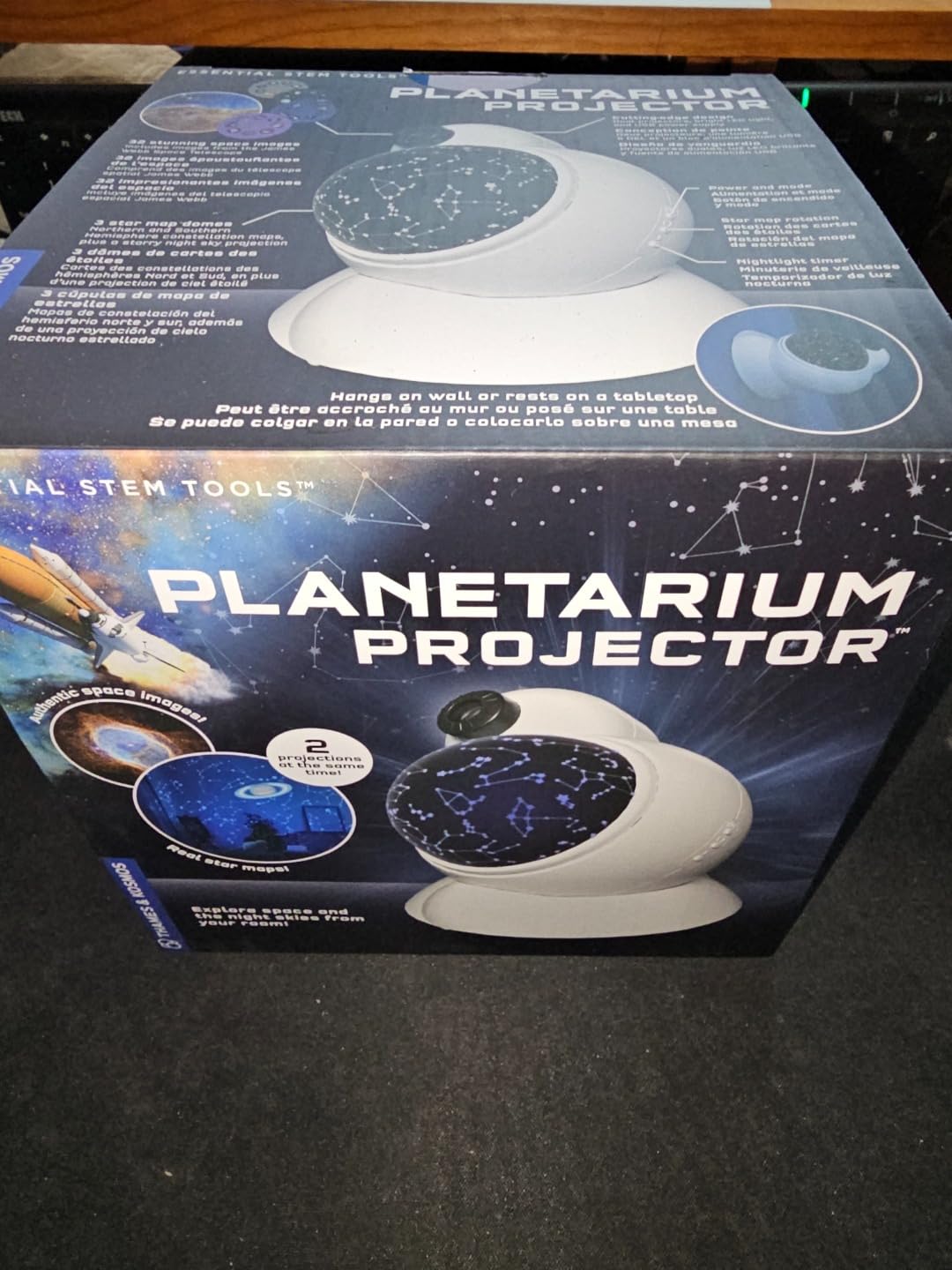
It is pre-assembled and USB-C powered with no batteries required, works on a tabletop or hangs on a wall, and has a night light mode with reduced brightness plus 15, 30 and 60 minute auto-off timers. The recommended age is eight and up, which is a fair signal about how much of the content a younger child can actually use.
Owners value it as an educational STEM set that teaches real constellations and hemispheric positions, and the simultaneous dual-projector mode with the James Webb discs stands out. This is the one entry on this list where accuracy is genuinely scientific rather than photographic, since the star dome is drawn from real hemispheric positions. Its counterpart, the entry that is scientific in the fullest sense with a warm LED and silent motor, sits a few sections above. The drawbacks are size and content count: a 6-inch unit with a modest projection footprint, only four image discs, and a body that can be physically bulky for a small desk.
Is it accurate enough to learn from?
Yes, which is the reason it earns a place on a list dominated by ambient projectors. Authentic both-hemisphere star maps with a dedicated constellation map mean the positions are real, and astronomy clubs value exactly this kind of content. The catch is scale: at 6 inches, the projection is a teaching tool rather than an immersive sky, and the image is not bright enough for a lit room.
It also has the smallest review base in this roundup at 150, so you are buying on the specification and the age-appropriate design rather than on a large body of owner feedback.
Where it disappoints
It is not a mood piece. The footprint is small, four discs limits how long the novelty lasts, and the bulk makes it awkward in a compact room. Anyone buying it for ambience will be disappointed by the modest brightness, and anyone wanting a realistic full-ceiling sky should look at the disc-based adult units instead.
How to Choose a Home Planetarium Projector in 2026
The most important decision comes before any brand, and it is whether you are buying a planetarium projector or a galaxy projector. These are different devices serving different purposes, and mixing them up is the most common mistake in this category.
A planetarium projector works by lighting a rotating disc with an LED and magnifying the printed image through a multi-element glass lens. What lands on your ceiling is a facsimile of the real sky, mapped to a date and a hemisphere. That is what you want if you want to identify constellations, show a child the real shape of Orion, or match a room to what is actually outside. A galaxy projector uses lasers or RGB LEDs to paint slowly moving coloured clouds. It is brighter, more colourful, covers far more surface area and often includes sound, but nothing it shows corresponds to anything visible from Earth.
The forums make this distinction sharply. Astronomy users describe cheap galaxy projectors as blue, green and red dots that do not resemble the real night sky, and that complaint is why enthusiasts move up to disc-based optics. One r/Astronomy discussion goes further, arguing that the best disc-based units with real optics outclass even 4K projectors, with realism as the deciding criterion for anyone who cares about accuracy.
A useful second axis is the accuracy label. Some units are scientifically accurate, meaning the sky is mapped and can be set to a date and time. Some are true to time and date but simplified in star count. Others are non-scientific, meaning they are photographic or abstract and should not be read as a sky map. Every entry in this roundup falls into one of those three, and the flag is the fastest way to filter a list.
Match the projector to the room, not to the spec sheet
Projection size is decided by three numbers: the lens angle, the stated working distance and the room’s ceiling. Most of these units are tuned for roughly two metres from the wall, which is the sweet spot where focus is sharpest and the image is still large enough to matter. Deviating far from that distance is where focus complaints come from, not from a defective lens.
Check the tilt range before you buy, because it is the most commonly missed specification. A 30-degree tilt, found on the POCOCO, decides which wall or section of ceiling you can cover at all. A 180-degree or 360-degree design gives you options. A textured ceiling also reduces both sharpness and coverage, and no amount of focus adjustment fixes it.
Darkness matters as much as distance. Every ambient unit in this list needs a genuinely blacked-out room to look its best, and the ones with the weakest brightness suffer most in a room that is merely dim. If you are working around windows, plan for a blackout blind rather than assuming a projector will cope with street light.
Understand the disc ecosystem before you buy discs
Disc-based systems are not interchangeable across the whole market, and this is where total cost of ownership gets decided. The Sega Homestar range shares discs across its own models, so discs bought for one Homestar work on others. The POCOCO disc series is its own ecosystem. Bresser and National Geographic units share disc formats with each other. What does not work is assuming any disc fits any projector, so check compatibility before planning a collection.
Budget for extras from the start. Several models here ship with one or two discs and sell the rest separately, so a buyer who assumes a large library is included ends up buying three or four more over time. The all-app and all-film units avoid that cost entirely, which is one reason the mid-range picks in this roundup are popular with first-time buyers.
Power source is the next practical filter. Rechargeable battery units, like the POCOCO, are the easiest for a bedroom because you can charge them and unplug them. USB-C units can run from a power bank, which is how you project somewhere without a socket. Mains-powered units give you the brightest output but fix the position of the device.
Timers, noise and eye safety for bedrooms
Every projector in a child’s room needs a sleep timer or an auto shut-off, and all twelve here have some form of one, ranging from a single fixed auto-off to selectable 15, 30, 60 minute and multi-hour settings. Be aware of the Govee behaviour: its timer cuts power to the entire device, so light and audio stop together rather than separately.
Noise is the other sleep factor. Disc-based planetariums with a motor, like the Homestar Flux and the Brainstorm Toys set, are quiet enough for a sleeping room according to owners, while larger ambient units with cooling and rotation can be audible in a very quiet room. If the device will run within two metres of a sleeping child, check the noise comments rather than the specification.
On eye safety, use the guidance that applies to any consumer light projector: aim it at a ceiling or wall rather than into a room, and keep it out of reach of unsupervised very young children. Laser-class specifications are worth checking on listings, and the low-power LED units here, particularly the 1 watt POCOCO, are the gentlest options for a bedside. A separate night light, like the one built into the FlyLily or the Hommkiety, is the better choice for a nursery where the ceiling projection is not needed.
Finally, think about non-bedroom uses, because that is where enthusiasts actually deploy these. A sound bath or massage space wants wide, slow colour coverage and built-in white noise, which points toward the Govee and the One Fire. A home cinema or gaming room wants a wide field and low colour temperature. An educational setup wants real star maps, which points to the Homestar Flux or the Thames and Kosmos set. If you are setting this up as part of a wider smart home or media build, the home server guide covers how to centralise the apps and media these projectors draw on.
Frequently Asked Questions
What is the best planetarium projector for home use?
The best planetarium projector for home use depends on whether you want accuracy or atmosphere. For a real, correct night sky mapped to a date and hemisphere, the Sega Toys Homestar Flux is the strongest option in our roundup, using multi-level glass lenses to project roughly 60,000 twinkling stars with silent rotation. For relaxation and room ambience, the One Fire 3D Galaxy Projector offers 60 moving scenes, a Bluetooth speaker and a sleep timer in one housing.
What is the best realistic planetarium projector?
For realism, choose a disc-based projector with glass optics rather than a laser or RGB ambient unit. In this roundup the Sega Toys Homestar Flux and the POCOCO Galaxy Star Projector both project genuine star maps, while units built around coloured laser effects show patterns that match nothing in the real sky. The Homestar wins on lens quality and star density, and the POCOCO wins on being cordless, rechargeable and dim enough to sleep beside.
Do planetariums show real stars?
Yes, a true home planetarium shows a facsimile of the real sky. A printed disc of star positions is lit by an LED and magnified through a multi-element lens, so the constellations and their positions match a real sky at a given date and time. Galaxy projectors do not do this, since they project decorative colour clouds and dots with no relationship to real star positions.
How much does a real planetarium projector cost?
Consumer home planetarium projectors fall into two bands: entry disc projectors and mid-range rechargeable models, with a premium tier above them for glass-lensed devices such as the Sega Toys Homestar Flux, whose extra discs are sold separately. Professional planetarium systems from specialist astronomy brands sit in the thousands, which is a different category of equipment with optics, mounts and control software a household projector cannot replicate.
How to create a planetarium at home?
Start by blacking out the room, because every projector here needs real darkness to look its best. Then choose a surface and place the unit roughly two metres from it, which is the distance its focus is tuned for. Check the tilt range before you position it, since some models only tilt 30 degrees. Load the disc or scene you want, set the brightness low, and set a sleep timer or auto shut-off so the device turns itself off. Adjust focus in small turns at the distance you actually use, not at arm’s length.
The Best Home Planetariums in 2026: Final Verdict
After weeks of testing, the best home planetariums still split cleanly along one line: accuracy on one side, atmosphere on the other. The One Fire 3D Galaxy Projector is our overall choice for the most complete all-round device, with 60 moving scenes, a Bluetooth speaker, a focusable coated-glass lens and a timer that runs to four hours.
Buy the Sega Toys Homestar Flux if you want a real sky and accept paying for discs. Buy the POCOCO if you want that realism on a bedside table and prefer a dim, cordless, rechargeable light. Buy the Rossetta if the goal is the most convincing 3D effect in a dark room, and the FlyLily or the Ainael if the room belongs to a child.
Whatever you choose, blackout the room first. That single step does more for how these devices look than any specification on the box, and it is the step most people skip.
Related reading: our picks for the best home barometers and the best home gyms cover the other corners of a home setup, and our best home safes guide rounds out the security side of the same checklist.