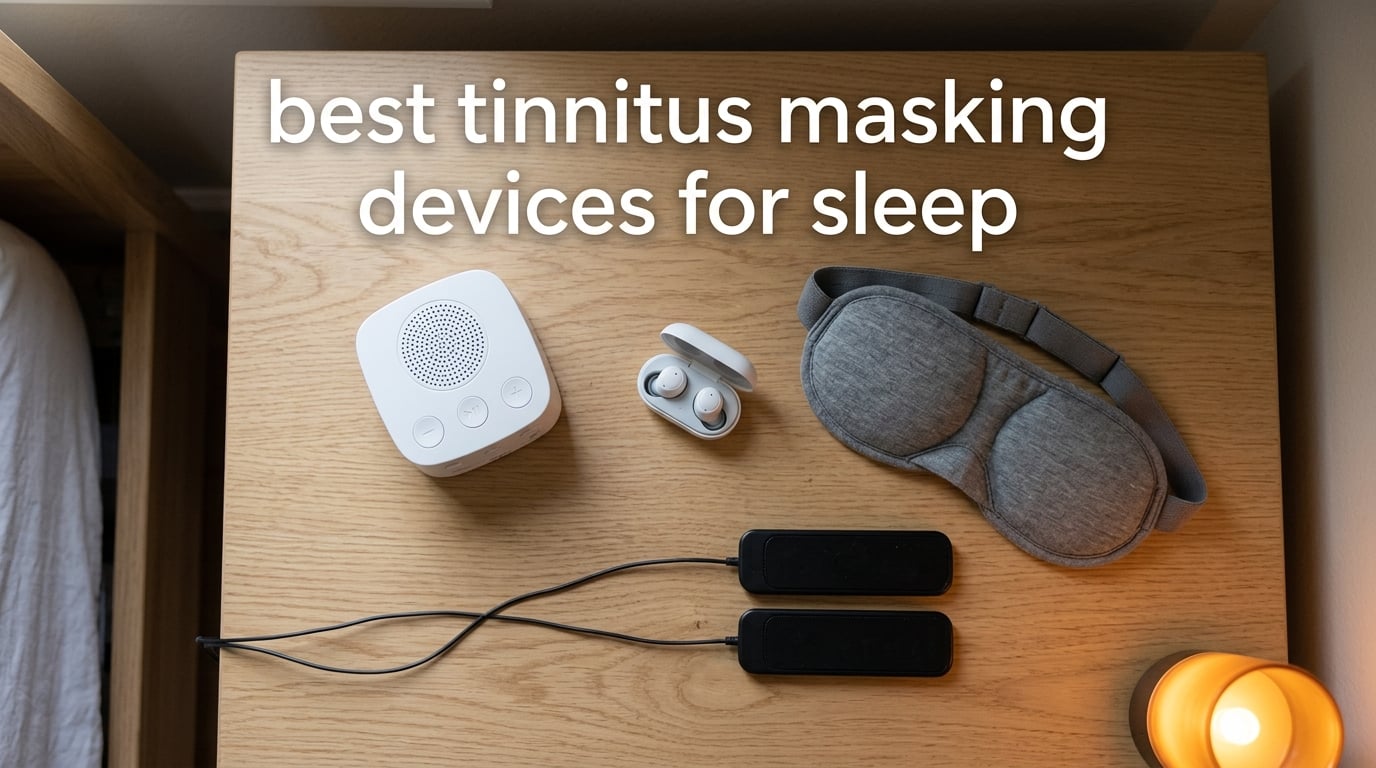
Yes, masking devices help with tinnitus at night, and the effect is usually dramatic rather than subtle. A steady sound source in the bedroom raises the noise floor so your brain has something to land on besides the ringing, and for most people that is the difference between falling asleep in twenty minutes and lying awake for two hours.
The problem is that tinnitus is loudest in exactly the room where you need quiet. A daytime office is full of background sound. A silent bedroom at 2am is not, and that silence is when the ringing takes over. The people who rate masking devices highest are usually the ones whose tinnitus spikes at bedtime, not the ones who notice it all day.
We went through the current generation of bedside sound machines, fan-based machines, in-ear sleep earbuds, under-pillow speakers and audio sleep masks to find the ones that hold up over a full night. Ten devices made the cut, grouped by device type so you can skip straight to the category that fits your bedroom and your sleeping position.
If your problem is pressure from earbuds on a pillow, our guide to sleep headphones for side sleepers covers the fit problem in more detail than we can here.
Table of Contents
Top 3 Best Tinnitus Masking Picks for Sleep in October
The LectroFan Classic takes the top slot because it is the least fussy of the group. It plays 20 non-looping sounds, it runs off USB, it is small enough for any nightstand, and its 4.6 average across nearly 25,000 reviews tells you it has been running in real bedrooms for years.
The Magicteam machine is the volume-per-pound option. Thirty-two volume steps and a memory function mean you set it once and never touch it again, which matters at 1am when you are fumbling in the dark.
The SNOOZ Pro is the pick if your tinnitus is tangled up with a snoring partner, street noise or a busy house. A real fan inside gives it a deeper, smoother floor than most digital machines, and the app scheduler means it starts before you do.
Best Tinnitus Masking Devices for Sleep at a Glance in 2026
Everything below is a physical device, not an app. We listed all ten so you can compare types side by side before you commit, and every entry was checked against owner feedback rather than manufacturer claims alone.
| Product | Specifications | Action |
|---|---|---|
 LectroFan Classic LectroFan Classic |
|
Check Latest Price |
 Sound + Sleep White Noise Machine Sound + Sleep White Noise Machine |
|
Check Latest Price |
 Magicteam Sound Machine Magicteam Sound Machine |
|
Check Latest Price |
 Yogasleep Dohm Nova Yogasleep Dohm Nova |
|
Check Latest Price |
 Sound Oasis Bluetooth Sound Machine Sound Oasis Bluetooth Sound Machine |
|
Check Latest Price |
 SNOOZ Pro SNOOZ Pro |
|
Check Latest Price |
 Sleenova SoundMask Sleenova SoundMask |
|
Check Latest Price |
 Ozlo Sleepbuds 2 Ozlo Sleepbuds 2 |
|
Check Latest Price |
 Sound Oasis Pillow Speakers Sound Oasis Pillow Speakers |
|
Check Latest Price |
 Sound Oasis Tinnitus Therapy System Sound Oasis Tinnitus Therapy System |
|
Check Latest Price |
How Tinnitus Masking Works When You Lie Down
Do white noise machines work for tinnitus? Yes, for most people they are one of the cheapest and most reliable ways to get through the night, and the reason is mechanical rather than mysterious. Continuous background sound raises the noise floor of the room, which reduces the contrast between your tinnitus and everything else, which makes the ringing less noticeable and less likely to pull you out of sleep.
There are two separate effects and they are worth separating. The first is immediate masking: the sound overlaps the ringing and covers part of it. The second is habituation, where a consistent sound source gives your brain something predictable to learn to de-prioritise. Clinicians tend to value the second effect more, but the first is what gets you to sleep tonight.
Silence is the enemy here. In a truly quiet room your brain has nothing else to attend to, and attention is exactly what amplifies a tinnitus signal. A running fan, a rain loop or a bedside machine replaces that empty attention with a low-level input your brain can ignore without effort.
Frequency matters as much as volume. Broadband noise such as white noise covers a wide range, so it works for most pitches. Narrowband sources such as a fan or rain tend to sit in the lower and middle range, which suits low-pitched ringing. A high-pitched hiss suits the opposite case. If your masker works at one volume but the ringing still cuts through, the sound is in the wrong band, not too quiet.
One honest limit before we get into the list: masking reduces perception, it does not treat the underlying cause. Nothing in this roundup stops tinnitus permanently.
The Four Device Types and Who Each One Fits
There are four ways to add sound to a bedroom, and picking the wrong one is the most common reason a device gets abandoned in a drawer after a week.
Bedside sound machines sit across the room and flood the space. They are the easiest option because nothing touches your face, they run all night on mains power, and they mask a snoring partner as well as your own tinnitus. This is the category most people should start with, and it is the one with the most owner feedback behind it.
In-ear sleep earbuds deliver sound directly to your ear canal. They are the most powerful masker per decibel and the most private, since a partner hears nothing. The trade-off is comfort, ear pressure when side sleeping, and the fact that some people simply cannot wear anything in their ears overnight.
Under-pillow speakers point sound into the pillow so it reaches your ear through fabric. They sit between the two: no earbud pressure, more private than a room-filling machine, and they can be loud enough for hard-of-hearing users. You still need a separate sound source to feed them.
Wearable audio sleep masks combine blackout and sound in one fabric band around the head. They suit side sleepers who want audio without an earbud in the canal, and they block light as a bonus. They cost more than a plain machine and their review histories are thinner.
Phone apps fill the same role with no hardware, and they cost nothing. What you give up is battery: a phone on the nightstand playing all night will run flat, and once it does the silence comes straight back.
Which Masking Sound Matches Your Tinnitus Pitch
The most effective tinnitus masking sound is the one that overlaps your pitch, and matching pitch beats turning up volume every time. Most of the machines below carry a range, so you can experiment in a minute rather than buying blind.
For high-pitched ringing, which many people describe as a hiss or a mosquito, look for white noise, blue noise or high-frequency shimmer tracks. Pink noise also works well here because it tilts slightly brighter than brown.
For low-pitched or tonal ringing, the drone-type sounds sit closer to the signal. Brown noise, a deep fan, a box fan or low ocean swell usually cover it with less volume.
For a pulsing or heartbeat-style sound, cover it differently. Pulsatile tinnitus has a different set of causes and deserves an audiology appointment, not a louder fan.
For broadband coverage when you are not sure of your pitch, continuous fan and HVAC noise is the classic choice, and owners on tinnitus forums describe it as the most effective and simplest masker they have used.
For low-frequency rumble from a snoring partner or a shared wall, brown noise and deep fan tones outperform rain and birdsong, which sit too high to cover it.
Always prefer continuous, non-looping playback. Tracks with a silent gap between them can wake you, and that is the moment your brain notices the ringing again.
1. LectroFan Classic – The Set-It-Once Bedside Machine
Adaptive Sound Technologies LectroFan Classic Sound Machine, Black
20 non-looping sounds
USB powered
4.13 inch cube
12.8 ounces
Pros
- 20 sounds never loop back on themselves
- Small enough for any nightstand
- USB power means no charging routine
- Memory-style simplicity
- Very large owner review base
Cons
- No Bluetooth or app
- USB only so it will not run untethered
- Smaller sound library than big multi-sound machines
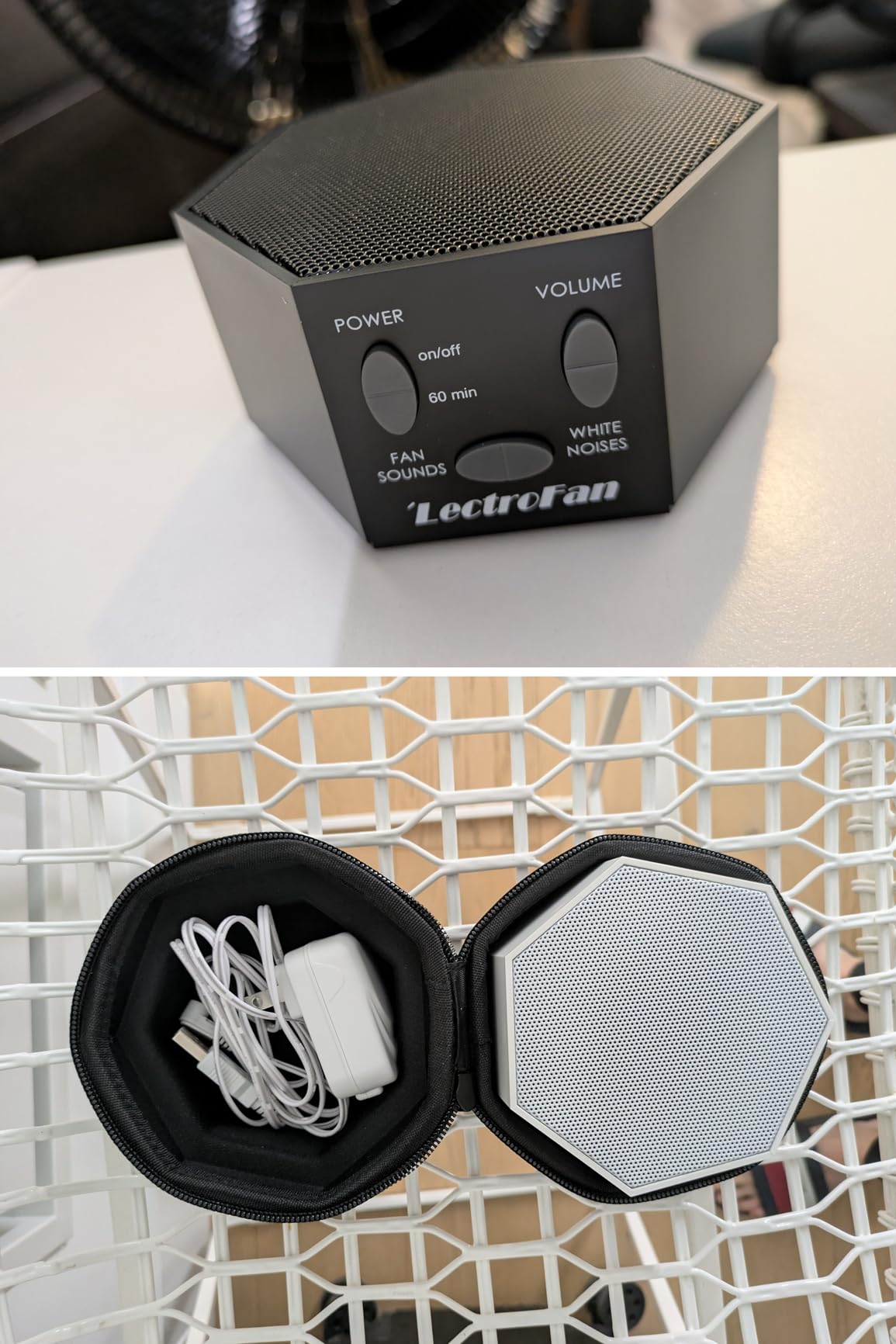
The LectroFan has been on the market since 2014, and its 4.6 average across 24,907 reviews is the highest star rating in this group backed by a deep owner history. It is a 4.13 inch cube weighing 12.8 ounces, so it takes up very little of a nightstand.
That size is the quiet advantage. You can place it close to the pillow without it feeling like a piece of furniture, and close placement means you can hit masking level at a lower volume setting, which matters when the goal is eight hours of playback.
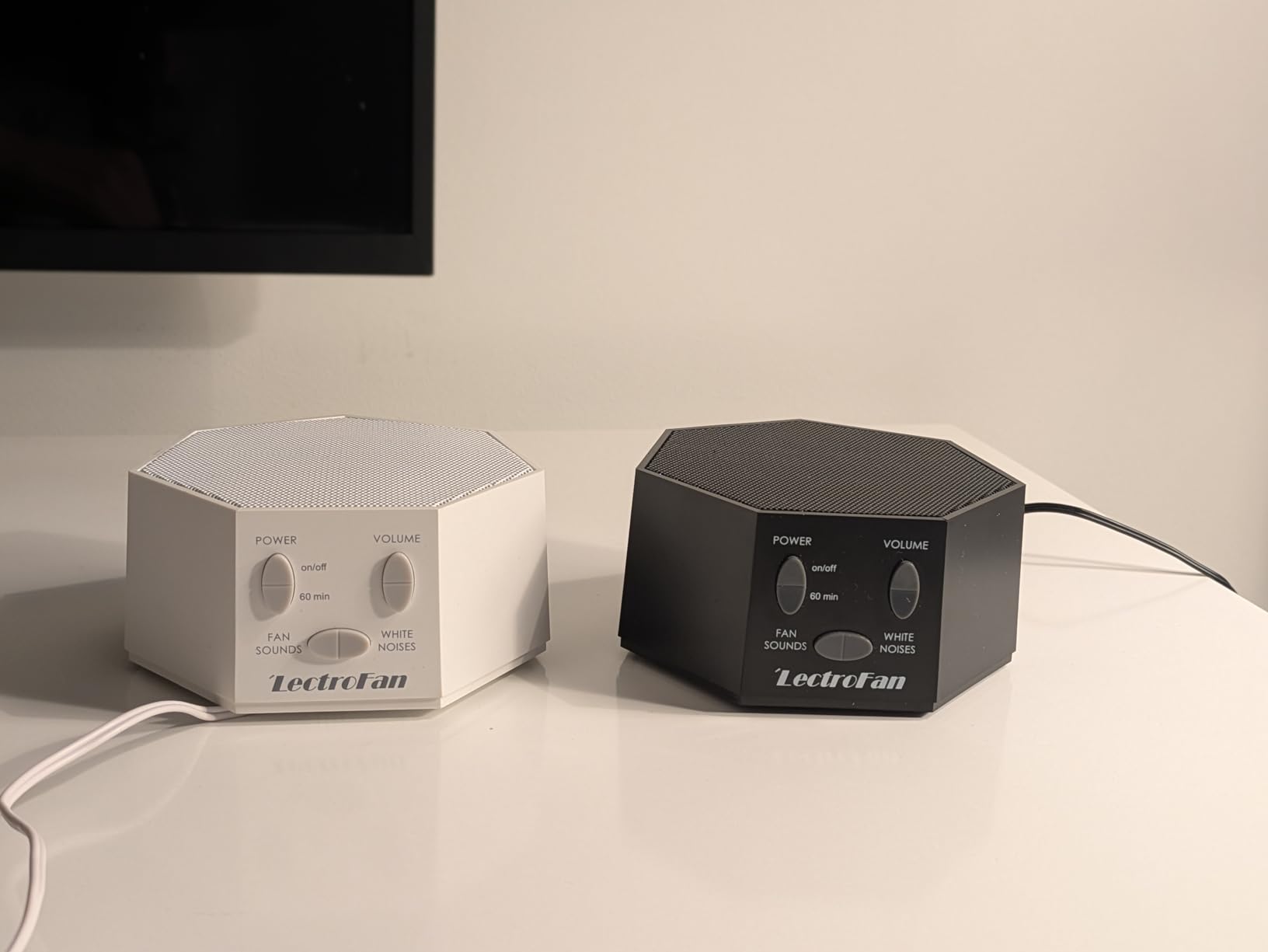
It carries 20 non-looping sleep sounds, meaning each track is long enough that you will not hear it restart. The library covers fan, rain, water, birds and a broad set of broadband tones, so frequency matching is something you can do with the dial rather than with new hardware. Volume steps are described as precise rather than coarse.
The build is a solid-state design with no moving parts, and it runs entirely off USB. There is a built-in sleep timer with automatic shutoff, which matters more than it sounds: a machine that keeps playing until morning keeps reminding you it is still there.
Who it works for most
Anyone whose bedroom is quiet and whose tinnitus is broadband enough that a few different tracks can cover it. If you have never used a sound machine before, this is the one to start with, because there is nothing to learn and nothing to charge.
It is also the safest first purchase for people who share a bed. A room-filling machine is audible to a partner, but it is a background hum rather than music, and most partners adjust within a night or two.
Where it falls short
There is no Bluetooth and no app, so the sound library is fixed at whatever you bought. If you want to test a specific tinnitus frequency match or stream your own audio, this machine cannot do it and you would need a phone speaker instead, which is a poor substitute for an eight-hour masking source.
It also needs to be plugged in. That is fine on a nightstand and useless in a hotel room unless you carry a power bank. If you travel with your masker, look at the rechargeable option further down.
2. Sound + Sleep – Built for Masking Snoring and Shared Walls
Adaptive Sound Technologies Sound + Sleep White Noise Machine, Black
30 non-looping stories
Adaptive Sound mode
3.5mm jack
2 pounds
Pros
- Adaptive mode reacts to sudden noise
- 30 stories with no audible loop
- Three richness levels
- Display button kills all lights
- Gradual timer fade
Cons
- Reliability reports of static and early failure
- Sounds described as low-definition
- Richness effects can be jarring
- No continuous volume dial
This is the machine owners most often buy specifically for tinnitus, usually alongside a snoring partner or a thin wall. The Adaptive Sound Technology is the headline: a built-in microphone listens to the room and raises the volume when an unexpected noise appears, then settles back down.
On a night when a truck goes past at 1am, that automation is the difference between waking up and staying asleep. The company backs it with a 30 day risk-free guarantee and a one year parts warranty, which is unusually generous for a device at this level.
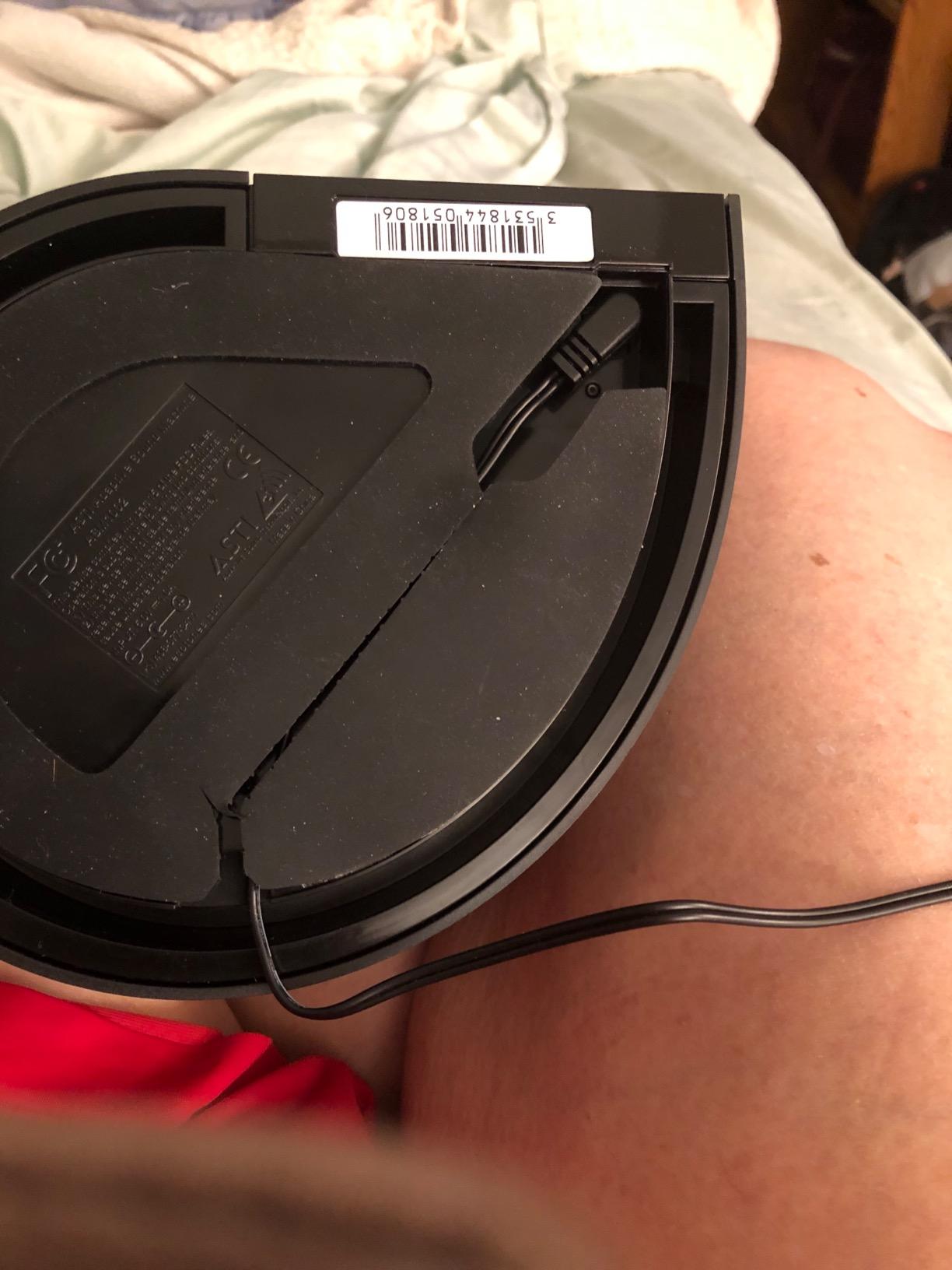
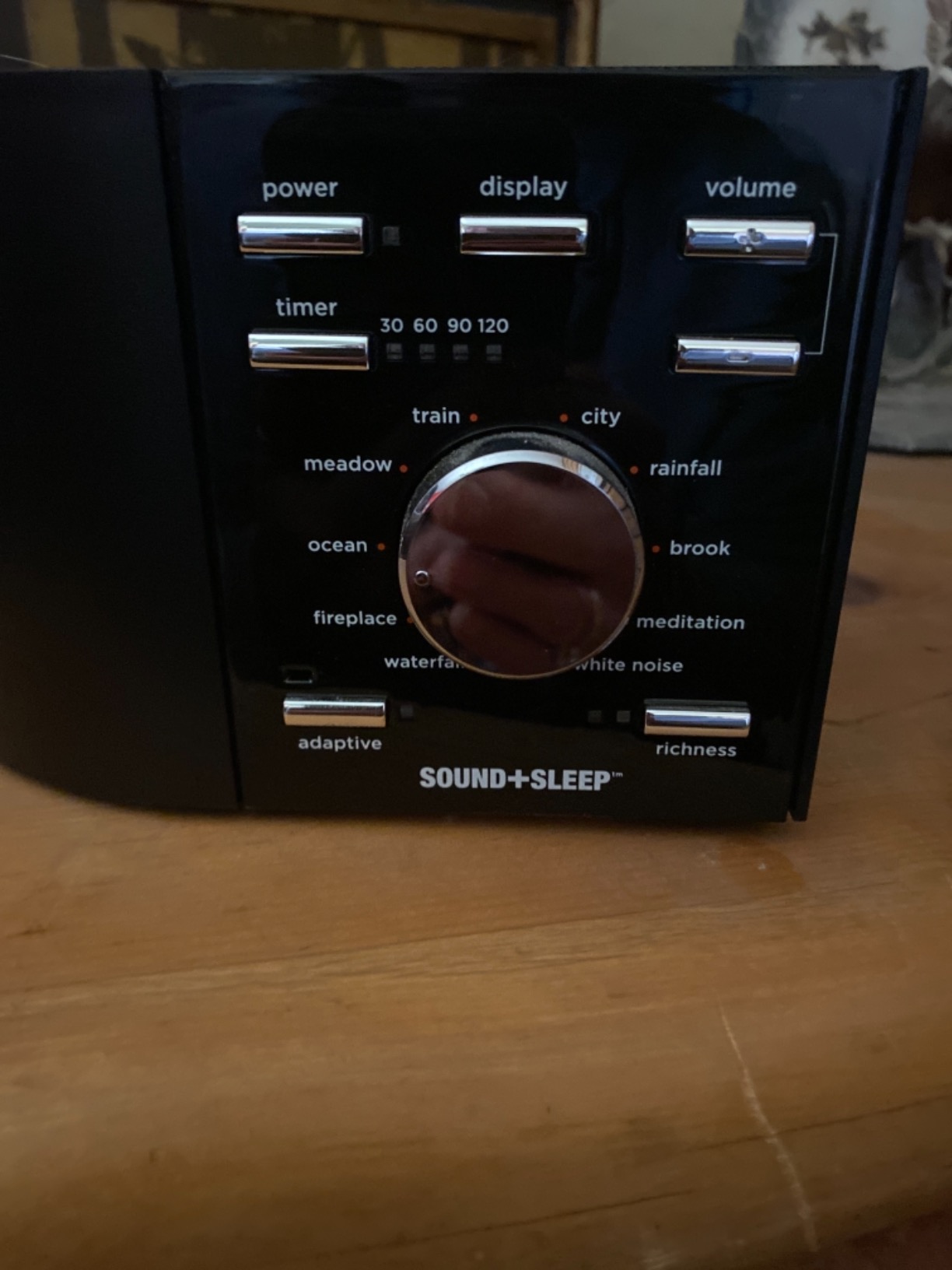
The 30 sound stories never loop back on themselves, and each one has three richness levels that add random variation so your brain cannot lock onto a repeating sequence. Water-based tracks like rain, waterfall and brook are the ones some listeners find thin, but the broadband tones are strong.
Volume is adjusted with repeated button presses rather than a dial, and there is no maximum indicator, so finding your level at bedtime takes practice. A separate button turns off the display entirely for full darkness, and the sleep timer fades gradually instead of cutting out.
When the adaptive mode is worth it
If you share a bed with a snorer, this is the strongest match in the roundup. Snoring arrives in unpredictable bursts, and a machine at a fixed level gets buried every time. The adaptive response pushes the masking level up for the burst and brings it back afterwards without you touching anything.
It also has a 3.5mm headphone jack as well as its 3.5mm input, so you can plug in a set of open earbuds for private listening if the room machine is too much for a partner.
Where it falls short
Reliability is the real concern. Multiple reviews describe machines developing static or buzzing, or failing outright, within a month or two of use, which is why the average sits at 4.1 rather than higher despite a large review base.
Sound fidelity is the second concern. The richness mode layers random effects that some listeners find culturally jarring, and a few reviewers describe the water sounds as low-definition. If you are picky about audio, test this one over several nights before you commit.
3. Magicteam Sound Machine – The Most Volume Steps and Owner Reviews
Magicteam Sound White Noise Machine with 20 Non Looping Natural Soothing Sounds and Memory Function 32 Levels of Volume Powered by AC or USB and Sleep Sound Timer Therapy for Baby Kids Adults
20 non-looping sounds
32 volume levels
Sleep timer
3.01 inch body
Pros
- Loud for a 3 inch unit
- 32 volume steps
- Non-looping audio
- Memory restores your settings
- Gradual timer fade
- Very large review base
Cons
- No internal battery
- Closely spaced unlabelled buttons
- Sound can peter out in large rooms
- A few early failures
With 69,037 reviews at a 4.5 average and a number one best seller ranking in its category, the Magicteam has more verified owner history than any other device on this list. That matters for a category where reliability matters more than features, because you are buying something that has to run every single night.
The 32-step scale is unusually fine control for a machine this small, and it is the reason the box can drown out heavy household and street noise without you having to set it right at the edge of what is comfortable.
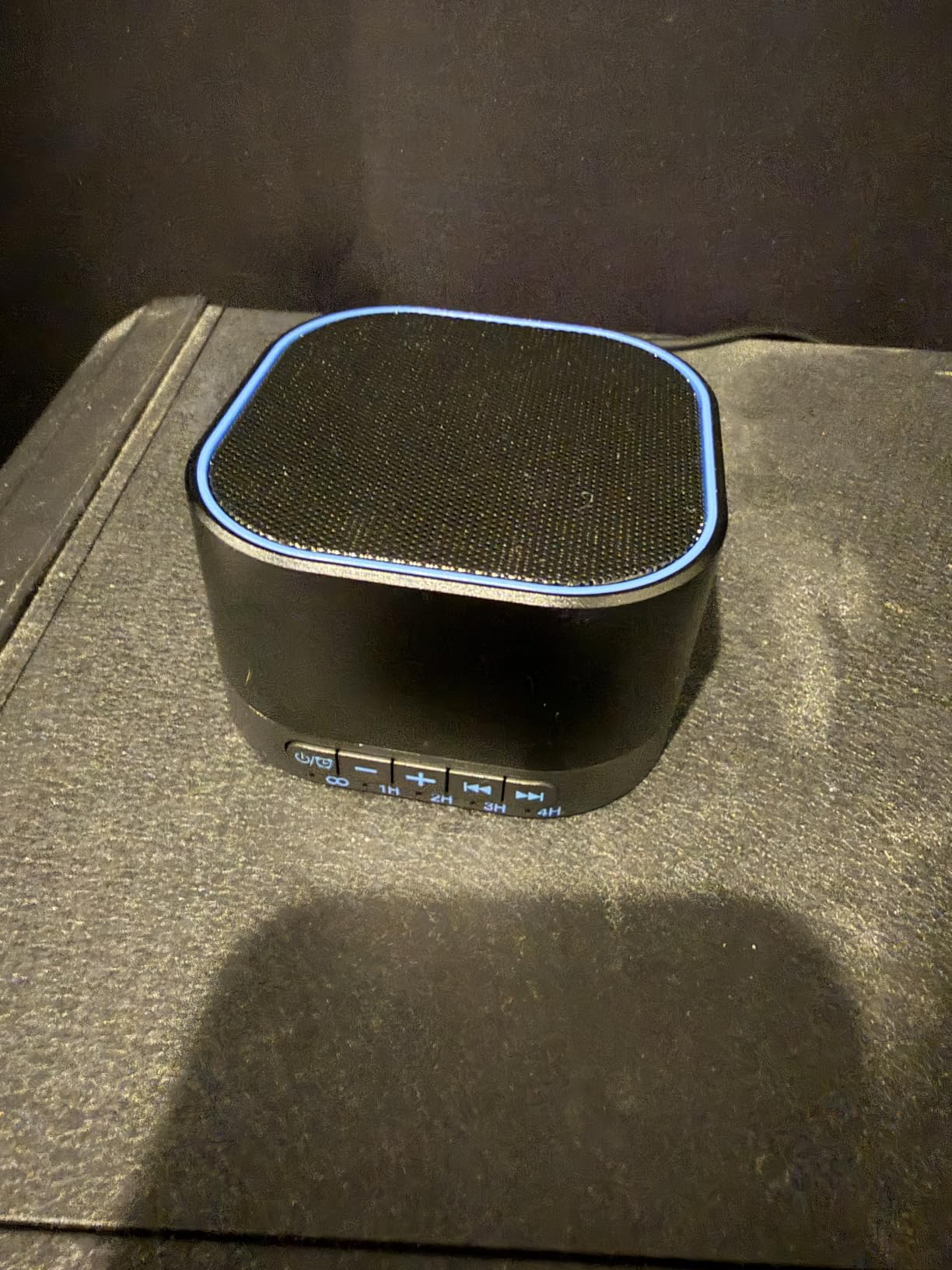
The sound library has 20 non-looping tracks including white, brown, pink and blue noise, plus fan, brook, rain, ocean, birds and bonfire. That spread is unusually good for frequency matching: the pink and blue noise cover high-pitched ringing, the brown noise and fan cover low-pitched and tonal cases.
The memory function is the sleeper feature. It restores the last sound, volume and timer you used, so after two nights you never touch the controls again. The timer offers 1, 2, 3, 4 hour or continuous, and it fades out gradually rather than stopping dead.
Why the fine volume control matters
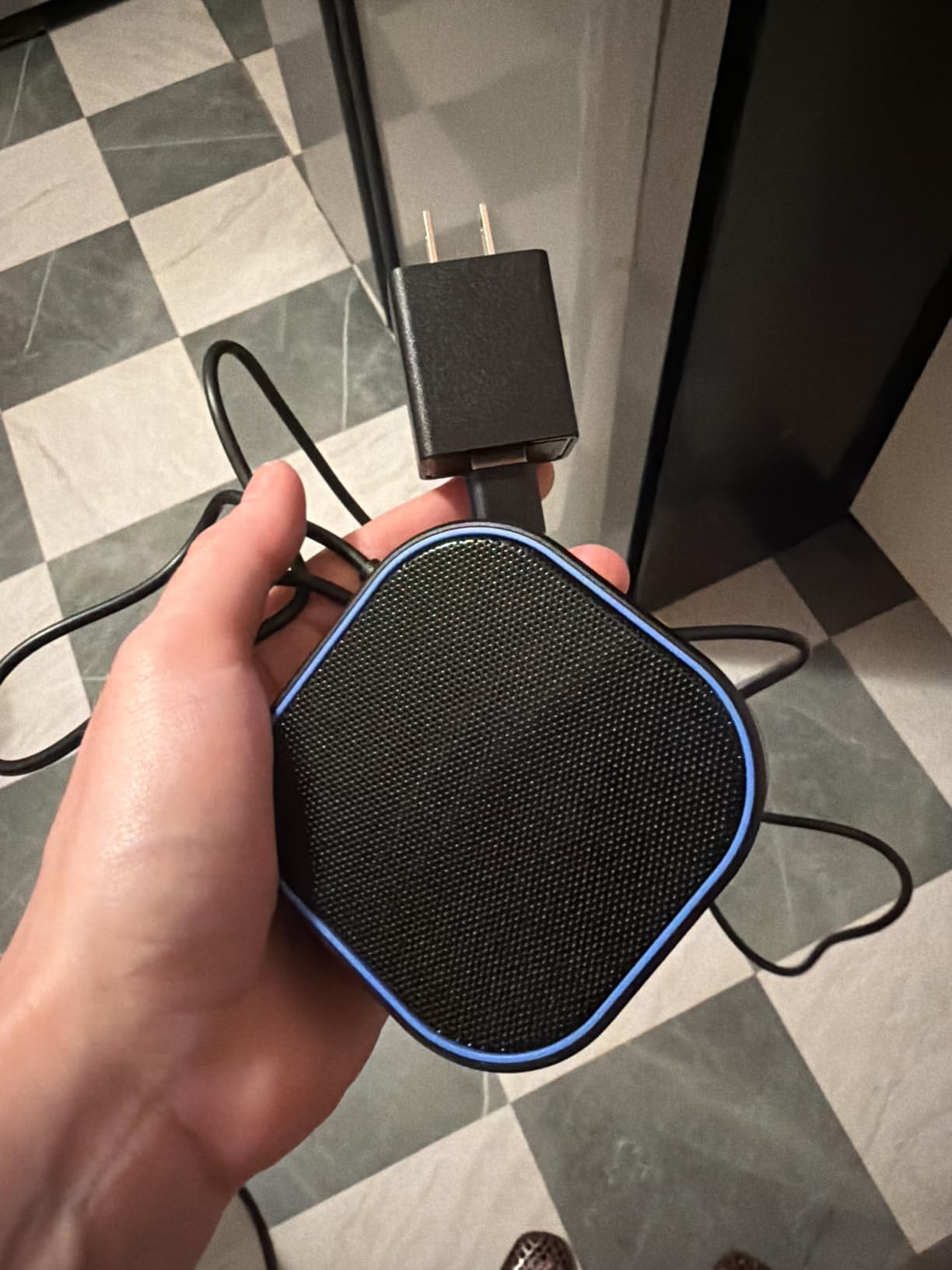
Tinnitus maskers have a real floor problem. You need enough level to cover the ringing, but you also need to stay under a level that is safe for eight hours straight. Thirty-two steps let you land inside that narrow band rather than choosing between too quiet and too loud.
The body is 3.01 inches square and weighs 5.76 ounces, and owners frequently buy a second one as a travel unit. The buttons are dim enough not to light the room.
Where it falls short
There is no internal battery at all. It is inert unless you plug it into a wall outlet, a USB port or a power bank, so hotel nights take an extra cable in your bag.
The buttons sit close together with no embossed icons, and owners report hitting the timer by accident in the dark. Getting back to a favourite sound means scrolling through the full list each time. In larger rooms a few reviewers also report the output petering out at maximum volume.
4. Yogasleep Dohm Nova – Real Fan Sound Without the Blown Air
Yogasleep Dohm Nova White Noise Sound Machine, Better Sleep for Babies & Adults. Includes Night Light, 10 Fan Speeds & Calming Pink Noise for Louder Noise Masking. Noise Canceling for Office Privacy.
Real fan-based noise
10 fan speeds
Dimmable amber light
5.6 inch body
Pros
- Mechanical fan tone many find less tiring
- No air blown at the sleeper
- Shell twist plus 10 speeds
- Amber night light
- Washable fabric cover
Cons
- Fan can develop a grinding noise over time
- Volume steps are large
- Top buttons unmarked in the dark
- No continuous timer option
If digital white noise makes you tense, the Dohm Nova is a genuinely different proposition. It uses a real fan inside, which means the sound is mechanically generated rather than synthesised, and a large share of owners describe that tone as far less fatiguing over a long night.
It is worth understanding why this matters for tinnitus. Digital noise sits in a narrow, even band, and your brain eventually notices it as an artefact. A fan tone has small natural variations, so it behaves more like an environment and less like a playback error.
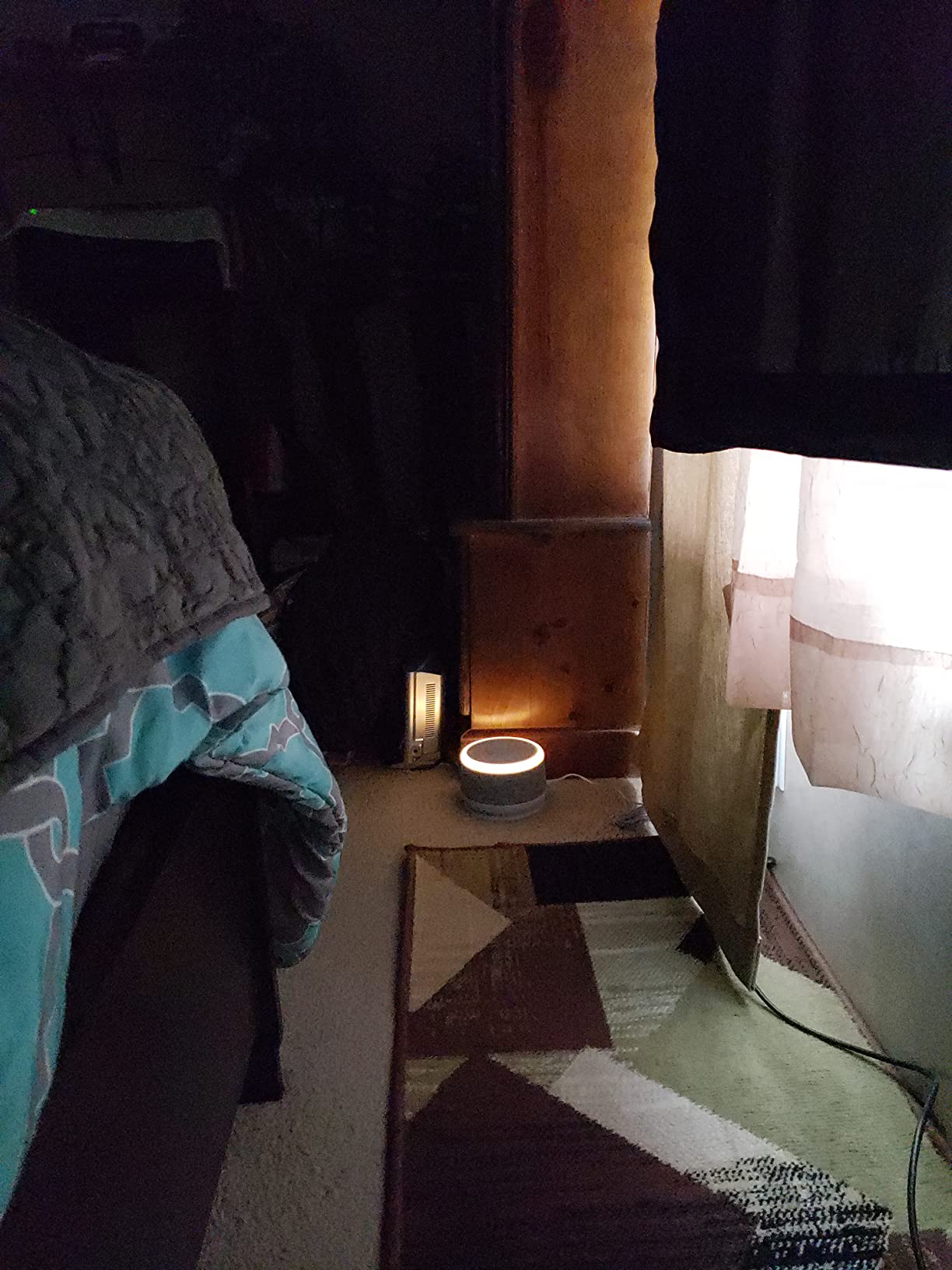
Control is a two-stage affair. You pick one of 10 fan speeds with the volume buttons and then twist the outer shell to shift the tone. That combination gives finer control than the ten steps alone would suggest, and the washable fabric overlay lets sound through while keeping the machine looking like an object rather than a gadget.
The dimmable amber night light is the sleeper favourite, designed with circadian rhythm in mind rather than as an afterthought. Multiple reviews single it out, particularly from people sharing a room with a baby.
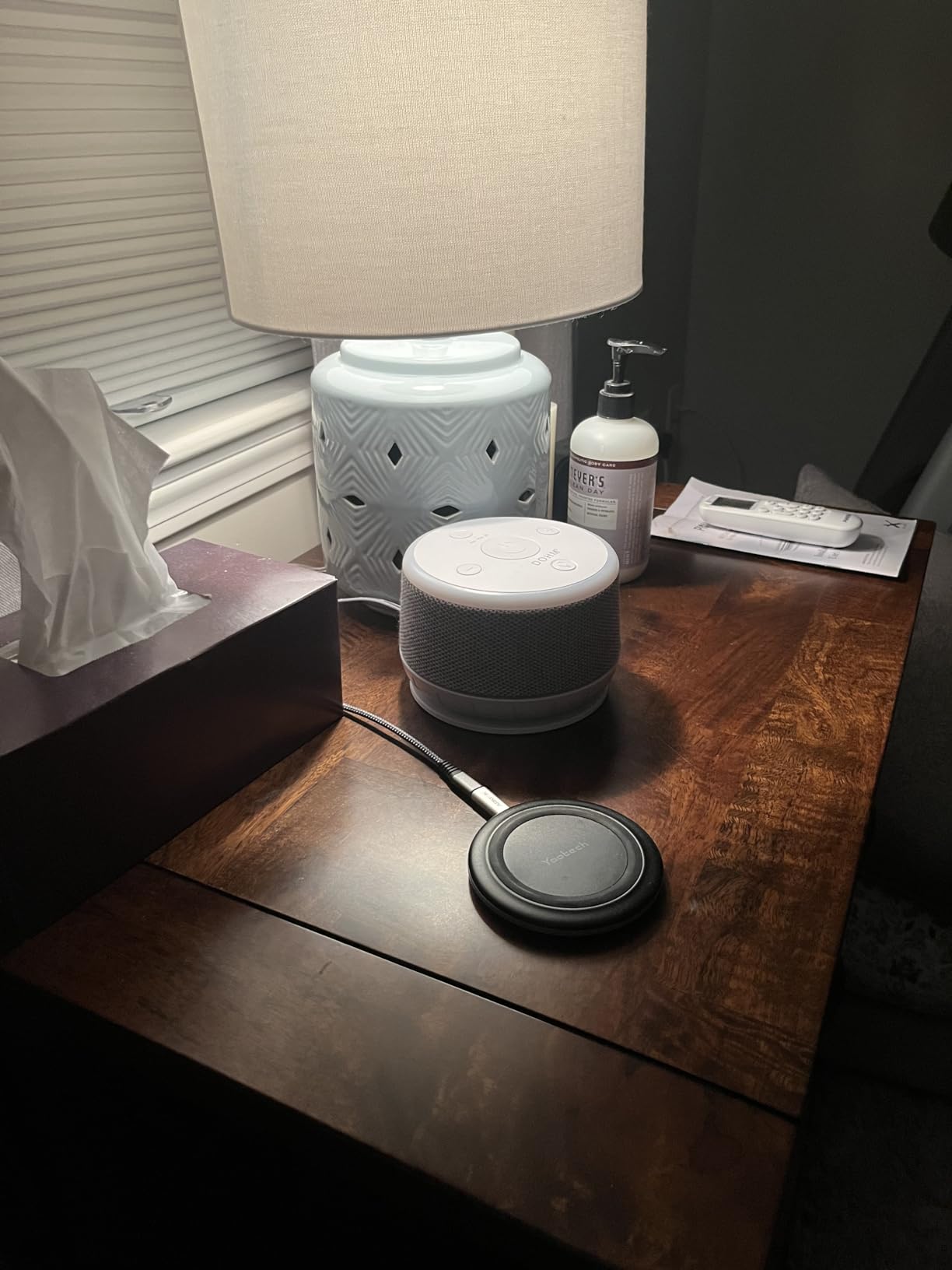
Why fan tone suits some tinnitus pitches
Fan noise is concentrated in the low and middle range, which makes this a good match for tonal, low-pitched ringing. It is the sound tinnitus forums recommend most often for exactly that reason, and it is often the first thing people try before spending money on anything else.
Owners also report it working against voices, cars and traffic, because a real broadband mechanical source covers more of the spectrum than rain or birdsong tracks do.
Where it falls short
Durability is the main negative pattern. Several reviews describe the internal fan developing a grinding noise after somewhere between six months and two years, with replacements sent by the company but the same issue recurring.
Volume steps are large, so fine adjustment takes getting used to, and the top buttons have no tactile markings for finding in the dark. The timer only offers 45 minutes, 90 minutes or 8 hours, with no continuous setting, which is a genuine limitation for someone who wants sound that runs past the timer.
5. Sound Oasis Bluetooth Sound Machine – The Tanker for Travel and Snoring
Sound Oasis Bluetooth White Noise Machine – Portable Sound Machine with 20 Non-Looping Nature, Pink & Brown Noise Sounds, Tinnitus Masker for Sleep, Baby, Office & Travel, Rechargeable
20 non-looping tracks
Bluetooth and microSD
Rechargeable battery
2.75 inch body
Pros
- Marketed explicitly as a tinnitus masker
- Very loud for its size
- Rechargeable for 7 to 8 hours or more
- Also works as a Bluetooth speaker
- microSD slot for custom libraries
Cons
- No built-in sleep timer
- Tiny unlit buttons
- Some reports of sound cutting out
- Track-end ramp can wake light sleepers
This is one of the few units in the roundup positioned explicitly as a tinnitus masker rather than a general sleep machine, and users with ringing ears report that the positioning is not just marketing. The 20 built-in soundtracks live on an included microSD card, and the deep white and brown noise tracks are the ones most often credited.
Loudness is the surprise. From a 2.75 inch metal-bodied unit, output is high enough to drown out snoring and street noise, which is a fair test for anyone whose tinnitus is loud enough to compete with a partner.
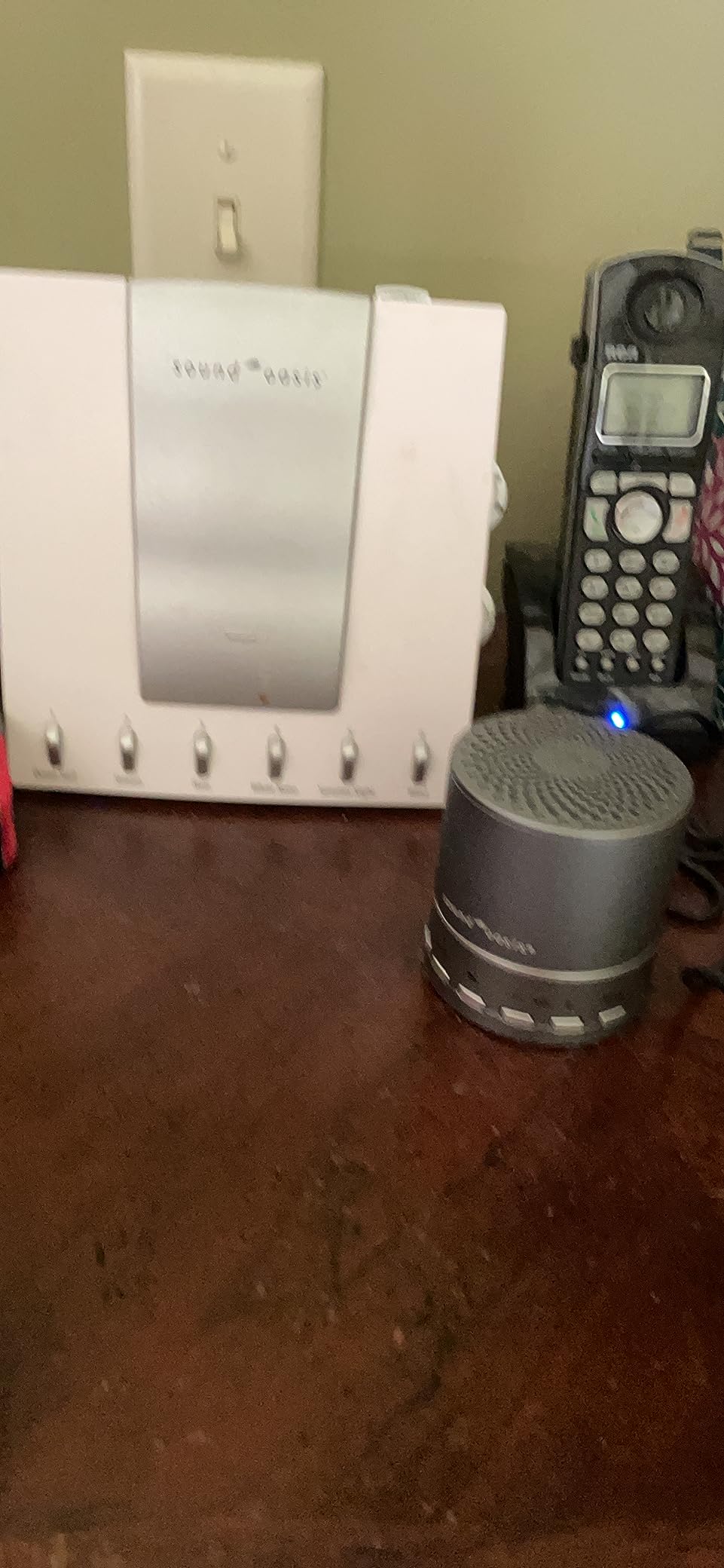
The rechargeable lithium polymer battery runs roughly 7 to 8 hours or more, and owners report getting up to three nights of continuous play from one charge. That is one of the few machines here that works away from a socket without a cable, which makes it the pick for travel and for anyone whose bedroom outlet is inconvenient.
It doubles as a Bluetooth speaker with roughly 30 feet of range, so it is not dead weight during the day. The microSD slot also accepts custom playlists from the Sound Oasis library if the built-in set stops working for you.
When a rechargeable unit beats a plug-in
Hotel nights, camping, and any room where the nearest outlet is across the room. A machine that runs three nights per charge also survives power cuts, which in our experience is when tinnitus is at its worst.
It is also the easiest unit here to move between rooms, at 9.6 ounces and small enough for a bag. The 3.5mm headphone output is there if you want to take the sound private.
Where it falls short
There is no built-in sleep timer, which is a basic feature on cheaper competing machines, and the buttons are very small and unlit. Several reviews also report the sound fading out mid-playback and needing a wave of the hand to resume, plus a cluster of microSD and Bluetooth popping complaints.
One detail worth knowing: sound ramps down at the end of a track before it restarts, and that ramp is enough to wake some light sleepers. Test it on a night when you are not relying on it.
6. SNOOZ Pro – The Fan Machine With an App That Starts It For You
SNOOZ Pro Smart White Noise Sound Machine, Real Fan Inside for Sleeping
Real fan inside
10 volume settings
App scheduler
Travel case included
Pros
- Smooth deep tone with no rattle or whine
- Owners call it their loudest machine
- Scheduling and timer via app
- 1.2 pounds with a case included
- Turns off as a gentle alarm
Cons
- Companion app often fails to connect
- Top volume modest in large rooms
- Scheduling depends on the app
- Higher cost than other bedside boxes
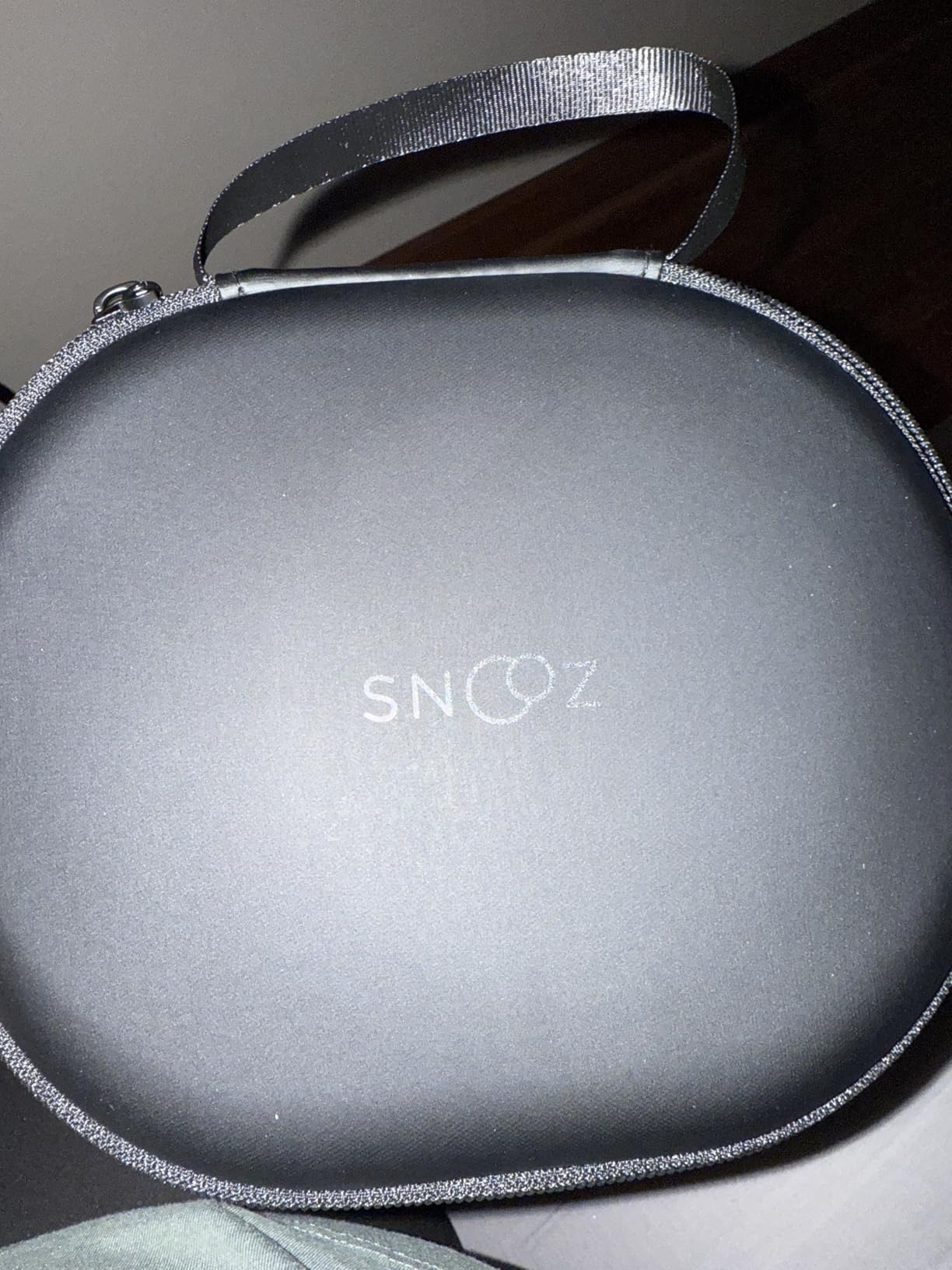
The SNOOZ Pro takes the fan-tuner idea further than the Dohm and adds the one feature that genuinely changes sleep for tinnitus users: scheduling. Set it to switch on at a fixed time, and the masking sound is already in the room before you are conscious enough to notice the ringing.
That sounds small. It is not. Most people with nocturnal tinnitus do not have trouble staying asleep once they are asleep, they have trouble dropping off, and a machine that comes on by itself removes the last decision of the day.
The sound is generated by a real fan rather than a fan simulation, and reviews describe the tone as smooth and deep with none of the rattle or whine that afflicts some mechanical machines. Owners repeatedly call it the loudest and most effective machine they have owned, and several list tinnitus and barking dogs alongside snoring and street noise as things it covers.
There are 10 volume settings with adjustable tone and a memory function for your level, plus a sleep timer, an auto on/off scheduler, a digital remote and app support. The manufacturer recommends placing it 3 to 6 feet from your head and between you and the noise source, which is the correct setup for masking a partner.
What scheduling actually fixes
It removes the bedtime decision and it survives a noisy evening. Set the schedule for the time you normally get into bed, and the room already has its noise floor when you arrive, whether or not you remembered to press anything.
It also doubles as an alarm, and because the machine fades rather than beeps, several owners describe it as a gentler way to wake up than a phone. Smart plug compatibility means the scheduling does not depend on your phone being in the room.
Where it falls short
The app is the weak point, and it is the one that matters most given how much the scheduling depends on it. Reviews repeatedly describe connection failures and lengthy troubleshooting, and some owners note that scheduling routes through the app rather than the on-device controls.
A few owners feel the maximum volume is still modest in a larger bedroom or against exterior noise. It is also the priciest bedside machine here, so the case for it rests on the app and the fan tone rather than on the sound alone.
7. Sleenova SoundMask – Audio and Blackout Without an Earbud
Sleenova SoundMask – Comfortable Audio Sleep Mask Built for Side Sleepers
Ultra-thin flat speakers
Sleep mask form factor
Removable electronics
Lycra lining
Pros
- Speakers sit flush so no earbud pressure
- Blocks light and sound in one
- Deep eye cups avoid pressure
- Soft brushed Lycra lining
- Electronics remove for washing
Cons
- Among the lowest average ratings here
- Speakers are wired into the mask
- Still closer to the ear than a bedside machine
- Less flexible than a room-filling box
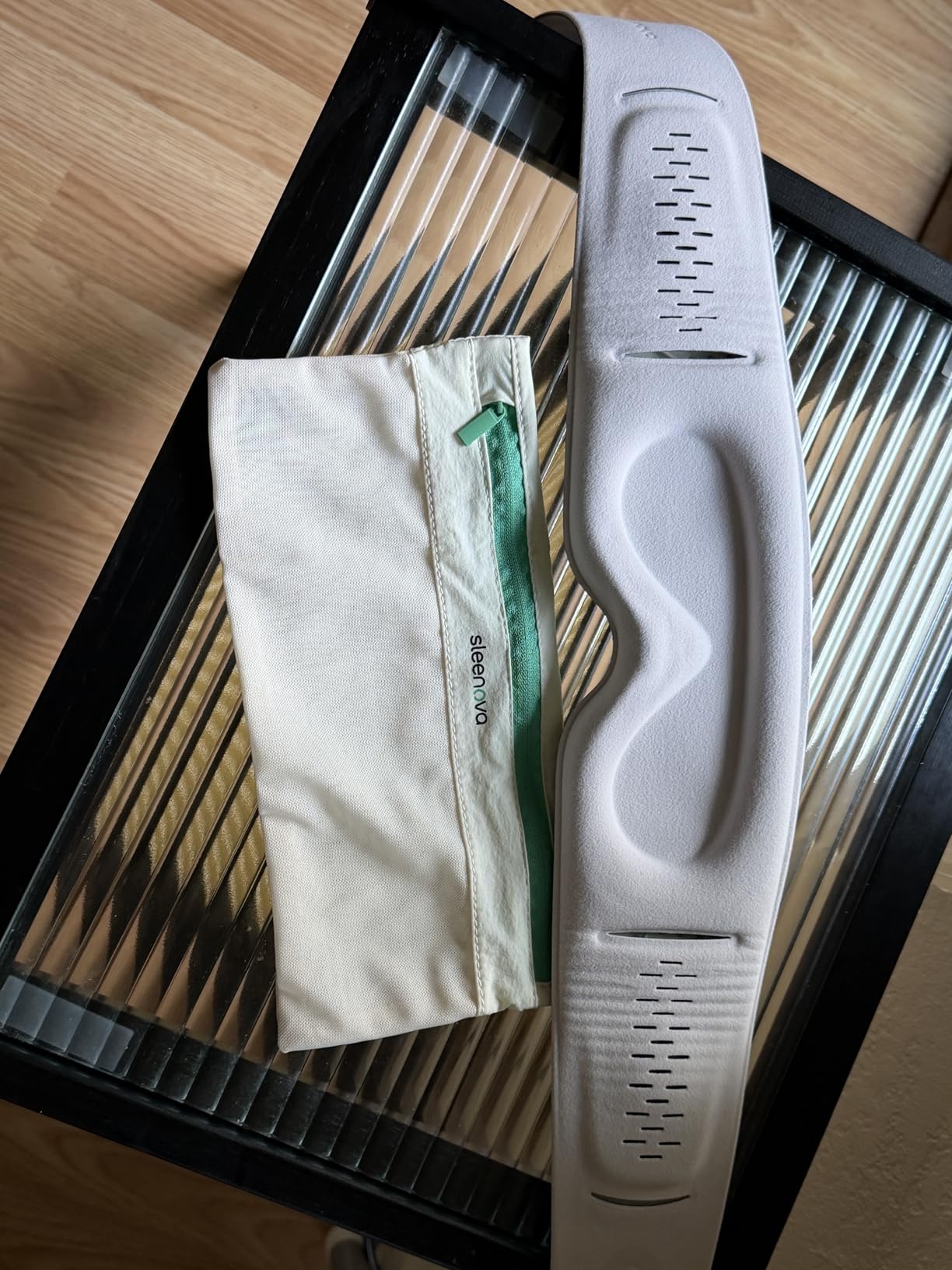
Most other masking options here either sit across the room or go in your ear. The Sleenova SoundMask does neither: the speakers are thin flat pads sitting against the outside of each ear inside a fabric sleep mask, so nothing enters the canal and nothing presses on it.
That makes it the direct answer to the most common complaint in tinnitus forums, which is ear pain from side sleeping. If you have tried sleep earbuds and woken up with a sore ear canal, this is a structurally different solution rather than a smaller version of the same one.
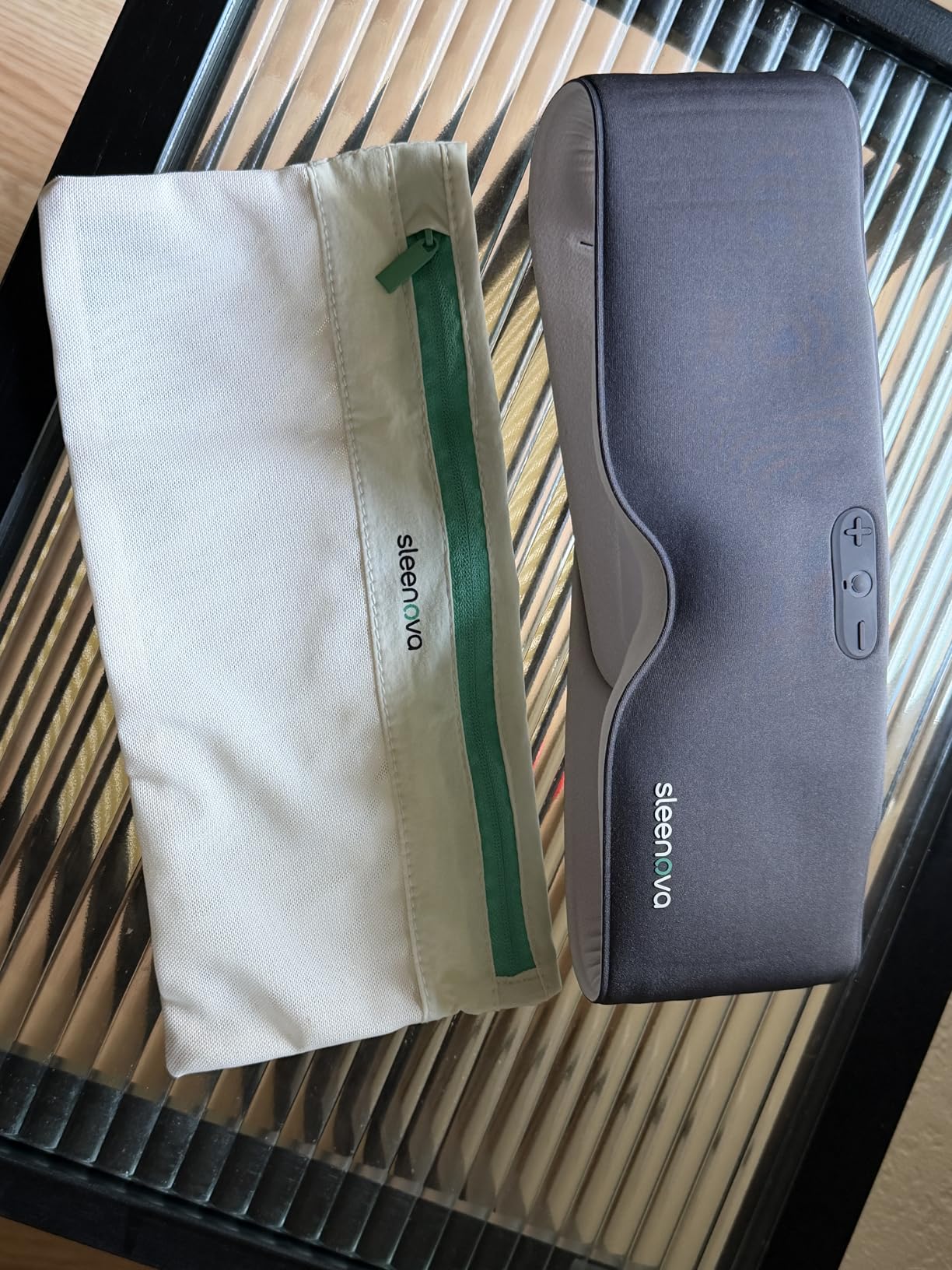
Comfort details are the reason to pick it. The contoured nose bridge blocks light without pressing on the bridge of your nose, the eye cups are deep enough to leave room for your lashes, and the brushed Lycra lining is described as soft and non-scratchy against the skin. Speakers are adjustable, so you can slide them to sit where your ears actually are.
The app handles sleep audio, timer and alarm, and settings are saved to the device so Sleep Mode and Nap Mode run phone-free. Bluetooth Mode is there for podcasts and music. The electronic module removes so the fabric can be machine-washed, and the cover can be swapped without replacing the whole mask.
When a sleep mask beats a bedside machine
Side sleeping is the case. A machine across the room cannot mask your own ear canal as effectively as a source sitting right beside it, and the light blocking is a real bonus for anyone whose tinnitus is worse in a dark, silent room.
It is also the option for people who use a CPAP, or who have had ear surgery, or who simply cannot wear anything in the ear overnight. The 18-month electronics support is longer than most in this category.
Where it falls short
This sits at 4.0, among the lowest averages in the group, with a noticeably higher share of one-star feedback than the fan-based machines. The trade-off of wearable audio is that you have more hardware on your head, and some people find that harder to settle into than a machine in the corner.
The speakers are wired into the mask, which adds bulk for restless sleepers, and the headphones-style design still sits closer to the ear than an under-pillow or bedside option would.
8. Ozlo Sleepbuds 2 – In-Ear Masking With a 14-Hour Battery
Ozlo Sleepbuds® 2 – Sleep Earbuds, Snoring & Noise Masking Headphones
1.6 g per earbud
14 hour battery
50+ sleep sounds
Four tip sizes
Pros
- 1.6 g buds stay in place all night
- 14 hours covers a full night
- Private in-ear alarm
- 50+ sounds plus Bluetooth
- Timer fades then switches to masking
Cons
- Higher cost than the bedside options
- Unsuitable with some ear conditions
- Bluetooth stream dies with the battery
- Passive isolation rather than active cancellation
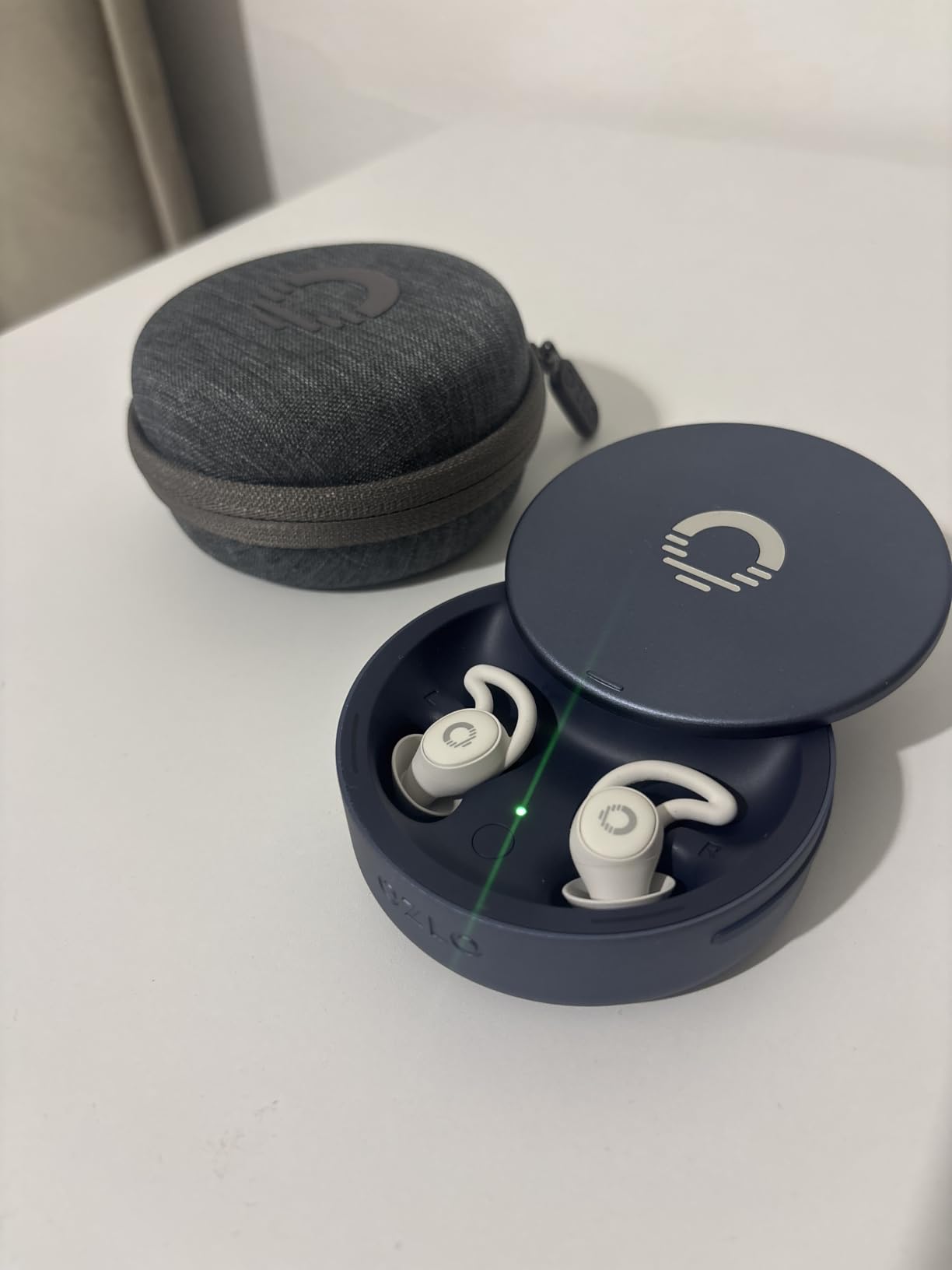
These are the only true in-ear option here, and they are built for sleep rather than adapted from daytime earbuds. Each bud weighs 1.6 grams, which is the number that decides whether an in-ear device is viable overnight at all. Owners describe them as staying put through the night with no soreness and no popping out when they roll onto their side.
The 14-hour battery is the second number that matters. It covers a full night with room to spare, which directly addresses the most common complaint owners of lesser sleep earbuds report: waking at 4 or 5am to a silent earbud and an immediate spike in tinnitus.
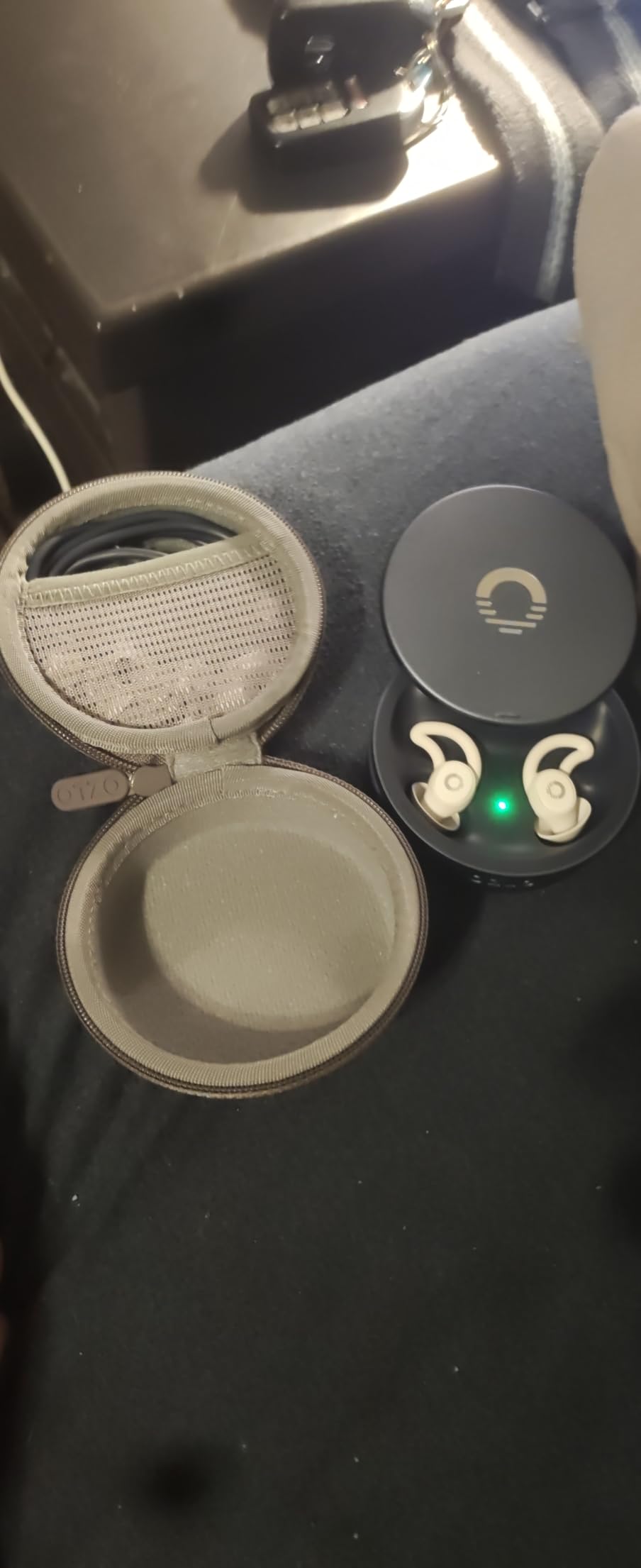
Sound comes from 50+ built-in sleep tracks, with Bluetooth streaming if you want your own audio, and a sleep timer that fades the music out and then switches to continuous masking. That sequencing is the feature most tinnitus users care about, because it means you fall asleep listening to something pleasant and wake to steady masking.
Four soft silicone tip sizes from XS to L let you get a proper seal, and a seal is what determines whether masking is effective. A poor seal leaks your own tinnitus back in at full volume. The private in-ear alarm wakes only you, which matters in a shared bed. If you are still comparing shapes, our sleep headphones guide covers the fit trade-offs in more detail.
When in-ear is the right call
In-ear masking is the most powerful option per decibel, and it is the only one that is completely private. If your tinnitus is loud enough that a machine across the room only partly covers it, the ear canal is where the coverage happens.
It is also the right choice when the noise you need to cover is your own partner snoring at close range. The listing positions the steady sound shield as tuned for low partner snoring specifically.
Where it falls short
It carries a higher cost than the bedside options, and the 4.2 average comes from a 191-review base on a newer platform, so there is less long-term history than the bedside machines have.
More importantly, inserted earbuds are simply unsuitable for anyone with an ear infection, recent ear surgery, or sensitivity to in-ear pressure. Isolation is passive rather than active, so masking still depends on volume, and once the battery dies a Bluetooth stream cannot be continued. If any of that applies to you, skip this section and read the pillow speaker entry instead.
9. Sound Oasis Pillow Speakers – Private Masking With No Earbud
Sound Oasis Amplified Pillow Speakers – 2 Ultra-Thin Under Pillow Hi-Fi Stereo Speakers with Volume Control, Private Sleep Audio for Music, White Noise, Relaxation & Tinnitus Masking, 3.5mm Connection
Two under-pillow speakers
Inline volume control
73 inch cable
Amplified output
Pros
- Sound goes into the pillow so a partner barely hears it
- Amplified output suits hard-of-hearing users
- No earbuds
- which matters with CPAP
- Inline volume control on the cable
- Works with phones and CD players
Cons
- Background hum or static reported
- Sound cuts out until replugged
- Single speaker failures
- Speakers slide under the pillow
- Muffled audio on thick pillows
Pillow speakers sit in the middle of the pack. They put sound close enough to your ear to mask well, they are invisible under the bedding, and a partner barely hears anything. Critically, they put nothing in your ear, which makes them the option for CPAP users and anyone whose ear canals object to a night of earbuds.
The amplified output is the reason to choose this pair over cheap passive pillow speakers. Owners who are hard of hearing report that the built-in amplifier is what makes the sound audible at all, where passive drivers simply fade into the pillow.
Who this works well for
Couples with mismatched sleep needs are the strongest case. The sound is directed into the pillow, so your partner gets silence while you get close-range coverage, which no across-the-room machine can do.
It also connects to anything with a 3.5mm jack, including phones, tablets, MP3 players, CD players and the Sound Oasis sound therapy systems. A 73 inch cable reaches from the headboard to a bedside table, and the inline volume control means you adjust without getting out of bed.
Where it falls short
Hardware reliability is the main cluster of complaints. Several reviews describe a persistent background hum or scratchy static once plugged in, sound cutting out until the power is unplugged and replugged, and individual speakers failing so the set drops to mono.
Practical setup also takes work. The flat speakers slide around under the pillow and need taping or pinning to stay put, the cables tangle and pull the control module behind the bed, and audio can be muffled depending on pillow thickness. It is also a speaker, not a sound source, so you need something to feed it.
10. Sound Oasis Tinnitus Sound Therapy System – Built Around Tinnitus Specifically
Sound Oasis® Bluetooth Tinnitus Sound Therapy System® Alarm Clock – Sleep Better, Manage and Mask Tinnitus, 30 Built-in Sounds for Tinnitus Relief, Sleep-Friendly Lighting, Travel Friendly (BST-150T)
30 audiologist-based sounds
Subwoofer for bass
7 to 16 hour battery
Orange alarm display
Pros
- Only unit here built explicitly for tinnitus
- 30 sounds based on audiologist recordings
- Sleep-friendly orange display with 31 brightness levels
- Rear speaker plus subwoofer for bass
- Rechargeable and works cord-free
- Includes a management booklet
Cons
- Smallest review base at 40
- Newer platform with limited long-term history
- Needs a separate source for custom audio
- Only three timer and alarm choices
This is the one device in the roundup sold as a tinnitus sound therapy system rather than a general sleep machine, and that distinction runs through the design. The 30 built-in sounds are the same Sound Oasis recordings used by audiologists for tinnitus management, not a general nature library dressed up with a tinnitus label.
That matters because a curated set is more useful than a large random one. Instead of scrolling through 20 tracks hoping one overlaps your pitch, the library was assembled around sounds that people with ringing ears actually respond to.
Why the alarm clock is part of the tinnitus design
The backlit display uses sleep-friendly orange rather than blue-white, with 31 brightness settings including fully off, and a 30, 60 or 90 minute timer that fades gradually. A bright blue display in a dark bedroom is its own kind of wake-up call, and most people with tinnitus do not need the extra jolt.
The rear-facing speaker plus subwoofer delivers bass that most compact units cannot, and bass is the part of the spectrum that covers low-pitched and rumbling tinnitus best. The rechargeable battery runs 7 to 16 hours cord-free, with USB-C charging, and there is a 3.5mm headphone jack for private listening.
Where it falls short
The 40-review base is the thinnest here, and it is a recent platform, so long-term durability is essentially unproven. That is not a knock on the machine, it is a reason to test it thoroughly during whatever return window applies before you keep it.
It also needs a separate sound machine or Bluetooth source for custom audio, and offers only three alarm sounds and three timer choices. The included Living With Tinnitus booklet is a nice addition, but reading it is not a substitute for an audiology assessment if your tinnitus is new or worsening.
How to Choose a Masking Device for Sleep
Work through these in order. The first three narrow the category, and the rest stop you returning something after a week.
1. Decide how private the sound needs to be. If a partner sleeping beside you would be disturbed, in-ear or under-pillow options are your answer. If a background hum is fine, a bedside machine covers more of the room and is easier to live with.
2. Check your sleeping position first. Side sleepers should rule out anything bulky in the ear. A 1.6 g bud or a flat mask speaker is fine; a chunky earbud is not. Back sleepers can get away with almost anything.
3. Do the battery maths against a real night. Most sleepers need 8 to 9 hours, not 5. The Ozlo Sleepbuds 2 claim 14 hours and clear the bar. The Sound Oasis Bluetooth machine reports 7 to 8 hours or more, which is close but not generous. Everything else in this roundup runs on mains or USB, which is unlimited and therefore the safest answer if the outlet is near the bed.
4. Look for non-looping audio. Every product here plays non-looping tracks, and that is not a coincidence. A machine with a 90-second loop is a machine that will wake you up on schedule.
5. Make sure the sound library covers your pitch. Ideally you want at least white, pink and brown noise plus a fan track. That gives you four different bands to match against, instead of betting everything on one sound.
6. Only turn it up as far as you need. A masker that has to run at full volume to work is not a solution, because sustained loud playback in the ear is exactly what you are trying to avoid. If you find yourself pushing the level higher each night, the sound is in the wrong band.
Test over several nights before you commit to anything. Tinnitus is variable, and a device that works on a calm Tuesday can fail on a bad Friday. Most return windows give you enough nights to see whether you are still reaching for the machine when you wake up.
Two things worth adding that cost nothing. A fan in the room works, and owners on tinnitus forums describe a simple fan as the most effective and cheapest masker they have used, particularly for tonal low-to-mid ringing. And a plug or earplug for physical blocking plus a sound source is a pairing that comes up repeatedly, because blocking stops external noise and masking covers the internal signal.
When Masking Is Not Enough
Masking is a management tool. It reduces perception of tinnitus and it helps you sleep, but it does not treat the cause and it is not a cure. If your tinnitus is new, one-sided, or getting worse, that is an audiology appointment, not a shopping decision.
Pulsatile tinnitus, which sounds like a heartbeat in rhythm with your pulse, is the clearest example. It has a different set of possible causes and it should be assessed rather than covered up with a fan.
For people whose hearing loss is the driver, hearing aids with built-in sound therapy programs can do two jobs at once. These are fitted by an audiologist and use sounds specifically selected for tinnitus management, which is a different intervention from playing white noise through a speaker.
What audiologists generally recommend alongside sound therapy is habituation-focused work: counselling, cognitive behavioural therapy for tinnitus, and tinnitus retraining therapy. The common thread is that the goal is to reduce how much attention your brain pays to the signal, which is what sound therapy is also aiming at when it works well over time.
If tinnitus is keeping you awake most nights, that is worth raising with your doctor rather than treating as a purely consumer problem. Poor sleep and tinnitus reinforce each other, and breaking that loop early is easier than later.
Frequently Asked Questions
What is the most effective tinnitus masking sound?
The most effective sound is the one that overlaps the pitch of your ringing. High-pitched tinnitus is best covered by white, blue or pink noise, while low-pitched or tonal ringing responds better to brown noise, fan and rain sounds. A bedside fan is the most commonly recommended starting point because it is continuous, non-looping and free. Start low on volume and change the sound rather than turning it up.
Do white noise machines work for tinnitus?
Yes, for most people they are one of the cheapest and most reliable ways to sleep with tinnitus. Continuous background sound raises the noise floor of the room, which reduces the contrast between your tinnitus and everything else and makes the ringing less noticeable. Over time a consistent sound source can also support habituation, where the brain gradually filters the ringing out.
What is the best sleep aid for tinnitus?
A bedside sound machine is the best starting point for most people, because it needs no charging, touches nothing on your face and can mask a snoring partner as well as your own tinnitus. A compact model with non-looping tracks, 20 or more sounds and a sleep timer covers nearly every case. In-ear sleep earbuds are the stronger choice only if the room machine cannot cover your pitch or you need completely private sound.
What are the best earbuds for sleeping with tinnitus?
Purpose-built sleep earbuds are better than adapted daytime earbuds, because they weigh about 1.6 grams per bud, sit flush so they do not press painfully when you lie on your side, and run for 14 hours so nothing dies at 4am. The Ozlo Sleepbuds 2 are the clearest example in this roundup. Confirm a seal with the included tip sizes, since a poor seal leaks your tinnitus straight back in.
What do audiologists recommend for tinnitus?
Audiologists usually recommend a combination approach rather than a single device. Sound therapy, hearing aids fitted with tinnitus sound programs, counselling, cognitive behavioural therapy for tinnitus and tinnitus retraining therapy are commonly used together. They also rule out underlying causes such as earwax, medication effects and hearing loss. Masking devices are a useful part of that plan, but they reduce perception rather than treating the cause.
Will masking devices stop tinnitus permanently?
No. Masking devices add a background sound that reduces how much your brain notices the ringing, which helps you sleep and can support habituation over time. They do not remove the underlying signal and no consumer masking device makes tinnitus disappear permanently. If your tinnitus is new, one-sided, pulsing or getting worse, book an audiology assessment rather than buying another machine.
Conclusion
Start with a bedside machine rather than an in-ear device, because it has the fewest ways to go wrong over eight hours. The LectroFan Classic is our pick for the best tinnitus masking devices for sleep in 2026: non-looping audio, USB power, a footprint smaller than a mug and a review history longer than anything else here.
Move up to the SNOOZ Pro if you share a bed and want the sound to start itself, to the Yogasleep Dohm Nova if digital noise makes you tense, or to the Ozlo Sleepbuds 2 only if you know your ear canals can take them. Test whichever you pick over several nights before you keep it, and keep the volume as low as the job allows.