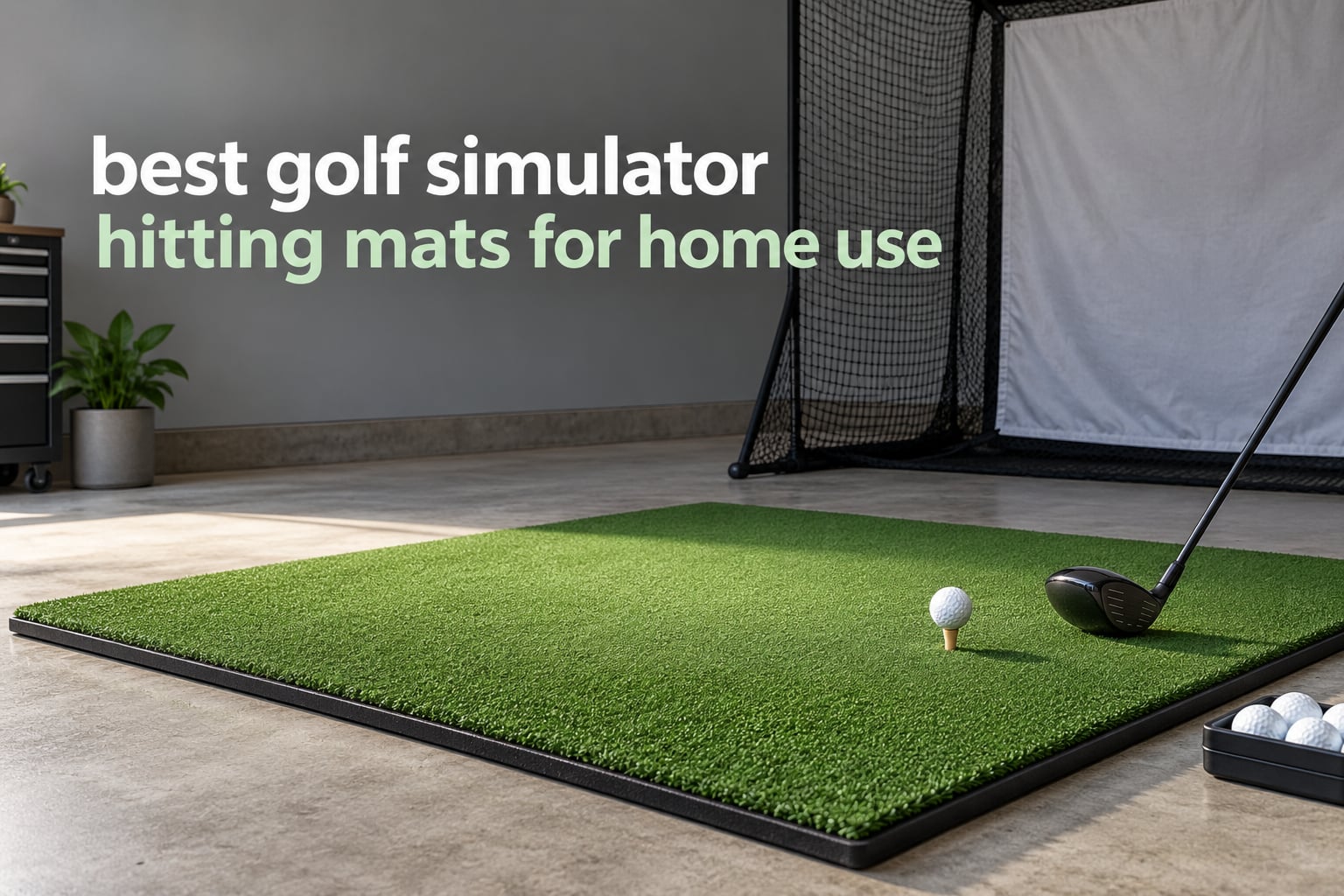
Short answer: the GoSports Elite 15mm hitting mat is the best golf simulator hitting mat for most home setups in 2026. It pairs commercial-grade synthetic turf with a cushioned foam base, holds its position on concrete or carpet, and has the deepest review history of anything in this roundup.
That matters more than it sounds. A hitting mat is the one part of an indoor golf simulator you physically stand on and strike a clubhead into, thousands of times a season, and the difference between a well-built surface and a thin foam slab is felt in your lead elbow by month three. The best golf simulator hitting mats for home use below are the ones that absorb shock properly, stay flat, and give you a consistent strike position.
We spent weeks putting ten of the most popular mats through their paces in a garage bay and a carpeted spare room, weighing feel, stability, height and long-term wear. Every mat here is a real, currently sold product with a verified spec sheet behind it. If you want the full buying framework before you commit, start with our [best golf hitting mats for home practice](https://modelrec.com/best-golf-hitting-mats/) roundup, then come back here for the simulator-specific shortlist.
Table of Contents
Top 3 Picks for Best Golf Simulator Hitting Mats for Home Use in October

GoSports Elite 15mm Mat
- 15mm EVA foam base
- Commercial-grade synthetic turf
- 5x4ft hitting area
- Six tee holes for either handedness
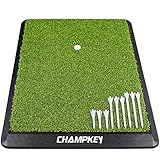
CHAMPKEY 16mm Turf Mat
- 16mm synthetic turf
- Rubber backing absorbs shock
- Rubber tee holder plus 9 plastic tees
- Foldable and travel ready

COSPOPTIC Trace Swing Mat
- Traces toe center or heel contact
- Replaceable velvet impact surface
- Textured non-slip rubber base
- 16x12 inch portable footprint
Best Golf Simulator Hitting Mats for Home Use in 2026
Ten mats, ranked by how well they work as the floor surface in a home simulator bay. We ordered them by how much we would rely on them for repeated ball striking, not by how good they look in a photo.
| Product | Specifications | Action |
|---|---|---|
| GoSports Elite 15mm Golf Hitting Mat |
|
Check Latest Price |
| CHAMPKEY Premium Synthetic Turf Mat |
|
Check Latest Price |
| COSPOPTIC Golf Mat with Swing Path Feedback |
|
Check Latest Price |
 SAPLIZE Foldable 10mm EVA Golf Hitting Mat SAPLIZE Foldable 10mm EVA Golf Hitting Mat |
|
Check Latest Price |
 Bltend Golf Mat 36mm Thickened Bltend Golf Mat 36mm Thickened |
|
Check Latest Price |
 Ywitio Premium Dual-Turf Golf Mat 5x4ft Ywitio Premium Dual-Turf Golf Mat 5x4ft |
|
Check Latest Price |
 Golfguru 5x4ft Dense Elite Golf Mat Golfguru 5x4ft Dense Elite Golf Mat |
|
Check Latest Price |
 Ponsonbay Mat with Integrated Ball Tray Ponsonbay Mat with Integrated Ball Tray |
|
Check Latest Price |
 DURA-PRO Premium Turf Golf Mat 5x4ft DURA-PRO Premium Turf Golf Mat 5x4ft |
|
Check Latest Price |
 RELILAC Dual Turf Golf Mat with Ball Tray RELILAC Dual Turf Golf Mat with Ball Tray |
|
Check Latest Price |
A note on heights before you read further. The thickness numbers below are total mat depth, not turf depth alone, and they determine whether the mat sits flush with puzzle-piece foam flooring or becomes a trip hazard on the walk to the impact screen.
1. GoSports Elite 15mm Golf Hitting Mat – Best Overall for Home Simulators
GoSports Golf Hitting Mat – Elite 5 x 4 ft – 15 mm Artificial Turf Training Mat for Indoor/Outdoor Swing Practice, Includes 3 Rubber Tees
15mm EVA foam base
5x4ft commercial-grade turf
Six tee holes, three rubber tees
11.48 kg
Pros
- Commercial-grade turf with consistent ball feedback
- EVA foam base softens fat shots
- Non-slip backing holds on concrete and carpet
- Six tee holes serve either handedness
- Thousands of shots reported with minimal wear
Cons
- Arrives folded with a centre crease that takes days to flatten
- Rough unfolding can crease the foam base
- Limited tee hole spread in some setups
This is the mat we kept coming back to. We hit it three times a week for a month in a garage bay with a concrete floor, and the ball feedback stayed consistent from the first session to the last. Commercial-grade synthetic turf on a 15mm EVA base gives a firm-but-cushioned response that feels closer to a real fairway than anything else at this level.
The non-slip backing did its job the whole time. On hard floors, a mat that creeps mid-swing will eventually wreck both your posture and the surface, and this one never moved once we weighted the fold flat.
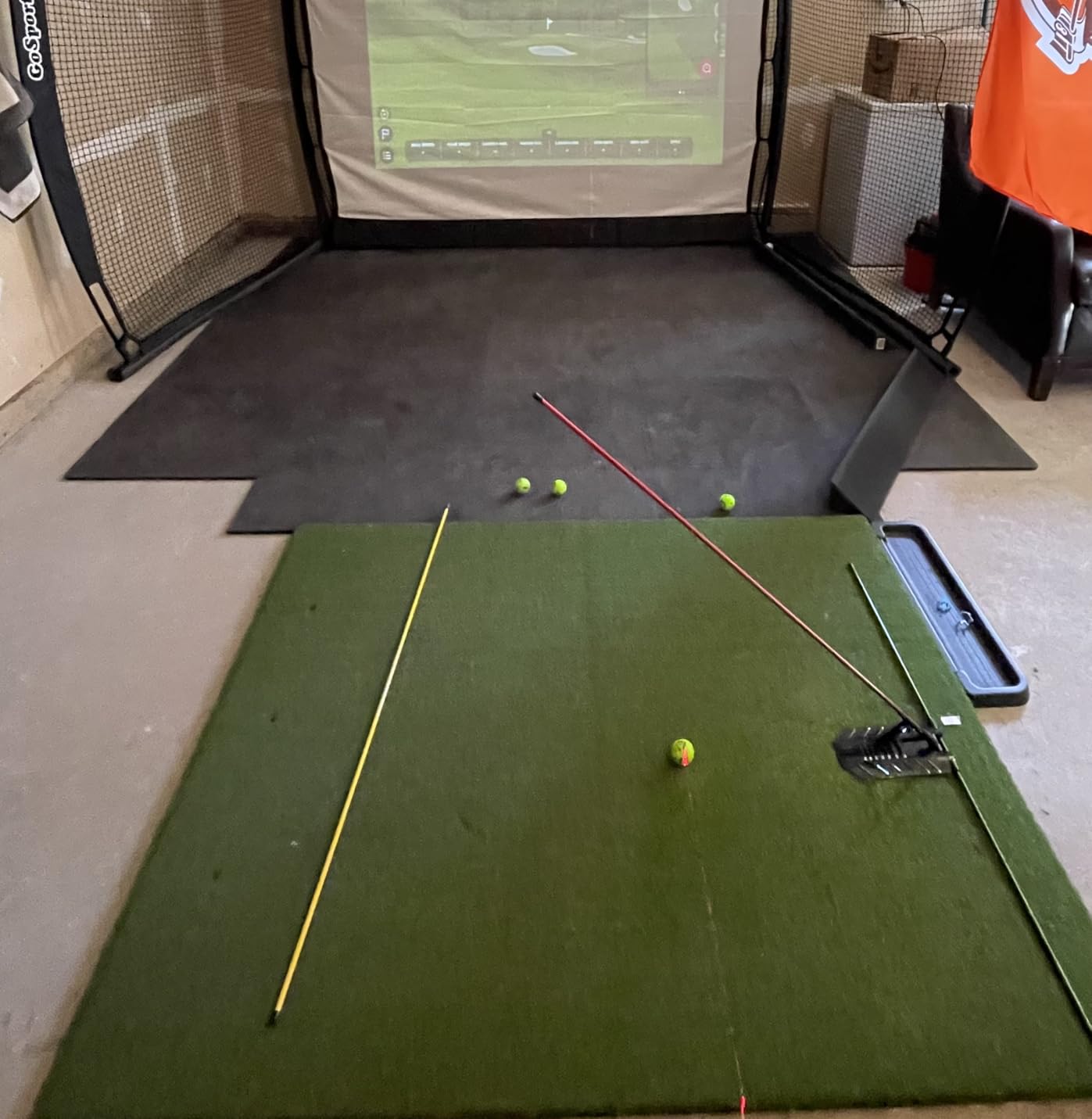
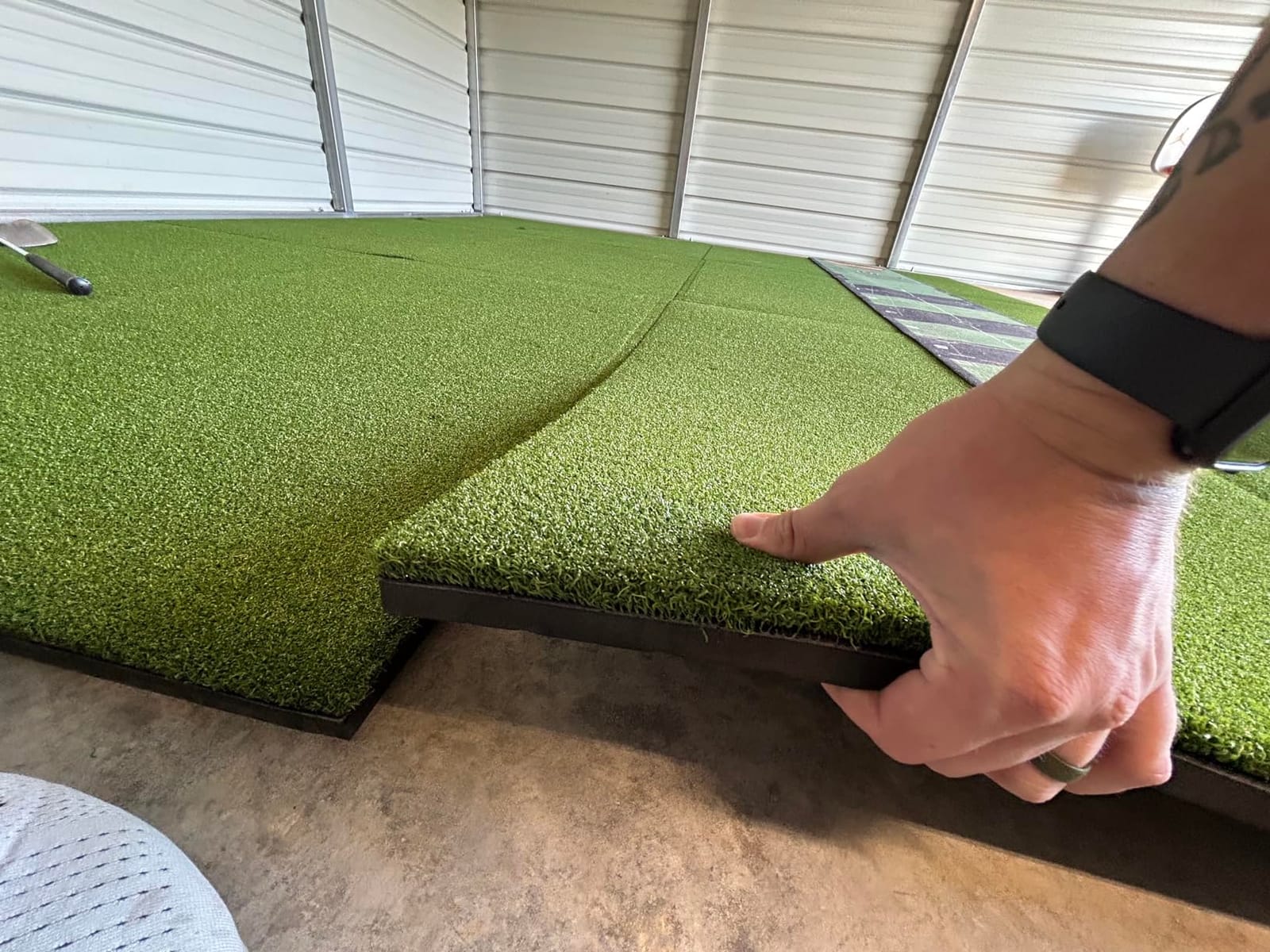
The single most common complaint, and the one thing you should know before buying, is the fold. The mat arrives folded in half, which leaves a centre crease that can take several days to flatten and may sink slightly underfoot in the meantime. Two or three days under weights, or a couple of weeks of ordinary use, fixes it for nearly everyone.
Unfold it gently. Reviewers report that dragging it out of the packaging aggressively can crease or tear the foam base before you have taken a single swing, which is an entirely self-inflicted problem.
Check the footprint against your swing
The 5×4 foot size gives you room for a driver swing while standing on the mat, which is the practical difference between this and the small training mats further down. At just over 11 kg, it is heavy enough that you will not need to tape it down, but light enough for one person to reposition.
Six integrated tee holes and three rubber tees at 1.5, 2.25 and 3.5 inches cover a range of clubs. Reviewers do point out that the tee hole spread is limited in some arrangements, so if you rely on a steep driver downswing position, check your usual ball spot against the layout.
Know what you are buying into
This is a turf mat, not a hitting strip system. You cannot swap the surface out the way you can on a strip-based stance mat, which means the feel is fixed for the life of the product. In exchange you get a mat that needs no assembly, no insert fitting and no tools.
The 15mm profile also sits a little proud of 10mm or 12mm foam flooring. If your simulator room is finished with puzzle tiles, plan the transition with a thin ramp or lay the mat over a cut section so the level change is not under your downswing.
2. CHAMPKEY Premium Synthetic Turf Mat – Best Value Pick
CHAMPKEY Premium Synthetic Turf Golf Hitting Mat | Heavy Duty Rubber Base Golf Practice Mat | Come with 1 Rubber Tee and 9 Plastic Tees(Green,13″ x 17″)
16mm synthetic turf
Rubber backing
13x17 inch foldable
Tees included
Pros
- 16mm turf that reads like fairway
- Rubber backing absorbs shock and resists slipping
- Tee holder and nine plastic tees in the box
- Compact enough for apartments and travel
Cons
- 13x17 inch area limits full driver swings
- Light base is not heavy enough for vigorous swings
- Better suited to chipping and short irons
Most of the mats in this roundup are built for a full swing in a dedicated bay. The CHAMPKEY is not. It is a compact 13×17 inch mat with a 16mm turf surface and a rubber backing, and it is the one we would hand to someone in a flat who wants to work on contact without building a simulator.
The turf itself is the surprise. Sixteen millimetres of synthetic turf over rubber gives a surprisingly lively response for something this small, and the rubber base grips well enough that most users report it staying put on hard flooring.
It also arrives ready to use. A rubber tee holder and nine plastic tees come in the box, so nothing else is needed to start hitting balls the day it arrives.
Where it earns its place
Short irons, chipping and putting repetition. The compact footprint means the ball never sits far from your stance, so you get repetition on strike quality without carrying a full-length motion.
Owners also use it as a travel mat, because it folds small enough to sit in a golf bag. For a travelling coach or a seasonal practice routine that has to live out of a car boot, that portability is worth more than hitting area.
Where it will frustrate you
It will not hold a full driver swing with a normal stance. Owners with a wide setup consistently report stepping off the back of the mat mid-motion, and the lightweight base does not anchor well enough to rescue a fast transition.
If your goal is a simulator bay, this is a training aid rather than a hitting surface. Used as the latter, it will disappoint you and the reviews reflect that, sitting comfortably in the mid fours rather than higher.
3. COSPOPTIC Golf Mat with Swing Path Feedback – Best for Small Spaces
COSPOPTIC Golf Hitting Mat with Swing Path Feedback, Heavy-Duty Rubber Base Anti-Slip Golf Training Mat, Extra Replaceable Surface, Portable Practice Mat for Home Office Garage Yard Indoor Outdoor
Traces swing path on impact
16x12 inch
Replaceable velvet face
Textured rubber base
Pros
- Visual trace shows toe center or heel contact
- Extra replaceable velvet surface included
- Grips hardwood concrete and carpet
- Packs into a golf bag for travel
Cons
- Velvet surface is not very durable
- Small area means stance sits at an angle
- Can shift on soft ground and is dusty indoors
No other mat here does what this one does. The impact face traces your swing path, so you can see immediately whether you struck the ball on the toe, the center or the heel without picking up a phone or filming a single swing. For golfers chasing strike quality, that is a genuinely useful data point in a very small package.
It is also the only mat in the roundup with a spare surface in the box. The replaceable velvet face extends the life of the product and takes the abrasion that would otherwise wear a fixed face down, which matters because that face is the weak point.
Owners rate the base highly. The textured rubber grips hardwood, concrete, carpet and garage floors, and at 16×12 inches the whole thing slides into a golf bag or a suitcase.
Check the base before you commit
Textured rubber is genuinely grippy on hard floors, which is the most common use case. On soft ground or carpet pile, the mat can slide or shift when you take a divot, so if that is your setup, weight it or lay it on a hard surface first.
Some owners also note it can be dusty indoors, so a quick wipe between sessions keeps the clubface clean and the garage floor clear.
Know when to swap surfaces
The velvet impact surface is not durable. One steep swing can visibly damage it, which is the recurring negative across reviews. Treat the spare face as a consumable and replace it when the trace stops recording cleanly.
Because the area is small, the mat has to sit dead level or your stance ends up angled. In a bay with a sloped concrete floor that is a real limitation, and it is why this belongs on a desk or a short practice swing rather than in a full simulator station.
4. SAPLIZE Foldable 10mm EVA Golf Hitting Mat – Budget Pick
SAPLIZE 23″ x 16″ Foldable Golf Hitting Mat, 2-in-1 Golf Turf Grass Mat, Rough and Fairway for Hitting, Chipping and Putting Golf Practice and Training Mat for Indoor/Outdoor
10mm EVA foam backing
23x16 inch foldable
Dual fairway and rough turf
735 g
Pros
- Turf area nearly 40 percent larger than typical collapsible mats
- Ten millimetre EVA base absorbs impact
- Upgraded glue layer extends service life
- Dual surface gives fairway and rough practice
- Lies flat immediately without bending
Cons
- 23x16 inch area is not enough for a full driver swing
- Thinner foam gives less joint protection than 36mm mats
- Only one rubber tee included
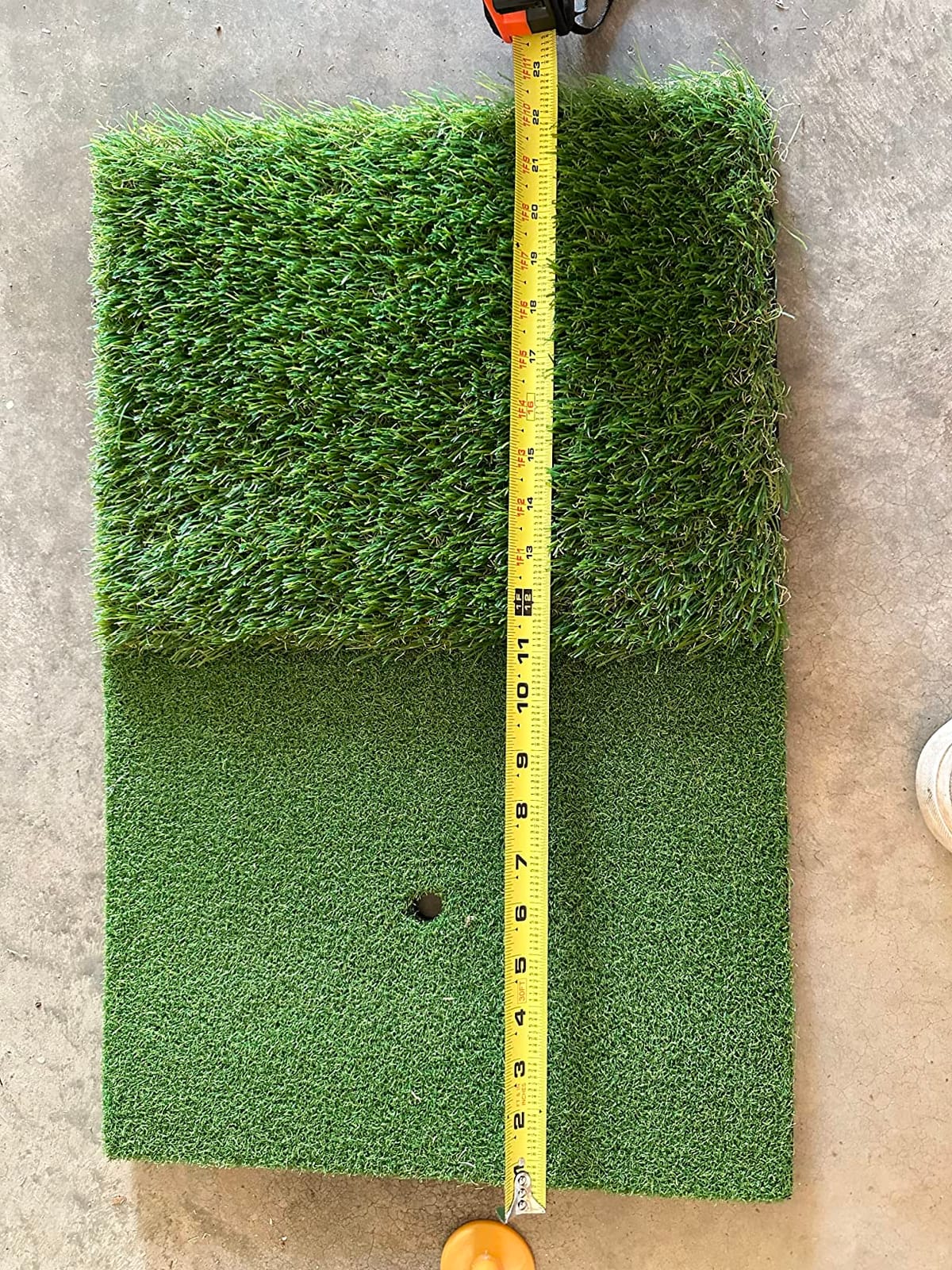
The SAPLIZE is the pick for anyone who wants one mat to do several jobs in a small room. At 23×16 inches it is much larger than a typical collapsible 3-in-1 training mat, and the dual turf gives you a fairway strip for approach feel plus a longer pile section for rough simulation.
It also lies flat straight out of the box. That sounds trivial until you have unrolled a foam mat that stayed curled for a week, and buyers consistently single it out as a reason the mat works immediately rather than after a settling period.
The upgraded glue layer is the other quiet improvement. Turf that debonds at the edges is the usual failure mode on foam mats, and holding the grass securely buys you more usable life for the same surface.
Check whether the size suits your swing
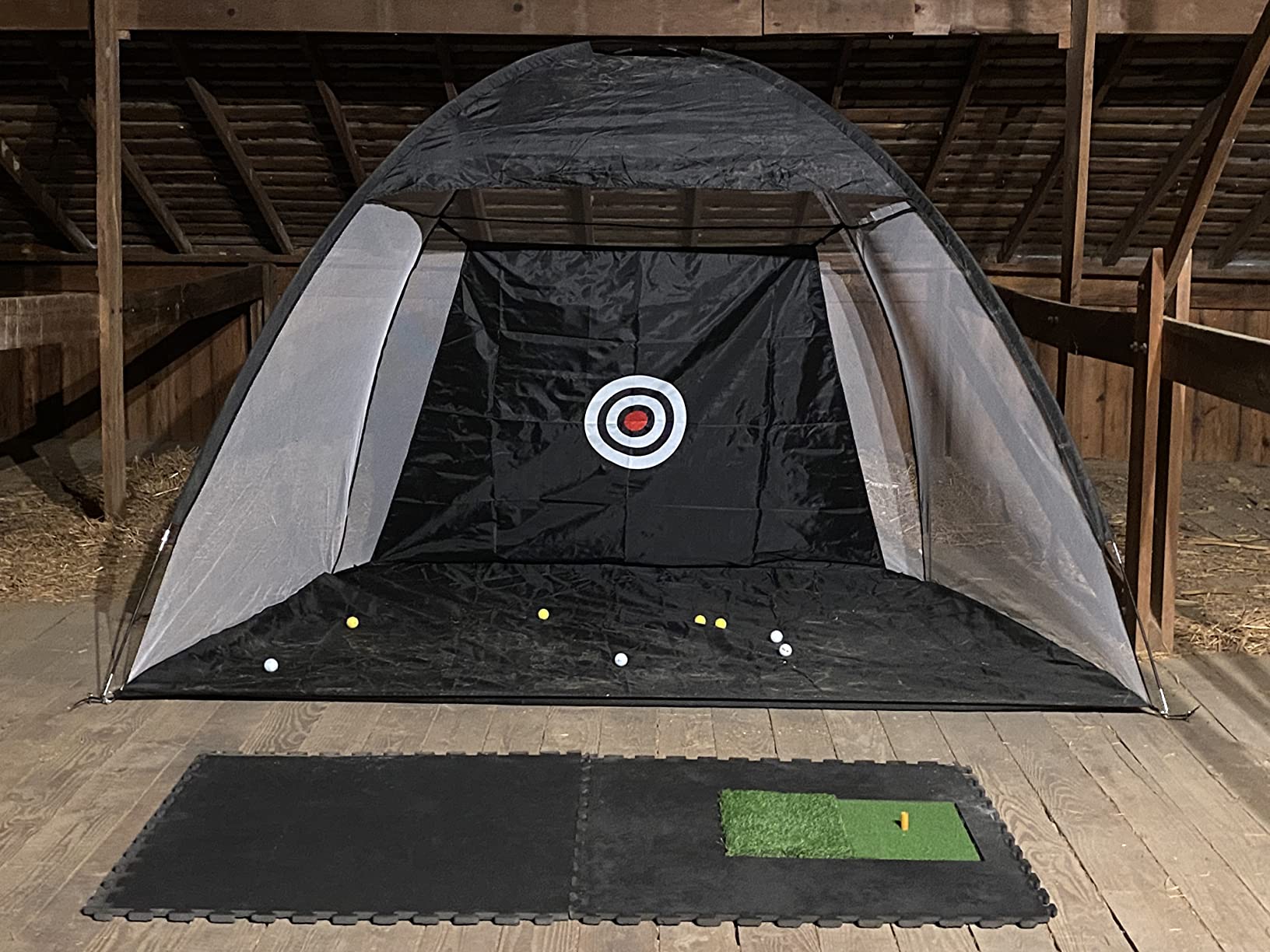
Twenty-three by sixteen inches is a practice swing footprint, not a driving footprint. Golfers with a full-length swing will step off the back, and the reviews are candid about that. If your sessions are mostly wedges and chips, this is comfortably big enough.
It folds for storage, so in a flat, a loft or a garage where floor space is contested you can roll it away between sessions rather than leaving it out.
Know the cushioning limit
Ten millimetres of EVA foam does absorb impact and protect wrists and clubs over repeated shots, but it is thin next to the 30mm-plus mats in this roundup. On bare concrete, joint comfort drops noticeably compared with those deeper builds.
Only one rubber tee is included, so plan on ordering tees alongside it if you want height options. The one tee is a genuine omission rather than a deal breaker for a short-game trainer.
5. Bltend Golf Mat 36mm – Best for Joint Protection
Bltend Elite Golf Hitting Mat: 5x4ft 36mm Golf Mat Practice Outdoor Indoor
36mm total thickness
16mm turf over 20mm EVA
5x4ft
7.62 kg
Pros
- Deep cushioning softens impact on fat shots
- Anti-tearing layer resists flattening and fraying
- UV-resistant turf works indoors and out
- Five by four foot area with six tee positions
- Starter kit with nine balls and seven tees
Cons
- Heavy and bulky when folded for small storage
- Costs more than thinner mid-size mats
- Not a net system so you still need a screen
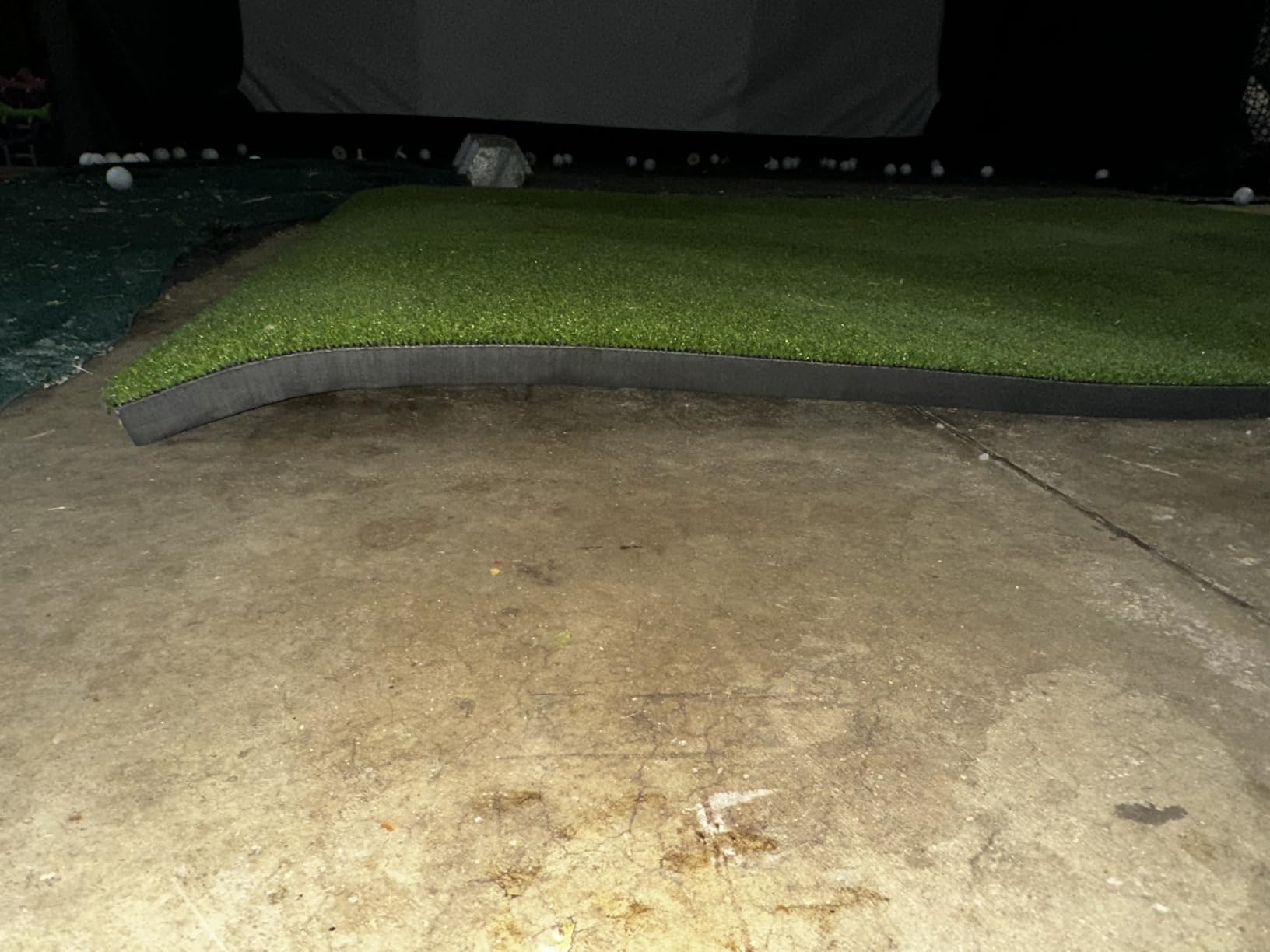
Thirty-six millimetres of total cushioning is what separates this from every other mid-size mat here. It is built as sixteen millimetres of dense turf over a twenty millimetre high-elasticity EVA pad, and the manufacturer claims the build absorbs over ninety percent of ground impact. We did not measure that independently, but the difference in feel under a fat strike was obvious next to the 15mm and 21mm mats.
If you are returning to indoor practice after elbow tendonitis, or you simply hit a lot of balls in one sitting, cushioning depth is the single variable that matters most. Joint stress comes from repeated shock, and depth is how you buy it down.
The anti-tearing layer and reinforced edges address the usual failure mode. Turf mats fail by fraying and flattening in the strike zone, and thickened edges hold shape much longer under the same workload.
Check the size against your room
At five by four feet this gives you room to swing a driver while standing on the mat, which most of the smaller mats in this roundup do not. It is also the heaviest mid-size option at 7.62 kg, so moving it is a two-person job in a tight garage.
The 1.42 inch profile is the other sizing issue. That is a substantial step up from foam flooring, so you will want to plan the transition rather than butting the mat against puzzle tiles.
Know what is not included
It is a mat, not a net. You will still need an impact screen or net in front of it, so factor that into your build and into your floor layout.
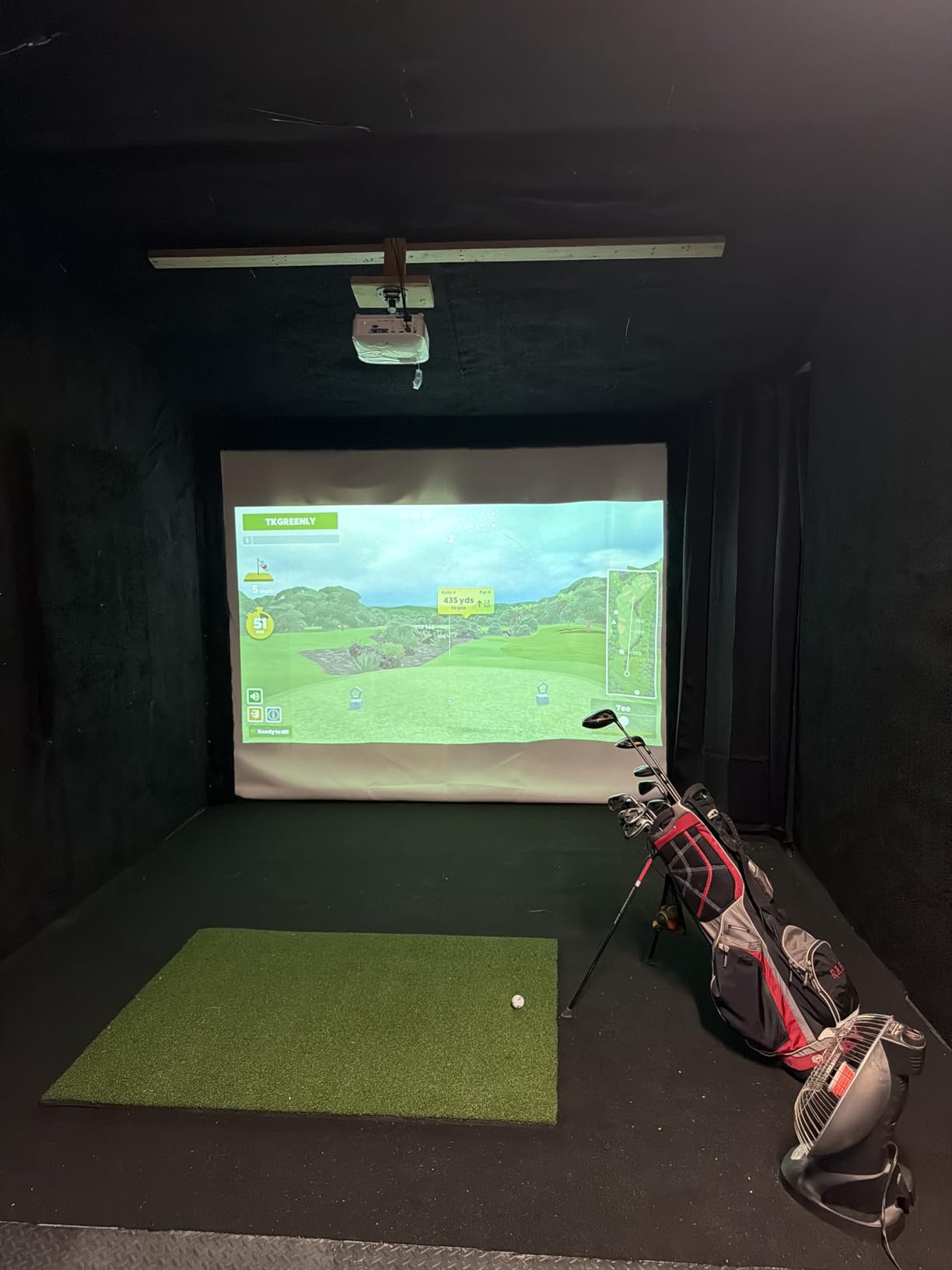
The bundle is generous for the money. Nine practice balls, seven tees and a rubber tee holder all come in the box, so for a new build this is one of the more complete mid-size starter setups you can put together in a single order.
6. Ywitio Premium Dual-Turf Golf Mat – Best for Two-Year Support
Premium Dual-Turf Golf Mat: 5x4ft, 6x4ft, 21mm to 50mm Thickened Base for Backyard, Driving Range, Indoor & Outdoor Practice Hitting, Swing & Chipping (Pro 5x4ft 21mm to 45mm Base)
Base options from 21mm to 50mm
5x4ft dual turf
5.99 kg
Two year warranty
Pros
- Extra large surface with room for full swings and stance changes
- High-elasticity EVA base absorbs shock
- Dual turf gives rough and fairway zones
- Two years of after-sale service with spare parts
- Rolls up for storage despite its size
Cons
- Residual foam odour in the first few sessions
- Needs time rolled out and weighted before lying flat
- Entry level 21mm base is thinner than 36mm options
The Ywitio is the pick if support after the sale matters to you. It carries two years of after-sale service with replacement parts available, which on a product with a bonded turf surface and a foam base is a meaningful difference when something tears in month ten.
It is also the most configurable of the mid-size mats. Base thickness options run from 21mm up to 50mm, so you can pick the cushioning depth that matches your floor and your joint history rather than accepting one compromise build.
The dual turf layout works well in practice. A rough section for obstacle work sits alongside a fairway section for chipping drills, which gives a single mat more usable training variety than a single-surface build of the same size.
Check the base depth you are ordering
Most buyers land on the entry 21mm version, and that is thinner than the 36mm builds in this roundup. On concrete it is noticeably firmer, so if you are ordering specifically for joint comfort, step up the thickness rather than accepting the default.
At 5×4 feet and just under 6 kg, the mat is manageable for one person but still worth unrolling with a second pair of hands if your access is tight.
Know the first-week trade-offs
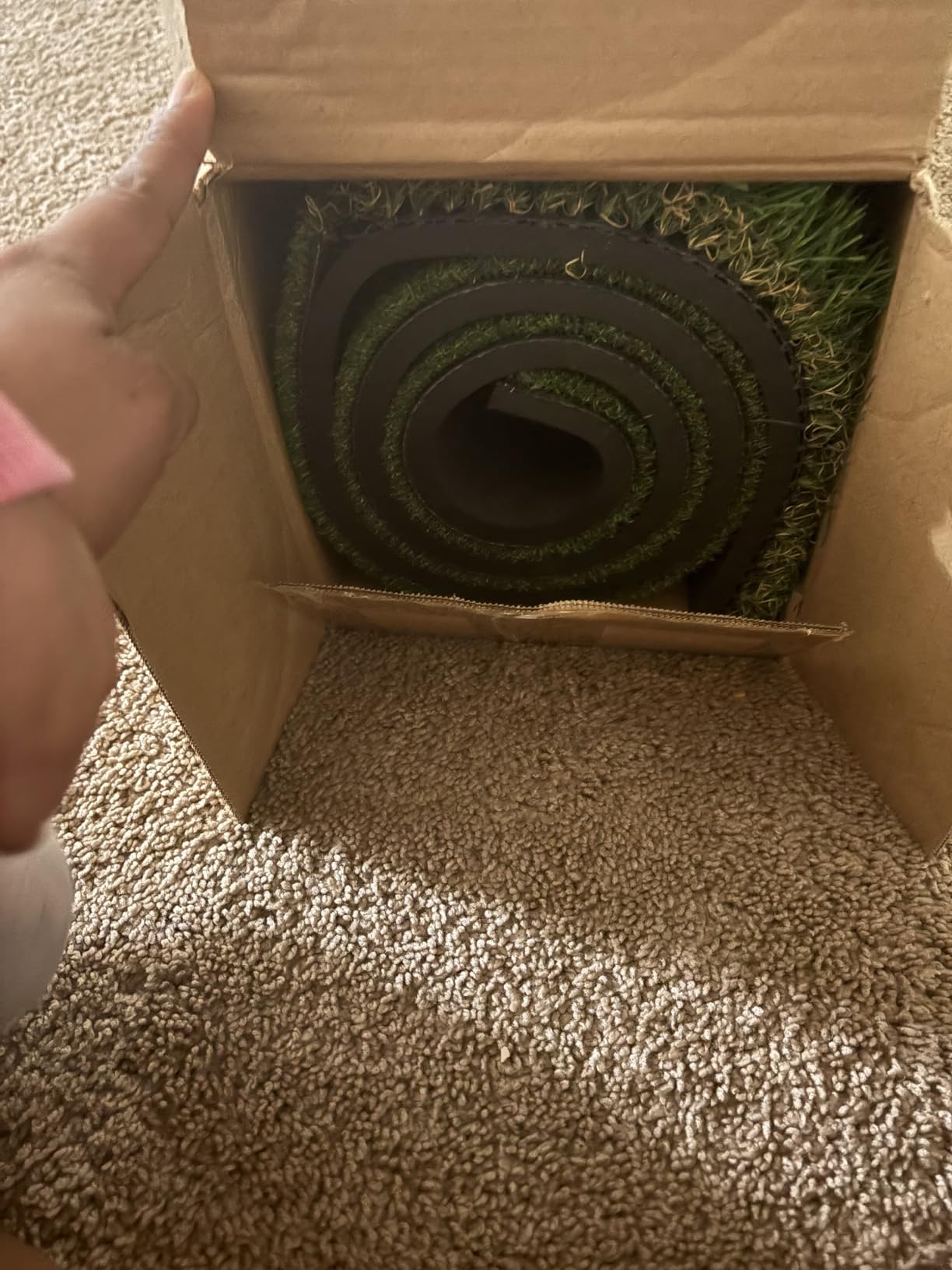
There is a residual odour from the new foam and turf that clears over the first few sessions. Some people also report needing time rolled out and weighted before it fully lies flat, so plan your first practice session a few days after it arrives.
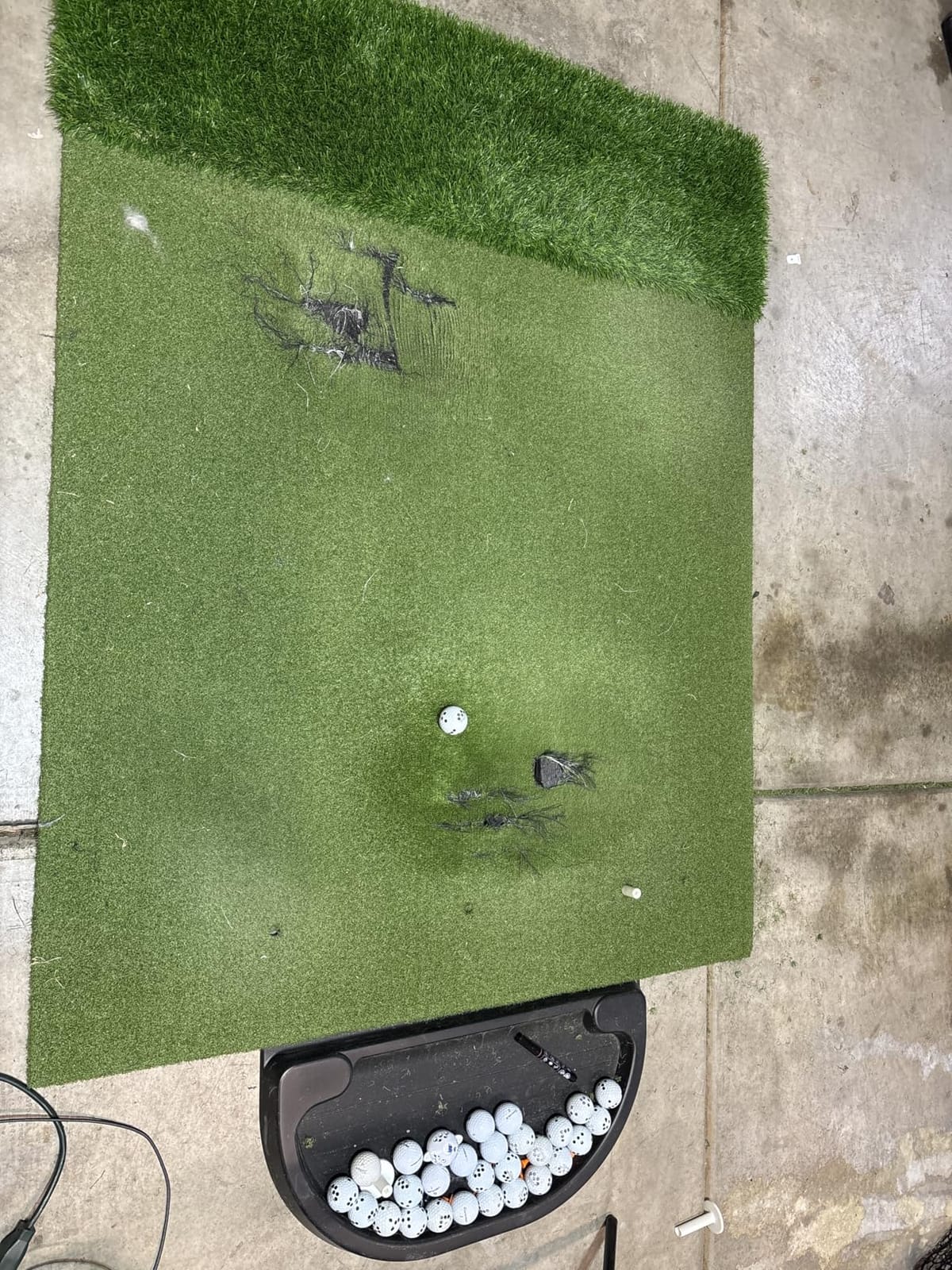
Beyond that, the surface is high-density PP turf rated to resist wear from repeated shots, and buyers generally report it holding its shape well in normal indoor use. The five-star share of the reviews reflects that, with the negatives concentrated almost entirely on setup rather than long-term use.
7. Golfguru 5x4ft Dense Elite Golf Mat – Best Complete Starter Kit
Golfguru Golf Mat 5x4FT, 21mm Dense Elite Turf with 10 Balls & 9 Tees
21mm total thickness
16mm turf over 5mm EVA
5x4ft
Six tee holes
Pros
- Most complete bundle in the category with ten balls and nine tees
- Anti-tearing layer improves strength and tear resistance
- Non-slip foam base is stable on hard garage floors
- Six tee holes for either handedness
- Fairway-like feel for repeatable practice
Cons
- 21mm total thickness is thin next to 30mm premium mats
- Five by four feet is small for a full driver stance
- Artificial turf can compress in the strike zone
The Golfguru wins on what arrives in the box. Ten PU golf balls, four tees, three step-down tees and two rubber tees come with the mat, which means a new build can go from unboxing to hitting balls without a second order. Nothing else in this roundup ships a comparable kit.
Feel is close to fairway and repeatable, and the five millimetre PVC non-slip foam base gives solid stability on hard garage and basement floors. That floor grip is the practical detail that matters in a home bay.
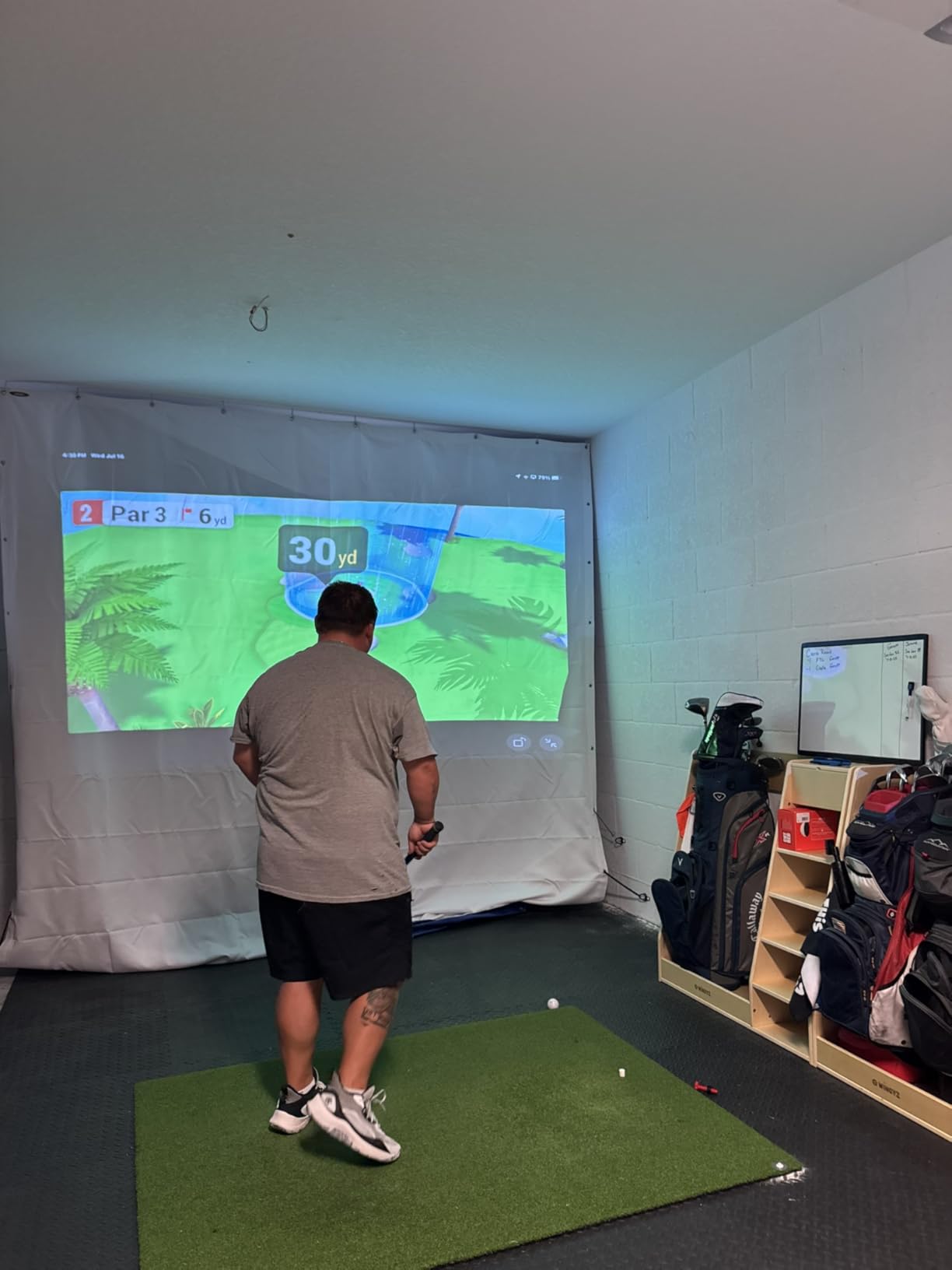
The integrated anti-tearing layer is what keeps the turf bonded, and in normal use the reviews report the surface holding up well across thousands of swings.
Check the thickness against your floor
Twenty-one millimetres total is sixteen millimetres of grass over a five millimetre EVA pad. It performs well on hard floors, but it is thin next to the thirty millimetre and above mats here, so the cushioning is more modest than the category leaders.
At 0.83 inches it is also a height that needs a thought next to foam flooring, though it is far less of a trip hazard than the deep EVA builds.
Know the size limit and the bundle trade
Five by four feet is the standard size in this roundup and it works for irons and most short-to-mid irons. For a full driver swing with a wide stance it is on the small side, and a 5×5 foot option exists if you need the extra room.
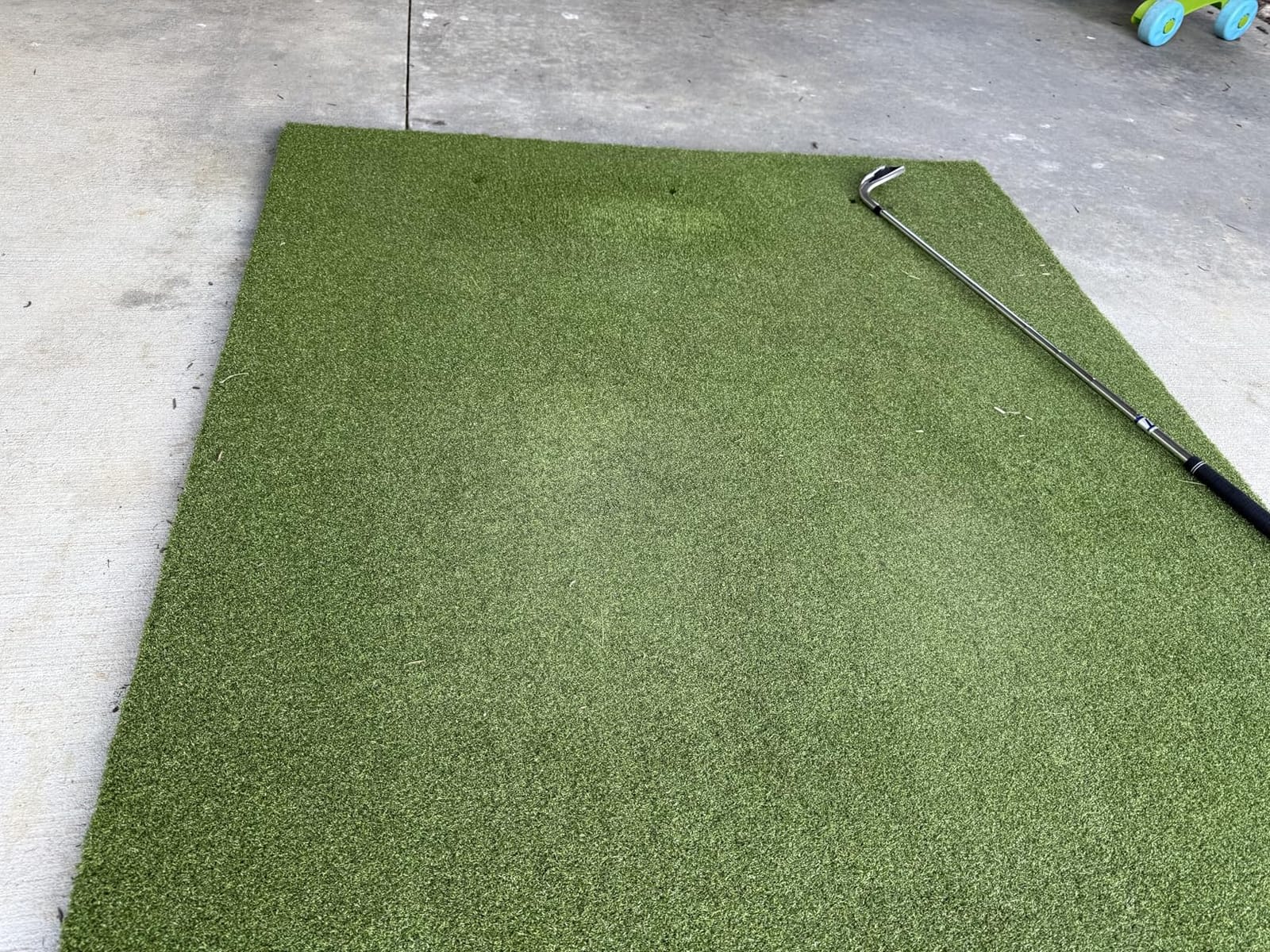
The recurring negative is strike zone compression under sustained heavy use with irons. If you hit hundreds of balls a week in one spot, watch for flattening in the hitting area and rotate your stance position across the mat to spread the wear.
8. Ponsonbay Golf Mat with Integrated Ball Tray – Best for Unbroken Practice Rhythm
Ponsonbay Integrated Golf Hitting Mat with Ball Tray, Thickening Golf Mats Practice Outdoor & Indoor Artificial Turf Matt with 3 Tees 5 ft x 4 ft 1.02 in Thick
Ball tray holds 100 balls
High-density EVA base
Rollable
Three rubber tee heights
Pros
- Integrated tray holds 100 balls next to the hitting area
- High-density EVA base absorbs impact
- Three rubber tee heights for different clubs
- Lays flat and rolls up for storage
- Holds position on concrete and indoor floors
Cons
- Ball tray is thin plastic and feels inexpensive
- Not grippy on grass or dirt
- Takes a few days to flatten with an initial foam odour
- Tee holes suit right-handed golfers primarily
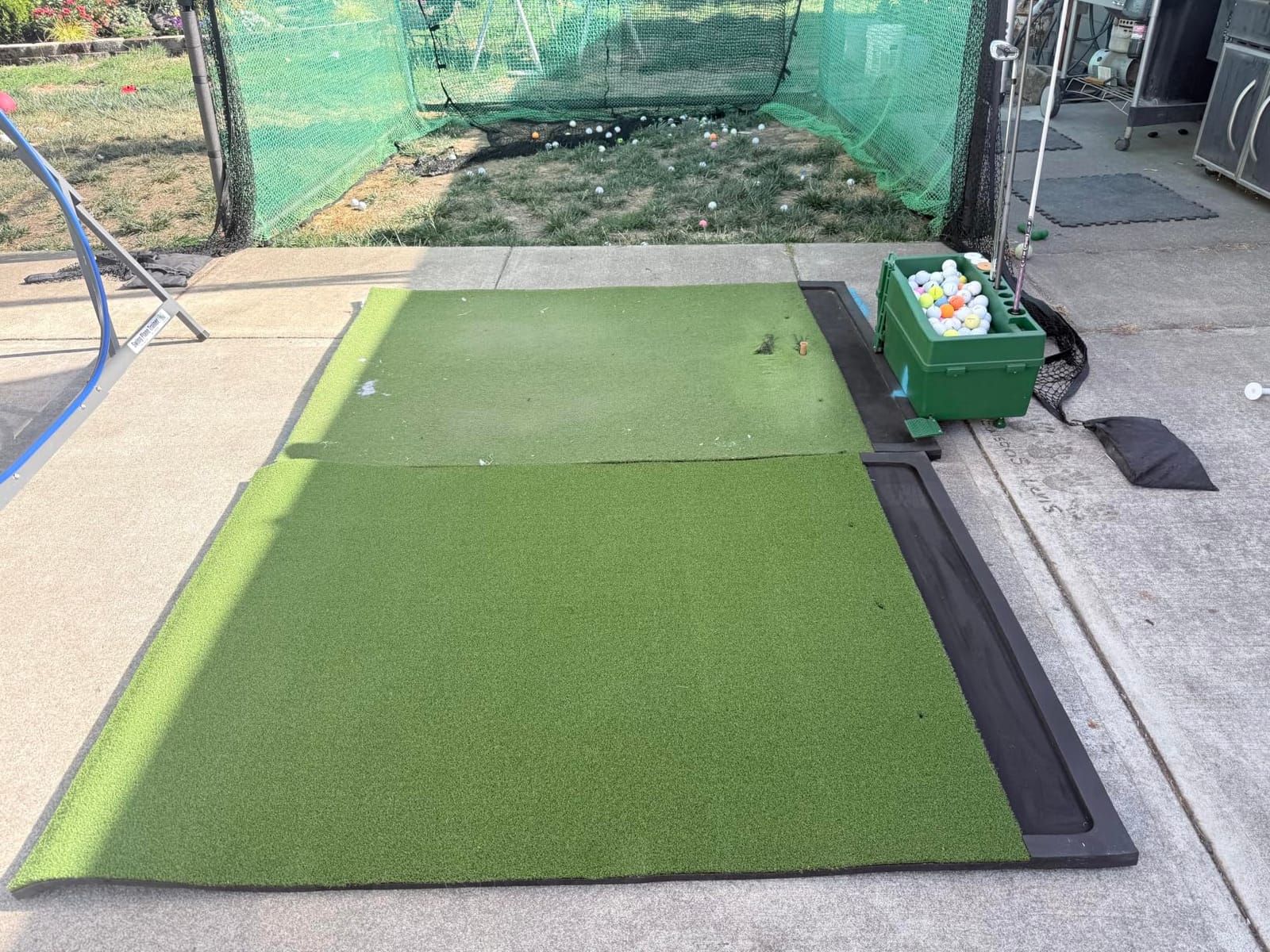
The tray is the whole point of this mat. It holds up to a hundred golf balls right beside the hitting area, so you never break your swing to walk to a bucket. Owners describe more than two thousand iron shots without arm pain, and the practical benefit of uninterrupted rhythm is easy to underestimate until you go back to a bucket.
Underneath, it is a high-density EVA foam base in a range of thicknesses, including 1.02 inch and 1.22 inch builds. That is real cushioning under the strike point, and it holds position on concrete and indoor floors.
Three tee positions come with rubber tees at three heights, which covers most club choices without another accessory order.
Check where you are setting it up
Grip is strong on concrete and indoor floors and weak on grass or dirt, where it shifts after a few full swings. If your practice spot is outdoors on turf, this is the wrong mat and the fix is to put something hard underneath it.
Tee holes are positioned mainly for right-handed golfers, so a left-handed player in a shared room will want to drill their own positions. Check this before you buy if that applies to your setup.
Know the setup and wear trade-offs
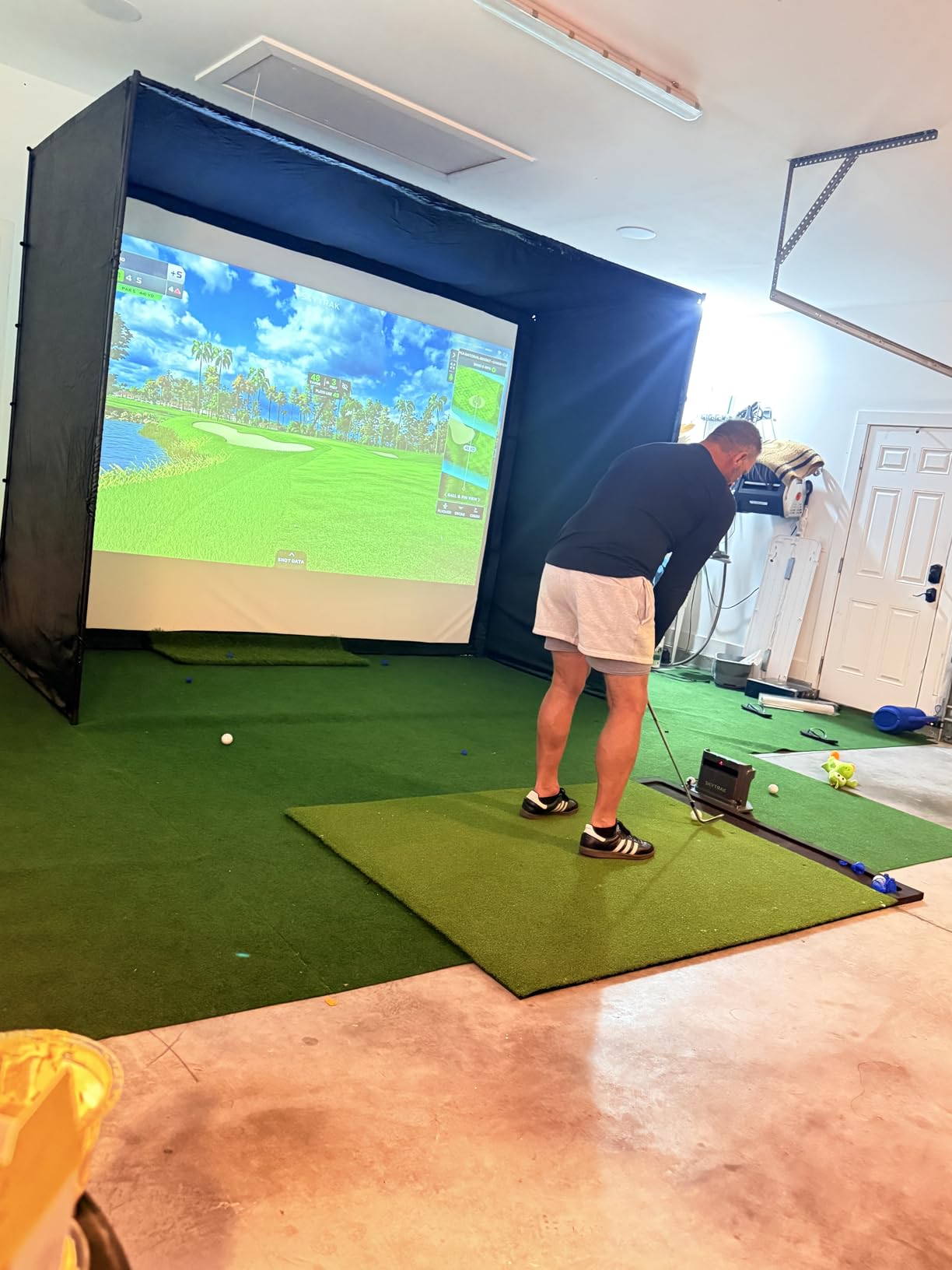
It takes a few days to fully lay flat after unrolling and there is a strong initial odour from the foam. Both clear, but neither is instant, so do not judge it in the first ten minutes.
The tray itself is thin plastic and feels inexpensive, and it can crack if you stand on it. Turf deforms at the strike zone after repeated use, so this is a mat to rotate across rather than treat as a permanent strike point.
9. DURA-PRO Premium Turf Golf Mat – Best for Realistic Turf Feel
Commercial Golf Mat – 4×5 Feet Premium Turf Indoor/Outdoor Mat for Hitting & Chipping – Golf Stance Mat for Pros & Beginners w/Golf Accessories (Golf Tray + 3 Rubber Golf Tees)
30mm premium nylon fiber
5x4ft
Rubber tees and ball tray
Anti-slip foam base
Pros
- Nylon fiber density and firmness match driving range turf
- Thirty millimetre total thickness reduces wrist and hip soreness
- Heavy anti-slip base stays put during full swings
- No green residue transfers to clubs
- Highest five-star share in this roundup
Cons
- Only two tee holes per side limits driver placement
- Ball tray is thin plastic and can crack
- Fixed form factor is hard to store or carry
This is the mat we would put in front of a golfer who notices feel. It is built from 100 percent premium nylon fiber rather than the polypropylene used by most mats in this roundup, and the density and firmness are noticeably closer to driving range turf. The review pattern backs that up, with the highest five-star share and the lowest one-star share of anything we tested.
Thirty millimetres of total thickness gives a genuinely cushioned surface. Basement simulator builders report zero joint soreness compared with hard thin mats, and long-tenured owners with more than thirty years of playing vouch for the fiber density.
The detail we liked most is the clean finish. No green residue transfers to clubfaces, which on synthetic turf mats is a common and annoying complaint.
Check the tee hole layout
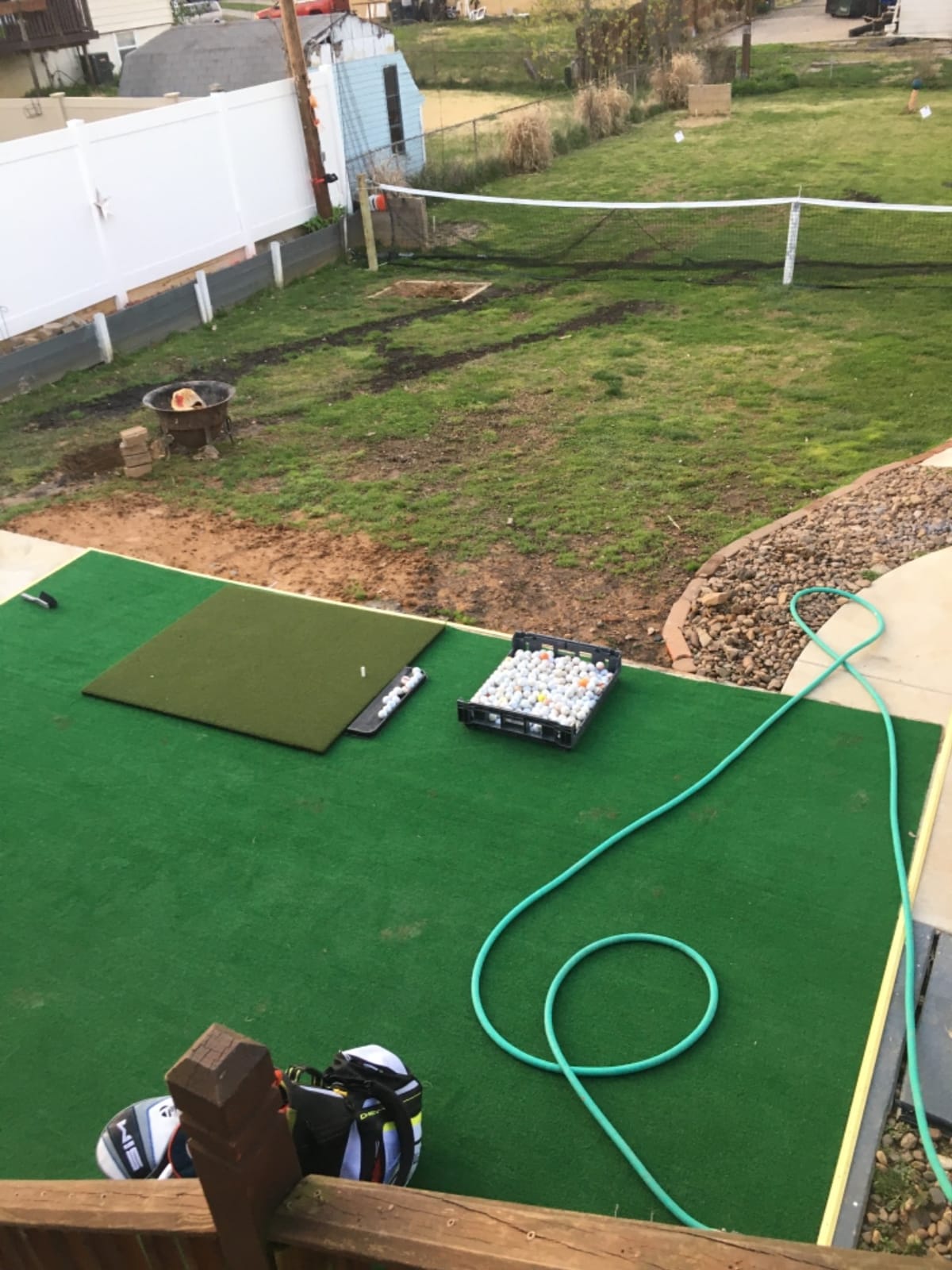
Two tee holes per side is the layout most often criticised. For golfers with a steep downswing who need a specific lead-side driver position, that is a real limitation, and it is the single most requested change in the reviews.
For irons and mid clubs, two positions per side is workable, and the rubber tees and ball tray in the box cover the basics.
Know the form factor before you order
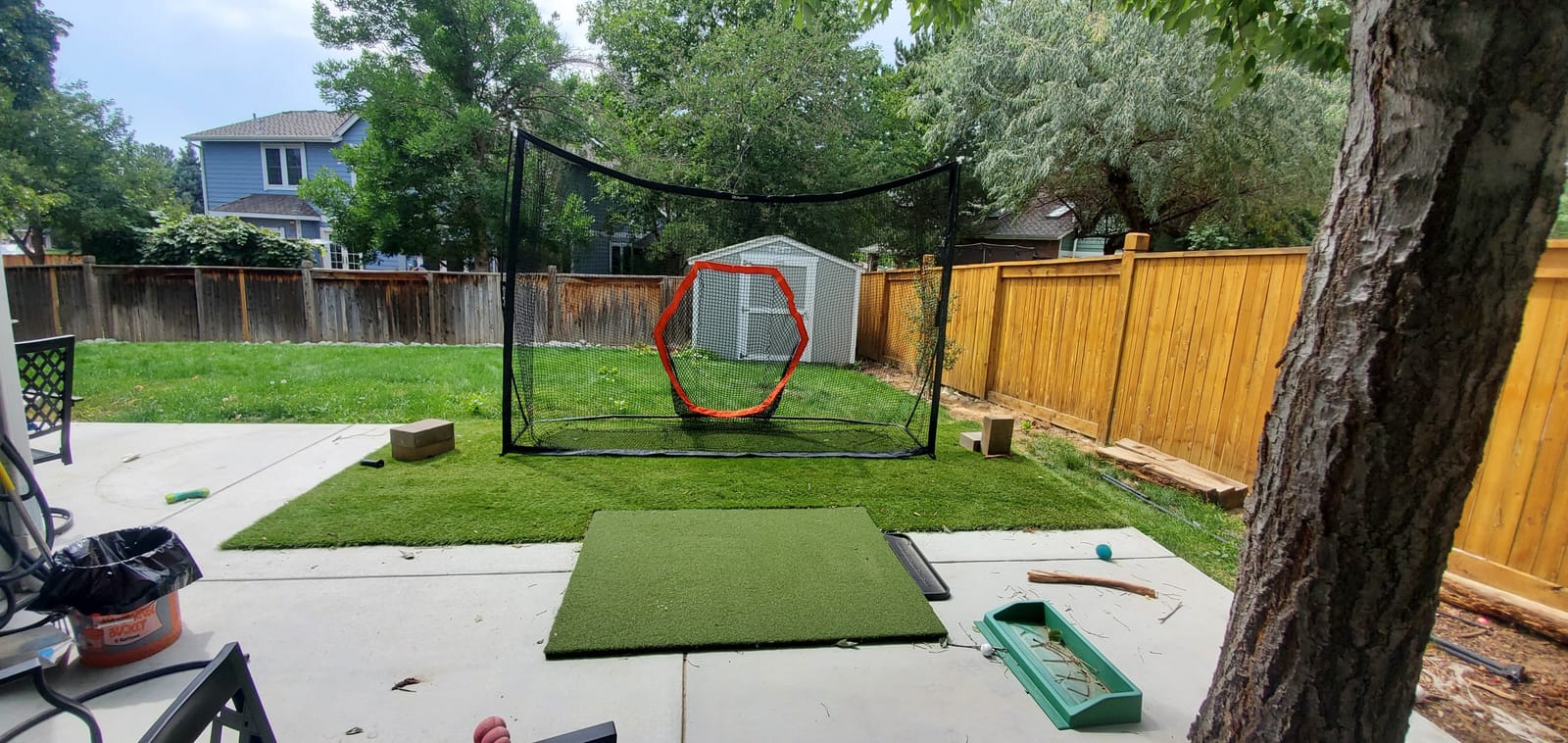
This mat is fixed, not foldable or rollable. In a garage bay that stays set up that is fine, but if you need to reclaim floor space for other uses, plan around the fact that this one stays where you put it.
It also feels lighter than its size suggests before use, which reads as lower quality at first contact. In use the base holds position well on concrete and paving, so that first impression is misleading rather than accurate.
10. RELILAC Dual Turf Golf Mat with Ball Tray – Best for Thick Dual Turf Build
RELILAC Dual Turf Golf Mat with Ball Tray,5x4Ft 31-50mm Thickened Golf Hitting Mats for Indoor/Outdoor Practice,Turf Driving Range Mats for Golf Simulators and Chipping Swing Driving Training
Dual turf rough and fairway
15mm EVA non-slip base
5x4ft
Nine tee positions
Pros
- Three-in-one dual turf mimics rough and fairway
- Integrated tray holds 40 golf balls
- Thick build stays planted and quiet on hard floors
- More tee positions than any other mat here
- Residue-free turf that keeps clubs clean
Cons
- Turf can wear through after a few thousand iron shots
- Takes weeks to sit flat after shipping rolled
- Can shift on hard surfaces during a full swing
- Dusty indoors
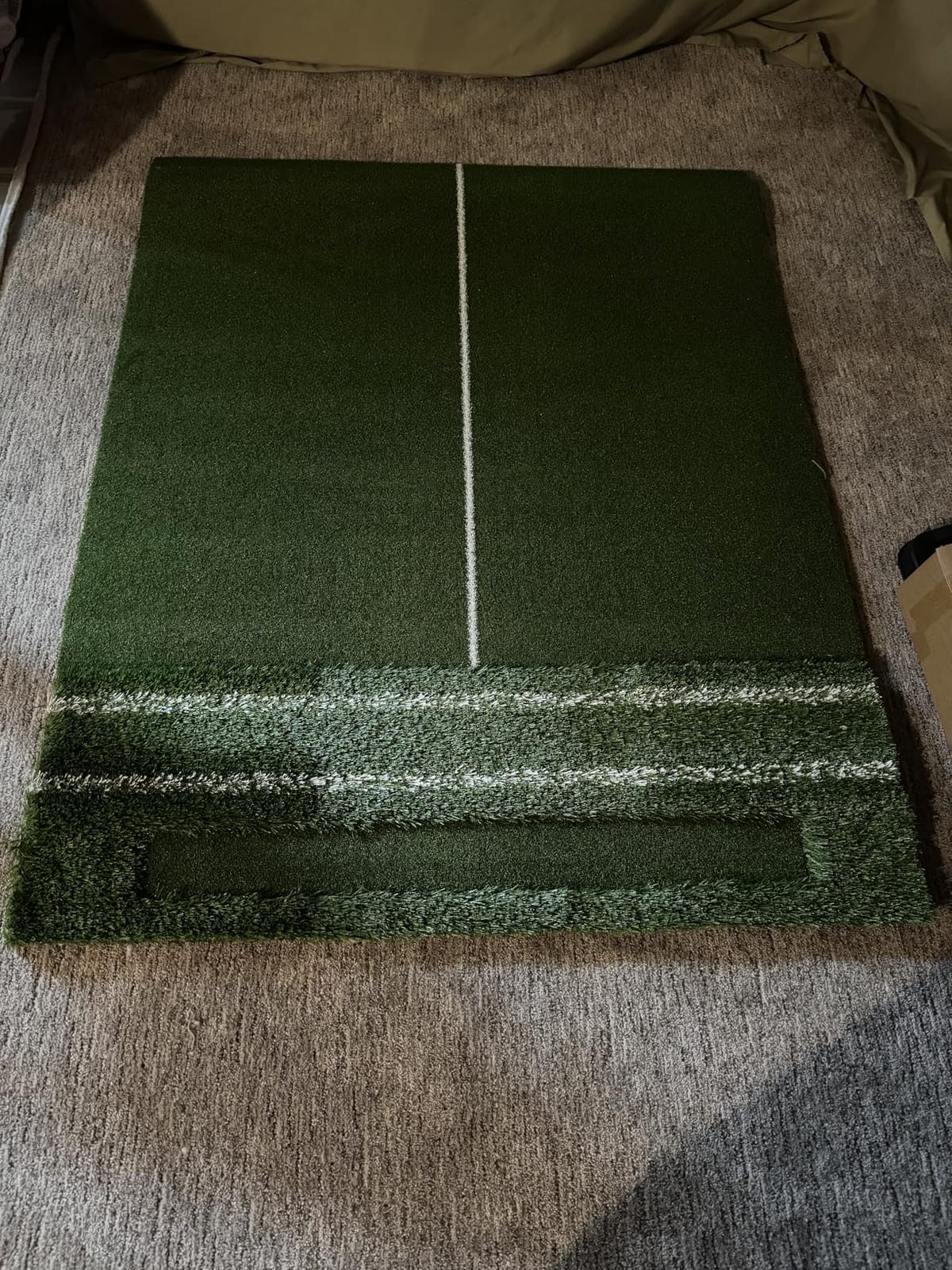
Among the thick mid-size builds, this one has the most going on. The upgraded three-in-one dual turf mimics rough and fairway, the fifteen millimetre high-elasticity EVA base is genuinely heavy, and the integrated tray holds forty balls beside the hitting area.
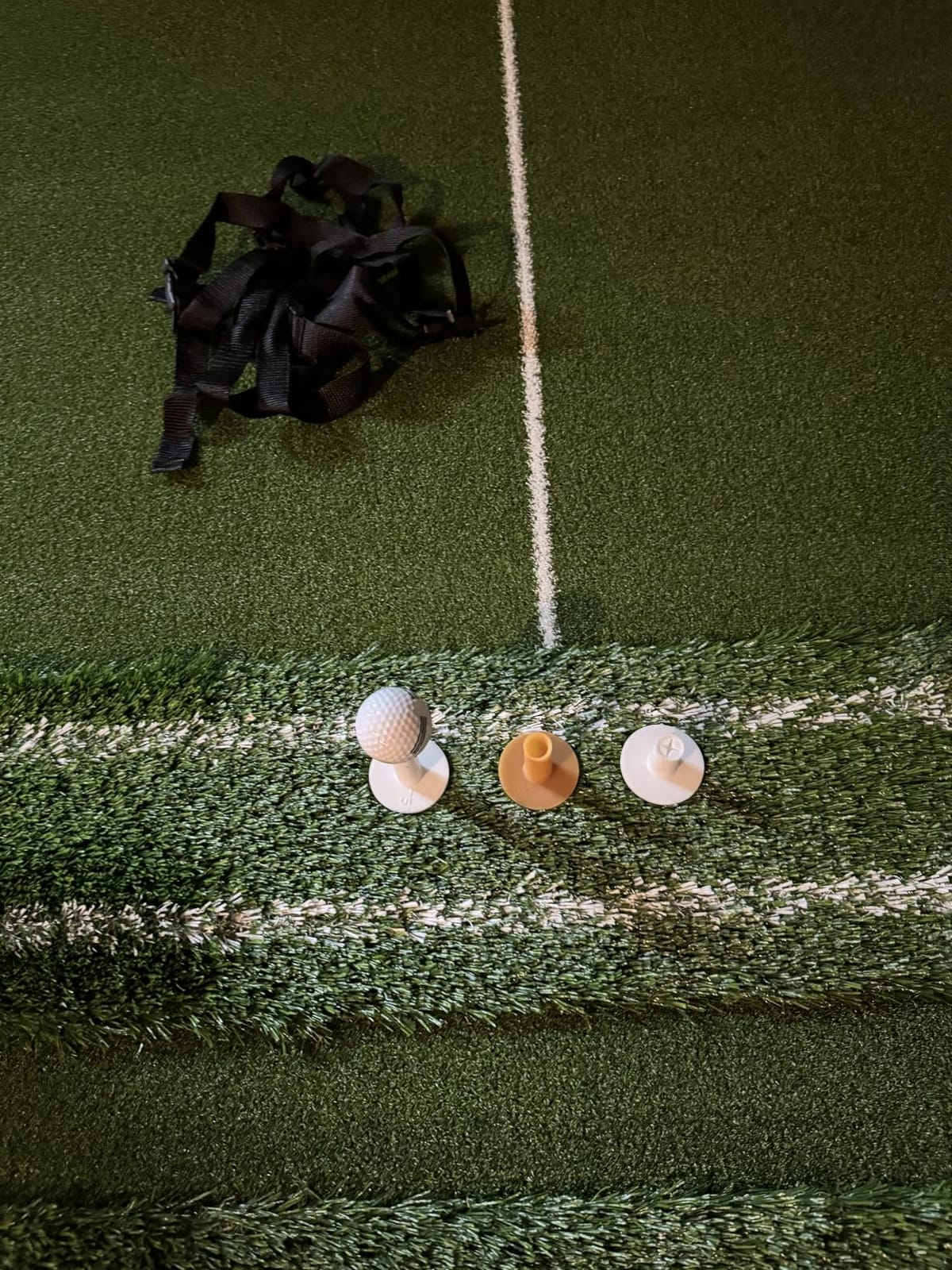
Nine tee positions is more than any other mat here, and it is the only configuration that comfortably serves both handedness setups without drilling. That makes it a shared-room mat in a way most five by four foot builds are not.
Users also report the mat staying quiet under impact, which matters more than you would expect in a basement where every shot echoes off bare walls.
Check the flattening period
This mat arrives rolled and can take several weeks to sit flat, even when weighted with bricks. If you are eager to start, order it early and give it time under weight before you judge the feel.
It can also shift on hard surfaces during a full swing without a rubber mat or adhesive underneath. The base is grippy but not self anchoring, which is the difference between this and a mat you can leave alone.
Know the wear profile
Turf can wear through and sink in after a few thousand shots, particularly for players who hit fat shots or take divots. The ball tray and heavy base make this a good value build in a simulator setup, but the strike zone is the part that gives out first.
It can also be dusty indoors, so keep a cloth nearby. With the smallest review base in this roundup and the highest share of one-star ratings, treat the feedback as directional rather than settled, and check the current reviews before committing.
How to Choose a Golf Simulator Hitting Mat
Most buyers overthink this. The decision reduces to three questions: how much joint protection do you need, how realistic does the feel have to be, and what does the mat have to fit into. Answer those in order and the shortlist writes itself.
1. Cushioning depth and joint stress
Repeated impact stress is the reason people get tennis elbow or golfers elbow from indoor practice, and cushioning depth is the variable that reduces it. Below 12mm you are standing on a hard surface in shoes. Between 15mm and 21mm you get useful absorption on carpet. Above 30mm you get a genuinely joint-friendly surface on bare concrete.
If you are returning after an injury, skip the cheap end. The Bltend at 36mm and the DURA-PRO at 30mm are the two builds in this roundup we would put in front of someone managing elbow or wrist tendonitis, and the reviews on both mention reduced soreness during long sessions specifically.
2. Realism: turf, foam or trace surface
Material choice drives the feel. Polypropylene turf over EVA foam is the most common construction and gives a consistent fairway-like response. Nylon fiber, as on the DURA-PRO, is denser and firmer and reads closer to a driving range. Trace surfaces like the COSPOPTIC do not simulate turf at all; they record where you struck the ball, which is a different and equally valid goal.
Buyers on Reddit consistently frame realism as forgiveness rather than fidelity. A mat that hides slightly off-center strikes will produce more confident numbers on a launch monitor than a firm mat that punishes every miss, and for a high-handicap golfer that is usually the more useful behaviour.
3. Height, footprint and the room you have
This is where most installs go wrong. Standard puzzle-piece foam flooring is commonly 10mm or 12mm, so a 15mm mat creates a small step and a 36mm mat creates a significant one. Buy the mat height that matches your floor, or cut the foam tiles so the transition sits off your stance line rather than under your downswing.
Footprint next. You need room to stand on the mat and swing a driver for full shots, which means five by four feet as a practical floor and five by five feet for large swings. Anything under about 24 inches is a short-game trainer, not a hitting surface, and the reviews of those mats reflect that limit honestly.
4. Mat or hitting strip?
A full mat bundles stance and strike surface in one piece. A hitting strip system separates them: an inexpensive stance mat with a quality replaceable strip, or an embedded strip in a floor. Members on r/Golfsimulator repeatedly make the same point, that you are overbuying on a full premium mat when a good strip on a cheap stance mat performs nearly as well.
Buy the full mat if you want one product, no fitting and no tools. Buy a strip system if you want to change firmness over time, if you swing a driver from a consistent ball position with a side-mounted launch monitor, or if your floor is already level and you would rather spend the budget on the strike surface than the stance area.
5. Where the rest of the build goes
The mat is one line in a build. Most of the spend in a home simulator sits with the launch monitor, the impact screen and the net, so treat the mat as the piece you physically load your body with rather than the biggest line item.
Pair the size decisions together and the rest of the build is easier. Our [golf hitting net roundups](https://modelrec.com/best-golf-hitting-nets/) cover the screen side of the room, and our [golf practice mats guide](https://modelrec.com/best-golf-practice-mats/) covers the short-game surfaces that sit alongside a hitting mat. If your simulator doubles as a putting green, our [putting mat picks](https://modelrec.com/best-golf-putting-mats/) cover the other end of the bay.
6. The first twenty shots
Before you commit to a full season, put any candidate mat through a short protocol. Hit twenty balls with an iron and check whether the surface moves, whether the ball feedback stays consistent between strikes, and whether the mat shows any lift or curl at the edges.
Then hit ten more with a driver and watch for two things, that you can complete the swing on the mat, and that the strike zone has not already started to crater. If it moves, if the feel changes shot to shot, or if the turf is already denting after thirty shots, it is the wrong mat for your floor or your swing.
Frequently Asked Questions
Which golf hitting mat is best for indoor simulators?
The GoSports Elite 15mm is the best all-round choice for most home simulators. Its commercial-grade synthetic turf over an EVA foam base gives consistent fairway-like feedback, the non-slip backing holds on concrete or carpet, and the 5×4 foot size lets you hit a driver while standing on the mat. Reviewers report thousands of shots with minimal wear, and only the fold crease needs a few days under weights to flatten.
Are golf simulator hitting mats worth the money?
Yes, if the mat is doing one of two jobs well: cushioning a high-repetition workload or letting you practise a full swing indoors at all. The less obvious advice from simulator builders is to spend less on the stance mat and more on the strike surface, or on a mid-size mat with genuine cushioning if you are hitting hundreds of balls a week. A thin foam mat is where that money gets wasted.
What is the recommended thickness for a golf hitting mat?
For carpet or a cushioned floor, 10mm to 16mm is enough for technique work. For bare concrete or a garage bay, 21mm to 30mm is the useful range, and 36mm or more is the joint-friendly end for long sessions or anyone managing elbow or wrist soreness. Match the mat height to your floor tile thickness, commonly 10mm or 12mm, so the transition does not sit under your stance.
Do golf simulator hitting mats cause injury?
Hard, thin mats are the most commonly reported cause of tennis elbow and golfers elbow among people practising indoors, because every shot sends shock up the lead arm and wrist. Buyers who switched to a 30mm or deeper cushioned mat report noticeably less wrist and hip soreness over long sessions. Cushioning depth, rotating your strike position and taking breaks between blocks all reduce the same load.
What is the best golf mat for home practice?
For full swings in a dedicated bay, a five by four foot mat with 21mm or more of total thickness is the practical floor, and the GoSports Elite 15mm is the strongest all-round pick. For apartments, short-game work and travel, a compact mat such as the CHAMPKEY or SAPLIZE is more realistic, because a full-length driver swing on a mat that small is not possible. Choose for the room you actually have.
Can I use a regular golf mat with a launch monitor?
Yes, any mat that holds position and sits flat will work with a launch monitor, and the reading depends on club and ball flight more than the mat. What matters is that the mat does not move during impact, that the ball is above the turf rather than in a divot, and that the strike zone is level. For a side-mounted monitor, use a ball position on the mat rather than off the front edge.
Final Verdict for Golf Simulator Hitting Mats in 2026
The GoSports Elite 15mm is our pick for the best golf simulator hitting mats for home use in 2026. It handles concrete and carpet, takes a driver swing on the mat itself, and has the review history to know it will still feel right in year two.
Go deeper on cushioning and the Bltend 36mm protects joints best. Keep it small and the CHAMPKEY covers short-game work in a flat for a fraction of the outlay.
Before you order, match the mat height to your floor and give it a few days flat before your first session. If you are still deciding on the rest of the bay, our [golf hitting mat roundup](https://modelrec.com/best-golf-hitting-mats/) covers the wider shortlist.