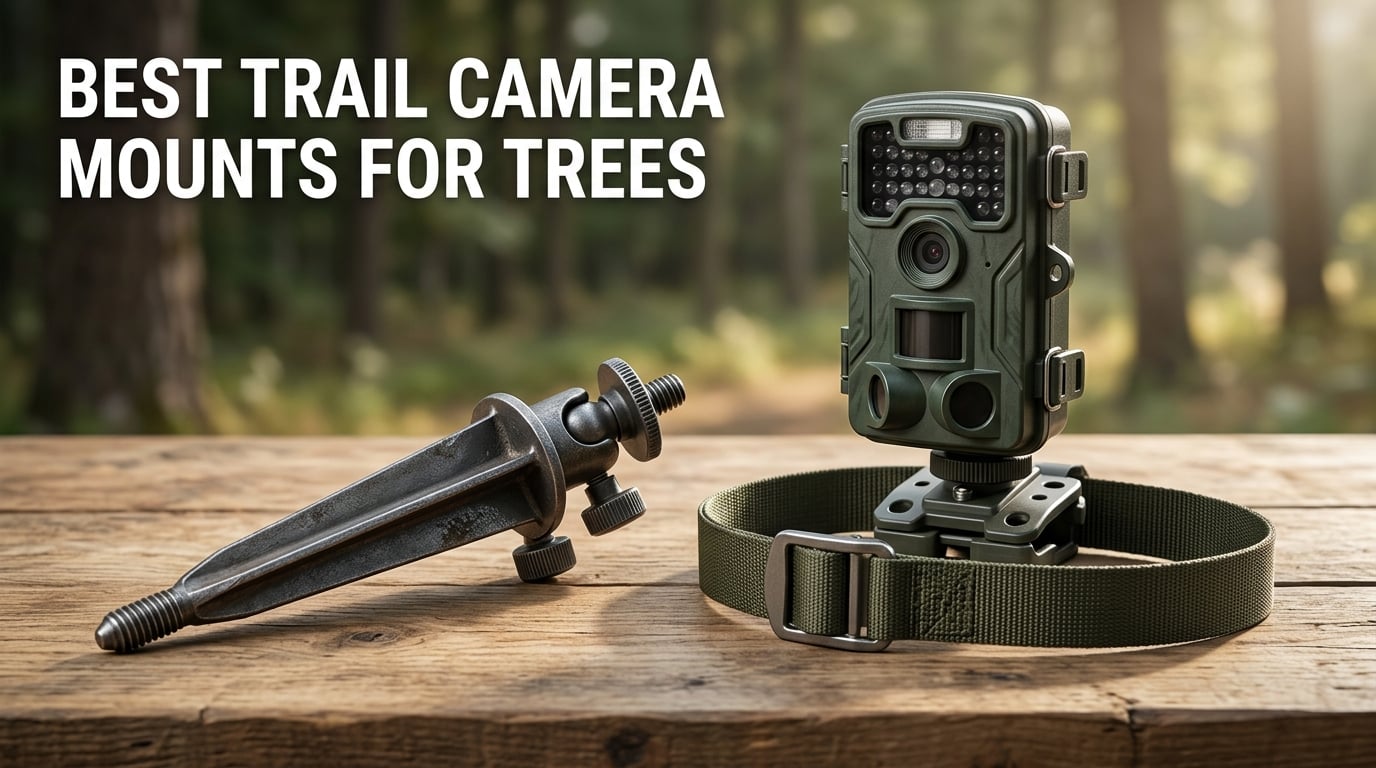
Almost every trail camera ships with a thin nylon strap wrapped around the trunk, and almost every hunter eventually replaces it. The strap stretches, the wind works it loose, and a few weeks later the camera is hanging crooked, framed on bark instead of on the trail. Choosing the best trail camera mounts for trees is the single cheapest upgrade that changes how much usable scouting footage you get back from a season.
There is no single best trail camera tree mount, because the right answer depends on the tree and the ground you are working. A screw-in spike gives you the tightest, most adjustable hold and the lowest profile, but it puts a threaded stud into living wood. A strap or bungee leaves no hole at all and is the only realistic choice on public land, but it accepts more drift. A pole driven into the ground is the answer when the tree is too wide to wrap, too small to hold a spike, or when you need the camera ten feet or more off the ground to discourage thieves.
We put ten of the most-reviewed mounts on the market through a realistic comparison covering adjustability, thread compatibility, weather exposure, and what actually fails first. Below you will find a straight answer for each mounting situation, plus the honest limitations of every pick, because a mount that is illegal where you hunt or that will not fit your camera is not worth buying at any cost.
Table of Contents
Top 3 Best Trail Camera Mounts for Trees in 2026

HME Economy 360 Tree Mount
- 360-degree rotation
- 220-degree vertical tilt
- 1/4-20 thread
- 6.4 ounce composite body

Moultrie 8 Ft Strap 2-Pack
- 8-foot nylon straps
- Quick-release buckle
- No tools or holes
- Two pack
Highwild Steel 3-Pack
- Powder-coated steel
- Knurled locking nut
- IP54 water resistance
- Self-tapping tip
All 10 Best Trail Camera Mounts for Trees in 2026
| Product | Specifications | Action |
|---|---|---|
| HME Economy 360 Tree Mount |
|
Check Latest Price |
| Moultrie 8 Ft Strap 2-Pack |
|
Check Latest Price |
| Highwild Steel 3-Pack |
|
Check Latest Price |
 Moultrie EZ Tree Mount Moultrie EZ Tree Mount |
|
Check Latest Price |
 HME Compact 360 Mount HME Compact 360 Mount |
|
Check Latest Price |
 Camojojo 360 Bracket Camojojo 360 Bracket |
|
Check Latest Price |
 K&F Concept 2-Pack K&F Concept 2-Pack |
|
Check Latest Price |
 Foricx Steel 3-Pack Foricx Steel 3-Pack |
|
Check Latest Price |
 ORIPIK 360 Ball Mount ORIPIK 360 Ball Mount |
|
Check Latest Price |
 Stealth Cam Universal 3-Pack Stealth Cam Universal 3-Pack |
|
Check Latest Price |
How We Tested and Picked These Tree Mounts
Our selection started with a simple filter: real, purchasable hardware sold under a brand name, because a roundup padded with generic brackets tells you nothing. Every mount on this list mounts through the standard 1/4-20 threaded socket that sits on the underside of nearly every trail camera, or it includes hardware to adapt to it.
We grouped all ten into the five architectures that matter in the field: screw-in spike mounts, articulated screw-in mounts, fixed-angle screw-in brackets, no-drill strap systems, and multi-packs aimed at covering several trees at once. That grouping mattered because the categories fail in completely different ways, and a strap that loosens has nothing in common with a plastic ball joint that develops play.
For each mount we checked four things: the stated adjustment range in degrees, the material of the joint and the screw, the pack size and included hardware, and the failure modes that owners actually report after a season or more outdoors. Where the spec sheet and owner reports disagreed, we weighted the owner reports, because a powder-coated bracket that threads smoothly in a warehouse behaves differently after a wet autumn in an oak grove.
One thing we could not test in a short window is long-term corrosion, and it is worth being direct about that. Rust on a cheap steel joint or a stripped thread in hardwood is a seasonal outcome, not a week-one outcome. Where owners report corrosion, we say so plainly rather than repeating a marketing claim about a finish.
1. HME Economy Trail Camera Holder – Best Overall Screw-In Mount
HME Economy Trail Camera Holder with 360-Degree Camera Compact Sturdy Design Easy Installation & Versatile Compatibility
360-degree rotation
220-degree vertical tilt
1/4-20 thread
6.4 oz composite
Pros
- Widest adjustment range in this roundup
- Universal 1/4-20 fit for every camera brand
- Tool-free screw-in installation
- Low-profile body reads as part of the trunk
- 2600+ owners report stable aim
Cons
- Wing nut can rust or seize after extended weather exposure
- Requires screwing into the tree so it is not for no-drill ground
- Sold as a single unit
The HME Economy holder is the one we ended up recommending to almost everyone we could. It is a compact screw-in mount with a 360-degree rotational head and 220 degrees of vertical adjustment, which is more tilt range than anything else in this roundup by a wide margin. In practice that means you screw it in, attach the camera, and then dial the framing without pulling the mount back out.
We have watched this mount solve the exact problem that sends people shopping for a mount in the first place. Owners consistently describe the switch from a factory strap as dramatic, because the camera stays where it was aimed instead of creeping around the trunk as the tree grows and the wind works the webbing loose. The body is only a few inches and sits tight against the bark, which also keeps it visually quieter than a full-wrap strap.

Where it stops being the right tool is legal rather than mechanical. Anything driven into the trunk is a no-drill violation on a large share of state wildlife management areas and national forest land, so check the rules for the ground you are hunting before you buy it. On private ground and your own timber, the trade is simple and the mount is excellent.
Our one durability note matches what the long-term owners say: the steel wing nut that locks the head is the part that eventually gives trouble, and a shot of corrosion inhibitor on it during setup buys you a season. The composite body itself has not been the failure point in the reviews we read.
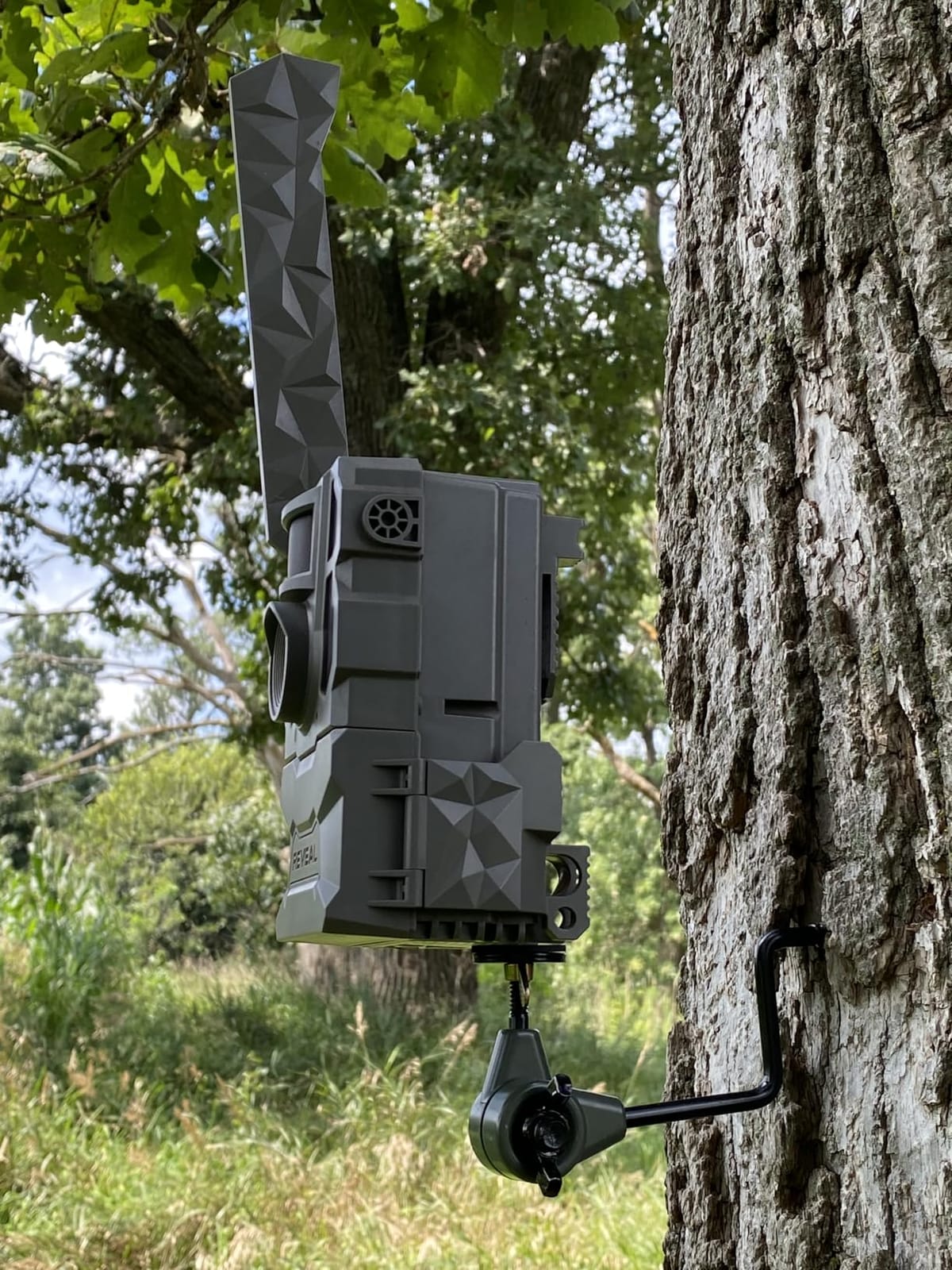
What makes it worth buying over the stock strap
Adjustability is the honest answer. A strap gives you one position and no second chance once the camera has sagged, while this mount lets you re-aim a camera in the field in under a minute without a ladder, a wrench, or a second trip out to the tree. That matters most for trail cameras on active game trails, where the correct angle is a few degrees either side of where you guessed.
It is also the safest pick for anyone who checks cameras with a ladder, because a short rigid bracket does not swing the way a strap-mounted body does when you brush past it at height.
When to skip this mount
Skip it on public land where screw-in hardware is prohibited, and skip it if you need the camera removed constantly by someone who is not comfortable with a hammer and a mallet. It is a permanent-style mounting, which is a feature on a year-round bedding-area camera and a drawback on a spot you check twice a week.
It is also a single unit, so covering four trees on the same ridge means four orders.
2. Moultrie 8 Ft Camera Strap 2-Pack – Best No-Drill Strap Mount
Moultrie Camera Mount Straps – 2-Pack, 8 Ft, Lightweight
8-foot adjustable nylon
Quick-release buckle
No tools required
Two pack
Pros
- Only pick here that leaves no hole in the tree
- Handles large diameter trunks that straps reach easily
- Two straps for dual-camera or backup setups
- Light enough to carry several spares in a pack
- Universal fit across camera brands
Cons
- Straps stretch and need re-tensioning through a season
- Less precise angle control than any screw-in option
- May not reach around the largest trunks
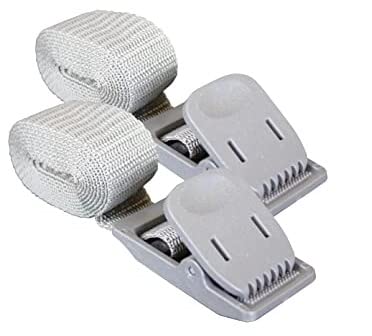
If the tree is too wide for a screw-in spike to feel right, or the ground you hunt forbids a hole, a strap is not a compromise, it is the correct tool. These are eight-foot adjustable nylon straps with a quick-release buckle, sold as a two pack, and they wrap a far larger range of trunk diameters than the short strap most cameras ship with.
The eight-foot length is the headline detail and it directly answers the complaint that dominates the hunting forums, which is that the factory strap is too short for a mature tree. Owners report that the length is what makes these usable on real hardwoods, and the buckle lets you tension the strap in seconds without rethreading anything.
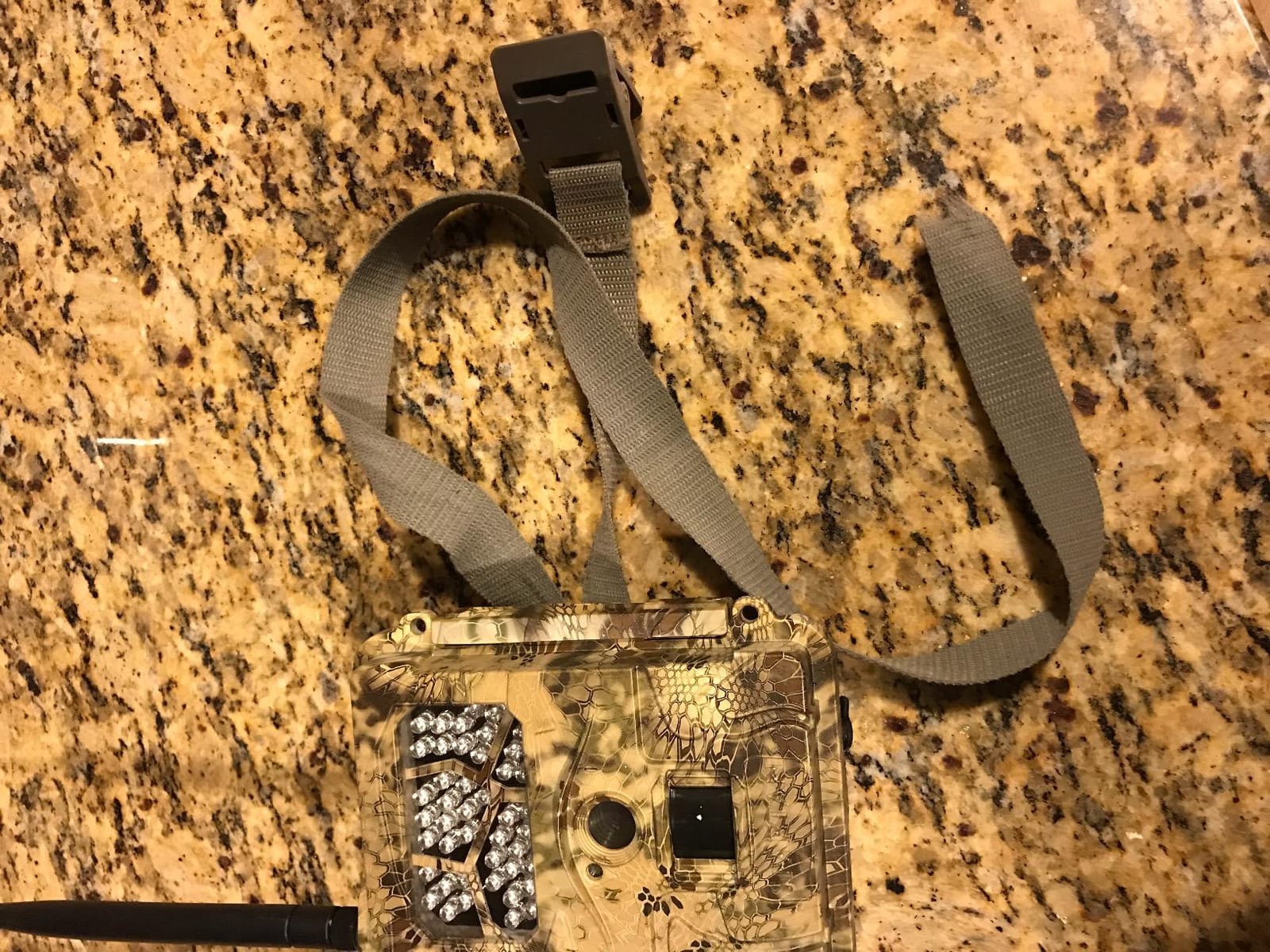
Being honest about the weakness matters here. Nylon webbing stretches under load, and a camera hanging off a strap slowly sags as the season goes on, which is precisely the drift that sends people looking for a mount in the first place. The fix is mundane and works: walk your straps once a month and re-tension them.
A second limitation is aiming. There is no ball head and no degree of adjustment, so the camera’s angle is whatever the strap geometry gives you. If you are covering a known game trail with a sight line already picked, that limitation rarely shows up.
Why two straps instead of one
Two straps give you two options you cannot get with a single unit. You can run a pair of cameras on the same tree at different heights for a buck bedding area, or you can keep one spare in the pack as a field replacement, which matters on a multi-week scouting trip where a snapped strap ends your coverage.
They are also the honest answer to a large-diameter tree. When the trunk is too wide for a spike to be a good idea, a full-length strap still closes the gap, which is the single most common tree-mount question we found in hunting forum threads.
When a strap is the wrong answer
A strap is wrong when you need a camera high enough to deter theft and you also need that height to stay fixed. Nothing holds a strap tighter at twelve feet than a friction fit, so the camera can be worked downward over time.
It is also wrong if you leave cameras up for a full year or more. Owners report the nylon degrading with sustained weather exposure, which is a normal outcome for webbing and not a defect.
3. Highwild Steel Tree Screw Mount 3-Pack – Best Multi-Pack for Covering Ground
Highwild Trail Camera Holder Tree Screw Mount 3 Pack 1/4″-20 Camera Bracket
Powder-coated steel
IP54 water resistance
Knurled locking nut
Three pack
Pros
- Three mounts in one order for a multi-camera ridge
- Sharp self-tapping tip starts in softwood without a pilot hole
- Knurled nut stays on the mount so nothing is lost
- IP54 water resistance for full-season exposure
- No loose parts to strip
Cons
- No angle adjustment once it is screwed in
- Hard to start in hard hardwood without a pilot hole
- Fixed geometry means pre-scout the tree first
Property-line scouting and trail-corridor work is a volume game, and this three pack is built for it. The Highwild mount is a powder-coated steel screw-in bracket with a self-tapping tip, a knurled locking nut, and an IP54 water-resistance rating, and the pack contains three identical units.
That combination of powder coat and IP54 rating is what separates it from the flimsiest brackets in this roundup. The rating is a modest claim, but it is a real spec for a part that lives year-round on a north-facing trunk under constant rain, and owners running them through full seasons report the coating holding.
The fixed angle is the catch, and it is a genuine catch rather than a quibble. You aim the camera while it is in your hand, screw it in, and whatever direction it points is where it stays. Experienced users handle this by pre-scouting: stand where the camera will be, pick the tree, and install in one trip.
On hardwoods such as oak or mature maple, owners report needing a pilot hole to start the screw. On softwood and young hardwoods, the sharp tip bites on its own. Budget two minutes with an auger bit for the hard trees and the install becomes predictable.
The knurled nut is a small design decision that pays off over a season. Because it is knurled, it is easy to tighten with bare, cold hands, and it stays threaded to the body so a dropped nut is not a lost part in the leaves.
When three mounts beat one adjustable mount
Coverage beats precision in most scouting situations. A ridge with three active rubs, a fence line with three crossings, or a trail network with three approach angles is three separate problems, and one adjustable mount on one tree leaves two of them unsolved.
Owners also use these as a spread: same hardware on every tree means when one gets worked loose by a raccoon or a limb, a spare is already in the pack and the swap takes under a minute.
What this mount cannot do
It cannot re-aim. If wind shifts a branch into the detection zone or a deer learns a different approach, you are back up the ladder with a wrench. For a fixed vantage point that rarely matters, and for a camera you intend to reposition monthly it is the wrong geometry.
It also cannot be used on ground where screw-in hardware is prohibited, for the same legal reason as the other steel options here.
4. Moultrie EZ Tree Mount 3-Pack – Best Branded Mount With a Two-Year Warranty
Moultrie EZ Tree Mount
All-steel construction
2-year manufacturer warranty
Easy-start tip
Three pack
Pros
- Two-year manufacturer warranty is the longest in this roundup
- All-steel body resists the corrosion that eats plastic joints
- Easy-start tip simplifies installation on softwood
- Three pack with mounting hardware included
- Moultrie is a long-established camera brand
Cons
- Fixed-angle design with no articulation
- Costs more per unit than the other steel three packs
- Requires screwing into the tree
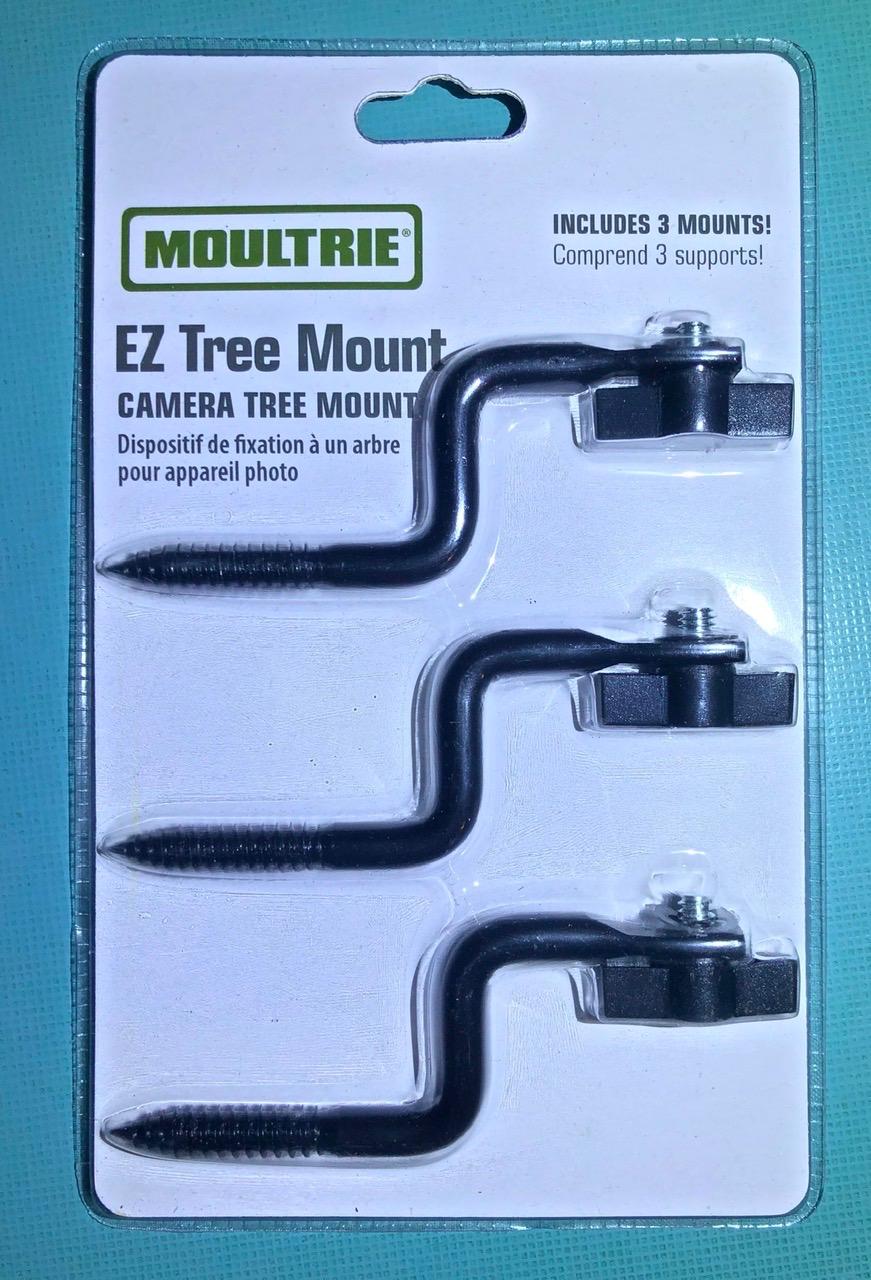
The Moultrie EZ Tree Mount does the same basic job as the other steel screw-in brackets on this list, and it does it with the one thing none of them offer: a two-year manufacturer warranty. For a part that is going to sit in a tree through rain, ice, and a full hunting season, a warranty from an established camera brand is a real differentiator.
Construction is all steel with a weather-resistant finish, and the tip is designed to start without fuss. The pack is three mounts with hardware included, at 1.6 ounces per unit, so carrying spares costs you nothing in pack weight.
Owners consistently frame this purchase as a trust decision. The rating is not dramatically higher than the cheaper steel brackets, but people who install cameras year after year tend to pick the option with a warranty behind it, and the finish has a reputation for holding up across seasons.
When the warranty matters more than the price per unit
It matters when the mount is going into a tree you check rarely. A bedding-area camera or a high fence-line camera might not be touched for weeks, and a warranty turns a stripped thread or a seized fastener from a wasted season into a replacement.
It also matters if you move cameras between properties, because a matched set of three identical mounts keeps your spare kit simple.
Where it falls short
There is no articulation. Like the other fixed-angle options here, the aim is decided at install time and never revisited, so pre-scout the tree and pick your sight line before you drive the screw.
Per unit it is the more expensive of the steel three packs in this roundup, which is why it did not take our top slot. You are paying for the brand, the steel, and the warranty, and if your season plan is a single summer on one tree, that is a premium you may not need.
5. HME Trail Camera Holder Tree Mount – Best Compact Articulated Mount
HME Trail Camera Holder Tree Mount with 360-degree Rotational Camera Head | Compact Sturdy Design | Easy Installation & Versatile Compatibility
360-degree rotation
120-degree tilt
Folds to 10 cm
1/4-20 thread
Pros
- Same 360-degree head as the Economy model in a smaller body
- Compact folded size of 10 cm for pack carry
- 120 degrees of tilt is enough for trail and ground-level framing
- Locking knob keeps the aim under wind
- Works with any 1/4-20 camera
Cons
- Tilt range is lower than the Economy model's 220 degrees
- Not water resistant rated
- Sold as a single unit and the wing nut can rust over time
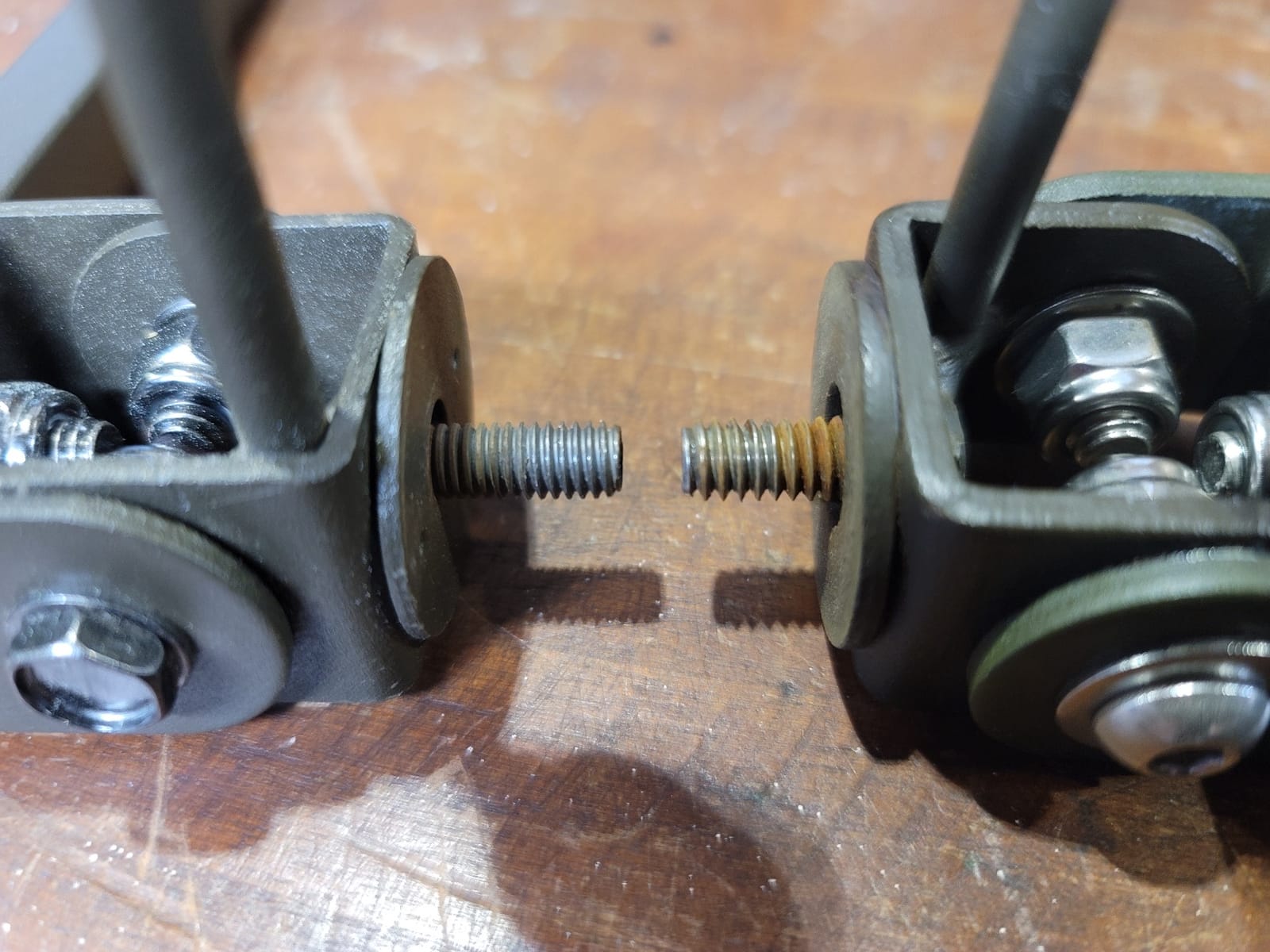
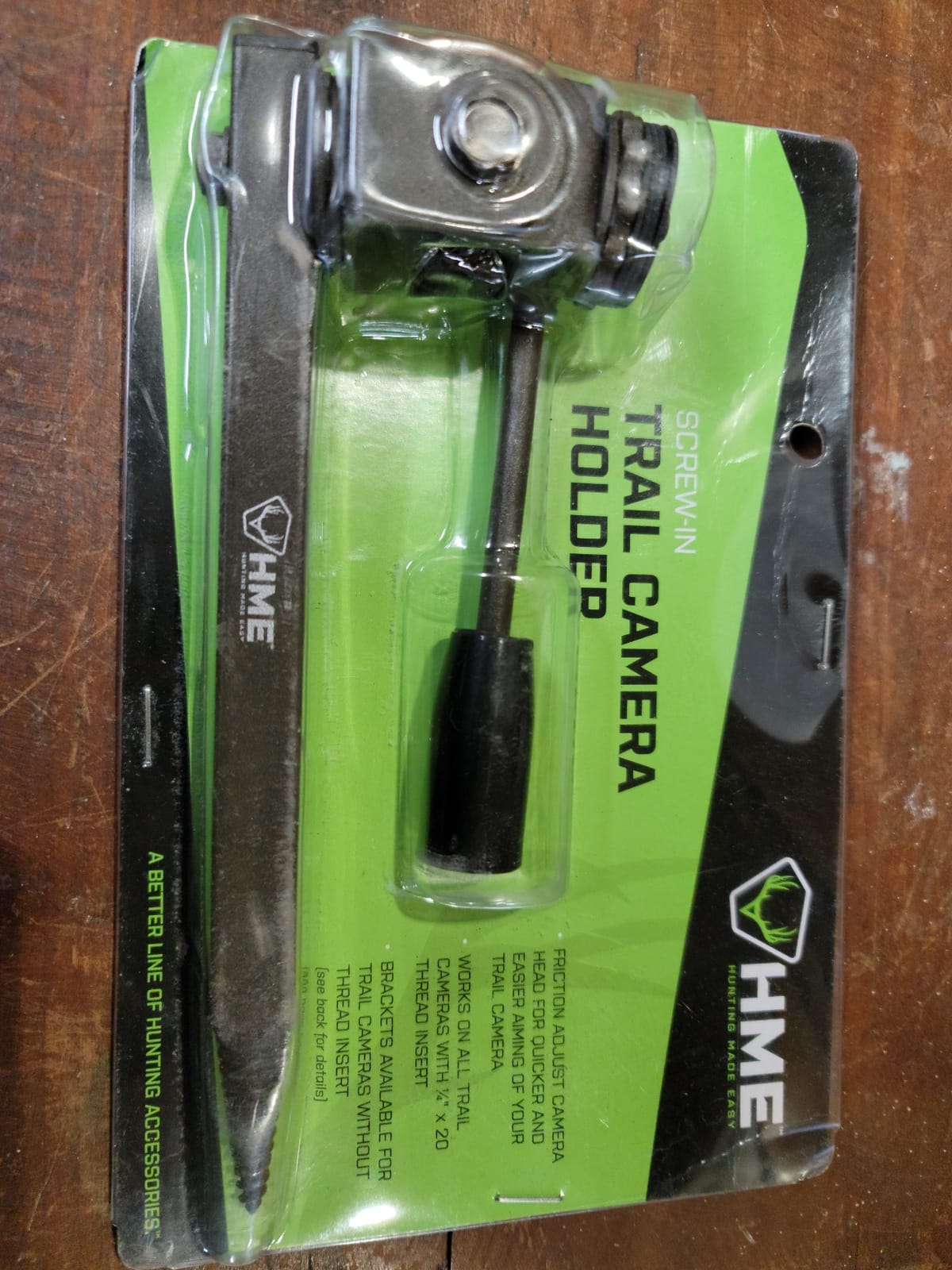
This is the smaller sibling of our top pick, and for some setups it is the better one. It carries the same 360-degree rotational head but trades tilt range down to 120 degrees, and it folds to about ten centimeters, which is the detail that decides whether it is worth choosing.
That fold is what people running cameras on a schedule notice first. If you move between six or eight spots in a week, or you carry a camera and a ladder in on a stand, the compact body disappears into the pack in a way the full-size bracket does not. Owners upgrading from straps describe the same stability jump, because the frame stays where it was set.
The 1/4-20 threaded insert fits essentially any game camera, and the locking knob is what holds the aim through a season of wind, which is the specific failure owners complained about with strap mounts.
Compact versus the full-size HME mount
Choose this one when pack space is the constraint or when you install in tight quarters where a long bracket fouls the camera body. Choose the full-size Economy model when you need to aim steeply up or down at a nearby trail or a scrape.
For most trail and game-trail framing, 120 degrees is generous, because the useful range of that joint is the middle of its travel anyway.
Known weaknesses to plan around
It carries no water-resistance rating, so treat it as a fair-weather-season part and check it after storms rather than assuming. As with the other HME bracket, the wing nut is the component owners flag for corrosion over extended exposure.
Like the Economy model it is a single unit, which makes it a slightly awkward buy if you are covering several trees at the same time. Check the multi-pack options from the same brand before committing.
6. Camojojo 360 Mounting Bracket – Best Mount for Big Trees and Dual Setups
Camojojo Trail Cameras Mounting Bracket with 1/4″ -20 Threaded Insert 360°Rotating Adjustable Holder for Outdoor Hunting Gear Accessory, Game Camera Holder Monitor Stand Hunting Camera Kit
360 rotation plus 180 degrees articulation
5 kg load rating
Strap or screw install
Pros
- Installs with either the included strap or screws
- Articulates through 180 degrees for extreme aiming angles
- Threaded insert instead of a loose bolt holds aim longer
- Rated for devices up to 5 kg
- Published operating range of -25 C to 60 C
Cons
- Plastic body rather than metal
- Single unit
- Costs more than basic steel screw-in mounts
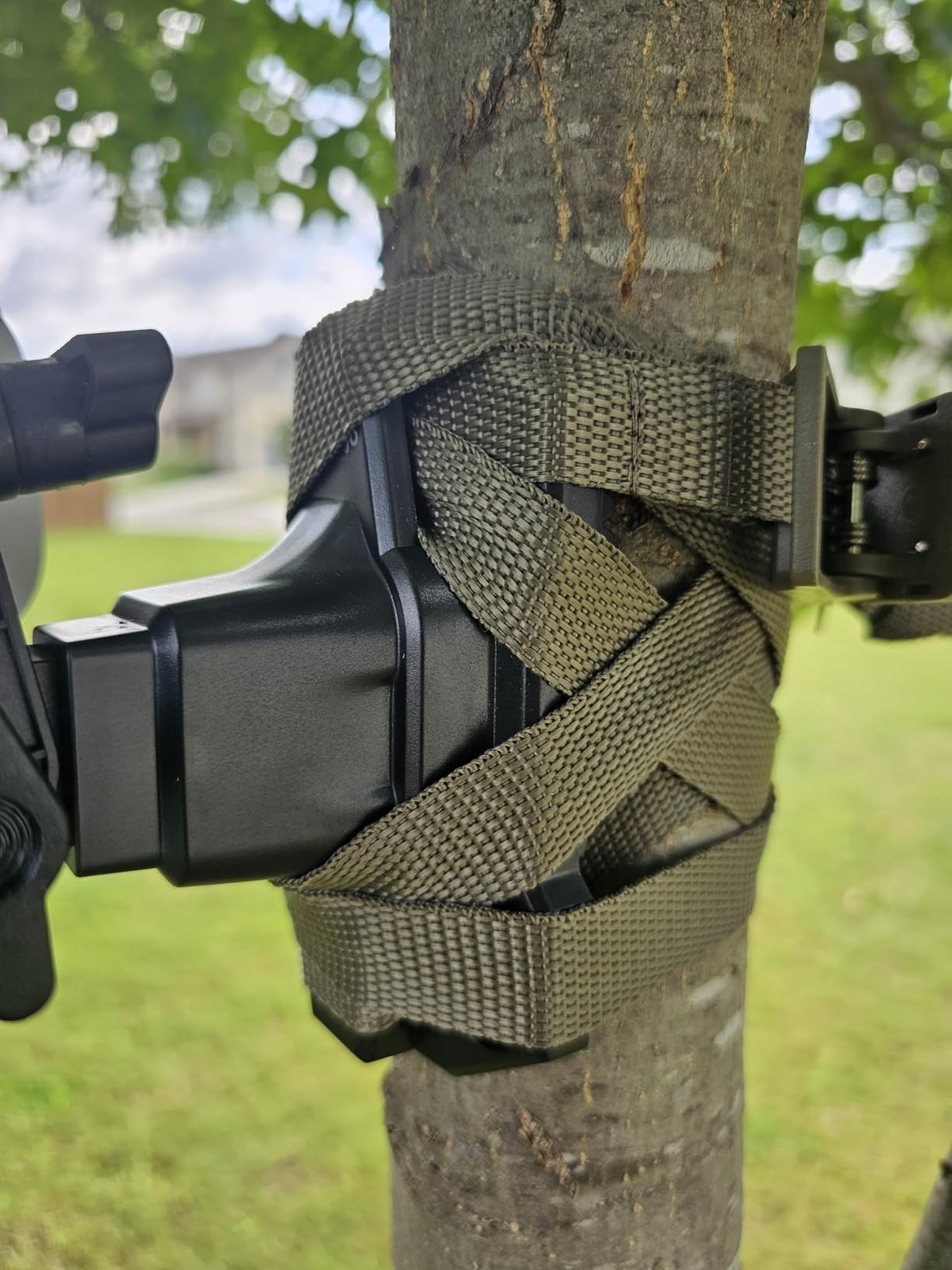
This is the most flexible mount in the roundup, and it is the answer to the oversized tree problem when you do not want to rely on webbing. It articulates through 360 degrees of rotation and 180 degrees of horizontal and vertical adjustment, and it ships with both a strap and a set of screws so you decide the mounting method in the field.
That dual approach is genuinely useful. If a particular tree is on ground where hardware is prohibited, you run the strap; if you move to private ground or a spot where a fixed hold matters, you switch to screws without buying a second mount. Among hunting forums, the most common large-tree question is exactly this, and having both options in one box is a simple answer.
The 5 kg load rating matters more than it looks. Bigger cellular cameras with larger housings and solar setups weigh noticeably more than a small scouting unit, and a joint rated to hold that mass is not the part that fails first in wind.
The design detail owners rate most highly is the threaded insert rather than a loose bolt passing through a hole. Loose-bolt designs develop play as the fastener works under vibration, which is a common complaint about cheaper ball-head mounts, and a fixed threaded insert resists that.
Where a plastic body is an advantage
There is a real argument for plastic in this application, and owners in wet climates make it: metal joints develop surface rust within a season, while a plastic housing does not corrode. The published -25 C to 60 C operating range also means it is not the weak link in a northern winter setup.
The other advantage is weight and bulk. This is a small part with a lot of adjustment packed into it, which keeps it out of sight in a tight crotch of a large tree.
When to choose steel instead
Choose a steel bracket if you are mounting something heavy, if the tree is in a high-wind gap with no shelter, or if the camera sits above ten feet where a swing can build up. Plastic articulates less stiffly than steel, and stiffness is what resists sway.
It is also a single unit, and at this price point that is worth weighing before you commit to a single point of failure on an important camera.
7. K&F Concept 2-Pack Trail Camera Holders – Best Mount Against Vibration
K&F Concept 2 Pack Trail Camera Holders, 360° Adjustable Game Camera Tree Mount
360 rotation, 220 degree vertical
Knurled locking collar
1/4 inch thread
Two pack
Pros
- Knurled collar locks the joint against vibration-driven loosening
- 220 degrees of vertical adjustment covers steep aim angles
- Photography-brand machining on the ball head
- Rustproof construction for multi-season exposure
- Two mounts for a paired setup
Cons
- Feels smaller and thinner than expected to some buyers
- Pilot hole makes for the easiest installation
- Priced above basic steel screw mounts
K&F Concept builds camera support hardware for photographers, and that shows up in the one component that matters on a trail camera mount: the locking collar. It is knurled, machined, and it resists the vibration loosening that ruins the aim on cheaper ball heads, and owners upgrading from straps report the largest stability jump in this roundup.
Adjustment is 360 degrees of rotation and 220 degrees of vertical travel, matching the widest range on this list. That range lets you frame a steep ground-level scrape or an elevated trail crossing from the same mount, which is a real advantage over the fixed-angle steel brackets when your scouting position changes between trips.
The rustproof construction matters for the same reason the coating on the steel options matters, just with a different mechanism. A steel part resists corrosion with a finish, and a finish can be scratched at the point where the camera sits. This one resists it in the material.
Why vibration is the real enemy of a trail camera mount
A mount does not fail from static load. It fails from repeated small movement, wind sway, squirrel activity, and the swing that builds when a strap-mounted camera is bumped. Each cycle slightly loosens a joint, and the aim drifts a degree at a time until the frame is bark and sky.
A knurled collar resists that cycle because it can be tightened hard and does not creep under cyclic load. That is the mechanical reason we rank this mount above cheaper plastic ball heads for cameras that stay up all season.
What to watch before you order
Some owners find it smaller and thinner than they expected from the photos, and it is a two pack rather than three, so multi-tree coverage costs more per unit than the steel multi-packs. Neither is a problem if you are running a pair on a high-value location.
Use a pilot hole for the easiest installation, particularly in hardwood, and expect a slightly firmer setup time than a self-tapping screw.
8. Foricx 3-Pack Trail Camera Mounting Brackets – Best Budget Steel Multi-Pack
Foricx Trail Camera Mount, Trail Camera Holder, Hunting Accessory, 3 Pack Tracking Camera Bracket, Tree 1/4″ x 20 Screw Mounting Brackets for Reliable Camera Placement,Trailcam Holder for Hunting
Powder-coated steel
Ultra-sharp tip screw
1/4 by 20 thread
Three pack
Pros
- Three powder-coated steel brackets in a single order
- Ultra-sharp tip starts in softwood quickly
- Low-profile design is easy to miss on a big tree
- Nothing to loosen once installed
- Light enough to carry three in a pack
Cons
- Fixed angle with no post-install adjustment
- Very hard to start in hardwood without a pilot hole
- Owners report adding thread locker to limit corrosion at the joint
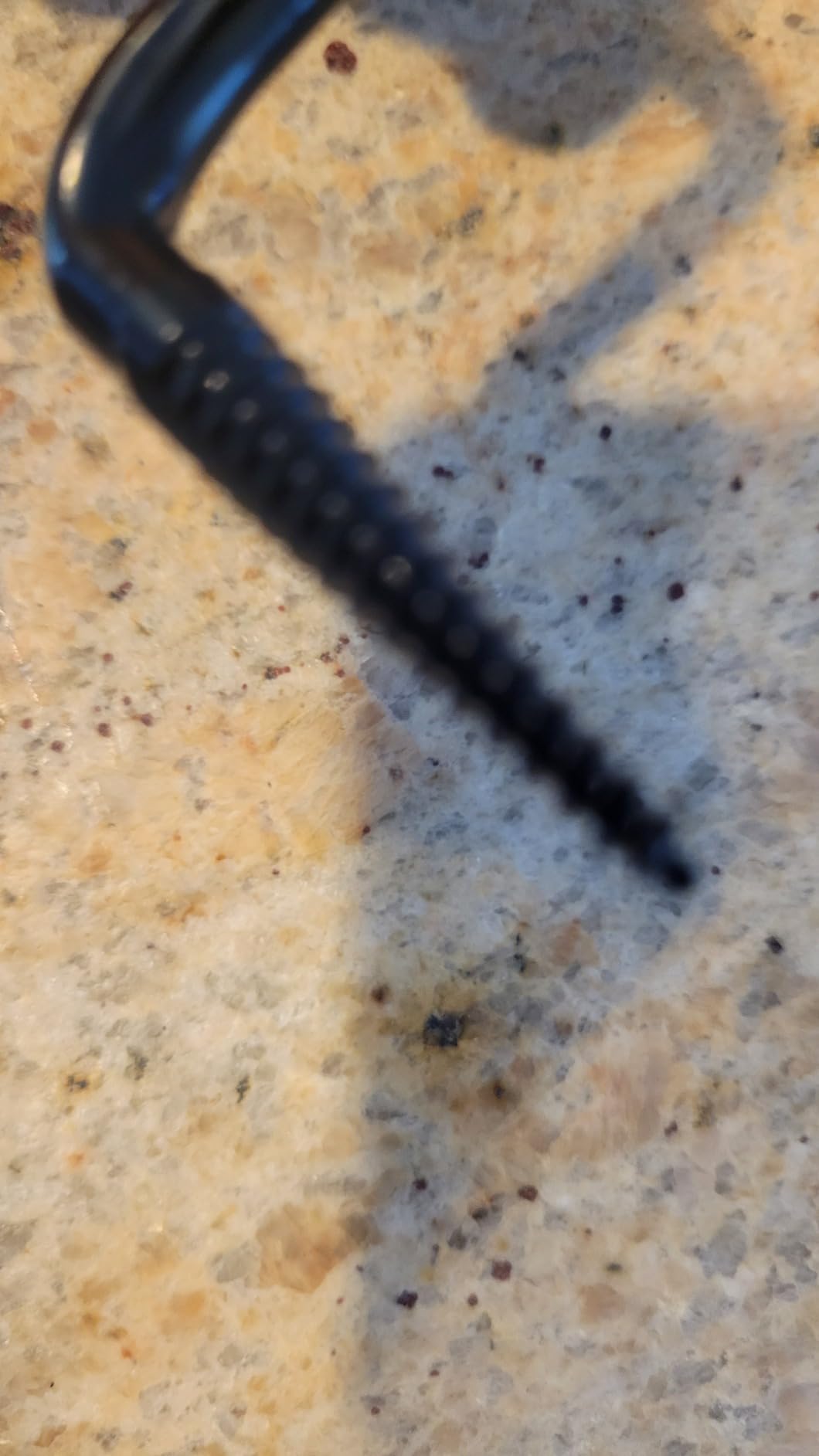
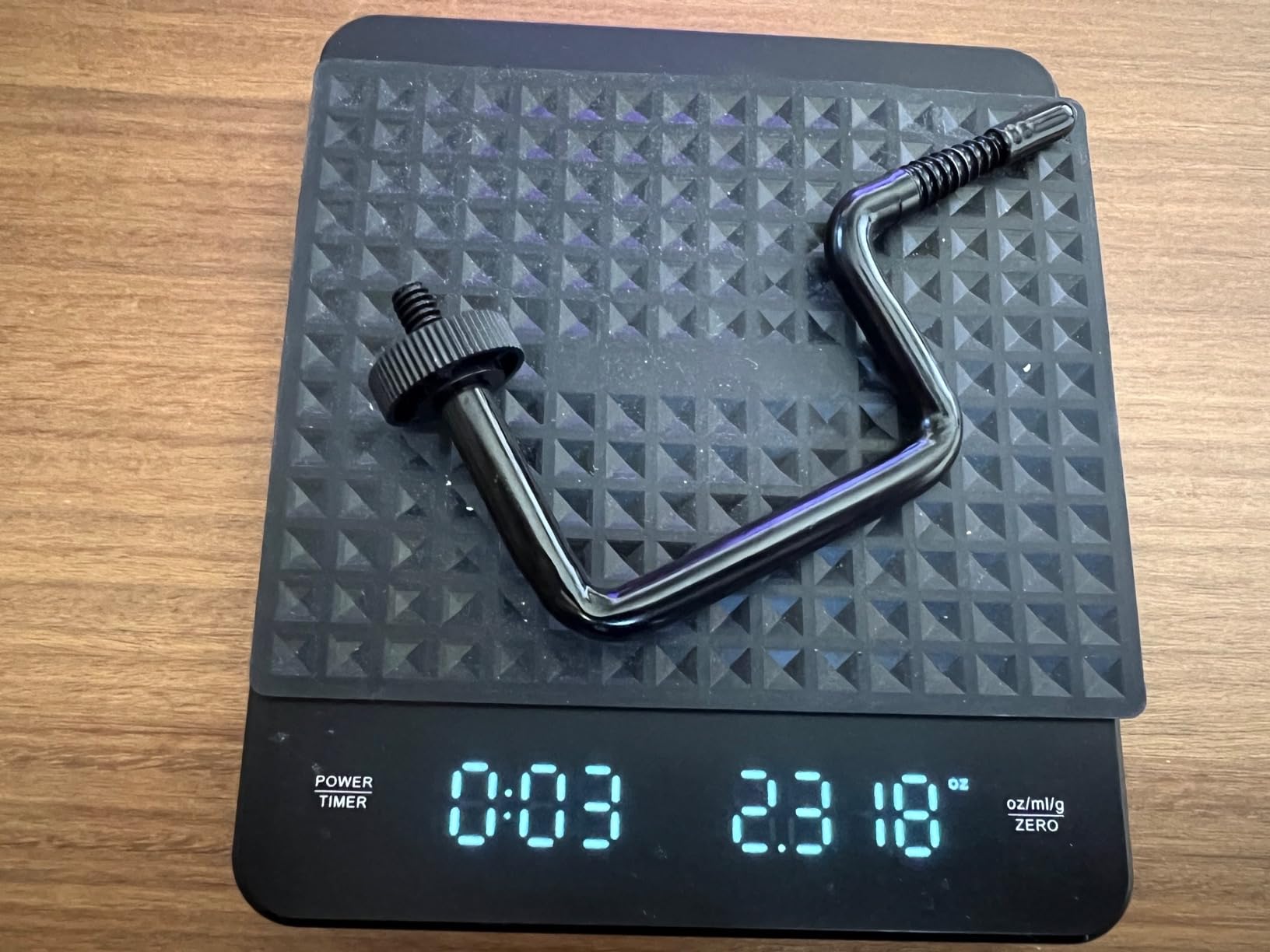
The Foricx three pack is the value pick for the same job the HME and Highwild brackets do, in powder-coated steel, with an ultra-sharp tip and a low-profile design that is easy to overlook on a large trunk. It is the option we would hand someone running a large camera grid on a tight budget.
Coating, steel, and three units make it a genuinely durable part rather than a disposable bracket, and owners using them as set-and-forget placements report that the low profile is what keeps the camera from being spotted or worked by an animal.
It shares the fixed-angle tradeoff of the other steel brackets, so treat it the same way: choose the tree and the sight line before you install. Nothing about the design lets you correct the aim afterward, and that is the single thing to internalize before buying.
One maintenance note is worth repeating because owners raise it directly: dissimilar metals at the camera’s threaded insert can encourage corrosion over a full season. A drop of thread locker on the camera-side thread is cheap insurance and takes seconds with the camera on the ground.
When three cheap brackets beat one good bracket
Coverage is the argument. Three brackets let you watch three trees, three trail crossings, or a feeder and a scrape at the same time, and fixed geometry stops mattering once you have chosen good sight lines in advance.
There is also a replacement argument. Hardware in a tree takes abuse from weather and animals, and a spare in the pack turns a lost afternoon into a ninety-second swap.
What this budget pick does not offer
No adjustability at all, and the screw is genuinely difficult to start in hardwoods such as oak without a pilot hole. Budget for an auger bit if your trees are mature, or you will be standing there with a mallet wondering why it will not bite.
It is also the smallest of the steel options, so if you are mounting a large cellular camera, check that the bracket sits flat and stable against the back of the housing.
9. ORIPIK 360 Adjustable Tree Mount – Best Entry-Level Articulated Mount
ORIPIK Trail Camera Tree Mount: 360 Degrees Adjustable Game Camera Mount with 1/4 inch Screw, Easy Installation & Compact Sturdy, 4 Pack
360-degree ball head
1/4 by 20 thread
Water resistant
Screw or expansion fixing
Pros
- Real 360-degree ball head at the entry price point
- Water resistant for a normal season of rain
- Installs with a pointed screw or an expansion screw
- Available in several pack sizes for better per-unit value
- Compact enough to sit close to the trunk
Cons
- Ball joint and screw reported to rust within a year
- Arms can look bulky in tight placements
- Animals can shift a ball-head mount more easily than a strap
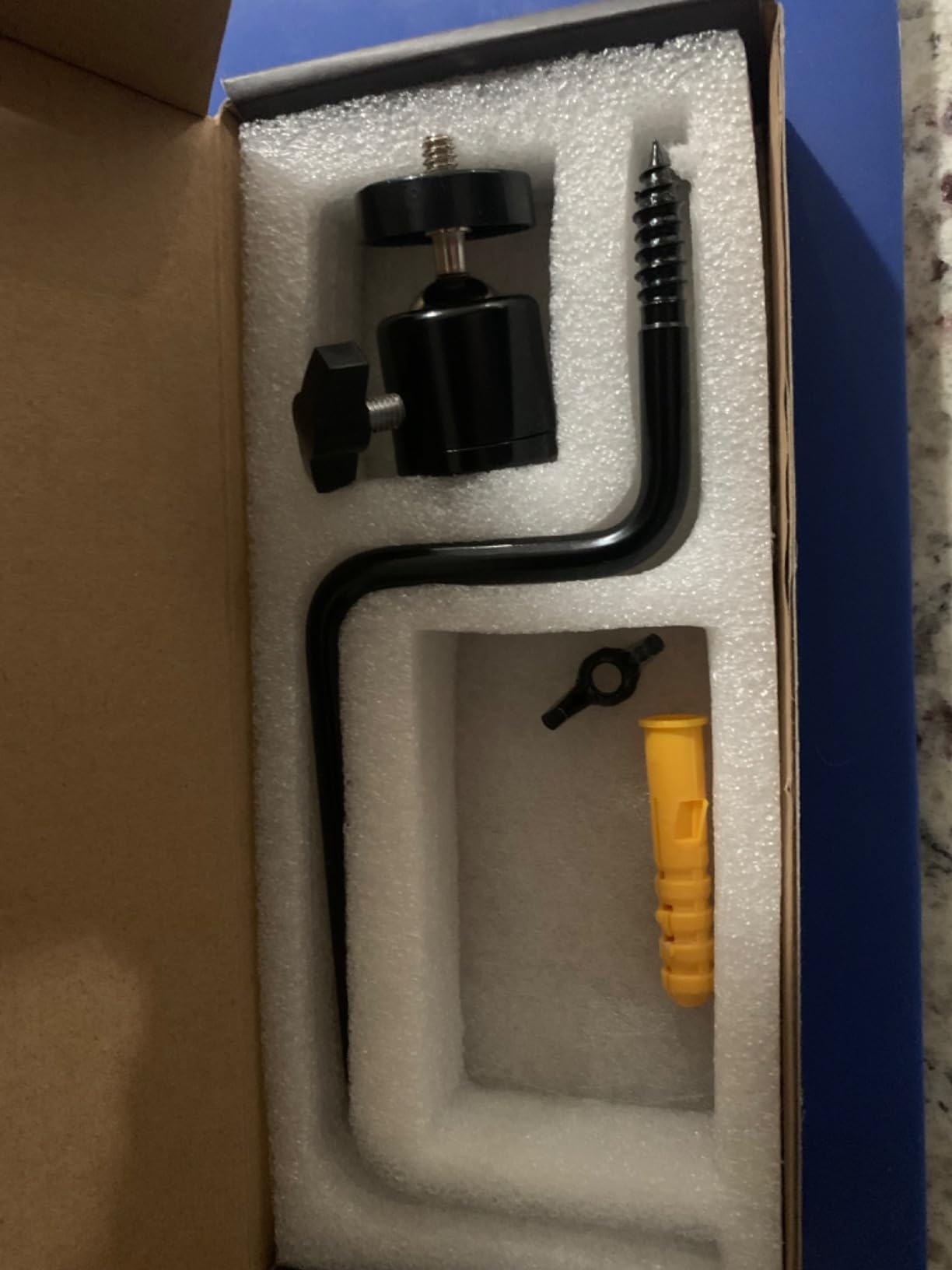
The ORIPIK mount is the cheapest way in this roundup to genuine articulation, and for a camera you plan to reposition or check often, that is a real saving compared with a metal ball head. It rotates through 360 degrees, takes the standard 1/4-20 thread, and is water resistant rather than simply untreated.
Two installation options are included, which sounds minor and is not. A pointed screw suits a softwood trunk, and an expansion fixing gives you a path for surfaces where you would rather not drive a self-tapping thread as deep.
Pack size flexibility is the quiet advantage here. If one mount is a trial, there are larger packs available, and for anyone covering a whole ridge the per-unit cost drops enough that a seasonal replacement strategy becomes practical, which is exactly how owners use this one.
The honest limit is corrosion. Owners report that the ball joint and the screw develop surface rust within about a year, which fits a part at this price and material level. That is not a defect so much as a service life, and for a camera you rotate between spots each season it is a reasonable trade.
Why a ball head changes how you scout
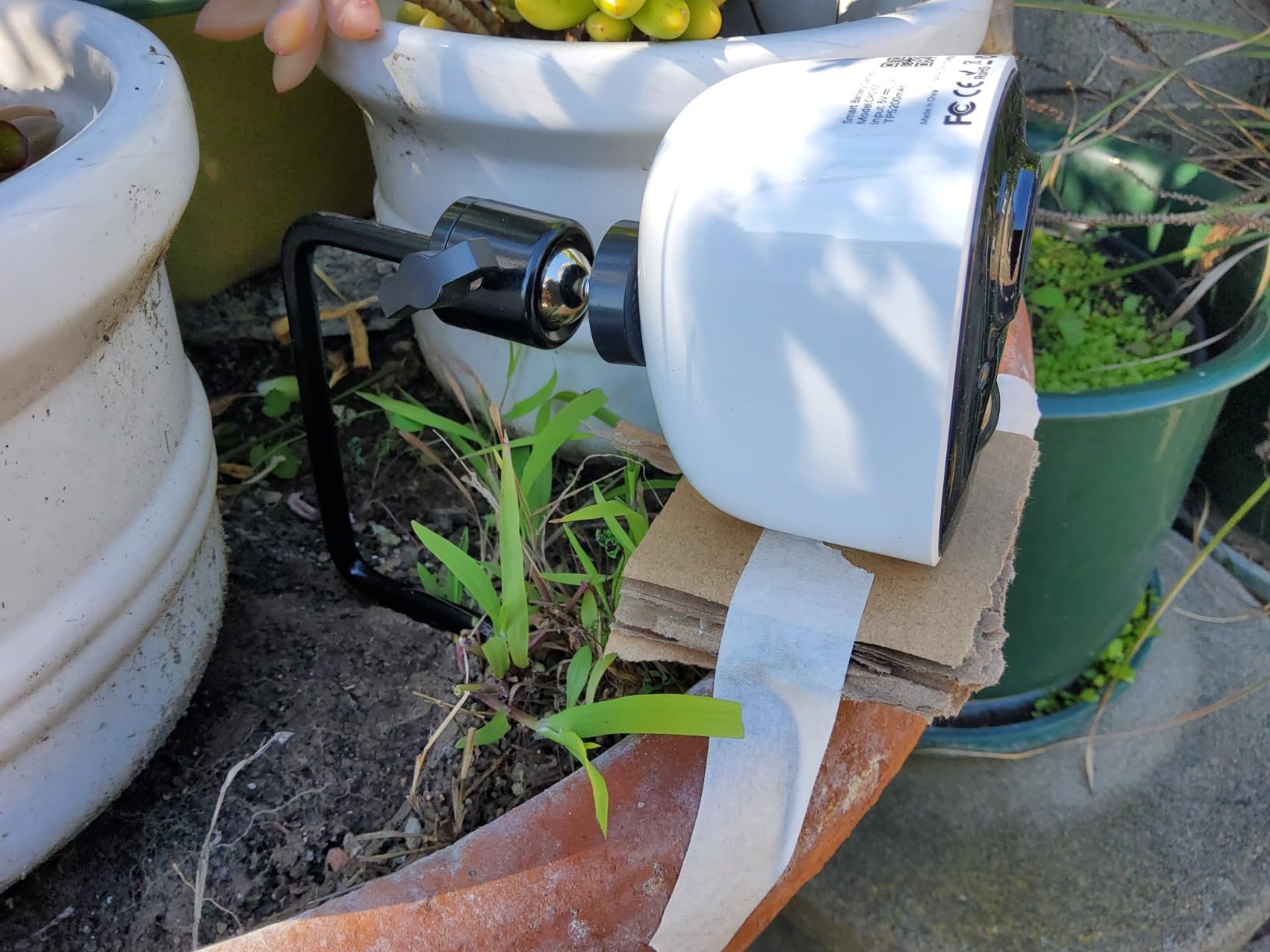
A fixed bracket asks you to decide the angle before you leave the truck. A ball head lets you walk up, look at the sight line, and set the frame in thirty seconds, which matters when you are scouting a new block and do not yet know where the deer are crossing.
It also makes a re-aim after a wind event a five-second job instead of a ladder trip with tools.
When it is not the right pick
Choose something stiffer for a heavy camera above ten feet, where a light-duty ball head can swing under load. It is also not the pick for a high-security location, because a ball joint is easier for an animal or a person to work loose than a rigid fixed bracket.
Treat it as a seasonal or multi-season part and inspect the joint before each season rather than assuming it will still be tight.
10. Stealth Cam Universal Fit Screw Mount 3-Pack – Best for Heavy Cameras
STEALTH CAM Universal Fit 1/4″ Tripod Mount Compact Stabilizing Durable Steel 8.25″ Width 2.375″ Height Hunting Trail Camera Tree Screw Mount, 3 Pack
8.25 inch wide base plate
2.375 inch height
IP54 rated
Rust-resistant coating
Pros
- Extra-wide base plate stabilises heavy and larger cameras
- Brace plate spans rough bark that a small bracket would rock on
- IP54 water resistance and a rust-resistant coating
- Raised height keeps the camera body clear of insects and ants
- Three pack for multiple locations
Cons
- No articulation once installed
- Users recommend a pilot hole to avoid stripping the thumb screw
- Costs more per unit than basic steel screw mounts
The Stealth Cam mount exists to solve a problem the other nine do not: keeping a large, heavy camera stable on a rough trunk. Its base plate is 8.25 inches wide, which spreads the load across a bigger contact area, and the 2.375-inch height holds the camera body clear of the bark surface.
That clearance is not a cosmetic detail. Strap and low-profile mounts routinely put a camera housing flush against bark, and owners report ants, spiders, and moisture finding that gap. Lifting the camera off the trunk removes the flat surface those problems rely on.
The wide plate also bridges bark ridges and knots, which is where a narrow bracket rocks. On a mature tree with deeply furrowed bark, a plate that contacts two or three separate high points is a genuinely different mounting situation from a small bracket on one smooth face.
It carries an IP54 rating and a rust-resistant coating, and it comes from a brand with a long record in trail cameras, so the hardware is designed around the same housing shapes the brand sells.
When a wide base plate is the deciding factor
It decides the outcome when the camera is heavy, the trunk is rough, or the camera sits in a windy gap. A bracket that rocks under load will slowly walk out of aim, and a wide plate stops the rocking at the start rather than trying to correct it later.
It is also the right answer for cellular cameras with larger housings and solar setups, where a small bracket may not seat flat against the back of the case.
What to plan around
There is no angle adjustment, so pre-scout as with the other fixed brackets. Owners also recommend a pilot hole, because starting the screw by hand in hardwood can strip the thumb screw and leave a mount that never seats properly.
It is the most expensive per-unit option in this roundup, which is hard to justify for a small scouting camera and easy to justify for a large one on a bed you cannot afford to reframe every few weeks.
Buying Guide: Choosing the Right Trail Camera Mount for Your Tree
The five ways to mount a trail camera to a tree
1. Screw-in spike or step bolt. A threaded stud is driven into the trunk and the camera screws to it. This is the tightest, lowest-profile, and most adjustable method, and it is the method to use on private ground where a permanent mark is acceptable.
2. Articulated screw-in mount. The same attachment, but the camera hangs off a ball head or swivel so you can re-aim after installation. It costs more and gains you the ability to correct a bad angle without tools.
3. Fixed-angle screw bracket. A simple steel bracket with a 1/4-20 threaded hole. It has fewer parts, nothing to loosen, and an angle that must be decided before you install.
4. Strap or bungee. Webbing wraps the trunk, no hole is drilled, and the camera is re-aimed only by moving it. This is the method for public land and for trees where you must leave no mark.
5. Pole or stake. A freestanding pole driven into the ground beside the tree, which decouples the camera from the trunk entirely. It is the answer when the tree is the wrong diameter, and the standard answer when the camera needs to sit high for theft deterrence.
Direct answer: for a mature tree on private ground, use an articulated screw-in mount. For public land or a tree you want untouched, use a full-length strap. For a tree that is too wide or too small to mount cleanly, or for theft deterrence, use a pole.
1/4-20 thread and camera brand compatibility
Nearly every trail camera sold today attaches with a standard 1/4-20 threaded insert on its underside, which is the same thread used on photographic tripods. That single fact removes most of the compatibility anxiety that buyers bring to this purchase: Browning, Bushnell, Moultrie, Stealth Cam, Tactacam, Reconyx, and SPYPOINT units all use it, and every mount in this roundup is built around it.
The exceptions worth checking are the models with proprietary mounts or optional solar kits where the panel needs its own clearance above or beside the camera. If your camera is a large cellular unit with a solar panel, confirm the housing dimensions against the bracket’s base plate before you order, and check that a wide plate such as the Stealth Cam mount can seat flat on the back of the case.
What actually breaks first, and why
Straps and bungees fail by stretching. Nylon webbing under a hanging camera lengthens slowly, so the camera sags and the frame drifts. The fix is a monthly re-tension, and the failure is predictable rather than sudden.
Plastic ball joints fail by developing play. Repeated vibration works the socket loose a fraction at a time, and the frame walks out of position over weeks. Knurled, properly tightened collars resist this better than a hand-tight plastic joint.
Fixed steel brackets fail at the screw, in two ways. Stripped threads happen when a self-tapping screw is forced into hardwood without a pilot hole, and corrosion at the joint is reported often enough on budget steel parts that a drop of thread locker is worth the seconds it takes.
Wing nuts and lock knobs fail by rusting and seizing, which is the most common long-term complaint aimed at the HME brackets in this roundup. Corrosion inhibitor at install time is a cheap fix.
There is a wider lesson in the forums on this topic: metal joints are not automatically the durable choice. Owners in wet climates report that inexpensive plastic mounts outlast metal ones simply because there is nothing to corrode.
How high to mount, and where to point it
Height trades detection range against theft exposure. A camera at eye level on a game trail reads well and is easy to service, and it is also the easiest height for someone to reach. Anything above about six feet needs a pole or a climbing stick, and above ten feet becomes a genuine deterrent because removal requires a ladder and time.
Species drives the rest. Deer bedding and rub coverage reads best lower, around waist to shoulder height, angled slightly down. Turkey struts and ground approaches need low placement, near the ground. A predator or general trail camera works higher, which also happens to be the most theft-resistant placement.
Keep the detection zone clear of the trigger limb. Owners on fixed-angle mounts get false alerts constantly when a branch sits in the frame, and that is an argument for cutting a small limb clearance above the camera before you install rather than after.
Public land and the no-drill rule
Screw-in hardware is prohibited on a large share of state wildlife management areas, national forest land, and some state parks, and the specific restrictions vary by agency and change over time. Hunting forum discussions about trail cameras on public land focus almost entirely on this point, and buying a steel bracket for ground where it cannot be used is the most common purchase mistake in this category.
When in doubt, use a strap or a pole, both of which are generally treated as removable personal items. Check the regulations published by the agency that manages the specific tract rather than relying on general advice, because what counts as a permanent fixture is defined differently in different places.
On the tree itself: a single small threaded stud driven into the bark of a mature tree generally does not kill it, and it heals over in most cases. A row of spikes, or a large lag bolt in a young tree, is a different matter. If tree damage is a concern for you or your landowner, the strap and pole options remove the question entirely.
If you want more background on tree-based gear and placement, our guides to faux trees and hall trees cover the wider world of tree setups. For narrower profiles, we have also reviewed pencil Christmas trees, slim Christmas trees, and diorama trees, though for a trail camera the real decision is always between the five mounting methods above.
Detering Theft Without Drilling Into a Tree
Most cameras are not stolen by determined thieves with ladders. They are taken by someone who spots a camera on a fence post, walks up, and takes it in under a minute, so the practical countermeasures are about visibility, height, and friction rather than serious security hardware.
1. Mount high. Anything above ten feet on a pole requires a ladder and a few minutes of being visible in daylight. This is the single most effective step, and it is why pole setups exist rather than being a novelty.
2. Use a cable lock. Python-style cable locks are the standard answer recommended by hunting organizations for cameras on public land, and they turn a ten-second grab into a deliberate act. Lag bolting into a large trunk with a padlock is the common permanent alternative on private land.
3. Kill the profile. A low-profile screw-in mount with a dark finish is much harder to identify as a camera from a distance than a strap wrapped around a white-barked tree, and forum users regularly recommend screw-in style mounts for exactly this reason.
4. Add a decoy. A second older or cheaper-looking camera on a nearby tree or post makes a whole cluster look less worth stopping for, and it is the cheapest insurance in this list.
5. Check on a schedule. Cameras that are checked regularly are stolen less often, because the value of the footage already taken is lower to the person taking it. Pair your mount with a scouting routine rather than treating security as hardware alone.
One note on hardware choice that supports all five steps: a mount with a solid anchor point near the threaded insert makes it possible to run a cable through the bracket itself, which is a better anchor than a strap loop because it does not move.
Frequently Asked Questions
How do you attach a trail camera to a tree?
You attach a trail camera to a tree in five common ways: a screw-in spike or step bolt driven into the trunk, an articulated screw-in mount with a ball head, a fixed-angle steel bracket, a strap or bungee wrapped around the trunk, or a pole driven into the ground beside the tree. Nearly all of them use the standard 1/4-20 threaded socket on the bottom of the camera, so any of these mounts fits most camera brands.
Can I mount a camera to a tree?
Yes, on private land and on your own timber a trail camera can be mounted directly to a tree. On public land, state wildlife management areas and national forest land, screw-in hardware is frequently prohibited because it is treated as a permanent structure. Straps and ground-driven poles are usually allowed because they are removable, so check the agency rules for the specific tract.
What is the best trail camera mount?
The best trail camera mount depends on the ground and the tree. For private land and a mature tree, an articulated screw-in mount such as the HME Economy holder is the strongest overall choice because it offers the widest adjustment range. For public land or trees you must leave unmarked, a full-length strap is the correct mount. For oversized trees and theft deterrence, use a pole.
Which camera mount is the best for trees?
Best by category: the HME Economy for adjustable screw-in mounting, the Moultrie 8-foot strap for no-drill installs, the Highwild or Foricx three pack for covering several trees, the Ku0026amp;F Concept for vibration resistance, the Stealth Cam for heavy cameras on rough bark, and the Camojojo bracket when you need both a strap and a screw option in one product.
What is the best way to mount a trail camera?
The best method is the one that matches the tree and the rules of the land. A screw-in mount is the most stable and most adjustable, a strap is the only option that leaves no hole, and a pole is best when the tree is the wrong size or when you want the camera high. Pre-scout the sight line before installing a fixed-angle mount, because those cannot be re-aimed.
Can you put trail cameras on public hunting land?
Generally yes, but the hardware matters. Many states restrict cameras used for scouting or recording on public land and prohibit screw-in hardware on wildlife management areas and national forest land. Straps and ground-driven poles are the safest options because they are removable, and you should check the specific agency regulations for the tract you are hunting.
How do you secure a trail camera on public land?
Mount it high on a pole above ten feet, use a python-style cable lock through the mount, choose a low-profile dark mount that is hard to identify, add a decoy camera nearby, and check cameras on a regular schedule. Each step raises the time and effort required, and together they make casual theft unlikely.
Will screwing a mount into a tree kill it?
A single small threaded mount driven into the bark of a mature tree usually does not kill it and the wound partially heals over. Repeated spikes, large lag bolts, or hardware driven into young trees can cause lasting damage. If tree health matters to you or your landowner, use a strap or a ground-driven pole instead.
How high should a trail camera be mounted on a tree?
Around six feet balances detection quality and serviceability, while ten feet or more is where theft deterrence really begins because removal needs a ladder. Deer bedding areas read well lower with a slight downward angle, turkeys need low placement near the ground, and a pole is required for anything above head height on a tree trunk.
Why does my trail camera strap keep loosening?
Nylon webbing stretches under the weight of a camera and works loose in wind and rain, so the camera sags and drifts out of aim. Re-tension it monthly, and if you need the aim fixed permanently, move to a screw-in mount on private ground or a pole on public land. A shorter strap on a fast-growing tree is the worst case of this problem.
Conclusion: Which Tree Mount Fits Your Setup
If you own the ground, the HME Economy holder is the best trail camera mount for trees because the adjustment range lets you fix an aim that the factory strap cannot. If you hunt public land or must leave no mark, the Moultrie eight-foot strap pair is the correct and legal choice, and re-tension it monthly.
For volume coverage, the Highwild, Foricx, or Moultrie three packs put multiple cameras up at once, and you accept a fixed angle in exchange. For heavy cameras on rough bark, the Stealth Cam plate holds where a small bracket rocks, and for vibration resistance the K&F Concept collar holds aim through a full season.
Whatever you choose, pick the mount that matches the tree in front of you rather than the one with the longest spec list, and check the land rules before the first screw goes in. Every one of these picks is a better buy in 2026 once it is the right architecture for the job.