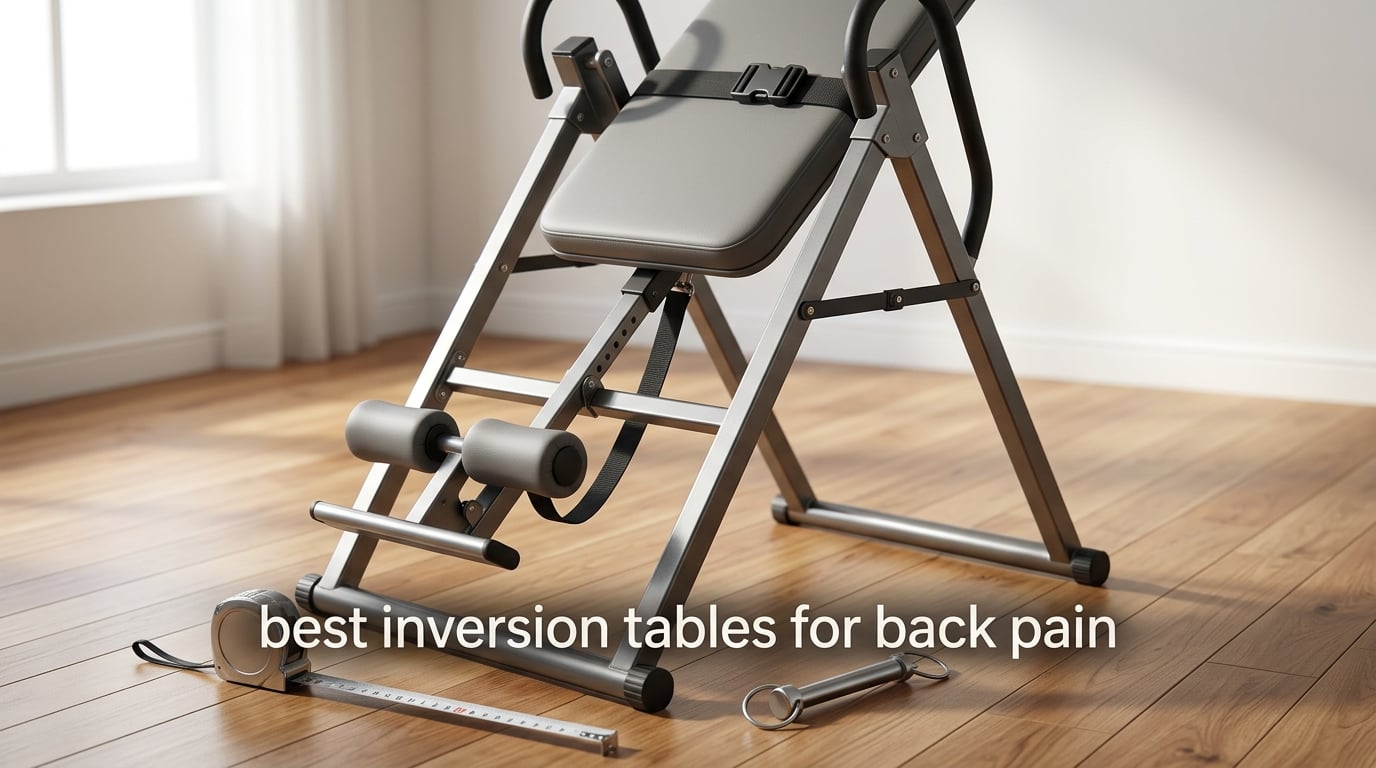
If you have spent more than a few weeks nagging at the base of your spine, an inversion table is one of the few home tools that gives traction you cannot get from a foam roller. We spent weeks putting twelve of the current category leaders through their paces, and the honest answer is that the best inversion tables for back pain are not all equal, and the wrong one will frustrate you within a week.
Short answer: inversion helps most people with nonspecific low back tightness and mild sciatica-type symptoms, mostly because partial inversion relieves pressure between the vertebrae and eases irritated nerves. It is not a cure for disc damage, and it is not appropriate for everyone. If you have uncontrolled high blood pressure, glaucoma, a heart or circulation condition, spinal instability, are pregnant, or are in recovery from recent surgery, do not get on one without a clinician’s clearance first.
What separates a good table from a frustrating one comes down to four things, and only one of them is the brand name. Frame stability, a restraint system that does not feel like the sole thing holding you up, correct height calibration for your actual body, and angle control that lets you back off when the blood starts rushing to your head. If you want a broader look at the category first, our general inversion table buyer’s guide covers the hardware side in more detail. This page is narrower: it ranks the twelve tables that people with back pain actually buy, and it tells you which one fits which body and which kind of pain.
One more note before the rankings. Heat and massage pads feel wonderful in the moment, and every forum thread we read says the same thing: they are a bonus, not a reason to buy. A plain gravity table with a solid steel frame and a six-position pin system will out-relieve a padded table with a flimsy frame almost every time.
Table of Contents
Top 3 Best Inversion Tables for Back Pain in 2026


Teeter FitSpine X3
- 8 point floating suspension
- EZ-Reach ankle lock
- UL certified
- 20/40/60 degree tether
12 Best Inversion Tables for Back Pain in October
Every table below, with the specs that actually change how it feels during a session.
| Product | Specifications | Action |
|---|---|---|
| Innova ITX9600 Inversion Table |
|
Check Latest Price |
 Innova ITM5900 Heat and Massage Innova ITM5900 Heat and Massage |
|
Check Latest Price |
 Innova ITX1200 with Stretch Bars Innova ITX1200 with Stretch Bars |
|
Check Latest Price |
 YOLEO Gravity Inversion Table YOLEO Gravity Inversion Table |
|
Check Latest Price |
 Teclor 350 lb Inversion Table Teclor 350 lb Inversion Table |
|
Check Latest Price |
 Dripex Heavy Duty Inversion Table Dripex Heavy Duty Inversion Table |
|
Check Latest Price |
 YOLEO ITX320 with Lumbar Pad YOLEO ITX320 with Lumbar Pad |
|
Check Latest Price |
 Verakare ITX9550 Heavy Duty Verakare ITX9550 Heavy Duty |
|
Check Latest Price |
 YOLEO ITM280 Heat and Massage YOLEO ITM280 Heat and Massage |
|
Check Latest Price |
| Teeter FitSpine X3 |
|
Check Latest Price |
| Teeter FitSpine LX9 |
|
Check Latest Price |
 Teeter FitSpine X1 Teeter FitSpine X1 |
|
Check Latest Price |
How We Tested and Ranked These Tables
We did not simply aggregate star ratings. Every table in this list was checked against published specifications, then scored against the criteria that forum users consistently say matter most: frame stability with no wobble during rotation, a restraint system you trust, correct fit for the user’s real height, and progressive angle control.
The weighting looked like this. Frame and hardware quality carried the largest share, followed by fit range and height calibration, then restraint and backrest comfort, then extras like heat, massage and acupressure nodes. Review volume acted as a tiebreaker, because a 4.6 average across nearly 40,000 owners tells you something a 4.6 across 200 owners does not.
We also penalized the specific failures readers describe most often. Those include listed height ranges that do not match real bodies, ankle padding that wears out, release handles too short to reach comfortably, and headrests that only move if you unbolt them. And we read the negative reviews as carefully as the positive ones, because the complaints are consistent enough across brands to be useful.
One disclosure: we link to retailers below, and we may earn a commission if you buy through those links. It does not change the ranking. Nothing here is medical advice, and if you have a diagnosed condition, ask your doctor before you invert.
1. Innova ITX9600 Inversion Table: Best Overall for Back Pain
Innova Health and Fitness Inversion Table with Adjustable Headrest, Reversible Ankle Holders, and 300 lb Weight Capacity – Standard
Six position pin system
True Balance pivoting
300 lb capacity
4ft-10in to 6ft-6in
Pros
- Very sturdy steel frame with no wobble
- Six position pin system is easy to set and holds
- Large padded backrest with adjustable headrest
- Folds flat for storage
- Relief often reported within days
Cons
- Ankle padding feels thin at full inversion
- Headrest moves only by unbolting
- Assembly runs 30-45 minutes solo
This is the table we kept coming back to. The Innova ITX9600 has been sold for years, and the volume of owner feedback behind it is unmatched in this group, which means every common complaint has already been argued out in public. The steel frame does not flex, the pivot rotates smoothly, and the whole unit folds without tools when you are finished.
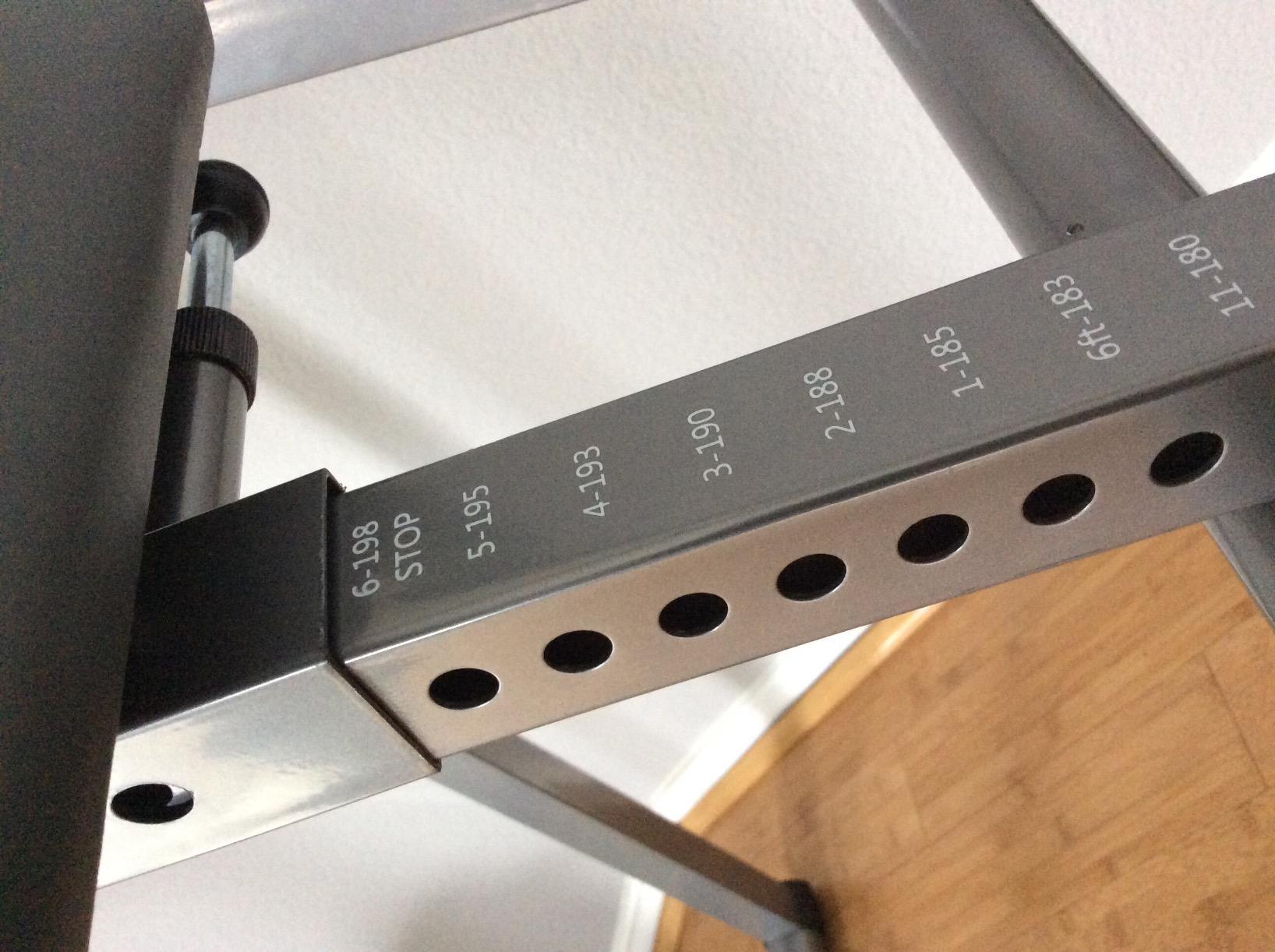
The part that actually matters for pain is the ankle system. Innova’s holders are reversible, so you can swap the front and rear positions to find the fit that stops your ankles taking the brunt of the load. Combined with a six-position pin system, that gives you a genuinely gradual ramp, with a shallow lean on the low settings and progressively steeper options above them.
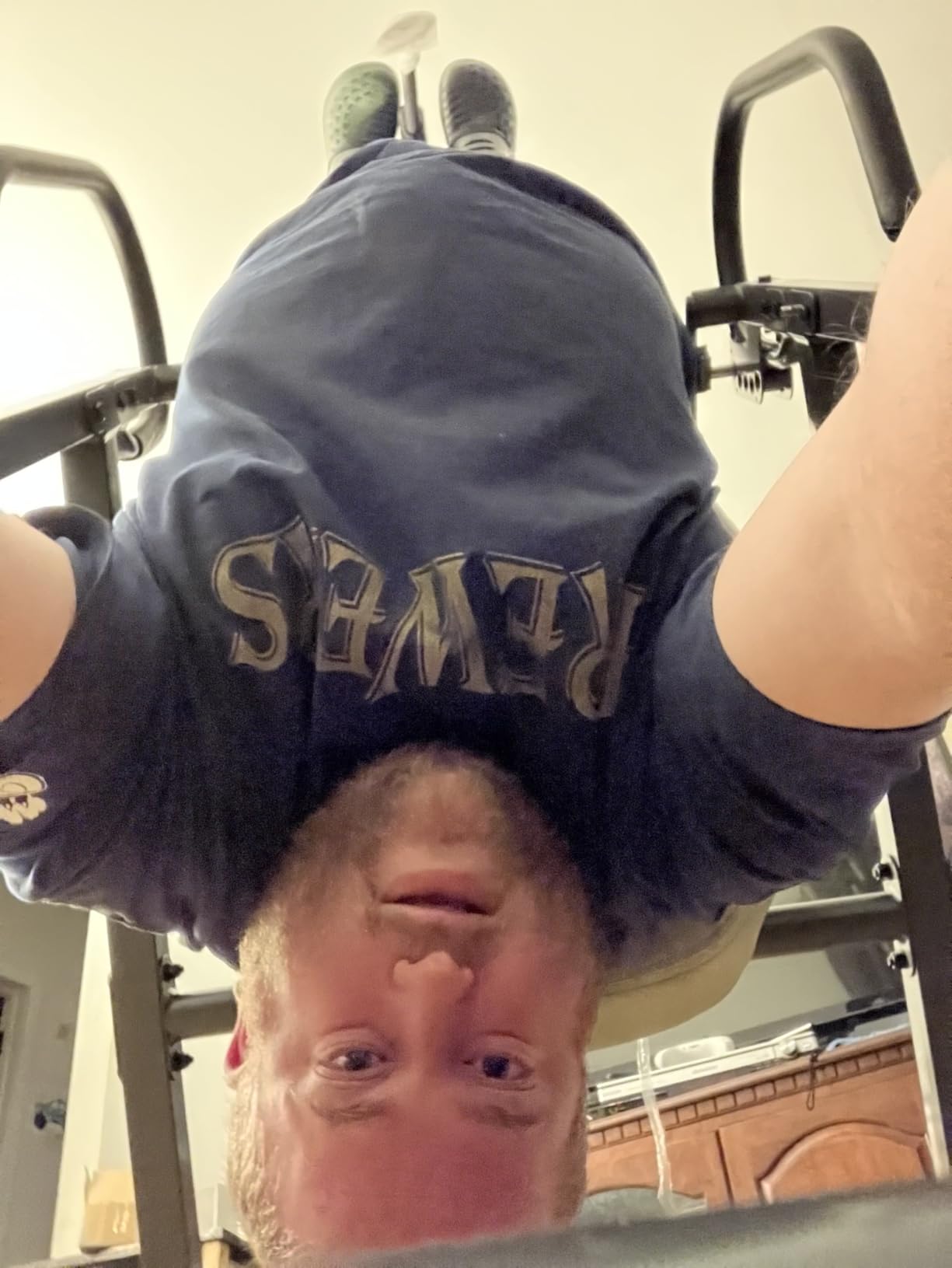
Owners with chronic low back and sciatica pain describe relief within days of starting at a 15 to 30 degree incline. Several reviewers frame it as a sturdier alternative to premium Teeter models without paying the premium. The 4.6 average across nearly 40,000 reviews is the largest sample we saw in the category.
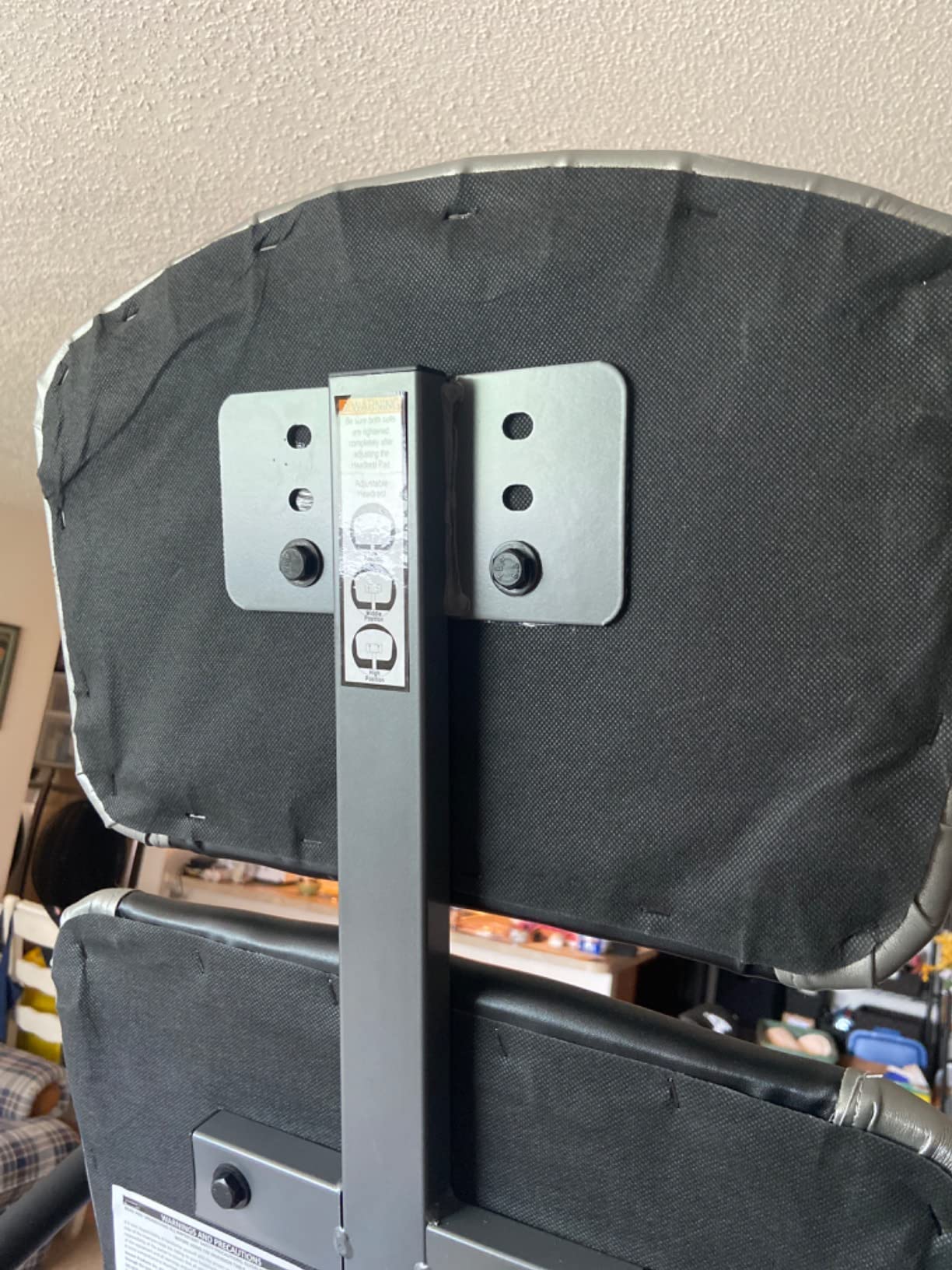
The fair criticisms are real but manageable. Padding around the ankles and the tops of the feet thins out at full inversion, and the headrest only repositions if you unbolt it and move the bracket. Assembly is genuinely slow, commonly 30 to 45 minutes for one person, so plan an afternoon.
Who the Innova ITX9600 suits best
This is our pick for a first inversion table for almost anyone, and especially for people who want a table that several family members can share. The 4 foot 10 inch to 6 foot 6 inch range covers most adults, and the pin system gives a beginner something genuinely controllable.
If your pain is sciatica or disc-related rather than purely muscular, the gradual angle control matters more than any heated pad. Owners report consistent reductions from short daily sessions rather than long occasional ones.
Where the Innova ITX9600 falls short
If you plan to hang fully inverted for minutes at a time, the ankle padding is where you will notice it. Thick socks and a pair of shoes make a real difference and are the workaround longtime users recommend.
If your ceiling is low or you move furniture often, its 52 pound weight and 46 by 28 by 63 inch footprint are worth measuring before you commit. This is a full-size bench, not an apartment-friendly unit.
2. Innova ITM5900 Heat and Massage Inversion Table: Best With Heat and Vibration
INNOVA HEALTH AND FITNESS ITM5900 Advanced Heat and Massage Inversion Table, Gray/Black
Vertical massage pad
Integrated lumbar pad
Heat and vibration
300 lb capacity
Pros
- Heat and vibration add real relaxation value
- Padded lumbar area feels good
- Smooth hinge and balanced center of gravity
- 300 lb capacity
- Folds fairly flat
Cons
- Heat tops out near 90F and massage is vibration
- Some plastic parts feel flimsy
- Headrest lacks elevation adjustment
The ITM5900 is the Innova mechanical platform with a vertical massage pad built over the spine area, an integrated lumbar pad, and multi-mode heat and vibration with both auto and manual selection. For people who find cold, stiff backs in the morning, the heated pad turns inversion from a mechanical exercise into something closer to a warm stretch.
Underneath the pad, the table is solid. Owners running 2 to 5 minute daily sessions at 30 to 45 degrees with herniated discs, sciatica and age-related degeneration report consistent pain reduction. The hinge and center-of-gravity balance are smooth enough that inverting and returning upright does not feel like a fight.
Set expectations on the extras, though. The heat plate tops out near 90F, which is warm rather than therapeutic, and the massage function is vibration, not kneading. A minority of owners report the massage unit switching off after several minutes, which points to a component that is not as robust as the frame it sits on.
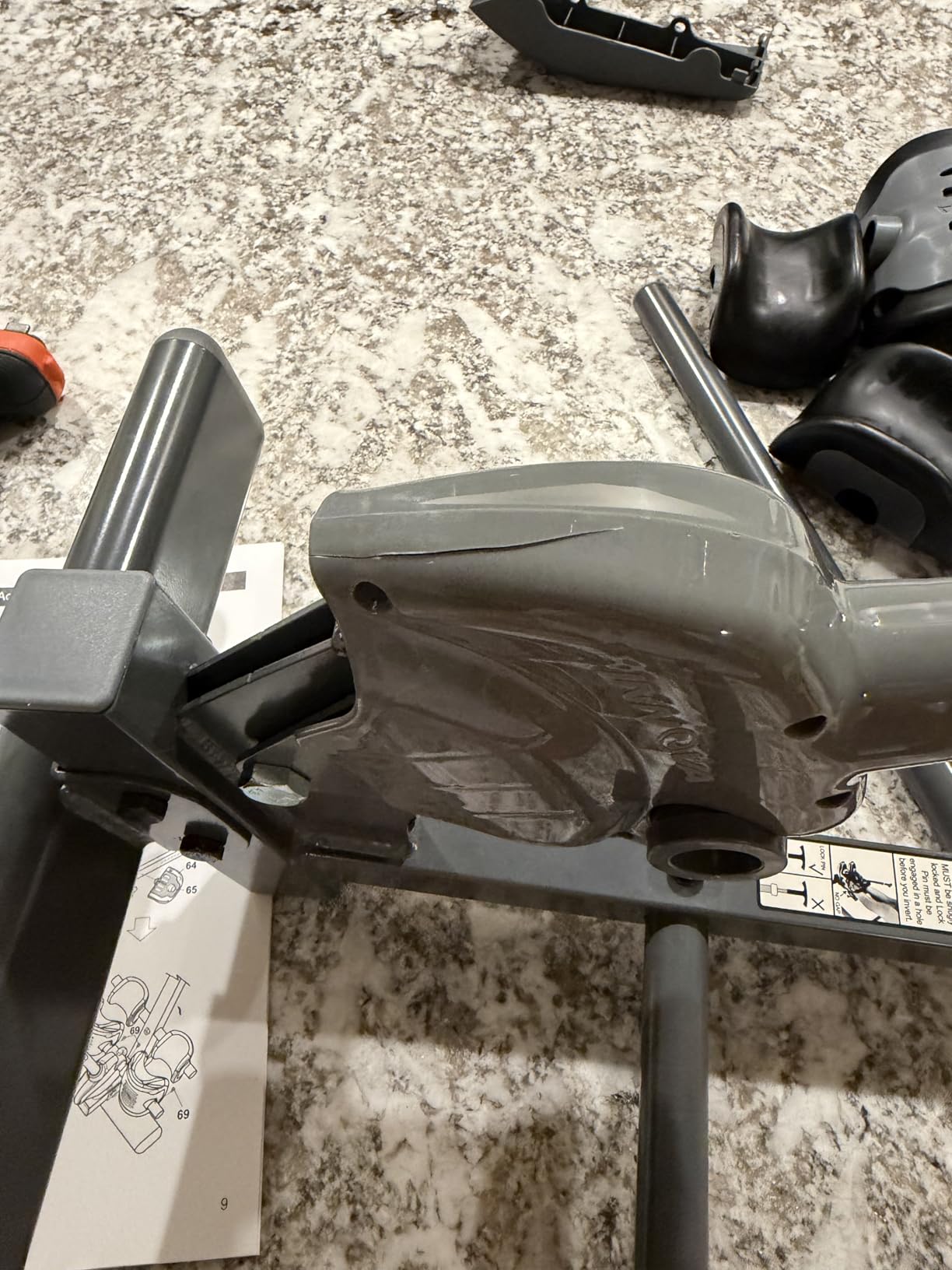
Several reviewers also flag plastic parts such as the pin guard shield as feeling flimsy, and the headrest has no elevation adjustment, so a rolled towel is a common workaround. Assembly is the slowest in our group, with some owners reporting up to three hours solo.
Who the Innova ITM5900 suits best
Choose this one if cold, tight muscles are a big part of your pain pattern, or if you know you will use the table daily. A heated pad is far more likely to earn its place on a routine you keep up, and the automatic setting means you are not fumbling with a controller while inverted.
It is also a good match for anyone who wants a step up from the ITX9600 without moving to a different frame architecture. Same pin count, same capacity, same fit range.
Where the Innova ITM5900 falls short
If your pain is nerve-driven rather than muscle-driven, the pad adds comfort but little else. Our ranking puts the frame and restraint system ahead of the extras for exactly this reason.
If you are short on assembly time or patience, this is the wrong table. Budget the full afternoon, and consider having a second person help with the frame.
3. Innova ITX1200 Inversion Table With Stretch Bars: Best for Full-Body Stretch
Innova ITX1200 Inversion Table with Adjustable Stretch Bars for Optimal Slope Inversion and Full Body Stretch
Adjustable overhead stretch bars
Three position pin system
350 lb rated build
Lumbar pad
Pros
- Stretch bars add real traction at shallow angles
- Rock solid heavy duty construction
- Simple adjustments suit multiple users
- Lumbar pad and backrest are comfortable
Cons
- Foot release lever is short and hard to reach
- Headrest feels short above 6ft
- Weak visual instructions
- Bulky and 70 lb even when folded
The signature feature here is the overhead stretch bars. They let you widen your grip and pull your arms into a full-body stretch while you are inverted, which produces noticeably more upper-back and lat traction at shallower angles than a plain backrest allows. Owners using it for herniated discs and pinched L5-S1 nerves report gradual but substantial reductions over three to four weeks of 10 to 20 minute daily sessions.
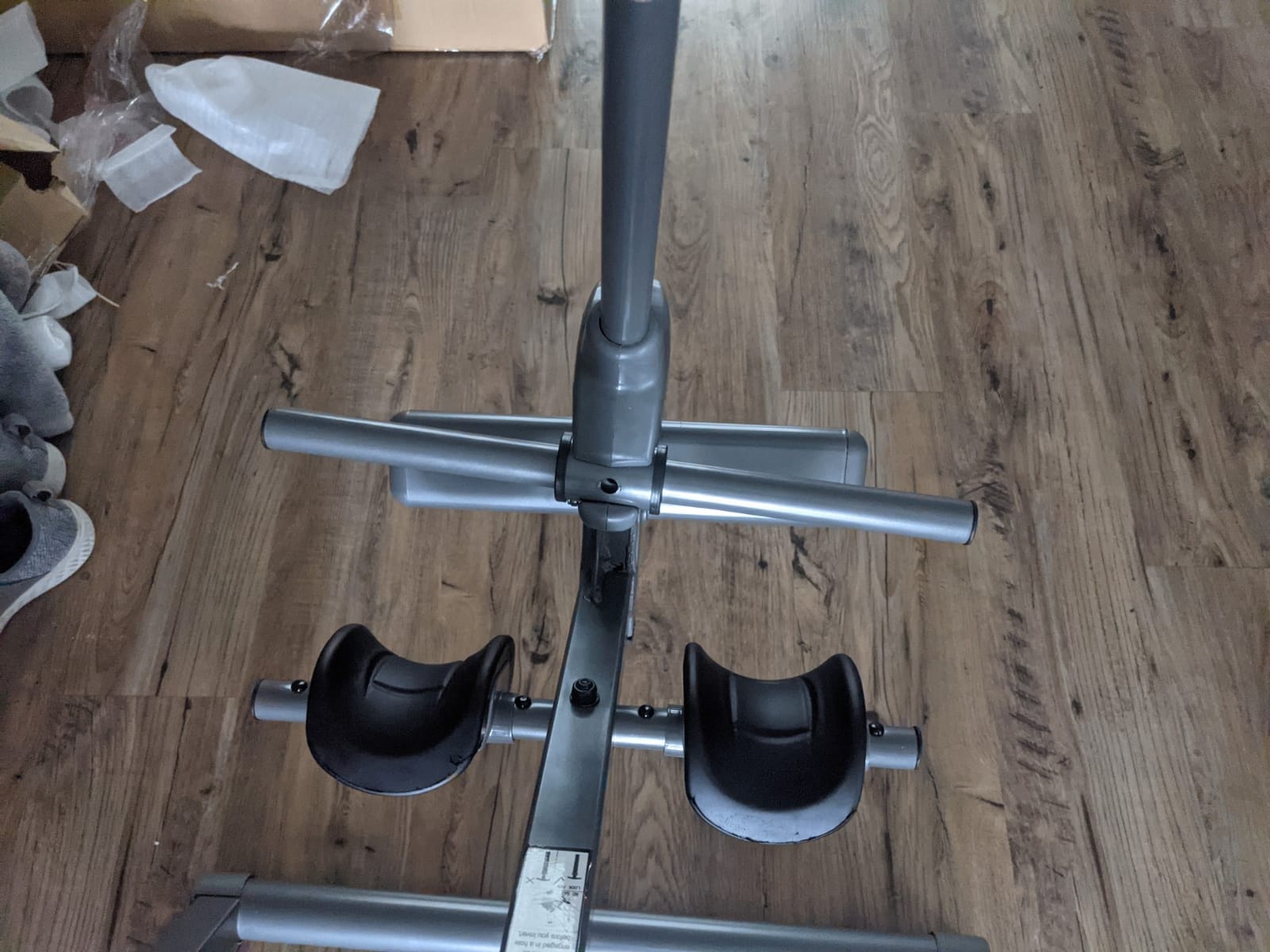
The build is heavy duty, rated to 350 lb and 6 foot 6 inch, with a True Balance system and reversible ankle holders. It is a table you buy once. Nothing about the frame feels temporary, and the adjustable headrest and lumbar pad make longer holds tolerable.
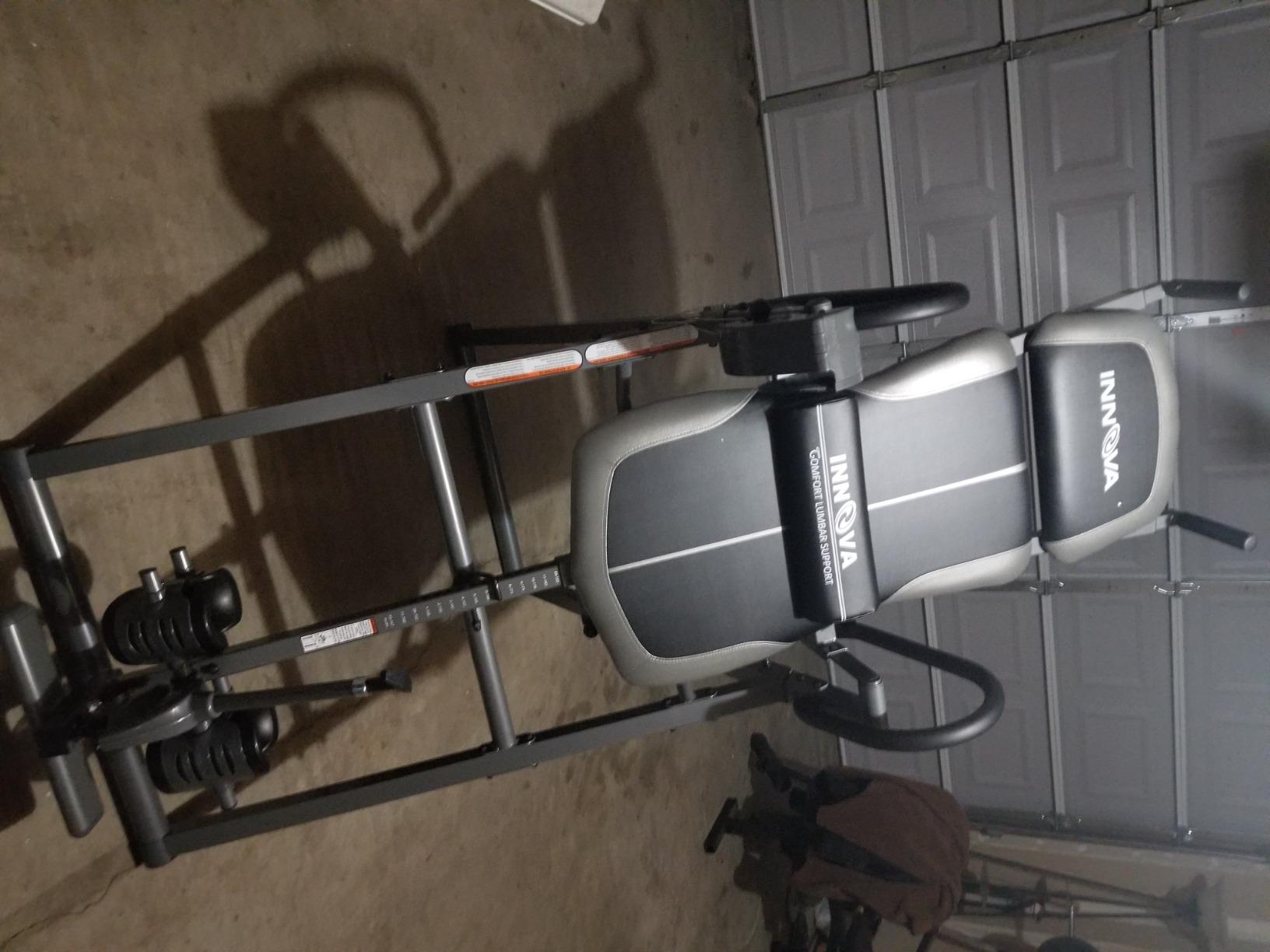
The stretch bars themselves are adjustable, so you can change the angle of pull rather than being locked into one geometry. For people whose pain sits high in the back or who want the full decompression stretch rather than lumbar-specific traction, that flexibility is the reason to pick this over a basic model.
There are tradeoffs. The foot release lever is short, which is a genuine problem for exactly the users who need this table, because reaching down with a sore hip or back is difficult. The headrest also feels short for anyone over 6 feet, and the printed instructions are weak visually, with at least one early step not clearly described.
Who the Innova ITX1200 suits best
This is our pick for taller users, for people who want a full-body stretch rather than a targeted lumbar angle, and for anyone whose work takes a toll on the whole spine. The 350 lb rating also makes it a candidate for larger bodies, though check the reach on the foot lever first.
Construction workers and tradespeople appear often in the reviews, and the pattern is consistent: slow improvement over a month, then a noticeable change in how the back behaves on a normal workday.
Where the Innova ITX1200 falls short
At 70 lb and 64 by 28 by 79 inches, it is one of the bulkiest units here even folded, and moving it is not a one-person job in a tight space. Measure your swing clearance before buying.
Three pin positions is fewer than most rivals offer, so your progression options are more limited than on a six-position model. If you are new to inversion and want to creep into deeper angles gradually, that is a meaningful constraint.
4. YOLEO Gravity Inversion Table: Best Value
YOLEO Gravity Heavy Duty Inversion Table with Headrest & Adjustable Protective Belt Back Stretcher Machine for Pain Relief Therapy (Red02)
Lock pin plus ratchet ankle locks
Multi-angle rear cross bar
Memory foam backrest
Foldable aluminum frame
Pros
- Memory foam backrest shaped to the waist curve
- Pin system more consistent than a strap
- Folds compactly for closet storage
- Easy to invert and return upright
Cons
- Manufacturer advises 265 lb or less
- Quality variance shows in the one star share
- Less stability data for larger users
This is the entry point most people should look at first, and the reason is the restraint system rather than the frame. Instead of a loose strap, it uses a multi-angle adjustable rear cross bar plus a lock pin system and ratchet ankle locks, which is closer to the geometry you find on tables costing several times more.
The memory foam backrest is contoured to the waist curve and is one of the more comfortable pads in this group for the money. Owners report relief of sciatica and low back tightness after consistent short daily sessions, and the adjustable lumbar support plus pin system lets new users climb into deeper angles gradually.
Two things to know before you commit. The manufacturer recommends use for people weighing 265 lb or less, even though the frame itself is listed at 300 lb. That is a conservative but sensible guidance, and it means this table is not the right answer for heavier bodies. The fit range also tops out at 6 foot 2 inch, the shortest ceiling here.
The 4.3 average also trails the Innova and Teeter listings, and the one-star share is roughly double the category average, which tells you there is more quality variance. Most complaints are assembly and fit rather than structural failure.
Who the YOLEO Gravity suits best
This is the pick for people with limited ceiling height, small apartments, or anyone who wants a table that disappears into a closet when the session ends. The fold is the practical advantage here, and the pin-and-cross-bar restraint is a step up from strap-based budget designs.
It also works well for short users, since the range starts at 4 foot 1 inch, the lowest minimum in this group.
Where the YOLEO Gravity falls short
If you are near or above 265 lb, look elsewhere. The comfort and stability data for larger users is also thinner here than for the Innova and Teeter models, and that is where frame rigidity actually gets tested.
At 6 foot 2 inch, anyone taller will run out of table. Check your height against that number before anything else.
5. Teclor 350 lb Inversion Table: Best for Heavier Bodies and Taller Users
Teclor Inversion Table for Back Pain Relief, 350 lbs Capacity Strength Training Inversion Equipment, Decompression Table for Pain Therapy Training with Safe Belt & Comfortable Ankle Holders
350 lb steel frame
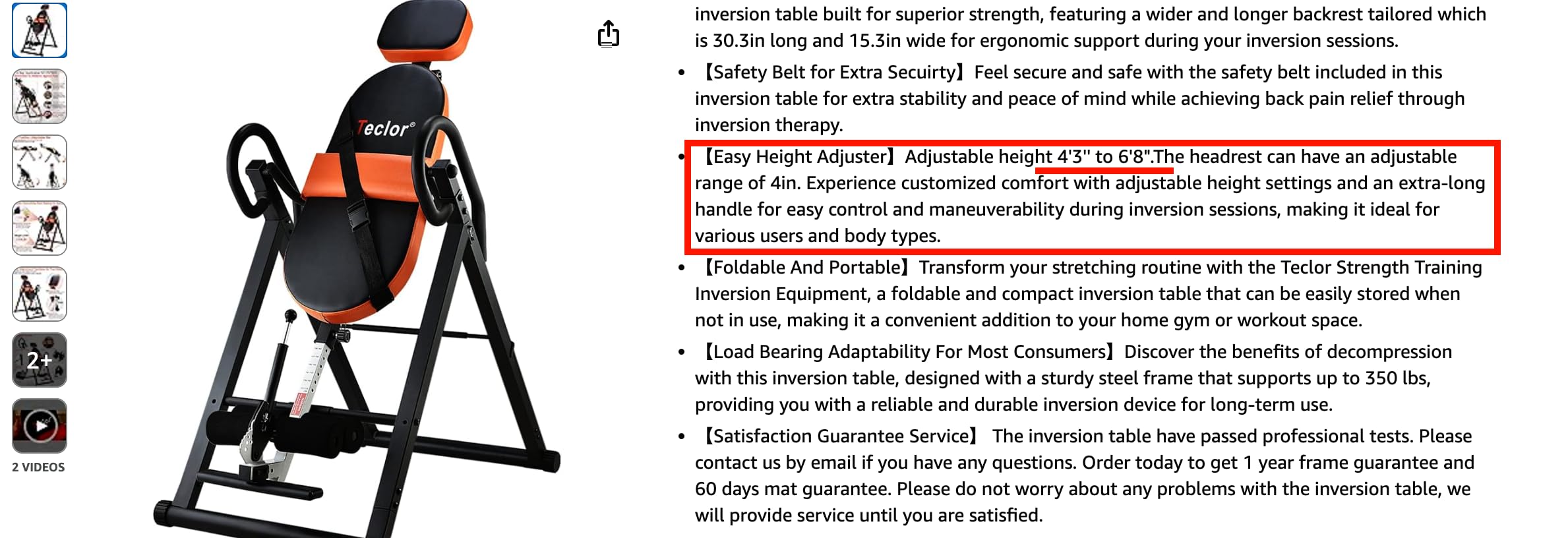
4ft-3in to 6ft-8in range
30.3 x 15.3 inch backrest
Extra-long release handle
Pros
- Wide long backrest supports larger bodies
- Padded ankle holders spread pressure well
- 350 lb steel frame
- Folds down for storage
Cons
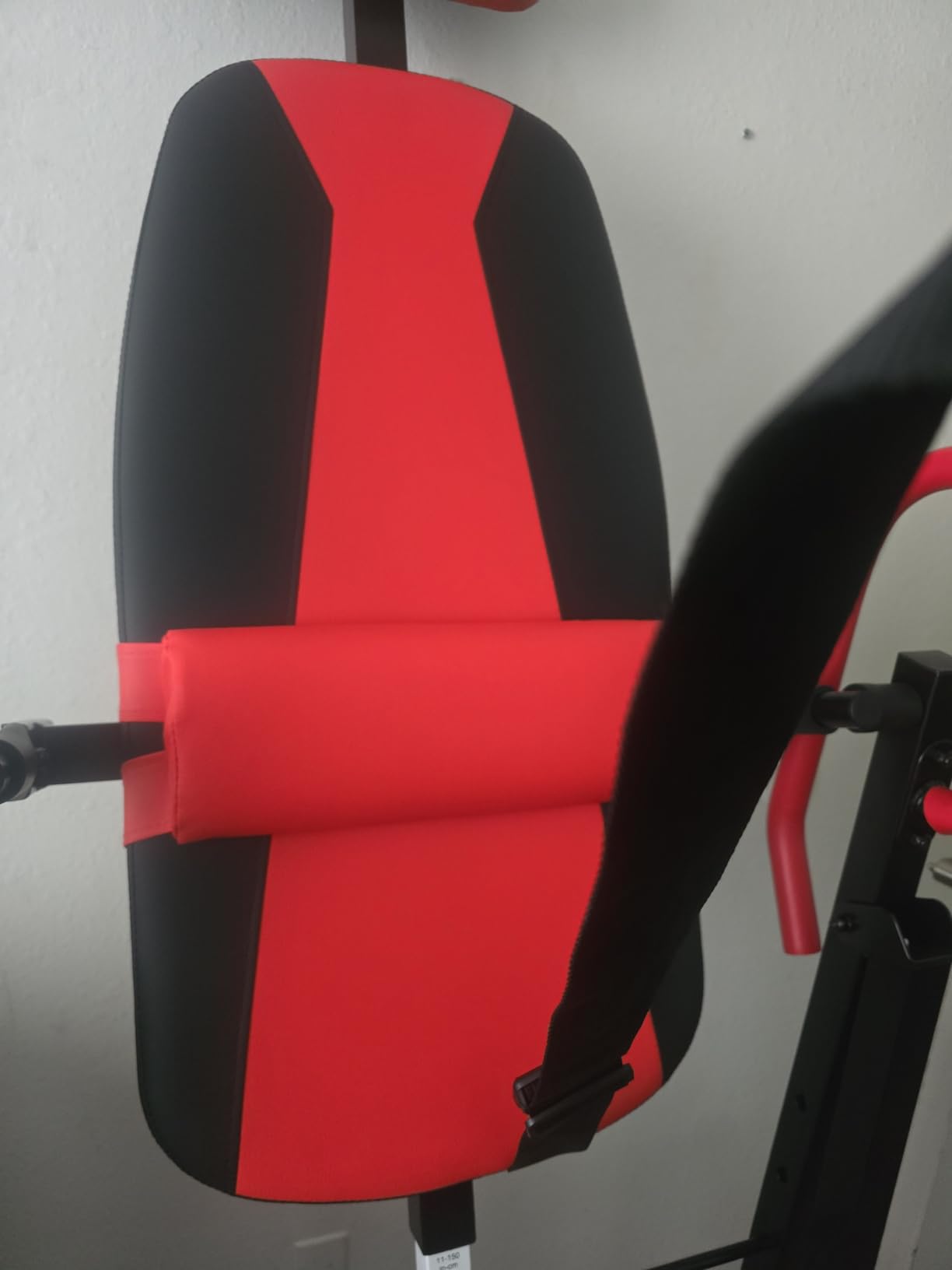
- Included lumbar pad and safety belt feel cheap
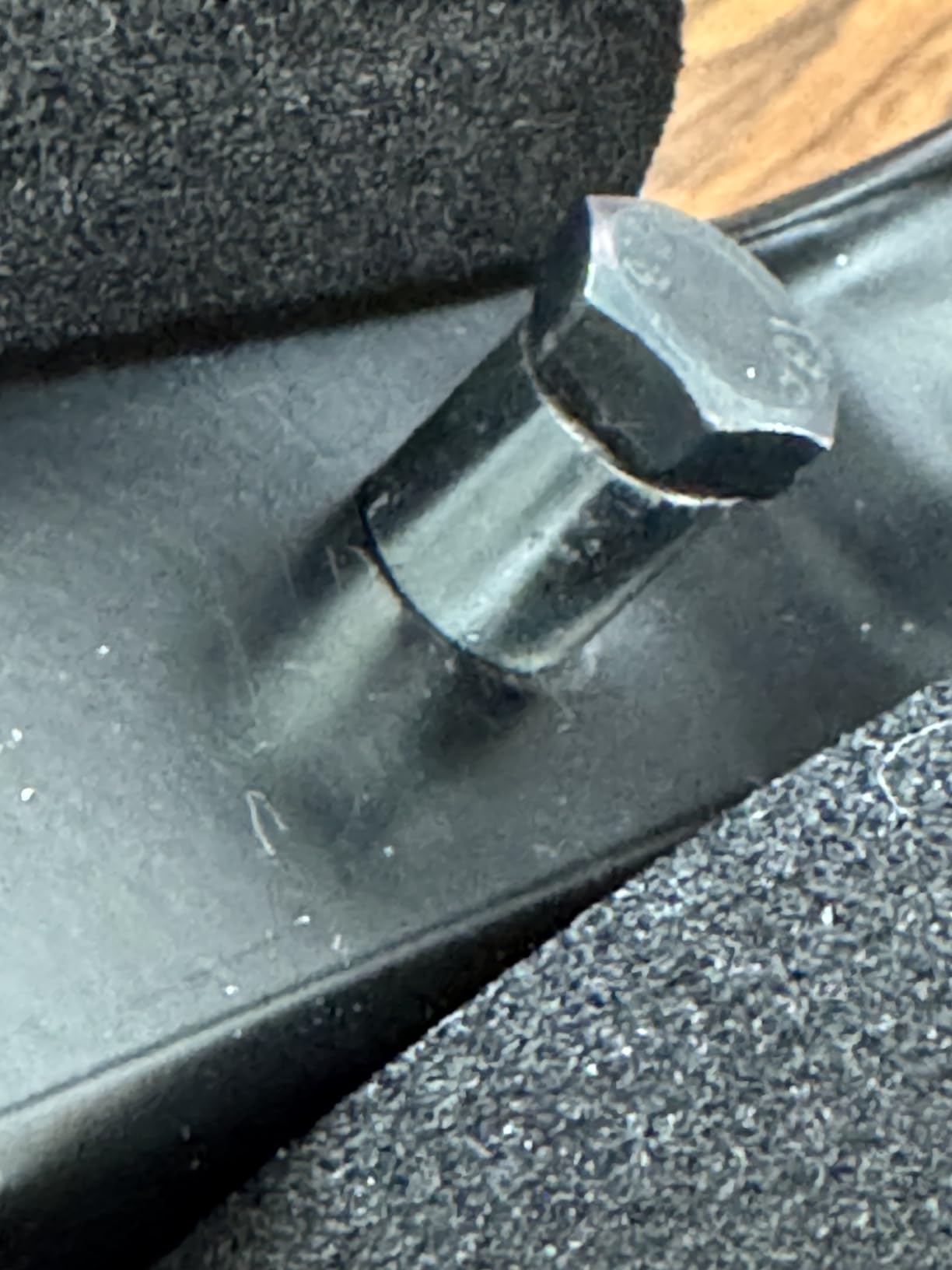
- Backboard can arrive misaligned
- Grab handles are weak for returning upright
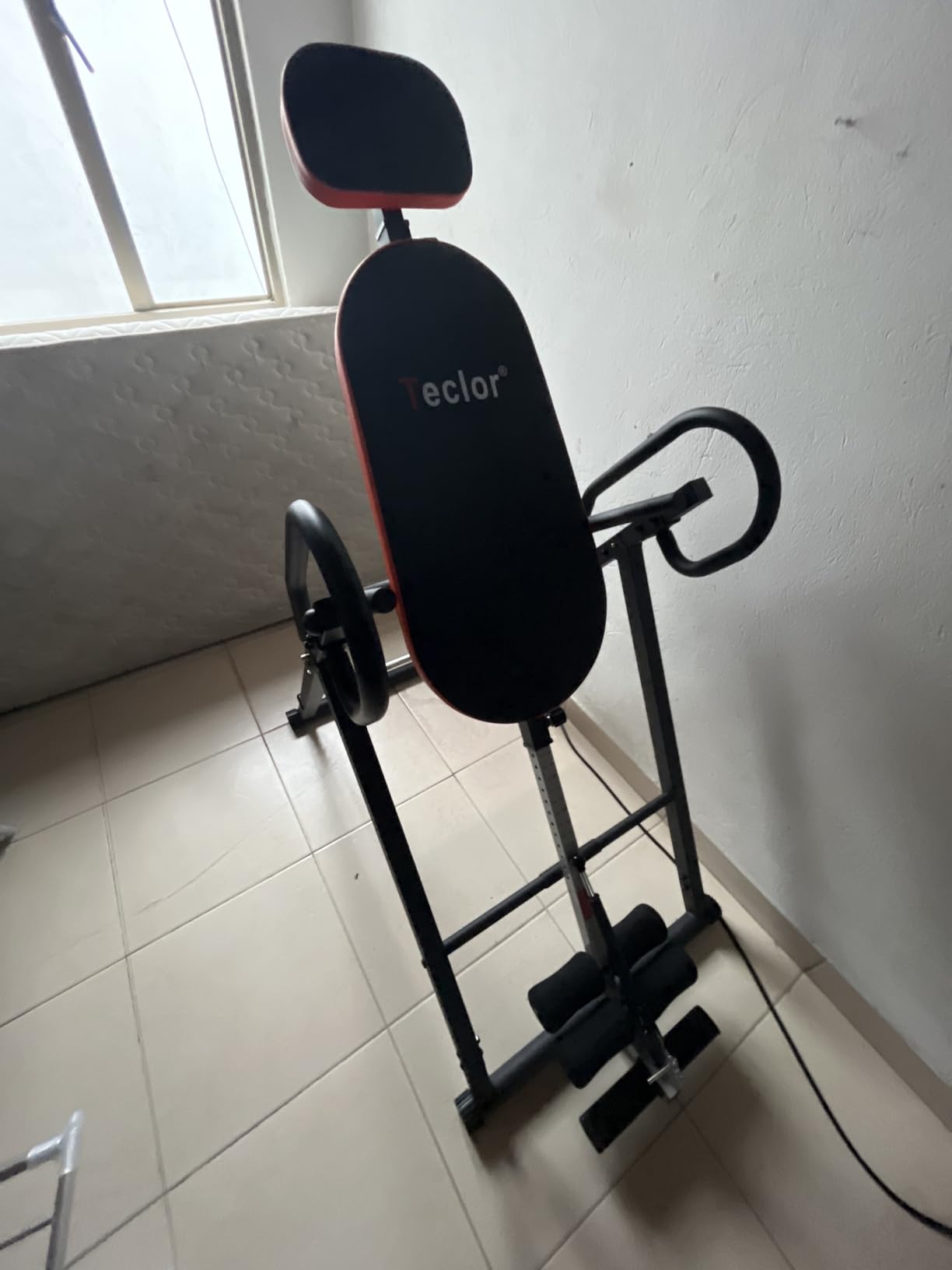
Everything about this frame is sized up. The steel structure is rated to 350 lb, the backrest measures 30.3 by 15.3 inches, and the height adjustment runs from 4 foot 3 inch to 6 foot 8 inch, the tallest range we tested. Owners in the 240 to 350 lb band report solid stability and genuine relief of chronic low back tension after short sessions.
The extra-long release handle is a smart piece of engineering. It means you can let go of the angle control without bending forward, which matters more the deeper you go and the more your back hurts on the way out. Padded ankle holders also distribute load better than bare rollers at higher weights.
The recurring criticism is not the frame, it is the accessories. Owners describe the included lumbar pad, ankle foam, safety belt and bundled tools as cheaply made, and several note the lumbar pad attaches with hook-and-loop to a spot that does not obviously exist on the backboard. Some report the backboard arriving misaligned or too wide to bolt in cleanly, which is a shipping problem worth photographing before you assemble.
Grab handles also do less than you would hope for returning upright from full inversion, so you still need a real arm motion or a spotter. Treat the included safety belt as backup rather than primary angle control.
Who the Teclor 350 lb suits best
If you are over 250 lb, this is one of the few frames here where the capacity claim is backed by a wide backrest and enough surface area to sit comfortably. It is also our pick for anyone between 6 foot 2 inch and 6 foot 8 inch, a range most models do not cover.
Budget for replacing the lumbar pad and ignoring the included belt. Several owners report a spray adhesive fixing the loose foam in a minute.
Where the Teclor 350 lb falls short
Build quality is uneven out of the box. Misaligned backboards and cheap accessory packs are common enough that we would not call this the safest option, even though the frame itself is genuinely robust.
The 4.3 average across 861 reviews is a thinner evidence base than the leaders here. If you want the capacity with more proven hardware, the Innova ITX1200 offers a similar rating with better-documented ownership.
6. Dripex Heavy Duty Inversion Table: Best for Small Spaces
Dripex Heavy Duty Gravity Inversion Table 300 lbs Capacity
Folds in 3 seconds
300 lb steel frame
Adjustable lumbar and footrest
Four position pin system
Pros
- Folds in about three seconds
- Integrated steel frame stays stable to 300 lb
- Lumbar height and footrest adjustments tune your balance
- Assembly is simpler than comparable frames
Cons
- Only four fixed pin positions
- Fewer angle increments for gradual progression
- Limited written review detail
The whole design brief here was storage. This table folds in about three seconds, which means it can live in a corner of a small flat and still be usable on a weekday morning. Most competitors need a deliberate multi-step collapse, and this one does not. The frame is an integrated steel structure rated to 300 lb, so folding does not come at the expense of rigidity.
Balance tuning is unusually good for the category. Lumbar support, height and footrest are all adjustable, which lets you account for uneven weight distribution, and the ankle holding system and headrest both adjust too. Buyers specifically mention being able to micro-adjust balance for their own body weight.
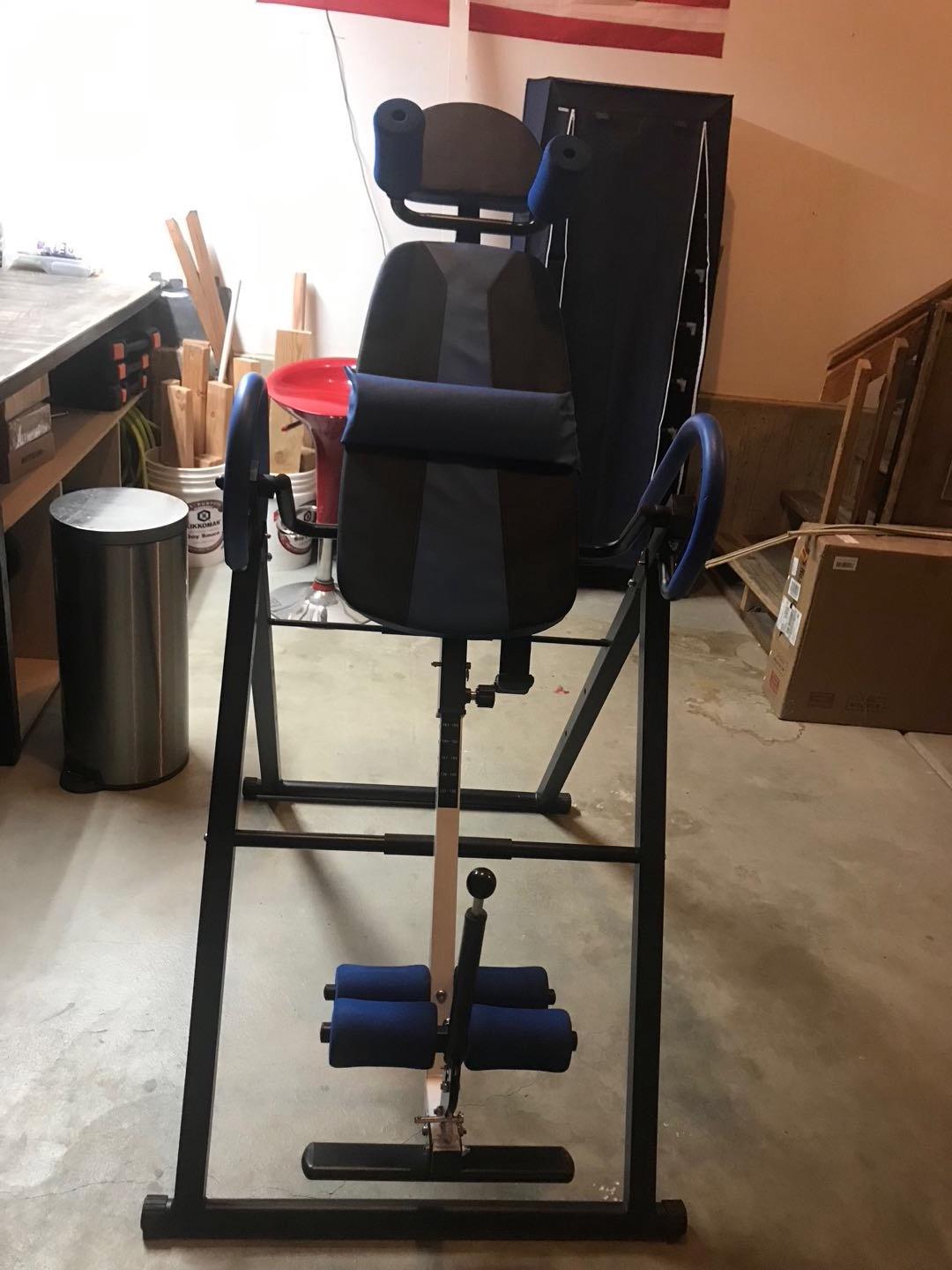
Height adjusts from 1.5 m to 1.95 m, which is roughly 4 foot 11 inch to 6 foot 5 inch. That is a narrower range than some competitors, and worth checking against your own height, particularly if you are under 5 feet.
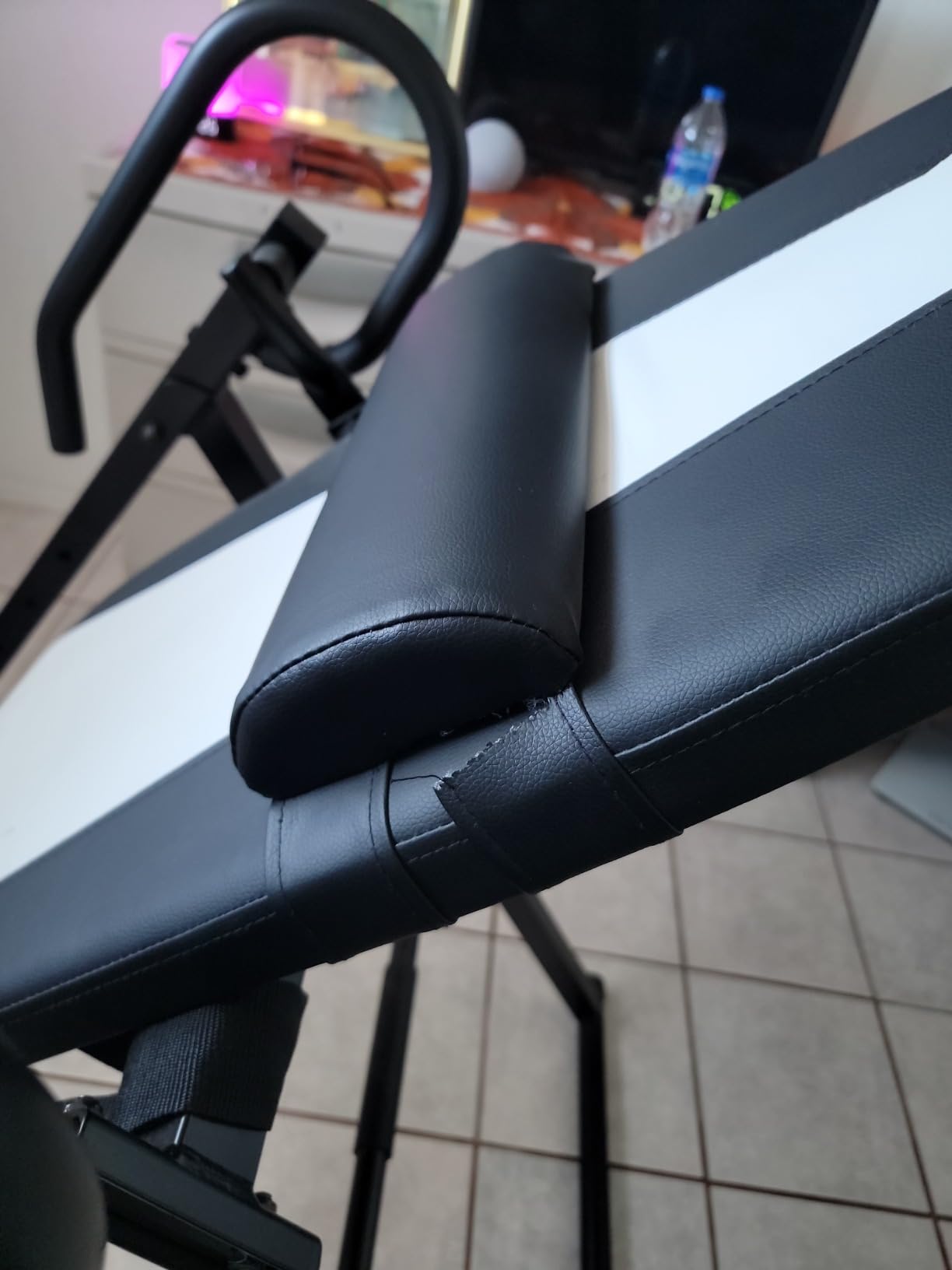
The main limitation is angle granularity. Four fixed pin positions is fewer increments than the six-position designs elsewhere, so ramping from a partial angle to deeper inversion is a bigger jump. Assembly is also described as simpler than similar frames, which helps on a table this size.
Who the Dripex suits best
This is the pick for apartment living, garage gyms, or any situation where floor space is the binding constraint. A three-second fold changes how often you will actually use it, because a table you have to wrestle out of a corner is a table you stop using.
The adjustable footrest and lumbar support also make it a reasonable pick for people whose weight distribution makes balance tricky on other models.
Where the Dripex falls short
Four pin positions is the real compromise. If you are sensitive to blood rushing to your head and want to stop at a precise angle, the finer gradation of a six-position system is easier to live with.
The written review detail on this listing is thinner than the Innova and Teeter products, so you are buying on specifications and a 4.5 average rather than a deep pool of long-form owner reports.
7. YOLEO ITX320 Inversion Table: Best With a Removable Lumbar Pad
YOLEO ITX320 Inversion Table for Back Pain Foldable Inversion Table
Removable adjustable lumbar pad
Wider backrest
4 position pin system
4ft-10in to 6ft-6in
Pros
- Lumbar pad can be repositioned or removed for different bodies
- Wider backrest suits older users
- Improved ankle holders reduce pressure
- Clear assembly instructions
Cons
- Heavy and awkward to move around the home
- Shorter users may need help getting upright
- One report of surface rust inside poles
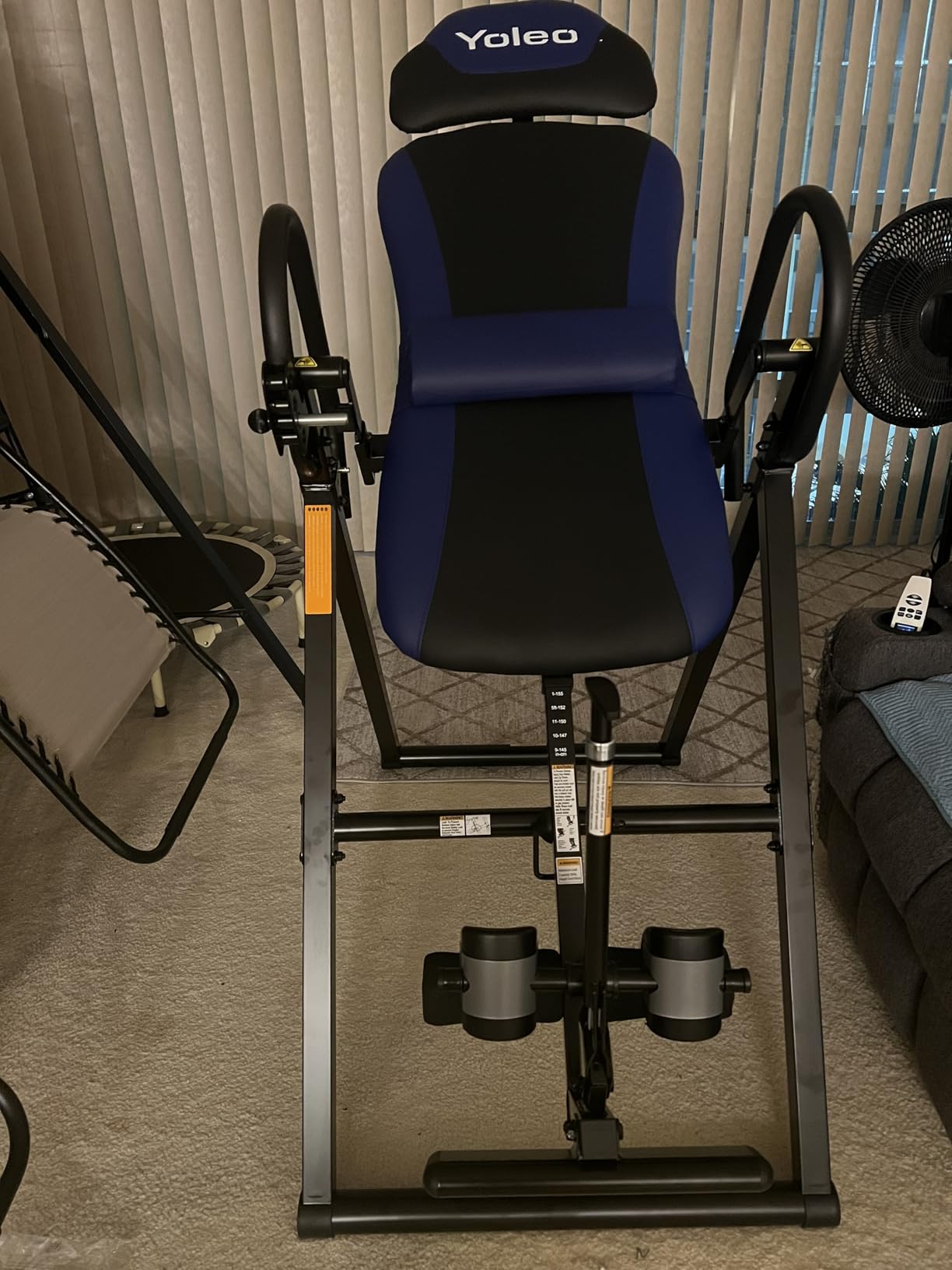
The removable lumbar pad is the reason to look here. Most tables give you a fixed bolster, which either presses on the wrong spot for your shape or does nothing useful. On the ITX320 you can slide it, or take it out entirely for fuller spinal traction. Owners managing scoliosis, chronic back pain and sciatica report steady improvement over several weeks of 5 to 15 minute daily sessions, and the pad and wider backrest are the details they praise most, particularly if you are over 60.
The ankle system is described as improved specifically to reduce ankle pressure, and it releases easily, which matters on the way out of a session. The fit range covers 4 foot 10 inch to 6 foot 6 inch, and the instructions are clear and detailed enough that first-time assemblers are reporting success.
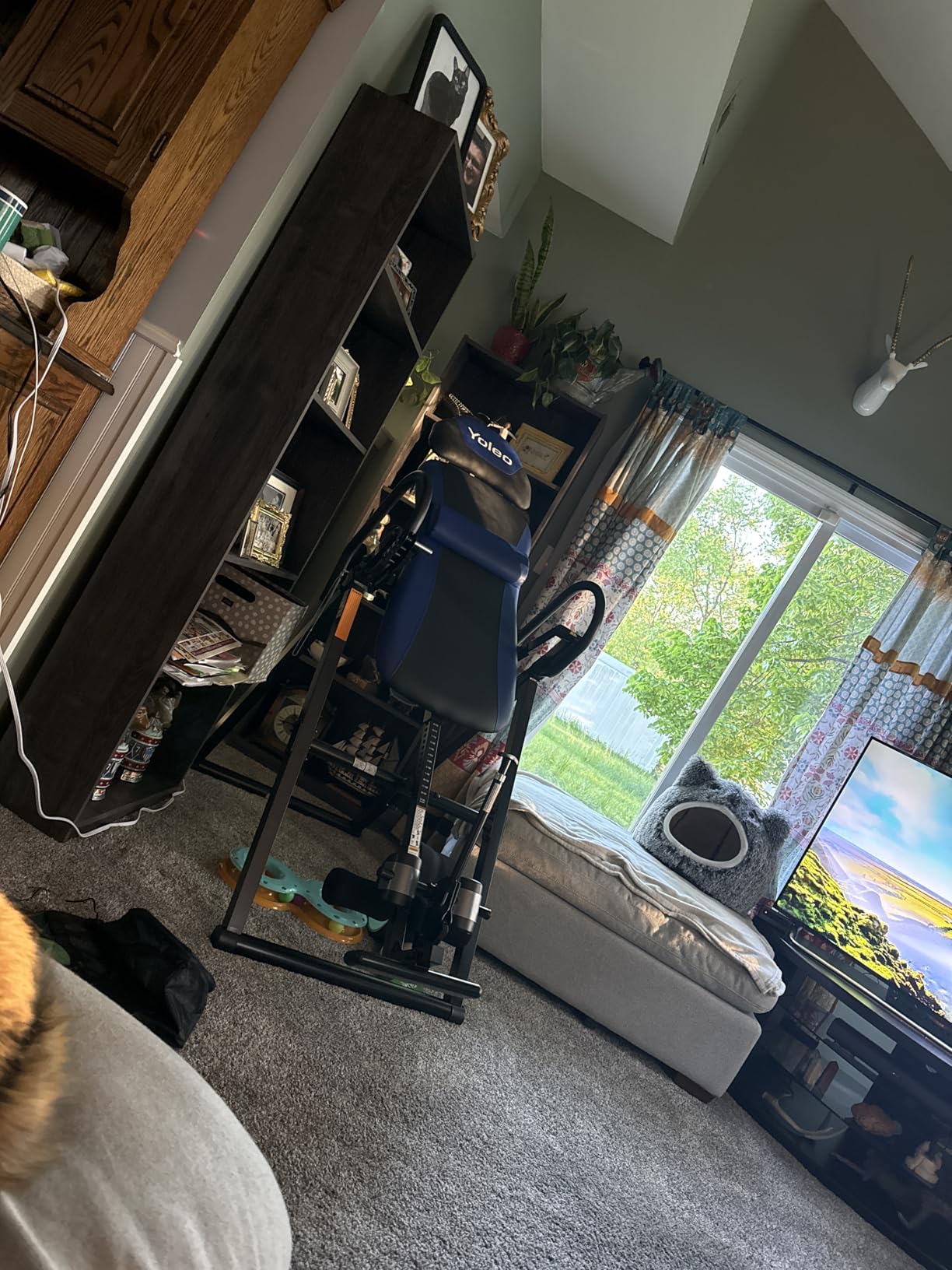
The lighter concern here is the weight. At 24 kg this is a hefty unit to reposition, and if the table lives in a garage, that is part of your decision. Shorter users may still need a hand or a spotter to get back upright, because the geometry does not do the work for you at the bottom of the range.
One buyer reported surface rust inside two poles from condensation, which suggests storage humidity matters if you are in a humid climate or a basement. Not a widespread complaint, but it is a reason to store it dry.
Who the YOLEO ITX320 suits best
This is our recommendation for sciatica-type discomfort, particularly if you are over 60 or your pain pattern varies day to day. Being able to remove or relocate the lumbar pad means you can dial in the support for the specific day rather than living with a fixed geometry.
It is also a good choice if more than one person in the household will use the table, since a fixed pad cannot suit two different body shapes.
Where the YOLEO ITX320 falls short
Four pin positions again limits how gradually you can increase angle. If head rush is an issue for you, look for a six-position system instead.
At 24 kg with no folding handle, moving it between rooms is a two-person job. If your sessions will happen away from wherever it is stored, budget for a dolly or a second person.
8. Verakare ITX9550 Heavy Duty Inversion Table: Budget Pick
Verakare ITX9550 Heavy Duty Inversion Table
Six position pin system
True Balance system
300 lb capacity
Built by Innova Products
Pros
- Manufactured by Innova Products on the same line
- Stable and does not shift on carpet
- Folds easily and stores compactly
- Good value against costlier Teeter models
Cons
- Bulky and heavy
- usually a two person assembly
- Foot pads can work loose over time
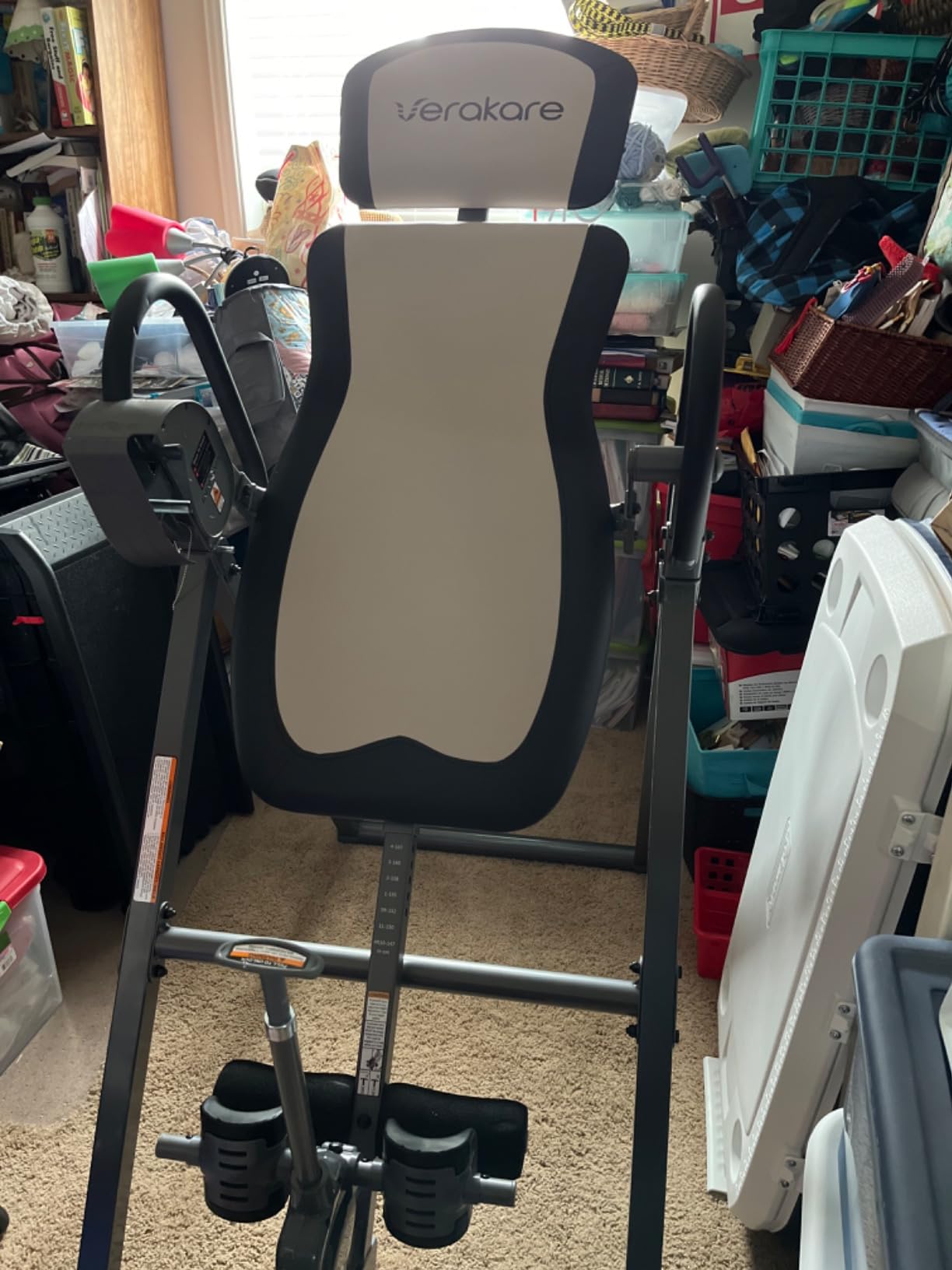
The Verakare name is unfamiliar, but the manufacturer listed on this listing is Innova Products, the same factory behind the Innova line. That single fact reframes the whole product. You are buying Innova mechanicals, including the reversible ankle holding system, the True Balance inverting system and the six-position pin system with its patented protective cover, at a substantially lower entry price.
Owners identify it as an Innova-built table early and often, and rate it favorably against far more expensive Teeter models. It is reported as stable on carpet, which matters more than it sounds, because a table that slides during rotation is a table people stop trusting. The adjustable lumbar pad and headrest cover a 4 foot 10 inch to 6 foot 6 inch range.
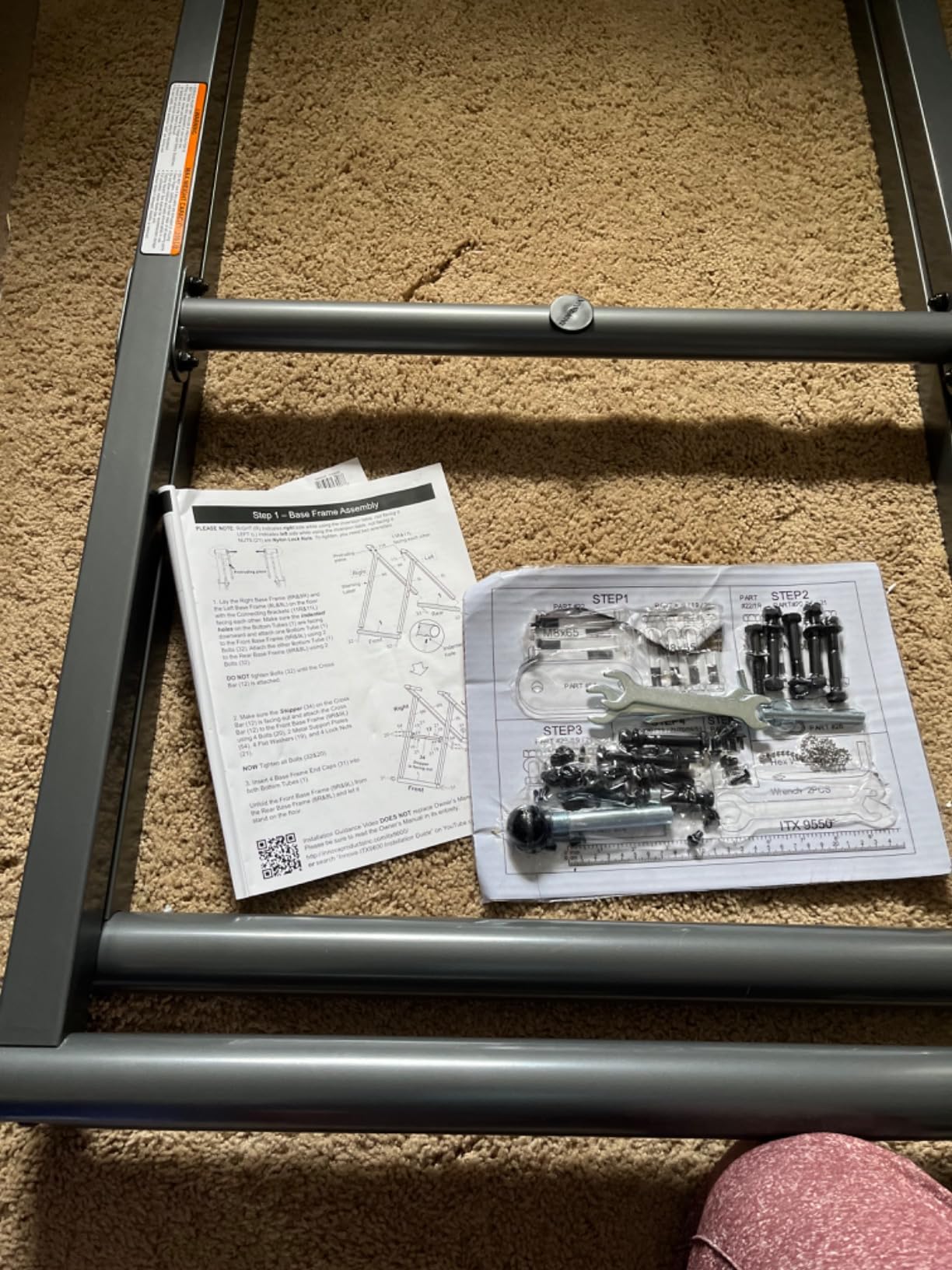
Compression is the tradeoff. At 46 by 28 by 62 inches it is bulky, and most owners describe assembly as a two-person job. Balance needs deliberate adjustment, particularly if your weight distribution is uneven, and it lacks the device holder found on larger Innova models, which sounds trivial until you want to follow a routine video mid-session.
There is also a small durability note worth passing along: the foot pads are a tight fit on the metal and can work loose over time, so check them every few months.
Who the Verakare ITX9550 suits best
This is the pick if you want Innova hardware without the Innova badge, and it is a genuinely strong value proposition. The six-position pin system is a step above most frames at this entry point, and the reversible ankle holders are the feature that most budget designs cheap out on.
Carpet owners take note: the reported stability on soft flooring is a real practical difference from lighter frames that wander.
Where the Verakare ITX9550 falls short
Assembly time and bulk are the two real drawbacks. If you have back pain severe enough that you cannot bend, twist or lift for an extended stretch, do not plan to build this alone.
The 273-review base is thin compared with the Innova listings, so you are leaning more on the manufacturer relationship than on a deep pool of owner reports. That is a reasonable trade, but it is a trade.
9. YOLEO ITM280 Heat and Massage Inversion Table: Best With Remote-Controlled Heat
YOLEO Inversion Table Massage & Heat for Back Pain Relief Equipment
Remote controlled massage pad
Integrated heat
320 lb capacity
Memory foam backrest
Pros
- Remote avoids fumbling while inverted
- 320 lb capacity beats most competing frames
- Angle pin system gives repeatable positioning
- Memory foam back suits longer holds
Cons
- Cable based heat needs a nearby outlet
- Bulkier than a plain gravity table
- Smaller review base than the leaders
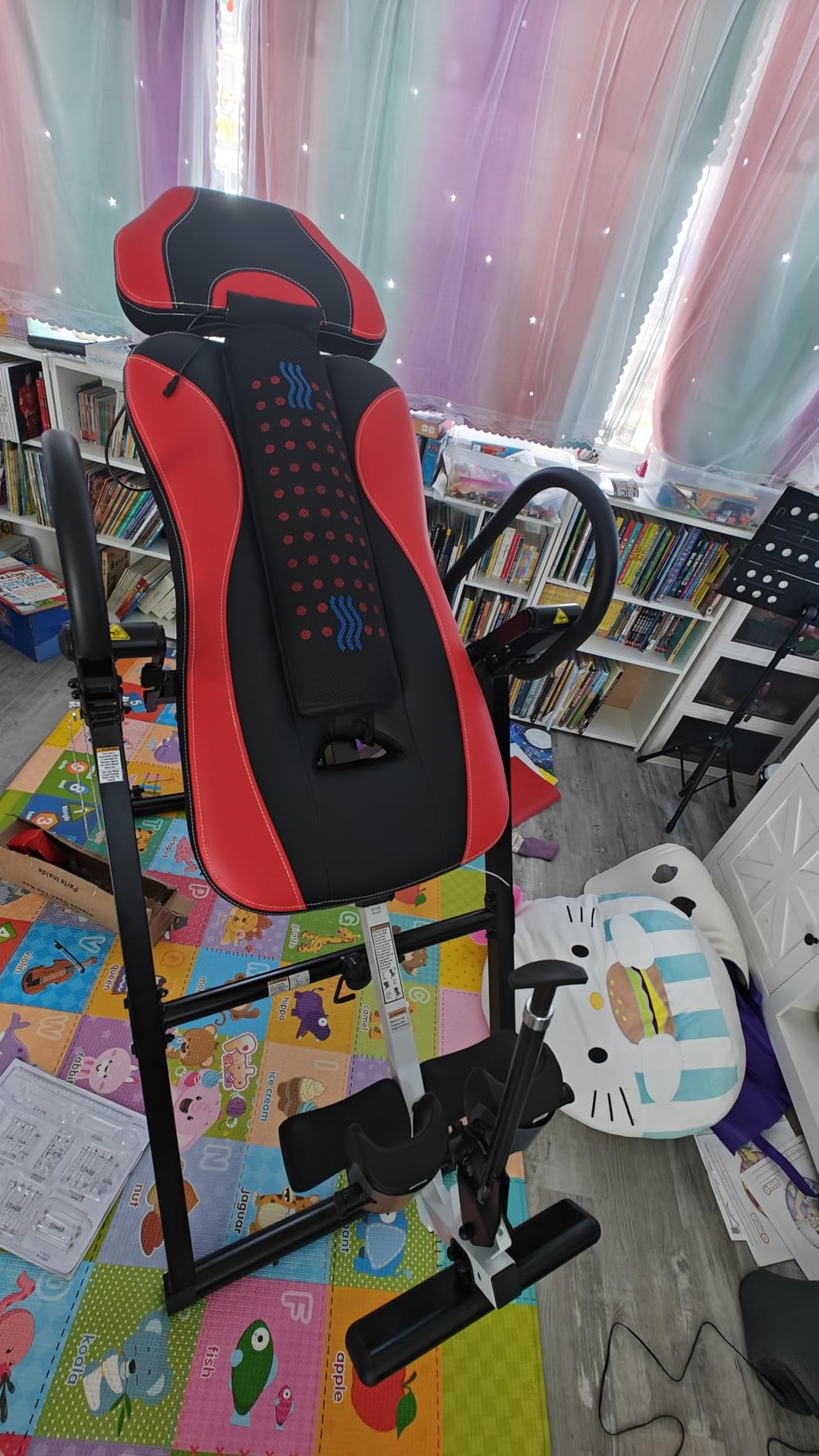
The difference between this and other heated tables is the remote control. With a cable-based pad, reaching down to adjust settings means hanging further into the inversion, which is exactly what you should not be doing. A remote lets you change mode or heat mid-session from a stable position, and several owners use the pad at full setting during short sessions, pointing to that convenience as the reason it works.
The frame is also rated to 320 lb, higher than most of the field, with an angle pin system for consistent repeatable positioning and reversible ankle holders designed to cut ankle pressure. The memory foam backrest is contoured to the waist curve and handles longer holds better than flat foam.
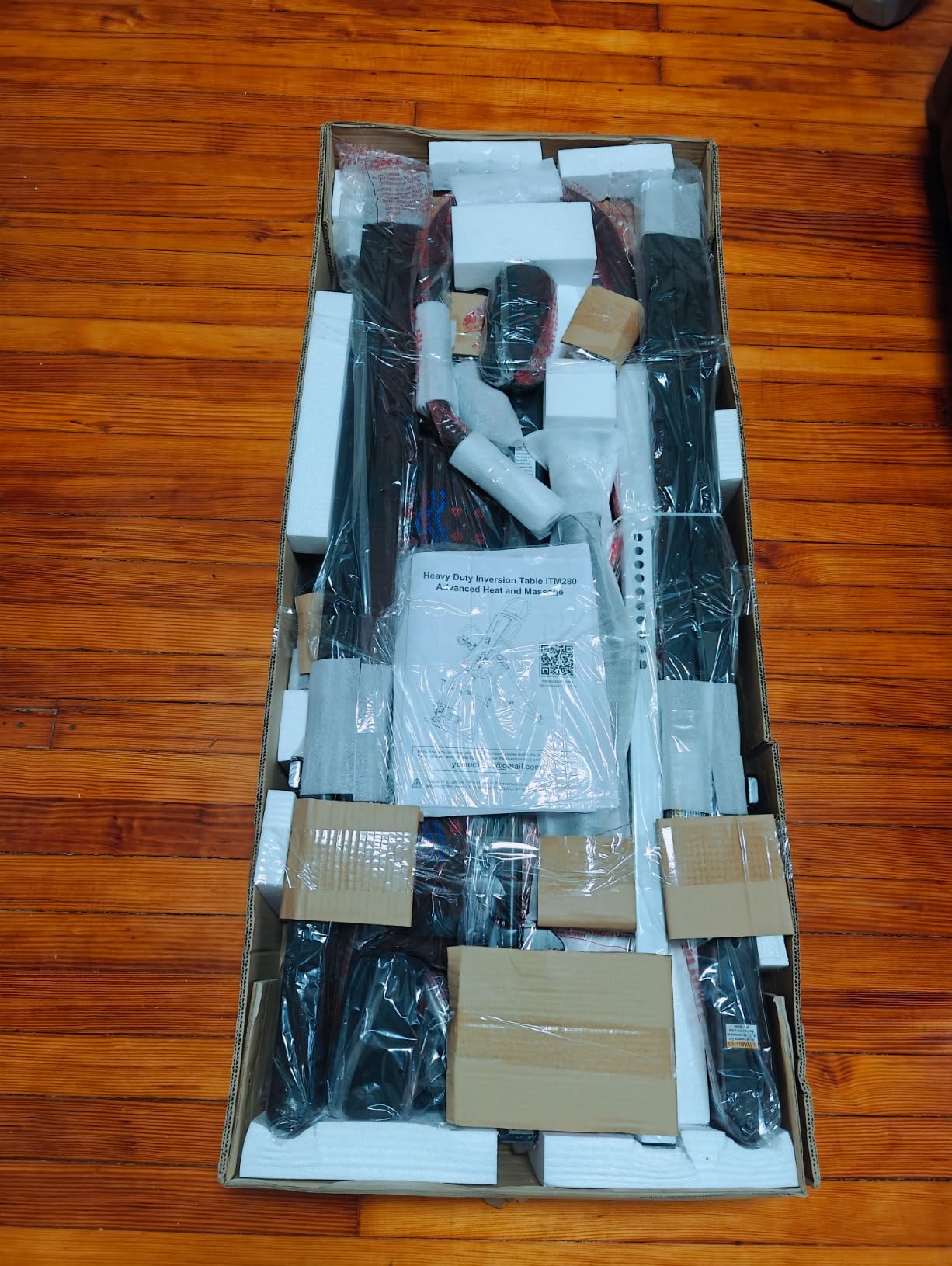
It accommodates users from 4.75 ft to 6.4 ft, which is a narrower band at the short end than most rivals. More importantly, the heat and massage functions are cable based, so you need an outlet within reach and the table stays put once it is placed.
At 27 kg this is bulkier than a plain gravity table, and the 4.4 average across 226 reviews is a smaller sample than we would like. Several owners note the cable as the limiting factor rather than the mechanism itself.
Who the YOLEO ITM280 suits best
This suits people who want heat and massage but do not want to over-rotate into the inversion to change settings. The remote is the whole feature, and it removes the most common complaint we saw about heated tables.
The 320 lb capacity also makes it a candidate for heavier users who specifically want the heated option, which is a rare combination in this category.
Where the YOLEO ITM280 falls short
The cable is a hard constraint on where the table can live and how you use it. If your sessions happen somewhere without a convenient outlet, this feature is dead weight.
The fit range starting at 4.75 ft rules out shorter users, and 6.4 ft is mid-pack for taller ones. Check your height against both numbers first.
10. Teeter FitSpine X3: Top Rated Inversion Table for Back Pain
Teeter FitSpine X3 Inversion Table, Deluxe EZ-Reach Ankle System, Back Pain Relief Kit, FDA-Registered (X3A2)
8 point floating suspension
EZ-Reach ankle lock
UL and FDA registered
5 year warranty
Pros
- Highest rated in this group
- Long EZ-Reach handle for ankle release
- Smooth backrest allows maximum body slide
- Folds in seconds with no disassembly
- Acupressure nodes plus lumbar bridge
Cons
- Heavy at about 66 lb with an awkward package
- Some units need hinge adjustment before balancing
- Printed booklet needed as app and CD fail
The FitSpine X3 shares the highest average rating in this group, and the reason is the backrest. The patented FlexTechnology 8-point floating suspension lets the surface move with your body, so instead of hanging on a rigid board you slide smoothly into the inversion. Owners recovering from disc problems, sciatica and chronic low back pain describe dramatic improvement within 30 days of short daily sessions at moderate angles.
The EZ-Reach ankle system is the second thing you notice. The extra-long stainless steel handle lets you release the lock without bending forward, and there is a secondary gravity lock as a backup. The EZ-Angle tether is marked at 20, 40 and 60 degrees, so you can stop at a known angle rather than guessing.
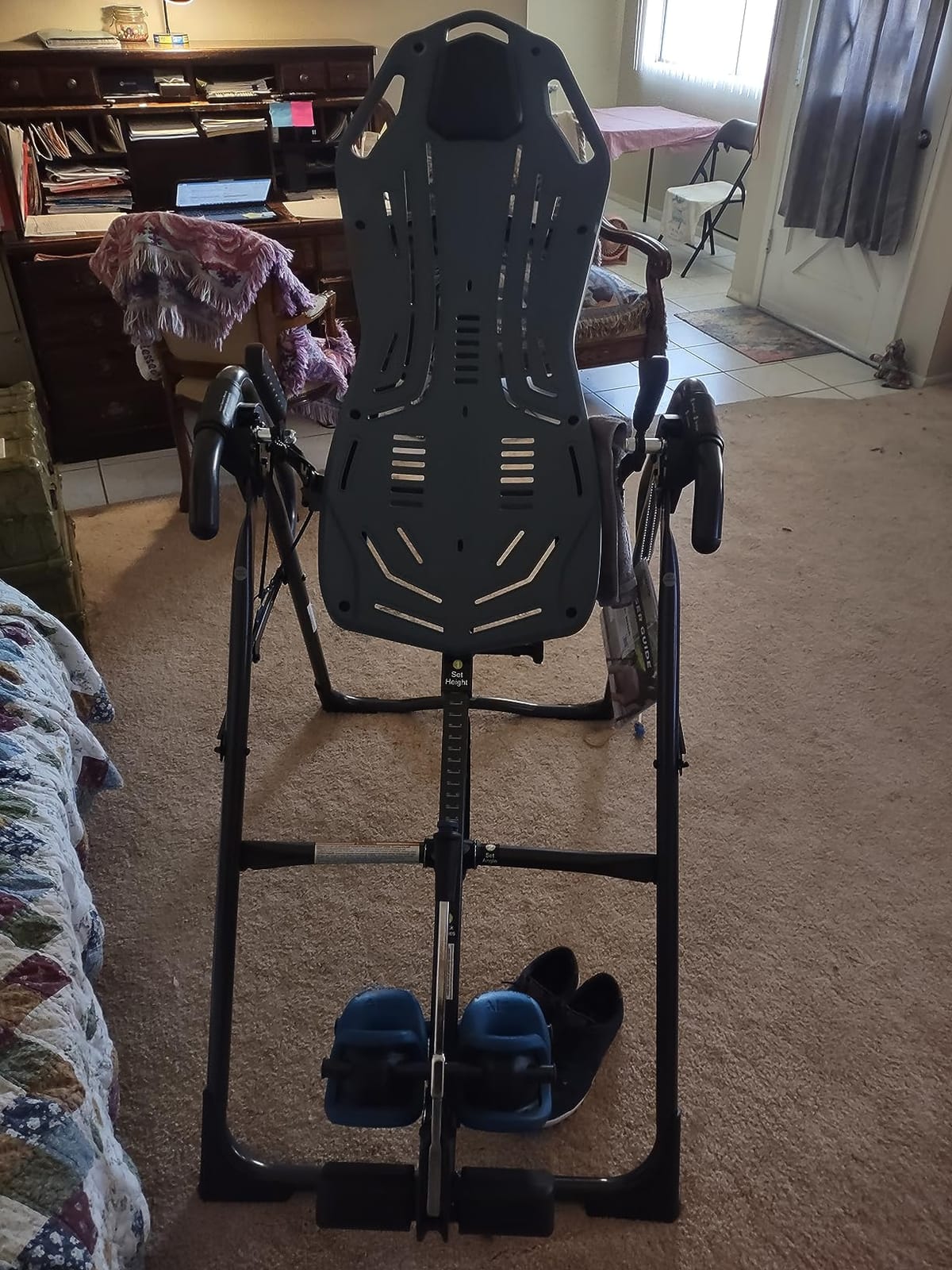
Among the twelve tables here, the FDA registration as a 510(k) medical device and the UL safety certification appear only on the three Teeter models, and this frame carries a 5-year manufacturer warranty on heat-treated steel. The eight acupressure nodes in varied heights plus the adjustable lumbar bridge target specific pain areas rather than just stretching generically.
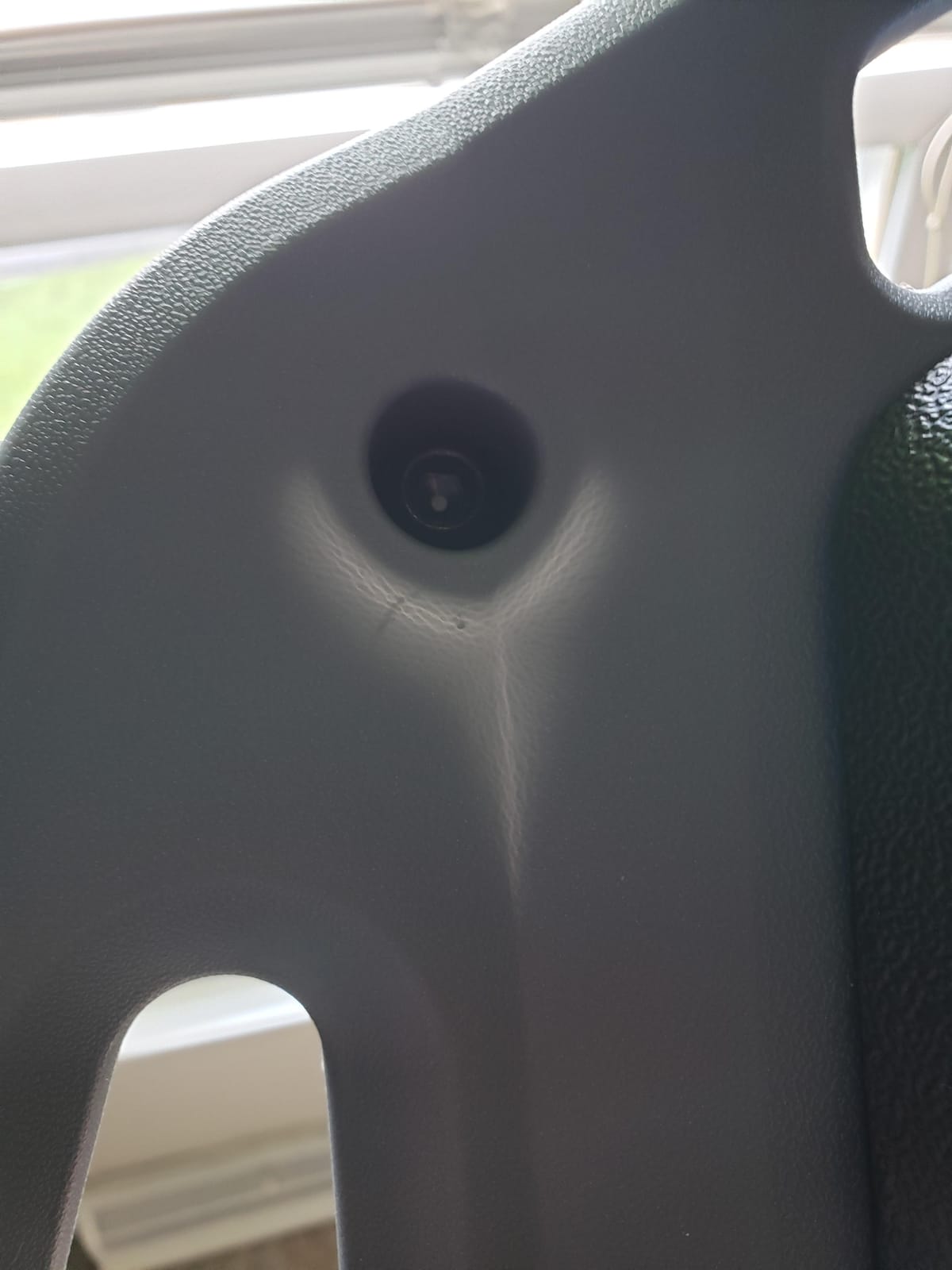
The compromises are weight and setup. At roughly 66 lb with an awkward shipping package, this is not a table you casually move between rooms, and low ceilings can be a problem given the assembled height. Some units need hinge and shaft adjustment before they balance properly out of the box. Owners also report the included assembly CD and app not working, so you will need the printed booklet.
Who the Teeter FitSpine X3 suits best
Choose this if your pain is significant enough that you want the best-engineered table available, and if you can dedicate a permanent spot to it. The certifications are not marketing here: they are the reason a physical therapist would feel comfortable recommending it, and the FDA registration is the only one in this roundup a doctor or insurer can act on.
The 20, 40 and 60 degree tether markings are genuinely useful for people who get head rush, because you can set a limit before you climb in rather than reacting mid-rotation.
Where the Teeter FitSpine X3 falls short
Price and weight are the honest drawbacks. This is a heavy, permanent fixture, and at this level of investment the assembly friction feels sharper, because you expect a better unboxing experience than a broken CD and an app that will not launch.
It also rates to 300 lb and tops out at 6 foot 6 inch, so the heaviest and tallest users should look at the frame capacity list rather than assuming premium means universal.
11. Teeter FitSpine LX9: Premium Pick
Teeter FitSpine LX9 Inversion Table, Deluxe Easy-to-Reach Ankle Lock, Back Pain Relief Kit, FDA-Registered (LX9 – Black)
Arched boarding platform
Storage caddy
EZ-Reach ankle lock
5 year warranty
Pros
- Boarding platform makes mounting and dismounting easier
- Rock solid with no wobble reported at 250-300 lb
- Long handle ankle lock means no reaching down
- FDA registered and UL certified
Cons
- Most expensive option here
- Heaviest unit at about 74 lb
- Instructions are vague and need photos
- Ankle clamps need socks
The LX9 improves on the X3 in one specific way that matters enormously if you have back pain: the arched boarding platform. Getting onto a flat bench when your lower back hurts is the moment many people give up, and the raised arched frame makes climbing on and off a genuinely easier motion. Owners with sciatica, disc degeneration and post-surgical back pain report substantial repeatable relief from two or three short daily sessions.
The engineering is the same pedigree as the X3: FlexTechnology 8-point floating suspension, eight acupressure nodes, an adjustable lumbar bridge accessory, the EZ-Reach ankle system with its long stainless steel handle and secondary gravity lock, and an EZ-Angle tether preset at 20, 40 and 60 degrees. A storage caddy is included for the accessories. It is FDA registered and UL certified, rated for 4 foot 8 inch to 6 foot 6 inch up to 300 lb, with a 5-year warranty on heat-treated steel.
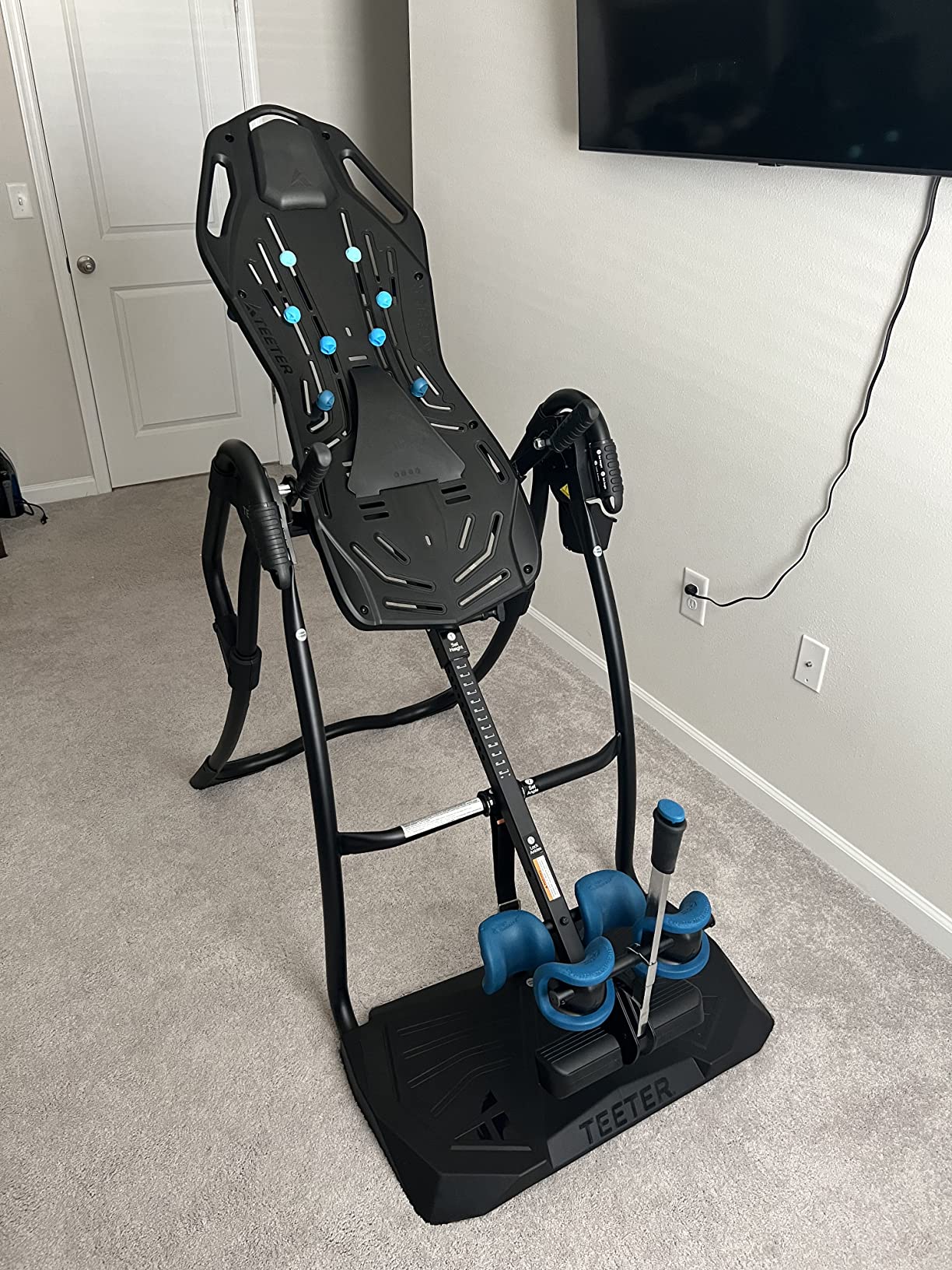
The five-star share here is the highest in our group, and the stability reports are the strongest: owners at 250 to 300 lb describe a table that is rock solid with no wobble. One owner notes that FDA registration allowed insurance reimbursement, which is not guaranteed but is not unusual either.
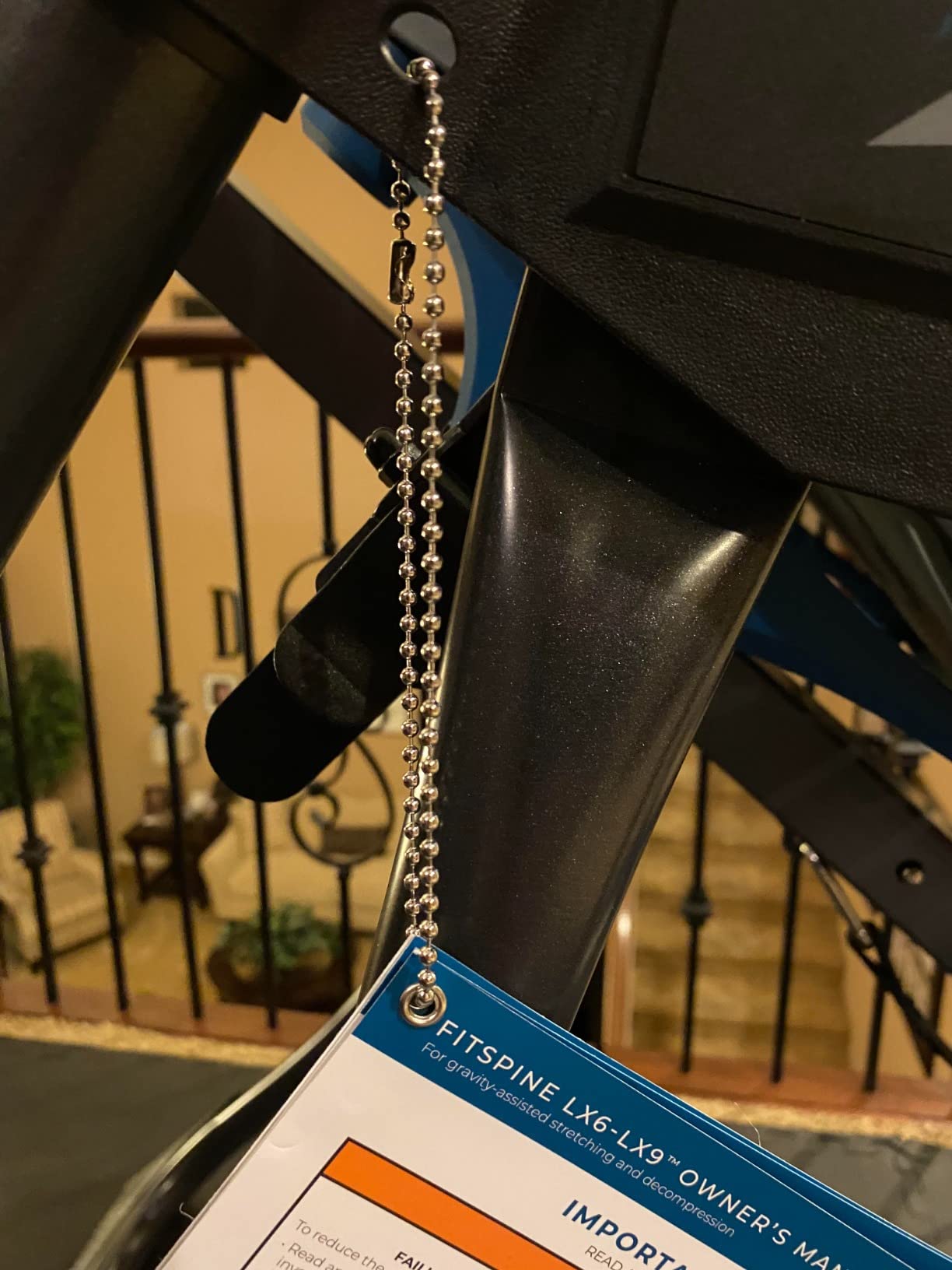
The drawbacks are the obvious ones. It is the most expensive table here and the heaviest at roughly 74 lb, and it stays bulky even folded. The instructions are described as vague, to the point that some owners needed photos to finish assembly. The ankle clamps are uncomfortable without socks or sweatpants, and several users recommend a spotter for the first sessions.
Who the Teeter FitSpine LX9 suits best
This is for the person whose pain is bad enough that getting on and off the table is part of the problem, not the exercise. The boarding platform removes the single hardest movement from the routine, and that alone justifies the step up for many users.
It also suits shared households near the 300 lb ceiling of the rating, and anyone who wants the certifications on paper for a doctor or insurer to see.
Where the Teeter FitSpine LX9 falls short
Height calibration is essential on this frame, and several owners note that getting it right is what controls the return to upright. If you are not willing to spend time on setup, that undoes its advantages.
At 74 lb with bulky folded dimensions, this is a fixed installation. If you need the table in more than one place, the Innova or Verakare folding models are a better fit for your life even if they are not as refined.
12. Teeter FitSpine X1: Best for Full Inversion and Grip Work
Teeter FitSpine X1 Inversion Table, Decompression Surface for Full-Body Stretch, Ergo Embrace Ankle Supports, Integrated Accessories, UL Safety Certified, Heavy-Duty 300 lb Capacity
Removable full lock-out tether
8 acupressure nodes
Ergo Embrace ankle cups
Teeter Move app
Pros
- Smooth surface allows a full body slide
- Balances well and returns upright with an arm movement
- UL certified steel with 5 year warranty
- Integrated Grip-and-Stretch handholds
Cons
- Bulky and heavy to move with a back injury
- Ankle cuffs get uncomfortable in long full holds
- Lower ankle lock reach than the X3 and LX9
- Balance takes several sessions to dial in
The X1 sits between the entry Teeter models and the X3 in engineering, and its distinguishing feature is the removable EZ-Angle tether. Set the preset maximum angle, or pull the tether out entirely for full lock-out inversion if you have worked up to it. That flexibility is what makes it the best of this group for people who want to progress toward hanging fully upside down rather than capping out at a partial angle.
The integrated Grip-and-Stretch handholds in the backrest and frame are the other thing users notice, and they give you somewhere to pull during the transition in and out. Owners with herniated discs, scoliosis and chronic sciatica report genuine pain relief and better sleep within a few weeks of daily use, and several moved up from cheaper knock-off tables specifically for the smooth backrest and cuff-style ankle support.
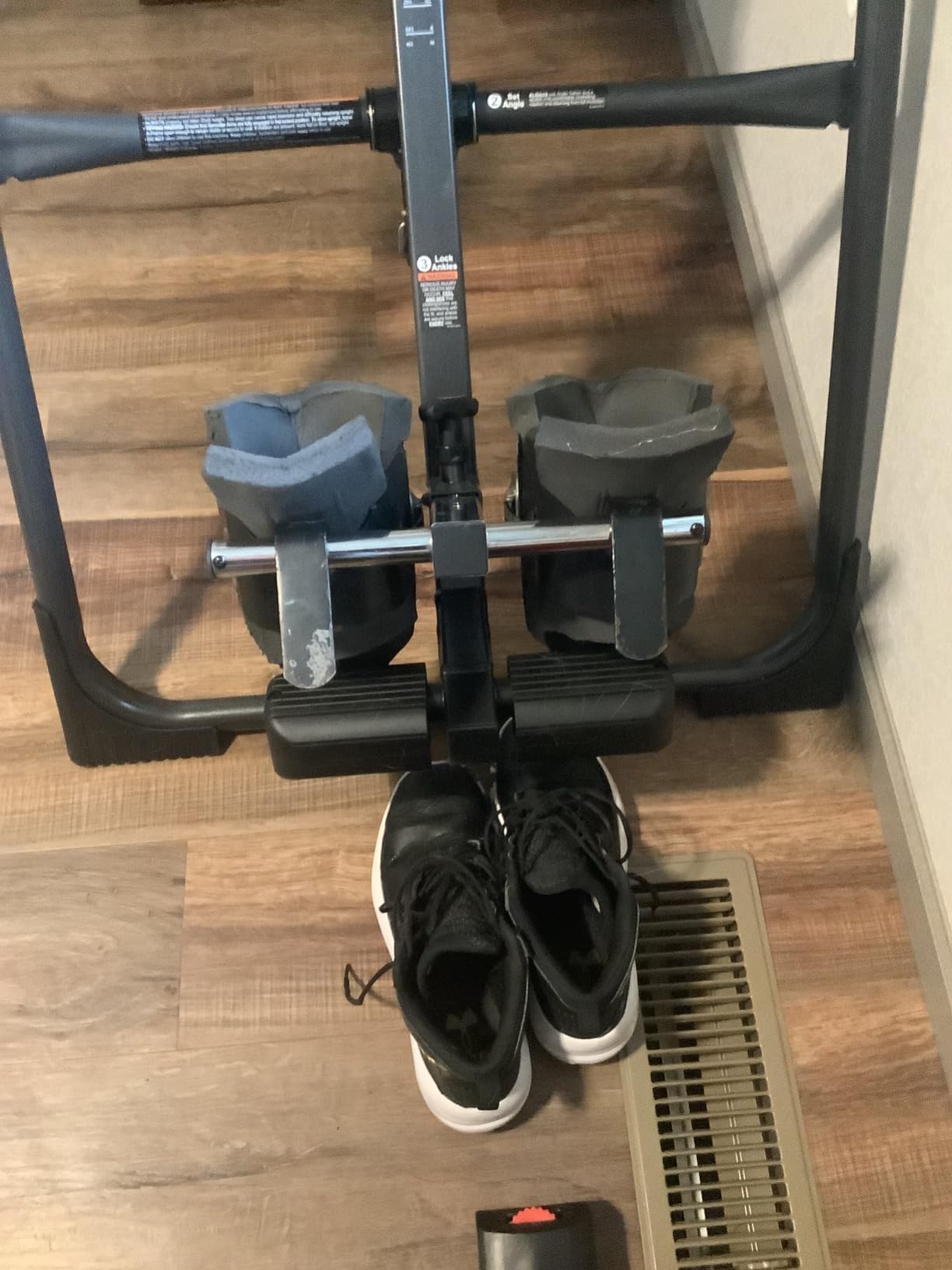
It carries the same certification and warranty story as the other Teeters: heat-treated steel, UL safety certified, FDA registered 510(k), 5-year warranty, rated 4 foot 8 inch to 6 foot 6 inch up to 300 lb. The free Teeter Move app covers iOS and Android. Eight acupressure nodes in varied heights and an adjustable lumbar bridge are included, so the extras match the higher models.
What it does not have is the EZ-Reach handle. The ankle lock reach here is lower than on the X3 and LX9, so releasing means reaching down further. Ankle cuffs also become uncomfortable during long full-inversion holds, and the first-time balance took several sessions for owners to dial in. It is bulky and heavy to move, which is a real problem for people with the kind of back injury that brought them here.
Who the Teeter FitSpine X1 suits best
Pick this if your goal is eventually hanging fully inverted, and you want the safety of a detachable tether while you get there. The lock-out option is a real ceiling that most strap and fixed-pin designs cannot offer.
It is also a sensible middle Teeter for people who found the smooth backrest and cuff-style ankles worth having but do not need the boarding platform of the LX9.
Where the Teeter FitSpine X1 falls short
The ankle lock reach is the practical limit. If you have shoulder or upper back pain, the extra-long handle on the X3 or LX9 is worth the step up.
Full inversion is not a goal you should chase quickly. The safe progression is partial angles for weeks before you ever go past 45 degrees, and if you skip that, the cap on this table will not protect you.
Do Inversion Tables Really Work for Back Pain?
Yes, for a large share of people, but the mechanism matters more than the product. When you hang at an angle, gravity spreads the vertebrae apart and reduces downward load on the intervertebral discs. That takes pressure off irritated nerves and tight structures, and for nonspecific low back tightness and mild sciatica-type symptoms it often feels like relief within days.
Partial inversion at 20 to 45 degrees captures most of the decompression benefit with far less blood rushing to your head than going fully upside down. That is why every good table in this list offers a range of pin positions or a marked tether, and why the best inversion tables for back pain are the ones that let you stop early.
Now the honest part. A poster on r/backpain reported a month of twice-daily, four-minute sessions at 45 degrees with no measurable benefit. That is a genuinely common outcome, and it almost always comes down to dose and angle rather than the table. Going too deep, too soon, too often is the single biggest reason people conclude that inversion does not work. Our back brace roundup covers the other category of tools people pair with it for exactly this reason.
Two more realistic expectations. Heat and massage pads are relaxation bonuses, not treatment. And the effect usually accumulates over weeks, not sessions, which is why the 30-day marks show up so often in owner reports on the better-built tables.
How to Start Using an Inversion Table Safely
This is the section we wish every seller included, because almost nobody explains it. The medical sources that dominate search results for this topic, among them Mayo Clinic, WebMD and MSU Health Care, all frame inversion as a technique that needs a gradual ramp, and the ramp is where most people get it wrong.
Step one: check the clearance before you assemble. Measure your ceiling and the floor area the table needs to swing through. A table that folds quickly still needs a wide arc to rotate in, and a full inversion needs vertical room above your head. A Cathe user who wrote a detailed buying comparison put it simply: measure the swing area, not just the footprint.
Step two: calibrate your height before the first session. This is the number one failure mode, and it is worth understanding before you buy. Set the table too tall and it will not tip back at all. Set it too short and you can invert but cannot return upright without hauling on the side handles. Sit on the table, set the height so your head is comfortably supported, and test the balance with a spotter before trusting it alone.
Step three: start at 15 to 30 degrees for 1 to 2 minutes. This is the guidance the health sources converge on. Use the first pin or the lowest tether setting, and do not go past 30 degrees in the opening week. Thick socks and shoes make the ankle hold more comfortable and improve grip, which is the single most common piece of advice in owner reviews.
Step four: ramp on a schedule, not on a whim. A workable progression runs like this: week one at 15 to 30 degrees for 1 to 2 minutes, three to five sessions a week. Week two at 30 to 40 degrees for 2 to 3 minutes. Week three at 40 to 45 degrees for 3 to 5 minutes. Only consider going further after several symptom-free weeks, and honestly, most people never need to. A Cathe user who progressed from 20 to 40 degrees over several weeks reported a good spine stretch and abandoned anything beyond 60 degrees because of head rush.
Step five: keep a spotter nearby for the first sessions. Especially if you are new to inversion, over 60, or working around an injury. This is standard advice in the health guidance and it costs nothing.
Step six: come down the same way you went up. Do not release the ankle lock from a deeper angle than you are comfortable controlling. Use the long release handle, keep your arms engaged, and push through your arms rather than jerking your spine. A GolfWRX owner who uses a Teeter long-term notes the pull on knee and ankle joints during inversion, and some users add a pull-up bar to help themselves back upright. We mention that specifically as a joint-load warning: this is traction, and your hips, knees and ankles carry the work.
Who Should Not Use an Inversion Table
Inversion reverses blood flow direction relative to your heart and loads your spine, so it is not a neutral activity. Ask a clinician before you start if any of the following apply to you, and if they do not clear you, do not use one.
Clear contraindications include uncontrolled high blood pressure, glaucoma or any condition affecting eye pressure, heart disease and circulation problems, spinal instability or a diagnosed disc situation that has not been assessed, pregnancy, and the recovery period after spinal or abdominal surgery. Herniated and bulging disc conditions are exactly the cases where medical guidance matters most, and a physio-referred user with a bulging disc is one of the positive cases that shows up often, because the referral came first.
Skip it entirely if you are pregnant, if you have had a recent head injury, or if you are not confident you can control your own descent. The whole point of a marked tether or a detent pin is that you can stop at a known angle, and a table that tips you to 180 degrees because nothing was set is not a tool, it is a hazard.
And if you are in the first six weeks of a new back injury, or your pain is getting worse rather than better, call a doctor before spending on any table. Our picks are for chronic, stable, mechanical pain. They are not treatment for an acute injury.
Inversion Table Buying Guide: Frame, Fit, and Footprint
Frame and sturdiness come first. Users consistently rank stability at the top of their priorities, above comfort features and above extras. A 300 lb rated steel frame with welded joints and non-slip feet is the baseline; anything lighter will feel different at full inversion, and the wobble you feel is real feedback about how much load the frame is carrying. The Innova and Verakare listings share a manufacturer, and that shared hardware is the reason the cheaper name performs like the pricier one.
The ankle restraint is the second priority, and it is where the geometry debate lives. Padded cups, rollers and full leg cuffs are not interchangeable. Rollers are the most common on budget tables and least comfortable over long holds. Padded cups spread load across a wider surface and are the easiest to get into. Full leg cuffs, front and back, are the most secure and are the configuration experienced users rate highest, and a detailed comparison on the Cathe forum put cuffs ahead of rollers on that basis. The Verakare and Innova reversible holders let you swap positions to find the fit that stops your ankles taking the load.
Height calibration is the third, and the failure modes are worth restating. Too tall and the table will not invert. Too short and you cannot get upright without straining. The listed height range is a starting point, not a guarantee, and budget tables in particular are known to list heights that do not match real users. One r/backpain poster found a 5 foot 3 inch user needing to set the table to 5 foot 5 inch. Sit on any table and test the balance with a spotter before your first solo session.
Angle control comes in three forms, and all three appear in this roundup. A strap or tether with marked angles, as on the Teeter models, gives you set stops at 20, 40 and 60 degrees and some can be removed for full lock-out. A detented pin system, as on the Innova models, gives you six discrete positions, which is the best compromise between control and gradual progression. A multi-angle rear cross bar, as on the YOLEO Gravity, sits between the two. Four positions is workable; six is better; continuous adjustment is not something to want, because it removes your ability to set a limit.
Comfort is mostly about the headrest, the lumbar support and the ankle padding. A headrest that only moves by unbolting is a genuine annoyance that shows up in reviews for several models here. A lumbar pad that is removable and repositionable, as on the YOLEO ITX320, adapts to different body shapes and to different pain days. Ankle padding that feels thin at full inversion is the most common comfort complaint across every brand, and the workaround is always the same: thick socks and shoes.
Space and storage decide how often you will use the table. Measure the ceiling height against the assembled height, and remember that a full inversion needs clearance above your head. For the swing, allow a wide arc in front of and above the table. If you fold it, compare fold times honestly: the Dripex collapses in about three seconds, which is a different household habit from a model that needs deliberate disassembly.
Extras are last. Heat and massage pads are pleasant, and if you already own a good heating pad, you can get the same effect for a fraction of the outlay. Cord-based heat also ties the table to an outlet, which limits where you put it. Buy extras for comfort, never as a substitute for frame quality.
What Works Better Than an Inversion Table?
For some conditions, nothing beats a table. For others, a different tool is genuinely better suited, and pretending otherwise is how people end up frustrated on a device that was never the right answer.
For discogenic and nerve compression pain, inversion remains one of the few at-home options that produces real spinal separation. A lumbar traction device works on the same principle in a more targeted, lower-load way, which is a better choice if you have joint load concerns in the knees or ankles.
For general flexibility and upper-back mobility, a stretching rack or a set of hang-ups delivers full-body traction with better loading through the shoulders and no blood-pressure spike. The Innova ITX1200 with overhead stretch bars is the compromise, giving you a similar effect on one machine.
For stiffness that is not really spinal, a foam roller, a lacrosse ball, or a physical therapy home program will often do more than inversion. Muscle lengthening problems do not respond to decompression.
For neck pain, cervical traction devices that you use lying down are far better controlled than a table, where the neck load comes from your own body weight at an angle. Our advice is to treat the neck and the lower back as two separate problems with two separate tools.
For chronic pain that wakes you up, the problem may be the bed, not the spine. A lot of people buy an inversion table to fix sleep that a mattress never addressed. Worth reading our adjustable bed roundup first, or our mattress picks for back pain, before spending on traction hardware.
And if your pain is severe, worsening, or accompanied by numbness, weakness or bowel changes, no consumer device is the right answer. See a clinician.
Frequently Asked Questions
Do inversion tables really work for lower back pain?
For most people with nonspecific low back tightness and mild sciatica-type symptoms, yes. Hanging at a partial angle uses gravity to spread the vertebrae apart and reduce load on the discs and irritated nerves, and many owners report relief within days. The catch is dose and angle: starting too deep, too long and too often is the most common reason people conclude it does not work. A month of daily four-minute sessions at 45 degrees with no result is a well-documented experience on user forums.
How long should I stay inverted and at what angle?
Beginners should start at 15 to 30 degrees for 1 to 2 minutes, three to five sessions a week. Over the first few weeks, progress to around 30 to 40 degrees for 2 to 3 minutes, then 40 to 45 degrees for 3 to 5 minutes. Most people get all the benefit they need from partial inversion and never need to go past 45 degrees. Going fully upside down increases head rush and joint load without a proven extra benefit.
What are the downsides of using an inversion table?
The main drawbacks are head rush and a blood pressure spike at steeper angles, load on the hips, knees and ankles, discomfort around the ankle cuffs, and the risk of a fall if the height is miscalibrated. Height calibration is the most common failure: set the table too tall and it will not invert, set it too short and you cannot return upright without hauling on the handles. Poorly padded ankle holders are also a frequent source of complaint, especially at full inversion.
Is inversion therapy safe if I have high blood pressure?
Not without medical clearance. Inverting redirects blood flow toward the head, which can raise blood pressure and heart rate, and that is a concern with uncontrolled hypertension, glaucoma, heart conditions and circulation problems. If a clinician has cleared you, keep the angle at 20 to 40 degrees and stop the session at the first sign of head rush. Pregnancy and recovery from recent spinal or abdominal surgery are also reasons to avoid the table entirely.
What works better than an inversion table?
It depends on the problem. A lumbar traction device gives similar spinal separation with less joint load. A stretching rack or hang-ups deliver full-body traction with better shoulder loading and no blood pressure spike. A foam roller or a physical therapy program works better for muscle tightness than for compression. Cervical traction devices are far better suited to neck pain than an inversion table, where neck load comes from your own body weight.
How do I know my inversion table is adjusted for my height?
Sit on the table with the ankle lock engaged and let your head rest on the headrest, then test the balance. If the table will not tip back at all, the boom is set too tall for you. If it inverts easily but you cannot return upright without pulling hard on the side handles, it is set too short. Listed height ranges are a starting point, and budget tables in particular may list a range that does not match real bodies, so always test with a spotter before your first session alone.
Final Verdict: The Best Inversion Tables for Back Pain
The Innova ITX9600 is the best inversion table for back pain overall, and the reason is evidence rather than marketing. It has the deepest owner feedback base in the category, a steel frame that does not wobble, reversible ankle holders and a six-position pin system that lets you ramp into deeper angles without guessing. If you want one table that covers most people from 4 foot 10 inch to 6 foot 6 inch up to 300 lb, this is it.
Pick the Innova ITM5900 if heat and vibration will keep you in a daily routine. Pick the Teclor for the widest backrest and height range if you are a larger or taller user. Pick the YOLEO ITX320 if a repositionable lumbar pad matters to your pain pattern. Pick the Innova ITX1200 if you want the overhead stretch bars. Pick the Dripex if floor space is the constraint.
And if you want the best-engineered table in the category with certifications you can show a doctor, the Teeter FitSpine X3 and LX9 are the two we would put in a treatment room. Whichever you choose, start at 15 to 30 degrees for one to two minutes, keep a spotter nearby for the first few sessions, and give the ramp schedule time to work. Inversion is a routine, not a one-off, and that is where the relief lives.