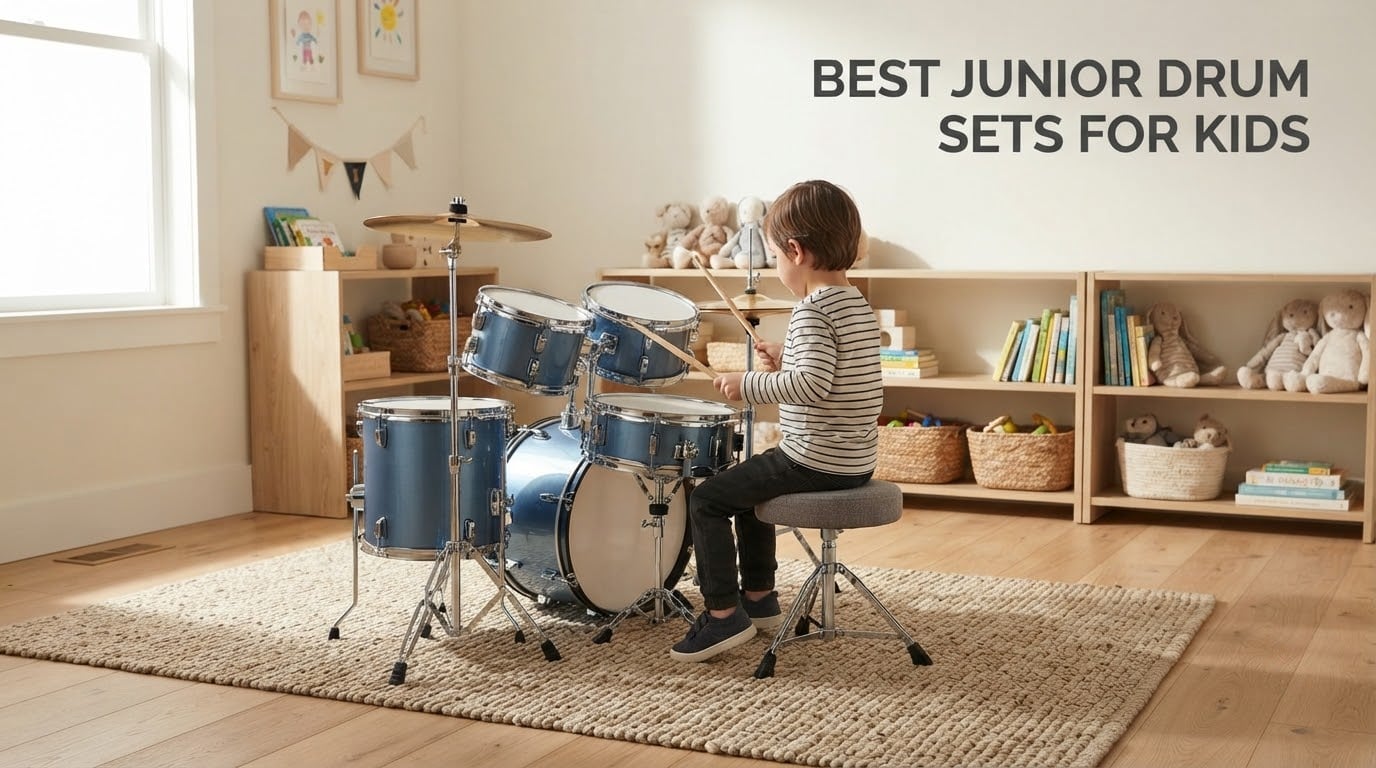
A good starter kit is the one your child can physically sit at without stretching, and that is the whole reason the best junior drum sets for kids are built the way they are. A 16-inch bass drum sounds like an arbitrary number until you watch a 6-year-old try to play a 22-inch one, knees up around their ears, pedal out of reach, shoulders climbing. Shrink the bass drum and everything above it drops into place.
We compared 10 junior drum kits on shell material, actual drum dimensions, what arrives in the carton, hardware quality, and the review volume behind each listing. All 10 are acoustic. That is a deliberate choice, because for a child learning coordination, stick control, and the physical habit of playing with two limbs at once, the acoustic kit teaches the real thing. For noise-sensitive homes we cover electronic alternatives separately, including our picks for the [best electronic drum sets](https://modelrec.com/best-electronic-drum-sets/).
If you want the short version: the Mendini by Cecilio 16 Inch 3-Piece is the strongest all-round pick here, combining a 16-inch bass drum with poplar wood shells and more than 7,600 reviews behind it. The Music Alley 3 Piece is the better budget move, and the Ashthorpe 5-Piece with genuine brass cymbals is the one to buy if cymbal sound matters more to you than the sticker price. Our [full kids drum set rankings](https://modelrec.com/best-kids-drum-sets/) cover toddler toys and electronic kits too.
One warning before we start. Box labels lie about age. Plenty of kits marked for ages 3 and up have a 16-inch bass drum that a 3-year-old physically cannot pedal. Judge by bass drum diameter and by the seated reach test later in this guide, not by the age printed on the side of the box.
Table of Contents
Top 3 Best Junior Drum Sets for Kids in 2026
The Ashthorpe 5-Piece is the pick when cymbals matter. It ships with genuine brass hi-hats and a brass crash and ride, and brass is the difference between a kit that sounds like drums and a kit that sounds like a bin of pots. Budget junior kits frequently ship with thin alloy cymbals that dull out within months.
Mendini by Cecilio 16 Inch 3-Piece
- 16 inch bass drum
- Poplar wood shells
- Pedal throne and sticks included

Music Alley 3 Piece Kids Drum Set
- Bass snare and tom
- Tunable drum heads
- Compact bedroom size

Ashthorpe 5-Piece With Brass Cymbals
- 16 inch bass and floor tom
- Genuine brass cymbals
- All chrome hardware
Every kit below is written in the same format, so you can compare them line by line. Each review covers the sound, the fit for a real child, the assembly, and the two or three things reviewers complain about most.
All 10 Junior Drum Sets at a Glance in October
Here is the full field with the specifications that actually differentiate these kits. Bass drum diameter sets the scale of everything else, and the number of pieces tells you whether cymbal stands and a floor tom are included or whether you are buying a rack and a pedal.
| Product | Specifications | Action |
|---|---|---|
| Mendini by Cecilio 16 Inch 3-Piece |
|
Check Latest Price |
| Music Alley 3 Piece Kids Drum Set |
|
Check Latest Price |
 Eastar 14 Inch 3-Piece Junior Kit Eastar 14 Inch 3-Piece Junior Kit |
|
Check Latest Price |
 Best Choice Products 3-Piece Set Best Choice Products 3-Piece Set |
|
Check Latest Price |
| Ashthorpe 5-Piece With Brass Cymbals |
|
Check Latest Price |
 Gammon Percussion 5-Piece Kit Gammon Percussion 5-Piece Kit |
|
Check Latest Price |
 Ashthorpe 3-Piece With 14 Inch Bass Ashthorpe 3-Piece With 14 Inch Bass |
|
Check Latest Price |
 Gammon Percussion 3-Piece Kit Gammon Percussion 3-Piece Kit |
|
Check Latest Price |
 Eastar 16 Inch 5-Piece Junior Kit Eastar 16 Inch 5-Piece Junior Kit |
|
Check Latest Price |
 Donner 5-Piece 14 Inch Junior Kit Donner 5-Piece 14 Inch Junior Kit |
|
Check Latest Price |
Reading that table quickly: the five kits with a floor tom give a child the full five-piece layout they will eventually need, while the three-piece kits are simpler and faster to set up. The 12-inch and 14-inch bass drums suit younger children, and the 16-inch bass drums suit kids from about 6 upward.
How to Size a Junior Drum Set for Your Child
The single most useful number on any junior drum listing is the bass drum diameter, and it is rarely the first thing printed. A 12-inch bass is a toddler and preschool kit. A 14-inch bass fits a child roughly 4 to 7. A 16-inch bass is the standard junior fit for ages 6 to 10. Anything past 16 inches is a full-size kit and belongs to a teen.
Why does the bass drum decide everything? Because the rack toms mount directly above it, and the hi-hat and snare stands bolt to the same hardware. Shrink the bass and the toms descend, the stands come down, and the pedal travels into the range of a shorter leg. That is the entire engineering logic behind every junior kit ever made.
The seated reach test takes about two minutes and prevents most disappointment. Sit your child on the throne, bare feet flat on the floor, and check four things in order:
Both knees sit in front of the bass drum with roughly a hand’s width of clearance, not touching the shell.
The pedal board sits under the right foot with the heel down, without the child stretching forward.
Snare and hi-hat are reachable at elbow height with the arms relaxed, not shrugged up.
The throne height lets the forearms angle slightly downward, which is where a drummer’s arms actually live.
If your child has to lean forward to reach the pedal, the kit is too large no matter what the box says. A slightly small kit produces good posture and immediate enjoyment, while a slightly large one produces a slumped seat and a lost interest within a fortnight.
Height matters more than age. Measure from floor to seated knee and use that against the bass drum size. A tall 6-year-old can handle a 16-inch kit that most of their classmates cannot, and a short 9-year-old may still be best served by 14 inches. Drum throne height is adjustable on every kit in this roundup, so the drums are not a fixed point.
1. Mendini By Cecilio 16 Inch 3-Piece Junior Drum Set
Mendini By Cecilio 16 Inch Drum Set, 3-Piece Junior Drum Set – Metallic Red
16 inch bass drum
Poplar wood shells
28 lb total weight
Pedal throne and sticks in box
Pros
- Real instrument rather than a toy
- Poplar wood shells for a clean tone
- Easy assembly with installation video
- Good build quality for the size
Cons
- Seat top can pop off during play
- Snare stand not secure for everyone
- Instructions unclear on some variants
We kept coming back to this kit because the review base is enormous and the complaints are narrow. More than 7,600 ratings sit behind a 4.5 average, and when a product has that much history, the recurring complaints are real but not disqualifying. The recurring ones here are the throne and the snare stand, both hardware items a parent can deal with.
The 16-inch bass drum is the reason this ranks first. It gives a child aged 6 to 10 a genuinely reachable layout without shrinking the toms into decorative sizes, and the whole set weighs 28 pounds, which is light enough for a child to reposition alone. Shells are horizontally grained poplar, and reviewers consistently describe the sound as clear rather than toy-like.
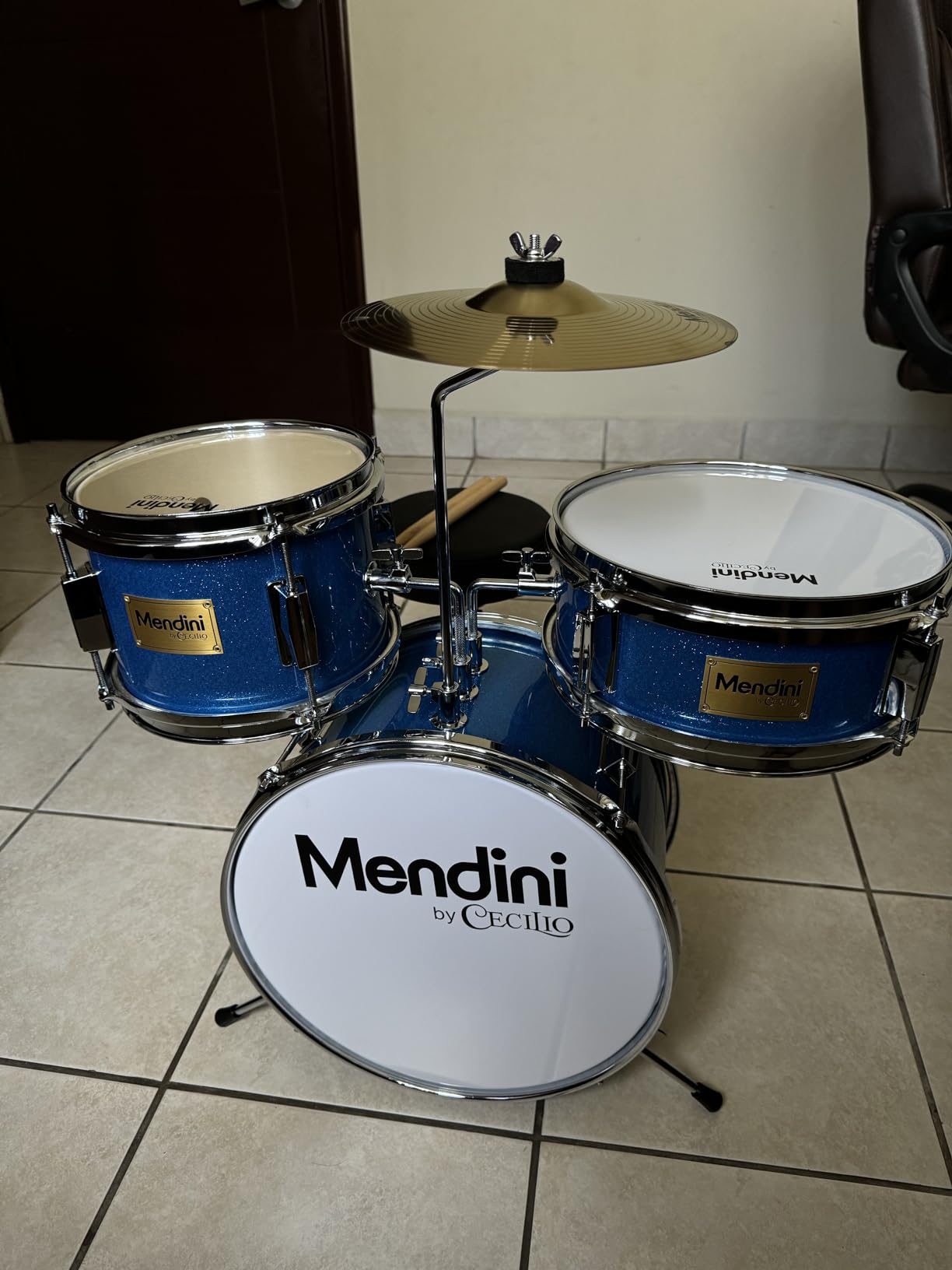
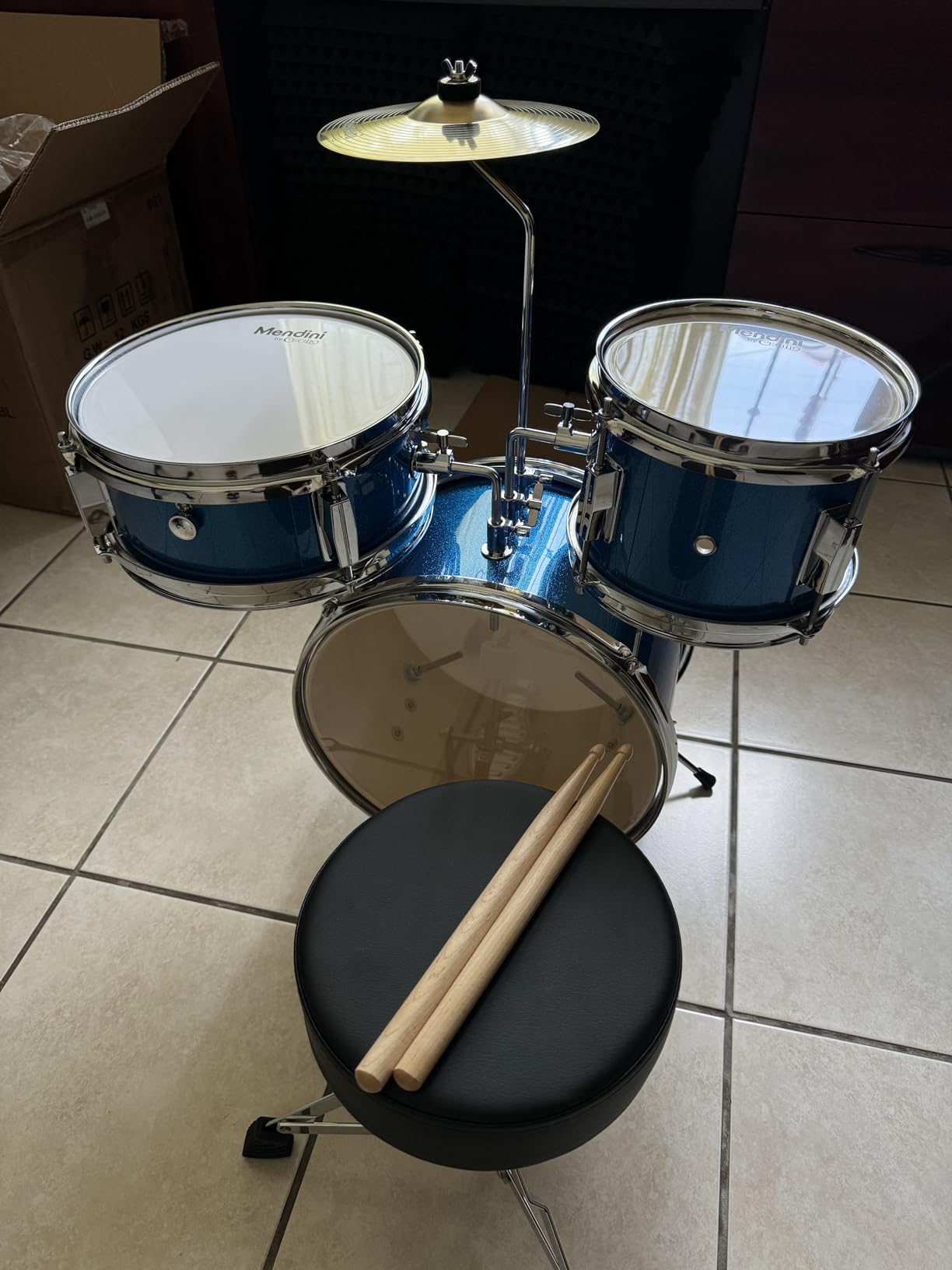
What arrives in the box matters more than the brochure, and here you get a full three-piece set: bass drum, mounted tom, snare, a cymbal, a drum foot pedal, a round padded throne, and a pair of wooden drumsticks. That is a complete playable kit with nothing structurally missing. A drum key is the one thing we would add.
The finish is a metallic red, and the rack is a triangular fixation structure with anti-slip rubber feet, which is a better stability design than the flat-base setups on some cheaper kits. The feet matter more than they sound. A bass drum that walks forward every time your child kicks it will end up against a wall within a week.
What to check before assembly day
Check the throne first, because that is where most of the friction shows up. The seat is a removable round pad on a bolt, and a child leaning back hard during a groove can pop the top off. A dab of thread locker or a gentle reminder to sit forward solves it in ten seconds.
Check the tom mount as you build. A small number of buyers report the mounted tom not holding tension once tightened, which usually means a lug was cross-threaded. If the head looks slack, back the tension rod off completely and re-thread it rather than forcing it.
Where this kit falls short
There is no floor tom and no hi-hat here, so a child who quickly wants a fuller kit will outgrow the layout within a year or two. The snare stand is also a basic fixed-height design, which means the snare sits lower than a taller child will eventually want it.
Assembly relies partly on an installation video rather than printed instructions, and some variants have unclear documentation. Budget twenty minutes and a phone, and the process is genuinely easy. For a first real drum set, this remains our pick because nothing else in the field pairs this rating with this much review history.
2. Music Alley 3 Piece Kids Drum Set
Music Alley 3 Piece Kids Drum Set with Throne, Cymbal & Sticks, Blue
Tunable drum heads
Acacia wood and metal
25.6 in footprint
16.1 lb weight
Pros
- Tunable heads make it a real instrument
- Compact footprint suits a bedroom
- Throne pedal and sticks all included
- Real wood and metal construction
Cons
- Smaller than expected for older children
- Hardware needs occasional tightening
- Cymbal quality is basic
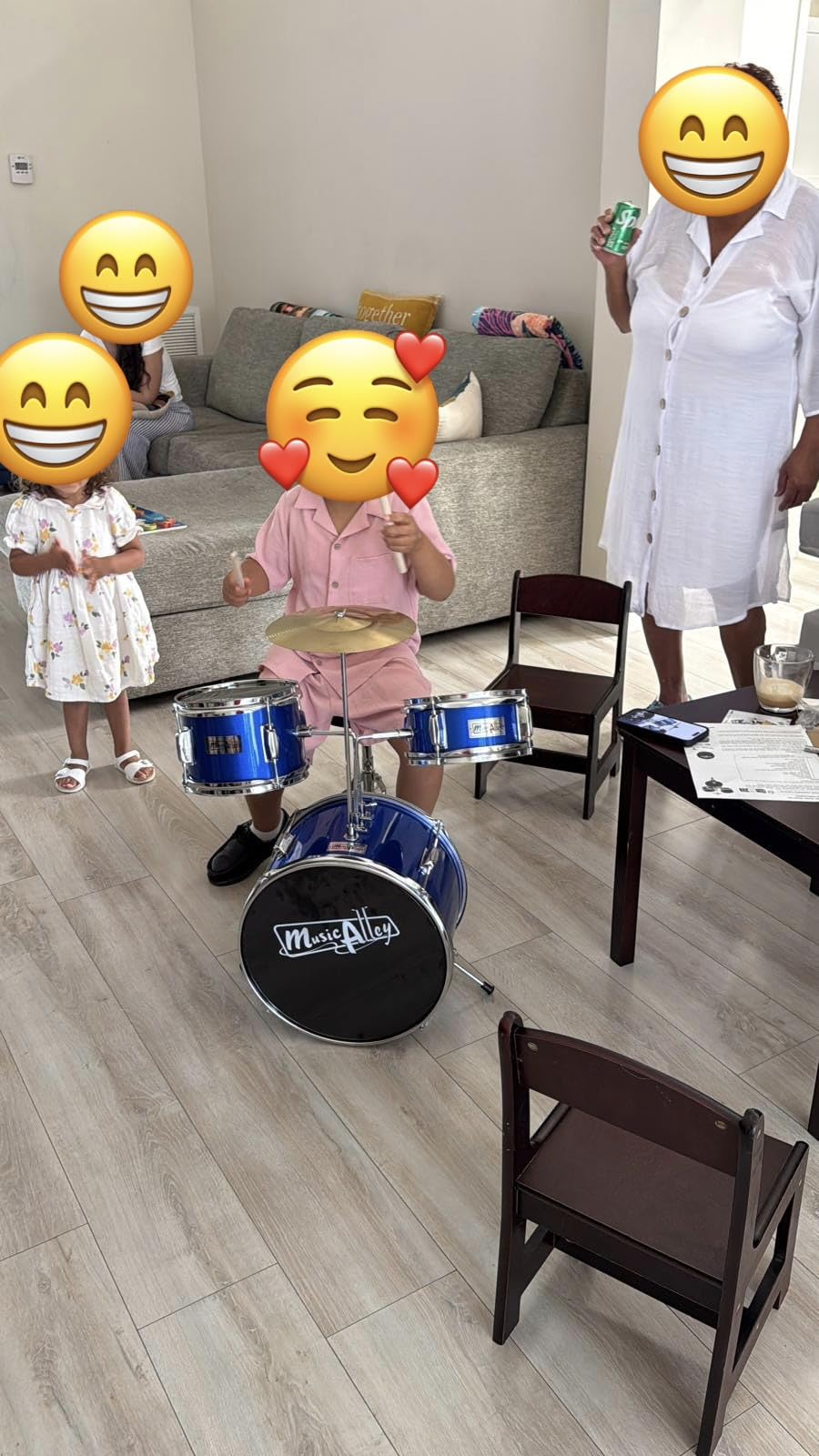
This is the kit we recommend when a parent tells us the drum set is a birthday present and the room is small. At 25.6 inches on its widest dimension and 16.1 pounds, it takes up less floor than any other kit here and can be carried by an older sibling. The review base is large at 5,884 ratings, sitting at the same 4.5 average as our Editor’s Choice.
The detail that separates it from a toy is the tunable drum heads. Real instruments, the head on each shell can be tensioned and pitched, which is what lets a child develop the ear for how a snare should sound versus a floor tom. Reviewers who compare it to full-size kits tend to be pleasantly surprised by the tone.
Acacia wood, metal, and wood construction gives it a genuinely instrument-like look rather than a moulded plastic one, and it comes with the bass drum, snare, tom, a cymbal, bass pedal, throne, and sticks. In other words, the entire beginner shopping list is in the box. Colour options include metallic blue, red, and black.
It carries a 2-year manufacturer warranty, which is longer than the 90-day and 60-day windows attached to several kits in this roundup. That is a meaningful difference if a hoop cracks six weeks in.
Why the compact size is the feature
Noise and floor space are the two complaints that kill junior drum sets in real homes. This kit addresses floor space directly. A child can set it up in a corner, play for twenty minutes, and have it folded back against the wall before anyone objects. A kit that gets put away is a kit that gets played.
For volume, the honest answer is that a 3-piece kit with one cymbal is already among the quieter options in this roundup. Fewer metal surfaces means less reflective sound. If walls are still thin, practice pads and a lower-volume cymbal are the next step rather than a bigger kit.
Where this kit falls short
Size is the honest limitation. Children who read the age range generously tend to find it small within a year, and reviewers report exactly that. Buy it for a 4 to 7-year-old and you will have bought it right.
The included cymbal is thin and basic. It will not sound like the brass cymbals in our Ashthorpe 5-Piece, and it is the first thing we would replace. Hardware also benefits from a quick check with a drum key after the first few sessions, because a lightweight kit needs a tightening more often than a heavy one.
3. Eastar 14 Inch 3-Piece Junior Drum Kit
Eastar Drum Set 14 inch for Beginners,3 Piece Junior Drum Kit with Bass Tom Snare Drum,Adjustable Throne, Cymbal, Pedal & Two Pairs of Drumsticks, Metallic Purple
14 x 10 inch bass drum
8 x 6 inch tom
10 x 5 inch snare
10 inch cymbal
Pros
- Ships with two pairs of drumsticks
- Poplar hardwood shells with 6 lugs
- Transparent heads give good vibration
- Polished finish looks sharp
Cons
- Bass pedal does not stay put
- Drums can shift while playing
- Best suited to very young children
This is one of the few kits in the roundup that ships with both a pair of children’s sticks and a pair of adult 7A sticks, and that detail solves a problem most parents hit around the second birthday. The child grows out of the kid sticks, the adult sticks are already in the box, and nobody has to go back to a music shop.
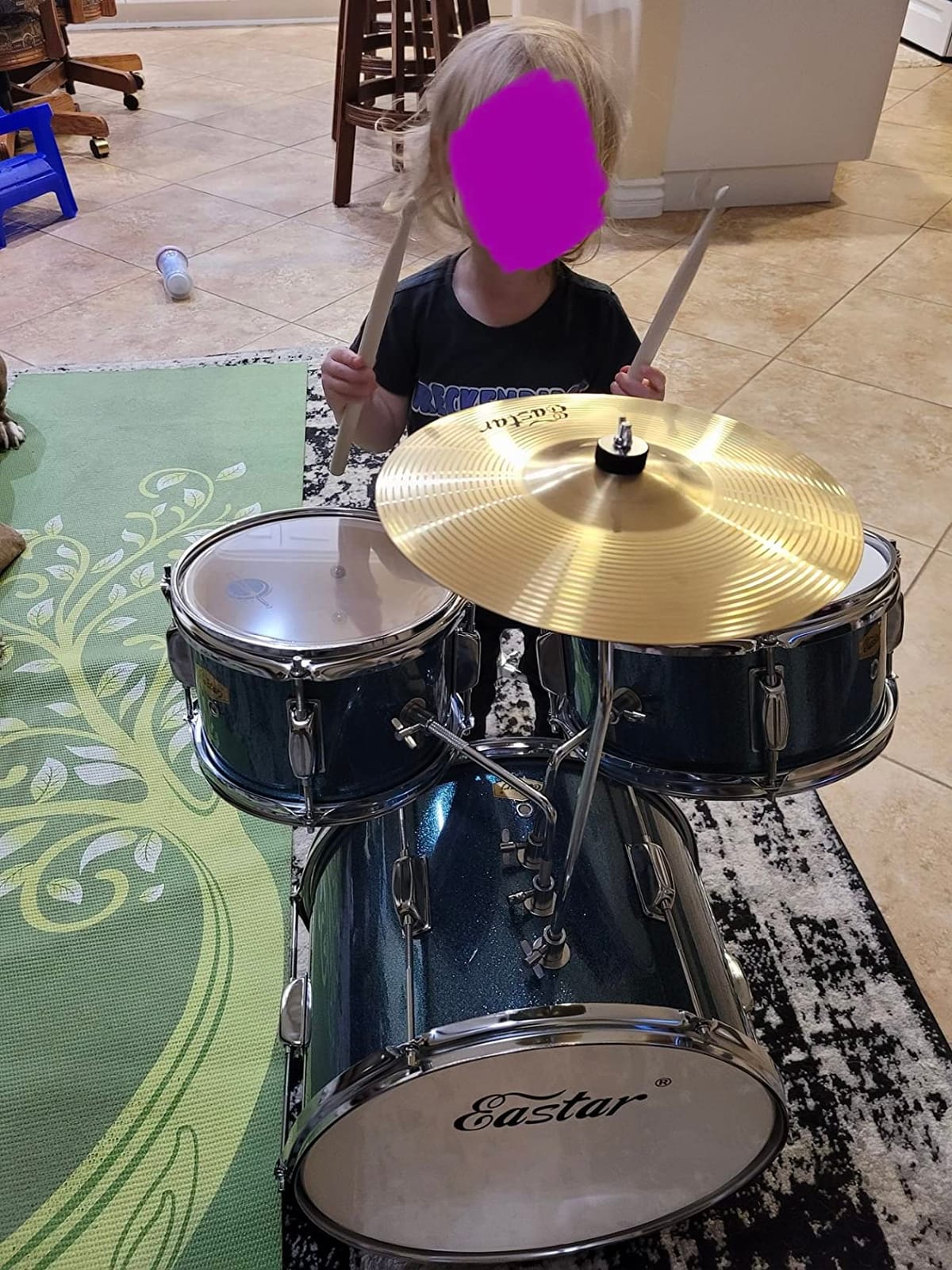
Spec-wise it is a proper instrument listing: a 14 by 10 inch bass drum, an 8 by 6 inch mounted tom, a 10 by 5 inch mounted snare with an internal adjustable sound belt, and a 10 inch cymbal on its own arm. Shells are poplar hardwood with a 6-lug structure, and the heads are transparent so you can see the tension rods and the vibration when the kit is struck.
Finish options include purple, blue, black, and red, and the polished metallic coating is one of the nicer-looking shells in the budget tier. The plated rings, lugs, and pedal give it a more finished appearance than the painted hardware on cheaper sets, and assembly is reported as straightforward.
At 10 kilograms, this is a kit a young child can shift around a room themselves. That matters more than it sounds. A kit a child cannot move is a kit that gets played in one spot until that spot becomes a problem.
What a 14-inch bass gets you
A 14-inch bass is the sweet spot for ages 4 to 7. The pedal sits close enough that a small leg can work the beater, and the rack tom lands at a height where a short forearm reaches it without the child standing up. If your child can touch their knees together in front of the shell, the fit is right.
The 6-lug shell design is worth a note. More lugs means tension is spread more evenly around the head, so the drum sounds rounder and holds pitch better after a knock. Three-lug budget shells flex unevenly, and that is one of those sounds a child notices before an adult does.
Where this kit falls short
Stability is the recurring theme in the reviews. The pedal does not stay put once the child starts moving their foot, and the drums can creep during play even after everything has been tightened. Put it on a rug and check the pedal position each time your child sits down.
Size is the other limit. A 14-inch bass suits younger children, and reviewers specifically flag this kit as best for ages 4 and under. A 7-year-old will outgrow it in months rather than years. If you suspect a fast start, look at a 16-inch bass instead.
4. Best Choice Products 3-Piece Beginner Drum Set
Best Choice Products 3-Piece Beginner Drum Set for Kids Juniors, w/Throne Stool, Cymbal, Drum Sticks, Bass Drum Pedal, 2 Toms – Blue
22 x 15 x 29 inch assembled
All-wood drum shells
22 lb weight
22 inch length footprint
Pros
- Rare two-tom layout at this tier
- All-wood shells give a warm tone
- High-gloss finish wipes clean
- Single drum key included
Cons
- Only a 60 day warranty
- Return shipping at customer expense
- Basic cymbal
- Instructions could be clearer
The most unusual thing about this kit is that it ships with two toms instead of one. Almost every other 3-piece kit in this roundup gives you a bass drum, a snare, and one mounted tom. Two toms gives a young drummer a two-drum pattern to aim at, which is exactly the coordination milestone that matters at this age.
Shell material is all wood with blackened metal fastenings and a high-gloss finish, and it is tuned with a single drum key included in the package. The assembled dimensions are 22 inches long by 29 inches high, and at 22 pounds it is sturdy without being immovable.
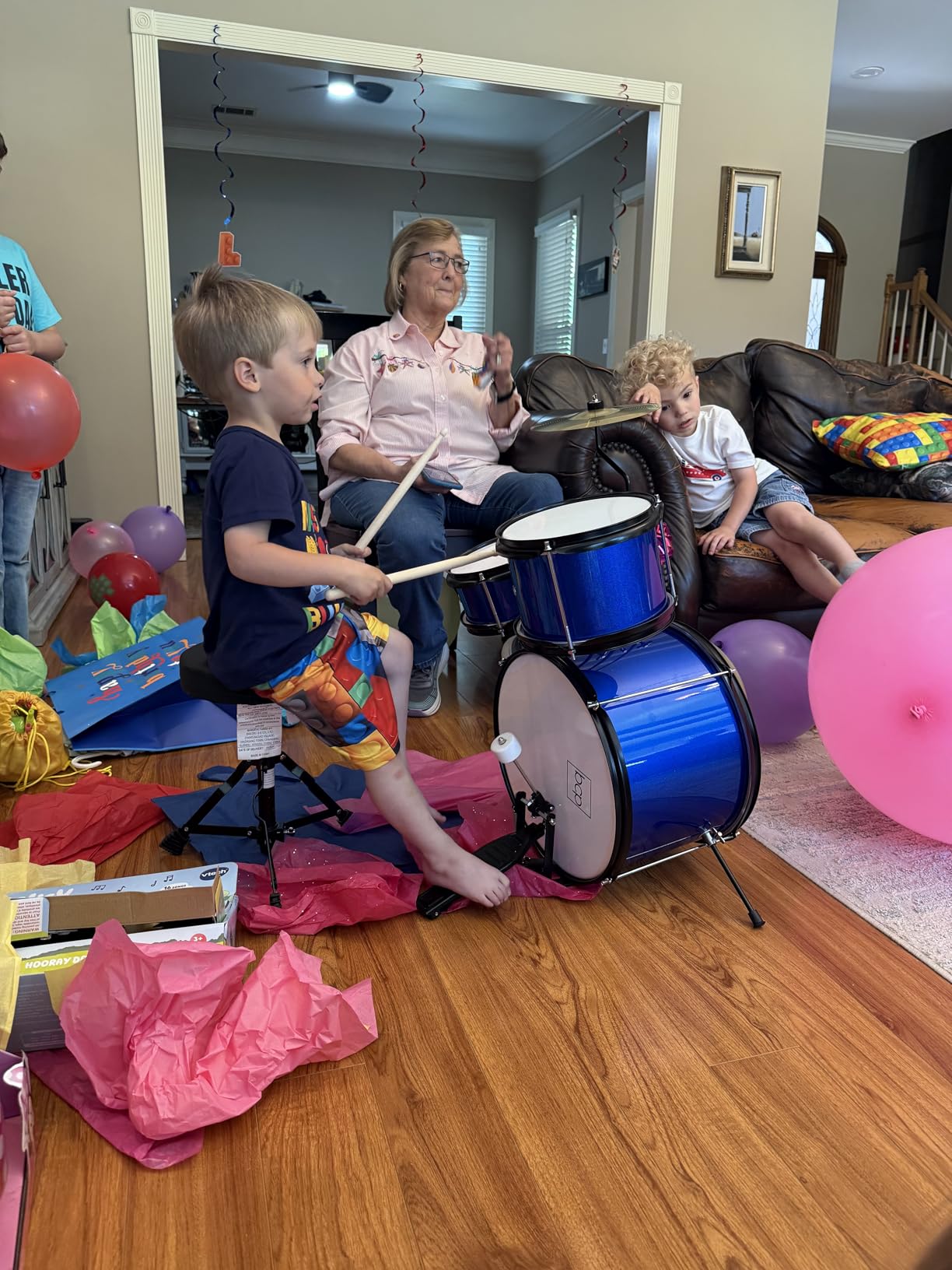
The box contains 2 toms, 1 bass drum, a cymbal, drum sticks, a pedal, and a cushioned stool. That is everything a first kit needs, and the cushioned stool is a genuine step up from the bare wooden stools on cheaper sets. Multiple sparkle finishes are available, which matters when the recipient is seven.
Its position in the category rankings is strong, and the review base of 1,930 ratings at 4.4 tells you the volume of feedback here is solid rather than anecdotal. Families report the wood tone as noticeably warmer than the metal-shelled sets in the same bracket.
Why two toms matter for a beginner
Rhythm reading usually arrives as a two-drum pattern before it becomes anything complicated. A snare on beat one and a tom on beat three is the first groove most children recognise, and it only exists on this kit if two toms are in front of them. Practising a two-drum pattern on a snare alone is like practising scales on one key.
The high-gloss finish is also practical. Fingerprints, stick marks, and scuffs wipe off a gloss surface, whereas a matte painted shell shows every mark. For a kit that will be handled daily by a child, that is a small detail that adds up.
Where this kit falls short
The warranty is the real drawback: 60 days, with returns shipped at the customer’s expense. The seller will issue a prepaid label if the fault is theirs, but a defect discovered in month three leaves you paying to ship a drum set. Every other kit here carries 90 days or a full year, and some carry two years.
The cymbal is basic and the assembly instructions could be clearer. Budget thirty minutes for assembly, and check the pedal bolt before the first sitting. If your child needs a kit that will be handed on to a younger sibling, buy the one with the longer warranty.
5. Ashthorpe 5-Piece Complete Kit With Brass Cymbals
Ashthorpe 5-Piece Complete Kids Drum Set with Genuine Brass Cymbals – Junior Beginner Kit with 16″ Bass, Throne, Hi-Hats, Pedals & Drumsticks – Green
16 x 11 inch bass drum
8 inch brass hi-hats
10 inch brass crash ride
Poplar shells triple flanged
Pros
- Genuine brass cymbals included
- Full 5-piece layout with floor tom
- Poplar hardwood shells with triple flanged hoops
- All chrome hardware throughout
Cons
- Snare stand lacks angle adjustment
- Small for a 10-year-old
- Cymbals can arrive dented
- Bass pedal may not function
Cymbals are where budget junior kits normally fail, and this is the one that solves it. You get 8-inch genuine brass hi-hats and a 10-inch brass crash and ride, not the thin alloy discs that turn a kit into a box of pots and pans. If a child is going to fall in love with cymbal playing, this is the kit that makes that happen in year one instead of year three.
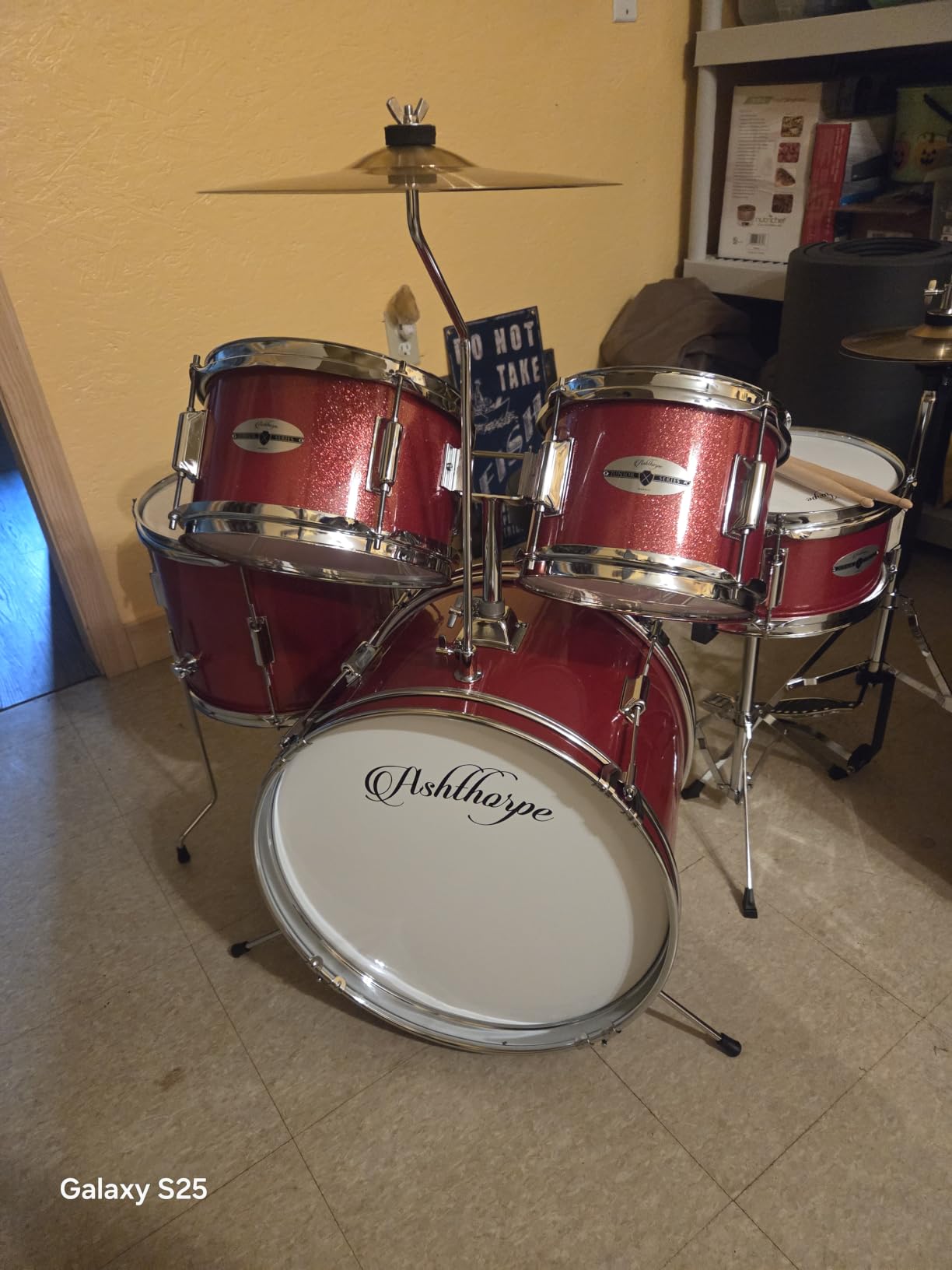
The shell configuration is a genuine 5-piece junior layout: a 16 by 11 inch bass drum, a 12 by 10 inch floor tom, 10 by 6 inch and 8 by 6 inch mounted toms, and a 10 by 5 inch snare. Two mounted toms plus a floor tom is the arrangement a drummer eventually plays on a full-size kit, so the technique transfers cleanly.
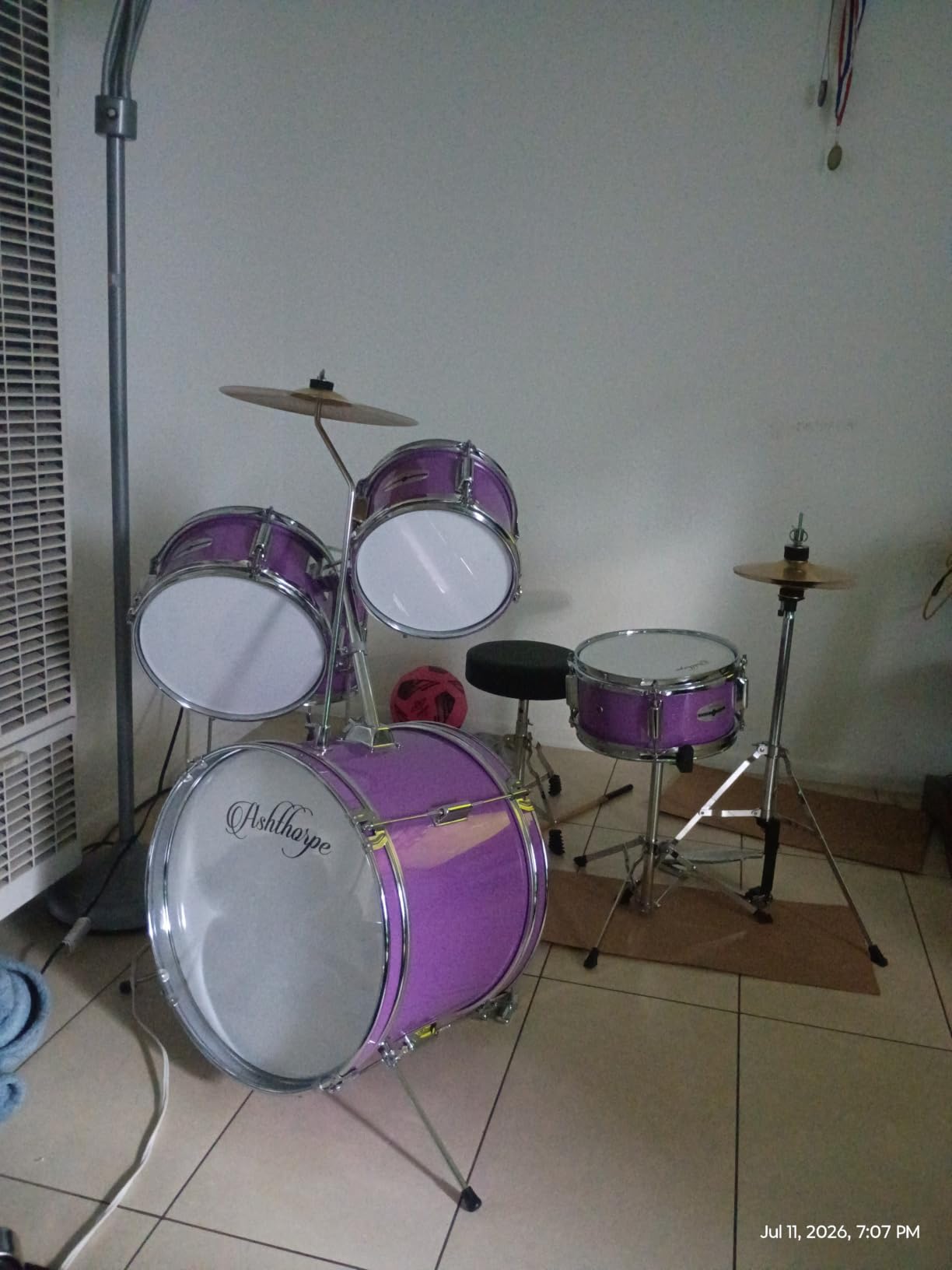
Everything else is specified properly too. Shells are poplar hardwood with triple flanged hoops, hardware is all chrome, and the box includes stands, a padded throne, drumsticks, hardware, pedals, and a drum key. Seven colour options run from green and pink through to silver and black, so you are not stuck with a fixed finish.
At 44 pounds, this is the heaviest kit in the roundup, and that weight is a feature. A kit that does not move when kicked is a kit a child can play hard on without an adult chasing it around the room.
What brass cymbals actually change
Brass cymbals are heavier and slower to decay than alloy, which means they ring instead of click. A hi-hat made of thin alloy goes papery in about six months and dulls with handling. Brass holds its shape, takes a beat harder, and produces the warmer wash that makes a child want to keep hitting it.
It also changes how you plan the next two years. With alloy cymbals, a cymbal replacement is a certainty. With brass, you are far more likely to buy a stand, a better pedal, or a second throne. Reviewers of this kit specifically single out the cymbals as the reason the kit sounds like a real instrument.
Where this kit falls short
Quality control is inconsistent. Reports mention cymbals arriving dented and a bass pedal that sometimes does not function, which are both problems you should check within the warranty window rather than after it. Check the pedal first, tap the cymbal edges, and deal with anything wrong immediately.
There is also a safety note worth taking seriously: a sharp edge on the throne seat has been reported. Feel the seat with a fingertip before handing it to a child. And despite the 16-inch bass, reviewers flag it as running small for a 10-year-old, so plan on moving up around age 9 rather than 12.
6. Gammon Percussion 5-Piece Kids Drum Set
Gammon Percussion 5-Piece Kids Drum Set, Complete Junior Drum Kit with Cymbals, Hardware, Sticks, & Throne – Black
16 inch bass drum
Chain driven bass pedal
44 lb weight
Solid wood shells high gloss
Pros
- Highest rated kit in this roundup
- Chain driven pedal teaches real kick technique
- Snare stand and hi-hat stand both included
- Clear instructions and easy assembly
Cons
- Cymbals are somewhat flimsy
- Hi-hats can bend easily
- Only offered in black
- 90 day warranty
This carries the highest average rating of the 10 kits we looked at, at 4.6, and the reason is the pedal. It ships with chain-driven bass drums pedals, and chain drive is the mechanism real drum kits use. A child who learns on a chain drive pedal learns the return motion, the beater arc, and the foot control that later transfers to any larger kit without relearning.
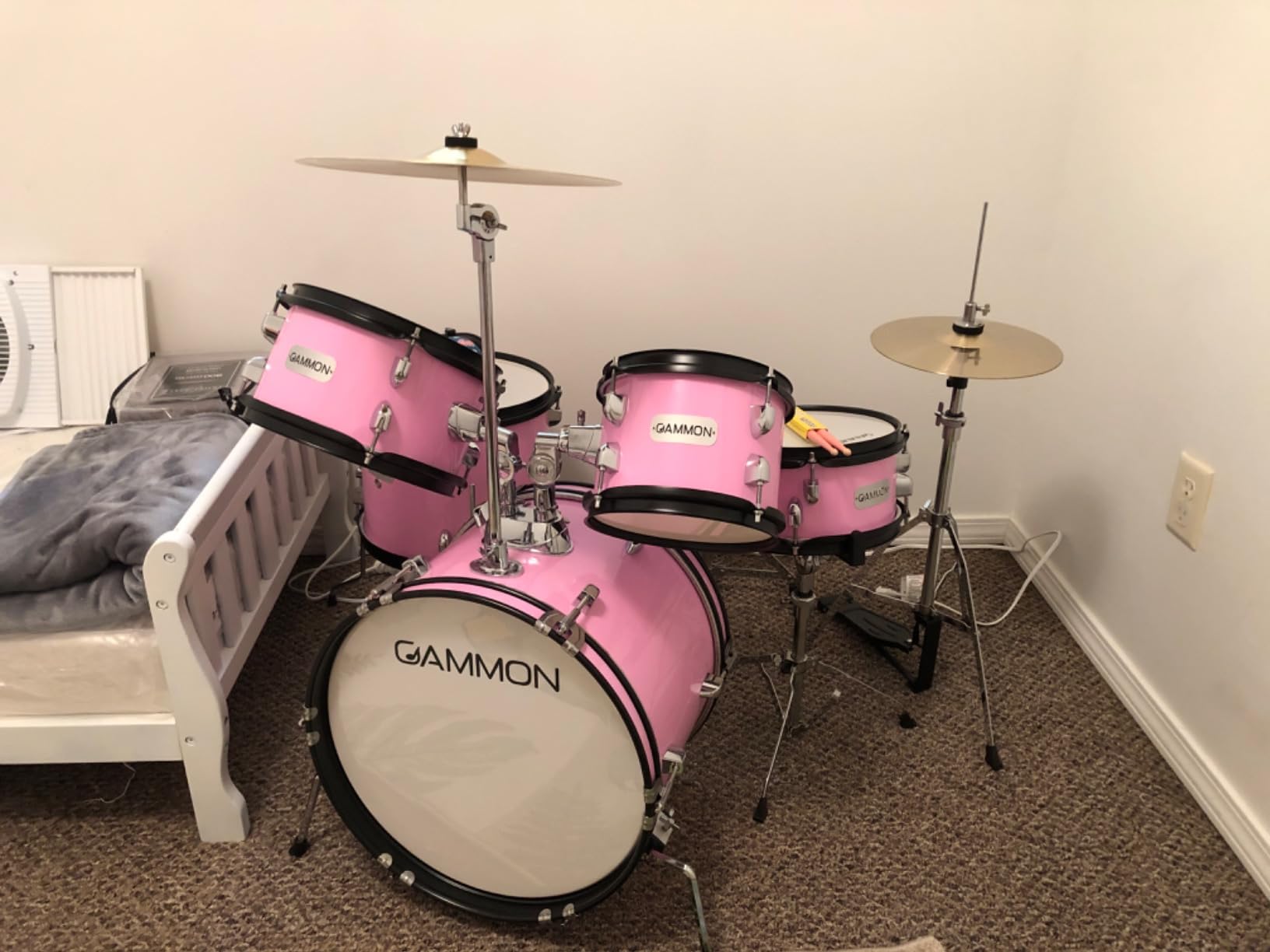
It is also the most complete box in the roundup. You get a 16-inch bass drum, snare, floor tom, two mounted toms, hi-hat cymbals with a stand, a crash cymbal, a drum pedal, a drummer’s throne, a pair of drumsticks, all hardware, a drum key, and readable instructions. The snare stand and hi-hat stand both being included is the detail most competing kits leave out.
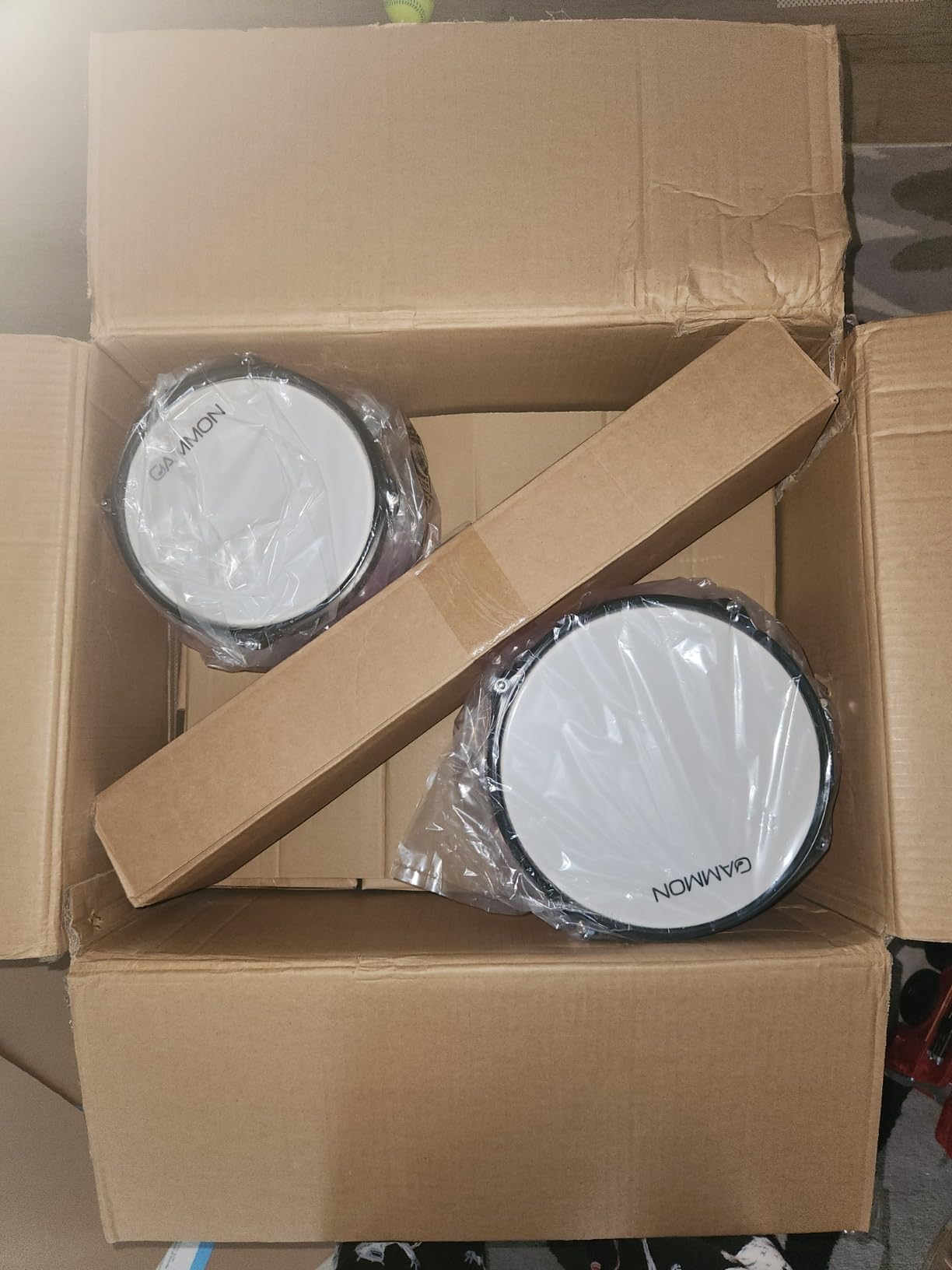
Shells are solid wood with a high gloss finish, premium batter heads, black rims, and chrome details. At 44 pounds it is heavy in the same way the Ashthorpe 5-Piece is heavy, and for the same reason: it stays where you put it. The darker visual treatment also reads as more grown-up than the bright metallics on the budget kits, which matters if the child is 9 rather than 5.
Reviewers with a background in drumming tend to be the most enthusiastic about this one, and durability comes up repeatedly. Kits like this are described as lasting years, which changes the maths if you have more than one child coming through.
Why the pedal matters more than the cymbals
Foot technique is the hardest part of drumming to teach and the easiest to ruin. A stiff, unresponsive pedal teaches a child that the kick drum is something to avoid, and that habit is difficult to undo. Chain drive is smooth, consistent, and forgiving of an imperfect kick foot, which is exactly what a beginner needs.
That reasoning generalises. Even if the cymbals on this kit are the weakest part, the pedal means a child who plays on for two years arrives at their next kit already able to use the bass drum. The cymbals you can replace in an afternoon; foot timing you cannot.
Where this kit falls short
The cymbals are the obvious weak point. Hi-hats in particular are described as somewhat flimsy and prone to bending, so treat them carefully and expect a hi-hat replacement at some point in the first two years.
Availability is narrow. This kit is only offered in black, which matters if your child has a strong colour preference. The warranty is 90 days, so inspect the pedal, the cymbals, and the throne on day one rather than settling that in month four.
7. Ashthorpe 3-Piece Junior Kit With 14 Inch Bass
Ashthorpe 3-Piece Complete Kids Drum Set – Junior Beginner Kit with 14″ Bass, Adjustable Throne, Cymbal, Pedal & Drumsticks – Black
14 x 9 inch bass drum
10 x 5 inch tom
8 x 5 inch snare
8 inch stainless crash
Pros
- Compact 15 inch footprint for tight rooms
- Poplar hardwood shells with triple flanged hoops
- Snare has an adjustable tension knob
- Includes throne sticks and a drum key
Cons
- Stool is not very sturdy
- Foot pedal does not attach well
- Assembly instructions confuse some buyers
- 90 day warranty
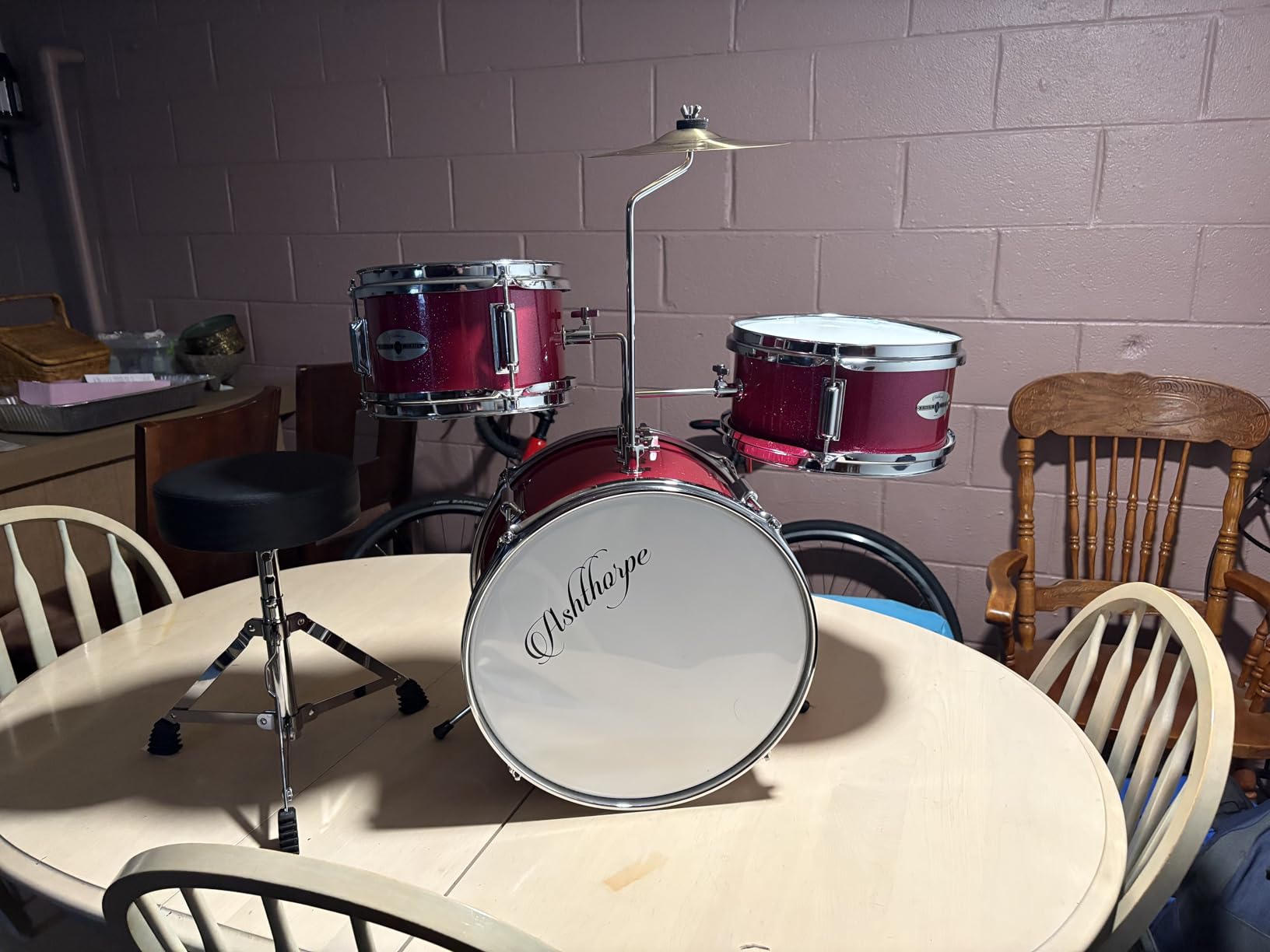
This is the smallest complete kit in the roundup at 15 by 15 by 14 inches, and for a child playing in a bedroom or a flat with thin walls, that footprint is the deciding factor. At 20 pounds it is also light enough for a child to set up and put away without asking an adult for help, which is the difference between a kit that gets used daily and one that does not.
The drum sizes are a 14 by 9 inch bass drum, a 10 by 5 inch mounted tom, and an 8 by 5 inch mounted snare, plus an 8-inch stainless steel crash cymbal. Shells are poplar hardwood with triple flanged hoops and the hardware and accents are all chrome, which is more metal work than most kits at this level include.
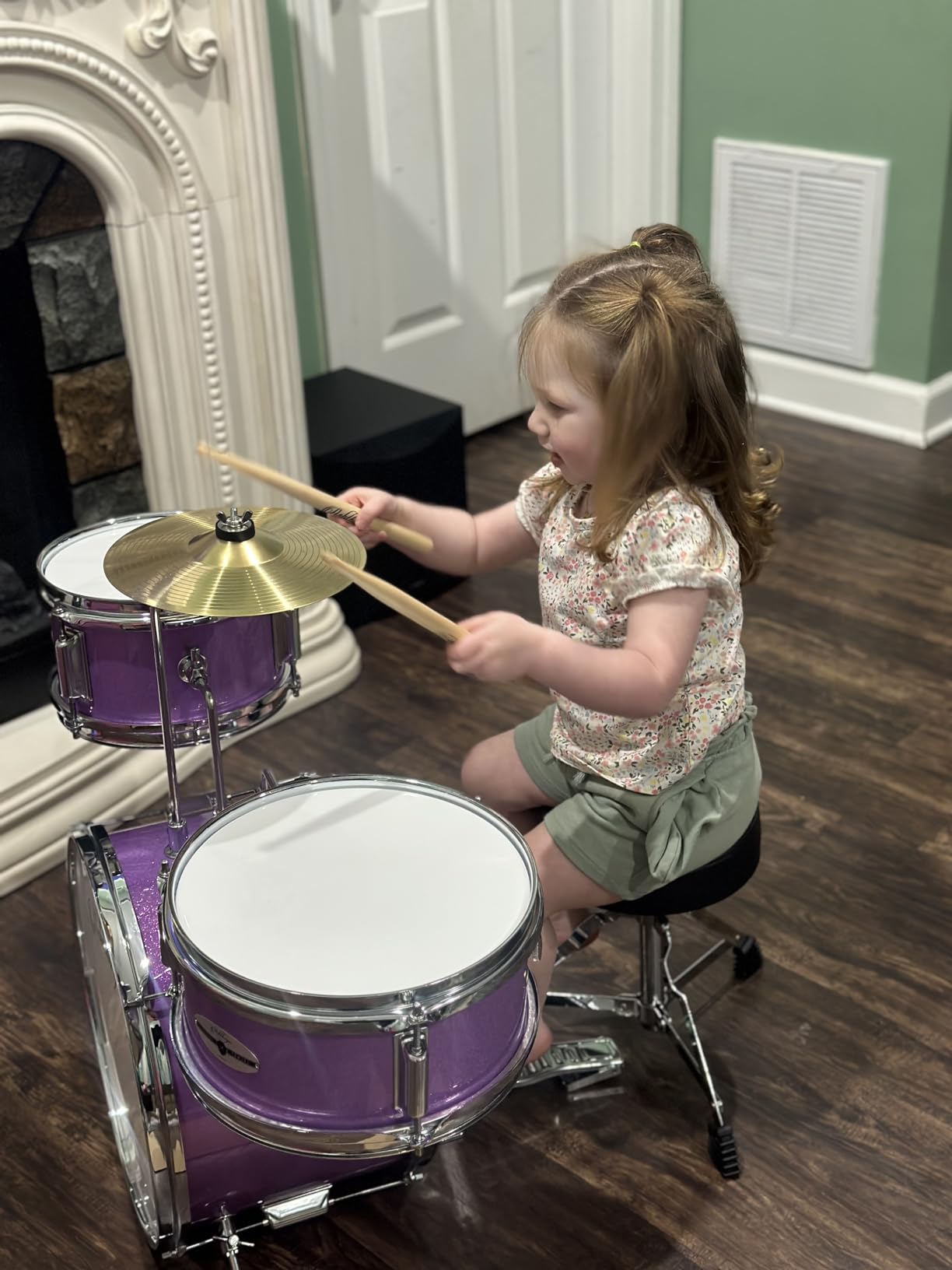
The snare has internal wires and an adjustable tension knob, so the drummer can change the snare’s brightness, which is a real musical tool rather than decoration. The box includes a padded throne, drumsticks, hardware, pedals, and a drum key. Seven colour options cover black, green, pink, silver, red, blue, and purple.
Compared with the 3-piece Ashthorpe 5-piece sibling, this trades a floor tom and hi-hats for pure simplicity. Fewer pieces means less assembly time and fewer stands to wobble, and for a first instrument that is usually the right trade.
When a smaller kit is the better buy
Small is the right answer more often than drum buyers expect. If your child is under 7, a 14-inch bass with a 20-pound total weight is a kit they can own rather than a kit they need help with. Independence is what keeps a beginner playing past the first month.
The room argument is just as real. A 15-inch footprint fits beside a bed or in a corner of a living room, and a kit that can be moved out of sight when practice time ends avoids the daily negotiation that turns a parent’s music room into a grievance.
Where this kit falls short
The stool is the weak point and it is the piece a child uses constantly. Buyers report it is not very sturdy, and a wobbly throne teaches a slumped posture that lingers. If the throne rattles, add a non-slip mat underneath rather than tightening it further.
The foot pedal also attaches poorly on this model, so spend extra time on that connection during assembly. Budget for a separate bass pedal within a year or two, because a good pedal is the single biggest improvement a family can make to a budget kit.
8. Gammon Percussion 3-Piece Kit With 12 Inch Bass
Gammon 3-Piece Kids Drum Set with Throne – Black, Junior Beginner Kit with Bass Drum, Toms, Cymbal, Pedal, and Drumsticks
12 x 10 inch bass drum
10 x 6 inch snare
8 x 6 inch tom
9.1 kg total weight
Pros
- Genuine wood construction at a toy-level entry
- Solid wood shells with premium batter heads
- Assembles in about 20 minutes
- Eight colour options to choose from
Cons
- Kick pedal is weaker than the rest of the kit
- Cymbal mount sits above the kick drum
- No hi-hat included
- 90 day warranty
At 12 inches, this is the smallest bass drum in the roundup, and that makes it the correct choice for a 2 to 6-year-old rather than a compromise. A 12-inch bass with a pedal lets a genuinely small child work the footboard, which is the skill that separates a toy from an instrument. The total weight of 9.1 kilograms means a preschooler can carry it.
The other two drums are a 10 by 6 inch mounted snare and an 8 by 6 inch mounted tom, plus an 8-inch cymbal on its own arm. Shells are solid wood with black rims and a high-gloss finish, fitted with premium batter heads that give a clean and notably loud sound for the size. Loud is not a downside here, because that is the part children enjoy first.
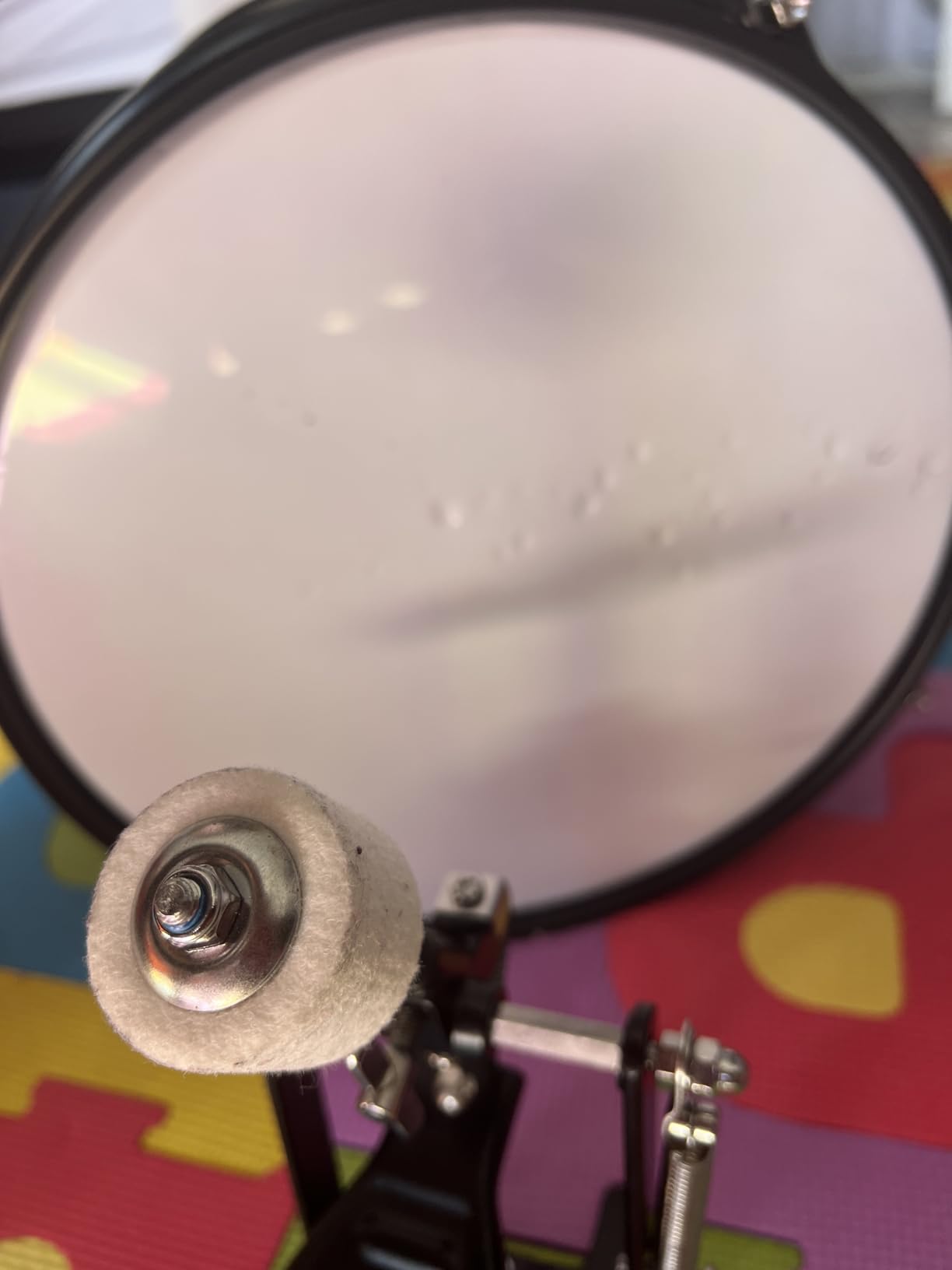
Assembly takes about 20 minutes for most families, and the padded throne and drumsticks are included with the pedal. Eight colour options run from purple and pink through teal, green, silver, black, red, and blue, which is the widest choice in the roundup and genuinely useful when the child is choosing.
Parents of younger children tend to rate this one highly, and the recurring comment is that it sounds like a real drum set rather than a plastic rhythm toy. That matters at this age, because a toy teaches a child that drumming is something you tap on for fun, and an instrument teaches them that it is something you practise.
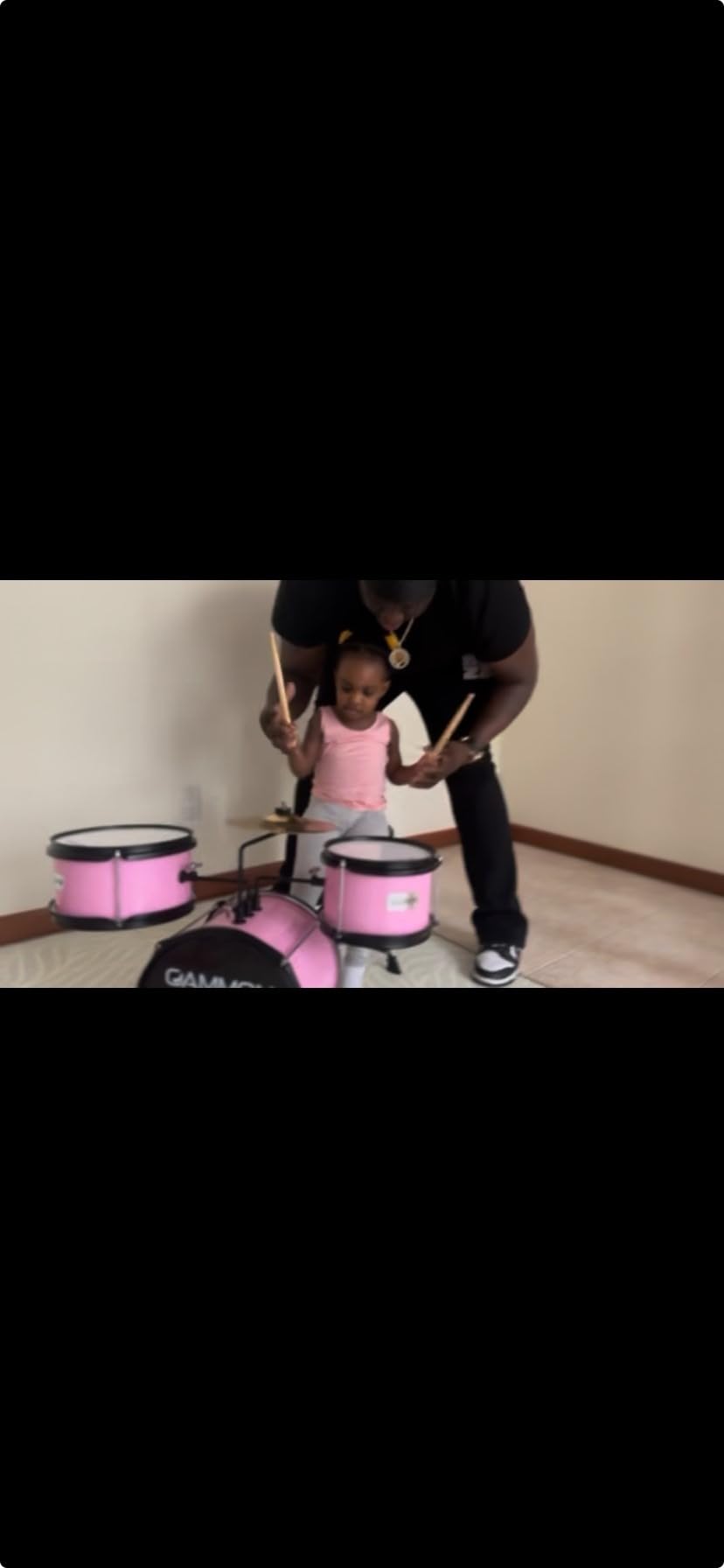
Toy versus instrument, and why it matters at three
Most drum toys for toddlers are plastic, hollow, and tuned to nothing. A child can pound on one for an hour and learn no transferable skill, because the toy physically cannot respond to where or how hard they strike it. A wood shell with a real head responds, and that response is the lesson.
That is why parents of 2 to 6-year-olds rate this kit well. The bass drum is genuinely pedalable at this size, the heads are real heads, and the sound responds to technique. Children who start on something like this tend to move to lessons and to a bigger kit without a difficult transition.
Where this kit falls short
The kick pedal is the compromise in this kit and it is noticeably weaker than the rest of the build. Expect to replace it, and expect that replacement to be the moment the child starts using the bass drum properly. The pedal mechanism is what teaches the foot, and a better one teaches it sooner.
Two layout quirks are worth knowing in advance. The snare sits in a rack position that some buyers find awkward for a small child, and the cymbal arm is perched above the kick drum, which can interfere with a foot. Check both positions with your child seated before they settle in.
9. Eastar 16 Inch 5-Piece Junior Drum Kit
Drum Set Eastar 16 inch 5-Piece, Junior Drum Kit for Beginners Kids Teenagers with Adjustable Throne and Cymbal, Pedal & Drumsticks, Metallic Black (EDS-350MBK)
16 inch 5-piece layout
Cross grained poplar shells
Throne rated 220 lb
6-ear lug structure
Pros
- Throne supports 220 lb so adults can sit on it
- Cross grained poplar shells are strong
- Includes both adult and kids drumsticks
- Adjustable snare strainer for tone control
Cons
- Assembly instructions are poor
- Hi-hat assembly is confusing
- Runs smaller than expected for teens
This kit has one specification that no other kit in the roundup can match: the throne is rated to support 220 pounds. A parent, a teacher, or an older sibling can sit down and demonstrate a rhythm, which is one of the most effective teaching tools a beginner has. Most budget thrones top out far lower, and a parent perched on a collapsed stool is a bad advert for drumming.
The shells are cross-grained poplar, and the cross-grain construction is chosen for strength and volume rather than appearance. The 6-ear lug structure gives more even head tension, black rims and plated stands add a finished look, and the snare has an adjustable strainer so the tone can be changed rather than just the volume.
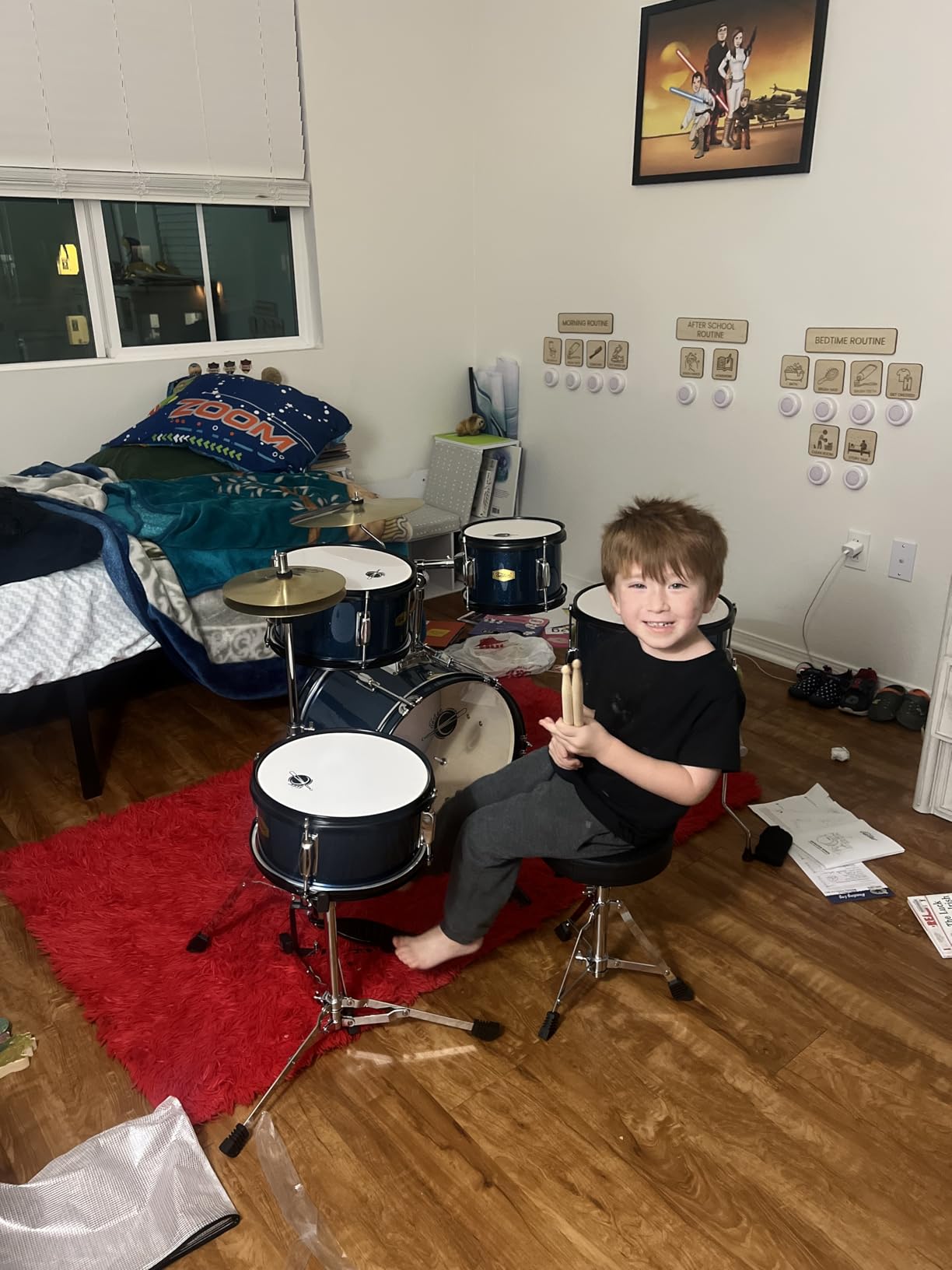
Both adult and children’s drumsticks are included, so the same two-pairs-of-sticks thinking appears here as on the Eastar 14-inch model. It is a 16-inch 5-piece layout, and a 1-year manufacturer warranty is longer than the 90-day window on most kits in this bracket.
The stated audience is ages 6 to teenagers, and the 16-inch bass drum supports that at the younger end. The catch is how small it actually feels once assembled, and that is where the assembly experience matters most.
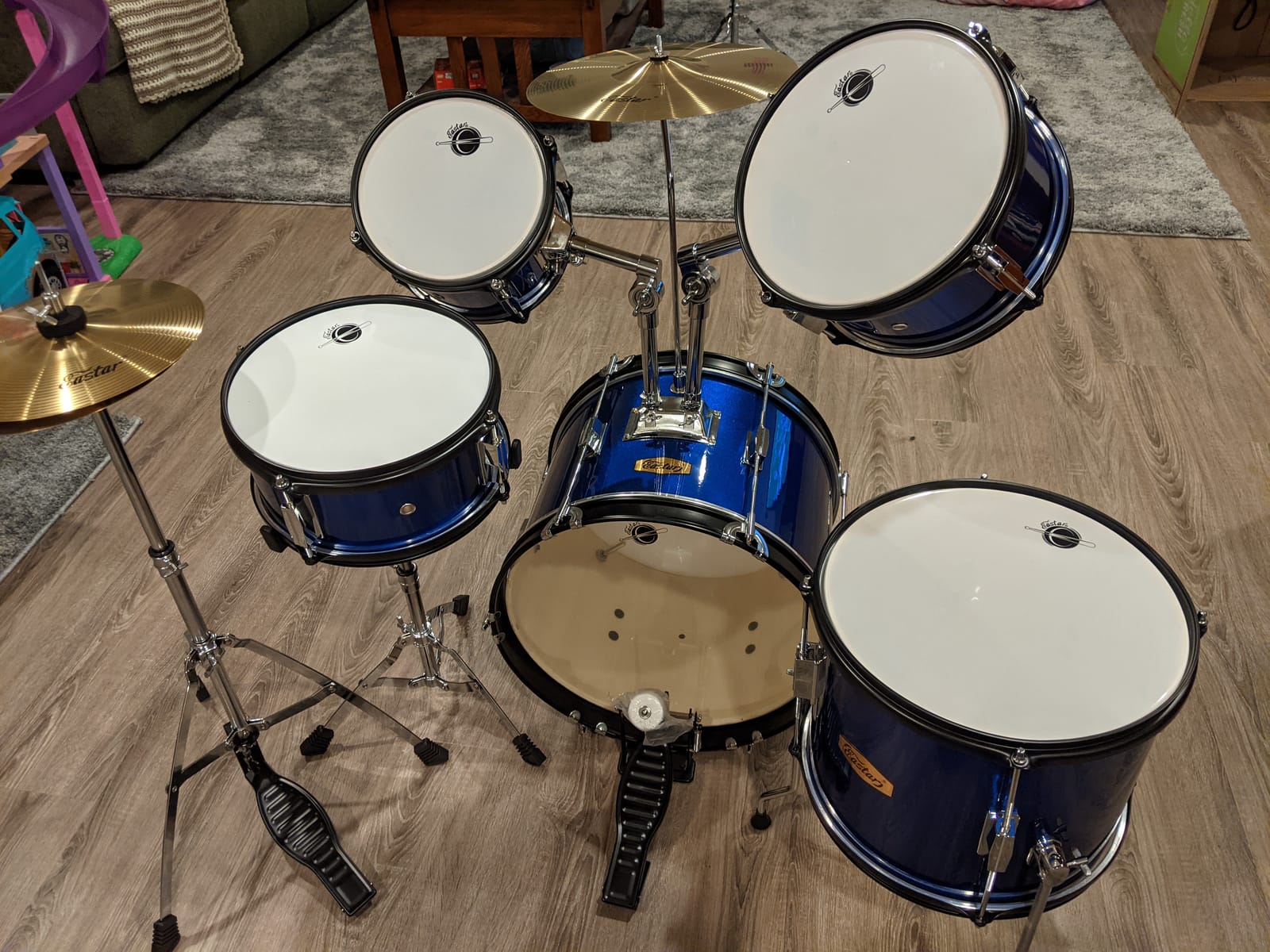
Why a parent can sit on the throne
Teaching a child to drum by talking does not work. Sitting down and playing a pattern while they watch, or steadying their hands on a rhythm, teaches immediately. A throne rated to 220 pounds makes that possible without a second seat, and it also means the throne survives being climbed on, which children do.
Beyond demonstrations, the weight rating predicts longevity. A throne rated for 90 pounds that a 130-pound adult leans on will fail, and a failed throne ends the family practice sessions. This one will not.
Where this kit falls short
Assembly is the biggest problem here, and it is not a small one. Buyers report unclear instructions, confusing hi-hat assembly, and needing video guidance to get it right. Set aside an hour, watch a walkthrough first, and assemble the hardware before the shells.
Size runs smaller than expected. Despite being marketed toward teenagers, reviewers describe it as closer to a 6 to 10-year-old fit, so for an 11 or 12-year-old it is a stepping stone rather than a destination. The sound quality is good for the tier, and it improves noticeably once the kit is properly assembled.
10. Donner 5-Piece 14 Inch Junior Drum Kit
Kids Drum Sets-Donner 5-Piece for Beginners,14 inch Junior Drum Kit, with Adjustable Throne, Cymbal, Hi-Hat, Pedal & Drumstick, Present for Child-Blue
14 x 10 inch bass drum
12 x 8 inch floor tom
8 inch hi-hat with stand
Throne rated 198 lb
Pros
- Ships with a hi-hat and stand plus a floor tom
- Poplar shells with 6-ear structure
- Throne supports 198 lb for parent demos
- Triangular fixation with rubber feet for stability
Cons
- Several parts are fixed rather than adjustable
- Cymbal sizes may run smaller than expected
- Lowest rating in this roundup
What makes this kit unusual is the combination of a hi-hat with a stand and a 12 by 8 inch floor tom in a package at this level. Most 5-piece kits in this roundup give you one of those. Having both means a child can practise a proper hi-hat and hi-hat foot pattern from the start, and the floor tom gives them a low drum to move to as they grow.
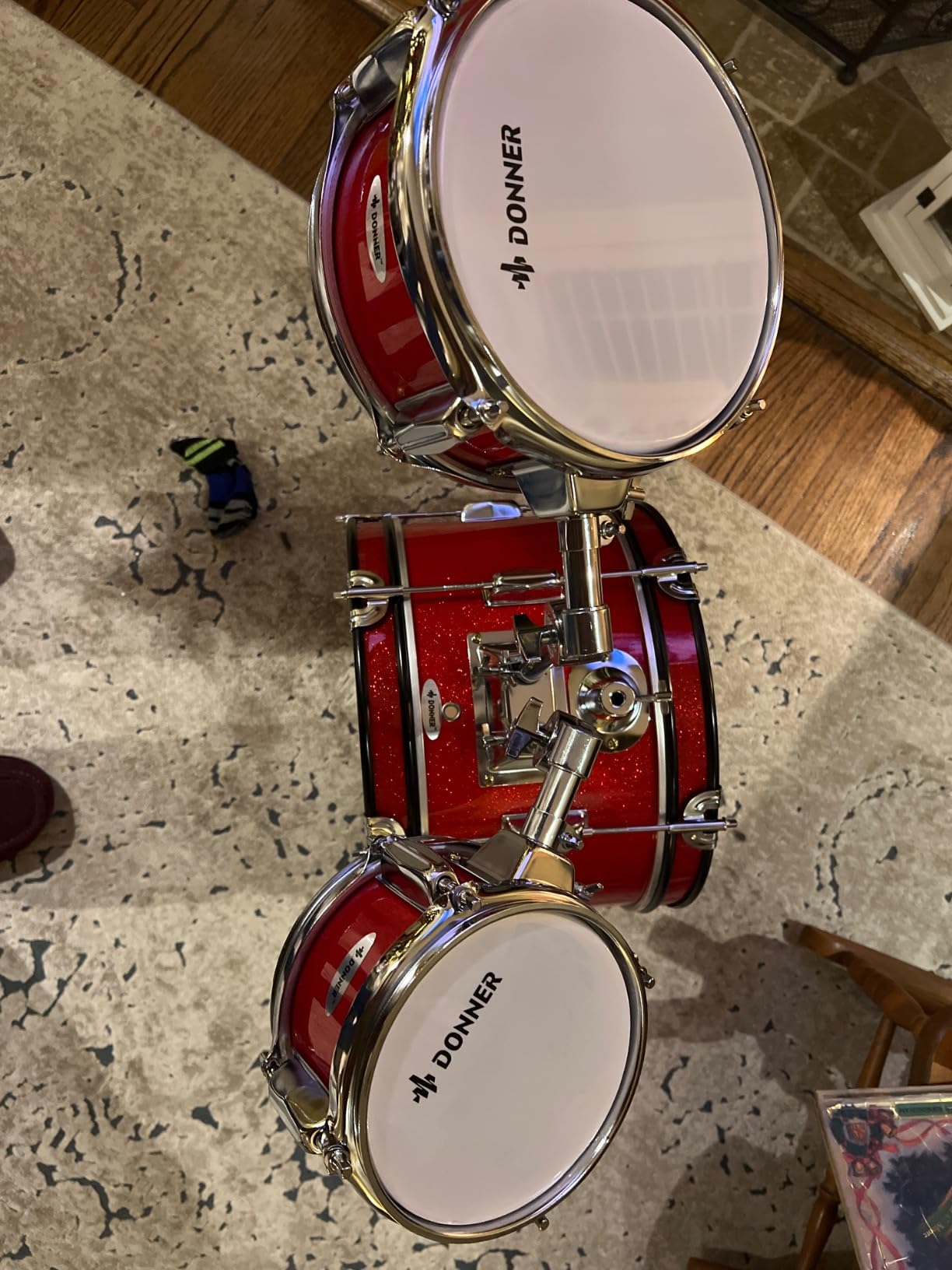
The shell specification is honest: a 14 by 10 inch bass drum, two fixed 6 by 4 inch toms, an 8 by 4 inch fixed snare with stand, a 12 by 8 inch floor tom, an 8-inch hi-hat with stand, and a 1-inch straight cymbal with stand. Shells are horizontal-grained poplar with a 6-ear structure, and there are silver rims with coated brackets.
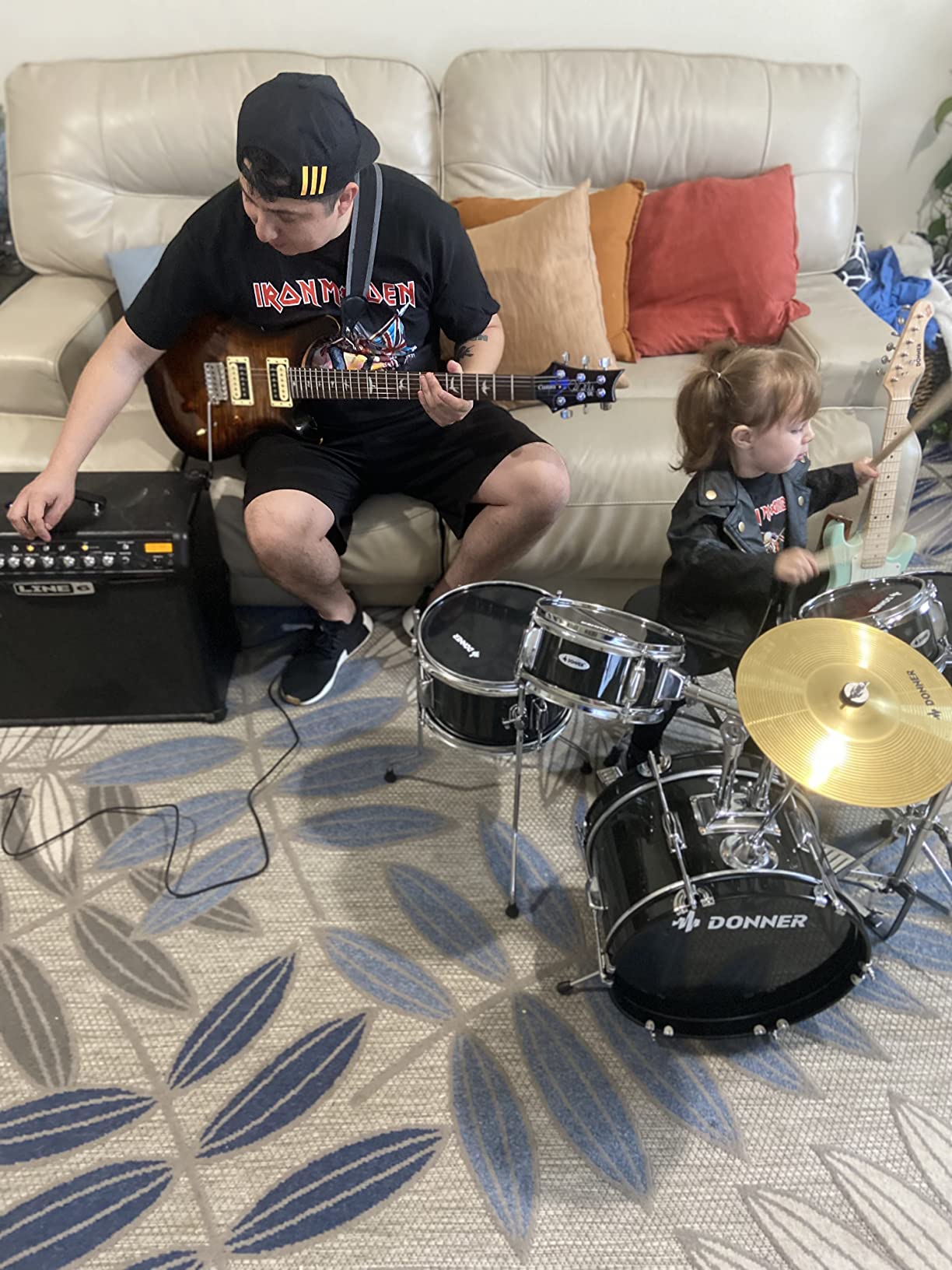
The throne is a double-plate bench rated to 198 pounds, so a parent can sit and demonstrate, and the rack uses a triangular fixation with rubber feet for stability, which is the same design principle as our Editor’s Choice. An installation video is included, adult and small drumsticks both ship in the box, and the bass pedal and adjustable throne are part of the package.
Three finishes are available: metallic blue, black, and red. At 17.49 kilograms, it is a solidly weighted kit that will not slide during a kick-heavy passage.
Reading the fixed-versus-adjusted distinction
Several drums here are described as fixed, which means their height is set at the factory rather than adjustable. For a child who is still growing, adjustable toms are worth a lot because they are the difference between a comfortable reach and a shrug. Fixed toms here are fine for a 5 to 8-year-old and become a problem around 9.
The floor tom and the hi-hat are the parts that will outlast the rest of the kit. Both keep working as your child moves toward a full-size setup, and both teach patterns that carry straight over. If a child sticks with drumming, those two pieces are the most transferable in the box.
Where this kit falls short
This carries the lowest average rating in the roundup at 4.3, and the reviews suggest inconsistency rather than a design flaw. The 414-review base is also the thinnest here, so there is less evidence than we would like behind the long-term claim.
Cymbal sizes can run smaller than buyers expect, and a 1-inch straight cymbal is a narrow piece of metal. Check the cymbal diameters against the photos before you commit. Everything else about this package is competitive, and it remains one of the more complete boxes available at this size.
Acoustic or Electronic: Making the Call for Kids
Every kit in this roundup is acoustic, and for a first instrument that is the right default. An acoustic shell responds to where a stick lands, so a child learns dynamics, articulation, and the difference between a rim shot and a centre hit without being told. That is the technique that makes the jump to any real kit painless.
The case for electronic is volume and constraint. Mesh-headed electronic kits play at a fraction of the noise, which changes what is possible in a flat, a shared house, or a home with a sleeping sibling. The mesh options at the top of the range feel close enough to acoustic heads that technique transfer is not compromised. Our [acoustic drum set picks for kids](https://modelrec.com/best-acoustic-drum-sets-for-kids/) go deeper on shells and cymbal choices if noise is not your constraint.
Mesh versus rubber versus silicone is the decision that trips people up. Mesh uses a woven steel surface stretched over a frame, and it feels closest to a real head while staying quiet. Rubber pads are quieter still but feel spongy and teach nothing about stick control. Silicone pads sit between the two and are the least transferable option.
Our view is that noise, not capability, should drive the decision. If a child can play an acoustic kit at a civil hour, buy acoustic. If the neighbours are a problem, buy mesh-headed electronic rather than cheap rubber-pad electronic. If you are still weighing it, our [general electronic drum set guide](https://modelrec.com/best-electronic-drum-sets/) covers the formats, and the [budget electronic roundup](https://modelrec.com/best-electronic-drum-sets-under-1000-dollars/) covers the entry tier.
Buying Guide: 7 Things to Check Before You Buy
1. Measure the bass drum against your child, not the age on the box. A 12-inch bass suits ages 2 to 6, a 14-inch suits roughly 4 to 7, and a 16-inch suits 6 to 10. Age labels on junior kits are marketing shorthand and are frequently optimistic by two full years.
2. Run the seated reach test. Feet flat, knees in front of the bass drum with clearance, pedal under the heel, snare and hi-hat at relaxed elbow height. If any of those fail, the kit is the wrong size no matter how good the specification sheet looks.
3. Count the pieces and know what each one is for. A 3-piece kit is bass, snare, and one mounted tom. A 5-piece adds a floor tom and a second mounted tom. The upgrade from 3 to 5 pieces is the natural next step once a child is playing consistent time, usually around ages 8 to 10. A 5-piece set does not automatically include a hi-hat stand, so check.
4. Verify the cymbal material. Brass cymbals ring and last. Thin alloy cymbals dull out in months and are the most common reason a child loses interest in a kit. Listings that do not state the material are telling you something, and the default assumption should be alloy. Look for a stated diameter too, since cymbals under 8 inches are decoration rather than cymbals.
5. Check the throne, not just the drums. A wobbly throne teaches a bad posture and ends practice sessions early. Look for a padded seat, a wide base, and a stated weight rating. Anything rated under about 200 pounds will be pushed past its limit by an adult sitting down to demonstrate.
6. Think about volume before the first loud hit. A rug under the kit protects a hardwood floor and reduces high-frequency harshness. A thicker cymbal pad, or replacing alloy cymbals with lower-volume brass ones later, does more for volume than shrinking the kit. If walls are thin, an electronic mesh kit is the real answer rather than a quieter acoustic one.
7. Read the warranty, because it predicts the support you get. Warranties here range from 60 days to two years. The 60-day kits also commonly charge return shipping to the customer, which effectively means a kit that fails in month three is yours to ship. Anything at 90 days or a full year is a better bet on a product that will be handled daily by a child.
Two more things worth knowing that almost no listing tells you. First, assembly difficulty varies enormously: some kits go together in twenty minutes, others need an hour and a video walkthrough regardless of experience. Second, the used market is where good value hides, and a used kit from a known brand with intact hardware beats a new kit with a 60-day warranty. Inspect the shells for cracks, spin every stand, test the pedal return, and check the throne height mechanism before you commit.
Finally, plan the upgrade path so nothing feels wasted. A 12-inch or 14-inch kit is a first instrument and will be outgrown in roughly a year or two; treat it as such. The most common and least painful sequence is a 3-piece starter, then a 5-piece kit with a floor tom and hi-hat, then a full-size kit. Reusing the throne and cymbal stands across all three stages is normal, and it means the middle kit is the only real spend in the middle.
Frequently Asked Questions
What is a good beginner drum set for kids?
A good beginner drum set for kids is one where the bass drum diameter matches your child’s leg length. For a 4 to 7-year-old, a 14-inch bass with a bass, snare, and one mounted tom is the standard entry point. Look for real wood shells, a tunable head, an included throne, pedal, and drumsticks, and cymbals at least 8 inches across. The best junior drum sets for kids in this roundup all ship with enough hardware that nothing structural has to be bought separately.
What size drum set should a 10 year old use?
A 10-year-old should use a 16-inch bass drum 5-piece kit. At that age a child can generally reach a 16-inch pedal comfortably, and a 5-piece layout with a floor tom and two mounted toms matches the pattern work they are ready for. If the child is short for their age, a 14-inch kit is still workable and will last longer than the sizing charts suggest.
What age is a junior drum set for?
A junior drum set is designed for children roughly 5 to 10 years old, defined by a 12-inch to 16-inch bass drum rather than by a stated age. Below 5, a smaller 3-piece kit with a 12-inch bass is easier to pedal. Above 10, most children move to a full-size kit with a 22-inch bass drum. Always check reach with the seated test rather than trusting the printed age range.
Do they make quiet drum sets?
There is no fully silent drum set, but volume drops dramatically with the right choice. Mesh-headed electronic kits are the quietest option that still teaches real technique, because the surface responds like a drum head. Among acoustic kits, volume comes from fewer cymbals, smaller cymbals, and a thicker practice pad on the snare. A rug under the kit also cuts the high-frequency harshness that reads as loudness in a shared space.
Is drumming good for an ADHD child?
Drumming is often recommended for children with ADHD because it pairs physical movement with a clear, immediate feedback loop. A steady beat gives an external structure to follow, and the physical act of striking a drum consumes a lot of the restless energy that makes concentration difficult. The element that matters most is repetition, so a set of drums plus a metronome or a slow play-along track works better than drums alone. Feedback varies by child, so keep practice short and let the child lead.
What size drumstick is appropriate for a 10-year-old?
A 10-year-old usually starts comfortably on 5A sticks, which are thinner and lighter than the adult 7A standard and easier on a developing grip. For younger children between 4 and 7, 7A sticks or the shorter kids sticks included with most junior kits are the right starting point. A good test is whether the child can play a steady stroke without the stick rolling out of the hand or the forearm tensing. Many kits ship with two pairs, one child size and one adult size, which covers the whole range.
Final Verdict: The Best Junior Drum Sets for Kids
The Mendini By Cecilio 16 Inch 3-Piece is our overall pick, and the reason is not subtle. It pairs a 16-inch bass drum with poplar wood shells, ships with everything a child needs to play, and carries more than 7,600 reviews at 4.5. That combination of rating and evidence is not available anywhere else in this field, and its two recurring complaints, throne stability and snare stand security, are both solvable in an afternoon.
Buy the Music Alley 3 Piece instead if the room is small or the budget is tight, and buy the Gammon Percussion 3-Piece with the 12-inch bass if your child is genuinely preschool-aged. For a child aged 5 to 8 who is already asking for more, the Ashthorpe 5-Piece with genuine brass cymbals is the strongest long-term choice, because the cymbals sound like cymbals and the floor tom gives the kit a future.
Whatever you choose, do the seated reach test before the drums come out of the box, and inspect the cymbals, pedal, and throne on day one while the warranty is live. Those ten minutes prevent almost every complaint we read about. If you want a wider look than an acoustic roundup, our [complete kids drum set guide](https://modelrec.com/best-kids-drum-sets/) covers toddler toys and electronic kits, and our [full acoustic drum set rankings](https://modelrec.com/best-acoustic-drum-sets/) go deeper on shell materials and hardware for larger players.