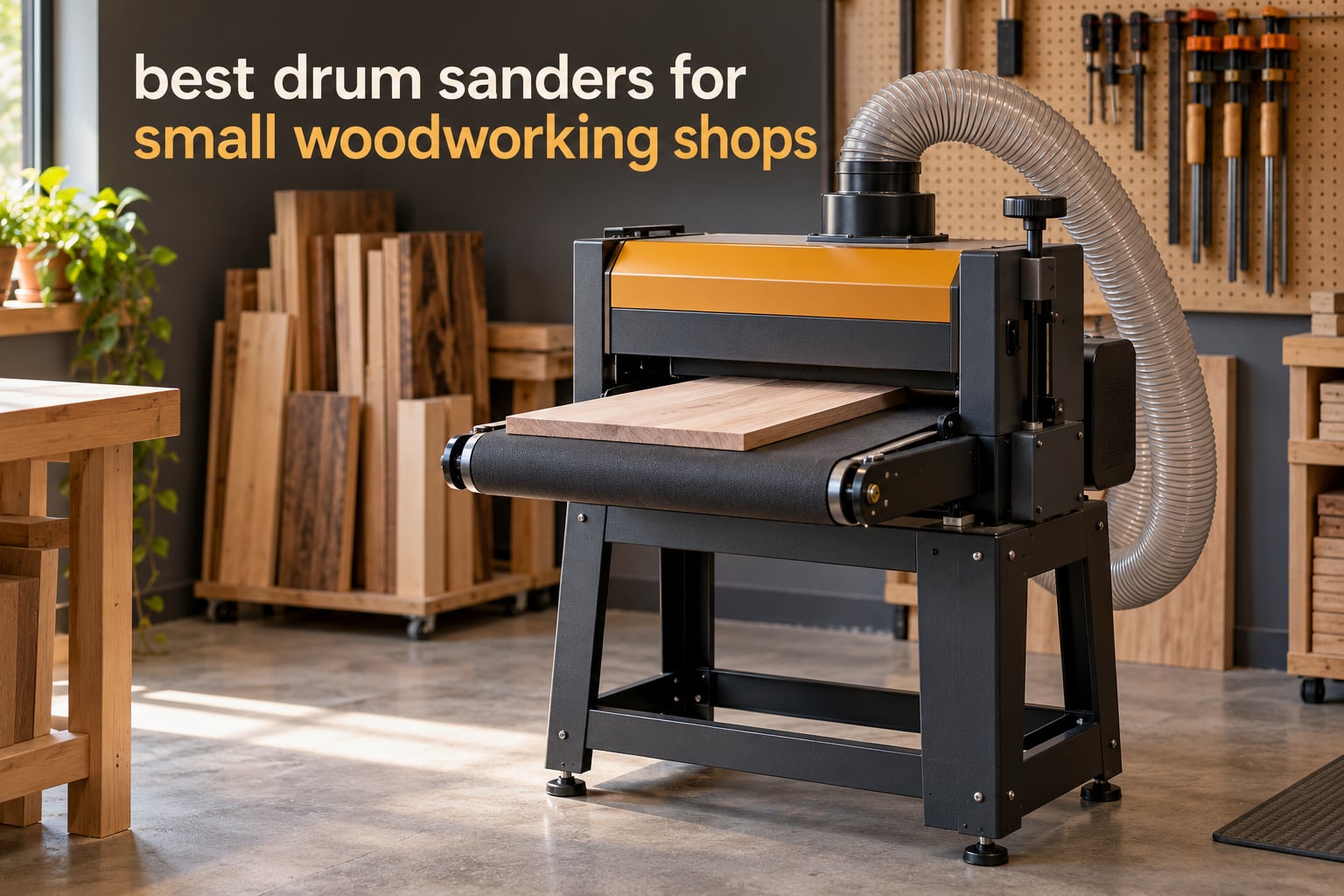
Yes, a drum sander is worth it in a small shop, but only if you are sanding the same thing over and over. If you glue up a panel, a set of cabinet doors, or a stack of cutting board blanks, a drum sander is the only machine in the small-shop price bracket that makes every piece exactly the same thickness in one pass. Here is the honest verdict up front: for most one- and two-person shops the best drum sander for small woodworking shop duty is a 16-inch open-stand machine with automatic feed control, not the biggest one you can fit.
The forums are split on brands but consistent on the shape of the answer. In the drum sander comparison thread on Lumberjocks, owners keep naming SuperMax and JET 1632/1836 models as the machines they would buy again, and the recurring advice is that open-ended sanders are the best way in for an entry-level shop. A FineWoodworking thread makes the case that drum sanders are the only efficient way in a small shop to thickness lots of really thin, delicate parts. If you want the wider picture of every drum sander class, including the big production machines, our roundup of the 10 best drum sanders covers that ground.
What follows is a roundup of six machines that actually fit a small shop, plus the shop-planning details almost every roundup leaves out: how wide your drum needs to be, what circuit it needs, how much dust collection air it takes, and how thin you can safely sand. We spent a lot of time reading owner reports on Lumberjocks, NC Woodworker and Sawmill Creek before picking, because in this niche a review that never names a defect is not worth much.
Table of Contents
Top 3 Best Drum Sanders for Small Woodworking Shops in 2026

JET JWDS-1632 16-Inch Drum Sander
- 1-1/2 HP 115V single phase
- 16 inch one pass or 32 inch in two
- SandSmart auto feed control
- Toolless parallelism dial

JET JWDS-1020 10-Inch Benchtop
- 1 HP 115V benchtop format
- Toolless abrasive change
- Handles thin stock and veneer
- 73 pound machine

JET JWDS-1632OSC Oscillating Drum
- 3/4 inch oscillating drum stroke
- No snipe or low spots
- 1-1/2 HP 115V single phase
- SandSmart auto feed control
The 1632 wins because it does the boring jobs well: load-sensing feed, a toolless parallelism dial, a 4-inch dust port, and an open stand that takes about a 20 by 37 inch footprint. The 1020 wins on footprint and review volume. The oscillating model wins on finish quality, and it has the highest owner rating in the group, though on a much smaller pool of reviews.
Best Drum Sanders for Small Woodworking Shops in October
| Product | Specifications | Action |
|---|---|---|
| JET JWDS-1632 16-Inch Drum Sander |
|
Check Latest Price |
| JET JWDS-1020 10-Inch Benchtop |
|
Check Latest Price |
| JET JWDS-1632OSC Oscillating Drum |
|
Check Latest Price |
 JET JWDS-1836 18-Inch Drum Sander JET JWDS-1836 18-Inch Drum Sander |
|
Check Latest Price |
 VEVOR MS3140 16-Inch Drum Sander VEVOR MS3140 16-Inch Drum Sander |
|
Check Latest Price |
 Powermatic PM2244 22-Inch Drum Sander Powermatic PM2244 22-Inch Drum Sander |
|
Check Latest Price |
1. JET JWDS-1632 16-Inch Drum Sander – SandSmart Auto Feed on an Open Stand
JET 16″ Drum Sander w/Stand, SandSmart Auto Feed Control (JWDS-1632)
1-1/2 HP 115V 1Ph 14A
16 inch one pass, 32 inch in two
156 lb
20 by 37 inch open stand
5 year warranty
Pros
- Load-sensing SandSmart feed holds the fastest rate the cut allows
- Toolless parallelism dial and dual self-aligning belt trackers
- Dust hood rated to capture up to 97 percent with a cyclone unit
- Reverses wide boards for 32 inch of capacity
- Quiet relative to a planer
Cons
- Abrasive changes are cramped inside the drum
- Abrasive strips loosen at the motor side with coarse grit
- Some units ship misaligned and need adjustment before use
The JWDS-1632 is the machine I keep coming back to for a small shop. It is a 1-1/2 HP, 115-volt single phase unit rated at 14 amps, so it needs a 20-amp circuit, and it weighs 156 pounds. SandSmart monitors drum motor load and regulates conveyor speed continuously, up to 10 feet per minute, which means the machine slows itself down on hard species instead of stalling or burning the abrasive.
Out of the box it handles solid wood, veneer and panels up to 16 inches in one pass, or you can flip a wide board and get 32 inches of capacity in two passes. The parallelism adjustment is an external dial that needs no tools, and the dual belt trackers keep the conveyor centred without constant fiddling.
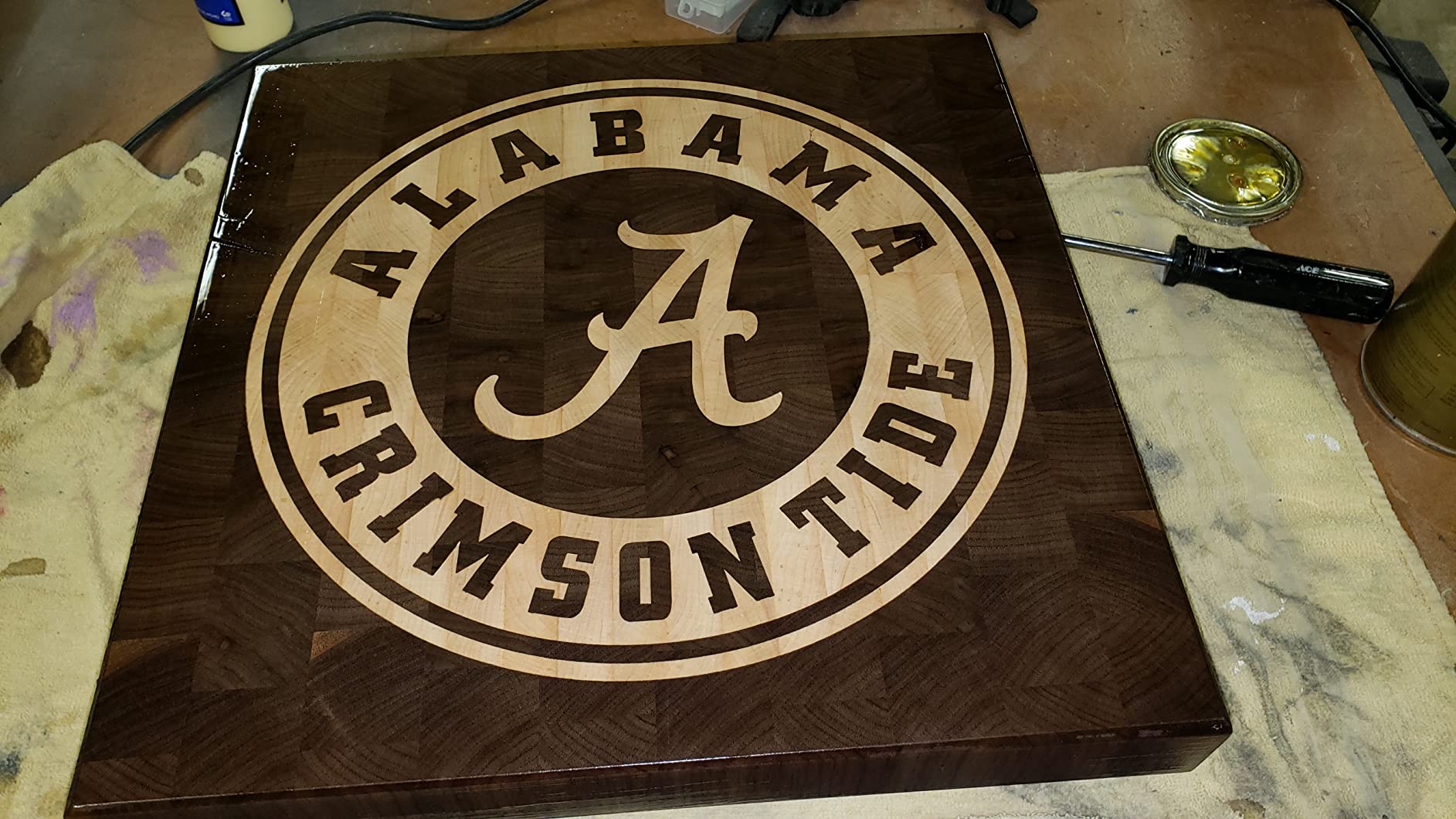
Owners on NC Woodworker and FineWoodworking threads consistently describe this as the machine that replaced their planer for panel work. One JET 1020 owner in the NC Woodworker drum sander thread described the small model as the one that evens out joinery, and the 1632 is the step up from that. The dust hood channel mirrors the drum shape and directs chips to a 4-inch port, and JET rates the combination at up to 97 percent collection with one of their cyclone collectors.
The honest complaint list matters here. Changing the abrasive means working inside a cramped drum area, and plenty of owners use a wood block as a third hand to hold the drum. Strips also tend to loosen at the motor end, particularly with an 80-grit strip. And some machines arrive misaligned end to end, so budget an hour for the parallelism dial before you judge results.
How it handles warped and glued panels
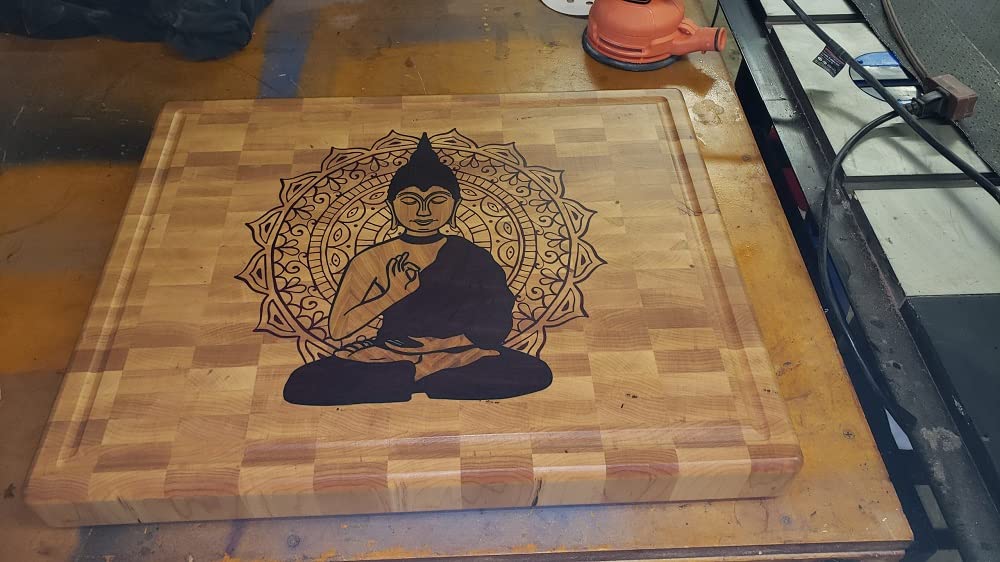
This is where a drum sander earns its floor space. On a glued panel the machine sands the whole surface at one depth, so you get a flat face without the snipe a planer leaves or the tear-out a belt sander tears into figured grain. Expect roughly 1/64 inch or less of removal per pass at a sane feed rate, which is why a thick panel takes several passes rather than one.
The failure mode is twist. NC Woodworker owners report that warped, twisted panels produce wave marks and gouges, because the drum is a cylinder and a twisted board rocks on it. Flatten warped material on a jointer or spindle sander first, then bring it here for final thickness. If you need a machine that handles curved or figured stock better.
Who should skip it
If your shop is 8 by 10 feet with a single 15-amp circuit already committed to a table saw, this machine is a problem. The 20-amp requirement plus the 20 by 37 inch stand footprint plus dust collection is a real floor-space and electrical budget. A benchtop 10-inch model handles the same shop honestly and you can put it away when the job is done.
2. JET JWDS-1020 10-Inch Benchtop Drum Sander – Fits a Flip-Top Cart
JET 10-Inch Benchtop Drum Sander, 1 HP, 115V 1Ph (Model JWDS-1020)
1 HP 115V 1Ph 8A
10 inch benchtop drum
73 lb
26.85 by 17.9 inch footprint
5 year warranty
Pros
- Largest review pool in the group at 267 ratings
- Compact benchtop body that fits on a flip-top cart
- Toolless abrasive take-up fasteners make rewrapping fast
- Handles thin material down to veneer thickness
- Quiet running with decent dust capture
Cons
- Belt tracking adjustment is finicky and slow to dial in
- Clips can be fitted backwards and will not grip the strip
- Heavy for a benchtop unit
- Only one 80 grit wrap is included
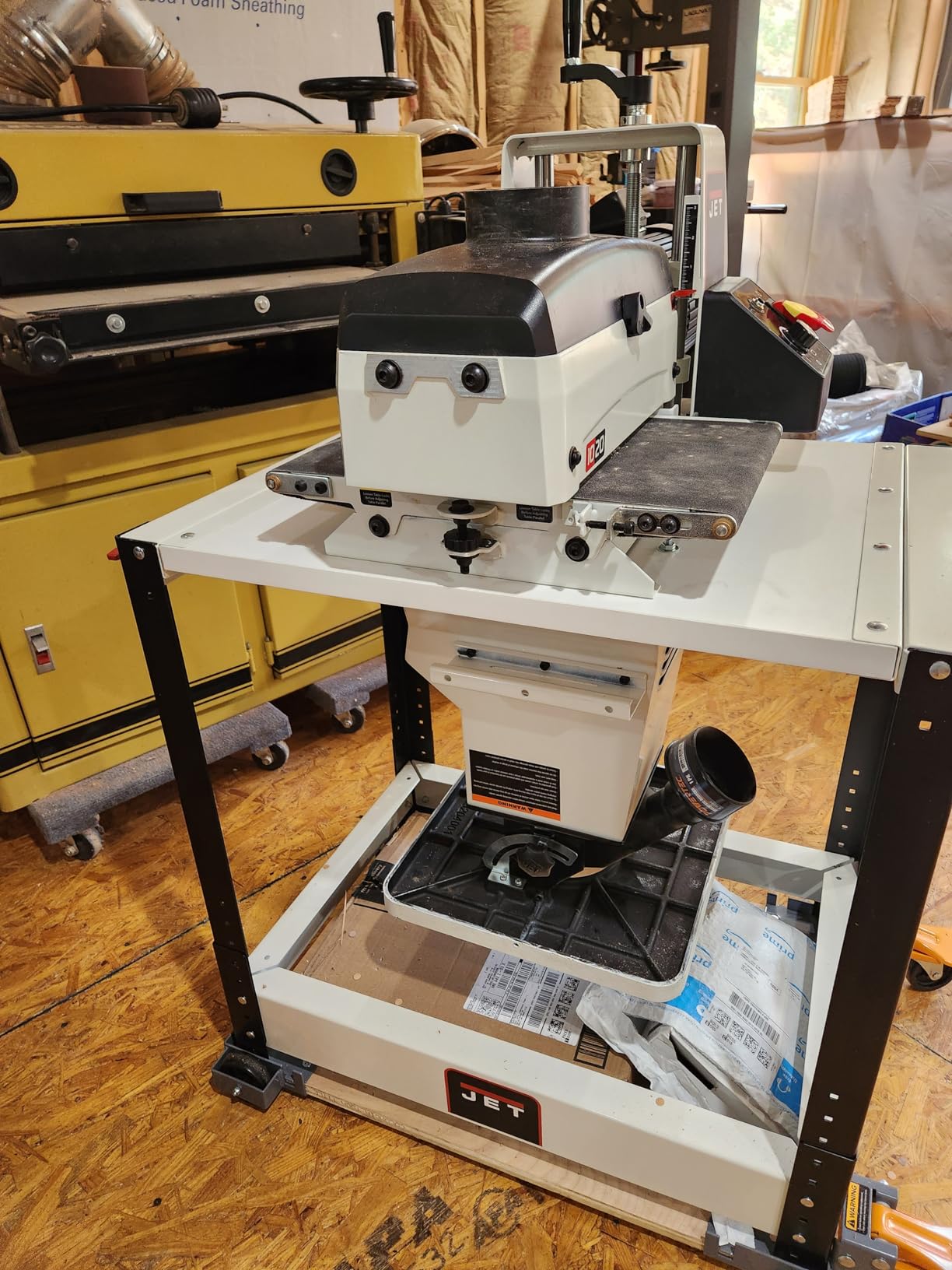
The JWDS-1020 is the answer for a basement shop or a garage with one usable bench. At 73 pounds and 26.85 by 17.9 inches, it is the only machine here that a person can lift onto a bench by themselves, and at 8 amps it is comfortable on a standard 15-amp circuit. The die-cast aluminium and steel body is rigid enough to produce consistent stock, which is the one thing a cheap benchtop sander usually cannot do.
Two design choices stand out. The extruded aluminium drum is shaped to dissipate heat, which protects delicate material from burn marks, and the precision-flattened reinforced steel conveyor bed keeps boards from tipping as they pass under the drum. Toolless abrasive take-up fasteners mean a wrap change takes minutes rather than an hour, which matters more than any spec when you are doing short jobs.
The open-ended design means you can flip a board for up to 20 inches of sanding capacity in two passes. Owners use it for cutting board blanks, small panels and door parts, and the review pool at 267 ratings is the largest in this group. On NC Woodworker, a 1020 owner says it evens out joinery but feels underpowered and warns that these machines can be expensive to repair, so it is worth knowing that judgement up front.
The recurring negative thread is belt tracking and abrasive tensioning. Owners who set the tracking once and re-check it periodically report the machine holding adjustment for years. A smaller group fitted the abrasive clips backwards, which produces bunching and burning, so check clip orientation before your first strip. Some units also arrive with a misaligned conveyor bed or an exhaust fin that contacts the drum.
What actually fits through the 10-inch drum
Measure your parts, not your ambition. A 10-inch drum handles cutting board blanks, small drawer sides, shaker parts, thin stock and small panels in one pass, and wider pieces only if you are willing to do two passes and keep the edges consistent. If your regular work includes full-size cabinet doors or tabletops, this machine makes you do extra handling for no gain.
The 1 HP motor is the honest limit here. It is comfortable on thin to medium stock and light feed rates, and it will bog if you take deep passes on hard species at full speed. Treat it as a finishing and thicknessing machine for small parts, which is exactly what most small shops use it for.
Who should skip it
If you are producing glued-up panels or doors in batches, the constant flipping gets old fast and the 1 HP motor will feel slow. Buy a 16-inch machine instead. And if your shop cannot spare bench space, a benchtop sander that has to be carried up and down a ladder every session is a machine you will stop using.
3. JET JWDS-1632OSC Oscillating Drum Sander – Snipe-Free Panels
JET 16-Inch Oscillating Drum Sander, 1-1/2 HP, 115V 1Ph (Model JWDS-1632OSC)
1-1/2 HP 115V 1Ph 14A
3/4 inch oscillating drum stroke
16 inch wide
227 lb
5 year warranty
Pros
- Oscillating drum removes snipe
- tear-out and low spots
- Highest owner rating in this group at 4.7
- Ceramic belt trackers cut manual belt adjustment
- Separate feed and drum motors for independent control
- External parallelism dial needs no tools
Cons
- Heaviest JET here at 227 pounds
- Dust cover lid rattles loudly because the turn lock will not hold
- Extension bed supports are effectively required
- Needs real calibration time before it performs
This is the only machine in the roundup with an oscillating drum, and it is the difference you feel on a glued panel. A 3/4 inch stroke moves the drum across the cut as it spins, so no single line of abrasive is grinding the whole length of the board. Owners report no snipe, no tear-out and no low spots on cabinet doors, cutting boards and segmented work.
Everything else is familiar 1632 territory: 1-1/2 HP, 115-volt single phase at 14 amps, SandSmart load-sensing feed, conveyor speed up to 10 feet per minute, and a dust hood with an integrated channel feeding a 4-inch port. The drum is precision-machined and dynamically balanced aluminium, and parallelism is set with an external dial.
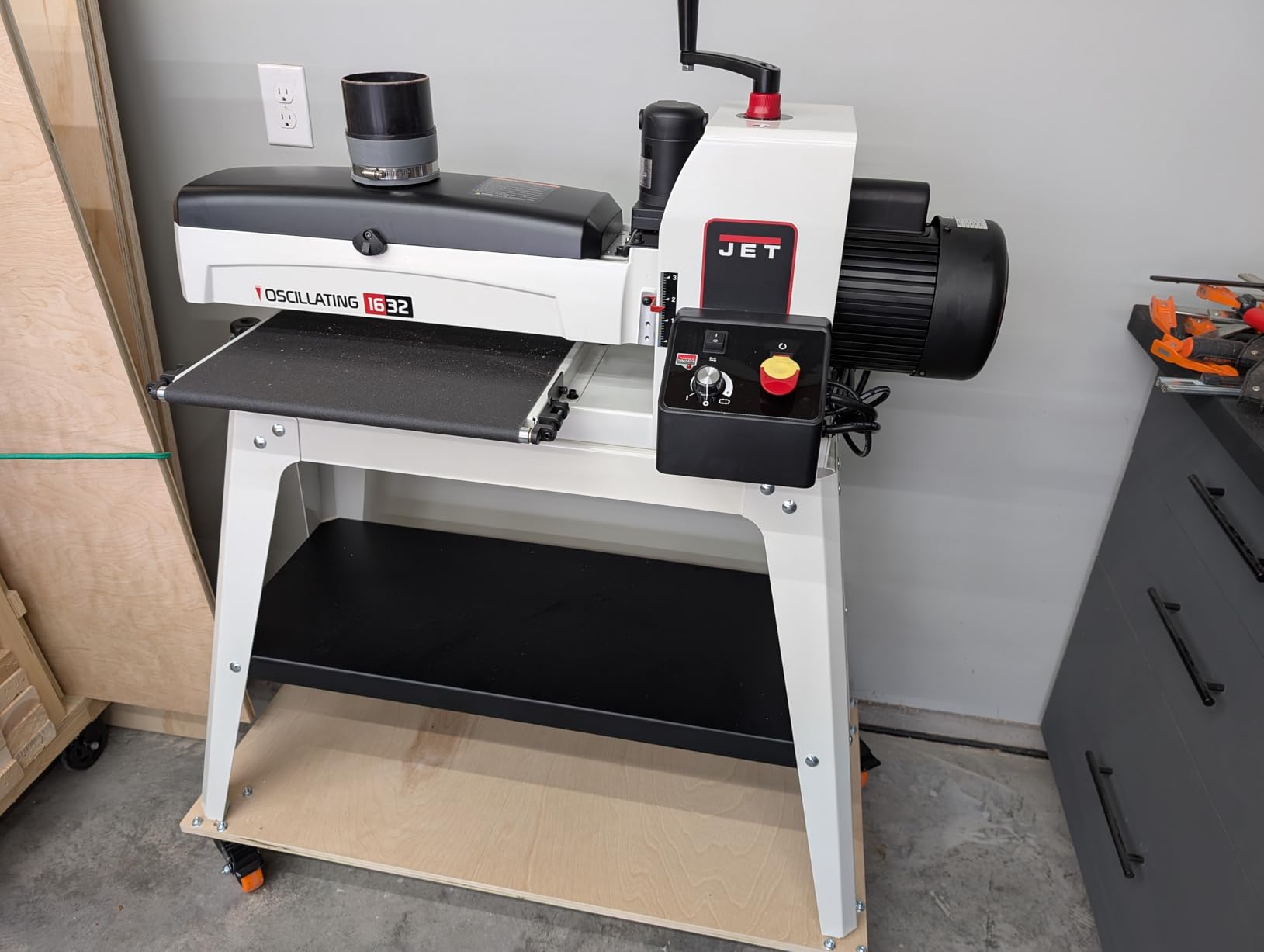
The ceramic conveyor belt trackers are a small detail with a big effect. They reduce how often you touch belt tracking by hand, which on a conventional drum sander is the most common reason a good machine produces bad results. Separate feed and drum motors mean you can slow the conveyor for figured veneer without slowing the drum.
Now the caveats, because they are real. At 227 pounds you need a second or third person and a cart for the stand. The drum dust cover lid rattles loudly against the housing because there is no cushion seal and the turn lock will not hold it tight. And the optional infeed and outfeed bed extensions are close to required if you want to feed long panels properly.
When the oscillating drum actually pays off
It pays off on wide, glued, visible surfaces: cabinet doors, table tops, panel doors and anything you plan to finish with a clear coat. On rough stock or on parts you will edge and route afterwards, the oscillation is not doing anything you would notice, and you are carrying extra weight for the privilege.
Because the review pool is small at 19 ratings, treat the 4.7 score as encouraging rather than proven. That is why we did not put it at the top of the roundup. If your work is exactly the kind of flat, defect-free surface this drum produces, it is worth the extra care on arrival. Who should skip it
Skip it if handling weight is a real constraint in your shop, if the rattle bothers you, or if you mostly sand rough material. A conventional 16-inch drum sander gives you the same capacity at 156 pounds with a much longer service history behind it.
4. JET JWDS-1836 18-Inch Drum Sander – Widest Single-Pass Capacity
JET 18-Inch Drum Sander with Open Stand, 1-3/4 HP, 115V 1Ph (Model JWDS-1836)
1-3/4 HP 115V 1Ph 15A
18 inch wide in one pass
164 lb
20 by 37 inch open stand
10 FPM conveyor
Pros
- Widest single-pass capacity here at 18 inches
- 1-3/4 HP gives real authority on hard species
- SandSmart auto feed handles feed rate without supervision
- Parallelism dial has a stop to return the bed flat quickly
- Storage shelf and pre-drilled caster holes on the stand
Cons
- Mid-range 3.8 rating with a notable share of one-star reviews
- Abrasive strips loosen during a run
- Parallelism dial must be reset using the stop before each setup
- Heavy at 164 pounds and awkward to move alone
The JWDS-1836 answers the sizing question directly: 18 inches of width in a single pass, driven by a 1-3/4 HP motor at 15 amps on 115 volts. That extra horsepower is the part that matters. Forum complaints about drum sanders stalling or leaving indentations almost always come down to horsepower-to-drum-width ratio and too little feed control, and this machine has both.
SandSmart monitors drum motor load and adjusts conveyor speed automatically. The parallelism dial sits outside the bed and needs no tools, and its return stop lets you snap the bed back to a flat position quickly between setups. The stand keeps a 20 by 37 inch footprint, which is the same footprint as the 1632 despite the wider drum.
Owners like the capacity and the auto feed. The reservations cluster around setup and repeat attention. With a 3.8 average across 28 ratings and 14 percent of reviews at one star, this is the least settled machine in the group, so expect some hands-on calibration and expect to re-tighten abrasive strips mid-run.
Dust collection is a 4-inch port fed by a hood channel that mirrors the drum shape, and the conveyor is infinitely variable up to 10 feet per minute. That is enough airflow for most small-shop collectors if you keep the hose short and the machine level.
18 inches versus 16 inches in a small shop
Eighteen inches matters when you regularly sand full-size cabinet doors, side panels or table tops without wanting a second pass. If your parts top out at 16 inches or you mostly glue up panels narrower than a door, the 1632 does the same work for less money and less weight. That is the honest calculation for most small shops.
Who should skip it
Skip it if your parts are small, if you are on a 15-amp circuit with nothing spare, or if you want the lowest-risk ownership experience. It is a heavier, higher-horsepower machine for a narrower list of jobs than the 16-inch models here.
5. VEVOR MS3140 16-Inch Drum Sander – Dual Motor With Extension Tables
VEVOR 16″ Drum Sander with Stand & Extension Tables, 1.5HP 1720RPM Dual Motor Drum Sander for Woodworking – Variable Speed Conveyor Belt, 4″ Dust Collection Port for Cabinet & Furniture Finishing
1.5 HP 1720 RPM dual motor
16 inch wide, 1/32 to 3 inch thick
193.4 lb
4 inch dust port
110V 4A
Pros
- Dual motor system separates sanding power from feed control
- Variable speed conveyor with a belt tracker
- Two extension table assemblies support long workpieces
- Handwheel height adjustment gives very fine depth control
- Mobile wheels and an open stand
Cons
- Abrasive clamp is cramped and sharp to reach from the infeed side
- 193 pounds is difficult to reposition without a dolly
- Feed belt can slip on aggressive passes until you dial in rate and depth
- Some snipe on the first passes while belt tension is learned
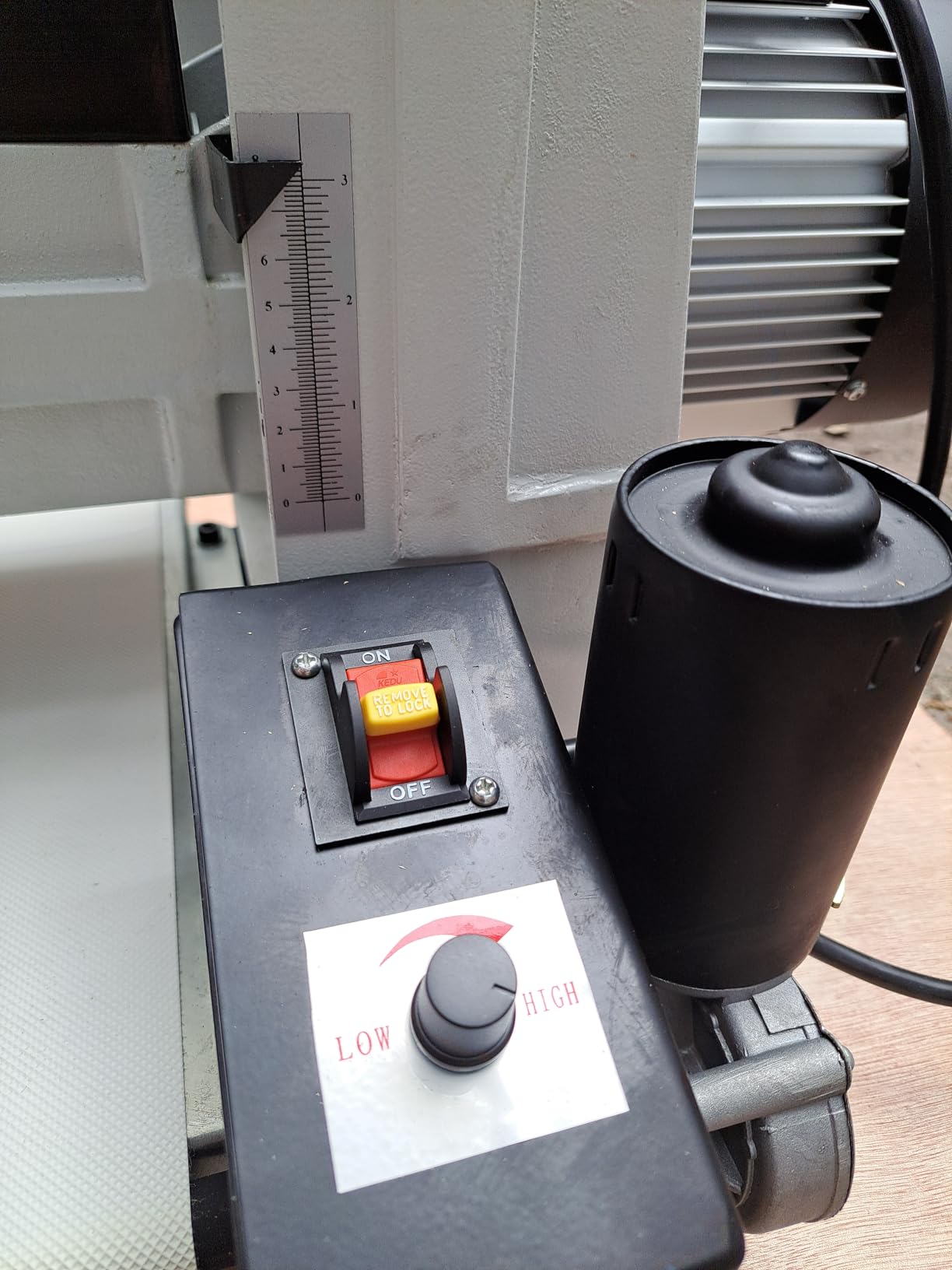
The MS3140 is the value entry in this group. It pairs a 1.5 HP motor at 1720 rpm with an independent gear-reduction conveyor motor, so the feed system is not stealing power from sanding. It handles boards up to 16 inches wide and from 1/32 inch up to 3 inches thick, and it runs on 110 volts drawing 4 amps, which is the lowest electrical demand of any floor machine here.
The handwheel height adjustment is unusually fine. Owners report taking 1/64 inch or less per pass, and that precision is what makes it usable for thinner material. Two extension table assemblies ship in the box and bolt on for long panels, so you are not immediately buying accessories to support a wide workpiece.
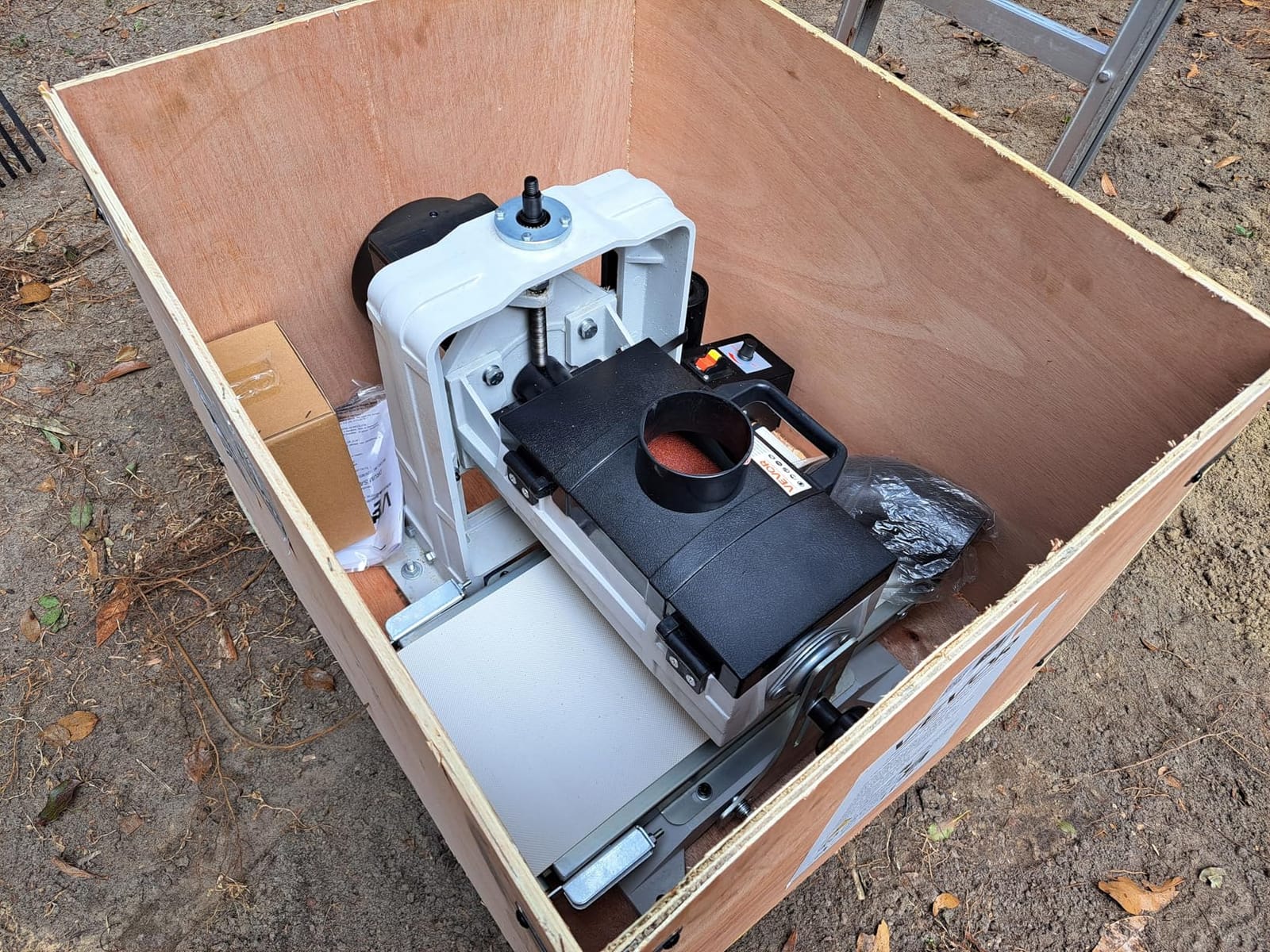
Owners describe a stout cast iron frame that holds alignment, a variable speed conveyor that feeds smoothly with little vibration, and a large 4-inch dust port that accepts ordinary hose. It arrives in a sturdy wooden crate and is nearly fully assembled, which matters when a machine weighs 193.4 pounds.
The complaints are consistent. The abrasive clamp is difficult to reach from the infeed side, with sharp internal edges and no clearance, and one reviewer said it cost them a cut thumb. The feed belt can slip and stall the drum on aggressive passes until you learn the relationship between feed rate and depth of cut. There is some snipe on early passes while belt tension is being learned.
Where it beats the JET machines
Low amperage, extension tables in the box, and a dual motor arrangement that holds feed speed under load. If your shop has limited circuit capacity or you sand long panels that need support, those three things are real advantages. Variable speed feed also lets you slow down for veneer without changing anything else.
Where it loses is refinement. The clamp accessibility problem is an everyday annoyance rather than a one-time annoyance, and the 3.8 rating rests on only 10 ratings, which is thin evidence in either direction.
Skip it if you change abrasive wraps often and hand access matters to you, or if you want the deepest service ecosystem behind the machine. For rough flattening of construction lumber and panels in a shop with modest electrical capacity, it is hard to argue against.
6. Powermatic PM2244 22-Inch Drum Sander – Closed Stand With Storage
Powermatic 22-Inch Drum Sander, 1-3/4 HP, 115V 1Ph (Model PM2244)
1-3/4 HP 115V 1Ph 14A
22 inch drum width
328 lb
Closed stand with storage
5 year warranty
Pros
- Widest drum in the roundup at 22 inches
- Feed logic system slows the conveyor before the motor overloads
- Extension tables give 37-1/2 inches of workpiece support
- Closed stand stores abrasives neatly
- Integrated casters make it easier to reposition
Cons
- Heaviest machine here at 328 pounds
- Some units arrived with cracked castings or bent bases
- Feed stalls reported on large workpieces causing indentations and burns
- Reports of electronics failures and weak support
- Slower material removal than expected
The PM2244 is the widest drum here at 22 inches, driven by a 1-3/4 HP motor on 115 volts at 14 amps. Its feed logic system monitors the drum motor and regulates conveyor speed before the motor overloads, and the included infeed and outfeed tables provide 37-1/2 inches of support. There is an emergency stop for quick shutoff, which is worth having on a machine this size.
The closed stand is a real difference for a small shop. It holds abrasives and keeps the machine self-contained, and integrated casters help when you need to move it. Table parallelism is adjusted with a dial at the table rather than by shifting the whole drum carriage, and belt tracking is designed to need less manual adjustment.
Owners who receive a well-aligned unit praise the accuracy, some verifying it with calipers on cabinet doors, and report snipe-free, consistently thick results across passes. Several say it replaced their planer. It also runs quietly for its size and pairs with a 4-inch collector for near dust-free results.
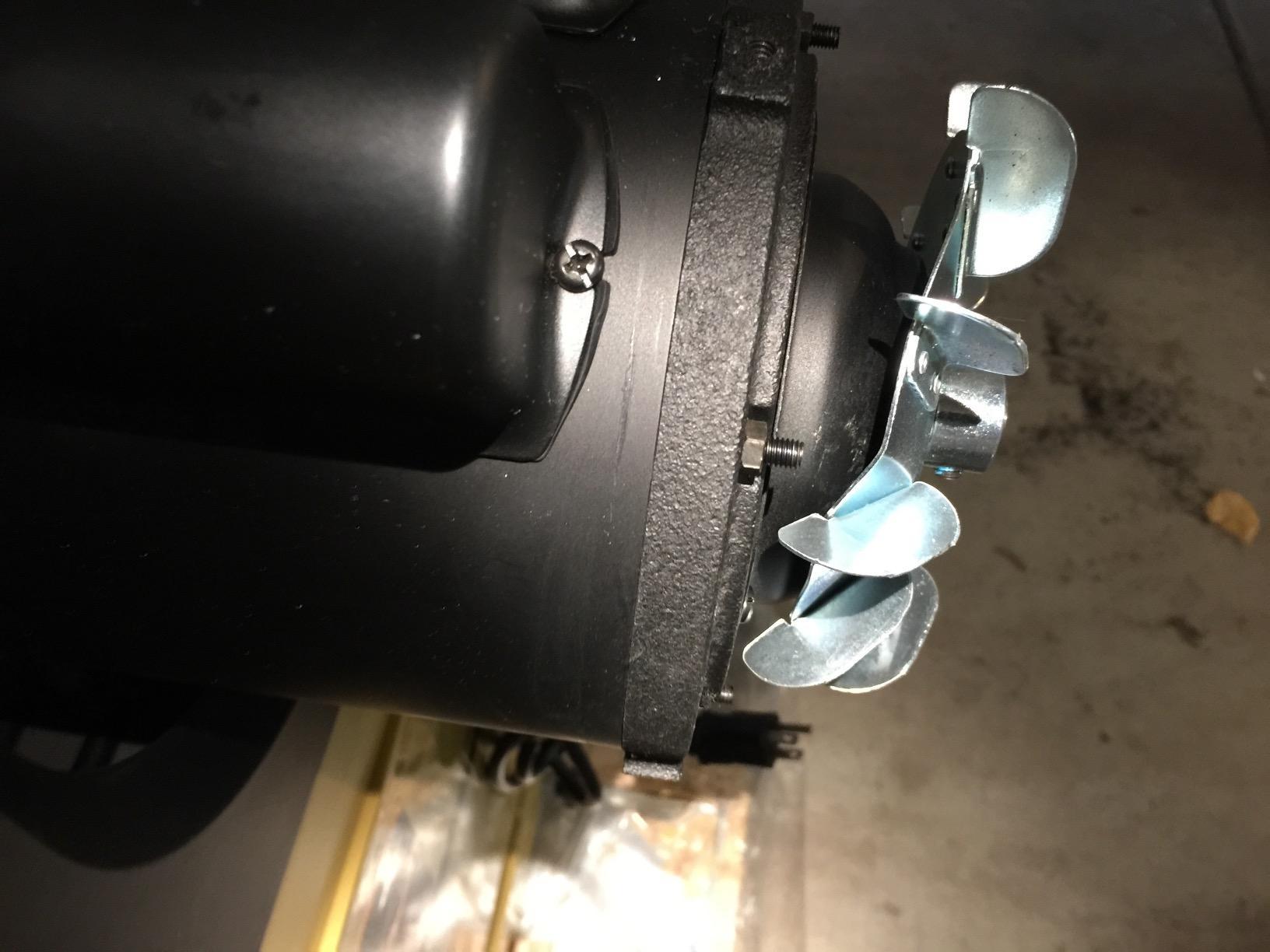
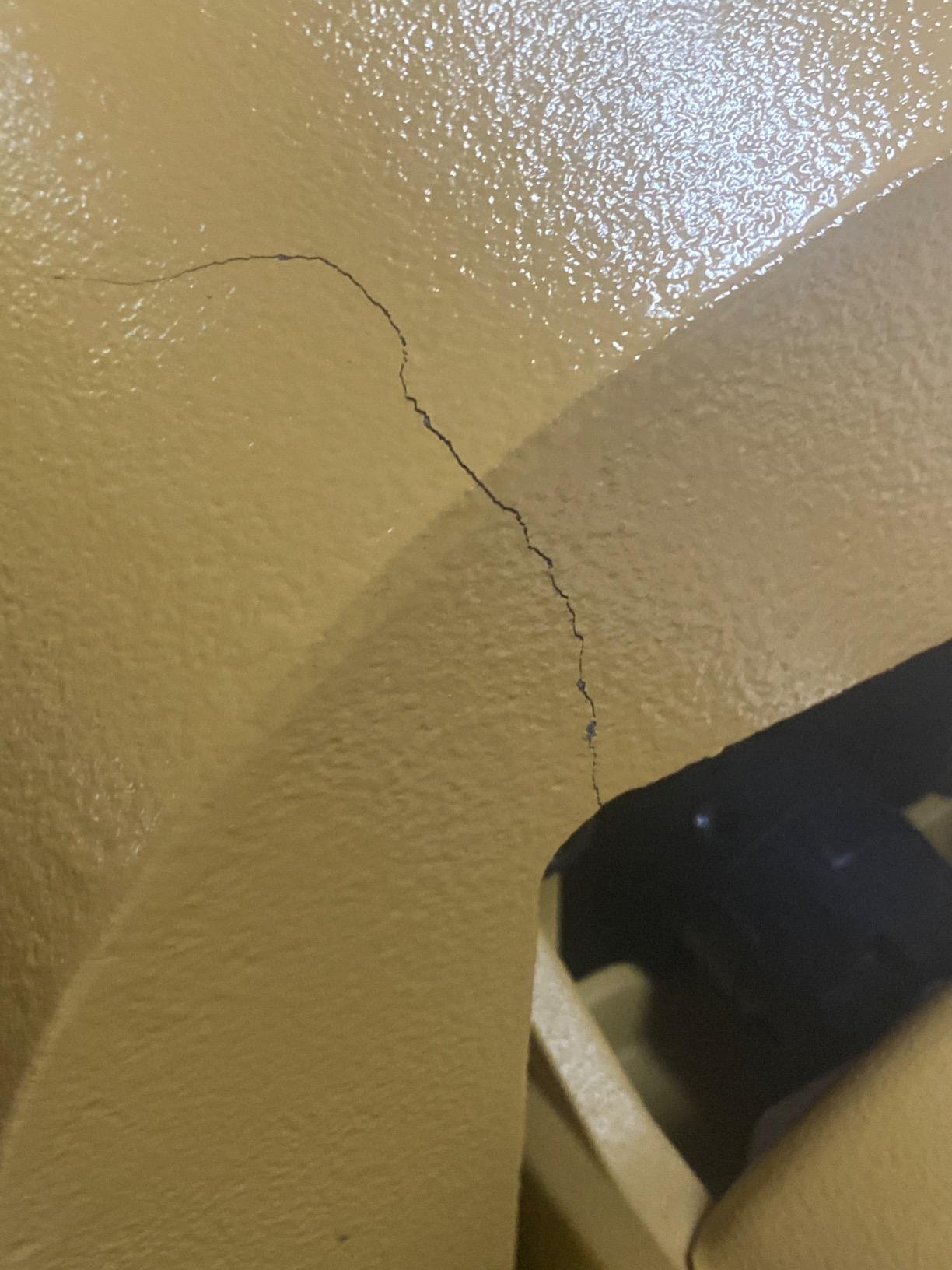
It is also the most polarised machine in the group, with the lowest average rating here at 3.6 across 36 ratings and 21 percent of reviews at one star. Reported problems include boards stopping mid-feed on large workpieces and leaving drum indentations and burns, shipping damage such as cracked castings or a bent base, electronics failures, and slower material removal than expected.
Does a 22-inch drum belong in a small shop?
Only if your widest recurring part is close to 22 inches. Doors, side panels and tops all go through in one pass, which means you can skip the flipping ritual and the risk of mismatched edges. If your work is narrower, a 16-inch machine gives you nearly all of the benefit at roughly half the weight.
At 328 pounds, with a footprint of 42.25 by 37.75 inches, this is a two-person move. Budget a dolly, a dedicated circuit and a collector with real airflow, and inspect the machine carefully in the first week so a hardware problem does not sit unnoticed.
Who should skip it
Skip it in a basement shop or a two-car garage. It is the largest, heaviest, most expensive machine here, it has the widest spread of owner experiences, and its advantage only pays off on wide work. For most small shops the 16-inch open-stand models are the better buy.
Are Drum Sanders Worth It in a Small Shop?
They are worth it if you sand parts to a set thickness more than a few times a month, and they are overkill if you mostly finish furniture surfaces. The value comes from repeatability: every piece comes off the same thickness, which removes the measuring, marking and hand-sanding loop that eats an evening on a single glued panel.
There is a fair argument against. A drum sander takes floor space, needs a real circuit, needs dust collection with serious airflow, and has a learning curve on abrasive wrap tension that frustrates beginners into blaming the machine. A shop with one small planer and a palm sander can get through the same work. The Sawmill Creek thread on small drum sander recommendations is a good example of that honest two-sided debate.
The payback calculation is simple. If hand-sanding a batch of doors takes four hours and a drum sander takes forty minutes, the hours you get back pay for the machine within a year or two of regular use. If you sand two doors a year, the maths never works.
How to Choose a Drum Sander for a Small Shop
Start with your widest part, not the machine. Measure the widest board, door or panel you expect to sand repeatedly and buy at that width or slightly wider. A 10-inch drum suits cutting board blanks, drawer parts and small panels. A 16-inch drum covers cabinet doors and tabletops in one pass with flipping for anything wider. An 18- or 22-inch drum only earns its space if you regularly handle full-size doors or side panels.
Second, look at horsepower against drum width. Small parts on a narrow drum need very little, which is why a 1 HP benchtop machine feels fine on thin stock. Wide drums need enough power to keep the abrasive cutting under load, and machines without load-sensing feed control are where stalling complaints come from. Every 16-inch machine here has load feedback except the entry-level VEVOR, which manages it with variable feed instead.
Third, check the two things that end up deciding your satisfaction: whether the machine needs a dedicated circuit, and whether your collector can keep up. Get those right before you compare warranty terms. Our roundup of the 10 best drum sanders covers larger machines if your shop has the room and the electrical service for them.
Electrical Requirements: 115V Circuits and Amperage
Every machine in this roundup runs on 115-volt single phase power, which is the main reason they suit small shops. Amperage is where the planning matters. The JWDS-1020 draws 8 amps and is comfortable on a 15-amp circuit. The VEVOR MS3140 lists 4 amps, also fine. The JWDS-1632 is rated at 14 amps and JET specifies a 20-amp circuit, the JWDS-1632OSC is 14 amps, the PM2244 is 14 amps, and the JWDS-1836 is rated at 15 amps.
Our rule is simple: if the machine draws 14 amps or more, give it a dedicated circuit rather than sharing with a table saw or thickness planer. Forum advice on dedicated 110-volt 15A circuits matches that. Sharing a 20-amp branch with another shop machine is where you get nuisance breaker trips mid-pass, and a drum sander that trips halfway through a panel wastes the whole pass.
If your shop already has 220-volt service, note that none of these machines need it. Three-phase machines in the 24-inch-and-up class do, and a variable frequency drive becomes part of the conversation, which is one more reason they are a poor fit for a small shop.
Dust Collection: Port Size and How Much Airflow You Need
Five of the six machines here use a 4-inch collection port, and the sixth is in the same family of standard 4-inch hose. That simplifies the hose and adapter situation, but it does not guarantee good air movement. A drum sander moves a genuinely large volume of fine dust, and shop owners report repeatedly that a drum sander overwhelms a collector sized for a table saw.
Practical guidance from owners: keep the run from machine to collector as short and straight as possible, seal every joint, and dedicate a larger collector to the sander rather than sharing a small unit across several machines. The JET 1632 is the only one here with a published capture figure, rated to collect up to 97 percent of sanding dust with a JET cyclone collector.
Plan the floor space alongside the machine. The open stands here need about 20 by 37 inches of footprint each, the PM2244 needs 42.25 by 37.75 inches plus clearance for the extension tables, and the benchtop 1020 needs a bench rather than floor space. Leave working room on the infeed side so a full-length panel has somewhere to go.
How Thin Can a Drum Sander Go?
Most machines here will take material down to roughly 1/32 inch of thickness, which is veneer territory. The JWDS-1020 is routinely used on thin material, and the VEVOR MS3140 lists a range of 1/32 to 3 inches. The practical limit is not the machine, it is handling: below about 1/8 inch, a panel becomes impossible to support on a conveyor bed without support tables, so thin stock usually means adding extensions and slowing the feed.
The real constraint is flex. Thin wide panels will bow on the conveyor, and a bowed panel sands unevenly no matter how good the drum is. Support the workpiece and keep feed speed down.
Abrasive Grit Progression and What a Wrap Really Costs
Every machine in this roundup ships with a single 80-grit strip or wrap, and one owner reported that buying a roll of paper without knowing how many strips come out of it was a genuine surprise. Do the arithmetic once. NC Woodworker owners doing this maths with Klingspor-style rolls report roughly 17 strips per roll, so the cost per strip is the roll price divided by 17, and it is worth comparing cloth-backed paper against cheaper aluminum oxide rolls before you settle on a supplier.
The grit sequence most owners converge on is 80 grit to take down glue-up and jointing marks, then 120 or 150 to flatten, then 180 or 220 for final sanding. Each step should remove no more than about a quarter turn of wrap tension, or you risk cutting into the previous grit level. That limit is a common thread in owner reports, and it explains most of the burn and chatter complaints people blame on the machine.
Resin in pine and softwood loads up abrasive quickly. If you sand a lot of softwood, keep a dedicated coarser strip for those jobs and do not try to make one grit do everything.
Drum Sander vs Wide Belt Sander vs Planer vs Spindle Sander
A drum sander wins on thin, delicate, dimension-critical parts. A wide belt sander is faster and better for straight edges and thick stock, but the machines forum users recommend are large, expensive and sometimes need compressed air. A planer is faster on thick, flat, straight stock but leaves snipe and cannot handle thin stock safely. A spindle sander handles curved and profiled parts in tight spaces and costs a fraction of a drum sander, which makes it the sensible first machine in many shops.
The honest comparison for a small shop: buy a spindle sander first if you do curved or small-batch work, buy a planer if you dimension lumber all day, and buy a drum sander if you make glued panels and doors. Most shops end up with a drum sander and a spindle sander together, since they solve opposite problems.
Open-End vs Closed Stand and Benchtop vs Floor-Standing
Open-ended sanders let you reverse a wide board for a second pass, which is why the 1632 gives you 16 or 32 inches of capacity from one machine. The forum consensus on entry-level buying is that open-ended is the better fit. Closed stands like the PM2244 add storage and a more self-contained footprint but give up the flip-through convenience.
Benchtop versus floor-standing is purely a space question. The 1020 at 26.85 by 17.9 inches can live on a flip-top cart and come down when the job is done. Everything else needs permanent floor space plus infeed and outfeed clearance for long workpieces.
Common Drum Sander Problems and How to Fix Them
Burn marks and chatter almost always mean the feed is too fast for the grit or the species. Slow the conveyor, drop to a coarser grit, and take a lighter cut. Wave marks and gouges mean the material has twist. Flatten it first on a jointer or spindle sander, and expect a drum to punish any board that rocks.
An abrasive strip that loosens mid-run gets re-tightened with the take-up fasteners, and strips loosening at the motor end are a known trait on the 1632. Ridges across the workpiece almost always mean the wrap tension is uneven, so re-wrap with a quarter turn at most per pass. Paper beating at the drum ends is usually a strip that is slightly too long, and trimming the strip length fixes it. Feed stalls and drum indentations come from too much depth per pass for the motor, or from a machine with weak load feedback.
Finally, dust escaping at the infeed means the hood is not sealed or the collector cannot keep up. Check the run length and every joint before assuming the machine is faulty.
Frequently Asked Questions
Are drum sanders worth the money?
They are worth it if you sand parts to a set thickness regularly, such as glued panels, cabinet doors or cutting board blanks. The machine holds one depth across the full drum width, which removes repeated measuring and hand-sanding. They are usually not worth it for occasional small projects, because the machine, circuit and dust collection together take real shop space and money.
How thin can a drum sander go?
Most machines in this roundup handle material down to about 1/32 inch. The real limit is handling, not capacity: below roughly 1/8 inch a wide panel flexes on the conveyor bed and sands unevenly unless you add support tables and slow the feed. Thin veneer also needs a lighter pass and a lower feed speed to avoid burn marks.
What is the best affordable drum sander available?
The JET JWDS-1020 is the most affordable route into drum sanding, with the largest owner review pool in this group. It is a 1 HP, 115-volt benchtop machine that fits on a flip-top cart and handles thin material and small panels. Among floor machines, the VEVOR MS3140 has the lowest electrical demand at 4 amps and includes extension tables.
What are some common problems with drum sanders?
Burn marks and chatter come from feeding too fast for the grit or species. Wave marks and gouges come from twisted or warped material. Ridges mean uneven wrap tension, and loosening strips need re-tightening. Feed stalls and drum indentations mean too much depth per pass for the available motor power. Escaping dust usually means a long collector run or an unsealed joint.
What is a benchtop sander used for?
A benchtop drum sander is used for small parts and thin material: cutting board blanks, drawer sides, small panels and thin stock. The benchtop format trades capacity for portability, so you can mount it on a bench or a flip-top cart and store it when the job is finished. It is the practical choice when floor space or circuit capacity is limited.
The Verdict: Which Drum Sander Belongs in Your Shop
For most small woodworking shops in 2026, the JET JWDS-1632 is the best drum sander for a small shop: 16 inches of width, load-sensing feed, a toolless parallelism dial, a 4-inch dust port and an open stand that fits a modest footprint. If your parts are small and your space is tight, the JWDS-1020 benchtop machine does the same job at a fraction of the weight. Save the oscillating model for wide, visible panels and the 18- and 22-inch machines for shops with full-size door and panel work. Match the drum width to your widest part, wire a dedicated circuit, and budget real dust collection airflow before you order anything.