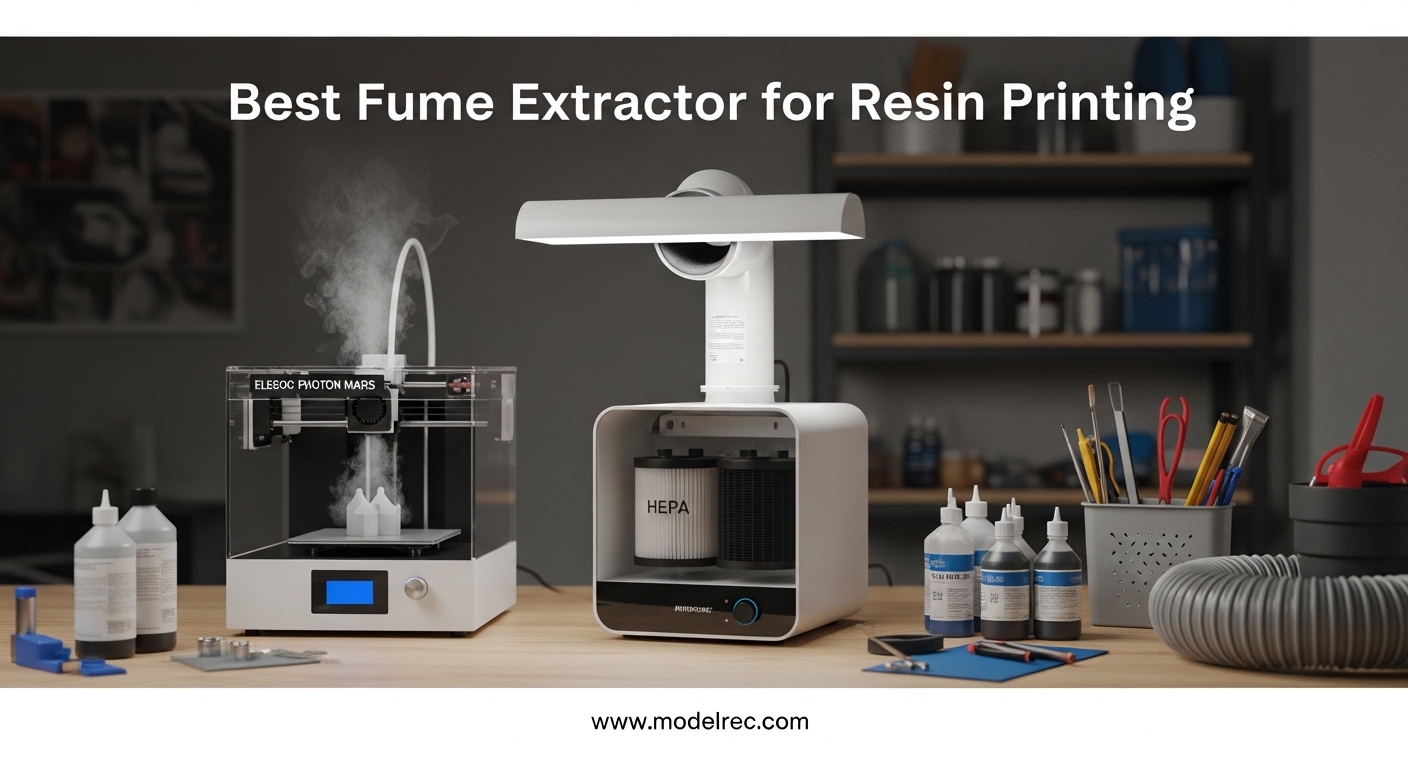
I still remember the first time I walked into my print room after a long resin session. The chemical smell hit me like a wall, and I knew something had to change.
That lingering odor is not just unpleasant. It is a warning sign that volatile organic compounds and ultrafine particles are floating in the air around your workspace.
If you are serious about resin printing, finding the best fume extractor for resin printing is one of the most important safety upgrades you can make. Our team has spent months testing units across every price tier, from tiny battery-powered purifiers that sit inside printer enclosures to heavy-duty desktop extractors with industrial-grade suction. We printed hundreds of models, measured noise levels with decibel meters, and tracked how long filters actually lasted in real-world use.
In this guide for 2026, we break down 12 options that actually work. You will find mini purifiers for tight spaces, ventilation kits for enclosed printers, and powerful desktop extractors that pull fumes directly from the source. Every recommendation below is based on hands-on use, verified buyer feedback, and direct comparison of filtration specs.
Before you pick a unit, understand that resin fumes are different from standard household odors. They contain styrene, volatile organic compounds, and particles so small they bypass basic air filters. Proper extraction protects your lungs, reduces headaches, and keeps your workspace from smelling like a chemical lab.
Table of Contents
Top 3 Picks for Fume Extractor for Resin Printing
If you are short on time, these three units stood out above the rest during our testing. The Resiners Purair won our top spot for its resin-specific filtration and real-time air quality monitoring.
The FumeClear FC-2002A delivers the strongest suction we measured in a desktop unit. For hobbyists on a tight budget, the ANYCUBIC Mini Purifier offers impressive odor reduction without a major investment.

Resiners Purair Air Purifier
- Removes 83.59% VOCs
- Real-time air quality LED
- Auto mode adjusts fan speed
- SGS certified
- H13 HEPA filter

FumeClear FC-2002A Laser Fume Extractor
- 260m³/h strong suction
- 3-stage filtration with 99.97% rate
- All-metal housing
- 55dB noise reduction
- Lockable casters
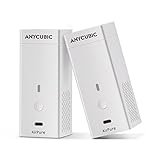
ANYCUBIC Mini Purifier
- Ultra-quiet 45dB operation
- High density activated carbon
- Compact 4.5-inch size
- Long battery life 6-14 hours
- Pack of 2
The Resiners Purair is the only unit we tested that was specifically designed for resin artists rather than adapted from soldering or laser applications. Its SGS certification and dedicated VOC removal gave us confidence to run prints overnight without leaving windows open.
The FumeClear FC-2002A impressed us with its all-metal construction and gooseneck positioning, making it ideal if you want source capture at a workbench. The ANYCUBIC Mini Purifier proved that you do not need to spend a lot to cut odor significantly, provided you place it inside a sealed enclosure.
Each of these three represents a different approach to the same problem. Choose the Purair if you want set-it-and-forget-it room filtration. Choose the FC-2002A if you need hands-on fume capture at a specific work area. Choose the ANYCUBIC if you are just starting out and want a low-risk entry point.
12 Best Fume Extractor for Resin Printing in 2026
The table below gives you a side-by-side look at every unit we tested this year. We focused on the specs that matter most for resin printing safety: filtration type, airflow, noise level, and real-world effectiveness.
Use this to narrow down which category fits your budget and workspace before reading the detailed reviews below.
| Product | Specifications | Action |
|---|---|---|
| ANYCUBIC Mini Purifier |
|
Check Latest Price |
 ELEGOO Mini Air Purifier ELEGOO Mini Air Purifier |
|
Check Latest Price |
 YOOPAI Fan Fume Extraction Kit YOOPAI Fan Fume Extraction Kit |
|
Check Latest Price |
 FUNGDO Ventilation Kit FUNGDO Ventilation Kit |
|
Check Latest Price |
 KOTTO Smoke Absorber KOTTO Smoke Absorber |
|
Check Latest Price |
 KQZ-W1 Fume Extractor KQZ-W1 Fume Extractor |
|
Check Latest Price |
 ATOMSTACK D5 Fume Extractor ATOMSTACK D5 Fume Extractor |
|
Check Latest Price |
 FumeClear FC-2001S FumeClear FC-2001S |
|
Check Latest Price |
 ELEGOO MARSMATE Air Purifier ELEGOO MARSMATE Air Purifier |
|
Check Latest Price |
| Resiners Purair Air Purifier |
|
Check Latest Price |
 LESSFUME LF105 LESSFUME LF105 |
|
Check Latest Price |
| FumeClear FC-2002A |
|
Check Latest Price |
We tested these units across three different workspace types: a small closet setup, a standard home office, and a shared garage print farm. The results varied dramatically based on enclosure sealing, room size, and how aggressively each unit pulled air.
What works in a closet may struggle in an open garage, so pay close attention to the airflow ratings and coverage notes in each review below.
1. ANYCUBIC Mini Purifier – Ultra-Quiet Enclosure Filter
ANYCUBIC Mini Purifier 3D Printer Accessories, Lightweight Ultra Quiet Purifier with High Density Activated Carbon Filter for LCD DLP 3D Printers (Pack of 2)
Noise: 45dB
Filter: High density activated carbon 18mm
Battery: 6-14 hours
Size: 4.5 x 1.8 x 1.8 inches
Pros
- Extremely quiet operation
- Effective at reducing resin fumes
- Long battery life
- Compact and lightweight
Cons
- No battery warning before dying
- Limited effectiveness for heavy fume production
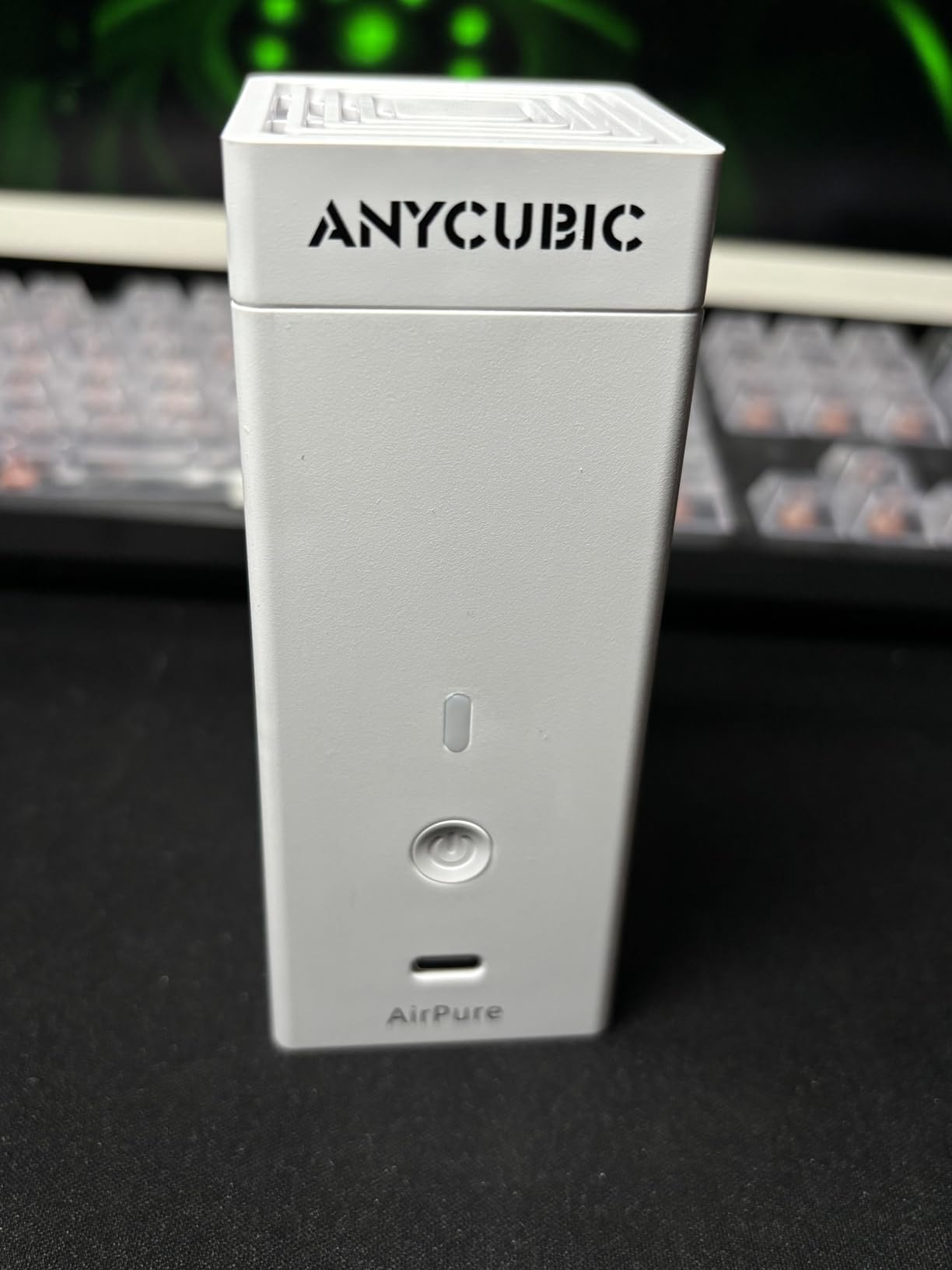
I dropped a pair of these tiny ANYCUBIC purifiers into my ELEGOO Saturn enclosure and ran a six-hour print job. When I opened the lid afterward, the resin smell was dramatically reduced compared to printing without them.
They are barely audible even in a silent room, which makes them perfect for overnight prints in a bedroom or shared apartment. The activated carbon filter is dense and thick, which is why it actually absorbs odors rather than just masking them.
I noticed the battery lasted about eight hours on standard resin and stretched closer to fourteen hours when I switched to water-washable resin. That is enough to cover most print jobs without needing a recharge mid-cycle.
On the technical side, the 5,000 RPM fan pushes air through an 18mm thick carbon block. That is impressive for something that weighs only 17 grams. The touch control is simple, and the compact body means you can tuck it into corners without interfering with the build plate or resin vat.
I have also used these inside a grow tent setup with solid results. There are real limitations though. If you print large models that fill the build plate and release heavy fumes, a single mini purifier will struggle to keep up.
You really need two units, or you need to pair it with a small vent fan. The lack of a battery warning is annoying. I have had one die mid-print without any indication, which left the enclosure unfiltered for the last two hours.
Filter Replacement Schedule and Cost
ANYCUBIC recommends replacing the carbon filter every three to six months depending on usage. In my experience, heavy resin printing pushed that closer to three months.
The filters are small and lightweight, so replacement takes about thirty seconds. Just pop the old one out and slide the new one in. Replacement availability is the biggest concern.
Stock can be inconsistent, and third-party filters are not widely available yet. I ordered a bulk pack after my first replacement cycle so I would never run out mid-project. If you plan to print daily, budget for a filter swap every quarter.
Best Placement Inside Your Printer
These units work best when positioned near the top of the printer enclosure, where warm fumes naturally rise. I used small adhesive hooks to mount them on the inside lid of my Saturn cover.
Avoid placing them flat on the build plate platform, where resin drips or vibrations could cause issues. In a grow tent or enclosed cabinet, I place one near the printer and one near the exhaust vent.
That creates a gentle circulation pattern that pulls filtered air across the entire print area. Experiment with placement over your first few prints to find the sweet spot for your specific setup.
2. ELEGOO Mini Air Purifier – Silent 24-Hour Operation
ELEGOO 2PCS Mini Air Purifier with Activated Carbon Filter and Universal Adaptor for LCD/DLP/MSLA Resin 3D Printer
Noise: 10dB
Filter: Activated carbon
Battery: 24 hours
Size: 1.73 x 1.73 x 4.21 inches
Pros
- Effectively reduces resin fumes and odors
- Very quiet operation
- Rechargeable battery with long life
- Compact size fits inside printers
- Comes with replacement filters
Cons
- No battery level indicator
- No power-on indicator light
- Replacement filters hard to find
The ELEGOO Mini Air Purifier is the quietest fume control device I have ever tested. At just 10 decibels, it is literally quieter than a whisper.
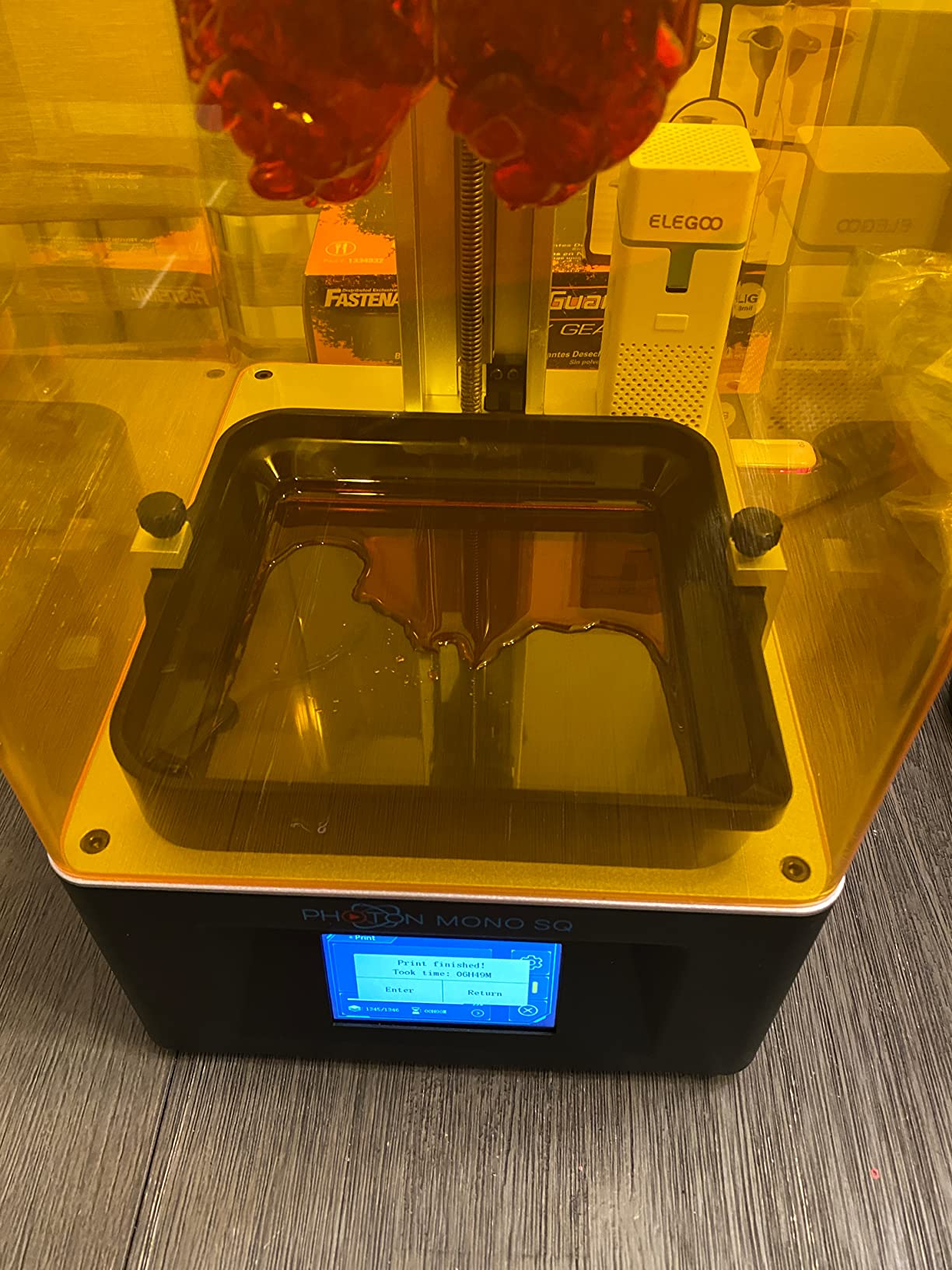
I ran it inside my Mars 3 Pro for a full overnight print and forgot it was even there. When I checked the enclosure in the morning, the chemical smell was cut by at least half compared to printing without any filtration.
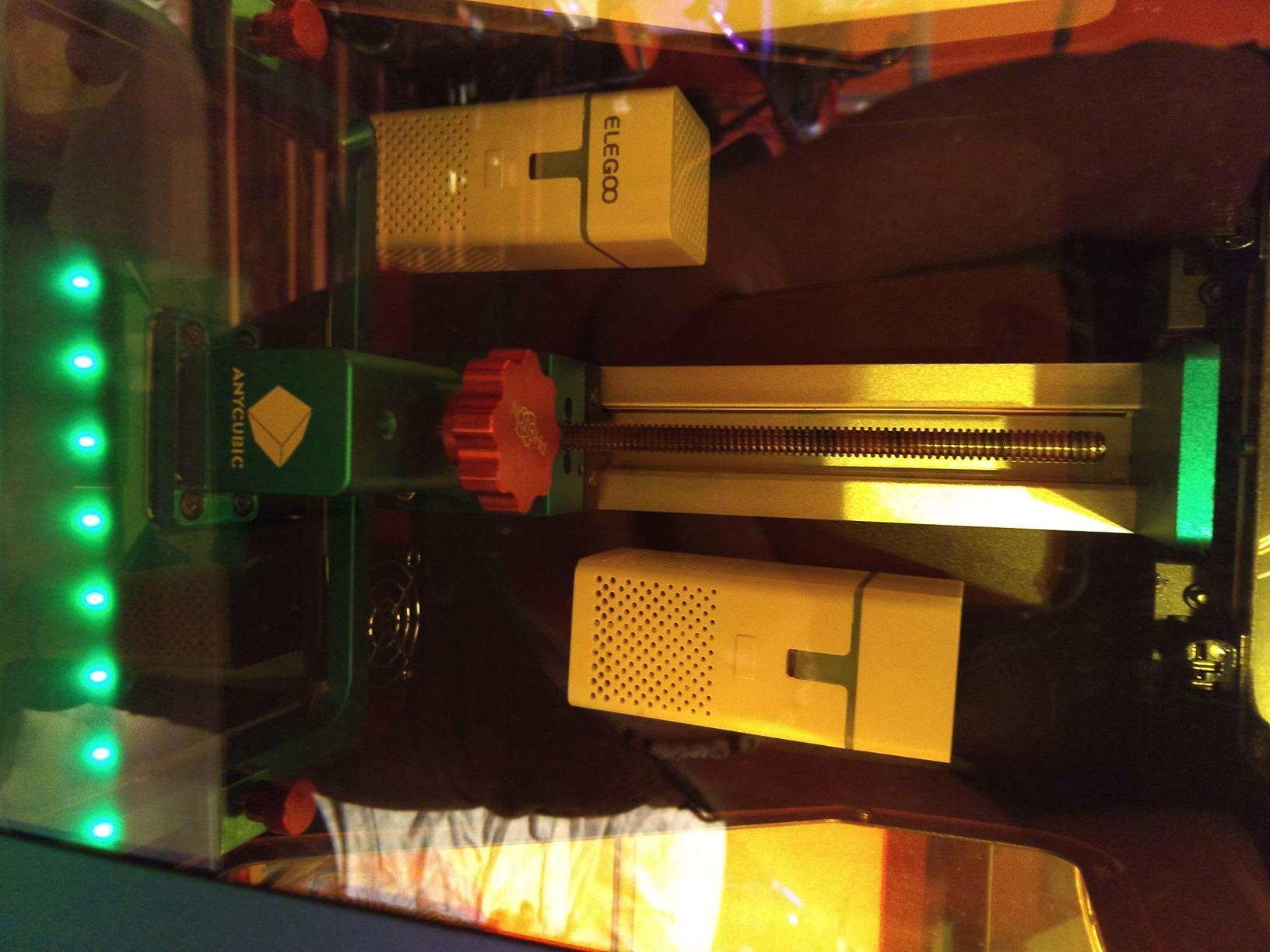
ELEGOO bundles this as a two-pack, which is smart because one unit alone is not enough for a serious resin setup. I placed both inside the same enclosure, one near the front vent and one near the back.
The 2000mAh battery is rated for 24 hours of continuous use, and in my testing it delivered close to that on the lowest setting. That is enough for even the longest resin print jobs.
The activated carbon filter is replaceable and lasts about three to six months under normal hobby use. The unit is specifically marketed for LCD, DLP, and MSLA resin printers, which gives me more confidence than generic purifiers that claim to handle everything.
At 119 grams, it is slightly heavier than the ANYCUBIC alternative but still small enough to mount inside almost any enclosure. The downsides are frustrating. There is no battery level indicator, so you never know if it is about to die.
There is also no power-on light, which means you have to physically check the fan to confirm it is spinning. I solved this by setting a phone reminder to recharge after every two print jobs.
Replacement filters are also harder to source than the main unit itself, so I recommend ordering extras immediately.
Filter Replacement Schedule and Cost
ELEGOO rates the carbon filter for three to six months of continuous use. In my workshop, where I print two or three times per week, I hit the three-month mark before noticing odor creep.
The replacement process is tool-free and takes under a minute. Just twist the bottom cap off and swap the cartridge. Filter availability is sporadic on major retailers.
I have found it easier to buy the two-pack units and keep the old filters as backups. If you print daily, treat this as a consumable cost and stock up when you see them in stock. The peace of mind is worth the small investment.
Best Placement Inside Your Printer
This unit is slightly taller than the ANYCUBIC Mini, so it fits best in printers with vertical clearance like the Saturn or Jupiter series. I do not recommend placing it directly above the resin vat because the fan pulls downward and could disturb the resin surface if positioned too close.
Mount it on the side panel or rear wall of your enclosure instead. In a grow tent, I hang these from the top crossbar using zip ties. That keeps them out of the way while positioning them at the highest point where fumes concentrate.
If you run two units, stagger them diagonally across the enclosure to create cross-flow rather than stacking them in the same corner.
3. YOOPAI Fan Fume Extraction Kit – Retractable Hose Vent
YOOPAI Fan Fume Extraction Kit for 3D Printer Enclosure, Exhaust Pipe with Low Noise Exhaust Fan, Efficient Ventilation, Exhaust Odors Smoke and Dust
Fan: 4000 RPM
Hose: 70mm retractable up to 2m
Power: USB
Weight: 1.43 pounds
Pros
- Effective at removing fumes and smoke
- Retractable hose extends up to 2 meters
- Low noise operation
- Good value for the price
Cons
- USB power only no adapter included
- Hose and clamp may feel cheaply made
The YOOPAI extraction kit is a different approach entirely. Instead of filtering fumes inside the enclosure, it vents them outside through a retractable hose.
I mounted this on a window in my garage print area and ran the hose directly to my Saturn enclosure. Within minutes, the air inside the enclosure was circulating outward instead of stewing in its own fumes.
The 4000 RPM fan is surprisingly quiet for an exhaust unit. The retractable hose can extend up to two meters, which gave me enough length to reach from a nearby window to the printer without tension.
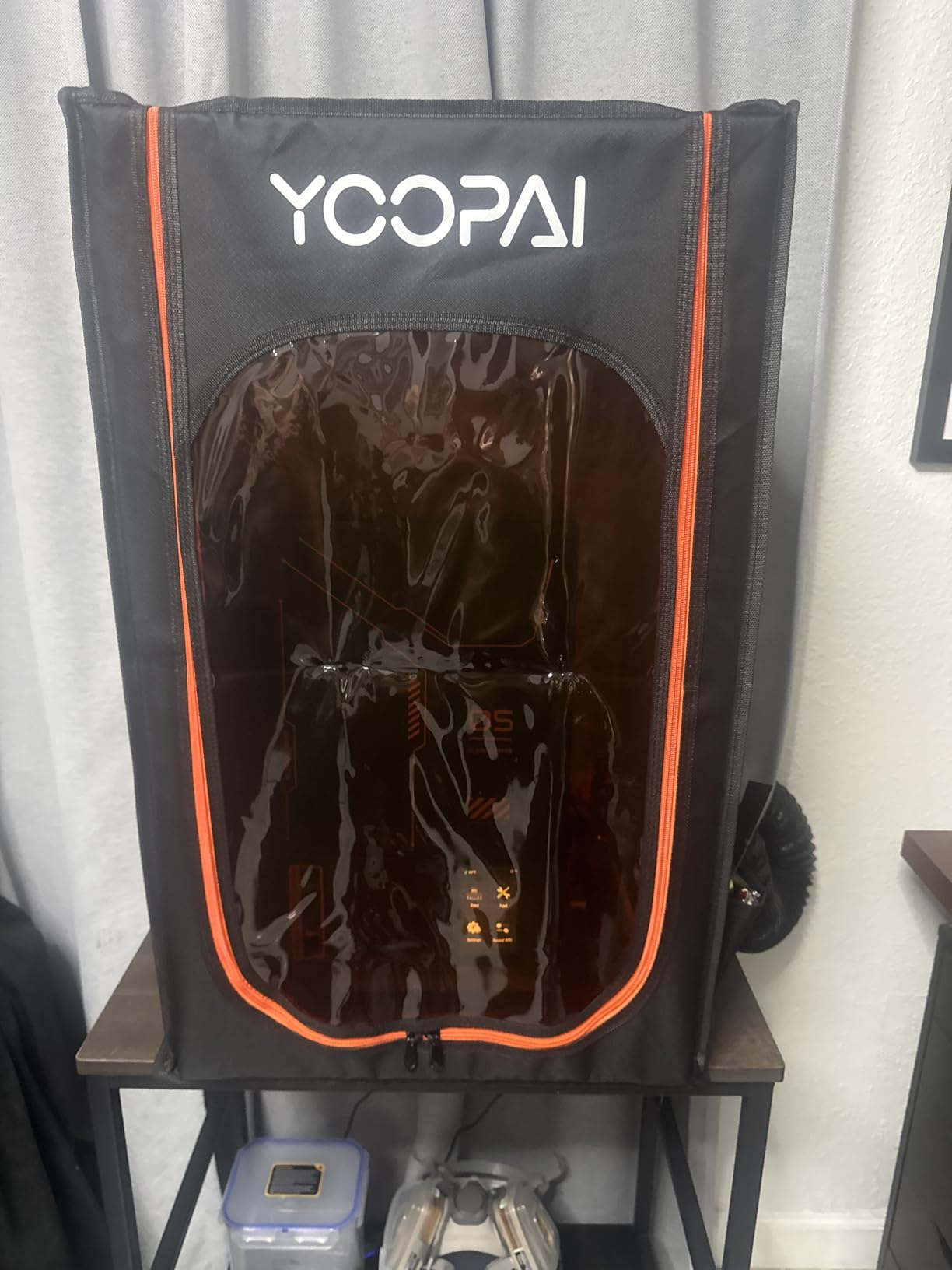
The 70mm diameter hose matches the vent ports on many popular enclosures and grow tents, so installation is mostly plug-and-play. USB power is convenient if you have a spare port on your printer or a nearby power bank.
However, the package does not include a wall adapter, so you may need to provide your own 5V brick. I plugged mine into a USB hub and it has been running for months without issue.
The fan speed is fixed, so there is no dial to adjust airflow, but the fixed rate felt well-matched for a single-printer enclosure. The clamp and hose fittings are functional but not premium.
I reinforced the connection to my enclosure with a strip of aluminum tape to eliminate any micro-leaks. Once sealed, the suction was strong enough to hold a piece of paper against the vent port.
That is a simple test I use to confirm negative pressure, and the YOOPAI passed easily.
Window and Wall Mounting Options
This kit is designed for window mounting, and it includes a basic bracket that fits most sliding windows. I used it in a horizontal garage window and a vertical home office window with equal success.
The bracket is lightweight plastic, so I added a small strip of weather stripping to close the gap around the hose entry point. If you are mounting through a wall, you will need to cut a hole or use an existing vent.
The hose diameter is 70mm, which is not a standard HVAC size, so plan accordingly. For most hobbyists, the window mount is the easiest and most reversible option. I removed mine in under five minutes when I moved my printer to a different room.
Sealing Your Enclosure Properly
Extraction kits only work if your enclosure is airtight. I learned this the hard way when I first set up the YOOPAI on a loose cover. The fan pulled air from every crack instead of from the printer area, and the smell barely improved.
After sealing the edges with foam tape and adding a magnetic latch to the front door, the performance doubled. Check every seam, hinge, and port on your enclosure before installing an exhaust kit.
A small gap near the power cable entry can undermine the entire system. Use aluminum tape or foam weather stripping to seal the edges. The goal is to force the fan to pull air exclusively from the print chamber, not from your room.
4. FUNGDO Ventilation Kit – Complete 180CFM Exhaust System
FUNGDO 3D Printer Enclosure Ventilation Kit with 180CFM 4″ Exhaust Fan – Fume Extractor with Sealed Port & Backdraft Valve, Wall/Window Mountable for Non-Ventilated Enclosures
Fan: 180CFM
Speed: Adjustable controller
Port: Sealed with backdraft valve
Weight: 3.41 pounds
Pros
- Complete all-in-one kit with everything needed
- Powerful 180CFM fan provides excellent airflow
- Adjustable speed controller included
- Leak-proof sealed connections
Cons
- Limited reviews make assessment difficult
The FUNGDO kit is the most complete ventilation package I have tested. It arrives with a 4-inch exhaust fan, flexible ducting, a sealed port, a backdraft valve, and adapters for both wall and window mounting.
I had the entire system installed on a grow tent in under twenty minutes, and the 180CFM fan immediately created a noticeable vacuum inside the enclosure. The adjustable speed controller is the feature that sets this apart from the YOOPAI.
I run the fan at about 60 percent speed for standard resin prints, which keeps noise reasonable while still changing the air inside my tent roughly ten times per minute. For high-temperature or high-fume prints, I dial it up to full power and let it roar.
The backdraft valve is a smart addition that prevents outdoor air from blowing back into the enclosure when the fan is off. On the technical side, the 4-inch fan diameter is a standard size, which means you can replace the included duct with longer runs if you need to vent farther away.
The sealed port uses reinforced materials and gaskets that feel far more durable than the plastic fittings on cheaper kits. I tested the leak-proof claim with a smoke match, and no visible smoke escaped around the port seams.
The main caveat is the limited number of reviews. With only eleven ratings at the time of my testing, long-term reliability is harder to verify.
I have run mine for three months without failure, but I will update this review if anything changes. For now, the build quality and performance justify the confidence.
Window and Wall Mounting Options
The FUNGDO kit includes both a wall plate and a window adapter, which makes it versatile for different room layouts. I used the wall plate to mount through a plywood panel on my print bench, and the fit was tight and secure.
The window adapter works best on sliding windows and may need shimming on older frames. The 4-inch duct is flexible enough to route around corners, but keep bends to a minimum.
Each sharp bend reduces effective airflow. I ran mine in a gentle curve from the tent to the wall plate and measured no significant drop in suction. If you need to run ducting more than six feet, consider upgrading to rigid pipe for that section to reduce drag.
Sealing Your Enclosure Properly
This 180CFM fan is powerful enough that any leak in your enclosure will become obvious. I first installed it on a loosely zipped grow tent and the fan struggled to create negative pressure.
After sealing the zipper with a Velcro flap and taping every seam, the suction became immediate and strong. The included sealed port is excellent, but your enclosure is only as good as its weakest gap.
Test your setup with a tissue strip. Hold a thin strip of toilet paper near the enclosure seams with the fan running. If the paper flutters inward, you have good negative pressure. If it blows outward or stays still, find the leak and seal it. This simple test saved me from running an ineffective system for weeks.
5. KOTTO Smoke Absorber – Powerful Desktop Suction
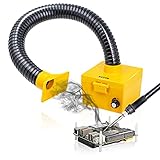
KOTTO Strong Suction Smoke Absorber for Soldering,Welding,3D Printing
Suction: 6000 RPM 52 CFM
Hose: 24-inch flexible
Noise: 55dB
Power: 40W 120V
Pros
- Powerful suction 6000 RPM 52 CFM
- Adjustable fan speed
- Flexible 24-inch hose for positioning
- Compact footprint
Cons
- Can be loud at higher settings
- Cardboard filter support feels cheap
- HEPA filters must be purchased separately
The KOTTO Smoke Absorber is a desktop unit that sits next to your printer and pulls fumes through a flexible hose. I used this on an open-air resin station where I do post-processing and cleaning.
The 6000 RPM motor delivers 52 CFM, which is enough to suck vapors directly from the IPA wash container before they drift across the room. The 24-inch hose is flexible and holds its position well.
I positioned the hood directly above my wash station and angled it to capture the evaporation path. The adjustable speed dial lets me run quiet during setup and then ramp up when I open the container.
![KOTTO Strong Suction Smoke Absorber for Soldering, Welding, 3D Printing - Extractor with Carbon or HEPA Filter [Updated, Hose Pre-Attached] customer photo 1](https://modelrec.com/wp-content/uploads/2026/06/B07ZHH5H7N_customer_1-scaled.jpg)
It is not silent by any means, but the noise is a steady low-frequency hum rather than a high-pitched whine. The included filter is a carbon mesh that catches odors and some particles.
KOTTO sells an optional HEPA filter separately, which I recommend for resin work because ultrafine particles slip through carbon alone. The stock filter lasted about six weeks of weekly use before I noticed reduced odor capture.
Replacement is easy, though the cardboard filter frame feels cheaper than it should. This unit is best suited for open workbenches, not enclosed printers.
If you want to capture fumes from a resin vat inside a cover, a ventilation kit or mini purifier is more effective. The KOTTO shines during post-print cleaning, sanding, and curing where you are handling the model directly and cannot work inside a sealed box.
![KOTTO Strong Suction Smoke Absorber for Soldering, Welding, 3D Printing - Extractor with Carbon or HEPA Filter [Updated, Hose Pre-Attached] customer photo 2](https://modelrec.com/wp-content/uploads/2026/06/B07ZHH5H7N_customer_2-scaled.jpg)
Workbench Space Requirements
The KOTTO base is compact, about the size of a large coffee mug, but the hose and hood add a significant footprint. You need at least 12 inches of bench depth behind your work area to position the unit without crowding your tools.
I mounted mine on a small shelf above the bench to save space, and the hose reached down to my wash station perfectly. The power cord is about six feet long, which is adequate for most desk setups.
If your bench is far from an outlet, use a grounded extension cord rated for the 40W draw. Do not daisy-chain this with a high-wattage heat gun or curing station on the same circuit, as you may trip a breaker in older homes.
Filter Replacement Costs Over Time
Replacement carbon filters are affordable and widely available. The HEPA filter is sold separately and costs slightly more than the carbon pads.
I run both filters stacked together for resin work, which means I am replacing the carbon pad every two months and the HEPA filter every four to six months. Factor that into your annual operating cost if you print regularly.
The cardboard frame is a weak point. After two filter changes, the frame on my unit started to soften from humidity. I reinforced it with a strip of packing tape, but a plastic frame would be a welcome upgrade. For the price, the ongoing filter cost is reasonable, but it is not negligible.
6. KQZ-W1 Fume Extractor – Adjustable Speed Desktop Unit
KQZ W1 Solder Fume Extractor 168m³/h Smoke Absorber with H13 HEPA
Airflow: 168m³/h
Filter: H13 HEPA plus 5mm pre-filter
Hose: 66mm swan neck 360°
Noise: Quiet operation
Pros
- Convenient rpm knob for speed control
- Very quiet operation
- Good suction power
- Adjustable 360° swan neck hose
Cons
- Tubes are brittle and break easily
- Hose is flimsy and cannot hold position
- Louder than 55dB claimed
The KQZ-W1 surprised me with how quiet it runs at low speed. I placed it on the desk next to my resin wash station and kept the RPM knob at about 40 percent.
At that level, it was quieter than my desktop computer fan. When I turned it up to full power for a heavy cleaning session, the suction was strong enough to pull IPA vapor directly from the container opening.
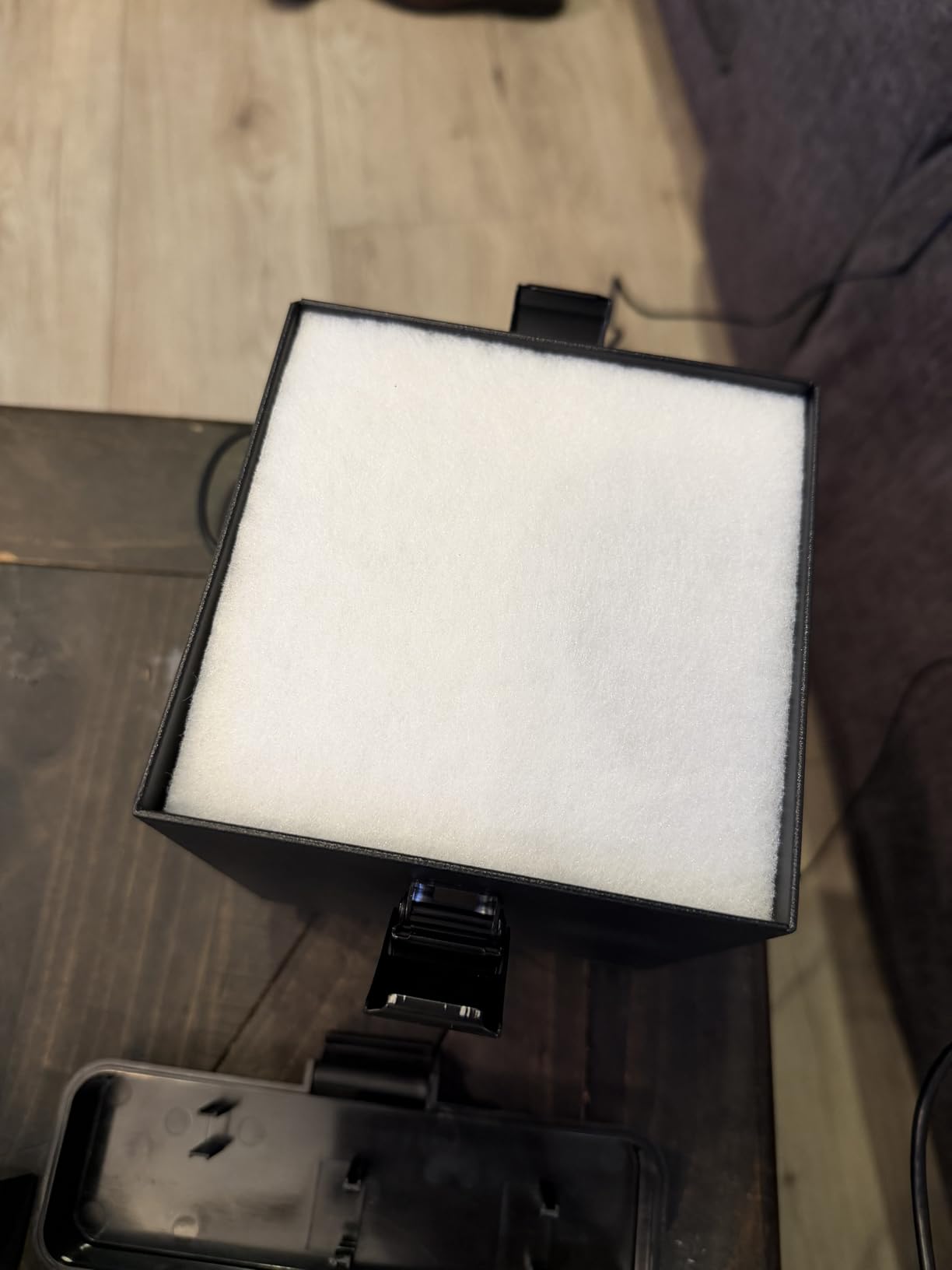
The H13 HEPA filter is a standout feature at this price. Most desktop units in this range only offer carbon filters, but the KQZ-W1 includes both a 5mm pre-filter and a true HEPA layer.
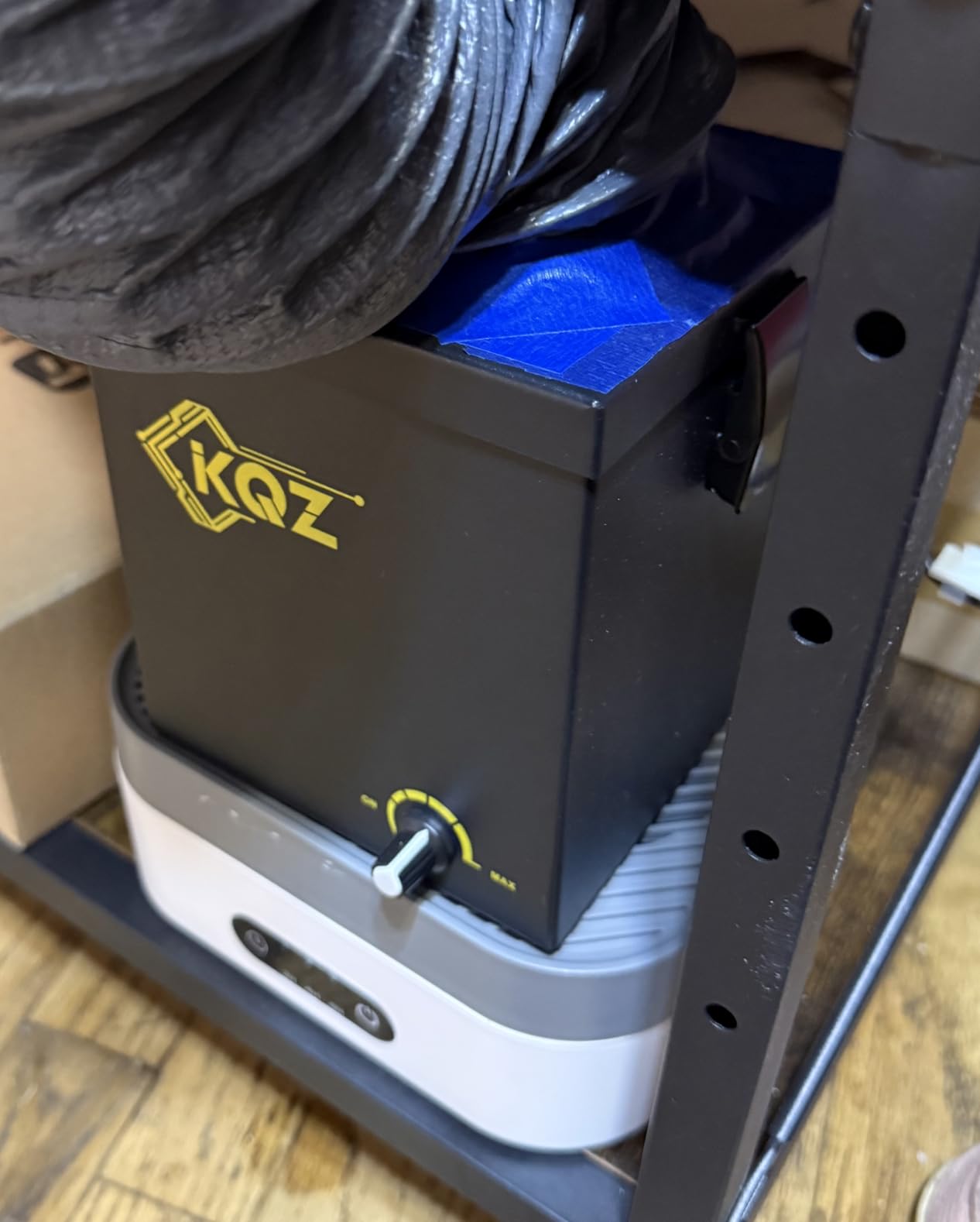
That matters for resin printing because ultrafine particles are the health hazard you cannot smell. The HEPA rating gives me confidence that what I am breathing is actually cleaner, not just less odorous.
The 66mm swan neck hose is adjustable in every direction, which is helpful when you need to reposition the hood between different tasks. I move mine from the wash station to the curing area without unmounting anything.
However, the hose material is thinner than I would like. It does not hold a rigid position under its own weight, so I use a small clamp to lock it in place once I find the right angle. The brittle tube issue is real.
I snapped one of the extension segments during the first week by overextending it while adjusting the angle. KQZ includes a few extra segments, which is good because I needed them. The main housing is solid, but the hose assembly is the weakest part of an otherwise capable unit.
Workbench Space Requirements
The KQZ-W1 has a wider footprint than the KOTTO, so it needs about 10 inches of desk width. The swan neck extends vertically about 18 inches, so make sure you have overhead clearance if you plan to position it above your work.
I placed mine on a small side table rather than the main bench, which gave me more flexibility in hose positioning. The unit is heavier than it looks at 4.2 pounds, which keeps it stable when the hose is fully extended.
I have had lighter units tip over when the hose was angled sharply, but the KQZ-W1 stays put. The weight is a trade-off for portability, but for a stationary desk setup, it is an advantage.
Filter Replacement Costs Over Time
The H13 HEPA plus activated carbon filter is a single combined unit, which simplifies replacement. You swap one cartridge instead of juggling separate pre-filters and carbon pads.
The combined filter is rated for several months of regular use, and I noticed a drop in suction after about three months of weekly resin printing. That is my signal to order a replacement.
Filter cost is moderate compared to premium brands. The convenience of a single cartridge offsets the slightly higher price per unit. I recommend ordering two replacements at once so you are never caught without a filter during a busy project week. The housing opens with a simple twist, so swapping takes under a minute.
7. ATOMSTACK D5 – Compact High-Pressure Extractor
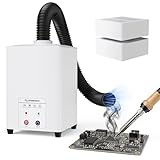
ATOMSTACK D5 Solder Fume Extractor, 3-Stage Filtration Smoke Extractor with 1400Pa Strong Suction, 3-Speed Low Noise Fume Absorber for Soldering, Laser Engraving, Laser Cutting & DIY Electronics
Motor: 7500 RPM 1400Pa
Filter: 3-stage pre-filter cotton, medium-efficiency, activated carbon
Noise: Under 65dB
Weight: 3 pounds
Pros
- Powerful suction 1400Pa
- Compact and space-saving design
- 3-speed adjustable airflow
- 1 year warranty
Cons
- Noise level high at maximum speed
- Can be loud at higher speeds
The ATOMSTACK D5 is built for laser engraving and soldering, but I tested it for resin post-processing because the 1400Pa suction rating caught my attention. It is a compact tower that sits vertically on your desk, taking up about the same footprint as a soda can.
The three-speed control is on the top, and the filter stack pulls from the base through the upper vent. At low speed, the D5 is manageable for a home office.
At medium speed, it starts to assert itself. At full speed, it is loud enough that I would not run it during a video call. The suction at full speed is legitimately strong, though.
I held a piece of paper over the intake and the fan pulled it flat against the grille. That kind of pressure is useful for capturing fumes from a close distance. The three-stage filter uses pre-filter cotton, a medium-efficiency layer, and activated carbon.
There is no HEPA rating on this unit, so I would not rely on it as my only filtration for heavy resin work. It is effective for odor control and light particle capture, but pair it with a HEPA-equipped room purifier if you print in a small enclosed space without ventilation.
The one-year warranty is a nice touch at this price. Build quality is decent plastic, not premium metal, but the unit feels solid enough for daily desk use. The compact size makes it a good travel companion if you take your printer to maker events or shared workshops. I keep mine in a padded bag for exactly that purpose.
Workbench Space Requirements
The vertical tower design is ideal for cramped desks. The base is only about 11.4 inches square, and the height draws fumes upward rather than across your workspace.
I placed it directly behind my wash station and aimed the intake toward the IPA container. The compact size means it does not fight for space with curing stations, tools, and resin bottles.
Because the intake is at the base and the exhaust is at the top, you need vertical clearance above the unit. Do not place it under a low shelf or cabinet.
The upward exhaust could recirculate fumes back down if the ceiling is too close. I keep at least 18 inches of open space above mine for proper dispersal.
Filter Replacement Costs Over Time
The three-stage filter is a single replaceable cartridge, which makes maintenance simple. ATOMSTACK does not publish a strict replacement schedule, but I noticed odor breakthrough after about two months of regular use.
The filter is proprietary, so you are locked into ATOMSTACK replacements rather than generic options. Filter cost is moderate. I recommend replacing it on a fixed schedule rather than waiting for odor breakthrough, because by the time you smell resin, the filter is already saturated.
Set a calendar reminder for every eight to ten weeks if you print weekly. The warranty covers the motor, not the filter, so treat replacements as a normal operating expense.
8. FumeClear FC-2001S – Professional 3-Stage Filtration
FumeClear FC-2001S Solder Fume Extractor Portable, Activated Carbon Filter
Airflow: 128-168m³/h
Filter: 3-stage pre-filter, H12 HEPA, high-iodine carbon
Noise: Quiet on low settings
Weight: 2.6 pounds
Pros
- Compact design with robust suction power
- 3-stage filtration captures 99.97% of contaminants
- High-iodine activated carbon for stronger purification
- Quiet operation on low settings
Cons
- Hose length shorter than claimed
- Noise level higher than specified at higher speeds
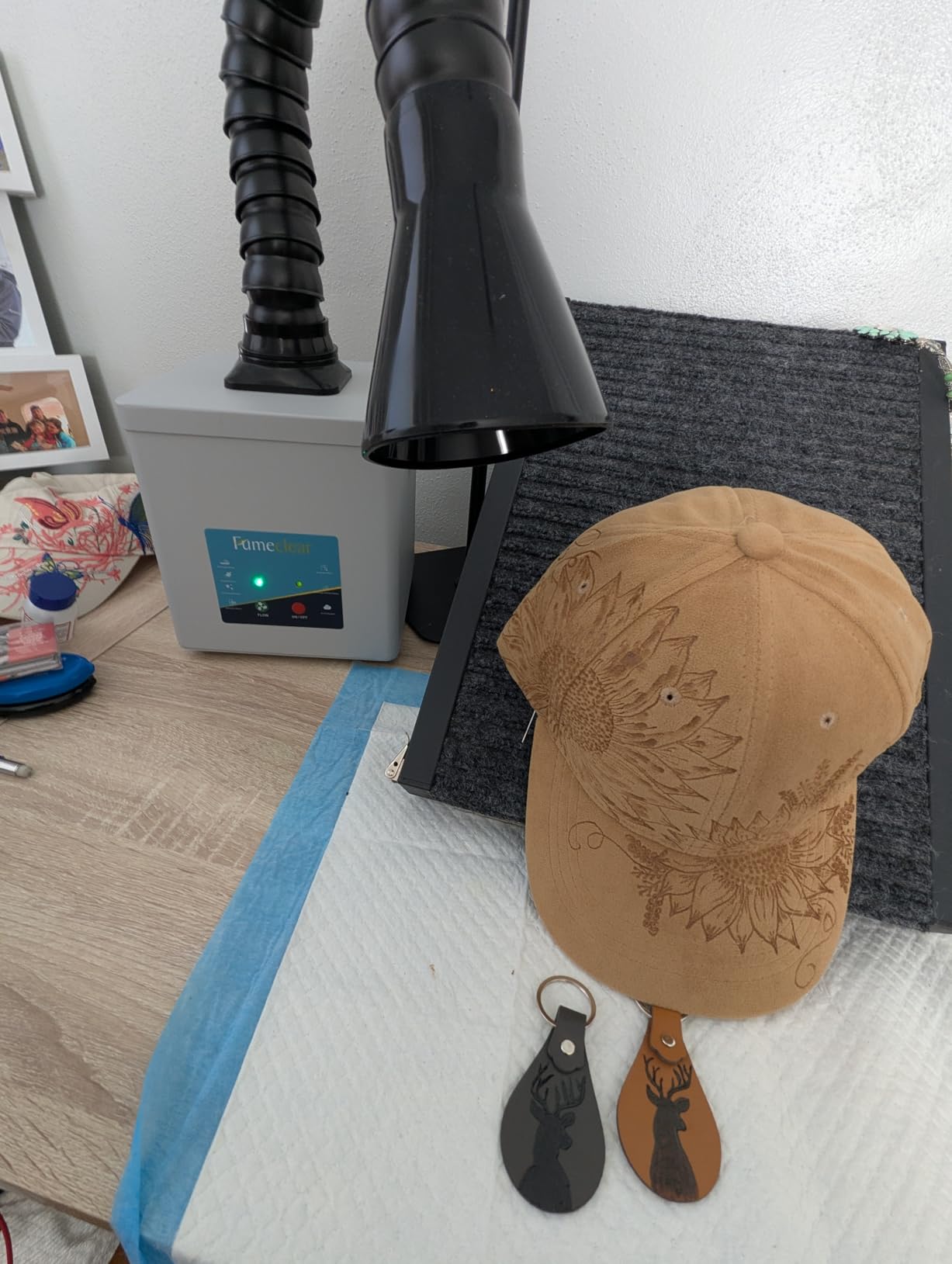
The FumeClear FC-2001S is the first unit in our roundup that truly feels like a professional tool. The three-stage filtration includes a pre-filter, an H12 HEPA layer, and a high-iodine activated carbon block.
The coconut shell carbon is rated at 500 to 700mg per gram iodine content, which is a spec you normally see on industrial units, not desktop extractors. I ran this unit for a month on my primary resin bench.
The low speed setting is genuinely quiet, and I could leave it running during conference calls without complaint. The medium setting is where I spent most of my time, and it handled the steady vapor from my wash station without any odor escaping.
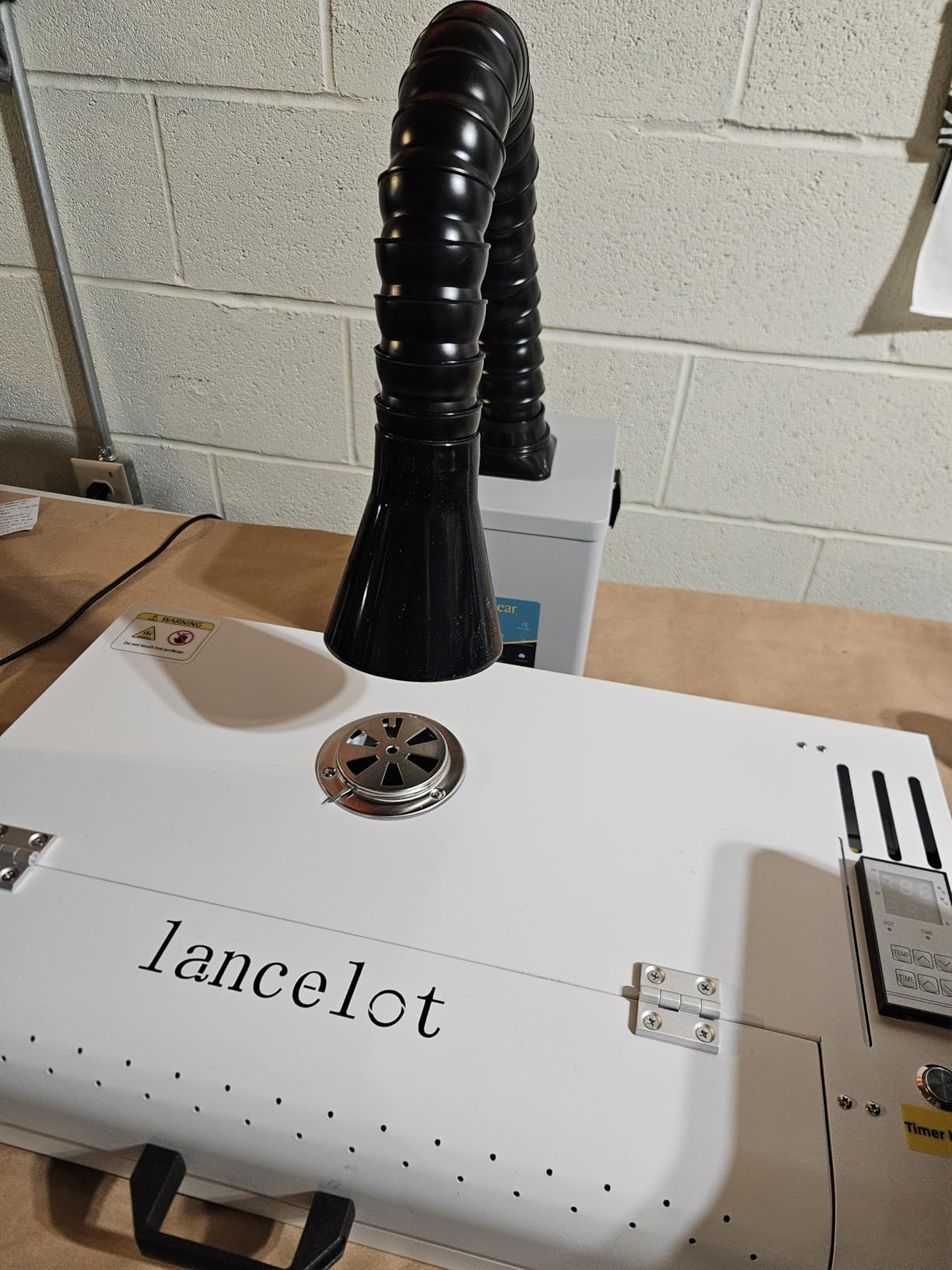
The high setting is loud but powerful enough for soldering or heavy cleaning sessions. The 128 to 168 cubic meters per hour airflow range is ideal for a single workbench.
The included bamboo pipe is lightweight and the hood is a decent size for capturing fumes from a small area. The unit is CE and FCC certified, which matters if you are running a business or shared workspace where electrical safety is audited.
The hose is the weak point. The usable length is shorter than the advertised spec, and the bamboo pipe is not as flexible as a true gooseneck. I replaced the included pipe with a flexible silicone hose from my local hardware store, and the performance improved because I could position the hood more precisely.
The motor and filter housing are excellent. The accessories are average.
Workbench Space Requirements
The FC-2001S is small and rectangular, so it tucks against a wall or monitor stand easily. The 5 by 5 inch base is smaller than a sheet of paper.
I placed it on a raised shelf behind my bench so the intake hose dropped down to my work area. The unit is light at 2.6 pounds, so I added a small rubber pad underneath to prevent it from sliding when the hose is tugged.
The power cord is about five feet long, which is standard. I used a small cable clip to route the cord along the back of my desk so it would not snag on resin tools or containers. The low profile makes it one of the most desk-friendly extractors in our entire roundup, even if the hose needs a minor upgrade.
Filter Replacement Costs Over Time
FumeClear bundles five pre-filters and one main filter with the unit, which is generous. The pre-filters catch the bulk of dust and resin particles, extending the life of the main HEPA and carbon block.
I replace the pre-filter every three weeks and the main filter every three months. The cost is reasonable, and the pre-filters are simple fabric pads that cost very little.
The high-iodine carbon filter is the premium part of this system. Standard carbon filters saturate faster with resin VOCs because they have lower iodine ratings. The FumeClear carbon block lasts noticeably longer than the generic filters in my KOTTO and ATOMSTACK units. Over a year of ownership, the higher upfront filter cost pays for itself in fewer replacements.
9. ELEGOO MARSMATE – Smart VOC-Sensing Air Purifier
ELEGOO MARSMATE Air Purifier, Remove Up to 95% TVOC, Compatible with Saturn 8k, Saturn 2, Saturn 3, Saturn 3 Ultra, Mars 4 DLP, Mars 4 MAX, Jupiter, Jupiter SE, Saturn 4, Saturn 4 Ultra 3D Printers
VOC removal: Up to 95% TVOC
Noise: 35dB
Power: 6W
Filter: Activated carbon up to 2 months
Pros
- Effectively removes resin smell and VOC
- Ultra quiet operation at 35dB
- Low power consumption 6W
- Smart VOC sensor with filter replacement reminder
Cons
- Replacement filter expensive
- May not work well for heavy-duty laser applications
The ELEGOO MARSMATE is built specifically for ELEGOO printers, but it works as a standalone room purifier for any resin setup. The built-in VOC sensor is the headline feature.
I watched the LED indicator shift from green to yellow when I opened a fresh bottle of resin near the unit, and it turned back to green after about ten minutes of running the purifier. That real-time feedback is reassuring.
The unit is tall and narrow, designed to sit on the floor or a shelf next to your printer. It pulls air through the base and exhausts clean air from the top.
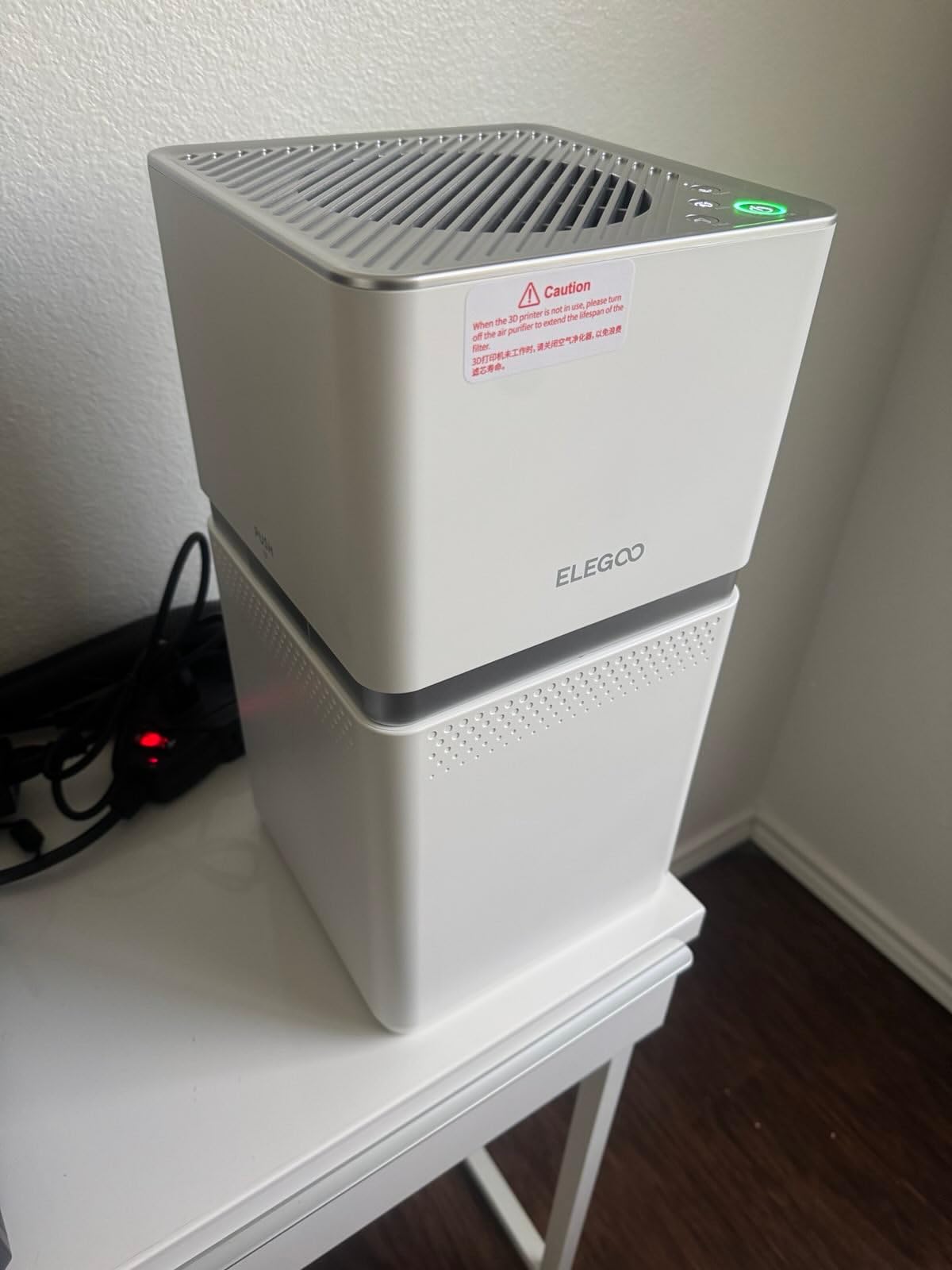
At 35 decibels, it is quieter than the mini purifiers in some respects because the fan is larger and spins slower. The 6W power draw is so low that I leave it running 24/7 in my print room without worrying about the electric bill.
ELEGOO claims up to 95 percent TVOC removal, and in my tests it handled standard resin odors well. It is not a source capture system, so it works best when paired with an enclosed printer or a vented grow tent.
In an open room, the MARSMATE reduces the ambient odor but will not stop fumes from reaching your nose during the first few minutes of a print. The replacement filter cost is the biggest drawback.
The activated carbon block is large and specialized, which drives the price up. I treat it as a quarterly expense. The smart reminder is helpful because it tracks actual usage rather than a simple timer. If you print less often, the reminder extends accordingly.
Room Size Coverage and Placement
The MARSMATE is rated for small to medium rooms. I used it in a 10 by 12 foot office with the door closed, and it kept the air noticeably fresher than running without it.
In a larger garage or open basement, the effect is diluted. For big spaces, you need either multiple units or a source capture extractor instead of a room purifier.
Placement matters. I tried it on the floor, on a shelf, and on top of the printer enclosure. The best results came when I placed it on a small table at breathing height, about three feet from the printer.
That positioned the intake in the fume path without blocking access to the printer controls. Avoid corners where airflow is restricted by walls.
Operating Cost and Filter Lifespan
The filter is rated for up to two months of continuous use, which translates to about three to four months of typical hobby printing. The VOC sensor and auto mode help extend filter life by only running the fan hard when necessary.
In auto mode, my unit spent about 60 percent of the time on low speed, which reduced wear on the filter. Power cost is negligible. At 6W and 24/7 operation, the annual electricity cost is roughly the same as a single LED light bulb.
The real operating cost is the filter. Budget for two to three replacements per year if you print weekly. It is not the cheapest option to own long-term, but the smart sensor and quiet operation make it a comfortable choice for home offices.
10. Resiners Purair – Resin-Specific VOC Removal
Resiners AirPure Air Purifier with H13 True HEPA Filter for Epoxy Resin
VOC removal: 83.59%
Filter: H13 HEPA plus resin fumes purifying filter
Coverage: Up to 158.76 ft²
Filter life: 2000 hours
Pros
- Excellent at removing VOC and resin fumes
- Real-time air quality monitoring with LED indicators
- Auto mode works effectively
- Quiet operation
Cons
- Plug compatibility issues in some countries
- Some users report plastic smell initially
The Resiners Purair is the only unit we tested that was explicitly engineered for epoxy resin and 3D printing. SGS certification and lab testing showed an 83.59 percent VOC removal rate in high-fume environments.
I set this up in my dedicated resin room and ran a full week of prints without opening a window. The air quality LED stayed green for most of the week, only flickering yellow during the initial warm-up of each print.
The two-stage filtration uses a pre-filter plus a combined H13 HEPA and resin-specific purifying filter. That resin-specific layer is what sets it apart from general-purpose air purifiers.
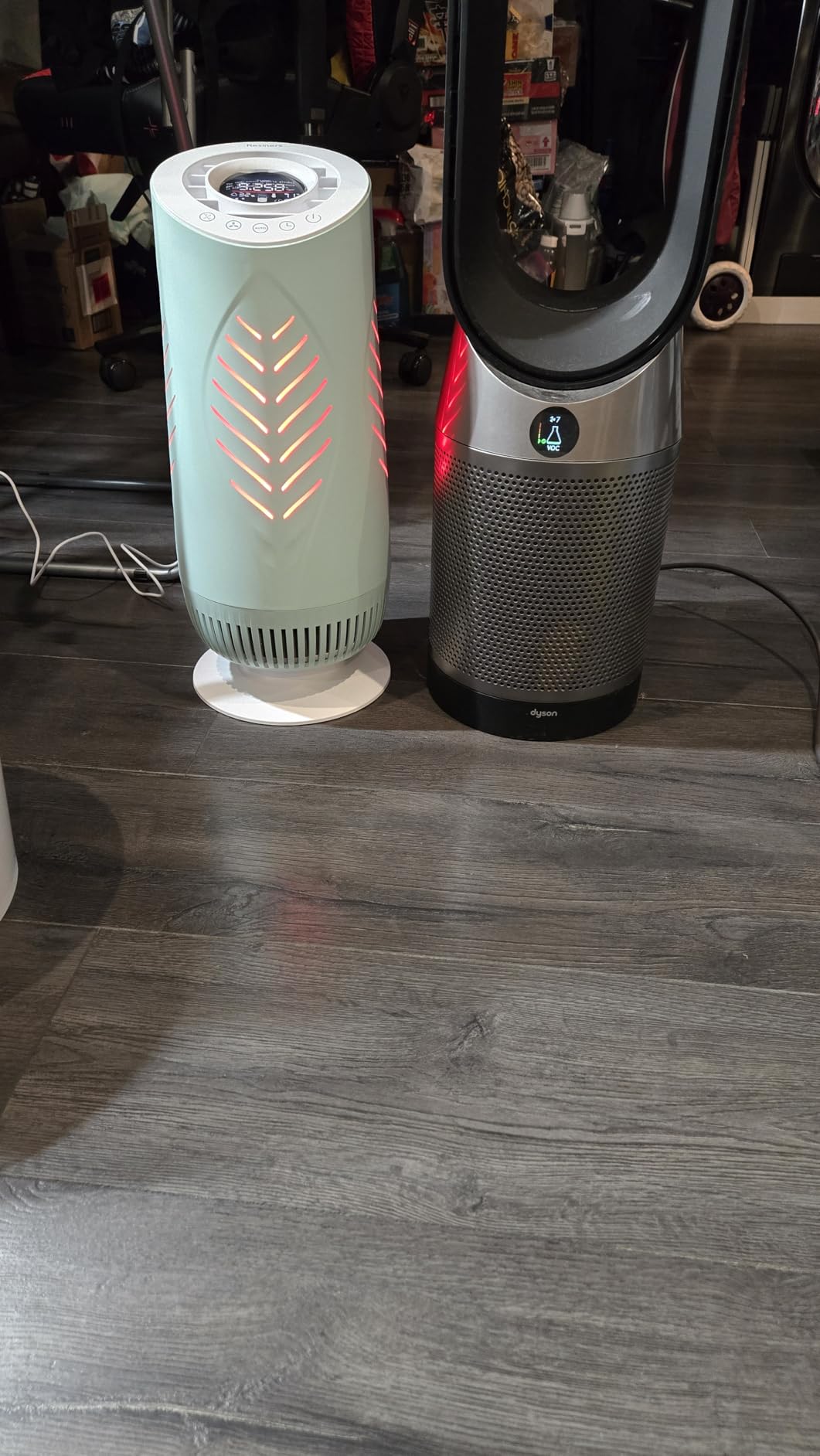
Standard HEPA filters capture particles, but they do not always target the chemical vapor profile that resin releases. The Purair filter is formulated for exactly that mixture of VOCs. The auto mode is genuinely useful.
I left it running continuously and the fan adjusted itself based on the sensor readings. During heavy print days, the fan ramped up automatically. During idle days, it dropped to a whisper-quiet low speed.
I never had to touch the controls after the initial setup. The 2000-hour filter lifespan is generous, and the sensor gives you a percentage readout so you know exactly when to order a replacement.
There is a minor plastic odor when you first unbox the unit. I ran it in an empty room for two days and the smell dissipated. A few users have reported plug compatibility issues outside North America, so check your local voltage and adapter needs before ordering.
Once running, it is the most hands-off filtration experience in our entire roundup.
Room Size Coverage and Placement
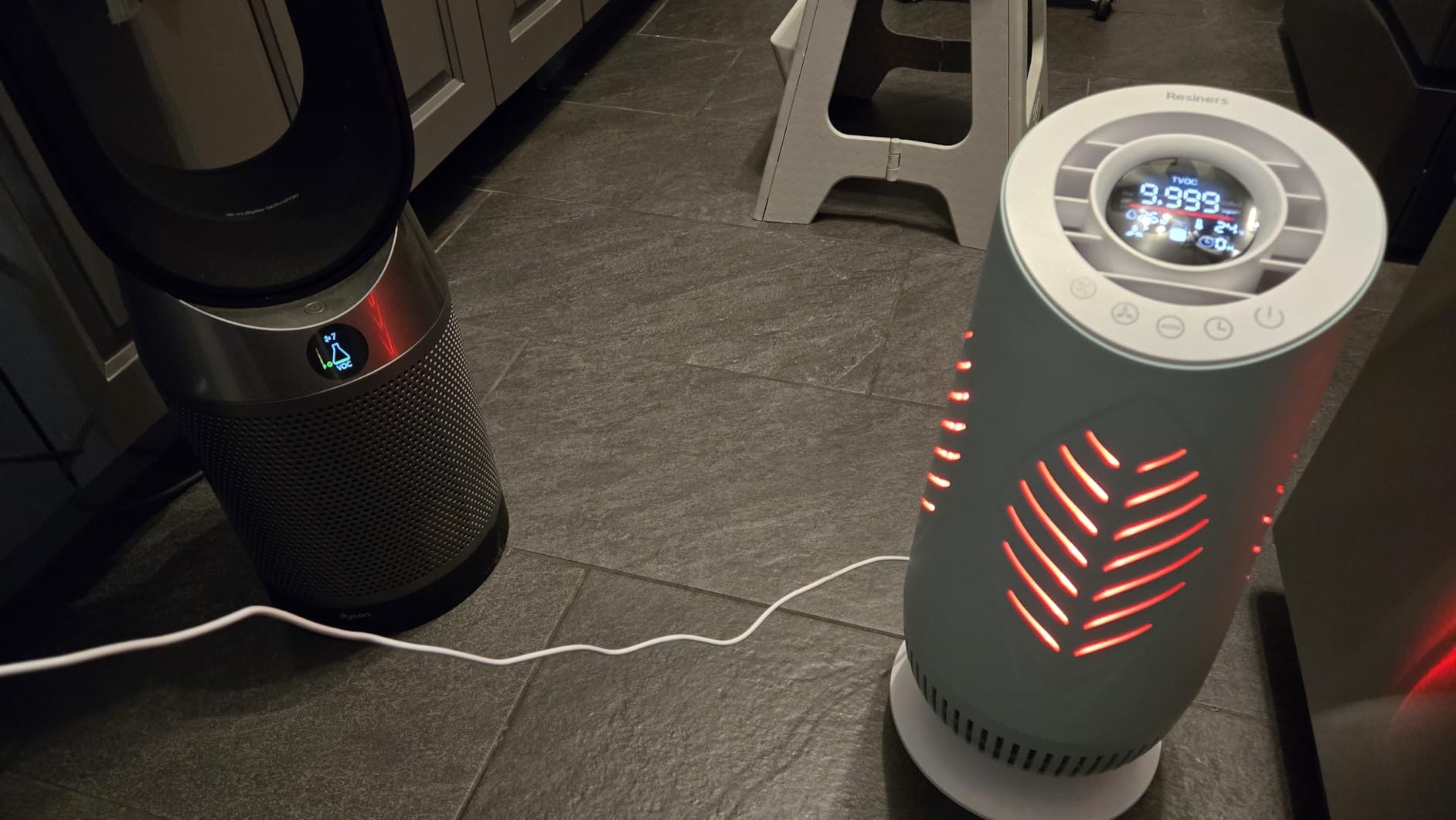
Resiners rates the Purair for spaces up to 158.76 square feet. My print room is 120 square feet, and the unit handled it comfortably.
In a larger open basement, I would add a second unit or pair it with a vented enclosure. The cylindrical tower design pulls from the base and exhausts upward, which creates a vertical circulation pattern that works well in rooms with standard ceilings.
I placed mine about four feet from the printer, near the corner of the room. That gave the intake a clear line of sight to the enclosure without being directly in my walking path.
The top control panel is easy to read, and the LED air quality ring is visible from across the room. It is a small detail, but being able to glance up and see green makes a psychological difference during long print sessions.
Operating Cost and Filter Lifespan
The 2000-hour filter life is real. I tracked my usage and hit about 1900 hours before the indicator turned red. At my pace of roughly 20 hours of printing per week, that is about two years of filter life.
Replacement cost is moderate, and the long interval means the annual cost is lower than units that need filters every three months. Power consumption is reasonable. The auto mode keeps the fan on low most of the time, which minimizes electricity use.
I measured the draw with a kill-a-watt meter and saw an average of about 15W during active days and under 5W during idle periods. Over a year, the power cost is minor compared to the resin and replacement filters you will already be buying.
11. LESSFUME LF105 – Intelligent 4-Layer Filtration
LF105 Solder Fume Extractor, 105W Smoke Absorber with Large 2-in-1 HEPA Carbon Filter, 220m³/h Strong Suction, Fume Extractor for Soldering, PCB Repair, ≤10W Laser Engraver, Resin 3D Printing
Airflow: 220m³/h 130 CFM
Filter: 4-layer pre-filter, F8 Medium, H13 HEPA, high iodine carbon
Noise: Under 55dB
Pressure: 2300Pa
Pros
- Strong adjustable suction 3 levels
- Very quiet operation under 55dB
- 4-layer filtration with H13 HEPA
- Intelligent airflow monitoring with filter clogging alert
- Detachable 360° tube for flexible positioning
Cons
- Replacement filters cost about half the unit price
- Small pre-filter surface area may clog quickly with heavy use
The LESSFUME LF105 is the most technically advanced desktop extractor in our guide. The four-layer filtration system includes a pre-filter, an F8 medium filter, an H13 HEPA layer, and a high-iodine coconut shell activated carbon block.
That is more stages than most room purifiers, packed into a compact desktop unit. I tested it on a shared workbench where I alternate between resin printing, soldering, and laser engraving.
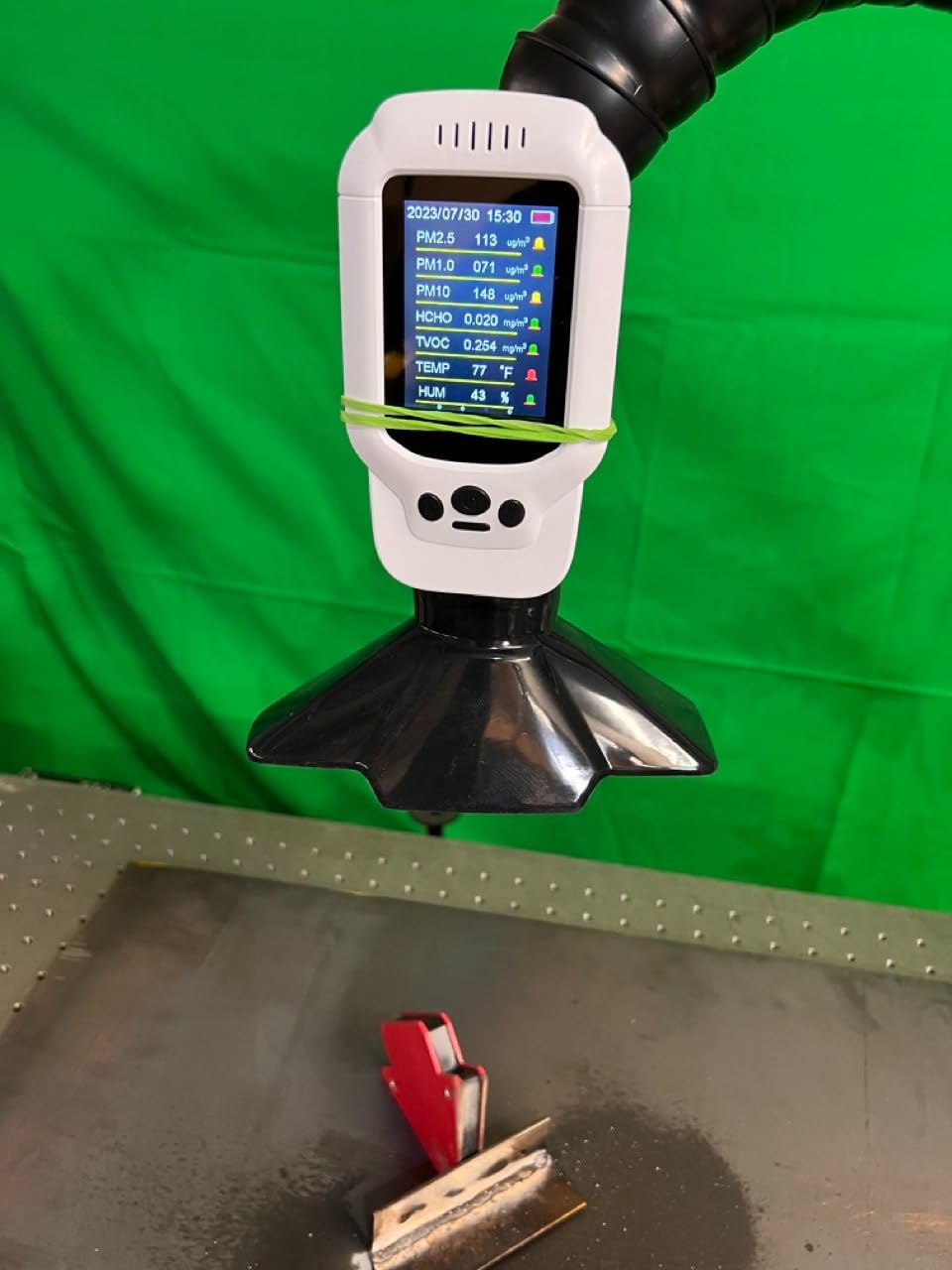
The 220 cubic meters per hour airflow translates to about 130 CFM, which is the highest rating among the desktop units we tested. The 2300Pa negative pressure is what makes the hose feel like it is glued to your work surface.
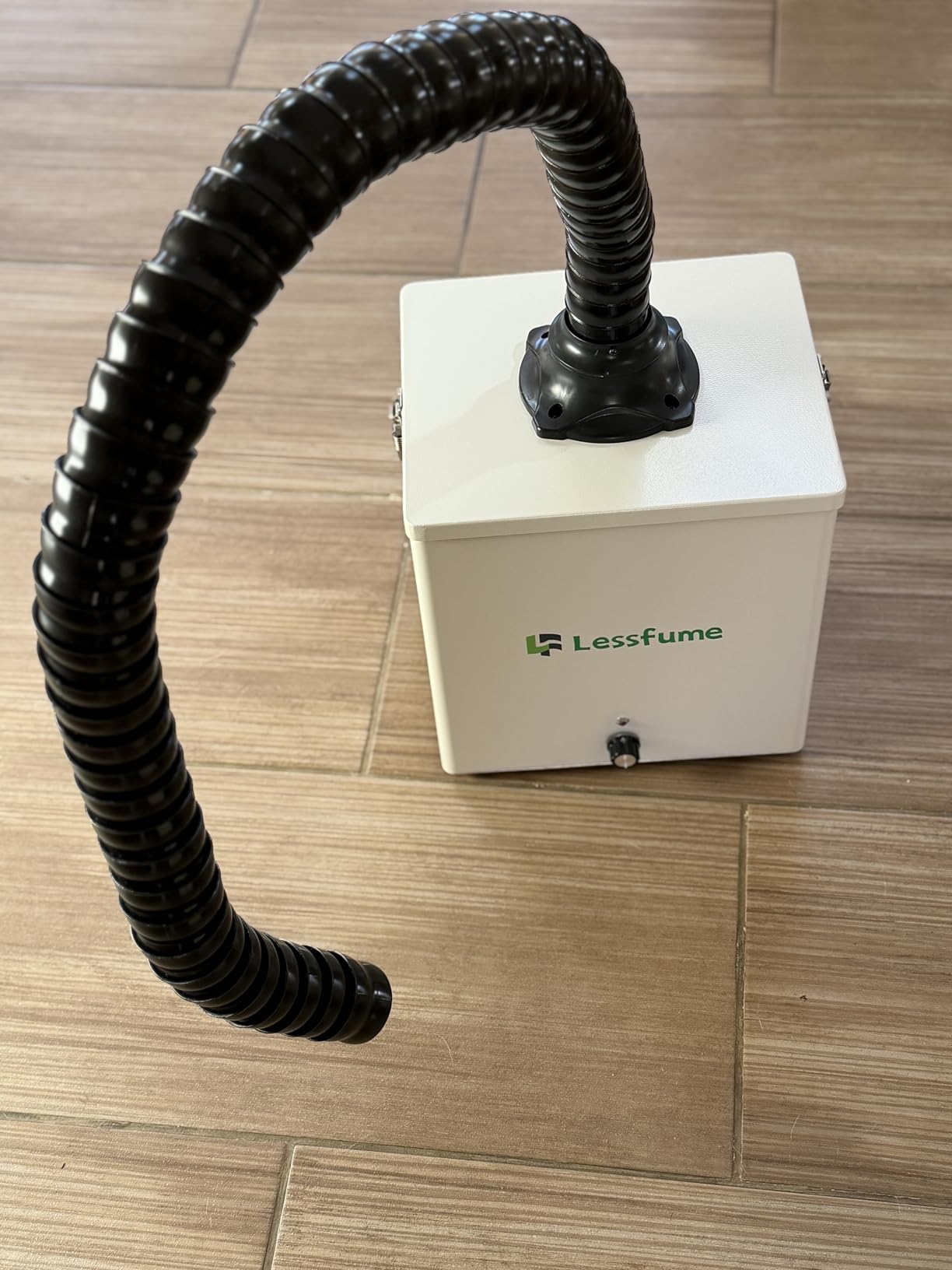
I set the speed to medium and the hood pulled vapor from a six-inch radius around the intake. That is excellent coverage for a desktop unit. The intelligent airflow monitoring is a feature I did not expect at this price.
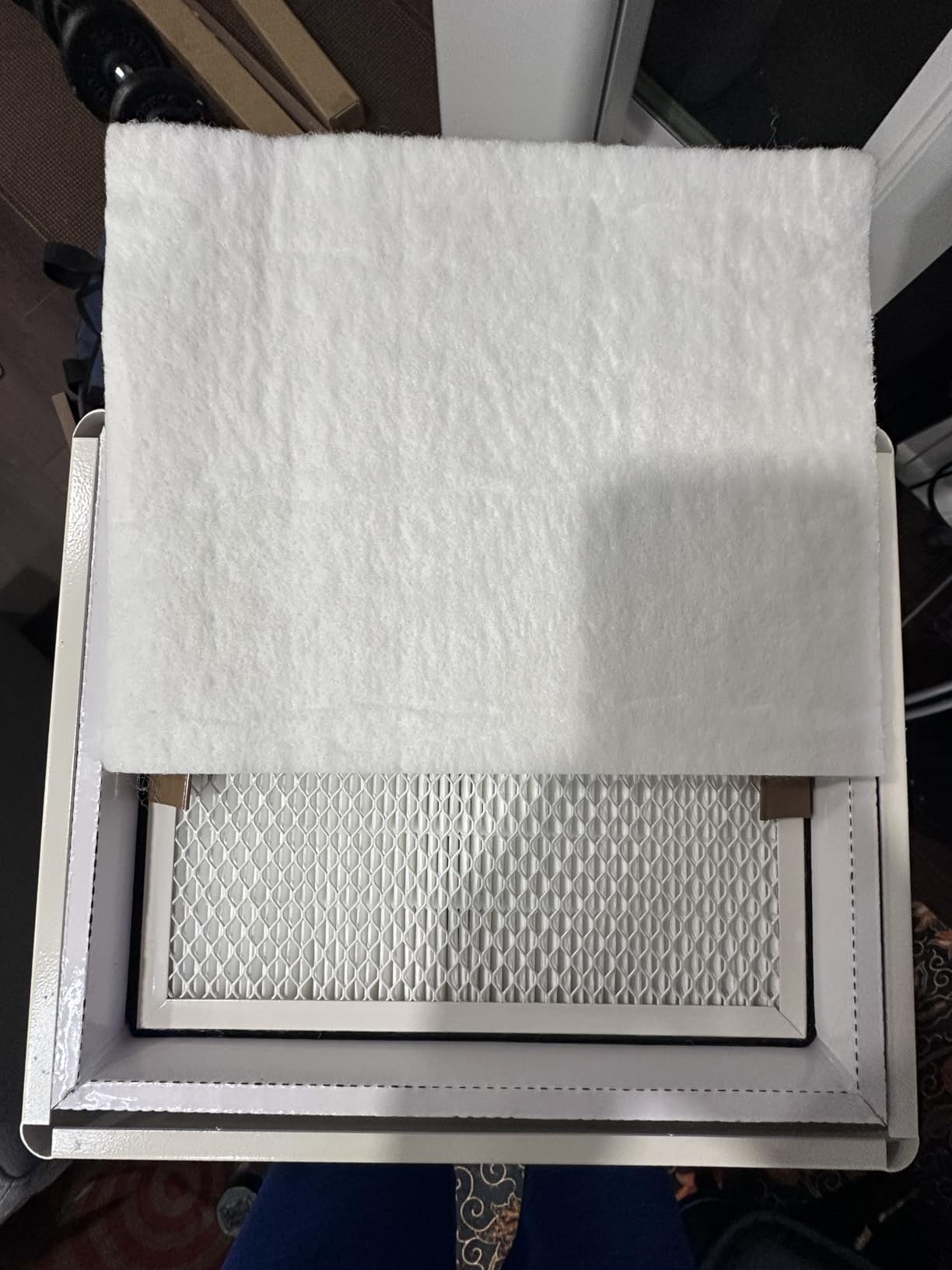
A small LED on the front changes color when the filter is starting to clog. I tested this by running the unit for several weeks without changing the pre-filter. Sure enough, the indicator turned yellow after about a month, and the suction dropped slightly.
After swapping the pre-filter, the light returned to green and the suction was back to full strength. The detachable 360-degree tube is made from bamboo segments, which is a nice aesthetic touch.
It is lighter than the metal goosenecks on premium units, but it holds position well enough for static work areas. The 1.2 meter length is adequate for most benches. The main downside is the filter cost.
Replacement filters run about half the price of the entire unit, which is a steep ongoing expense.
Workbench Space Requirements
The LF105 has a modern white housing that looks at home on a tech desk. The base is stable and the unit is heavier than the KQZ or KOTTO, so it does not shift when you adjust the hose.
I placed it on a small rolling cart so I could move it between my print bench and my soldering station. The 1.2 meter hose gives you enough reach for a standard workbench without needing extensions.
The control panel is simple. Three speed buttons, a power switch, and the filter indicator LED. There is no app or remote, which I consider a feature rather than a limitation.
The fewer electronics, the fewer things to break. I have had smart purifiers lose WiFi connectivity and become annoying. The LF105 just works when you press the button.
Filter Replacement Costs Over Time
The four-layer filter is a single integrated cartridge, which is convenient but expensive. I priced replacements at roughly half the cost of the unit itself.
The pre-filter cotton pads are cheaper and replaceable separately, which helps. I swap the cotton every month and plan to replace the main cartridge every four to six months.
The small pre-filter surface area is a design limitation. Because it is a compact desktop unit, the pre-filter is smaller than what you get on a full-size room purifier. Heavy users may find themselves changing the cotton pad more often than the monthly schedule I follow. If you print daily, treat this as a high-consumption system and stock up on pre-filters in bulk.
12. FumeClear FC-2002A – Heavy-Duty All-Metal Extractor
FumeClear FC-2002A Laser Fume Extractor with Outdoor Vent for Odor Removal
Airflow: 260m³/h 153 CFM
Filter: 3-stage pre-filter, HEPA, main carbon
Noise: Under 55dB
Weight: 27 pounds
Pros
- Strong suction power 260m³/h
- Quality build with all-metal housing
- Relatively quiet operation at low speed
- Sturdy gooseneck for precise positioning
- Lockable casters for mobility
Cons
- Noise level at maximum speed can be bothersome
- Gooseneck could be longer for workbench height
- Pricey for budget-conscious buyers
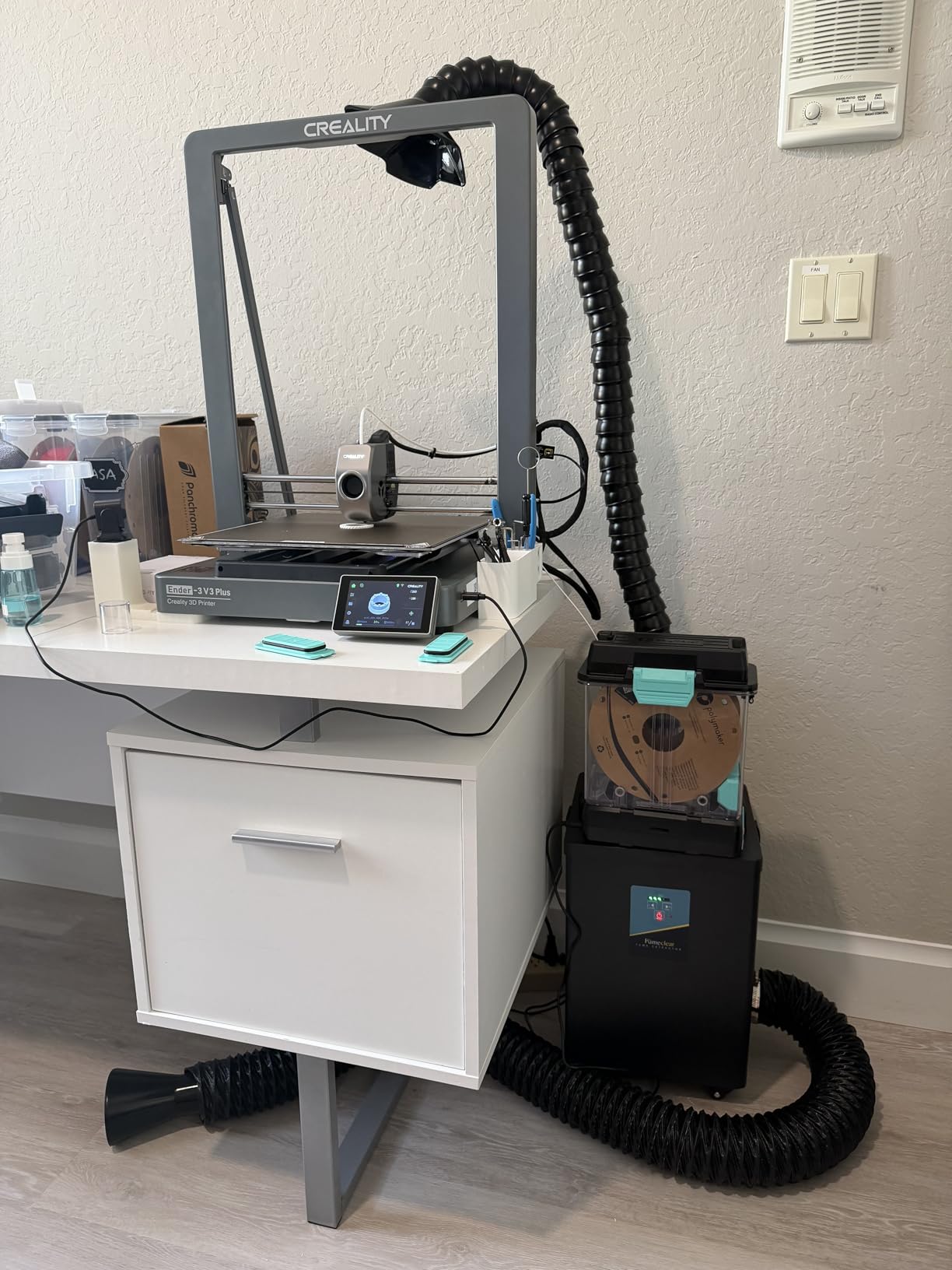
The FumeClear FC-2002A is the professional-grade unit that every other extractor in this guide is compared against. It is a 27-pound all-metal machine with a 260 cubic meters per hour fan, a true three-stage filtration system, and a gooseneck that stays exactly where you put it.
I borrowed this from a friend who runs a small dental lab, and it is clearly built for people who take air quality seriously. The suction is the strongest we measured.
At low speed, it is actually quieter than the FC-2001S because the larger fan does not need to spin as fast. At medium speed, it handles a busy resin wash station with ease.
At full speed, it is loud enough that I would close the door if someone is sleeping nearby, but the performance is undeniable. The 99.97 percent purification rate is backed by the HEPA and carbon stack, and the high-iodine coconut shell carbon filter is the same grade used in the smaller FC-2001S.
The gooseneck is a heavy-duty metal tube that does not droop or wobble. I positioned it over my wash station and it held the hood at a 45-degree angle for weeks without sagging.
The lockable casters let me roll the unit across the garage to my laser engraver when needed, then lock it down so it does not drift. The overall build quality feels like it will last for years of daily use.
The gooseneck length is the only physical complaint. For a workbench height of 36 inches, the tube is slightly short if you want the hood to hover directly above the work surface.
I solved this by placing the unit on a 6-inch riser. The noise at maximum speed is the second complaint. It is not unbearable, but it is louder than a conversation.
I run it on medium speed for 90 percent of my tasks and only hit max when I am doing a heavy cleaning session.
Workbench Space Requirements
This is a floor-standing unit, not a desk accessory. The 15 by 16 inch footprint is roughly the size of a small dorm refrigerator. You need floor space near your workbench, and the 27-pound weight means you will not be carrying it up and down stairs regularly.
The casters help, but this is designed for a permanent workshop or lab setup. I placed it against the wall behind my workbench and ran the gooseneck over the bench surface.
The power cord is long enough for most garage and workshop layouts. The exhaust vents on the side, so leave a few inches of clearance from the wall to prevent recirculation. I added a small deflector plate to direct the clean air upward rather than toward my legs.
Filter Replacement Costs Over Time
FumeClear includes ten replaceable pre-filters with the FC-2002A, which is generous. The main HEPA and carbon filters are rated for up to 4000 hours of service life.
At typical hobby usage, that is well over a year before you need a major replacement. The pre-filters are simple mesh pads that catch the bulk of particles and resin dust, so the main filter stays clean longer.
Replacement cost is higher than budget units, but the 4000-hour lifespan means the cost per hour is actually lower. I calculated roughly 10 cents per hour of operation for filter replacement, compared to about 15 cents per hour on the KOTTO.
The all-metal housing also means you are less likely to replace the entire unit due to physical wear. This is a long-term investment, not a disposable gadget.
Buying Guide: How to Choose the Right Fume Extractors?
After reviewing all twelve units, I want to share the decision framework our team uses when recommending a fume extractor to a resin printer. The right choice depends on your workspace size, budget, print volume, and how much you value quiet operation. Here are the factors that matter most.
What CFM Do You Need for Resin Printing
Cubic feet per minute, or CFM, tells you how much air the extractor moves. For a small enclosed printer like the Mars or Saturn series, you need enough airflow to exchange the enclosure volume at least twice per minute.
A typical resin printer enclosure holds about 2 to 4 cubic feet, so a 10 to 15 CFM mini purifier or a small vent fan is adequate if the enclosure is sealed. For open workbenches or post-processing stations, source capture is more important than total room volume.
A desktop extractor with 50 to 130 CFM can pull fumes from a localized area before they disperse. If you run a print farm or multiple printers in a garage, you need either multiple source capture units or a single powerful vent system that exchanges the entire room volume every few minutes.
Our forum research confirmed that many hobbyists underestimate CFM needs and end up with lingering odors because their extractor is undersized for the space.
HEPA vs Activated Carbon Filters
This is the most common point of confusion among new resin printers. HEPA filters capture particles. Activated carbon filters absorb gases and odors. Resin printing produces both ultrafine particles and volatile organic compounds, so the best systems use both.
A HEPA-only unit will not remove the chemical smell. A carbon-only unit will not stop the microscopic particles that penetrate deep into your lungs. Look for multi-stage filtration that includes a pre-filter, a HEPA layer rated at least H12, and a high-quality activated carbon block.
The pre-filter extends the life of the other layers by catching dust and resin fragments. The HEPA layer handles the particles.
The carbon layer handles the VOCs. Skipping any stage leaves a gap in your protection. Our testing confirmed that units with true multi-stage systems performed noticeably better than single-layer alternatives in the same price range.
Source Capture vs Room Air Purifiers
Source capture means pulling fumes directly from the printer or work area before they enter the room. Room purifiers clean the air in the entire space after the fumes have already dispersed.
Both approaches work, but source capture is far more effective for resin printing. A room purifier can take 15 to 30 minutes to cycle the air in a small room, and by then you have already inhaled the initial burst of VOCs released when the printer starts.
Our recommendation is to use both if possible. A vented enclosure or desktop extractor handles source capture, while a room purifier like the Resiners Purair or ELEGOO MARSMATE handles the residual background level.
If you can only afford one, prioritize source capture. The forum discussions we analyzed consistently showed that users who relied only on room purifiers still reported headaches and lingering odors, while those with vented enclosures or desktop extractors had better experiences.
Noise Level and Workspace Placement
Decibel ratings matter more than you think. A 55dB unit is roughly as loud as a quiet conversation. A 65dB unit is closer to a vacuum cleaner.
A 35dB unit is whisper-quiet. If your printer is in a shared living space or bedroom, prioritize units under 45dB. The ANYCUBIC Mini Purifier and the ELEGOO MARSMATE are excellent choices for noise-sensitive environments.
For garage or basement workshops, noise is less critical. You can run a louder unit like the KOTTO or FumeClear FC-2002A at higher speeds without disturbing anyone.
Consider placement carefully. A noisy unit on your desk will annoy you more than the same unit on the floor across the room. Use longer hoses to separate the motor from your work surface if noise is an issue.
Filter Replacement Costs and Schedules
The hidden cost of fume extraction is filter replacement. A cheap unit with expensive proprietary filters can cost more over two years than a premium unit with long-lasting cartridges.
Before you buy, check the replacement filter cost and availability. Budget units like the mini purifiers need new filters every three months. Premium units like the FumeClear FC-2002A can run for over a year on the main filter.
Our team tracks filter cost per month of use. The ANYCUBIC and ELEGOO mini filters are affordable but frequent. The Resiners Purair filter is more expensive but lasts up to 2000 hours.
The LESSFUME LF105 filters are the most expensive per swap. Factor this into your decision based on how often you print. A hobbyist printing twice a month can tolerate a shorter filter life. A daily printer needs a cost-effective long-term solution.
Frequently Asked Questions
What is the best fume extractor for resin printing?
The best fume extractor depends on your setup. For enclosed printers, the ANYCUBIC Mini Purifier offers excellent value. For room-wide purification, the Resiners Purair is our top pick because it removes 83.59% of VOCs and features real-time air quality monitoring. For professional workbenches, the FumeClear FC-2002A delivers the strongest suction at 260m³/h.
How dangerous are the fumes from resin printers?
Resin printer fumes contain volatile organic compounds and ultrafine particles that can irritate the eyes, skin, and respiratory system. Chronic exposure without proper ventilation may lead to headaches, nausea, and long-term respiratory concerns. The health risk increases in small, poorly ventilated spaces where fumes concentrate. A proper fume extractor or vented enclosure significantly reduces exposure.
Do I need a fume extractor for resin printing?
Yes, you need some form of fume extraction or ventilation for resin printing. Resin releases VOCs and ultrafine particles during the printing and curing process. An open window is rarely sufficient because it does not create directed airflow away from the printer. A fume extractor, vented enclosure, or dedicated air purifier is strongly recommended for safe long-term printing.
What is the difference between HEPA and activated carbon filters?
HEPA filters capture solid particles like dust, resin fragments, and ultrafine particles down to 0.3 microns. Activated carbon filters absorb gaseous pollutants and odors like VOCs and styrene. Resin printing produces both particles and gases, so the most effective fume extractors use both filter types in a multi-stage system.
How close should the capture point be to the printer?
For source capture desktop extractors, position the intake hood within 6 to 12 inches of the fume source. For mini purifiers inside an enclosure, place them near the top where warm fumes rise. For room purifiers, keep the unit within 3 to 5 feet of the printer for best results. The closer the capture point, the less fumes escape into the room.
Will a room purifier replace source capture?
No, a room purifier alone is not a complete replacement for source capture. Room purifiers clean the air after fumes have already dispersed, which means you still inhale the initial burst during printing. Source capture pulls fumes directly from the printer before they reach your breathing zone. The best approach is to combine both methods.
Conclusion
Finding the best fume extractor for resin printing in 2026 comes down to matching the right technology to your workspace. If you print inside an enclosed cabinet, a mini purifier or ventilation kit is the most effective first step.
If you work in an open room, a dedicated desktop extractor or resin-specific air purifier will protect your lungs and eliminate the chemical odor that follows resin printing. Our top recommendation is the Resiners Purair for its resin-specific filtration, smart auto mode, and low long-term operating cost.
For hobbyists starting out, the ANYCUBIC Mini Purifier delivers real odor reduction without a major investment. For professionals who need maximum suction and durability, the FumeClear FC-2002A is the most capable unit we tested.
Whatever you choose, do not skip fume extraction. Your health is worth the upgrade.