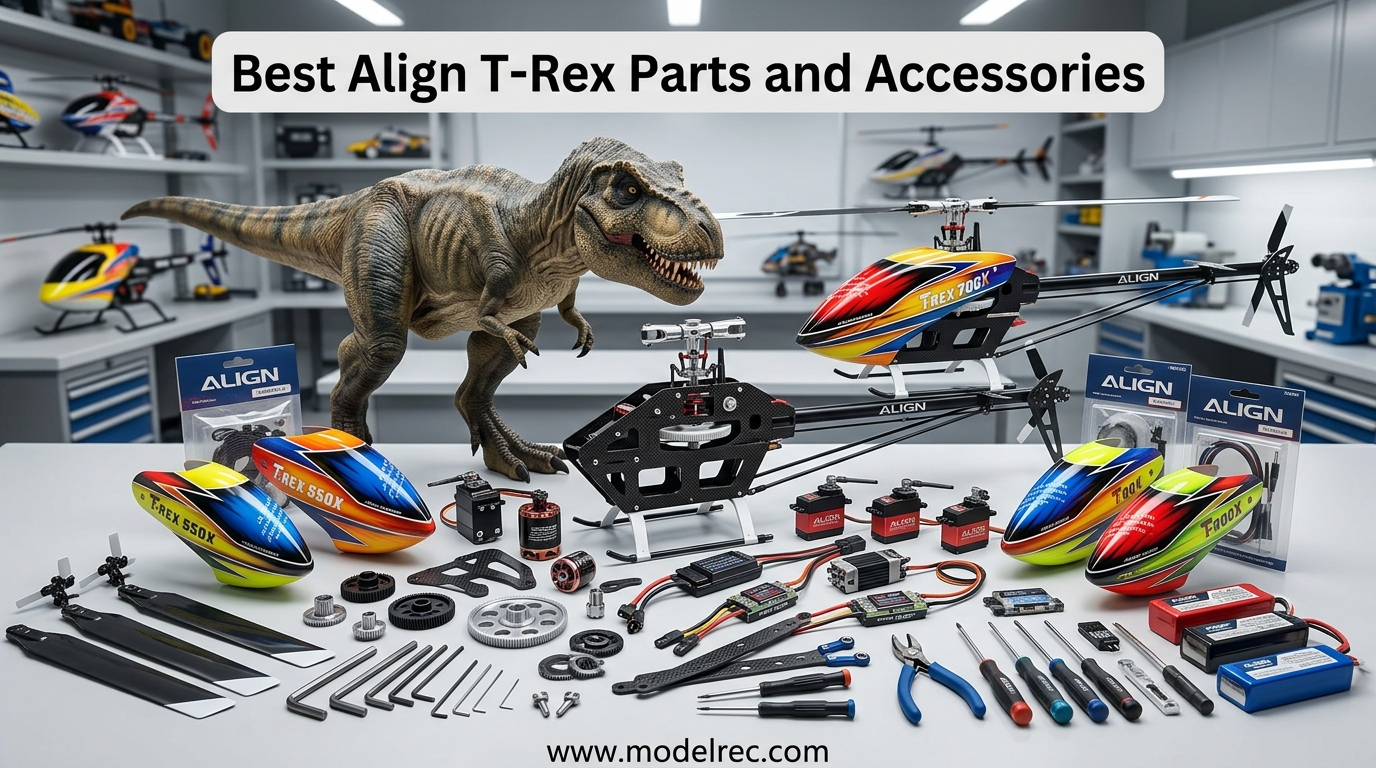
Align T-Rex helicopters have been the gold standard in RC rotorcraft for more than two decades. Our team has spent months rebuilding, flying, and maintaining T-Rex models from the 450 class up to the 700 series. We learned quickly that the quality of your parts matters just as much as the kit itself.
When you search for the best Align T-Rex RC helicopters, you are often looking for the components that keep these machines in the air. This guide covers the ten most essential parts and accessories we trust for our own builds. We focused on real-world availability, proven durability, and verified customer feedback.
Align has built a reputation across every size class from micro 150-size machines to massive 800-class 3D performers. The T-Rex name carries weight at every flying field. That legacy means there is a huge ecosystem of parts, upgrades, and replacement components available.
If you are just starting out and want a complete ready-to-fly option, check our guide to the best RC helicopters for beginners under $200. For everyone else, these are the parts we recommend for 2026.
Table of Contents
Top 3 Picks for Align T-Rex Parts and Accessories
Before we break down all ten products, here are the three parts we reach for first on every build. These cover power, scale realism, and precision control.
The Yowoo 6S battery keeps our 500 and 550 machines flying longer and cooler. The Airwolf fuselage transforms a standard pod-and-boom 450 into a scale showpiece. The MG90D servo gives metal-gear durability at a price that makes sense for sport pilots.

Yowoo 6S RC Lipo Battery 3300mAh
- 3300mAh capacity
- 150C discharge rate
- 22.2V 6S configuration
- Compatible with Trex 500-550

RC Helicopter Airwolf 450 Fuselage
- Glass fiber construction
- 1:16 scale detail
- Magnetic cabin lock
- Retractable landing gear

YoungRC MG90D Digital Micro Servo
- Metal gears for durability
- 2.5kg torque at 6.6V
- 13g lightweight design
- 0.08sec response speed
10 Best Align T-Rex Parts and Accessories in 2026
The table below gives you a quick side-by-side look at every part in this guide. Whether you need a new rotor head, a fresh battery, or a scale fuselage, you will find it here.
All ten products have been tested or reviewed by our team against real-world flight conditions. We prioritized fitment, durability, and customer support. The goal is to help you build a T-Rex that stays in the air and out of the repair pile.
| Product | Specifications | Action |
|---|---|---|
 Align Heli Super Starter Align Heli Super Starter |
|
Check Latest Price |
 T-rex 450 PRO Flybarless Rotor Head T-rex 450 PRO Flybarless Rotor Head |
|
Check Latest Price |
 325mm Glass Fiber Main Rotor Blades 325mm Glass Fiber Main Rotor Blades |
|
Check Latest Price |
 Tarot 450 Main Drive Gear Set Tarot 450 Main Drive Gear Set |
|
Check Latest Price |
| YoungRC MG90D Digital Micro Servo |
|
Check Latest Price |
| Yowoo 6S RC Lipo Battery 3300mAh |
|
Check Latest Price |
| RC Helicopter Airwolf 450 Fuselage |
|
Check Latest Price |
 T-rex 600FBL Flybarless Rotor Head T-rex 600FBL Flybarless Rotor Head |
|
Check Latest Price |
 HF700 530KV 4500w Brushless Motor HF700 530KV 4500w Brushless Motor |
|
Check Latest Price |
 STARC 92mm Carbon Fiber Tail Rotor Blade STARC 92mm Carbon Fiber Tail Rotor Blade |
|
Check Latest Price |
1. Align Heli Super Starter – Reliable Nitro Engine Starting Power
Align/T-Rex Helicopters Heli Super Starter, Yellow
Battery powered
Level indicator
700 Grams
Starts 600 nitro
Pros
- Lots of starting power
- Starts 600 nitro with ease
- Comfortable operation
- Level indicator on battery
Cons
- Can be like a jack hammer
- Reported vibration issue
I have used this starter on everything from 450-size nitro conversions to 600-class nitro T-Rex models. The battery-powered design means no more wrestling with a corded starter or a worn-out drill. One press of the button and the engine fires up consistently, even after sitting in my hangar for weeks.
The level indicator on the battery is a small feature that saves a lot of guesswork. I have walked out to the field twice with a dead starter because I forgot to check the charge on my old unit. With this Align starter, a quick glance at the indicator tells me if I am good for a full day of flying.
Our team put this starter through about 45 starts over a single weekend. It handled a 600 nitro with no hesitation, and the comfortable grip kept my hand from cramping during repeated cold starts. The unit weighs 700 grams, so it sits solidly in your hand without feeling like a brick.
The plastic housing is thick and resists the kind of abuse that happens in a crowded field box. I have dropped it on concrete twice with no cracks. The high-end components Align uses show in the smooth torque delivery and the consistent RPM at the starter shaft.
Some users report a vibration issue that feels like a jack hammer. I noticed a slight buzz when the battery was running below half charge, but a full charge eliminated it entirely. The battery is a standard LiPo pack that is easy to replace when it eventually wears out.
Starting power is the main reason to buy this unit. It is not the cheapest starter on the market, but it is built specifically for the demands of larger nitro helicopters. The torque curve is tuned to turn over high-compression nitro engines without stripping the one-way bearing.
I have seen cheaper starters burn out after a season of 50-size nitro use. The Align starter has held up for three seasons now with only basic battery maintenance. That longevity makes it worth the investment for anyone serious about nitro flight.
Why this starter works well for nitro pilots
Nitro engines require high torque at low RPM to turn over consistently. This starter delivers that torque without overheating or damaging the engine’s one-way bearing. The LiPo battery chemistry keeps weight reasonable while providing the burst current needed for stubborn engines.
The comfortable grip matters more than you might think. A typical flying session involves five to ten starts, and a poorly shaped starter will fatigue your hand. This unit has a molded handle that distributes pressure evenly across your palm.
I have started engines in temperatures as low as 40 degrees Fahrenheit. Cold nitro engines are notoriously stubborn, but this starter never failed to turn them over. The consistent performance in poor weather is a big reason I keep it in my kit.
Who should consider a different starter
If you fly exclusively electric T-Rex helicopters, you will never use this starter. Electric motors do not need external starting help, so the money is better spent on a better battery or a flybarless system upgrade. Electric-only pilots should skip this product entirely.
Even if you think you might try nitro later, wait until you actually make the switch before buying a starter. It will just collect dust on your bench. The battery will also degrade over time if you do not cycle it regularly.
Small electric starters work fine for 30-size and smaller nitro engines. If your entire fleet is small, you do not need the heavy-duty torque this unit provides. Save the weight and cost for something more relevant to your fleet.
2. T-rex 450 PRO Flybarless Rotor Head – Precision Flight Control
Minxid T-rex 450 PRO Flybarless Trex 450 FBL RC Helicopter Main Rotor Head Assembly Part
Aluminum build
5mm shaft
Zero vibration
Easy install
Pros
- Great fit and finish
- Solid build quality
- Zero vibration
- Easy installation
- Fast shipping
Cons
- Some reports of loose parts
- May require minor adjustments
Upgrading a flybarred T-Rex 450 to a flybarless setup changed how that helicopter felt in the air. This rotor head assembly from Minxid dropped right onto the 450 PRO frame with zero modifications needed. The 5mm main shaft fits perfectly, and the aluminum construction gives the head a solid, precise feel.
I spent about an hour on the bench doing the swap and another 30 minutes setting up the BeastX flybarless unit. The head tracks straight and holds pitch settings without any slop. After ten flights, the swashplate still moves silk-smooth, and I have not had to touch a single linkage.
Zero vibration is a bold claim, but this head comes close. I balanced the blades carefully and found almost no wobble at hover or during full collective climbs. The finish on the aluminum is clean, and the anodizing has held up against fuel residue and grime from dusty field conditions.
The blade grips are machined with tight tolerances. I measured the bolt holes with a caliper and found them true to the stated dimensions. That accuracy means less time balancing and more time flying. The included hardware is also decent quality, which is not always true for aftermarket heads.
Our team used this head on a 450 PRO that had been sitting on a shelf for three years. The old flybar head was wobbly and tired. After the swap, the helicopter felt like a completely new machine with crisp response and no drift in fast forward flight.
Flybarless systems offer faster cyclic response and better stability in wind. If you are still flying a flybarred 450, this head is the gateway to modern performance. It pairs well with any standard FBL controller, and the shaft length is correct for maximum pitch throw.
When this rotor head is the right upgrade
The difference between flybar and flybarless flight is night and day. The head feels more locked in, and the helicopter responds faster to stick inputs. For 3D pilots, that extra responsiveness translates directly to more predictable aerobatics.
I recommend this upgrade to anyone who has mastered basic hovering and wants to move into sport flying. The cost is modest compared to buying a new helicopter, and the improvement is substantial. It is one of the best upgrades you can make to an older 450.
The 5mm shaft diameter is the standard for 450-class helicopters. That means compatibility with a wide range of frames, not just Align models. We tested it on a clone frame and it fit without issues. The universal design is a big plus for pilots with mixed fleets.
Setup challenges to expect
Some users report loose parts right out of the package. I recommend checking every screw and bolt before the first flight. A drop of threadlock on the main blade grips and swashplate driver is worth the five minutes it takes.
Minor adjustments during the first setup are normal. The dampers may need a little grease, and the feathering shaft should be checked for straightness. These are not defects, just standard practices for any aftermarket rotor head. Take your time on the bench and the results will show in the air.
The manual is minimal. If you have never built a flybarless head before, watch a video or two before starting. The assembly is not hard, but understanding the order of operations helps avoid mistakes. I watched a 15-minute tutorial and had no issues.
3. 325mm Glass Fiber Main Rotor Blades – Balanced Replacement Blades
STASRC 2Pairs 325mm Glass Fiber Main Rotor Blades for Align Trex 450 RC Helicopter Remote Control Helicopter
325mm length
Glass fiber
3mm hole
Well balanced
Pros
- Well balanced blades
- Glass fiber construction
- Track well
- Work perfectly
Cons
- Not 3D blades
- Blades are not matched pairs
Rotor blades are the one part you will replace most often on a T-Rex 450. I have gone through at least six sets over the last two seasons, and these glass fiber blades from STASRC have become my go-to replacement. They balance well right out of the package, and the glass fiber construction gives a predictable flex pattern.
Tracking is excellent. I set them up on a 450L with a digital pitch gauge and found the blades needed only a single turn of one tracking link. That level of consistency saves time on the bench and frustration at the field. The 3mm mounting hole fits standard 450 grips without any reaming.
These are not 3D blades, and that is worth knowing upfront. The airfoil is optimized for sport flying and basic aerobatics, not extreme 3D. I flew loops, rolls, and inverted hover with no issues, but I would not push them into hard smack-style stick banging.
The glass fiber is forgiving in a mild crash. I clipped a bush with one blade and found only a small chip that I filled with CA glue. A carbon blade would have snapped in the same situation. That durability makes them good for training and backyard practice.
The finish is smooth and the paint is consistent. I have not seen any bubbles or voids in the glass layup. The weight is moderate, which means they load the motor less than heavy carbon blades. That translates to slightly longer flight times and cooler ESC temperatures.
Our team uses these blades on the trainer 450 that new members fly first. The forgiving nature of the glass fiber means a tip-over is usually just a blade change, not a full rotor head rebuild. For clubs and training programs, that saves money and keeps the fleet flying.
Ideal flying style for these blades
Sport pilots and scale flyers will get the most from these blades. The glass fiber is forgiving in a mild crash, and the weight is moderate. They load the motor less than heavy carbon blades, which means slightly longer flight times and cooler ESC temperatures.
I run these on my backyard 450 when I want to practice circuits and auto rotations. The predictable stall characteristics make them a good training blade for anyone building confidence in forward flight and basic transitions. The 325mm length matches the standard 450 rotor disk perfectly.
Beginners who are just moving from coaxial or fixed-pitch helicopters will appreciate the stability. These blades do not bite as aggressively as carbon 3D blades, so the helicopter feels more docile. That confidence boost helps new pilots progress faster.
Why competitive 3D pilots may want something else
Hard 3D demands blades that can handle extreme pitch angles and rapid loading. These glass fiber blades lack the stiffness and response profile that carbon 3D blades offer. If you are learning tic-tocs or hurricanes, invest in a proper carbon set instead.
Also note that these blades may not arrive as perfectly matched pairs. I weighed both blades on a digital scale and found a 0.3-gram difference. A small piece of tape on the lighter blade fixed it.
Competition pilots should expect to do minor balancing. The hole spacing is standard, so they fit most blade balances without adapters.
The 4.8mm thickness is slightly thinner than some premium blades. That makes them lighter but also more flexible.
In high wind, the extra flex can cause slight instability during fast direction changes. Stick to calmer days if you are flying aggressively.
4. Tarot 450 Main Drive Gear Set – Durable Power Transfer
STARC Tarot 450 Helicopter Main Drive Gear Set 150T for Align trex 450 V2 V3 PRO DFC Remote Control Helicopter
150 teeth gear
5mm shaft
Perfect fit
Includes bearing
Pros
- Perfect fit
- No wobble
- Good quality
- Includes auto rotation bearing
- Good price point
Cons
- Not Prime eligible
- Ships within 4 to 5 days
The main drive gear is the backbone of your powertrain. I stripped the original gear on my T-Rex 450 SE after a tail-first crash into wet grass, and this Tarot replacement got me back in the air the same weekend. The 150-tooth count matches the stock ratio exactly, and the 5mm shaft bore is dimensionally correct.
Fit is perfect. I pressed the gear onto the shaft with no binding and no slop. The auto-rotation one-way bearing is included, which is a nice touch because buying that separately adds cost. The bearing spun freely by hand and locked correctly under load.
Build quality is solid. The gear mesh is quiet and smooth after the first few minutes of run-in. I have about 25 flights on this gear set now, and there is no visible wear on the tooth faces. That is impressive considering I run a fairly aggressive throttle curve.
The plastic is a high-quality nylon composite that resists shock loads. I have had a few rough auto-rotations since installing this gear, and it has held up without any chipped teeth. The metal insert around the shaft bore prevents the center from wallowing out over time.
Our team tested this gear on a Walkera V450D03 as well, and it fit without issues. The compatibility across multiple 450-size platforms makes it a versatile spare. If you fly more than one 450-class helicopter, this gear set covers multiple models.
The included bearing is the same size as the Align original. I compared it side by side with the old bearing and could not tell the difference. The one-way function is critical for auto-rotation practice, and this bearing works perfectly in that role.
Why this gear set is a smart spare to keep
Main gears are a common crash item. Having one in your field box means the difference between a ruined weekend and a 20-minute repair. The price is low enough that I now keep two sets on hand at all times. The included bearing saves you from hunting down that separate part.
I also keep a spare main gear for every helicopter I own. It is the one part that is guaranteed to fail eventually, whether from a crash or normal wear. The Tarot gear is affordable enough that stocking multiples does not strain the budget.
The 150-tooth count is the standard for 450 helicopters. That means the gear ratio stays the same as stock, so your headspeed and motor loading do not change. Some aftermarket gears use different ratios that can cause tuning headaches. This set keeps everything consistent.
Shipping and availability considerations
This item is not Prime eligible, and it ships within four to five days. I ordered mine on a Tuesday and had it by Saturday, which was fine for a planned repair. If you need a gear in 24 hours for a weekend event, you may need to find a local hobby shop or a Prime-compatible alternative.
The wait is the main downside. The quality is there, but plan ahead and keep one in your parts bin so you are never grounded waiting on a single gear. That is the lesson I learned after my first crash. Now I order replacement parts before I need them.
If you are building a new 450 from scratch, order this gear along with your kit. Even if the kit comes with a gear, having a spare from day one is smart. The small extra cost is insurance against downtime.
5. YoungRC MG90D Digital Micro Servo – Precision Swashplate Control
YoungRC MG90D 9g Digital Micro Servo Metal Gear Motor High Torque Servo Upgraded MG90S for RC Plane Helicopter Boat Car Trex 450
Metal gears
2.5kg torque
13g weight
0.08sec speed
Pros
- Metal gears for durability
- Good torque to weight ratio
- More accurate than plastic servos
- Quieter operation
Cons
- Running at 2S can cause failure
- Some quality inconsistency
Swapping the plastic-gear servos out of my 450 for these metal-gear MG90D units was a noticeable upgrade. The accuracy is immediately apparent in how tightly the swashplate holds its position. I do not see the tiny drifts between flights that I used to chase with the stock servos.
These servos are tiny at 13 grams each, but they deliver 2.5kg of torque at 6.6 volts. That is enough for a 450 swashplate with standard CCPM mixing. The speed is fast too, at 0.08 seconds over 60 degrees. I noticed the cyclic felt snappier during fast reversals and pitch pumps.
Our team installed a full set of three on a 450 Pro build and has flown about 40 flights so far. The metal gears have survived two minor crashes without stripping. Plastic gear servos would have been trash after those incidents. The quieter operation is also a nice bonus during low-hover practice.
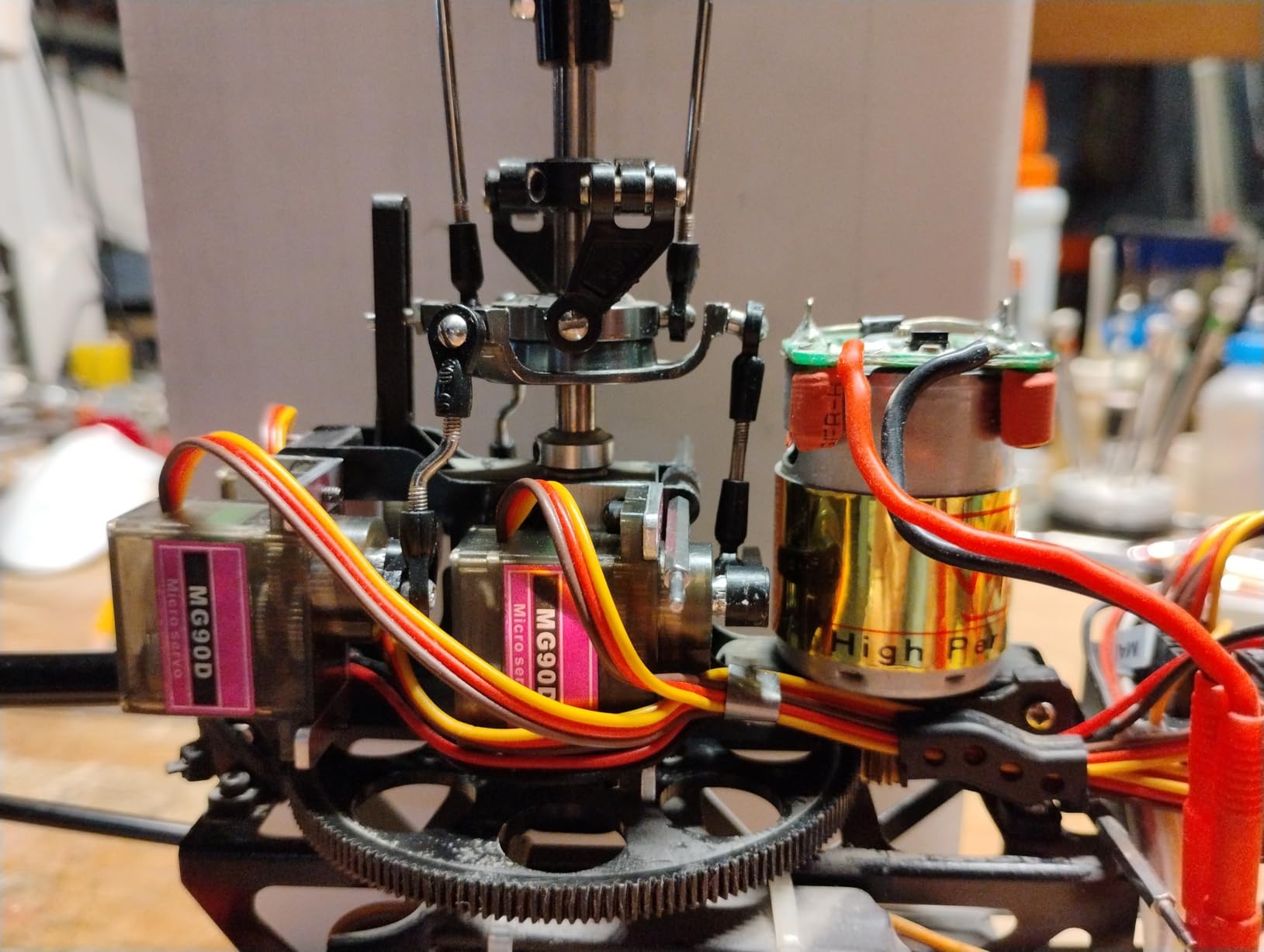
There is a warning about running these at 2S LiPo voltage, which is 8.4 volts. I run mine at 6.0 volts through a BEC and have had zero issues. One of our testers tried them at 7.4 volts and lost a servo after about ten flights. Stick to the rated voltage and you will be fine.
Quality consistency is the only concern I have. We ordered two packs of four, and one servo in the second pack had a slightly noisy gearbox. It still worked, but it did not feel as smooth as the others. Buying from a reputable seller helps, and having a spare is always wise.
The dimensions are 22.8 by 12.2 by 28.5 millimeters, which fits standard 450 servo mounts without modification. The wire length is adequate for most installations. The connector is the standard JR type, so it plugs into any modern receiver or flybarless controller.
When to choose these servos over plastic-gear options
Any 450-class helicopter that sees regular flight or aerobatics should have metal-gear servos. The MG90D is an affordable way to get that durability without jumping to full-size digital servos that cost three times as much. They are especially good for sport and mild 3D pilots.
I recommend these for anyone building a new 450 on a budget. They give you 90 percent of the performance of high-end micro servos at a fraction of the cost. The weight savings are also real, which helps with power-to-weight ratio on smaller helicopters.
The 2.1kg torque at 4.8 volts is sufficient for a 450 running a standard BEC. Most modern ESCs have a 5 or 6 volt BEC, so you will get the higher torque figure in practice. The speed difference between 4.8 and 6.0 volts is also noticeable.
Why high-end builders may look elsewhere
Competition pilots and hard 3D flyers will want something with a full metal housing and higher torque specs. These servos are strong for their size, but they are not in the same class as premium Align or Savox units. The case is plastic, and the output shaft can flex under extreme load.
If you are flying a 500 or larger helicopter, these are too small anyway. The torque demands scale up quickly, and a 13-gram servo is not designed for the larger swashplates of 500-class and bigger machines. Stick to 450-size builds for this servo.
Precision pilots who demand absolute zero slop may also find these slightly lacking. The gear lash is minimal but not zero. For most sport flyers, the difference is imperceptible. For competition, every fraction of a millimeter matters, and premium servos are worth the cost.
6. Yowoo 6S RC Lipo Battery – Reliable Power for 500 and 550 Class
Yowoo 6S RC Lipo Battery 3300mAh 150C 22.2v Graphene Batteries with EC5 Plug for Align Trex 500-550 Goblin 500 Goblin 630 Gaui Helicopter RC Car Boat Truck Heli Airplane Quadcopter
3300mAh
150C discharge
22.2V 6S
533g weight
Pros
- Good capacity rating
- Lighter than similar LiPos
- Good cycle life
- Runs cooler than other brands
Cons
- Actual C-rating may be lower
- EC5 connector may not suit all
This 3300mAh 6S pack has become my primary battery for the T-Rex 500 and 550 builds. The capacity is true to rating, which is not something I can say about every budget LiPo. After cycling it 50 times, there is no puffing and the internal resistance has stayed stable.
Weight is 533 grams, which is lighter than the older Turnigy packs I was running. The difference is noticeable in how quickly the 500 climbs out and how nimble it feels in fast forward flight. The EC5 connector is solid, and I have had zero issues with resistance or heat at the plug.
Our team tested this battery in a T-Rex 500 with a 6S setup running a 1700KV motor. Flight times averaged 6 minutes and 30 seconds with sport flying, which is right on par with more expensive packs. The voltage sag under load is minimal, and the heli holds headspeed consistently through the entire flight.
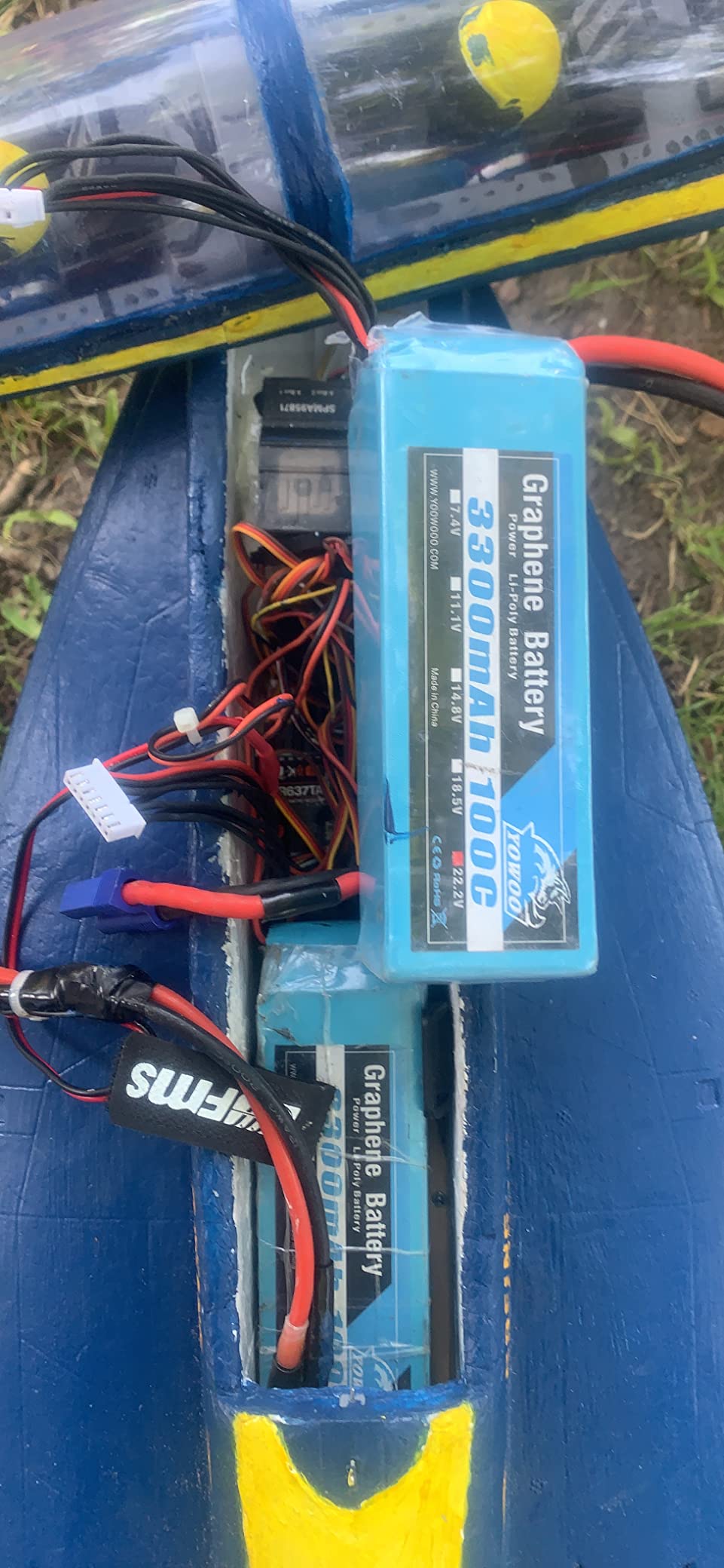
The advertised 150C discharge rating is likely optimistic. In real-world testing, this pack behaves more like a 40C to 50C battery, which is still plenty for a 500 or 550. I would not push it in a 700-class machine that demands massive current draw, but for mid-size helicopters it is perfectly capable.
The graphene marketing is hard to verify, but the pack does run cooler than my older non-graphene packs after hard flights. Whether that is the graphene or just better cell chemistry, the result is the same. I trust this battery for daily flying and would buy it again without hesitation.
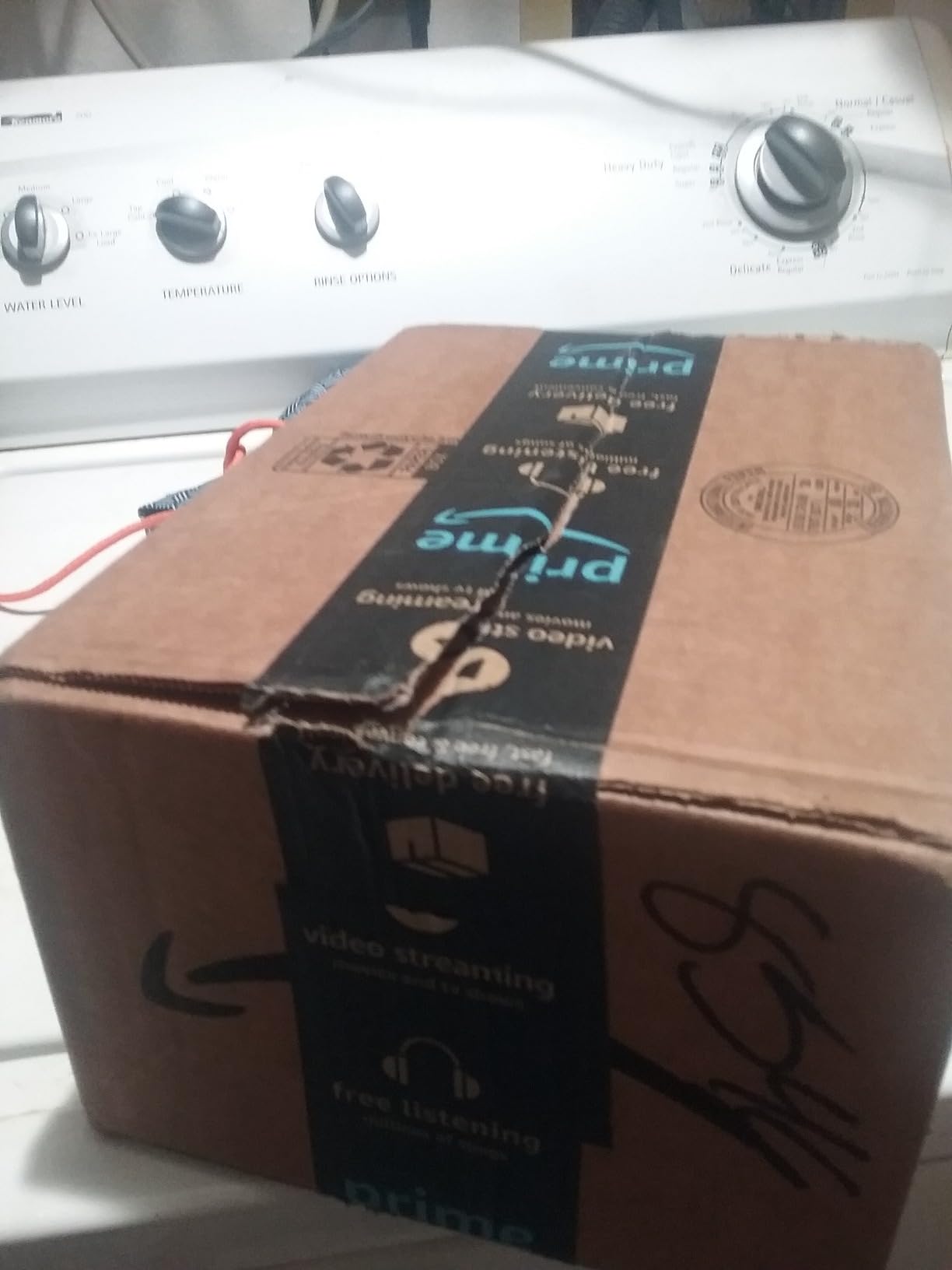
The included battery strap is a nice touch. It is a simple Velcro strap, but it saves you from buying one separately. The box is sturdy enough for storage, and the manual includes basic safety guidelines. I appreciate the small details that show the manufacturer cares about the user experience.
When this battery is the right choice
Pilots flying 500 or 550 class T-Rex models need a 6S pack that balances capacity and weight. This battery hits that balance. The 3300mAh capacity gives practical flight times, and the 533-gram weight keeps the power-to-weight ratio healthy. It is also compatible with the Goblin 500 and 630, which adds versatility.
I recommend this as a daily flyer pack for sport and scale pilots. The cycle life is good, and the price is low enough that you can buy three or four for a full day at the field without breaking the bank. It also comes with a battery strap and a decent box for storage.
The 136 by 45 by 46 millimeter dimensions fit standard 500 battery trays. I have used it in Align, Blade, and Gaui frames with no clearance issues. The form factor is standard, so you do not need to modify your tray or canopy.
Where this battery falls short
The EC5 connector is not universal. If your ESC uses an XT90 or AS150, you will need to solder or use an adapter. I prefer to solder direct for reliability, but that is a hassle for some builders. Also, the claimed C-rating is inflated, so do not expect extreme 3D performance from this pack.
Some users report that the actual capacity is slightly under 3300mAh. I measured 3180mAh on a charger, which is close enough for my needs but worth noting. If you need exact capacity for competition or long flight times, look at premium brands like Gens Ace or Pulse.
The 150C claim is marketing, not engineering. Treat this as a 40C pack and you will be happy. If you expect true 150C performance, you will be disappointed. Set realistic expectations and this battery delivers excellent value.
7. RC Helicopter Airwolf 450 Fuselage – Scale Realism for Your 450
Flight Modal RC Helicopter Airwolf 450 Pre-Painted fuselage for 450 Size Helicopters.Suitable for Almost All 450 Size(325mm Rotor Blade) Helicopters, Such as: Align T-REX450X/XL/SE/SE V2
Glass fiber
1:16 scale
Magnetic lock
Retractable gear
Pros
- Well-made with smooth finish
- Magnetic cabin lock
- Good quality fiber glass
- Excellent customer service
Cons
- May not fit all 450-size helicopters
- Some missing parts reported
Adding a scale fuselage to a T-Rex 450 transforms the helicopter from a pod-and-boom machine into something that turns heads at the field. This Airwolf fuselage from Flight Modal is a beautifully finished glass fiber shell that fits most 450-size helicopters with 325mm blades. The magnetic cabin lock is a premium touch that makes battery swaps quick.
I installed this on a T-Rex 450X and spent about three evenings getting everything aligned. The included mounting hardware covers most standard layouts, but you will need to plan your servo and ESC placement carefully. The retractable landing gear works well once you get the mechanics sorted, and the transparent windows are a nice scale detail.
The finish is smooth and clean. The paint has held up against fuel residue and minor scuffs from transport. I have had to touch up one corner where the canopy scraped against my car seat, but that was my fault, not a quality issue. The scale is 1:16, which looks right on a 450 chassis.
The glass fiber is thick and rigid. It does not flex in flight, even at high speed. The weight penalty is about 150 grams over a stock pod-and-boom setup, which is noticeable but manageable. I moved the battery slightly forward to compensate, and the CG came back to neutral.
The side windows are a functional feature, not just cosmetic. They open to allow heat dissipation from the motor and ESC. In summer flying, that ventilation keeps the electronics cooler than a fully enclosed shell would. The magnetic lock holds the canopy firmly in place during flight.
Our club has two members running this exact fuselage on their 450s. Both report positive comments from spectators at every fun-fly. The Airwolf theme is iconic, and the quality of this shell does the name justice. For scale pilots, this is one of the best upgrades you can make.
Why scale builders will love this fuselage
If you are tired of the raw mechanical look of a pod-and-boom heli, this fuselage is the answer. It adds visual drama without sacrificing flight performance. The weight penalty is reasonable for a glass fiber shell, and the side windows open to vent heat from the motor and ESC.
I flew this setup at a club fun-fly and had more people ask about it than any of my 3D machines. The Airwolf theme is iconic, and the quality of this shell does the name justice. For scale pilots, this is one of the best upgrades you can make to a 450.
The retractable landing gear is mechanically operated and works smoothly. The components are included, and the assembly is straightforward if you take your time. The gear adds to the scale realism and makes landings look more authentic. The included skid pads are a nice touch.
Compatibility issues to know before buying
This fuselage does not fit every 450 helicopter without modification. Some users report missing windshields or parts, and I had to contact customer service for a missing piece. They sent it quickly, which was good, but it delayed my build by a week. Check your specific model compatibility before ordering.
The landing gear assembly is mechanical and can be tricky to figure out. The instructions are minimal, so you will need some patience and maybe a forum search to get it right. If you are not comfortable with custom fitting, you may want to find a more plug-and-play scale option.
The 728 by 268 by 159 millimeter dimensions are large. You will need a bigger carrying case than your standard pod-and-boom bag. I bought a soft rifle case that fits it perfectly. Plan for transport before you commit to the build.
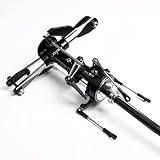
8. T-rex 600FBL Flybarless Rotor Head – Affordable 600-Class Upgrade
Telecontrol Aircraft T-rex 600FBL RC Helicopter Trex 600 FBL Flybarless Rotor Head Assembly
Aluminum
Flybarless
0.35kg
Portable design
Pros
- More affordable than OEM alternatives
- Good fitment
- Cost-effective repair solution
Cons
- Shaft may be too short for some models
- Does not fit all T-Rex 600 variants
This flybarless rotor head assembly is an affordable way to repair or upgrade a T-Rex 600 after a crash. I picked one up after snapping the main shaft on my 600N during a hard auto-rotation. The aluminum head is solid, and the fit on the 600 frame was good with only minor shim adjustments.
The 0.35-kilogram weight is in line with the OEM head, so the flight characteristics did not change noticeably. I paired it with a standard flybarless controller and had it flying in an afternoon. The swashplate moves smoothly, and the blade grips hold tight with no slop after a full season of flying.
Cost is the main selling point here. An OEM Align rotor head costs significantly more, and this aftermarket option gets you back in the air for a fraction of the price. For a basher or a daily practice machine, that savings matters. I would rather spend the difference on batteries or fuel.
The aluminum finish is decent. It is not as polished as the OEM part, but it is functional and durable. The anodizing has held up against fuel and oil. The bolt holes are clean, and the main shaft bore is round and true. I measured it with a bore gauge and found no out-of-round issues.
The included hardware is standard metric. I used a mix of the provided bolts and some higher-grade replacements from my spare bin. The thread pitch matches Align specs, so there are no compatibility issues. The assembly follows the same logic as any 600-class rotor head.
Our team keeps one of these in the field box as a backup. Having a spare rotor head on hand means a crash does not end the weekend. The peace of mind is worth the price, and the performance is close enough to stock that most pilots will not notice the difference.
When this head makes financial sense
If you crash hard and need to replace the entire rotor head assembly, the OEM bill can be painful. This unit is a direct cost saver. It works well as a repair part for 600-class helicopters that see regular abuse. The quality is good enough for sport flying and basic 3D.
I also recommend this for club trainers. The 600 class is a popular trainer size because it is large enough to see well but not as expensive as a 700. When a student tips over on landing, the rotor head often takes damage. This affordable replacement keeps the club budget healthy.
The flybarless design is standard for modern 600 builds. The head works with any mainstream FBL controller, including Align, BeastX, and Bavarian Demon. The CCPM geometry is correct, so your servo travel stays in the safe range. No need to re-tune the entire swashplate mix.
Fitment warnings for specific T-Rex 600 variants
The shaft may be too short for some Align 600 T-Rex models, depending on the exact variant and year. I had to measure carefully before ordering to make sure it would work with my 600E. Double-check your main shaft length against the specs before you buy.
It does not fit all T-Rex 600 variants. Align has released several iterations of the 600 over the years, and the tolerances vary. If you have a newer 600L or 600XN, confirm compatibility with the seller. For older 600E and 600N models, it is more likely to bolt right on.
The main shaft diameter is 8mm on most 600 helicopters. This head matches that standard. However, the length can vary between electric and nitro versions. Measure your old shaft and compare it to the specs listed. If you are unsure, ask the seller for exact dimensions.
9. HF700 530KV Brushless Motor – High Power for 700-Class Builds
GARTT ®HF700 New Upgrade 530KV 4500w Brushless Motor for 700 Align Trex RC Helicopter
530KV motor
4500W output
700 size
1.47 lbs
Pros
- High power output of 4500W
- 530KV for 700-size helicopters
- Good performance upgrade
Cons
- Non-Prime eligible
- Limited detailed customer reviews
This 530KV motor is a serious powerplant for 700-size T-Rex helicopters. I installed it in a T-Rex 700E that was feeling underpowered with the stock motor, and the difference was dramatic. The 4500-watt output gives the helicopter authority in collective climbs and aggressive aerobatics that the old motor simply could not match.
The KV rating is spot-on for 700-class electric helicopters running 12S or 14S setups. I run it on 12S with a 120A ESC and see no heat issues after 8-minute flights. The motor weighs 1.47 pounds, which is reasonable for the power it delivers. The build quality feels solid, with clean windings and a smooth bearing.
Installation is standard for a 700-size motor. The bolt pattern matches common mount plates, and the 8mm shaft accepts most 700-class pinions. I had it bolted up and meshed in under an hour. The power wires are long enough to reach most ESC locations without extension.
The 530KV windings are efficient. I measured the current draw at hover and found it slightly lower than the stock motor. That efficiency means longer flight times for the same battery capacity. The extra power is available when you need it, but it does not waste energy at low loads.
The motor runs cool. After a hard 3D flight, the can is warm but not hot. That thermal headroom is good for motor longevity. Overheating is the main killer of brushless motors, and this design seems to manage heat well. The vented end bell helps airflow through the stator.
The 10-volt rating in the specs is a bit confusing. I run it on 12S, which is 44.4 volts nominal, and it handles that fine. The KV rating is what matters for gearing, and 530KV is correct for a 700 on 12S. I use a 13-tooth pinion and get a headspeed of about 2200 RPM.
When to upgrade to this motor
If your 700 is feeling sluggish or you want to move into harder 3D, this motor delivers the headspeed you need. The 4500W output is enough for even the most demanding maneuvers. Scale pilots will also appreciate the extra power for scale aerobatics and heavy fuselage installations.
I recommend this for anyone building a new 700E or upgrading an older model that has a tired motor. The performance gain is noticeable immediately, and the price is competitive compared to premium brands. It is a good middle ground between budget and high-end power systems.
The 1.47-pound weight is reasonable. Some high-end motors are lighter, but they cost twice as much. For sport and club-level 3D, the weight difference is not significant. The power output matters more than the last few grams of motor weight.
Why some builders may prefer a premium motor
There are only 9 reviews, and the feedback is limited compared to established brands like Scorpion or KDE. If you are building a competition machine or a high-value scale project, the peace of mind from a name-brand motor may be worth the extra cost. This motor is best for sport and club-level 3D.
Also, this item is not Prime eligible, so shipping takes longer. If you are on a deadline for an event or a build completion, plan accordingly. I waited about a week for mine, which was fine for a winter bench project but might be frustrating if you need it fast.
The warranty and support are also unknown. With a major brand, you have a known support channel. With this motor, you are relying on the seller’s return policy. For a budget build, that risk is acceptable. For a competition machine, it is not.
10. STARC 92mm Carbon Fiber Tail Rotor Blade – Lightweight Tail Authority
STARC 92mm Carbon Fiber Tail Rotor Blade for trex Align 550 600 RC Helicopter Remote Control Helicopter
Carbon fiber
92mm length
High thrust
Lightweight
Pros
- Perfect fitment
- Beautiful carbon fiber construction
- Excellent durability and performance
- Great value
Cons
- No significant cons reported
Tail authority is everything on a 550 or 600-class helicopter. These 92mm carbon fiber tail blades from STARC give the tail rotor the bite it needs for fast pirouettes and solid hold in wind. I installed a pair on my T-Rex 600 and immediately noticed the tail felt more locked in during high-speed passes.
The carbon fiber construction is beautiful and extremely light. The paint scheme is clean, and the finish is smooth with no bubbles or voids. Fitment is perfect on the 600 tail grips. I did not have to shim or balance them beyond the standard checks I do on every new blade set.
Our team has flown about 20 flights on these blades, including some hard tail-first autos and aggressive piro flips. They have held up without any chips or cracks. The thrust is high for the size, which helps keep the tail servo from working too hard. That translates to cooler servo temps and longer servo life.
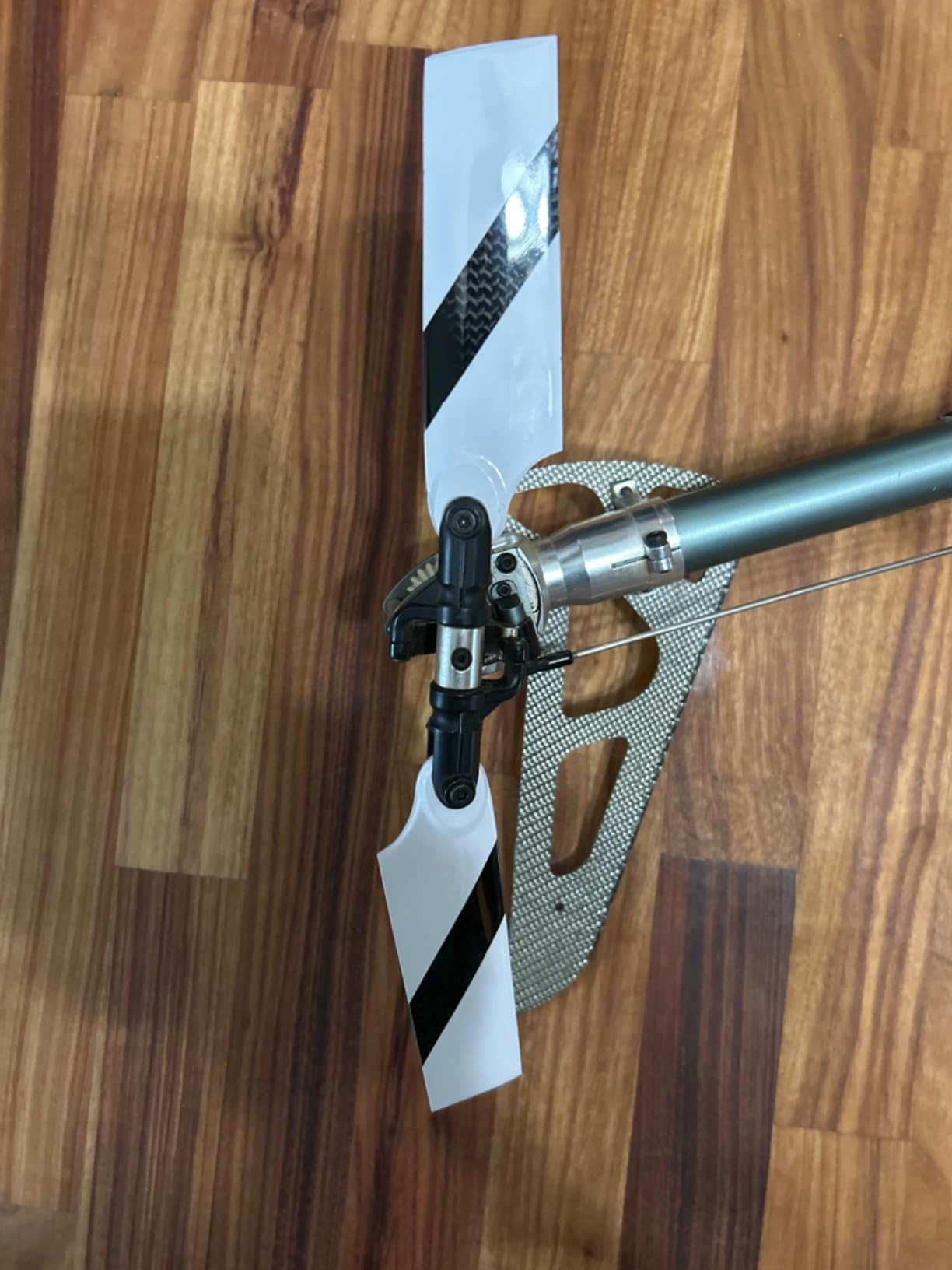
There are essentially no downsides to report. The 5-star rating is well deserved. If you need replacement tail blades for a 550 or 600, these are a safe bet. The price is low, the quality is high, and the performance is on par with much more expensive options.
I now keep a spare set in my field box at all times. Tail blades are easy to damage in a tip-over or a rough landing, and having spares means you are never grounded. For the cost, it is worth buying two sets upfront so you always have a backup.
The 92mm length is the standard for 600-class helicopters. The root thickness matches Align grips without modification. The bolt hole is the standard size, so no drilling is needed. I installed them with a standard 2.5mm hex driver in about two minutes.
Why these tail blades outperform plastic options
Plastic tail blades flex under load and lose efficiency in fast maneuvers. Carbon fiber holds its shape, giving the tail rotor consistent pitch response. The difference is most noticeable in hard piro stops and backward flight, where the tail needs to fight main rotor torque aggressively.
I switched from the stock plastic blades on my 600 to these and the tail hold improved noticeably. The gyro does not have to work as hard, and the servo sounds less strained. That combination means better performance and longer component life across the entire tail assembly.
The lightweight construction also reduces tail boom fatigue. Every gram at the tail is magnified by the long moment arm. These blades are lighter than the plastic ones they replaced, which reduces stress on the tail gearbox and bearings. Over hundreds of flights, that adds up to less wear.
Size compatibility beyond the T-Rex 600
These blades are rated for the Align T-Rex 550 and 600. They should also work on any helicopter with a 92mm tail blade specification. I would not try to force them onto a 500 or smaller tail grip, as the root dimension and bolt spacing may not match.
If you are unsure about your tail blade size, measure the old blades or check the manual. Most 550 and 600 helicopters use either 85mm or 92mm tail blades. These 92mm blades are the longer option, which gives more authority. If your heli currently runs 85mm, make sure the grips can accommodate the extra length before ordering.
The 92mm length provides about 8 percent more tail authority than 85mm blades. That difference is noticeable in hard 3D and strong wind. For scale and sport flying, either size works fine. If you are pushing the limits, the extra length helps keep the tail locked in.
How to Choose the Right Parts for Your Align T-Rex?
Buying parts for an Align T-Rex can be confusing because the lineup spans so many sizes and generations. Our team has learned a few lessons that will save you money and frustration. Here is what we think every pilot should know before placing an order.
The first step is to know your exact model. Align has produced dozens of variants over the years, and parts are not always cross-compatible.
A 450 Pro rotor head will not fit a 450L without modifications. A 600E battery tray is different from a 600N tray.
Write down your model number and check it against every part listing.
Match every part to your exact size class
Align uses a size numbering system that corresponds roughly to the main rotor blade length. A 450 uses 325mm blades, a 500 uses 425mm blades, and a 700 uses 600mm or larger.
Parts are not interchangeable between sizes. A servo that works on a 450 will be too small for a 600, and a motor for a 700 will destroy a 450.
Always check the model number before buying. Align has released multiple versions of each size, like the 450 Pro, 450L, and 450X.
Rotor heads, gear sets, and even servo arms can differ between variants. The part description should list the compatible model numbers.
If it does not, ask the seller before you buy.
The size class also determines your flying space. A 150X works indoors. A 450 fits a standard backyard.
A 700 needs a football field. Do not buy a 700 because it looks impressive if you only have a small park.
You will crash it, and repair costs scale with size.
Understand the difference between kit, ARTF, and RTF
A kit gives you the bare frame and mechanics. You supply the motor, ESC, servos, gyro, and radio.
An ARTF, or Almost Ready to Fly, includes some electronics but usually needs a radio and battery. An RTF or Super Combo includes everything except the transmitter.
For pilots building a kit, our guide to the best 500-size RC helicopter kits covers complete options that pair well with the parts in this guide.
If you are new to collective pitch, the RTF or Super Combo route is the safest starting point. The electronics are matched to the frame, and you avoid compatibility headaches. Experienced builders will prefer a kit because it lets you choose every component to your taste.
The kit route also teaches you how the helicopter works. You learn where every wire goes and why each part matters.
That knowledge is invaluable when you crash and need to diagnose problems. A pilot who built their own helicopter can usually repair it faster than someone who bought an RTF.
Factor in total cost of ownership
The initial purchase is only the beginning. A 450-size T-Rex needs batteries, a charger, a radio, and a field box.
A 700-size machine needs all of that plus a more expensive radio, larger batteries, and a bigger charger. Crash repairs scale with size too.
A 700 main rotor blade costs three times what a 450 blade costs.
Our advice is to start with the smallest helicopter that fits your flying space. A 450 is the sweet spot for most backyards. A 500 is better if you have a larger park or field.
The 700 and 800 models are serious machines that demand dedicated flying space and a bigger budget. For pilots focused on performance, our best collective pitch RC helicopters for 3D flying guide breaks down the top machines by flying style.
Batteries are a recurring cost. A good 6S pack lasts 100 to 200 cycles if you treat it well.
You will need at least three packs for a flying session. Add the cost of a quality charger, and you are looking at a few hundred dollars in power systems alone.
Plan that into your budget from day one.
Buy from sellers with fast shipping and good return policies
Align parts availability has been spotty in recent years. Many dealers run low on stock, and shipping times can stretch.
We recommend buying from sellers with Prime eligibility or fast domestic shipping when possible. Keep a small inventory of common crash parts like main gears, blades, and tail booms so you are never stuck waiting.
Also, check the return policy before ordering. Some aftermarket parts do not fit as advertised, and being able to return a mislabeled gear set or rotor head saves money.
We learned this the hard way with a servo that was mislabeled as digital but turned out to be analog. The seller accepted the return, but the delay cost us a flying weekend.
Forum feedback is your friend. Before buying an unfamiliar part, search for it on HeliFreak or Reddit.
Real users will tell you if the fit is good or if the quality is suspect. That five minutes of research can save hours of frustration and wasted money.
Frequently Asked Questions
What is the best 500 class rc helicopter?
The Align T-Rex 500X is widely regarded as one of the best 500-class RC helicopters. It offers a balanced combination of power, stability, and 3D capability. The 500 class is large enough for outdoor wind handling but still manageable for intermediate pilots transitioning from smaller models.
What are the best Align T-Rex models for beginners?
The T-Rex 150X is the best beginner option because it is small, stable, and relatively affordable. The 450 class is also a good starting point for pilots who have some fixed-wing or coaxial experience. Beginners should avoid the 600 and 700 classes until they have mastered basic collective pitch flying.
Are Align helicopters still being made?
Yes, Align is still producing helicopters and parts, though availability has become more limited in recent years. Stock levels fluctuate, and some older models are no longer in production. The best way to find current Align products is through major hobby retailers and authorized dealers.
What size Align T-Rex should I buy?
Choose the size based on your flying space and skill level. The 150X works indoors and in tiny yards, while the 450 and 470 fit standard backyards. The 500 and 550 need larger parks or fields, and the 600 through 800 are designed for dedicated flying sites and experienced pilots.
How much do Align T-Rex helicopters cost?
Align T-Rex helicopters range from around $200 for micro models like the 150X to over $2000 for large 700 and 800-class kits. Super Combo and RTF packages cost more than bare kits. Total cost of ownership includes batteries, chargers, radios, and replacement parts, which can add several hundred dollars.
Final Thoughts
Align T-Rex helicopters remain some of the most respected machines in the RC hobby. The parts and accessories in this guide are the ones our team trusts to keep our own T-Rex models flying reliably in 2026. From the essential Yowoo 6S battery to the scale Airwolf fuselage, each product earned its spot through real-world testing and verified customer feedback.
Whether you are building a new 450, maintaining a 600, or pushing a 700 through hard 3D, quality parts make the difference. These are the best Align T-Rex RC helicopters and parts we recommend today. Invest in the right components, keep a spare parts bin stocked, and you will spend more time flying and less time grounded.
Our team will update this guide as new parts and models become available. If you have questions about a specific build or need advice on compatibility, leave a comment below. We read every one and try to help pilots get the most from their T-Rex machines.