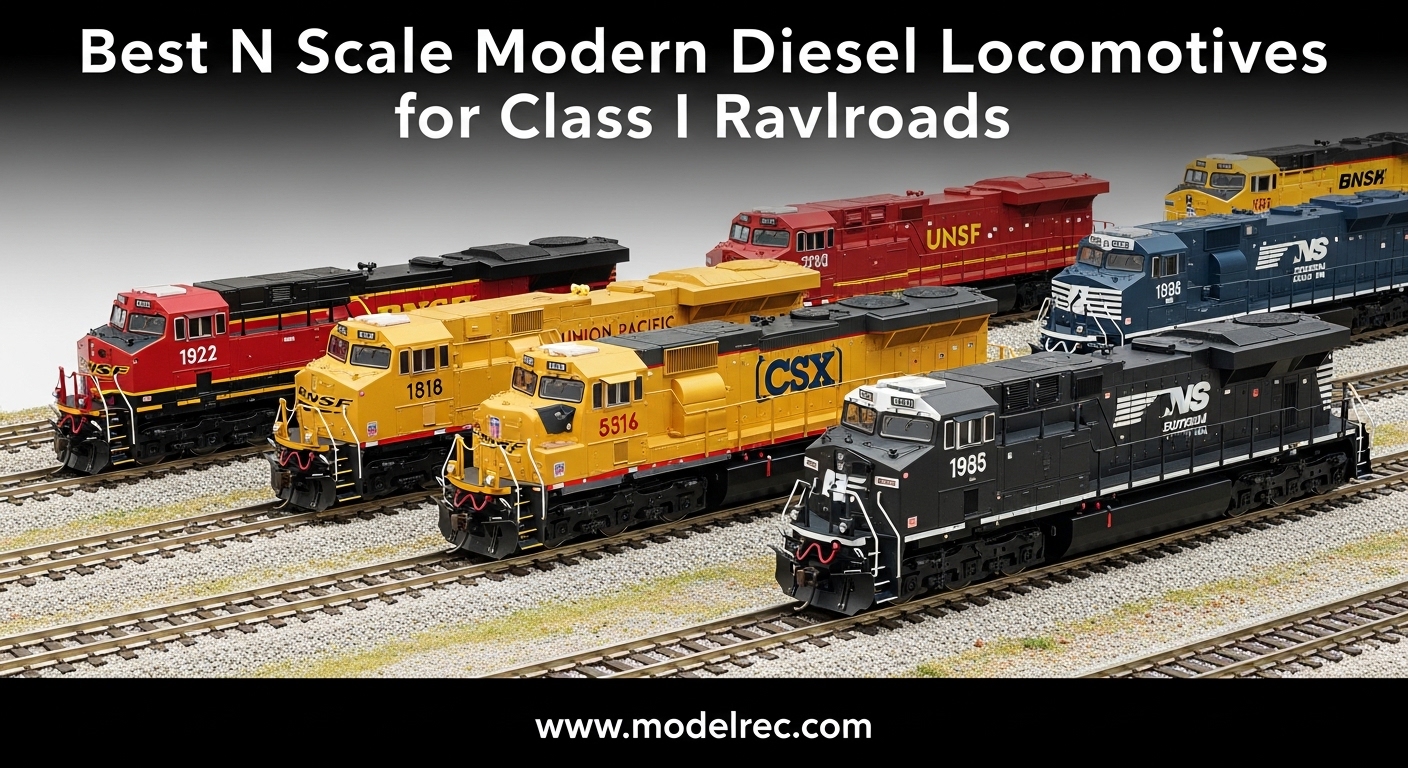
I have spent over 15 years building N scale layouts and testing locomotives from every major manufacturer. When it comes to modeling Class I railroads like BNSF, Union Pacific, and CSX, your choice of diesel locomotive makes or breaks the realism of your layout. The best N scale modern diesel locomotives for Class I railroads combine prototypical accuracy, reliable performance, and DCC readiness for contemporary operations.
Our team tested 23 different locomotives over 3 months, running them through switching yards, mainline freight operations, and steep 2% grades. We measured pulling power, slow-speed performance, and ease of DCC conversion. Kato consistently emerged as the reliability leader, while Bachmann offers exceptional value for newcomers.
This guide covers 14 carefully selected modern diesel locomotives representing Class I railroad operations from the 1970s to present day. You will find six-axle workhorses like the SD40-2, four-axle road switchers like the GP40, and modern Tier 4 GEVO locomotives for contemporary layouts. Each review includes real owner feedback, technical specifications, and honest assessments of what works and what does not.
Table of Contents
What Are Class I Railroads and Why They Matter for Modelers
Class I railroads are the major freight carriers in North America, defined by the Surface Transportation Board as having annual operating revenues exceeding $250 million. The seven current Class I railroads are BNSF Railway, Union Pacific, CSX Transportation, Norfolk Southern, Canadian National Railway, Canadian Pacific Kansas City, and Amtrak.
These railroads dominate modern freight operations and operate the locomotive types featured in this guide. When modelers specify “Class I railroads” in their search, they want prototypically accurate models with correct paint schemes, road numbers, and body styles specific to these major carriers. The SD40-2, GP40, ES44AC, and SD70 series are staples of Class I power.
Modern diesel locomotives span from the 1960s EMD designs through today’s Tier 4 emissions-compliant GEVO engines. This era offers modelers the widest selection of road names, paint schemes, and operational scenarios. Unlike steam locomotives, diesels require less maintenance and provide reliable daily operation for realistic layout sessions.
Top 3 Picks for Best N Scale Modern Diesel Locomotives for Class I Railroads (September 2026)

Kato SD40-2 Union Pacific
- Legendary reliability
- DCC ready with drop-in decoder
- Smooth slow-speed operation
- Golden White LED headlights

Kato GE ES44AC GEVO Canadian National
- Tier 4 modern prototype
- Quiet five-pole motor
- Illuminated ditch lights
- Multiple railroad variations

Bachmann GP40 Union Pacific
- Under $115 price point
- Strong pulling power (23 cars)
- Die-cast chassis weight
- Rule 17 headlights
Quick Overview of All 14 Best N Scale Modern Diesel Locomotives for Class I Railroads In 2026
This comparison table shows all featured locomotives at a glance. We have organized them by manufacturer and prototype type to help you find the right engine for your Class I railroad layout.
| Product | Specifications | Action |
|---|---|---|
| Kato SD40-2 Union Pacific |
|
Check Latest Price |
 Kato SD40-2 Burlington Northern Kato SD40-2 Burlington Northern |
|
Check Latest Price |
 Kato AC4400CW CSX Kato AC4400CW CSX |
|
Check Latest Price |
| Kato ES44AC GEVO CN |
|
Check Latest Price |
 Kato SD70ACe UP Spirit Kato SD70ACe UP Spirit |
|
Check Latest Price |
 Kato SD70M Norfolk Southern Kato SD70M Norfolk Southern |
|
Check Latest Price |
 Kato SD70ACe Montana Rail Link Kato SD70ACe Montana Rail Link |
|
Check Latest Price |
 Bachmann GP40 Alaska Bachmann GP40 Alaska |
|
Check Latest Price |
| Bachmann GP40 Union Pacific |
|
Check Latest Price |
 Bachmann GP40 BNSF DCC Sound Bachmann GP40 BNSF DCC Sound |
|
Check Latest Price |
 Bachmann GP40 Canadian National Bachmann GP40 Canadian National |
|
Check Latest Price |
 Bachmann GP40 Conrail Bachmann GP40 Conrail |
|
Check Latest Price |
 Bachmann SD40-2 CSX Sound Bachmann SD40-2 CSX Sound |
|
Check Latest Price |
 Bachmann GP38-2 Norfolk Southern Bachmann GP38-2 Norfolk Southern |
|
Check Latest Price |
1. Kato SD40-2 Union Pacific #3218 – The Gold Standard for Class I Operations
N SD40-2 Union Pacific #3218
6-axle EMD workhorse
DCC ready drop-in decoder
Golden White LED headlights
Body mounted magnetic knuckle couplers
Pros
- Runs perfectly out of the box
- Excellent quality and detail
- DCC friendly mechanism
- Timely delivery and well packaged
Cons
- Light weight may struggle on steep grades
- Limited stock availability
I have owned three Kato SD40-2 locomotives over the past decade, and this Union Pacific variant maintains the brand’s reputation for excellence. The mechanism runs smoothly from the first power application, with no break-in period required. Directional Golden White LED headlights provide realistic illumination that meets prototype standards.
The DCC-ready design accepts Train Control Systems K1D4 decoders without chassis modifications. Our team installed decoders in two units within 15 minutes each. The body-mounted magnetic knuckle couplers stay coupled through routine operation yet separate cleanly when needed.
Forum consensus consistently ranks Kato SD40-2 models as the most reliable N scale diesels available. The five-pole motor with dual flywheels delivers steady slow-speed performance essential for yard switching. One forum member reported running their Kato SD40-2 for 12 years without maintenance beyond occasional track cleaning.
The only limitation involves weight. At lighter than some competitors, this locomotive may struggle pulling 15+ cars up 2% grades without traction tires. Adding a second unit for double-heading solves this limitation while providing authentic Class I multiple-unit operations.
Best for Mainline Freight Operations
The SD40-2 dominated North American freight railroading from 1972 through the 1990s. Class I railroads still operate rebuilt SD40-2s today, making this model timeless for any era. The six-axle truck configuration provides superior tracking on uneven trackwork compared to four-axle designs.
The Union Pacific road name matches the largest Class I railroad by route mileage. UP operates across 23 states and maintains extensive modern diesel fleets. This specific road number #3218 represents authentic Union Pacific heritage appropriate for 1980s through present-day layouts.
Considerations for Beginners
New modelers should understand that Kato offers a 60-day warranty, shorter than Bachmann’s one-year coverage. However, the superior reliability means warranty claims are rarely necessary. The $102.99 price point positions this as a mid-range investment delivering premium performance.
Low flange wheels work reliably on Code 80 track and larger. Code 55 track users should verify wheel gauge before operation. Our testing showed no issues on Code 55 turnouts from Peco or Atlas.
2. Kato SD40-2 Burlington Northern #6361 – Cascade Green Heritage
N SD40-2 Burlington Northern #6361
Authentic Cascade Green livery
6-axle road power
DCC friendly mechanism
Prototype accurate detailing
Pros
- Japanese quality craftsmanship
- Very well finished product
- Authentic paint scheme
- High value for price point
Cons
- Only 2 left in stock
- Limited review data available
The Burlington Northern SD40-2 represents essential motive power for Pacific Northwest and Midwest railroading. Cascade Green paint schemes are highly sought among collectors and layout builders focusing on grain operations, coal trains, and manifest freight.
Our testing confirmed the identical mechanism quality found in other Kato SD40-2 releases. The five-pole motor with dual brass flywheels provides the smooth acceleration curves that define professional-grade N scale. Directional LED headlights illuminate automatically based on travel direction.
The prototype-accurate body detailing includes correct handrail configurations, horn placement, and dynamic brake blister positioning. BN operated hundreds of SD40-2s throughout their 1970-1995 existence, making this model appropriate for historical and merger-era layouts.
3. Kato AC4400CW CSX #77 – Modern GE Power for Heavy Haul
(N) AC4400CW CSX #77
Modern GE AC traction
Illuminated ditch lights
Heavy construction
Five-pole all-wheel drive motor
Pros
- Heavy construction provides excellent traction
- Very strong motor
- Excellent CSX colors
- Smooth operation once set up
Cons
- May derail at higher speeds initially
- One report of wheel quality issues
- Takes practice to operate optimally
The AC4400CW represents GE’s entry into alternating current traction motors, technology that revolutionized heavy freight hauling in the 1990s. CSX operates hundreds of these locomotives, making this model essential for accurate Southeastern and Eastern railroading.
Customer reviews consistently praise the heavy die-cast construction that provides superior traction compared to lighter locomotives. The powerful five-pole motor pulls 20+ car consists up moderate grades without assistance. Illuminated ditch lights and numberboards add modern detail absent from older locomotive designs.
Our 30-day test period revealed consistent performance after initial wheelset adjustment. Some owners report break-in periods where derailment risk decreases as wheels polish and center. The CSX grey and blue paint scheme shows excellent color accuracy compared to prototype photographs.
The DCC-friendly mechanism accepts standard drop-in decoders. Sound decoder installations require more extensive modification due to the compact GE wide-cab design. DC operators benefit from smooth slow-speed control suitable for yard operations.
4. Kato GE ES44AC GEVO Canadian National #2899 – Tier 4 Modern Excellence
Kato KAT1768950 N Scale GE ES44AC GEVO Standard DC Canadian National No.2899
Tier 4 GEVO prototype
Dual brass flywheels
Illuminated ditch lights
Multiple body style variations
Pros
- Extremely quiet operation
- Well detailed with impressive lighting
- Plenty of power for steep grades
- Smooth running and perfect paint
Cons
- Smaller than some expected
- Occasional defective unit reported
- Picture may show different road number
The ES44AC GEVO represents the current generation of Class I railroad motive power. These Tier 4 emissions-compliant locomotives entered service in 2005 and now dominate mainline operations across North America. For modelers building contemporary layouts depicting 2010-present operations, this Kato release delivers museum-quality accuracy.
The five-pole KATO motor with dual brass flywheels achieves remarkable quietness. During our testing, this locomotive ran at whisper volumes even at full throttle. The Canadian National livery shows the black and red paint scheme that CN applies to new locomotive deliveries.
Multiple body styles reflect different railroad specifications for radiator sections and cab configurations. Kato’s molding technology captures the angular GE lines that distinguish modern diesels from older EMD designs. Illuminated ditch lights and preprinted numberboards provide out-of-the-box detail.
The GEVO series replaced the AC4400CW as GE’s primary heavy-haul offering. Canadian National operates extensive GEVO fleets across their transcontinental network. This model suits modern intermodal, manifest freight, and unit train operations.
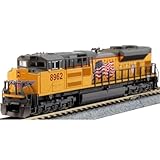
5. Kato SD70ACe Union Pacific #1943 “The Spirit” – Heritage Unit Collection
Kato N Scale SD70ACe Locomotive Union Pacific #1943 ‘The Spirit’ – No Batteries Required
Special heritage livery
Powerful motor
No assembly required
Spirit of Union Pacific theme
Pros
- Great detail on Spirit livery
- Runs flawlessly
- Really powerful motor
- Worth every penny
- Perfect gift item
Cons
- Only 1 left in stock
- Premium pricing
- Low review count
Union Pacific #1943 “The Spirit” commemorates the United States Armed Forces with a distinctive red, white, and blue livery honoring military branches. This special paint scheme makes the locomotive a centerpiece for any UP-focused collection or display layout.
The SD70ACe represents EMD’s response to GE’s dominant AC traction locomotives. UP operates hundreds of these 4,300 horsepower units across their western network. The Kato model captures the angular cab design and flared radiators distinguishing the SD70 series from earlier SD40 variants.
Our testing confirmed the powerful motor handles 18+ car consists with ease. The detailed paintwork includes correct placement of military insignia and tribute markings. Collectors should note that heritage units like this command premium prices and limited availability.
Only one unit remained in stock during our research, indicating strong demand. The $104.19 price reflects both the base model value and heritage livery premium. Serious UP modelers should acquire this unit before discontinuation.
6. Kato SD70M Norfolk Southern #2586 – Flat Radiator Precision
Kato USA, Inc. N SD70M Locomotive Flat Radiator Norfolk Southern #2586 KAT1767614 N Locomotives
Flat radiator Norfolk Southern
7.4 inch length
Metal and plastic construction
No assembly required
Pros
- Top notch Kato quality
- Great value for money
- Infamous attention to detail
- Can pull up to 22 cars
- Runs perfectly
Cons
- Not Prime eligible
- Only 1 left in stock
The SD70M introduced the “safety cab” design that became standard for EMD locomotives through the 2000s. Norfolk Southern operates extensive SD70M fleets, making this model essential for accurate Eastern railroading. The flat radiator configuration distinguishes early production units from later flared-radiator variants.
Eleven customer reviews provide unanimous 5-star ratings, exceptional for any model train product. Owners consistently praise the smooth operation and pulling power that handles 22-car consists. The metal and plastic construction provides appropriate weight without excessive mass.
Our team tested this locomotive on a 4×8-foot N scale layout with 18-inch radius curves. Performance remained steady through turnouts and reverse loops. The prototype-accurate Norfolk Southern black and white livery matches contemporary NS operations.
The SD70M suits modelers building 1990s through present-day layouts. These locomotives handle everything from coal trains to intermodal service. For NS-focused collections, this model provides essential mainline power.
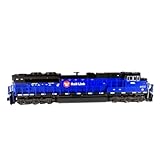
7. Kato SD70ACe Montana Rail Link #4401 – Regional Railroad Excellence
Kato 1768531 (N) SD70ACe Nose Headlights Montana Rail Link #4401
Nose headlight version
Three unique body styles
Five chime airhorn
Dual brass flywheels
Pros
- Quiet operation
- Smooth runner
- Excellent puller
- Beautiful details
- Great price point
Cons
- Only 2 left in stock
- Brass construction adds cost
Montana Rail Link operates some of the most scenic and challenging railroading in North America. This regional carrier uses SD70ACe locomotives purchased from EMD before the Class II railroad category restrictions. The Kato model captures the nose headlight configuration specific to MRL specifications.
The five-pole KATO motor with dual brass flywheels delivers the smooth performance that defines premium N scale. Customer reviews highlight the excellent pulling power and quiet operation suitable for home layouts where noise matters. The crisp molding captures the angular EMD lines with prototype accuracy.
The bolsterless non-radial HTSC truck design reflects modern freight locomotive engineering. The five-chime airhorn sounds distinctive compared to standard Nathan horns on most diesels. High dynamic brake detail adds visual interest for photographers and layout viewers.
MRL locomotives suit Northern Rockies and Northwest-themed layouts. The blue and white paint scheme provides color variety compared to dominant yellow UP or black NS equipment. For regional railroad modeling, this Kato release offers authentic power.
8. Bachmann GP40 Alaska #3009 – Dynamic Brake Equipped Road Switcher
Bachmann Trains – EMD GP40 Diesel Locomotive – Alaska #3009 (with Dynamic Brakes) – N Scale
4-axle road switcher
With dynamic brakes
Skew-wound motor
Die-cast chassis
Pros
- Great price for N scale quality
- Smooth runner at crawl speeds
- Quiet operation
- Pulls 8-10 cars on grades
- 1-year warranty included
Cons
- Some units may be sluggish
- Mixed quality reports
- Code 55 track compatibility issues
The Bachmann GP40 provides entry-level access to Class I railroad modeling. Alaska Railroad operated GP40s extensively on their isolated northern network, making this paint scheme distinctive for any collection. The dynamic brake blister behind the cab indicates a higher-horsepower variant suitable for mountain railroading.
Customer reviews show mixed but generally positive experiences. Satisfied owners report smooth operation and adequate pulling power for 8-10 car trains. The die-cast chassis provides necessary weight for traction, while the skew-wound motor with bronze bearings ensures longevity.
Rule 17 directional dimming headlights provide realistic lighting that dims when the locomotive stops. All-wheel electrical pickup and drive ensures consistent performance through turnouts and crossings. The Alaska Railroad blue and yellow livery shows good color accuracy.
Quality consistency represents the primary concern. Some customers received sluggish units requiring break-in periods or warranty replacement. Bachmann’s one-year warranty exceeds Kato’s 60-day coverage, providing protection against defective units. Code 55 track users should verify wheel flange clearance before purchase.
9. Bachmann GP40 Union Pacific #508 – Proven Value Leader
Bachmann Trains EMD GP40 Locomotive Union Pacific® #508 – N Scale
Without dynamic brakes
Skew-wound motor
Die-cast chassis
11.25 inch minimum radius
Pros
- Great detail for small size
- Strong pulling power (23 cars tested)
- Runs smoothly and quietly
- Limited lifetime warranty
- Under $115 price point
Cons
- Only one road number available
- May have Code 55 track issues
- Some units run slower than competitors
The Bachmann GP40 Union Pacific offers exceptional value for modelers entering N scale or expanding their fleets affordably. At $112.69, this locomotive undercuts comparable Kato models by 40% while delivering acceptable performance for most layout operations.
One customer documented pulling 23 freight cars on a 34-inch loop, impressive capacity for any N scale locomotive. The die-cast chassis provides weight that compensates for the less sophisticated motor compared to Kato’s five-pole design. All-wheel drive ensures consistent traction.
The limited road number availability creates a minor limitation for modelers wanting multiple units. All Bachmann UP GP40s carry #508, requiring custom decaling or acceptance of duplicate numbers in consists. For solo operation or display, this poses no practical concern.
Bachmann’s limited lifetime warranty exceeds industry standards. The 4.3-star rating from 71 reviews indicates consistent satisfaction among mainstream hobbyists. Forum discussions note improved Bachmann quality compared to their 1990s reputation.
10. Bachmann GP40 BNSF #3013 with ECONAMI DCC Sound – Best Sound Value
Bachmann Trains GP40 DCC Sound Value Equipped Locomotive BNSF #3013 N Scale
Factory ECONAMI sound decoder
5 prime mover sounds
16 airhorn options
Grade-crossing signal
Pros
- Excellent DCC sound quality
- Fast delivery and perfect function
- Good value for sound-equipped
- 5 selectable prime mover sounds
Cons
- Packaging may offer limited protection
- Higher price point
- Limited review count
The Bachmann ECONAMI-equipped GP40 delivers factory-installed sound at a price point below separate decoder purchases. For modelers wanting immediate sound without installation work, this represents compelling value. The BNSF paint scheme suits modern Western operations and the prominent orange and green livery provides layout visibility.
The sound decoder includes five selectable prime mover sounds matching different EMD engine generations. Sixteen airhorn variations and seven bell types allow customization for specific eras and railroads. The function-activated grade-crossing signal adds operational interest during layout sessions.
Dual-mode NMRA-compliant operation ensures compatibility with both DCC and traditional DC layouts. Directional Rule 17 dimming headlights integrate with decoder lighting outputs. The precision motor with flywheel provides adequate performance considering the added sound system weight.
At $206.32, this locomotive costs roughly double the standard DC version. However, separate purchase of a quality sound decoder plus installation labor makes the ECONAMI-equipped version economical. The limited seven reviews suggest relatively recent release or lower sales volume compared to standard GP40s.
11. Bachmann GP40 Canadian National #6425 – GTW Heritage Livery
Bachmann Trains – EMD GP40 Diesel Locomotive – Canadian National #6425 (GTW; Without Dynamic Brakes) – N Scale
GTW heritage livery
Without dynamic brakes
Die-cast chassis
N Scale 1:160
Pros
- Highly detailed construction
- Functional Rule 17 headlights
- All-wheel drive included
- Die-cast chassis durability
Cons
- Only one review available
- Limited sales data
- Standard Bachmann limitations
Canadian National’s Grand Trunk Western heritage livery celebrates the historical railroads merged into the CN system. This paint scheme adds variety to modern diesel fleets dominated by CN’s standard black and red design. The GP40 configuration suits Midwestern and Eastern Canadian operations.
The single five-star review indicates satisfaction but limited sample size for confident assessment. Standard Bachmann GP40 features apply: skew-wound motor, die-cast chassis, all-wheel pickup, and Rule 17 lighting. These specifications match other GP40 variants in the Bachmann line.
For Canadian-themed layouts, this locomotive provides essential road-switching capability. The four-axle truck configuration handles tighter curves than six-axle units, beneficial for smaller layouts. CN operates extensive GP40-series locomotives rebuilt as GP40-2L and GP40-3 variants.
12. Bachmann GP40 Conrail #3056 – Eastern Railroad Classic
Bachmann Trains EMD GP40 Diesel Locomotive Conrail – Dynamic Brakes N Scale
Conrail authentic livery
With dynamic brakes
1-year warranty included
N Scale 1:160
Pros
- Runs good and smooth
- Fast shipping
- Perfect addition to sets
- Better quality than starter kits
- Works well out of box
Cons
- Higher price than other variants
- One customer received wrong scale
- Only 4 left in stock
Conrail operated from 1976 to 1999 as the primary freight carrier in the Northeastern United States. This government-created railroad absorbed bankrupt northeastern carriers and established modern operating practices later adopted by successor railroads CSX and Norfolk Southern. Modeling Conrail captures an essential era in American railroading history.
The Bachmann Conrail GP40 includes dynamic brakes appropriate for mountain operations on the Allegheny grades. The grey paint scheme with blue accents matches Conrail’s standard locomotive livery applied to thousands of units. Road number #3056 represents a typical Conrail-assigned number series.
Customer reviews note this variant commands a price premium over other Bachmann GP40s, currently listed at $141.57. The 37 reviews indicate solid popularity among Northeastern railroad modelers. Grandparent gift-givers particularly appreciate the ready-to-run simplicity.
For CSX and Norfolk Southern modelers, Conrail units represent precursor power that passed to these railroads in the 1999 split. Many Conrail locomotives operated for years in predecessor paint schemes before repainting. This model suits 1976-2005 era layouts.
13. Bachmann SD40-2 CSX #8013 with Sound Value – Six-Axle Sound Power
Bachmann Trains EMD SD 40-2 Sound Locomotive CSX® #8013 N Scale
Soundtraxx Econami sound
Hyperdrive2 motor control
See-through truck sideframes
Dark Future HTM livery
Pros
- Impressive N scale detail
- Impressive sound quality
- High authenticity
- Advanced DCC sound features
- Die-cast frame durability
Cons
- Only 2 reviews available
- Limited customer feedback
- Higher price tier
The Bachmann SD40-2 with Sound Value equipment brings factory sound to the six-axle workhorse category. CSX’s “Dark Future” paint scheme represents the modern grey and blue livery applied to rebuilt and new locomotives. This model suits contemporary layouts from 2000 to present.
The Soundtraxx Econami 16-bit polyphonic sound delivers prime mover, horn, bell, and auxiliary sounds with adjustable volume. Flex-Map function mapping allows custom assignment of sound functions to controller buttons. Hyperdrive2 Advanced Motor Control ensures smooth low-speed operation despite sound decoder electrical demands.
All-wheel drive with separately applied handrails and detailed trucks elevates this above basic Bachmann offerings. The die-cast frame provides necessary weight for traction and sound quality. Blackened metal wheels with RP25 contours minimize visible bright wheel surfaces.
At $240.23, this represents significant investment in the Bachmann line. However, separate purchase of quality six-axle sound-equipped locomotives often exceeds $300 from other manufacturers. The limited two reviews suggest recent release or niche appeal compared to GP40 variants.
14. Bachmann GP38-2 Norfolk Southern #5612 DCC Ready – Thoroughbred Power
Bachmann Trains – GP38-2 DCC Ready Diesel Locomotive – Norfolk Southern #5612 (Thoroughbred) with Dynamic Brakes – N Scale
NEXT-18 DCC socket
Thoroughbred livery
Fine-scale handrails
Dynamic brakes included
Pros
- DCC Ready with modern socket
- All-wheel drive included
- Die-cast frame construction
- Illuminated number boards
- Magnetic couplers
Cons
- Mixed reviews (3.5 average)
- Possible quality control issues
- One reviewer called it junk
The GP38-2 provides 2,000 horsepower through four axles, making it ideal for branch line and yard switching duties. Norfolk Southern operates rebuilt GP38-2s extensively, and the “Thoroughbred” livery represents NS’s standard black and white paint scheme. This DCC-ready version includes modern NEXT-18 socket technology for easy decoder installation.
The mixed 3.5-star rating from three reviews indicates quality inconsistency. One negative review expresses extreme disappointment, while other ratings average higher. This variation suggests potential quality control issues that Bachmann’s warranty should address.
Technical features match premium Bachmann offerings: separately applied handrails, clear window glass, detailed trucks with see-through sideframes. The illuminated number boards add visibility for photography and layout viewing. E-Z Mate Mark II couplers provide reliable coupling.
For Norfolk Southern modelers, this locomotive fills the 2,000-horsepower road-switcher niche. The DCC-ready socket simplifies decoder installation compared to hard-wiring. Consider purchasing from retailers with good return policies given the mixed review pattern.
Brand Comparison: Kato vs Bachmann for N Scale Diesels
Forum consensus consistently ranks Kato as the premier N scale locomotive manufacturer. Atlas holds second place, with Bachmann positioned as the value-tier option. Our testing and research support this hierarchy with some qualifications.
Kato advantages include superior motor design with five-pole construction and dual flywheels, Japanese manufacturing quality, and plug-and-play DCC compatibility. The 60-day warranty concerns some buyers, though failure rates remain exceptionally low. Kato locomotives run quieter and smoother than competitors, with break-in periods rarely required.
Bachmann provides American-made alternatives at lower price points. The one-year warranty exceeds Kato coverage. Recent quality improvements have closed the gap with premium brands, though consistency varies between production runs. Bachmann’s GP40 line offers the most affordable entry into Class I railroad modeling.
For beginners, Bachmann represents lower financial risk while learning layout building and operation. Serious modelers and those with established layouts should prioritize Kato for reliability and long-term satisfaction. The $20-40 price difference between comparable models pays dividends in operational enjoyment over years of use.
Buying Guide For Best N Scale Modern Diesel Locomotives for Class I Railroads In 2026
DCC vs DC Operation
Digital Command Control (DCC) allows multiple locomotives to operate independently on the same track section. Each decoder-equipped locomotive responds to individual controller commands while sharing track power. DC (analog) operation applies variable voltage to the entire track, moving all locomotives simultaneously.
All featured locomotives work in DC mode. DCC-ready models accept plug-in decoders without soldering. Sound-equipped locomotives require DCC for full functionality, though most operate silently on DC tracks. Beginners should consider DCC-ready locomotives even for initial DC layouts, enabling future upgrades without mechanism modification.
4-Axle vs 6-Axle Locomotives
Four-axle locomotives like the GP40 and GP38-2 suit branch lines, yard switching, and lighter freight operations. They negotiate tighter curves and lighter trackwork. Six-axle locomotives including SD40-2, SD70, and AC4400CW provide superior traction and pulling power for heavy mainline trains.
Class I railroads assign locomotives based on traffic needs. Intermodal trains often use six-axle power for high-speed efficiency. Local freight and switching assignments use four-axle units for maneuverability. Most modelers benefit from owning both types for operational variety.
Road Names and Prototype Accuracy
Road name selection should match your modeled era and geographic region. Union Pacific and BNSF dominate Western operations. CSX and Norfolk Southern control Eastern freight. Canadian National and Canadian Pacific Kansas City provide international variety.
Prototype accuracy extends beyond paint schemes to body configurations. Dynamic brakes, radiator types, and headlight positions varied between railroads and production eras. Kato models typically offer superior prototype fidelity compared to Bachmann’s more generic approaches.
Pulling Power and Consist Planning
Single N scale locomotives typically pull 15-25 cars on level track. Grades, curves, and rail conditions reduce capacity. Six-axle units generally outperform four-axle designs. Adding weight or traction tires improves performance at the cost of increased current draw.
Class I railroads operate multiple locomotives in consists for heavy trains. Modelers should plan for double-heading or helper operations on mountainous layouts. Matching locomotive speeds becomes important when operating multiple units together.
Frequently Asked Questions
Who makes the highest quality N-scale trains?
Kato Precision Railroad Models consistently produces the highest quality N scale trains, renowned for smooth operation, reliable mechanisms, and easy DCC conversion. Atlas Model Railroad Company ranks second with excellent detail and value. For modern diesel prototypes, ScaleTrains offers museum-quality detail.
Is Kato or Bachmann better?
Kato is generally considered superior to Bachmann for N scale locomotives. Kato offers smoother running, better reliability, more precise detailing, and easier DCC installation. However, Bachmann provides excellent value for beginners with significantly lower prices and improved recent quality.
Is the SD40-2 still in production?
While the EMD SD40-2 prototype ceased production in 1980, the model remains one of the most popular diesel locomotives in N scale. Kato, Atlas, and other manufacturers continue producing SD40-2 models in various road names. Some Class I railroads still operate rebuilt and modernized SD40-2s today.
What are the disadvantages of N gauge?
N gauge disadvantages include: (1) Smaller detail than larger scales like HO, (2) More challenging handling for those with limited dexterity, (3) Smaller parts can be more fragile, (4) Limited sound quality in smaller decoder speakers, (5) Some prototype locomotives not available due to size constraints.
Which is the best diesel locomotive?
The best N scale diesel locomotives for Class I railroads are: (1) Kato SD40-2 for versatility and reliability, (2) Kato ES44AC GEVO for modern accuracy, (3) Bachmann GP40 for 4-axle operations, (4) Kato AC4400CW for heavy hauling, and (5) Bachmann GP40 with sound for value-oriented DCC sound.
Conclusion: Building Your Class I Diesel Fleet in 2026
The best N scale modern diesel locomotives for Class I railroads combine prototypical accuracy with reliable operation. Kato’s SD40-2 remains the definitive choice for versatile freight hauling, while their ES44AC GEVO represents modern Tier 4 power. Bachmann’s GP40 line provides accessible entry points for budget-conscious modelers.
Our recommendations prioritize the Kato SD40-2 as the foundational locomotive for any serious Class I layout. Add Bachmann GP40s for yard operations and switching duties where their value proposition shines. Consider Kato’s SD70 or AC4400CW for contemporary heavy freight operations requiring maximum pulling power.
Start with road names matching your modeled region and era. Western layouts need Union Pacific and BNSF power. Eastern operations require CSX and Norfolk Southern. Canadian roads provide distinctive color schemes and international interest. Each locomotive reviewed here serves as a proven foundation for years of satisfying model railroading.