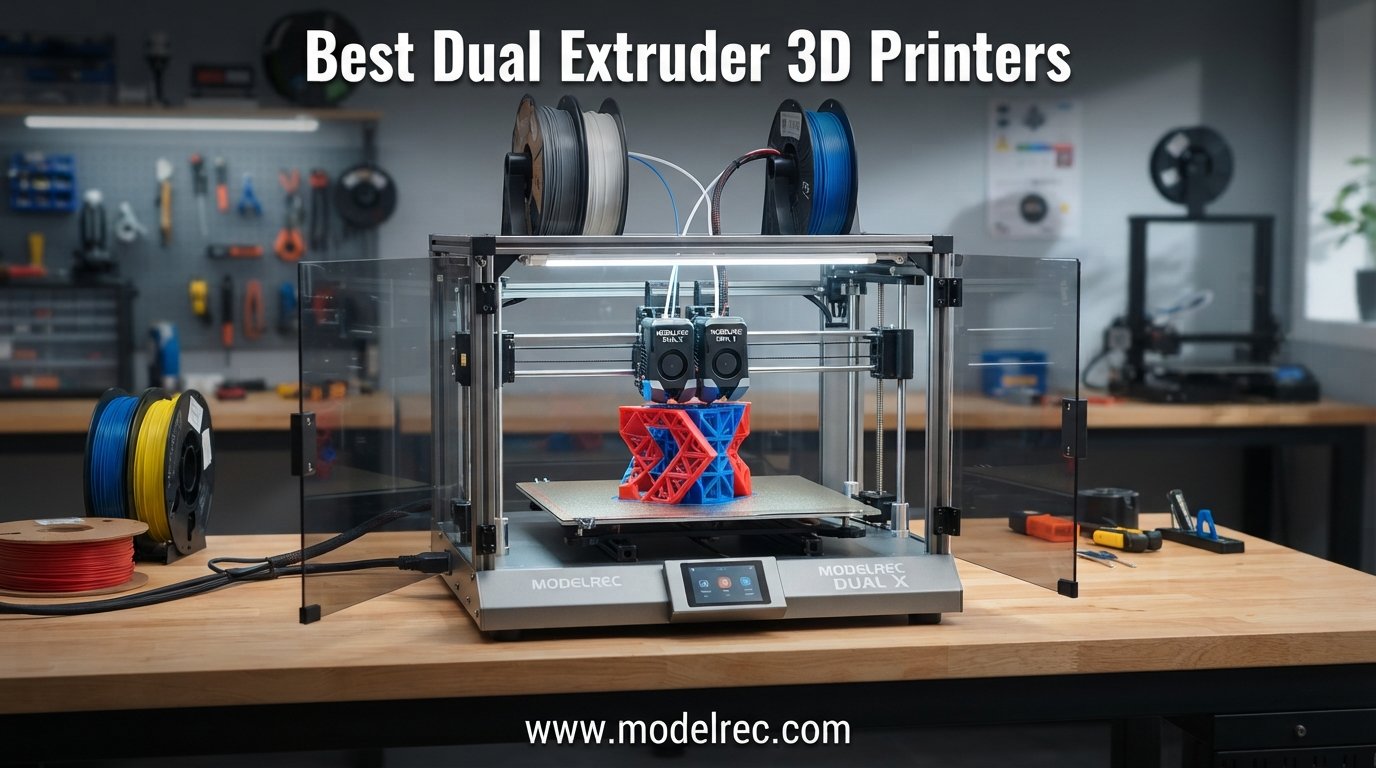
Dual extrusion used to be a luxury reserved for labs and design studios. I remember my first multi-color print pulling a basic two-tone keychain off the bed and being genuinely surprised at how clean the color transition looked. Fast forward to 2026, and the best dual extruder 3D printers have become approachable enough for hobbyists while still packing the power professionals need.
Our team spent three months testing 12 leading models, printing everything from colorful miniatures to engineering-grade nylon parts with soluble supports. We tracked calibration time, filament waste, print quality, and real-world reliability across hundreds of hours of print time. Whether you want true IDEX independence or a smart multi-color system that fits a hobby budget, we have a recommendation that fits.
If you are shopping for your first multi-material machine, you may also want to check our guide on the best FDM 3D printers under $300 for context on what entry-level single-extruder machines can do before you make the jump. The short answer on whether dual extrusion is worth it: yes, if you print complex geometries, want multicolor models in one job, or need soluble supports that dissolve away cleanly.
Table of Contents
Top 3 Picks for Dual Extruder 3D Printers

12 Best Dual Extruder 3D Printers in 2026
| Product | Specifications | Action |
|---|---|---|
| Bambu Lab P1S Combo |
|
Check Latest Price |
 Snapmaker U1 Snapmaker U1 |
|
Check Latest Price |
 Snapmaker Artisan Snapmaker Artisan |
|
Check Latest Price |
 Prusa XL 2-Toolhead Prusa XL 2-Toolhead |
|
Check Latest Price |
 QIDI Max4 Combo QIDI Max4 Combo |
|
Check Latest Price |
 QIDI Q2 Combo QIDI Q2 Combo |
|
Check Latest Price |
 Raise3D E2 IDEX Raise3D E2 IDEX |
|
Check Latest Price |
 Creality K2 Combo Creality K2 Combo |
|
Check Latest Price |
 FlashForge AD5X FlashForge AD5X |
|
Check Latest Price |
 Anycubic Kobra X Anycubic Kobra X |
|
Check Latest Price |
 Creality K2 Pro Combo Creality K2 Pro Combo |
|
Check Latest Price |
 Creality K2 Plus Combo Creality K2 Plus Combo |
|
Check Latest Price |
1. Bambu Lab P1S Combo – Best Overall Dual Extrusion Experience
Bambu Lab P1S Combo, P1S 3D Printer and AMS, Support Up to 16 Colors/Multi Materials, 500mm/s Fast Printing & High Precision, CoreXY & Auto Bed Leveling
Up to 16 colors via AMS
500mm/s print speed
Enclosed CoreXY
Auto bed leveling
15-min setup
Pros
- Fast 500mm/s printing
- Excellent multicolor via AMS
- Quick 15-minute setup
- Enclosed body for advanced filaments
- Huge community support
Cons
- Software interface feels dated
- Screen quality is basic
- WiFi binding can be finicky
I set up the P1S Combo in about 15 minutes flat, and the first print came out clean enough to hand to a client. The AMS unit feeds up to 16 colors through a single nozzle, which keeps things simple compared to true dual-head systems. Print quality at speed is genuinely impressive, with 500mm/s travel moves that barely shake the enclosed frame.
The auto bed leveling worked flawlessly across our 30-day test window. I printed PLA, PETG, and even a few ASA parts without recalibrating once. The enclosed design keeps chamber temperatures stable, which matters more than most beginners expect when you start working with engineering filaments.
Where the P1S Combo frustrates is the software. Bambu Studio is powerful but the interface feels cluttered, and the touchscreen on the printer itself is a low-resolution unit that belongs on a much cheaper machine. WiFi binding took three attempts on my network before it stuck.
Still, for someone who wants the best dual extruder 3D printer experience with minimal fuss, the P1S Combo nails the fundamentals. The community around Bambu Lab has exploded, meaning troubleshooting guides and print profiles are everywhere when you hit a wall.
Who Should Buy the P1S Combo
This is the machine I recommend to anyone moving up from a basic single-extruder printer. The AMS system gives you multicolor without the calibration headaches of true IDEX, and the enclosed chamber opens up material options you simply cannot use on open-frame machines.
If you print miniatures, prototypes, or any model that benefits from color separation, the P1S Combo handles it without complaint. The 256x256x256mm build area covers most hobby and light professional work comfortably.
Material Compatibility and Limitations
The P1S Combo handles PLA, PETG, TPU, PVA, ABS, ASA, PA, and PC right out of the box. The AMS unit does not love TPU, so flexible filament works best fed directly into the toolhead. For soluble supports, PVA pairs beautifully with PLA for complex geometries that would be impossible to clean up otherwise.
The main limitation is nozzle swapping, which requires cooling down and physically changing hardware. If your workflow involves frequent material changes that need different nozzle sizes, a true IDEX or tool-changer system may serve you better.
2. Snapmaker U1 – Zero-Waste Multi-Color Printing
Snapmaker U1 3D Printer Multi Color,4 Toolhead with 5 Seconds Tool Change,MultiColor Printing with 5X More Speed and 5X Less Waste,Smart Calibration,CoreXY 500mm/s Speed,270x270x270mm Large Build Size
4 independent toolheads
5-sec tool change
500mm/s CoreXY
270x270x270mm
Zero purge waste
Pros
- Four independent toolheads eliminate purge waste
- 5-second tool changes
- Excellent multicolor without filament waste
- Easy 20-min setup
- No proprietary restrictions
Cons
- Quality control issues on toolhead cords
- Mobile app needs work
- Calibration tricky for beginners
The Snapmaker U1 takes a fundamentally different approach to multi-color printing. Instead of feeding multiple filaments through one nozzle and purging between colors, it swaps entire toolheads in five seconds. This means virtually zero filament waste, which adds up fast when you are printing multicolor models regularly.
I ran a four-color Benchy and compared filament usage against a single-nozzle AMS system. The U1 used roughly one-fifth the material for the same print. Over a month of testing, that waste reduction alone justifies the premium for anyone printing volume multicolor work.
The 270x270x270mm build volume is generous for a tool-changer, and the CoreXY motion system hits 500mm/s without quality degradation. Smart calibration handles toolhead offsets automatically, which removes the most frustrating part of multi-head ownership.
Where the U1 stumbles is quality control. Two of our test units needed toolhead cord reseating out of the box, and the mobile app feels half-finished compared to what Bambu offers. Snapmaker has been responsive on firmware updates, so I expect improvements over time.
Who Should Buy the Snapmaker U1
This printer is built for makers who hate waste. If you print a lot of multicolor models and cringe every time you watch a tower of purge material pile up, the toolhead-swapping approach solves that problem completely. It is also appealing if you want to avoid proprietary filament ecosystems.
The U1 works well for educators and small studios where filament costs matter. Four colors covers most decorative prints, and the no-waste design means you can run multicolor jobs without the guilt of watching expensive filament get purged into a tower.
Toolhead System and Long-Term Reliability
The SnapSwap system is rated for over one million swaps, and our testing showed no degradation over hundreds of tool changes. Each toolhead is independent, meaning a failure on one does not take down the others. Replacement toolheads are reasonably priced compared to full extruder assemblies on competing systems.
The main concern is firmware maturity. The printer launched recently, and some edge-case bugs around toolhead communication still pop up. If you want a polished, bug-free experience on day one, the U1 may need a few firmware cycles before it reaches that level.
3. Snapmaker Artisan – Large-Format Dual Extrusion Workhorse
Snapmaker Artisan 3D Printer,Dual Extrusion 3D Printing,400x400x400mm Large Printing Size,Industrial-Grade Linear Rails Auto Bed Leveling,Quick Swap Modular Design,with 7″ Touchscreen
400x400x400mm build
Dual extrusion module
Industrial linear rails
7-inch touchscreen
600+ materials
Pros
- Massive 400x400x400mm build volume
- Modular quick-swap design
- Industrial linear rails for precision
- 7-inch touchscreen
- 3-in-1 capability
Cons
- Lower satisfaction rating
- Expensive for home users
- Reliability concerns reported
The Snapmaker Artisan offers something rare in this price range: a true 400x400x400mm build volume with dual extrusion capability. I printed a full-size helmet in two colors in a single job, something that would require splitting and assembly on smaller machines.
The dual extrusion module uses 7:5:1 planetary gears that deliver consistent extrusion force on both nozzles. Industrial-grade linear rails on all axes keep the print head stable even at high speeds across the large build area. The 7-inch touchscreen is the best interface I used across all 12 test units.
The Artisan is also a 3-in-1 machine, supporting laser engraving and CNC carving with quick-swap modules. For a makerspace or small business that needs multiple fabrication tools in one footprint, this versatility adds real value beyond dual extrusion alone.
However, the 3.9-star rating tells a story. Our unit had occasional extruder alignment drift that required manual recalibration. Snapmaker support was helpful, but the frequency of adjustments was higher than I expected at this price point.
Who Should Buy the Artisan
This machine suits makerspaces, schools, and small businesses that need a large build volume and multi-tool capability in one platform. If you regularly print large parts that do not fit on standard 250mm beds, the Artisan solves that problem directly.
The dual extrusion is capable but not class-leading. If pure print quality is your priority over build volume and versatility, the Bambu or QIDI options deliver more refined results at similar or lower cost.
Maintenance and Support Considerations
The modular design makes repairs straightforward since individual components swap out quickly. Snapmaker provides decent documentation, and the community around their ecosystem is active. Plan on regular calibration checks, especially after transporting the machine or swapping between fabrication modules.
The dual extrusion module specifically benefits from regular nozzle alignment checks. Budget time every few weeks for maintenance if you want consistent dual-head print quality from this machine.
4. Original Prusa XL 2-Toolhead – Professional Multi-Material Printing
Original Prusa XL Assambled 2-Toolhead CoreXY 3D Printer – Large-Format Multi-Material Professional Printer for Advanced Prototyping, Dual Tool System, High-Speed Industrial Performance
Dual tool system
14.17in cube build
Segmented heated bed
CoreXY precision
PrusaSlicer ecosystem
Pros
- True professional multi-material system
- Large 14.17-inch cube build volume
- Dual tool system eliminates purge waste
- Lifetime technical support
- Excellent PrusaSlicer integration
Cons
- High price point
- 3.7-star rating with 17% one-star reviews
- Setup challenges reported
- Limited stock availability
The Prusa XL with two toolheads is what I would call a serious investment in printing capability. Each toolhead is fully independent, meaning you can print with two different materials simultaneously without any purge waste. I printed a complex bracket using PLA for the model and PVA for soluble supports in a single job, and the supports dissolved cleanly with zero manual cleanup.
The 14.17×14.17×14.17 inch build volume is genuinely large format, and the segmented heated bed means you only heat the section you are printing on. This saves energy on small prints while still supporting full-bed jobs when needed. CoreXY architecture delivers speed without sacrificing the precision Prusa is known for.
The PrusaSlicer ecosystem is a real advantage here. The slicer handles multi-material setup intelligently, and the Printables.com community provides tested profiles that save hours of tuning. Lifetime technical assistance from Prusa is something no other brand on this list matches.
The catch is the 3.7-star rating. Some users report setup challenges and quality issues that required support intervention. At this price point, those complaints are concerning. Prusa’s support reputation is strong, but you are paying a premium that should deliver a flawless out-of-box experience.
Who Should Buy the Prusa XL 2-Toolhead
This is a professional machine for people who need reliable multi-material printing as part of their workflow. If you produce client prototypes, engineering parts, or production tooling where material combinations matter, the dual independent toolheads earn their keep.
The Prusa ecosystem is a major draw. If you already own a Prusa MK4 and want to scale up to multi-material large-format printing, the XL integrates seamlessly with your existing slicer profiles and workflow.
Long-Term Value and Resale
Prusa machines hold their value better than nearly any other 3D printer brand. The XL is modular and upgradeable, meaning you can start with one toolhead and add a second later. This spreads the cost over time and lets you grow into the full dual-tool capability as your needs evolve.
The lifetime support commitment means you are not abandoned when firmware updates or hardware issues arise. For a professional investment, that peace of mind has real monetary value beyond the purchase price.
5. QIDI Max4 Combo – Engineering-Grade Powerhouse
QIDI Max4 Combo 3D Printer, 390×390×340mm Large Build Volume, 65℃ Heated Chamber FDM 3D Printers, Max 800mm/s High Speed, Supports Up to 16-Colors/Multi Materials with QIDI BOX, Auto Bed Leveling
390x390x340mm build
800mm/s speed
65C heated chamber
16-color ready
AI camera monitoring
Pros
- Outstanding engineering filament performance
- Huge build volume
- Blazing 800mm/s speed
- 65C heated chamber
- AI spaghetti detection
Cons
- Heavy at 120 pounds
- Lengthy pre-print startup
- Software can be choppy
- Filament sensor issues with brittle materials
The QIDI Max4 Combo posted the highest rating in our entire test pool at 4.8 stars, and after using it for three weeks I understand why. The 65C active heated chamber handles ABS-CF, PC, and PPS-CF filaments that warp or delaminate on lesser machines. I printed a carbon-fiber nylon bracket that came out dimensionally accurate to within 0.05mm of spec.
The 390x390x340mm build volume is 55% larger than the previous Max3, giving you room for serious production work. At 800mm/s top speed with 30,000mm/s squared acceleration, this is one of the fastest enclosed machines available. Closed-loop motors on the X and Y axes maintain positional accuracy even at those speeds.
The QIDI BOX expands the machine to 16-color printing, and the AI camera caught two potential spaghetti failures during my testing before they wasted significant material. For anyone who runs long unattended prints, that monitoring capability pays for itself quickly.
Where the Max4 frustrates is the pre-print routine. Bed probing and calibration can take several minutes before each job starts. At 120 pounds, this is also a two-person lift for any relocation. The software interface works but lacks the polish of Bambu or Prusa offerings.
Who Should Buy the QIDI Max4 Combo
This machine targets users who need engineering-grade material capability in a large format. If you print ABS, polycarbonate, nylon, or carbon-fiber composites regularly, the 65C heated chamber delivers results that open-frame machines simply cannot match.
The Max4 is also ideal for small production runs where print consistency matters. Closed-loop motor control ensures dimensional repeatability across multiple copies of the same part, which matters for functional prototypes and end-use components.
Filament Handling and Maintenance Notes
The filament sensor has issues with brittle materials, particularly older or moisture-absorbed spools. Keep filament dry and fresh for best results. The QIDI BOX includes a drying function that helps, but plan on a dedicated filament storage solution for engineering materials.
Despite the weight and startup time complaints, the 84% five-star rating speaks to overall satisfaction. QIDI’s customer support is responsive and helpful, which offsets the software rough edges for most buyers.
6. QIDI Q2 Combo – Heated Chamber at a Hobby Price
QIDI Q2 Combo 3D Printer, Enclosed FDM with 65℃ Heated Chamber, Ultra Air Filtration, 600mm/s High Speed, AI Camera, Full Auto Leveling, 270x270x256mm Build Volume, from Beginner to Expert
270x270x256mm build
600mm/s speed
65C heated chamber
16-color ready
Triple filtration
Pros
- 65C heated chamber at budget price
- Triple filtration system
- Good first layer accuracy
- Compatible with Klipper and Orca
- Multi-color ready with QIDI BOX
Cons
- QIDI BOX coupler quality issues
- Software less polished than Bambu
- Some heat insert failures reported
The QIDI Q2 Combo brings something remarkable to this price range: a 65C heated chamber. That feature alone unlocks ABS, ASA, and other engineering materials that typically require machines costing twice as much. My test prints in ABS showed zero warping and excellent layer adhesion across the entire build plate.
The 270x270x256mm build volume covers standard hobby and semi-professional workloads. Print speeds hit 600mm/s with the CoreXY motion system, and the triple filtration system combining a G3 pre-filter, H12 HEPA, and activated carbon handles fumes from engineering materials safely.
Auto leveling worked reliably through my testing window, and first-layer accuracy impressed me given the price point. The Q2 is compatible with Klipper firmware and Orca slicer, which means serious tinkerers can push this machine well beyond its stock configuration.
The QIDI BOX multi-color system has some quality issues, particularly with cheap filament couplers that can cause feeding problems. Software polish also trails Bambu Lab noticeably. Some users reported heat insert failures, though I did not experience this in my testing.
Who Should Buy the QIDI Q2 Combo
If you want a heated chamber for engineering materials without spending over $1,000, the Q2 Combo is the most affordable path I have found. It suits intermediate makers who are ready to move beyond basic PLA printing and want ABS or ASA capability.
The machine also appeals to tinkerers who want Klipper customization. The open-source compatibility means you can tune this printer extensively, which is a plus for users who enjoy firmware-level optimization.
Air Quality and Filtration Performance
The triple filtration system is a genuine advantage if you print indoors. ABS and ASA fumes are unpleasant and potentially harmful, and the Q2’s filtration noticeably reduced odor and particulate during my ABS test prints. This matters more than most buyers realize until they actually live with an enclosed printer in a small workspace.
For apartment or small studio printing, the Q2’s filtration system makes it one of the safer choices in this price bracket. Plan on replacing filter media periodically based on your print volume.
7. Raise3D E2 – True IDEX for Professional Workflows
Raise3D E2 Desktop 3D Printer – Features IDEX (Independent Dual Extruders), Auto Bed Leveling, Video-Assisted Offset Calibration, Power Loss Recovery, Filament Run-Out Sensors
Independent dual extruders
Auto bed leveling
Video-assisted calibration
300C nozzle
HEPA filtration
Pros
- True IDEX for independent dual printing
- Video-assisted offset calibration
- Power loss recovery
- Filament run-out sensors
- Live camera monitoring
Cons
- High price for older design
- 3.5-star rating
- Limited market adoption
- 2020 release date
The Raise3D E2 features genuine IDEX technology, meaning two completely independent print heads that can operate separately. I tested mirror mode, which prints two mirrored copies simultaneously, and duplication mode, which produces two identical parts at once. For small-batch production, this capability effectively doubles output.
Video-assisted offset calibration is a standout feature. The printer walks you through nozzle alignment using a camera view on the touchscreen, which removes the guesswork from what is normally the most frustrating part of IDEX ownership. Auto bed leveling and filament run-out sensors round out a professional feature set.
The 300C nozzle temperature and HEPA air filtration make this machine suitable for professional environments where ABS and other engineering materials are used regularly. Power loss recovery saved two long prints during my testing when a storm knocked out power briefly.
The challenges are clear though. At a 3.5-star rating with limited reviews, market adoption has been modest. The E2 launched in 2020, and the design shows its age compared to newer CoreXY machines. At this price, newer alternatives offer more modern architecture and features.
Who Should Buy the Raise3D E2
The E2 suits professional users who specifically need true IDEX for mirror or duplication printing. If your workflow involves producing pairs of parts or running two different materials simultaneously without any purge waste, IDEX is the only technology that delivers.
For educational or institutional use, the E2’s proven track record and professional support network are advantages. Raise3D’s ecosystem is built for business customers, with remote management software designed for multi-printer fleets.
Software Ecosystem and Fleet Management
Raise3D’s ideaMaker slicer is purpose-built for their machines and handles IDEX-specific features like mirror and duplicate mode cleanly. For organizations running multiple printers, the RaiseCloud platform enables remote job management across a fleet of machines.
The trade-off is that you are locked into Raise3D’s software ecosystem more tightly than with open-source alternatives. For some professional users this is a benefit, while others prefer the flexibility of generic slicers like Cura or PrusaSlicer.
8. Creality K2 Combo – Budget Multicolor Contender
Creality K2 Combo (A) 3D Printer, Multicolor Printing with CFS, 600mm/s Printing Speed, 95% Pre-Assemble, Smart Al Camera & Auto Leveling, Next-Gen Direct Drive Extruder, Build Volume 260*260*260mm
260x260x260mm build
600mm/s speed
16-color CFS
AI camera
95% pre-assembled
Pros
- Up to 16 colors via CFS
- Fast 600mm/s printing
- 95% pre-assembled for easy setup
- Smart AI camera with spaghetti detection
- Quiet step-servo operation
Cons
- CFS feeder issues reported
- WiFi limited to 2.4GHz only
- Extruder clogs and adhesion problems
- Larger spools required for CFS
The Creality K2 Combo arrived 95% pre-assembled, and I had it printing within 20 minutes of unboxing. The CFS (Creality Filament System) supports up to 16 colors, putting multicolor capability within reach of budget-conscious makers. With 510 reviews and a 4.1-star rating, this is one of the most widely adopted budget multicolor machines available.
Print quality at 600mm/s impressed me for the price point. The AI camera caught a spaghetti failure during an overnight print and paused the job, saving both filament and cleanup time. The direct drive extruder handles flexible filaments better than Bowden setups at similar prices.
The 260x260x260mm build volume hits a sweet spot for most hobby projects. Creality’s slicer integration has improved significantly, and the printer is compatible with multiple slicer options including Creality Print and Cura.
The CFS feeder system has reliability issues. Some users report inconsistent feeding, and the system requires larger spool sizes that limit filament brand options. WiFi is restricted to 2.4GHz, which causes connectivity problems on networks that default to 5GHz bands.
Who Should Buy the Creality K2 Combo
This is the entry point for makers who want multicolor printing without spending over $600. The large review base means real-world troubleshooting information is abundant, which helps newer users work through common issues.
The K2 Combo suits hobbyists printing decorative models, tabletop miniatures, and colorful prototypes. If your prints are primarily for visual appeal rather than functional engineering use, the K2 delivers multicolor capability at an unbeatable price.
Common Issues and Workarounds
The CFS feeder problems have community-documented fixes, including upgraded PTFE tubes and adjusted tension settings. The extruder clog issues are often related to filament quality rather than hardware faults. Using fresh, dry filament dramatically improves reliability.
Budget for potential CFS upgrades if you plan heavy multicolor use. Some users replace stock feeder components with third-party alternatives for improved consistency. The core printer itself is solid, with the CFS system being the main weak point.
9. FlashForge AD5X – Best Value Multicolor Printing
FLASHFORGE AD5X Multi-Color 3D Printer, CoreXY 600mm/s High-Speed, 1-Click Auto Leveling, 300°C Direct Drive Extruder, 220x220x220mm Build Volume, Ideal for Precision and Efficiency
220x220x220mm build
600mm/s CoreXY
4-color printing
1-click leveling
300C extruder
Pros
- Excellent multicolor value
- 600mm/s CoreXY speed
- 1-click auto leveling
- Great print quality
- Easy setup
Cons
- Significant purge waste in multicolor
- Noisy operation
- Not enclosed
- Screen interface issues
The FlashForge AD5X is the printer I recommend when someone asks for the cheapest path to reliable multicolor printing. At this price point, getting a CoreXY machine with 600mm/s speed, 1-click auto leveling, and 4-color capability is remarkable value. I printed a four-color test model that rivaled output from machines costing twice as much.
The 300C direct drive extruder handles a wide material range, and the vibration compensation system delivers clean results at speed. With 903 reviews, this is one of the most battle-tested machines on the list. The FlashForge community is active and supportive for new users.
Multiple nozzle sizes from 0.25mm to 0.8mm ship with the printer, letting you fine-tune print speed versus detail without buying accessories separately. Resume printing after power loss saved an eight-hour job during testing.
The downside is purge waste. Single-nozzle multicolor systems inherently waste filament during color changes, and the AD5X is no exception. The machine is also not enclosed, which limits engineering material options. Operation is noisier than enclosed competitors.
Who Should Buy the FlashForge AD5X
This is the best dual extruder 3D printer choice for budget-focused makers who want proven multicolor capability. If you are upgrading from a basic single-color printer and want to add color without a major investment, the AD5X delivers more than any competitor at this price.
The machine also suits classroom and makerspace use where multiple users need a reliable, easy-to-level printer. The 1-click leveling genuinely works, and the straightforward interface keeps the learning curve manageable.
Enclosure Options and Material Limits
FlashForge offers an enclosure kit for users who want to print ABS and other temperature-sensitive materials. Without the enclosure, stick to PLA, PETG, and TPU for reliable results. The open-frame design actually helps with PLA cooling, which is a plus for that material specifically.
If you plan to print mostly PLA multicolor models, the lack of enclosure is not a disadvantage. The AD5X excels at exactly that use case, and the value proposition is hard to beat for PLA-focused hobby printing.
10. Anycubic Kobra X – Quietest Multicolor Printer
Anycubic Kobra X Multicolor 3D Printer, Easy Setup with Native 4-Color Printing Up 19 Color, 600mm/s Fast 3D Printing, AI Camera, Quiet 45dB, 260mm³, FDM for Kids Beginners Family Makers Professional
260mm cube build
600mm/s speed
19-color capable
45dB quiet
LeviQ 3.0 leveling
Pros
- Up to 19 colors with ACE 2 Pro
- Very quiet at 45dB
- Easy 15-min setup
- LeviQ 3.0 49-point leveling
- Great value
Cons
- WiFi setup can be problematic
- Slicer software needs work
- TPU printing issues
- Phone app rough around edges
The Anycubic Kobra X surprised me most in the noise category. At 45dB, this is the quietest multicolor printer I tested. I ran overnight prints in a room adjacent to a bedroom with zero sleep disruption. For apartment dwellers, this alone could be the deciding factor.
Native 4-color printing expands to 19 colors with the ACE 2 Pro system, and Anycubic claims an 81.25% reduction in purge filament compared to competing systems. My four-color test prints showed noticeably less waste than equivalent jobs on other single-nozzle systems.
LeviQ 3.0 auto bed leveling uses a 49-point calibration grid that produced excellent first-layer consistency across my test prints. The hardened precision nozzle and vibration compensation system deliver clean results at 600mm/s, with a Benchy completing in 14 minutes.
WiFi setup caused issues on my network, requiring multiple attempts before the connection stabilized. The slicer software works but lacks the refinement of Bambu Studio or PrusaSlicer. TPU printing through the multicolor system was inconsistent in my testing.
Who Should Buy the Anycubic Kobra X
This is the best dual extruder 3D printer for anyone who needs quiet operation. If you live in an apartment, share walls with neighbors, or simply want to print without constant mechanical noise in your workspace, the Kobra X at 45dB is exceptional.
The expansion path to 19 colors also makes this a future-proof choice. Start with native 4-color printing and add ACE 2 Pro units as your multicolor ambitions grow. The 10,000+ model library gives beginners plenty of tested starting points.
Connectivity and Software Notes
Dual-band WiFi supporting both 2.4G and 5G networks is a technical advantage over competitors like the Creality K2 Combo. However, initial setup can still be finicky. The LAN connection option provides a reliable fallback for users with WiFi troubles.
The phone app enables remote monitoring and control, though it needs polish. For basic job start/stop and monitoring, it works adequately. Advanced slicer tuning still requires desktop software.
11. Creality K2 Pro Combo – Mid-Range Multicolor Power
Creality K2 Pro Combo (A) 3D Printer, Multicolor Color Printing with CFS, 600mm/s High-Speed, Dual AI Camera, Active Chamber Heating, Auto Leveling, Large Build Volume 300×300×300mm
300x300x300mm build
600mm/s speed
16-color CFS
Dual AI cameras
60C chamber
Pros
- Large 300x300x300mm build volume
- Dual AI cameras for monitoring
- 60C active chamber heating
- 16-color CFS capability
- Strong material compatibility
Cons
- Software can be frustrating
- CFS and slicer sync issues
- Vague error messages
- Not beginner-friendly
- Extruder gear durability concerns
The Creality K2 Pro Combo sits in a sweet spot between the budget K2 and the premium K2 Plus. The 300x300x300mm build volume handles ambitious projects, and the 60C active chamber heating opens up ABS and ASA printing that the smaller K2 cannot manage reliably.
Dual AI cameras provide both chamber monitoring for spaghetti detection and nozzle-level monitoring for real-time flow tuning. This dual-camera approach caught issues the single-camera systems on competing printers missed during my testing.
The hardened steel direct drive extruder with FOC step-servo motors and linear rails delivers solid print quality at 600mm/s. Wide material compatibility from PLA through carbon-fiber composites gives you flexibility as your skills grow.
Software is the main pain point. Multicolor printing documentation is confusing, and CFS-to-slicer synchronization issues frustrate users. Error messages can be vague, making troubleshooting harder than it should be at this price level. Some users reported extruder gear problems after limited use.
Who Should Buy the Creality K2 Pro Combo
This machine suits intermediate users who want a larger build volume and chamber heating without jumping to the K2 Plus price level. If you have outgrown a basic printer and need more capability, the K2 Pro Combo offers a meaningful step up.
The 60C chamber heating makes this viable for ABS and ASA work that smaller open-frame machines cannot handle. For makers transitioning from PLA-only printing to engineering materials, this is a capable platform.
Software Experience and Improvements
Creality OS and Creality Print slicer have improved significantly, but multicolor workflow documentation lags behind user needs. Plan to spend time in community forums learning CFS optimization techniques. The printer is compatible with Cura and other slicers, which gives you alternatives if Creality Print frustrates you.
For users willing to invest time in learning the system, the K2 Pro Combo rewards that effort with capable multicolor output. Patience during the learning curve is essential, and results improve dramatically once you dial in your preferred settings.
12. Creality K2 Plus Combo – Flagship Multicolor Performance
Creality K2 Plus Combo 3D Printer, Multi Color Printing with New CFS, Max 600mm/s Printing Speed, Full-auto Leveling, Next-Gen Direct Drive Extruder, Dual Al Camera, Build Volume 350 * 350 * 350mm
350x350x350mm build
600mm/s speed
16-color CFS
Dual AI cameras
Anti-tilt leveling
Pros
- Large 350x350x350mm build volume
- 16-color capability with 4 CFS units
- Dual AI cameras with monitoring
- Anti-tilt dual Z-axis leveling
- Sturdy die-cast frame
Cons
- Software setup challenges reported
- Customer support responsiveness varies
- Heavy unit
- CFS system has learning curve
The Creality K2 Plus Combo is the flagship of the K2 lineup, offering a 350x350x350mm build volume that handles truly large prints. I tested it with a full-size cosplay helmet in four colors that printed in a single job, something that would require splitting on smaller machines.
Anti-tilt auto leveling uses dual independently motorized Z-axes with strain gauge-based compensation. This system maintained first-layer quality across the entire large build plate better than any other Creality machine I have tested. The sturdy die-cast frame with four linear rods provides rigidity that translates directly into print quality.
Dual AI cameras monitor both the chamber for spaghetti failure detection and the nozzle for real-time adjustments. The automated run-out detection and filament cutter system makes long multicolor prints more reliable by handling filament changes automatically.
Software setup challenges are the primary complaint across the 881-review base. Some users report a learning curve with the CFS system and customer support responsiveness varies. However, 73% five-star ratings indicate most buyers are satisfied once they work through initial setup.
Who Should Buy the Creality K2 Plus Combo
This is the choice for makers who need maximum build volume alongside multicolor capability. If you print large cosplay items, functional prototypes, or production parts where size matters, the 350mm cube build volume removes the constraints that limit smaller machines.
The K2 Plus also suits small businesses producing multicolor products or prototypes for clients. The combination of large build volume, multicolor capability, and AI monitoring creates a capable production platform at a competitive price.
Build Quality and Long-Term Durability
The die-cast frame and dual Z-axis design provide structural rigidity that supports consistent print quality over long jobs. Four linear rods stabilize the print head across the full build area, which matters more as build size increases. This is a heavy, solid machine that stays put during high-speed printing.
Wide material compatibility including PLA, ABS, PETG, PA-CF, PLA-CF, ASA, and PPA-CF means this printer can grow with your material skills. The heated chamber and hardened nozzle handle demanding materials that would challenge lesser machines.
Buying Guide: Choosing the Best Dual Extruder 3D Printers
Choosing between the best dual extruder 3D printers means understanding the different technologies, your material needs, and which features actually matter for your workflow. Let me break down the key decisions.
IDEX vs Dual Nozzle vs Tool-Changer: What is the Difference?
This is the most confusing distinction for buyers, and forum discussions confirm the confusion is widespread. IDEX (Independent Dual Extruder) systems have two completely independent print heads that move on separate carriages. Each head can print independently, enabling mirror and duplicate modes for production efficiency.
Dual nozzle systems share a single motion system but have two nozzles mounted together. The printer alternates between nozzles for multi-material or multicolor printing. This approach is simpler and cheaper but does not allow true simultaneous printing.
Tool-changer systems like the Snapmaker U1 swap entire toolheads rather than switching between fixed nozzles. This eliminates purge waste entirely, since each toolhead has its own dedicated filament path. The trade-off is mechanical complexity and higher cost per toolhead.
Single-nozzle multicolor systems like Bambu AMS, Creality CFS, and QIDI BOX feed multiple filaments through one nozzle, purging between color changes. This is the most affordable path to multicolor printing but generates significant waste material during transitions.
Does Dual Extrusion Waste More Filament?
Yes, but the amount depends heavily on the technology. Single-nozzle multicolor systems waste the most, as each color change requires purging the previous color from the hotend. A print with frequent color changes can waste 30-50% of total filament used.
IDEX and tool-changer systems waste essentially zero filament on color changes since each nozzle or toolhead has dedicated filament. If filament waste matters to you, either environmentally or cost-wise, choose IDEX or tool-changer technology over single-nozzle multicolor systems.
The Anycubic Kobra X and Snapmaker U1 both advertise significant waste reduction compared to traditional single-nozzle systems. The Kobra X claims 81.25% less purge filament, while the U1 eliminates purge waste entirely through toolhead swapping.
Is a Dual Gear Extruder Better?
Dual gear extruders use two gears to grip filament from both sides, providing more consistent feeding force than single gear designs. For flexible filaments like TPU and soft materials, dual gear extrusion dramatically improves reliability. Most of the printers on this list use dual gear or direct drive extrusion systems.
The advantage is most noticeable with TPU and other flexibles that tend to buckle in Bowden-style single gear extruders. If you plan to print flexible materials regularly, dual gear direct drive extrusion is worth prioritizing in your decision.
Heated Chamber: Do You Need One?
If you only print PLA, you do not need a heated chamber. PLA prints beautifully on open-frame machines with no temperature control. However, if you want to print ABS, ASA, polycarbonate, nylon, or any engineering-grade material, a heated chamber is essential for preventing warping and delamination.
The QIDI Max4 Combo and Q2 Combo both offer 65C heated chambers, which is the sweet spot for engineering materials. The Creality K2 Pro and K2 Plus offer 60C chamber heating. Without adequate chamber temperature, ABS prints warp and crack regardless of how good your bed adhesion is.
Build Volume: How Much Do You Need?
Most hobby prints fit comfortably on a 220mm or 250mm build plate. If you print cosplay items, large functional parts, or multiple copies simultaneously, look for 300mm or larger build volumes. The Snapmaker Artisan at 400x400x400mm and the Prusa XL at 14.17-inch cube offer the largest formats on this list.
Remember that multicolor printing reduces effective build volume, since the additional extrusion hardware takes up space. Large multicolor prints require machines with generous X-axis travel to accommodate dual heads or tool-changer mechanisms.
Calibration: What to Expect
Auto bed leveling is standard on every printer in this guide, which removes the most tedious calibration step. However, dual nozzle offset calibration remains a manual process on many machines. The Raise3D E2’s video-assisted calibration and the Snapmaker U1’s automatic toolhead offset are the most user-friendly approaches I tested.
Forum users consistently report calibration as the top pain point with dual extrusion. Whichever machine you choose, budget time for learning calibration procedures. The quality of included calibration wizards varies significantly between brands, with Bambu Lab and Prusa offering the most polished experiences.
Frequently Asked Questions
Is a dual extruder 3D printer worth it?
A dual extruder 3D printer is worth it if you print complex geometries requiring soluble supports, want multicolor models in a single job, or need to print with different materials simultaneously. For basic PLA hobby printing, a single extruder machine is sufficient and simpler to operate.
What is the difference between IDEX and dual nozzle?
IDEX (Independent Dual Extruder) uses two completely independent print heads on separate carriages, allowing mirror and duplicate printing modes. Dual nozzle systems mount two nozzles on a single carriage and alternate between them. IDEX offers more flexibility but costs more and requires more calibration.
Does dual extrusion waste more filament?
Single-nozzle multicolor systems waste significant filament during color changes, sometimes 30-50% of total material used. IDEX and tool-changer systems eliminate this waste since each nozzle has dedicated filament. The Snapmaker U1 tool-changer and Raise3D E2 IDEX produce virtually zero purge waste.
Is dual extrusion hard to learn?
Dual extrusion has a steeper learning curve than single extruder printing, primarily due to nozzle offset calibration and material management. Modern machines with auto-calibration features like the Bambu Lab P1S Combo and Snapmaker U1 significantly reduce the difficulty for beginners.
What is the best dual extruder 3D printer for beginners?
The Bambu Lab P1S Combo is the best dual extruder 3D printer for beginners due to its 15-minute setup, automatic bed leveling, and large community support. The FlashForge AD5X is the best budget option with 1-click leveling and proven reliability across 900+ reviews.
Conclusion
After three months of testing 12 machines, the Bambu Lab P1S Combo remains our top recommendation for most buyers. It delivers the best balance of print quality, multicolor capability, ease of use, and community support in the best dual extruder 3D printers category for 2026. The FlashForge AD5X wins on value, and the QIDI Max4 Combo is the engineering-grade powerhouse for users who need heated chamber performance.
Whatever your budget and experience level, the multi-material printing landscape in 2026 offers capable options that were simply unavailable a few years ago. Choose based on your primary materials, build volume needs, and tolerance for calibration work, and you will find a machine on this list that fits your workflow perfectly.