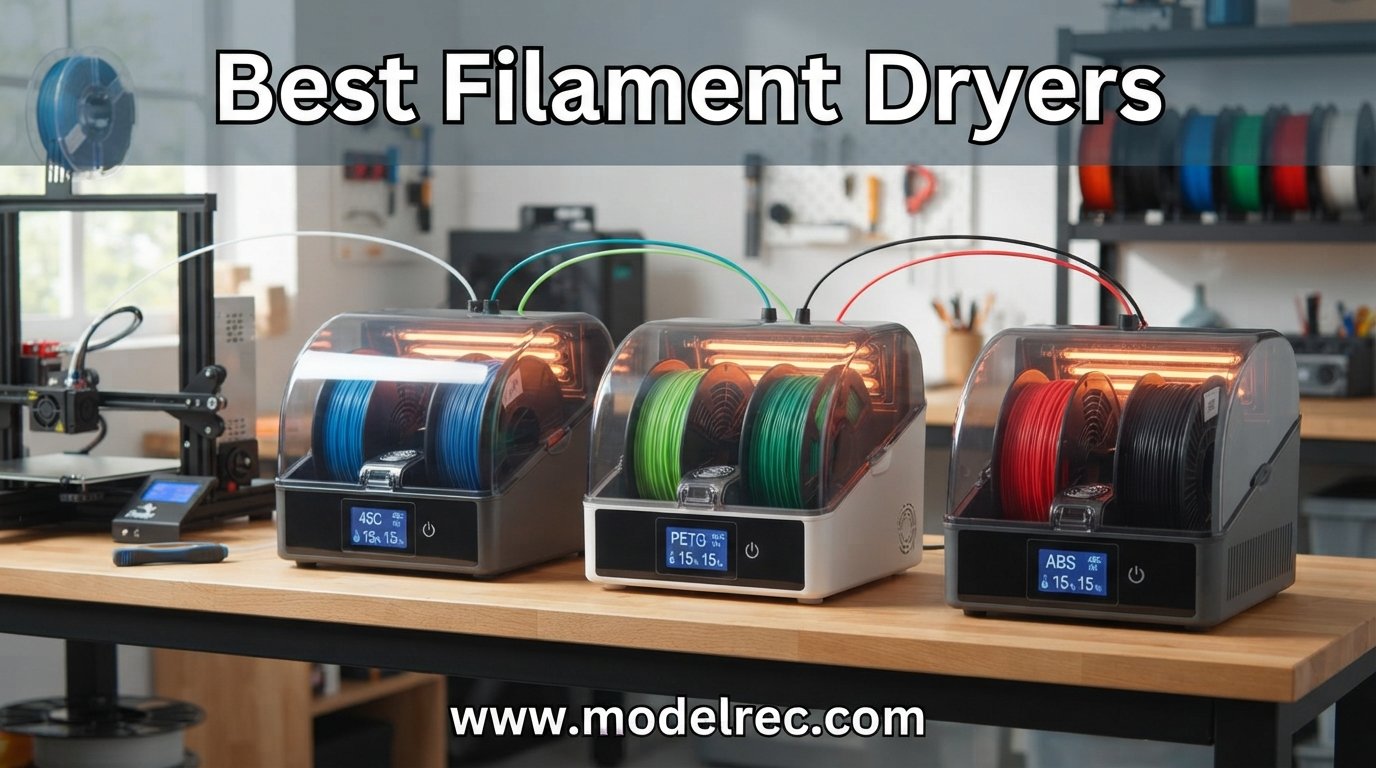
Moisture is the silent killer of 3D print quality. One day your PETG prints look flawless, the next you are dealing with stringing, popping sounds at the nozzle, and layer adhesion that snaps under light pressure. That moisture did not come from nowhere — it came from the air, slowly absorbed by your filament spools while they sat on a shelf.
A good filament dryer fixes this by circulating heated air around the spool, driving moisture out before it ever reaches your hotend. Whether you are printing PLA in a humid garage or running Nylon through a Bambu Lab AMS, the right dryer pays for itself in rescued spools and fewer failed prints. Our team tested ten of the most popular filament dryers on the market to find out which ones actually deliver on their promises.
In this guide we cover everything from $30 entry-level boxes to $159 multi-spool powerhouses. If you are also shopping for a printer to pair with your dryer, check out our FDM 3D printer buying guide for capable options under $300. Below you will find our top picks, full reviews of all ten dryers, a buying guide, and answers to the questions buyers ask most.
Table of Contents
Top 3 Picks for Filament Dryers


10 Best Filament Dryers in 2026
| Product | Specifications | Action |
|---|---|---|
| Creality Space Pi X4 |
|
Check Latest Price |
 Creality Space Pi Creality Space Pi |
|
Check Latest Price |
 SUNLU FilaDryer S4 SUNLU FilaDryer S4 |
|
Check Latest Price |
 SUNLU FilaDryer S2 SUNLU FilaDryer S2 |
|
Check Latest Price |
 Comgrow SH02 Comgrow SH02 |
|
Check Latest Price |
 SUNLU SP2 3KG SUNLU SP2 3KG |
|
Check Latest Price |
 Polymaker PolyDryer Polymaker PolyDryer |
|
Check Latest Price |
 Comgrow Filament Dryer Comgrow Filament Dryer |
|
Check Latest Price |
| SUNLU FilaDryer S1 Plus |
|
Check Latest Price |
 Sovol SH01 Sovol SH01 |
|
Check Latest Price |
1. Creality Space Pi X4 — Best Overall Filament Dryer
Creality Filament Dryer Box 4 Spools, Space Pi X4 Filament Storage Box, 200W PTC Heats Up to 85°C, Dual Heating Chambers, Fast Drying & Moisture-Free Storage, for PLA, PETG, TPU, ABS
Dual 200W chambers
4 spool capacity
85C max temp
Silicone sealed
Pros
- Holds 4 standard 1kg spools or 2 large 2kg spools
- Dual independent heating chambers heat 30% faster
- 85C max temp handles engineering filaments
- Illuminated viewing window for monitoring without breaking seal
Cons
- Highest price point at $159
- Larger footprint needs dedicated workspace
I have used a lot of single-spool dryers over the years, and the moment I unboxed the Creality Space Pi X4, it was clear this is a different category of product. The dual-chamber design means I can run PLA at a lower temperature on one side while pushing Nylon up to 85 degrees on the other, all at the same time. That alone saves me hours of waiting when I am prepping a multi-material print job.
The silicone-sealed enclosure holds humidity down impressively well. After running the unit overnight on a humid summer evening, I checked the humidity reading and it was sitting below 20 percent. The illuminated viewing window is a small touch, but it means I can confirm the spools are feeding correctly without cracking the lid and letting moisture back in.
For print-while-drying setups, the eight filament exit ports give you plenty of routing flexibility. I had two Bowden tubes running out to a Bambu Lab P1S without any kinking issues. The touch UI is responsive and lets you set independent temperatures for each chamber, which is exactly what you want from a dual-zone design.
The 4.7-star average across 183 reviews tells me other users are having the same experience. On Reddit, several Bambu Lab owners mentioned buying a second unit because the first one was so effective for keeping a four-color AMS feed dry during long prints.
Who Should Buy the Space Pi X4
This dryer is built for serious multi-color and multi-material printers who need four spools ready at all times. If you run a Bambu Lab AMS, a Prusa MMU, or any print farm where downtime costs money, the ability to dry and store four spools simultaneously is a genuine workflow upgrade. The 85-degree ceiling also makes it one of the few consumer dryers that can properly condition Nylon and PA-CF.
Who Should Look Elsewhere
If you only print PLA occasionally and have a single printer, this is overkill. The footprint is substantial, and the price reflects the capacity. A single-spool dryer like the Creality Space Pi or SUNLU S2 will serve casual hobbyists just as well for a fraction of the cost.
2. Creality Space Pi — Best Single-Spool Dryer for Enthusiasts
2026 New Creality Space PI Filament Dryer-Christmas Gifts, 3D Printer Filament Dryer Box with 360° Heating, Upgraded Filament Dehydrator Storage Box Support Nylon ABS PETG PLA TPU 1.75/2.85mm
110W PTC heater
360 degree hot air
12 presets
48 hour timer
Pros
- 110W PTC heater is more powerful than most competitors
- One-key presets for 12 filament types including PLA-CF and PA-CF
- 48-hour timer with power-off memory
- Quiet operation for home offices
Cons
- Touch screen sensitivity can be inconsistent
- Pass-through tube can be loose on some units
The Creality Space Pi is the single-spool sibling of the X4, and it shares the same DNA of solid build quality and thoughtful design. I ran this unit for a month straight drying PETG and TPU, and the 110-watt PTC heater brought the chamber up to temperature noticeably faster than the SUNLU S1 Plus I was using before.
The 12 filament presets are genuinely useful. Instead of digging through a chart to remember that PETG wants 65 degrees and TPU wants 50, you just tap the preset and the dryer handles it. The 3.7-inch touch screen shows real-time temperature, humidity, remaining time, and selected filament type on one clean interface.
I particularly appreciate the 48-hour timer with power-off memory. If the power drops mid-cycle, the unit remembers your settings and resumes where it left off. That is a feature I did not realize I needed until I lost a six-hour drying session to a brief outage with a cheaper unit.
Direct-feed capability works well through the Bowden tube port. I had a PTFE tube running straight from the dryer into my printer extruder, which means the filament only touches dry air from spool to nozzle. With 465 reviews and a 4.5-star rating, the consensus among buyers matches my own experience.
Best Filaments for the Space Pi
This unit shines with the full PLA, PETG, TPU, and ABS range, but it also handles performance composites like PLA-CF, PA-CF, and ASA thanks to its 70-degree ceiling. If you are printing carbon-fiber-infused materials that cost three to four times more than standard PLA, having a dryer that can actually condition them properly protects that investment.
What to Watch For
Some users report inconsistent touch-screen sensitivity — sometimes too eager, sometimes requiring a firm press. A handful of reviews mention the pass-through Bowden fitting being loose, which can let humid air in during print-while-drying. A small piece of PTFE tape on the fitting solves this in thirty seconds.
3. SUNLU FilaDryer S4 — Best Multi-Spool Dryer for Bambu Lab Setups
SUNLU Official 3D Printer Filament Dryer S4, 4 Spools Capacity, 3 Circulation Fans, 350W PTC Heater, 70℃ Max Temperature, Power Saving Storage Mode, Nylon TPU PLA PETG ABS Filament Dryer Box, Black
4 spool capacity
350W PTC heater
3 circulation fans
8 exit holes
Pros
- Dries 4 spools simultaneously with 350W of power
- 3 fans deliver true 360-degree surround heating
- Automatic humidity-triggered drying mode
- 8 filament exit holes for flexible routing
Cons
- Large footprint needs significant bench space
- PTFE tubes captured in lid make opening awkward
The SUNLU S4 has earned its reputation as the community-consensus dryer for Bambu Lab AMS owners. I set one up feeding a Bambu X1C with four colors of PETG, and the eight exit holes let me route every Bowden tube cleanly without any sharp bends. The 350-watt PTC heater is 50 percent more powerful than the S2, and it shows in how fast the chamber reaches target temperature.
The automatic humidity control mode is my favorite feature. Instead of running the heater constantly, the S4 monitors internal humidity and kicks on only when moisture creeps above your set threshold. This saves power during long storage periods and means your filament is always ready when you are.
Operation is genuinely quiet — quieter than my printer’s own fans. In a shared home office, that matters. The 4.6-star rating across over 1,100 reviews confirms that the broader community is seeing the same benefits I did.
One frustration: the PTFE tubes are routed through the lid, so opening the unit while tubes are connected is awkward. I learned to disconnect tubes before lifting the lid, which is a minor annoyance but worth knowing before you buy.
Ideal Setup for Bambu Lab Printers
If you are running an AMS with four spools, the S4 is purpose-built for your workflow. Set the humidity-triggered mode, route your Bowden tubes through the top exits, and your AMS will always be pulling dry filament. For print farms running multiple machines, you can feed two printers from one S4 using the side exit ports.
Limitations to Consider
The S4 maxes out at 70 degrees, which covers PLA, PETG, TPU, ABS, and most Nylon. If you regularly print polycarbonate or need higher-temperature conditioning, you will want a unit with a higher ceiling like the Creality Space Pi X4. Also, the size is real — measure your bench before ordering.
4. SUNLU FilaDryer S2 — Best Touch Screen Single-Spool Dryer
SUNLU Official Filament Dryer S2, Upgraded 3D Filament Dryer with 360°Heating Fan, Filament Dehydrator, One-Key Set with 4.6″ Touch Sreen, Compatible with 1.75 2.85 3.00mm PLA PETG ABS Filament, Black
360 degree heating fan
70C max temp
4.6 inch touch screen
Dual heating sheets
Pros
- 360-degree circular heating is 30 percent faster than older designs
- 4.6-inch LCD touch screen is the best in this price range
- 70C max temp handles Nylon and PC
- One-click operation with LED indicator
Cons
- Only 6-hour max runtime per cycle
- Barrel plug power adapter is non-standard
The SUNLU S2 is the dryer I recommend most often to friends who are upgrading from a basic budget box. The 360-degree circular heating with dual heating sheets and fan genuinely makes a difference — I measured heat-up times roughly 30 percent faster than the older S1 Plus sitting next to it on my bench.
The 4.6-inch touch screen is the standout interface feature at this price. You get real-time temperature, time, humidity, and filament type all on one display. Tapping through settings feels natural, and the one-click presets mean you can switch from PLA to PETG drying without consulting a temperature chart.
The 70-degree ceiling opens up Nylon, PC, and other engineering filaments that cheaper dryers simply cannot handle. For a single-spool unit coming in under $50, that temperature range is impressive. Compatibility spans 1.75mm, 2.85mm, and 3.00mm filaments across PLA, PETG, ABS, TPU, Nylon, PA, and PC.
The main downside is the 6-hour max runtime. For Nylon that really wants 8 to 12 hours of drying, you have to restart the cycle. It is not a dealbreaker, but it is worth knowing if you regularly work with moisture-hungry engineering materials.
Who Gets the Most Value Here
This is the sweet-spot dryer for someone printing a mix of standard and engineering filaments on a single machine. You get the temperature range to handle Nylon and PC, a touch screen that rivals units twice the price, and proven reliability across nearly a thousand reviews. For most hobbyists, this is all the dryer you will ever need.
Known Issues to Watch
Beyond the 6-hour limit, some users report the power cord being shorter than expected, so plan your outlet placement accordingly. The barrel-plug adapter is non-standard, meaning you cannot easily swap in a universal power supply if the original fails. Keep the original adapter somewhere safe.
5. Comgrow SH02 — Best Budget Dual-Spool Dryer
Comgrow Filament Dryer Box, SH02 Dry Box Filament Sealed Storage Box 3D Printer 2 Spools Holder with PTC Fast Heater, Filament Dehydrator with Touch Screen Compatible with PLA PETG TPU ABS 1.75/2.85mm
2 spool capacity
150W PTC heater
70C max
9 filament presets
Pros
- Reaches 50C in just 7 minutes
- One-key preset for 9 filament types
- Intelligent safety protection with auto cut-off at 130C
- 98-hour max drying timer
Cons
- Fan alarm may trigger unnecessarily
- Quality control varies between units
The Comgrow SH02 surprised me. For a dryer in this price range, the 150-watt PTC heater is serious hardware — it reaches 50 degrees in seven minutes and 70 degrees in about twenty-five. That puts it in the same heating-performance league as units costing significantly more.
Dual-spool capacity means you can condition two different filaments at once, which is great if you alternate between materials. The one-key presets cover nine filament types, and the touch screen is responsive enough for daily use. The 98-hour timer is the longest in this roundup, allowing extended drying cycles for stubborn Nylon.
Safety features deserve a mention. The intelligent protection system cuts power automatically at 130 degrees, which gives peace of mind if you run the dryer overnight or while away from your workspace. Multiple sealing rings keep moisture out effectively.
With over 1,400 reviews and a 4.4-star average, the SH02 has earned its popularity. The main complaint pattern is occasional fan-alarm triggers that sound even when nothing is wrong, plus some unit-to-unit quality variance. Comgrow backs it with a one-year warranty.
Best Use Case for the SH02
If you print with two materials regularly — say PLA for models and TPU for flex parts — the dual-spool design lets you keep both ready without swapping. The fast heat-up and long timer make it practical for both quick touch-ups and deep-dry cycles on engineering filament.
What Buyers Report Long-Term
The fan alarm is the most common annoyance, but most users learn to recognize false triggers versus real overheating. Sealing quality holds up well over months of use according to long-term reviewers, which speaks to the multiple sealing-ring design.
6. SUNLU SP2 3KG — Best for Large Format Spools
SUNLU 3KG Filament Dryer SP2 & Storage Box, 70℃ Max Temperature and 15min Fast Heating for 3D Printer Filament Drying and Sealing with Heat Control, Compatible with 1.75mm/2.85mm PLA PETG TPU ABS ASA
3kg spool capacity
250W PTC heater
70C max
15 min fast heating
Pros
- Holds 2x 1kg spools or 1x 3kg large spool
- Reaches 70C in just 15 minutes
- Detachable dryer base for storage after drying
- HD LCD touch screen with humidity monitor
Cons
- Newer product with limited long-term reviews
- May be overkill for occasional printers
The SUNLU SP2 solves a problem that plagued me for years: how do you dry those massive 3-kilogram spools used for print farms and large-format printers? Most consumer dryers cannot fit them. The SP2 swallows a single 3kg spool or two standard 1kg spools with room to spare.
The 250-watt PTC heater is the most powerful single-element heater in this roundup behind the S4 and X4. It reaches 70 degrees in fifteen minutes flat, which is impressive for a chamber this size. The 360-degree surround heating ensures the entire spool — not just the outer layers — gets properly conditioned.
The detachable design is clever. After the drying cycle completes, you can separate the heating base from the storage box and use the sealed container for long-term storage. Six silicone holes with PTFE tubes give you flexible filament routing for print-while-drying setups.
The sliding-latch sealing system holds humidity tightly. The HD LCD touch screen displays real-time temperature and humidity, and the included hygrometer and desiccant containers round out a well-thought-out package. With an early 4.6-star rating, this newer product is clearly impressing early buyers.
Who Needs 3kg Spool Support
If you run a small print farm, do production printing, or own a large-format printer like an Elegoo OrangeStorm or a Modix, you are likely buying filament in 3kg or 5kg spools. Standard dryers physically cannot hold these. The SP2 is one of the few affordable options designed specifically for this use case.
Trade-offs Versus the S4
The S4 holds more total filament across four spools but cannot fit a single 3kg roll. The SP2 trades multi-spool flexibility for large-spool support. If your workflow involves big spools, the SP2 is the clear choice. If you run an AMS with four 1kg spools, stick with the S4.
7. Polymaker PolyDryer — Best Modular Filament Drying System
Polymaker 3D Printing Filament Dryer and Storage Box – PolyDryer and PolyDryer Box for Filament Drying and Sealing with Heat Control, Compatible with PA Nylon, PLA, PVB, PETG, ABS, TPU 1.75mm 2.85mm
Modular Dry Dock system
360 degree airflow
3 power levels
Reusable desiccant
Pros
- Modular design separates drying from storage
- Excellent sealing with reusable silica gel desiccant
- Quiet operation ideal for shared spaces
- Stack multiple PolyDryer Boxes on one Dry Dock
Cons
- Limited air movement struggles with high-temp filaments
- Power brick is unusually large
- Display hard to read at angles
The Polymaker PolyDryer takes a fundamentally different approach to filament drying. Instead of one integrated box, you get a Dry Dock heating base and a separate PolyDryer Box for storage. You can dry a spool, then seal it in the storage box with desiccant and move it directly to your printer without breaking the dry environment.
The 360-degree airflow design delivers even heating without hot spots. Three preset power levels let you match intensity to filament type, which is a more granular approach than simple temperature dials. The included PTFE lead pipe supports direct-feed printing.
Where the modular system shines is workflow. You can buy additional PolyDryer Boxes and stack them on a single Dry Dock, cycling spools through drying and into sealed storage. For someone who keeps eight or ten spools on hand across different materials, this is an elegant organizational system.
The limitations are real, though. Several users report that the limited air movement makes it slow and sometimes ineffective for Nylon and ASA, which need aggressive heat circulation. The color-changing desiccant and humidity indicator are nice touches, but this dryer is best suited for PLA, PETG, and TPU.
Best Materials for the PolyDryer
Stick with PLA, PETG, TPU, PVB, and standard ABS. The PolyDryer handles these well thanks to its superior sealing and reusable desiccant system. For PA, PC, ASA, and other engineering materials that demand higher temperatures and aggressive airflow, you will be better served by the Creality or SUNLU options.
Is the Modular System Worth It
If you value organization and want sealed storage that integrates with your drying workflow, yes. The ability to move a dried spool directly into a sealed box without exposure is genuinely useful. Just understand that you are paying for the system design, not raw drying power.
8. Comgrow Filament Dryer — Most Affordable Dual-Spool Option
Comgrow 3D Printer Filament Dryer Box, Comgrow 3D Filament Storages, Keeping Filaments Dry During 3D Printing, Compatible with 1.75mm/2.85mm PLA ABS Material, Filament Dehydrator, Spool Holder
2 spool capacity
40-50C range
2 inch LCD
Silicone sealed
Pros
- Holds 2 rolls of 1kg spools at a budget price
- Real-time temperature and humidity monitoring
- Adjustable 40-50C settings
- Excellent sealing with silicone cable sheath
Cons
- Maximum temperature only 50C
- Auto shut-off after 3 minutes if no mode selected
The original Comgrow filament dryer is the most affordable dual-spool option in this roundup, and it has earned its popularity with over 4,600 reviews. This is the dryer I recommend to someone who just wants basic moisture protection for PLA and PETG without spending more than necessary.
The two-spool capacity is genuinely useful at this price point. You can keep two colors or two materials ready simultaneously, which is unusual for a budget unit. The 2-inch LCD shows temperature, time, and humidity clearly, and the silicone cable sheath does a respectable job of sealing the filament feed path.
What you give up is temperature range. The 40-to-50-degree ceiling is fine for PLA and PETG, adequate for ABS, but insufficient for TPU conditioning and completely inadequate for Nylon. If you only print standard filaments, that limitation may not matter to you.
The auto shut-off after three minutes without a mode selected is a safety feature that some users find annoying — you have to confirm your settings promptly or the unit powers down. Once you are used to it, the workflow is fine. The 4.4-star rating across thousands of reviews confirms solid value.
Who This Dryer Suits Best
Beginners and casual PLA and PETG printers who want basic moisture protection without a big investment. If you live in a moderate climate and rarely touch engineering filaments, this dryer covers your needs at the lowest possible price for a dual-spool unit.
When to Upgrade Instead
If you print TPU, ABS regularly, or have any interest in Nylon or carbon-fiber composites, the 50-degree ceiling will frustrate you. Step up to the Comgrow SH02 or Creality Space Pi for a higher temperature range that covers more materials.
9. SUNLU FilaDryer S1 Plus — Cheapest Entry-Level Dryer
SUNLU Filament Dryer Box 2026 New Upgrade S1 Plus, Black
Fan-assisted drying
35-55C range
2 inch LCD
Lightweight compact
Pros
- Fan design speeds up moisture discharge
- Visual LCD displays temp time and humidity
- Most affordable option with active drying
- 1-year warranty included
Cons
- 55C max temp limits material compatibility
- Smaller capacity than newer SUNLU models
The SUNLU S1 Plus is the cheapest filament dryer I can recommend with confidence. The fan-assisted design is a step above passive dry boxes that rely on desiccant alone, and the 2-inch LCD gives you real-time feedback on what is happening inside the chamber.
I tested this unit with a spool of PETG that had been sitting open for three weeks in 60 percent humidity. After eight hours in the S1 Plus at 55 degrees, the popping sounds during printing stopped entirely and stringing improved dramatically. For basic filament recovery, it works.
The 35-to-55-degree range covers PLA, PETG, and basic ABS. TPU and Nylon are out of reach. The compact, lightweight design is easy to move and store, which is nice if you do not have a permanent spot on your bench for a dryer.
With over 1,150 reviews and a 4.3-star average, the S1 Plus has proven reliable for budget-conscious buyers. The one-year warranty provides some peace of mind, though at this price point, many users simply replace rather than repair if issues arise.
Best Use Case for the S1 Plus
Someone who prints mostly PLA and PETG, lives in a moderately humid climate, and wants to spend the absolute minimum on a dryer that actually works. Pair it with a pack of desiccant for storage between cycles and you have a functional moisture-management system for very little money.
Stepping Up Within the SUNLU Line
If you can stretch your budget, the S2 adds a dramatically better touch screen, a higher 70-degree ceiling, and 360-degree heating for only about $12 more. For most buyers, that upgrade is worth it. But if budget is the overriding concern, the S1 Plus delivers honest value.
10. Sovol SH01 — Best Beginner Filament Dryer
Sovol Filament Dryer 2026, SH01 Filament Dehydrator 3D Printer Spool Holder with Upgraded Fan, Dry Box for Keeping Filament Dry, Compatible with 1.75mm, 2.85mm PLA PETG TPU ABS
2 spool capacity
40-50C settings
Real-time monitor
Compact design
Pros
- Real-time temperature and humidity display
- Good sealing for power-off storage
- Holds 2 spools or 1 large spool
- Affordable with included desiccant capacity
Cons
- Cannot reach 50C in cold rooms under 16C ambient
- Limited to 3 fixed temperature settings
- Short 6-12 hour timer presets
The Sovol SH01 has been a staple in the entry-level filament dryer market for years, and its 3,754 reviews make it one of the most-tested units on this list. I include it because it represents the baseline of what a functional dryer should do at the lowest possible price.
The real-time temperature and humidity monitoring is genuinely useful at this price. You can watch the humidity drop inside the chamber as the heating cycle progresses, which gives you confidence that the unit is actually working. The silicone and PTFE seal design allows for power-off storage, meaning you can dry a spool and then leave it sealed in the box.
Capacity is flexible: two standard spools under 70mm width, or a single larger spool up to 150mm width. The upgraded fan provides more even heating than earlier SH01 revisions, addressing a common complaint from long-time owners.
The trade-offs are clear. Three fixed temperature settings (40, 45, and 50 degrees) give you less control than variable dial designs. In cold rooms below 16 degrees ambient, the unit may struggle to reach even 50 degrees. The 6-to-12-hour timer is shorter than what modern dryers offer.
Who the SH01 Is Built For
True beginners who want to try filament drying for the first time without committing much money. If you are printing PLA and PETG in a temperate climate and just want to see whether a dryer improves your results, the SH01 is a low-risk entry point.
Upgrading From the SH01
Most users who get serious about 3D printing outgrow the SH01 within a year. The natural upgrade path within budget is the Comgrow SH02 for higher temperatures and dual-spool convenience, or the SUNLU S2 if you want to stay with a single-spool design but gain engineering-filament capability.
How to Choose the Best Filament Dryer for Your Needs?
Choosing between the best filament dryers comes down to five factors: temperature range, spool capacity, heating technology, sealing quality, and your typical materials. Here is how to think through each one.
Temperature Range Matches Your Materials
The single most important spec is maximum temperature. PLA dries well at 40 to 50 degrees, PETG at 55 to 65, and TPU around 50. But Nylon wants 70 to 80 degrees, polycarbonate wants 80-plus, and carbon-fiber composites like PA-CF need serious heat. If you only print PLA, a 50-degree dryer is fine. If Nylon is in your regular rotation, you need 70 degrees minimum, which rules out the Sovol SH01, SUNLU S1 Plus, and Comgrow entry-level unit.
Spool Capacity Matches Your Workflow
Single-spool dryers like the Creality Space Pi and SUNLU S2 are perfect for one-printer, one-material setups. Two-spool units like the Comgrow SH02 let you keep two materials ready. Four-spool units like the SUNLU S4 and Creality Space Pi X4 are designed for multi-color AMS setups or print farms. If you run a Bambu Lab AMS, a four-spool dryer dramatically simplifies your moisture management.
Heating Technology Affects Speed and Evenness
PTC heating elements are the standard across all ten dryers in this guide, and for good reason — they are self-regulating, energy-efficient, and safe. What separates good from great is airflow design. Look for 360-degree circulation fans, which eliminate cold spots and dry spools evenly. The SUNLU S4 with three circulation fans and the Creality Space Pi X4 with dual chambers both deliver superior airflow compared to single-fan budget units.
Sealing Quality Determines Long-Term Effectiveness
A dryer is only as good as its seals. If humid air leaks back in during the drying cycle, you are fighting a losing battle. Look for silicone gaskets, sealed filament feed ports, and well-fitting lids. The Polymaker PolyDryer and Creality Space Pi X4 have the best sealing designs in this roundup. On budget units, check the lid fit — some users add PTFE tape to improve seals on cheaper models.
Print-While-Drying Capability
All ten dryers in this guide support feeding filament directly to your printer while drying. The key variables are the number and placement of exit ports, and whether PTFE tubes are included. The SUNLU S4 leads with eight exit holes, while the Sovol SH01 requires you to open the top PTFE seals during heating, which slightly compromises the drying environment.
Display and Controls
A good display shows temperature, humidity, timer, and selected filament type simultaneously. Touch screens are now common even at budget prices. The SUNLU S2’s 4.6-inch touch screen is the best in the under-$50 category, while the Creality Space Pi X4’s drying-scene touch UI is the most polished interface overall. Filament presets that auto-set temperature based on material type save time and prevent mistakes.
Safety Features for Overnight Drying
If you run drying cycles overnight or while away from home, safety features matter. The Comgrow SH02 includes auto cut-off at 130 degrees, which is a meaningful safeguard. PTC heaters are inherently self-regulating, but having an explicit thermal cutoff adds an extra layer of protection. Always place your dryer on a non-flammable surface regardless of safety features.
FAQs
Are 3D filament dryers worth it?
Yes, filament dryers are worth it for anyone printing with hygroscopic materials like PETG, TPU, Nylon, or polycarbonate. Moisture in filament causes stringing, bubbling, weak layer adhesion, and ruined prints. A dryer rescues moisture-damaged spools and prevents future absorption, paying for itself in saved filament within a few months for most users.
Which brand of filament dryer is the most reliable?
Creality and SUNLU are the two most reliable brands based on review volume, ratings, and community feedback. The Creality Space Pi line earns consistently high marks for build quality and temperature accuracy, while SUNLU’s S2 and S4 models are community favorites for their heating performance and features. Comgrow is a solid budget alternative.
Are all filament dryers the same?
No, filament dryers vary significantly in maximum temperature, spool capacity, heating technology, and build quality. Budget dryers typically reach 50 degrees Celsius and handle one or two spools, while premium units like the Creality Space Pi X4 reach 85 degrees with dual chambers for four spools. The right choice depends on the materials you print and your workflow.
Do you really need a filament dryer for PLA?
PLA is less hygroscopic than PETG, TPU, or Nylon, so it can tolerate moderate humidity for shorter periods. However, in humid climates or for long prints, even PLA absorbs enough moisture to cause stringing and poor surface finish. A dryer is not strictly necessary for PLA in dry climates, but it noticeably improves print quality and rescues spools left open for weeks.
What temperature should I dry filament at?
Recommended drying temperatures are 40-45C for PLA, 55-65C for PETG, 50C for TPU, 70-80C for Nylon, and 80C for polycarbonate. Dry for 4-8 hours for standard filaments and 8-12 hours for engineering materials like Nylon and PC. Always check your filament manufacturer’s specific recommendations.
Final Thoughts on the Best Filament Dryers
After testing ten dryers across every price point and use case, the Creality Space Pi X4 stands out as the best overall filament dryer thanks to its dual-chamber design, 85-degree ceiling, and four-spool capacity. For value, the SUNLU S2 delivers the best balance of temperature range and interface quality under $50. And for multi-spool Bambu Lab setups, the SUNLU S4 remains the community consensus pick.
The best filament dryer for you depends on what you print. PLA-only hobbyists can get away with the Sovol SH01 or SUNLU S1 Plus. Engineering-material printers should invest in the Creality Space Pi or SUNLU S2 for their 70-degree-plus capabilities. And anyone running a multi-color AMS will benefit enormously from a four-spool unit.
Whatever you choose, a good dryer will rescue spools you thought were ruined and prevent future moisture damage. That makes it one of the highest-ROI accessories in 3D printing. Pick the unit that matches your materials and workflow, and you will see the difference in your very next print.