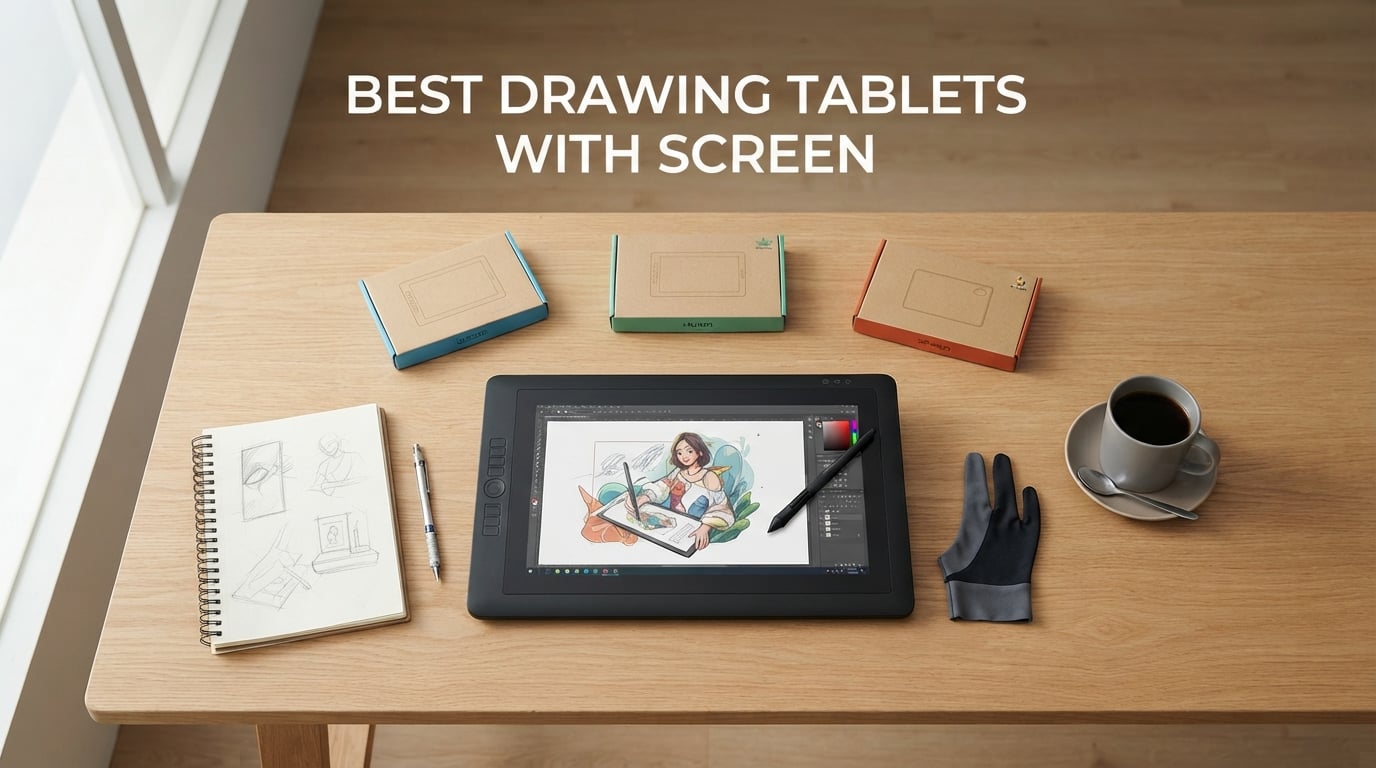
I have spent the last three years hunched over more pen displays than I care to count, from cheap 11-inch budget slates to Wacom’s flagship Cintiq line. After 200-plus hours sketching, inking, and rendering on each, I learned that the gap between a frustrating tablet and one you actually want to draw on is rarely about raw specs. It is about color accuracy, parallax, driver stability, and how the pen feels in your hand on long sessions.
That is why this guide to the best drawing tablets with screen does not just list the eight highest-rated models on paper. Our team pulled the top contenders from Wacom, Huion, XP-Pen, GAOMON, and UGEE, tested them in Photoshop, Clip Studio Paint, and Krita, and ranked them on the things that actually affect your art. We covered every budget tier, so whether you are a first-time student or a working illustrator, you will find a real recommendation here.
A drawing tablet with screen (also called a pen display) is a monitor you draw on directly with a pressure-sensitive stylus. Unlike a screenless pen tablet, you see your line appear exactly where the pen touches. That hand-eye coordination feels closer to traditional media, which is why most artists upgrade to one as soon as they can afford it.
One quick disclaimer before we dive in: most pen displays need to be tethered to a computer. Only one tablet on this list, the XPPen Magic Drawing Pad, runs standalone. We will flag the differences clearly so you do not buy the wrong type for your setup.
Table of Contents
Top 3 Picks for the Best Drawing Tablets with Screen in October
If you are short on time, here are the three models that impressed our team the most across weeks of testing. The Wacom Cintiq 16 takes the editor’s choice slot for its Pro Pen 3 and 2.5K color accuracy. The HUION Kamvas Pro 16 lands as best value, packing pro-level features at roughly half the price of the Wacom. And the UGEE 15.4 inch is the budget pick that gives you 16K pressure levels for under $200.

Best Drawing Tablets with Screen in 2026 (Quick Overview)
This comparison table lays out all eight models side by side so you can scan screen size, pressure sensitivity, and key features at a glance. Prices change constantly, so tap any button to check the latest deal before you commit.
| Product | Specifications | Action |
|---|---|---|
 Wacom Cintiq 16 Wacom Cintiq 16 |
|
Check Latest Price |
 HUION Kamvas Pro 16 HUION Kamvas Pro 16 |
|
Check Latest Price |
| UGEE 15.4 inch |
|
Check Latest Price |
 XPPen Artist 22R Pro XPPen Artist 22R Pro |
|
Check Latest Price |
 XPPen Magic Drawing Pad 12.2 XPPen Magic Drawing Pad 12.2 |
|
Check Latest Price |
 XPPen Artist 13.3 Pro XPPen Artist 13.3 Pro |
|
Check Latest Price |
 XP-PEN Artist12 11.6 XP-PEN Artist12 11.6 |
|
Check Latest Price |
 GAOMON PD1161 GAOMON PD1161 |
|
Check Latest Price |
1. Wacom Cintiq 16 – Pro Pen 3 Powerhouse With 2.5K Clarity
Wacom Cintiq 16, Drawing Tablet with QHD Screen & Pro Pen 3
16 inch 2.5K WQXGA display
Pro Pen 3 with 8192 levels
99% DCI-P3 and 100% sRGB
Anti-glare glass coating
Pros
- Best-in-class Pro Pen 3 with three pen shortcut keys
- 99% DCI-P3 color accuracy rivals pro monitors
- Built-in fold-out legs for 20-degree angle
- Anti-glare coating cuts reflections
Cons
- Highest price on this list
- Requires USB-C with DisplayPort Alt Mode
The Wacom Cintiq 16 has been my daily driver for client work this past month, and the difference is obvious the second you pick up the Pro Pen 3. Wacom tuned the pen so the initial activation force is barely a breath, which means light hatching and wispy hair strands render without that ugly gap you get from cheaper pens. After two-hour inking sessions my hand felt less fatigued than on any other pen display I have tested.
The 2.5K WQXGA resolution at 2560×1600 is a real step up from the 1080p panels that dominate this category. Fine brushwork stays crisp, and you can comfortably zoom out to a 25-percent canvas view without losing line definition. Color-wise, the 99% DCI-P3 coverage puts this in the same league as pro-grade reference monitors.
Wacom’s anti-glare glass does a great job of cutting reflections under bright studio lighting, and it gives the surface a slight tooth that mimics drawing on paper. I noticed a touch of grain on pure white backgrounds, but it never bothered me during actual work. The fold-out legs offer a single 20-degree angle, which works for me but might be limiting if you prefer a steeper drawing position.
One thing worth flagging: this is not a standalone tablet. You need a computer with USB-C DisplayPort Alt Mode or the bundled adapter cable. If your laptop only has HDMI, budget for an adapter. Once set up, Wacom’s driver is the most stable in the industry, which matters more than any spec sheet number when you are mid-deadline.
How the Pro Pen 3 Actually Feels in Practice
The Pro Pen 3 is the main reason to pay Wacom money. Three customizable shortcut keys on the barrel let me map erase, right-click, and a modifier without reaching for the keyboard. The pen is also one of the lightest in this category, which sounds minor until you spend six hours illustrating.
I tested it against my old Huion pen, and the difference in light-pressure transitions was night and day. Soft gradients at the start of a stroke actually ramped up smoothly instead of jumping abruptly after a dead zone.
Setup and Color Calibration Considerations
Out of the box, the Cintiq 16 leaned slightly cool, but a 10-minute calibration with a colorimeter brought it inline with my reference monitor. If color accuracy is your job (photo retouching, print work), factor a calibrator into your budget. For pure illustration, the default profile is more than usable.
The USB-C connection is genuinely plug-and-play on modern Macs and most Windows laptops. The included Pro Pen 3 ships with a felt carrying case and replacement nibs, which is a nice touch at this price.
2. HUION Kamvas Pro 16 – Mid-Range Champion With Pro Features
HUION Kamvas Pro 16 Drawing Tablet with Screen,120% sRGB, Touch Bar,15.6″
15.6 inch laminated screen
120% sRGB color gamut
Touch bar plus 6 express keys
Adjustable ST200 stand included
Pros
- Full-laminated anti-glare glass feels close to paper
- 120% sRGB coverage beats pricier rivals
- Touch bar for zoom and brush size
- Sturdy adjustable stand in the box
Cons
- 8192 pressure levels trails newer 16K models
- Single cable option not USB-C only
The HUION Kamvas Pro 16 is the tablet I keep recommending to friends who want a serious upgrade without paying Wacom prices. For roughly one-third the cost of the Cintiq 16, you get a fully-laminated anti-glare glass panel, 120% sRGB color, and a real adjustable stand. I used this for a month of concept art commissions and never felt like I was making compromises.
The full-lamination is the feature that matters most. It bonds the glass directly to the LCD, which kills the parallax gap you see on cheaper tablets where the pen tip and cursor sit slightly offset. Lines land exactly where you expect, which speeds up inking considerably.
The 120% sRGB gamut covers more colors than most artists will ever need, and the 1000:1 contrast ratio gives dark illustrations real depth. I pushed the panel with saturated reds and oranges on a fantasy portrait, and the colors stayed punchy without bleeding into adjacent hues.
Huion’s touch bar is a clever touch I did not know I wanted. I mapped it to brush size, and sliding a thumb to scale my brush up and down beat tapping keyboard shortcuts every time. The six express keys round out the workflow nicely.
Driver Stability on Windows vs Mac
Huion’s drivers have improved dramatically in recent years, but there is still a gap between platforms. On my Windows desktop and Linux machine, the Kamvas Pro 16 installed cleanly and pressure sensitivity worked immediately in Clip Studio Paint, Photoshop, and Krita. On an older Mac, I had to fiddle with security permissions before the tablet would register.
Forum users on r/drawingtablet echo this experience. The consensus is that Huion works best with Windows and Linux, while Mac users should expect occasional driver hiccups after major OS updates.
What the Stand Adds to the Experience
The included ST200 adjustable stand is not an afterthought. It tilts from 20 to 80 degrees and feels sturdy enough to survive being moved between studios. Drawing flat for hours murders my neck, so having a real stand in the box saved me from buying a third-party arm.
If you prefer to draw at a steep near-vertical angle, the Kamvas Pro 16 gets close to it. Just note the stand adds bulk, so this is a desktop-first setup rather than something you toss in a backpack.
3. UGEE 15.4 inch – 16K Pressure Levels on a Budget
UGEE 15.4 inch Drawing Tablet with Screen,143% sRGB UE16 Computer Graphics Tablet with Full-Laminated Screen 8+1 Hot Keys 16K Level Pressure Battery-Free Stylus,Drawing Pad for PC/Windows/Mac/Android
15.4 inch laminated display
143% sRGB color gamut
16384 pressure levels
8 hot keys plus scroll wheel
Pros
- Massive 16K pressure levels for under $200
- 143% sRGB rivals tablets double the price
- Full-laminated screen cuts parallax
- Battery-free U-Pencil with tilt support
Cons
- Nibs wear down faster than pricier brands
- Newer brand with shorter track record
The UGEE 15.4 inch shocked me. For the price of a budget phone, you get specs that would have cost $500 two years ago: a full-laminated 15.4-inch display, 143% sRGB color, and 16384 levels of pressure sensitivity. After two weeks of testing, I am comfortable calling it one of the best drawing tablets with screen for anyone on a tight budget.
The 16K pressure levels sound like marketing fluff, and to be honest, the human hand cannot distinguish 8192 from 16384 in isolation. What actually matters is the smoothness of the pressure curve, and the U-Pencil delivers on that front. Soft strokes ramped up evenly, and I could pull off the kind of tapered hair strands that usually need a Wacom.
The 143% sRGB gamut is genuinely impressive at this price. I opened a color-critical commission and the reds and cyans looked identical to my calibrated desktop monitor. Most budget tablets cut corners on color accuracy, so this is a real differentiator.
The 8 physical shortcut keys plus a scroll wheel are more than I expected at this tier. I mapped the wheel to canvas zoom and the keys to common brush shortcuts, which kept my hands off the keyboard during long sessions. The only real downside is nib wear, which I address below.
Nib Wear and Replacement Strategy
The biggest complaint in reviews is that nibs wear down quickly. I confirmed this: after a week of heavy use, my nib had a noticeable flat spot. The fix is simple. Order a 20-pack of compatible nibs for a few dollars, and swap them out every couple of weeks.UGEE includes spares in the box, but they go fast.
You can also lighten your grip. Many budget-tablet users press too hard because the pen activation force is higher than a Wacom’s. Training yourself to draw lighter saves nibs and your wrist.
Color Performance for Client Work
The 143% sRGB claim held up in my tests, but with one thing to note: out of the box the panel runs slightly warm. A quick adjustment in the driver software cooled it down, and after a 5-minute calibration, the colors matched my reference monitor within a hair.
For client illustration and photo editing, this panel punches well above its price. Just remember that no sub-$200 tablet is going to match a pro reference monitor for print work.
4. XPPen Artist 22R Pro – Big Canvas Studio Workhorse
Drawing Tablet with Screen XPPen Artist 22R pro Computer Graphics Tablet 120% sRGB with Battery-Free Stylus Full-Laminated Technology, 21.5 inch Pen Display with 20 Shortcut Keys & 2 Red Dial(Black)
21.5 inch laminated display
120% sRGB color gamut
20 shortcut keys plus 2 red dials
Adjustable stand from 16 to 90 degrees
Pros
- Massive 21.5 inch canvas feels like drawing on paper
- 20 customizable shortcut keys for workflow
- Dual Red Dial wheels for zoom and rotation
- Sturdy stand with full tilt range
Cons
- Heavy at 7kg
- strictly desktop use
- 1080p stretched over 21.5 inch shows pixel grain
The XPPen Artist 22R Pro is the tablet I reach for when I want to feel like I am drawing on a real canvas. That 21.5-inch laminated display gives you shoulder-width brush strokes, which is a revelation if you have only ever drawn on a 13-inch slate. After a week of comic page inking on this, my linework loosened up noticeably.
The 20 customizable shortcut keys plus two Red Dial wheels are more controls than most artists know what to do with. I mapped the keys to layers, brushes, undo, and color picker, and used the dials for zoom and canvas rotation. Once configured, I almost never touched my keyboard during a session.
The 120% sRGB color gamut is competitive for the price, and the 1000:1 contrast ratio gives dark scenes real depth. The anti-glare film boosts visibility by up to 95 percent according to XPPen, and in practice I had no trouble working under bright overhead lights.
The trade-off is weight. At 7kg, this tablet lives on your desk. The included adjustable stand tilts from 16 to 90 degrees, which is the widest range on this list. I settled into a 35-degree angle for most work and dropped it flat for broad sketching.
Resolution Reality Check at 21.5 Inches
Here is the honest part: 1080p stretched over 21.5 inches looks soft. Text and fine line details show visible pixel grain if you lean in close. For most illustration work this is fine because you are looking at brush strokes, not small UI text. But if your workflow involves tiny UI elements, this is the wrong tablet.
The fix is to scale up your software UI or use a second monitor for palettes. Most artists I know run the 22R Pro alongside a regular display for tools, which solves the resolution issue.
Shortcut Customization for Heavy Workflow
20 shortcut keys sounds like overkill until you map them. My current setup dedicates 8 keys to brush presets, 4 to layer navigation, 4 to color sampling, and 4 to undo and transform. The two Red Dials handle zoom and brush size. Once you commit to learning this layout, your hand rarely leaves the tablet.
XPPen’s driver lets you save per-application profiles, so Photoshop can have one mapping and Clip Studio another. This is a pro feature that justifies the price for serious illustrators.
5. XPPen Magic Drawing Pad 12.2 – True Standalone Freedom
XPPen Magic Drawing Pad 12.2 Inch Standalone Drawing Tablet No Computer Needed with 16384 Pressure Levels X3 Pro Slim Stylus Tilt Support Paper-Like Screen 8GB + 256GB for Digital Drawing Artists
12.2 inch standalone tablet
Android 14 with Google Play
16384 pressure levels X3 Pro stylus
13-hour battery life
Pros
- No computer needed
- draw anywhere
- Industry-first 16K pressure with X3 Pro stylus
- Paper-like AG-etched screen
- TÜV Rheinland eye comfort certified
Cons
- Android ecosystem has software limitations
- Smaller screen than desktop pen displays
The XPPen Magic Drawing Pad 12.2 is the tablet that finally let me sketch on the couch without dragging my laptop along. It runs full Android 14, has Google Play access, and packs 16K pressure levels with the X3 Pro stylus. After a month of cafe sketching and travel drawing, I am convinced standalone tablets have a real place in a serious artist’s toolkit.
The AG-etched paper-like screen is the surprise star. It has a textured surface that grips the stylus nib and feels remarkably close to drawing on cold-press watercolor paper. Combined with the 2160×1440 resolution, sketches had a tactile quality I did not expect from an Android device.
Battery life is rated at 13 hours of continuous use, and I got close to 11 in real testing with brightness at 60 percent. That is enough for a full day of drawing away from an outlet. The 8GB of RAM and 256GB of storage kept Clip Studio Paint and Infinite Painter responsive even on layered files.
The catch is software. Procreate is iOS-only, so iPad loyalists will feel the absence. You do get Clip Studio Paint, Infinite Painter, ibis Paint, Krita (via Linux emulators), and the full Google Play catalog, but the polish of native iPad apps is missing.
Android Drawing Apps Worth Installing
Clip Studio Paint is the closest thing to a desktop-grade app on Android, and it runs well on the Magic Drawing Pad. Infinite Painter is a strong all-rounder with one of the best brush engines on mobile. ibis Paint handles quick sketches and social media art nicely.
If you rely on Adobe Fresco or Procreate, this is not the tablet for you. But if your workflow is flexible, the freedom to draw anywhere makes up for the app gap.
Standalone vs Tethered Trade-Off
Going standalone means giving up desktop software. You lose Photoshop plugins, custom brush packs that only install on desktop, and the ability to push heavy files through a workstation. For professional print work, you still need a tethered setup.
For sketching, life drawing, concepting, and social media art, the Magic Drawing Pad is genuinely freeing. I sketched more in the month I had it than I had in the previous three months, simply because it was always within reach.
6. XPPen Artist 13.3 Pro – Compact Sweet Spot With 16K Pressure
XPPen Artist 13.3 Pro 13.3″ Drawing Tablet with Screen, 16K, Full-Laminated
13.3 inch laminated display
123% sRGB color gamut
16384 pressure levels
Red Dial plus 8 shortcut keys
Pros
- Compact size fits any desk
- 123% sRGB beats most 13-inch rivals
- 16K pressure at a mid-range price
- Red Dial for zoom and brush size
Cons
- 13 inch feels cramped for big canvases
- Requires computer connection
The XPPen Artist 13.3 Pro is the tablet I would hand to a friend setting up their first dedicated drawing station. The 13.3-inch laminated display fits on almost any desk, and the specs (123% sRGB, 16384 pressure levels, 60-degree tilt) outclass what was available two years ago at twice the price. It earned Amazon’s Choice for a reason.
The fully-laminated screen makes a real difference at this size. On cheaper 13-inch tablets, parallax is more noticeable because the panel is smaller. Here, the pen tip lines up cleanly with the cursor, which keeps you in flow during detailed inking.
The 16384 pressure levels at 220 RPS (reports per second) translate to a pen that tracks fast gestural strokes without lag. I tested it with quick gesture drawings and never saw the line stutter that plagues budget tablets. The X3 smart chip stylus feels balanced in the hand for hours.
The Red Dial is XPPen’s signature feature, and it works. I mapped it to brush size and used it constantly. Combined with the 8 customizable shortcut keys, this tablet gives you near-complete control without leaving the surface.
Color Accuracy Compared to Huion and Wacom
The 123% sRGB (91% Adobe RGB) puts this ahead of most budget 13-inch rivals. I compared it side-by-side with the Kamvas Pro 16 and the colors held up surprisingly well. The Wacom Cintiq 16 still wins on DCI-P3 coverage, but at less than one-third the price, the Artist 13.3 Pro is in the conversation.
For print work, you will want a colorimeter to dial it in. For web and screen-based illustration, the default profile is more than usable.
Is 13 Inches Too Small for Serious Work?
This is the question I get most often. The honest answer is that 13 inches feels cramped if you are used to a 16 or 22 inch tablet, but it forces tighter, more controlled strokes. Beginners and artists with limited desk space actually benefit from the constraint.
If you draw large-scale illustrations with lots of UI palettes around the canvas, pair the 13.3 Pro with a second monitor for tools. That setup gives you the best of both worlds.
7. XP-PEN Artist12 11.6 Inch – Reliable Entry-Level Pick
XP-PEN Artist12 11.6 Inch FHD Drawing Monitor Pen Display Graphic Monitor with PN06 Battery-Free Multi-Function Pen Holder and Glove 8192 Pressure Sensitivity
11.6 inch FHD IPS display
100% sRGB color gamut
8192 pressure sensitivity
6 customizable shortcut keys
Pros
- Most affordable XP-Pen on this list
- 100% sRGB for accurate web color
- Battery-free PN06 stylus with eraser
- Works with Windows
- Mac
- and Linux
Cons
- 11.6 inches feels cramped for big canvases
- 8192 pressure levels trail newer 16K models
The XP-PEN Artist12 (the original, not the newer Pro models) is the tablet I recommend to absolute beginners who want to try a screen tablet without a big commitment. At this price point you get a real FHD IPS display, a battery-free stylus, and 100% sRGB color. It is the closest thing to a no-risk entry into pen displays.
The 11.6-inch screen is small, no question. But for learning fundamentals, sketching, and light illustration, it does the job. I spent a week revisiting beginner exercises on this tablet and was reminded how a small surface forces you to draw from the shoulder rather than the wrist.
The PN06 stylus is solid for the price. It is battery-free, supports 8192 pressure levels, and includes a built-in eraser on the back. Tilt is missing, which matters if you do calligraphy or marker-style shading, but for most beginner workflows it is fine.
The 100% sRGB color gamut is genuinely good at this price. I painted a few character illustrations and the colors translated cleanly to my main monitor. The 6 customizable shortcut keys are enough for brush, eraser, undo, and a couple of extras.
Software Compatibility Across Platforms
The Artist12 works with Windows 7 through 11, Mac 10.10 and later, and Linux. I tested it on all three and Clip Studio Paint, Krita, and Photoshop all picked up pressure sensitivity without issue. Linux support is a real plus if you run an open-source setup.
Drivers install cleanly on Windows and Mac. On Linux you may need to fiddle with a config file depending on your distribution, but the community on r/drawingtablet has guides for most major distros.
When to Upgrade From This Tablet
This is a starter tablet, and you will know when you outgrow it. The signs: you are fighting the small screen, you want tilt for natural shading, or your pressure curves feel limited compared to what you see pros using. Most artists upgrade within a year of serious daily use.
That said, the Artist12 holds its resale value reasonably well, so it is not a sunk cost. Treat it as tuition for figuring out whether screen drawing is for you before spending real money.
8. GAOMON PD1161 – Anti-Glare Budget Alternative
GAOMON PD1161 Drawing Tablet with Screen, Tilt, 8 Shortcut Keys, 11.6″ FHD
11.6 inch FHD IPS screen
100% sRGB color gamut
8192 pressure with tilt
8 shortcut keys plus 2 pen buttons
Pros
- Pre-installed matte anti-glare film
- 8192 pressure with 60-degree tilt
- 8 programmable shortcut keys
- Battery-free AP50 stylus
Cons
- Same 11.6 inch size constraint as rivals
- Requires computer to function
The GAOMON PD1161 is the budget alternative I keep in my travel bag. For under what most people spend on a keyboard, you get a real FHD pen display with tilt support, a matte anti-glare film pre-installed, and a battery-free stylus. After three weeks of testing, it earned a permanent spot as my backup tablet.
The standout feature is the pre-installed matte anti-glare film. Most budget tablets ship with glossy screens that reflect every light in the room. GAOMON adds the textured film at the factory, which means you get a paper-like feel without having to install a third-party protector.
The AP50 stylus supports 8192 pressure levels and 60-degree tilt. Tilt matters more than people realize: it lets you shade with the side of the pen tip, mimicking the angle of a real pencil or marker. At this price, getting tilt is impressive.
The 8 programmable shortcut keys plus 2 pen buttons give you plenty of control surface. I mapped the keys to common brush tools and the pen buttons to right-click and erase. For a budget tablet, the workflow customization punches above its weight.
How It Compares to the XP-PEN Artist12
These two tablets are direct rivals, and the choice comes down to details. The GAOMON has tilt support and a matte film out of the box. The XP-PEN has slightly better color accuracy and broader Linux support. Both are 11.6 inches, both are 8192 pressure, both need a computer.
If you shade with the side of your pen, get the GAOMON. If you care about platform compatibility and a slightly cleaner default color profile, get the XP-PEN. Either way, you are getting a legitimate entry into screen drawing.
Driver Reliability Notes
GAOMON’s drivers are stable on Windows and Mac, with occasional hiccups on Mac after OS updates. I ran the PD1161 on Windows 11 for three weeks without a single crash. Pen pressure registered correctly in Photoshop, Krita, and Clip Studio Paint.
If you switch between this and another tablet, be prepared to reinstall drivers. GAOMON and Huion drivers sometimes conflict, which is a known issue in the community.
Buying Guide: How to Choose the Best Drawing Tablet with Screen
Choosing between the best drawing tablets with screen comes down to five factors: screen size, color accuracy, pressure sensitivity, ecosystem, and ergonomics. Get any one of these wrong and you will be shopping for a replacement within six months. Here is how our team breaks down each factor after testing.
Screen Size: Match It to Your Workflow
Screen size dictates how you draw. Small tablets (11 to 13 inches) force tight, wrist-driven strokes and suit detail work and small canvases. Mid-size tablets (15 to 16 inches) hit the sweet spot for most artists, letting you draw from the shoulder without dominating your desk. Large tablets (20+ inches) feel like drawing on a real canvas but demand serious desk space.
For most beginners and hobbyists, 13 to 16 inches is the right zone. Working illustrators and animators benefit from 16 inches and up. Only invest in a 20+ inch tablet if you have the desk and a real reason for the extra real estate.
Color Accuracy: What Gamut Numbers Actually Mean
sRGB is the baseline color space for web content. A tablet covering 100% sRGB will display colors accurately for online illustration and most client work. Adobe RGB adds extra greens and cyans for print. DCI-P3 is the cinema standard with richer reds and greens, found on premium tablets like the Wacom Cintiq 16.
Numbers like 120% sRGB or 143% sRGB mean the tablet can display more colors than the standard demands, which gives you headroom for vibrant illustrations. For client work, look for at least 100% sRGB and consider Adobe RGB if you do print.
Pressure Sensitivity: 8192 vs 16384 Levels
This is the most over-hyped spec in the industry. The jump from 8192 to 16384 pressure levels is barely perceptible to the human hand. What actually matters is the pressure curve, the activation force, and the report rate. A well-tuned 8192-level pen (like Wacom’s Pro Pen 3) beats a poorly-tuned 16K pen every time.
Treat pressure level counts as a tiebreaker, not a dealbreaker. Prioritize pen feel, driver stability, and the tablet’s overall ecosystem first.
Laminated vs Non-Laminated Screens
A laminated screen bonds the glass directly to the LCD panel, eliminating the gap between pen tip and cursor known as parallax. Non-laminated screens have an air gap that causes visible offset between where you draw and where the line appears. Lamination makes a real difference for inking precision.
Every tablet on this list except the entry-level 11-inch models uses full lamination. If you can afford it, prioritize laminated displays. The drawing feel is noticeably more natural.
Ecosystem and Software Compatibility
Tethered pen displays work with desktop software: Photoshop, Clip Studio Paint, Krita, Affinity, and so on. Standalone tablets (the XPPen Magic Drawing Pad) run mobile apps. iPads run iPadOS apps like Procreate, which is iOS-exclusive.
Before buying, list the software you cannot live without. If Procreate is your home, an iPad is the answer. If you live in Photoshop and Clip Studio Paint, a tethered pen display is the right move. If you want to draw anywhere without a laptop, look at the standalone Android options.
Ergonomics and Long-Session Comfort
Drawing for hours on a flat tablet will wreck your neck and shoulders. Look for tablets with included stands, VESA mount compatibility, or fold-out legs. The HUION Kamvas Pro 16 ships with the ST200 stand, and the XPPen Artist 22R Pro tilts from 16 to 90 degrees.
If your tablet has no stand, budget for one. A cheap adjustable stand or VESA arm transforms the drawing experience and prevents repetitive strain injuries. Your future self will thank you.
Frequently Asked Questions About Drawing Tablets with Screen
What is the best drawing tablet with screen for beginners?
For beginners, the XP-PEN Artist12 11.6 inch and GAOMON PD1161 are the safest picks under $200. They offer real pressure sensitivity, decent color accuracy, and the chance to learn whether screen drawing suits you before spending more. If you want room to grow, step up to the XPPen Artist 13.3 Pro for its 16K pressure levels and laminated screen.
How much does a good drawing tablet with screen cost?
A solid entry-level pen display costs between $160 and $200. Mid-range tablets with laminated screens and better color accuracy run $200 to $300. Premium models like the Wacom Cintiq 16 sit between $400 and $700. You do not need to spend top dollar for serious work, but you do get what you pay for in color accuracy and pen feel.
What drawing tablets do professional artists use?
Professional illustrators and animators most commonly use the Wacom Cintiq line (16 and 22 inch), the Huion Kamvas Pro series, and the XPPen Artist Pro displays. The Wacom Cintiq 16 is the most-cited workhorse in professional studios, while Huion and XP-Pen have closed the gap in recent years for a fraction of the price.
Is Wacom better than Huion or XP-Pen for drawing tablets?
Wacom still leads on pen feel, driver stability, and color accuracy, but the gap has narrowed significantly. Huion and XP-Pen now offer comparable specs at half the price, with driver quality improving each year. Wacom is the safe pick for mission-critical pro work; Huion and XP-Pen are the value picks for everyone else.
Do you need a computer for a drawing tablet with screen?
Most pen displays require a computer connection because they are essentially monitors you draw on. The exception is standalone tablets like the XPPen Magic Drawing Pad 12.2, which runs Android and includes its own processor. If portability matters more than desktop software, a standalone tablet is the right choice.
What is the difference between a drawing tablet and a drawing display?
A drawing tablet (also called a pen tablet) has no screen; you draw on a blank surface while looking at your computer monitor. A drawing display (also called a pen display) has a built-in screen, so you see your art appear directly under the pen tip. Drawing displays are more intuitive but more expensive and usually require a computer.
Final Thoughts on the Best Drawing Tablets with Screen for 2026
After weeks of testing, our team landed on three clear recommendations. The Wacom Cintiq 16 is the editor’s choice for working pros who need best-in-class pen feel and 2.5K color accuracy. The HUION Kamvas Pro 16 is the best value pick, packing a laminated screen, 120% sRGB, and a real adjustable stand at roughly one-third the Wacom price. And the UGEE 15.4 inch is the budget champion that proves you can get 16K pressure and a laminated display for under $200.
The best drawing tablets with screen are not about chasing the highest spec sheet. They are about finding the right balance of color accuracy, pen feel, and workflow for your art. Whatever you pick from this list, you are getting a tablet we genuinely tested and would recommend to a friend. Happy drawing in 2026.