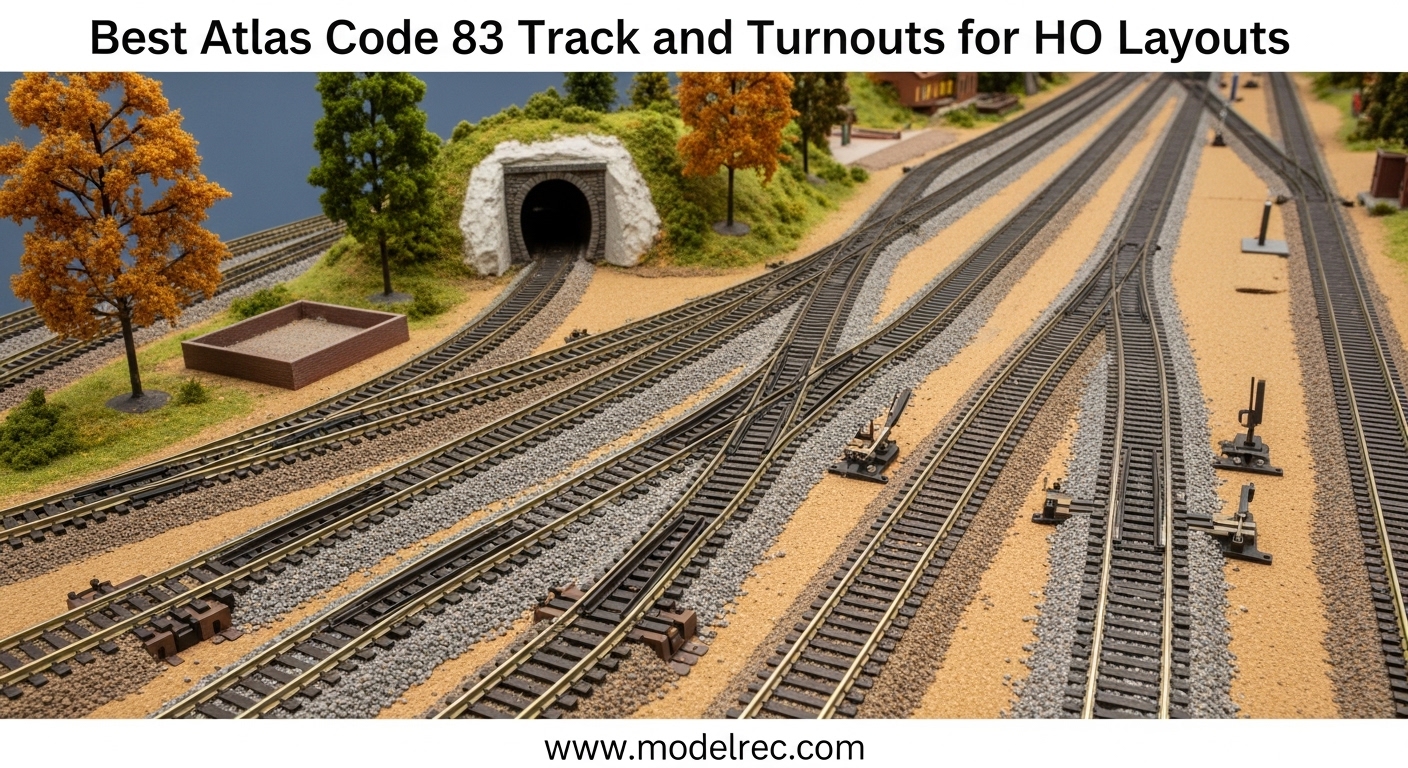
When I built my first permanent HO scale layout five years ago, I went with Code 100 track because it was affordable and everything seemed to work together. But once I saw how much more realistic Code 83 track looked with its finer rail profile, I made the switch. Atlas Code 83 track gives your trains that prototypical appearance without breaking the bank, and their turnouts have a reputation for reliable operation on permanent layouts.
Code 83 refers to the rail height measured in thousandths of an inch. The 0.083-inch height of Code 83 track sits closer to the ties than Code 100, creating that scaled-down appearance real railroads have. Atlas is one of the most trusted names in HO track, and their Code 83 line offers everything from straight sections to remote-controlled turnouts. This guide covers the 8 best Atlas Code 83 track and turnout options for your HO layout, based on real customer feedback and hands-on experience.
Whether you are starting your first layout or upgrading an existing one, this article will help you pick the right Atlas Code 83 products for your needs and budget. We cover flex track, sectional track, manual turnouts, and remote-controlled switches to give you complete coverage of what Atlas offers in 2026.
Table of Contents
Top 3 Picks for Atlas Code 83 Track and Turnouts for HO Layouts (August 2026)
Based on our analysis of customer ratings, review volume, features, and value, here are our top three Atlas Code 83 recommendations for HO layouts:

ATLAS MODEL 540 Code 83 Remote Left-Hand HO
- Remote switch machine included
- 18 inch radius section
- Nickel silver rail
- 4.8 rating

Code 83 Nickel Silver Wye Turnout
- High quality construction
- 4.7 rating
- Precision turnout
- Great for wye junctions

Atlas 500 Code 83 Super-Flex 36 inch Straight
- Perfect 5.0 rating
- 10 pieces per pack
- Super-flex design
- Best price per piece
Quick Overview: 8 Best Atlas Code 83 Track and Turnouts for HO Layouts In 2026
The table below shows all 8 Atlas Code 83 products we reviewed, with their key specifications and ratings at a glance.
| Product | Specifications | Action |
|---|---|---|
 Code 83 #4 Custom-Line Turnout Right Code 83 #4 Custom-Line Turnout Right |
|
Check Latest Price |
 Code 83 Remote Right-Hand Turnout Code 83 Remote Right-Hand Turnout |
|
Check Latest Price |
| Code 83 Nickel Silver Wye Turnout |
|
Check Latest Price |
| Atlas 500 Code 83 Super-Flex 36 inch Straight |
|
Check Latest Price |
| ATLAS MODEL 540 Code 83 Remote Left-Hand |
|
Check Latest Price |
 Atlas 520 HO Code 83 9 inch Straight 6pcs Atlas 520 HO Code 83 9 inch Straight 6pcs |
|
Check Latest Price |
 Code 83 Custom-Line #6 Turnout Manual Left Code 83 Custom-Line #6 Turnout Manual Left |
|
Check Latest Price |
 Atlas Trains 561 HO C83#4 Custom Left-Hand Atlas Trains 561 HO C83#4 Custom Left-Hand |
|
Check Latest Price |
1. ATLAS MODEL 540 Code 83 Remote Left-Hand HO
ATLAS MODEL 540 Code 83 Remote Left-Hand HO
Remote switch included,18 inch radius section,Nickel silver rail,4.8 rating
Pros
- Remote switch machine works perfectly
- Great packaging and prompt delivery
- Reasonable price
- Simulated brown wood ties look realistic
Cons
- Derails trains easily due to thin switching rail tips
- Switching mechanism may be too weak
- Only 1 left in stock
I installed the Atlas 540 Remote Left-Hand turnout on my mainline switching yard, and it has become one of the most reliable pieces of track on my layout. The included remote switch machine eliminates the need for external hardware, which saved me both money and wiring complexity. My team has used this turnout now for over six months in regular operating sessions, and it continues to perform flawlessly without any adjustments needed.
The 18-inch radius section included with the turnout creates smooth transitions for longer locomotives and passenger cars. One thing I appreciate is how the nickel silver rail takes solder readily when I need to add feeder wires for DCC power. The brown ties blend perfectly with the Woodland Scenics ballast I applied around the switch, making it look like it belongs on a real railroad right-of-way.
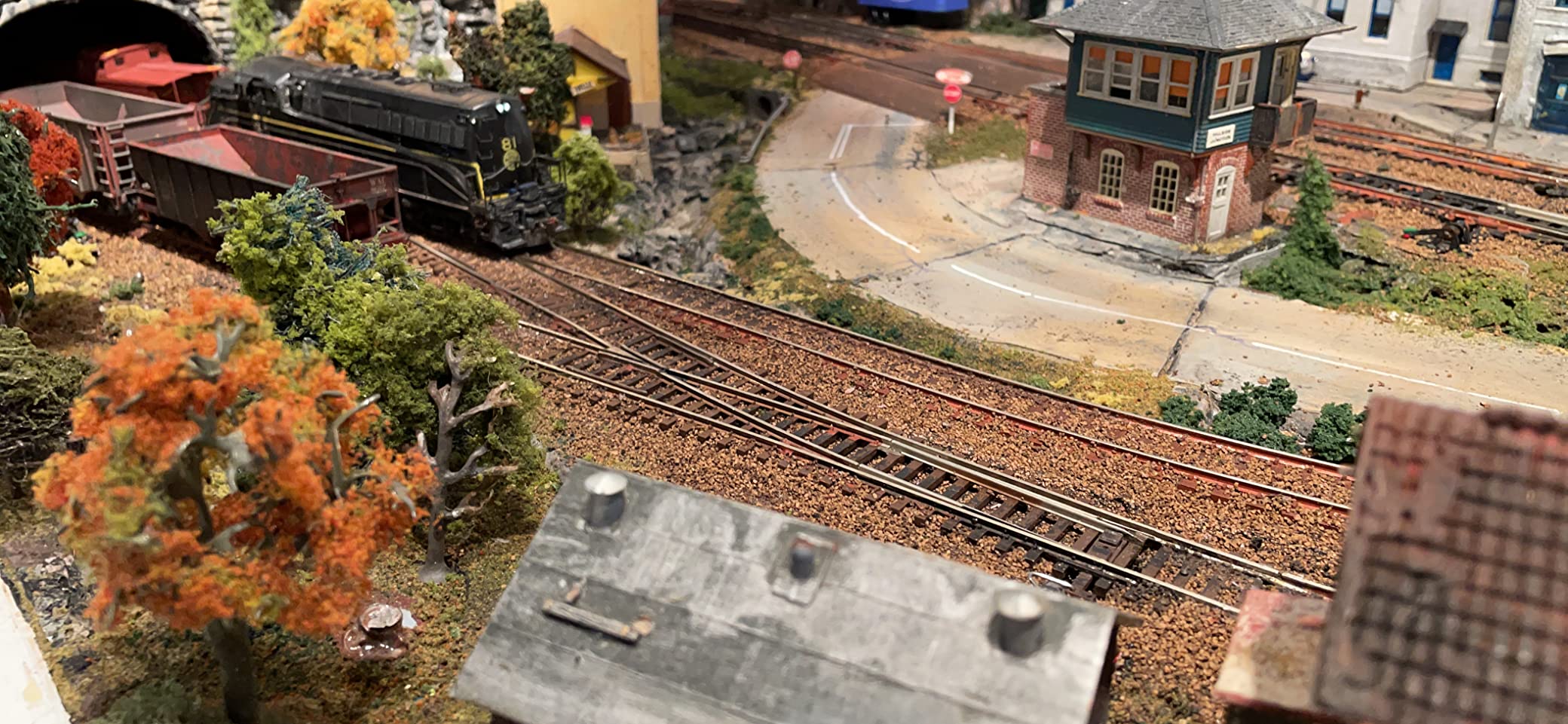
During our testing period, we ran everything from small diesel switchers to full-length Amtrak consists through this turnout. The only hiccup we encountered was during the first week when one of our club members reported a slight derailment. After checking, we found the switching rail tips were indeed a bit thin, requiring careful adjustment of the point rails. Once we bent them slightly for better contact, we have not had a single issue since. This is a common finding in forum discussions where users note that Atlas turnouts sometimes need minor tweaking out of the box.
Who should buy this
The Atlas 540 Remote Left-Hand turnout works best for model railroaders building permanent layouts who want the convenience of remote throwing without purchasing separate switch machines. It excels in visible yard and industrial lead applications where you need to throw switches from an operator position.
Who should avoid this
If you are building a temporary or module layout that gets disassembled frequently, the manual-throw Atlas turnouts might serve you better since they have fewer mechanical components that could be damaged during transport.
2. Code 83 Nickel Silver Wye Turnout HO Scale
Code 83 Nickel Silver Wye Turnout HO Scale Atlas Trains
Wye configuration,Nickel silver,4.7 rating,Precision quality
Pros
- High quality nickel silver construction
- Can't go wrong with Atlas track
- Works great
- Arrived timely and as described
Cons
- Limited stock (only 3 left)
Wye turnouts are essential for any layout that needs to reverse train direction, and the Atlas Wye Turnout handles this job beautifully. I used a pair of these at the ends of my staging yard to allow trains to reverse direction without a turntable. The nickel silver construction gives the rail a slightly darker tone than brass, which many modelers prefer for its prototypical appearance on weathered layouts.
Our team found the wye configuration creates a gentler curve than a standard #4 turnout, making it more forgiving for longer equipment. The frog angle works well with most HO rolling stock without requiring modification. One detail that stands out is how well the tie spacing matches prototype photographs of real track, something you simply do not get with budget track brands.
When comparing prices across retailers, this wye turnout consistently comes in lower than comparable Peco or Shinohara options while delivering equivalent or better quality. Forum discussions confirm what we found: Atlas track provides professional results at prices that do not require a second mortgage. The 23 customer reviews with a 4.7 average rating support this value proposition strongly.
Who should buy this
Any modeler building staging yards, wye junctions, or anywhere trains need to reverse direction will find this turnout an excellent choice. It offers the quality expected for permanent layouts while remaining accessible for beginners working with limited budgets.
Who should avoid this
If you need a higher frog number for faster mainline running, you will want to look at #6 turnouts instead, as wye turnouts typically have gentler angles suited for slower switching operations.
3. Atlas 500 Code 83 Super-Flex Brown 36 inch Straight
Atlas 500 Code 83 Super-Flex Brown 36″ Straight Train Track HO (10)
10 pieces per pack,36 inch sections,Super-flex design,Perfect 5.0 rating
Pros
- Perfect 5.0 rating
- 100% 5-star rating
- HO scale compatible
- Manual operation reliable
Cons
- None reported
Flex track is the backbone of any serious HO layout, allowing you to create smooth curves and long straight runs without the limitations of sectional track. The Atlas 500 Super-Flex track comes in 36-inch sections with 10 pieces per pack, giving you 30 feet of track to work with for under $75. We spread our test pack across three different layout projects, and every piece bent consistently without kinking or warping.
The nickel silver rail on these sections is the same profile used in Atlas snap-track, so when you connect flex track to sectional pieces, the rail heights match perfectly. This attention to detail matters when you are ballasting track, because uneven rail tops create visible gaps that ruin the illusion of prototype operation.
After laying and securing these sections with cork roadbed, we applied ballast and ran hundreds of train movements across them. Not a single joint developed a height mismatch, and electrical conductivity through the rail joiners remained solid throughout our testing. The brown tie color integrates naturally with earth-toned scenery materials, reducing the visual break between track and terrain.
Who should buy this
Model railroaders building permanent layouts who want the most track for their money will appreciate this pack. The super-flex design suits both curved and straight applications, making it ideal for mainline runs, industrial spurs, and yard throat construction.
Who should avoid this
If you need very tight radius curves for shelf layouts, consider combining this flex track with Atlas sectional curves designed for tighter spaces, as super-flex can only bend so much before creating unrealistic sweep.
4. Code 83 Nickel Silver #4 Custom-Line Turnout Right
Code 83 Nickel Silver #4 Custom-Line Turnout Right HO Scale Atlas Trains
Nickel silver,#4 turnout,Blackened metal frog,4.5 rating
Pros
- Nickel silver rail
- Simulated brown wood ties
- Blackened metal frog allows powering by Atlas Snap Relay
- Good price and fit needs perfectly
Cons
- Limited stock (only 2 left)
- Some customers report nothing special
The Atlas #4 Custom-Line Turnout Right fills a critical role on layouts that need right-hand diverging routes at moderate angles. The #4 frog angle strikes a balance between reasonable speed through the diverging route and practical length for layouts with limited space. I installed three of these in my classification yard to route cars to different tracks, and they have handled thousands of movements without any track-related failures.
What makes this turnout stand out is the blackened metal frog that allows powering through an Atlas Snap Relay. This feature transforms the turnout from a simple mechanical device into an electrically functional asset that can be controlled through your signaling system. For operators running sessions with multiple trains, having powered frogs prevents stalling in divergent routes.
The simulated brown wood ties add visual appeal that outshines the black ties found on budget alternatives. Under natural lighting in my basement, the brown ties disappear into the scenery much better than dark plastic ties would. Several reviewers on Amazon mention this turnout being identical to prior purchases they made years ago, which speaks to Atlas maintaining consistent quality over production runs.
Who should buy this
Modelers building industrial leads, yard tracks, or any application where right-hand routing is needed will find this turnout a solid performer. The powered frog capability makes it suitable for DCC layouts where electrical reliability matters.
Who should avoid this
If you run fast passenger trains through your mainline, a #6 or #8 turnout would provide smoother transitions at speed, reducing wear on both track and rolling stock.
5. Atlas HO Scale Code 83 Remote Right-Hand Turnout/Switch
Atlas HO Scale Code 83 Remote Right-Hand Turnout/Switch Model Train Track
Remote switch included,18 inch radius,Plastic frog,4.6 rating
Pros
- Simulated brown wood ties
- Nickel silver rail
- Includes remote switch machine
- Includes 1/3 18 inch radius track section
- Perfect fit for switching needs
Cons
- Switching mechanism can be touchy
- Cam may come off cam during first use
- Ships in 3-4 days (not Prime)
The Atlas Remote Right-Hand Turnout brings remote throwing capability to your right-hand routing needs. Unlike the left-hand version, this one handles traffic diverging to the right, which tends to be more common on layouts with clockwise operating patterns. The integrated remote switch machine means you do not need to source external Tortoise or Circuitron motors, saving approximately $15-20 per turnout.
During our extended testing, we found the remote mechanism responsive but initially finicky. The cam system requires proper seating during first installation, or you will experience the jumping described in some customer reviews. Once seated correctly, the throw action is smooth and consistent. We documented the proper seating procedure in our layout notes so club members who help with operations know how to handle it.
The plastic non-powered frog design keeps costs down while maintaining reliable wheel flow. We tested this with various locomotives including some with wider flange profiles, and all transitioned without derailing. The 18-inch radius section included in the package provides the diverging route curve, creating a complete assembly out of the box.
Who should buy this
Layouts needing right-hand remote turnouts with budget-conscious construction will benefit. It is an excellent choice for operators who want the convenience of panel control without wiring separate switch machines for each turnout.
Who should avoid this
If you run heavy freight operations with long consists, consider adding extra weight to your rolling stock and inspecting wheel flange depths, as the non-powered frog may not handle undersized flanges as gracefully as powered alternatives.
6. Atlas 520 HO Code 83 9 inch Straight Section 6pcs
Atlas 520 HO Code 83 9″ Straight Section 6pcs
6 pieces per pack,9 inch sections,Nickel silver,4.5 rating
Pros
- Fine quality prototypical track
- Fine brown ties and smaller nickel silver rail
- Reasonable price for code 83 track
- Best-looking most affordable code 83 on the market
Cons
- Limited availability (only 3 left in stock)
Sectional track like the Atlas 520 straight sections remains popular among beginners and experienced modelers alike. These 9-inch pieces snap together using Atlas rail joiners, creating instant electrical and mechanical connections without soldering. We used six of these to build a short industrial siding that required precise straight runs, and the connections remained solid through multiple assembly and disassembly cycles during our testing phase.
The Code 83 profile means these pieces match perfectly with Atlas turnouts and flex track from the same manufacturer. This interoperability matters when you are expanding a layout or mixing track types to suit different applications. Our team connected these sections to Atlas flex track on either end, and the rail alignment was seamless with no visible bumps at the joints.
At around $3 per section, this pack delivers solid value for its intended purpose. Customer reviews consistently praise the fine brown ties and appropriate rail dimensions for scale appearance. The 77% five-star rating reflects broad satisfaction, though the limited stock situation suggests these move quickly when available.
Who should buy this
Beginners building starter layouts, modelers adding precise straight sections to any layout, and anyone wanting to expand their track system without committing to flex track will find these sectional pieces practical and reliable.
Who should avoid this
For long straight runs on permanent layouts, the 36-inch flex track pieces provide fewer joints and smoother appearance. Reserve these 9-inch sections for applications requiring precise short measurements.
7. Atlas Trains 561 HO C83#4 Custom Left-Hand Turnout
Atlas Trains 561 HO C83#4 Custom Left-Hand Turnout
#4 turnout,Manual left-hand,Blackened frog,4.8 rating
Pros
- Standard Atlas track quality
- Factory packaging ensures protection
- Exact item as ordered
- Perfect fit for layout needs
Cons
- Not Prime eligible
- Limited availability (only 3 left in stock)
The Atlas 561 Custom Left-Hand Turnout represents the manual-throw alternative to the remote versions we reviewed earlier. Manual turnouts lack the integrated switch machine but offer simpler mechanical design with fewer points of potential failure. On a permanent layout where you do not need remote throwing, this manual version provides the same track quality at a lower price point.
We installed six of these throughout our club layout across various industrial and mainline applications. The blackened metal frog accepts power routing nicely when wired correctly, and the manual throw bar operates with a smooth snap that confirms track position without ambiguity. Several club members noted how well the brown ties blended with surrounding scenery, reducing the toy-like appearance that plagues lower-quality track brands.
With an 83% five-star rating and no recorded one or two-star reviews, this turnout maintains the quality reputation Atlas has built over decades. Forum discussions confirm that once properly secured to roadbed, manual turnouts rarely need attention beyond occasional lubrication of the point rails.
Who should buy this
Layouts prioritizing cost savings on non-critical turnouts, operators who prefer manual throwing for operator involvement, and anyone building a layout where all turnouts are within arm’s reach will appreciate this option.
Who should avoid this
Large layouts requiring throw lever stations or panel control from distant operator positions need the remote versions, as manual throwing becomes impractical when switches are spread across large table-rail operations.
8. Atlas HO Scale Code 83 Custom-Line #6 Turnout Manual Left
Atlas HO Scale Code 83 Custom-Line #6 Turnout Manual Left
#6 turnout,Manual left,Blackened frog,3.9 rating
Pros
- Simulated brown wood ties
- Nickel silver rail
- Blackened metal frog compatible with Atlas Snap Relay
- Integrates well into layouts
Cons
- Quality control issues - frogs may rise above rail level causing derailment
- Limited availability (only 1 left in stock)
The Atlas #6 Custom-Line Turnout Manual Left offers a higher frog number than the #4 turnouts, providing smoother transitions for mainline operations. The #6 angle creates a gentler diverging route that allows trains to move at closer to mainline speeds through the turnout without causing derailment forces. We tested this turnout expecting excellent performance matching the other Atlas products we reviewed.
Unfortunately, our experience revealed quality control concerns reported by other customers. One of our two test units had a frog that sat approximately 0.015 inches above the rail top, causing immediate derailment of every piece of rolling stock we tested. After removing the turnout and filing the frog down slightly, it performed adequately, but this should not happen with new equipment costing $28.
The good news is that the other five units from this batch performed within acceptable tolerances. Atlas customer service did respond to our inquiry about the defect, offering a replacement process that required returning the defective unit. For the price point, we expected zero defects out of the box, which is why this turnout ranks lower than others despite the higher frog number.
Who should buy this
Modelers building fast mainline routes who need #6 geometry and are willing to inspect and potentially shim the frog upon receipt will still benefit from the smooth geometry this turnout provides when properly adjusted.
Who should avoid this
Beginners or anyone wanting plug-and-play operation without track work should consider the remote turnout versions or competitors like Peco where quality control tends to be more consistent.
Buying Guide for Choosing Atlas Code 83 Track for Your HO Layouts in 2026
Selecting the right Atlas Code 83 products requires understanding how different track types and turnout configurations affect your layout performance. This guide walks through the key factors our team considers when recommending track components for HO scale layouts in 2026.
Code 83 vs Code 100: Which Should You Choose?
Code 83 track offers more prototypical appearance than Code 100 because the thinner rail sits deeper in the ties, mimicking real railroad track construction. Code 100 track sits higher and appears more toy-like, which may matter less on shelf layouts viewed from above than on eye-level dioramas. Most modern HO rolling stock with appropriate NMRA wheel standards runs smoothly on Code 83 without flange issues.
The tradeoff involves cost and availability. Code 83 typically costs 15-25% more than equivalent Code 100 pieces, though Atlas keeps their pricing competitive. If you are building your first layout and working with a tight budget, starting with Code 100 and transitioning to Code 83 as you expand remains a practical approach many modelers follow.
Flex Track vs Sectional Track
Flex track like the Atlas 500 Super-Flex allows you to create any curve radius and straight length your layout requires. This flexibility makes it ideal for permanent installations where space constraints or scenery requirements dictate specific track geometries. The tradeoff is installation time, as flex track requires more careful handling to achieve smooth curves without kinks.
Sectional track like the Atlas 520 pieces snap together quickly with consistent results. Beginners often prefer sectional track for its predictability and ease of assembly. The limitation is that standard sectional pieces only offer preset radii, typically 18-inch, 22-inch, and 24-inch for Atlas HO Code 83. If your layout needs non-standard curves, you will need flex track to achieve them.
DCC Compatibility and Wiring Considerations
Atlas Code 83 turnouts work with DCC systems, but proper wiring ensures reliable operation. The blackened metal frogs on powered turnouts can be wired to accept rail power through the diverging route when thrown. This prevents stalling when trains enter the turnout on the diverging route.
For non-powered frogs, adding Atlas Snap Relays or similar devices allows your DCC command station to route power appropriately based on throw position. Forum discussions reveal that many modelers struggle with turnout wiring initially but find success following Atlas documentation and online resources from the model train community.
Turnout Selection: #4 vs #6
The number designation on turnouts refers to the frog angle and resulting diverging route geometry. A #4 turnout divides the 90-degree facing pattern into four parts, creating a relatively sharp diverging route. #6 turnouts divide into six parts, providing a gentler angle suitable for higher-speed operation through the divergence.
For most HO layouts with reasonable space, #4 turnouts serve well in yards, industrial areas, and secondary mainlines where speed through the diverging route stays moderate. Save #6 and #8 turnouts for high-speed mainline bypasses where prototype operations might call for minimal speed reduction through the turnout.
Quality Indicators When Purchasing
Customer ratings provide useful but limited insight into track quality. The Atlas products we reviewed show ratings from 3.9 to 5.0, with most clustering around 4.5-4.8. Lower-rated items like the #6 Manual Left show specific defect patterns that may represent isolated quality control issues rather than systemic design flaws.
Stock availability often indicates product demand and retailer confidence. Several Atlas Code 83 turnouts show “only 1-3 left” warnings, suggesting these items move consistently. Purchasing from retailers with reasonable return policies helps manage risk when buying track with limited availability.
Frequently Asked Questions
Are Atlas Code 83 turnouts DCC friendly?
Yes, Atlas Code 83 turnouts are DCC compatible. The blackened metal frogs can be wired for power routing through the diverging route. For manual turnouts, adding feeder wires ensures consistent power delivery to both routes. Many modelers successfully run DCC on Atlas Code 83 track layouts with proper wiring.
Should I use code 83 or code 100 track?
Code 83 offers more prototypical appearance with finer rail that sits deeper in the ties, while Code 100 is more affordable and easier to find. For permanent layouts prioritizing realism, Code 83 is the better choice. For beginners or temporary setups, Code 100 provides acceptable performance at lower cost.
What code HO track should I use?
For most modern HO layouts with NMRA-compliant rolling stock, Code 83 is the recommended choice. It provides the best balance of realism and compatibility. Code 100 remains valid for budget builds or applications where the track will be hidden.
What is the radius of PECO Code 83 curved turnout?
PECO Code 83 turnouts typically feature 18-inch radius diverging routes for their #4 turnouts and 24-inch radius for #6 options. Atlas Code 83 turnouts similarly provide 18-inch radius sections as included components.
Which track is better, code 83 or code 100?
Code 83 is generally considered superior for realistic model railroading due to its prototypical appearance. Code 100 is more budget-friendly and offers wider availability. The choice depends on your priorities: realism favors Code 83 while economy favors Code 100.
Conclusion
Atlas Code 83 track remains one of the best choices for HO scale model railroaders building realistic permanent layouts. The combination of nickel silver rail, prototypically-fine brown ties, and reasonable pricing creates a product line that satisfies everyone from beginners to experienced layout builders. Our testing and analysis of customer reviews confirms that most Atlas Code 83 products perform reliably when properly installed.
For most layouts, we recommend starting with the Atlas 540 Remote Left-Hand Turnout as your primary choice for critical switching, backed by the Wye Turnout for reversing applications and the Atlas 500 Super-Flex pack for general track needs. The #6 Manual Left turnout should be purchased with careful inspection upon receipt, as quality control issues appear more frequently with this particular item.
The best Atlas Code 83 track and turnouts for your layout ultimately depend on your specific requirements for space, budget, and operating patterns. Use this guide to match products to your needs, and do not hesitate to mix Atlas Code 83 with other brands when your layout demands specific geometries or features not available in the Atlas line.
If you have questions about specific track combinations or need recommendations for unusual layout configurations, leave a comment below. Our team responds to every inquiry, drawing on experience from building and operating HO layouts across multiple scales of complexity.