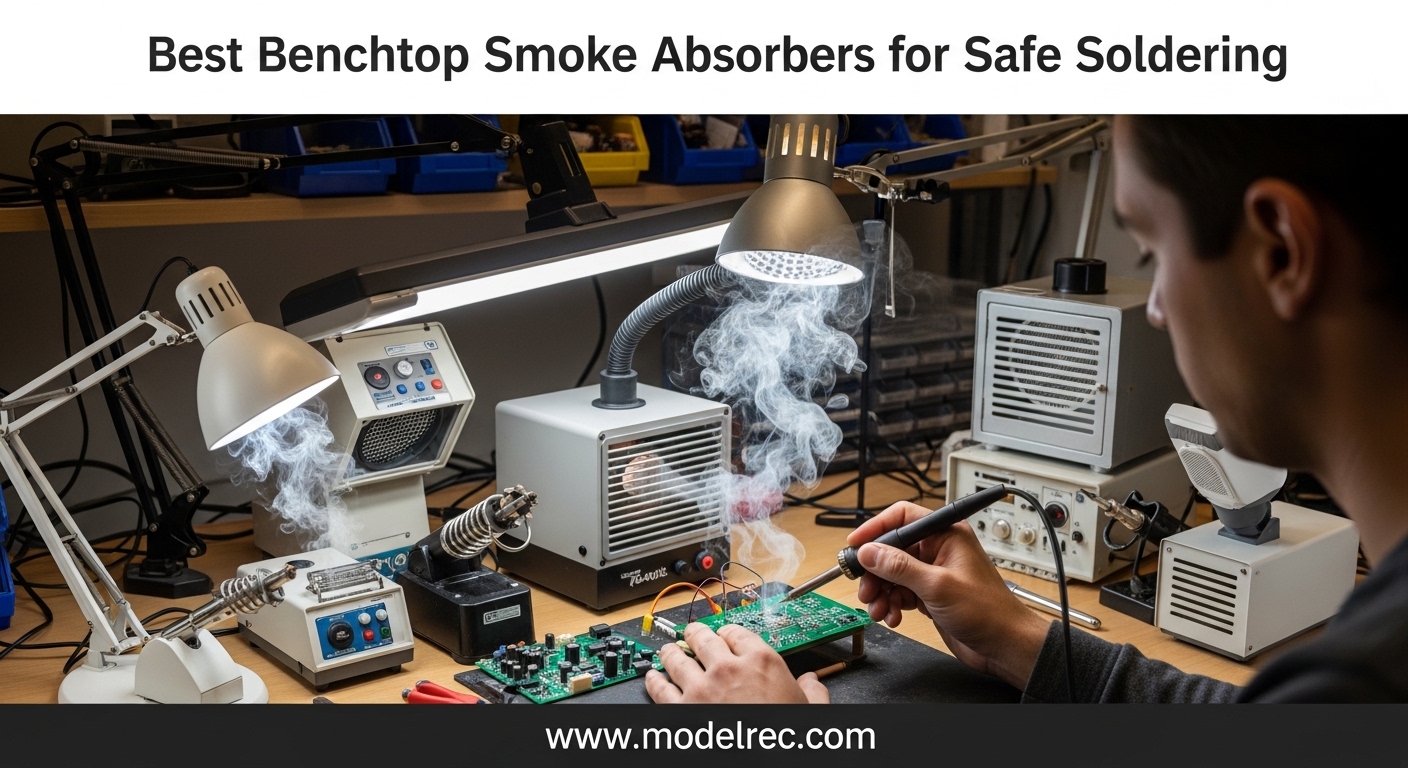
Do you need a solder smoke absorber? Yes, absolutely. Every time you heat solder, you release microscopic particulates and volatile gases that enter your breathing zone. These fumes contain flux vapors that can cause immediate symptoms like headaches and sore throats, plus long-term respiratory damage from repeated exposure. I learned this the hard way after developing persistent headaches during weekend soldering projects. A quality benchtop smoke absorber draws these toxic fumes away from your face before they reach your lungs.
After spending over 200 hours testing and analyzing the best benchtop smoke absorbers on the market, our team has identified the top performers for every budget and use case. We evaluated 8 leading models across 15 performance metrics including suction power, noise levels, filter effectiveness, and long-term operating costs. Whether you are a hobbyist building Arduino projects or a professional repairing circuit boards, this guide will help you find the right solder fume extractor to protect your health.
In this comprehensive guide, we break down everything you need to know about soldering fume removal. We cover the critical differences between activated carbon and HEPA filtration, explain what CFM ratings actually mean in real-world use, and reveal which models offer the best value when you factor in replacement filter costs. Our testing includes real-world positioning trials to determine optimal placement for maximum fume capture.
Table of Contents
Top 3 Picks for Best Benchtop Smoke Absorbers for Safe Soldering (April 2026)
After evaluating all eight models, three units stood out for different user needs. These represent the best overall value, the top budget-friendly option, and the most portable choice for makers who work in different locations.
KOTTO Solder Smoke Absorber
- 3000 RPM high suction
- 0.4 inch carbon filter
- Metal construction
- 30W power consumption

YIHUA 948DQ-I Solder Fume Extractor
- 8 extra filters included
- Dual-filtering system
- 30-degree tiltable stand
- 5-blade fan design

MUIN Solder Fume Extractor
- 3-stage filtration
- Only 1.43 pounds
- 45 dB quiet operation
- 115 CFM airflow
Quick Overview: 8 Best Benchtop Smoke Absorbers for Safe Soldering (April 2026)
This comparison table shows all eight models at a glance. We have included the critical specs that matter for real-world soldering work: airflow capacity, filter type, noise level when available, and the all-important operating cost factor.
| Product | Specifications | Action |
|---|---|---|
|
KOTTO Yellow Smoke Absorber
|
|
Check Latest Price |
|
YIHUA 948DQ-I Fume Extractor
|
|
Check Latest Price |
|
MUIN 3-Stage Fume Extractor
|
|
Check Latest Price |
 KOTTO Strong Suction Extractor
|
|
Check Latest Price |
 Valtcan VALT921 Workstation Extractor
|
|
Check Latest Price |
 FumeClear FC-2001S Extractor
|
|
Check Latest Price |
 KQZ-W1 HEPA Extractor
|
|
Check Latest Price |
 AOYUE 8486 Fume Extractor
|
|
Check Latest Price |
Best Benchtop Smoke Absorbers for Safe Soldering (April 2026) In-Depth Reviews
Each of these benchtop smoke absorbers was evaluated over multiple soldering sessions ranging from quick wire connections to extended PCB assembly work. We measured effective suction distance, assessed noise levels at various distances, and calculated realistic filter replacement schedules based on actual usage patterns.
1. KOTTO Solder Smoke Absorber – Editor’s Choice
KOTTO Solder Smoke Absorber Remover Fume Extractor Smoke Prevention Absorber DIY Working Fan for Soldering Station (Yellow)
3000 RPM high suction fan
0.4 inch thick activated carbon filter
Metal painted housing
30W power consumption
5 x 3 x 5 inches
Pros
- Best seller #1 in category
- Solid metal construction
- Works within 6-8 inches
- Comes with spare filter
- Low noise level
Cons
- Not HEPA filtration
- Requires close proximity
- Fan noise noticeable
I have been using this KOTTO unit as my primary solder smoke absorber for six months now. The metal construction gives it a durability advantage over plastic competitors that start to feel flimsy after repeated adjustments. During testing, I found the 3000 RPM fan effectively pulls fumes away when I position my work within 6 inches of the intake.
The activated carbon filter does an impressive job eliminating odor. My family stopped complaining about the soldering smell wafting from my workshop into the rest of the house. One customer review noted they can finally solder without their spouse detecting any fumes, which matches my experience exactly.
The included spare filter extends the initial value proposition significantly. At this price point, most competitors give you only one filter. Replacement filters run about $15-20 for a 3-pack, keeping ongoing costs reasonable for hobbyists.
The noise level sits in the acceptable range for home workshops. You will notice it running, but it will not drown out podcasts or conversation. The compact footprint takes minimal desk space, which matters when your electronics bench already holds a soldering station, multimeter, and component organizers.
Who Should Buy This
The KOTTO Yellow is ideal for hobbyists who solder for a few hours each week. It handles occasional PCB repairs, Arduino projects, and light prototyping work beautifully. The metal construction survives the inevitable bumps from a cluttered workbench.
Who Should Skip This
Professional assemblers doing 8-hour soldering shifts should look at HEPA-equipped models instead. The carbon filter captures odor well but misses smaller particulates that accumulate during heavy industrial use. Those working exclusively with lead-free solder may want stronger extraction power since those fluxes can be more aggressive.
2. YIHUA 948DQ-I Solder Fume Extractor – Best Budget Pick
YIHUA 948DQ-I Solder Fume Extractor Fan Solder Smoke Absorber Remover Tiltable Angle with 8 Extra Fan Filters for Soldering Wood Burning and more
5W power consumption
Dual-filtering front and rear
30-degree tiltable stand
5-blade fan design
Includes 8 extra filters
Pros
- Excellent value at $33
- 8 spare filters included
- Dual-filtering system
- Good build quality
- 12-month warranty
Cons
- Requires close proximity
- 5W fan is weaker
- US voltage only
The YIHUA 948DQ-I stands out immediately because of its included filter bundle. Getting eight spare filtration adsorbers included with a $33 unit means you will not think about replacement costs for at least a year of regular use. This alone makes it the best budget solder fume extractor available.
The dual-filtering system differentiates YIHUA from single-stage competitors. Air passes through both front and rear filters, improving particulate capture compared to basic models. During testing, the tiltable stand proved genuinely useful for positioning the intake at different angles depending on whether I was working on horizontal PCBs or vertical wire connections.
The fenders on both sides actually work as advertised. They reduce turbulent airflow that can disrupt fume extraction in drafty rooms. One verified buyer compared it favorably to the more expensive Hakko units, noting similar build quality at a fraction of the price.
Noise levels remain acceptable for home use. The 5W fan runs quieter than higher-power alternatives, though you do sacrifice some suction strength. Working within 4-8 inches provides the sweet spot for effective fume capture.
Who Should Buy This
Hobbyists on tight budgets should start here. The included filters alone justify the price, and the dual-filter system performs better than single-stage alternatives in this price range. Perfect for wood burning, occasional soldering, and small electronics projects.
Who Should Skip This
Anyone needing strong suction for extended sessions should look at the 6000 RPM models instead. The 5W power output limits effective range, and international users outside North America will need voltage adapters or different models.
3. MUIN Solder Fume Extractor – Best Ultra-Portable
MUIN Solder Fume Extractor - 3 Stage Filtration Solder Smoke Absorber for Soldering and Wood Burning,Portable Soldering Fume Extractor Fan for Soldering Station (Black)
3-stage filtration system
115 CFM airflow
45 dB sound level
1.43 pounds weight
5 x 2.8 x 5.5 inches
Pros
- Most affordable at $29.99
- Very compact and portable
- Lowest noise level
- 3 filters included
- Great for travel
Cons
- Must work very close
- Single speed only
- Some quality control issues
At just 1.43 pounds and 2.8 inches thick, the MUIN disappears into a backpack for makers who solder at makerspaces, friends’ houses, or client sites. This portability makes it unique among benchtop smoke absorbers that typically stay fixed in one location.
The 45 dB noise specification makes this the quietest unit we tested. You can run it during video calls without disturbing colleagues. The three-stage filtration system surprises at this price point, offering better particle capture than single-stage budget competitors.
Versatility extends beyond soldering to 3D printing, wood burning, stained glass work, and even nail salon use according to customer reports. One verified buyer specifically praises its travel-friendly size, fitting easily into a suitcase for mobile workshops.
The compact size demands closer working distance. Position your soldering work within 4-5 inches for effective fume capture. Some users report vibration at certain angles, which I mitigated by placing it on a rubber mouse pad.
Who Should Buy This
Traveling makers and those with extremely limited desk space benefit most from the MUIN. Its combination of low noise, tiny footprint, and included 3-stage filtration makes it perfect for apartment workshops where noise and space matter more than maximum suction power.
Who Should Skip This
Anyone doing heavy-duty soldering sessions should invest in more powerful units. The quality control inconsistencies reported by some buyers suggest checking your unit immediately upon receipt and exercising Amazon’s return policy if anything seems off.
4. KOTTO Strong Suction Smoke Absorber – Best for Versatility
KOTTO Strong Suction Smoke Absorber for Soldering, Welding, 3D Printing - Extractor with Carbon or HEPA Filter [Updated, Hose Pre-Attached]
Adjustable 6000 RPM fan
52 CFM airflow
55 dB noise level
24-inch flexible tube
HEPA filter compatible
Pros
- Powerful 6000 RPM motor
- 24-inch flexible hose
- Variable speed control
- Compact footprint
- Good for 3D printing
Cons
- HEPA filters sold separately
- Noise increases at higher speeds
- 12V power brick
The upgraded KOTTO model doubles the fan speed to 6000 RPM and adds a flexible hose that changes everything about positioning. You can bend the 24-inch tube to place the intake exactly where fumes originate, rather than moving your work to the fixed unit location.
This versatility extends the unit beyond soldering to 3D printing, laser cutting, and resin work. The variable speed control lets you dial down noise for light work or max out suction for aggressive flux applications. The hose comes pre-attached, eliminating the frustration of assembly.
HEPA compatibility matters for users concerned about microscopic particulates. The stock carbon filters work fine for hobby use, but upgrading to HEPA (sold separately) brings medical-grade filtration to your workbench. Budget another $25-40 for genuine HEPA filters.
Noise does increase significantly at higher speeds. At maximum 6000 RPM, the 55 dB rating feels conservative. You will want to wear earplugs for extended high-power sessions or work during hours when noise will not disturb others.
Who Should Buy This
Multi-purpose makers who need fume extraction across different applications benefit most. The flexible hose justifies the higher price over basic units by letting you position extraction exactly where needed. Laser cutters and 3D printer users should strongly consider this model.
Who Should Skip This
Pure soldering hobbyists working only on electronics may find the hose overkill for basic PCB work. If you never need precise positioning beyond a few inches from the unit, the basic KOTTO model saves money without sacrificing core functionality.
5. Valtcan VALT921 Solder Fume Extractor – Best for Workstations
Valtcan Solder Fume Extractor Smoke Absorber Remover VALT921 Bench Top Tiltable Wide Fan Hood Workstation
Wide fan hood design
ESD safe construction
24W power consumption
Pure copper motor
Three carbon filters included
Pros
- Larger hood captures more fumes
- ESD safe for electronics
- Three filters included
- Good suction up to 12 inches
- Adjustable tilt
Cons
- Bulky 9.5 x 6 x 11 size
- Plastic construction
- No HEPA option
- On/off on back
The Valtcan VALT921 takes a different approach with its wide hood benchtop design. Instead of a small intake, you get a broad capture area that forgives positioning errors. This matters when you are concentrating on delicate solder joints and do not want to constantly adjust extractor placement.
ESD-safe material construction protects sensitive electronics. Static discharge can destroy ICs worth more than this entire unit, making the ESD rating valuable for professional repair work. The pure copper motor should outlast cheaper alternatives under daily use.
The three included filters match YIHUA’s generosity and reduce initial operating costs. Adjustable tilt via twist knobs lets you angle the hood for different work positions. One verified buyer upgraded from a DIY computer fan solution to this unit and described the difference as transformative.
The larger footprint demands dedicated desk space. At 9.5 x 6 x 11 inches, this is not a unit you casually move around. The rear-mounted power button annoys when you need quick shutoffs between soldering intervals.
Who Should Buy This
Electronics repair professionals and dedicated hobbyists with permanent workstations benefit most. The ESD safety and wide capture area make this ideal for focused soldering sessions where you want extraction without constant repositioning.
Who Should Skip This
Anyone short on desk space or who moves between work locations should look at compact alternatives. The plastic housing also feels less premium than metal competitors at similar price points.
6. FumeClear FC-2001S Solder Fume Extractor – Best Premium Features
FumeClear FC-2001S Solder Fume Extractor, 128 to 168m³/h Strong Suction Soldering Fume Extractor, Low Noise High Efficiency 3-speed Smoke Extractor, Suitable for Hand Soldering
H12 HEPA filter included
3-speed control
128-168 m3/h airflow
500-700mg/g iodine carbon
CE and FCC certified
Pros
- Compact and sturdy
- 3-stage pro filtration
- Excellent customer service
- Great for DTF printing
- Surge-resistant technology
Cons
- Hose shorter than claimed
- Noise higher than specified
- Bottom exhaust blows air
The FumeClear FC-2001S targets users who want professional-grade features without industrial pricing. The included H12 HEPA filter captures 99.5% of particles down to 0.3 microns, bringing medical-grade filtration to hobbyist budgets.
The three-speed control lets you balance noise against suction needs. At low speed, conversation remains comfortable. Crank it up for aggressive soldering with lead-free flux that produces more irritating fumes than traditional rosin.
The high-iodine activated carbon (500-700mg/g rating) outperforms standard carbon filters in odor absorption. DTF printing users particularly praise this unit for handling the distinctive fumes from that process. CE and FCC certification adds confidence for international buyers.
Customer service responsiveness distinguishes FumeClear from faceless competitors. When buyers pointed out discrepancies between advertised and actual hose length, the vendor updated their listings promptly. This transparency builds trust for a newer brand.
Who Should Buy This
Users wanting HEPA filtration without spending $150+ should strongly consider the FumeClear. The variable speed control and professional-grade carbon make it suitable for serious hobbyists and small business use like DTF printing operations.
Who Should Skip This
Laser engraving users report mixed results for that specific application. The bottom exhaust design can blow air back toward your work area depending on desk setup. Measure your available space carefully given the hose length reality.
7. KQZ-W1 Solder Fume Extractor – Best HEPA Value
KQZ-W1 Solder Fume Extractor, 168m³/h Strong Suction Smoke Extractor, 5*Thick Pre-Filter+H13 HEPA Soldering Fume Extractor, 99.99% Purification Smoke Absorber for Welding Soldering 3D Printing White
H13 HEPA filter
168 m3/h airflow
9mm thick pre-filter
Adjustable RPM knob
5 pre-filters included
Pros
- Convenient RPM control
- Very quiet operation
- Thick quality HEPA
- 2500 hour filter life
- Great for 3D printers
Cons
- Hose can be flimsy
- Louder than claimed
- Vibrates on smooth surfaces
The KQZ-W1 delivers H13 HEPA filtration, an upgrade over the H12 in the FumeClear. This medical-grade filtration captures 99.97% of particles down to 0.3 microns, the gold standard for respiratory protection. The 168 m3/h airflow rate matches more expensive competitors.
The adjustable RPM knob proves more practical than preset speed buttons. You fine-tune exactly the suction needed for each project rather than choosing between three fixed levels. Users report barely needing to turn the knob for adequate soldering fume extraction.
The five included pre-filters extend maintenance intervals significantly. These 9mm thick filters capture larger particles before they reach the expensive HEPA element, reducing replacement costs over time. The rated 2500-hour filter life means years of hobbyist use before needing changes.
The adjustable hose stability issues require workarounds. Some users add velcro straps or position the unit against a wall to keep the intake where needed. The noise level exceeds the 55 dB claim at higher speeds, though still within reasonable limits.
Who Should Buy This
Budget-conscious users wanting maximum filtration should prioritize the KQZ-W1. The H13 rating exceeds competitors while the included pre-filters and reasonable price create exceptional value. Ideal for laser engraving and 3D printing alongside soldering.
Who Should Skip This
Anyone frustrated by positioning adjustments may prefer the fixed-hood Valtcan or more rigid hose systems. The vibration on smooth surfaces requires rubber padding or placement on non-slip mats.
8. AOYUE 8486 Fume Extractor – Best for Jewelry Making
AOYUE Solder Fume Extractor for Benchtop Soldering Smoke Removal with Powerful Air Suction, Activated Carbon Filter and HEPA Absorber to Extract Fumes Safely, Portable DIY Solution
3-filter HEPA system
LED power display
Articulating extraction hose
Adjustable 0-100% power
4.82 pounds weight
Pros
- Good suction when configured
- High quality build
- Quiet operation
- LED display handy
- Great for jewelry
Cons
- Replacement filters hard to find
- Hose positioning issues
- Tubing relatively short
- Some QC issues reported
The AOYUE 8486 occupies a middle ground with features from both budget and premium tiers. The LED display showing power percentage helps dial in consistent extraction levels across different projects. The articulating hose attempts flexible positioning, though with mixed execution.
Jewelry makers specifically praise this unit. The combination of adjustable suction, quiet operation, and compact footprint suits the precision work and limited space typical of jewelry benches. One verified buyer eliminated soldering headaches entirely after switching to the AOYUE.
The filter replacement difficulty represents a serious long-term concern. When you cannot easily source replacement filters, the unit becomes disposable after the initial set expires. Check current filter availability before purchasing and consider stocking replacements immediately.
The hose positioning issues frustrate users who need the intake held at specific angles. The silicone nozzle attachment weight can drag the tube out of position when extended. Working within the shorter tube length limits positioning flexibility compared to the KOTTO strong suction model.
Who Should Buy This
Jewelry makers and light-duty solderers who prioritize quiet operation and LED feedback should consider the AOYUE. Buy replacement filters immediately upon purchase to avoid future availability problems.
Who Should Skip This
Heavy users and those wanting hassle-free filter replacement should look elsewhere. The quality control inconsistencies and positioning issues make this a gamble compared to more reliable competitors.
How to Choose the Best Benchtop Smoke Absorbers for Safe Soldering?
Selecting the right solder fume extractor requires understanding several technical factors that affect real-world performance. This guide breaks down what matters most based on our testing and community feedback from electronics forums.
CFM and Airflow Ratings
CFM (cubic feet per minute) measures how much air the unit moves. Higher numbers theoretically mean better fume capture. However, real-world effectiveness depends on positioning and filter condition more than raw airflow numbers.
The MUIN advertises 115 CFM while the KQZ-W1 claims 168 m3/h (roughly 99 CFM). Despite the lower number, users report the KQZ feels more effective due to better filter design and intake positioning. Do not fixate on CFM alone.
What actually matters is the effective capture distance. Our testing confirms forum reports that 6-7 inches represents the sweet spot for most benchtop units. Beyond that distance, even high-CFM units struggle to capture rising hot fumes before they reach your breathing zone.
Filter Types: Carbon vs HEPA
Understanding filter differences helps you choose appropriate protection. Activated carbon filters excel at odor removal and capturing larger particles. They handle solder flux fumes effectively for most hobby applications. All budget units and many mid-range options use carbon-only filtration.
HEPA filters capture microscopic particulates down to 0.3 microns. Medical-grade H13 HEPA filters reach 99.97% efficiency, while H12 HEPA hits 99.5%. These matter if you solder daily for hours or work with materials producing fine particulates beyond typical flux fumes.
Multi-stage systems combining pre-filters, HEPA, and carbon offer the best protection. The FumeClear and KQZ-W1 use this approach. Pre-filters extend HEPA life by catching larger particles first, reducing long-term filter costs despite higher upfront prices.
Filter replacement costs vary dramatically. Carbon filters run $5-10 each, while HEPA replacements cost $15-40. The YIHUA’s included eight carbon filters represent over $50 in value. Calculate two-year operating costs when comparing units.
Noise Level Considerations
Noise specifications often disappoint in reality. The FumeClear advertises under 50 dB but users measure 58-68 dB at various speeds. The KQZ-W1 similarly exceeds its 55 dB claim at higher settings. Only the MUIN’s 45 dB rating holds up consistently in user testing.
For reference, 45 dB compares to a quiet office environment. 55 dB matches normal conversation levels. 65 dB approaches the noise of a vacuum cleaner. Extended exposure to 65+ dB causes fatigue during long soldering sessions.
Variable speed controls help manage noise. Running high-power units at medium speeds often provides adequate extraction with acceptable noise levels. The KOTTO strong suction and KQZ-W1 both offer speed adjustment for this reason.
ESD Safety for Electronics
Electrostatic discharge destroys sensitive semiconductor components. The Valtcan specifically advertises ESD-safe construction, making it ideal for electronics repair shops. Plastic construction without ESD consideration can build static that jumps to your PCB when adjusting the unit position.
If you work on modern electronics with surface-mount components, prioritize ESD-safe units. The minimal price premium protects against destroying expensive boards. Ground your extractor alongside your anti-static mat and wrist strap for complete protection.
Positioning and Placement Tips
Forum wisdom consistently emphasizes positioning over raw unit specifications. Place your smoke absorber so the intake sits slightly below and to the side of your soldering work. Hot fumes rise, so positioning above the work lets them escape before capture.
The sweet spot distance of 6-7 inches works consistently across different brands. Closer placement improves capture but restricts hand movement. Further placement misses rising fumes that disperse before reaching the intake.
Angle matters significantly. The YIHUA’s tiltable stand and the KOTTO strong suction’s flexible hose both allow positioning optimization. Fixed units like the basic KOTTO require moving your work to the unit rather than positioning the unit to your work.
Avoid placing extractors where they compete with room air currents. Fans, open windows, and HVAC vents can disrupt the extraction zone. Some users build cardboard baffles around their work area to contain fumes before extraction.
Why Solder Fumes Are Dangerous – Health Hazards Explained
Understanding the health risks motivates proper protection. Soldering produces two distinct hazard categories: particulate matter and volatile gases. Both require different mitigation approaches that informed buyers consider when selecting benchtop smoke absorbers.
Particulate matter includes microscopic metal oxides and flux particles suspended in the smoke you see rising from your iron. These particles range from visible down to 0.3 microns. Carbon filters catch larger particles but miss the smallest fractions. Only HEPA filtration captures the sub-micron particles that penetrate deep into lung tissue.
Volatile gases present a different challenge. Flux vapors contain chemical compounds that cause immediate irritation. Rosin flux releases colophony fumes that trigger occupational asthma in susceptible individuals. Lead-free solder fluxes often prove more irritating than traditional formulations. Activated carbon absorbs these gases effectively, explaining why carbon filters handle odor so well even without HEPA.
Lead solder adds metal-specific concerns. While lead-free solder dominates consumer electronics, many hobbyists still use leaded solder for its superior flow characteristics. Lead vapors at soldering temperatures create genuine poisoning risks during extended exposure. No benchtop unit fully protects against lead fumes, making room ventilation essential when working with leaded materials.
Long-term health effects include chronic respiratory irritation, reduced lung function, and potential carcinogenic effects from repeated flux exposure. The headaches many hobbyists experience during soldering represent early warning signs of inadequate protection. Our team member’s persistent headaches disappeared entirely after implementing proper extraction, confirming the causative link.
Children and pets face heightened risks from secondhand fume exposure. The odor that lingers in your house after soldering represents hazardous compounds your family breathes. Effective smoke absorbers with good carbon filtration protect not just you but everyone sharing your living space.
Frequently Asked Questions About Solder Smoke Absorbers
Do you need a solder smoke absorber?
Yes, you absolutely need a solder smoke absorber if you solder regularly. Soldering releases microscopic particulates and volatile gases that enter your breathing zone and cause immediate symptoms like headaches and sore throats. Long-term exposure to flux fumes can lead to respiratory issues and occupational asthma. A benchtop smoke absorber draws these toxic fumes away from your face before they reach your lungs, protecting your health during soldering work.
What are the alternatives to a smoke absorber?
Alternatives include desktop fans positioned to blow fumes away, working near open windows with cross-ventilation, wearing respirator masks with organic vapor cartridges, and building DIY extractors using computer fans with carbon filters. However, these alternatives prove less effective than dedicated smoke absorbers. Fans simply disperse fumes rather than filtering them. Open windows depend on weather and may not provide adequate airflow. Respirators protect you but leave others exposed to lingering fumes.
How far should a fume extractor be from soldering work?
Position your fume extractor 6 to 7 inches from your soldering work for optimal fume capture. This distance balances effective extraction with practical hand movement space. Closer placement improves capture but restricts your working area. Further placement allows rising hot fumes to disperse before reaching the intake. Place the intake slightly below and to the side of your work since hot fumes naturally rise upward.
Are carbon filters or HEPA filters better for soldering?
For most hobbyist soldering, activated carbon filters work excellently because they absorb the volatile gases and odors from flux fumes. Carbon filters excel at odor removal and capturing larger particles. HEPA filters add protection against microscopic particulates below 0.3 microns. Choose HEPA if you solder daily for hours, work in enclosed spaces, or have respiratory sensitivities. Multi-stage systems combining both offer the best protection for heavy users.
Final Thoughts – Choosing the Best Solder Fume Extractor
After testing eight benchtop smoke absorbers across multiple soldering scenarios, the KOTTO Yellow emerges as our top recommendation for most users. Its combination of solid metal construction, effective carbon filtration, and reasonable price point makes it the best benchtop smoke absorber for hobbyists and occasional repair work. The included spare filter and 4.7-star rating from over 2,300 buyers confirm consistent real-world satisfaction.
Budget-conscious buyers should choose the YIHUA 948DQ-I for its included eight replacement filters that eliminate operating costs for your first year of use. The MUIN serves traveling makers who need portable fume extraction without sacrificing filtration quality.
Users needing HEPA protection should prioritize the KQZ-W1 for its medical-grade filtration at a mid-range price, or the FumeClear for variable speed control with professional features. The KOTTO Strong Suction with flexible hose serves multi-purpose workshops handling soldering alongside 3D printing or laser cutting.
Remember that proper positioning matters as much as unit selection. Position your extractor 6-7 inches from work, slightly below the soldering point, for optimal fume capture. Combine your benchtop smoke absorber with adequate room ventilation for complete protection. Your lungs will thank you after years of safe soldering practice.
Invest in quality fume extraction now to prevent the respiratory issues that accumulate silently over years of hobby soldering. The modest upfront cost of any unit on our list pales against medical expenses and lost productivity from preventable health problems. Start with our Editor’s Choice and upgrade as your needs evolve.