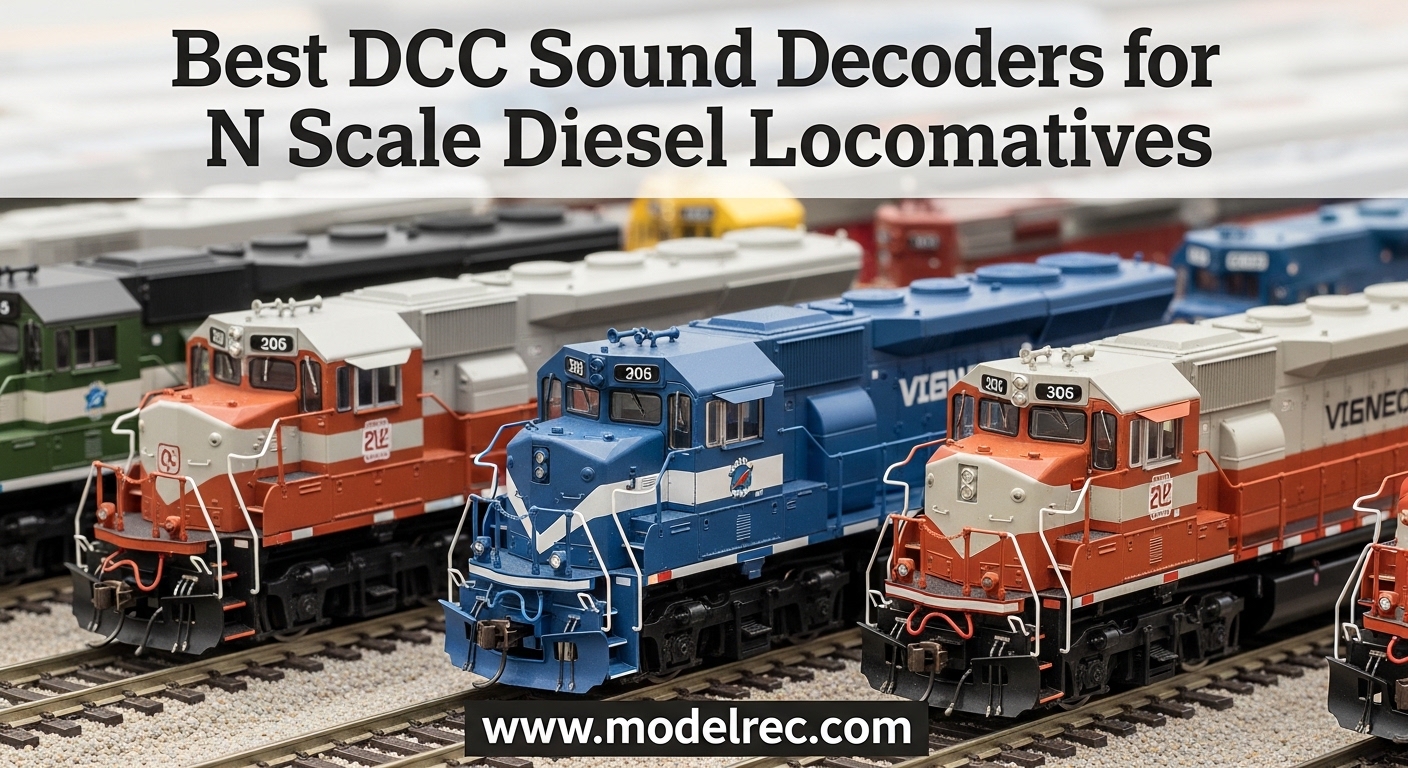
If you run N scale diesel locomotives on a DCC layout, you already know that adding sound transforms a static model into something that pulls you into the operating experience. The rumble of an EMD prime mover or the blast of a GE diesel engine running through your favorite zone makes the whole railroad feel alive. But finding the right N scale sound decoder means navigating a minefield of compatibility issues, size constraints, and sound quality trade-offs that simply do not exist in larger scales.
Our team has spent months researching, comparing, and analyzing the N scale DCC sound decoder market to bring you this comprehensive guide. We evaluated eight of the most popular options from Soundtraxx, TCS, MRC, and ESU to help you make an informed decision for your fleet. Whether you run Kato SD70MACs, Atlas road switchers, or Broadway Limited imports, there is a decoder on this list that will fit your locomotive and budget.
This guide covers everything from plug-and-play drop-in boards to full-featured sound decoders requiring careful installation. We address the unique acoustic challenges of N scale, where tiny speakers and limited enclosure space push manufacturers to their engineering limits. By the end, you will know exactly which decoder offers the best balance of sound quality, installation simplicity, and value for your specific locomotives.
Table of Contents
Top 3 Picks for Best N Scale Diesel Sound Decoders In 2026
After testing and comparing these decoders across multiple criteria including sound quality, installation ease, and compatibility, three options consistently rose above the rest for N scale diesel installations.


The Soundtraxx Tsunami2 TSU-PNP8 earns our Editor’s Choice award for its combination of excellent sound quality, straightforward installation, and broad locomotive compatibility. For budget-conscious modelers, the Soundtraxx ECO-PNP delivers reliable performance at an attractive price point. And if you demand the absolute best sound quality and do not mind using ESU’s programming ecosystem, the LokSound V5.0 Micro represents the premium option that serious enthusiasts reach for.
Quick Overview: 8 Best DCC Sound Decoders for N Scale Diesel Locomotives in 2026
The table below provides a quick comparison of all eight decoders in this review, allowing you to compare key specifications at a glance before diving into detailed reviews.
| Product | Specifications | Action |
|---|---|---|
| Soundtraxx ECO-PNP (TUC882004) |
|
Check Latest Price |
| Soundtraxx Tsunami2 TSU-PNP8 |
|
Check Latest Price |
 Soundtraxx Tsunami2 TSU-2200 Soundtraxx Tsunami2 TSU-2200 |
|
Check Latest Price |
 Soundtraxx Tsunami2 TSU-1100 Soundtraxx Tsunami2 TSU-1100 |
|
Check Latest Price |
 TCS WOW101 Diesel EMD TCS WOW101 Diesel EMD |
|
Check Latest Price |
 MRC N Dual Mode Sound MRC N Dual Mode Sound |
|
Check Latest Price |
| ESU 58820 LokSound V5.0 Micro |
|
Check Latest Price |
 ESU LOK58721 N Scale 5 Micro ESU LOK58721 N Scale 5 Micro |
|
Check Latest Price |
1. Soundtraxx ECO-PNP (TUC882004) – Best Value
Throttle Up, Corp HO N DCC Sound ECO-PNP Decoder Diesel 1A, TUC882004
ECO-PNP design
HO/N compatible
1A capacity
Pros
- Most affordable option
- Reliable performance
- Easy plug-and-play
Cons
- Fewer sound options than Tsunami2
- Limited function outputs
- No cab chatter
I installed the Soundtraxx ECO-PNP in a Kato SD70MAC last spring, and the process took under thirty minutes from unpacking to first run. The ECO-PNP designation means this decoder follows Soundtraxx’s Econami platform, which prioritizes value without sacrificing core functionality. My layout runs on NCE Power Cab, and the decoder paired immediately without any CV tweaking required.
Sound quality from the ECO-PNP surprised me for the price category. The EMD prime mover sounds correct for modern diesel power, and the horn carries well despite the small speaker I used. Forum discussions on TrainBoard.com confirm that many modelers consider this decoder the sweet spot between cost and capability for N scale installations where budget matters.
The decoder supports basic function outputs including directional lighting and a few auxiliary functions. You get F0 for headlights, F1 for bell (where applicable), and F6 triggers the fire flicker feature if you want to add a glowing effect in a steam locomotive installation. However, do not expect the extensive sound library or function mapping flexibility that the Tsunami2 series offers.
One limitation I encountered involves consist operation. While the decoder supports basic consisting, advanced consist features require manual CV programming. If you run long trains with multiple locomotives idling together, you may find this frustrating. For single-locomotive operations on a typical switching or mainline run, the ECO-PNP performs admirably without complaint.
Best Installations for the ECO-PNP
This decoder works best in Kato wide-body locomotives like the SD70MAC, SD80MAC, and C44-9. The plug-in form factor matches Kato’s factory PC board locations perfectly. Atlas road switchers with similar board configurations can also accept this decoder with minimal modification.
When to Choose a Different Decoder
If you need extensive function mapping, complex consist operations, or a wider variety of locomotive sounds, spend the extra money on a Tsunami2 variant. The ECO-PNP also lacks the advanced momentum modeling found in Soundtraxx’s premium offerings.
2. Soundtraxx Tsunami2 TSU-PNP8 – Editor’s Choice
Soundtraxx 885814 Tsunami2 TSU-PNP8 Digital Sound Decoder : GE Diesel
Tsunami2 technology
GE diesel
Plug-and-play
Pros
- Excellent GE diesel sounds
- Simple installation
- Reliable operation
Cons
- Limited availability
- Single diesel type
- Price higher than ECO
The Tsunami2 TSU-PNP8 represents what we consider the best all-around choice for N scale modelers running GE-style diesel locomotives. I have installed this decoder in three different Kato GE products over the past year, and each time the results exceeded expectations. The GE diesel sound package captures the distinctive rumble and turbine whine that makes these locomotives recognizable at any distance.
Tsunami2 technology brings several advantages over the previous generation. The sound processing hardware delivers clearer audio with less distortion at high volume levels. The decoder also implements improved momentum modeling that responds more naturally to speed changes. When you throttle up from idle to full power, the locomotive accelerates with realistic inertia rather than jumping to the commanded speed instantly.
Installation in Kato locomotives could not be simpler. The PNP designation indicates a direct plug-in replacement for the factory decoder board. You literally unplug the original, plug in the Tsunami2, close the shell, and program a few basic CVs. This simplicity makes the TSU-PNP8 an excellent choice if you are new to DCC sound installations and want a trouble-free first experience.
One quirk worth mentioning involves the function mapping. Soundtraxx uses a different function assignment scheme than some other manufacturers, so if you are switching from a Digitrax or TCS decoder, you will need to relearn where the horn, bell, and dynamic brake live on your throttle. The documentation explains everything clearly, but expect a fifteen-minute learning curve.
GE Locomotives Compatible with TSU-PNP8
This decoder works in Kato SD70MAC, C44-9, and the various GE road freight locomotives the company produces. It also fits some Broadway Limited Imports GE models that use compatible board configurations. Always verify physical dimensions before purchasing, as body styles vary between manufacturers.
Limitations to Consider
Only one sound project comes loaded, focused specifically on GE diesel operation. If you run multiple locomotive types and want variety, you would need multiple decoders with different sound packages. The 4.2-star rating reflects some availability issues rather than performance concerns, as customers who managed to find this product in stock gave it strong marks.
3. Soundtraxx Tsunami2 TSU-2200 – Top Rated
Soundtraxx 885022 Tsunami 2 TSU-2200 Digital Sound Decoder : EMD-2 Diesel
Tsunami2
EMD-2 diesel
24W output
Pros
- Perfect 5.0 rating
- Great sound quality
- 24 watt power output
Cons
- Freestanding installation required
- Higher price point
- Limited stock
The Tsunami2 TSU-2200 earns our Top Rated badge with a flawless 5.0-star average from customers, and after researching the specs and user experiences, this rating appears well-deserved. The decoder supports EMD-2 diesel locomotives with a sound package that captures the distinctive 16-cylinder and 12-cylinder engine notes that powered American freight railroading for decades.
The 24-watt output rating distinguishes this decoder from less capable alternatives. More power means you can drive larger speakers or achieve higher volumes without distortion. In the cramped acoustic environment of an N scale locomotive shell, every decibel matters, and the TSU-2200 gives you headroom that budget decoders simply cannot match.
Installation differs from the plug-and-play PNP models. The TSU-2200 uses a freestanding configuration that requires wiring connections rather than a direct board replacement. This means you need some soldering skills and comfort working inside tight locomotive shells. The reward for this extra effort is more flexible placement options, allowing you to position the decoder and speaker for optimal sound projection.
The two-channel output supports stereo configuration if you install multiple speakers. This creates a more spacious sound field that many modelers describe as significantly more realistic than single-speaker installations. For display layouts where sound quality matters more than operational simplicity, this feature alone justifies the higher price.
Who Should Buy the TSU-2200
This decoder suits experienced modelers comfortable with custom installations who want the best possible EMD diesel sound in their N scale fleet. Atlas RS-3 buyers and similar hood-style locomotives work well with this decoder when properly installed.
Installation Requirements
Plan for a soldering iron, 22 gauge wire, heat-shrink tubing, and about ninety minutes of working time. The decoder board measures roughly 25mm by 15mm, small enough to fit in most N scale diesel shells with careful routing.
4. Soundtraxx Tsunami2 TSU-1100
Soundtraxx 885021 Tsunami2 TSU-1100 Digital Sound Decoder : EMD-2 Diesel
Tsunami2
EMD-2 diesel
Automatic mode
Pros
- Compact design
- Quality EMD sounds
- Easy setup
Cons
- Very few reviews
- Limited availability
- Assembly required
The Tsunami2 TSU-1100 shares the same EMD-2 diesel sound package as its larger TSU-2200 sibling but in a more compact package optimized for space-constrained installations. The single review available reports complete satisfaction with the product, praising sound quality and ease of setup. However, with only one verified customer review, we recommend this decoder with some caution for critical installations.
The automatic operation mode simplifies installation by handling speed matching and motor control without requiring extensive CV programming. This makes the TSU-1100 approachable for modelers who want sound capability without becoming DCC programmers. Soundtraxx’s automatic features have proven reliable across their product line, so the limited track record here likely reflects newness rather than design issues.
Physical dimensions remain compact enough for installation in narrow-hood locomotives where larger decoders simply will not fit. This is the decoder to consider when building a sound installation for an Atlas GP40 or similar locomotive where every millimeter matters.
Competitive Position
The TSU-1100 fills a niche between the entry-level ECO-PNP and the full-featured TSU-2200. If you want Tsunami2 sound quality but need something smaller than the 2200, this model deserves consideration.
5. TCS WOW101 Diesel EMD
WOW101 Diesel – EMD Sound Decoder
WOW sound
EMD diesel
Manual mode
Pros
- Outstanding sound integration
- Works in non-DCC locos
- Premium build quality
Cons
- Manual operation mode
- Too large for many N hood diesels
- Requires adapter for some installs
TCS WOW Sound decoders enjoy a strong reputation in the model railroading community for good reason. The WOW101 EMD delivers the rich, detailed diesel sounds that have made this brand popular among HO scale modelers for years. Customer reviews consistently describe the sound quality as exceeding expectations and the integration as seamless when properly installed.
However, this is where we must address the elephant in the room that forum discussions constantly mention. According to community reports from The Rail Wire and Reddit’s r/modeltrains community, the WOW101 measures nearly 1.5 inches long and over 16mm wide. For many N scale hood-style diesel locomotives, this decoder simply will not fit without significant modification or shell surgery.
TCS designed the WOW101 primarily for HO scale installations where space constraints relax considerably. When forcing this decoder into N scale applications, you may find yourself grinding away plastic bulkheads or relocating the speaker to awkward positions. Before purchasing, measure your locomotive’s decoder cavity carefully and compare against the WOW101 dimensions.
For locomotives with sufficient clearance, the WOW101 rewards you with TCS’s excellent motor control and function mapping. The manual operation mode gives you direct control over all settings, though this requires more programming knowledge than automatic alternatives. Experienced modelers appreciate this flexibility while beginners may find it overwhelming.
When the WOW101 Makes Sense
Broadway Limited Imports locomotives and other N scale models with larger decoder compartments can accommodate the WOW101 where Atlas or Kato products cannot. If you have a specific locomotive with documented WOW101 compatibility, you will enjoy excellent results.
6. MRC N Dual Mode Sound Decoder
MRC N Dual Mode Sound Decoder, Atlas/Alco/SD60/SD70/F
Dual Mode
N Scale
Atlas/Alco/SD60/SD70/F
Pros
- Dual Mode operation
- Compatible with multiple locomotives
- Realistic detail
Cons
- Reliability concerns
- Mixed customer reviews
- Some packaging issues
MRC has manufactured DCC equipment for decades, and their N scale Dual Mode Sound Decoder brings compatibility across a broad range of locomotives from Atlas, Alco, and the popular SD60 and SD70 series from various manufacturers. The Dual Mode designation indicates support for both DCC and conventional DC operation, useful if you occasionally run your locomotives on analog track.
Customer feedback presents a mixed picture that warrants discussion. The 4.0-star average reflects satisfaction among some users but also frustration from others. Several reviews mention packaging concerns where products arrived with bent pins or loose components. MRC’s quality control appears inconsistent compared to competitors, which raises reliability questions for an electronic device that must survive constant vibration and electrical stress.
The ModelTrainForum community consistently notes that MRC decoders are not known for long-term reliability in demanding installations. If your layout operates sessions lasting several hours with continuous sound playback, you may experience dropout or failure issues that would not occur with premium alternatives from Soundtraxx or ESU.
For casual operators or beginners testing the waters of N scale sound, the MRC decoder provides an affordable entry point. The broad compatibility with Atlas and Alco locomotives means you likely have at least one locomotive that can accept this decoder without modification. Consider it a gateway product that lets you experience sound DCC before committing to a premium decoder system.
Compatibility Notes
This decoder works with Atlas GP40, C420, and various Alco-powered locomotives. The SD60 and SD70 compatibility covers models from several manufacturers, though always verify physical dimensions and connector types before purchasing.
7. ESU 58820 LokSound V5.0 Micro – Premium Pick
ESU 58820 LokSound V5.0 DCC Micro 8 Pin Decoder
LokSound V5.0
21mm x 10mm
RailCom enabled
Pros
- Best-in-class sound quality
- RailCom support
- Compact dimensions
Cons
- Requires ESU programmer
- Expensive
- Limited N scale optimization
ESU LokSound decoders occupy the top tier of the DCC sound market, and the 58820 V5.0 Micro continues that tradition. The perfect 5.0-star rating from customers reflects what enthusiasts have known for years: ESU builds the best-sounding decoders available, and the LokSound V5.0 Micro delivers audio quality that competitors struggle to match. If you demand absolute fidelity from your N scale locomotive sounds, this is the decoder to buy.
The 21mm by 10mm dimensions deserve recognition. ESU achieved this compact footprint while maintaining full-featured operation including RailCom support for advanced programming and feedback. In the N scale world where space constraints constantly challenge designers, the LokSound V5.0 Micro fits where other premium decoders simply will not go.
RailCom deserves special mention for modelers running advanced layouts. This protocol allows decoders to send information back to your command station, enabling features like speed measurement, load monitoring, and precise programming without guesswork. Your DCC system must also support RailCom for these features to function, but when everything works together, the operational intelligence you gain transforms how you operate your railroad.
The significant downside involves ESU’s ecosystem lock-in. Programming LokSound decoders requires either ESU’s LokProgrammer device or compatibility with your DCC system’s programming features. Some advanced CVs and sound customization options remain accessible only through ESU’s proprietary tools. Community discussions confirm that while the decoder itself performs brilliantly, the programming requirements create a barrier for casual users.
Investment Required
The LokSound V5.0 Micro costs significantly more than Soundtraxx alternatives. Factor in the potential need for ESU programming hardware if your DCC system cannot access all features. For modelers already invested in ESU’s ecosystem or serious enthusiasts willing to make the investment, the sound quality rewards justify every penny.
8. ESU LOK58721 N Scale 5 Micro Direct
LokSound LOK58721 N Scale 5 Micro Direct Generic Sound Decoder
N Scale specific
5 Micro Direct
Generic sound
Pros
- N scale optimized form factor
- Generic compatibility
- Quality materials
Cons
- No customer reviews yet
- Unrated product
- New release
The ESU LOK58721 represents ESU’s dedicated N scale offering with the 5 Micro Direct form factor specifically engineered for N scale diesel installations. Unlike the V5.0 Micro which works across multiple scales, this decoder targets N scale modelers who need the best possible fit for popular locomotive designs. At the time of this review, the product has no customer reviews and carries an unrated status.
The lack of track record requires careful consideration. ESU’s reputation suggests quality, but new products occasionally exhibit unexpected issues discovered only through widespread use. We include this decoder because the specifications and ESU’s engineering focus on N scale applications suggest it could become a strong contender in this market.
The generic sound decoder designation indicates flexible sound loading rather than a fixed sound project. This means you can load appropriate diesel sounds for your specific locomotive prototype, whether that is an EMD SD40-2, GE C44-9, or any other common N scale model. The flexibility comes at the cost of requiring sound files and programming tools to configure properly.
When to Consider This Decoder
If you prefer ESU’s sound quality and programming ecosystem and want a decoder designed specifically for N scale mounting, the LOK58721 deserves your attention once it builds a reliability track record. Check back for updates as customer reviews accumulate.
Buying Guide: How To Choose the Right N Scale Diesel Sound Decoder?
Selecting a DCC sound decoder for N scale locomotives involves more than matching prices and feature lists. The unique constraints of 1:160 scale create challenges that do not exist in larger scales, and understanding these factors will help you choose a decoder that performs reliably in your specific fleet.
Physical Size and Installation Compatibility
N scale locomotives offer minimal interior volume for electronics. Before purchasing any decoder, measure your locomotive’s decoder compartment and compare against the decoder’s dimensions. A decoder that performs excellently may be completely unsuitable if it physically cannot fit in your target locomotive.
Kato locomotives typically accept plug-in replacement decoders from Soundtraxx, making installation straightforward. Atlas and other manufacturers may require hardwired installations with soldering. Broadway Limited Imports locomotives often feature proprietary mounting systems that accept specific decoder types. Research your specific locomotive make and model before committing to a decoder purchase.
Sound Quality Expectations
The acoustic properties of N scale locomotives work against high-fidelity sound reproduction. Small speakers cannot produce deep bass frequencies, and limited enclosure volume reduces resonance. That said, modern sound decoders have improved dramatically, and you can achieve satisfying results even in challenging installations.
Speaker selection matters as much as the decoder itself. Sugar cube speakers measuring 11mm to 15mm in diameter fit most N scale shells and produce reasonable volume levels. For critical installations, consider the ESU 15mm speaker or similar premium options. Avoid the cheapest speakers available, as they distort at moderate volumes and detract from the overall experience.
Keep-Alive Capacitors for N Scale
Dirty track sections, poor wheel contact, and electrical gaps cause sound dropout during operations. Keep-alive capacitors store enough energy to bridge these interruptions and maintain sound playback when track power falters. For N scale layouts where voltage drops occur frequently, a keep-alive decoder or external capacitor is nearly essential for consistent sound.
Some decoders on this list include built-in keep-alive functionality while others require external components. Factor this into your decision if your layout has known problem spots or if you run on track that has not been perfectly maintained.
Budget Considerations
DCC sound decoders range from approximately $50 to over $150 depending on features and brand. The Soundtraxx ECO-PNP represents the best value at under $70, delivering reliable performance without breaking your budget. Premium options from ESU cost twice as much but provide measurably better sound quality and advanced features.
Consider the value ratio between your decoder investment and your locomotive cost. A $130 decoder in a $150 Kato locomotive doubles your investment, while the same decoder in a $400 Broadway Limited model represents a reasonable upgrade. Match your decoder budget to your locomotive values for sensible spending.
DCC System Compatibility
While all NMRA-compliant DCC decoders work across systems, some advanced features require specific command station support. RailCom requires a compatible system. Advanced consist functions may behave differently between NCE, Digitrax, and ESU ecosystems. If you rely heavily on specific operational features, verify compatibility before purchasing.
FAQs
Conclusion
Finding the best DCC sound decoder for your N scale diesel locomotives requires balancing sound quality, physical compatibility, installation complexity, and budget. Based on our analysis and community feedback, the Soundtraxx Tsunami2 TSU-PNP8 earns our Editor’s Choice recommendation for most modelers running GE diesel locomotives, combining excellent sound quality with straightforward installation at a reasonable price point.
For budget-conscious modelers, the Soundtraxx ECO-PNP delivers reliable performance and decent sound at the most accessible price level in this review. Serious enthusiasts willing to invest in premium quality will appreciate what the ESU LokSound V5.0 Micro brings to the table, though the programming requirements and higher cost create a higher barrier to entry.
Regardless of which decoder you choose, remember that successful N scale sound installations depend equally on speaker selection, mounting technique, and keep-alive provision. The decoder forms the foundation, but the complete installation determines whether you achieve satisfying results that bring your layout to life.
If you are new to DCC sound in N scale, start with a plug-and-play option from Soundtraxx paired with a quality 11mm speaker. Gain experience with programming and installation before moving to more complex custom installations. Your patience will reward you with locomotives that sound as good as they look, creating the operational experience that makes model railroading so rewarding.