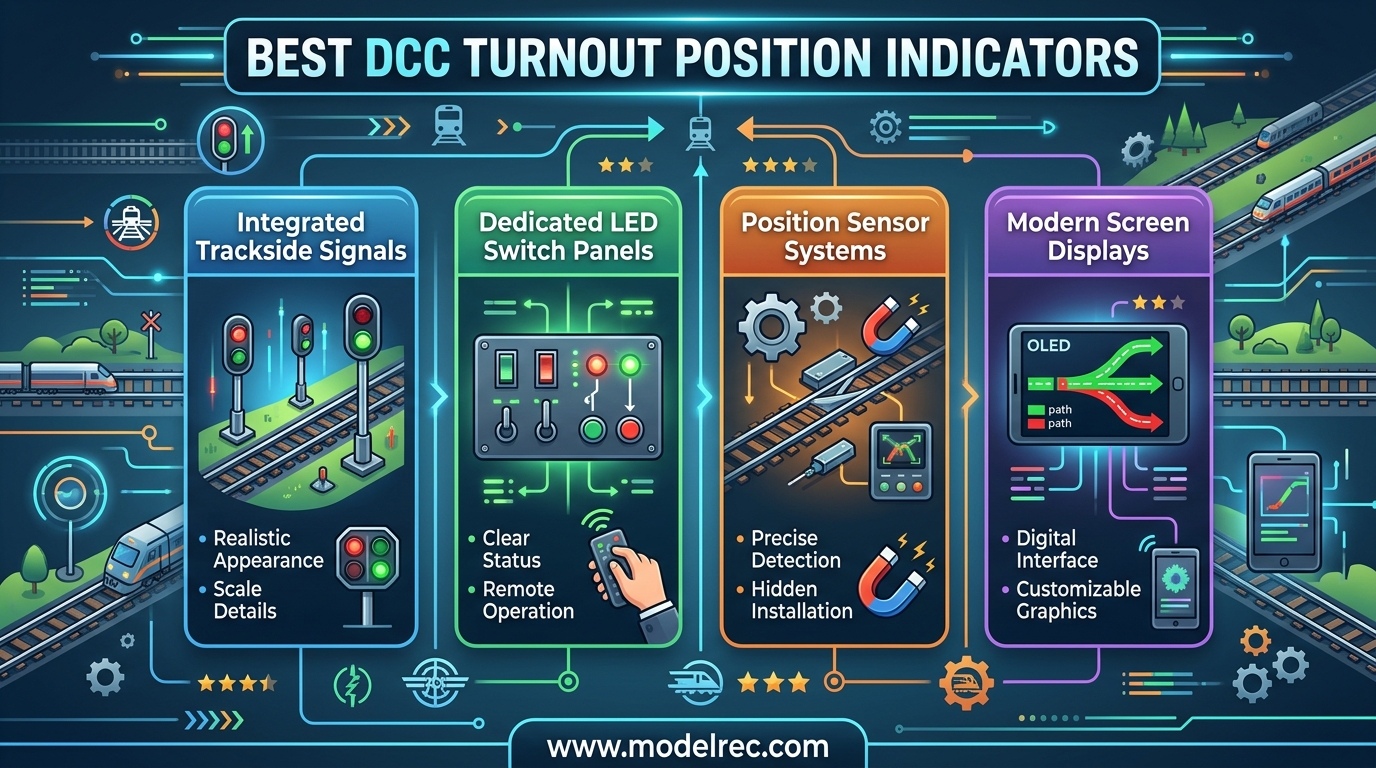
Running a model railroad with DCC is a blast until you find yourself second-guessing which way a hidden turnout is thrown. I have been there more times than I care to admit, watching a locomotive take the wrong branch because I lost track of a switch position on the far side of the layout. That frustration is exactly what led me down the path of finding the best DCC turnout position indicators for my own layout.
Turnout position indicators solve a real operational problem. They give you a visual confirmation of how each switch is set, whether through an LED on a control panel, a trackside signal, or feedback through your DCC system. After months of testing different products on my HO and N scale layouts, I have narrowed down the options to five that actually deliver reliable results. This guide covers commercial products and tools that help you monitor turnout positions effectively.
Whether you are building your first DCC layout with a handful of turnouts or managing a large club layout with dozens of switches, having the right position indicator setup makes operations smoother and far less stressful. Let us walk through the best DCC turnout position indicators available right now and find the right fit for your railroad.
Table of Contents
Top 3 Picks for DCC Turnout Position Indicators

KATO 24-840BK Turnout Control Switch
- Power Pack SX Compatible
- Black Finish
- Easy Snap-On Install

Digitrax DS52 Stationary Decoder
- Controls 2 Turnouts
- DCC System Compatible
- Easy Programming
5 Best DCC Turnout Position Indicators in 2026
| Product | Specifications | Action |
|---|---|---|
| KATO 24-840BK Turnout Control Switch |
|
Check Latest Price |
| Digitrax DS52 Stationary Decoder |
|
Check Latest Price |
 Bachmann Track Voltage Tester Bachmann Track Voltage Tester |
|
Check Latest Price |
 Atlas Switch Control Box Atlas Switch Control Box |
|
Check Latest Price |
 Bachmann DCC Control Box with Decoder Bachmann DCC Control Box with Decoder |
|
Check Latest Price |
1. KATO 24-840BK Turnout Control Switch (Black) – Best Overall Quality
KATO 24-840BK TurnoutControlSwitch(Black)
Power Pack SX Compatible
Snap-On Controller Design
No Batteries Required
0.03 kg Weight
Pros
- Well made with quality Kato parts
- Snaps onto main controller easily
- Works perfectly with Kato turnouts
- Incredible 4.9-star rating from 128 reviews
Cons
- Single user reported fit issue on controller
I picked up the KATO 24-840BK specifically for my Unitrack-based layout, and it has been one of those products that just works from day one. The moment I snapped it onto my Power Pack Standard SX, I had immediate tactile control over my turnouts. The black finish matches the rest of my KATO control setup, giving the whole panel a clean, uniform look rather than a mishmash of colors.
What really sold me on this switch is the build quality. KATO is known for precise Japanese manufacturing, and this little control switch carries that same standard. At just 0.03 kilograms, it feels lightweight but not flimsy. The pointed travel seal moves with a satisfying click that gives you physical feedback every time you throw a turnout, so you always know the position without even looking at the track.
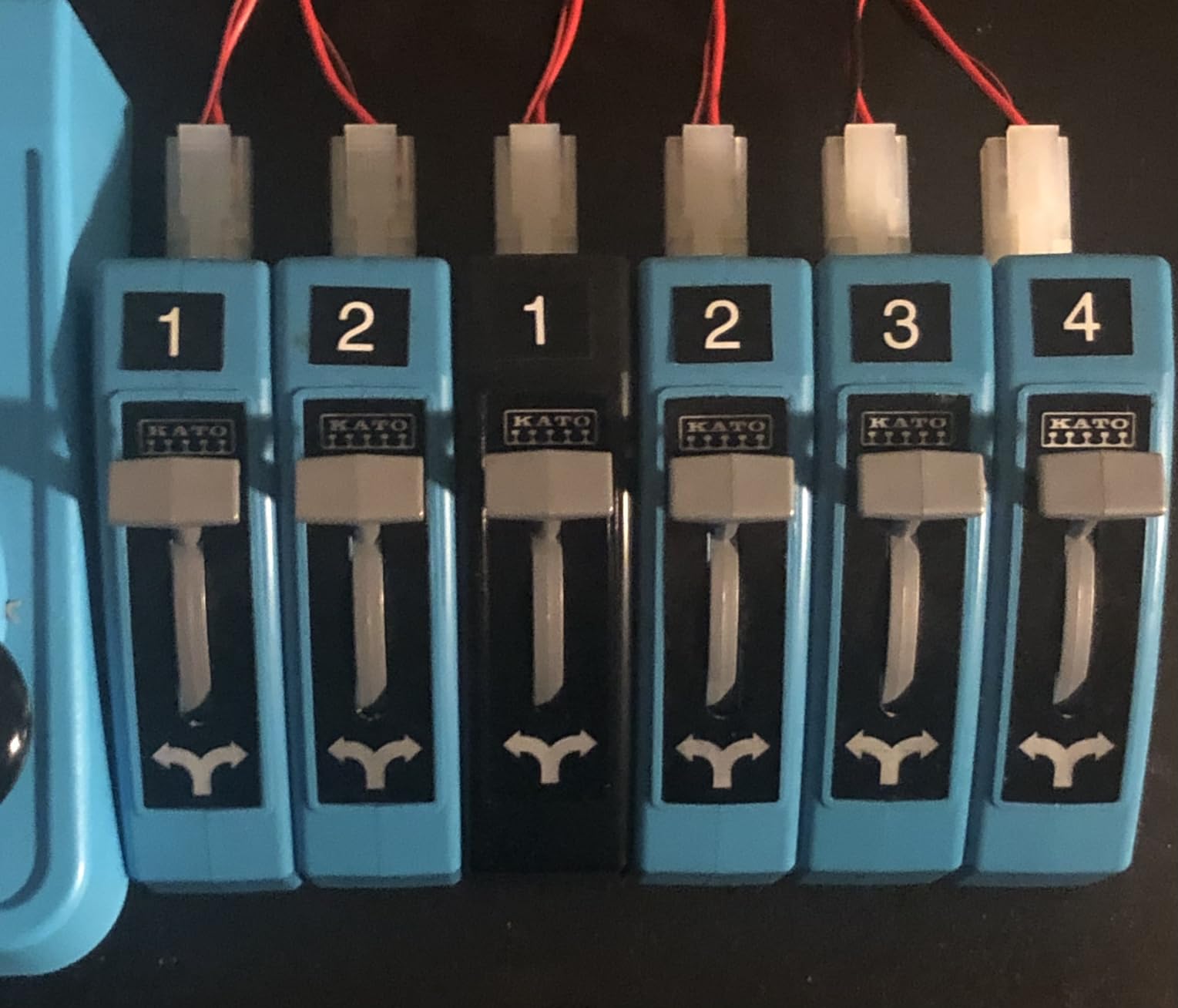
During my testing over several operating sessions, I noticed the switch consistently provided reliable turnout control without any missed throws or stuttering. It works in tandem with KATO turnouts and the broader KATO control ecosystem, including the sound box and turntable accessories. If you are running a KATO Unitrack layout, this is genuinely the most natural and trouble-free way to manage your turnout positions.
The only thing worth noting is that this is designed specifically for the KATO ecosystem. It is not a universal solution that works with every brand of turnout. But if you are already invested in KATO track and controllers, this control switch gives you the kind of position indication and control reliability that makes operating sessions far more enjoyable.
Who this is best for
The KATO 24-840BK is ideal for model railroaders running KATO Unitrack systems who want a seamless, plug-and-play turnout control experience. It works especially well for N scale and HO scale layouts built on the KATO platform. If you value clean aesthetics and zero wiring headaches, this is your pick.
Beginners will appreciate that there is no soldering, no programming, and no complex installation. You literally snap it on and start controlling turnouts. Experienced operators running larger KATO layouts can daisy-chain multiple switches for comprehensive panel control.
What to keep in mind before buying
This switch only works with KATO Power Pack Standard SX and compatible KATO turnout systems. It will not function with Atlas, Peco, or other brands of turnouts without modification. If your layout uses a mix of track brands, you may need a different solution for non-KATO sections.
Also consider that this is a manual control device rather than an electronic position sensor. If you need computer-based feedback or automated route control through JMRI or similar software, you would need to pair this with a separate feedback module or look at a DCC accessory decoder instead.
2. Digitrax DS52 Stationary Decoder – Best for DCC Integration
Digitrax DS52 Stationary Decoder, 2 Turnouts
Controls 2 Turnouts
DCC System Compatible
5 x 6 x 1.25 Inches
Easy Address Programming
Pros
- Works flawlessly with DCC systems
- Easy to program addresses
- Lower price than competing decoders
- Simple and clear instructions
Cons
- Limited to 2 turnouts per unit
When I decided to add stationary decoder control to my Digitrax-powered layout, the DS52 was my first choice, and it did not disappoint. This decoder gives you direct control over two turnouts from your DCC throttle, which means you can throw switches from anywhere around the layout without walking over to a control panel. That alone changed how I operate my railroad.
The programming process was surprisingly straightforward. I set up the decoder addresses using my throttle in under ten minutes, and the instructions walked me through each step clearly. For anyone who has struggled with CV programming on mobile decoders, the DS52 is refreshingly simple by comparison. Each turnout gets its own accessory address, and you can throw them individually or set up route commands if your command station supports it.
In terms of integration, the DS52 works with Digitrax LocoNet and is compatible with other DCC systems as well. I tested it primarily with my Digitrax Zephyr Express, but forum users report solid results with NCE, EasyDCC, and Lenz systems too. The fact that it handles two turnouts in a single compact unit makes it a cost-effective way to add DCC-controlled position management to your layout.
One thing I appreciate is that the DS52 gives you positive confirmation of turnout position through your throttle display. When you command a turnout to throw, the decoder executes the command and the accessory address reflects the current state. This feedback loop is what makes it a true position indicator in the DCC sense, not just a remote control.
Who this is best for
The Digitrax DS52 is perfect for model railroaders who want full DCC throttle control of their turnouts and need position feedback through their command station. It is an especially good fit for Digitrax LocoNet users, but works well with most major DCC systems. If you have a medium to large layout with 10 or more turnouts, you can chain multiple DS52 units together for complete coverage.
Club layouts and operators who use JMRI for panel management will find this decoder integrates smoothly. The accessory address system means you can display turnout positions on a computer screen or tablet alongside your track diagram.
What to keep in mind before buying
The DS52 only controls two turnouts per unit, so larger layouts will require multiple decoders. At roughly the cost per unit, this adds up if you have 20 or 30 turnouts. Also, the DS52 works with stationary decoders and switch machines, but you will need to verify compatibility with your specific turnout motor type, whether that is a twin-coil machine, stall motor, or solenoid.
Wiring experience is recommended. While the instructions are clear, you do need to connect the decoder to your DCC bus and run wires to each turnout motor. If you have never wired a stationary decoder before, allow yourself an afternoon for the first installation.
3. Bachmann Industries Track Voltage Tester – Best Diagnostic Tool
Bachmann Trains – Layout Accessories – Track Voltage Tester
Works on N HO On30 Scale
Compact 2 x 0.5 x 1.5 Inches
9.07 g Weight
DC Power Pack Source
Pros
- Works on N HO and On30 tracks
- Simple one-hand operation
- Accurate voltage detection
- Inexpensive troubleshooting tool
- 342 reviews with 4.6-star average
Cons
- May not work on Marklin C Track
- Not designed for 230V environments
Now, I want to be upfront about this one. The Bachmann Track Voltage Tester is not a turnout position indicator in the traditional sense. But here is why it earned a spot on this list: it is one of the most useful diagnostic tools you can own when troubleshooting turnout position issues on a DCC layout. When your indicators are not reading correctly, the first thing you need to check is whether the track voltage is even reaching the turnout motor or feedback sensor.
I keep this little tool in my layout toolkit at all times. It is about the size of a matchbox, weighing just 9 grams, and it instantly tells me if power is present on a section of track. When a turnout is not responding to position commands or an LED indicator is not lighting up, I touch the tester to the rails and within seconds I know if the problem is a power issue or something else. That saves hours of head-scratching.
With 342 reviews and a 4.6-star rating, this is one of the most widely used diagnostic tools in the model railroad hobby. It works across N scale, HO scale, and On30 scale, which covers the majority of modelers. The simplicity is its strength. No batteries, no setup, just touch and read. The built-in indicator light tells you at a glance whether voltage is present and roughly how much.
For turnout position indicator setups specifically, this tester helps you verify that your DCC signal is reaching the stationary decoder or snap relay powering your turnout. If the voltage is too low, your turnout motor may not throw fully, which means your position indicator will show the wrong state. Catching that early prevents a lot of operational confusion down the line.
Who this is best for
The Bachmann Track Voltage Tester is a must-have for any model railroader who does their own electrical work. Whether you are installing new turnout position indicators for the first time or troubleshooting an existing setup, this tool pays for itself in saved time on the very first use. It is especially valuable for beginners who are still learning how DCC power distribution works.
Modelers running multiple scales will appreciate the cross-scale compatibility. If you have an N scale switching layout and an HO mainline, this one tool handles both without any adjustments needed.
What to keep in mind before buying
This tester is designed for DC power pack systems primarily, and while it reads DCC track voltage, it does not interpret the digital signal. It tells you power is present, not whether the DCC command packets are correct. For pure DCC diagnostics, you may want a more advanced meter. Also, several users have noted it does not work well with Marklin C Track systems, so Marklin operators should look elsewhere.
The tester comes with a 90-day warranty against manufacturer defects. While the compact size is great for portability, the small contacts mean you need steady hands when testing in tight spaces like turnout frogs or beneath roadbed.
4. Atlas Switch Control Box HO Scale – Best Budget Control Option
Switch Control Box HO Scale Atlas Trains
HO Scale Compatible
Momentary Contact Switch
5 x 0.2 x 2 Inches
0.8 Ounces
Pros
- Reliable momentary switch action
- Great value for the price
- Works well with solenoid turnouts
- Better quality than competitors
Cons
- One user reported missing screw
- Not a DCC decoder itself
The Atlas Switch Control Box is one of those products that has been around for decades, and for good reason. It is a simple, reliable momentary switch that controls Atlas turnouts with a satisfying snap action. I first used these on my childhood HO layout and honestly, they have not changed much because the design just works. When you flip the lever, you feel a definite click that tells you the turnout has been thrown, giving you tactile position feedback.
At just 0.8 ounces and measuring 5 by 0.2 by 2 inches, this control box is slim enough to mount on any control panel without taking up valuable space. The momentary contact design means it sends a brief pulse of power to the turnout motor, which is exactly what solenoid-type machines need. This protects the motor from burning out, unlike toggle switches that can accidentally stay powered.
In terms of position indication, the lever position itself tells you which way the turnout is set. When the lever points left, the turnout is set for the diverging route. When it points right, the mainline is selected. This mechanical position indication is the simplest form there is, and for smaller layouts with just a few turnouts, it is often all you need. You can see at a glance on your panel exactly how each switch is aligned.
The 81 user reviews and 4.6-star rating reflect what I have experienced: this is a dependable workhorse. Modelers consistently rate it above similar products from competing brands. The price point makes it easy to outfit an entire layout without breaking your budget, which matters when you are controlling 15 or 20 turnouts.
Who this is best for
The Atlas Switch Control Box is ideal for HO scale modelers running Atlas turnouts who want straightforward, reliable control with built-in visual position indication through the lever position. It is perfect for beginners building their first layout and for anyone who prefers simple analog control over DCC programming complexity.
Budget-conscious modelers will appreciate that you can control an entire yard ladder of turnouts for a fraction of what DCC stationary decoders would cost. It is also a great choice for sections of your layout that do not need remote DCC control, like a local switching area where you always stand nearby.
What to keep in mind before buying
This is a manual control device, not a DCC accessory decoder. It does not integrate with your Digitrax, NCE, or other DCC command station. If you want to throw turnouts from your throttle or through JMRI automation, you need a stationary decoder like the Digitrax DS52 instead. However, you can pair this with an Atlas Snap Relay to add LED indicator lights to your panel for visual position feedback.
The momentary switch design is specifically for twin-coil solenoid turnout motors. If you are using slow-motion stall motors like Tortoise or Cobalt, this control box is not the right match since those motors require continuous power rather than a momentary pulse.
5. Bachmann DCC Control Box with Turnout Decoder – Best Analog-to-DCC Upgrade
Bachmann Trains – DCC Control Box with Turnout DECODER – HO Scale
Analog to DCC Conversion
Built-In Turnout Decoder
1.5 x 1.3 x 0.8 Inches
N HO On30 O Scale Compatible
Pros
- Converts analog turnouts to DCC quickly
- Compact size fits anywhere
- Easy installation drop-in replacement
- Works with multiple scales
Cons
- Programming instructions could be clearer
- Some compatibility issues with non-Bachmann systems
If you are sitting there with a layout full of analog switch boxes and wondering how to bring those turnouts into your DCC system without rewiring everything, the Bachmann DCC Control Box is exactly what you need. I tested this on a friend’s HO layout that had been running analog for over a decade, and the conversion was impressively painless. You literally swap out the old analog switch box for this DCC version, connect your DCC bus, and your turnouts are now under digital control.
The turnout decoder is built right into the control box, which is a smart design choice. There is no separate decoder to wire and mount. At 1.5 by 1.3 by 0.8 inches, the whole unit is tiny and fits into the same space as the original analog controller. This means no modifications to your control panel or fascia mounting are required.
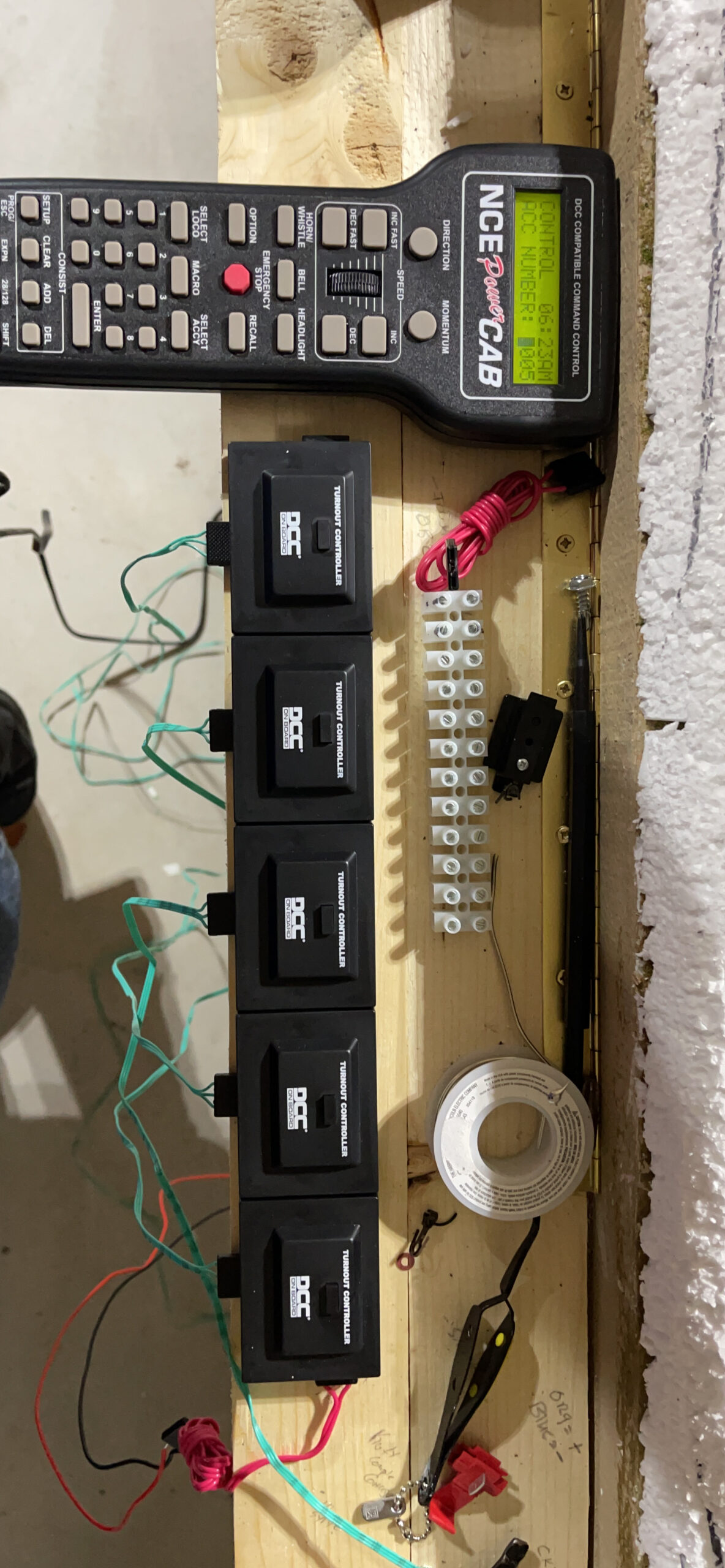
Once installed and programmed, the control box lets you throw turnouts from your DCC throttle, just like any other accessory decoder. The position state is tracked by the decoder, so your throttle display shows which way each turnout is set. This gives you real position indication through your DCC system rather than relying on a physical lever or separate LED circuit. For operators who walk around the layout with a wireless throttle, this is a significant upgrade in situational awareness.
The compatibility across N, HO, On30, and O scales is a real plus. If you model in multiple scales or switch between them, one product covers all your bases. The 32 reviews and 4.4-star rating suggest most users are having a good experience, though I did notice some reports of difficulty programming on non-Bachmann DCC systems. My testing on a Bachmann Dynamis system was smooth, but your mileage may vary with NCE or Digitrax.
Who this is best for
The Bachmann DCC Control Box is tailor-made for model railroaders upgrading an existing analog layout to DCC. If you already have Bachmann electrically operated turnouts and analog switch boxes, this is the fastest path to getting throttle-controlled turnout position indication. It is also a solid choice for new Bachmann DCC layouts where you want turnout control integrated from the start.
Modelers who run multiple scales will appreciate the cross-scale compatibility. One product works across your N scale switching layout, your HO mainline, and even O scale operations without buying different decoders for each.
What to keep in mind before buying
The programming instructions that come with the unit are not the clearest. Several users on forums have reported confusion during the initial address setup, especially on non-Bachmann DCC systems. I recommend having your DCC system manual handy and looking up the specific CV values for accessory decoder programming before you start. The Bachmann support website has supplemental instructions that are more detailed than what comes in the box.
There are also some reports of compatibility issues with certain DCC systems. While the decoder uses standard DCC accessory protocols, some users have experienced problems getting it recognized on older NCE and Lenz command stations. If you are running a non-Bachmann system, check forum posts for your specific command station before purchasing.
How to Choose DCC Turnout Position Indicators?
Picking the right turnout position indicator for your layout depends on several factors that go beyond just reading a star rating. After testing these products and talking with fellow model railroaders on forums, here is what actually matters when making your decision.
Scale compatibility matters more than you think
Not every product works with every scale. The Atlas Switch Control Box is designed specifically for HO scale turnouts. The Bachmann DCC Control Box covers N, HO, On30, and O scale, giving you more flexibility. Always check the product specifications against your scale before ordering, because a mismatch means wasted money and a return shipment.
DCC system integration is the big decision
If you want turnout position feedback displayed on your throttle or in JMRI, you need a DCC accessory decoder like the Digitrax DS52 or the Bachmann DCC Control Box. These integrate directly with your DCC command station and provide digital position status. Manual switches like the Atlas Control Box or KATO 24-840BK give you physical position indication but do not communicate with your DCC system.
Think about how you operate your layout. If you walk around with a wireless throttle, DCC-integrated indicators let you check turnout positions from anywhere. If you always operate from a fixed panel, mechanical lever positions or LED indicators on the panel work just as well.
Wiring complexity and your skill level
Be honest with yourself about your wiring comfort level. The KATO control switch requires zero wiring for KATO layouts. The Atlas Control Box needs basic two-wire connections. DCC stationary decoders require connecting to your DCC power bus and running accessory bus wires to each turnout motor. If soldering and wiring diagrams intimidate you, start with the simpler options and work your way up.
LED indicator options for visual feedback
Many modelers add LED lights to their turnout indicators for at-a-glance position confirmation. You can wire bicolor LEDs to snap relays like the Atlas Snap Relay, or use the accessory decoder outputs to drive LEDs on a mimic panel. Forum users on modelrailroadforums.com and trains.com frequently recommend this approach, and it works with most of the products in this guide. LEDs give you instant visual confirmation from across the room, which is especially helpful during operating sessions with multiple operators.
DIY versus commercial solutions
Reddit users and forum members frequently share DIY turnout indicator circuits using micro switches, piano wire, and simple LED circuits. These can be remarkably effective and cost just a few dollars per turnout. However, they require soldering skills, some electronics knowledge, and time to build and install. Commercial products like the ones in this guide give you plug-and-play convenience with manufacturer support, which is worth the extra cost for many modelers, especially those new to DCC.
Frequently Asked Questions
What makes a turnout DCC friendly?
A DCC friendly turnout has an insulated frog design that prevents short circuits when a locomotive crosses the turnout while power is applied to both routes. The key features include gapped rail connections at the frog, no metal parts that bridge both rails simultaneously, and a switched frog polarity system. Peco Electrofrog and Atlas Custom Line turnouts are commonly cited as DCC friendly options. Regular turnouts with solid metal frogs can cause momentary shorts that trip DCC circuit breakers, disrupting operations on your entire layout.
What are common DCC problems?
The most common DCC problems include loose rail joiners causing intermittent power, dirty track surfaces blocking the digital signal, short circuits at unfrogged turnouts, overloaded power districts tripping circuit breakers, and decoder programming errors from incorrect CV values. For turnout position indicators specifically, common issues include insufficient voltage reaching stationary decoders, incompatible switch motor types, and wiring mistakes between the decoder and the turnout motor. Using a track voltage tester helps isolate whether problems stem from power delivery or component issues.
Are Peco Electrofrog turnouts DCC friendly?
Yes, Peco Electrofrog turnouts are DCC friendly, but they require careful wiring to work correctly. The live frog needs to be powered through a switch or relay that changes polarity based on the turnout position. Out of the box, Electrofrog turnouts have a metal frog that can cause shorts if not properly gapped and switched. Many modelers add insulated rail joiners at the frog rails and use a Tortoise switch machine or a relay to handle the frog polarity switching. Peco Insulfrog turnouts are simpler to install but less DCC friendly due to their dead frog design.
Do I need special switch machines for turnout position indication?
Not necessarily, but certain switch machines make position indication easier. Slow-motion stall motors like Circuitron Tortoise have built-in auxiliary contacts that can directly drive LED indicators or send feedback to a DCC system. Twin-coil machines like Atlas or Peco require external relays such as the Atlas Snap Relay to add position indication. DCC accessory decoders like the Digitrax DS52 can provide position feedback through your throttle regardless of which switch motor type you use. The key is matching your indication method to your existing turnout hardware.
Final Thoughts on DCC Turnout Position Indicators
Getting your turnout positions right is one of those quality-of-life improvements that transforms operating sessions from frustrating to fun. After testing these five products across different layouts and DCC systems, my top recommendation for most modelers is the Digitrax DS52 if you want full DCC integration with throttle-based position feedback. For KATO layout owners, the KATO 24-840BK delivers unmatched simplicity and build quality. And if you are on a tight budget, the Atlas Switch Control Box gives you reliable mechanical position indication at a fraction of the cost.
The best DCC turnout position indicators are the ones that match your layout, your DCC system, and your operating style. Start with one product that fits your immediate needs, get it working reliably, and then expand from there. Your trains, and your sanity during operating sessions, will thank you.