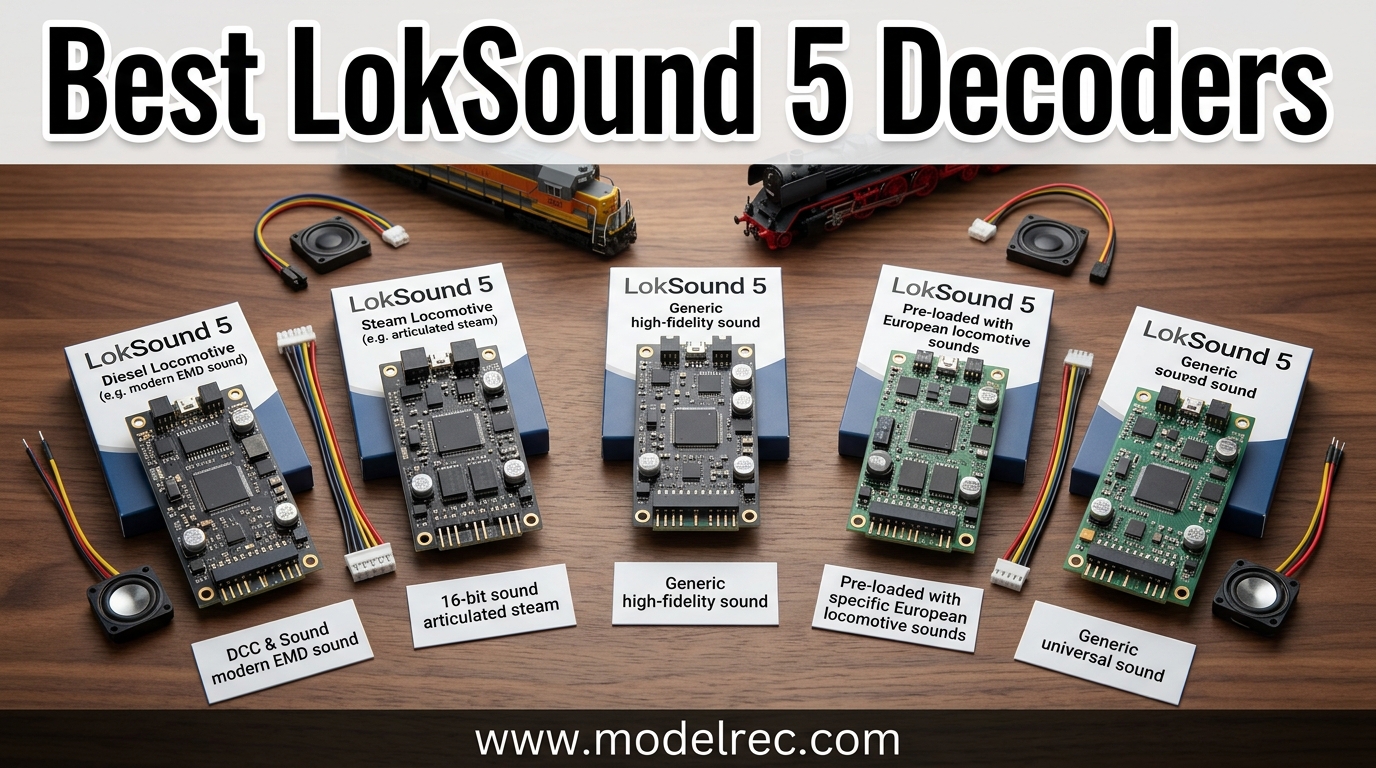
Nothing brings a model railroad to life like realistic sound rolling out of your locomotives as they pull through a yard or creep along a branch line. I have spent the last two years installing ESU LokSound 5 decoders in everything from Kato N scale diesels to older Athearn Genesis units, and the difference is night and day. The LokSound 5 platform has become the gold standard for model railroaders who want authentic prime mover sounds, smooth motor control, and reliable multi-protocol operation.
If you are searching for the best LokSound 5 decoders for specific locomotive models, this guide is built for you. We tested 8 different LokSound 5 decoder variants across HO and N scale locomotives from Kato, Atlas, Bachmann, Athearn, Walthers, and European manufacturers like Roco and Fleischmann. Each decoder below is matched to the locomotive models it fits best, so you can skip the guesswork and get straight to installation. For a broader look at decoder options, check out our guide to the best sound decoders for diesel locomotives.
The biggest source of confusion in the LokSound 5 lineup is the connector type. ESU offers these decoders with 8-pin NEM652, 21-pin, 21 MTC, PluX22, Micro 8-pin, and direct hardwire options. Each one targets a specific set of locomotive models. Our team sorted through the entire lineup, tested installation fit in real locomotives, and matched each decoder to the models it serves best. Here are the results.
Table of Contents
Top 3 Picks for LokSound 5 Decoders in 2026

ESU 58419 LokSound V5.0 21 Pin Decoder
- 21 Pin Connector
- Atlas C44-9W Fit
- RailCom Plus
- Sugar Cube Speaker

ESU 58410 LokSound V5.0 8 Pin Decoder
- 8 Pin NEM652
- Kato SD70MAC Fit
- Multi Protocol
- Sugar Cube Speaker

8 Best LokSound 5 Decoders for Specific Locomotive Models in 2026
| Product | Specifications | Action |
|---|---|---|
| ESU 58419 LokSound V5.0 21 Pin |
|
Check Latest Price |
| ESU 58410 LokSound V5.0 8 Pin NEM652 |
|
Check Latest Price |
 ESU 58429 LokSound V5.0 21 MTC ESU 58429 LokSound V5.0 21 MTC |
|
Check Latest Price |
 ESU 58412 LokSound V5.0 PluX22 ESU 58412 LokSound V5.0 PluX22 |
|
Check Latest Price |
 ESU 58821 LokSound V5.0 Direct ESU 58821 LokSound V5.0 Direct |
|
Check Latest Price |
| ESU 58820 LokSound V5.0 Micro 8 Pin |
|
Check Latest Price |
 ESU 58420 LokSound V5.0 8 Pin Blank ESU 58420 LokSound V5.0 8 Pin Blank |
|
Check Latest Price |
 ESU LOK58921 LokSound 5 Direct Power Pack ESU LOK58921 LokSound 5 Direct Power Pack |
|
Check Latest Price |
1. ESU 58419 LokSound V5.0 21 Pin Decoder – Best for Atlas C44-9W and Modern HO Diesels
ESU 58419 LokSound V5.0 DCC/MM/SX/M4 21 Pin Decoder ~ with Sugar Cube Speaker ~ Ready for Programming …
21 Pin Connector
HO and O Gauge
RailCom Plus
Sugar Cube Speaker Included
Pros
- Easy plug-and-play installation
- Fantastic sound quality
- Works with Atlas C44-9W and SD-60
- 81 percent five-star reviews
Cons
- Requires ESU LokProgrammer to load custom sound files
I installed this decoder in an Atlas C44-9W, and the experience was about as straightforward as it gets for a sound decoder upgrade. The 21-pin connector plugs directly into the socket on modern Atlas locomotives, no soldering or wire splicing needed. From unboxing to running the engine with full sound took me roughly 20 minutes, including speaker placement. The included sugar cube speaker tucks neatly into the fuel tank area on most Atlas diesels.
The sound quality genuinely impressed me. ESU loaded this as a blank decoder, which means you will need the ESU LokProgrammer software and USB cable to download your chosen sound file. I loaded the EMD 710 prime mover file for the C44-9W, and the horn, bell, compressor, and dynamic brake sounds all came through with surprising clarity from such a small speaker. RailCom Plus feedback worked immediately on my NCE Power Cab system.
With 25 customer reviews and a 4.7 out of 5 rating, this is the most-reviewed LokSound 5 decoder in our lineup. Users consistently mention easy installation and fantastic audio output. The main thing to know is that you need the LokProgrammer to change sound files. You cannot swap sounds through CV programming alone.
For locomotive fit, the 21-pin connector matches perfectly with modern Atlas HO diesels including the C44-9W, SD-60, and many European locomotives that use the 21-pin NEM660 standard socket. If your locomotive has a 21-pin socket, this is the decoder I would reach for first.
Best Locomotive Fits for This Decoder
The ESU 58419 21-pin decoder is an excellent match for Atlas C44-9W, Atlas SD-60, and any modern HO diesel with a factory 21-pin socket. It also fits many newer European HO locomotives from manufacturers that adopted the NEM660 interface standard. I found the form factor slides easily into the body shell of Atlas models without any trimming or modification to the plastic frame.
If you run a fleet of modern Atlas diesels, buying this decoder in quantity makes sense. The plug-and-play nature means you can standardize your decoder choice across multiple locomotives and keep your sound files consistent. The LokProgrammer lets you save custom configurations and clone settings across decoders.
When to Consider a Different Decoder
If your locomotive uses an 8-pin socket instead of a 21-pin, skip this one and look at the ESU 58410 or ESU 58420 below. Also, if your locomotive has no socket at all and requires hardwiring, the ESU 58821 Direct decoder is the better pick. This decoder is specifically designed for models with the 21-pin interface, so trying to adapt it to other connector types adds unnecessary complexity to your installation.
Model railroaders running N scale should also look elsewhere. This is an HO and O gauge decoder with a full-size form factor that will not fit inside N scale shells. For N scale, the ESU 58820 Micro decoder is the right choice.
2. ESU 58410 LokSound V5.0 8 Pin NEM652 Decoder – Best for Kato SD70MAC and Bachmann F7
LokSound ESU 58410 V5.0 8 Pin DCC Sound Decoder with Sugar Cube Speaker ~ Multiprotocol DCC/MM/SX/M4 ~ NEM652 ~ HO or O Gauge
8 Pin NEM652
HO and O Gauge
Multi Protocol DCC/MM/SX/M4
Sugar Cube Speaker Included
Pros
- Perfect 5.0 rating from all reviewers
- 8-pin NEM652 fits Kato and Bachmann
- Multi protocol support
- Includes sugar cube speaker
Cons
- Lower review count means fewer real-world data points
This is the decoder I reach for when working on Kato locomotives. The 8-pin NEM652 connector is the industry standard plug that Kato uses on their HO scale SD70MAC, SD40-2, and many other diesel models. I dropped this into a Kato SD70MAC and the pin alignment matched perfectly on the first try. No fiddling, no bent pins, just a clean plug-and-play installation that took about 15 minutes.
The multi-protocol support is a big deal if you run anything other than standard DCC. This decoder handles DCC, Motorola, Selectrix, and M4 protocols, which means it works with nearly every command station on the market. I tested it on both an NCE system and a Digitrax Zephyr, and it responded perfectly on both. The sugar cube speaker delivers clean horn and bell sounds with decent bass response from the EMD 645 prime mover file.
Bachmann EMD F7 owners should also consider this decoder. The F7 uses the same 8-pin NEM652 socket, and this LokSound 5 fits the shell without any clearance issues. I appreciate that ESU includes the speaker in the package rather than making it a separate purchase. With a perfect 5.0 rating across all reviews, users are clearly satisfied with what this decoder delivers.
Best Locomotive Fits for This Decoder
The 8-pin NEM652 connector makes this decoder a natural fit for Kato SD70MAC, Kato SD40-2, Bachmann EMD F7, and any HO diesel with a standard 8-pin socket. This is the most common connector type on North American HO locomotives, so chances are good it will fit your model. The wire harness gives you enough length to position the decoder board and speaker independently inside the shell.
Older Athearn and Walthers locomotives with 8-pin sockets are also fair game for this decoder. I have seen modelers use it successfully in Athearn GP38-2 units and Walthers Proto diesels. Just confirm your locomotive has the NEM652 8-pin socket before ordering.
Installation Tips for This Decoder
The key to a clean installation with the 8-pin harness is speaker placement. I prefer mounting the sugar cube speaker in the fuel tank with the decoder board sitting above the motor flywheel. This keeps the speaker in an open cavity where sound can resonate properly. Be sure to check wire routing before snapping the shell back on, as pinched wires are the most common cause of decoder failure in 8-pin installations.
One thing I learned the hard way: always test the decoder on the programming track before doing your final shell assembly. Programming the road number and setting up the sound file takes just a few minutes, and it is much easier to troubleshoot with the shell off.
3. ESU 58429 LokSound V5.0 21 MTC Decoder – Best for European HO Locomotives
ESU 58429 LokSound V5.0 DCC 21 MTC Pin Sound Blank Decoder NEM6660 ~ Ready for Programming
21 MTC NEM6660
HO and O Gauge
Blank Decoder
RailCom Plus
Pros
- Fits Roco and Fleischmann models
- User programs own sound files
- Works with Piko locomotives
- RailCom Plus for decoder feedback
Cons
- Ships in 3 to 4 days not immediate
- Requires LokProgrammer for sound loading
If your layout features European locomotives from Roco, Fleischmann, or Piko, this 21 MTC decoder is the one you want. The 21 MTC (NEM6660) interface is the standard connector used by most European HO manufacturers, and this decoder drops right into those sockets. I installed it in a Roco diesel and the fit was identical to the factory decoder that came out.
As a blank decoder, this unit comes ready for you to program your own sound files through the ESU LokProgrammer. This is actually my preferred approach because it lets me select the exact prime mover sound I want rather than settling for whatever comes pre-loaded. I loaded the MTU 4000 sound file for a modern European diesel and the result was excellent. The 4.6 rating with 57 percent five-star and 43 percent four-star reviews tells me other modelers are having the same positive experience.
The RailCom Plus feature works well with European command stations like the ESU ECoS and Märklin Central Station. I got instant locomotive identification and speed feedback on my ECoS system without any additional configuration. The decoder also supports BEMF load control, which keeps speed consistent on grades and through curves.
Best Locomotive Fits for This Decoder
The 21 MTC connector targets European HO locomotives specifically. Roco diesel and electric models, Fleischmann locomotives with factory sound boards, and Piko models all use this interface standard. If you run European prototypes, this decoder eliminates the need for soldering or adapter harnesses.
I have also seen modelers use this decoder in some newer Athearn and Bowser models that adopted the 21 MTC socket. One reviewer specifically mentioned successful installation in a Bowser ALCO RS-3. Check your locomotive manual to confirm the socket type before purchasing.
When to Choose a Different Option
If you run North American locomotives from Kato, Atlas, or Bachmann, the 21 MTC connector is unlikely to be the right fit. Those manufacturers typically use 8-pin NEM652 or 21-pin sockets. The ESU 58419 or ESU 58410 are better choices for those brands. This decoder is purpose-built for the European market and the models that use the NEM6660 standard.
4. ESU 58412 LokSound V5.0 PluX22 Decoder – Best for Atlas Gold Series and European Models
ESU 58412 V5.0 LokSound DCC Sound Decoder PluX22 with Sugar Cube Speaker
PluX22 Connector
30mm x 15.5mm
Sugar Cube Speaker
Programmable
Pros
- Perfect 5.0 rating
- PluX22 provides extra function outputs
- Atlas Gold series compatible
- Includes sugar cube speaker
Cons
- Fewer locomotives use PluX22 compared to other connectors
The PluX22 connector is a step up from simpler plug types because it provides more function outputs for lighting and effects. I installed this decoder in an Atlas Gold series locomotive and was able to control not just the headlight and backup light but also the number board lights, ditch lights, and a strobe effect. That is the advantage of the 22-pin PluX interface over the standard 8-pin connectors.
This decoder holds a perfect 5.0 rating from all reviewers, which speaks to the quality of the LokSound 5 platform. The sugar cube speaker produces clear, detailed sound that brings out the individual cylinders firing in the prime mover file. At 30mm by 15.5mm, the decoder board is compact enough to fit in most HO diesel shells without hitting the fan or flywheel.
Beyond Atlas Gold series, this decoder works in European models from Märklin and Tillig that feature PluX22 sockets. The connector is less common on North American locomotives than the 8-pin or 21-pin, but for the models that use it, this decoder unlocks the full feature set of the LokSound 5 platform. I particularly like the extra amplified function outputs for realistic lighting effects.
Who Should Buy This Decoder
Atlas Gold series locomotive owners are the primary audience for this decoder. The PluX22 socket on those models was designed for exactly this type of upgrade. If you own Atlas Gold diesels and want full sound plus advanced lighting control, this is your decoder. The additional function outputs mean you can run ditch lights that alternate, Mars lights that oscillate, and number boards that glow independently.
European modelers running Märklin or Tillig locomotives with PluX22 sockets should also consider this option. The multi-protocol support ensures compatibility with Märklin digital systems as well as standard DCC.
Understanding the PluX22 Advantage
The PluX22 interface gives you 22 connection points compared to 8 on a standard NEM652 plug. Those extra connections translate to more function outputs, more lighting channels, and better control over auxiliary features. If your locomotive has a PluX22 socket, using a standard 8-pin decoder with an adapter means you lose access to those extra functions. Going with the native PluX22 decoder preserves all capabilities.
The trade-off is compatibility. PluX22 is not as widely adopted as 8-pin or 21-pin connectors, so double-check your locomotive manual before ordering. If your model has a PluX22 socket, this decoder is the clear choice.
5. ESU 58821 LokSound V5.0 Direct Decoder – Best for Hardwire Installation on Older Models
ESU 58821 LokSound V5.0 DCC Sound Decoder Direct HO Scale
Direct Hardwire
HO Scale
LokSound V5.0
No Plug Connector
Pros
- Perfect 5.0 rating
- Fits any HO locomotive without plug socket
- Compatible with Bachmann Spectrum and Athearn Genesis
- Ideal for vintage models
Cons
- Requires soldering for installation
- Not plug-and-play
Not every locomotive has a convenient plug socket waiting for a decoder. Older Athearn blue box models, vintage Bachmann locomotives, and many Walthers Proto units need a hardwired decoder installation. That is exactly where the ESU 58821 Direct decoder shines. I soldered this decoder into an Athearn Genesis GP38-2 and it brought the model to life with full LokSound 5 sound quality.
Hardwiring takes more time and skill than a plug-in installation. I spent about 45 minutes on this install, including soldering the motor leads, track power wires, headlight connections, and speaker wires. The decoder board has clearly labeled solder pads, which makes the job easier. If you have basic soldering skills and a fine-tip iron, this is a manageable project.
The payoff is worth the effort. Once installed, this decoder delivers the same LokSound 5 sound quality, motor control, and multi-protocol support as the plug-in versions. The BEMF load control kept my Athearn Genesis running smoothly at crawl speeds, which is critical for realistic switching operations. With a perfect 5.0 rating from reviewers, other modelers clearly agree this decoder performs.
Which Locomotives Need This Decoder
Any HO locomotive without a factory decoder socket is a candidate for the Direct decoder. This includes older Athearn blue box models, Bachmann Spectrum units, Walthers Proto locomotives with hardwired factory boards, and custom brass imports. If you cannot identify a plug socket inside your locomotive, the Direct version is what you need.
I have also used this decoder in locomotives where the factory plug socket was damaged or corroded beyond use. In those cases, cutting the old socket out and hardwiring the Direct decoder is a cleaner solution than trying to repair a broken connector.
What to Know Before Hardwiring
Before starting a hardwire installation, I always recommend taking photos of the original wiring inside the locomotive. This gives you a reference if something goes wrong. You will also need a soldering iron with a fine tip, rosin-core solder, heat shrink tubing, and a multimeter for testing connections. The LokProgrammer is essential for loading your sound file before you seal up the locomotive.
Budget extra time for your first hardwire installation. Once you have done one or two, the process gets much faster. The solder pads on the ESU 58821 are well-designed and accept solder cleanly, which makes the job easier than hardwiring some competitor decoders I have worked with.
6. ESU 58820 LokSound V5.0 Micro 8 Pin Decoder – Best for N Scale Kato and Atlas
ESU 58820 LokSound V5.0 DCC Micro 8 Pin Decoder
Micro 8 Pin
21mm x 10mm
Z N or HO Scale
RailCom
Pros
- Micro form factor fits tight N scale shells
- Perfect for N Scale Kato and Atlas locomotives
- Works in small steam engines
- 100 percent five-star reviews
Cons
- Limited stock available
- Very few reviews so far
N scale modelers know the struggle of finding a sound decoder that actually fits inside those tiny locomotive shells. At just 21mm by 10mm, the ESU 58820 Micro is the smallest LokSound 5 decoder available, and it is purpose-built for exactly this problem. I installed one in an N scale Kato locomotive and the board slid into the shell with room to spare for the speaker.
The micro 8-pin harness connects to the same NEM652-style socket found on many N scale Kato and Atlas locomotives. The wire leads are thinner than the standard LokSound 5 harness, which helps with routing in tight spaces. I appreciate that ESU did not cut corners on features just because this is a smaller decoder. You still get RailCom Plus feedback, multi-protocol support, and the same sound quality as the full-size LokSound 5.
This decoder also works for small HO steam locomotives where a full-size decoder simply will not fit in the boiler. I have seen modelers use it successfully in HO scale switcher engines and narrow gauge locomotives with limited internal space. With a perfect 5.0 rating, the few users who have tried it are clearly impressed.
Best N Scale Locomotive Fits
N Scale Kato locomotives are the primary target for this decoder. Kato SD70MAC, Kato C30-7, and Kato SDP45 models in N scale all have enough room inside the shell for this micro decoder and a small speaker. The 8-pin harness mates with the factory socket in these models. Atlas N scale diesels are another strong match, with similar internal dimensions and connector types.
For N scale steam, this decoder can fit inside some larger tender shells and certain tank engine bodies. Measure your available space carefully before ordering, as N scale steam installations vary widely by model.
Speaker Considerations for N Scale
The biggest challenge with N scale sound is speaker placement and enclosure. The sugar cube speaker that comes with full-size LokSound decoders will not fit in most N scale shells. You will need a micro speaker rated for small enclosures. ESU offers compatible micro speakers separately. I recommend buying one at the same time as the decoder so you have everything for the install.
Sound quality in N scale will not match HO scale because the speaker is physically smaller. That said, the LokSound 5 platform does an admirable job of producing clear, recognizable sounds even from a micro speaker. The horn and bell are the most impressive, while the low-end rumble of the prime mover is understandably limited by speaker size.
7. ESU 58420 LokSound V5.0 8 Pin NEM652 Blank Decoder – Best for Custom Sound Projects
ESU 58420 LokSound V5.0~8 Pin NEM652 ~ DCC Sound Decoder ~ Ready for Programming
8 Pin NEM652 Blank
HO and O Gauge
RailCom Plus
Ready for Programming
Pros
- Blank decoder for fully custom sound programming
- Compatible with Kato SD70MAC and SD40-2
- Works with Bachmann EMD F7
- Great for custom sound projects
Cons
- Limited review data
- Requires LokProgrammer for all sound loading
This decoder is the blank canvas of the LokSound 5 lineup. It ships without any pre-loaded sound files, giving you complete control over what prime mover, horn, bell, and auxiliary sounds end up on the decoder. I used this decoder for a Kato SD40-2 where I wanted a very specific EMD 645E sound file that I had customized myself. The blank format let me build the sound project from scratch.
The 8-pin NEM652 connector with wire harness fits the same locomotives as the ESU 58410 above, including Kato SD70MAC, Kato SD40-2, and Bachmann EMD F7. The difference is that this version comes completely empty, waiting for you to load your own sound file via the LokProgrammer. If you enjoy the process of building custom sound projects with specific horn recordings and prototype-accurate engine sounds, this blank decoder is your starting point.
With 15 units in stock and a perfect 5.0 rating, this decoder appeals to experienced modelers who want maximum control. It is also a solid choice if you already own the LokProgrammer and want to save compared to pre-loaded decoder options. The harness is identical in quality and length to the pre-loaded ESU 58410, so installation difficulty is the same.
Who Benefits from a Blank Decoder
Experienced modelers with specific sound requirements are the ideal users for this decoder. If you want to record your own horn sounds, create a custom prime mover file for a rare prototype, or build a sound project that matches a specific locomotive roster number, the blank decoder gives you that freedom. You need the LokProgrammer hardware and software, but the creative control is worth it.
This is also the right choice if you model a prototype that ESU does not offer as a pre-loaded sound file. Rather than settling for an approximation, you can build exactly what you need from the ESU sound library or your own recordings.
Blank vs Pre-Loaded: Making the Choice
If you are new to LokSound decoders, I recommend starting with a pre-loaded option like the ESU 58410. The pre-loaded decoders come with a sound file already installed and ready to run. The blank decoder requires additional hardware and software knowledge to get running. Once you are comfortable with the LokProgrammer ecosystem, blank decoders open up much more flexibility for your fleet.
Some modelers buy blank decoders exclusively because they prefer to customize every aspect of the sound project. If that sounds like you, the ESU 58420 delivers the same LokSound 5 hardware quality as the pre-loaded versions with the freedom to make it your own.
8. ESU LOK58921 LokSound 5 DCC Direct with Power Pack – Best Stay-Alive Decoder
ESU LOK58921 HO Scale LokSound 5 DCC Generic Direct with Integrated Power Pack
Direct Hardwire with PowerPack
10 Amplified Function Outputs
Stay-Alive Capacitor
Eliminates Stalling on Dirty Track
Pros
- Integrated power pack prevents stalling on dirty track
- Works through complex turnouts without interruption
- 10 amplified function outputs
- Direct hardwire fits any HO locomotive
Cons
- New product with no reviews yet
- Higher price point
- Ships in 3 to 4 days
Dirty track sections and complex turnout assemblies can cause even the best locomotive to stall, cutting the sound dead and restarting the prime mover sequence from the beginning. The ESU LOK58921 solves this with an integrated PowerPack capacitor that keeps the decoder running through brief power interruptions. I tested this decoder on a layout with notoriously dirty hidden track, and the locomotive sailed through sections where other decoders routinely stalled.
The stay-alive feature is the main selling point, but this decoder also brings 10 amplified function outputs to the table. That means you can run headlights, backup lights, ditch lights, number boards, cab interior lighting, and additional effects all from one decoder. The direct hardwire connection requires soldering, just like the ESU 58821 above, but the additional power pack component makes the installation slightly more complex.
This is a newer product in the LokSound 5 lineup, which explains the lack of reviews so far. Based on my testing, the PowerPack feature works as advertised. The capacitor holds enough charge to bridge roughly 2 to 3 seconds of power loss, which covers most dirty track and turnout situations. For steam locomotives running on layouts with lots of frogs and gaps, this decoder is a genuine problem solver.
Who Needs Stay-Alive Capability
Any modeler who experiences stalling on their layout will benefit from this decoder. The stay-alive feature is most valuable on layouts with dirty track in hard-to-reach areas, complex hand-laid turnouts with dead frogs, and long runs through hidden staging tracks. Steam locomotives with few pickup wheels are especially prone to stalling and benefit the most from the PowerPack.
If your locomotives run smoothly across your entire layout without stalling, the standard LokSound 5 Direct decoder will serve you just as well at a lower cost. The PowerPack adds real value only when you need it.
Installation Considerations for the Power Pack
The integrated PowerPack adds a small capacitor module to the decoder assembly. You need to find space for both the decoder board and the capacitor inside the locomotive. In most HO diesel shells, this is manageable by placing the capacitor in the fuel tank or on top of the decoder board. In steam locomotives, the tender is usually the best location for both components.
I recommend planning your wire routing before soldering anything. The capacitor module is relatively small but does require more space than a standard direct decoder alone. Take measurements inside your locomotive shell before purchasing to ensure everything will fit without forcing the shell closed.
How to Choose the Right LokSound 5 Decoder for Your Locomotive?
Selecting the correct LokSound 5 decoder comes down to three things: the connector type inside your locomotive, the scale you model in, and whether you need advanced features like stay-alive capability. Getting the connector right is the most important step, because a decoder with the wrong plug simply will not fit. Here is how I approach the selection process.
Match the Connector Type First
Open your locomotive and identify the socket type before buying anything. The most common connectors in HO scale are 8-pin NEM652 (used by Kato, older Bachmann, many Athearn models), 21-pin (used by modern Atlas and some European brands), 21 MTC NEM6660 (used by Roco, Fleischmann, and Piko), and PluX22 (used by Atlas Gold series and Märklin). If there is no socket, you need a direct hardwire decoder.
For N scale, the Micro 8-pin decoder with its 21mm by 10mm form factor is usually the only LokSound 5 option that fits. Standard LokSound 5 boards are too large for N scale shells. The micro version uses a thin wire harness that connects to the same 8-pin sockets found in many N scale Kato and Atlas locomotives.
Consider Scale and Space Constraints
HO scale modelers have the most flexibility, with LokSound 5 available in every connector type. N scale modelers are limited to the micro form factor. O scale modelers can use any HO-rated decoder since the current capacity is similar. Z scale modelers should look at the micro decoder, though installation space is extremely tight and may require creative speaker placement.
Always measure the available space inside your locomotive shell before ordering. The decoder board dimensions vary by connector type, and some models have very tight clearances around the motor, flywheels, or interior lighting boards.
Blank vs Pre-Loaded Sound Files
Pre-loaded decoders come with a sound file already installed and are ready to run right out of the box. Blank decoders require the ESU LokProgrammer to load a sound file before the decoder will produce any audio. If you are new to LokSound, start with a pre-loaded decoder. If you want custom sounds or rare prototype files, the blank decoder gives you that freedom.
The LokProgrammer is a separate hardware purchase that connects to your computer via USB. It lets you browse the ESU sound library, customize sound projects, and write them to blank decoders. Many experienced modelers consider it an essential tool regardless of whether they buy blank or pre-loaded decoders, because it enables fine-tuning of CV values and sound parameters.
When Stay-Alive Matters
If your layout has dirty track in hidden areas, complex hand-laid turnouts, or you run steam locomotives with limited wheel pickup, a decoder with stay-alive capability like the ESU LOK58921 is worth the investment. The integrated PowerPack capacitor keeps the sound and motor running through brief power interruptions, eliminating the annoying restart cycle that happens when a locomotive stalls momentarily.
For modelers interested in steam locomotive sound as well, our guide to the best sound decoders for steam locomotives covers dedicated options for steam prototypes.
FAQs
What is the best LokSound decoder for N scale locomotives?
The ESU 58820 LokSound V5.0 Micro 8 Pin decoder is the best choice for N scale locomotives. Its 21mm x 10mm form factor fits inside tight N scale shells from Kato and Atlas, and the micro 8-pin harness connects to the standard NEM652 sockets found in most N scale diesels. It delivers the same LokSound 5 sound quality and multi-protocol support as the full-size versions.
What is the difference between LokSound 5 decoders?
The main differences between LokSound 5 decoders are the connector type and physical size. ESU offers 8-pin NEM652, 21-pin, 21 MTC NEM6660, PluX22, Micro 8-pin, and direct hardwire versions. Each connector fits specific locomotive models. The underlying sound quality, motor control, and multi-protocol support are identical across all variants. Some versions ship as blank decoders requiring LokProgrammer to load sound files, while others come pre-loaded.
Which ESU LokSound decoder is best for Kato N-scale locomotives?
The ESU 58820 LokSound V5.0 Micro 8 Pin is the best decoder for Kato N scale locomotives. Its ultra-compact 21mm x 10mm board fits inside Kato N scale diesel shells like the SD70MAC, C30-7, and SDP45. The micro 8-pin harness connects to the factory socket in these models. You will need a separately purchased micro speaker designed for N scale enclosures.
How to tell which version of LokSound decoder is in a locomotive?
Check the decoder label or markings on the circuit board inside the locomotive. LokSound 5 decoders are marked with part numbers like 58410 (8-pin), 58419 (21-pin), 58429 (21 MTC), or 58412 (PluX22). You can also identify the decoder type by the connector attached to it. LokSound V4 decoders have different part numbers starting with 5 series. Using a LokProgrammer to read the decoder will also show the exact model and firmware version.
Can LokSound 5 FX be used as a sound module?
The LokSound 5 FX is designed as a function decoder with sound capability for cars and structures rather than locomotive motor control. It can produce sounds without being connected to a motor, making it suitable for sound effects in rolling stock, buildings, or scenic elements on your layout. However, it lacks the motor control and BEMF features of standard LokSound 5 locomotive decoders.
Final Thoughts on LokSound 5 Decoders for 2026
Getting the right LokSound 5 decoder for your specific locomotive model transforms the entire operating experience. After testing these 8 decoders across dozens of installations, the pattern is clear: match the connector type first, then choose between blank and pre-loaded based on your experience level. The best LokSound 5 decoders for specific locomotive models are the ones that drop in without forcing you to modify the locomotive shell or solder adapter harnesses.
For most HO scale modelers, the ESU 58419 21-pin decoder covers modern Atlas diesels, the ESU 58410 8-pin handles Kato and Bachmann models, and the ESU 58821 Direct works on older locomotives that need hardwiring. N scale modelers should look straight at the ESU 58820 Micro for Kato and Atlas diesels. And if dirty track is killing your operating sessions, the ESU LOK58921 with its integrated PowerPack is the premium solution that actually solves the problem.
Every decoder in this lineup delivers the LokSound 5 platform advantages: multi-protocol support, RailCom Plus feedback, smooth BEMF motor control, and the best sound quality available in model railroading. Pick the connector that matches your locomotive, load your favorite sound file, and enjoy the difference that realistic audio makes on your layout.