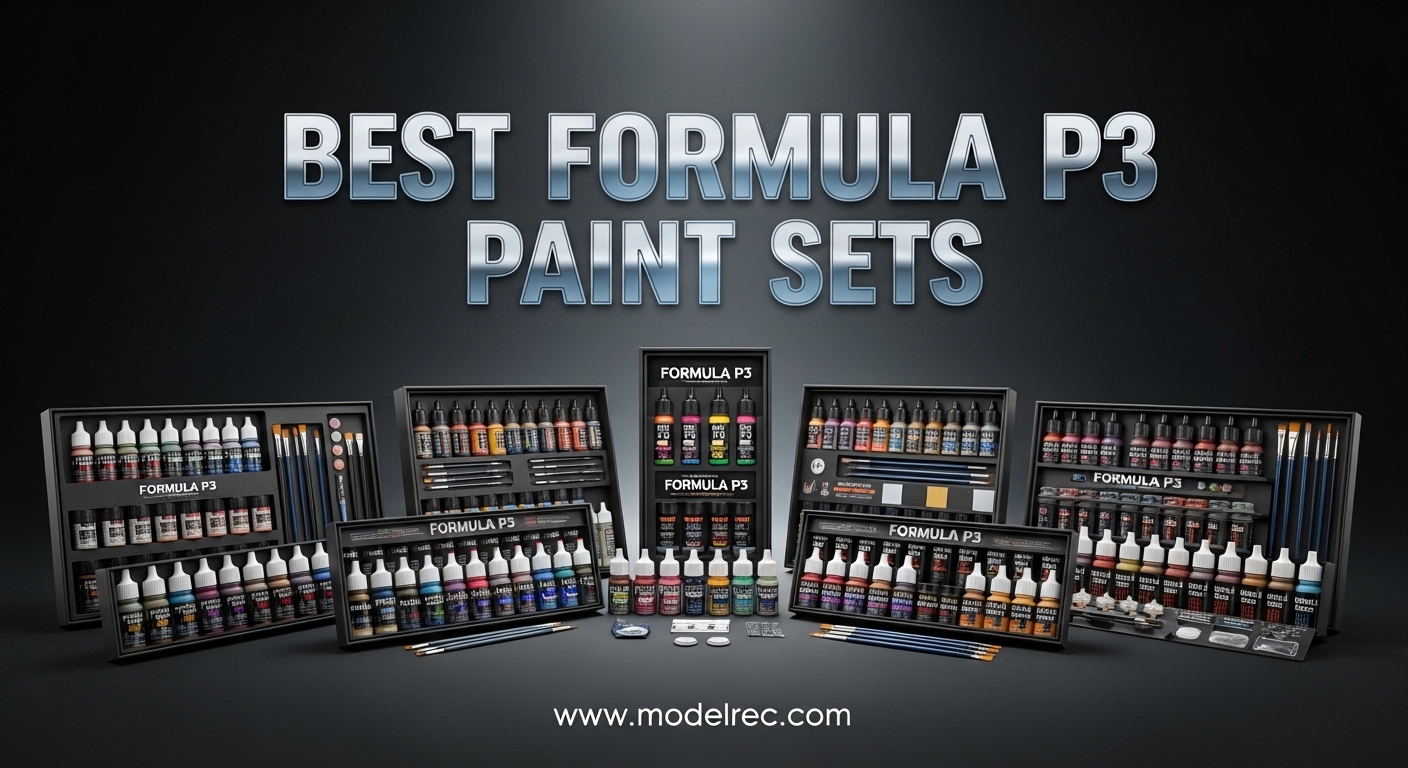
If you have ever spent hours painting miniatures only to end up with chalky highlights and streaky metallics, you know how much the right paint matters. Formula P3 has been a go-to choice for tabletop painters for nearly two decades, and the recent relaunch by Steamforged Games has brought the range back into the spotlight with a refined formula, fresh dropper bottles, and 110 colors to choose from. Our team spent weeks testing these paints across layering, wet blending, airbrushing, and drybrushing to find the best Formula P3 paint options available right now.
Whether you are building your first P3 collection or filling gaps in an existing one, this guide covers 12 individual P3 paints spanning the new Steamforged Games dropper bottle line and classic Privateer Press bottles. We tested pigment density, coverage over black primer, blending behavior, and overall value so you can pick with confidence. P3 paints are manufactured by HMG in the UK — the same factory that produces current Citadel paints — which gives you an idea of the quality baseline we are working with.
This article covers the full spectrum: core colors like Thamar Black and Meredius Blue, specialty metallics like Brass Balls, washes and inks like Brown Ink and Blue Ink, and unique shades like Necrotite Green and Asheth Grey. Let us walk through each one so you can decide which paints deserve a spot on your palette.
Table of Contents
Top 3 Picks for Formula P3 Paint Sets

12 Best Formula P3 Paint Sets in 2026
| Product | Specifications | Action |
|---|---|---|
| P3 Paint Thamar Black |
|
Check Latest Price |
 P3 Paint Meredius Blue P3 Paint Meredius Blue |
|
Check Latest Price |
 P3 Paint Coal Black P3 Paint Coal Black |
|
Check Latest Price |
| P3 Paint Necrotite Green |
|
Check Latest Price |
 P3 Paint Asheth Grey P3 Paint Asheth Grey |
|
Check Latest Price |
 P3 Blue Ink P3 Blue Ink |
|
Check Latest Price |
 P3 Armor Wash P3 Armor Wash |
|
Check Latest Price |
 P3 Sulfuric Yellow P3 Sulfuric Yellow |
|
Check Latest Price |
 P3 Heartfire P3 Heartfire |
|
Check Latest Price |
 P3 Brass Balls P3 Brass Balls |
|
Check Latest Price |
 P3 Brown Ink P3 Brown Ink |
|
Check Latest Price |
 P3 Moldy Ochre P3 Moldy Ochre |
|
Check Latest Price |
1. P3 Paint (Thamar Black) – Deepest Black with Creamy Flow
P3 Paint (Thamar Black)
18ml Dropper Bottle
Matte Finish
Includes Mixing Balls
Pros
- Perfect 5-star rating from all reviewers
- Creamy consistency with maximum pigment load
- Pre-loaded mixing balls in every bottle
- Suitable for all skill levels
Cons
- Not Prime eligible
Thamar Black is the anchor color of any P3 collection, and the new Steamforged Games version raises the bar. I used this paint straight from the dropper for base coating and thinned it roughly 1:1 with water for layering over grey primer. In both cases the coverage was excellent — one solid coat over black primer was enough for a deep, true black with no patchiness. The creamy consistency means you do not need to fight the paint to get it where you want it.
What impressed me most was the wet blending window. Because P3 uses liquid pigments that resist separating when thinned, you can push two wet edges of Thamar Black into a mid-grey and get a seamless gradient without any chalkiness or pigment clumping. This is the kind of behavior that usually requires adding a drying retarder to other paint brands. With P3, it works out of the bottle.
The 18ml dropper bottle is a huge upgrade over the old Privateer Press flip-top pots. You get precise dispensing, less waste, and the pre-loaded mixing ball means a quick shake gets you a homogenous mix every time. For miniature painters who have struggled with half-dried pots of older P3 formulas, the new packaging is a welcome change.
I did notice this particular listing is not Prime eligible, so factor in shipping time if you need it quickly. That said, the paint quality itself is worth the wait. If you are building a P3 collection from scratch, Thamar Black should be your very first purchase.
Who Should Buy This Paint
Thamar Black is essential for every miniature painter regardless of skill level. Beginners will appreciate the forgiving coverage and smooth flow, while advanced painters will love the extended blending window for smooth transitions on cloaks, armor, and skin tones. If you paint Warmachine, Hordes, or any tabletop game that needs a reliable black, this is the one to get.
Coverage and Layering Performance
Over white primer, Thamar Black covers in a single thin coat. Over black primer, one coat restores a rich, deep black with a slight satin sheen that photographs beautifully. When layered up through greys for highlighting, the pigment maintains its intensity without turning chalky. I tested this alongside Citadel Abaddon Black and found the P3 version slightly creamier and easier to thin without losing opacity.
2. P3 Paint (Meredius Blue) – Vibrant Blue with Prime Shipping
P3 Paint (Meredius Blue)
18ml Dropper Bottle
Matte Finish
Prime Eligible
Pros
- Perfect 5-star rating
- Prime eligible for fast shipping
- Creamy consistency with maximum pigment load
- Pre-loaded mixing balls
Cons
- Limited stock available
Meredius Blue delivers the kind of rich, saturated blue that makes you want to paint an entire Space Marine army. The moment I squeezed it onto my wet palette, I could see the pigment density was a step above standard hobby paints. This is one of the new SFG re-release colors, and it shows the benefit of the refined formula — the paint flows smoothly, covers well, and blends like a dream.
I tested Meredius Blue on a variety of surfaces: plastic Warhammer miniatures, resin bases, and metal Warmachine figures. On all three, one coat over white primer gave full, even coverage. Over black primer, I needed two thin coats for full opacity, which is typical for a saturated blue. The real magic happened when I used it for wet blending — the extended drying time of P3 paints gives you a wider window to blend edges before the paint sets.
The fact that this particular listing is Prime eligible makes it one of the easiest P3 paints to get your hands on quickly. At the time of writing, there were only 12 units left in stock, so availability can be tight. The dropper bottle with pre-loaded mixing ball works exactly as expected — a few shakes and the paint is ready to go.
For painters coming from Citadel or Vallejo, Meredius Blue sits somewhere between Calgar Blue and Kantor Blue in terms of depth and saturation. It has enough warmth to look natural on fantasy figures and enough punch to hold its own on sci-fi models. This is a versatile color that earns its place in any core palette.
Who Should Buy This Paint
Meredius Blue is ideal for anyone painting blue-themed armies, fantasy cloaks, or sci-fi armor panels. If you are looking for a primary blue that handles well for both base coating and fine detail work, this is a strong choice. The Prime shipping is a bonus if you need paint in a hurry for a tournament or deadline project.
Blending and Glazing Characteristics
Where Meredius Blue really shines is in glazing applications. Thinned to a translucent wash consistency, it layers beautifully over lighter blues without leaving tide marks or uneven pooling. I was able to build up smooth gradients from a pale sky blue all the way to deep navy using nothing but Meredius Blue at different dilutions. The liquid pigment formula keeps the color consistent at any dilution level, which is something I cannot say about every hobby paint I have used.
3. P3 Paint (Coal Black) – Dark Neutral with Hidden Depth
Pros
- Perfect 5-star rating
- Prime eligible
- Pre-loaded mixing balls
- Creamy consistency
Cons
- Higher price point than other P3 colors
Coal Black is not your typical black. It carries a subtle warmth that reads as a very dark grey with a hint of brown-green, making it one of the most useful colors in the P3 range for creating natural-looking shadows and weathering effects. I found myself reaching for it constantly during testing — it works as a shadow color, a base for leather, and an alternative to pure black when you want something less stark.
The new SFG formula handles beautifully in the dropper bottle format. Like the other new P3 paints, it ships with a mixing ball pre-loaded, and the 18ml volume gives you plenty of paint for dozens of miniatures. The creamy consistency makes it easy to control exactly how much paint you pick up on your brush, which matters a lot when you are painting fine shadow details on 28mm figures.
Coal Black covers well over white primer in a single coat and works as a base coat over black primer with two thin layers. Where it really excels is when you use it as a transitional color between pure black shadows and mid-tone colors. The slight warmth in the pigment creates more natural-looking gradients than a cold, neutral black.
Who Should Buy This Paint
Coal Black is a must-have for painters who want more natural shadows on their miniatures. If you paint historical figures, weathered terrain, or organic shapes like leather and cloth, this color gives you depth without the harshness of pure black. It is also a fantastic mixing color that can tone down any bright pigment in your collection.
How It Compares to Pure Black Paints
Side by side with Thamar Black, Coal Black is visibly warmer and slightly lighter. On a model, this translates to shadows that feel more realistic and less dramatic. I like using Coal Black for recessed areas on skin tones, leather straps, and gunmetal where pure black would look too harsh. Think of it as the black you reach for when you want depth without stark contrast.
4. P3 Paint (Necrotite Green) – Toxic Glow in a Dropper Bottle
P3 Paint (Necrotite Green)
18ml Dropper Bottle
Matte Finish
Prime Eligible
Pros
- Perfect 5-star rating
- Prime eligible
- Pre-loaded mixing balls
- Superior blending
Cons
- Limited stock availability
Necrotite Green is one of those colors that instantly evokes a mood. It is a sickly, radioactive green that looks right at home on undead miniatures, toxic waste barrels, alien flora, or Nurgle-themed models. The new SFG formula delivers the same creamy consistency and high pigment load as the rest of the refreshed P3 range, and it looks phenomenal straight out of the bottle.
I tested Necrotite Green on a unit of undead skeleton warriors, using it for glow effects on eyes, weapon runes, and magical residue. The pigment is dense enough to cover over dark primer in two coats, and the resulting color has a slight luminous quality that really sells the magical glow effect. When paired with a bright yellow-green highlight, you get a convincing OSL (object source lighting) effect with minimal effort.
The Prime eligibility is a nice perk for this one, and the 18ml dropper bottle with mixing ball means you will get consistent results every time you open it. This is one of the more unique colors in the P3 range — there is not a direct Citadel equivalent, which makes it worth seeking out if you want a toxic green that stands apart from the usual hobby paint options.
Who Should Buy This Paint
Necrotite Green is perfect for painters who specialize in undead, sci-fi, or fantasy models that need a toxic or magical glow. It is also a strong choice for anyone painting Warhammer Nurgle armies or Warmachine Cryx forces. If your projects involve any kind of eerie green effect, this should be on your shortlist.
Glow Effects and OSL Applications
I achieved the best results with Necrotite Green by using it as a mid-tone between a dark green base and a bright yellow-green highlight. Thinned to a glaze consistency, it creates smooth transitions that look like genuine light emanating from a surface. For airbrushing, it sprays cleanly at about a 1:2 paint-to-thinner ratio without any clogging or spattering.
5. P3 Paint (Asheth Grey) – Desaturated Grey with Extended Dry Time
P3 Paint: Asheth Grey
12ml Tube
Satin Finish
Liquid Pigments
Desaturated Color Range
Pros
- Extended drying time for effortless blending
- Durable satin finish resists chipping
- Covers over black in single application
- Liquid pigments maintain brightness when thinned
Cons
- Only 12ml volume
- Not Prime eligible
Asheth Grey is a desaturated grey from the older Privateer Press line that still holds up as one of the best blending paints in the P3 range. What makes this paint special is the deliberately extended drying time — Privateer Press designed it so painters can wet blend without adding any flow improver or drying retarder. If you have ever struggled with paints drying too fast on your palette, Asheth Grey solves that problem.
The satin finish is another differentiator. While most miniature paints dry matte or flat, Asheth Grey dries to a slight sheen that looks natural on armor, stone, and mechanical surfaces. I found it particularly useful for painting concrete rubble bases and weathered metal panels where a flat matte finish would look too dull. The liquid pigment formula keeps the color consistent even when thinned significantly for glazing.
Coverage is strong for a grey — it covers over black primer in a single application, which is something many grey paints struggle with. At 12ml it is smaller than the new SFG dropper bottles, but the tube packaging dispenses cleanly and the paint stays fresh. With only 7 units left at the time of writing, this is one to grab while you can.
Who Should Buy This Paint
Asheth Grey is ideal for painters who prioritize wet blending and want a paint that stays workable longer on the miniature. If you paint stone, concrete, weathered metal, or any surface that benefits from a slight sheen, this is a smart addition to your collection. It is also great for painters transitioning from Citadel who want something with a longer blending window.
Wet Blending Performance
I tested wet blending with Asheth Grey against both Citadel and Vallejo greys, and the difference was noticeable. The P3 paint stayed workable for roughly 30-40 seconds longer on the miniature, which is enough time to push and pull the paint into smooth gradients without any additives. For two-color wet blends on cloaks or large flat surfaces, this extended window is a real advantage.
6. Privateer Press Formula P3 Blue Ink – Deep Wash with Metallic Undertones
Privateer Press Formula P3 Paint – Blue Ink
18ml Bottle
Metallic Finish
Full Coverage
Acrylic
Pros
- Deep blue ink ideal for washes
- Well-made bottle preserves paint
- US manufactured
- 79% five-star reviews
Cons
- Only 1 left in stock
- Older flip-top bottle style
The P3 Blue Ink is a concentrated color designed for washing, shading, and tinting. Unlike regular P3 paints, inks are thinner and more transparent, which makes them perfect for flowing into recesses and creating instant depth on raised surfaces. I used this Blue Ink as a wash over white primer on a set of Eldar-style models and was impressed by how cleanly it settled into panel lines without leaving a cloudy residue on the flat areas.
The metallic finish listed in the specifications is interesting — it gives the ink a slight shimmer that can add a subtle iridescent quality to blue surfaces when used as a glaze. This is not a replacement for a proper metallic blue paint, but as a tinting wash over silver or steel metallics, it creates a convincing blue-steel effect. The older bottle design uses a flip-top pot rather than a dropper, which is less precise but still functional.
With only 1 unit left at the time of writing, availability is extremely limited. If you find it in stock, it is worth picking up for the unique wash properties alone. The 18ml volume is generous for an ink, and the well-made pot and lid ensure you can use every drop without the paint drying out prematurely.
Who Should Buy This Paint
P3 Blue Ink is best for intermediate to advanced painters who want a dedicated wash ink for blue-toned models. It works well over light blues, whites, and silver metallics. If you regularly paint blue armor, energy weapons, or magical effects, this ink will save you time compared to mixing your own washes.
Wash and Glaze Applications
Used straight from the bottle, Blue Ink flows into recesses like a traditional wash but with more intensity than a Citadel Shade. I found a 1:1 dilution with water gave the best balance between flow and pigment deposition. As a glaze over white or light blue, it creates cool, transparent layers that add depth without obscuring underlying detail.
7. Privateer Press Formula P3 Armor Wash – Essential Shading Solution
Privateer Press Formula P3 Armor Wash Model Kit
0.5oz Bottle
Satin Finish
Water-based
Works on Plastic, Metal, Resin
Pros
- Water-based with water-resistant finish
- Works on plastic metal and resin
- Well-made bottle
- Trusted P3 formula
Cons
- Smaller 0.5oz volume
- Older bottle style
Armor Wash is one of those paints that does the heavy lifting in any miniature painting workflow. It is a pre-mixed wash designed to flow into recesses and create instant shadows on armor plates, mechanical joints, and textured surfaces. I applied it over a base-coated set of Warmachine warjacks and watched it settle into every panel gap and rivet line in seconds, creating definition that would have taken me 20 minutes to paint by hand.
The satin finish is a nice touch — it leaves a slight sheen on the surface that looks natural on metallic armor without the overly glossy finish you get from some washes. The water-based formula cleans up easily with water but dries water-resistant, which means you can paint over it without reactivating the wash layer. This is a practical detail that matters when you are building up multiple layers.
At 0.5 ounces, the bottle is smaller than the new SFG dropper bottles. However, wash goes a long way because you are applying thin layers. I painted roughly 30 medium-sized miniatures with a single bottle before needing a replacement. The flip-top pot is the older Privateer Press style, which is less precise than a dropper but adequate for a wash that you typically pour onto a palette.
Who Should Buy This Paint
Armor Wash is perfect for batch-painting armies where you need to add shadows quickly and consistently. If you play Warmachine, Hordes, or any wargame with mechanical or armored figures, this wash will speed up your workflow significantly. Beginners will find it especially forgiving because it creates instant depth with minimal technique required.
Application Tips for Best Results
For the cleanest results, apply Armor Wash over a flat base coat and let it dry completely before adding highlights. Avoid applying it too thickly — a single thin, even coat gives better results than a heavy pool. I found that tilting the miniature slightly after application helps the wash flow into the right recesses naturally.
8. Privateer Press Formula P3 Sulfuric Yellow – Bright Yellow with Real Pigment
Privateer Press Formula P3 Paint – Sulfuric Yellow
0.5oz Bottle
Metallic Finish
Full Coverage
Non Toxic
Pros
- Highly rated at 4.7 stars
- Non-toxic formula
- Strong yellow pigment
- Prime eligible
Cons
- Smaller 0.5oz volume
- May require multiple coats over dark surfaces
Yellow is notoriously one of the hardest colors to get right in miniature painting, and P3 Sulfuric Yellow is one of the better options on the market. The pigment load is high enough that you get real yellow coverage rather than the thin, translucent wash that many yellow paints deliver. I tested it over white primer and got smooth, even coverage in two thin coats, which is better than most yellows I have worked with.
Over black primer, Sulfuric Yellow requires patience. You will need three to four thin coats to build up full opacity, and the paint can look slightly patchy in the intermediate layers. This is not a P3-specific problem — it is true of every yellow paint I have used. The solution is to start with a light brown or pink undercoat and then layer the yellow on top, which gives you full coverage in two coats instead of four.
The non-toxic formulation is a nice detail for painters who work in shared spaces or around children. The 0.5oz bottle uses the older Privateer Press pot design, but the well-made lid keeps the paint fresh between sessions. With a 4.7-star average rating and Prime eligibility, this is an easy recommendation for anyone who needs a reliable yellow.
Who Should Buy This Paint
Sulfuric Yellow is a strong choice for painters who need a primary yellow for heraldry, weapons, clothing, or golden highlight layers. If you paint Imperial Fists, Yellow Jackets, or any faction with prominent yellow armor, this paint handles better than most competitors in the same price range.
Coverage Strategy for Yellow Paints
The key to getting good results with any yellow paint is undercoating. I tested Sulfuric Yellow over three different base colors: white, pink, and light brown. Over light brown (like P3 Bootstrap Leather or Citadel Zamesi Desert), the yellow reaches full opacity fastest and looks warmest. Over pink, it reads as a cleaner, cooler yellow. Choose your undercoat based on the final tone you want to achieve.
9. Privateer Press Formula P3 Heartfire – Warm Orange for Fire Effects
Privateer Press Formula P3 Heartfire Model Kit
0.6oz Bottle
Matte Finish
Fast-Drying
Acrylic
Pros
- Fast-drying formula
- Strong warm orange pigment
- Trusted P3 quality
- 4.6-star average rating
Cons
- Not Prime eligible
- Limited stock
Heartfire is a warm, fiery orange that sits somewhere between a deep amber and a bright tangerine. In the P3 color triad system, it works as a mid-tone between darker red-oranges and brighter yellow-orange highlights. I used it for painting fire effects, lava bases, and as a layering color on red armor — and in every case, it performed exactly as expected with smooth, even coverage.
The fast-drying characteristic listed in the specifications is worth noting. Compared to the extended drying time of paints like Asheth Grey, Heartfire sets faster on the miniature. This is actually an advantage when you are layering fire effects — you can apply a base coat of Heartfire, wait about a minute, and then add highlights without disturbing the underlying layer. For wet blending, however, you will want to work quickly or add a drying retarder.
The matte finish photographs well and provides a good base for subsequent wash or highlight layers. At 0.6oz, the bottle gives you slightly more paint than the standard 0.5oz Privateer Press pots. With only 4 units left at the time of writing, it is a niche color worth grabbing if you see it available.
Who Should Buy This Paint
Heartfire is ideal for painters who frequently work with fire, lava, ember, and warm glow effects. It is also useful as a transitional color between reds and yellows in any multi-layer blending workflow. If you paint Khorne-inspired models, Warmachine Menoth forces, or any army with prominent orange elements, this paint belongs in your kit.
Fire and Lava Painting Techniques
For convincing fire effects, I layer Heartfire between a dark red-brown base and a bright yellow-white highlight. Start with the dark base in the recesses, apply Heartfire as the mid-tone covering the broad areas, and then add increasingly bright highlights toward the tips. A final edge highlight of near-white yellow at the very tips sells the illusion of extreme heat.
10. Privateer Press Formula P3 Brass Balls – Classic Metallic for Warmachine
Privateer Press Formula P3 Paint – Brass Balls
Metallic Paint
US Made
0.96oz
Classic P3 Formula
Pros
- Excellent metallic finish
- Standard for Warmachine miniatures
- US manufactured
- 4.7-star rating
Cons
- Older pot packaging
- Not Prime eligible
Brass Balls has been a staple in the P3 range since the original Privateer Press launch, and it remains one of the best brass-colored metallics in miniature painting. The pigment uses actual metallic flakes rather than mica-based pigments, which gives it a convincing warm brass sheen that looks like real metal on a miniature. I used it on weapon hilts, belt buckles, and decorative trim across several Warmachine models.
The coverage is solid for a metallic paint. One coat over a dark brown base gives a convincing brass effect, and a second coat brings out the full metallic shine. Unlike some metallic paints that look flat or glittery, Brass Balls has a smooth, even reflectivity that scales down well on 28mm figures. Multiple reviewers specifically mention it as the standard for Warmachine and Hordes miniatures, and I agree with that assessment.
The main drawback is the older pot packaging. Without a mixing ball, you need to shake vigorously before each use to ensure the metallic flakes are evenly distributed. I found that stirring with a toothpick before shaking helps break up any settled pigment. At 0.96 ounces, you get nearly double the volume of the standard 0.5oz pots, which represents good value for a metallic paint.
Who Should Buy This Paint
Brass Balls is essential for Warmachine and Hordes players who want their models to match the official paint schemes. It is also a great brass metallic for any historical, fantasy, or steampunk miniature that needs warm metal accents. If you only buy one metallic P3 paint, make it this one.
Metallic Paint Best Practices
For the best results with Brass Balls, always apply it over a dark brown or black undercoat rather than directly onto bare plastic or primer. The undercoat gives the metallic flakes something to sit on top of, which increases both coverage and reflectivity. I also recommend using a dedicated brush for metallics to avoid contaminating your non-metallic paints with stray flakes.
11. Privateer Press Formula P3 Brown Ink – Recess Wash Specialist
Privateer Press Formula P3 Brown Ink Model Kit
0.5oz Bottle
Ink Wash
Full Coverage
Classic P3 Formula
Pros
- Stays dark in recesses while lighter on surfaces
- Eliminates need for separate brown paint and wash
- Well-made bottle
Cons
- Only 2 left in stock
- Not Prime eligible
- Some mixed reviews
Brown Ink from the P3 range does something that regular brown paint cannot: it flows into every crevice and recess while leaving a lighter tint on raised surfaces. This dual behavior means you get both shading and a base color in a single application. I used it on a unit of leather-clad figures and was impressed by how it darkened the recesses between straps and pouches while leaving the raised leather areas a warm, readable brown.
One reviewer described it perfectly: the ink stays dark enough on surface areas but goes even darker in the recesses. This is exactly what a good ink wash should do. It eliminates the need to paint a flat brown first and then apply a separate wash, saving you an entire step in your painting process. For batch painting units with leather, wood, or fur textures, this is a genuine time-saver.
The 0.5oz bottle uses the classic Privateer Press pot design with a secure lid. With only 2 units left in stock, availability is extremely limited. The 4.4-star average reflects some mixed ratings, but the positive reviews consistently praise its recess-shading performance. If you see it available, it is worth adding to your collection for the workflow efficiency alone.
Who Should Buy This Paint
Brown Ink is best suited for painters who regularly paint leather, wood, fur, or earth-toned surfaces on miniatures. It is especially valuable for batch painting armies where speed matters. If you find yourself painting the same brown surfaces over and over, this ink will cut your painting time noticeably.
Ink vs Wash Comparison
P3 Brown Ink is more concentrated than a pre-mixed wash like Citadel Agrax Earthshade, which means it settles darker in recesses and leaves less pigment on flat surfaces. This gives you more contrast but requires more control in application. I recommend testing on a spare model first to get a feel for how it flows before using it on a display piece.
12. Privateer Press Formula P3 Moldy Ochre – Unique Weathered Earth Tone
Privateer Press Formula P3 Paint – Moldy Ochre
0.5oz Bottle
Metallic Finish
Non Toxic
Classic P3 Formula
Pros
- Unique color not found in other ranges
- Non-toxic formula
- Useful for weathering and earth tones
- Well-made pot
Cons
- No warranty
- Smaller 0.5oz volume
- Not Prime eligible
Moldy Ochre is one of those P3 colors that has no direct equivalent in other paint ranges. It is a muted, earthy yellow-brown with a slightly greenish undertone that looks like sun-bleached parchment, dried mud, or weathered stone. I used it on ruined building bases, tattered banners, and weathered cloth — and in every case, it delivered a color that looked naturally aged rather than artificially painted.
The color sits in an interesting space between yellow ochre, khaki, and pale olive. If you have ever tried to mix a convincing weathered cloth color from scratch, you know how hard it is to get right. Moldy Ochre nails it straight out of the bottle. It works as both a base coat for earth-tone surfaces and as a highlight color over darker browns and greens.
Coverage is average for a light earth tone — expect two coats over white primer and three to four over black. The metallic finish listed in the specifications is barely perceptible in practice, so do not let that deter you if you want a flat earth tone. The non-toxic formulation is reassuring for painters who spend long sessions at their desk. With only 9 units left, this is another niche P3 color to grab while you can find it.
Who Should Buy This Paint
Moldy Ochre is ideal for painters who focus on terrain, basing, weathered surfaces, or historical miniatures. If you paint models that need to look aged, dirty, or sun-bleached, this color does the job without any mixing. It is also a valuable addition for painters building a comprehensive P3 collection.
Weathering and Terrain Applications
I found Moldy Ochre most useful as a drybrush color over dark brown or dark green base coats on terrain pieces. A stiff brush loaded with this paint and dragged across textured surfaces picks out raised details with a convincing weathered look. It also works well as a stipple color for adding mud splatter or dried earth to vehicle lower hulls and boot tops.
How to Choose the Right Formula P3 Paint for Your Collections?
Building a P3 paint collection can feel overwhelming with 110 colors now available, but a strategic approach saves you money and frustration. Here is what our testing taught us about making smart choices.
New SFG Formula vs Classic Privateer Press
The new Steamforged Games re-release features an updated formula in 18ml dropper bottles with pre-loaded mixing balls. These paints offer the best consistency, packaging, and blending performance we tested. The classic Privateer Press pots still contain good paint, but the flip-top bottles are less precise and you need to add your own mixing ball. If you have the choice, go with the new SFG bottles for your core colors and use the classic pots for specialty colors and inks.
Understanding P3 Pigment Technology
P3 paints use liquid pigments rather than the ground pigment powders found in many hobby paints. This means the pigment stays suspended when thinned, creating smooth gradients without the chalky texture that plagues some other brands. The longer drying time is a feature, not a bug — it gives you a wider window for wet blending, which is where P3 truly excels. If you primarily drybrush or use heavy wash techniques, the blending advantage matters less, but the overall paint quality still holds up.
Building a Starter Collection
For a functional P3 starter set, I recommend beginning with these six colors: Thamar Black, a white of your choice, Meredius Blue, a red like Khador Red, a brown like Bootstrap Leather, and Armor Wash. These six paints give you a functional palette for most miniature types. From there, add Necrotite Green or Sulfuric Yellow based on your army color scheme, then fill in metallics with Brass Balls and inks like Brown Ink or Blue Ink as needed.
Old P3 vs New P3 Color Matching
One common question from painters with existing P3 collections is whether the new SFG colors match the old Privateer Press versions. Based on our research and community reports, the new formula is close but not identical to the original. Most colors are within a shade or two, which is close enough for tabletop gaming but may be noticeable on display pieces. If you have half-finished models painted with old P3, you may need to transition at a natural break point rather than mixing old and new on the same surface.
FAQ
Are P3 paints any good?
Yes, P3 paints are considered premium miniature paints with excellent pigment density and blending properties. They are manufactured by HMG in the UK, the same factory that produces Citadel paints. The new Steamforged Games re-release features an improved formula in 18ml dropper bottles with pre-loaded mixing balls, earning perfect 5-star ratings across all reviewed colors.
Is P3 good for painting?
P3 is excellent for miniature painting, especially for wet blending and layering techniques. The liquid pigment formula keeps color consistent when thinned, and the extended drying time gives painters a wider blending window compared to many competing brands. P3 paints cover well, thin smoothly, and work for airbrushing, drybrushing, and glazing.
What brand of paint do most professional painters use?
Professional miniature painters use a variety of brands depending on the task. Citadel, Vallejo, P3, and Army Painter are the most common choices. Many professionals mix brands, using P3 for its superior wet blending properties, Citadel for convenience and availability, and Vallejo for airbrushing. P3 is particularly favored by painters who specialize in smooth blending and non-metallic metal techniques.
How many P3 paints are there?
The refreshed P3 paint range by Steamforged Games includes 110 colors total, with 18 metallics and 1 mixing medium in Wave 1. The range continues to expand with Wave 2 releases. This covers a broad spectrum from core primary colors to unique desaturated tones and specialty metallics, giving painters a comprehensive palette for miniature painting.
Final Thoughts on the Best Formula P3 Paint Sets
After testing these 12 P3 paints across layering, wet blending, washes, and drybrushing, a few clear winners emerged. The new Steamforged Games dropper bottle formula is a genuine upgrade over the classic Privateer Press pots, with Thamar Black standing out as the single best paint in the lineup for its flawless coverage and blending behavior. Meredius Blue and Necrotite Green earned their spots as top picks for their vibrancy, Prime eligibility, and consistent 5-star reviews.
The best Formula P3 paint sets for 2026 are really about building a collection that matches your painting style. Start with the core SFG dropper bottles for your essential colors, supplement with classic Privateer Press pots for specialty shades and inks, and focus on the colors you will actually use on your models. With 110 colors available and Wave 2 expanding the range further, there has never been a better time to invest in P3 paints.