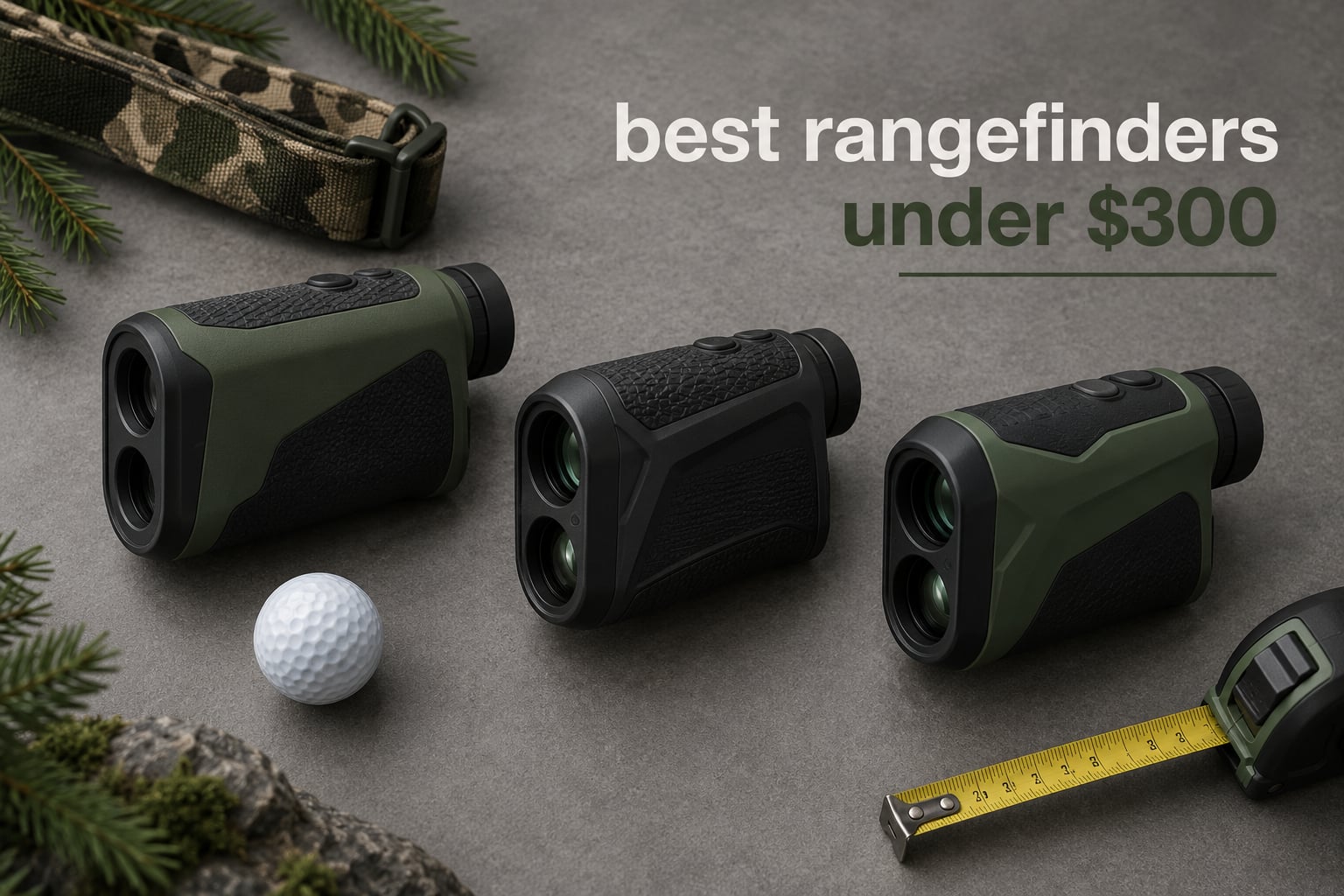
Most people shopping the best rangefinders under 300 dollars start with the wrong question. They compare maximum range numbers, and 1,400 yards beats 700 yards on paper even though almost nobody shoots a deer at 700 yards. The spec that actually decides your experience is angle compensation, how the display reads at last light, and whether the device covers your sport at all.
So before the list, a quick router. Golf players want slope adjustment, a pin finder with vibration, and a physical slope switch for tournament rounds. Bowhunters and deer hunters need HCD-style compensation so they can range a tree trunk from a stand and still get the true horizontal distance. Rifle and precision shooters want range to reflective targets, fast acquisition, and a display that survives glare and dusk. A golf device is usually a poor hunting device and the reverse is also true, and that mismatch is the most common expensive mistake in this category.
Our overall pick is the Callaway 300 Pro, a red 6x unit with a tournament-legal external slope switch and pin lock that reaches 300 yards. It is the most complete single purchase here because it handles golf rounds and works as a basic hunting rangefinder for deer inside a treestand. For a hunting-first setup, the Vortex Crossfire HD 1400 is the strongest optical package, and the TIDEWE 700/1000Y is the hunting pick for anyone who wants speed and low weight. We earn a commission on qualifying purchases from this page, and the list below reflects specs and owner feedback gathered in 2026.
Table of Contents
Top 3 Best Rangefinders Under $300 in 2026

Vortex Crossfire HD 1400
- Red TOLED display
- 1400 yard reflective range
- 5x HD optics
- Lifetime VIP warranty

All 10 Rangefinders Under 300 Dollars at a Glance in October
The quick read: four golf-first models with slope switches, four hunting-first models, and two that split the difference. Accuracy specs cluster tightly around plus or minus 1 yard, so the deciding factors are display type, angle compensation, and how consistently the flag lock holds on a cluttered background.
| Product | Specifications | Action |
|---|---|---|
| Callaway 300 Pro |
|
Check Latest Price |
| Vortex Crossfire HD 1400 |
|
Check Latest Price |
 Blue Tees Golf Series 3 Max+ Blue Tees Golf Series 3 Max+ |
|
Check Latest Price |
 Acer Gadget Golf Rangefinder Acer Gadget Golf Rangefinder |
|
Check Latest Price |
 REDTIGER Golf Rangefinder REDTIGER Golf Rangefinder |
|
Check Latest Price |
| TIDEWE Hunting 700/1000Y |
|
Check Latest Price |
 REVASRI NK1000 Golf REVASRI NK1000 Golf |
|
Check Latest Price |
 AOFAR HX-700N AOFAR HX-700N |
|
Check Latest Price |
 REVASRI Hunting 1000Y REVASRI Hunting 1000Y |
|
Check Latest Price |
 Gogogo Sport Vpro GS03 Gogogo Sport Vpro GS03 |
|
Check Latest Price |
1. Callaway 300 Pro: Best Overall for Golf and Everyday Use
Callaway Golf 300 Pro Slope Laser Rangefinder
6x magnification
5-1000 yard range
Plus or minus 1 yard accuracy
External slope switch
IPX4
Pros
- External slope switch keeps tournament play legal
- Pin Acquisition Technology locks the flag out to 300 yards with a vibration pulse
- Integrated magnet clamps firmly to a golf cart frame
- One CR2 battery covered more than 100 rounds for a single owner
Cons
- Body is compact and some owners find it small
- Repeat readings from one spot can vary by 1-2 yards
- Magnet is strong enough to leave the device behind on the cart
Of everything here, the Callaway 300 Pro is the one I would hand to a relative without asking what they shoot. It measures 5 to 1,000 yards at plus or minus 1 yard, magnifies 6x, and adds a pin finder that locks the flag out to 300 yards with a confirming pulse. The body weighs 8 ounces and measures 4 by 2.7 by 1.4 inches, so it disappears into a pocket or a cart cup holder.
What separates it from the other golf models here is the physical slope switch. You flip it off for a sanctioned round and on for practice, without digging through menu screens while another group waits on the tee box.
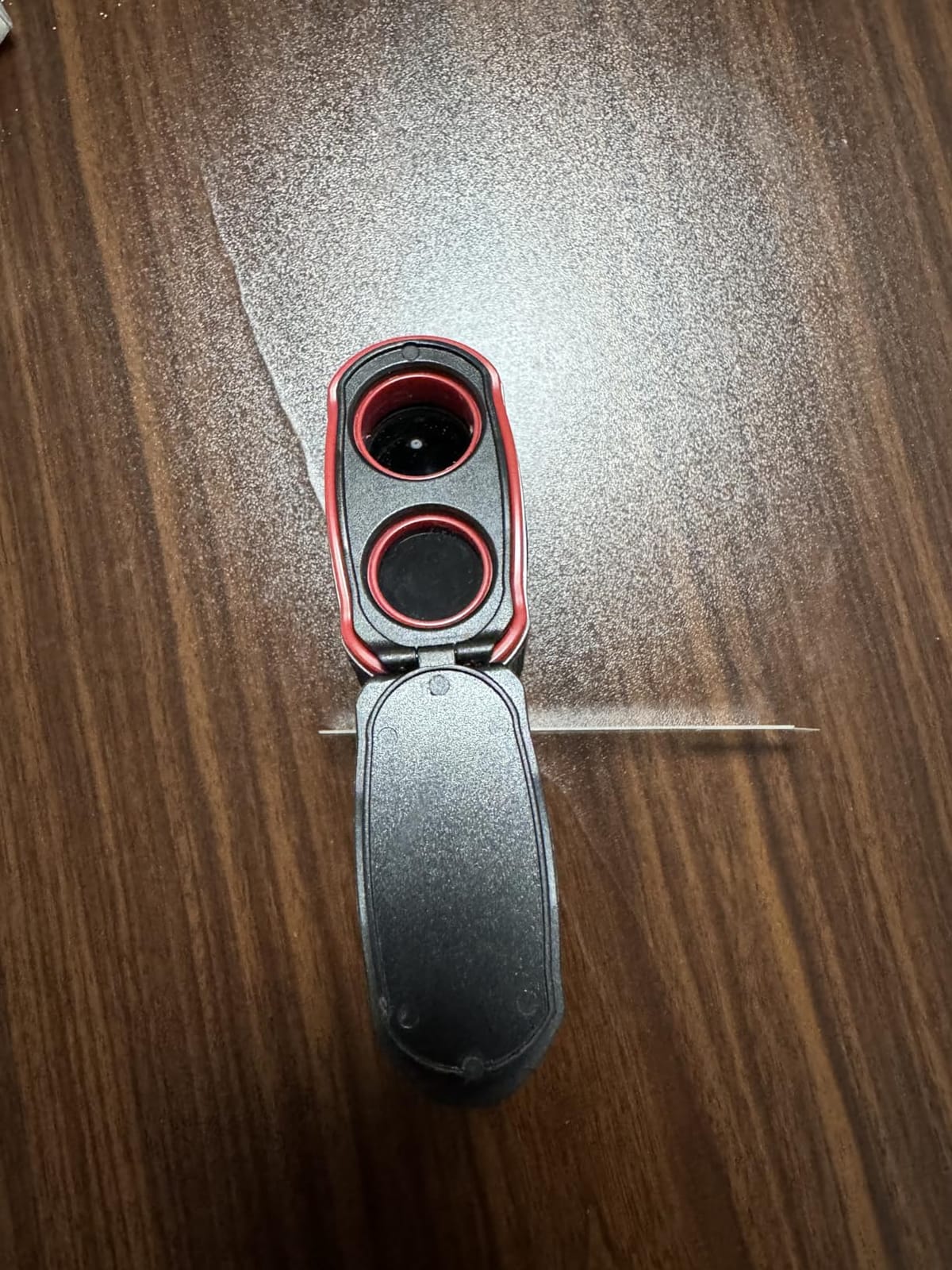
Accuracy is the quiet strength. Owners comparing it against premium laser units report readings that match within a yard most of the time, and the display holds the number on screen long enough to read it before it fades. Pin Acquisition Technology is genuinely useful on approach shots where the flag sits in front of a tree line or a bunker.
The battery story is also better than the rechargeable competition in one specific way. One owner reported a single CR2 lithium cell covering more than 100 rounds, and the included molded hard case with a carabiner takes the drop risk that forum readers worry about most when a device lives in a treestand or on a cart.
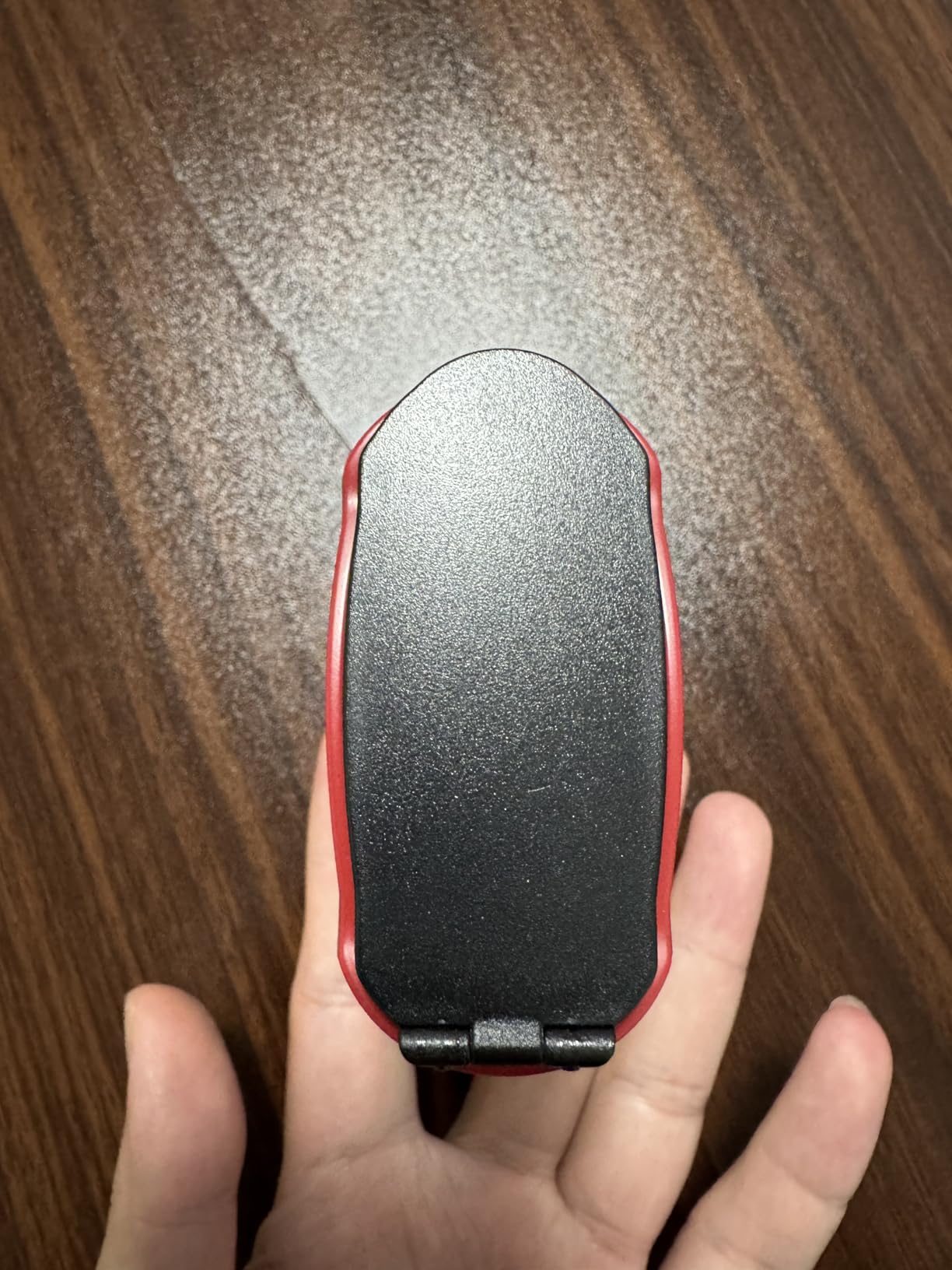
Check the magnification and the size before you commit
Six times is enough to find a flag in almost any round, and the built-in magnet is strong enough that you will not need a separate cart mount. If your game relies on reading greens or contours at distance rather than yardages, this device will not do that for you.
Skip it if you hunt open country or shoot rifle
Its 1,000 yard figure is a reflective-target number, and there is no windage compensation or ballistic solver for precision shooting. Golfers who also bowhunt will find it perfectly adequate for deer inside about 40 yards from the ground, and far short of what western open-country hunting needs.
2. Vortex Crossfire HD 1400: Best Hunting Rangefinder Under 300 Dollars
Vortex Crossfire HD 1400 Laser Rangefinder
5x magnification
1400 yard reflective range
750 yards on game
Red TOLED display
HCD and LOS modes
Pros
- Red TOLED display stays legible in any lighting condition
- HD optical system with select glass elements and XR lens coatings
- 1400 yard maximum on reflective surfaces
- Unlimited unconditional transferable lifetime VIP warranty
Cons
- No slope mode and no golf distance compensation
- Hunting-first design with no flag finder vibration
The glass is what separates this model from everything else in the list. The HD optical system uses select glass elements to cut chromatic aberration, and XR lens coatings push light transmission hard enough that the picture holds up at dawn. The red TOLED readout is the most-cited reason owners like it.
Ranging performance backs up the glass. It reaches 1,400 yards on reflective surfaces and 750 yards on game, with HCD and LOS modes so you can choose horizontal component distance or straight line. Three target modes, normal, first, and last, handle brush and partially hidden animals well.
The warranty is the other headline. Vortex offers an unlimited, unconditional, transferable lifetime VIP policy, which matters for a tool that lives in a harness pocket and gets dropped from a stand. Buyers weighing Leupold against Vortex should read our hunting rangefinder comparisons for how the warranty terms differ in practice.
Owners talk less about the numbers and more about what they can see through the glass. Colour fidelity holds up against a dark canopy, and the red digits stay legible when the readout would otherwise wash out. A soft carry case is included, and the listed body dimensions are 4 by 1.3 by 2.9 inches.
Why the display type matters more than the range number
A deer at 60 yards in heavy timber is a contrast problem, not a distance problem. A TOLED panel driven at low brightness reads cleanly in conditions where an illuminated LCD washes out or a plain LCD becomes hard to parse.
Skip it if you play golf
There is no slope compensation and no golf mode, so it will not give you a slope-adjusted carry distance or a pin lock with vibration. Golf-only shoppers should start with our golf rangefinder roundup instead.
3. TIDEWE Hunting Rangefinder 700/1000Y: Best for Speed and Low Weight
TideWe Hunting Rangefinder with Rechargeable Battery, 700Y Camo Laser Range Finder 6X Magnification, Distance/Angle/Speed/Scan Multi Functional Water-Resistant Rangefinder with Case
6x magnification
3-700 yard range
Plus or minus 1 yard accuracy
5.67 oz
Read speed 0.46 seconds
Pros
- Readings arrive in as little as 0.46 seconds
- Body weighs only 5.67 ounces
- Rechargeable battery rated for up to 21000 measurements per charge
- Continuous scan works well on trees and brush edges
Cons
- 700 yard maximum range is short for open field shooting
- No slope compensation and no flag lock with vibration
- Fewer measurement modes than the golf focused models
Speed is the whole argument for this device. At 0.46 seconds to a reading, you can work a moving animal or sweep a group of deer without losing the moment. That matters more in practice than the extra 700 yards some rivals claim on paper.
It weighs 5.67 ounces and measures 4.12 by 2.61 by 1.5 inches, so it disappears into a harness pocket. The leaf camo pattern and simple point, press, read layout mean you can find it without looking.
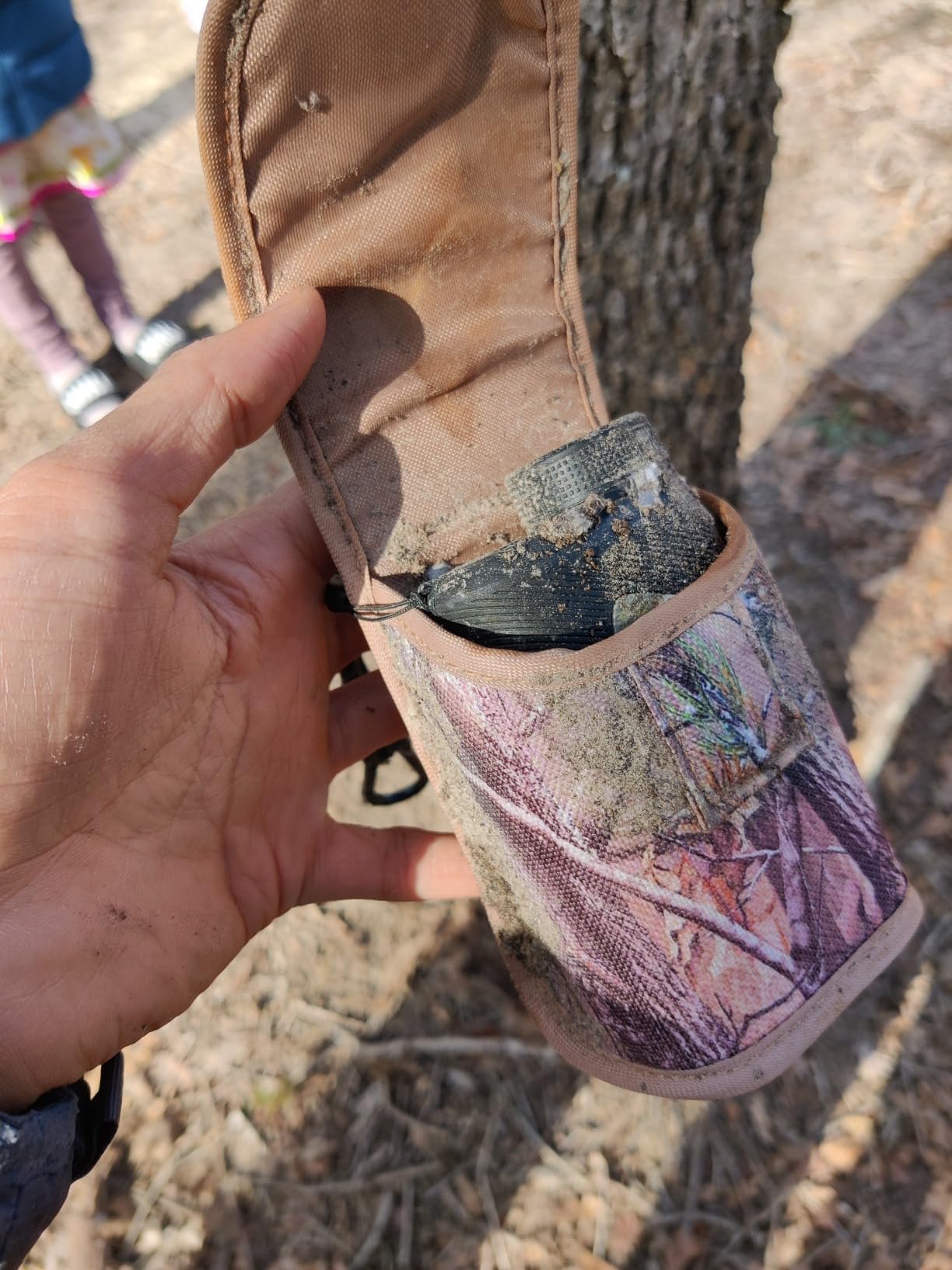
Battery endurance removes the usual field problem. The rechargeable lithium-ion cell is rated for up to 21,000 measurements per charge, so nobody is digging through a pack for a spare cell on day three of a trip. IP54 waterproofing covers steady rain and lens fog.
Modes cover straight-line distance, vertical distance, horizontal distance, speed, and continuous scan. That is fewer than the golf models, but each does a job hunters use, and the horizontal and vertical readouts pair well with ranging a tree from a stand.
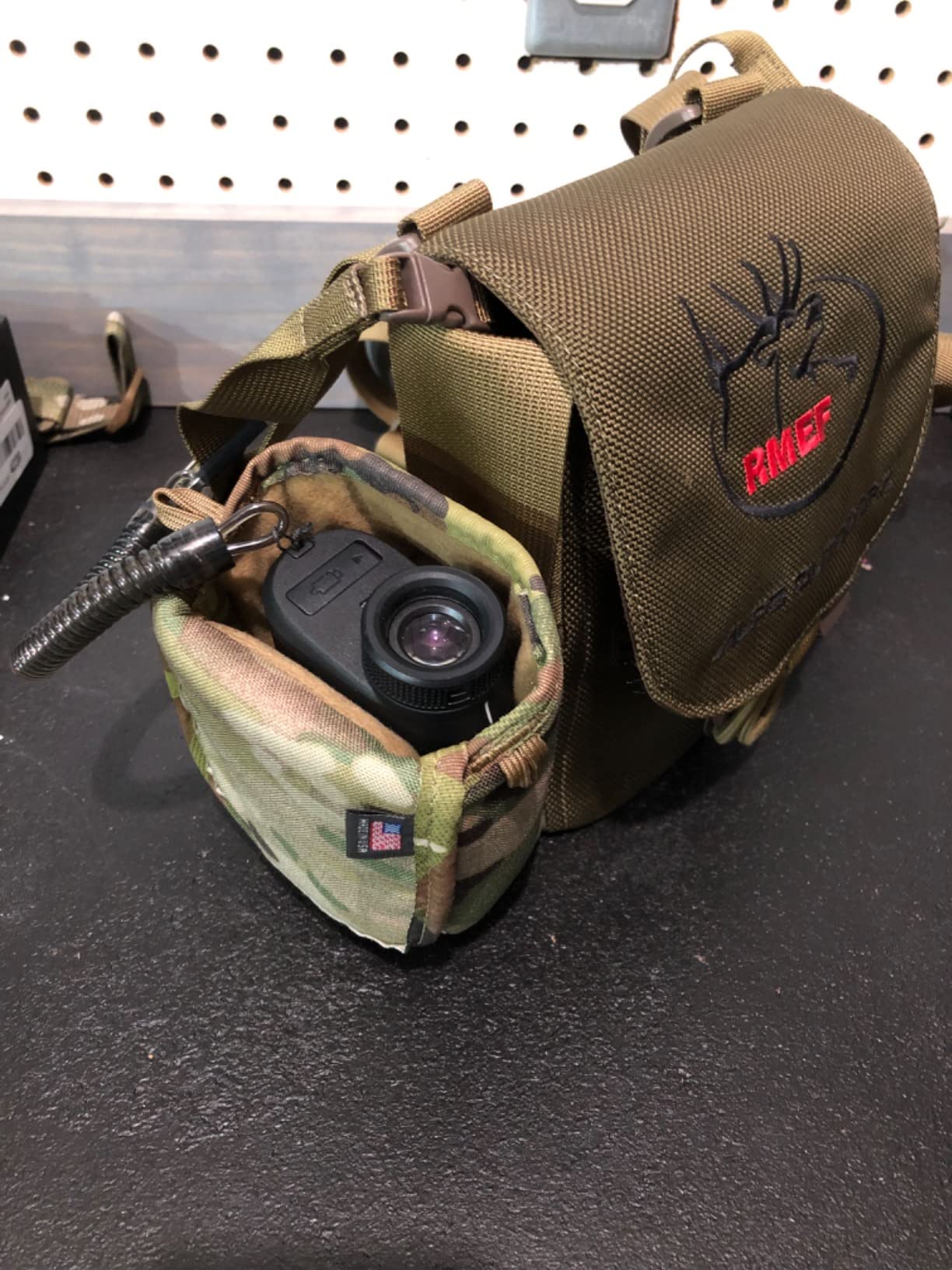
Check whether 700 yards covers your terrain
In eastern timber, 700 yards on game is far more than you will ever need. If you hunt open sagebrush or coastal range where animals present at 800 yards or more, the short range here becomes the deciding weakness and you should read up on the longer-range options in our full rangefinder guide.
Skip it if your only sport is golf
There is no slope mode, no flag lock with vibration, and no tournament slope switch. Angled shots down a fairway will produce a line-of-sight number rather than a true horizontal distance, which is exactly the number golfers need.
4. Blue Tees Golf Series 3 Max+: Best Rechargeable Golf Rangefinder
Blue Tees Golf Series 3 Max+ Golf Rangefinder with Slope Switch, 1000 Yards Range Finder, 6X Magnification, Slope Measurement, Magnetic Strip, Flag Pole Locking with Pulse Vibration
1000 yard range
6x to 7x magnification
Plus or minus 1 yard accuracy
Rechargeable USB-C
IPX4
Pros
- Auto-Ambient display switches the readout between red and black automatically
- Adaptive slope switch with continuous arc and a tournament toggle
- Built-in magnetic strip for cart and club mounting
- Rechargeable battery with a USB-C cable in the box
Cons
- Heaviest body in this group at 16 ounces
- 4.3 average with 9 percent of reviews at one star
- Magnification is listed inconsistently between 6x and 7x
- Some buyers need several passes to settle on a pin reading
The Auto-Ambient display is the feature that sets this apart from the other golf models here. The readout text changes between red and black on its own as light changes, so the same device works in bright noon sun and in the last round before dusk without you touching a setting.
The adaptive slope switch gives you true distance with continuous arc technology, and it toggles off for tournament play. Flag Lock technology confirms pin acquisition with a vibrating pulse out to 1,000 yards at plus or minus 1 yard accuracy, and the built-in magnetic strip attaches to a cart, a club, or any metal surface.
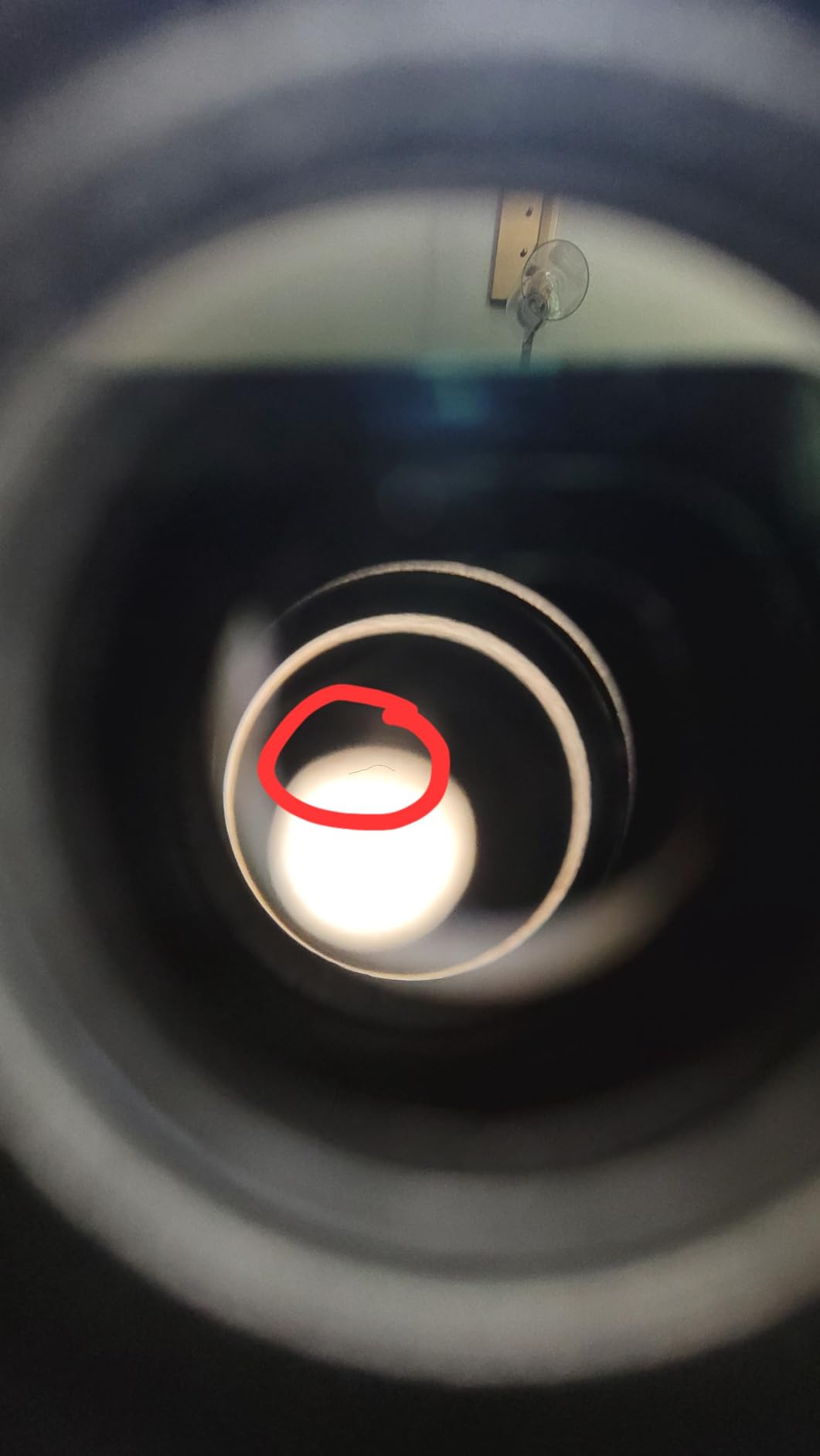
Two years of manufacturer warranty plus a 60-day money-back guarantee is stronger coverage than most budget golf models manage, and the package includes a weather-proof case, lanyard, and USB-C cable.
Set expectations carefully on weight. At 16 ounces this is the heaviest device in the roundup, and it is noticeably chunkier in a hand than the 8-ounce Callaway.
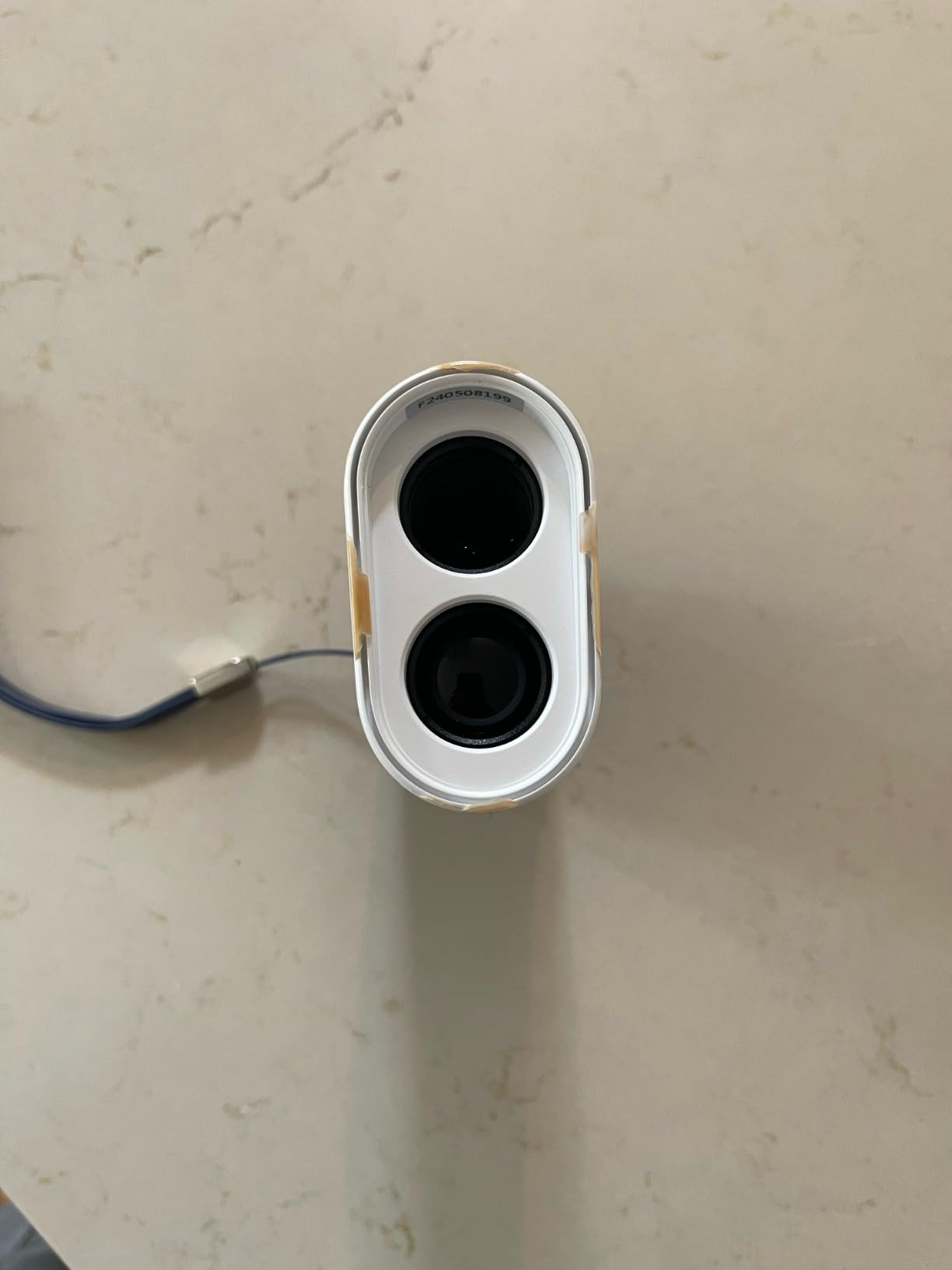
Decide how you will carry it before buying
Cart golfers get the most out of the built-in magnet, since the unit lives on the frame all round. Walking golfers who carry a light bag should weigh the 16 ounces against lighter 6x alternatives before committing.
Skip it if consistency on the pin matters most
At a 4.3 average with 9 percent of reviews at one star, lock-on consistency is the recurring complaint. Some buyers report needing multiple attempts before the reading settles, and the magnification figure is listed as 6x in the title and 7 in the specification sheet.
5. Acer Gadget Golf Rangefinder: Best Accuracy in the Class
Acer Golf Rangefinder with Slope – 800Yards Range Finder for Hunting, 6X Magnification with Flag Pole Locking Vibration, Rechargeable Battery with Magnet Stripe Golf Accessories for Men, Gifts
800 yard range
6x magnification
Plus or minus 0.5 yard accuracy
Six modes
USB-C rechargeable
Pros
- Stated accuracy of plus or minus 0.5 yard
- Anti-shake technology steadies readings with unsteady hands
- Six measurement modes including slope and vertical distance
- USB-C rechargeable with a magnetic cart strip
- Top ranked seller in Golf Rangefinders with a 4.6 average
Cons
- 800 yard maximum range is the shortest of the golf models here
- Not permitted in slope restricted competitive events
- One reviewer reported the unit failing to pick up the flagstick
The number that separates this from the pack is its plus or minus 0.5 yard accuracy, well inside the plus or minus 1 yard most units here claim. Anti-shake technology steadies the reading when your hands are not, which on a downhill putt or a rangled stance is the difference between a usable number and a re-shoot.
Six measurement modes cycle with the M button: slope compensation, vertical distance, horizontal distance, angle, speed, and scanning. Flagpole lock with a vibration alert confirms acquisition, and the magnetic strip handles cart attachment.
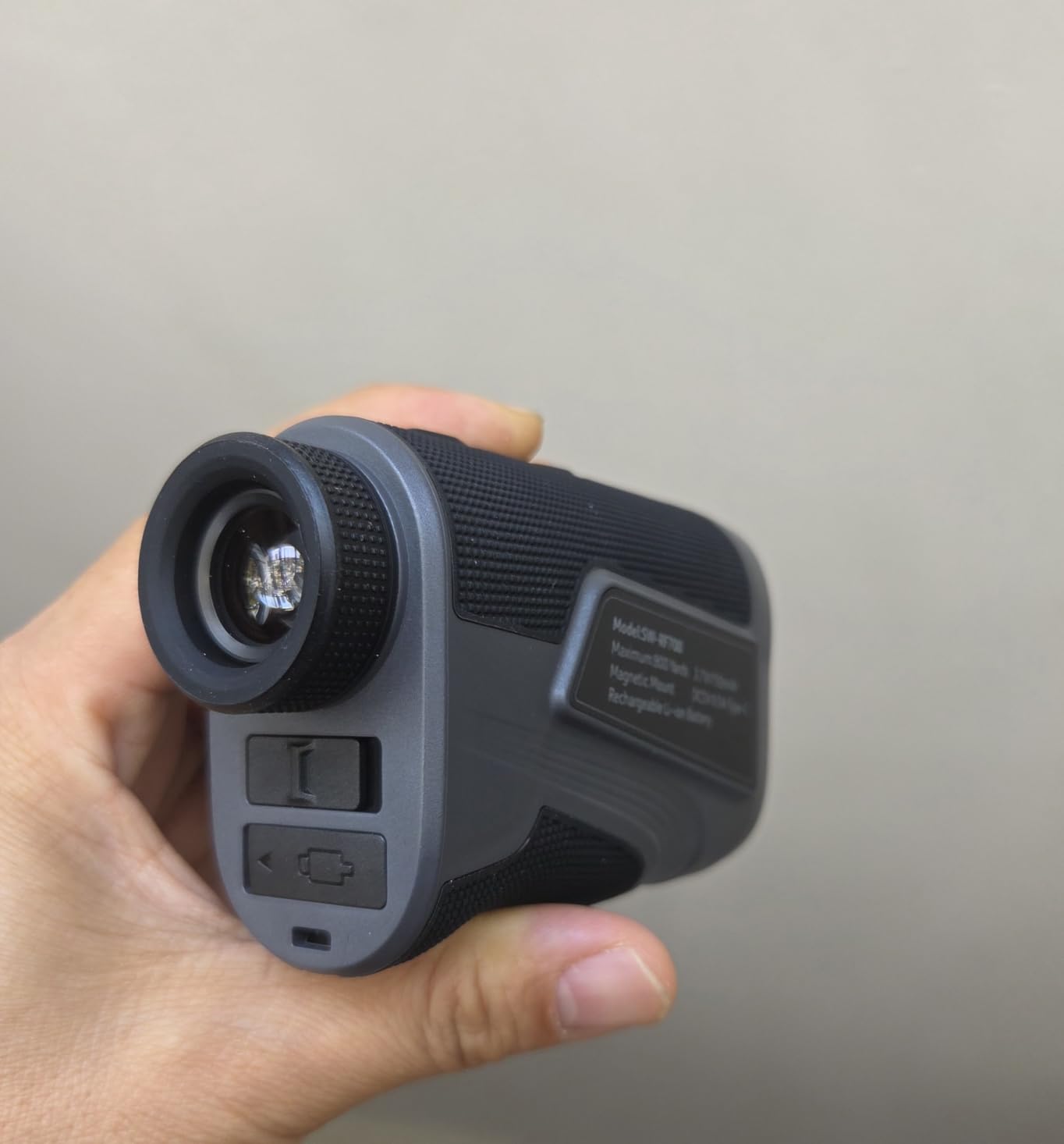
Power comes from a USB-C rechargeable lithium-ion cell, so there are no disposable batteries to pack, and the bright LCD stays easy to read on a device with no backlight system.
The honest limitation is range. At 800 yards it covers virtually every approach shot, but it will not reach a back pin on a long par five or a driver carry into a forced carry. The warranty is one year, shorter than the two-year cover on several rivals here.
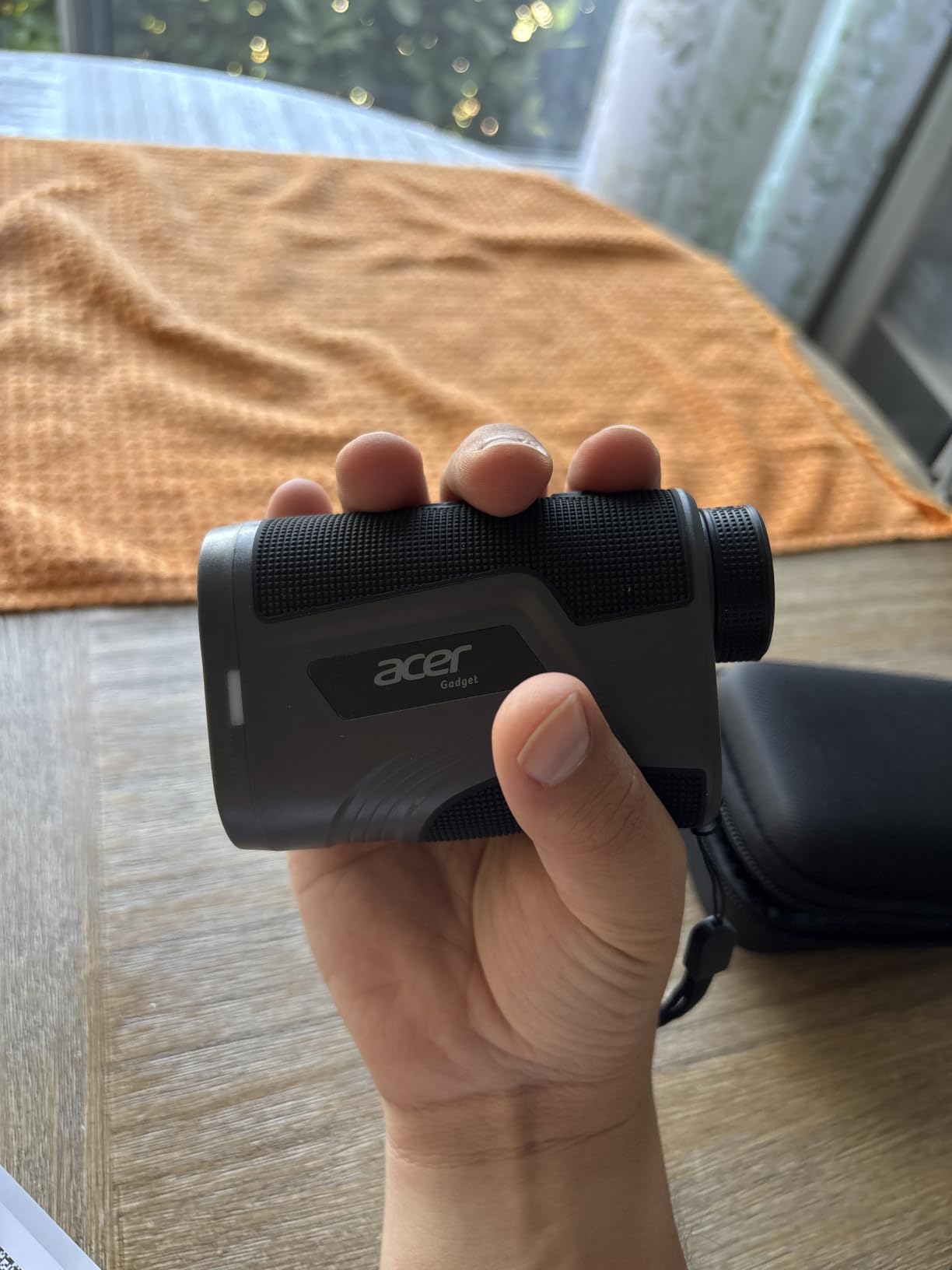
Think about tournament legality before you commit
Because this model has no physical slope switch, slope data can still appear on the readout with the mode turned off. That is genuinely useful data for practice, and it disqualifies the device in slope-restricted competitive events.
Skip it if you need a hunting scan workflow
Eight hundred yards is the shortest of the golf devices in this roundup, though it still covers a driver carry on most courses.
6. REDTIGER Golf Rangefinder: Best Magnification Under 300 Dollars
REDTIGER Golf Rangefinder with Slope On/Off,7X Magnification 1200 Yards
7x magnification
1200 yard range
0.5 yard accuracy
Transflective LCD
Six modes
Pros
- 7x magnification makes distant flags easier to acquire
- 1200 yard range at 0.5 yard accuracy
- Transflective LCD stays readable in varied light
- USB-C rechargeable rated for up to 30000 cycles
- Two year unconditional warranty with lifetime technical support
Cons
- Pin locking struggles against busy backgrounds
- Vibration sometimes fires on background objects
- Water resistant only rather than waterproof
- Must be switched into golf mode manually or readings will be wrong
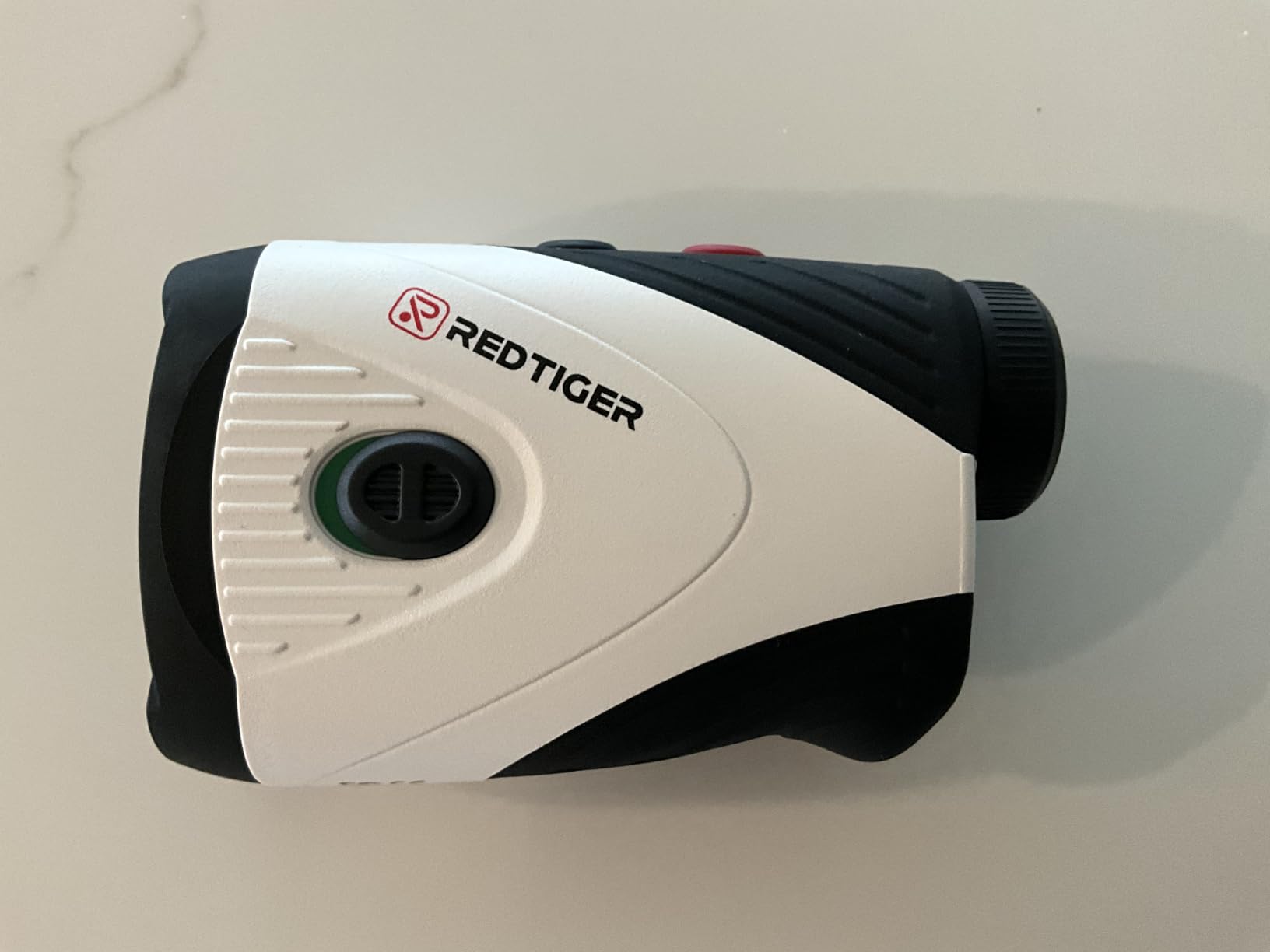
Magnification is the differentiator here. Seven times is more than any other model in the list, and it shows up in practice when you are trying to identify a flag against a wooded green or pick out a distant marker on a long par three. The transflective LCD reads well in both bright sun and shade.
Range reaches 1,200 yards with 0.5 yard accuracy, and six modes cover slope compensation, flag lock, horizontal and height ranging, speed measurement, and continuous scan. The USB-C rechargeable battery is rated for up to 30,000 cycles, and one owner reports still being on the original charge after two years.
Mounting hardware is unusually generous: a magnetic strip for clubs or cart plus a magnetic belt clip in the box, which removes the forget-it-on-the-cart problem magnetic devices create.
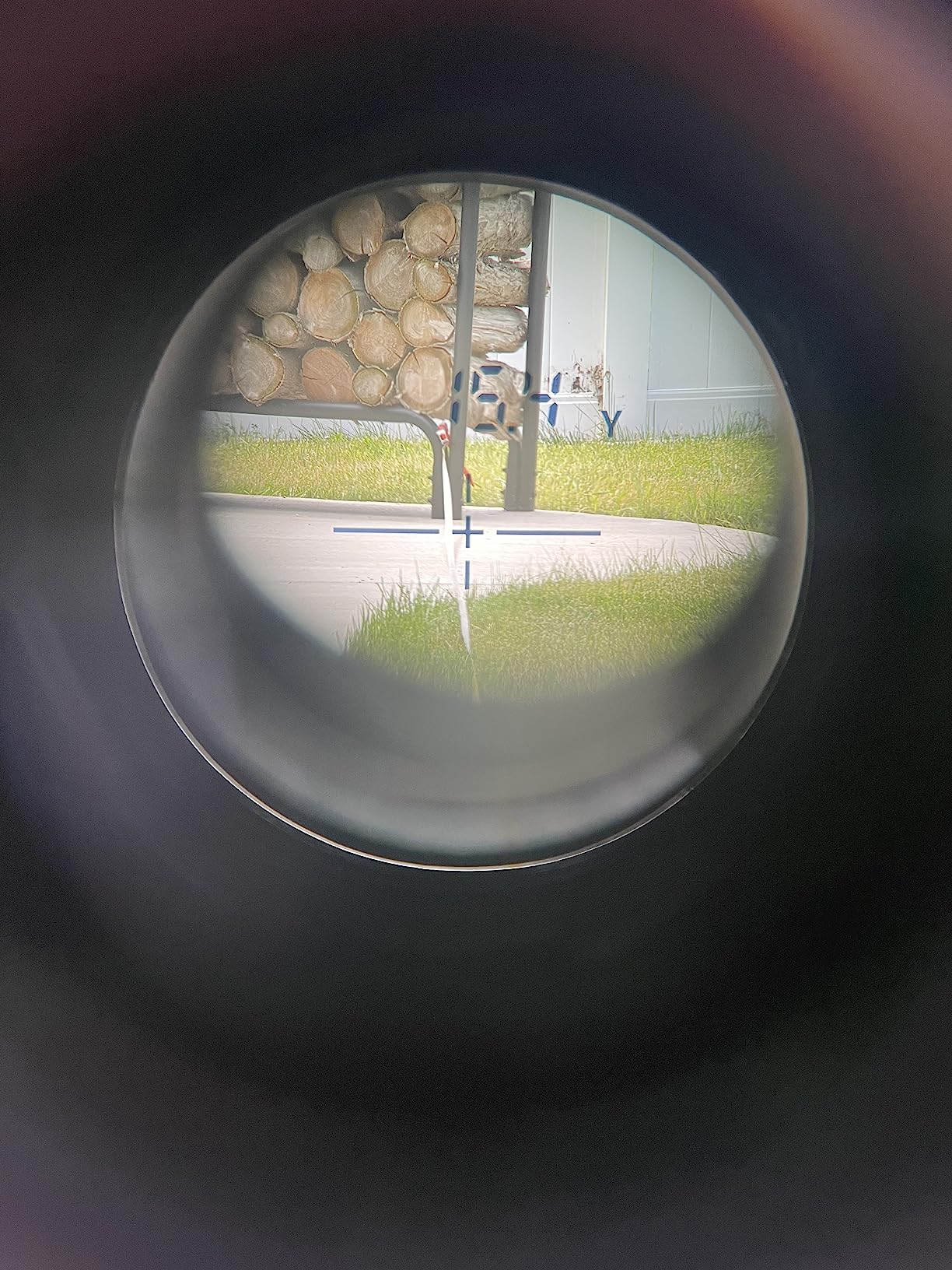
Lock-on consistency is the weakness, and it comes up repeatedly. Against trees, fans, or a crowd of spectators the vibration can fire on the background instead of the pin, and several owners describe needing two or three passes before trusting the number.
Test your expectations on flag lock before you buy
If you regularly play courses with dense tree lines behind the green, this model will demand more patience than the Callaway or the Acer. Ranging a bare pin against sky is where it feels fastest and most confident.
Skip it for hunting or for wet-weather reliability
It is water resistant rather than waterproof, so steady rain and lens fog are a real risk in the field. There is also no hunting scan workflow and no angle compensation designed for ranging game rather than flags.
7. REVASRI NK1000 Golf: Best Lightweight Golf Pick
REVASRI Golf Rangefinder with Slope and Pin Lock Vibration, External Slope Switch for Golf Tournament Legal, Rangefinders with Rechargeable Battery 1000YDS Laser Range Finder
1000 yard range
6.5x magnification
Plus or minus 1 yard accuracy
4.3 oz
USB-C rechargeable
Pros
- Weighs only 4.3 oz and measures 3.8 by 2.6 by 1.3 inches
- Fully multilayer coated lens with high light transmittance
- External slope switch makes it tournament legal
- Flag lock with vibration plus hold-to-scan for cluttered backgrounds
Cons
- 4.2 average with 9 percent of reviews at one star
- Pin lock does not always grab the flag against clutter
- Small body is harder to hold steady
- Occasional nonsensical readings reported by some owners
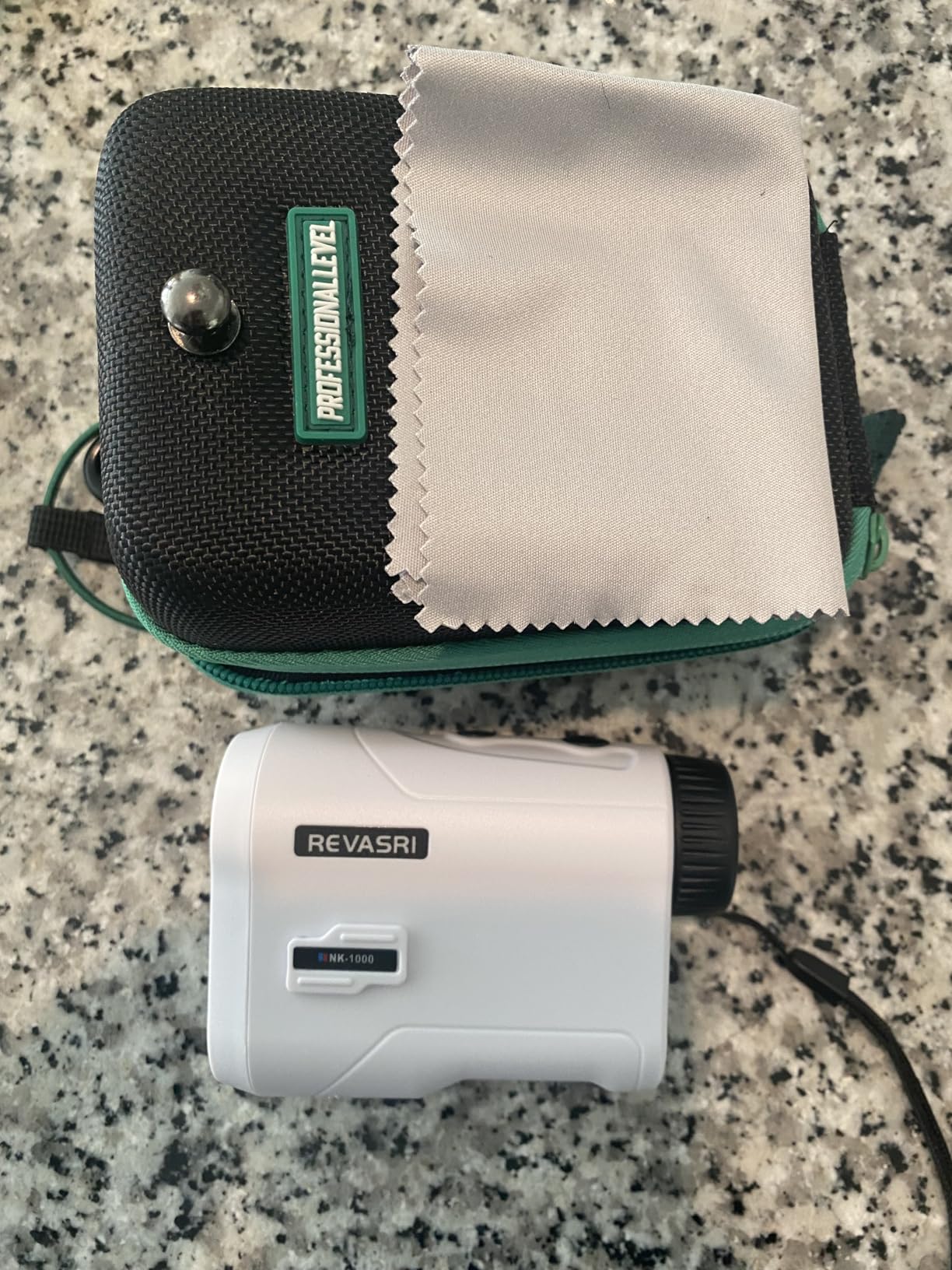
Very few devices here weigh under five ounces, and at 4.3 ounces with a 3.8 by 2.6 by 1.3 inch body this is one of the easiest to carry all day. The fully multilayer coated lens gives a clearer view than the price band suggests, and measurements arrive in about half a second.
Feature-wise it is a full golf device: external slope switch, slope compensation showing angle, line-of-sight distance and adjusted distance, flagpole lock with vibration, hold-to-scan when the pin overlaps the background, yards and meters toggle, and a low battery indicator.

More than 5,800 owners have reviewed it, so the feedback here is unusually well tested. Buyers who compare it against premium laser and golf brands report yardages matching within one to two yards.
But the profile is polarized, with 62 percent five-star and 9 percent one-star. The negatives cluster on physical handling: a small body that is hard to hold steady, an eyepiece that slips out of focus when pulled from a pocket, and occasional readings that show dashes or a nonsensical number instead of a distance.
Weigh the handling trade-off honestly
The 4.3-ounce body is a genuine benefit if you walk courses or hunt all day, and the coated lens keeps the view usable. Buyers who value a rock-solid grip and a fixed focus diopter will be happier with a larger body.
Skip it if you need consistent pin lock or long-range capability
Flag lock against trees and spectators is the weak point, and the warranty runs only one year. It also has no cart magnet, so you will need a separate mount or a pocket.
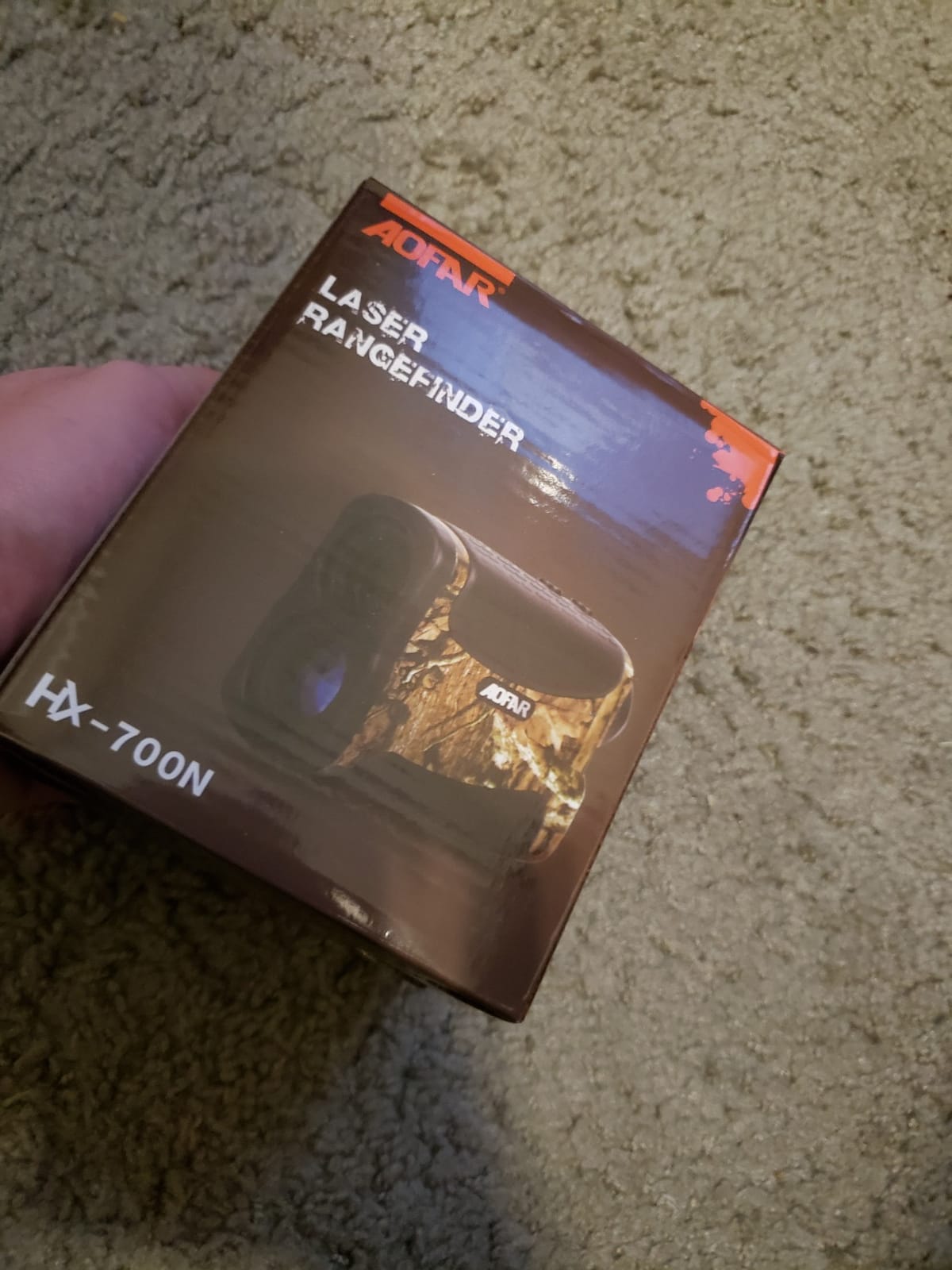
8. AOFAR HX-700N: Best Rugged Budget Hunting Rangefinder
AOFAR HX-700N Hunting Range Finder 700 Yards Waterproof Archery Rangefinder for Bow Hunting with Range and Speed Mode, Free Battery, Carrying Case
5-700 yard range
6x magnified imaging
Plus or minus 1 yard accuracy
180 g
IP54 waterproof
Pros
- Verified against tape measures by owners at within one yard
- Waterproof and dustproof rugged construction
- Reported to survive a 20 foot drop
- Complete accessory kit with pouch and CR2 battery
- Two year VIP warranty with lifetime support
Cons
- Bulky in the hand at 180 g
- Reticle and readout do not illuminate so it cannot be used in the dark
- Only two modes and no slope or height measurement
- Carry pouch is tight and slow to draw from
This is the durability pick. Owners check it against a tape measure and get readings within a yard, and one reports it surviving a 20-foot drop without damage. Waterproof and dustproof construction means rain and mud are not a concern.
Advanced pin sensor technology drives 6x magnified imaging from 5 to 700 yards at plus or minus 1 yard accuracy. Range and speed modes are all you get, and the kit is generous: a pouch with a belt loop, a CR2 battery, a carabiner, a 550 cord lanyard, and a cleaning cloth.
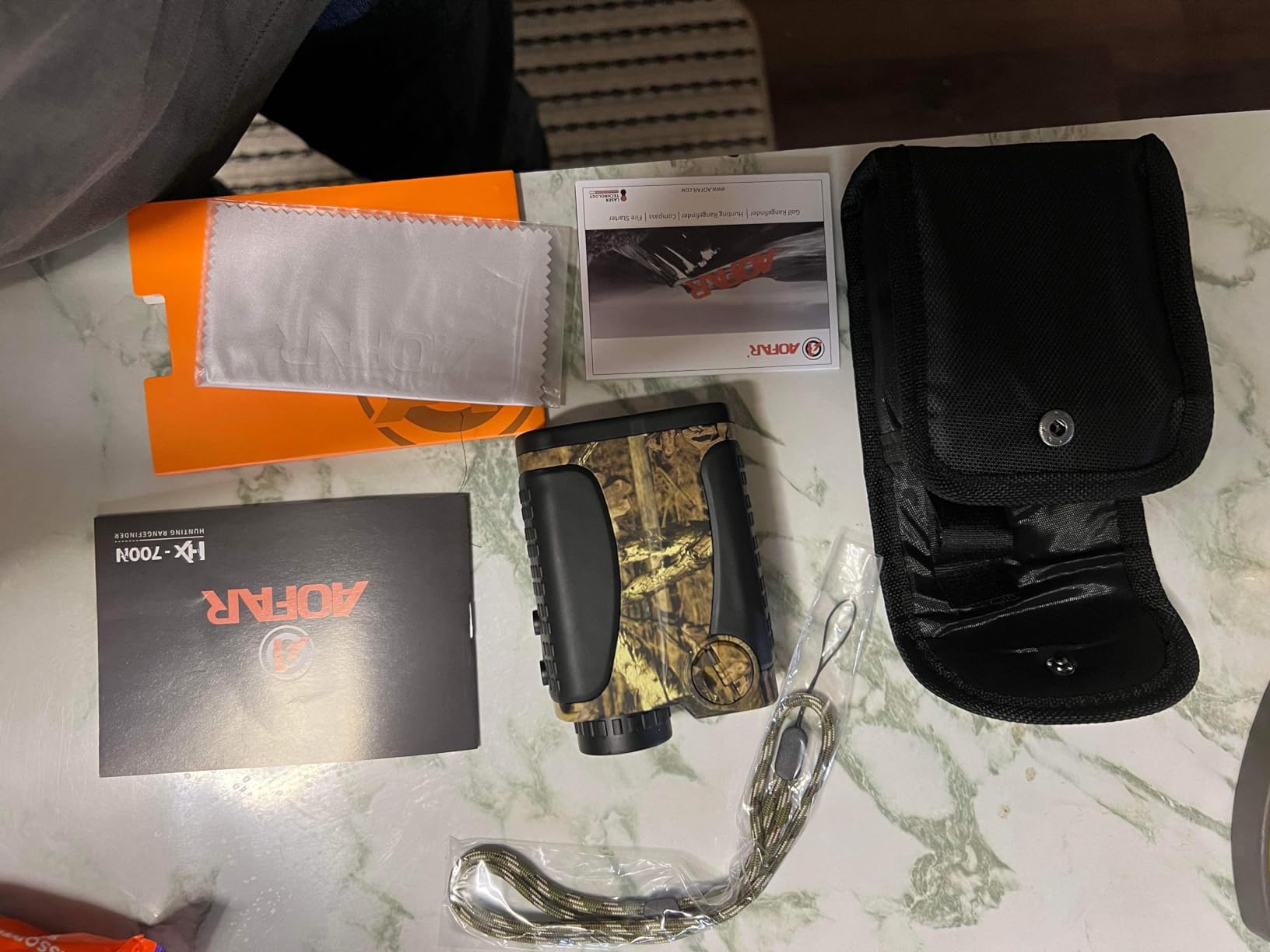
The two-year VIP warranty with lifetime customer support is a stronger commitment than most budget hunting devices offer. That matters because forum readers repeatedly flag dropped devices as the biggest real-world failure, and electronics coverage is where budget warranties usually get vague.
Two complaints recur. At 180 grams it feels bulky in the hand next to units in this list that weigh under five ounces, and the crosshairs and range readout do not illuminate at all, so this device is unusable in darkness. That last point disqualifies it for anyone hunting at last light.
Check your typical shooting light first
If your season ends well before dark, the lack of illumination costs you nothing. If you regularly shoot through the last 30 minutes of light, an unilluminated display is a deal breaker regardless of how rugged the body is.
Skip it if range or measurement depth matters
Seven hundred yards covers timber hunting well but not open-country big game, and two modes means no height, no slope, and no scanning workflow. It is also the bulkiest option here for anyone counting ounces.
9. REVASRI Hunting Rangefinder 1000Y: Best Multi-Mode Hunting Pick
REVASRI Hunting Laser Rangefinder with Rechargeable Battery 1000 Yards Hunting Range Finder with Target Acquisition Technology Easy-to-Use Clear Accurate Rangefinders for Hunters
1000 yard range
6.5x magnification
Plus or minus 1 yard and 1 degree
4.23 oz
Rechargeable Li-ion
Pros
- Seven functions including golf distance compensation and two point height
- Reopens the last-used mode at power on
- Continuous scan updates angle height horizontal and straight line readings
- Weighs just 4.23 oz for a 1000 yard range
- Rechargeable built-in battery with USB-C charging
Cons
- No built-in magnet or cart mount
- Only a one year warranty
- Listing dimensions conflict between the spec sheet and feature copy
The feature density here is unusual for the tier. Seven functions cover ranging, all-in-one, scanning, speed measurement, two-point height measurement, golf distance compensation, and storage, with mode memory that reopens whatever you were using when you powered down.
Continuous scan is the mode that earns its place in the field. One press updates angle, height, horizontal, and straight-line distance across multiple targets, which is how you measure a deer relative to the tree behind it without ranging twice.
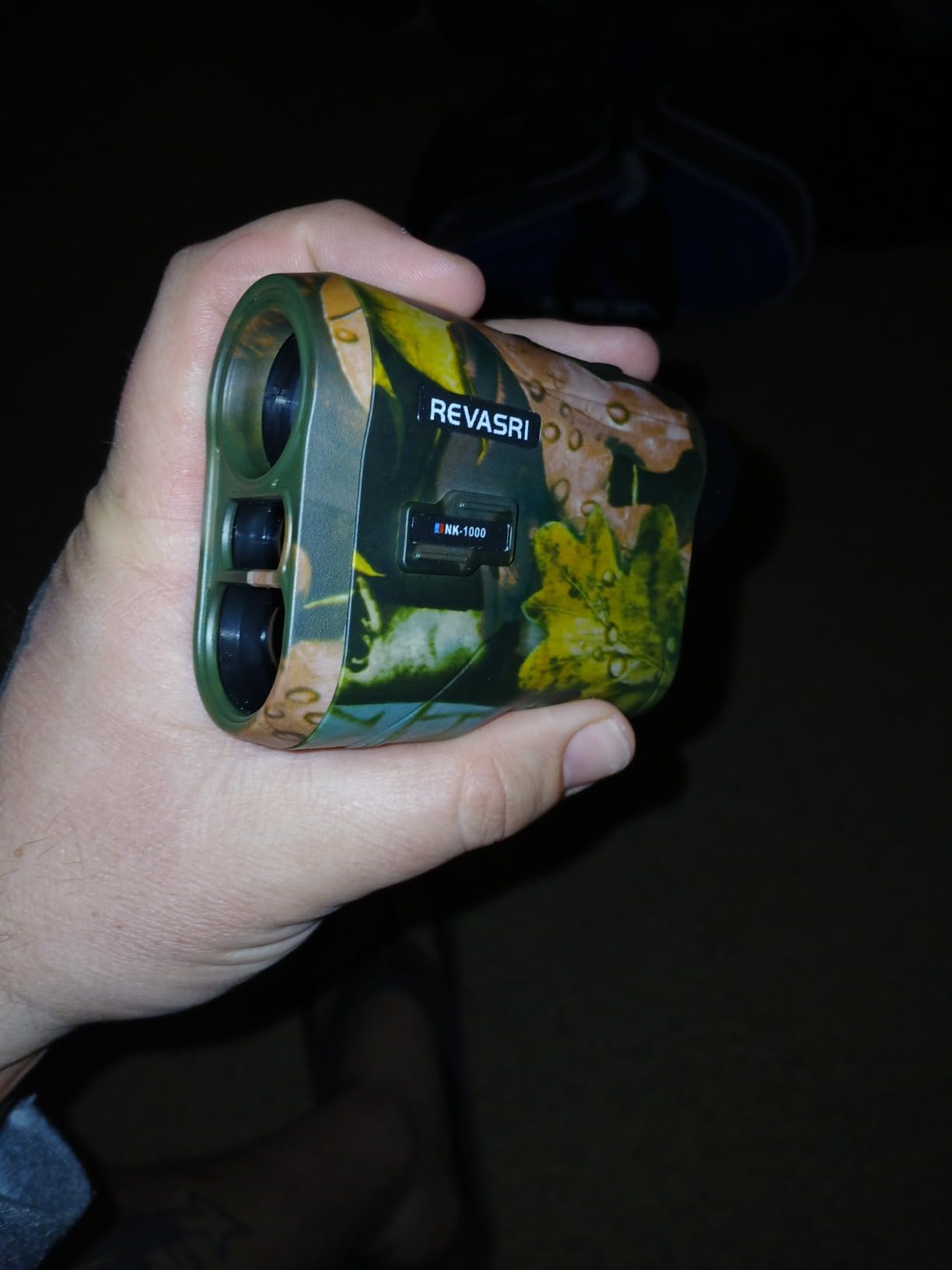
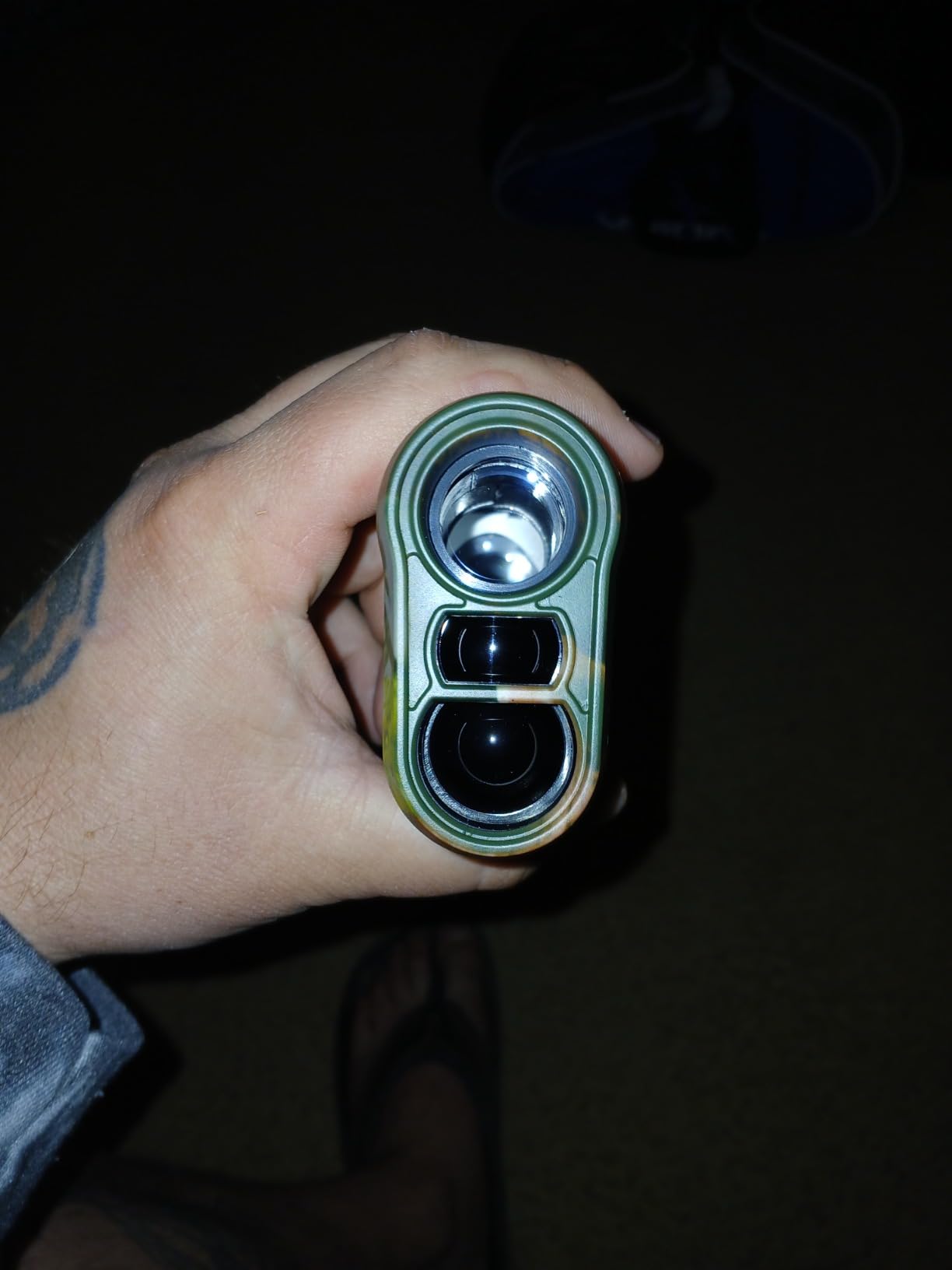
Optics are 6.5x with a multilayer coated lens and a transmissive LCD that reviewers note stays clear for eyeglass wearers. It measures 1,000 yards at plus or minus 1 yard distance and plus or minus 1 degree angle, and the rain-proof body weighs just 4.23 ounces.
The built-in rechargeable lithium-ion cell charges over USB-C, so there are no disposable cells to lose in a pack. The included case, cable, lanyard, and lens cloth cover the rest.
Look at mode memory before your next trip
Reopening the last-used mode is a small feature that saves real friction when you are pulling the device one-handed in the dark. The two-point height routine also makes it useful for muzzleloader shooters who drop targets at differing elevations.
Skip it if you golf or need a cart mount
The golf compensation mode is a bonus rather than a golf device, with no pin finder and no tournament slope switch. There is also no magnet, and the one-year warranty is short.
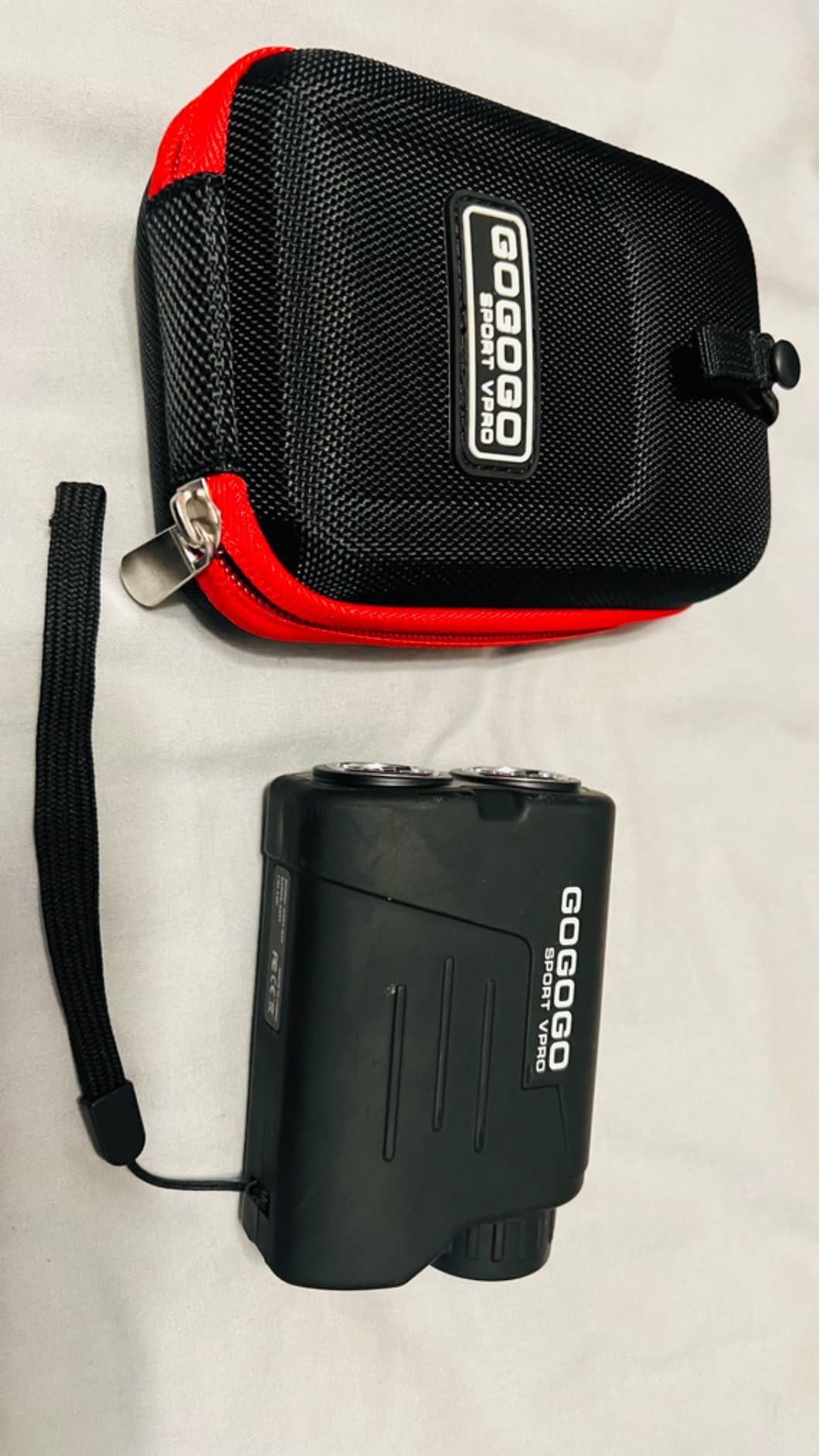
10. Gogogo Sport Vpro GS03: Best Dual-Sport Golf and Hunting Pick
Gogogo Sport Vpro GS03 Laser Golf/Hunting Rangefinder, 1000 Yards
5-1000 yard range
6x magnification
Plus or minus 1 yard accuracy
Golf and hunting modes
IP54
Pros
- Three purpose built modes for golf with slope
- hunting with silent scan
- and speed
- Replaceable CR2 battery means no charging downtime
- Reports accuracy matching devices costing several times more
- Reported to survive drops from tree stands and golf carts
- Doubles as a 6x monocular for glassing and sightseeing
Cons
- No magnet for cart attachment
- Weak low-light performance especially at dusk
- Skinny flagsticks are picked up less reliably
- Holds accuracy to about plus or minus 3 yards on wooded courses
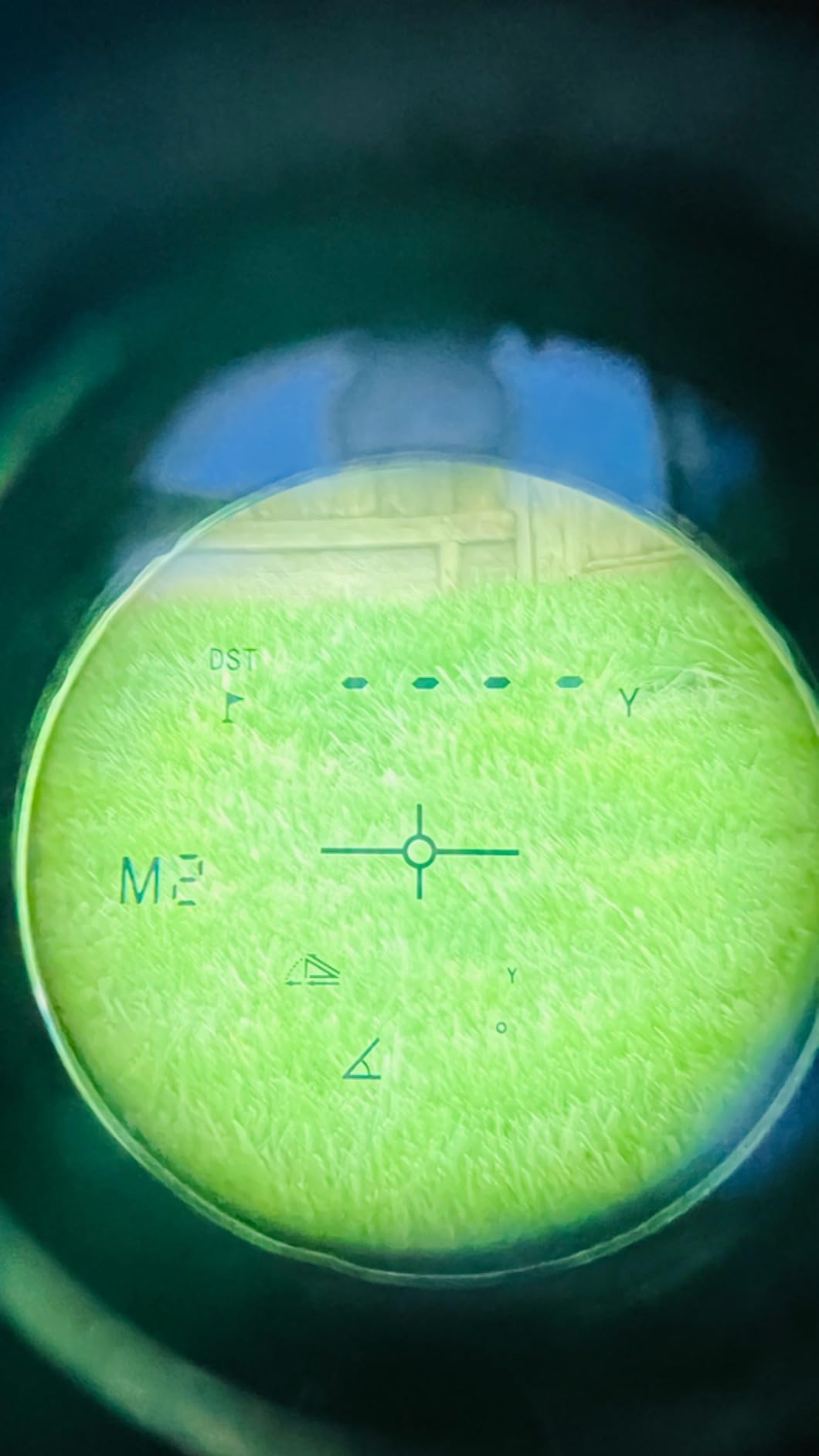
Most people who hunt and golf end up carrying two devices. This one does both. Mode 1 is hunting with a silent straight-line scan, mode 2 is golf with slope-adjusted distance, line-of-sight distance, angle and flag-lock vibration, and mode 3 measures speed from 0 to 300 km/h.
Flag lock reaches 250 yards with a 300 yard extended lock, and one-button operation handles measurement and the yard, meter, feet toggle. A replaceable CR2 battery means no charging downtime and no gradual degradation from a built-in cell, which is a quiet advantage for a device left in a vehicle all season.
Long-term owners describe accuracy within a yard or two of devices costing three to four times more, and report it surviving drops from tree stands and golf carts plus repeated moisture exposure. It also works as a 6x monocular for bird-watching and scenery, which quietly justifies the weight at 150 grams.
Weaknesses are consistent across reviews. There is no magnet, so it cannot live on a golf cart frame. Skinny flagsticks are picked up less reliably than on costlier models, and low-light performance at dusk is among the weakest in this roundup.
Check the last-light condition you actually shoot in
This model reads fine in daylight and ordinary shade. Deep dusk with a dark background is where the display falls behind a TOLED panel, so late-season deer hunters should weigh that against the convenience of one device for both sports.
Skip it if you golf seriously or shoot thin flagsticks
Readings can vary by about three yards on wooded courses, and the scan mode is less trustworthy than the standard flag lock. Golfers who compete will also want a physical slope switch, which this model does not have.
What the Extra Money Above a Cheap Rangefinder Actually Buys You
The honest answer to the most common question in rangefinder forums is that cheap devices measure distances correctly. Several budget models here are verified by owners against tape measures, and their stated accuracy sits at plus or minus 1 yard or better. Distance is not where the money goes.
Here is what the step up actually buys, in order of how much it matters in the field:
Display technology. A red TOLED panel reads in low light where an unilluminated LCD is unusable. If you hunt at dawn or dusk, this is the single biggest jump between tiers.
Optics and glass. HD optical systems with select glass elements and multi-layer or XR coatings reduce chromatic aberration and hold contrast against a dark tree line. Range a deer across an open field and a cheap body can do it; range one through timber at last light and you need the better glass.
Range compensation that matches your sport. HCD and LOS modes, inclinometers, two-point height measurement, and scan functions cost nothing in parts and everything in refinement. Ranging the tree rather than the deer is the field technique that makes elevation correct.
Warranty that covers electronics. The Vortex VIP policy and the AOFAR two-year support are real differences. Budget devices often carry one-year policies, and circuit boards are the part most likely to fail.
Speed and lock consistency. Sub-half-second readings and a pin finder that actually holds on a cluttered background stop you from shooting a bad number. Accuracy on paper does not help if you cannot get the lock.
Field tip worth repeating because it is the most common setup error: confirm your device defaults to compensated mode, and when in doubt range a tree trunk behind the animal rather than the animal itself. Grazing animals present an angled surface that confuses some units.
How to Choose a Rangefinder in This Budget
Buy for your sport first. Golf devices optimize for flags, slope, and pin lock. Hunting devices optimize for trees, brush, and scanning. Buying a golf device for deer hunting leaves you without horizontal compensation, and buying a hunting device for golf leaves you without a pin finder. Angle compensation is usually called HCD, LOS, or TBR depending on the brand; the words mean different things, so read what the unit actually displays before you rely on it.
Ignore maximum range as a ranking criterion. Maximum range is measured against reflective surfaces. What matters is range on game, and the number that matters even more is how clearly you can read the display at 60 yards in timber. Several strong hunting devices here top out at 700 yards and work perfectly for eastern deer.
Check display type against your light. TOLED and OLED panels drive brightness hard and stay readable at low output. A transflective LCD uses ambient light and improves outdoors but fades in dim conditions. A plain LCD with no backlight is a daylight-only tool, and illumination is worth verifying before buying a dark-hour device.
Look at waterproofing and the battery. IP54 covers splash, dust, and steady rain. IPX7 means submersion tolerance. Rechargeable cells remove spare batteries but age over years, while a replaceable CR2 or AAA cell never degrades and costs nothing to swap in the field.
Verify the electronics warranty and the default mode. Buyers drop devices out of tree stands, and glass and housing coverage is often separated from electronics coverage. Turn the unit on before you rely on it in the field and confirm slope or HCD is active by default.
For golfers, check tournament rules. A physical slope switch is the cleanest solution because it makes the device legal on demand. Units with a software-only slope mode may still display slope data with the mode off, which disqualifies them in slope-restricted events.
Frequently Asked Questions
What is the best rangefinder for your money?
The Callaway 300 Pro is the strongest single purchase in this class. It covers 5 to 1000 yards at plus or minus 1 yard, adds a tournament-legal external slope switch, locks the pin out to 300 yards with a vibration pulse, and includes a hard case and cart magnet. It handles golf rounds and works as a basic deer-hunting rangefinder from the ground or an elevated stand.
Are cheap rangefinders any good?
Yes for distance. Several budget devices here are verified by owners against tape measures and read within a yard. What you give up is display readability at dawn and dusk, optical contrast through timber, range compensation depth, and electronics warranty coverage. Buy cheap for daylight golf and casual deer work; step up when your season ends after sunset.
Can I use a golf rangefinder for hunting?
Only for short-range deer work. Golf devices range flags, which are vertical poles, and their slope logic is tuned for a green. Hunting from a treestand you need horizontal component distance so an angled range returns the true ground distance your bow is sighted for. A golf device will give you line-of-sight numbers that are too long when you shoot downhill.
Is a rangefinder with slope worth it?
For golfers, yes if you practice with it and switch it off for sanctioned rounds. A physical slope switch makes that change instant. For hunters, slope compensation is not optional but it is not the same feature: you want HCD or TBR-style correction for angled positions rather than a golf slope reading. Check that the unit defaults to compensated mode out of the box.
How much should I spend on a rangefinder?
Under 100 dollars covers daylight use, basic ranging, and short-range hunting. Between 100 and 200 dollars adds better optics, rechargeable power, and more measurement modes. Above 200 dollars you are paying for display technology, warranty coverage, and lock consistency, which is where hunting at last light actually requires the extra money.
Do I need a rangefinder if I only shoot inside 40 yards?
If you hunt from an elevated stand, yes. Even at 40 yards the animal is often 15 to 20 feet below you, and line-of-sight distance will read longer than the true horizontal distance your bow is sighted for. Ranging the tree trunk beside the deer gives a clean reading. If you only shoot from ground level inside 40 yards, it is optional.
Bottom Line
The Callaway 300 Pro is the best rangefinder under 300 dollars for most readers because it is the only device here that handles tournament-legal golf and basic hunting in one body. Golf-only shoppers who want the tightest accuracy should look at the Acer Gadget, and bowhunters who want the sharpest glass at last light should save for the Vortex Crossfire HD 1400. If you want the most capable device for the least money, the TIDEWE hunting model pairs fast readings and a very light body with a rechargeable battery you will not have to think about.
Whichever you choose, turn the compensation on before you rely on it and range a tree rather than the animal. If you want a wider look at the format, our guides to bow hunting rangefinders and angle compensation models for tree stands go deeper on each use case. Check the latest listing details before you order, since model turnover in this category moves fast.