There is a moment in elk season that decides the hunt. You are sitting on a basin edge forty minutes before legal shooting light, the herd is still a smudge of tan against the far timber, and you need to know whether that shape is a legal cow at six hundred yards or a bull at nine hundred. Rangefinder binoculars were built for that moment: they put glass and a laser distance meter in one package, so you identify the animal and know the distance without breaking your glassing rhythm or reaching for a second device.
Elk country punishes impatience. Herds often sit six hundred to a thousand yards out in open basins, and the shots that matter most come downhill, where the raw line-of-sight range reads far longer than the true horizontal distance your bullet needs. That is why every optic on this list carries angle compensation, and why the magnification debate between 10×42 and 12×50 keeps coming up in hunting forums. If you want the short version of the separate-glass argument, we covered it in our rangefinder binocular picks for western hunts.
For this guide we compared ten true binocular rangefinders, all 10×42 configurations, reading the ranging engine, the glass, the ballistics menu and the owner reviews rather than the marketing headline. Roughly 880 owner reviews went into the analysis. What follows is ordered by how the optics perform in the places elk hunters actually glass: dawn basin scans, timber edges, staging areas and steep downhill angles.
Table of Contents
Top 3 Picks for Best Rangefinder Binoculars for Elk Hunting in October

Vortex Fury HD 5000 10×42
- 10x42 HD optics
- 5000 yard reflective range
- HCD and LOS modes
- Red OLED display

SIG SAUER Canyon 10×42
- 1500 yard game range
- Archery and ballistic modes
- Lightwave DSP engine
The Vortex Fury HD 5000 takes the top slot because it does the unglamorous things well: a bright red OLED readout, angle-compensated HCD ranging beside an advanced line-of-sight mode, a field of view that covers roughly 321 feet at a thousand yards, and a transferable lifetime warranty. It is not the sharpest glass in this group, and it does not ship with cartridge ballistics, but it is the one we would hand a hunter who glasses eight hours a day.
The Halo K2000 is the value pick, and owners comparing it to pricier glass regularly say they came away surprised. The SIG SAUER Canyon takes the bowhunter slot because it publishes a non-reflective game range of 1,500 yards on deer and elk, carries a dedicated archery ranging mode, and includes eight onboard ballistic groups.
All 10 Rangefinder Binoculars for Elk Hunting in 2026 at a Glance
| Product | Specifications | Action |
|---|---|---|
| Vortex Fury HD 5000 10×42 |
|
Check Latest Price |
 Astra Optix HBX1600B 10×42 Astra Optix HBX1600B 10×42 |
|
Check Latest Price |
 Bushnell Fusion X 10×42 Bushnell Fusion X 10×42 |
|
Check Latest Price |
| Halo K2000 10×42 |
|
Check Latest Price |
| SIG SAUER Canyon 10×42 |
|
Check Latest Price |
 Vortex Ranger HD 3000 10×42 Vortex Ranger HD 3000 10×42 |
|
Check Latest Price |
 Leupold BX-4 Range HD 10×42 Leupold BX-4 Range HD 10×42 |
|
Check Latest Price |
 Swarovski EL Range 10×42 Swarovski EL Range 10×42 |
|
Check Latest Price |
 SIG SAUER KILO10K ABS HD 10×42 SIG SAUER KILO10K ABS HD 10×42 |
|
Check Latest Price |
 SIG SAUER KILO6K HDX 10×42 SIG SAUER KILO6K HDX 10×42 |
|
Check Latest Price |
1. Vortex Fury HD 5000 10×42 — The Best All-Round Elk Rangefinder Binocular
Vortex Fury HD 5000 10×42 Laser Rangefinding Binoculars
10x42
5000 yd reflective
HCD and LOS
4.2 mm exit pupil
321.6 ft FOV at 1000 yd
Pros
- Accurate ranging praised on game and reflective targets
- Wide field covers a whole stage or scan in one view
- Glass stays clear from dawn to dusk
- Transferable lifetime warranty
Cons
- Heavier than entry-level 10x42 glass
- Non-illuminated black reticle can vanish on dark backgrounds
- No applied ballistics for specific cartridges
This is the optic we kept coming back to. Owners call it the best rangefinding binocular they have used, and the reason shows up in the ratings: 88% of the reviews on this model are five-star, with just 2% at one star. The ranging engine is the least controversial part. Reviewers describe it as accurate on game and reflective targets without qualification, which is more than can be said for several competitors here.
The Fury pairs angle-compensated HCD ranging with an advanced line-of-sight mode, so you can confirm how much of the number is slope. Best Mode and Last Mode target selection matter more in elk country than most spec sheets admit: when you are watching a group of eight animals in brush, picking the correct one before the laser fires saves seconds you do not have.
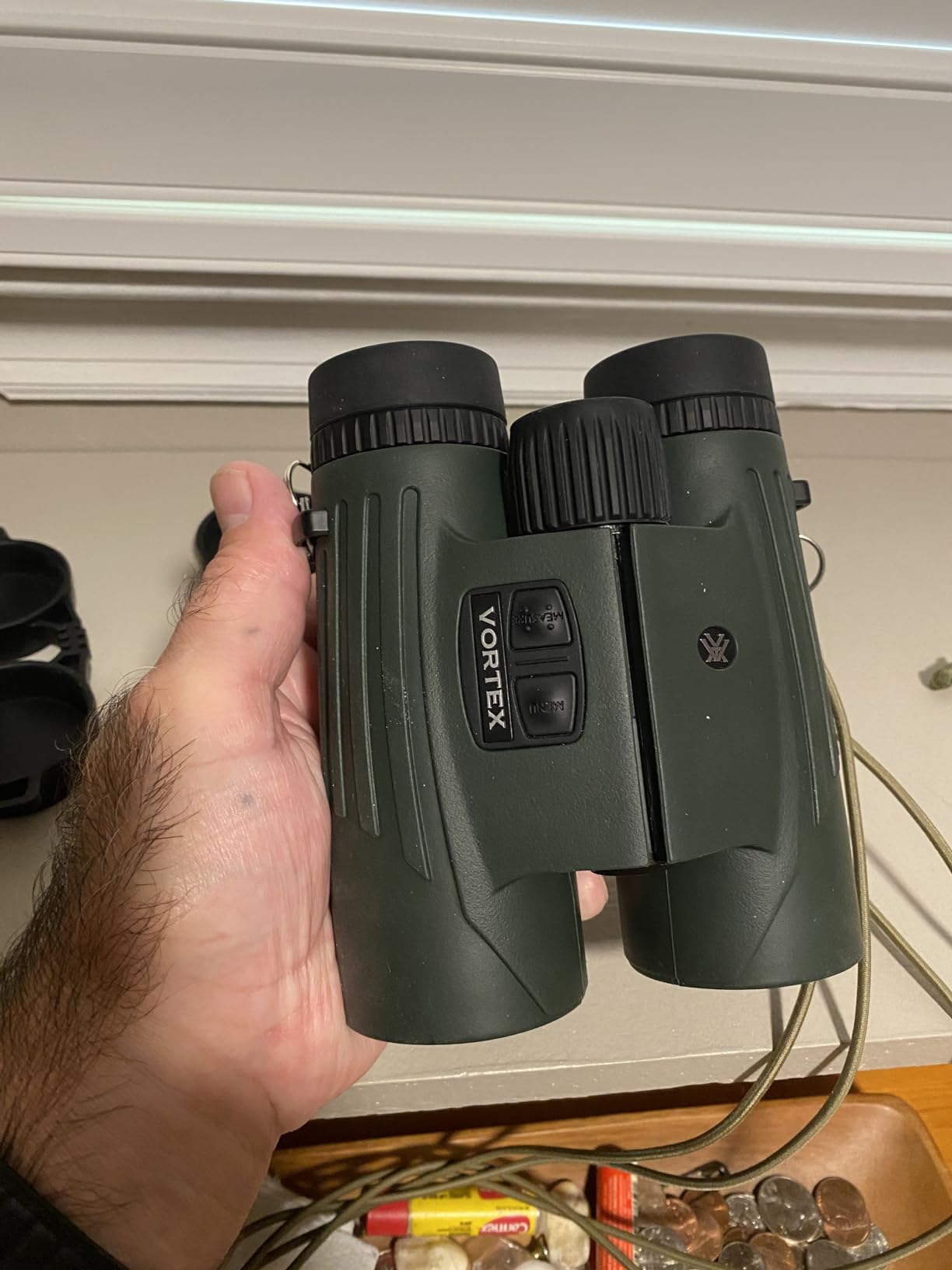
Glass is the tradeoff. The 10×42 configuration uses fully multi-coated HD lenses with dielectric phase-corrected prisms, and it holds up from first light to last. It simply is not the flagship glass in this group. For pure twilight transmission you would choose the Swarovski; for sharpness at a comparable price in this class, the Fury is hard to argue with.
Two practical details matter more than the marketing. The 321.6 foot field of view at a thousand yards is wide enough to sweep a staging area without panning constantly, and 16 mm of eye relief means it works with prescription glasses. The unit is nitrogen purged, waterproof and fogproof, and it has a tripod mounting point for ridge-scout setups.
How the Fury handles a downhill cow shot
Angle compensation is the feature that earns its keep in the mountains. When you are looking down a 25 degree slope at a cow six hundred yards out, the raw line-of-sight distance overstates the shot; HCD mode gives you the true horizontal figure you need to dial into a ballistic solver or drop card.
For archery hunters, note what is missing. There is no applied ballistics package here, so if you shoot a bow at 70 yards downhill you are doing the drop yourself. For rifle hunters running a solver in a phone or a Kestrel, the horizontal component is all you need.
Where the Fury is the wrong choice
If you spend the season on a glassing tripod with a spotting scope, the Fury is overkill as a primary glass and you would be better served by dedicated low-light glass plus a pocket rangefinder. Members on LongRangeHunting make exactly that argument for elk, and it is a reasonable one.
Second, the reticle is a non-illuminated black display. On a dark timber edge at last light that readout becomes hard to place, and while the OLED display itself is red and legible, the reticle presentation is the older style. Buy it for range and field of view, not for pre-dawn display finesse.
2. Astra Optix HBX1600B 10×42 — The Budget Rangefinder With More Modes Than You Need
Astra Optix HBX-1600B 10×42 1760-Yard Laser Rangefinder Hunting Binoculars
10x42
1760 yd reflective
800 yd on deer
7 ranging modes
0.15 second acquisition
Pros
- Optics and collimation unusually good for the class
- Smooth focus and interpupillary adjustment
- Angle-corrected and ballistics modes included
- Harness and CR2 battery in the box
Cons
- Black non-illuminated display is hard to read at dawn
- Included harness straps poorly sized for larger adults
- Actual game range falls short of the reflective figure
The HBX1600B sits at the entry point of this group and it does something the others mostly do not: it publishes an honest game range. The spec sheet lists 1,760 yards on reflective targets, 1,000 yards on trees and 800 yards on deer. That third number is the one that matters to an elk hunter, and having it printed on the product is rarer than it should be.
The mode list is long. Ballistics, scan, horizontal angle-corrected, angle with line-of-sight, archery, gun and golf modes are all there, and ranging speed is quoted at 0.15 seconds. Several owners report shooting elk with these in harsh weather, which is the real test. You can dial the menu down to horizontal or angle mode and ignore the rest for the entire season.
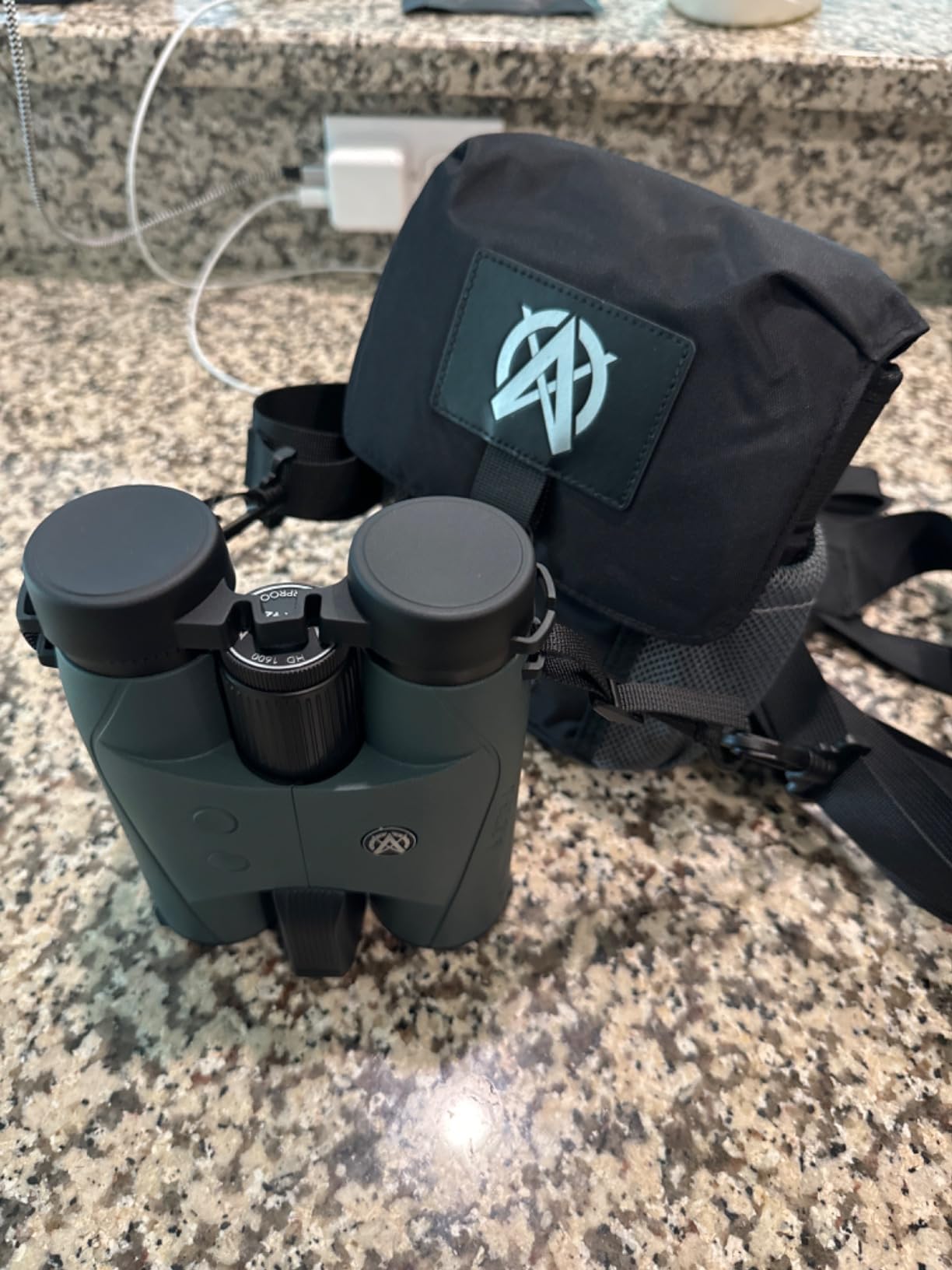
Optically, the all-glass system with silver-coated prisms surprises people. Owners single out the collimation and the smooth focus ring, and a few report using them for hours of glassing without eye strain. Eye relief of 15.1 mm and a 330 foot field of view at a thousand yards keep the picture comfortable and wide.
The rating spread is the widest in this group, and the reason is worth knowing before you buy. 59% of reviews are five-star, but 10% are one star. The complaints cluster on the black non-illuminated display, harness straps sized for smaller frames, and on some examples a loose battery contact that caused intermittent power. One international owner reports condensation and drifting range performance after two years.
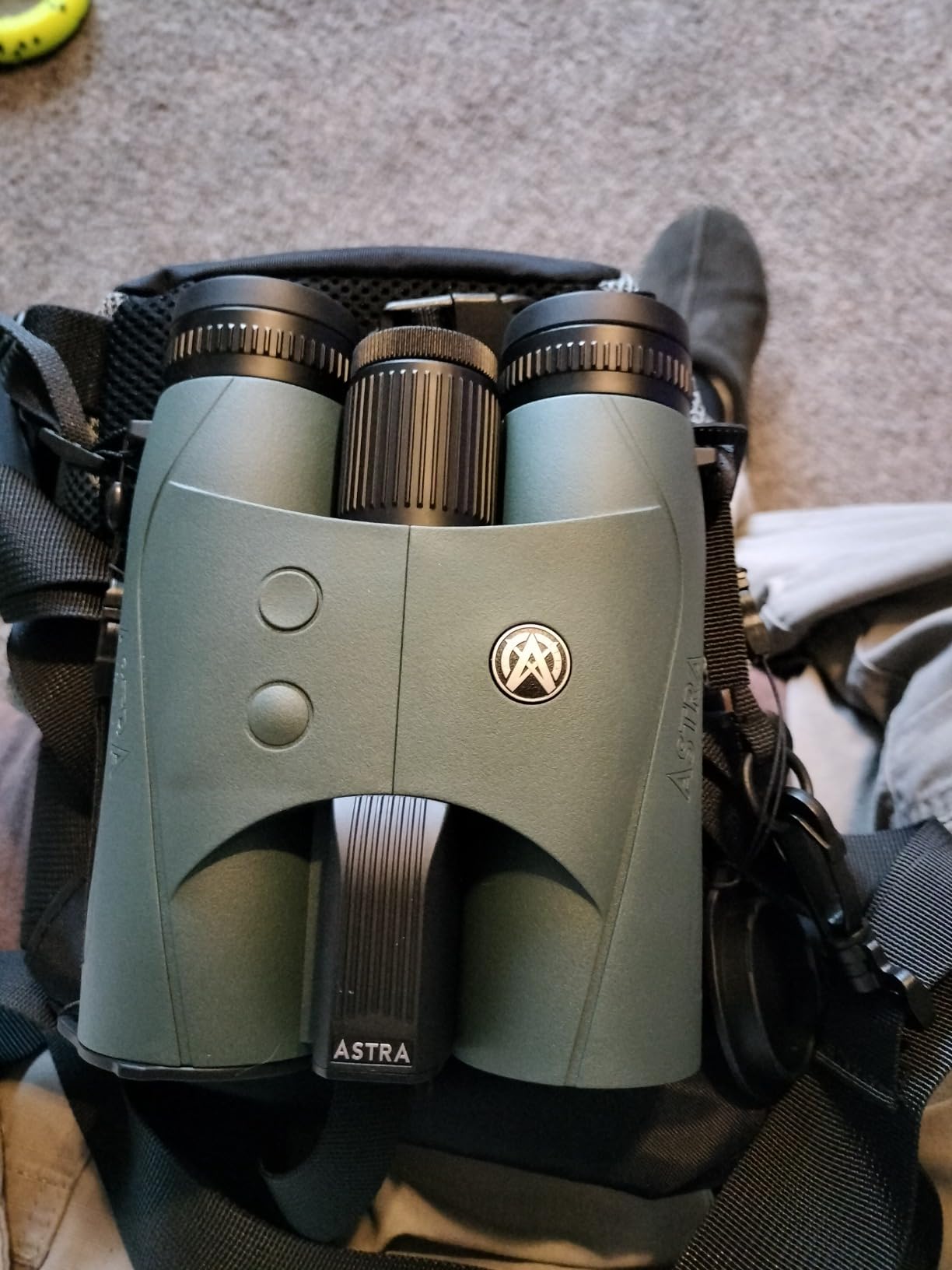
What the included harness actually gets you
It is a real chest harness, not a neck strap, and on a long day of glassing that keeps the binocular against your sternum instead of bouncing off your collarbone. The complaint we saw most was sizing, so plan on adjusting the straps or swapping in your own harness.
The CR2 lithium battery is included. That is a cold-weather liability worth reading the battery section for, since CR2 cells lose meaningful capacity on November mornings in the high country.
Where this budget optic falls short
800 yards on deer is enough for most elk situations and short for the ones where a herd is working a far timber line. Owners also report that the advertised reflective figure does not translate to live animals, which is the standard behavior for every laser rangefinder rather than a fault specific to this model.
Condensation appearing on a two-year-old unit is the report that gives us pause. If you buy it, keep a spare battery and a microfiber cloth in the same pocket as the harness.
3. Bushnell Fusion X 10×42 — The Best Rangefinder Binocular for Dawn and Dusk Glassing
Bushnell Fusion X 10x42mm Ranging Binoculars, ARC Technology
10x42
700 yd range
ARC compensation
ActivSync display
IPX7 rated
Pros
- ActivSync display readable in any background or light
- ARC gives true horizontal distance on slopes
- Sharp HDOS optics with good transmission
- IPX7 rated for submersion
Cons
- 700 yard range is the shortest here
- Bulkier and heavier than dedicated 10x42 glass
- Smaller pool of owner reviews
The Fusion X earns its place for one feature: ActivSync. The reticle and display auto-adjust between black and red, which means the readout stays visible whether you are silhouetted against snow, sky or a dark timber wall. On an elk hunt that starts before first light, a display you do not have to squint at is worth more than another thousand yards of advertised reflective range.
ARC angle compensation is accurate to plus or minus one degree of angle and shows line-of-sight and true horizontal distance simultaneously. On a steep downhill shot across a drainage you can watch both numbers settle and know which one your rifle needs.
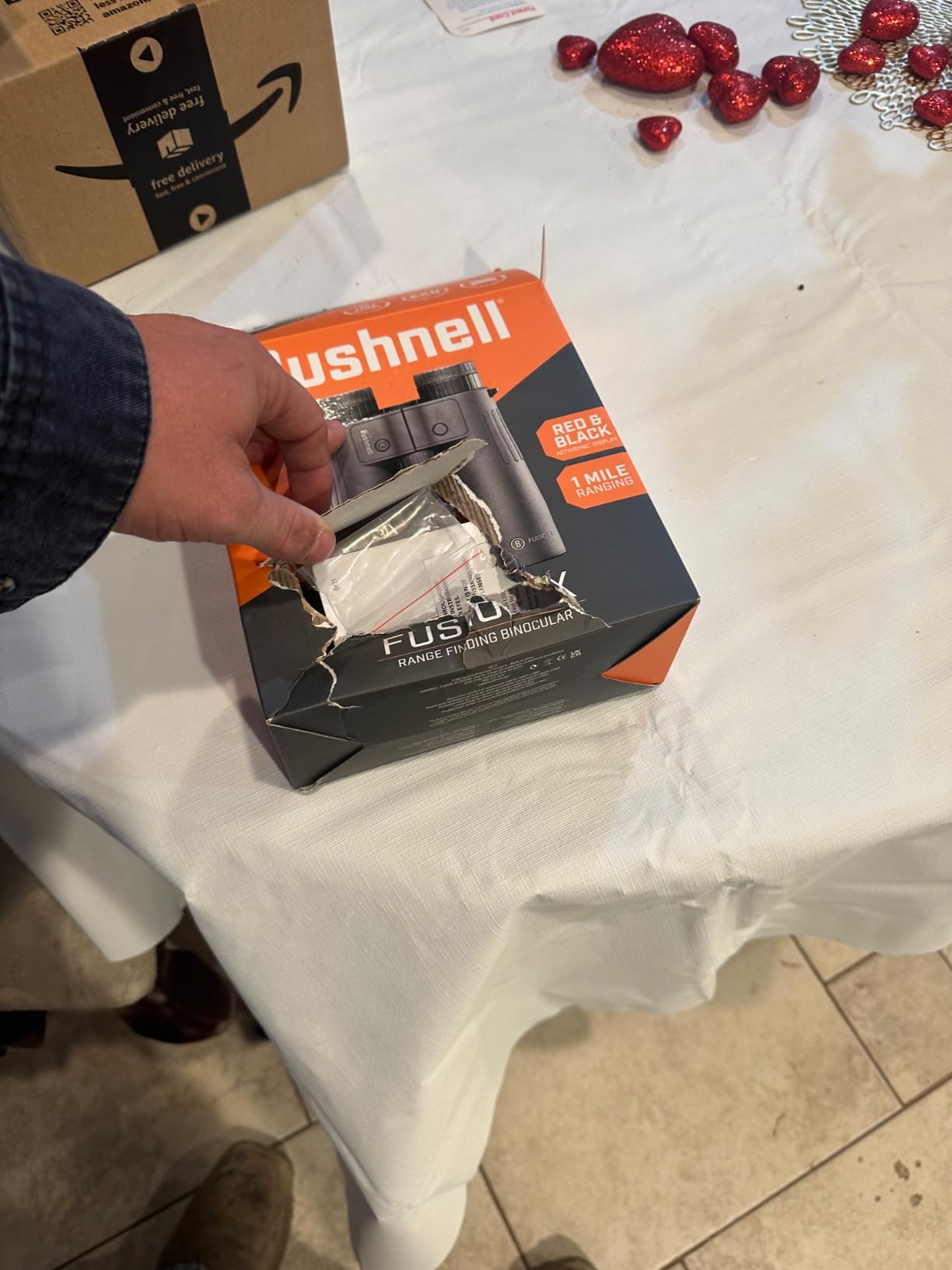
The optical system is Bushnell’s HDOS high-definition layout at 10×42, and 70% of reviews are five-star. Owners describe the image as sharp with good light transmission, and the IPX7 rating means the unit is submersible to one meter for thirty minutes, which is reassurance rather than a feature you will use.
Here is the honest limitation: 700 yards of measuring range. That is the shortest in this lineup. For archery season, and for cow hunting inside a couple hundred yards, it is more than enough. For a bull at nine hundred in an open basin, it is not.
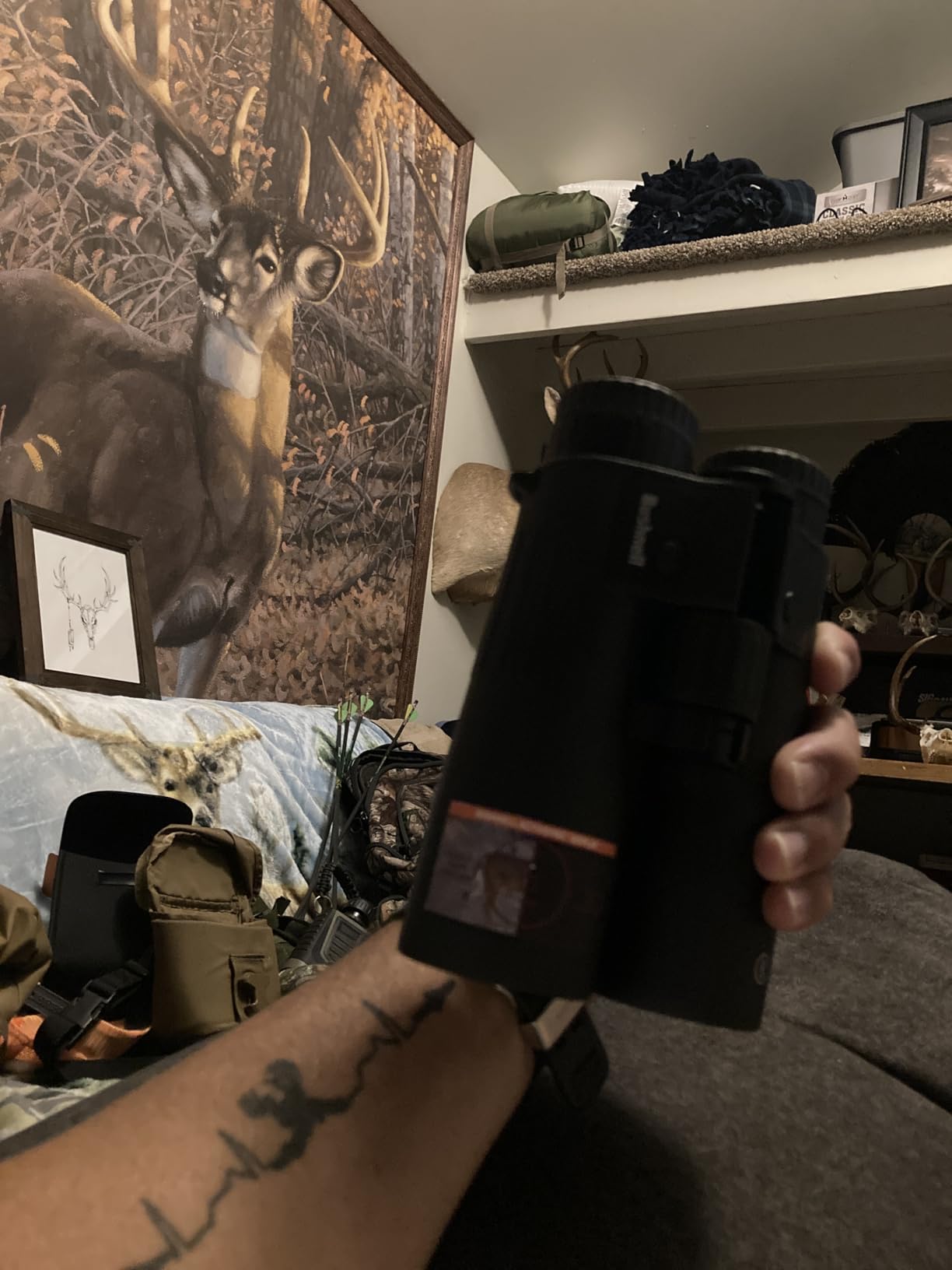
Why the display matters more than the range number
Every other optic here can range a basin herd except this one past 700 yards, so the question is what you lose. The answer is fine for most seasons. Archery hunters, cow hunters and anyone working timber within a few hundred yards will not touch the ceiling.
The display question is different. Elk move hardest at dawn and dusk, exactly when a fixed black-on-dark readout becomes unreadable. Auto-adjusting between black and red solves a problem the rest of this group has not solved at this tier.
Who should skip this one
If your season is defined by long-range bull rifles and you habitually pick animals out past 700 yards, the range ceiling will frustrate you, and you should spend up into the SIG SAUER Canyon or the Vortex Ranger HD 3000 instead. Both publish 1,500 yards on game.
Second, some buyers find it bulkier and heavier than dedicated 10×42 glass, which is the recurring cost of an integrated ranging chassis. Glassing all day with a spotter, you carry this for a function you use twice a day.
4. Halo Optics K2000 10×42 — The Budget Pick Rangefinder Binocular for Elk Hunters
Halo Optics K2000 Rangefinder Binoculars 10x 42mm
10x42
Angle Intelligence
Scan mode
6 degree FOV
IPX7 waterproof
Pros
- Glass clarity owners compare to Steiner and Vortex
- Ranging accuracy checked against standalone units
- Angle compensation works on sloped shots
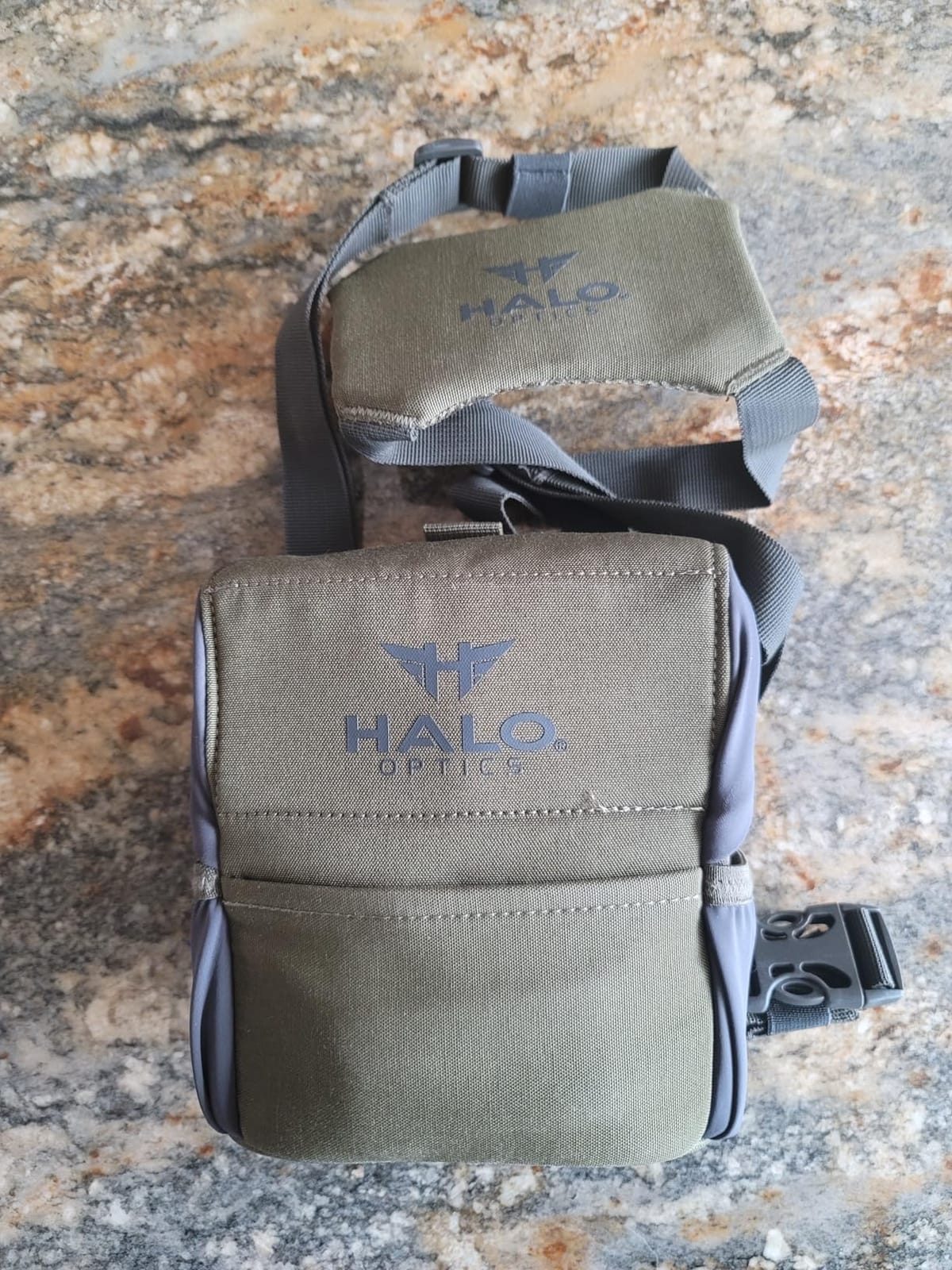
- Harness and soft case included
Cons
- Black non-illuminated readout is dim in low light
- Diopter wheel doubles as display focus
- No tripod mounting point
The K2000 is the model we kept recommending to hunters who assumed integrated rangefinders meant a compromise in the glass. That assumption is wrong here. Owners repeatedly say the clarity rivals scopes costing far more, and one review compares the image favorably to a Steiner and a Vortex directly.
Ranging performance is the second surprise. Reviewers report working from about five yards out to more than 1,800 yards on large targets, and several have checked the readings against standalone rangefinders and found them matching. Angle Intelligence gives true horizontal distance at any elevation, which is the number you need for downhill shots.
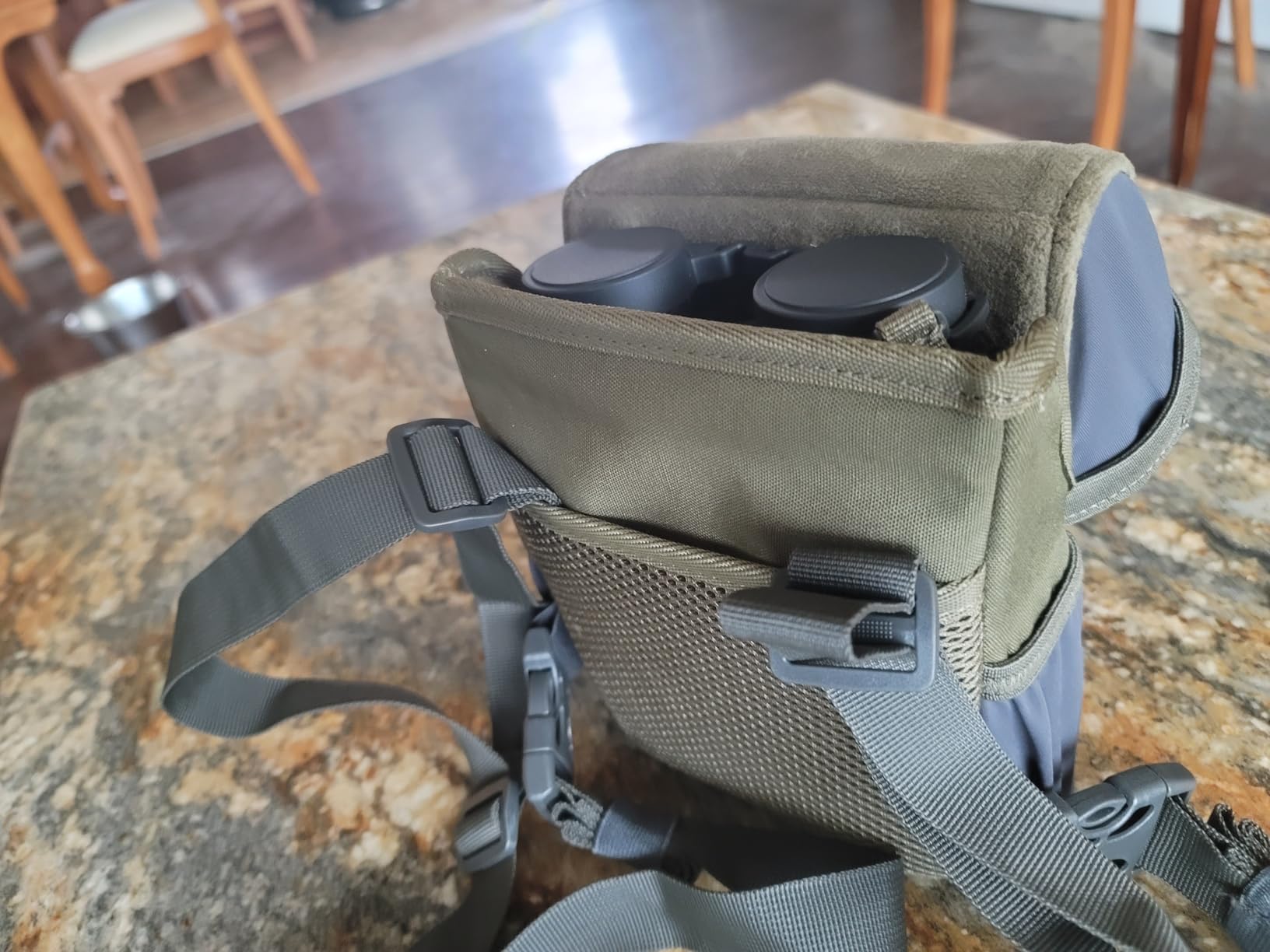
The chassis is magnesium with a slip-resistant grip, rated IPX7 waterproof and fogproof, and the 10×42 roof prism configuration uses fully multi-coated optics with a six degree field of view and plus or minus five diopters. The interface is two controls. After ten minutes in the field you will stop noticing it.
Getting rid of a separate handheld rangefinder also frees a chest pocket. Owners mention pack bulk more often than pack weight here, and that is the practical argument for integration that no spec sheet makes for you.
Reading the display at first light
This is the unit’s main weakness and it is a real one. The readout is black and non-illuminated, and the small numeric characters are not bold. At last light over a basin, several buyers found it unreadable enough to return.
The second issue is the diopter wheel, which also focuses the display. Adjusting it for a sharp image slightly blurs the numbers or the other way around, so you are making a compromise instead of setting both. Budget for a few seconds of fiddling in the parking lot before the hunt.
Where the K2000 does not fit
There is no tripod mounting point. The battery compartment occupies the usual location on the underside, so for long sessions on a spotting tripod you will need a separate rest or an adapter plate that is not included.
Ranging through glass or around partially reflective surfaces can also struggle. That is a physical limit of laser ranging rather than a defect, but it means a bull standing in front of a bright window is a harder read than one on an open slope.
5. SIG SAUER Canyon 10×42 — The Best Rangefinder Binocular for Bowhunting Elk
SIG SAUER Canyon 10x42mm Laser Rangefinding Binoculars
10x42
1500 yd on game
Lightwave DSP engine
8 ballistic groups
Red OLED display
Pros
- Ranging engine faster than separate handheld units
- Consistently ranges large game past 1200 yards
- Handles rough field use
- Red OLED display with adjustable brightness
Cons
- Ballistic profile is fixed with no user editing
- Display arrives dim out of the box
- Glass is good but not flagship tier
The Canyon’s spec sheet is unusually candid about ranging. It prints 4,000 yards on reflective surfaces and 1,500 yards on non-reflective targets, and it names deer and elk as the example. That is the number you should plan around, and it clears the 900-yard bull that most hunters are hoping for.
The Lightwave DSP engine runs scan mode at four updates per second, and RangeLock can report the closest, furthest or most recent reading. That last setting is the useful one when a cow steps in front of a bull at seven hundred yards and you need the distance to the animal you intend to shoot.
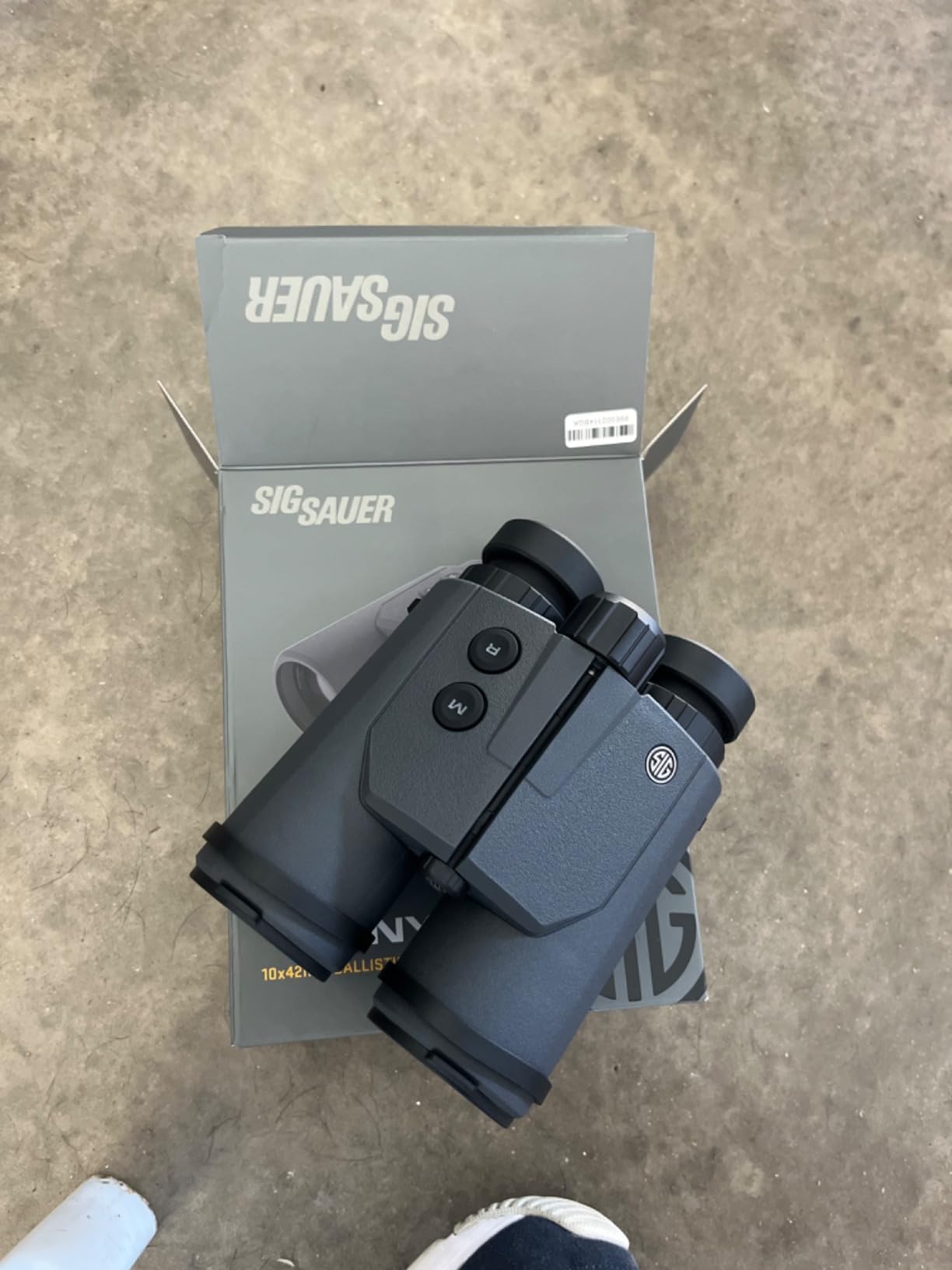
For archers, the dedicated archery ranging mode plus eight onboard ballistic groups in MOA or MRAD is the reason to pick this over a cheaper unit. Groups can be stored for specific setups, and the display resolves to one tenth of a yard or meter. A 1/4-20 tripod thread means it will sit on a glassing tripod without an adapter.
Glass is SpectraCoat anti-reflective coated at 10×42 with a 6.71 degree field of view and 15 mm eye relief. Owners rate the optics good rather than premium, and say they have taken abuse in rough terrain without complaint. Seventy-four percent of reviews are five-star.
How the archery mode changes a shot
Archery mode is not a gimmick for elk. It changes the ballistic solution to a flatter, faster projectile and reports the hold rather than an arbitrary distance figure, so at twenty-five yards on a downhill angle the readout reflects what an arrow actually does.
The honest limitation is that the Canyon’s ballistic profile is single and not user-editable. Compared with the KILO6K HDX, which stores up to 25 custom profiles, you are getting one good general solution instead of a per-loadout setup.
Where the Canyon gives ground
The red OLED display arrives dim. Owners like it once brightness is turned up, but on a dawn start you will want that dial adjusted the night before, not in the field.
Several buyers also note that eliminating the separate handheld rangefinder is what makes it feel faster in practice, one reviewer saying it outperforms a standalone ranger he already owned. The flip side is that if your season is mostly scanning with a spotting scope, you are paying for ranging you rarely use.
6. Vortex Ranger HD 3000 10×42 — The Best Rangefinder Binocular for Open-Basin Scanning
Vortex Ranger HD 3000 10×42 Laser Rangfinding Binoculars
10x42
3000 yd reflective
1500 yd game
17 mm eye relief
Red OLED display
Pros
- Optical definition comparable to more expensive glass
- Compact and lighter than most in this group
- Adjustable brightness red OLED reads easily
- Two-button interface is fast
- Harness and neck strap included
Cons
- Laser can take several attempts to acquire in sun
- Seven-segment style readout looks dated
- No built-in ballistics for cartridges
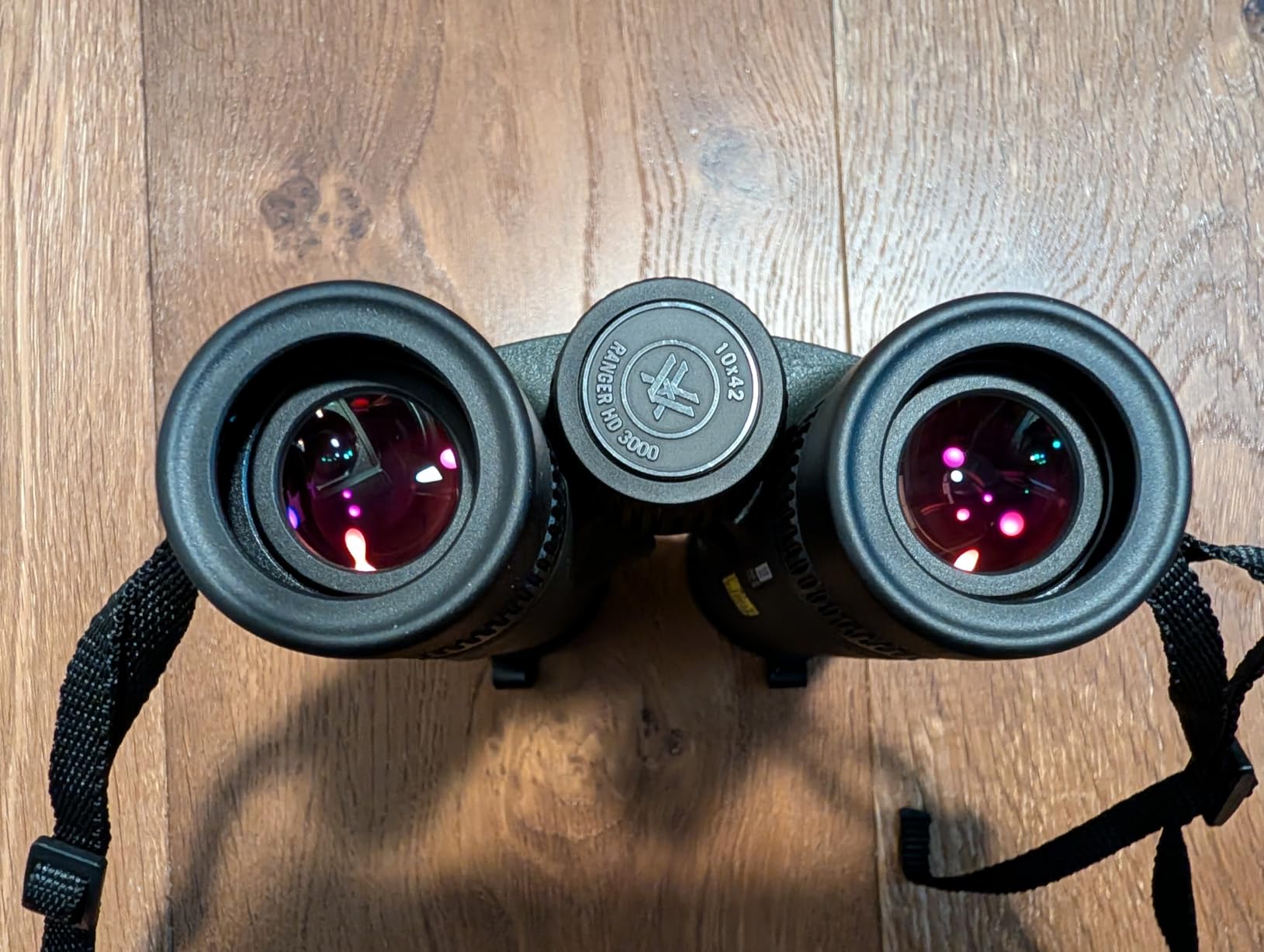
Open basins punish narrow optics. You spend hours sweeping two miles of timber edge, and the Ranger HD 3000 is designed for that specific job. Its 17 mm eye relief is among the most generous here, it packs smaller than most integrated rangefinders, and owners describe the image as comparable to glass costing considerably more.
Ranging runs to 3,000 yards on reflective targets and 1,500 yards on game, through LOS, HCD and scan modes. HCD is what you use on sloped terrain, and reviewers specifically call out that it gives the exact distance to aim on downhill shots.
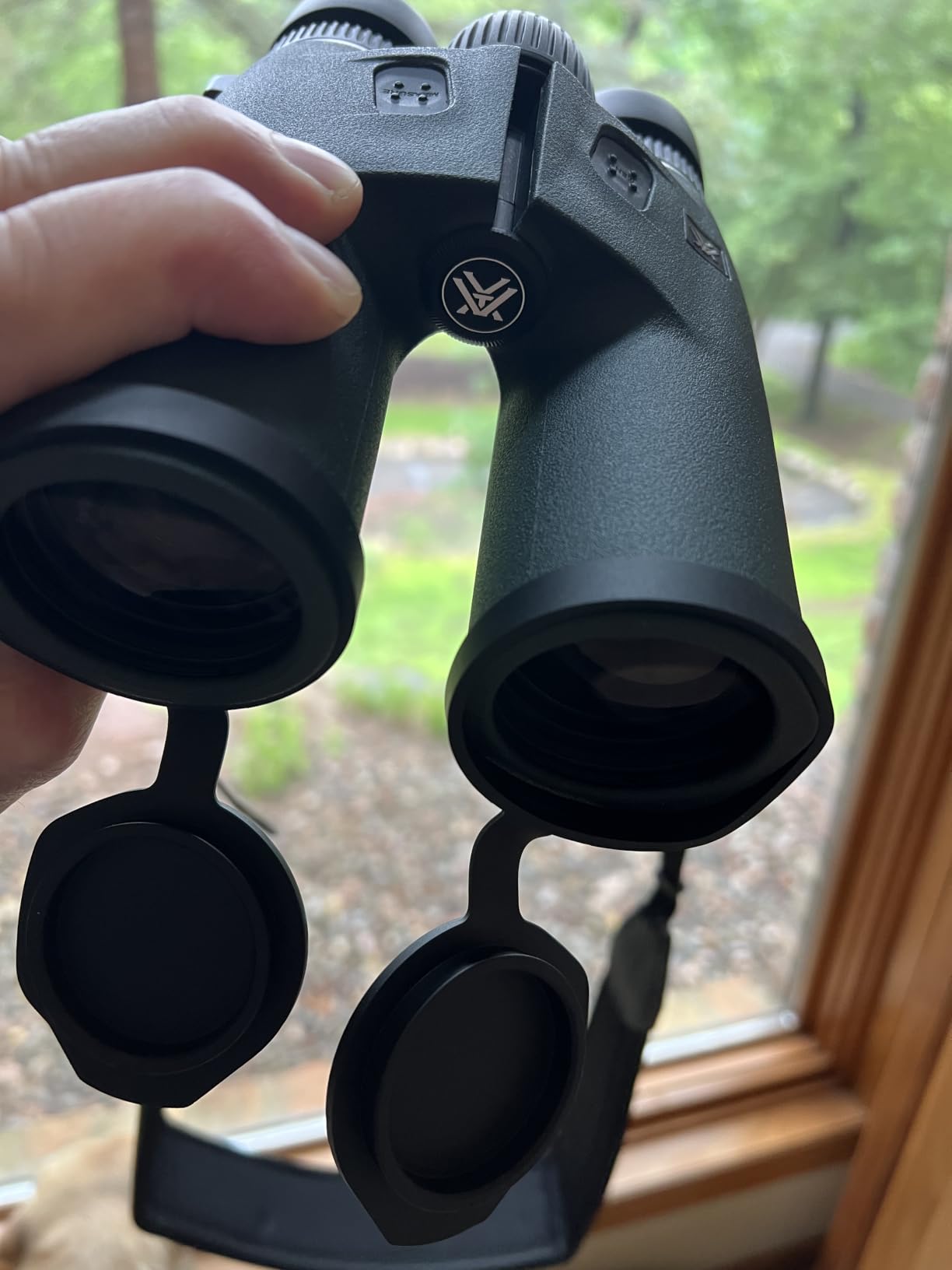
The build is the sort you want in October rain. Waterproof, fogproof and shockproof with a rubber-armored body and ArmorTek scratch-resistant coating on fully multi-coated HD lenses. A GlassPak harness, neck strap, tethered lens covers, cloth and CR123 battery come in the box, and Vortex backs it with the transferable lifetime VIP warranty.
Two-button operation means you spend more time looking through the glass than navigating a menu. That simplicity is why it suits a hunter who wants a rangefinder binocular rather than a rangefinder with binoculars attached.
Laser acquisition in bright sun
The most common complaint is that the laser can take multiple attempts to lock on, particularly in direct sun at low angle on a bright hillside. If you are on a south-facing slope at midday this is a real annoyance, though it does not appear in low light or against a dark timber background.
The display readout is the other gripe. It uses a seven-segment style presentation that some buyers find dated and hard to read quickly. If you have ever wished for a modern layout, this is where you will notice it.
Where the Ranger is the wrong buy
There is no built-in ballistics compensation for specific cartridges. For an archery or rifle hunter running downhill shots, you need another source for hold and drop. Shooters on SnipersHide note that integrated models with a full advanced ballistic suite satisfy a different need than pure glassing glass.
One field note from owners: heavier than it looks for long freehand sessions. A tripod helps if you are working a fixed setup for hours.
7. Leupold BX-4 Range HD 10×42 — The Best Rangefinder Binocular for Downhill Rifle Shots
Leupold BX-4 Range HD TBR/W 10x42mm Range-Finding Binocular Shadow Gray (182883)
10x42
TBR/W ballistic solution
Leupold Elite optics
Bright red OLED
Center focus
Pros
- TBR/W gives hold and wind correction downhill
- Very bright and clear Elite optical system
- Bright red OLED is easy to read
- Simple to operate for Leupold users
Cons
- Bulky and heavy for all-day glassing
- Several owners returned units over weight
- Small pool of owner reviews
The BX-4 is the one here built around a ballistic solution rather than a distance readout. True Ballistic Range with Wind takes your line-of-sight distance and your incline angle and returns a hold solution, which is exactly the problem a 700-yard downhill elk shot presents.
Glass comes from Leupold’s Elite optical system with Guard-ion lens coating, and owners consistently describe the image as very bright with low glare. That brightness is what makes the TBR/W readout readable in the low light where elk are moving. Eighty-five percent of reviews are five-star.
It is a Porro prism design with center focus, and for owners already running Leupold rifles and scopes, the interface needs no learning curve at all. It is also 100% waterproof and fogproof with a lifetime performance guarantee and a tripod mounting point.
Where TBR/W earns its keep
Elk shots from a bench above a drainage are steep. A raw distance of 640 yards on a 30 degree angle might be closer to 550 yards of true horizontal, and the drop difference is meaningful. A unit that hands you the hold removes a step and a source of error.
Wind holdoff matters on exposed ridges where an elk at eight hundred yards is in moving air. Not every rangefinder in this group handles it, and this one does.
Who should pass on it
Weight, and the review evidence is unusually blunt about it. Multiple owners returned them citing weight and clumsy handling even while praising the build quality, and it is rated at over two pounds in the listings. Glassing a full day with this on a neck strap will get tiring.
The second caution is evidence itself. There are only 23 owner reviews, so long-term durability is not well proven in either direction. Test the controls and the diopter at home before the season starts.
8. Swarovski EL Range 10×42 — The Best Low-Light Rangefinder Binocular for Dawn Elk Hunts
SWAROVSKI OPTIK EL Range 10×42 – Binoculars – integrated Rangefinder green
10x42
90% light transmission
Tracking Assistant
App-configurable profiles
15 mm eye relief
Pros
- Class-leading light transmission for pre-dawn glassing
- Large flat field with excellent color
- Tracking Assistant guides you to the target
- Profiles fully configurable in the companion app
Cons
- Sits at the top of the price range
- Thin long-term owner feedback
- Water resistant rather than fully waterproof
If the only thing that mattered were light, this is the optic. Swarovision optics with 90% light transmission and HD field flattener lenses produce a bright, wide, flat image with strong color fidelity, and that is the combination that lets you count points on a bull in the twenty minutes before legal shooting light.
The EL Range TA adds a Tracking Assistant that guides you toward the target with distance and directional indicators. Ballistic profiles are configurable through the companion configurator app, which rifle hunters use to match a specific zero and load. One HuntTalk member tested comparable glass at twilight and reported it clearly ahead of the field, and twilight is exactly where elk are moving.
Mechanically it is a roof prism with individual focus, plus or minus five diopters, 15 mm eye relief and tripod adaptability. The accessory kit is unusually complete: universal comfort strap, side bag, lens covers and cleaning kit.
How the Tracking Assistant helps on a moving herd
When a group is walking at seven hundred yards, the conventional workflow is find, center, press, read. The Tracking Assistant shortens that by indicating distance and direction together, which means less time hunting for the correct animal in the image before the laser fires.
For archery and precision rifle users, the app-configurable profiles are the more valuable half. You can build a profile for a specific zero, altitude and load rather than relying on a generic internal solution.
Where this is not the practical choice
It occupies the top of the price range by a wide margin in this group, and that gap buys you glass quality rather than ranging capability. If your budget is fixed, the optical gain is real but the ranging features are matched by mid-tier models.
Two practical cautions. It is listed as water resistant rather than fully waterproof, so take rain cover seriously on a multi-day trip. And with 21 reviews the long-term ownership picture is thinner than for the models with hundreds of reviews.
9. SIG SAUER KILO10K ABS HD Gen II 10×42 — The Best Rangefinder Binocular for Long-Range Rifle Elk Hunters
SIG SAUER KILO10K-ABS HD Gen II Rangefinding Binocular
10x42
10000 yd range
Applied Ballistics Elite
Rechargeable battery
22 mm eye relief
Pros
- Every owner review is five-star
- AB Elite is the most capable ballistic solver here
- Rechargeable battery avoids spare cell logistics
- Customizable OLED readable in any light
Cons
- Heaviest optic in this group
- Narrowest field of view for scanning
- Smallest review sample in the lineup
This is the ballistic tool. The Applied Ballistics Elite onboard solver takes your distance, inclination and rifle data and returns a solution directly in the display, which removes the phone from the workflow entirely. For long-range rifle hunters dialing a 900-yard downhill shot on a bull, that is the feature that justifies the tier.
The rechargeable lithium-ion battery is the sleeper advantage. Every other integrated rangefinder here runs on CR123 or CR2 cells, and cold alpine mornings degrade those. A rechargeable pack that charges in the truck solves a real failure mode that buyers report repeatedly with disposable cells.
Optics are HD glass with edge-to-edge clarity, and the 22 mm eye relief is among the most generous here, which is helpful if you wear glasses. The OLED display is customizable in brightness. Every one of the twelve owner reviews is five-star with no negative ratings recorded.
What the solver replaces
On a steep shot, a phone app in a cold gloved hand is slow and drops out at exactly the wrong moment. AB Elite runs onboard, so the solution appears where you are already looking. Shooters on SnipersHide who work integrated optics for precision shooting point to the advanced ballistic suite as the reason those models are worth the premium.
The 10,000 yard figure is a reflective-target number and you will never approach it on an elk. Treat it as a specification of the laser engine, not a hunting claim.
Where the KILO10K works against you
Weight. It is the heaviest optic in this lineup at around four pounds, and that shapes the whole hunt plan. It is a shooting instrument to glass from a position, not something to carry on a pack for five days.
The 5.2 degree field of view is also the narrowest here, which is slower for scanning timber edges where you need to cover ground quickly. With only 12 reviews, reliability is not yet proven over multiple seasons. Buy it for the ballistic solver and rechargeable battery, not as a general-purpose glass.
10. SIG SAUER KILO6K HDX 10×42 — The Best Rangefinder Binocular for Custom Elk Ballistics
SIG SAUER KILO6K HDX 10x42mm Laser Binocular Rangefinder
10x42
6000 yd reflective
25 custom profiles
BDX 2.0 Bluetooth
Lumatic OLED
Pros
- Feature set rivals models costing far more
- Five target modes and five range modes
- Lumatic OLED adjusts to ambient light
- LightWave DSP locks on quickly
Cons
- One owner reported a total power failure after one outing
- Thinnest review base in this group
- Water resistant rather than waterproof
The KILO6K HDX is the configurability pick. Applied Ballistics Ultralight stores up to 25 custom profiles, which means a bow profile, a bolt-action rifle profile and a suppressed rifle profile can all live on the optic rather than in three phone apps. For a hunter who switches setups, that is worth more than raw reflective range.
Onboard environmental sensors handle incline and decline for angle modified ranging, and the Lumatic OLED display adjusts to ambient light as the sky brightens. Bluetooth BDX 2.0 links the unit to mapping apps like OnX Hunt and BaseMap, so your range data lands on a map you are already navigating with.
The ranging engine runs at four updates per second through Hyperscan with Rangelock, across five target modes and five range modes. Owners like that the LightWave DSP suppresses false positives on partial targets, which matters in brush.
Setting up profiles before the season
Spend an evening with the BDX app and load your actual profiles before hunting season. Elk archers get the most from the archery range mode, and rifle hunters benefit from matching a profile to a real zero at your expected altitude rather than a generic one.
Because sensors handle slope automatically, you can spend your pre-season time on ballistics instead of relearning menus in the field. Members who value fine control cite the mode flexibility as the reason to pick this over simpler units.
What gives us pause
The evidence base is thin, with six owner reviews, and one of them is a total failure report: the optic stopped working after a single outing and would not power on even with a fresh battery. Two of the six reviews are one-star, the highest negative share in this lineup.
It is also listed as water resistant rather than fully waterproof. If you take one thing from this review, it is to test the power and the ranging functions immediately on arrival, well before you are standing on a ridge with a herd in front of you.
10×42 vs 12×50: Which Magnification Works Best for Elk?
Ten power is the right answer for most elk hunters, and the reason is identification, not resolution. At 700 to 900 yards you need enough magnification to count points on a bull and read body condition, but you also need to hold the image steady at dawn without a rest. Every optic in this roundup is a 10×42 for that reason.
Exit pupil is the number that governs low light, and it is simply the objective diameter divided by the magnification. A 10×42 gives a 4.2 mm exit pupil. A 10×50 gives 5 mm, which pushes more light through to the eye in the dim window around dawn and dusk when elk are moving. A 12×50 gives about 4.2 mm again, so it delivers more magnification but no more light than a 10×42.
Hand shake is what limits 12x in practice. Beyond roughly 700 yards, holding a 12x image steady without a rest becomes the limiting factor rather than optical resolution, and that is why many experienced elk hunters on LongRangeHunting call moderate magnification a no brainer for this species.
The three configurations compared
An 8×42 is lighter and steadier with a wider field of view, which suits long scans and tired arms, but antler configuration at 800 yards becomes guesswork. A 10×42 is the balanced choice and the reason it dominates this category. A 12×50 reaches further on a distant bull and demands a tripod or a shooting stick, with an exit pupil that gives nothing back in low light.
Field of view is the other half of the story. The optics here cluster around six degrees, with the SIG SAUER Canyon at 6.71 degrees and the KILO10K at 5.2 degrees. Wider means faster scanning of a timber edge; narrower means steadier on a single animal.
What a Rangefinder’s Range Number Actually Means on an Elk
Manufacturers quote reflective target range, and an elk is not a reflective target. A reflective target bounces the laser straight back with a clean signal. A live elk at 800 yards is a dark, irregular, partially occluded shape in brush, and the reflected signal is much weaker. The honest number is the one on game.
Only two models in this lineup publish a game range. The SIG SAUER Canyon lists 4,000 yards reflective and 1,500 yards on non-reflective targets such as deer and elk, and the Vortex Ranger HD 3000 lists 3,000 yards reflective and 1,500 yards on game. Use those figures to plan. A 5,000 yard reflective number, which the Vortex Fury HD 5000 carries, tells you about the laser engine rather than about what you will see across a basin.
The practical takeaway for an elk hunter: real basin glassing runs six hundred to a thousand yards, and any quality laser rangefinder binocular in this group will hold a reading there. What degrades readings is brush, moisture on the coat, glass, and partial occlusion. The Astra Optix publishes the clearest figure of all, listing deer at 800 yards, and its real-world behavior matches that honesty.
Two conditions improve game ranging noticeably. A clean, open background behind the animal returns more signal, and a light-colored wet or dusty coat reflects more than a dark shadowed flank. When a bull is in a dark timber line, expect the laser to work harder and take an extra second.
Rangefinder Binoculars vs Separate Glass and Rangefinder
This is the most argued question on elk hunting forums, and both sides have real cases. Integrated rangefinder binoculars put the distance readout in the same eyepiece as the image, which means no switching, no chest pocket, and one less thing to drop in a creek crossing.
The counterargument comes from hunters who glass for a living. A LongRangeHunting member took a pair of dedicated binoculars on an elk hunt and called moderate magnification the obvious choice, on the grounds that serious elk hunting is scanning wide rather than ranging constantly. If you range twice a season and glass for eight hours a day, a dedicated 9x or 10x with a small pocket rangefinder is the lighter, simpler answer.
There is also a glass quality split that forum regulars name explicitly. Members on SnipersHide describe dedicated low-light binoculars as having better glass for glassing while rangefinder models win on the ballistic suite. That is the honest trade: integration buys you ranging and ballistics, and it costs you some optical purity.
When integration wins
Choose integrated optics when you shoot downhill and need angle compensation, when weight is not your binding constraint, and when you want the horizontal distance in the field of view immediately. Rifle hunters dialing shots across a drainage get that value on every attempt.
When separate gear wins
Choose dedicated glass plus a pocket rangefinder when you are on a multi-day backpack trip and ounces compound, when your primary tool is a spotting scope with a glassing partner, or when you spend most of your time locating animals rather than measuring them. If you want to know more about standalone units, our hunting rangefinder picks cover that side of the setup.
Rangefinder Drift, Recalibration, and Cold-Weather Battery Life
Rangefinders drift. This is not unusual and it is not always disclosed. An ArcheryTalk user reported a Leica Geovid HD 10×42 reading two to three yards long between 20 and 100 yards and sent the unit back for factory recalibration. Premium glass does not guarantee accurate ranging.
Check your optic before the season. Range a known distance, ideally a tape-measured 300 to 500 yards, in both line-of-sight and angle-compensated modes. If the reading is consistently off by a yard or more in the same direction, contact the manufacturer for service rather than trying to correct it with a ballistic profile. Owners of long-term units in this lineup also report drifting readings and condensation after two seasons.
Batteries are the other autumn failure mode. Most models here run CR123 or CR2 lithium cells, and cold alpine mornings reduce their available capacity exactly when elk are moving. Carry spares in a warm pocket, not in the pack, and swap them at the vehicle rather than on the ridge.
The KILO10K is the exception with a rechargeable lithium-ion pack, which charges off a USB source in the truck and avoids the cold-cell problem. Several models in this group also include a battery in the box, which is one more thing to check the moment the package arrives.
How to Choose Rangefinder Binoculars for Elk Hunting
Seven factors decide whether a rangefinder binocular works in elk country. Weight them in this order and the wrong models fall away quickly.
1. Glass and coatings
Look for fully multi-coated lenses, dielectric phase-corrected prisms and HD or ED glass. For dawn and dusk, light transmission matters more than resolution, which is why the Swarovski EL Range leads on that measure. Budget models can still deliver a good image, and the Halo K2000 and Vortex Ranger HD 3000 both surprise owners on this point.
2. Game range, not reflective range
Find the number the manufacturer publishes for non-reflective targets. Only a few models give one, and it will be far below the headline figure. For basin glassing at six hundred to a thousand yards, 1,500 yards of game range is comfortable. A 700 yard ceiling like the Bushnell Fusion X is adequate for archery season and short for long-range bulls.
3. Magnification and objective lens
Ten power is the elk sweet spot. A larger objective lens, such as 50 mm rather than 42 mm, produces a wider exit pupil at the same magnification and helps in low light, at the cost of bulk and weight. If you can afford a 10×50 for pre-dawn glassing, that is the one spec upgrade worth making.
4. Angle compensation
Elk are shot downhill constantly, so horizontal component distance or ARC is not optional. Brands label it differently, HCD, ARC, AMR and angle modified range all describe the same job. Verify the unit shows line-of-sight and horizontal simultaneously so you can sanity check the slope.
5. Durability and weatherproofing
Nitrogen purging and O-ring seals handle temperature swings, and IPX7 means submersion to one meter for thirty minutes. Water resistant without a rating is a step below that. Elk seasons involve rain, snow and river crossings, so this is not a specification to skim.
6. Weight and carry
Every model here is heavier than dedicated glass, some considerably so. For a day hunt anything under 25 ounces works. For a multi-day backpack trip, assume 30 to 34 ounces for an integrated unit and use a harness. Above 38 ounces you are carrying a shooting instrument, not a glassing binocular, and should plan around that.
7. Battery type and cold performance
Check whether the unit takes CR2 or CR123 cells or a rechargeable pack, and carry spares. Also look at the display: an auto-adjusting red OLED like the Bushnell ActivSync system or the SIG Lumatic display solves the low-light readability problem that fixed black readouts create at dawn.
If you are still narrowing the field, our elk hunting call picks cover the other end of the hunt, but the optics decision comes first because it affects every hour you spend looking.
Frequently Asked Questions
What is the best binocular magnification for elk hunting?
Ten power is the sweet spot for elk because it lets you count points on a bull at 700 to 900 yards while remaining holdable at dawn without a tripod. A 12×50 gives more reach on distant animals but needs a rest, and its exit pupil is no larger than a 10×42, so it returns no extra light. An 8×42 scans faster but makes antler identification guesswork past 700 yards.
Which binoculars are better, 10×42 or 12X50?
For most elk hunters 10×42 is the better choice. It offers a 4.2 mm exit pupil, a wider field of view for scanning timber edges and enough magnification to identify a bull at basin distances. A 12×50 helps on a distant bull past 900 yards but demands a tripod or shooting stick once you pass roughly 700 yards, because hand shake rather than resolution becomes the limit.
Should I get 8x or 10x binoculars for hunting?
Eight power is lighter and steadier with a wider field of view, which suits long scans and tired arms. Ten power is the better all-around choice for elk because you need to identify antler configuration and body condition at distance. Most experienced elk hunters settle on 9x or 10x, and every integrated rangefinder binocular in our roundup is a 10×42.
Do rangefinder binoculars range elk accurately?
Yes, within about a yard on a clear line of sight at typical elk distances, but accuracy depends on the target being unobstructed, the coat condition, background contrast and the unit’s own calibration. Readouts can drift, so check a known measured distance before the season and send the optic back for factory service if it reads consistently long or short.
Are binoculars with a rangefinder worth it for elk hunting?
They are worth it if you shoot downhill and need angle compensation, if you want one device instead of a binocular and a pocket rangefinder, and if the extra weight is not your constraint. They are less worthwhile if you glass for hours and range only a few times a season, since dedicated 9x or 10x glass plus a small handheld covers that case with less weight and better optics.
What magnification is best for a rangefinder binocular?
Ten power is the best general magnification for a hunting rangefinder binocular because it balances identification distance against steadiness and light. Lower powers such as six or eight are better suited to golf and long-range scouting than to big-game glassing. If your season is defined by shots past 900 yards, moving up to 12×50 is reasonable, but plan on using a rest.
Best Rangefinder Binoculars for Elk Hunting: The Final Verdict
The Vortex Fury HD 5000 10×42 is the best rangefinder binocular for elk hunting for most people, because it pairs a wide field of view with angle-compensated ranging, a bright red OLED readout and the deepest owner history in this group. Buy it if you want one device that works from dawn glassing through a downhill shot without adjustment.
Take the Halo K2000 instead if budget matters and you will accept a dim readout. Take the SIG SAUER Canyon if you bow hunt and want a published 1,500 yard game range with a dedicated archery mode. Take the Bushnell Fusion X if your season happens within 700 yards and dawn readability is the priority.
For long-range rifle work, the Leupold BX-4 gives you hold and wind correction, and the SIG SAUER KILO10K puts a full ballistic solver and a rechargeable battery under your eye. In the glass premium category the Swarovski EL Range leads on low light, though it sits at the top of the price range and its owner feedback is thinner than the rest.
Whatever you choose, test the ranging modes and the display at home before the season opens, and carry spare cells. Elk hunters who regret optics rarely regret spending too little on glass; they regret buying a rangefinder they could not read in the dark or a chassis too heavy for the fifth day of the pack.