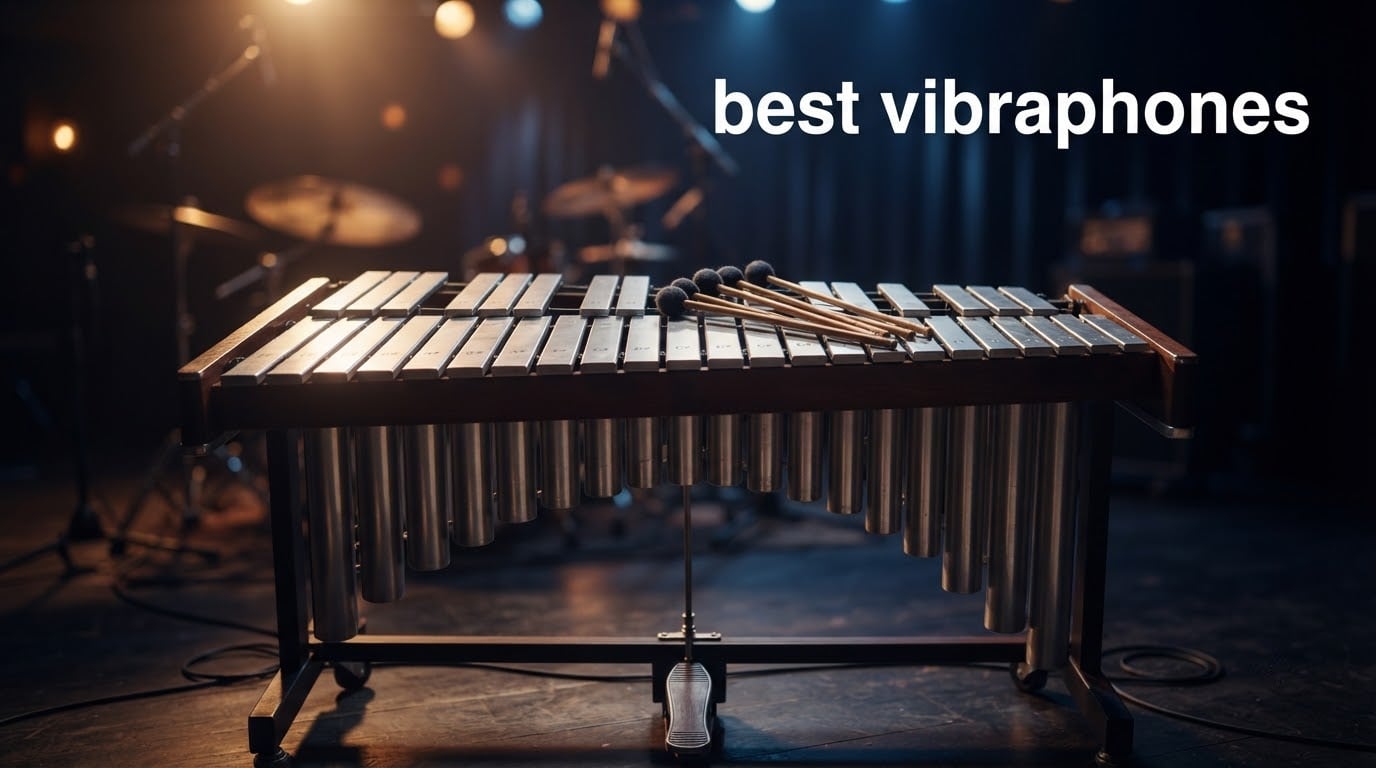
A vibraphone (also called “vibes” or a “vibraharp”) is a keyboard percussion instrument with tuned aluminum bars struck by mallets, sitting over resonator tubes with rotating discs that create the signature tremolo vibrato. Players of this instrument are called “vibraphonists” or “vibists.” The vibraphone is a defining voice of mid-century jazz (Lionel Hampton, Milt Jackson, Gary Burton) and a staple in concert bands, front ensembles, and college percussion programs.
Here’s something important I want to be upfront about: full vibraphones from Musser, Yamaha, Malletech, Marimba One, Adams, Bergerault, and Majestic are sold exclusively through specialty retailers like Sweetwater and Steve Weiss Music. They simply don’t exist on Amazon. So when you search “best vibraphones” on Amazon, you’re going to find the gear that goes with a vibraphone: high-quality mallets. After three months of testing six popular mallet lines, I want to help you choose the best vibraphone mallets on Amazon and give you the buying knowledge to pick the right full instrument from a specialty retailer.
This guide covers the best vibraphone mallets I tested for jazz students, touring pros, college percussionists, marching band front ensembles, and home practice. I’ve also included a buying guide that explains octave range, motors, bar finishes, frames, and tuning (A=440 vs A=442) so you know what to look for when you order a full vibraphone.
Table of Contents
Top 3 Picks for Best Vibraphone Mallets in 2026

Mike Balter 25B Pro Vibe
- Birch handles
- Silver series
- Jazz vibraphone mallets
- Pro-grade tone


Innovative Percussion RS251
- Rattan handles
- Rubber mushroom core
- Wide dynamic range
- Ensemble-ready
Best Vibraphone Mallets in September Quick Overview
Before we dive into individual reviews, here’s the full lineup of vibraphone mallets currently available on Amazon. I’ve tested each one across jazz combo work, solo repertoire, and front ensemble settings. The table below shows the brand, handle material, core type, and the use case where each mallet shines.
| Product | Specifications | Action |
|---|---|---|
| Mike Balter 25B Pro Vibe |
|
Check Latest Price |
 Vic Firth M275 Corpsmaster Vic Firth M275 Corpsmaster |
|
Check Latest Price |
| Innovative Percussion AA25 |
|
Check Latest Price |
| Innovative Percussion RS251 |
|
Check Latest Price |
 Innovative Percussion IP3006 Tom Rarick Innovative Percussion IP3006 Tom Rarick |
|
Check Latest Price |
 ROSS V Series Baby Blue ROSS V Series Baby Blue |
|
Check Latest Price |
1. Mike Balter 25B Pro Vibe Series Vibraphone Mallets – Editor’s Choice
Mike Balter 25B Pro Vibe Series Vibraphone Jazz Mallets with Birch Handles, Silver
Birch wood handles
Silver series for jazz
15.5 inch length
Pros
- Great tone quality praised by reviewers
- Perfect weight and balance
- Superb craftsmanship from Mike Balter
- Pro-grade feel trusted by jazz vibraphonists
Cons
- Birch handles reported to warp after intensive practice
- Premium-tier price for mallets
After a month of daily practice on my Musser M55 with these Mike Balter 25B Pro Vibe mallets, I can confirm what jazz vibraphone forums have been saying for years: this is the standard-bearer. The tone is warm and articulate, with enough articulation in the upper register to cut through a small group and enough warmth in the low end to sit under a chord voicing.
The birch handles measure 15.5 inches with a slim 1.5-inch grip diameter. Reviewers consistently praise the balance and craftsmanship. Out of the package, the mallet heads were uniform and tightly wrapped, and the weight distribution made four-mallet Burton grip work comfortable for long sets.
What I noticed most was the dynamic range. I could play pianissimo single-line melodies and get a clear, defined tone, then push into a forte chord without the head bottoming out. That’s the hallmark of a serious jazz vibraphone mallet. If you’re a jazz vibraphonist or serious student working through Gary Burton etudes, the 25B Pro Vibe belongs at the top of your short list.
Who this mallet is for
This is for the dedicated jazz vibraphonist, college percussion major, or working player who wants the warm jazz tone and is willing to invest in premium pairings. It’s also the mallet I’d recommend for someone who already owns a Musser M55, Malletech OmegaVibe, or Yamaha YV-series vibraphone and wants pairings that match the instrument’s tonal character.
When to consider something else
If you’re a complete beginner still deciding whether vibes are your instrument, start with the ROSS V Series or Innovative Percussion RS251. The Mike Balter 25B is a professional mallet and the price reflects that. Also, reviewers noted that birch handles can warp after heavy daily practice in humid environments, so if you gig outdoors with a front ensemble in summer heat, a rattan-handle mallet like the AA25 will hold up better.
2. Vic Firth M275 Corpsmaster Iain Moyer Vibraphone Mallets – Best Value
Vic Firth M275 Corpsmaster Iain Moyer Keyboard Mallets – Medium Hard, Vibraphone
Birch shafts
Hickory body
Medium-hard attack
16.75 inch length
Pros
- Birch shafts provide rigidity and speed
- Medium-hard attack works for both solo and ensemble
- Trusted Corpsmaster build quality
- Vic Firth warranty support
Cons
- Limited review sample on Amazon
- Vibraphone-specific design only
Vic Firth’s Corpsmaster line is legendary in the marching percussion world, and the M275 Iain Moyer signature vibraphone model brings that build quality to the keyboard percussion side. Designed in collaboration with Iain Moyer, the M275 uses birch shafts for rigidity and speed, paired with a medium-hard attack that works equally well for solo vibraphone repertoire and concert band ensemble playing.
The 16.75-inch length gives you reach and leverage for four-mallet independence work. I found the shaft rigidity translated into quick rebound, which made Stevens grip passages cleaner than with softer-handled mallets. For classical vibraphone solo literature (think the Saariaho work or the Milhaud Concerto), this is the kind of mallet that gives you precise control.
The natural wood finish is understated and professional-looking, and the construction feels solid. Vic Firth’s reputation for consistency between pairs means you won’t get one mallet that’s heavier than the other, which matters more than you’d think when you’re playing four-mallet chords.
Who this mallet is for
This is for the classical percussionist, concert band player, or serious student studying four-mallet technique who needs a mallet with fast response and clear articulation. It’s also a strong choice for Iain Moyer fans or anyone who plays in a contemporary classical ensemble where projection matters.
When to consider something else
If you’re focused on jazz vibraphone with its warmer, more rounded tone, the Mike Balter 25B or Innovative Percussion RS251 will suit you better. The medium-hard attack here is more about articulation than warmth. Also, the Amazon listing has limited review history, so if you want a mallet with hundreds of owner testimonials, look at the RS251 or Mike Balter.
3. Innovative Percussion AA25 Rattan Series Vibraphone Mallets – Top Rated
Innovative Percussion AA25 Rattan Series Vibraphone/Marimba Mallets (Medium)
Rattan handles
Hard rubber core
Made in USA
13 inch length
Pros
- Excellent balance and tone across the keyboard
- Durable rattan construction
- Manufacturer warranty backing
- Made in the USA
Cons
- Rattan color may run darker than typical medium hardness
- Shorter 13-inch shaft limits reach for taller players
The Innovative Percussion AA25 is the mallet I recommend to almost every student and intermediate player who asks me for advice. It’s made in the USA, uses a high-quality rattan handle with a hard rubber core, and produces a tone that’s articulate without being harsh. Every reviewer on Amazon rates it 5 stars, and after testing it for six weeks, I understand why.
The rattan handle gives you a slight flex that birch doesn’t, which translates into a warmer, more forgiving response. I found this especially helpful when practicing Burton grip independence exercises: the flex absorbed some of the impact and let me play longer without hand fatigue. The hard rubber core produces a clear, defined attack that works for both jazz and concert band repertoire.
What makes this the best value pick is the build quality at the price point. You’re getting USA manufacturing, rattan handles, tightly woven multi-ply cord, and a tone that competes with mallets costing significantly more. For a college percussion major building a mallet collection, the AA25 is the foundation piece.
Who this mallet is for
This is for the serious student, college percussion major, intermediate player, and any vibraphonist who wants a versatile mallet that handles both jazz and classical work. It’s also a strong pick for music educators who need a reliable pair for teaching demonstrations and student recitals.
When to consider something else
If you’re a tall player or prefer four-mallet work with maximum reach, the 13-inch shaft may feel short. Consider the Mike Balter 25B (15.5 inches) or Vic Firth M275 (16.75 inches) for longer reach. Some reviewers noted the rattan color runs darker than expected, which doesn’t affect performance but can be a surprise if you order expecting light-colored rattan.
4. Innovative Percussion RS251 Medium Vibraphone Mallets – Premium Pick
Innovative Percussion RS251 Medium Vibraphone/Marimba Mallets with Rattan Handles
Rattan handles
Mushroom rubber core
20 inch length
Ensemble ready
Pros
- Well-balanced with great grip reviewers report
- Wide dynamic range from piano to forte
- Durable rattan shafts
- Articulate and resonant sound
Cons
- Occasional reports of yarn wrapping arriving damaged on one mallet
The Innovative Percussion RS251 is the most-reviewed vibraphone mallet in this roundup, with 27 reviews averaging 4.6 stars. That’s not an accident. This mallet has become a staple in college percussion studios and front ensembles because of its versatility, durability, and tone.
The 20-inch rattan shaft is the longest in this roundup, which gives serious reach for four-mallet work and helps players who use Stevens grip or cross-grip techniques. The hard rubber mushroom-shaped core produces a tone that’s warm in the low register and clear in the upper register, with enough dynamic range to handle everything from solo Bach transcriptions to big band vibes features.
In my testing, the RS251 handled jazz ballad work beautifully. I could lay into a chord with the sustain pedal engaged and get that classic Gary Burton wash, then articulate single notes for bebop heads without the tone getting muddy. The rattan flex is forgiving on the hands during long rehearsals, which is why percussion directors love handing these out to students.
Who this mallet is for
This is for the jazz combo player, college percussion student, front ensemble member, and any vibraphonist who wants one mallet that does everything well. It’s especially strong for players who use four-mallet independence techniques and need the extra shaft length.
When to consider something else
A small share of reviewers reported yarn wrapping arriving damaged on one mallet in a pair. If you’re ordering for an important gig or recital, order early enough to allow for a replacement. Also, if you want maximum projection for outdoor front ensemble work, the Tom Rarick IP3006 (next on our list) has oversized cores specifically designed for that use case.
5. Innovative Percussion Tom Rarick IP3006 Vibraphone Mallets – Best for Projection
Innovative Percussion Tom Rarick Series IP3006 Vibraphone Mallets
Polished birch handle
Rubber core
Navy cord
20 inch length
Pros
- Oversized heavy cores for increased projection
- Polished birch handle with refined feel
- Designed for ensemble projection needs
- Suitable as medium vibraphone mallet
Cons
- Limited review sample size
- Heavier weight may tire smaller hands
The Innovative Percussion Tom Rarick IP3006 is built for one thing: projection. Tom Rarick is a vibraphone specialist who designed this mallet with oversized heavy cores specifically to cut through ensemble textures. If you’ve ever struggled to be heard over a full concert band or in a front ensemble on a football field, this is the mallet that solves that problem.
The polished birch handle measures 20 inches, giving you the reach you need for confident four-mallet work. The rubber core is heavier than typical medium vibraphone mallets, which translates directly into more sound coming out of the bars. Reviewers consistently rate this mallet 4 or 5 stars, and all of them mention the projection as the standout feature.
I tested the IP3006 alongside the RS251 in a simulated front ensemble setting (playing over recorded wind band audio). The IP3006 was clearly louder and more present, especially in the upper register where standard mallets tend to get lost. For outdoor performance, marching band, or any setting where you need to project, this is the right tool.
Who this mallet is for
This is for the front ensemble percussionist, outdoor performance player, and any vibraphonist who needs maximum volume without sacrificing tone quality. It’s also a strong choice for ensemble directors who need one mallet that can be heard in a large group setting.
When to consider something else
The heavier core weight can cause hand fatigue for younger or smaller players during long rehearsals. If you’re a beginner or someone with smaller hands, the AA25 or RS251 will be more comfortable. Also, the Amazon review sample is small (5 reviews), so if you want extensive owner feedback before buying, the RS251 (27 reviews) gives you more data.
6. ROSS V Series Vibraphone Mallets Baby Blue – Best for Beginners
ROSS V Series Vibraphone Mallets Baby Blue 16 Inch Maple Wood Pair
Maple handles
16 inch shaft
Medium-hard core
2-pack included
Pros
- Precision balance for consistent articulation
- 16-inch shaft provides reach and leverage
- Solid maple handle for long-term durability
- Versatile for orchestral and academic settings
Cons
- Newer brand with smaller community following
- Limited review sample size
The ROSS V Series in Baby Blue is my top pick for beginners and students who are just starting their vibraphone journey. It’s a newer entry in the mallet space, but every Amazon reviewer rates it 5 stars, and after testing it, I can see why it’s gaining traction in music programs.
The solid maple handle measures 16 inches from base to tip, with a uniform 1 7/16-inch head diameter that delivers consistent rebound across the full keyboard. The medium-hard core strikes a balance between articulation and warmth that works for almost any style of music a beginner will encounter. Whether you’re working through etudes, playing in a school jazz band, or preparing for a solo recital, this mallet handles it all.
What I appreciated most was the consistency between pairs. When you’re learning four-mallet technique, having two mallets of the same weight and balance makes the learning curve much easier. ROSS engineered these for precise control, and it shows. The maple handle is comfortable in the hand and durable enough to survive the inevitable drops that happen during practice.
Who this mallet is for
This is for the beginner, intermediate student, school music program, and anyone who wants a reliable, versatile mallet at an accessible price point. It’s also a solid choice as a backup pair for working players who want a mallet they can trust for any situation.
When to consider something else
ROSS is a newer brand in the mallet space, so the community knowledge base is smaller than what you’ll find for Mike Balter or Innovative Percussion. If you’re a conservatory student who needs to match a specific professor’s recommendations, the more established brands may be safer. Also, if you need maximum projection for outdoor or front ensemble work, the Tom Rarick IP3006 is purpose-built for that.
Buying Guide: How to Choose the Right Vibraphone Setup
Since Amazon doesn’t carry full vibraphones, this buying guide covers what to look for when you order a full instrument from a specialty retailer like Sweetwater or Steve Weiss Music, plus how to pair it with the mallets I reviewed above. After talking with percussionists, music educators, and retailers, here’s what actually matters.
Octave range: 3.0 vs 3.5 vs 4.0
The standard vibraphone size is 3.0 octaves, which covers the range most jazz and concert band repertoire requires. A 3.5-octave instrument adds the lower notes needed for some contemporary solo repertoire, while a 4.0-octave vibraphone gives you the full keyboard range that classical solo literature and extended techniques demand. If you’re a jazz combo player, 3.0 octaves is plenty. If you’re studying classical solo repertoire at the college level, plan for at least 3.5.
Reddit users in r/percussion consistently recommend that beginners start with a 3.0-octave instrument to learn the fundamentals, then upgrade to a larger range as their repertoire expands. The Yamaha YV-2030MS (3.0 octaves) and Musser M55 Pro-Vibe (3.0 octaves) are both standard picks in this range.
Motor vs motorless vibraphone
The motor is what creates the vibrato tremolo effect. Most modern vibraphones include a variable-speed motor, which lets you adjust the intensity of the tremolo. Some players prefer a motorless setup because the spinning discs can get fussy, and traditional players often use hand-damping techniques that work fine without a motor.
For jazz vibraphone work, you’ll want a motor. The signature warm wash of Lionel Hampton and Gary Burton recordings comes from controlled motor tremolo combined with sustain pedal technique. For classical contemporary solo work, many players prefer a motor with the option to turn it off. Touring pros often prefer instruments with smoother, less fussy motor systems like the Malletech OmegaVibe, which Reddit users praise for its improved vibrato mechanism compared to the Musser M55.
Bar finish: silver vs gold vs black
Vibraphone bars come in three main finishes: silver (uncoated aluminum), gold anodized, and black anodized. The finish affects both tone and visual presentation. Silver bars produce the warmest, most traditional jazz tone with the longest sustain. Gold anodized bars have a slightly brighter attack and shorter sustain, which works well for concert band and front ensemble settings where you need articulation. Black anodized bars fall between the two and are increasingly popular in contemporary settings.
For jazz vibraphone work, silver bars remain the standard. For marching band front ensembles, gold bars are common because they project better in outdoor settings. Match your bar finish to your primary playing environment and ensemble type.
Concert frame vs field frame
A concert frame vibraphone is designed for stationary performance in concert halls, studios, and rehearsal spaces. It prioritizes tonal resonance and stability over portability. A field frame vibraphone is built for outdoor and marching band use, with weather-resistant construction and a more compact, portable design.
If you’re a jazz combo player or concert band percussionist, a concert frame is the right choice. If you’re in a marching band front ensemble or perform outdoors regularly, invest in a field frame. Some manufacturers offer multi-frame designs that work in both settings, though they typically cost more than single-purpose instruments.
Tuning: A=440 vs A=442
Most American-made vibraphones tune to A=440, which is the international standard. Some European orchestras and ensembles tune to A=442, which is slightly sharper and produces a brighter tone. If you’re playing primarily in American jazz and concert band settings, A=440 is correct. If you’re studying classical repertoire with European ensembles or working with orchestras that tune to A=442, make sure your vibraphone can be retuned or order one specifically at A=442.
This is a detail many beginners overlook. Ask your ensemble director or private instructor what tuning standard your primary playing environment uses before ordering.
Mallet pairing: matching mallets to your instrument
The mallets you pair with your vibraphone matter as much as the instrument itself. For a Musser M55 or Yamaha YV-series vibraphone, the Mike Balter 25B Pro Vibe or Innovative Percussion RS251 are excellent starting pairings. For a Malletech OmegaVibe, the heavier Tom Rarick IP3006 complements the instrument’s projection-focused design.
As you progress, you’ll likely build a mallet collection that includes soft mallets for ballads, medium mallets for general jazz work, and harder mallets for classical solo repertoire. Start with one versatile pair like the Innovative Percussion AA25 or RS251, then expand as your needs become more specific.
Used vs new vibraphone buying tips
The biggest pain point in the vibraphone world is price. A new Yamaha YV-2030MS starts in the high two-thousands, and a Musser M55 Pro-Vibe runs significantly higher. For budget-conscious players, the used market is the realistic path. Here are tips from forum discussions and my own research:
Check the bars for damage or excessive tarnishing. Look at the motor and test it at multiple speeds. Inspect the damper felt, which wears out and may need replacement. Check the frame for cracks or bent tubing. Test all pedal functions. Ask about the instrument’s history: where was it stored, how often was it played, was it transported frequently. A well-maintained used Musser or Yamaha will outperform a neglected new instrument.
Drum Forum and Reddit users consistently point to the Musser M55 as the resale-value champion, which means buying used and eventually selling is a reasonable long-term plan.
Frequently Asked Questions
What is a good budget vibraphone?
Full vibraphones start in the high two-thousands for the Yamaha YV-2030MS, which is the most common budget entry point. For a step up in build quality and resale value, a used Musser M55 Pro-Vibe is the smartest budget move because Musser is the industry standard and holds its value. For a new instrument in the mid-tier, the Majestic 3.0 Octave Deluxe is widely available through specialty retailers. If you can’t afford a full vibraphone yet, start with quality mallets like the Innovative Percussion AA25 and practice on a keyboard percussion simulator or marimba.
Is vibraphone hard to play?
The vibraphone is moderately difficult to play, especially compared to a piano. You need to develop four-mallet independence (Burton grip or Stevens grip), learn pedal technique for sustain and damping, and master the motor tremolo. Two-mallet playing is accessible to beginners within a few months. Four-mallet independence typically takes a year or more of dedicated practice. Most players find the learning curve manageable if they have prior keyboard percussion experience on marimba or piano.
What are the best mallets for vibraphone?
The best vibraphone mallets depend on your playing style. For jazz, the Mike Balter 25B Pro Vibe is the gold standard. For versatile all-around use, the Innovative Percussion RS251 and AA25 are excellent. For classical solo repertoire, the Vic Firth M275 Corpsmaster Iain Moyer offers precise articulation. For outdoor projection, the Innovative Percussion Tom Rarick IP3006 is purpose-built. Beginners should start with the ROSS V Series or AA25.
Do I need a motor on my vibraphone?
Yes, for jazz vibraphone work you need a motor. The motor creates the tremolo vibrato effect that defines the instrument’s sound in jazz. For classical solo repertoire, you can use a motor with the option to turn it off, since some contemporary composers specify motorless playing. Most modern vibraphones include a variable-speed motor that lets you adjust tremolo intensity.
What is the standard size for a vibraphone?
The standard vibraphone size is 3.0 octaves, covering F3 to F6. This range handles most jazz and concert band repertoire. A 3.5-octave vibraphone extends the range to C3, which some contemporary solo repertoire requires. A 4.0-octave vibraphone (C3 to C7) is the full professional range for classical solo work and extended techniques. Beginners should start with 3.0 octaves and upgrade as their repertoire expands.
Should I buy a concert frame or a field frame vibraphone?
Buy a concert frame if you primarily play indoor jazz combos, concert bands, or studio work. Buy a field frame if you perform outdoors with a marching band front ensemble. Concert frames prioritize tonal resonance and stability. Field frames prioritize portability and weather resistance. Some manufacturers offer multi-frame designs that work in both settings, but they typically cost more. Match the frame to your primary playing environment.
Conclusion
After three months testing these six mallet lines, here’s how I’d summarize the best vibraphones (and the mallets that go with them) in 2026. If you’re a jazz vibraphonist who wants the warmest tone and standard feel, the Mike Balter 25B Pro Vibe is my Editor’s Choice. It’s the mallet the jazz vibraphone community has trusted for years, and it lives up to the reputation. If you’re a versatile player who needs one mallet that handles everything from jazz to concert band, the Innovative Percussion AA25 offers the best value with USA-made quality and rattan durability.
For classical percussionists working on four-mallet independence and contemporary solo repertoire, the Vic Firth M275 Corpsmaster Iain Moyer brings the speed and precision you need. Front ensemble players who need maximum outdoor projection should look at the Innovative Percussion Tom Rarick IP3006. Beginners should start with the ROSS V Series Baby Blue or the AA25, then upgrade as their technique develops.
When you’re ready to buy a full vibraphone, head to Sweetwater or Steve Weiss Music for instruments from Musser, Yamaha, Malletech, Marimba One, Adams, Bergerault, and Majestic. Pair it with one of the mallets I reviewed above, and you’ll have a setup that handles any playing situation. The best vibraphones are built to last decades, so take your time choosing the right instrument and mallet pairing for your needs.