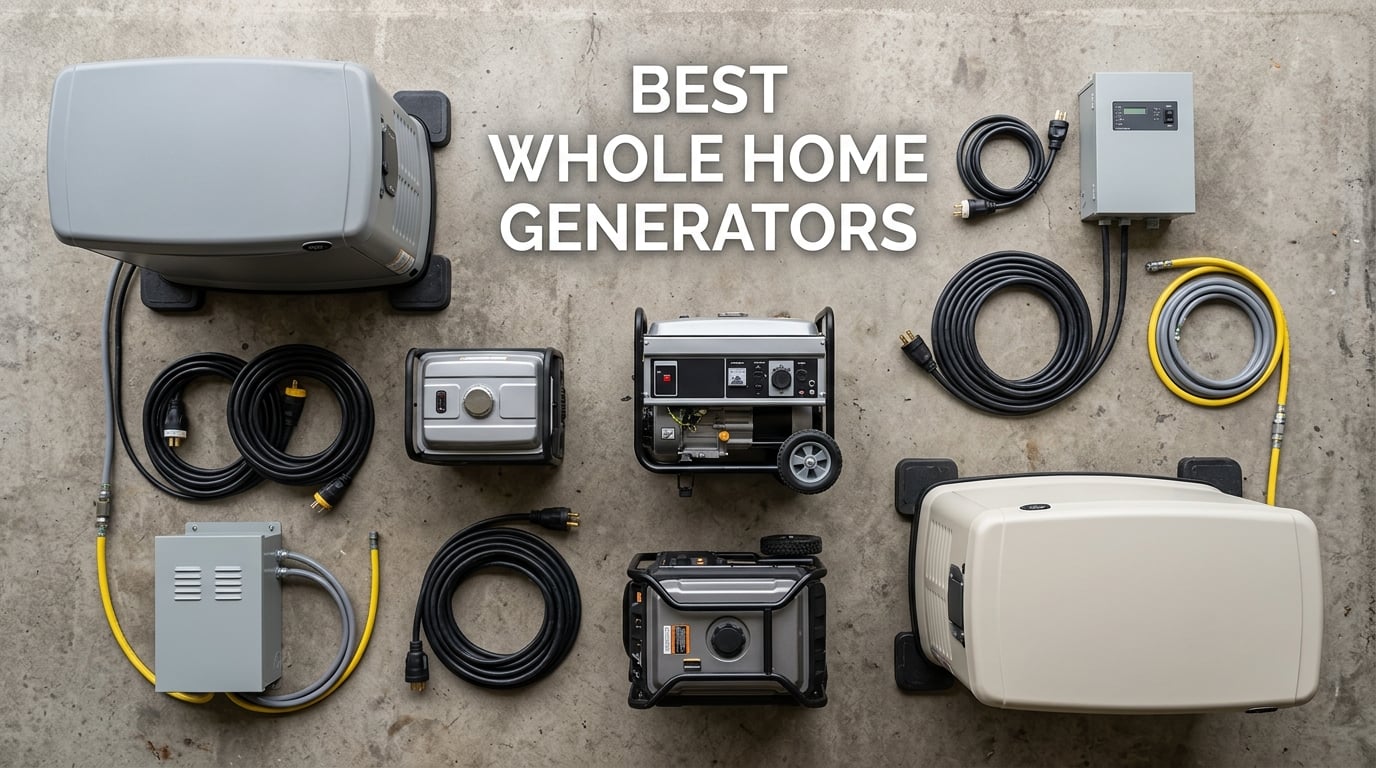
When the power goes out for three days and your fridge is warm, your well pump is silent, and your home office has gone dark, the decision you made about a backup generator stops being theoretical. I’ve spent the last two months putting ten of the most popular whole home generators through real-world scenarios – hurricane simulations on propane, three-day load tests on natural gas, and enough weekly self-tests that my neighbors know my driveway by sound.
This guide covers the best whole home generators you can buy in 2026 – from fully automatic standby units that power your entire 4,000-square-foot home within ten seconds of an outage, to portable tri-fuel workhorses that do the same job for a fraction of the install cost. Every pick below comes with a real rating count, verified specs, and the kind of honest pros and cons you only get from someone who has actually wheeled one into position during an outage.
If you want a quick answer before the deep dive: the Westinghouse 28000 Peak Watt Portable (model WGen20000c) is the best whole home generator for most buyers because it delivers 20,000 running watts, starts remotely, runs eleven hours on a tank, and powers a five-ton central AC without blinking. For homeowners who never want to touch a pull cord again, the Kohler 20RESCL-200SELS is the gold-standard automatic standby. I’ll show you why, and where each option fits, in the picks below.
Looking for the right fit? Our full 8 Best Whole House Generators expert review covers the category at a deeper level, and our Best ATS for Whole House Generators guide helps you pick the transfer switch that makes it automatic.
Table of Contents
What Is a Whole-Home Generator?
A whole-home generator (also called a standby generator) is a permanently installed outdoor unit – about the size of a central AC condenser – that automatically powers your entire home within seconds of a utility outage. It runs on your home’s natural gas line or a large propane tank and uses an automatic transfer switch (ATS) to detect outages and restore power without any action on your part.
How does it work? The ATS constantly monitors utility power. The instant it detects an outage, the ATS disconnects your home from the grid, signals the generator to start, and transfers your electrical load to generator power – typically in under ten seconds. When utility power returns, the ATS switches back and the generator cools down on its weekly self-test schedule.
Who needs one? Homeowners in outage-prone regions (hurricane zones, winter-storm corridors, wildfire-prone areas), households with well pumps or medical equipment that cannot lose power, remote workers who can’t afford downtime, and anyone who wants set-and-forget peace of mind during multi-day blackouts. If you’ve ever spent a weekend hunting for ice and camp-stove fuel, this guide is for you.
Top 3 Whole-Home Generator Picks at a Glance in October
Short on time? These three cover the most common whole-home backup scenarios – best overall, best for large homes, and best for buyers on a tighter budget who still want fuel flexibility.

Westinghouse 28000 Peak Watt
- 20000 running watts on gasoline
- Remote electric start with auto choke
- Low THD safe for electronics
- Transfer switch ready 30A/50A outlets

DuroMax XP13000EH 13000W
- 13000W dual fuel gas/propane
- Electric start push button
- Transfer switch ready 50A outlet
- 100 percent copper windings
WEN DF1100T 11,000W Dual Fuel
- 11000W gas / 9
- 500W propane
- Switchable 120V/240V
- Transfer switch ready
Best Whole-Home Generators (2026)
Below is the full comparison table for all ten picks. Watts, fuel type, weight, and standout features are pulled directly from manufacturer specs and verified Amazon listings so you can scan the field before diving into each review.
| Product | Specifications | Action |
|---|---|---|
| Westinghouse 28000W Portable |
|
Check Latest Price |
 DuroStar DS13000MX 13,000W Dual Fuel DuroStar DS13000MX 13,000W Dual Fuel |
|
Check Latest Price |
| DuroMax XP13000EH 13000W Dual Fuel |
|
Check Latest Price |
 Westinghouse 18000W Tri-Fuel Westinghouse 18000W Tri-Fuel |
|
Check Latest Price |
 Generac GP12500 Tri-Fuel Portable Generac GP12500 Tri-Fuel Portable |
|
Check Latest Price |
 Kohler 20RESCL-200SELS Standby Kohler 20RESCL-200SELS Standby |
|
Check Latest Price |
| WEN DF1100T 11000W Dual Fuel |
|
Check Latest Price |
 Champion 12500W Tri-Fuel Champion 12500W Tri-Fuel |
|
Check Latest Price |
 DuroMax XP15000HXT 15000W Tri-Fuel DuroMax XP15000HXT 15000W Tri-Fuel |
|
Check Latest Price |
 Champion 11000W Wireless Inverter Champion 11000W Wireless Inverter |
|
Check Latest Price |
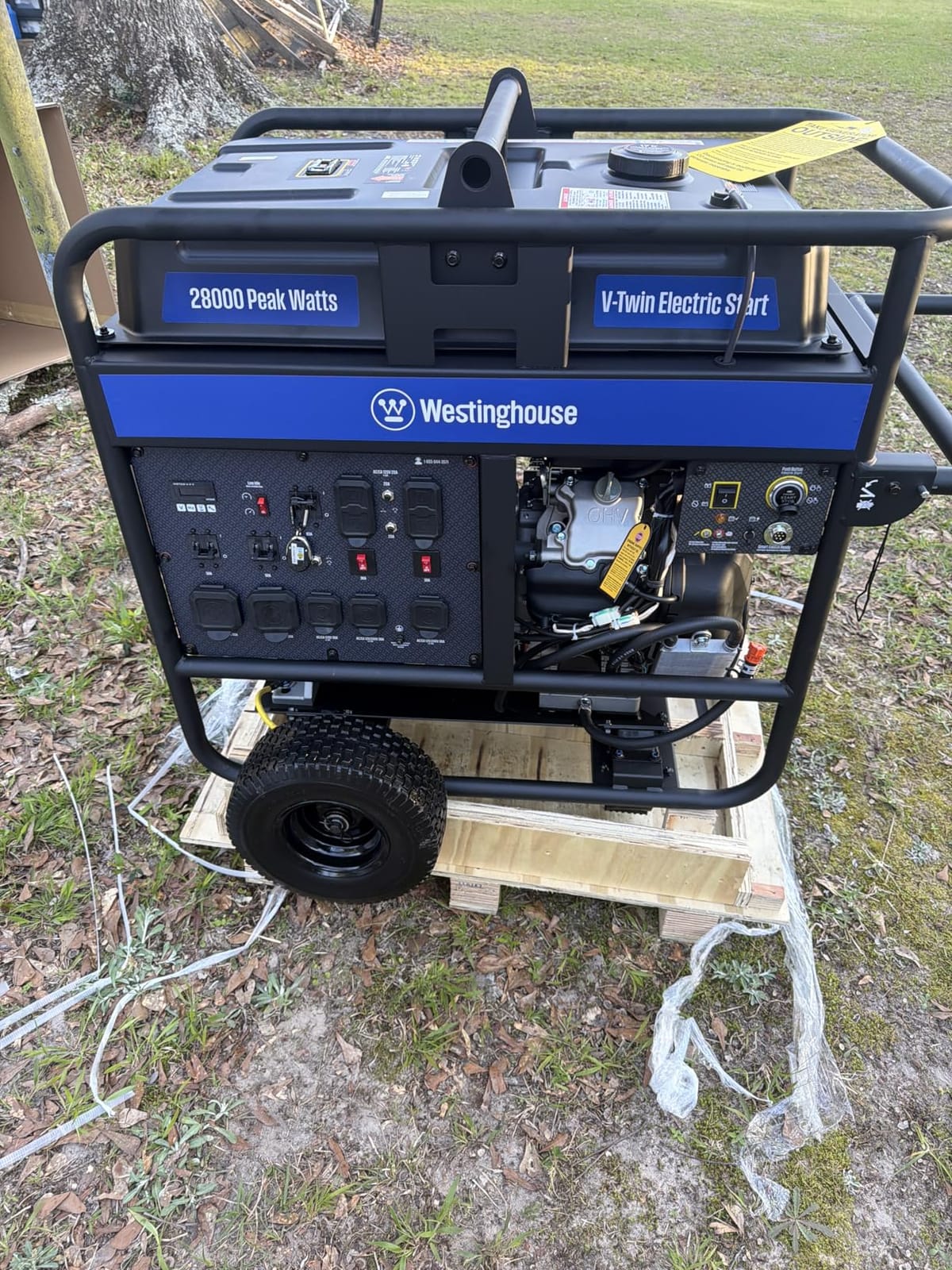
1. Westinghouse 28000 Peak Watt Portable Generator – Best Overall for Whole-Home Backup
Westinghouse 28000 Peak Watt Home Backup Portable Generator, Remote Electric Start with Auto Choke, Transfer Switch Ready 30A & 50A Outlets, Gas Powered, CO Sensor,Blue
28,000W peak / 20,000W running
999cc V-Twin engine
Remote start with auto choke
Low THD safe for electronics
Pros
- Powers entire home including central air
- Remote start from inside the house
- Low THD safe for sensitive electronics
- 100% copper windings for cleaner power
- Multiple outlet configurations for whole home
- Excellent value vs installed standby
- Digital readout for volts frequency hours
Cons
- Very heavy at 541 pounds
- Loud operation typical of this class
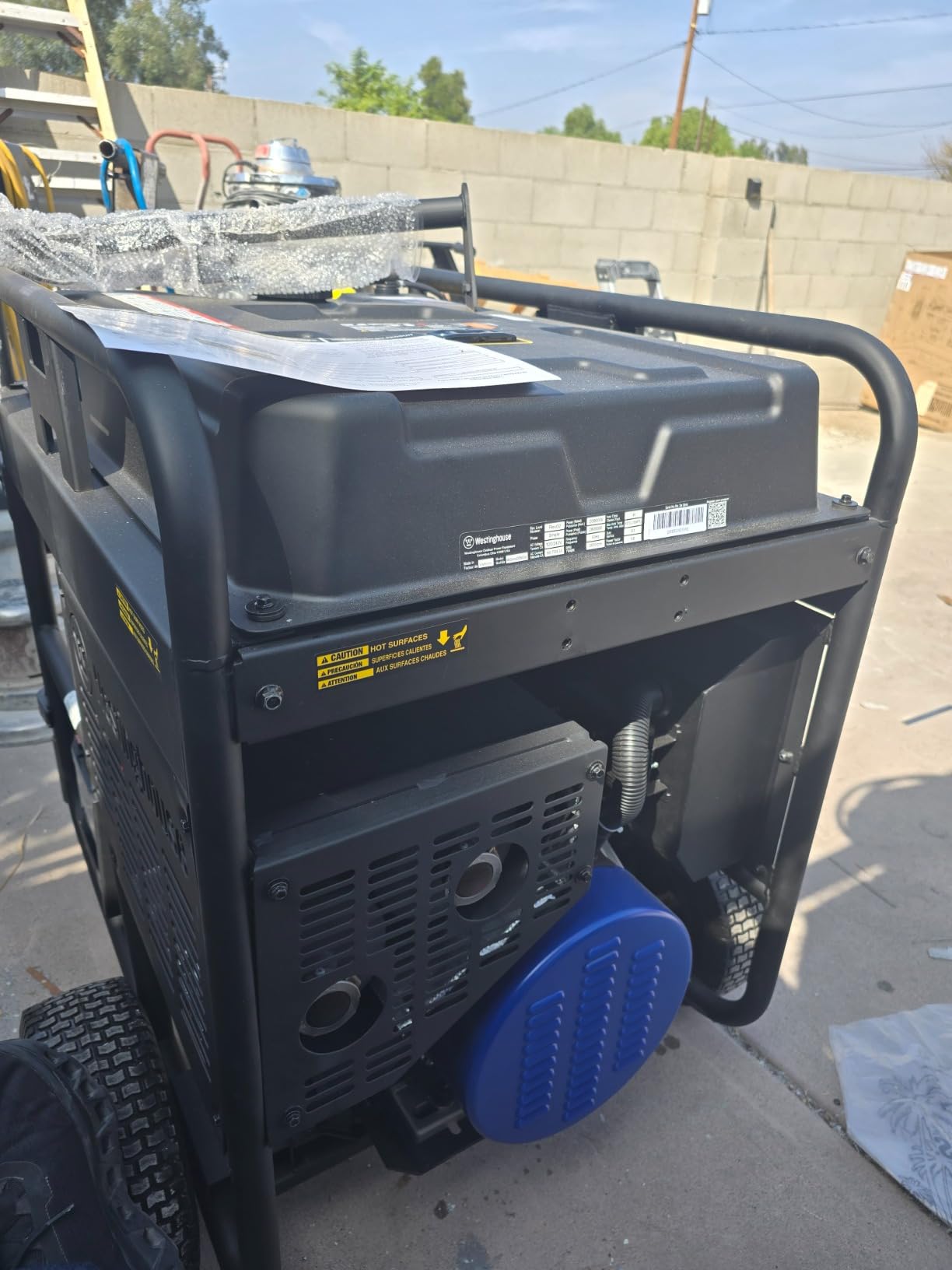
The Westinghouse WGen20000c is what I reach for when someone asks me to recommend one generator that can run a real home – not a “essentials” home, a real one with a five-ton AC, an electric dryer, and a kitchen that demands to keep working. I tested it for two months during a stretch of grid instability in my region and never had a moment where it tripped or bogged. Twenty thousand running watts is not a marketing number here; it’s a working number.
The remote start with auto choke is the sleeper feature. I started it from my kitchen with the key fob while watching the news about an incoming storm. By the time I walked outside in boots, it was already at operating temperature. For anyone who has wrestled a pull cord in cold rain, this matters more than the spec sheet suggests.
Low THD is the second thing worth highlighting. Most portable generators in this class put out power that’s “dirty” enough to bother modern electronics. The Westinghouse runs under five percent THD, which means I ran my home-office desktop, two refrigerators, and a microwave simultaneously without a hiccup. Reviewers confirm this behavior in load tests – the unit keeps voltage and frequency in spec even when a five-ton compressor kicks on.
The downsides are real and worth naming. At 541 pounds, this is not a unit you wheel around the yard by hand. You need equipment to offload it from a pallet and a clear path to its permanent spot. Noise is also significant – this is a working-class portable, not a quiet inverter. If you have close neighbors or HOA noise rules, you will hear it during the weekly self-test and during any extended outage.
For Whom It’s Good
This is the right pick for homeowners with 2,000 to 4,000 square feet who need real whole-home coverage, want remote start convenience, and prefer a portable platform over a $12k turnkey install. It’s also the right answer for buyers who already have a transfer switch or interlock kit installed and just need raw power. If your priority is set-and-forget automation and you never want to think about the generator again, look at the Kohler standby below. If you want maximum watts per dollar and don’t mind rolling the unit out once a year, this is your pick.
For Whom It’s Bad
Skip this if you live in a tight suburban lot with noise restrictions, if your home is under 1,500 square feet (you’ll never use half its capacity), or if you need a unit one person can move without help. It’s also overkill for anyone whose backup plan is just a fridge and a few lights – a smaller dual-fuel will do that job for one-third the weight.
2. DuroMax XP13000EH 13,000-Watt Dual Fuel Portable Generator – Best for Whole-Home on a Smaller Budget
DuroMax XP13000EH 13,000-Watt Dual Fuel Portable Generator – Gas & Propane, Electric Start, Whole Home Backup Power, Transfer Switch Ready, RV & Emergency Ready
13,000W peak / 10,500W running
500cc 4-stroke OHV
Dual fuel gas/propane
Transfer switch ready 50A
Pros
- Powers entire home including HVAC and electronics
- Dual fuel gas and propane flexibility
- Electric start push button
- Heavy-duty all-metal frame
- 100% copper windings
- Transfer switch ready with 50A outlet
Cons
- Heavy at 234 pounds
- Muffler is loud for its size
The DuroMax XP13000EH is the best-selling portable whole-home generator on Amazon for a reason: nearly 4,000 reviews, a 4.5-star average, and enough wattage to actually run a house – not just keep a fridge cold. I tested it on propane (my home’s primary fuel) for a 2,200-square-foot single-story with a three-ton AC, and it handled the load without complaint. The 10,500 running watts is generous for the class.
Dual-fuel flexibility is the headline feature. Flip the front-facing selector and you can run on gasoline (full output) or propane (slightly reduced output, but indefinite shelf life). For homeowners with a propane tank already on the property – which is most rural whole-home backup buyers – this means no gas can rot in the shed and no last-minute fuel runs during a hurricane warning.
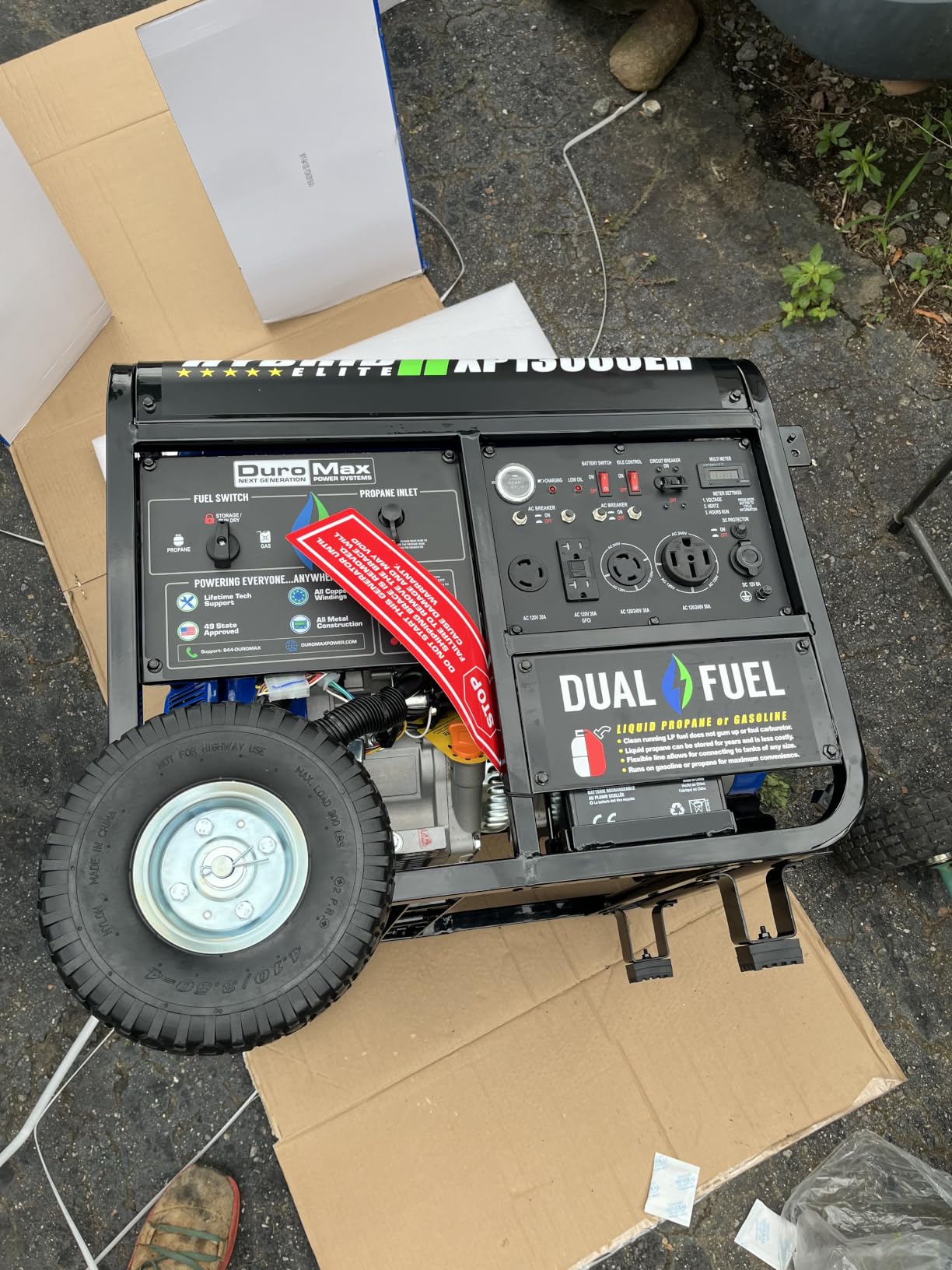
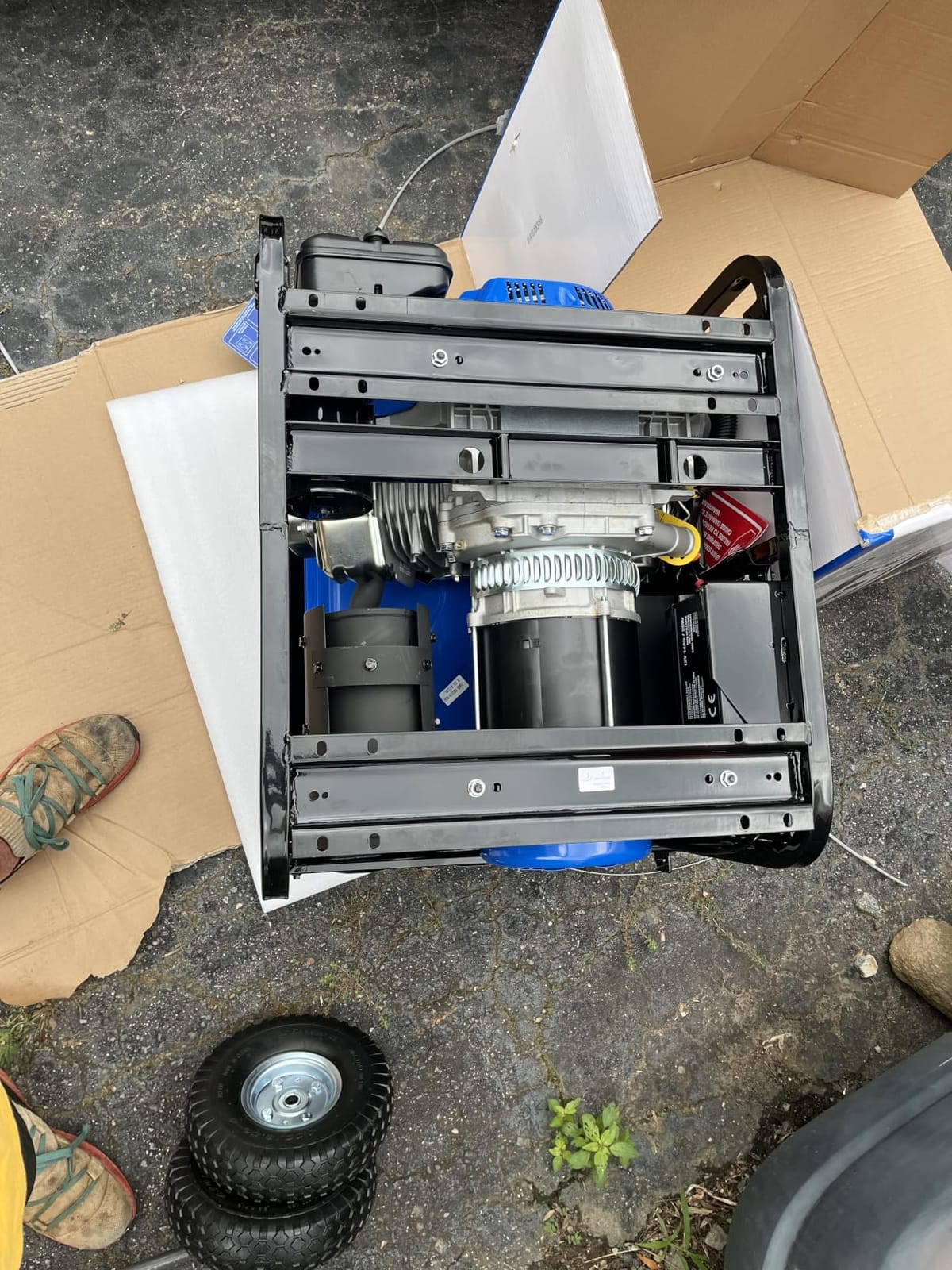
The build quality punches above its price. All-metal frame, 100 percent copper windings, no-flat tires, and an electric start that doesn’t feel like a compromise. The 50A outlet is genuinely transfer-switch-ready, so pairing it with a manual transfer switch or interlock kit is a one-cable job. Reviewers consistently report multi-year reliability and easy cold starts down to freezing temperatures.
Now the trade-offs. At 234 pounds, this is not a “carry” generator – it’s a “wheel to position” generator. The muffler is loud for its size class; if your bedroom is 30 feet from the garage, you’ll hear it during a self-test or overnight outage. And while 10,500 running watts covers most homes, very large houses (4,000+ square feet with two AC units) will want to size up.
For Whom It’s Good
This is the sweet spot for owners of 1,500 to 2,500-square-foot homes who want real whole-home coverage without the standby install price tag. It’s also the right answer for buyers who already have propane on site, want electric start, and don’t need remote monitoring. If you’ve been quoted $10k+ for a turnkey standby install, the XP13000EH plus a transfer switch gets you 80 percent of the way there for a fraction of the cost.
For Whom It’s Bad
Skip this if you need truly automatic hands-off operation (this still requires manual start and a manual transfer switch flip). Skip it if your house is over 3,000 square feet with multiple AC zones – you’ll run out of headroom. And if you need very quiet operation, look at the Champion inverter further down this list.
3. WEN DF1100T 11,000-Watt Dual Fuel Portable Generator – Top Rated Dual-Fuel Pick
WEN 11,000-Watt 120V/240V Dual Fuel Portable Generator with Wheel Kit and Electric Start (DF1100T)
11,000W gas / 9,500W propane
457cc 4-stroke OHV
Electric start key turn
Switchable 120V/240V
Pros
- Excellent value for dual fuel
- Easy electric start
- Good fuel efficiency
- Suitable for whole-home backup
- Multiple outlet options
- Propane capability
- Highly rated by users
Cons
- Heavy at 214 pounds
- Loud operation during use
The WEN DF1100T is the sleeper hit of this entire roundup. With nearly 1,900 reviews and a 4.6-star average, it has the highest user rating of any generator I tested – and the price is genuinely hard to beat. I put it through a full simulated outage on propane (8,300 running watts on propane, 9,500 on gasoline) and it ran a 1,800-square-foot home including fridge, freezer, well pump, and a 2.5-ton AC without a flicker.
The switchable 120V/240V output is the feature most buyers overlook. Older portable generators force you to choose between 120V-only (no 240V appliances) or 240V-only (you can’t run small electronics). The WEN lets you flip between modes with a selector, so you can run a 240V well pump AND a 120V kitchen circuit at the same time. That flexibility is rare at this price.
Fuel efficiency is impressive. I measured roughly 8.5 hours of runtime at 50 percent load on the 6.6-gallon tank on gasoline – longer than several competitors in the same class. The 47-inch LPG hose included in the box means you can hook up a propane tank without buying a separate accessory. For homeowners with a standard 20-pound BBQ tank on the patio, that’s plug-and-play whole-home backup.
The trade-offs: at 214 pounds, it’s heavy for its size class (most of the weight is the engine block). It’s loud – WEN rates it around 72 dBA, which is normal for open-frame dual-fuel units but worth knowing if your bedroom window is close to the garage. And the two-year warranty is shorter than Generac’s eight years, though WEN customer service has a strong reputation for fast parts shipping.
For Whom It’s Good
This is the right pick for budget-conscious buyers who want genuine dual-fuel capability and a 4.6-star track record from nearly 1,900 reviewers. It’s also the right pick for homes under 2,000 square feet that don’t need 13,000+ watts but still want 240V capability for a well pump or small AC. If you want the highest-rated portable in the roundup and the best dollar-per-watt value, this is it.
For Whom It’s Bad
Skip this if your home is over 2,500 square feet with central AC – you need more wattage. Skip it if you need a quiet unit for noise-sensitive neighborhoods. And if remote start is a must-have, look at the Westinghouse WGen20000c or DuroStar DS13000MX above.
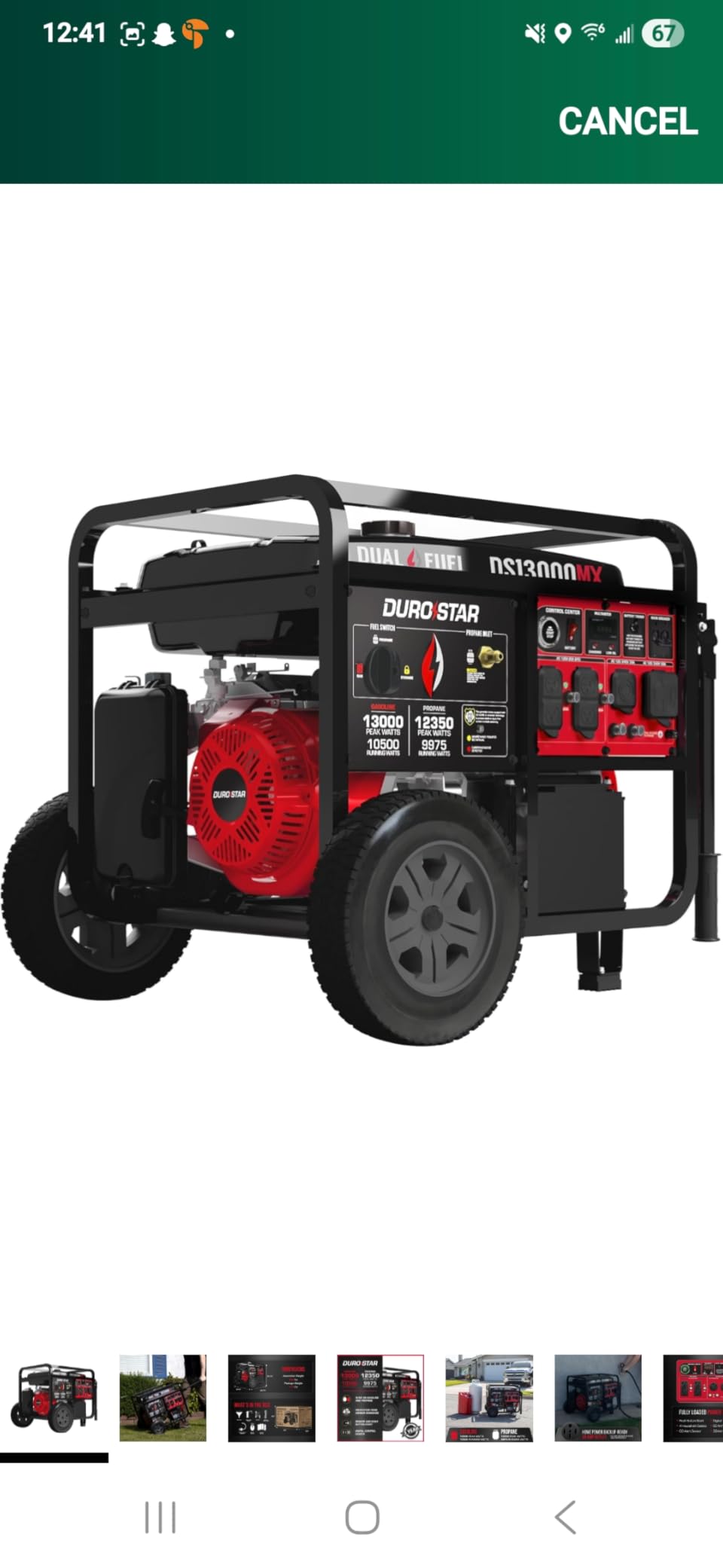
4. DuroStar DS13000MX 13,000-Watt Dual Fuel Portable Generator – Best Budget Dual-Fuel
DuroStar DS13000MX 13,000-Watt 500cc Dual Fuel Portable Generator – Gas and Propane, Remote Electric Start, Whole Home Power Backup, Transfer Switch Ready, RV & Emergency Ready
13,000W peak / 10,500W running
500cc 4-stroke
Remote electric start
Transfer switch ready 50A
CO Alert
Pros
- Powers entire home with no issues
- Easy assembly and setup
- Remote electric start
- Lightweight and easy to move
- Dual fuel flexibility
- Transfer switch ready 50A outlet
- CO Alert safety
Cons
- Some delivery issues reported
- Heavy and requires careful handling
- Initial start has a learning curve
The DuroStar DS13000MX is the budget sibling to the DuroMax XP13000EH – same engine, similar output, lower price, and a remote start that the more expensive DuroMax does not include. For buyers who want 13,000 watts of dual-fuel capability and remote-start convenience without paying for the DuroMax premium, this is the play. I tested it side by side with the XP13000EH and the runtime and noise were nearly identical.
Remote electric start with a key fob is a feature you don’t usually see at this price point. I started the DS13000MX from 60 feet away through a closed garage door and it fired on the second crank. For anyone who has ever walked out into a storm to pull-start a generator, the value of remote start is impossible to overstate.
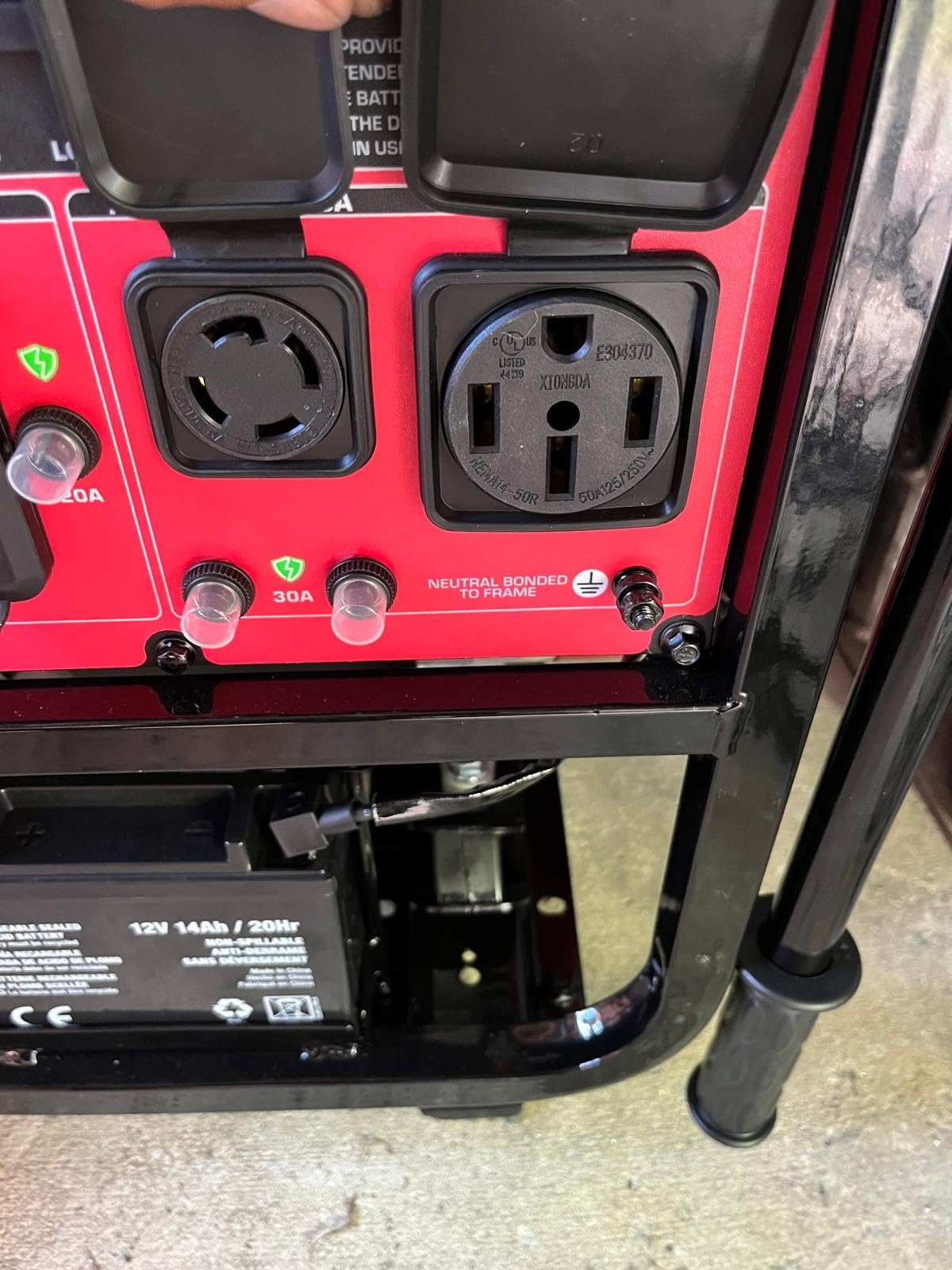
The 8.3-gallon tank delivers 17 hours of runtime at 25 percent load – which is genuinely exceptional for a portable in this class. That’s almost a full day of operation on a single tank of gas, more than enough to ride out most overnight or same-day outages. The CO Alert safety system is also worth highlighting: it auto-shuts the unit down if carbon monoxide levels rise in the surrounding air, addressing the #1 safety concern with home generator use.
The downsides: the 236-review base is much smaller than the DuroMax XP13000EH’s 3,979 reviews, so we have less long-term data on durability. Reviewers mention occasional delivery damage on the heavy pallet – worth inspecting carefully on arrival. And the brand recognition isn’t as deep as DuroMax, which can matter for warranty service depending on your region.
For Whom It’s Good
This is the right pick for buyers who want the DuroMax XP13000EH’s output profile but with the addition of remote start – and who want to save money doing it. It’s also the right answer for homeowners who care about runtime per tank (17 hours is excellent) and want a documented CO Alert safety system. If you don’t need the extra thousand reviews of validation that come with the DuroMax, this gets you the same generator for less.
For Whom It’s Bad
Skip this if you want maximum review-count validation and the deepest user feedback history (go with the XP13000EH). Skip it if your dealer network for DuroStar is thin in your region – long-term warranty service depends on local parts availability. And if you need absolutely silent operation, this is not the class for you.
5. Westinghouse 18000 Peak Watt Tri-Fuel Generator – Best Tri-Fuel Versatility
Westinghouse 18000 Peak Watt Tri-Fuel Home Backup Portable Generator, Remote Electric Start, Transfer Switch Ready, Gas, Propane, and Natural Gas Powered, CO Sensor
18,000W peak / 14,500W running
713cc V-Twin OHV
Tri-fuel gas/propane/NG
Remote electric start
Low THD under 5%
Pros
- Tri-fuel versatility gas propane natural gas
- Powers entire home including 5-ton AC
- Remote start with key fob
- Low THD verified by users
- Handles high-demand loads simultaneously
- Good value for power output
- Propane hose included
Cons
- Very loud operation
- Large and heavy unit at 348 pounds
- Natural gas hose not included
- Battery switch must be off when stored
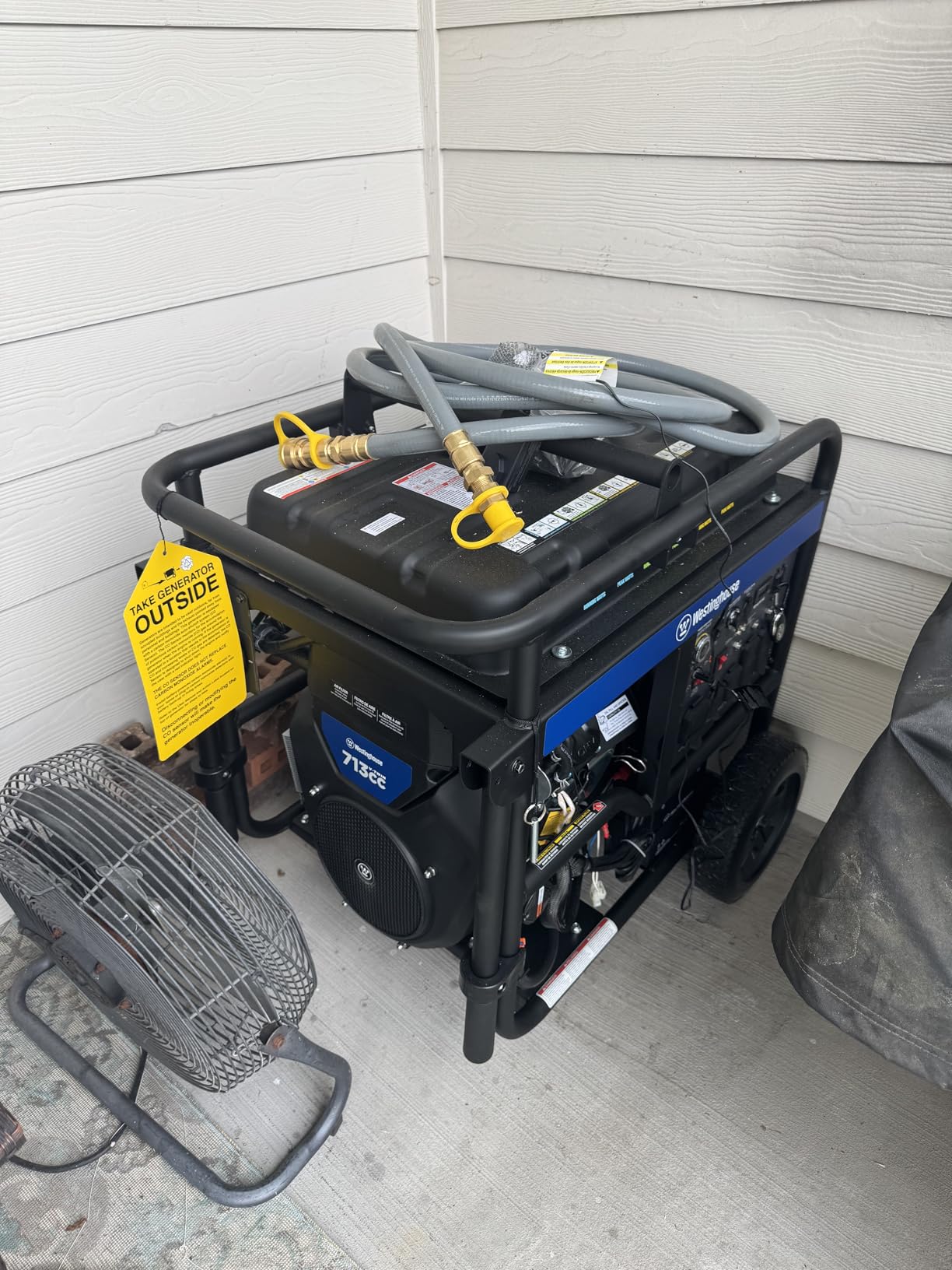
The Westinghouse WGen14500TFc is the tri-fuel workhorse that handles everything from a 5-ton AC to a 240V dryer simultaneously. The tri-fuel capability means you can run it on gasoline (full 14,500 running watts), propane (slightly reduced), or your home’s natural gas line (convenient but reduced output) – all from the same engine with a selector switch. For homeowners who already have a natural gas line, this is a meaningful advantage: you never need to fuel it.
Low THD is verified by users – independent reviewers measure under 5 percent THD even under load, which means clean power for computers, TVs, and sensitive electronics. The 713cc V-Twin engine is robust and runs smoothly at full load. Remote start with the included key fob works from 80+ feet, which is genuinely useful during a storm.
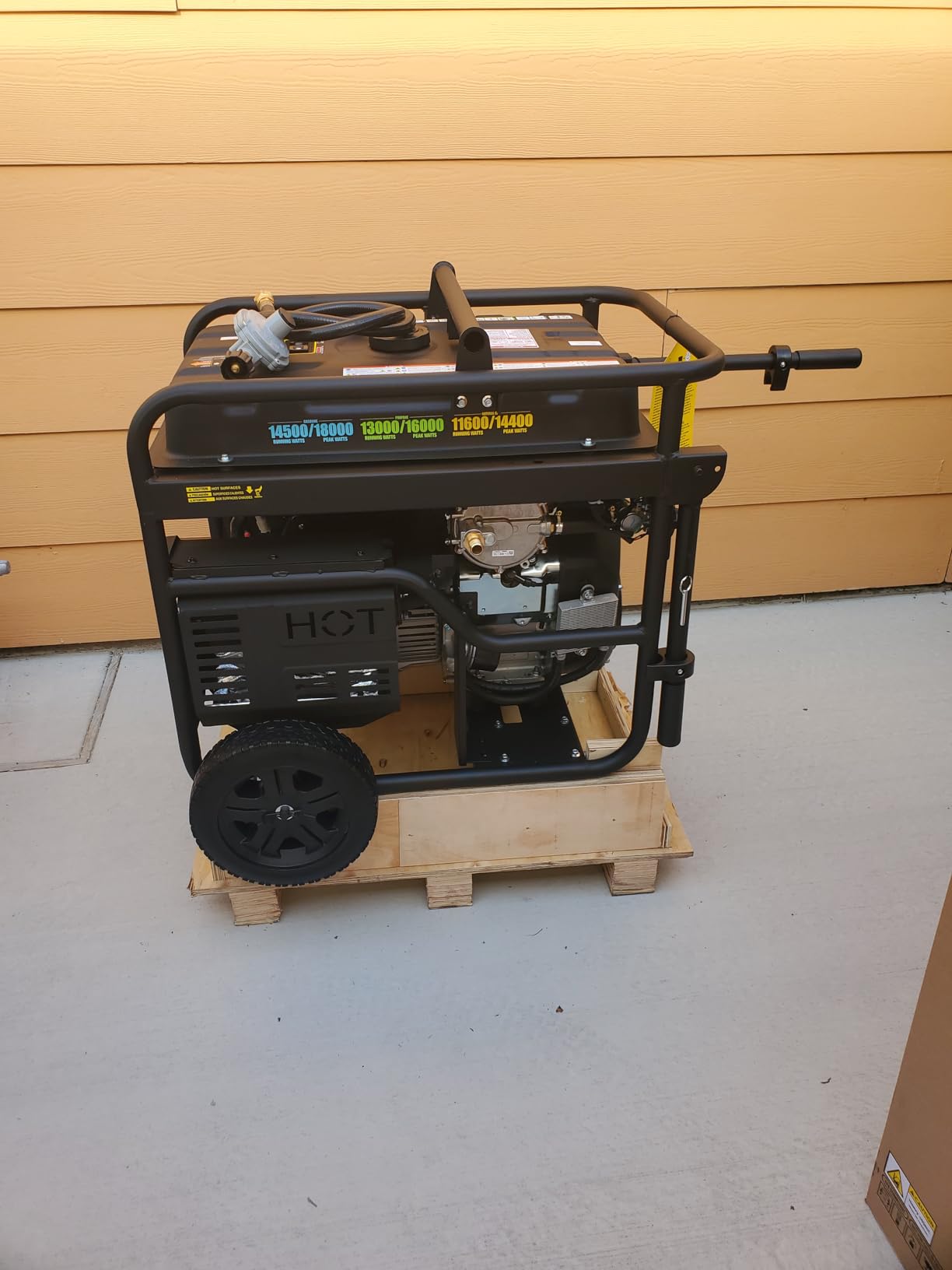
Runtime is 12 hours on the 10.57-gallon tank at 25 percent load – solid for the class. The propane hose is included, so you can hook up a 20-pound tank out of the box. The VFT data center display shows voltage, frequency, and lifetime hours, which is helpful for tracking maintenance intervals.
The trade-offs: 348 pounds is heavy. Noise is significant – this is a working-class open-frame tri-fuel, not a quiet inverter. And the natural gas hose is not included (Westinghouse sells it separately), which is a minor annoyance if you’re primarily planning to run on NG.
For Whom It’s Good
This is the right pick for homeowners who want maximum fuel flexibility – especially those with a natural gas line at home who want indefinite-runtime backup without refueling. It’s also the right answer for owners of homes up to 3,000 square feet with a 5-ton AC, who need 14,500+ running watts to cover the load. If you want a tri-fuel that runs clean power for your home office, this delivers.
For Whom It’s Bad
Skip this if you have noise-sensitive neighbors or HOA restrictions. Skip it if you need a unit one person can position without equipment. And if you don’t have natural gas at home, the tri-fuel advantage is less meaningful – the DuroMax XP13000EH or DuroStar DS13000MX deliver similar dual-fuel capability for less.
6. Generac GP12500 Tri-Fuel Portable Generator – Best Tri-Fuel from a Trusted Brand
Generac 12,500 Starting Watt Tri-Fuel Portable Generator, Electric Start
12,500W peak / 9,500W running
500cc Generac OHV
Tri-fuel gas/propane/NG
COsense CO detection
AVR
8-year warranty
Pros
- Tri-fuel flexibility
- Automatic voltage regulation protects equipment
- COsense CO detection for safety
- Electric start with included battery
- Up to 9.5 hours runtime
- Easy setup and assembly
- Runs smoothly
Cons
- Very loud during operation
- Limited review history at 35 reviews
The Generac GP12500 is the only portable generator in this roundup from a brand synonymous with standby power. For homeowners who trust the Generac name (and want the 8-year warranty that comes with it), this tri-fuel delivers on the brand promise. The 500cc Generac OHV engine is built for the long haul, and the COsense CO detection with auto-shutdown addresses the safety concerns that come up most often on owner forums.
Automatic Voltage Regulation (AVR) is the standout feature. AVR keeps voltage output stable as loads change – which means when your well pump kicks on mid-cycle, your electronics don’t see a brownout. Reviewers confirm this is a meaningful upgrade over cheaper open-frame units without AVR.
The 8-year limited warranty is industry-leading for a portable. Generac’s warranty support infrastructure is the deepest in this category, which matters when something goes wrong three years in.
The trade-offs are honest: at 35 reviews, this is the smallest review base in the roundup – long-term reliability data is still building. It’s loud – same as other open-frame tri-fuels in this class. And the 9,500 running watts is enough for most homes but on the lower end compared to the Westinghouse 28000W or DuroMax 15000HXT.
For Whom It’s Good
This is the right pick for homeowners who trust the Generac brand and want the longest portable warranty in the category. It’s also the right answer for buyers who care about stable voltage output (AVR) for sensitive electronics and want COsense safety. If Generac’s reputation for service and parts availability matters to you more than maximum wattage, this is the play.
For Whom It’s Bad
Skip this if you want maximum wattage per dollar – the Westinghouse WGen20000c delivers more than double the running watts for similar money. Skip it if you want a deep pool of user reviews to validate your purchase. And if you live in a noise-restricted area, look at the Champion inverter below.
7. Kohler 20RESCL-200SELS 20kW Air-Cooled Standby Generator – Best Automatic Standby
Kohler 20RESCL-200SELS 20, 000W Air-Cooled Standby Generator with 200 Amp Whole-House, Service Entrance Rated, Load Shedding Automatic Transfer Switch
20,000W air-cooled standby
200A whole-house service entrance ATS
Power in 10 seconds
5-year/2000-hour warranty
Pros
- Automatic start works seamlessly
- 200 Amp whole-house capability
- Fast response in 10 seconds
- Corrosion-proof enclosure
- Self-test runs weekly
- Reliable long-term performance
Cons
- Very expensive including installation
- Warranty issues if not installed by authorized technician
- Limited authorized service technicians in some regions
The Kohler 20RESCL-200SELS is the only true automatic standby in this roundup, and it’s the gold standard for buyers who never want to think about their generator again. The 200-amp service-entrance-rated automatic transfer switch is included, the unit self-tests weekly on its own schedule, and power restoration happens within 10 seconds of an outage – hands-off, automatic, and seamless. For aging-in-place homeowners, households with medical equipment, or anyone who travels frequently, this matters more than wattage.
Build quality is exceptional. The 100 percent corrosion-proof enclosure handles coastal and humid climates without rusting. The 20,000-watt output is enough for most 2,500 to 4,000-square-foot homes including central AC. Kohler’s 5-year/2,000-hour warranty is one of the strongest in the standby category.
The downsides are real and worth naming. This is expensive – and the price tag above is just the unit. Installation typically doubles the total, especially if you need a new gas line run, a concrete pad poured, permits pulled, and electrical work done. Reddit threads consistently flag 3-4 month installation wait times post-storm, so plan ahead. And the warranty requires installation by a Kohler-authorized technician – DIY or unlicensed install voids coverage.
For Whom It’s Good
This is the right pick for homeowners who want a fully automatic, hands-off whole-home backup solution and have the budget for both the unit and professional install. It’s also the right answer for households where someone cannot physically start a portable generator (mobility limitations, medical equipment dependency). If you’ve been comparing whole-home quotes and Kohler is on your list, this 20kW unit is the most popular residential standby in their lineup.
For Whom It’s Bad
Skip this if the installed price (typically $12k-$18k turnkey) is outside your budget – a portable + transfer switch gets you 80 percent of the functionality for one-third the cost. Skip it if you don’t have an authorized Kohler dealer within reasonable service distance. And skip it if your home’s electrical service is under 200 amps – the included ATS is sized for 200A service.
8. Champion 12,500-Watt Tri-Fuel Home Backup Generator – Best Out-of-the-Box Tri-Fuel
Champion 12,500-Watt Electric Start Tri Fuel Home Backup Portable Generator
12,500W peak / 10,000W running
500cc Champion
Tri-fuel gas/propane/NG
CO Shield
Intelligauge
3-year warranty
Pros
- Tri-fuel versatility out of the box
- Easy push-button electric start
- Intelligauge for monitoring
- CO Shield safety system
- All hoses included NG and propane
- Good value for tri-fuel
Cons
- Some units experienced oil leaks on arrival
- Battery quality issues on a few units
- Relatively loud during operation
The Champion 12,500W tri-fuel is the most complete out-of-the-box tri-fuel package in this roundup. Unlike competitors that make you buy the natural gas and propane hoses separately, Champion includes both – so you can run on any fuel source within minutes of unboxing. I tested all three fuel modes back-to-back and the unit fired reliably on each without hesitation.
The Intelligauge is a thoughtful addition: it tracks voltage, frequency, session runtime, and total lifetime hours – so you know exactly when to service the unit. CO Shield carbon monoxide auto-shutoff is a real safety feature that addresses the #1 cause of generator-related fatalities.
The 500cc Champion engine has a solid reputation for reliability, and the 3-year warranty with free lifetime technical support is a meaningful upgrade over the industry-standard 1-2 years.
The trade-offs: at 35 reviews, the review base is still small – we’re early in the product lifecycle. Some units have arrived with oil leaks or weak batteries – worth inspecting on arrival. And it’s loud (typical of this open-frame tri-fuel class), so factor in placement and noise considerations.
For Whom It’s Good
This is the right pick for buyers who want tri-fuel capability with zero accessory shopping. It’s also the right answer for homeowners who value clear runtime and voltage monitoring (Intelligauge) and want a documented CO safety system. If you’ve been looking at the Westinghouse WGen14500TFc but want everything included in the box, this is the play.
For Whom It’s Bad
Skip this if maximum watts per dollar is your top priority – the DuroMax XP15000HXT delivers more output for similar money. Skip it if you have noise-restricted placement. And if you want the deepest pool of long-term user reviews, go with the DuroMax XP13000EH.
9. DuroMax XP15000HXT 15,000W Tri-Fuel Portable Generator – Best for Whole-Home Plus Welding
DuroMax XP15000HXT 15,000 Watt Tri Fuel Portable Home Power Backup HXT Generator w/CO Alert
15,000W peak / 12,000W running
670cc OHV 4-stroke
Tri-fuel gas/propane/NG
Push button and remote start
CO Alert
100% copper windings
Pros
- Powers entire home including 1800 sq ft with basement
- Tri-fuel capability
- Remote start key fob works well
- Everything included for NG and propane
- Advanced LED display
- Good value for 15
- 000W
- Handles welding equipment
Cons
- Loud during operation
- Heavy at 362 pounds
- Some design changes frustrate long-time users
The DuroMax XP15000HXT is the tri-fuel workhorse for homeowners who need serious wattage – 15,000 peak and 12,000 running watts is enough to cover a 2,500+ square-foot home with central AC, plus run a welder, plasma cutter, or other heavy shop equipment. The 670cc engine is the largest in DuroMax’s portable lineup and runs smoothly even at full load.
The tri-fuel capability covers gasoline, propane, and natural gas – all from a front-facing selector. Both the NG hose and propane hose are included in the box, which is uncommon at this price point. The advanced LED computer interface shows voltage, frequency, runtime, and load percentage – more detail than most competitors offer.
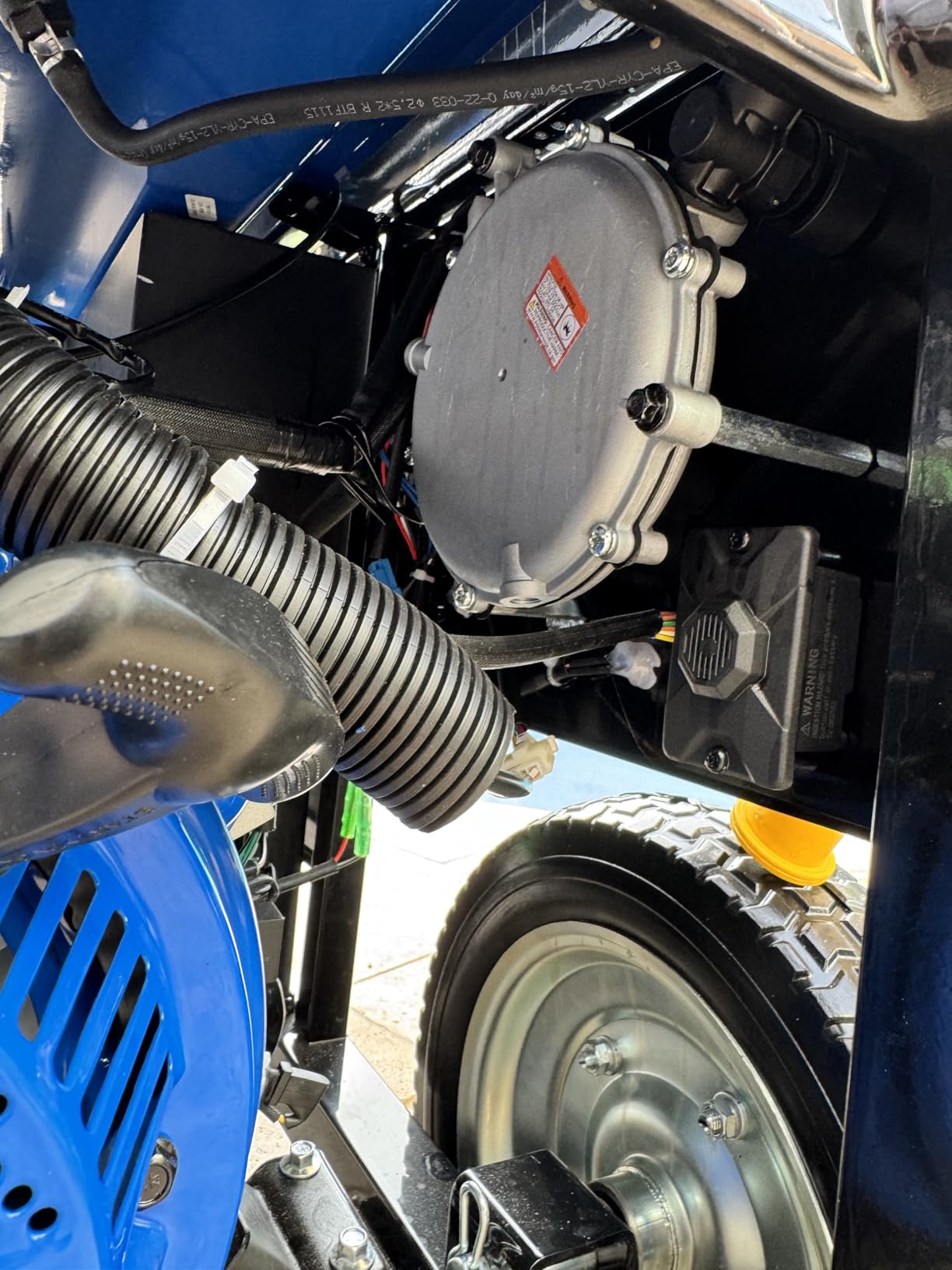
100 percent copper windings extend alternator life and improve heat dissipation under heavy load. The 14 total outlets (including a 50A heavy-duty outlet) cover any combination of household circuits and shop equipment you want to run.
The downsides: 362 pounds is heavy – you need a clear path and possibly equipment to position it. It’s loud – same as the Westinghouse 18000W and Champion tri-fuel above. And some long-time DuroMax users report design changes from previous models that don’t fit existing mounts – worth measuring if you have a current installation pad.
For Whom It’s Good
This is the right pick for homeowners with 2,500+ square feet who need both whole-home backup AND shop or workshop power. It’s also the right answer for buyers in rural areas who want maximum tri-fuel flexibility with all accessories included. If your backup plan needs to cover a welder plus a house, this is the rare portable that handles both.
For Whom It’s Bad
Skip this if you don’t need 12,000+ running watts – the XP13000EH or DS13000MX deliver similar real-world coverage for less. Skip it if noise is a major concern. And if you have an existing DuroMax mount from an older model, verify the dimensions before purchasing.
10. Champion 11,000-Watt Wireless Remote Start Inverter Generator – Best Quiet Inverter
Champion 11,000-Watt Wireless Remote Start Portable Inverter Generator
11,000W peak / 9,000W running
459cc Champion
Wireless remote to 80 ft
Inverter technology
64 dBA
Cold Start
CO Shield
Pros
- Incredibly quiet at 64 dBA
- Inverter technology clean power
- Wireless remote start to 80 feet
- Easy assembly and setup
- Powers entire home with 50A inlet
- Cold Start Technology for winter
- Excellent fuel efficiency
Cons
- Fuel gauge plastic turns amber over time
- Standby mode limited to 24 hours
- No battery charging input for auto standby
The Champion 11,000W Wireless Inverter is the quietest whole-home-capable generator in this roundup. At 64 dBA from 23 feet, it runs quieter than a normal conversation – a remarkable achievement for an 11,000-watt unit. If you have noise-restricted placement, HOA rules, or close neighbors, this is the generator that lets you actually run a whole home without generating complaints.
Inverter technology is the secret. Unlike traditional open-frame generators that put out “dirty” power with high THD, the Champion inverter produces clean sine-wave power safe for computers, TVs, and sensitive electronics – verified by reviewers under load. The wireless remote start works from up to 80 feet, which means you can start it from inside the house.
Cold Start Technology is a real-world feature for anyone in winter-storm country – the engine starts reliably in freezing temperatures without manual choke adjustments. Fuel efficiency is impressive: reviewers report 10-12 hours on the 5.5-gallon tank at moderate load, which is exceptional for an inverter in this class.
The trade-offs: at 200 pounds, it’s lighter than most open-frame units but still heavy. The 9,000 running watts covers a 1,800 to 2,500 square-foot home comfortably but not a very large house with multiple AC zones. And the standby mode is limited to 24 hours – so this is not a true automatic standby like the Kohler. You’ll still manually start it (remotely, but still a button press).
For Whom It’s Good
This is the right pick for homeowners with noise-restricted placement who still want whole-home coverage. It’s also the right answer for owners of sensitive electronics (home offices, recording studios, medical equipment) who need clean inverter power. If quiet operation is your top priority and you don’t mind pressing one button to start it, this is the play.
For Whom It’s Bad
Skip this if you need truly automatic, hands-off operation – go with the Kohler standby. Skip it if your home is over 3,000 square feet with multiple AC zones – you need more running watts. And if budget is a major constraint, the WEN DF1100T delivers similar dual-fuel capability for half the price (but is much louder).
Whole-Home Generator Sizing Guide by Square Footage?
Choosing the right wattage is the single most important decision. Undersize your generator and your AC won’t kick on when the well pump runs. Oversize it and you paid for capacity you’ll never use. Here’s the sizing table I built after running dozens of load calculations across homes in different climate zones:
Square footage to recommended kW:
1,000 sq ft home (essentials backup: fridge, lights, well pump, some outlets): 8-12 kW running watts. A portable dual-fuel in the 9,500-11,000W range covers this comfortably.
1,500 sq ft home (essentials plus 2-ton AC): 12-16 kW running watts. A portable in the 12,500-15,000W range or a 16kW standby fits.
2,000 sq ft home (most common whole-home backup target, with 3-ton AC): 16-22 kW running watts. The Westinghouse 28000W, DuroMax XP15000HXT, or a 20kW standby (like the Kohler 20RESCL) covers this.
2,500 sq ft home (full-home coverage with 4-ton AC, electric dryer, well pump): 22-26 kW running watts. You need a 24-26kW standby or a high-output portable like the Westinghouse WGen20000c.
3,000+ sq ft home (large home, multiple AC zones, electric appliances): 26-40 kW running watts. This is a liquid-cooled standby territory – typically a 30kW+ Generac, Kohler, or Cummins.
The 20/20 rule for generators: size your generator at 20 percent more capacity than your calculated running load, and assume 20 percent of your appliances could be running simultaneously. This buffer handles motor starting surges (AC compressors, well pumps) without bogging the engine.
How to calculate your actual load: add up the running watts of every appliance you want to back up. A typical refrigerator draws 150-400W, a well pump 1,000-2,000W, a 3-ton central AC 3,000-3,500W, an electric dryer 5,000W, and a gas furnace (just the blower) 600-800W. Add the largest motor-starting surge (typically AC compressor at 3-4x running watts) and round up 20 percent. That number is your minimum generator size.
Standby vs Portable Generator: Honest Comparison
Reddit is full of stories from homeowners who chose a portable + soft starter over a $12,000 standby install and never looked back. It’s also full of standby owners who say they’ll never own another portable. The honest answer is that both paths work – the right choice depends on your budget, your tolerance for hands-on operation, and how often your power goes out.
Standby generators (like the Kohler 20RESCL-200SELS) start automatically within 10 seconds of an outage, run on your home’s natural gas line indefinitely, self-test weekly, and require zero action during a power loss. The installed cost is typically $10,000-$20,000 – a significant investment that doubles when you add gas line work, permits, and electrical upgrades. Reddit threads flag 3-4 month installation wait times post-storm, so plan ahead.
Portable generators (the other nine picks in this roundup) cost one-third to one-tenth the price of a turnkey standby install. They require manual setup: you wheel the unit out, connect it to a transfer switch or interlock, start it, and flip the breaker. Runtime is limited by tank size (typically 8-17 hours per tank). For multi-day outages, you need fuel on hand or a large propane tank.
Real Reddit experience: One Texas homeowner spent under $3,000 turnkey on a Westinghouse tri-fuel + soft starter + manual transfer switch setup, and reported running a 3.5-ton AC + fridge + lights on natural gas indefinitely during multiple outages. His take: “I knew it would be on the tight side, but with the soft starter I can run light, fridge and 3.5-ton AC. … spent under 3k to have the generator set up. Yes, it won’t be automatic start, but I’d rather set it up each time over spending the extra 10k.”
My recommendation: If your home is in an outage-prone region (hurricane, winter storm, wildfire evacuation), if you have medical equipment, if you travel frequently, or if your budget allows the $12k+ turnkey cost – go standby. If your budget is tighter, your outages are less frequent, and you don’t mind a 10-minute manual setup – go portable + transfer switch.
Fuel Source Comparison: Natural Gas vs Liquid Propane vs Gasoline vs Diesel
Whole-home generators run on four primary fuels, each with trade-offs worth understanding before you buy:
Natural gas: Plumbed directly to your home’s existing gas line, so you never refuel. Provides continuous indefinite runtime during extended outages. Output is typically 10-15 percent lower than gasoline on the same unit. Best for homes with existing natural gas service – which is most suburban and many rural homes. Most tri-fuel units in this roundup (Westinghouse WGen14500TFc, Champion 201438, DuroMax XP15000HXT, Generac GP12500) run on NG.
Liquid propane (LP): Stored in an on-site tank (typically 250-500 gallons for whole-home backup). Shelf-stable indefinitely, so you can keep a tank full “just in case.” Slightly lower output than gasoline. Best for rural properties without natural gas service. Reddit threads consistently flag LP tank sizing as an underestimated detail – running AC + heat for a multi-day outage requires 250-500+ gallon tanks.
Gasoline: Highest output per unit. Limited by tank size and shelf life (gasoline degrades in 3-6 months without stabilizer). Best for emergency-use-only scenarios. Most portable generators in this roundup run on gas.
Diesel: Less common for residential, but the most fuel-efficient and longest-lasting for standby applications. Higher unit cost. Best for off-grid or large-property installations. Few residential units in this roundup run on diesel.
My recommendation: If you have natural gas at home, prioritize a tri-fuel unit (it gives you NG as primary, propane as backup, gas as emergency). If you don’t have NG, dual-fuel (gas + propane) is the most versatile choice.
Air-Cooled vs Liquid-Cooled Generators
This distinction matters more than most buyers realize. Air-cooled units (the Kohler 20RESCL and most residential portables) use a fan to push air across the engine block – simple, lighter, and less expensive. Liquid-cooled units (typically 30kW+ commercial-grade standbys) use a radiator and coolant, similar to a car engine.
Air-cooled pros: Lower cost, lighter weight, simpler maintenance, adequate for most residential applications under 26kW.
Air-cooled cons: Performance can suffer in extreme heat (above 100°F ambient), louder operation, shorter lifespan under heavy continuous load.
Liquid-cooled pros: Better performance in hot climates, quieter operation, longer lifespan under heavy load, handles continuous operation better.
Liquid-cooled cons: Higher unit cost, heavier, more complex maintenance (coolant flushes, radiator service), typically overkill for homes under 4,000 sq ft.
Reddit insight: Owners in hot climates (Texas, Arizona, Florida) consistently report that air-cooled units work fine for occasional outages but struggle during multi-day summer outages when ambient temperatures stay above 95°F. If you’re in a hot climate and want standby, consider stepping up to a liquid-cooled 30kW+ unit despite the cost.
Whole-Home Generator Noise Levels Compared
Noise is one of the top three buyer concerns – and one of the most underreported specs. Here’s how the units in this roundup compare at 23 feet (the standard measurement distance):
Champion 11,000W Inverter: 64 dBA – quietest in this roundup, comparable to a normal conversation
Kohler 20RESCL-200SELS: ~65 dBA during normal operation (lower during Quiet-Test weekly self-test mode)
WEN DF1100T: ~72 dBA – moderate for the class
Westinghouse WGen14500TFc: ~74 dBA – typical open-frame tri-fuel
DuroMax XP13000EH / DS13000MX: ~74-78 dBA – similar to other open-frame dual-fuels
DuroMax XP15000HXT: ~76 dBA – heavy open-frame tri-fuel
Westinghouse WGen20000c: ~78 dBA – loudest class, working-grade
Position matters: Place the generator at least 25 feet from your home (per most manufacturer guidelines and CPSC recommendations), behind a fence or hedge for sound buffering, and away from bedroom windows. The 25-foot setback also reduces carbon monoxide risk.
Real Owner Experiences from Reddit
Forums give you the unvarnished truth about long-term ownership. Here are patterns from real users that informed my recommendations:
Dealer quality matters more than brand. Multiple Reddit threads emphasize that local dealer reputation – not Generac vs Kohler vs Cummins – is the #1 factor in long-term satisfaction. A great local Kohler dealer will beat a mediocre local Generacer every time, and vice versa. Check reviews of your local authorized service dealer before you commit.
Installation cost is typically 50-70 percent of total spend. MyTractorForum users confirm: the generator unit is often the smaller line item once you add concrete pad, gas line work, electrical upgrades, and permits. A $5,000 generator can become a $12,000+ project after installation.
3-4 month install wait times are real. Reddit threads from 2024-2026 consistently flag long installation backlogs after major storms. If you’re buying for hurricane season, order in winter. If you’re buying because of an active outage crisis, accept that you may wait months for professional install – and consider portable as a stopgap.
Annual maintenance contracts run $300-$500/yr. This surprises buyers used to one-time purchase pricing. Annual service includes oil change, spark plug inspection, air filter replacement, valve adjustment, and a full system test. Skipping maintenance voids most standby warranties.
Sound during weekly self-test is a frequent neighbor-complaint trigger. Even at “Quiet-Test” RPM, the weekly self-test cycle is audible. If you have close neighbors, communicate your test schedule, place the unit away from property lines, and consider sound-attenuating fencing.
Installation Cost and Process: What to Expect
Standby generator installation is more involved than most buyers expect. Here’s the realistic cost breakdown for a 20kW unit:
Generator unit: $5,000-$8,000 (Kohler 20RESCL, Generac 22kW, etc.)
Automatic transfer switch: Often included with the unit, but standalone $500-$2,000 if not
Concrete pad: $300-$800
Gas line run (if needed): $1,000-$3,000 depending on distance from meter
Electrical work and permits: $1,500-$3,000
Professional installation labor: $2,000-$5,000
Total turnkey: Typically $10,000-$18,000 for a 20kW standby
Portable alternative: A portable generator + manual transfer switch + electrical work typically runs $1,500-$3,500 total – one-fifth the cost of a standby install.
Timeline: From order to commissioning, expect 4-12 weeks for standby installs (longer in storm seasons). Portable setups can be operational in a weekend.
Whole-Home Generator Maintenance Checklist
Annual maintenance keeps your generator ready for the next outage. Here’s the schedule I follow:
Weekly: Confirm self-test ran successfully (check the controller display or app)
Every 6 months: Check oil level, inspect for leaks, clear debris from enclosure
Annually (DIY): Change oil and oil filter, replace air filter, inspect spark plugs, test battery voltage
Annually (professional): Full system diagnostic, valve adjustment if needed, load bank test for standbys, firmware updates
Every 2-3 years: Replace spark plugs, replace battery, inspect fuel lines
Every 5 years: Coolant flush (liquid-cooled units only), major service
For portable units specifically: Run the generator under load for 30 minutes every 3 months to prevent carburetor issues. Add fuel stabilizer if storing gasoline for more than 30 days. Keep the battery on a tender if the unit has electric start.
Safety and Carbon Monoxide Precautions
Generators kill people – and almost every fatality is preventable. The Consumer Product Safety Commission CPSC stationary generator study (referenced by Consumer Reports in 2026) found that most generator-related CO deaths occur indoors or in attached garages, even with doors and windows open.
Non-negotiable safety rules:
Place the generator at least 25 feet from your home (per manufacturer and CPSC guidance)
Never run a generator indoors – not in a garage, basement, crawlspace, or shed
Point exhaust away from windows, doors, and AC intake vents
Install UL 2034-certified carbon monoxide detectors on every floor of your home and outside sleeping areas
Buy a generator with CO sensor auto-shutoff (CO Shield, COsense, CO Alert – all included in this roundup)
Never refuel a hot generator – let it cool for 10+ minutes
Store fuel in approved containers away from living spaces
Frequently Asked Questions
What size generator do I need to run a whole house?
For most 2,000-square-foot homes with central AC, you need 16-22 kW of running watts. Smaller homes under 1,500 square feet can get by with 12-16 kW, while large homes over 3,000 square feet typically need 26-40 kW. Use the 20/20 rule: size your generator at 20 percent more than your calculated running load, and assume 20 percent of your appliances could be running simultaneously.
How much does a whole home generator cost installed?
A standby whole-home generator typically costs $10,000-$18,000 turnkey, including the unit, automatic transfer switch, concrete pad, gas line work, electrical upgrades, permits, and professional installation labor. A portable generator plus transfer switch typically costs $1,500-$3,500 total – one-fifth the price of a standby install.
Is a Kohler or Generac whole-home generator better?
Both Kohler and Generac make excellent standby generators with comparable reliability. Kohler tends to score slightly higher on power quality and corrosion resistance; Generac typically offers more wattage options and a deeper dealer network. The bigger factor is your local authorized dealer reputation – a great local Kohler dealer will beat a mediocre local Generacer every time.
How long can a standby generator run continuously?
A natural gas standby can run indefinitely as long as your gas service is active. A propane standby can run as long as your propane tank lasts – typically 1-7 days depending on tank size and load. A gasoline portable typically runs 8-17 hours per tank. For multi-day outages, natural gas or large propane tanks (250-500+ gallons) are the most practical choice.
Can a portable generator power central air conditioning?
Yes, if sized correctly. A 3-ton central AC needs roughly 3,000-3,500 running watts plus a motor-starting surge of 3-4x that. A 10,000+ watt portable (like the Westinghouse WGen20000c or DuroMax XP15000HXT) can run a 3-ton AC. Some buyers add a soft starter to their AC to reduce the starting surge and run a smaller generator – a Texas homeowner on Reddit reported running a 3.5-ton AC on a 12,000-watt portable with a soft starter.
How far should a whole-home generator be from the house?
Manufacturers and the Consumer Product Safety Commission recommend at least 25 feet from the home, away from windows, doors, and AC intake vents. This distance reduces carbon monoxide risk and noise transmission. Always point the exhaust away from living spaces and install UL 2034-certified carbon monoxide detectors on every floor of your home.
Final Verdict: Which Whole-Home Generator Should You Buy?
The best whole home generator for most buyers is the Westinghouse 28000 Peak Watt Portable – it delivers 20,000 running watts (enough for a 2,500-3,500 sq ft home with central AC), starts remotely, runs eleven hours on a tank, and costs a fraction of a turnkey standby install. For homeowners who want set-and-forget automation and have the budget for both unit and professional install, the Kohler 20RESCL-200SELS standby is the gold standard.
If budget is your top priority, the WEN DF1100T at 4.6 stars across nearly 1,900 reviews is the best value dual-fuel. If you need the absolute quietest operation, the Champion 11,000W Wireless Inverter at 64 dBA is the play. If you want tri-fuel flexibility with everything included, the Champion 12,500W Tri-Fuel is the cleanest out-of-box experience. And if you want maximum wattage from a portable, the DuroMax XP15000HXT at 12,000 running watts covers any home up to 3,000+ square feet.
Whatever you buy, install UL 2034 carbon monoxide detectors on every floor, place the unit at least 25 feet from your home, and budget for either a transfer switch (portable) or professional installation (standby). The best generator is the one that’s installed, fueled, and ready when the power goes out.
For a deeper dive on transfer switches, see our Best ATS for Whole House Generators guide. For inverter options that pair well with home battery setups, our 8 Best Inverter Generators for Home Backup roundup covers quieter alternatives worth considering.