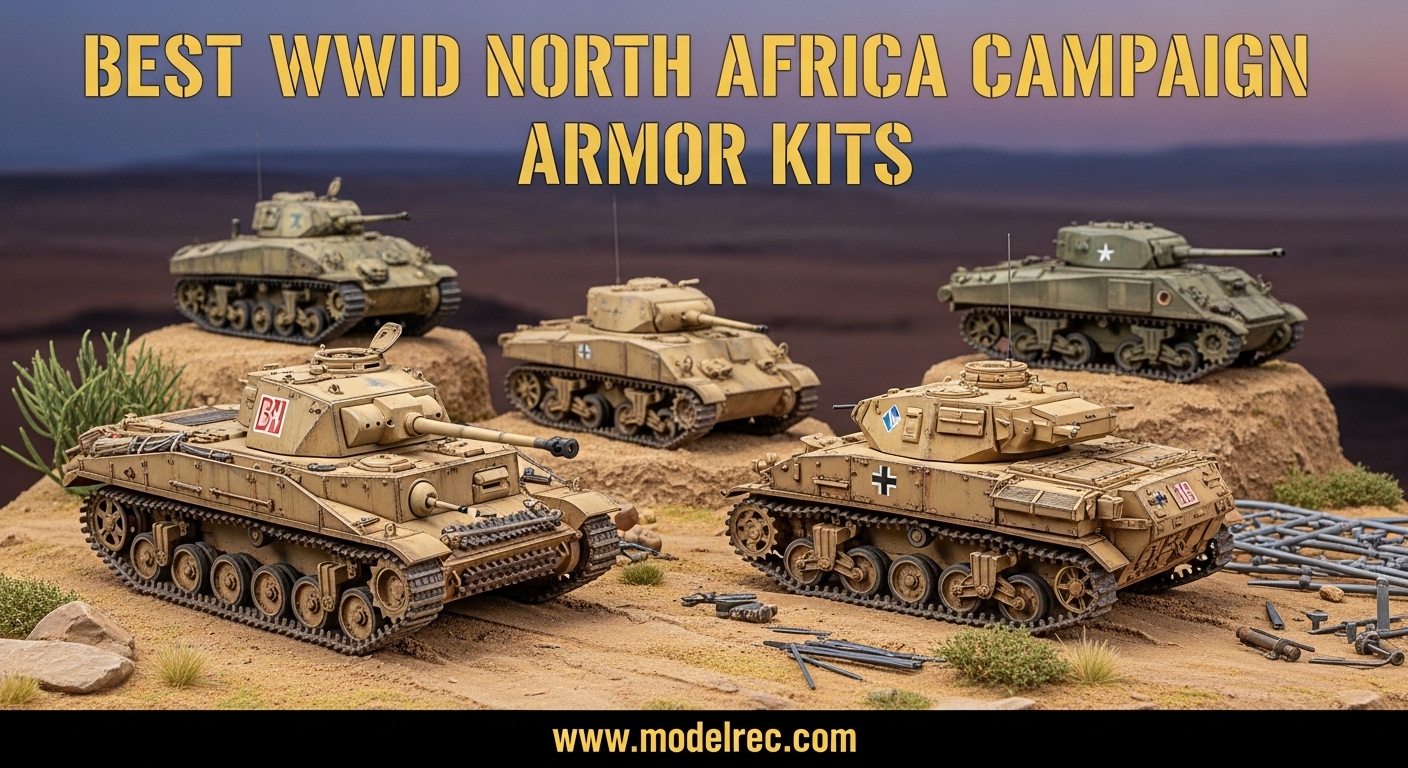
The desert war between 1940 and 1943 pitted Rommel’s Deutsches Afrikakorps against Montgomery’s British 8th Army in some of WWII’s most iconic battles. Modelers have long been fascinated by this theater, with its distinctive vehicles, harsh terrain, and legendary commanders. I’ve spent years building North Africa armor kits, and the right kit can make or break your desert campaign project.
WWII North Africa Campaign armor kits represent the tanks, armored cars, and support vehicles that fought across Egypt, Libya, and Tunisia. These models capture the unique character of desert warfare, from the heavily armored British Matildas to the fast-moving German Panzers and the arriving American Shermans. The best kits combine historical accuracy with engineering that makes building enjoyable rather than frustrating.
This guide covers the best WWII North Africa Campaign armor kits available in 2026, focusing on models that offer authentic details, good fit, and satisfying build experiences. Whether you’re building your first desert tank or adding to a North Africa collection, these kits deliver the historical authenticity and quality that serious modelers demand.
Table of Contents
- Top 3 Picks for WWII North Africa Campaign Armor Kits (October 2026)
- 15 Best WWII North Africa Campaign Armor Kits in 2026
- 1. Tamiya British Infantry Tank Matilda – Infantry Tank with Authentic Desert Details
- 2. Tamiya US Light Tank M3 Stuart – Fast and Agile Desert Fighter
- 3. Tamiya German Tiger I Early Production – The Desert Legend
- 4. Tamiya German Panzer III Ausf. L – Afrika Korps Backbone
- 5. Tamiya German Panzer IV Ausf. D – Desert Campaign Classic
- 6. Tamiya Panzerkampfwagen IV Ausf. F & Motorcycle Set – North Africa Limited Edition
- 7. Tamiya US Medium Tank M4A3E8 Sherman – Modern Engineering Excellence
- 8. Tamiya U.S. Medium Tank M4 Sherman – The Classic Allied Workhorse
- 9. Tamiya M4A3 Sherman – Accessory-Rich Sherman Variant
- 10. Tamiya British Churchill Mk.VII – Heavy Infantry Tank
- 11. Tamiya British Cruiser Tank A34 Comet – Modern British Excellence
- 12. Tamiya US Light Tank M5A1 – Stuart Evolution
- 13. Tamiya Sd.Kfz.222 Armored Car – Desert Reconnaissance
- 14. Tamiya German Sd.Kfz.135 Marder I – Tank Destroyer
- 15. Tamiya German Hanomag SDKFZ 251/1 – Essential Infantry Support
- Buying Guide for WWII North Africa Armor Kit
- Frequently Asked Questions About WWII North Africa Campaign Armor Kits
- Conclusion: Selecting Your WWII North Africa Campaign Armor Kit
Top 3 Picks for WWII North Africa Campaign Armor Kits (October 2026)

Tamiya British Matilda Infantry Tank
- Excellent Tamiya fit
- Detailed figures included
- Multiple paint schemes
- Perfect for dioramas

Tamiya German Tiger I Early Production
- Superb detail throughout
- Excellent engineering
- Multiple build options
- Highly detailed

Tamiya M4A3E8 Sherman Easy Eight
- Modern slide molding
- Beginner-friendly
- Cast texture reproduction
- Clear parts included
15 Best WWII North Africa Campaign Armor Kits in 2026
| Product | Specifications | Action |
|---|---|---|
| Tamiya British Matilda |
|
Check Latest Price |
 Tamiya M3 Stuart Tamiya M3 Stuart |
|
Check Latest Price |
| Tamiya Tiger I Early |
|
Check Latest Price |
 Tamiya Panzer III Ausf.L Tamiya Panzer III Ausf.L |
|
Check Latest Price |
 Tamiya Panzer IV Ausf.D Tamiya Panzer IV Ausf.D |
|
Check Latest Price |
 Tamiya Panzer IV North Africa Tamiya Panzer IV North Africa |
|
Check Latest Price |
| Tamiya M4A3E8 Sherman |
|
Check Latest Price |
 Tamiya M4 Sherman Tamiya M4 Sherman |
|
Check Latest Price |
 Tamiya M4A3 Sherman Tamiya M4A3 Sherman |
|
Check Latest Price |
 Tamiya Churchill Mk.VII Tamiya Churchill Mk.VII |
|
Check Latest Price |
 Tamiya A34 Comet Tamiya A34 Comet |
|
Check Latest Price |
 Tamiya M5A1 Stuart Tamiya M5A1 Stuart |
|
Check Latest Price |
 Tamiya Sd.Kfz.222 Tamiya Sd.Kfz.222 |
|
Check Latest Price |
 Tamiya Marder I Tamiya Marder I |
|
Check Latest Price |
 Tamiya Hanomag Half-Track Tamiya Hanomag Half-Track |
|
Check Latest Price |
1. Tamiya British Infantry Tank Matilda – Infantry Tank with Authentic Desert Details
Tamiya 35300 1/35 British Infantry Tank Matilda Plastic Model Kit
Scale: 1/35
Figures: 3 included
Cupola options: Tall and short
Multiple antennas included
Pros
- Perfect Tamiya quality with excellent fit
- Fabulous detail throughout
- Multiple paint scheme options
- Includes detailed figures
- Great for dioramas
Cons
- Some suspension detail covered by side plates
- May require decal setting solution
The British Matilda was one of the most feared tanks in the North Africa desert early in the campaign, and this Tamiya kit captures its imposing presence perfectly. I built this kit last year for an El Alamein diorama, and the experience reminded me why Tamiya sets the standard for armor models. The parts practically fall together during assembly, with that characteristic crisp molding that makes Tamiya kits so satisfying to build.
What impressed me most was the attention to detail in the casting texture and the multiple build options. You get both tall and short cupolas, two types of antennas, and enough stowage variations to create a personalized model. The figures are a nice bonus, with a full-size commander figure plus loader and driver torsos that add life to any diorama setting.
Technically, this kit represents the Matilda II as it appeared in North Africa service, with the appropriate hull and turret details. The molding is sharp throughout, with minimal flash and excellent part separation. The suspension captures the distinctive Matilda bogie system well, though some detail is inevitably hidden by the side skirts. The tracks are Tamiya’s flexible vinyl type, which assemble easily and can be posed with some care.
The instructions are clear and follow Tamiya’s logical pattern, making this an accessible build even for those new to British armor. You’ll find multiple paint scheme options on the decal sheet, representing different units and time periods in the desert campaign. The only real downside is that some suspension detail gets covered by the side armor plates, but this is accurate to the real vehicle and can be addressed with aftermarket parts if you’re feeling ambitious.
Best For Beginning Builders
The Matilda kit is ideal if you’re new to armor modeling or want a relaxing build with excellent results. The engineering is so well-executed that common pitfalls like fit issues are virtually nonexistent. You can focus on painting and weathering instead of filling gaps and correcting errors. This makes it perfect for skill-building while still producing an impressive finished model.
Best For Diorama Builders
If you enjoy creating desert scenes, this Matilda kit offers exceptional diorama potential. The included figures can be posed in various ways, and the tank’s distinctive silhouette makes it an immediate focal point. The multiple marking options let you place it in specific historical contexts, from Operation Compass to the battles around Gazala. Add some desert groundwork and accessories, and you have an instant showpiece.
2. Tamiya US Light Tank M3 Stuart – Fast and Agile Desert Fighter
Tamiya 35360 1/35 US Light Tank M3 Stuart Plastic Model Kit
Scale: 1/35
Late production M3 Stuart
Riveted hull design
3 marking options
Pros
- Excellent part fit and easy assembly
- Fun to build and weather
- Detailed drive sprocket and suspension
- Multiple marking options included
Cons
- White string for cable assembly is fiddly
- Small size (5 inches long)
The M3 Stuart earned the nickname “Honey” from British crews who appreciated its reliability and speed in the harsh desert environment. This Tamiya kit captures the late production version with the distinctive riveted hull, and I’ve found it to be one of the most enjoyable light tank builds in my collection. The engineering shows Tamiya’s commitment to accuracy while keeping the build process straightforward and rewarding.
When I built this kit for a Western Desert diorama, I was impressed by how well the parts aligned. The suspension assembles without any drama, and the drive sprocket detail is particularly crisp. You get a commander torso figure with both American and Soviet head options, reflecting the Lend-Lease service of Stuarts in the Red Army. The belt-type tracks assemble easily and can be posed realistically with some careful manipulation.
This kit represents the M3 Stuart as it appeared in North Africa service, with the cupola-less turret design that characterizes late production vehicles. The technical aspects are well-handled, with accurate hull dimensions and properly proportioned turret. The rivet detail is crisp and consistent, a common weak point in lesser kits. You’ll appreciate the attention to small details like the tool stowage and the delicate headlight guards.
The desert weathering potential here is outstanding. The numerous panel lines and rivets provide plenty of opportunities for washes and filters, while the relatively simple shape means you can focus on creating realistic dust accumulation without getting overwhelmed by complex detail. The small size might seem limiting, but it actually makes weathering more manageable since you can complete the process in less time than with larger vehicles.
Best For Quick Weekend Projects
The M3 Stuart kit is perfect if you want a satisfying build that won’t take weeks to complete. With approximately 5 inches in length when finished, the parts count is manageable, and the straightforward engineering means you can make real progress in each building session. This makes it ideal for those weekends when you want to start and finish a project without committing to a marathon build.
Best For Weathering Practice
If you’re looking to improve your desert weathering techniques, the Stuart offers an excellent canvas. The numerous panel lines, rivets, and surface details provide plenty of opportunities to practice washes, filters, and dust effects. The relatively compact size means you can experiment without investing huge amounts of time, making it perfect for skill development before tackling larger subjects.
3. Tamiya German Tiger I Early Production – The Desert Legend
Tamiya 35216 1/35 Ger. Tiger I Early Production Tank Plastic Model Kit for Unisex Adult
Scale: 1/35
Early production Tiger I
Flexible tracks included
Open/closed hatch options
Pros
- Excellent fit with no issues
- Superb detail on parts
- Clear and easy instructions
- Great for intermediate to advanced modelers
- Multiple paint scheme options
Cons
- Rubber tracks can be difficult to glue
- Engine deck exhaust hoses require careful cutting
- Some may prefer photo-etched parts
The Tiger I may have seen limited service in North Africa, but its presence looms large in the historical imagination. This Tamiya kit represents the early production version that could theoretically have been deployed to Tunisia, and the engineering quality is everything you’d expect from Tamiya’s flagship subjects. I’ve built two of these kits over the years, and both experiences were consistently excellent from start to finish.
The fit throughout this kit is exceptional. The hull assembles without any gaps, the turret fits perfectly, and even the tricky areas around the engine deck go together with minimal fuss. You get flexible vinyl tracks that can be glued with standard plastic cement, and while they require some patience, the results look very convincing when properly installed. The option to open or close hatches adds versatility, and the elevating main gun lets you choose your display configuration.
From a technical standpoint, this kit captures the early Tiger’s distinctive features accurately. The hull dimensions are correct, the turret shape is spot-on, and the overall proportions convey the Tiger’s imposing presence. The detail extends to small items like the tool clasps, headlight mounts, and the intricate exhaust system. While some modelers prefer individual link tracks, the vinyl tracks in this kit are well-molded with good sag when properly installed.
The painting potential here is tremendous. Even though Tigers in Tunisia wore standard dark yellow, you can experiment with different weathering intensities to represent varying service conditions. The numerous panels and details provide opportunities for sophisticated weathering techniques, from subtle dust accumulation to heavy wear patterns. The kit includes multiple paint scheme options, giving you flexibility in your interpretation.
Best For Detail-Oriented Modelers
The Tiger I kit is ideal if you enjoy spending time on fine details and want a subject that rewards careful work. The numerous small parts, from the tools to the ventilator details, provide endless opportunities for enhancement. Whether you’re building out of the box or adding aftermarket upgrades, this kit gives you a solid foundation for a truly impressive display piece.
Best For Intermediate to Advanced Builders
This kit strikes the right balance between accessibility and complexity. While a determined beginner could tackle it successfully, the Tiger really shines in the hands of builders with some experience. The engineering is sophisticated enough to be interesting without being frustrating, making it perfect for modelers who’ve mastered the basics and want to step up their game.
4. Tamiya German Panzer III Ausf. L – Afrika Korps Backbone
Tamiya 35215 1/35 German Pz. Kpfw III Ausf. L Tank Plastic Model Kit
Scale: 1/35
Panzer III Ausf. L
5 paint/marking schemes
Rubber molded tracks
Pros
- Practically falls together during assembly
- Superb detail consistent throughout
- Excellent value for the price
- Easy to build with no fit issues
- Huge aftermarket support
Cons
- No interior detail in hull or turret
- Rubber band style tracks not separate link
- Commander figure is somewhat stiff
- Limited decal options
The Panzer III was truly the workhorse of Rommel’s Afrika Korps, and this Ausf. L version represents one of the most important variants in the desert campaign. I’ve built this kit three times over the years, and it remains one of the most satisfying armor projects in my experience. The engineering is so well-executed that the assembly practically takes care of itself, letting you focus on painting and weathering.
This kit is widely regarded as one of the best Panzer III kits available at any price point, and after building it, I understand why. The parts fit together with that satisfying Tamiya precision, and the detail is consistent throughout. You get five different paint and marking schemes, providing excellent variety for different unit configurations. The soft molded rubber one-piece tracks assemble easily and can be posed with realistic sag when properly installed.
Technically, this kit captures the Panzer III Ausf. L accurately, with the correct hull dimensions, turret shape, and equipment layout. The molding quality is excellent, with crisp detail and minimal flash. The suspension system is well-detailed, and while some detail is lost to the rubber tracks, the overall effect is convincing. The kit includes a commander figure, though it’s somewhat basic compared to newer releases.
The Afrika Korps painting potential here is outstanding. You can create the classic dark yellow base with various degrees of dust weathering, and the five marking options give you flexibility in unit representation. The numerous panels and details provide perfect opportunities for washes, filters, and weathering effects. Whether you want a pristine-looking vehicle or a heavily weathered desert veteran, this kit gives you the foundation you need.
Best For Wargaming Projects
The Panzer III kit is ideal if you’re building models for wargaming purposes. The sturdy construction and straightforward assembly mean you can produce multiple vehicles efficiently. The excellent fit means less time spent on corrections and more time building your desert forces. With the variety of marking options, you can create a diverse armored formation for tabletop battles.
Best For Aftermarket Customization
If you enjoy adding aftermarket upgrades, the Panzer III Ausf. L offers tremendous potential. The huge aftermarket support means you can find photo-etched sets, metal barrels, individual track links, and numerous other enhancements. The base kit is so well-engineered that it provides an excellent foundation for any level of super-detailing you want to pursue.
5. Tamiya German Panzer IV Ausf. D – Desert Campaign Classic
Tamiya 35096 1/35 German Pzkpw IV AUSFD Plastic Model Kit
Scale: 1/35
Panzer IV Ausf. D
3 figures included
Flexible plastic tracks
Pros
- Excellent value for money
- Drama-free assembly with good fit
- Great for beginners and experienced modelers
- Manageable parts count
- Weekend build possibility
Cons
- Older tooling from 1977
- Some dimensional issues
- Motorization holes in hull
- Incorrect front lower hull design
The Panzer IV Ausf. D represents an early version of this important German medium tank, and despite its age, this Tamiya kit remains a solid choice for North Africa projects. I built this kit early in my modeling journey, and it taught me valuable lessons about working with older tooling while still achieving good results. The kit shows its 1977 origins in some areas, but the overall package delivers where it matters most.
What this kit lacks in modern engineering, it makes up for in accessibility and value. The assembly is straightforward with good fit overall, and the manageable parts count means you won’t feel overwhelmed. Three figures are included, adding instant diorama potential, and the flexible plastic tracks are easy to work with. You can assemble this as an early version or the later African variant, giving you flexibility in your build.
From a technical perspective, this kit has some accuracy issues that purists might want to address. The front lower hull design isn’t entirely correct, and there are dimensional discrepancies in some areas. However, for most builders, these issues won’t detract from the finished appearance. The molding shows its age with some soft details, but the overall effect is still convincing when painted and weathered properly.
The desert weathering potential is excellent here. The numerous panels and details provide opportunities for realistic weathering effects, and the relatively simple shape means you can focus on creating convincing dust accumulation and wear. This kit is particularly good for heavy weathering projects, as the softer details actually benefit from a more interpretive approach to painting and finishing.
Best For First-Time Armor Builders
The Panzer IV Ausf. D kit is perfect if you’re new to armor modeling and want a forgiving introduction to the hobby. The straightforward assembly, good fit, and manageable parts count mean you can focus on learning basic techniques without getting overwhelmed. This kit lets you make mistakes and learn from them while still producing a respectable finished model.
Best For Quick Build Sessions
This kit is ideal if you want a project that can be completed in a few dedicated building sessions. With its lower parts count and simple assembly, you can make real progress each time you sit down to work. This makes it perfect for those times when you want a satisfying building experience without committing to a long-term project.
6. Tamiya Panzerkampfwagen IV Ausf. F & Motorcycle Set – North Africa Limited Edition
TAMIYA 1/35 German Tank Panzerkampfwagen IV Ausf.F & Motorcycle Set North Africa Limited Edition TAM25208
Scale: 1/35
Panzer IV Ausf. F
Motorcycle and figures included
Link-to-link tracks
Pros
- Excellent Tamiya quality
- Great fit and finish
- Highly realistic tracks
- Perfect for dioramas
- Link-to-link track assembly
Cons
- Tracks can be tedious to assemble
- Higher markup on price
This limited edition North Africa set combines a Panzer IV Ausf. F with a motorcycle and figures, creating an instant diorama package that captures the essence of desert warfare. I built this kit last year for a Tunisia campaign scene, and the combination of vehicles and figures creates immediate visual interest. The link-to-link tracks are time-consuming but produce outstandingly realistic results.
The engineering quality here is classic Tamiya, with excellent fit and finish throughout. The Panzer IV builds up cleanly, and the motorcycle adds a wonderful detail element that brings the scene to life. You get multiple figures that can be posed in various ways, enhancing the storytelling potential. The link-to-link tracks require patience and persistence, but the realistic appearance and poseability make the effort worthwhile.
From a technical standpoint, this kit captures the Panzer IV Ausf. F as it appeared in North Africa service. The hull and turret details are accurate, and the overall proportions convey the vehicle’s character correctly. The motorcycle is a nice touch, representing the ubiquitous BMWs that accompanied German forces in the desert. The figures are well-sculpted and can be positioned to create interaction between elements.
The diorama potential here is exceptional. With the tank, motorcycle, and multiple figures, you have everything needed for an instant scene. The North Africa theme is carried throughout with appropriate stowage and equipment. This kit is perfect if you want to create a vignette without sourcing separate elements, and the limited edition status adds collector appeal.
Best For Diorama Enthusiasts
This kit is ideal if you love creating scenes and vignettes. The combination of tank, motorcycle, and figures gives you immediate storytelling potential. You can create a refueling scene, a maintenance stop, or a tactical rest scenario with minimal additional elements. The North Africa theme is consistent throughout, making historical accuracy straightforward.
Best For Modelers Who Enjoy Details
If you appreciate fine details and don’t mind spending extra time on assembly, the link-to-link tracks in this kit will appeal to you. The realistic appearance and poseability make them worth the effort. This kit rewards patience and attention to detail, making it perfect for builders who enjoy the process as much as the finished result.
7. Tamiya US Medium Tank M4A3E8 Sherman – Modern Engineering Excellence
Tamiya 35346 1/35 US Medium Tank M4A3E8 Sherman Plastic Model Kit
Scale: 1/35
M4A3E8 Easy Eight
Slide molded parts
Clear parts included
Pros
- Superb detail and easy assembly
- Beginner-friendly despite small parts
- Excellent cast texture reproduction
- Clear parts add realism
- Commander figure included
Cons
- Very small parts require good eyesight
- Rear wheel attach pins are fragile
- Track installation can be challenging
The M4A3E8 Sherman represented the final evolution of the Sherman design, and while it arrived late for the North Africa campaign, this kit is too good to exclude from any comprehensive armor collection. The slide-molded technology used here represents a significant advance over older Sherman kits, with crisp details and excellent fit throughout. I built this kit last year, and it impressed me with its modern engineering.
The most striking feature of this kit is the slide-molded turret and upper hull parts, which eliminate seam lines and provide excellent detail. The cast metal texture on the turret and welded hull surfaces are reproduced convincingly, capturing the Sherman’s distinctive appearance. Clear parts for the light lens and cupola vision blocks add a level of realism that older kits couldn’t achieve. The commander figure is well-sculpted and adds life to the model.
From a technical perspective, this kit represents the M4A3E8 accurately, with proper proportions and details. The single-pin T66 tracks are provided as belt-type tracks, which assemble easily and can be posed with some care. The suspension system is well-detailed, and the overall engineering shows Tamiya’s commitment to continuous improvement. Multiple marking options are included, giving you flexibility in your interpretation.
Despite the small parts and detail level, this kit is surprisingly beginner-friendly. The engineering is so well-executed that the assembly process is straightforward, with clear instructions and good fit throughout. The only challenges come from the very small parts and the track installation, but with care and patience, these are manageable. This kit demonstrates that modern technology can make complex subjects accessible to builders of all skill levels.
Best For Learning Modern Techniques
The M4A3E8 kit is perfect if you want to experience modern armor modeling techniques. The slide molding, clear parts, and sophisticated engineering represent current best practices in kit design. Building this kit will introduce you to approaches and methods that you can apply to other projects, making it an excellent learning experience for growing modelers.
Best For Display Piece Projects
If you’re building a Sherman specifically for display rather than wargaming or rough handling, this kit is an outstanding choice. The crisp details, clear parts, and overall accuracy make it perfect for showcase models. You can invest time in painting and weathering, knowing the underlying engineering provides a solid foundation for impressive results.
8. Tamiya U.S. Medium Tank M4 Sherman – The Classic Allied Workhorse
Tamiya 35190 1/35 U.S. Medium Tank M4 Sherman Plastic Model Kit
Scale: 1/35
M4 Sherman
Crew figures included
Flexible vinyl tracks
Pros
- Excellent entry into Sherman modeling
- Good details with plenty of extras
- Easy assembly with good fit
- Multiple marking options
- Vinyl tracks easy to assemble
Cons
- Older kit with some accuracy issues
- Requires aftermarket parts for maximum accuracy
The M4 Sherman was the backbone of Allied armored forces in every theater, and this Tamiya kit provides an excellent starting point for Sherman modeling. I built this kit early in my armor modeling journey, and it taught me valuable lessons about working with classic subjects. While it shows its age in some areas, the overall package delivers a satisfying building experience.
This kit excels at providing a solid foundation for Sherman projects. The assembly is straightforward with good fit overall, and the parts count is manageable for builders of various experience levels. Life-like crew figures are included, adding immediate diorama potential. The flexible vinyl tracks assemble easily and can be posed with realistic sag when properly installed. Multiple stowage options let you customize the appearance.
From a technical perspective, this kit captures the general appearance of the M4 Sherman well, though some accuracy issues exist that might concern purists. The molding shows its age with some soft details, but the overall effect is convincing when painted and weathered properly. The hull dimensions are generally correct, and the turret shape captures the Sherman’s distinctive profile. This kit is more about capturing the Sherman’s essence than achieving museum-quality accuracy.
The customization potential here is excellent. Whether you want to build it straight from the box or add aftermarket enhancements, this kit gives you flexibility. The good fit means corrections are minimal, and the numerous accessories provide plenty of stowage options. This kit is particularly good if you want to practice weathering techniques on a forgiving subject.
Best For Sherman Collection Starters
This kit is ideal if you’re beginning a Sherman collection and want a solid foundation to build upon. The good fit and straightforward assembly mean you can focus on learning the Sherman’s characteristics without getting bogged down in technical challenges. This kit gives you the confidence to tackle more complex Sherman variants later.
Best For Customization Projects
If you enjoy personalizing your models, this M4 Sherman offers excellent potential. The multiple stowage options, good fit, and aftermarket support mean you can create a unique interpretation. Whether you’re adding extra stowage, modifying the configuration, or experimenting with weathering, this kit provides a solid starting point.
9. Tamiya M4A3 Sherman – Accessory-Rich Sherman Variant
Tamiya Models M4A3 Sherman Model Kit
Scale: 1/35
M4A3 Sherman
4 figures included
External stowage
Pros
- Excellent for beginners and experienced modelers
- Budget-friendly and relaxing build
- Lots of bits and accessories
- Easy to assemble
- Multiple figures for dioramas
Cons
- Rubber one-piece tracks
- Upper/lower hull fit issues require filler
- Hollow area above tracks
- No interior detail
The M4A3 variant of the Sherman brought improvements to the design, and this Tamiya kit captures its essential character well. I’ve built this kit twice over the years, and both experiences were enjoyable and educational. While it has some limitations typical of older tooling, the overall package delivers good value and a satisfying building experience for modelers of various skill levels.
This kit shines in the accessories and figures department. You get four figures total: three crewmen and a tank commander, all in realistic poses. The external stowage options are extensive, allowing you to create a personalized loadout. Two kinds of road wheels and sprockets can be selected, giving you build flexibility. Optional position hatches and choices of cupolas add further variety. This kit is practically a diorama in a box.
From a technical standpoint, this kit shows its age in some areas. The rubber one-piece tracks are convenient but lack the detail of individual links. The upper and lower hull fit may require some filler to achieve a seamless appearance. There’s a hollow area above the tracks that might bother some builders. However, the overall dimensions and proportions are correct, and the Sherman’s distinctive appearance is captured convincingly.
Despite its limitations, this kit is budget-friendly and relaxing to build. The parts count is manageable, and the assembly is straightforward. This makes it perfect for those evenings when you want to make progress without complex problem-solving. The numerous accessories and figures mean you can create an interesting scene without additional purchases.
Best For Budget-Conscious Modelers
This M4A3 kit is ideal if you want good value without sacrificing quality. The reasonable price point, combined with the inclusion of figures and accessories, makes it an excellent choice for modelers watching their budget. You get a complete package that can become an impressive display piece with some careful painting and weathering.
Best For Group Build Projects
This kit is perfect if you’re participating in group builds or modeling events. The straightforward assembly and manageable parts count mean you can make steady progress alongside other builders. The variety of build options means no two M4A3s need to look the same, adding interest to group displays.
10. Tamiya British Churchill Mk.VII – Heavy Infantry Tank
Tamiya America, Inc 1/35 British Churchill MKVII Tank, TAM35210
Scale: 1/35
Churchill Mk.VII
4 figures included
Unique suspension system
Pros
- Very enjoyable kit to build
- Classic that never lost its appeal
- Straight forward assembly
- Good details for age of tooling
- Great for beginners and experts
Cons
- Older tooling from 1977
- Limited interior detail
The Churchill Mk.VII represented the final evolution of Britain’s heavy infantry tank, and while it saw limited service in North Africa, this kit provides an important addition to any comprehensive British armor collection. I built this kit for a late-war British armor display, and despite its 1977 tooling, the experience was thoroughly enjoyable from start to finish.
This kit demonstrates why some Tamiya classics remain popular decades after their release. The assembly is straightforward and drama-free, with good fit throughout. The unique suspension system is a fascinating engineering feature that’s well-represented here. Four figures are included, adding immediate diorama potential. The Churchill’s distinctive silhouette is captured accurately, making it instantly recognizable on any display shelf.
From a technical perspective, this kit shows its age in some areas but remains fundamentally sound. The molding is crisp where it counts, and the overall dimensions are correct. The limited interior detail is typical of kits from this era, but the exterior features are well-represented. The unique suspension system is one of the most interesting aspects of the build, providing a distinctive feature that sets the Churchill apart from other tanks.
The Churchill’s heavy, purposeful appearance makes it perfect for heavy weathering projects. The numerous panels and details provide opportunities for realistic wear and weathering effects. This kit is particularly good for showing heavy use and combat damage, as the Churchill’s design suggests a vehicle that’s seen hard service. The four included figures can help tell a story of crew endurance and determination.
Best For British Armor Collectors
This Churchill kit is essential if you’re building a comprehensive British armor collection. The Churchill’s distinctive appearance and historical significance make it a must-have subject. Despite its age, this kit delivers the essential character of the vehicle, making it a valuable addition to any British armor display.
Best For Skill Development
The Churchill kit is ideal if you’re looking to improve your modeling skills without taking on overwhelming complexity. The straightforward assembly and good fit mean you can focus on painting, weathering, and finishing techniques. This kit lets you practice and develop your skills while producing a satisfying result.
11. Tamiya British Cruiser Tank A34 Comet – Modern British Excellence
Tamiya 1/35 British Cruiser Tank A34 Comet TAM35380 Plastic Models Armor/Military 1/35
Scale: 1/35
A34 Comet
Assembly tracks
Clear searchlight parts
Pros
- Tamiya at their best with recent tooling
- Thoughtfully engineered and detailed
- Very easy and logical to assemble
- Excellent fit requiring minimal filling
- Two crew figures included
Cons
- Decals may silver (aftermarket recommended)
- Star decal on turret can be frustrating
The Comet represented the pinnacle of British cruiser tank development in WWII, and this modern Tamiya kit does justice to this important subject. I built this kit last year, and it impressed me with its thoughtful engineering and ease of assembly. This is Tamiya at their best, combining modern tooling technology with decades of armor modeling expertise.
The most striking feature of this kit is the vertical-plane hull with box style assembly, using two bulkheads like the actual tank. This approach ensures perfect alignment and eliminates fit issues. The realistic front hull and turret cast surfaces are reproduced convincingly, capturing the Comet’s distinctive appearance. Clear parts for the searchlight on the turret are a nice touch, adding display versatility. Assembly tracks with one-piece straight sections save time while maintaining detail.
From a technical perspective, this kit represents the A34 Comet accurately, with proper proportions and details. The two torso figures with winter clothes are well-sculpted and add display interest. Two marking options are included, providing historical variety. The engineering throughout is thoughtful and well-executed, making this kit a pleasure to build regardless of your experience level.
This kit is much easier to build than competitor’s versions of the Comet, making it accessible to modelers of various skill levels. The excellent fit means minimal filling and sanding, letting you focus on painting and weathering. The modern molding technology means crisp details throughout, from the smallest bolts to the large cast surfaces. This kit demonstrates how modern engineering can make complex subjects accessible.
Best For Modern Kit Experience
The Comet kit is perfect if you want to experience the best in modern armor kit design. The thoughtful engineering, crisp molding, and excellent fit represent current state-of-the-art practices. Building this kit will give you an appreciation for how far kit design has advanced, making it an educational experience as well as an enjoyable one.
Best For Commonwealth Armor Collections
This kit is essential if you’re building a comprehensive Commonwealth or late-war British armor collection. The Comet represents the final development of British cruiser tanks, making it historically significant. The modern engineering and excellent detail make it a worthy addition to any collection, whether you’re focusing on British armor or late-war subjects generally.
12. Tamiya US Light Tank M5A1 – Stuart Evolution
Tamiya 35313 1/35 US Light Tank M5A1 Plastic Model Kit
Scale: 1/35
M5A1 Stuart
4 figures included
Hedgerow cutters
Pros
- Great model for the price
- Small but detailed
- Excellent Tamiya quality and fit
- Good first armor kit
- Historical narrative included
Cons
- Older kit with motorization holes
- Rubber band tracks require heating/melting
- Zero interior detail
- Some scale accuracy issues
The M5A1 Stuart represented an evolution of the successful M3/M5 light tank line, and this Tamiya kit provides an affordable entry into light armor modeling. I built this kit as my first armor project years ago, and it taught me valuable lessons while providing an enjoyable introduction to the hobby. The small size and manageable parts count make it accessible to builders of various experience levels.
This kit offers exceptional value for the price. You get four figures total: one with an anti-aircraft gun and a three-man mortar team. The hedgerow cutters for the Normandy invasion are included, though they can be omitted for other theaters. The turret and hull details are accurately reproduced, capturing the M5A1’s distinctive appearance. The historical narrative included in the instructions adds educational value to the build.
From a technical standpoint, this kit shows its age in some areas. The motorization holes in the hull are typical of older Tamiya kits, though they can be filled if desired. The rubber band tracks require heating or melting to join properly, which can be frustrating for some builders. There’s no interior detail, and some scale accuracy issues exist. However, the overall appearance is convincing when painted and weathered properly.
The small size of this kit makes it perfect for experimenting with painting and weathering techniques. You can try different approaches without investing huge amounts of time, making it ideal for skill development. The numerous figures and accessories add diorama potential, letting you create a complete scene without additional purchases. This kit is particularly good for beginners who want a complete project in a single box.
Best For First-Time Builders
The M5A1 kit is ideal if you’re new to armor modeling and want an accessible introduction to the hobby. The small size, manageable parts count, and excellent Tamiya quality mean you can focus on learning basic techniques without getting overwhelmed. This kit gives you a complete modeling experience from assembly to painting to weathering.
Best For Technique Experimentation
This kit is perfect if you want to experiment with new painting and weathering techniques. The small size means you can try different approaches without major time investment. If a technique doesn’t work out, you haven’t lost weeks of work. This makes the M5A1 an excellent platform for skill development and creative exploration.
13. Tamiya Sd.Kfz.222 Armored Car – Desert Reconnaissance
TAMIYA 300035286 – 1:35 WWII Special Automotive 222 Direct-Action Reconnaissance Tank North Africa (3) for unisex
Scale: 1/35
Sd.Kfz.222
Motorcycle included
Photo etched parts
Pros
- Great little kit with easy build
- Parts fit together well
- Excellent value for money
- Photo etched and metal parts included
- Motorcycle and rider included
Cons
- Older sprues have some flash
- Instructions rely mostly on drawings
- Could use more welding details
The Sd.Kfz.222 armored car performed vital reconnaissance duties for the Afrika Korps, and this Tamiya kit captures this nimble vehicle’s character perfectly. I built this kit for a desert reconnaissance diorama, and the inclusion of a motorcycle and rider made it an instant scene-setter. The small size and straightforward engineering make this a quick, enjoyable build.
This kit offers tremendous value with its inclusion of photo-etched and metal parts. The photo-etched canopy adds detail that plastic alone couldn’t achieve, and the metal gun barrel provides accuracy and strength. The motorcycle and rider are wonderful additions that enhance display potential. A crew of two figures is included, allowing for personnel placement around the vehicle. The updated castings and accessories represent improvements over earlier releases.
From a technical perspective, this kit captures the Sd.Kfz.222 accurately for its scale. The open-topped turret design is well-represented, and the overall dimensions convey the vehicle’s purpose as a fast reconnaissance platform. Some flash on older sprues requires cleanup, but this is minor and easily addressed. The instructions rely heavily on drawings rather than written explanations, which some builders might find challenging.
The diorama potential here is exceptional. With the armored car, motorcycle, and figures, you have all the elements needed for an instant reconnaissance scene. The North Africa version includes appropriate details for desert service. This kit is perfect if you want to create a vignette without sourcing multiple components, making it an excellent choice for diorama builders.
Best For Quick Build Projects
The Sd.Kfz.222 kit is ideal if you want a satisfying build that can be completed quickly. The small size and straightforward engineering mean you can make real progress in each building session. This makes it perfect for those times when you want to start and finish a project in a few dedicated sessions.
Best For Diorama Elements
This kit is perfect if you need a reconnaissance element for your desert dioramas. The combination of vehicle, motorcycle, and figures gives you multiple storytelling options. Whether it’s a scouting mission, a rest stop, or a maintenance scene, this kit provides the elements needed to bring your vision to life.
14. Tamiya German Sd.Kfz.135 Marder I – Tank Destroyer
Tamiya 35370-000 1:35 German Sd.Kfz.135 Marten I Hunting Tank, Highly Model, Plastic Kit for Assembly, Detailed Replica, Unpainted, Brown
Scale: 1/35
Marder I
Highly detailed kit
Clear instructions
Pros
- Excellent Tamiya quality
- Fits together well
- Clear instructions
- Well designed and expertly molded
- Accurate to the real thing
Cons
- Small track parts are difficult to see/handle
- Some may prefer rubber tracks
The Marder I represented Germany’s effort to create effective tank destroyers from captured French chassis, and this Tamiya kit does justice to this interesting hybrid vehicle. I built this kit for a late-war German armor display, and the experience was thoroughly enjoyable. The kit captures the Marder’s unusual appearance while maintaining typical Tamiya quality throughout.
This kit demonstrates Tamiya’s commitment to accuracy and engineering excellence. The parts fit together well, requiring minimal filler and correction. The clear instructions follow Tamiya’s logical pattern, making assembly straightforward despite the vehicle’s unusual configuration. The molding is crisp throughout, with excellent detail reproduction. The kit is accurate to the real vehicle, capturing the distinctive profile of this improvised weapon.
From a technical perspective, this kit represents the Marder I accurately, with proper proportions and details. The open fighting compartment exposes the crew position, requiring some interior detailing. The small track parts can be challenging to handle, requiring care and patience during assembly. Some modelers might prefer rubber tracks for ease of installation, but the individual link tracks included here provide superior detail when properly assembled.
The Marder I’s unusual appearance makes it a conversation piece in any collection. The combination of French chassis and German gun creates a distinctive silhouette that’s immediately recognizable. The open fighting compartment provides opportunities for crew placement and interior detailing. This kit is perfect if you want something different from the standard tanks and assault guns.
Best For Unique Subject Enthusiasts
The Marder I kit is ideal if you appreciate unusual or hybrid military vehicles. The combination of captured French chassis and German armament creates a historically significant subject with an interesting story. This kit lets you explore an aspect of German military adaptation that’s often overlooked in favor of more conventional subjects.
Best For Advanced Detailing
This kit is perfect if you enjoy adding fine details and interior work. The open fighting compartment provides opportunities for crew placement and equipment stowage. You can add aftermarket photo-etched parts, individual track links, and other enhancements to create a truly impressive display piece. The basic kit is so well-engineered that it provides an excellent foundation for super-detailing.
15. Tamiya German Hanomag SDKFZ 251/1 – Essential Infantry Support
Tamiya 35020 1/35 German Hanomag SDKFZ 251/1 Plastic Model Kit
Scale: 1/35
Hanomag half-track
5 figures included
Detailed interior
Pros
- Quality kit that's fun to build
- Assembles relatively easily
- Front wheels roll and turn
- Detailed interior included
- Five German infantry figures
Cons
- Tracks can be difficult to install
- Drive wheels may need reinforcement
- Not historically accurate interior
- No driver figure included
The Hanomag half-track was the workhorse of German infantry units throughout WWII, and this Tamiya kit provides an essential addition to any North Africa diorama or collection. I’ve built this kit multiple times over the years, and it remains one of the most enjoyable and versatile armor projects in my experience. The inclusion of five infantry figures makes it an instant diorama element.
This kit offers exceptional value with its detailed interior and multiple figures. The torsion bar suspension detail in the interior adds realism, even if not entirely accurate to the real vehicle. The moveable rear crew doors provide display options, and the rubberized plastic tracks assemble with some patience. Two MG34 machine guns are included, adding armament detail. The five-man fire team with weapons provides instant personnel for diorama placement.
From a technical perspective, this kit shows its age in some areas but remains fundamentally sound. The molding is crisp where it counts, and the overall dimensions are correct. The front wheels roll and turn, adding play value if desired. The tracks can be challenging to install, requiring some patience and persistence. The drive wheels may need reinforcement for long-term durability. Despite these limitations, the Hanomag’s distinctive appearance is captured convincingly.
The diorama potential here is outstanding. With five infantry figures and a detailed vehicle interior, you have everything needed for an instant scene. Whether it’s a troop deployment, a tactical rest, or a combat action, this kit provides the elements for compelling storytelling. The Hanomag’s role as infantry transport makes it perfect for showing the human side of desert warfare.
Best For Infantry Dioramas
This Hanomag kit is ideal if you’re building dioramas that feature infantry elements. The five included figures can be posed in various ways around the vehicle, creating instant interaction and storytelling. The detailed interior provides context for the figures, whether they’re riding, deploying, or maintaining the vehicle.
Best For Budget-Conscious Builders
This kit offers excellent value if you’re watching your budget without wanting to sacrifice quality. The reasonable price point, combined with the inclusion of five figures and detailed interior, makes it an outstanding choice. You get a complete diorama element in a single box, reducing the need for additional purchases.
Buying Guide for WWII North Africa Armor Kit
Selecting the perfect WWII North Africa Campaign armor kit requires consideration of several factors beyond just the vehicle type. Your skill level, available building time, and intended use all play important roles in making the right choice. I’ve built dozens of desert theater kits over the years, and understanding these considerations has helped me choose projects that match my interests and abilities.
Scale Selection
The 1/35 scale dominates armor modeling for good reason. It offers the best balance between detail level and manageable size. Most manufacturers focus their best engineering on this scale, meaning you’ll find the most accurate and well-engineered kits available. The size allows for impressive detail without requiring display space that exceeds most collectors’ capabilities. However, if you’re building for wargaming, consider 1/72 or 1/76 scales for more practical table deployment.
Skill Level Considerations
Beginners should start with Tamiya kits known for excellent fit and straightforward engineering. The Matilda, Panzer III, and M5A1 Stuart all offer forgiving builds that teach fundamental techniques without overwhelming complexity. Intermediate modelers can tackle subjects with more detail or challenging assembly sequences, like the Tiger I or M4A3E8 Sherman. Advanced builders will appreciate subjects that reward careful work, such as the Sd.Kfz.222 with its photo-etched parts or the Marder I with its open fighting compartment.
Historical Accuracy Focus
Some modelers prioritize museum-quality accuracy above all else. For these builders, research becomes as important as assembly. Reference photos, historical documents, and scale drawings help identify potential kit issues. The newer Tamiya releases generally offer excellent accuracy, but older kits may have dimensional problems that concern purists. Decide your accuracy tolerance level before choosing a kit, as correcting errors requires time, skill, and often aftermarket parts.
Manufacturer Comparison
Tamiya consistently delivers excellent engineering and fit, making their kits ideal for builders of all experience levels. Their instructions are clear, the parts fit well, and the molding quality is high. Other manufacturers offer excellent alternatives, but Tamiya’s North Africa armor kits represent the safest choice for consistent quality. Consider aftermarket support when choosing manufacturers, as some subjects have extensive upgrade available while others don’t.
Desert Camouflage Painting
North Africa vehicles wore distinctive camouflage schemes that require specific approaches. The Germans used dark yellow as their base color, while British vehicles featured the complex Caunter scheme early in the campaign before transitioning to simpler patterns. American tanks arrived in olive drab but were quickly overpainted in theater. Research your specific subject’s historical period to ensure accuracy. Color modulation techniques and proper base coat preparation make desert schemes come alive.
Weathering Techniques
Desert weathering differs significantly from European theater modeling. The harsh environment created extreme dust accumulation, faded paint, and sun-bleached equipment. Start with filters to unify the paint scheme, then apply washes to bring out details. Pigment work creates realistic dust deposits, especially on lower surfaces and behind moving parts. Chipping effects should be used sparingly, as desert conditions actually preserved paint better than mud and moisture. Reference photos of desert vehicles provide essential guidance for realistic weathering.
Frequently Asked Questions About WWII North Africa Campaign Armor Kits
Who stopped Rommel in Africa?
Bernard Montgomery and the British 8th Army defeated Rommel at the Second Battle of El Alamein in October-November 1942, marking a turning point in the North African campaign. This victory, combined with American and Allied landings in Morocco and Algeria during Operation Torch, ultimately forced Axis forces to surrender in Tunisia in May 1943.
What tanks were used in the African campaign?
The North African campaign featured diverse armor. German forces relied on Panzer III and IV medium tanks, with limited Tiger I deployments. The British used Matilda and Valentine infantry tanks, plus Crusader cruiser tanks. American forces brought M3 Grant and M4 Sherman medium tanks, plus M3 and M5 Stuart light tanks. Each side also employed specialized vehicles including armored cars, tank destroyers, and half-tracks.
Why did the Germans want North Africa in WWII?
Germany sought to support their Italian ally who had suffered defeats in North Africa. Controlling North Africa would secure the Mediterranean, threaten the Suez Canal, and potentially access Middle Eastern oil fields. The region also became a testing ground for new weapons and tactics that would later be used on the Eastern Front and in Normandy.
What is the most feared tank in history?
While the Tiger I gained a fearsome reputation, in the North African context, the British Matilda II was initially feared by German forces due to its heavy armor which proved impenetrable to early anti-tank guns. The 88mm flak gun deployed as an anti-tank weapon became the most feared weapon in the desert, effectively countering Allied armor superiority.
Conclusion: Selecting Your WWII North Africa Campaign Armor Kit
The best WWII North Africa Campaign armor kits combine historical accuracy with enjoyable building experiences. The Tamiya British Matilda stands out as my editor’s choice for its exceptional quality and versatile diorama potential. For modelers seeking a premium project, the Tiger I delivers impressive detail and presence. The M4A3E8 Sherman represents outstanding value with its modern engineering and accessibility.
Remember that the best kit for you depends on your experience level, interests, and intended use. Beginners should start with straightforward kits like the M5A1 Stuart or Panzer III Ausf. L to develop fundamental skills. Advanced modelers might prefer the complexity of the Sd.Kfz.222 with its photo-etched parts or the Marder I with its open fighting compartment. Whatever you choose, these kits provide a solid foundation for exploring the fascinating history of desert warfare through scale modeling.