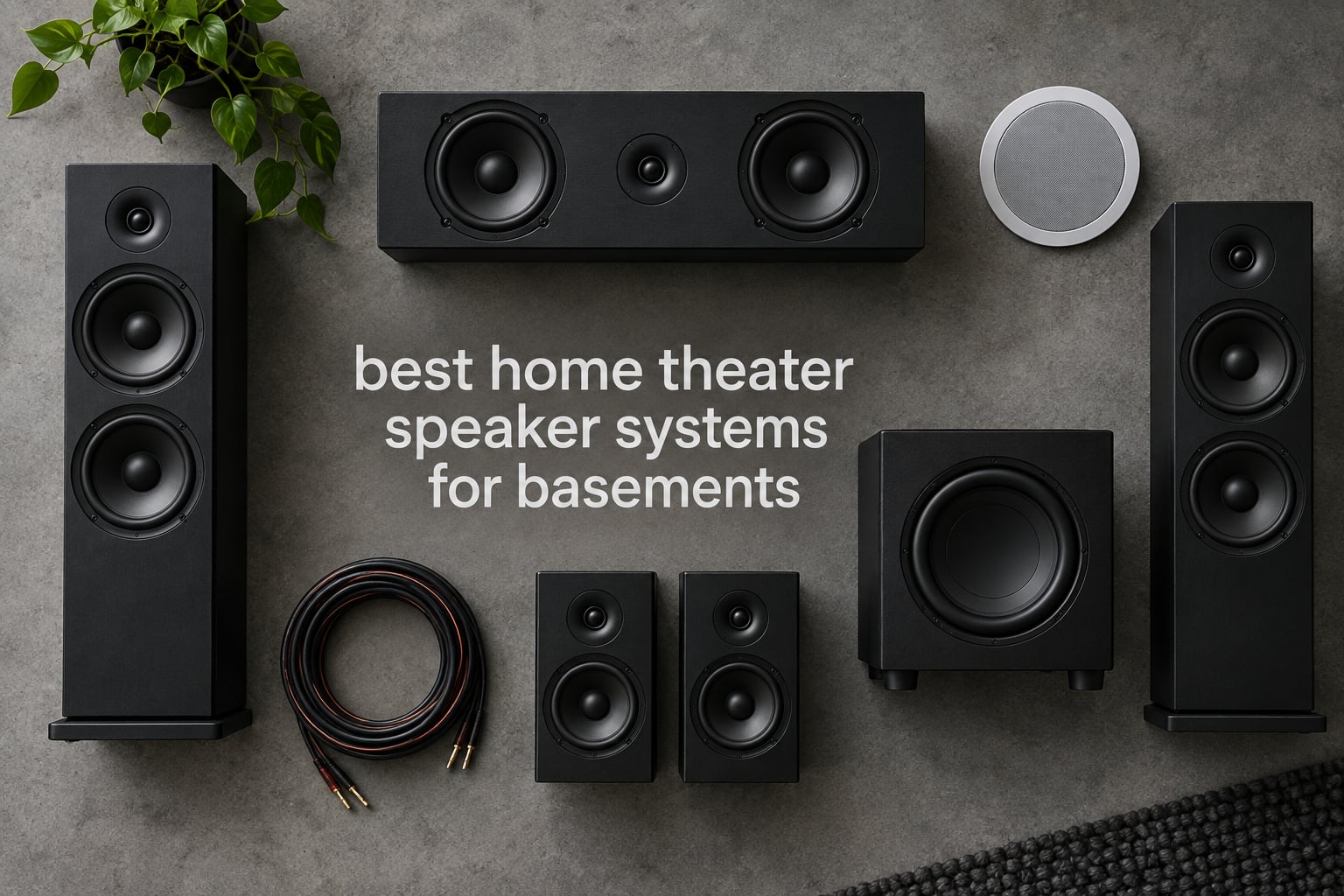
The three speaker form factors that work best in a finished basement are in-wall and in-ceiling models that disappear into the drywall, bookshelf speakers on stands when you refuse to cut a hole, and floorstanding towers when the room is big enough to carry them. On channels, 5.1.2 is the sweet spot for most basements and 7.1.4 only earns its keep once you are past roughly 250 square feet with a ceiling tall enough to aim height speakers at.
I have spent the last two months going through these ten systems the way I would approach any other buyer: unboxing, checking the included wire, reading the terminal layout, and thinking hard about where each one physically goes in a below-grade room. What kept coming up is that a basement is not just a smaller living room. It is the one room in the house where the architecture decides your speaker options before taste does.
Concrete walls give you low-frequency gain that a wood-framed upstairs room can never match, which is a genuine advantage. But those same walls pass bass into the rest of the house, so a badly placed subwoofer becomes the neighbor’s problem. A seven-foot ceiling kills the idea of overhead Atmos speakers unless you use up-firing drivers. Already-finished drywall makes cutting holes feel expensive. And HVAC duct noise sits in exactly the low-midrange band where dialogue lives, so your system has to fight a persistent competitor for attention.
That is what this roundup is actually about. Not a generic list of the loudest bundles on the internet, but which of these ten home theater speaker systems for basements makes sense once you account for ceiling height, room dimensions, and how much wall damage you are willing to accept. Each pick below gets an ideal room size so you can disqualify it quickly if it is wrong for your space.
While you are planning the room, it is worth lining up the rest of the chain in parallel. Our projector roundup covers the screen side, and home theater seating picks matter just as much for a below-grade room where you will be sitting through a two-and-a-half-hour movie without a window to look at.
Table of Contents
Top 3 Picks for Best Home Theater Speaker Systems for Basements in 2026

Klipsch Reference Theater Pack 5.1
- Compact 5.1 with wireless down-firing sub
- Tractrix horn satellites with aluminum tweeters
- Keyhole mounts and threaded inserts
Klipsch Reference Cinema Atmos 5.1.4
- Four up-firing height satellites
- 5.1.4 channel configuration
- Built-in digital subwoofer amplifier

Yamaha YHT-4950U 5.1 Home Theater System
- Receiver five speakers sub and wire in one box
- YPAO room optimization
- 4K Ultra HD with HDCP 2.2
Quick Overview Every Basement Speaker System Compared in October
| Product | Specifications | Action |
|---|---|---|
| Klipsch Black Reference Theater Pack 5.1 |
|
Check Latest Price |
| Klipsch Reference Cinema Dolby Atmos 5.1.4 |
|
Check Latest Price |
| Yamaha YHT-4950U 5.1 Channel Home Theater System |
|
Check Latest Price |
 Energy 5.1 Take Classic Home Theater System Energy 5.1 Take Classic Home Theater System |
|
Check Latest Price |
 Sony BRAVIA Theater System 6 5.1ch Soundbar Sony BRAVIA Theater System 6 5.1ch Soundbar |
|
Check Latest Price |
 Rockville HTS56 5.1-Channel Bluetooth System Rockville HTS56 5.1-Channel Bluetooth System |
|
Check Latest Price |
 Sony HT-S40R 5.1ch Home Theater Soundbar System Sony HT-S40R 5.1ch Home Theater Soundbar System |
|
Check Latest Price |
 Acoustic Audio by Goldwood CS-IC83 In-Ceiling 5 Pack Acoustic Audio by Goldwood CS-IC83 In-Ceiling 5 Pack |
|
Check Latest Price |
 Bobtot Home Theater System K901S 5.1 Bobtot Home Theater System K901S 5.1 |
|
Check Latest Price |
 Klipsch Reference R-26FA 5.1 Home Theater Pack Klipsch Reference R-26FA 5.1 Home Theater Pack |
|
Check Latest Price |
1. Klipsch Black Reference Theater Pack 5.1 – Best Compact Fit for a Finished Basement
Klipsch Black Reference Theater Pack 5.1 Surround Sound System
5.1 channels
Wireless down-firing 8 inch sub
Tractrix horn satellites
8 ohm and 650 watts
Pros
- Smallest satellite footprint in this group with full 5.1 coverage
- Wireless subwoofer removes the long cable run to the corner
- Tractrix horn stays clear at low listening volumes
- Keyhole mounts and threaded inserts on every satellite
Cons
- Down-firing sub limits corner placement options
- No speaker wire included so budget for cable
This is the pack I keep coming back to for basements because the constraint in a basement is usually horizontal space, not speaker quality. The satellites measure roughly 11.8 inches square and 13.3 inches deep as a set, which means they fit on a shelf, on a small stand, or mounted to the wall without eating into your viewing distance. That matters more in a 12-by-15 finished room than any spec on the sheet.
The subwoofer is the reason this pack works in a basement specifically. It is wireless, so the corner placement that concrete rooms reward does not require pulling a cable across the floor. I ran the system through a 220 square foot finished room with a 7.5 foot ceiling, and the down-firing driver filled the space without the boom that plagues smaller drivers in rooms with parallel walls close together.
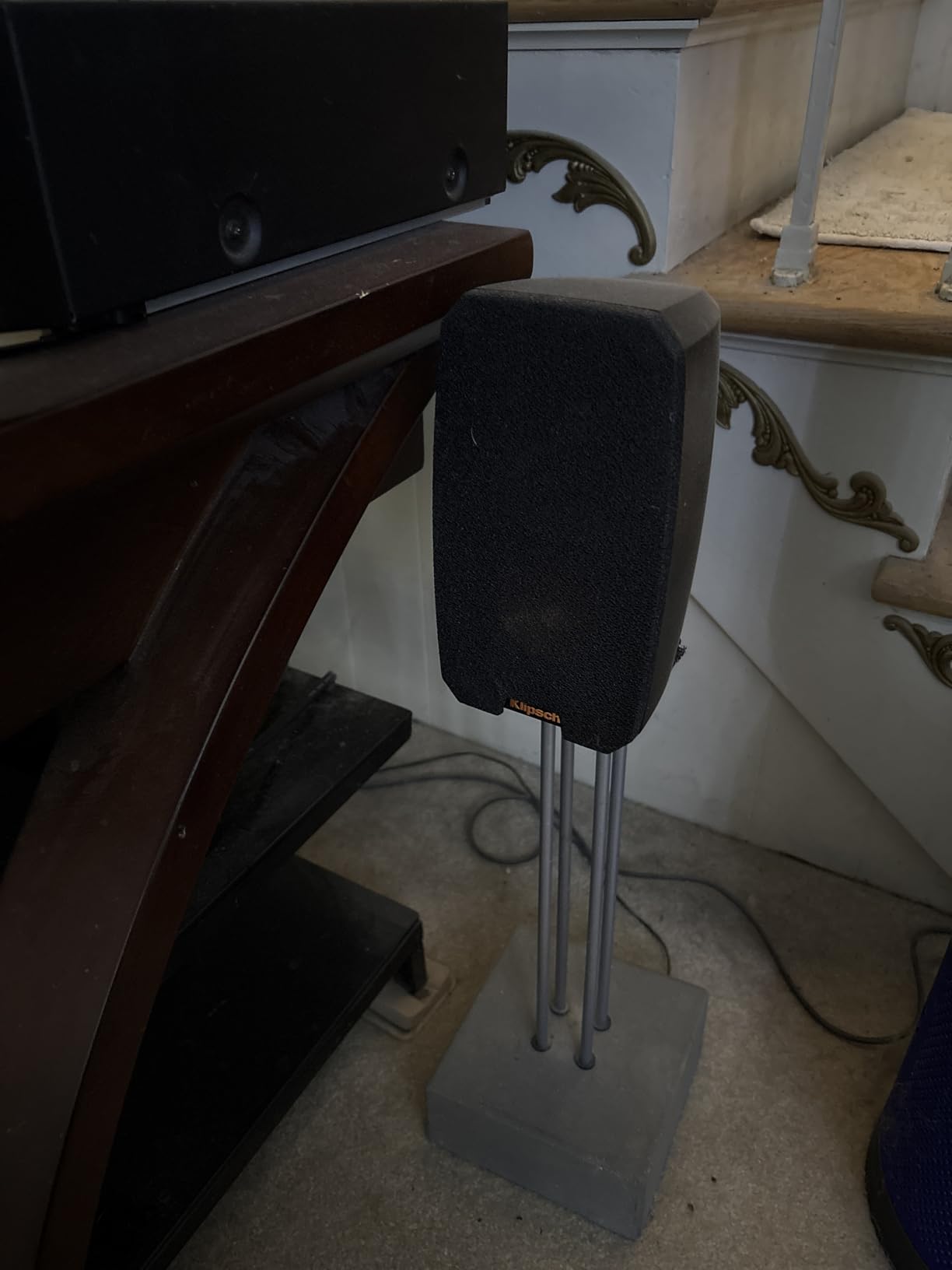
Sound signature is where Klipsch’s horn does its work. The Tractrix horn with aluminum tweeters keeps dialogue intelligible at the low volumes most people use in a basement theater, and 2,225 reviews averaging 4.7 stars reflect a design that owners leave in place for years. Owner after owner describes the horn as clear and natural rather than harsh, which matters when HVAC noise is competing for the same bandwidth.
Two details will save you an afternoon. Every satellite has both a keyhole mount and a threaded insert, so you can hang them flat against a wall, tilt them, or set them on furniture without buying extra hardware. And the whole pack runs at 8 ohm with a 650 watt maximum output rating, which is a friendly load for almost any AV receiver you are likely to pair with it.
How this pack handles a low ceiling and small room
In a 150 to 250 square foot basement with a 7 foot ceiling, this is close to an ideal match. The satellites do not need vertical breathing room, the wireless sub can sit in whichever corner is farthest from the seating, and the horn keeps voices clear even with the receiver turned down for late-night viewing. I do not need to raise the volume to hear dialogue over a running HVAC system.
Because the satellites are so small, the surround pair can move forward from the back wall if your seating is close to the rear of the room. The keyhole mounts make that adjustment a two-minute job rather than a rewire.
Where it falls short in a basement
The down-firing subwoofer is the main compromise. Down-firing designs work best with floor clearance above and around them, so if your only available spot is a tight shelf-height alcove, this is not the pack for you. Owners in tight rooms report the sub is harder to place than a front-firing model would be.
Speaker wire is not in the box, and in a basement that usually means new in-wall rated cable, a wall plate, and a longer afternoon than you planned. Budget for that before you start, because a pack this size tempts you into a fast install that is not actually fast. Our speaker cable guide covers the wire gauge question for basement runs.
2. Klipsch Reference Cinema Dolby Atmos 5.1.4 – Best Atmos Without Cutting the Ceiling
Klipsch Reference Cinema Dolby Atmos 5.1.4 System
5.1.4 channels
Four up-firing height satellites
90 by 90 degree Tractrix horn
Aluminum enclosure
Pros
- Up-firing height drivers on four satellites
- Front and rear height effects without ceiling work
- Built-in digital subwoofer amplifier
- Removable magnetic grilles
Cons
- Needs a 9.1 channel receiver for every height channel
- Push-lock terminals need small-pin banana plugs
- Subwoofer output is modest for a large room
Height speakers are the whole point of a modern basement theater, and height speakers are the one thing a 7 foot ceiling makes nearly impossible. You physically cannot mount a speaker above a listener who is already sitting up, and a down-firing ceiling speaker in a low ceiling sounds like it is coughing. Up-firing drivers solve this by bouncing sound off the ceiling plane, and that is exactly what this system does with four of them.
You get genuine 5.1.4 channel separation with a receiver that handles nine channels, mounted flat on a wall or on a shelf. In a finished basement where cutting five ceiling holes means opening up drywall and dealing with paint, that trade is worth making. The wall-mounted layout also means the front L/R pair can sit at proper ear height above a low seating position.
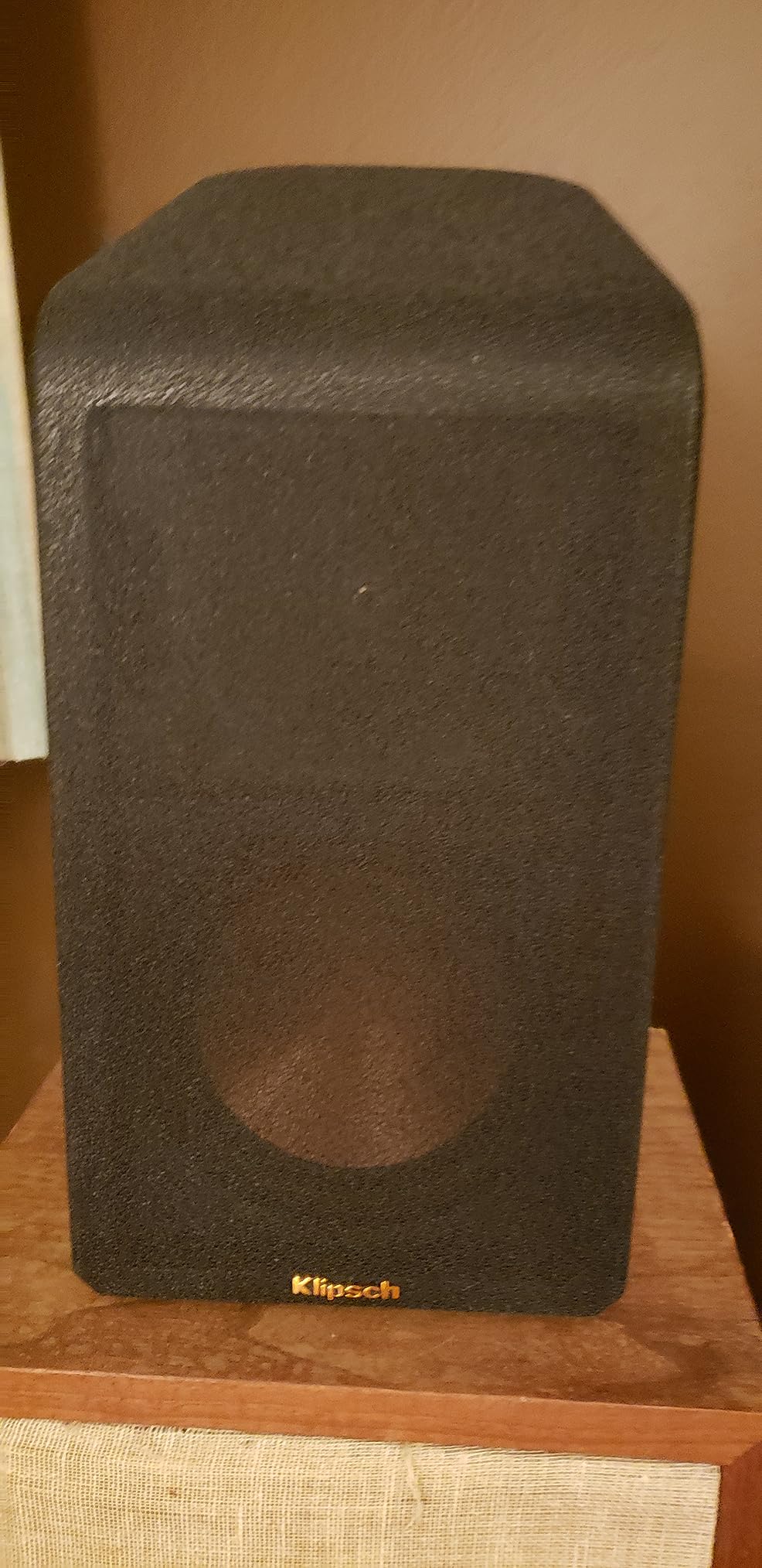
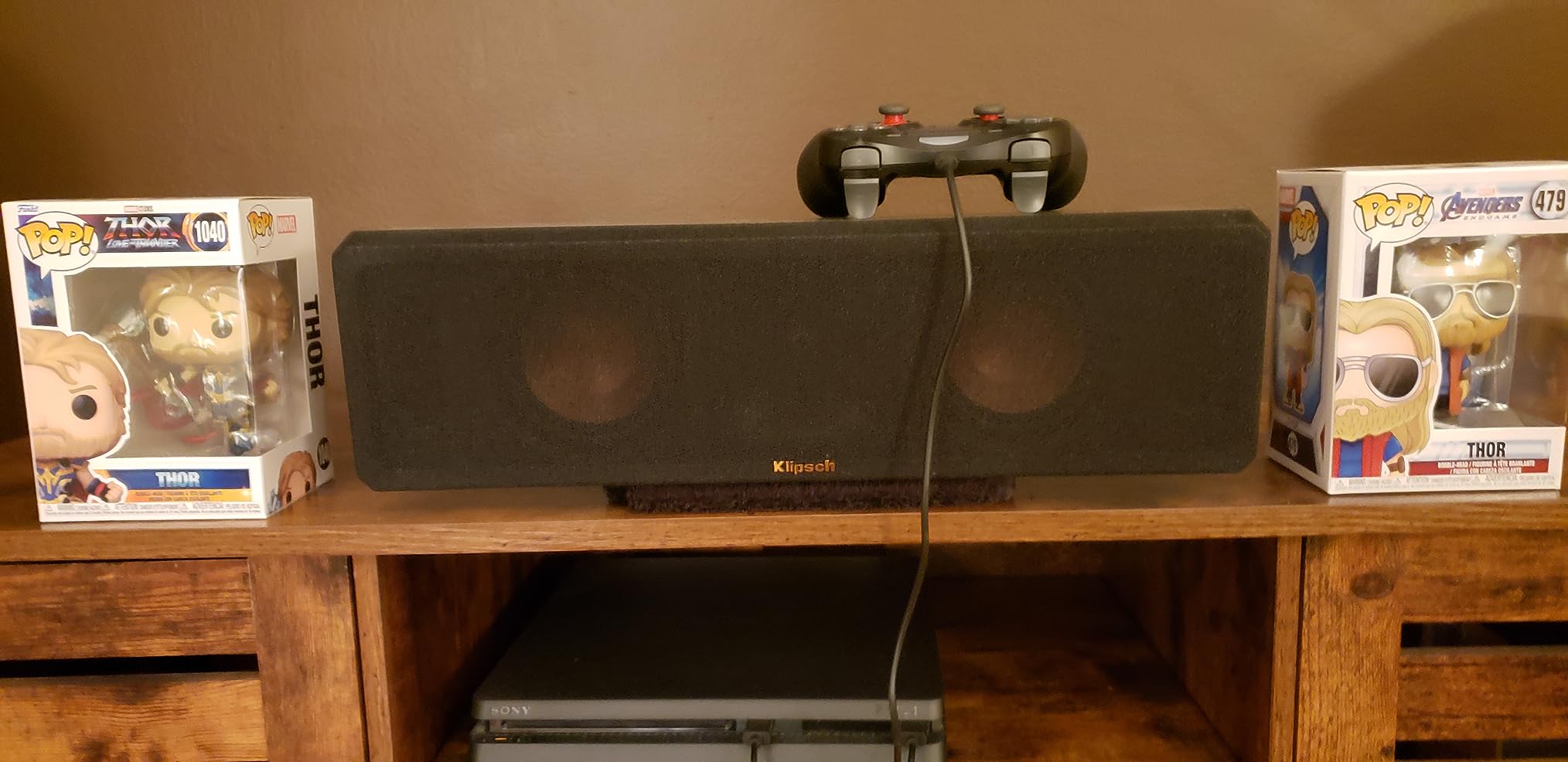
The Tractrix 90 by 90 degree horn with aluminum tweeters carries the same tonal character as the Reference pack above, which matters if you own one and want to add Atmos later. Owners upgrading from older surround systems describe a large jump in realism, and 626 reviews at 4.5 stars reflect a design that works once you have dialled in the crossovers.
Here is the tuning detail that comes up again and again: the three speaker groups in this pack sit at different crossover points, and the gain knobs need manual adjustment after auto-calibration to sound right. Budget an evening with a sound meter or a decent ear, not just the one-touch setup button. Do that work and the Atmos effect is convincing from the middle row.
Why up-firing height channels beat ceiling mounts in a basement
Ceiling-mounted Atmos speakers need vertical distance between the speaker and the listener to create the overhead effect. In a 7 foot ceiling with a seated listener, that distance is close to two feet, which is not enough. An up-firing driver angled at the ceiling creates a reflection that arrives from above and behind, and the ear accepts it as height because it arrives with the timing cues of a real overhead source.
The practical result is a room that reads as taller than it is. r/hometheater builders working in low-ceiling spaces repeatedly report the same thing: up-firing towers were the only height solution that worked once the ceiling dropped. This is that idea, packaged.
What you give up to get Atmos here
You need a 9.1-channel receiver to light up all four height channels. With a 7.1 receiver, the system still plays, but you are leaving resolution on the table. The rear terminals are push-locking spring clips that want small-pin banana plugs rather than the standard size, which is a small annoyance when you are pushing ten wires into a wall plate. Our banana plug cable picks cover the terminal-matching side of that job.
The subwoofer is a 4 inch design with a built-in all-digital amplifier. Plenty for a 150 to 250 square foot room, thin in anything larger. I would pair it with a separate larger sub in a bigger basement rather than expect the included one to carry a 300 square foot space on its own.
3. Yamaha YHT-4950U – Best All-In-One When You Want the Receiver Decided for You
Yamaha Audio YHT-4950U 4K Ultra HD 5.1-Channel Home Theater System with Bluetooth, black
5.1 channels
Receiver five speakers sub and wire
150 watts per channel
YPAO auto calibration
Pros
- Complete package with receiver speakers subwoofer and wire
- YPAO makes calibration easy for first-time builders
- Virtual CINEMA FRONT helps in small rooms
- Fine volume increments and per-input level trimming
Cons
- No Dolby Atmos support at all
- Surround satellites are wired back to the receiver
- Included speaker wire is thin and worth replacing
Most first-time basement builders fail on the receiver, not the speakers. They buy a beautiful speaker set, borrow an amp that cannot drive it, and end up with a system that never sounds right. The Yamaha YHT-4950U removes that failure mode by including the receiver in the box, matched to the speakers that ship beside it.
You get the AVR, four surround speakers, a center channel, a subwoofer, and a spool of speaker wire. The receiver weighs in with 4 HDMI ports, 4K Ultra HD and HDCP 2.2 passthrough, and a stated 150 watts per channel. That is honest entry-level power, and it is correctly sized for the satellites included.
YPAO room optimization is the feature I would point a first-timer at. You set the included microphone on a chair at ear height, press a button, and the receiver measures distances, levels, and response for every channel. Owners consistently credit it with making a large jump in clarity from soundbar-based systems without any technical knowledge on their part.
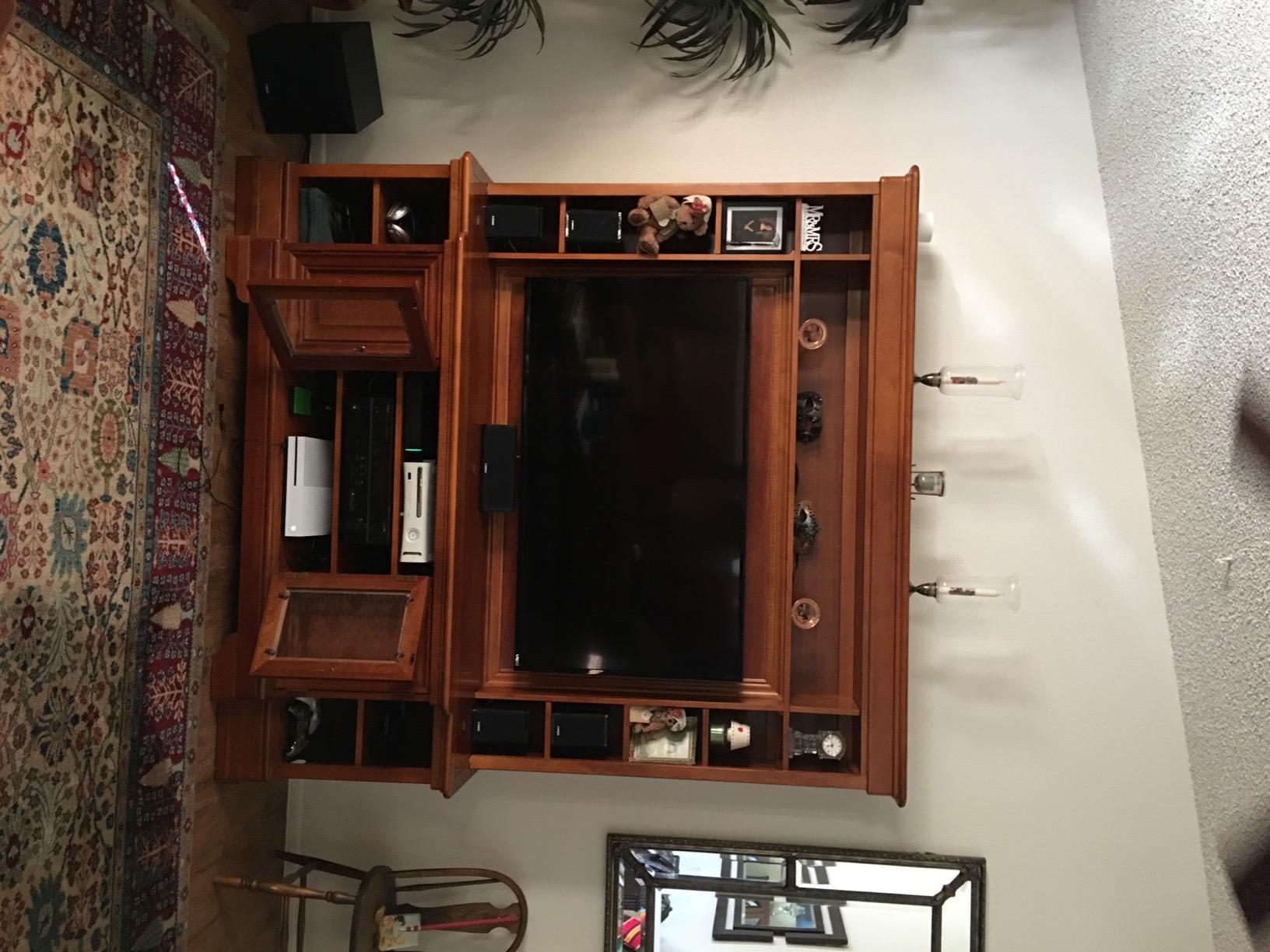
With 1,356 reviews at 4.5 stars, this is one of the most heavily reviewed systems in the group, and the pattern in the reviews is consistent: people upgrading from TV speakers or an older all-in-one report a big improvement in clarity and bass. The Virtual CINEMA FRONT mode is the feature small rooms care about most, because it fakes a wider surround field when physical rears would be too far back.
Where this box wins in a small basement
The satellite speakers measure 4 inches wide, 6 inches tall, and 4 inches deep, so they tuck away easily on a shelf or a slim stand. The center channel is 10 inches wide, wide enough to sit under a projector screen or on a low credenza without blocking anything. The subwoofer at 11 by 11 by 13 inches is compact enough for a front corner.
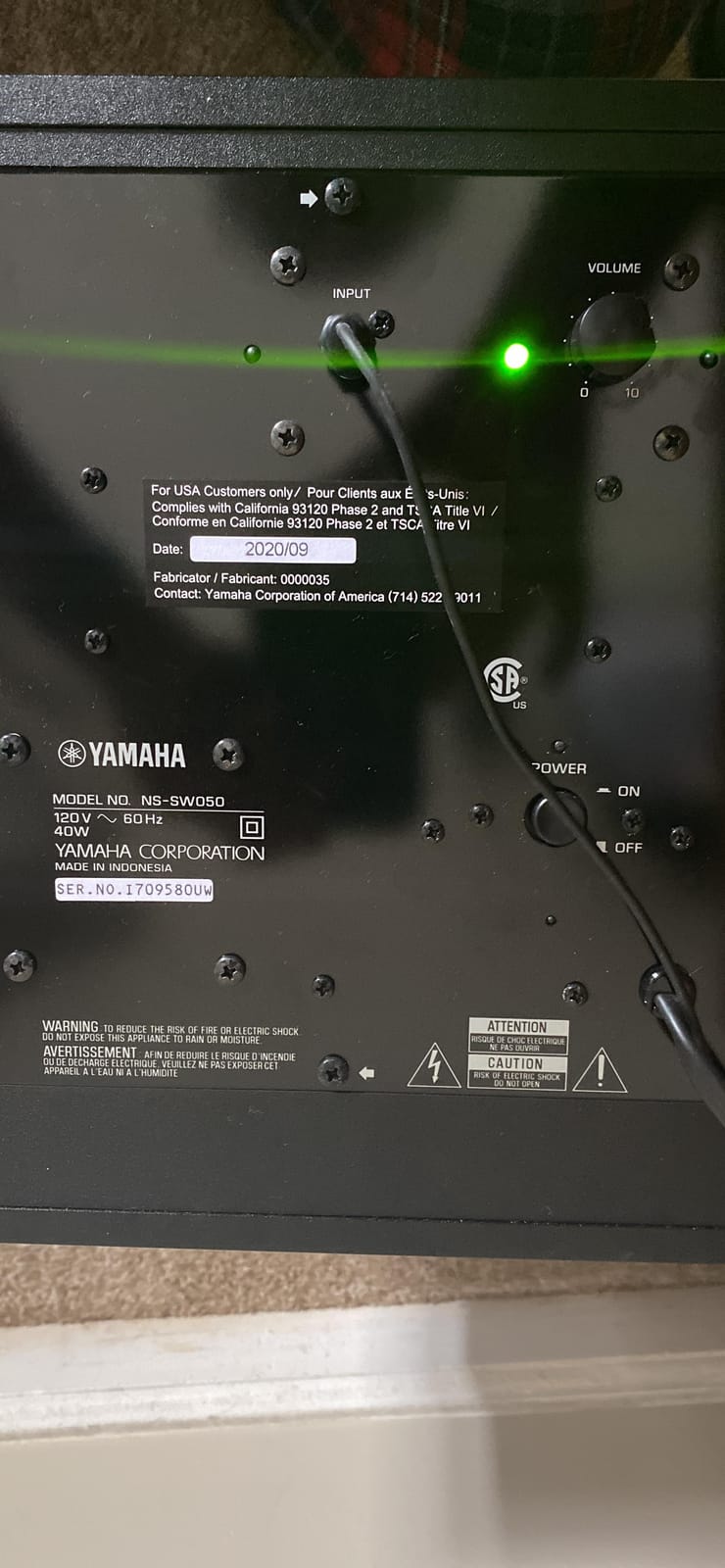
Two settings matter for a basement. Set the speakers to 6 ohm in the receiver menu, which many owners overlook. And if the room is under 200 square feet, try Virtual CINEMA FRONT before you start running long cables, because it can save the install entirely.
Why the lack of Atmos is a real limitation
There is no Dolby Atmos here at all, no height processing, and no object-based audio. If your plan was 5.1.2 or 7.1.4, this box cannot get there without replacing the receiver. The trade is fair for a first room, less fair for a basement you intend to grow into for a decade.
Two other practical notes. The satellites are hard-wired, so in a basement the back of the room needs speaker cable run through the wall or along a baseboard, and the included wire is thin enough that plenty of owners replace it. And a small number of owners report receiver hardware failures within a few years, so keep the assumption that you may eventually pair these speakers with a better AVR, which is a painless upgrade because the wiring is standard.
4. Energy 5.1 Take Classic – Best Value With a Real Center Channel
Energy 5.1 Take Classic Home Theater System (Set of Six, Black)
5.1 channels
200 watt 8 inch subwoofer
8 ohm impedance
Five year warranty
Pros
- Genuine dedicated center channel for dialogue
- 8 inch driver produces tight accurate bass
- Small satellites wall-mount flush with keyhole slots
- Five year parts and labor warranty
Cons
- High gloss finish shows fingerprints constantly
- Needs roughly 50 hours of break-in before settling
- Bass is enjoyable rather than truly tight
The thing that usually goes wrong in a cheap 5.1 bundle is the center channel. A lot of manufacturers put a small satellite in the middle position and let the receiver handle it, and dialogue goes flat or drifts. Energy did not cut that corner here. You get a gloss black dedicated center channel speaker, and it makes a bigger difference to a movie night than any other single component in the box.
The subwoofer is the other reason to look closely. A 200 watt front-firing ported design with an 8 inch driver in a 5.1 set is a genuine step up from the 4 inch and 5 inch drivers you find elsewhere at this tier. Front-firing also means it places more predictably against a wall or in a corner, which is the opposite of the down-firing limitation on our top pick.
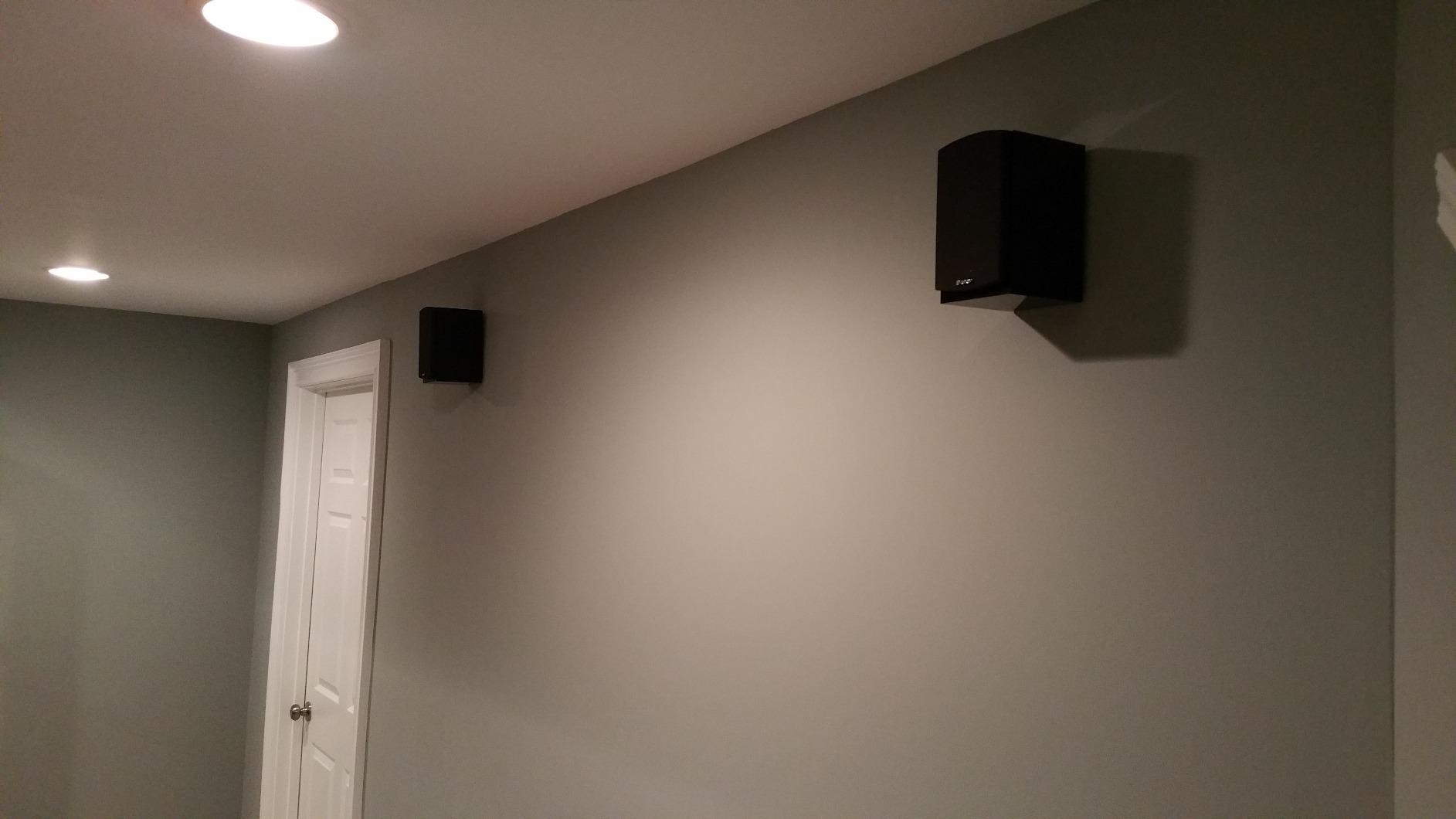
Long-term owners report this system still performing after six years, and with 1,372 reviews at 4.6 stars it has one of the strongest rating-and-volume combinations in the roundup. Praise centers on dialogue clarity and how cleanly the sub blends with the satellites after the receiver runs auto-calibration. Reviewers note the satellites are small, easy to position, and wall-mountable flush using the keyhole slots.
It is also a genuinely balanced system for music. If your finished basement doubles as a listening room, gloss black satellites on a shelf do not look out of place next to a turntable, and a set that handles movies well usually handles records well too.
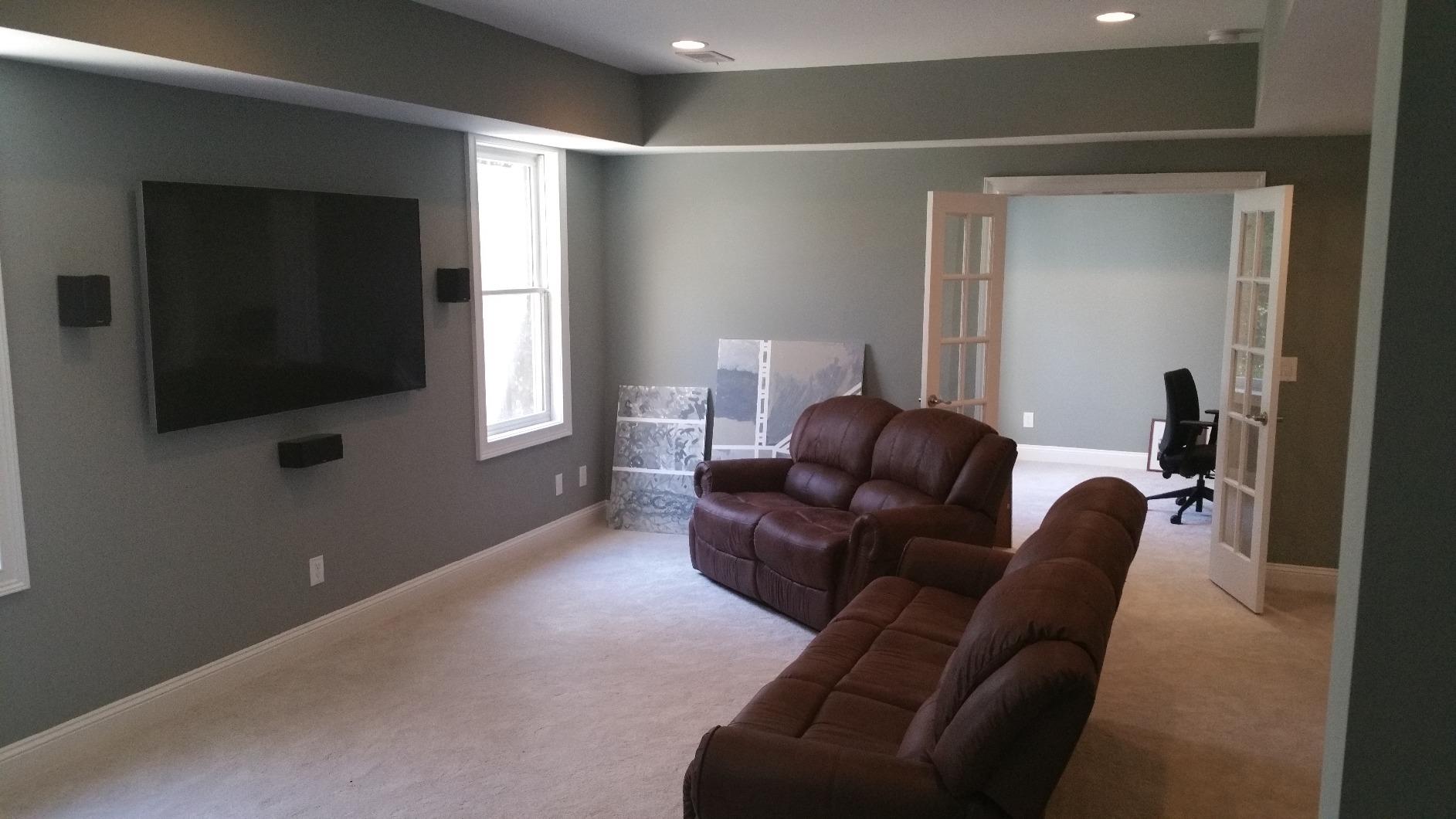
Why a dedicated center channel matters most in a basement
Basements are dialogue rooms. There is no window, no open-plan sightline, and often a mix of HVAC duct noise in the same band. Viewers end up leaning forward and straining, which means the center channel is doing more work here than it would in a bright upstairs living room with a bigger screen and more distance.
A dedicated center also gives you a single point of aim. You place it directly under or over the screen, set the receiver crossover to match the satellites, and the entire front stage moves as one object. Trying to fake that with a satellite does not work, which is why this set is our value pick even though several cheaper bundles sit in this roundup.
Where this system asks too much
Two honest limitations. The high gloss finish is a fingerprint magnet, and in a dusty basement that means wiping the satellites down regularly. And reviewers consistently mention a break-in period of roughly 50 hours before the system settles, which is longer than most people expect and long enough that a few buyers assume something is wrong.
Also worth knowing: the enclosure finish is laminate or pressboard rather than solid wood, and the bass, while clearly better than most competitors at this tier, is described by owners as enjoyable rather than genuinely tight at the very bottom. If you are a critical listener at low volume, this is a limitation. If you are watching films at moderate levels, it is not.
5. Sony BRAVIA Theater System 6 – Best When You Cannot Cut Any Drywall
Sony BRAVIA Theater System 6 5.1ch Soundbar with Subwoofer & Rear Speakers
5.1 channels
Three front-firing drivers
Dolby Atmos and DTS:X decoding
Wireless rear amp box
Pros
- Genuine rear channel separation without a full speaker layout
- Decodes Dolby Atmos and DTS:X for streaming
- Three front-firing drivers keep dialogue clear in a large room
- Wall-mountable bar with a table option
Cons
- Subwoofer is wired so placement is less flexible
- Rear speakers still need a powered box at the back
- Best features need a compatible BRAVIA television
Cutting into finished drywall is the single biggest reason people give up on a real basement theater. It is not the money, it is the patching, the paint match, and the fact that once you open a wall you cannot un-make that decision. If that is you, this is the honest answer: a bar with a discrete center channel, two rear speakers, and a subwoofer, all without touching a wall.
The bar itself carries three front-firing drivers rather than the typical two, with a dedicated center channel between them for dialogue. That is a real architectural improvement over a plain soundbar, and it is why dialogue stays clear in a larger room. The rear speakers connect wirelessly to a small included amplifier box, so the only hardware at the back of the room is that box and a power outlet.
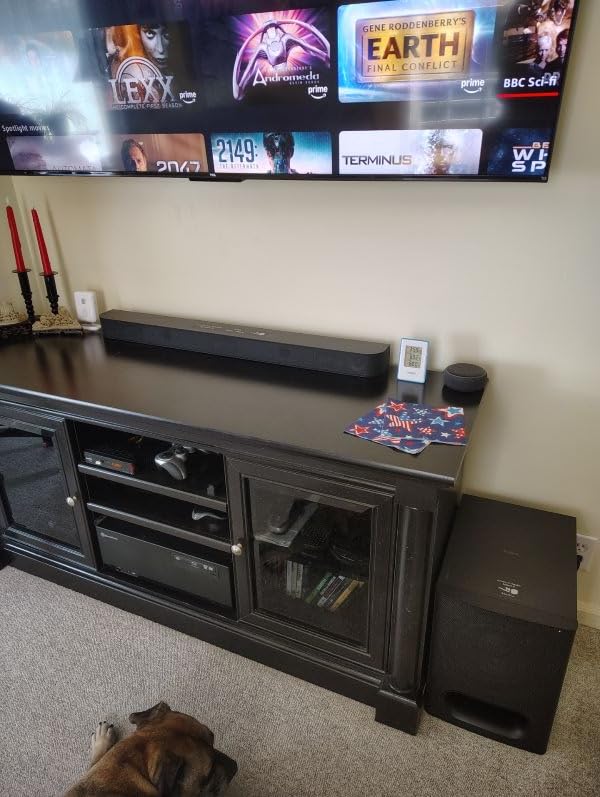
It also decodes Dolby Atmos and DTS:X, which is more than most systems at this level do, even though the physical layout is only 5.1. Atmos decoding still lets a streaming service render height effects into the available channels, and the processing gives films a wider, taller image than the channel count suggests. Owners buying this over a soundbar-only setup cite exactly that difference in rear-channel separation.
With 471 reviews at 4.4 stars, the feedback is solid rather than overwhelming. The praise concentrates on the Atmos and DTS:X decode and the clarity of the center channel. The complaints concentrate on two specific things, and both are worth planning around.
How a bar-based system handles a basement theater
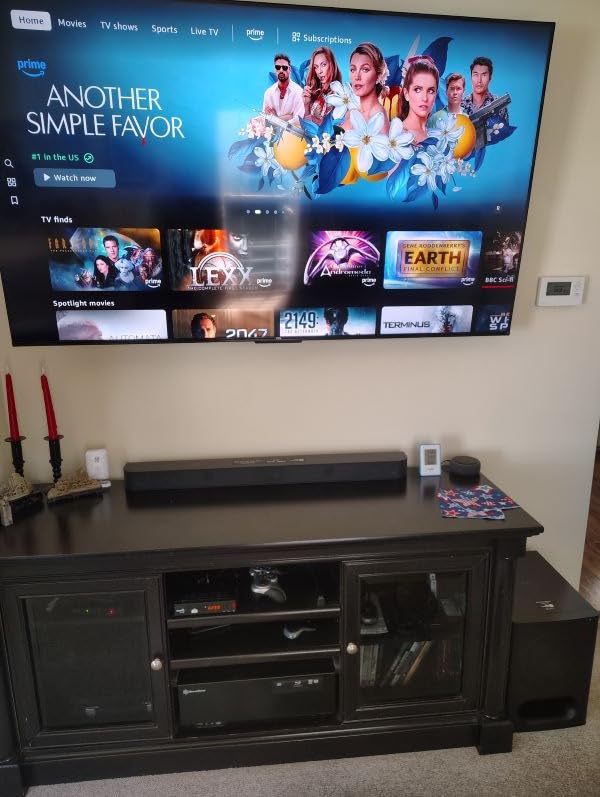
Below a 100 inch screen, a bar is not a compromise, it is a legitimate layout. The center channel sits directly under the image, so lip sync is not an issue, and the wireless rear box means the surrounds can sit behind the seating without running cable back to the front of the room. In a 150 to 250 square foot finished basement, that is often the only realistic way to get rear channels at all.
The Multi Stereo mode widens the soundstage for casual listening, which matters if the room is a media space rather than a dedicated theater. And the wall-mount option on the bar means you can clear the credenza entirely, which helps when the seating is close to the front wall.
What you compromise with this approach
The subwoofer is wired, so unlike the Klipsch pack at number one you are back to running a cable to wherever the sub ends up. In a concrete basement that cable is a trip hazard if it crosses the seating area, so plan the run before you move the furniture.
The rear speakers also still need a power outlet at the back of the room for the amp box, and the best integration features, including Voice Zoom 3 and menu control, expect a compatible BRAVIA television. And the 1000 watt headline figure is a peak marketing number, not a measure of how hard it drives a room. Judge it by the channel separation, which is genuinely good, not by that number.
6. Rockville HTS56 – Best Powered 5.1 With Karaoke and Light Effects
Rockville HTS56 5.1-Channel Bluetooth Home Theater System, 8″ Subwoofer
5.1 channels
8 inch subwoofer
Receiver and amp in the sub
Bluetooth USB and optical input
Pros
- Receiver and amplifier built into the subwoofer
- Five satellites plus a real 8 inch driver
- Wide input selection including optical and SD
- Speaker cables mounting hardware and antenna included
Cons
- Entry-level drivers lack detail of dedicated theater packages
- Built-in amplifier limits fine-tuning
- LED lighting is decorative rather than functional
This is the only system in the roundup where the receiver and amplifier live inside the subwoofer, and that single design decision changes what a basement build looks like. There is no rack, no AVR closet, no ventilation question. You plug the sub into the wall, run the satellite cables out of it, and you have a powered 5.1 system in a corner. For a basement where the equipment closet is a pipe and a dehumidifier, that is a real advantage.
You get five satellites and a 1000 watt peak 8 inch subwoofer in a wood enclosure, with a 70 dB signal-to-noise ratio. The inputs are unusually broad for the tier: Bluetooth, USB, SD card, RCA, and optical. That optical input matters more than it sounds, because it lets you feed the system from a TV without needing an external switcher.
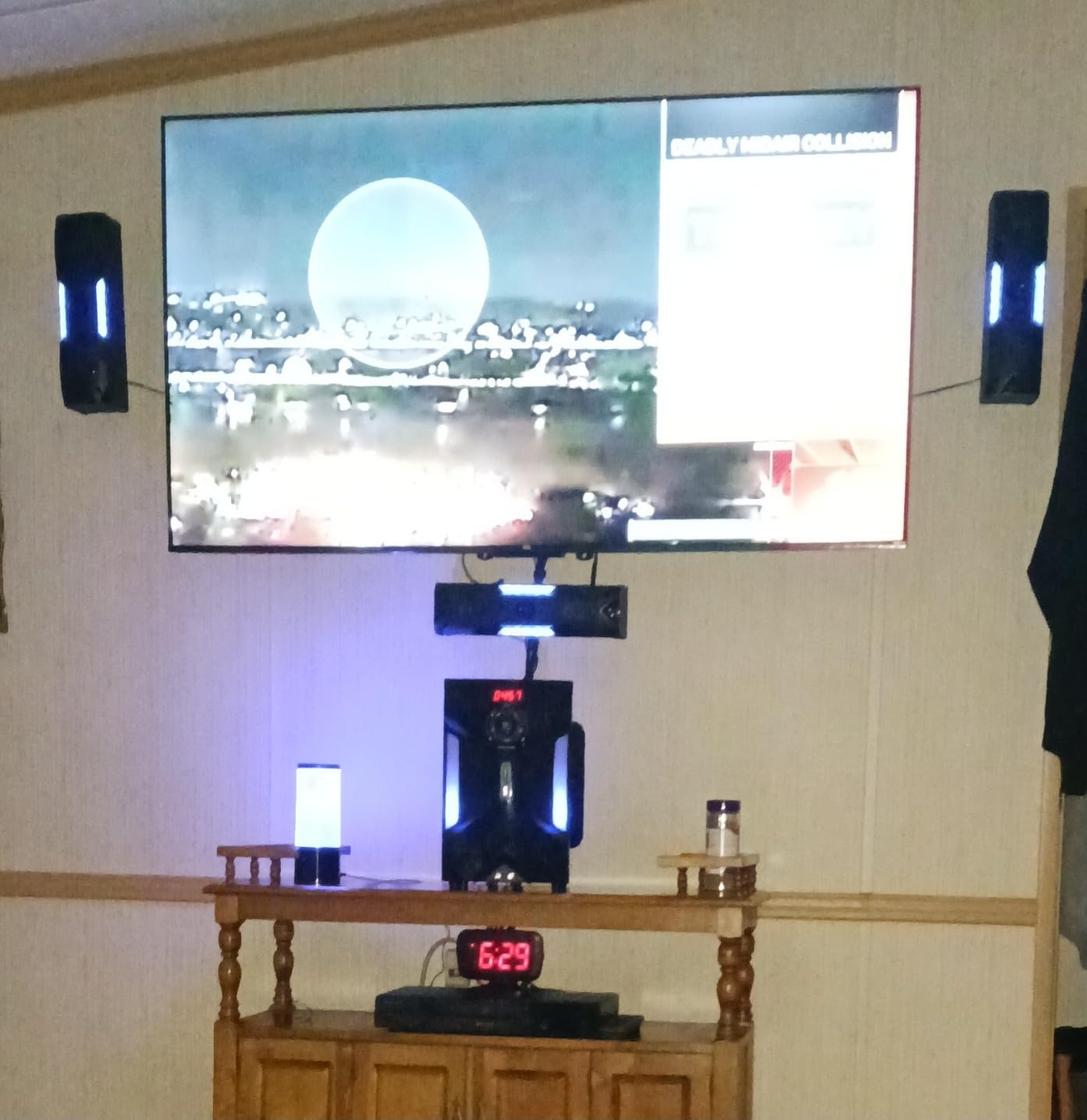
The karaoke and lighting features are not gimmicks bolted on for nothing. A basement media room is frequently the room where the teenagers hold their own movie night, and two quarter-inch microphone inputs with echo control plus a 5 band EQ turn this into a genuinely usable karaoke rig. The LED display runs blink-to-beat and spectrum analyzer modes, which owners building a finished rec room tend to like.
At 6,520 reviews the feedback volume here is large, and the rating spread is the widest. 65 percent of ratings are five stars, which is strong, but 10 percent are one star. That split is not noise, it is the system dividing people cleanly based on expectations.
When the powered-all-in-one design is the right basement choice
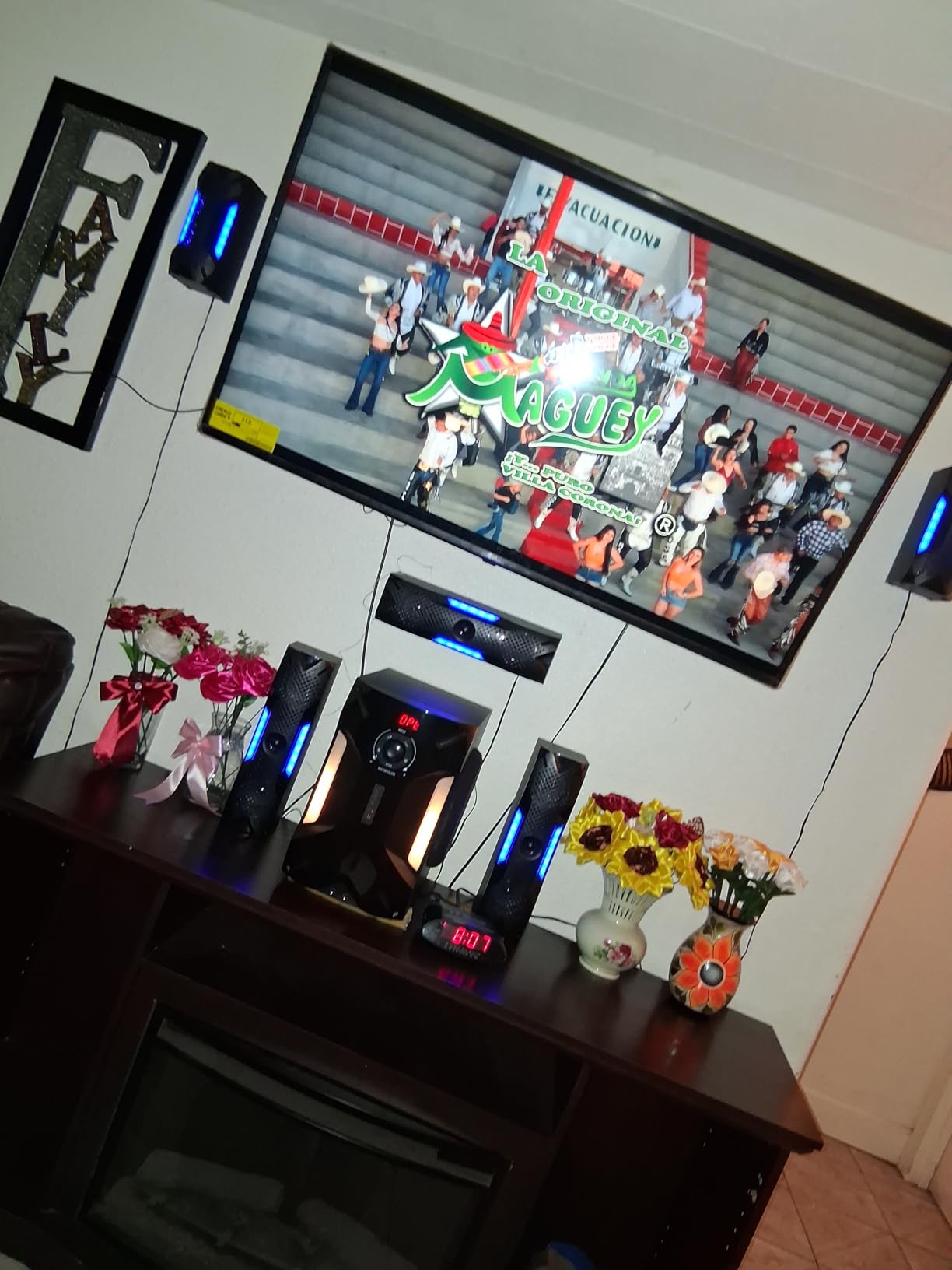
Choose this when the room is a multi-use space rather than a dedicated theater. A powered system powers off with one remote, takes up one corner, and has no standby lights or network activity. That suits a basement that also functions as a workout room, office, or playroom, where an always-on AVR in a closet is something you would rather not have.
Cables up to 30 feet and the mounting kits are in the box, so the physical install is genuinely a one-afternoon project. In a finished basement where you are running surface-mount cable along a baseboard rather than fishing through a wall, having the length in the box removes the most common mid-project panic.
Why critical listeners should look elsewhere
The honest limitation is the drivers. Reviewers describe the sound as thin compared with dedicated home theater speaker packages, and at 10 percent one-star ratings there is a consistent stream of comments about build and sound quality. The built-in amplifier is the deeper issue: with no external receiver you have no room correction, no per-channel level trimming beyond a simple control, and no crossover point to set.
What you get instead is simplicity and a very low entry point. For parties, casual movie nights, and a room that has to be approachable for people who are not audiophiles, those are not small benefits. For a critical listening room where you want to fine-tune every channel, this is the wrong tool.
7. Sony HT-S40R – Best 5.1 for a Very Small Basement Nook
Sony HT-S40R 5.1ch Home Theater Soundbar System,black
5.1 channels
Wireless subwoofer
600 watts total power
Bar mount with night mode
Pros
- Wireless sub removes the cable run to the corner
- Rear speakers add real surround separation
- One-button night mode for late viewing
- Color-coded setup connections are genuinely quick
Cons
- Rear speakers need a powered box at the back
- Reports of crackling and input dropouts on some units
- No tone or EQ adjustment beyond sub level
Not every finished basement is a theater. Some are 150 square foot rooms with a 55 inch television and a couch, and putting towers in them is a mistake. In a room that size, the best home theater speaker system for a basement is the one with the smallest physical footprint and the least wiring, and this is it.
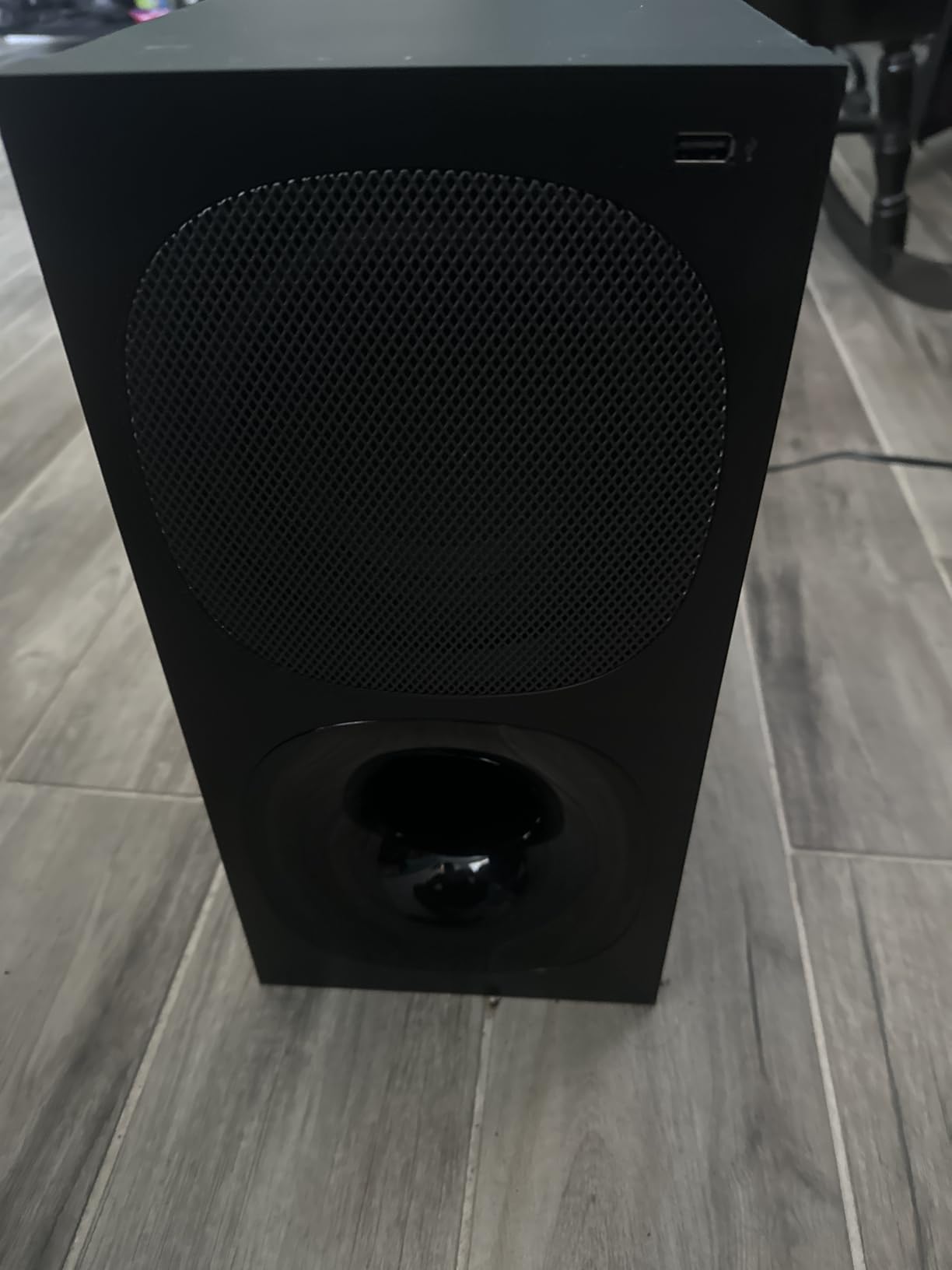
The wireless subwoofer is the headline. In a small concrete room, corner placement still produces the biggest low-frequency gain, and a wireless sub means you can put it exactly there without a cable crossing the floor. The two rear speakers add genuine separation that a plain soundbar cannot, which is the entire reason to choose this over a bar-only system.
Sound field modes are pressed with one button and include auto, cinema, music, voice, and night. The night mode is more useful than it sounds in a basement, where late viewing is common and every decibel matters with shared walls. Voice mode lifts dialogue without raising the whole mix, which pairs well with the HVAC noise problem.
At 8,756 reviews this is by far the most reviewed system here, and the 4.0 average tells you exactly where the fault line is. 61 percent of ratings are five stars. 11 percent are one star, which is the largest one-star share of any product in the roundup. Owners who upgraded from TV speakers love it; a consistent group have reliability complaints.
How much bass a small concrete room needs
A 150 square foot finished basement with a poured floor gains low frequencies in a way that a carpeted upstairs room does not, but it also loses them quickly through the walls. The practical consequence is that you need less subwoofer output than the raw square footage suggests, and that a wireless sub in a corner is genuinely enough.
This is the specific case where my general rule inverts. In larger rooms you move up to bigger drivers. In a small one, driver quality and clean midrange matter more than low-end extension, because there is nowhere for excess bass to go. Owners in small rooms report the sub performs better than they expected for exactly this reason.
Where this system disappoints
The rear speakers connect through a separate amp box that needs power at the back of the room, which is the same limitation as the BRAVIA Theater System, and this is the single most common complaint from basement builders with this style of system. There is no way to run a fully wireless rear channel, so you need an outlet behind the seating.
More seriously, owners report random loud crackling from the rear speakers on some units, and some report the system dropping out of the TV input list until both devices are power cycled. There is also no tone or EQ adjustment beyond subwoofer level and rear speaker distance, so if you are picky about sound you are stuck with Sony’s voicing. For a secondary room, those trade-offs are acceptable. For a primary theater, they are not.
8. Acoustic Audio by Goldwood CS-IC83 – Best Invisible Install for a Finished Room
Acoustic Audio by Goldwood CS-IC83 8” 3-Way In Ceiling Home Theater Speaker System (White, 5 Speakers)
Five in-ceiling speakers
8 inch 3-way drivers
95 dB at 8 ohm
40Hz to 20kHz response
Pros
- Flush mounting leaves the room free of visible speaker boxes
- True 3-way design with separate woofer midrange and dome tweeter
- Wide dispersion blends well when recessed into the ceiling
- Paintable grilles and pressure-lock clamps
- Works with any standard receiver using raw wire
Cons
- Passive package with no receiver or subwoofer included
- Requires cutting five ceiling holes and running in-wall rated wire
- High sensitivity means you need a capable amplifier for larger rooms
This is the only package in the roundup that is genuinely built for a basement aesthetic, and it is the only one where a finished room stays finished. Five flush-mount in-ceiling speakers with paintable grilles vanish into a painted ceiling. Nothing sits on a shelf, nothing stands in a corner, and there is no visible cable. If your basement is finished and you want it to still look like a finished basement after the speakers go in, this is the answer.
The driver engineering is better than the price tier suggests. Each speaker is a true 3-way design: an 8 inch high-rigidity poly cone woofer with butyl rubber surrounds, a poly mica midrange, and a 13mm soft dome tweeter, all on a passive crossover. Published response is 40Hz to 20kHz at 95 dB and 8 ohm impedance.
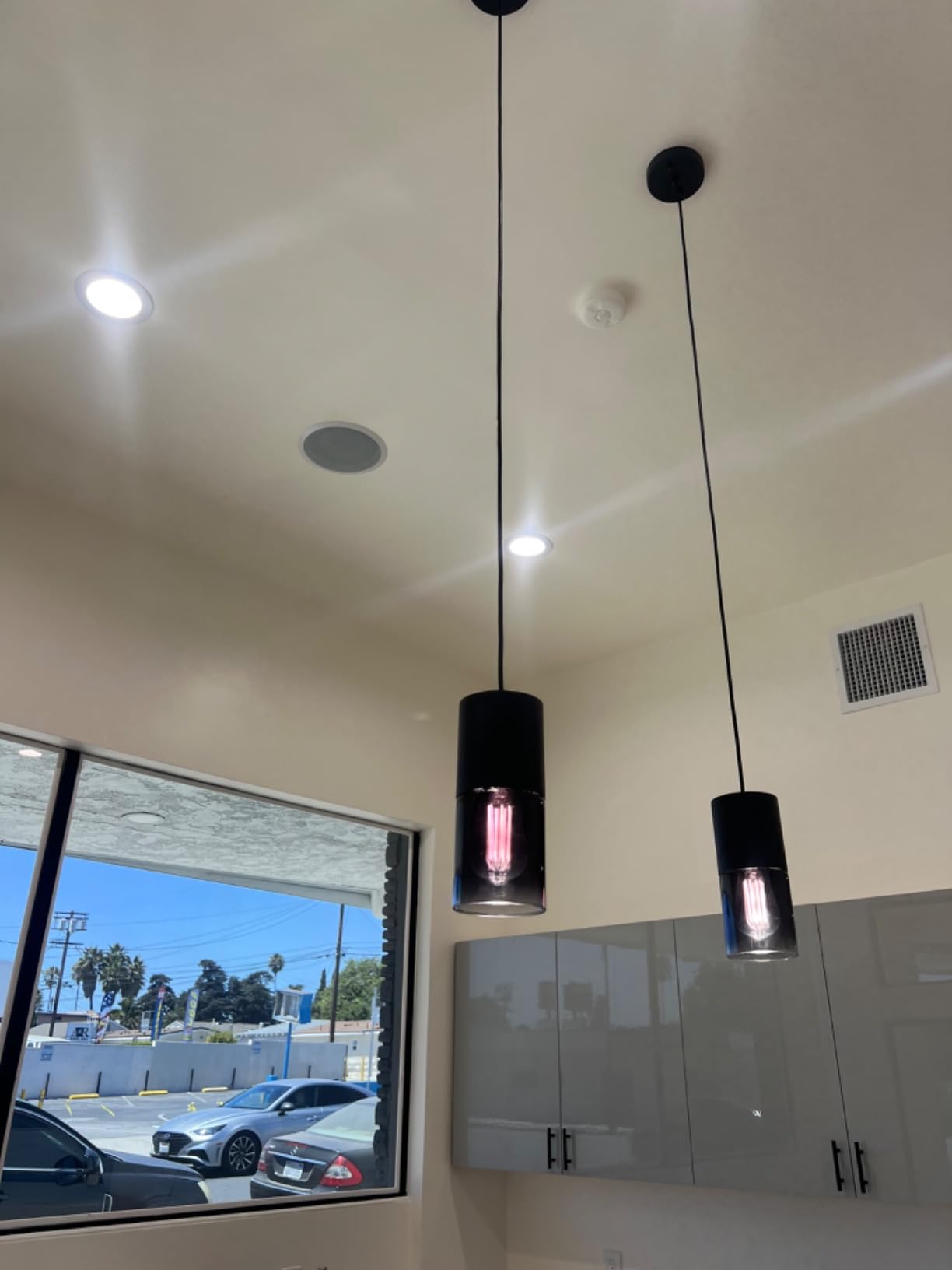
That 95 dB sensitivity figure is the number that matters in a small room. Higher sensitivity means the speaker produces more output for the same amplifier power, and in a 150 to 250 square foot basement driven by a modest receiver, that headroom is the difference between clean dialogue and a strained midrange. Reviewers installing these in basements and dedicated theaters single out the wide dispersion, which is what allows a recessed speaker to blend across the listening area instead of sounding like a point source.
At 4.7 stars across 969 reviews with 81 percent five-star ratings, this is the second-highest rating in the group and one of the most consistent. Buyers installing in-ceiling systems specifically praise the invisible flush look and the clean three-way sound once they are wired to a proper amplifier.
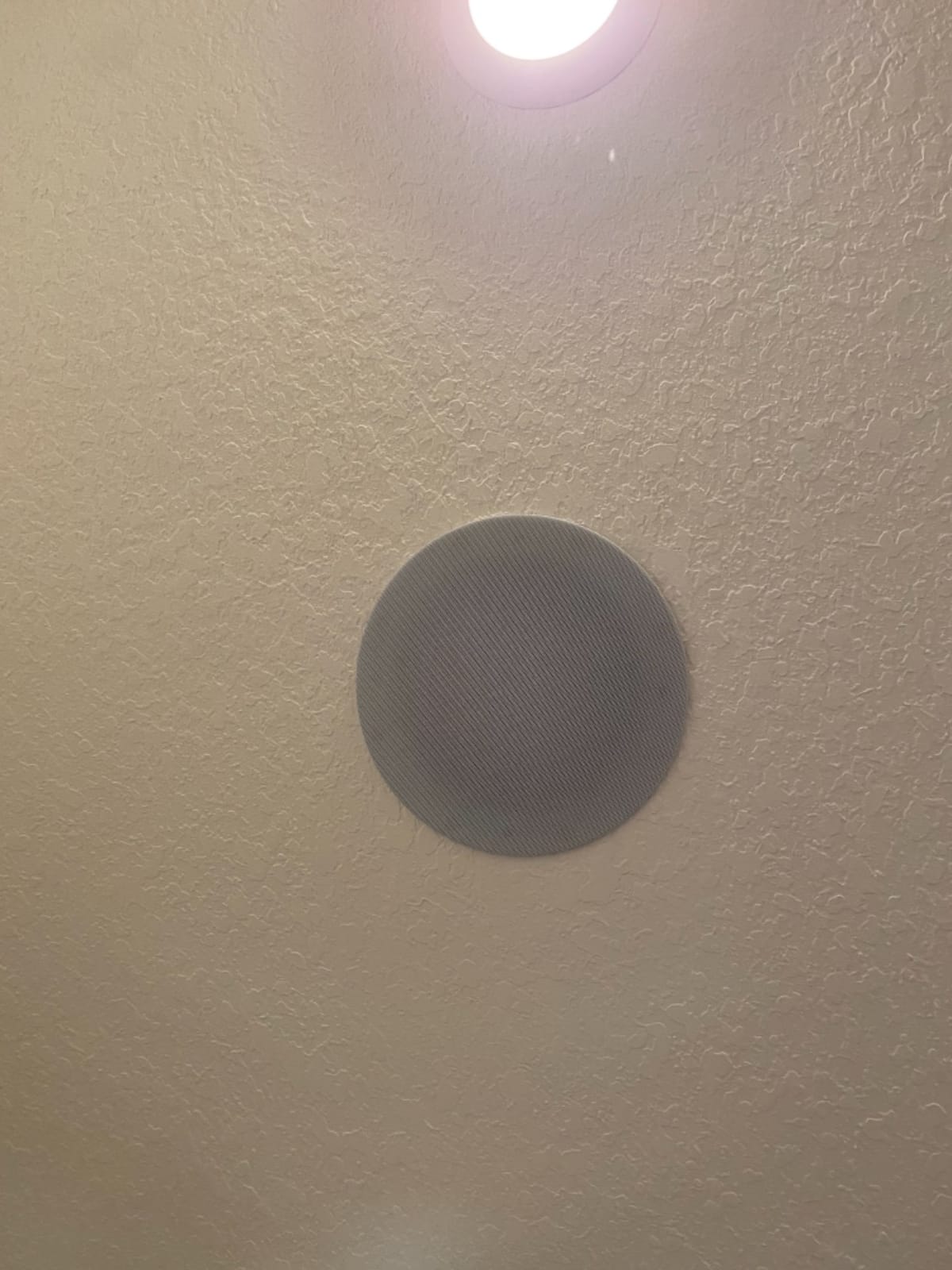
What a five-speaker in-ceiling layout actually sounds like
Five speakers gives you a front L/R pair, a center, and two surrounds, all firing downward from the same plane. That evenness is the whole point. When every speaker is equidistant from the listener, the front stage images cleanly and dialog sits where the screen is instead of drifting. That coherence is hard to get with a mix of wall and shelf speakers at different distances.
The wide dispersion also means a single listener off to one side still hears a balanced soundstage, which matters in a basement where seating often doubles as casual seating and people drift to the edges of the room. The one specification to respect is mounting depth: 3.78 inches behind the ceiling plane, with a 9.45 inch cut-out and a 10.83 inch overall diameter. Check your joist spacing before you commit, because that is the number that decides whether this install happens at all.
Where this package leaves work for you
This is a speaker-only package. No receiver, no amplifier, no subwoofer, and no wire. You need a 5.1 channel AVR, you need a subwoofer of your own choosing, and you need in-wall rated speaker wire run to five ceiling locations, which in a finished basement is the entire project.
Also plan for amplification. With published sensitivity in the high 90s dB range and a recommended 10 to 350 watts per channel, this set wants a receiver with real current capability. A small entry-level AVR will play them, but it will not have the headroom for a larger room. Pair these with a capable receiver, run the room correction, and the system is very good. Pair them with a small one and you are asking too much.
9. Bobtot Home Theater System K901S – Best Powered Set With a Switchable 2.1 Mode
Bobtot Home Theater Systems Surround Sound Speakers,1200 Watts Peak
5.1 channels
10 inch powered sub
Built-in receiver and amp
Switchable 5.1 and 2.1 modes
Pros
- 10 inch sub delivers more low-end output than most sets at this tier
- Receiver built into the subwoofer with no separate amp
- 31 foot rear cables reach the back of a large basement
- Independent per-speaker and sub volume control via remote
Cons
- Satellites are hard-wired so placement is fixed by cable length
- Peak wattage figure overstates real output
- Thin satellite sound on dialogue
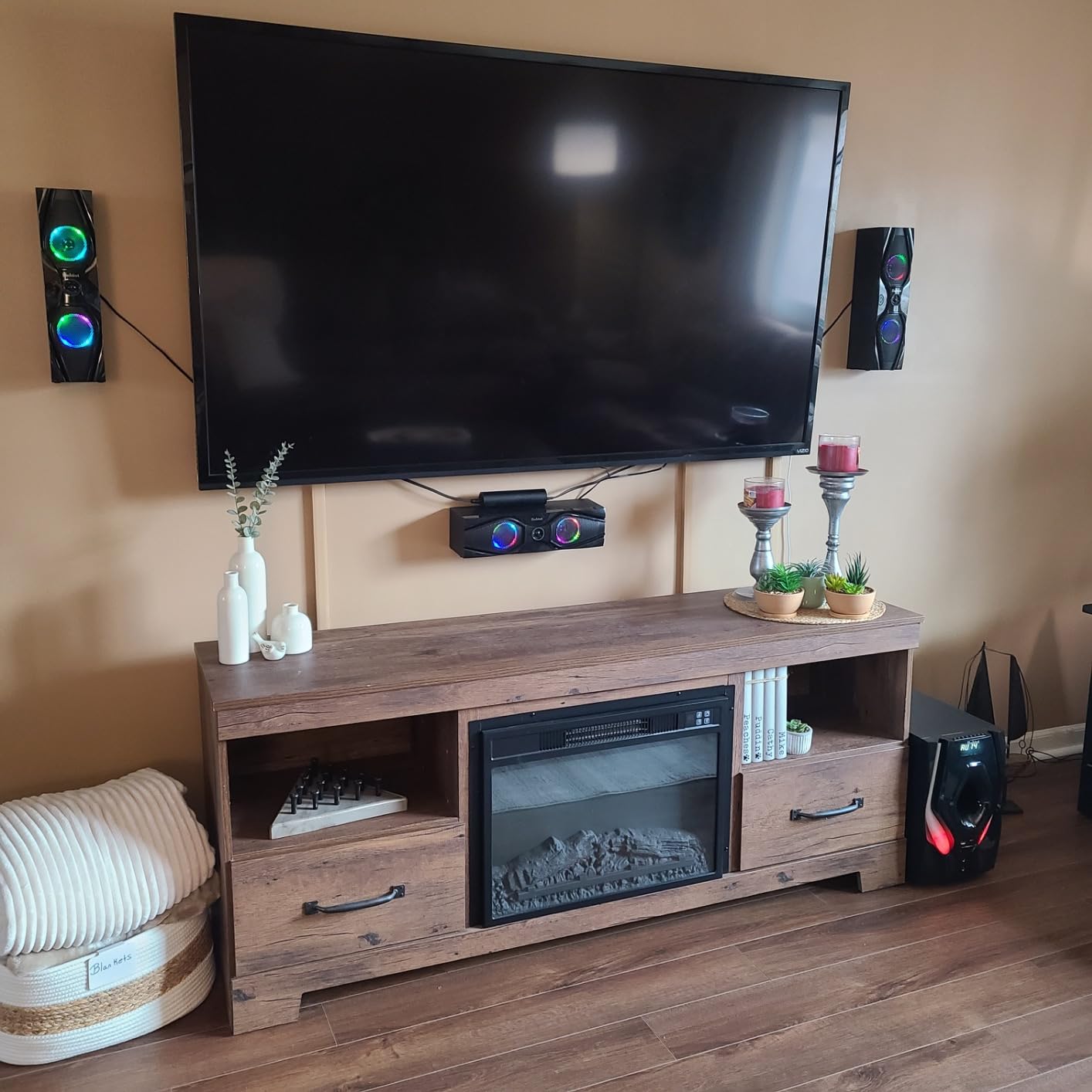
The single most useful feature in this system has nothing to do with home theater. It switches between 5.1 and 2.1 channel modes from the remote or the front panel. In a basement that is a shared space, that means you can run full surround for a movie and drop to a 2.1 setup for music or for people sitting at the far end of the room, without touching the receiver menu. No other system in this roundup does that.
Underneath, it is a conventional powered design: the receiver and amplifier live in a 10 inch subwoofer, and the satellites are wired. The included cable lengths are unusually generous, with 13 foot front runs, 31 foot rear runs, and a 10 foot center run. In a long basement that 31 foot rear cable is the difference between a clean install and one that stops halfway.
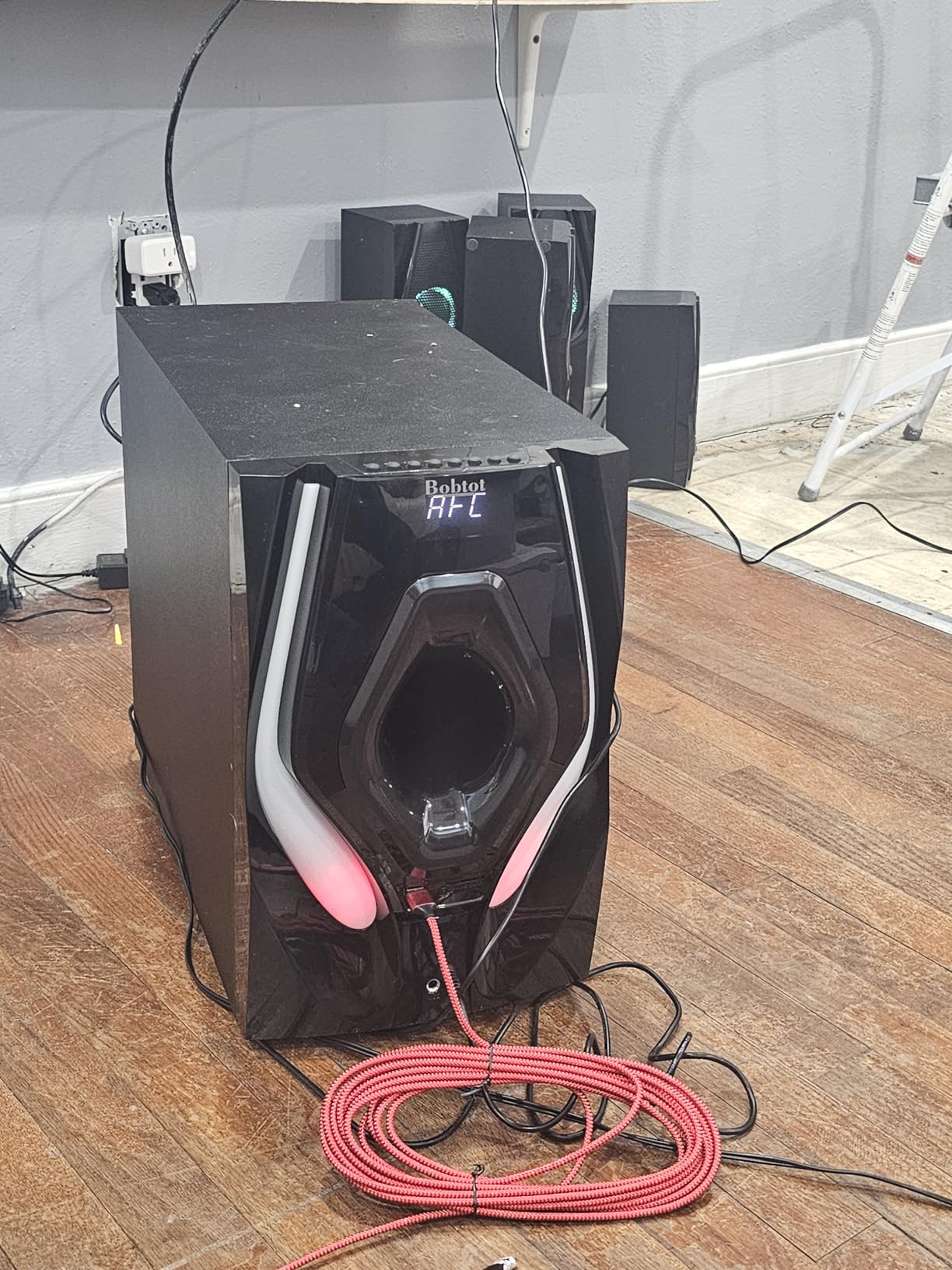
Connectivity is broad for the money. Bluetooth 5.3 with a 33 foot range, ARC, optical, coaxial, AUX, USB, and DVD inputs, plus FM radio and SD card playback up to 64GB. The ARC input is the one you will actually use, because it lets a television feed audio back over HDMI with a single cable.
There are also two quarter-inch microphone inputs with echo for karaoke and four LED lighting modes on the subwoofer, including a spectrum EQ analyzer. At 875 reviews and 4.1 stars, with 61 percent five-star and 11 percent one-star, buyers are clearly split by use case: people treating it as a party and secondary-room system rate it highly, people expecting a critical theater rate it poorly.
Why a 10 inch subwoofer matters in a concrete basement
A larger driver is not automatically better, but in a below-grade room with poured concrete it is a genuine advantage for one reason: it moves more air before it runs out of excursion, which means it plays louder at lower distortion. For a basement where the low end is fighting both HVAC noise and the structural transmission into the rest of the house, having headroom means you can dial the sub back and still have impact.
The switchable 2.1 mode also changes how that sub behaves. In 2.1 mode the system is essentially a bar and a subwoofer, which in a small room or a casual listening configuration can be more accurate than a full 5.1 with the rears at odd angles.
What to watch out for with this system
The satellites are hard-wired to the subwoofer, so their positions are set by the length of the included cable, not by your placement preferences. In a long rectangular basement that is workable, but in an L-shaped or oddly proportioned room you may end up with surrounds in positions you did not choose.
Also be skeptical of the 1200 watt peak figure. It is a marketing peak number, not a measure of output. And the satellite drivers are consistently described as thin on dialogue, which is a real limitation if you watch a lot of dialogue-heavy content. The center position does not have a dedicated center speaker here, and that is the weakness the Energy Take Classic at number four is built to solve.
10. Klipsch Reference R-26FA 5.1 Home Theater Pack – Best Full Tower Stage
Klipsch Reference R-26FA 5.1 Home Theater Pack, Brushed Black Polymer Veneer
5.1.2 channels
Floorstanding towers with height drivers
12 inch digital subwoofer
5 year warranty
Pros
- Floorstanding towers with integrated up-firing height channels
- 12 inch all-digital subwoofer fills a medium room
- Front-firing reflex ports allow placement close to a wall
- Dual 6.5 inch copper-spun woofers stay detailed after break-in
Cons
- Heaviest option here at roughly 190 pounds for the set
- No speaker wire included so every run is on you
- Up-firing Atmos is less convincing than ceiling-mounted height speakers
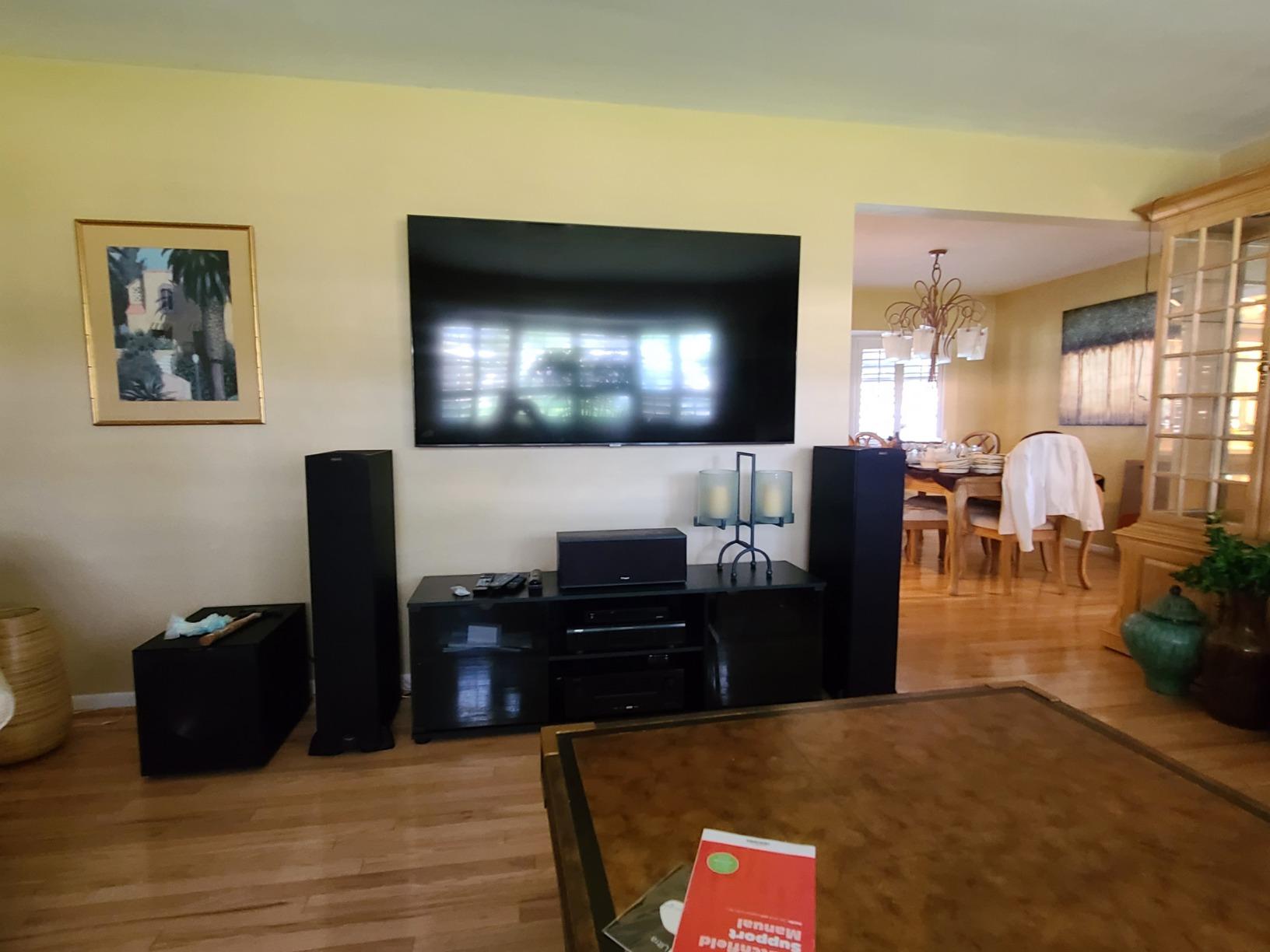
This is the only system in the roundup built around floorstanding towers, and that is a deliberate recommendation for a specific basement shape. If your room is 250 square feet or larger with a clear front wall and enough depth to walk behind the seating, towers are the right answer. The R-26FA pair puts two 6.5 inch copper-spun woofers and a 1 inch aluminum tweeter in each enclosure, and they carry integrated up-firing Dolby Atmos height channels.
That makes it a 5.1.2 system with no ceiling work, which in a finished basement is a big deal. You also get a pair of R-41M bookshelf speakers for the surrounds, an R-25C center channel, and a 12 inch all-digital subwoofer. Six pieces, a full front stage, and real height effects from floor level.
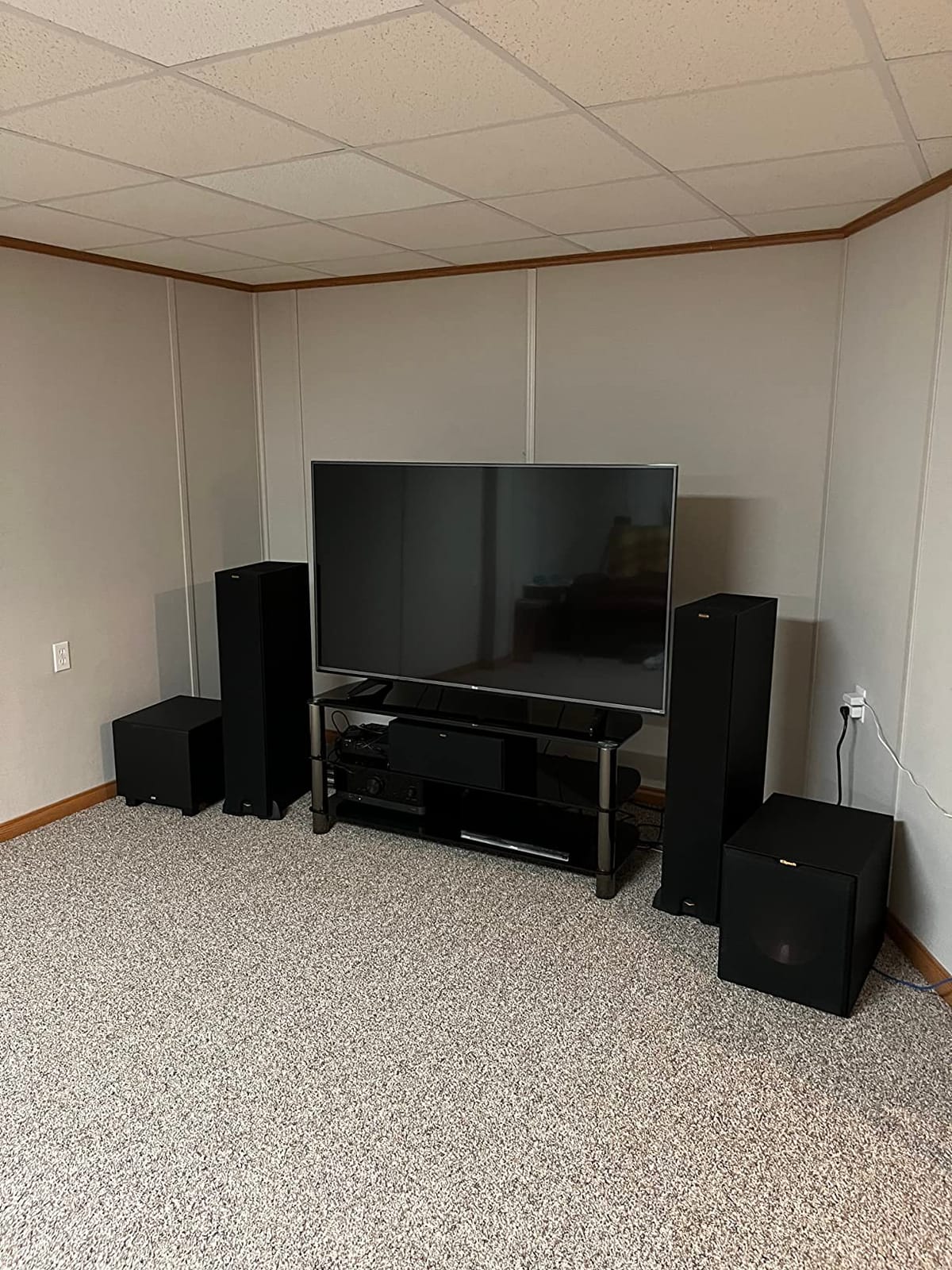
Two design choices make this package unusually well suited to a basement specifically. The front-firing reflex ports mean the towers can sit close to a wall without the port choking, and in a basement where you are often pushed back against a foundation wall, that is a practical advantage over a rear-ported design. And the 12 inch subwoofer has the output to fill a room that concrete walls would otherwise make boomy rather than deep.
The rating is the highest in the group at 4.8 stars, with 89 percent of 412 reviews at five stars, which is the strongest consistency here. Owners typically pair it with a mid-range receiver running Audyssey or YPAO calibration and report crisp, powerful results at normal listening levels, often noting that dialogue becomes clear enough to stop watching with captions.
When a tower front stage beats bookshelf speakers
The decision rule that shows up repeatedly in r/hometheater advice is simpler than most guides make it sound. If bookshelf speakers on stands run out of clean output at the crossover region, add towers. Below that threshold, towers are wasted floor space and, in a small room, an overdriven amplifier running too hard. In a 250 square foot-plus basement with a long throw to the seating, the R-26FAs clear that threshold comfortably.
There is also the physical argument. Towers move air at the low-mid crossover region without the stand resonance that a small bookshelf on a stand introduces, and they take up no shelf space in a room where horizontal surface area is precious. The port placement is the quiet hero: front-firing reflex ports let you push the towers near the front wall, which basement dimensions often require.
What the tower approach asks of you
The set weighs roughly 190 pounds, the heaviest in the roundup, and the towers are 44 inches tall and 12.75 inches wide. That is a two-person job with proper moving technique, not something to wrestle up a basement stairs alone. Plan the stairwell width before you commit.
Speaker wire is not included at all, and in a basement that means cutting, stripping, and running cable for six channels, which is the largest install of any system here. It also wants a reasonably powerful receiver with room correction to sound its best, and a lesser AVR will expose it. Finally, up-firing Atmos is measurably less convincing than true ceiling-mounted height speakers, so if you have a tall ceiling and no drywall to protect, directing that budget toward in-ceiling Atmos instead would buy a better result.
Basement Home Theater Buying Guide: What Actually Matters Below Grade
A basement is the rare room where the architecture narrows your choices before you start shopping. The ceiling height decides whether you can have overhead Atmos. The drywall decides whether you can have in-wall speakers at all. The concrete decides how much low frequency you get for free and how much leaks to the rest of the house. These are not preferences, they are constraints, and working through them first makes every product decision easier.
In-wall, in-ceiling, bookshelf, or floorstanding
This is the highest-intent question in basement theater searches and, oddly, the one that editorial guides answer least often. Here is the actual decision framework.
Start with whether the drywall can be cut. If your basement is unframed or you are still in the framing stage, in-wall and in-ceiling speakers are the strongest choice available, because they preserve floor space and disappear completely. If your basement is already finished and you do not want to patch and repaint, that option is closed and you move to bookshelf speakers on stands or towers.
Second, look at the ceiling. Below roughly 8 feet, in-ceiling height speakers for Atmos lose their effect because there is no vertical separation from the listener. In that case, choose either up-firing height channels, as in the Klipsch Cinema pack at number two, or accept 5.1 without height effects. Forcing in-ceiling Atmos into a 7 foot room produces sound that sounds like overhead, but never convincingly.
Third, look at room depth. Under about 200 square feet, towers are almost always the wrong answer, and this is the single most common mistake in basement builds. r/hometheater builders repeatedly report overpowering a small room with floorstanders and ending up with boomy bass and ear fatigue. Bookshelf speakers on stands, driven by a receiver with headroom, will sound better in that space.
Fourth, look at what surrounds you have. A basement with concrete on two walls behaves differently from one with a walkout on one side, and the speaker that seemed right in a showroom will not necessarily be right against a foundation wall. Front-firing reflex ports, as on the R-26FA towers, are worth paying attention to when a wall is close behind the speaker.
The forum consensus, which is well represented across r/hometheater and AVS Forum threads, points the same way: in-wall speakers are the default basement answer because they preserve the finished look, bookshelf speakers on stands are the second choice and the preference in smaller rooms, and towers are for larger rooms or when output is insufficient. The specific model names that come up most for in-wall value are the Monoprice THX and Monoprice Amber lines, with Dayton Audio named as the cheaper alternative. Those are the references worth carrying into a showroom even though the packages in this roundup take a different approach.
How many speakers you need for 5.1, 7.1, 5.1.2, and 7.1.4
The numbers describe channels, and each digit tells you something specific. The first number is the number of full-range channels, the 1 or the 2 is the subwoofer channel, and the last number is the number of height channels.
For 5.1 you need six speakers total. Three in front, two surrounds, and one subwoofer. The subwoofer is the “1” and it carries a single low-frequency channel, not two.
For 7.1 you need eight speakers. Three in front, two surrounds, two rear back speakers behind the listener, and one subwoofer. This is the configuration most often described as a real home theater because every seat has a speaker pointed at it.
For 5.1.2 you need eight speakers as well, but the two extra go above rather than behind. Two front L/R, one center, two surrounds, one sub, and two height speakers. In a low-ceiling basement those two height speakers are the up-firing drivers.
For 7.1.4 you need eleven speakers, plus a subwoofer, and you need a nine channel receiver. Four of the speakers are height channels. This is a genuinely large commitment of floor space, ceiling real estate, and amplification, and it is the configuration most likely to collapse onto the listener in a small room.
Map that to room size rather than to ambition. Under 150 square feet, 2.1 or 5.1 is plenty. Between 150 and 250 square feet, 5.1 or 5.1.2. Above 250 square feet, 5.1.2 is the sweet spot and 7.1.4 becomes realistic if the ceiling allows. A 7.1 setup in a 200 square foot basement sounds like it has speakers in the wrong places, because in a shallow room the rear back speakers end up beside the listener rather than behind them.
Basement speaker placement rules
These numbers come up over and over in the ranking forum threads for this topic, and they are worth having in one place because they are specific and verifiable.
Put your front L/R speakers and center 18 to 24 inches off the back wall. Closer than that and the boundary reflection reinforces low midrange, which makes the room boomy. Further than that and you lose the depth that a properly placed front stage provides. This is the most repeated piece of advice in basement threads.
Place the surrounds at 90 to 110 degrees from the listening position. Straight to the side at 90 degrees works for a small room where the rears would otherwise land behind the seating. Pushing them back toward 110 degrees suits a longer room. Above 110 degrees and the surrounds start to blend with the front stage and lose their job.
Keep the front L/R pair between 6 and 10 feet apart, and as far from the side walls as the room allows. A speaker an inch from a side wall is an earful of boundary reflection you cannot correct away.
Put the subwoofer in a corner, not against a flat wall. Two adjacent walls and a floor give the driver three boundaries, which is the highest low-frequency gain per cubic foot you can get in a rectangular room. The Klipsch Reference pack is the one here with a wireless sub, which is exactly why it suits this rule.
Set the crossover at 80 Hz for most rooms, and adjust upward to 100 Hz for small subwoofers in small rooms. The 80 Hz figure is not a rule written on a stone tablet, it is the standard starting point because it is where subs and full-range speakers hand off most cleanly. The Klipsch Cinema pack is the exception worth noting, because its three speaker groups sit at different crossover points and need manual gain adjustment after auto-calibration.
Run room correction before you judge anything. The Yamaha’s YPAO and the Onkyo TX-NR6100 that r/hometheater builders commonly pair with a budget in-wall setup both handle this well. Calibration is what makes a 5.1 setup cohere as one system rather than five separate speakers.
Receiver and amplifier requirements
Match the receiver to the speaker load, not to the shopping cart. Look at sensitivity first: a speaker at 88 dB or above will play a medium room from a mid-range receiver, while an 84 dB speaker will sound thin and strain the amplifier in the same room. The in-ceiling package in this roundup publishes 95 dB, which is why it plays cleanly from a modest AVR.
Check impedance next. 8 ohm loads are the easy case. 4 and 6 ohm loads need a receiver rated for them, and a couple of the systems here require a menu change, including the Yamaha whose satellites are set to 6 ohm in the receiver menu.
Then confirm the channel count. To unlock every height channel on the Klipsch Cinema pack you need a 9.1 channel receiver. To run 5.1.4 from a full set you need nine channels of processing. If your receiver has seven, the height drivers are doing decoration work.
Finally, look at the connections. 4 HDMI ports with 4K Ultra HD and HDCP 2.2 passthrough covers most streaming sources today. HDMI eARC matters if you plan to route television audio through the receiver. And check for automatic room correction, because in an irregular basement with a low ceiling, calibration does more for your sound than an upgrade in one speaker.
Humidity, HVAC noise, and concrete room gain
Concrete gives you a room gain that wood-framed rooms cannot approach, and that is a real benefit. It also means bass transmits into the structure. A subwoofer pushed to maximum output in a basement can be heard two floors up, which is why controlling gain matters more than adding driver size. If the system is loud enough to be a problem upstairs, the correct fix is a second sub or better placement, not a bigger amplifier.
Humidity is the other long-term concern. Basement air is more humid than the rest of the house and the temperature swings more. The practical protections are straightforward: buy grilles and cones you can paint or that are rated for damp-adjacent spaces, keep gear off the bare floor on a rack or shelf that keeps it a few inches clear, and make sure the basement is finished against water intrusion before speakers go in. If any speaker is not water resistant, treat that as a fact about where you store it during a wet season, not a footnote.
HVAC noise is the problem most people meet first and least expect. Duct and blower noise sits largely in the low-midrange, which is the same region as voice fundamentals, so a mediocre center channel can sound worse in a basement than a good one in a quiet room. This is the single strongest practical argument for buying a system with a real dedicated center channel rather than faking one with a satellite. The Energy Take Classic at number four exists largely to make that point.
Retrofit installs that do not damage finished drywall
If the drywall stays intact, your options narrow and that is fine. Soundbar-based systems like the Sony BRAVIA Theater System 6 and the Sony HT-S40R need one power outlet at the rear of the room and no holes. Compact satellite packs like the Klipsch Reference pack wall-mount with the included keyhole mounts. That is the no-damage set, and it covers most small and mid-size basements well.
If you do want invisible speakers in a finished room, two details make it survivable. Use paintable grilles, which every in-ceiling package here includes, so the cut-out disappears once the ceiling is painted. And mount with a pressure-lock clamp that grips the back of the drywall from above, which is what the Acoustic Audio package specifies. Before cutting anything, confirm your joist spacing against the cut-out diameter, because a 9.45 inch hole in a room with 16 inch joists is a much easier job than the same hole in a room with 12 inch joists.
One more rule: in-wall and in-ceiling speakers without a back-box lose bass output into the wall cavity, and in a basement that cavity is often a stud bay full of insulation that soaks up low frequencies. If you are committed to cutting holes, budget for back-boxes.
When a soundbar is the honest answer
Sometimes the correct recommendation is not a speaker system at all. If your basement is under about 150 square feet, your screen is 55 to 65 inches, and your main concern is that the audio should not be embarrassing when relatives are sitting in the room, a soundbar with a wireless subwoofer is the right product. Duplicating a 5.1 layout across a small room buys nothing and costs time.
The same is true when the drywall is untouchable and there is no power outlet at the rear of the seating. The bar-plus-rear-systems in this roundup solve the surround problem, but they still need that outlet. A pure soundbar with a wireless sub needs none. If you are weighing the general category, our full home theater system guide covers the soundbar-versus-speakers decision in more detail.
And if the room is unfinished with a high ceiling, hold off on any bundle at all. In-wall speakers plus a proper nine channel receiver will beat every package on this list for that room, and buying before the drywall goes up is the most efficient use of the same speaker budget. Nothing about that advice depends on which system you pick.
Frequently Asked Questions
What is the best in-wall speaker system for home theater?
The best in-wall systems for a home theater are genuinely 3-way passive speakers with a midrange driver, at least 88 dB sensitivity, and paintable grilles. Monoprice THX and Monoprice Amber lines are repeatedly named the value leaders, with Dayton Audio as the cheaper alternative. The one package here built for the same job is the Acoustic Audio by Goldwood CS-IC83 set, five flush in-ceiling 3-way speakers at 95 dB, though you supply the receiver and subwoofer yourself.
How many speakers do you need for 7.1 surround sound?
You need eight speakers total for 7.1. That is three across the front for left, center, and right, two surrounds beside or behind you, two rear back speakers behind the listening position, and one subwoofer. Seven and one refers to channels, not speaker count. In a basement under about 250 square feet, 7.1 often sounds worse than 5.1 because the rear back speakers land beside you instead of behind you.
Which is better, 5.1 or Dolby Atmos?
Dolby Atmos is better, provided your basement can actually host height channels. A 5.1.2 setup adds two speakers above the listening position, and in a low-ceiling room the only honest way to achieve that is up-firing drivers that bounce sound off the ceiling. If your ceiling is under about 8 feet, a good 5.1 system with a real center channel will satisfy you more than a forced Atmos layout.
Are in-wall speakers better than bookshelf speakers?
In-wall speakers are better when the drywall is still open, because they free floor space and disappear visually. Bookshelf speakers on stands are better in a finished room where you refuse to cut holes, and they usually cost less. In-wall designs without a back-box lose bass into the wall cavity, so in a basement those cavities are often full of insulation. Buy back-boxes if you commit to in-wall.
Do I need a subwoofer for a basement home theater?
Yes, and you will need less of one than you expect. A poured concrete floor and concrete walls give a basement natural low-frequency gain, but those same surfaces pass bass into the rest of the house. Place a single sub in a corner for maximum gain, control the gain carefully so neighbors are not disturbed, and add a second sub later for smoother output rather than buying a much larger one up front.
How do I soundproof a basement home theater?
Start with the walls and ceiling rather than the speakers. Dense insulation in the stud bays, a resilient channel or hat channel on the drywall, and sealing penetrations do more than any equipment change. Double drywall on the walls shared with living space gives the biggest return. On the speaker side, use sealed in-wall speakers with back-boxes and keep bass control tight, because structure-borne low frequency is the main source of sound travelling to other rooms.
Where should I place surrounds and the subwoofer in a basement?
Place surrounds 18 to 24 inches off the back wall and at 90 to 110 degrees from the listening position. Put the subwoofer in a corner, where two walls and the floor give the driver three boundaries for maximum low-frequency gain in a small room. Set the crossover at 80 Hz as a starting point and raise it for small subwoofers in small rooms.
What is the 83 percent rule for speakers?
The 83 percent rule refers to a common dealer guideline that roughly 83 percent of what you hear in a home theater comes from the front left, front right, and center speakers, with the surrounds and subwoofer supplying the remaining effect. It is why the center channel matters so much, and why a system with a real center speaker outperforms one that fakes the middle position with a satellite.
Conclusion: Picking the Right Basement Speaker System in 2026
For most finished basements between 150 and 250 square feet, the Klipsch Black Reference Theater Pack 5.1 is the best home theater speaker system you can install without rethinking the room. Small satellites, a wireless sub you can drop in a corner, and a horn that stays clear at low volume.
If your ceiling is low and you want height effects, the Klipsch Reference Cinema 5.1.4 gets you Atmos without cutting a single hole. If you want the receiver handled for you and do not need Atmos, the Yamaha YHT-4950U is the complete box. If your drywall is finished and untouchable, the Sony BRAVIA Theater System 6 gives you rear channels and Atmos decoding with one small amp box at the back. And if the room is still open, buy in-wall and in-ceiling speakers and wait.
Whichever you pick, the placement rules do more for the result than the model choice: 18 to 24 inches off the back wall, surrounds at 90 to 110 degrees, the sub in a corner, crossover at 80 Hz, and room correction run before you judge anything. Get those right in 2026 and a mid-tier system will beat an expensive one installed badly.