If you have asthma, the best air purifier for your home is a True HEPA unit with no ozone-producing ionizer, sized so it clears your room several times an hour. The Levoit Core 300-P is our top overall pick because it is AHAM VERIFIDE certified, hits 24 dB in sleep mode, and its 143 CFM CADR is published rather than guessed. Every purifier below was screened on the same four criteria before it made this list.
Asthma attacks are often set off by things you cannot see in the room. Pollen, mold spores, dust mite debris, pet dander, smoke particulate, and the gases off-cooking or off-paint all keep the trigger load high enough that airways stay irritated even between attacks. A properly filtered purifier lowers that load, which is why many people with asthma report fewer night-time symptoms within days of switching one on. The asthma-specific buying guides from the Asthma and Allergy Foundation of America and the American College of Allergy, Asthma and Immunology both point the same direction.
What most roundups get wrong is that they treat every HEPA purifier as interchangeable. The details that matter for asthma are the ones buyers rarely check: whether the unit produces ozone, how much clean air it actually delivers per minute, and how loud it is when you need it running overnight. We read the certification labels, airflow figures, noise ratings, and review patterns for all ten of the units below, and we left out anything that could not be verified on paper.
Updated for 2026, this guide covers bedroom units, open-plan living spaces, and multi-room homes. If you want a broader view first, our general best air purifiers buyer guide covers non-health use cases, and our best HEPA air purifier reviews go deeper on filter media. One note before we start: an air purifier reduces exposure to triggers. It is not a treatment for asthma, and it does not replace prescribed medication or a clinician’s advice.
Table of Contents
Top 3 Best Air Purifiers for Asthma Sufferers in October


All 10 Asthma-Friendly Air Purifiers at a Glance in 2026
Every purifier in this roundup passed the same screening: mechanical filtration with a published efficiency figure, no ionizer switched on by default, a published clean air delivery rate or certified air-change rating, and a replacement filter that is a normal part of ownership. The table below puts the ten side by side so you can match coverage to your room before you read the individual reviews.
| Product | Specifications | Action |
|---|---|---|
| Levoit Core 300-P |
|
Check Latest Price |
 GermGuardian AC4825E GermGuardian AC4825E |
|
Check Latest Price |
| Winix 5520 |
|
Check Latest Price |
 Honeywell HPA304 Honeywell HPA304 |
|
Check Latest Price |
 Coway AP-1512HH Coway AP-1512HH |
|
Check Latest Price |
 Levoit Core 600S-P Levoit Core 600S-P |
|
Check Latest Price |
 Medify MA-40 Medify MA-40 |
|
Check Latest Price |
 HATHASPACE HSP001 HATHASPACE HSP001 |
|
Check Latest Price |
| PuroAir 240 |
|
Check Latest Price |
 Levoit Vital 200S-P Levoit Vital 200S-P |
|
Check Latest Price |
What to Look For in an Air Purifier for Asthma
Four criteria decide whether a purifier is asthma-appropriate or just marketed that way. Here they are in the order that matters most, and every one of the ten picks in this guide meets all four.
1. True HEPA rated to 0.3 microns and below. A True HEPA filter is rated to capture 99.97% of particles as small as 0.3 microns, which covers pollen grains, mold spores, pet dander, and fine dust mite debris. For asthma, finer is better still, so look for published figures at 0.1 microns or 0.01 microns rather than the word HEPA on its own. Marketing language like HEPA-type or HEPA-grade is not a certification.
2. An activated carbon stage for gases, odors, and VOCs. HEPA media traps particles, not gases. Volatile organic compounds from cooking, cleaning sprays, paint, and new furnishings need a carbon or chemisorption stage to adsorb onto the surface of the media. If your asthma tracks with odors or chemical sensitivity, a thin carbon layer is not enough.
3. No ozone, and no ionizer running by default. Ozone is a known asthma-attack trigger. Any purifier with an ionizer, electrostatic charge, or plasma feature must have that feature switchable off and stay off, or be excluded entirely. Nine of the ten below have no ionization stage at all, and the tenth includes one you must deliberately leave switched off.
4. CADR sized to your room, not to the box. Clean air delivery rate in cubic feet per minute tells you how much filtered air a purifier moves. Multiply the CADR by 60 and divide that by the room volume to get air changes per hour. Aim for at least four air changes per hour in a bedroom where symptoms peak overnight, and treat any coverage number printed on the box as a marketing maximum rather than a working figure.
Why Asthma Sufferers Should Avoid Ozone and Ionizers
Ozone is a gas, not a particle, so no HEPA filter removes it once it is in the room. That is the core problem with ionizers and plasma-type purifiers, which work by charging particles so they stick to a collection plate. As a side effect they generate ozone as a byproduct, and the concentration in a closed room can climb quickly past indoor safety guidance. For most people that is a non-event. For an asthmatic airway, it is a direct trigger.
Guidance from the Asthma and Allergy Foundation of America and the ACAAI is consistent: choose mechanical filtration and leave ionization features switched off. In this roundup, that standard is why the Winix 5520 is still included despite its optional PlasmaWave setting. The feature is off unless you deliberately turn it on, and I would leave it off in any home with asthma. If a purifier requires you to accept an ionizer to get the filtration, it does not belong in an asthma household.
Buyers searching forums about this topic hit the same wall repeatedly. Members of r/AirPurifiers describe ionizing units as dangerous for people with existing respiratory problems, and the broader point holds regardless of brand: an ozone-free claim has to be verifiable, not assumed. Certification labels such as Zero Ozone Verified, or a manufacturer specification showing no ionization stage at all, are the only evidence worth trusting.
1. Levoit Core 300-P – Quiet AHAM VERIFIDE bedroom unit
Levoit Air Purifier for Home Pets Hair Allergens in Bedroom Quiet Purifiers
AHAM VERIFIDE CADR 143 CFM smoke
24dB in Sleep Mode
Covers 1,073 sq ft
Pros
- Independently verified CADR figures for smoke dust and pollen
- HEPA-grade capture of 0.1-0.3 micron particulates
- Near-silent 24dB Sleep Mode with a display light-off setting
- Compact cylindrical body that suits a bedside table
- AHAM
- CARB and ETL certified
Cons
- HEPA-grade filtration is specified while in Sleep Mode rather than at every fan speed
- Proprietary filter so off-brand replacements may not fit
- Modest CADR makes it a bedroom and small-room unit
- Replacement filters are an ongoing cost
This is the purifier I recommend first, and the reason is the certification rather than the marketing. The Core 300-P carries an AHAM VERIFIDE listing with a published CADR of 143 CFM for smoke, 153 CFM for dust, and 167 CFM for pollen. Those numbers let me size it honestly: in a 12 by 12 foot room with an 8 foot ceiling, that is roughly 1,152 cubic feet of air cleaned about 7 times an hour, which is more than enough to hold down dust mite debris and pet dander between filter changes.
For an asthma household, the 24 dB sleep mode is the feature I would not give up. Owners with allergies consistently describe it as the setting they leave running all night, and the display light-off mode keeps the unit from becoming a glowing cylinder in a dark room. Independent testing cited in the listing confirms HEPA-grade performance while operating in sleep mode, which is unusual for a unit at this level.
Our screening note is that the room-size figure is doing double duty. The 1,073 square foot claim assumes a single air change per hour, and few people run a purifier that way. Treated as a bedroom or nursery machine, the real-world performance is strong. Treated as a living room unit, you would want something with more airflow behind it.
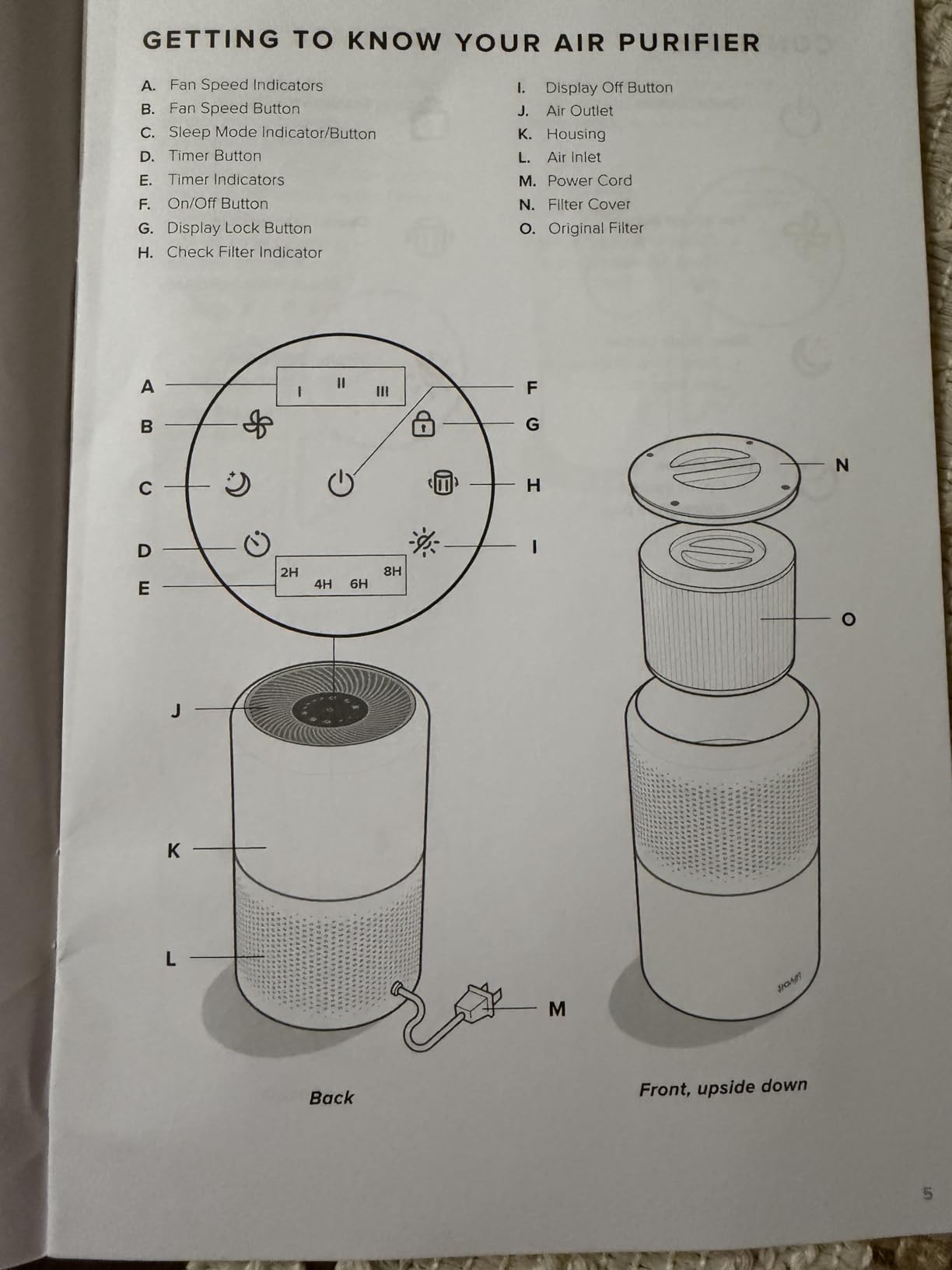
The three-stage stack handles cigarette smoke, dust, odors, pet dander, pet hair, pollen, VOCs, and wildfire smoke according to the manufacturer listing, with a pre-installed 3-stage Original Filter included in the box. If you have never run a purifier before, the controls are a single touch panel with a 2, 4, 6, or 8 hour timer and a filter check light that tells you when the media is spent.
What asthma buyers will notice day to day
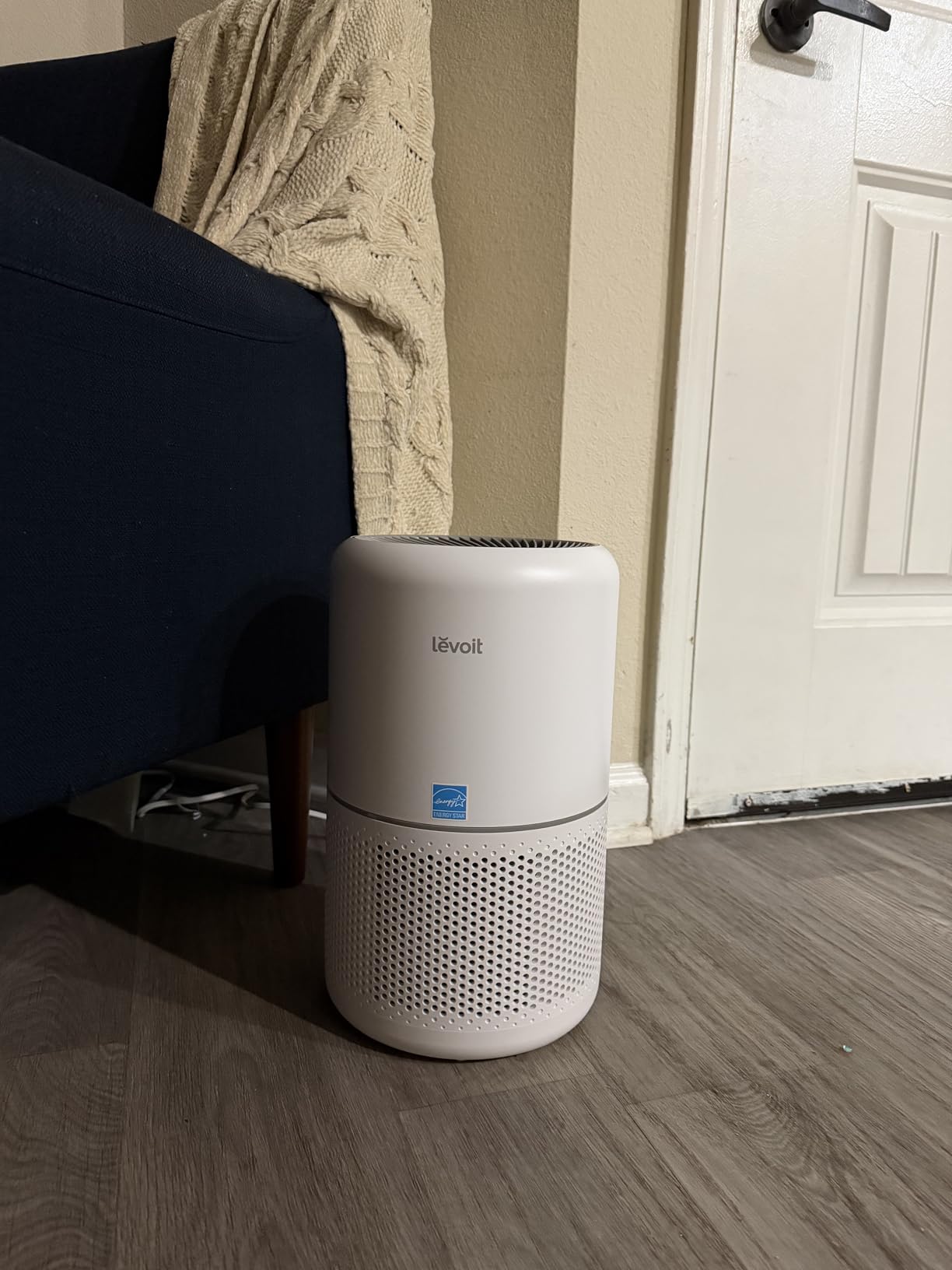
The most common feedback pattern across more than 100,000 reviews is reduced congestion and less morning stuffiness in rooms where the unit runs continuously. That is the outcome that matters for asthma: fewer night-time symptoms, fewer rescue inhaler moments in the morning. The 7.9 pound weight and 8.7 by 8.7 inch footprint mean you can move it between the bedroom and a child’s room as needed.
Two details reward attention before purchase. The 56 watt draw is modest, so running it all night on low is inexpensive, and the 2-year warranty is shorter than some competitors but longer than most budget units.
Where it falls short for asthma use
The HEPA-grade claim is written for sleep mode specifically, so if you are chasing maximum particle removal during a smoke event you will want to run it louder and accept more noise. There is no carbon-heavy stage, so heavy cooking odors or chemical sensitivity are not its strength. And the filter is proprietary, meaning the genuine ecosystem is the only one that fits and performs correctly.
2. GermGuardian AC4825E – Zero Ozone Verified tower with UV-C
GermGuardian HEPA Air Purifier – Large Room Air Purifier for Bedroom, Office, Dorm, and Home – Filters Pet Dander, Dust, Pollen, Smoke, Scents – AC4825E – 22″ Tower – Gray
Zero Ozone Verified
HEPA Pure filter to 0.1 microns
Covers 743 sq ft
Pros
- Zero Ozone Verified certification removes ionizer concerns
- HEPA Pure filter captures 99.97% of 0.1 micron allergens
- Optional UV-C light adds a second stage against mold and particles
- Activated carbon layer reduces cooking and pet scents
- Dial control needs no assembly
Cons
- Upper fan speeds are noticeably loud in a bedroom
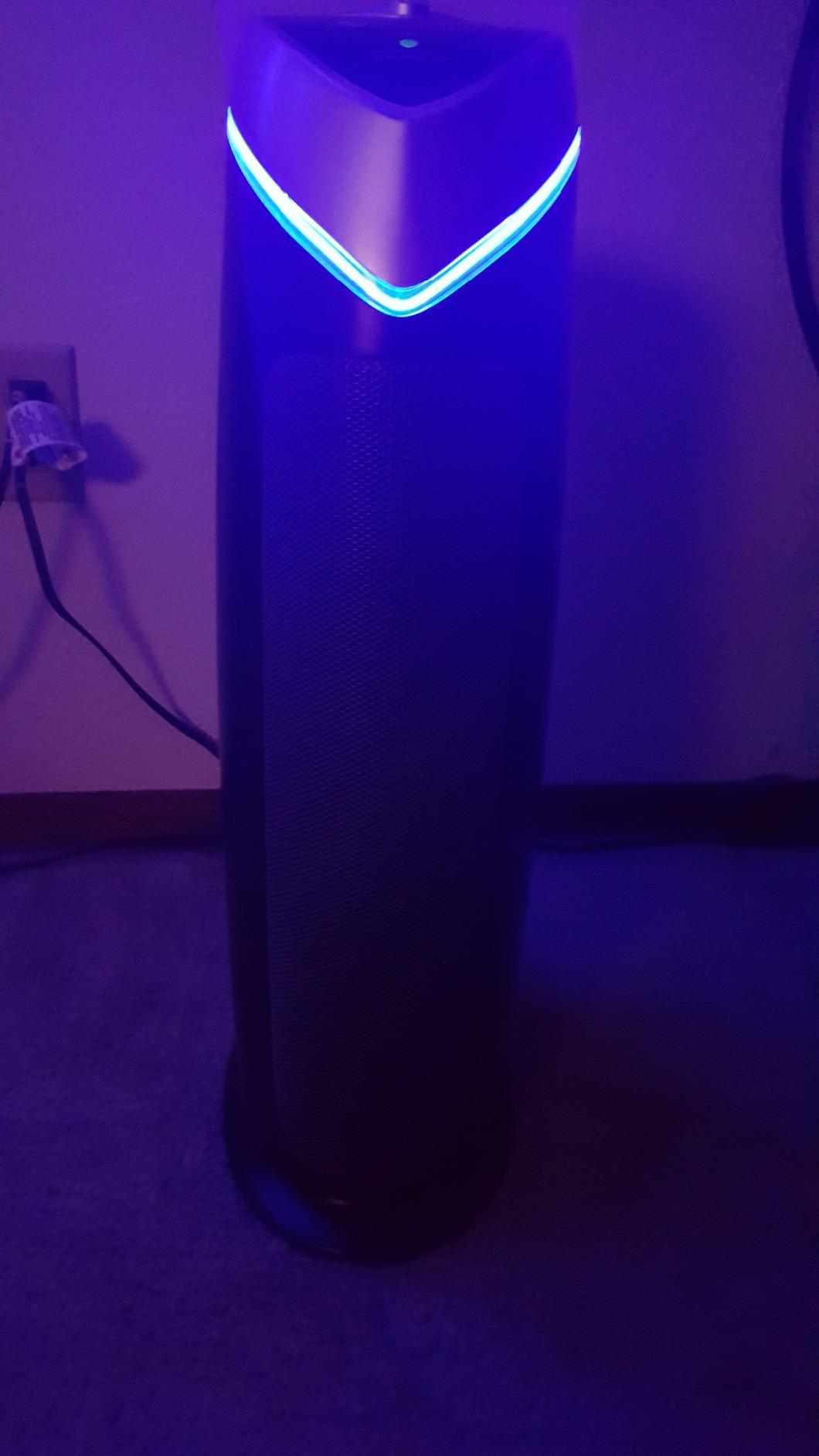
- Bright blue UV indicator light is distracting at night
- Slim pre-filter tears if vacuumed rather than rinsed
- New units can emit a temporary plastic smell
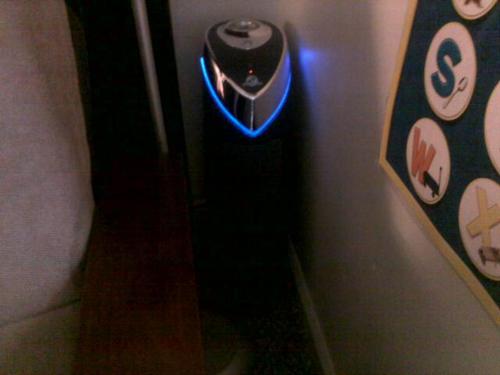
The GermGuardian AC4825E is the clearest answer in this roundup to the question of which air purifier does not produce ozone, because the Zero Ozone Verified marking is right there in the specification. That matters more than any feature list for an asthmatic buyer, and it is the reason this tower sits so high despite being one of the older designs in the category.
Filtration is a HEPA Pure filter rated at 99.97% for allergens as small as 0.1 microns, with an activated carbon layer for cooking and pet scents. That carbon stage is a genuine advantage over slim units for anyone whose asthma tracks with odors. The optional UV-C lamp adds another stage against mold and airborne particles, and both the filter and the bulb are replaceable separately, which extends the service life of the whole machine.
Airflow figures are honest for its class: the tower circulates 153 square feet every 12.5 minutes, or 743 square feet in an hour. Owners running it in a home office or a child’s bedroom report reduced congestion within a few weeks, which is the timeframe most people cite before noticing a change in symptom frequency.
At 8.55 pounds and 22 inches tall, it is a floor unit rather than a bedside machine, and the dial control with a dedicated UV-C button means you do not need an app or a remote. Three fan speeds are available, and the slowest one is the one you will actually use overnight.
What asthma buyers will notice day to day
The Zero Ozone Verified label means you can run this unit continuously without the indoor ozone question coming up, which removes the single biggest objection people with asthma raise about cheaper purifiers. Long-running owners with allergies report fresher air and fewer dust-related symptoms, and the carbon stage does real work on pet and cooking odors in an open-plan space.
Because the UV-C lamp and the HEPA filter are independently replaceable, the running cost is easier to predict than units with sealed filter cartridges. It is also CARB and ETL certified, so it clears the standard safety marks most buyers check.
Where it falls short for asthma use
Noise is the honest weakness. The upper fan speeds are noticeably loud, so the unit earns its keep on setting one only, and the bright blue UV indicator can be distracting in a dark bedroom. Owners also report that the slim pre-filter tears if you vacuum it rather than rinsing it, and new units can carry a temporary plastic smell that fades after a day or two of use.
3. Winix 5520 – Large-room coverage with a washable pre-filter
WINIX 5520 Air Purifier for Home Large Room Up to 1882 Ft² in 1 Hr With Air Quality Monitor, True HEPA, High Deodorization Carbon Filter and Auto Mode, Captures Pet Allergies, Smoke, Dust.
AHAM VERIFIDE 392 sq ft per air change
True HEPA to 0.01 microns
23.5dB on low
Pros
- AHAM VERIFIDE rating of 392 sq ft per air change
- True HEPA media rated to 99.99% at 0.01 microns
- Washable fine mesh pre-filter that extends HEPA life
- Smart sensor and app control with real-time fan adjustment
- Quiet at 23.5dB on the lowest speed
Cons
- Optional PlasmaWave ionization setting that sensitive users disable
- Companion app can be laggy or intermittently unresponsive
- Some owners report a clicking sound at low speed
- 120V plug only for overseas buyers
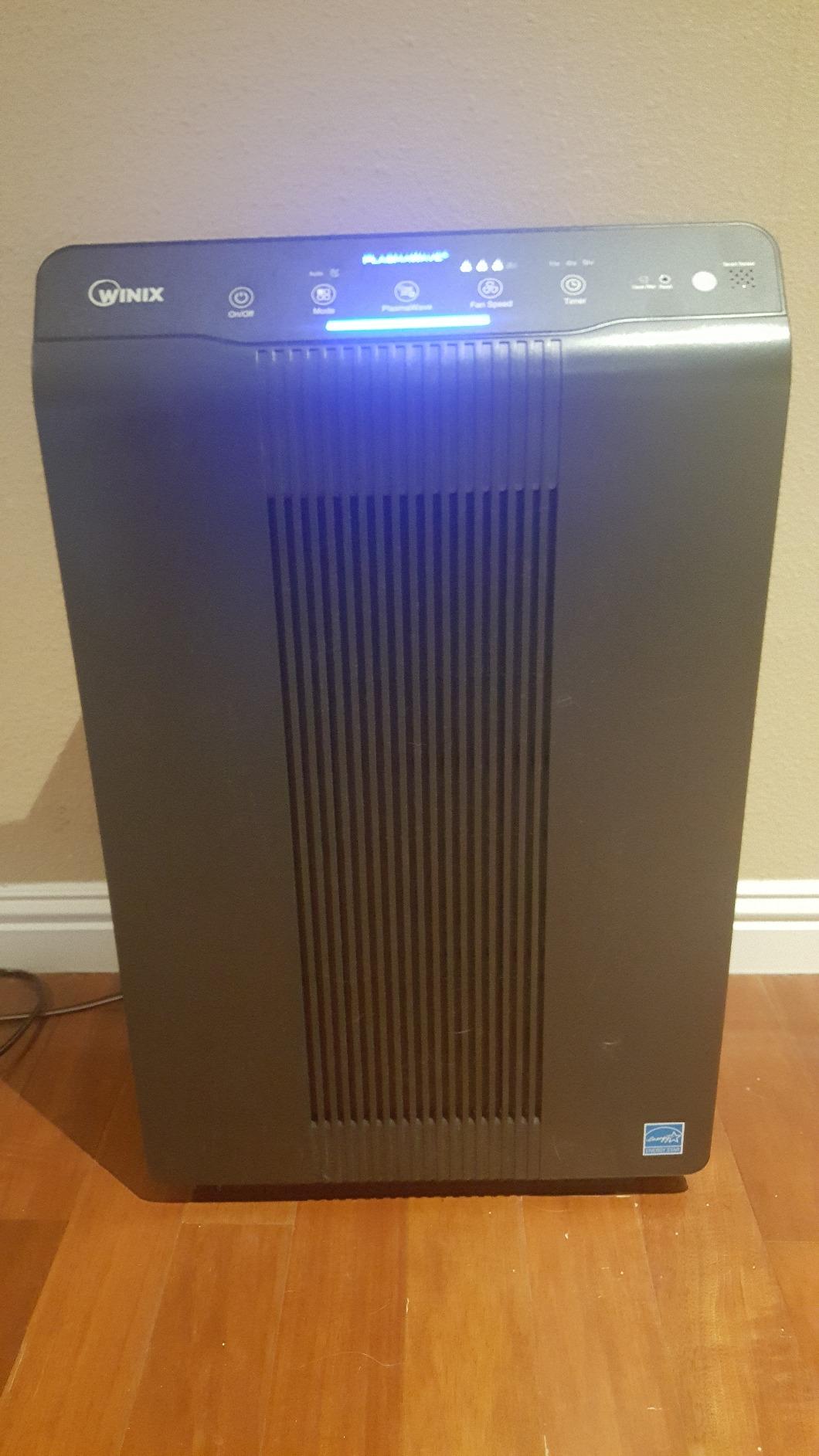
When a single purifier has to cover an open-plan living and dining space, the Winix 5520 does more work per dollar than anything else here. The AHAM VERIFIDE rating of 392 square feet per air change is an independently tested figure rather than a marketing maximum, and the manufacturer breakdown shows 1,882 square feet cleaned in an hour, 941 in thirty minutes, and 470 in fifteen.
Filtration is four stages, and the headline number is unusually fine. Winix specifies True HEPA capture of 99.99% of airborne allergens down to 0.01 microns, which is well past the 0.3 micron threshold where pollen and mold spores fall. The washable fine mesh pre-filter catches the largest particles before they reach the HEPA media, and in practice that pre-filter is what keeps replacement intervals sensible in a home with pets.
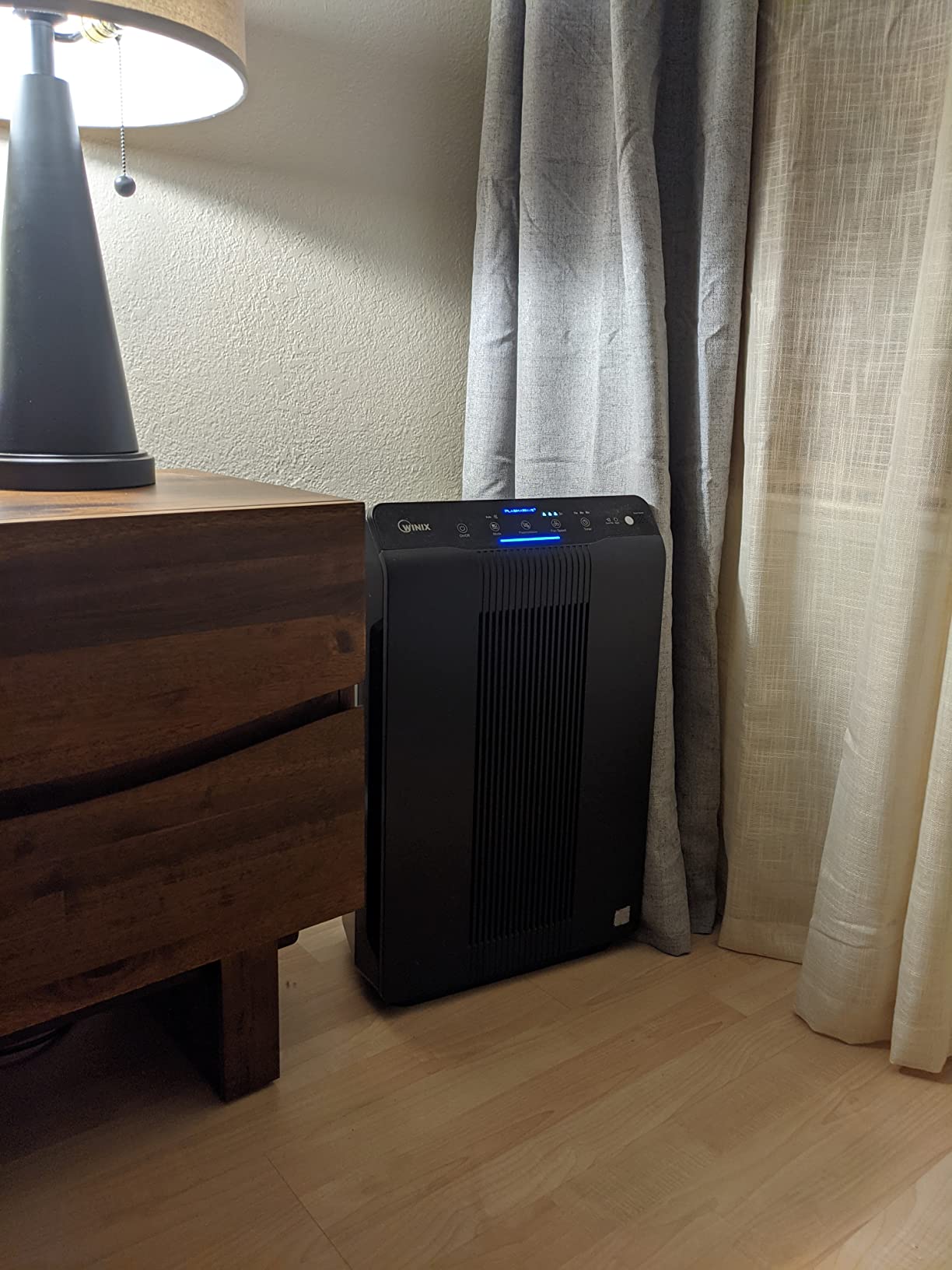
Two details stand out for asthma use. The advanced deodorization carbon filter handles VOCs and household odors, and the light-automated sleep mode drops to the quiet low speed when the room darkens, so the unit does not need a schedule to behave well at night. At 23.5 dB on the slowest speed it competes directly with the Levoit Core 300-P for bedroom silence.
It is a 13.3 pound floor unit measuring 8.3 by 13.6 by 22.7 inches, AHAM Verified and UL Certified, with an air quality indicator LED and a smart sensor that adjusts the fan in real time. Several owners report five years of continuous daily use without failure, which is the durability signal that matters most for a machine meant to run around the clock.
What asthma buyers will notice day to day
The washable pre-filter is the quiet hero of this design. Rinsing it monthly takes a minute and it keeps hair and dust out of the expensive media, which is exactly the maintenance habit that separates a purifier that works for five years from one that clogs in eight months. The auto mode responds to actual room conditions rather than a fixed schedule, so a smoky afternoon gets more airflow without you touching anything.
For households managing pet allergies alongside asthma, the combination of fine capture at 0.01 microns and a deodorization carbon stage handles both the dander and the smell. Our wildfire-season pick is the Levoit Core 600S-P, which we cover further down, but this unit holds its own when smoke is a seasonal concern.
Where it falls short for asthma use
Be clear about the PlasmaWave option. It is an ionization feature, and although it is not on by default, it should stay off in a home with asthma. That is the one criterion on our screening list this unit only passes conditionally, and it is why it is not the top pick despite strong specifications. The app is also the least reliable part of the package, and a clicking sound at low speed from fan imbalance shows up on a minority of units.
4. Honeywell HPA304 – Wall-placeable purifier for big rooms
Honeywell AllergenPlus HEPA Air Purifier for Home, 2250 Ft² Rooms in 1 hour, Reduces Allergens, Dust, Pollen, Smoke, Pet Dander, Odors, White, HPA304
465 sq ft room capacity
HEPA plus charcoal two-stage
Wall-placeable body
Pros
- HEPA and charcoal two-stage design that can sit flat against a wall
- Extremely quiet on the lowest cleaning level
- Owners report 7-10 years of continuous use
- Large 465 sq ft capacity for the money
- Filter check light and dimmable control panel
Cons
- Uses three separate HEPA filters per change so replacements cost more
- Turbo level is loud and unsuitable for sleeping
- No remote control and timer counts down hours only
- Low-setting airflow is localized in large rooms
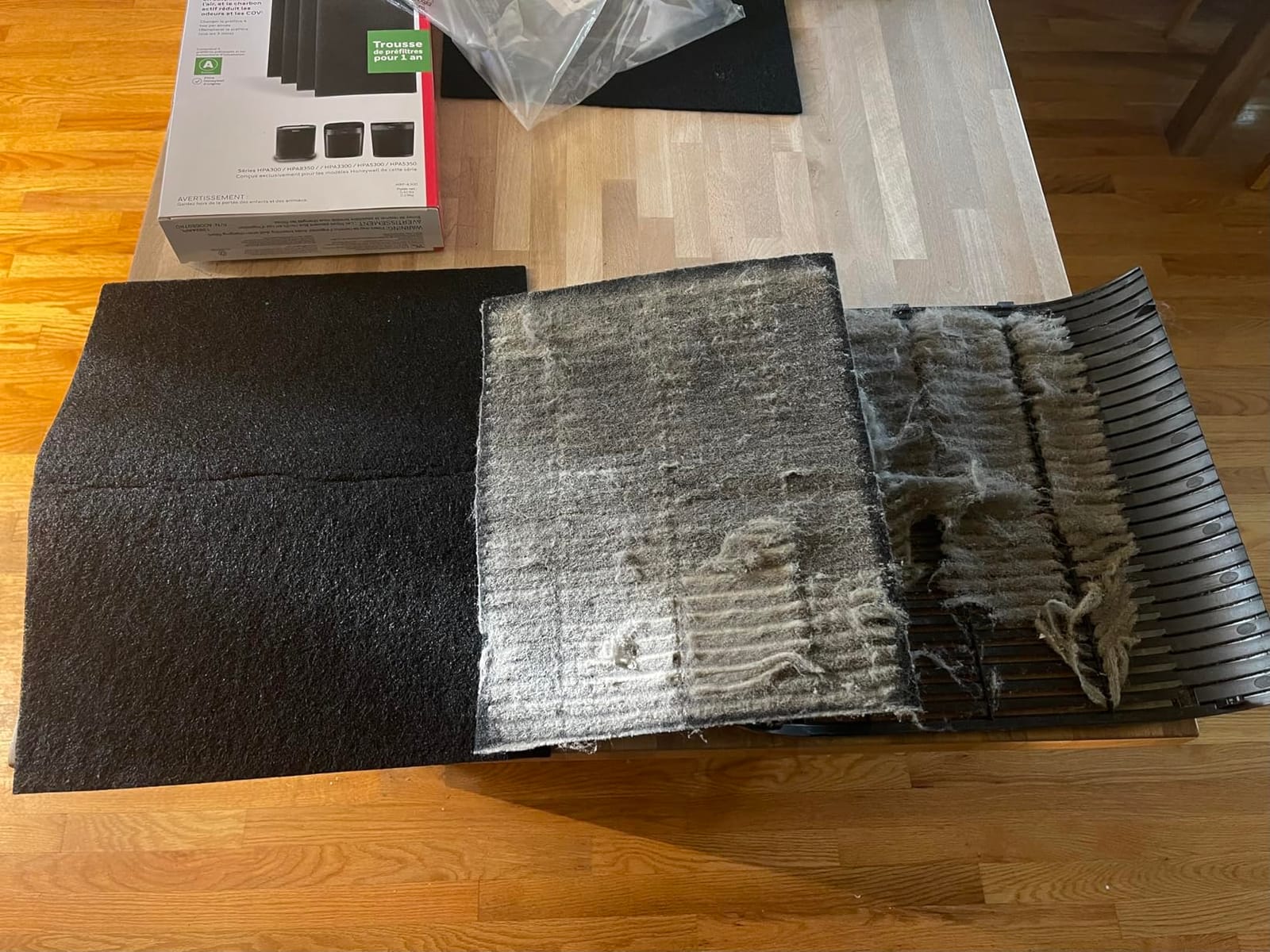
The Honeywell HPA304 solves a problem most towers create: where to put it. Its flat back sits directly against a wall, so you are not forced to leave six inches of clearance in a room where every outlet matters. Owners with asthma and chronic allergies describe it as the unit that finally stayed switched on, because it was not sitting awkwardly in the middle of the floor collecting dust.
It cleans up to 465 square feet, with the manufacturer claiming 2,250 square feet in 60 minutes at one air change per hour. Treat that larger figure with care, as we do with every coverage number on the box, and size on the 465 square foot figure at a realistic three to four air changes per hour. Filtration is HEPA rated to trap up to 99.97% of microscopic airborne allergens, layered behind a charcoal pre-filter for dust, pollen, pet dander, dust mite debris, and smoke.
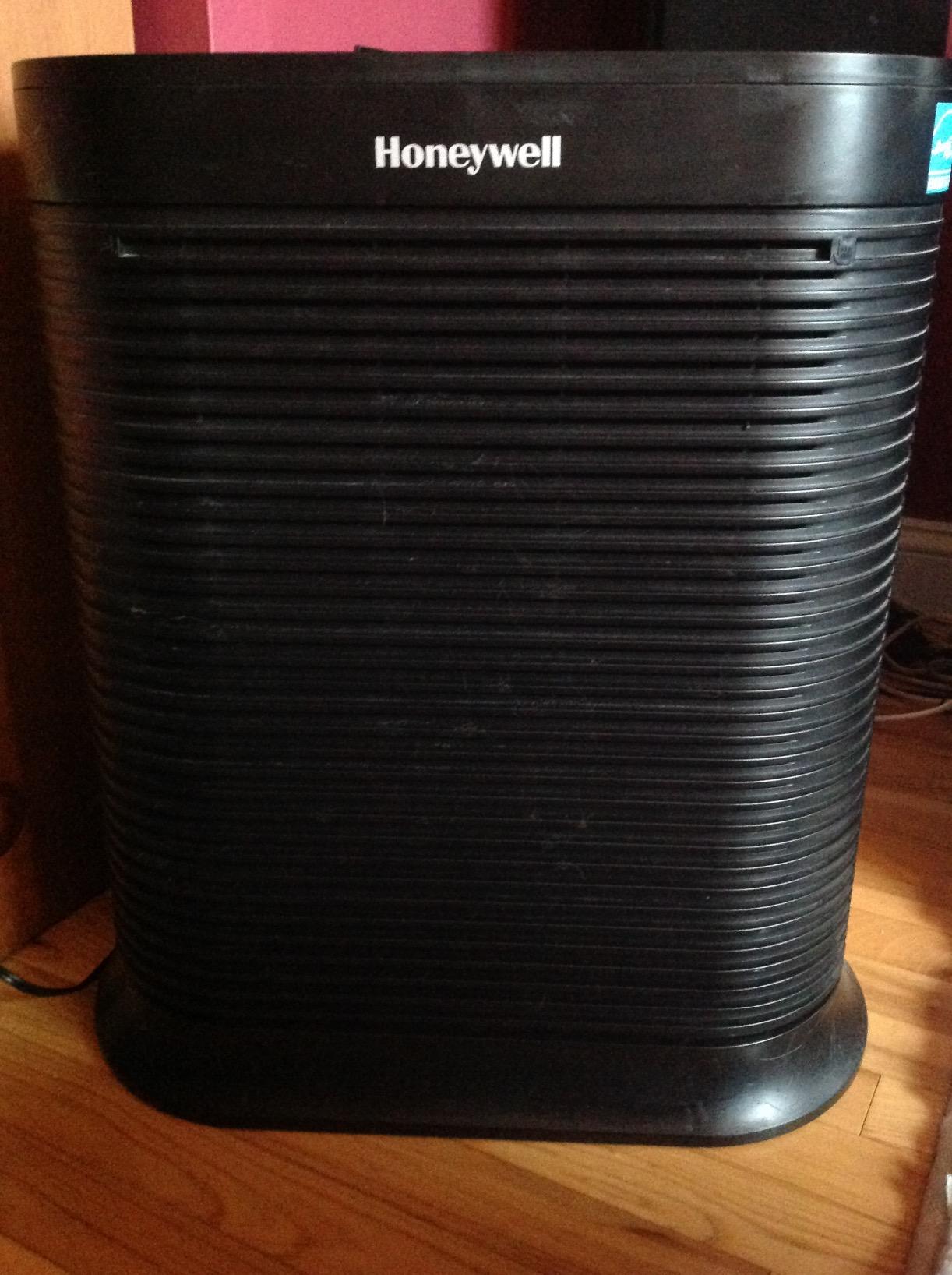
Three cleaning levels are provided, including Turbo Clean, plus dedicated Allergen and Germ modes. The lowest level is quiet enough to double as sleep white noise, and the dimmable control panel lighting means the unit will not light up a bedroom. The filter check indicator tells you when a stage needs attention rather than leaving you to guess.
At 17 pounds and 20.08 by 10.83 by 22.32 inches, this is a substantial floor unit. That mass is part of the story: owners running machines for seven to ten years is a durability track record that few machines of this class match, and a purifier that lasts a decade changes the annual cost of ownership completely.
What asthma buyers will notice day to day
Owners managing asthma, chronic allergies, and heavy pet dander describe lasting, noticeable improvement, and the reason seems obvious in hindsight. A unit that is quiet enough to run on low all night and small enough to sit against a wall is one you never switch off, and continuous low-speed running is where the benefit actually accumulates.
Three modes also mean you can match output to the moment. Allergen mode on a high-pollen morning, Turbo when smoke rolls in, and the quiet level overnight, all without touching the controls more than once a day.
Where it falls short for asthma use
Filter cost is the honest drawback. The unit uses three separate smaller HEPA filters rather than one large cartridge, so a single change costs more than on most competitors, and that is the line item that decides whether this stays switched on for ten years or gets turned off in year two. There is no remote, the timer only counts down rather than scheduling by clock, and low-setting airflow is somewhat localized in a large room.
5. Coway AP-1512HH – Four-stage filtration with deodorization
COWAY Air Purifier for Home Up to 1,748ft², HEPA Filter for Smoke, Allergies, Pet Dander, Odor, Air Quality Monitor, Auto&Eco Mode, Timer, Filter Indicator, 3yr Warranty, Mighty AP-1512HH(W), White
Four-stage filtration
1,748 sq ft in 60 minutes
3-year warranty
Pros
- Four stage filtration with washable pre-filter deodorization and HEPA
- Air quality sensor with Auto Mode matches output to real pollution
- LED indicator can be switched off for sleeping
- Filter and pre-filter alerts simplify maintenance
- 3-year manufacturer warranty
Cons
- Replacement filters are among the more expensive in this category
- No voice assistant or app integration on this model
- Larger footprint than compact bedroom units
- Auto mode is less responsive to purely odor-based pollution
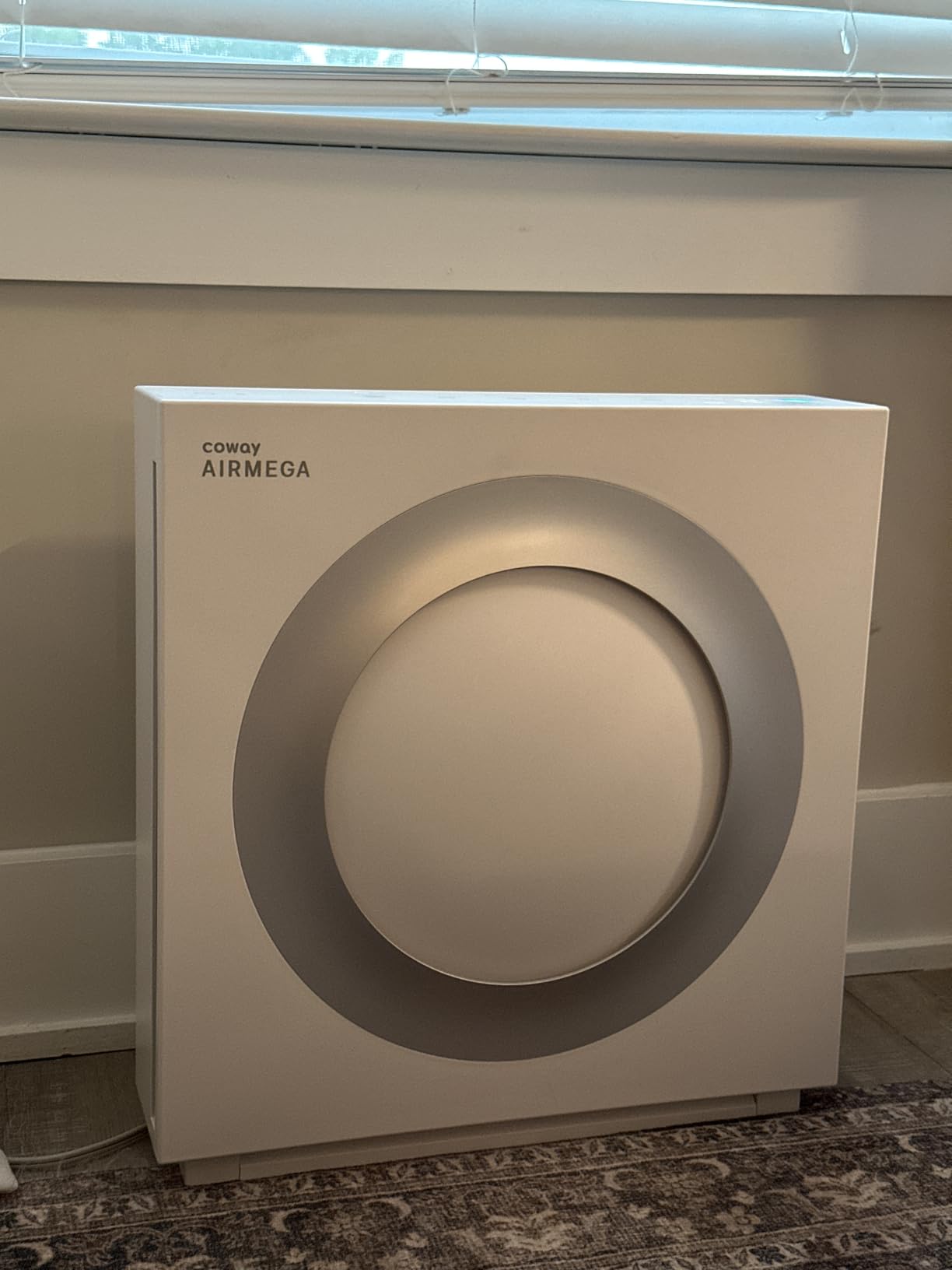
Where the Levoit and Winix units lead on particle capture, the Coway AP-1512HH leads on air quality feedback. The pollution sensor continuously adjusts the fan speed, so the machine responds to what is actually happening in the room rather than to a timer you set once. For a household where asthma flares on a specific day rather than on a schedule, that responsiveness is worth more than a higher top-end CADR.
Filtration runs four stages: a washable pre-filter, a deodorization filter, a bipolar device, and the HEPA filter, reducing 99.97% of 0.3 micron particles including pollen and other allergens while also reducing volatile organic compounds and odor. The deodorization stage is the reason this unit is our pick for anyone whose triggers include cooking fumes, cleaning products, or new furnishings.
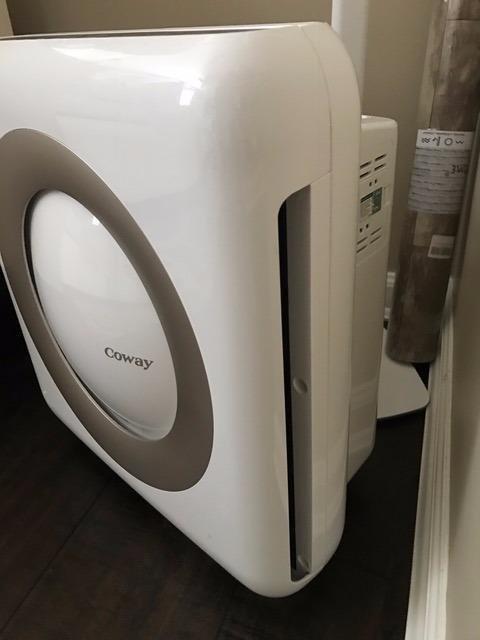
The LED air quality indicator is genuinely useful rather than decorative, and it can be switched off for sleeping, which matters more than it sounds when the unit lives in a bedroom. Filter replacement and pre-filter cleaning alerts remove the guesswork from maintenance, and the timer and Eco Mode give you a low-draw setting for rooms that are not in use.
Sizing is straightforward. The unit is designed to clean spaces up to 1,748 square feet in 60 minutes, and it is 12.5 pounds at 9.6 by 16.8 by 18.3 inches, so it is a mid-size floor unit rather than a compact bedroom cylinder. The 3-year warranty is among the longest stated in this roundup and is a real trust signal for anyone committing to continuous operation.
What asthma buyers will notice day to day
The washable pre-filter plus HEPA combination is a proven pairing for everyday indoor triggers, and buyers with pollen and dust sensitivity report steady improvements rather than dramatic one-week changes. The dual indicators, one for air quality and one for filter life, mean the machine tells you when it needs attention, which matters for anyone running it continuously rather than seasonally.
Auto Mode is the feature that keeps it working unattended. Set it once and the unit tracks room conditions, so a smoky or high-pollen day gets more airflow automatically and quieter nights get less.
Where it falls short for asthma use
Filter cost is the first limitation, and it is the one that shows up most often in reviews. Owners also note the absence of voice assistant and app integration, so scheduling has to happen at the unit itself. Finally, Auto Mode responds well to particle pollution and less well to purely odor-based sources, so if your triggers are smell-driven, the deodorization filter does the work rather than the sensor.
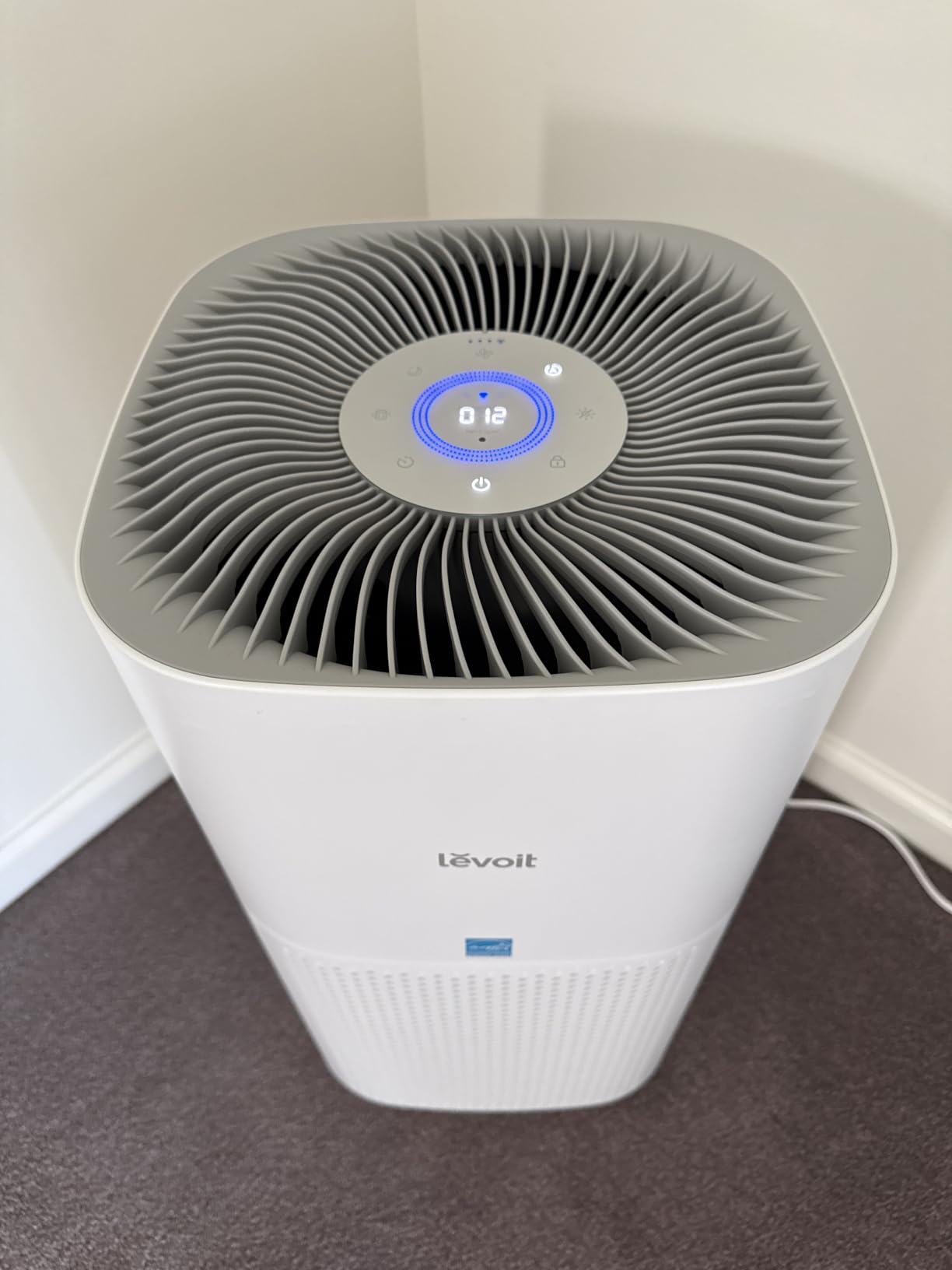
6. Levoit Core 600S-P – 391 CFM for open-plan spaces
Levoit Smart Air Purifiers for Home Large Room up to 2933 Ft², Core 600S-P
391 CFM CADR
AHAM VERIFIDE certified
Covers 2,933 sq ft per hour
Pros
- Very high CADR of 391 CFM for open-plan rooms and high ceilings
- Effectively silent in sleep mode and at low speeds
- PM2.5 readings drop measurably during smoke events
- App scheduling runs night sleep mode and daytime auto mode
- Owners report hay fever symptoms resolving within days
Cons
- The 2933 sq ft figure is optimistic in real rooms
- Top fan speeds are clearly audible
- Replacement filters are pricey
- Bottom panel can loosen when the unit is moved
If you have asthma and you live somewhere that gets wildfire smoke, this is the unit I would choose. The Levoit Core 600S-P moves 391 CFM of clean air, the second highest published CADR in this roundup, and that is comfortably enough to bring a large open-plan living space down from a smoke spike in a short window. Owners managing hay fever and smoke report the PM2.5 readout dropping visibly during an event, and the number on the ring light gives you something to trust.
It is AHAM VERIFIDE certified, with 3-stage filtration at 99.97% efficiency for 0.1 to 0.3 micron particulates including pollen, dust, and animal dander. Independent lab testing confirms it stays HEPA-grade while operating in sleep mode, which matters because the overnight hours are when many people with asthma notice their symptoms most.
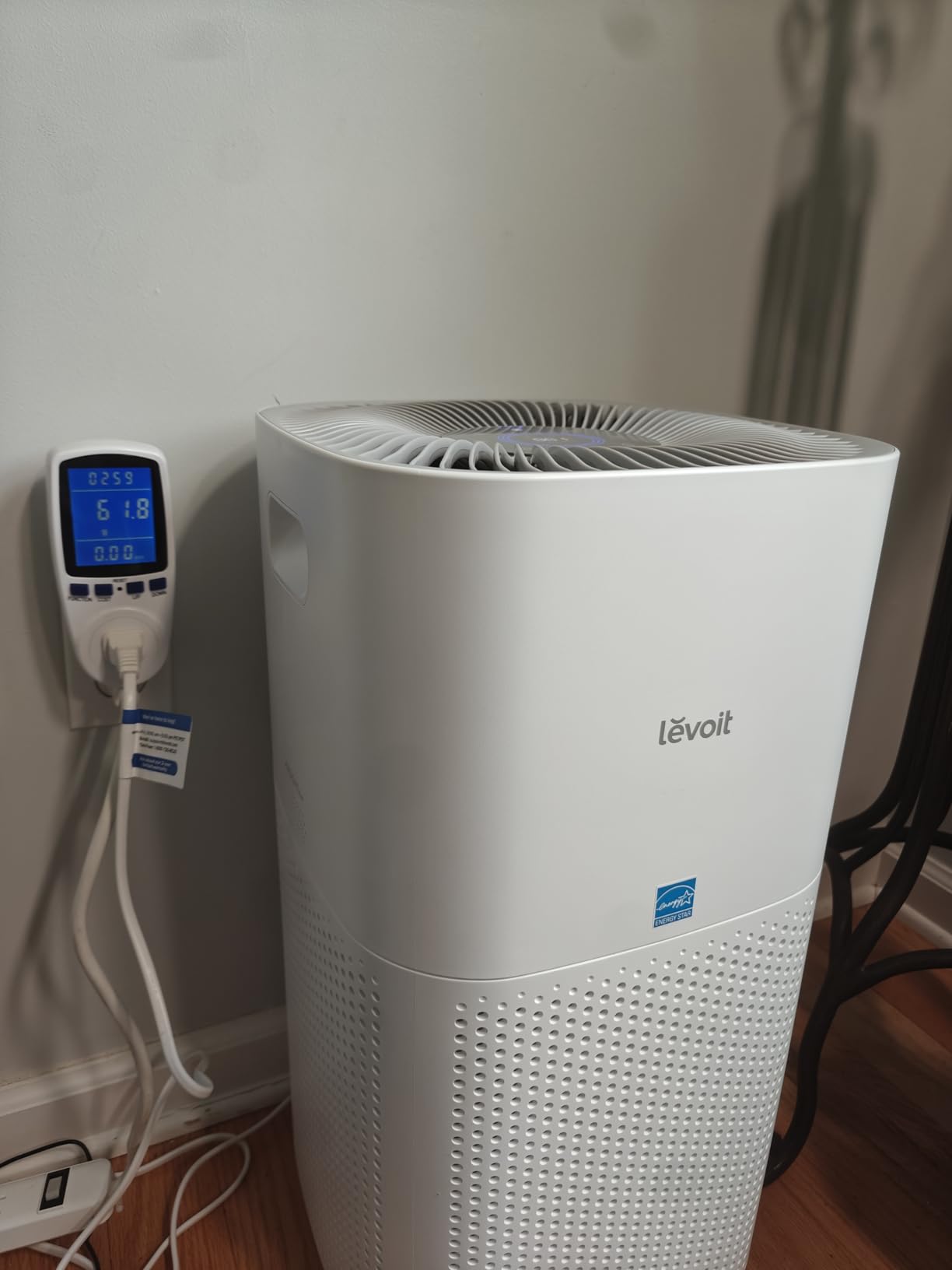
Smart app scheduling is the sleeper feature. You can run sleep mode overnight and Auto Mode during the day without touching the unit, and the operating range of 14 to 104 degrees Fahrenheit means it can stay on through a cold season in an unheated room, which is common in garages, basements, and home offices.
Size it as a large-room machine at 13.7 pounds and 12.3 by 12.3 by 23.6 inches. If you are curious about smoke-specific setups, our guide to air purifiers for wildfire smoke covers the placement and run-time strategy in more detail.
What asthma buyers will notice day to day
The PM2.5 sensor is the deciding feature for a smoke household. Seeing a real number fall gives you a way to know whether the bedroom is safe for an asthmatic child, rather than guessing from smell, which is unreliable once you are sensitized to it. The app scheduling also lets you set a night program once and stop thinking about the machine.
For hay fever and dander, owners report symptoms resolving within days, and the 391 CFM figure means you are not relying on a small filter trying to service a large room.
Where it falls short for asthma use
The 2,933 square foot coverage claim is optimistic, and that is the single most common complaint in the reviews. Real-world performance is best in medium-sized rooms, so size down rather than trusting the headline number. Top fan speeds are clearly audible, replacement filters are among the priciest here, and a bottom panel that can loosen when you move the unit is an irritating detail in a machine you may need to reposition between rooms.
7. Medify MA-40 – High-CADR purifier with a child lock
Medify MA-40 Air Purifier with HEPA Filter | 1,793 ft² Coverage in 1hr for Smoke, Wildfires, Odors, Pollen, Pets | Quiet Removal to 0.3 Microns | White, 1-Pack
CADR 406
HEPA H13 to 0.1 microns
Child lock on touch panel
Pros
- H13 HEPA media rated 99.9% down to 0.1 microns finer than typical H11 media
- CADR of 406 clears large rooms quickly
- Touch panel includes a child lock and a 0-8 hour timer
- Sleep mode dims every panel light for bedroom use
- Lifetime warranty on parts and service with genuine filters
Cons
- Replacement filter lasts only about 3000 hours or six months
- Minimum noise of 46dB is high for a bedroom
- Heavier 15 pound build
- 110V power only
The Medify MA-40 is built for a specific asthma situation: a child’s room, a playroom, or a shared space where you need real airflow without a curious toddler pressing buttons. The touch panel includes a child lock, and the 0 to 8 hour timer means you can run it through a school day or a sleep cycle without walking back to switch it off.
Filtration is H13 HEPA rated to remove 99.9% of particles down to 0.1 microns, which is finer than the H11 media most competitors in this range use. At 0.1 microns you are into fine smoke and combustion particulate, and that is the reason this unit performs well for families in smoke-heavy regions. CADR is 406, the highest in this roundup, clearing 1,793 square feet in one hour or 896 in thirty minutes.
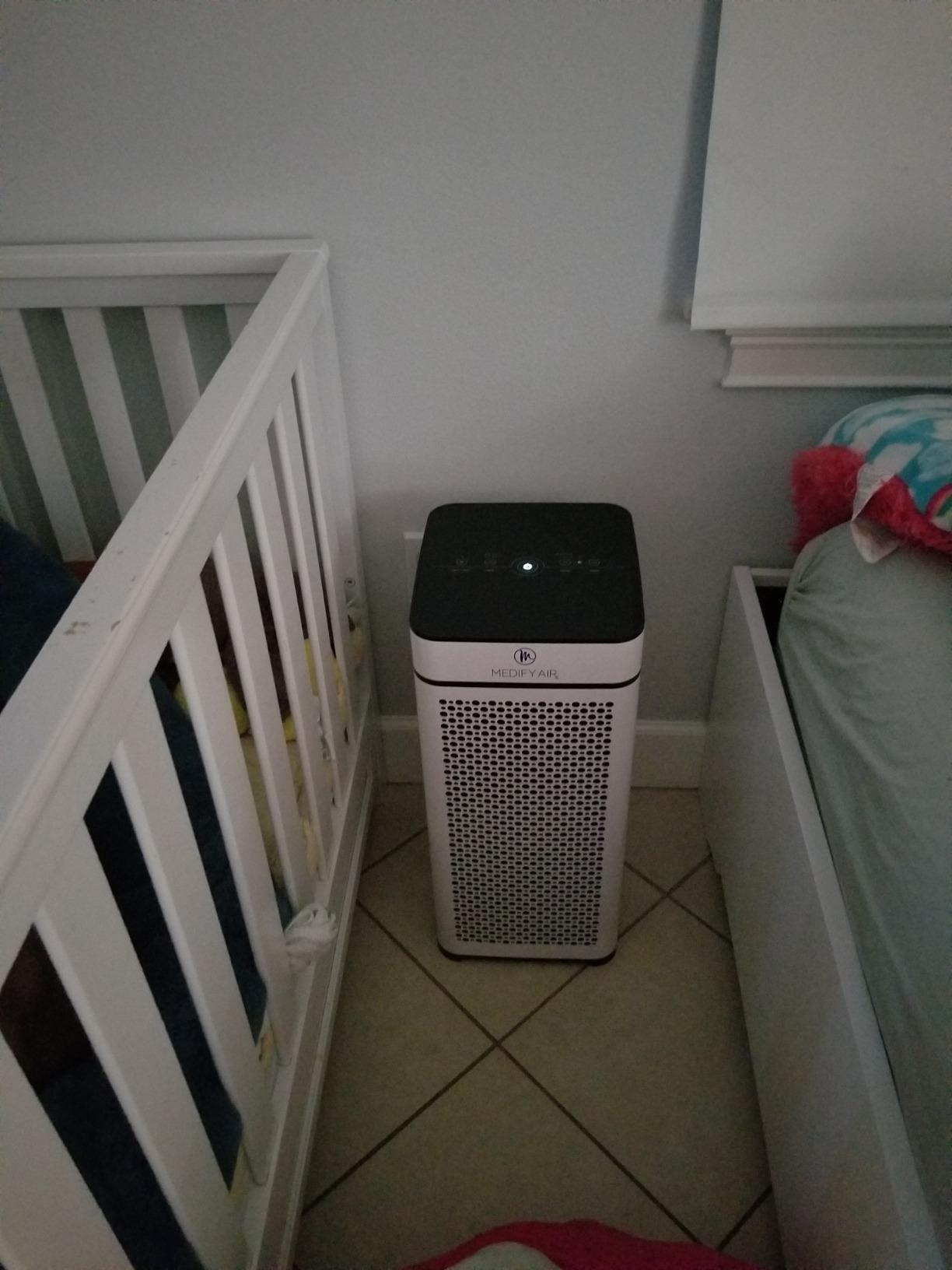
For our nursery purifier guide, the pattern is the same as here: a child lock, a dimmable sleep mode, and a filter indicator that tells you when to change the media. A filter replacement indicator removes the guesswork that leads families to run a saturated filter for months, which is one of the more common ways a purifier quietly stops helping.
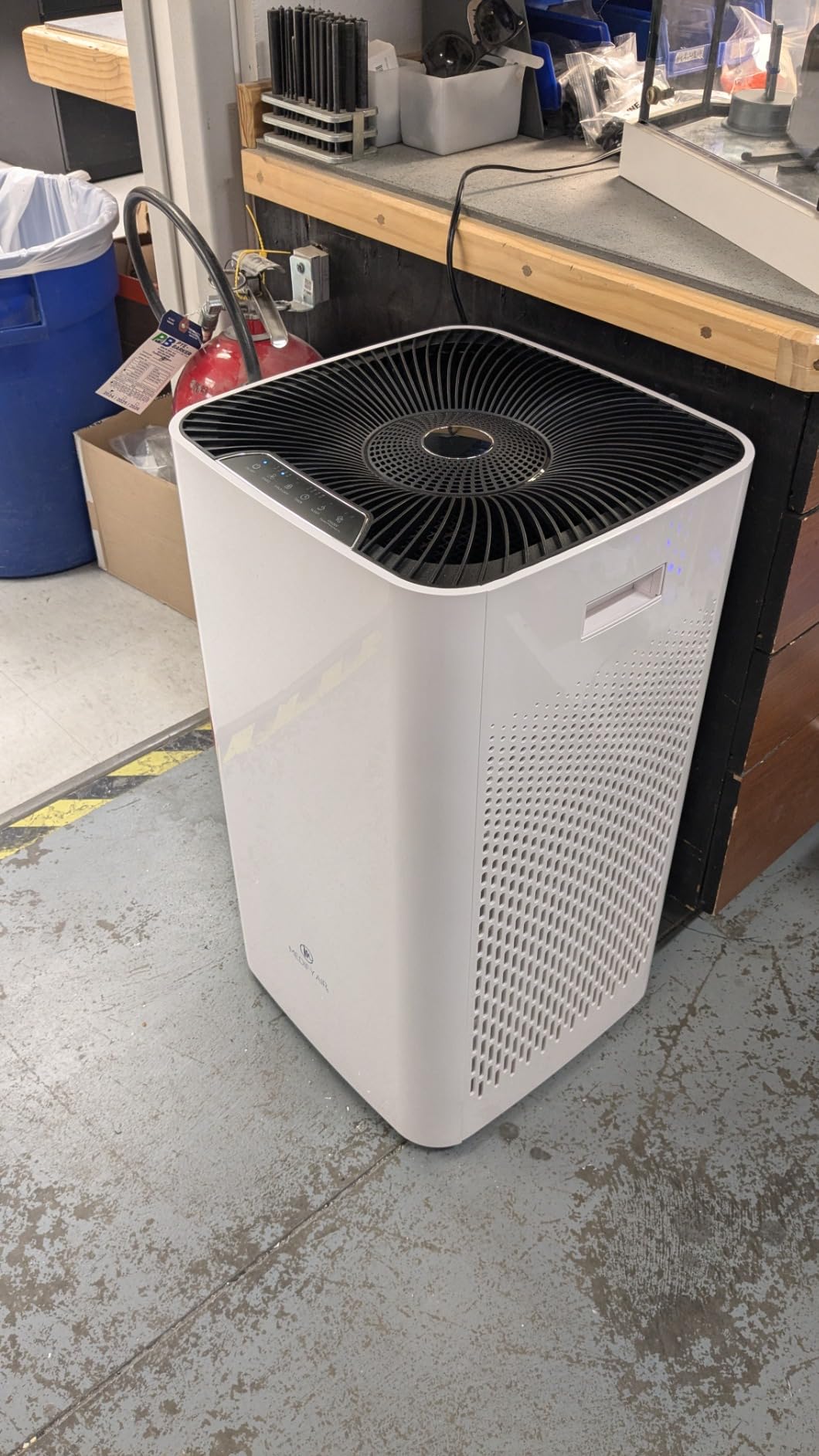
The lifetime warranty on parts and service, conditional on using genuine Medify filters, is a strong trust signal and unusual at this level. The build is substantial at 15 pounds and 25 by 24.5 by 13 inches, which is a floor unit rather than a bedside machine.
What asthma buyers will notice day to day
The combination of high CADR and a 0.1 micron capture threshold is what makes this effective in a busy family room where dander, dust, and cooking particulate all arrive at once. Reviewers in smoke-heavy regions single out particle capture as the reason they bought it, and the child lock removes a real household concern that most product pages ignore.
Sleep mode dims all panel lights, so the unit does not become a nightlight, and the child lock means you can leave it running at a higher speed during the day without someone turning it into a toy.
Where it falls short for asthma use
Noise is the real constraint. Minimum output is 46 dB, and that is well above the bedroom-oriented models in this roundup, so this is a daytime and playroom machine unless your household is unusually tolerant of background sound. The replacement filter is rated for about 3,000 hours or six months, which makes it the most frequent filter change and therefore the highest ongoing cost here. It also runs on 110V only.
8. HATHASPACE HSP001 – Sensor, touch display, and remote
HATHASPACE HSP001 True HEPA Air Purifier
H11 True HEPA at 99.9% of 0.3 microns
Honeycomb carbon stage
Covers about 700 sq ft
Pros
- 4-in-1 filtration with a honeycomb carbon stage for odors and VOCs
- Smart air quality sensor with a readable touch-screen readout
- Designed for quiet bedroom operation
- Remote control adjusts speed and lighting from across the room
- Lightweight 12 pound build with straightforward filter access
Cons
- H11 media captures to 0.3 microns which is less fine than H13 alternatives
- Coverage of roughly 700 sq ft is modest for larger rooms
- Replacement filters are a recurring cost
- No app or voice assistant integration
The HATHASPACE HSP001 appeals to buyers who want to see what the air is doing. The touch-screen display shows real-time air quality from the built-in sensor, and auto mode adjusts the fan speed based on what it detects. For someone trying to work out whether a purifier is actually helping in a specific room, that visibility is more useful than a slightly higher efficiency figure printed on a box.
Filtration is a 4-in-1 system covering pollen, dust, pet dander, VOCs, smoke, and odors, with an H11 HEPA filter rated at 99.9% for particles down to 0.3 microns and a honeycomb activated carbon filter for odors and VOCs. The honeycomb structure gives the carbon stage more surface area than a loose mesh, which is a meaningful advantage for anyone whose triggers include cooking smells or chemical products.
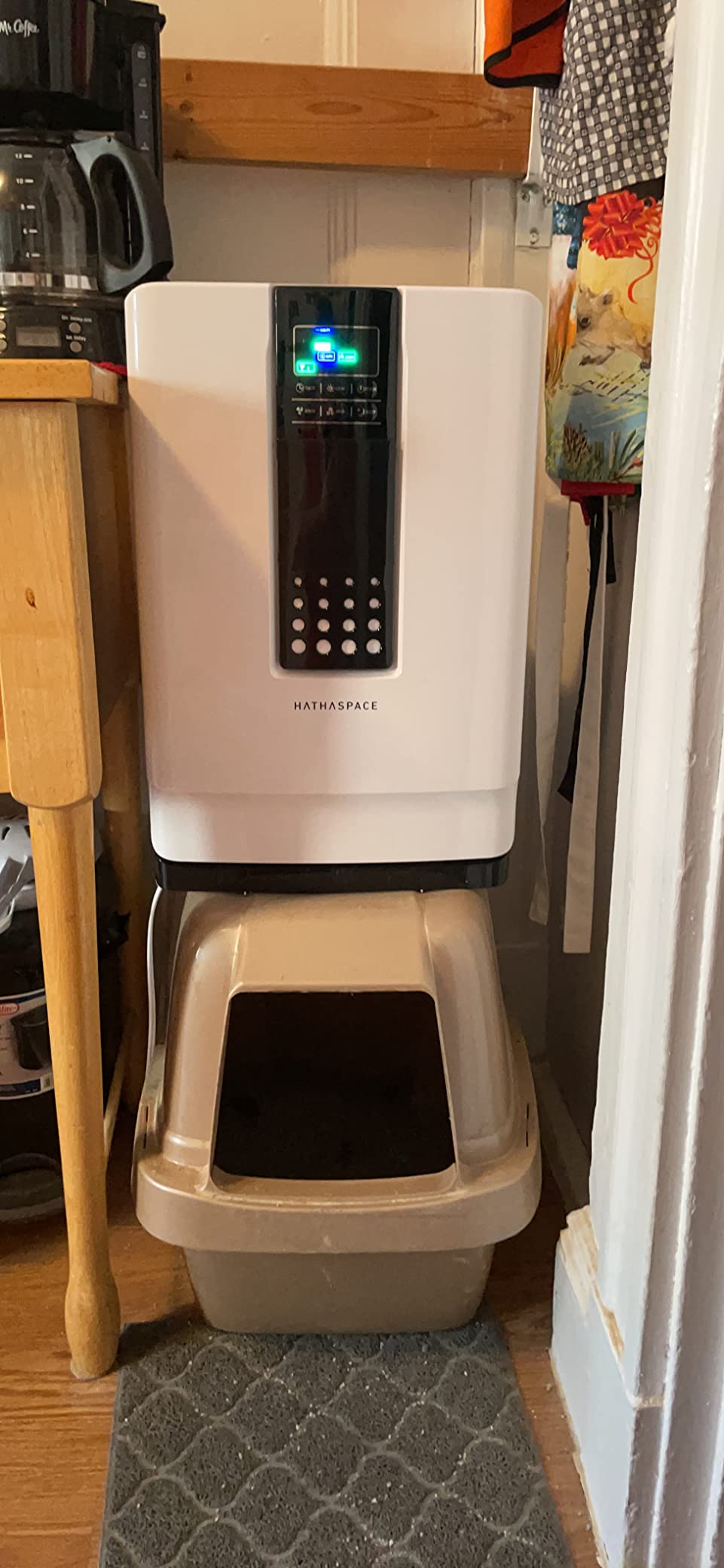
Control is unusually flexible for a unit at this level. Multiple fan speeds plus an included remote mean you can dim the lights and change output from across the room, which matters in a bedroom where getting up to silence a beeping control is its own trigger. Coverage is approximately 700 square feet, and the machine relies on mechanical filtration with no ionizer stage.
A 2-year warranty covers the machine. There is no app or voice assistant, so if you want scheduling you will use the fan speeds directly, though auto mode covers most households without any scheduling at all.
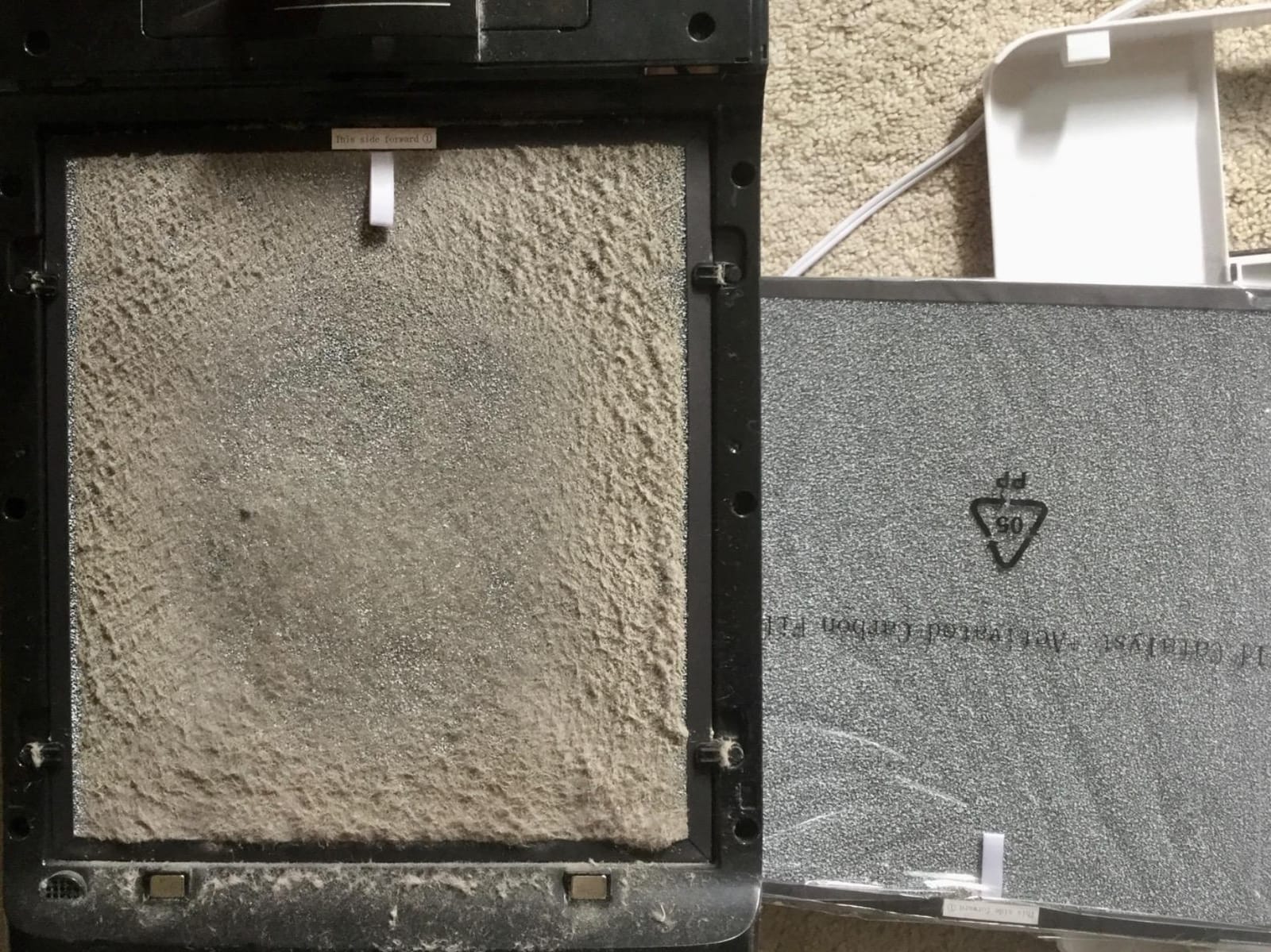
What asthma buyers will notice day to day
The honeycomb carbon stage is the part that separates this from other mid-priced towers. Gas-phase filtration is the hardest thing to do well, and asthma triggers that arrive as odors and VOCs need it. The touch display also makes it easy to confirm a change, which keeps people running the machine rather than switching it off after a disappointing week.
Buyers with chemical sensitivity and VOC sensitivity mention the carbon stage specifically, and the remote-controlled lighting keeps the unit usable in a dark room without getting up.
Where it falls short for asthma use
H11 media captures to 0.3 microns, which is a coarser threshold than the H13 units in this roundup. That matters if your triggers are fine smoke or combustion particulate rather than pollen and dust. Coverage of roughly 700 square feet is modest for open living spaces, and there is no app or voice assistant for hands-free control.
9. PuroAir 240 – Quiet value pick for bedrooms
PuroAir 240 HEPA Air Purifiers for Home Pets Bedroom – 1,000 Ft²
HEPA filtration up to 1,000 sq ft
CARB,ETL,ISO and UL certified
2-year warranty
Pros
- Whisper-quiet operation well suited to bedrooms and sleep
- Effective at removing musty stale and pet-related odors
- Lightweight 7.3 pound body with simple top-mounted controls
- 2-year warranty with 7-day-a-week US-based support
- Available in 12 and 4 pack configurations
Cons
- Less effective at capturing visible floating pet hair than at removing odors
- HEPA replacement filters can be costly and are harder to find outside the US
- 110V plug needs a step-down transformer for UK and European mains
- Build quality described as lightweight plastic by some buyers
The PuroAir 240 is the pick when quietness is the deciding factor and the budget is modest. Reviewers repeatedly mention improved sleep and reduced morning nasal congestion, and quietness is the reason. A purifier that is quiet enough to leave on all night does more for an asthmatic sleeper than a louder machine with slightly better specifications, because it actually stays switched on.
It is certified by CARB, ETL, ISO, and UL, and was tested independently by SleepScore for household pollutant removal, with reported improvements in allergy symptoms and sleep quality. Coverage is 1,000 square feet, and the 7.3 pound weight with a 10.63 by 10.63 by 28 inch footprint makes it one of the easiest machines in this roundup to reposition between a bedroom, a nursery, and a home office.
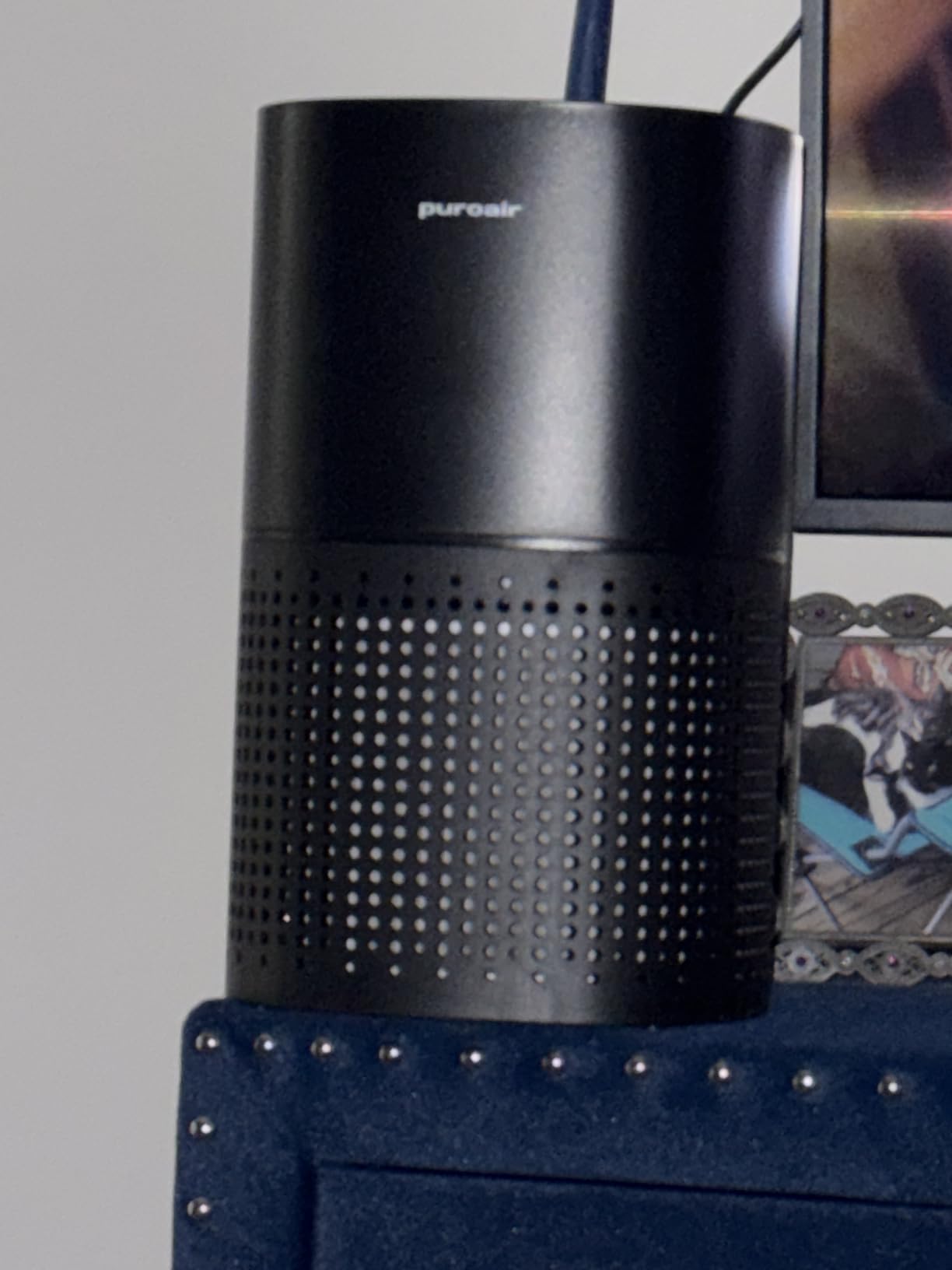
For households covering more than one room, the availability in 2-pack and 4-pack configurations is a genuine advantage. Instead of stretching one purifier across a whole home, you can place a quiet unit in each bedroom, which is where the overnight symptom peak actually happens. Simple top-mounted digital controls and a timer keep the daily routine uncomplicated.
Support is US-based and available seven days a week, and the brand has a partnership with the American Lung Association. A 2-year warranty applies to the unit.
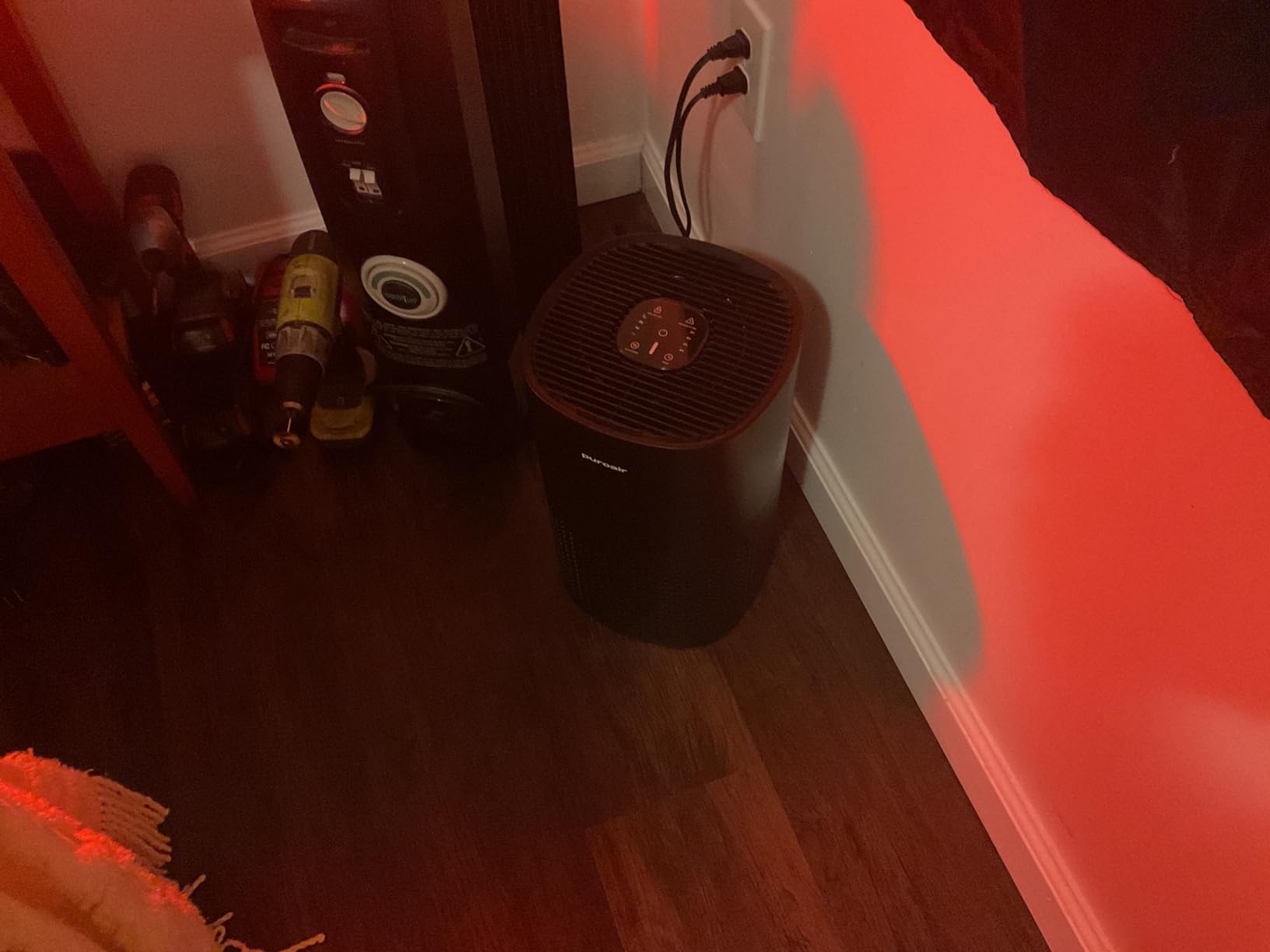
What asthma buyers will notice day to day
Odor control is the standout. Owners with pets and musty, stale indoor air report the smell clearing quickly, and for someone whose asthma is triggered by smell rather than by visible particles, that is the whole point. The multi-pack option also solves the bedroom problem properly, since one quiet machine per sleeping room beats one loud machine in the hallway.
At 4.5 stars it is the lowest-rated unit here, and the gap comes from build feel and filter availability rather than from filtration performance in normal use.
Where it falls short for asthma use
It is better at removing pet odors than at capturing visible floating pet hair, so a household with a heavy-shedding dog may still need a vacuum with a sealed HEPA system alongside it. Replacement HEPA filters can be costly and are harder to find outside the US, the 110V plug needs a step-down transformer in the UK and Europe, and some buyers describe the build as lightweight plastic. Warranty service is also a problem for anyone outside the US.
10. Levoit Vital 200S-P – Smart unit built for allergy households
LEVOIT Smart Air Purifier for Home Large Room up to 1875 Ft² Vital 200S-P
CADR 250 smoke,289 pollen
AHAM VERIFIDE certified
Dual air inlet for pet hair
Pros
- AHAM VERIFIDE certified with published CADR for smoke
- dust and pollen
- Dual air inlet including a U-shaped inlet that traps pet hair
- Very quiet on levels 1 and 2
- App control with scheduling
- light control and filter life percentage
Cons
- Best suited to bedrooms and smaller rooms rather than open living areas
- Replacement filters are not the cheapest option
- Air quality sensor is less accurate than laser-based sensors
- Higher fan speeds are audible across a room
The Vital 200S-P is the pet-and-allergy specialist of this group, and the dual air inlet is the reason. Alongside the main intake there is a U-shaped secondary inlet designed to trap pet hair and odors without clogging, which directly addresses the problem that defeats a lot of purifiers in homes with a shedding cat or dog. The HEPA media then handles what gets through.
It is AHAM VERIFIDE certified for air cleaning performance, safety, and energy efficiency, with published CADR figures of 250 CFM for smoke, 254 CFM for dust, and 289 CFM for pollen. Published pollen CADR is rare at this level, and it lets you size honestly: in a 200 square foot room with an 8 foot ceiling, 1,600 cubic feet of air at 250 CFM works out to roughly 9 air changes per hour, which is a genuinely strong bedroom number.
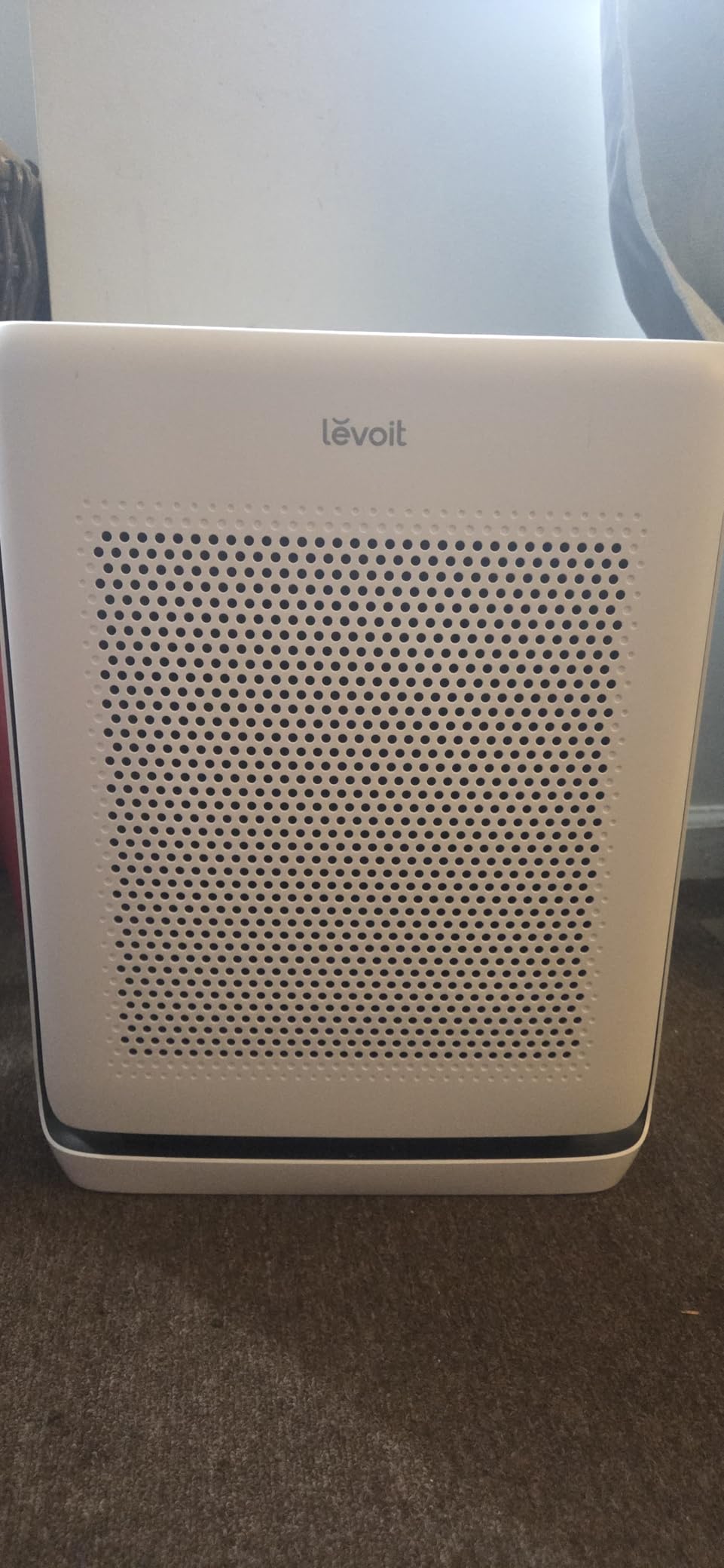
The app shows an air quality ring indicator with a four-level readout and tracks filter life as a percentage remaining, so you replace the media when the number says so rather than when the unit smells. Control panel lights are dimmable for sleep, and the filter is rated for approximately 12 months of use, the longest filter interval stated by any manufacturer in this roundup.
Users focused on allergy relief report clear reductions in sneezing, congestion, and night-time coughing. The 13.2 pound body at 14.96 by 8.66 by 19.69 inches suits a bedroom or a smaller living space, and levels 1 and 2 are quiet enough to be inaudible across a room.
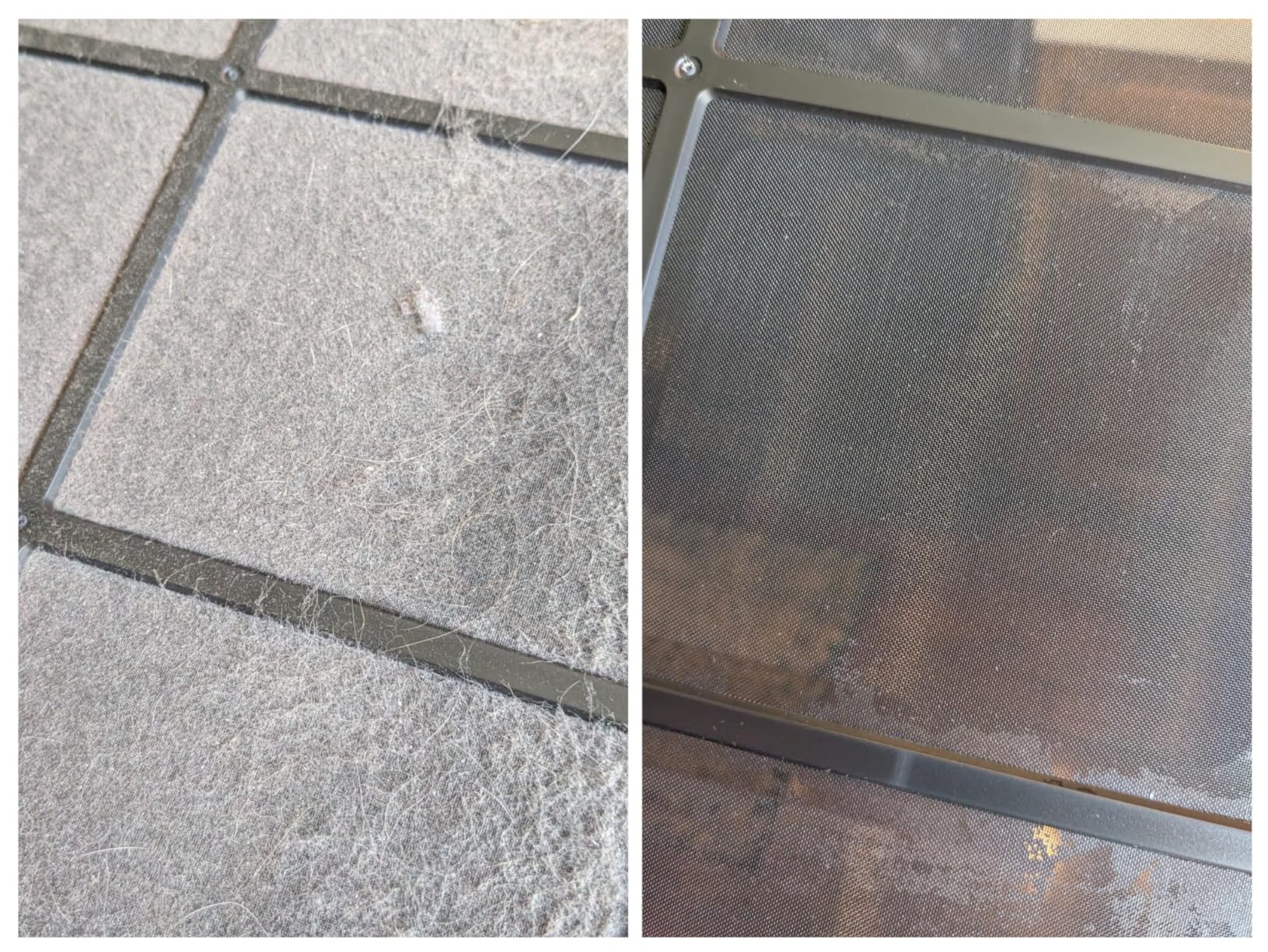
What asthma buyers will notice day to day
The U-shaped inlet is a real engineering answer to pet dander, and combined with 289 CFM pollen CADR it means a household with both an asthmatic child and a pet gets serious particle control without a commercial-grade machine. Reports of markedly reduced night-time coughing suggest people are running it overnight, which is when it does the most good.
The 12-month filter life and in-app tracking mean fewer interruptions. A purifier left running with a loaded filter loses effectiveness, so the filter life readout is an asthma feature as much as a convenience feature.
Where it falls short for asthma use
Real-world performance suits bedrooms and smaller rooms rather than large open living areas, despite the 1,875 square foot headline figure. The air quality sensor is not laser-based and some owners report it reading Very Good during heavy wildfire smoke, so treat the display as a rough trend indicator. Replacement filters are not the cheapest option, and the higher fan speeds carry across a room.
How to Size an Air Purifier for Asthma Relief with CADR and ACH
Most disappointing purifiers are not bad machines. They are correctly built and wrongly sized, so they never reach the air change rate your airways need. Five steps give you the right number before you shop.
1. Measure the room and calculate its volume. Multiply floor area by ceiling height. A 12 by 12 foot bedroom with an 8 foot ceiling is 1,152 cubic feet.
2. Find the CADR in cubic feet per minute. Use the smoke figure where it is published, since it is the most conservative of the common ratings. The Levoit Core 300-P is 143 CFM, the Core 600S-P is 391 CFM, the Medify MA-40 is 406 CFM, and the Levoit Vital 200S-P is 250 CFM for smoke.
3. Calculate air changes per hour. Divide volume by CADR, then multiply by 60. For the Core 300-P in that 1,152 cubic foot bedroom, 1,152 divided by 143 is about 8 minutes per air change, or roughly 7.4 air changes per hour.
4. Aim for four air changes per hour in a bedroom and five or more in a busy living space. Below four changes per hour, a purifier mostly tidies the air rather than meaningfully lowering the trigger load.
5. Sanity-check the box figure. If a listing claims coverage of several thousand square feet, work out what CADR that would require at three air changes per hour. A 2,000 square foot room with a 9 foot ceiling is 18,000 cubic feet, and you would need roughly 900 CFM to reach three air changes per hour. When the number on the box implies a CADR far above what the specification sheet lists, size on the CADR.
Units that lack a published CADR can be worked from their certified air-change figure instead. The Winix 5520 is AHAM VERIFIDE at 392 square feet per air change, and the Honeywell HPA304 cleans 465 square feet, so you can use those numbers directly rather than a coverage claim.
Air Purifier vs Humidifier vs Dehumidifier for Asthma
These three devices solve different problems, and the most common mistake in an asthma household is expecting one to do the work of the other two. A purifier removes particles and, with a carbon stage, some gases. A humidifier adds moisture to dry air. A dehumidifier pulls water out of the air, and with it the mold spores that need that moisture to thrive.
For asthma specifically, the order of importance usually runs dehumidification first, purification second, humidification third. High indoor humidity above roughly 50 percent supports mold growth, and mold spores are a leading asthma trigger, so a dehumidifier in a persistently damp room addresses a cause rather than a symptom. A purifier running alongside it then removes the spores already released into the air.
Humidification is the one that needs the most caution. Very dry winter air irritates airways and can worsen symptoms, so moderate humidification to roughly 30 to 50 percent relative humidity has a place, but a humidifier that is not cleaned regularly becomes a mold source, which is counterproductive in an asthma home. Use a hygrometer to check the number rather than guessing, and never run a humidifier and a dehumidifier in the same room. A furnace filter rated MERV-13 is a useful third layer, catching much of the dust before it ever reaches the room.
Quiet Bedroom Operation and the True Running Cost of a Purifier
Noise decides whether a purifier is used at all. A unit that is 50 dB on its lowest setting gets switched off within a week, and a purifier that is off is worth exactly nothing. For a bedroom, the two quietest options in this roundup are the Levoit Core 300-P at 24 dB in sleep mode and the Winix 5520 at 23.5 dB on its slowest speed. The Medify MA-40 is the counter-example, with a 46 dB minimum, and that is why it works as a daytime machine rather than a bedside one.
Light control matters as much as decibels. The Core 300-P and the Coway AP-1512HH both let you switch the display off, and the Medify sleep mode dims every panel light. A glowing control panel in a dark room is a genuine sleep disruption, and poor sleep makes asthma symptoms worse the next day.
On running cost, the numbers are smaller than most buyers expect. The Levoit Core 300-P draws 56 watts, so a full day of continuous operation is about 1.3 kWh and drops further on sleep mode, while the Medify MA-40 at 95 watts works out to roughly 2.3 kWh a day. Filter cost is the larger line, and it varies more than electricity ever will. The Levoit Vital 200S-P is rated for approximately 12 months of filter life, the Medify MA-40 for about 3,000 hours or six months, and the Honeywell HPA304 needs three separate HEPA filters per change, which is the most expensive single replacement in this group.
That filter interval is the number to plan around. Budget for the stated replacement period rather than the promotional one, and treat any claim of a 20-year filter life on a low-cost unit as marketing rather than fact, which is the position most people arrive at after reading through owner reports in air purifier forums. Buying the genuine filter and setting a calendar reminder is the difference between a purifier that keeps working and one that quietly stops.
Whole-Home Setups: When One Purifier Is Not Enough
A single purifier covers one room properly. Covering a whole home with one large machine rarely works, because the air it cleans never reaches the far end of the house, and the noise level required to move enough air makes it unliveable in a shared space. The approach that works is room by room, prioritised by where symptoms happen.
Bedrooms come first, because that is where the night-time peak occurs and where an hour of clean air changes how you sleep. A second unit goes in the main living area, and a third in any room with a smoker, a strong cooking routine, or an asthmatic child. This is the question that comes up repeatedly in r/AirPurifiers threads, where owners of asthmatic children running childcare spaces describe exactly this layout with two or three purifiers rather than one oversized machine.
Multi-pack options make this practical. The PuroAir 240 is available in 2-pack and 4-pack configurations, and running a quiet unit in each bedroom usually costs less in total electricity than running one large machine on a high setting. The trade-off is filter cost, since every purifier needs its own media, so check the replacement price for each model before committing to a whole-home layout.
Beyond the Purifier: A Medical Note and Other Trigger Steps
An air purifier reduces exposure to airborne triggers. It does not treat asthma, reduce airway inflammation directly, or replace prescribed medication, and no purifier on this list should be presented as doing so. If you use a rescue inhaler, keep using it as directed, and talk to your clinician before changing any part of your asthma management plan. The Asthma and Allergy Foundation of America and the ACAAI both carry patient guidance worth reading alongside any purchase.
With that said, a purifier works best as part of a layered approach. A MERV-13 or better furnace filter catches a large share of dust before it enters the room. Running bathroom and kitchen exhaust fans, and keeping a dehumidifier on in damp rooms, addresses moisture and mold at the source. Reducing indoor humidity to roughly 30 to 50 percent, measured with a hygrometer, limits the conditions mold needs.
For source control, wash bedding weekly in hot water, use mattress and pillow encasements, keep pets out of the bedroom, and vacuum with a sealed HEPA vacuum rather than one that exhausts fine dust back into the room. During wildfire season, keep windows closed and run the purifier on auto rather than on sleep, since you need maximum airflow when outdoor air is dirty. Portable air cleaners work best in a closed room with the door shut, so run one before bed rather than intermittently through the day.
Frequently Asked Questions
Do air purifiers really work for asthma?
Yes, for exposure reduction. A True HEPA purifier lowers the airborne load of pollen, mold spores, dust mite debris, pet dander, and fine smoke, which are common asthma triggers. Many people with asthma report fewer night-time symptoms within days. It does not treat asthma or replace medication, and the effect depends entirely on running the unit continuously in a closed room at a realistic air change rate.
Which air purifier does not produce ozone?
Every purifier in this roundup is ozone-free in normal operation, which was a hard screening criterion. The GermGuardian AC4825E carries explicit Zero Ozone Verified certification. The Levoit Core 300-P, Honeywell HPA304, Coway AP-1512HH, Levoit Core 600S-P, Medify MA-40, HATHASPACE HSP001, PuroAir 240, and Levoit Vital 200S-P use mechanical filtration with no ionization stage. The Winix 5520 has an optional PlasmaWave ionization feature, so keep it switched off.
Which is better for asthma, a humidifier or an air purifier?
An air purifier, for most people. Humidification only helps when indoor air is genuinely dry, and very humid indoor air encourages mold growth, which is itself an asthma trigger. If humidity is a problem in your home, a dehumidifier addresses mold at the source while a purifier removes the spores already in the air. Target 30 to 50 percent relative humidity and measure it with a hygrometer.
Do doctors recommend air purifiers for asthma?
Many clinicians suggest reducing indoor triggers as part of an asthma management plan, and organizations such as the Asthma and Allergy Foundation of America and the American College of Allergy, Asthma and Immunology advise avoiding ozone-generating devices specifically. Guidance consistently recommends True HEPA filtration alongside medication and trigger management rather than as a replacement for either.
How loud should an air purifier be for a bedroom?
Under 30 dB on its lowest or sleep setting is the practical target, since a unit above that tends to get switched off and a purifier that is off does nothing. The Levoit Core 300-P runs at 24 dB in sleep mode and the Winix 5520 at 23.5 dB on its lowest speed. The Medify MA-40 has a 46 dB minimum, which suits daytime rooms rather than a bedside position.
Conclusion: Our Top Air Purifier Picks for Asthma in 2026
The best air purifiers for asthma sufferers share four traits, and all ten units here have them: verified mechanical filtration down to 0.3 microns and below, an activated carbon stage for gases and odors, no ozone-producing ionizer running by default, and a published CADR figure that lets you size the machine honestly. Ignore coverage numbers printed on the side of a box, and buy on air changes per hour instead.
For most households, the Levoit Core 300-P is the answer. It is AHAM VERIFIDE certified at 143 CFM, quiet enough at 24 dB to run all night, and the least controversial choice for a bedroom, a nursery, or a child’s room. Add the Winix 5520 for a large open-plan space, the Levoit Core 600S-P when wildfire smoke is part of your year, and the PuroAir 240 when budget is the deciding factor. The GermGuardian AC4825E is the pick to verify first if your concern is specifically ozone, since it is the only unit here carrying a Zero Ozone Verified mark.
Whatever you choose, run it continuously in a closed room, keep every ionizer feature switched off, and budget for the genuine replacement filter on the interval the manufacturer states. An air purifier reduces exposure, not illness, so keep following your clinician’s plan alongside it. If you want more detail on the units we shortlisted but did not rank highly, our general air purifier guide goes into filtration media in more depth.