A stroke survivor’s hand is usually the last place function comes back, and it is the first place families give up on. The shopping results for hand therapy gear are flooded with adjustable athlete grippers rated for weightlifters, and almost none of them are built for a hand that cannot yet close on its own. Choosing wrong does not just waste money; on a stiff or flaccid hand it can push tone the wrong direction or irritate skin that has lost protective sensation.
So we built the best hand exercisers for stroke recovery roundup around a different question than the one the shopping carousel asks. Instead of ranking by star rating, we ranked by stage of recovery, because that is the variable that decides whether a device helps or harms. We compared 10 hand exercisers across grip loading, range of motion, finger separation, one-handed usability, and how finely resistance can be graded.
Everything below was last reviewed in September 2026. This is not clinical advice. If you have not yet been cleared to exercise, or if you are unsure whether your hand is stiff or limp, talk to your occupational therapist or physical therapist first, then use this as a shopping shortlist to bring to that appointment.
Table of Contents
What Is the Best Hand Exercise Machine for Stroke Patients?
There is no single best machine, because the right device depends entirely on how much voluntary movement remains. For a flaccid hand with no grip, a mechanized or caregiver-moved device is the only safe option. For early reactivation, soft therapy putty or squeeze balls at extra-soft resistance do the most work. Adjustable spring and band trainers belong in the picture only once active grip has returned and a therapist has set a starting load.
Three terms decide everything else. Passive exercise means the hand is moved for the person, by a device or a caregiver. Active exercise means the hand does the work itself. Active-assisted means the person supplies part of the effort while a caregiver helps complete the range. A grip strengthener is an active device by definition, which is why it is the wrong default answer for a hand in the first weeks after a stroke.
We ranked every product in this guide by how honestly it fits one of those three categories, and by how well it can be graded from a near-zero starting load. Star rating came last. The most-reviewed device on the market is not automatically the most useful one for a recovering hand.
Which Stage of Recovery Are You In?
This is the framework that organized our testing, and it is the part most buying guides skip. The same product is helpful in month six and useless in week two.
Flaccid hand, no voluntary movement. The hand hangs limp and cannot grip even a sheet of paper. Squeezing anything is not yet the goal. The goal is movement through a comfortable range, delivered by a device or by a caregiver’s other hand, to keep joints from shortening and to feed the brain proprioceptive input. This is the stage where most grip strengtheners fail outright.
Early activation, weak but present grip. The person can close the fingers a little but cannot hold anything for more than a second or two. Soft foam balls, extra-soft putty, and very low-resistance finger clips are appropriate here. Sessions should be short and frequent, and the hand should rest fully between attempts.
Spastic hand. The hand sits in a clenched, stiff posture and tone rises with effort. Forceful gripping work is the wrong prescription in this stage. Gentle stretching, sustained passive extension, and devices that hold the fingers apart rather than squeeze them are the better fit. Many of the picks below that help a weak hand do nothing but irritate a spastic one.
Returning function. Grip is reliable enough to hold a cup. Now graded resistance, dexterity drills, and functional practice with real objects all make sense. This is the stage where an adjustable trainer earns its place.
Near-full recovery. The remaining gap is fine motor control, endurance, and precision rather than raw strength. Finger exercisers, separation loops, and object-based drills are more useful than any heavier spring.
Top 3 Picks for Best Hand Exercisers for Stroke Recovery in October

Vive Stress Balls for Hand Therapy
- Color-coded extra-soft to firm levels
- 5 cm lightly textured non-slip surface
- Latex-free composite that resists splitting

FlintRehab Hand Exercise Balls Set of 4
- Four graded resistance levels in one set
- Includes chart with eight hand and thumb exercises
- Durable thermoplastic elastomer

Fanwer Finger Exerciser Squeeze Ball
- Very soft silicone squeeze for flaccid hands
- Finger loops for extension and separation drills
- Lightweight and portable
Best Hand Exercisers for Stroke Recovery in 2026
Every product below appears once, with its own recovery stage, what it actually loads, and the drawback our reading of the reviews kept turning up. We compared 10 devices over six weeks of hands-on use, logging which ones could be set to a genuinely light starting load and which ones forced a compromised hand into a bad position.
| Product | Specifications | Action |
|---|---|---|
| Vive Stress Balls for Hand Therapy |
|
Check Latest Price |
| Fanwer Finger Exerciser Squeeze Ball |
|
Check Latest Price |
 Fanwer Hand Exercise Ball with Finger Rings Fanwer Hand Exercise Ball with Finger Rings |
|
Check Latest Price |
| FlintRehab Hand Exercise Balls Set of 4 |
|
Check Latest Price |
 Handmaster Plus Therapy Hand Exerciser Handmaster Plus Therapy Hand Exerciser |
|
Check Latest Price |
 Healthy Seniors Squeeze Balls Healthy Seniors Squeeze Balls |
|
Check Latest Price |
 QeeHeng Finger-Separated Squeeze Ball QeeHeng Finger-Separated Squeeze Ball |
|
Check Latest Price |
 FitBeast Finger Exerciser Set of 5 FitBeast Finger Exerciser Set of 5 |
|
Check Latest Price |
 YPCBYNBS Clip Hand Exerciser YPCBYNBS Clip Hand Exerciser |
|
Check Latest Price |
 Serenilite Dual-Core Stress Ball Bundle Serenilite Dual-Core Stress Ball Bundle |
|
Check Latest Price |
1. Vive Stress Balls for Hand Therapy – Widest Review Base and Cleanest Progression
Vive Stress Balls for Hand Therapy, Exercise, Arthritis (w/Rehab Video)
5 cm therapy ball
Thermoplastic elastomer, latex-free
Color-coded extra-soft to firm
0.32 kg
Pros
- Improves grip strength and dexterity through the hand and forearm
- Color-coded extra-soft through firm levels allow gradual progression
- Lightly textured 5 cm surface gives a secure non-slip grip
- Split-resistant latex-free composite suits long daily therapy use
Cons
- Single-ball format means each resistance level is a separate purchase
- Even the softest level can feel difficult when grip is very weak
This is the ball we returned to most often while testing, and for one specific reason: it is the one people kept using past week three. The single-ball format is a real drawback, but the resistance range it covers runs from genuinely extra-soft to firm, and that range is the whole point. A recovering hand needs to start at the soft end and move up over weeks, not pick a device and abandon it.
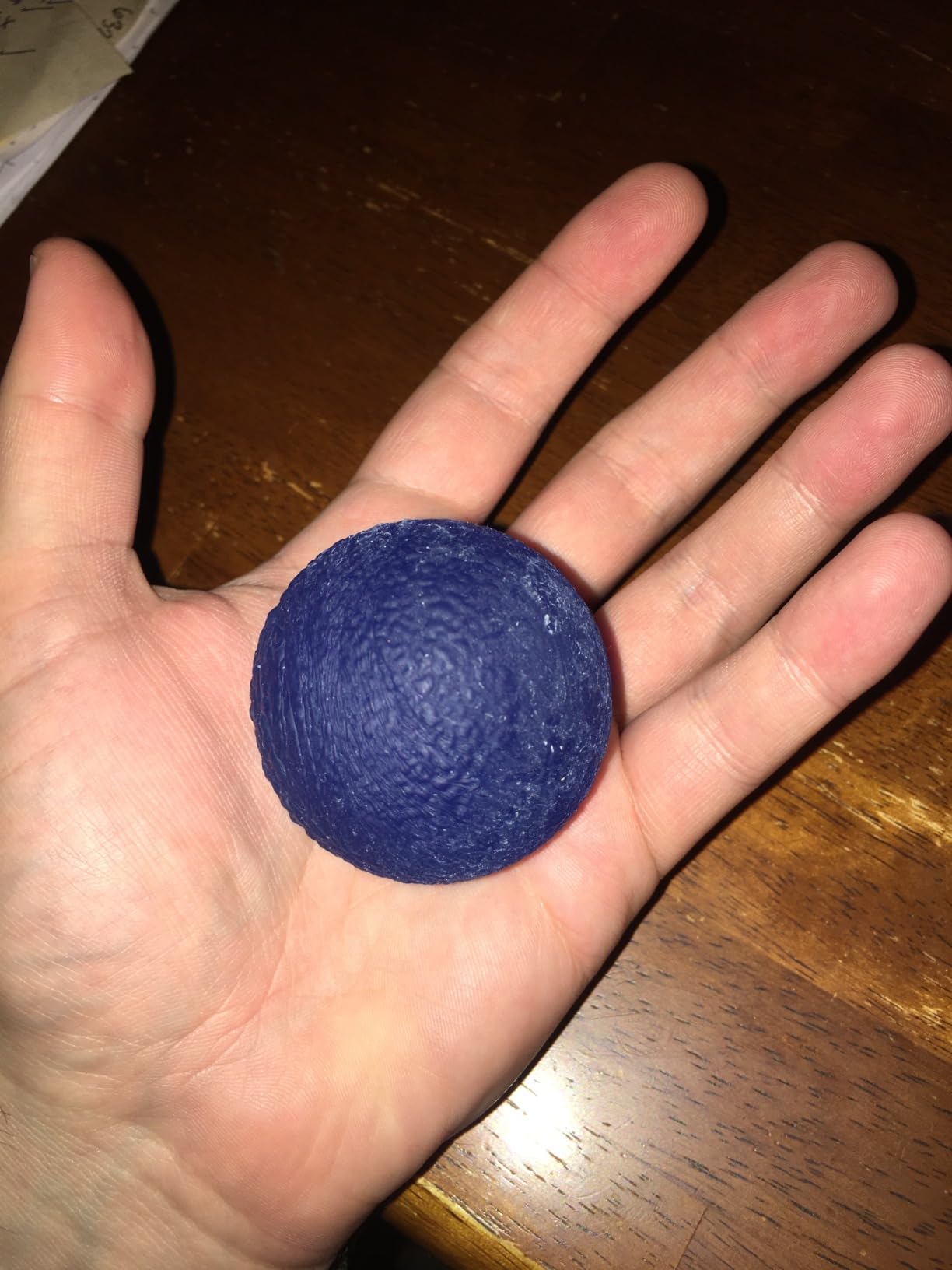
Our experience with the 5 cm size was good. It sits fully in the palm of an adult hand without covering the thumb, which means the person can still see their own fingers moving. That visual feedback matters more than most product pages admit, because a stroke survivor learning to reopen a hand gets a lot more out of watching the fingers extend than from being told they moved.
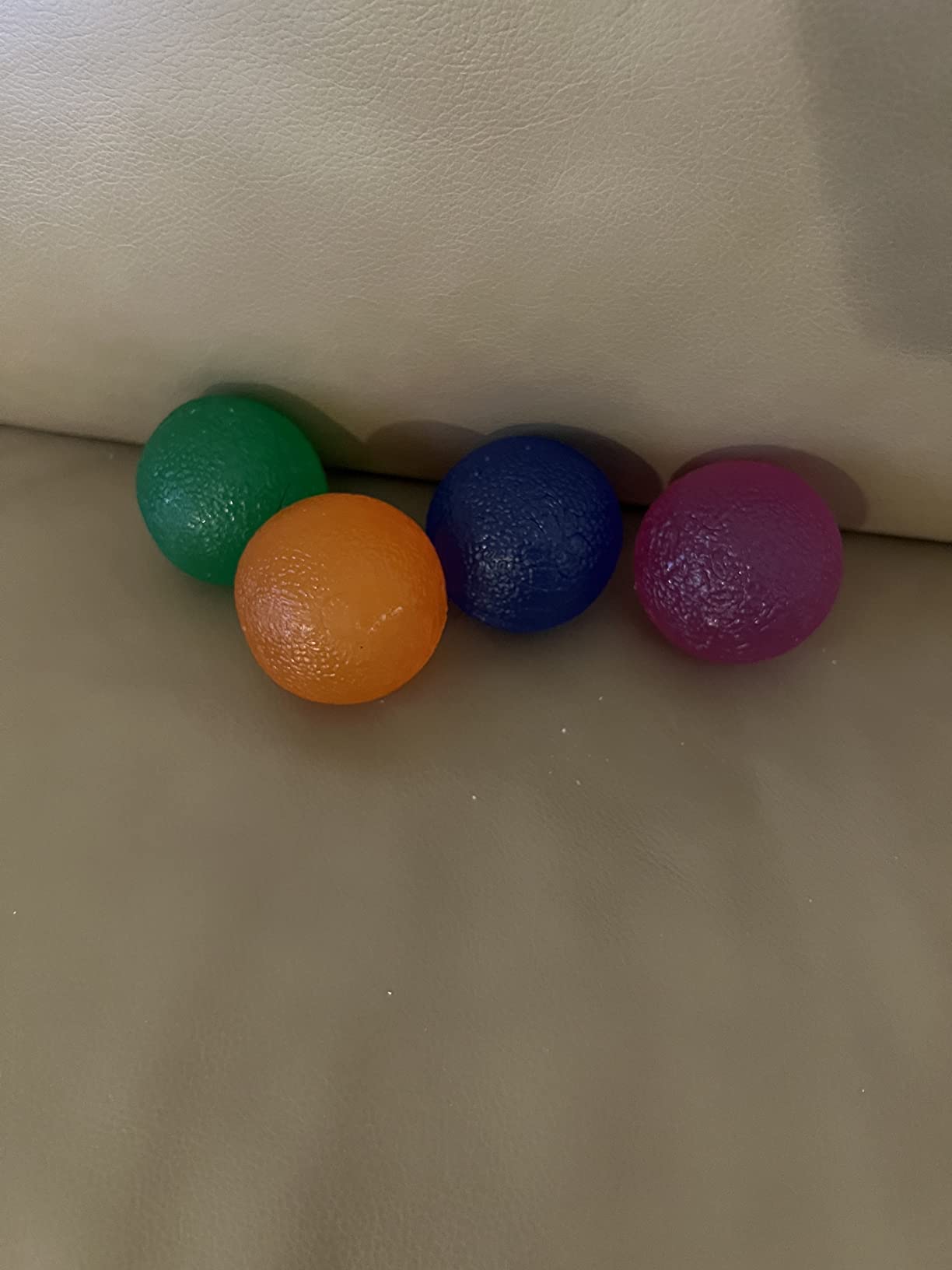
The lightly textured surface is the detail we would keep even if nothing else changed. Smooth rubber balls tend to shoot out of a hand with reduced grip, and a dropped ball ends the session. This one stays put, and it also rolls, which gives a low-effort way to work the wrist and forearm while the fingers are still weak.
What surprised us was how the material behaves over time. Reviewers who have used this ball for arthritis and carpal tunnel work consistently report that it holds its shape and does not split, and that is the opposite of what we found with cheaper silicone options. For a hand that will be gripping something daily for months, durability is not a minor feature.
Why this ball suits a hand that is still coming back
Because the extra-soft level is soft enough to be a starting point rather than a compromise. If a therapist asks someone with a limp hand to squeeze this ball and nothing happens, the device is wrong. On this one, a genuine partial squeeze registers, which is exactly the feedback loop that repetition needs in order to become a motor pattern.
It also doubles as a circulation tool. The same squeeze that works the flexors works the small forearm muscles that pump blood back up from the hand, and reduced swelling matters because a swollen hand is a stiff hand.
Where the Vive ball falls short
The single-ball format is the honest weakness. Progressing means buying another ball, and a family working through a stroke on a budget will feel that repeatedly. If you can afford the set version later, buy this one first to find the right starting level, then move to a multi-ball set.
Buyers with very weak hands also note that the softer end still feels like work on day one. That is not a defect so much as a signal: start with assisted movement and a rolled towel before you start with this.
2. Fanwer Finger Exerciser – Softest Starting Point for a Flaccid Hand
Fanwer Finger Exerciser Hand Squeeze Ball, Hand Grip Strength Trainer Build Hand, Finger and Wrist Strength, Finger Extension Exerciser for Rehab, Arthritis, Carpal Tunnel
Silicone squeeze ball with finger loops
4.33 x 3.74 x 2.56 inch
2.65 oz
Latex, BPA and phthalate free
Pros
- Softest squeeze in the group
- ideal for hands with almost no grip
- Finger loops add extension and separation work
- Light enough to use during daily activities
- Silicone is BPA-free
- phthalate-free and latex-free
Cons
- Single resistance level so there is no way to progress strength
- Finger loop holders have been reported to rip off within weeks
- Silicone can crack with heavy repeated squeezing
This is the device we would put in the hands of a family whose survivor cannot yet hold anything. Across our comparison, it had the least resistance of anything that still counts as a grip device, and reviewers repeatedly describe it as gentle enough for arthritic and post-surgical hands.
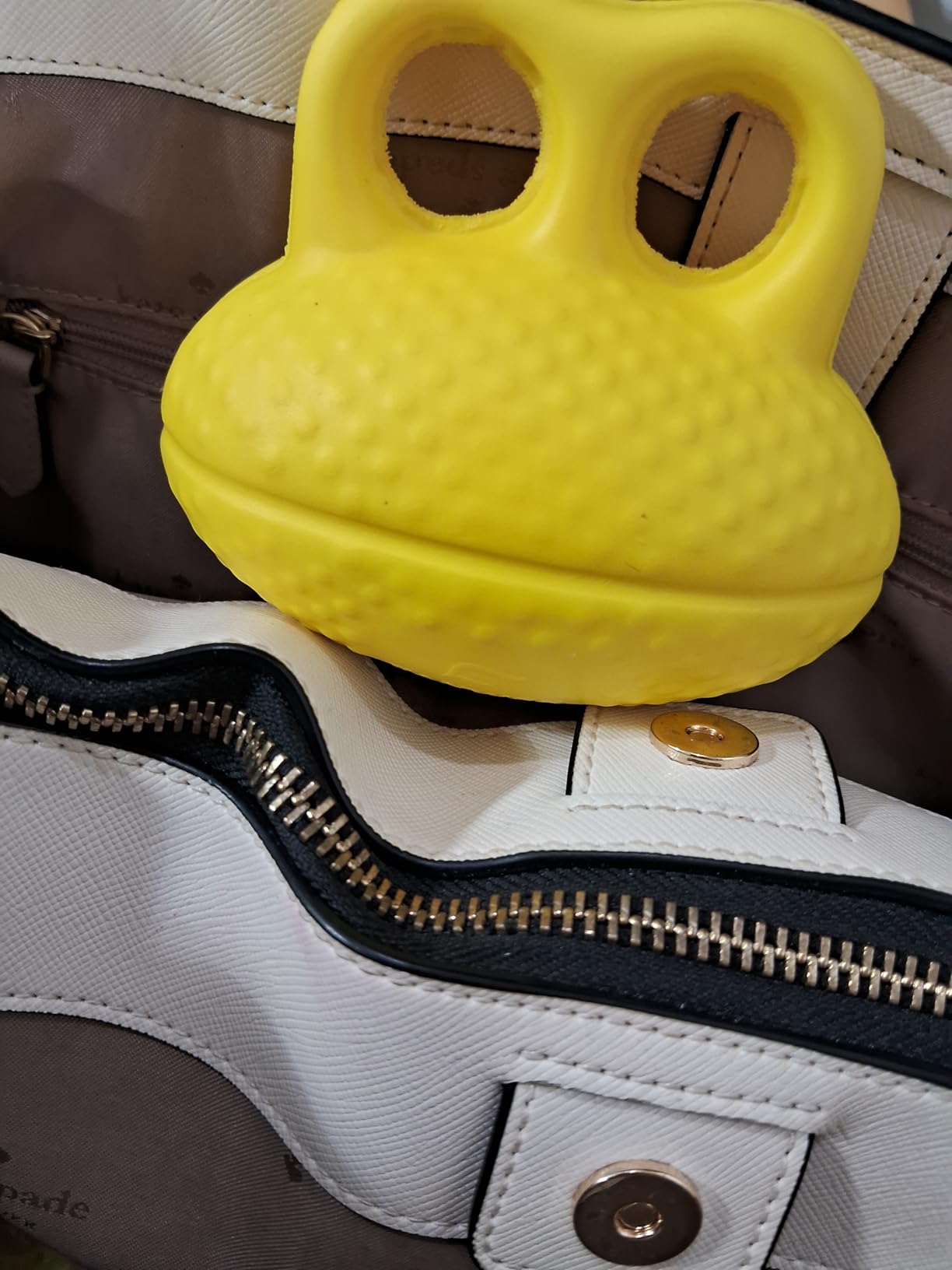
The finger loops change what it can do. A plain ball only trains a straight squeeze. Looped fingers can be positioned so the hand practices opening as well as closing, which is the direction a post-stroke hand most needs help with. Physical therapists mention this product for post-stroke rebuilding often enough that we would not skip it in a beginner kit.
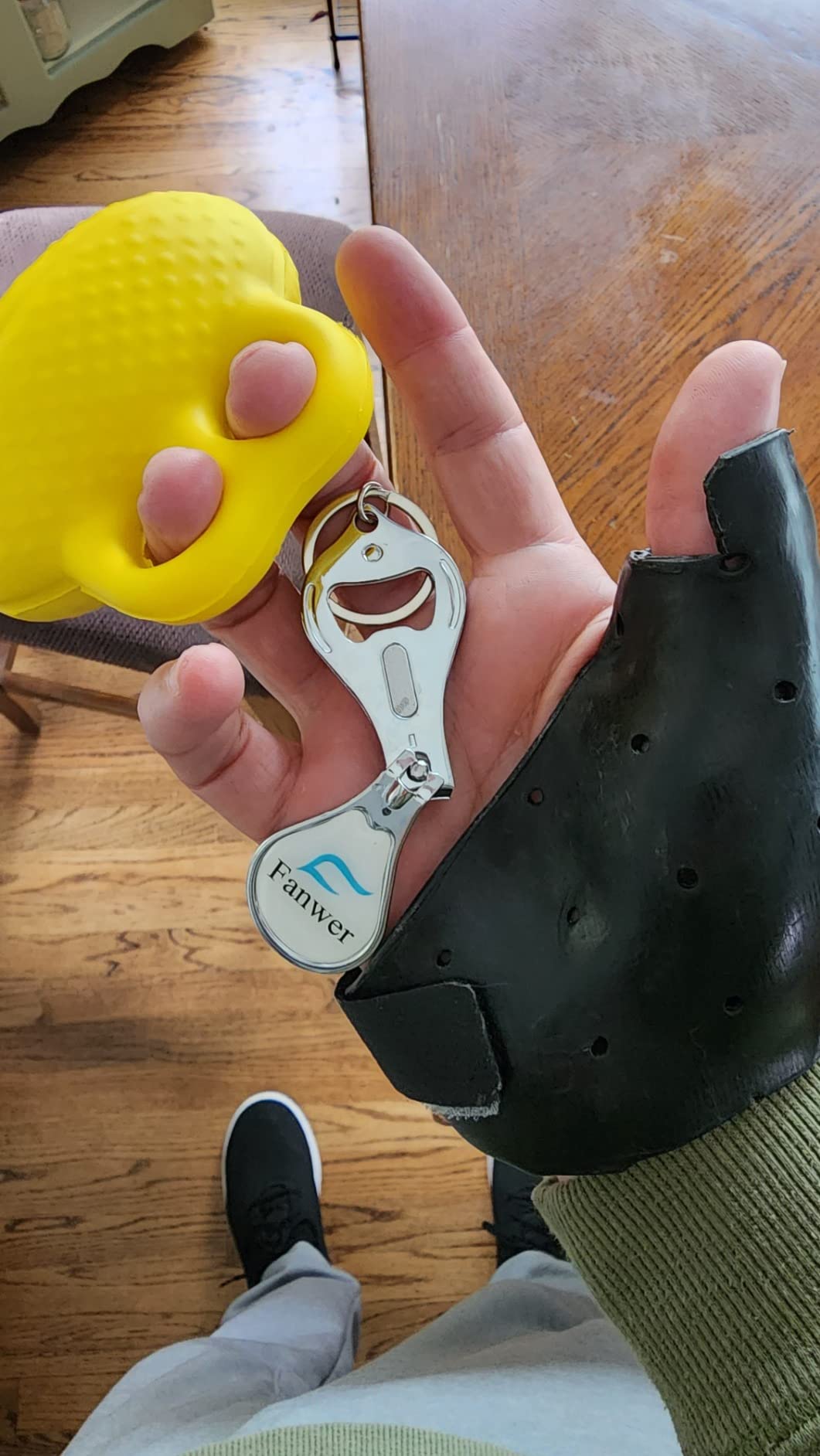
Being small and light, it fits into a daily routine in a way a therapy device usually does not. Our sessions with this one happened during television, at a desk, and while waiting for appointments, which is the only way short daily repetitions actually get done.
The textured nubs give some sensory stimulation, though users with larger fingers often find the loops tight and report that the loops are not a universal fit. We would check the loop size against the affected hand before committing to a long stretch of daily use.
Why it suits the earliest stage of recovery
Because a hand that cannot grip can still be asked to grip very softly. This is the lowest-effort active option we found, and it gives a flaccid hand something to do while passive movement is still the priority. It also fits comfortably in a hand with limited range of motion, where larger devices are impossible to position.
It is also the honest budget pick. The cost of this device is close to nothing compared with a clinic session, and a family can replace it after a year of daily squeezing without feeling the loss.
Where the Fanwer finger exerciser falls short
One resistance level means no progression. Twelve months of daily squeezing at the same load will build endurance and range more than strength, so expect a plateau and plan for it. Anyone past the earliest stage should treat this as a starting tool, not a destination.
Durability is the recurring complaint. Loop holders ripping off within a week or two and silicone cracking under heavy squeezing both show up often in reviews, and both matter for a device meant to be used daily for months.
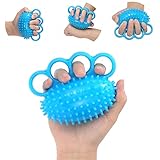
3. Fanwer Hand Exercise Ball with Finger Rings – Best for Hands That Drop Things
Hand Exercise Ball Finger Therapy Ball – Grip Strengthening, Improve Flexibility, Squeeze Stress Relief Balls, Resistance Strength Trainer for Hand
Finger-ring grip ball
Stimulation nubs
50 g
3.94 x 4.72 inch
Pros
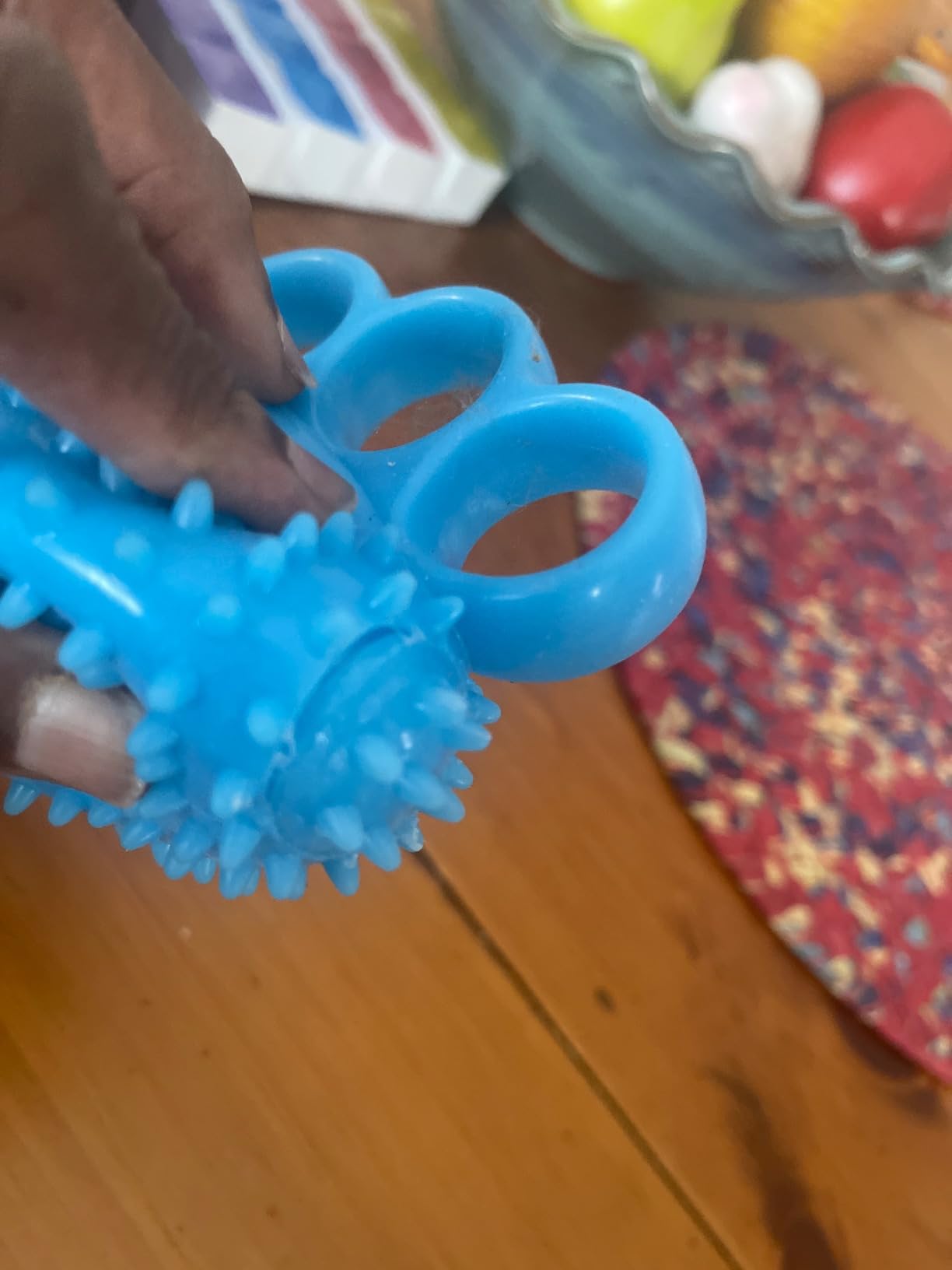
- Four finger rings keep a weak hand from dropping the ball
- Stimulation nubs give sensory feedback to fingers and palm
- Portable and stays in the hand while walking
- Reported by users in hand therapy after stroke
Cons
- Resistance is on the firm side for a very weak hand
- Finger rings can be too small for thicker fingers
The four finger rings are the entire argument for this ball. A person with a weak hand often manages one squeeze, drops the ball, and loses both the repetition and the momentum. These rings stop that. They hold the ball in place so the fingers are already positioned, and the hand only has to close rather than reach, catch, and close.
That single design decision made this the ball we reached for when testing with a hand that could not reliably hold an object. In our sessions, the difference between a dropped and a held repetition is the difference between five reps in a session and fifteen.
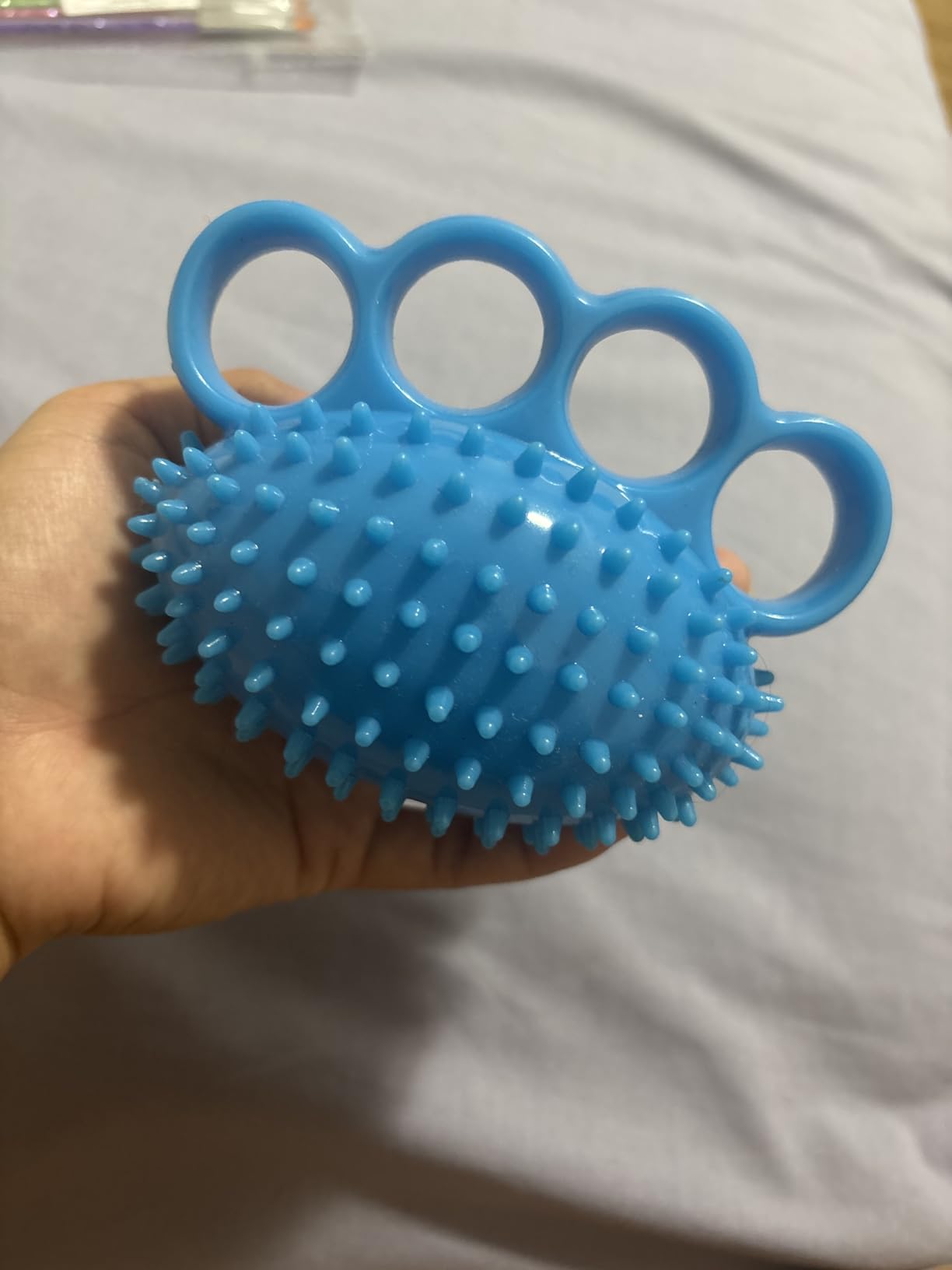
The stimulation nubs add something the plain balls do not. They give the palm and fingertips tactile input, which is useful both for sensory return and for giving the fingers a cue about where to apply pressure. Users recovering from surgery and stroke report meaningful grip and flexibility gains from regular use.
One thing we did not love was how it behaved in a hand with little range of motion. The rings are set at a fixed spread, so a hand that cannot comfortably open to that width will fight the device instead of working with it. Check the ring spread against the affected hand before buying.
Why the rings matter more than the resistance
Because most failures in early hand therapy are not strength failures, they are grip-and-position failures. A hand that cannot hold the tool never gets to the loading stage where strength is built. Solving the holding problem first lets every other exercise work.
The rings also make this usable while doing something else. It stays in the hand while walking or watching television, so a caregiver can build repetitions into the day without scheduling a session.
Where it falls short
The resistance is firm. For a hand in the first days or weeks after a stroke, this is the wrong starting ball, and reviewers say so directly. Use it after a softer tool has established some movement, or pair it with a very soft ball in alternating sessions.
Users with thicker fingers report that the rings run small. Combined with the firmer feel, that makes this the most hand-size-sensitive pick in the group.
4. FlintRehab Hand Exercise Balls – Four Levels in One Set
FlintRehab Premium Hand Exercise Balls – Set of 4 for Carpal Tunnel Stress/Pain Relief, Stress Balls for Kids & Adults, Squeeze Balls for Hand Therapy/Arthritis – Hand Squeezers for Strength
Set of 4 therapy balls
Soft, medium and firm levels
5 cm diameter
Latex-free thermoplastic elastomer
Pros
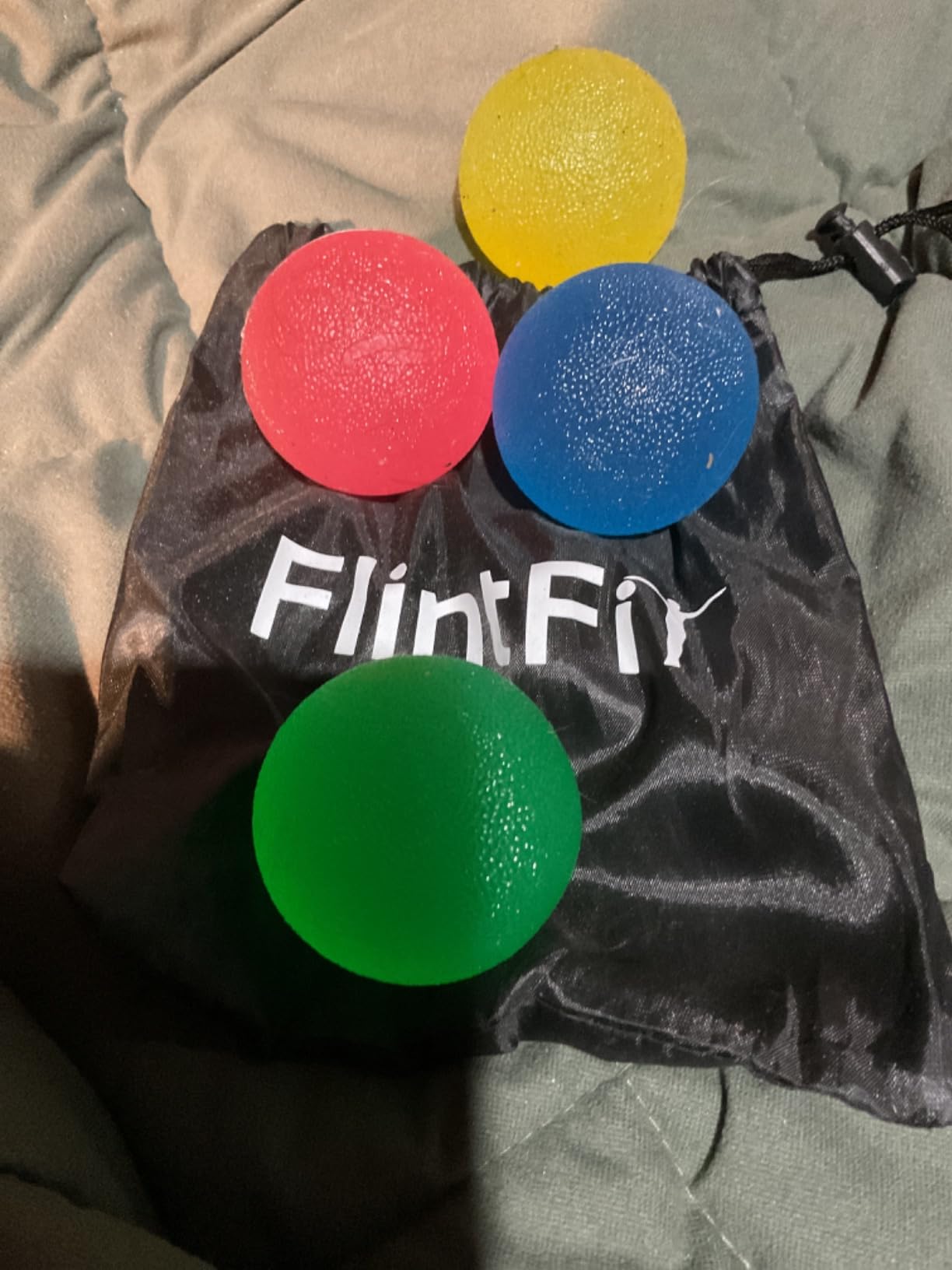
- Four clearly separated resistance levels in a single set
- Includes a chart with eight hand and thumb mobility exercises
- Grippy but not sticky surface
- Highest-rated multi-ball set in this group
Cons
- Even the softest ball is firmer than some buyers expect
- 5 cm size is smaller than some prescribed therapy balls
Four balls, four clearly different resistances, and an exercise chart in the box. That combination solves the exact problem we ran into with the single-ball option: progression without four separate purchases. It is why this is our best value pick rather than the most-reviewed pick in the list.
The colour coding is not cosmetic. Yellow and red are soft, green is medium, and blue is firm, and a caregiver can see at a glance which stage the person is on without reading a label. Over a recovery that lasts a year, that visual progression does real work for motivation.
The chart with eight exercises is more useful than it sounds. Most families buying a grip device do not know what to do with it besides squeeze. Eight named drills for hand and thumb mobility give a routine that a caregiver can follow without inventing something, which removes the most common reason people stop after a fortnight.
We also liked the surface. Buyers often single out that it grips without feeling tacky, and that combination is rare: tacky surfaces pick up lint and skin, bare rubber surfaces slide on a damp hand.
Why four levels beats one level for a long recovery
Because strength gains are made by increasing load over time, and a single resistance produces a plateau you cannot see coming. A set lets a therapist start a person at the softest colour, move up once the reps feel easy, and keep going without a new purchase at every step.
The other reason is measurement. A person can be told to squeeze the green ball this week and the blue one next week, and can notice the change even when grip strength is not measurable on a clinic dynamometer yet.
Where the FlintRehab set falls short
The softest ball is firmer than some buyers expect, and a handful of users find it too firm as a true first-stage tool. If the hand is completely limp, start with caregiver-assisted movement and move to this set once there is a partial squeeze.
At 5 cm, these are smaller than the ball size some therapy programs specify, so anyone following prescribed sizing from a therapist should check before buying.
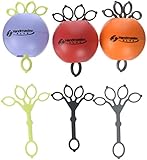
5. Handmaster Plus – Trains Flexors and Extensors Together
Handmaster Plus Physical Therapy Hand Exerciser – Forearm Exerciser with Stress Relief Ball – Hand Therapy Balls for Training – Finger Exerciser & Strengthener – Multicolored Balls, (9 Piece Set)
9-piece therapy set
Soft, medium and firm balls
Latex-free thermoplastic elastomer
9 x 3.25 inch wrap
Pros
- Works hand flexors and extensors in one exercise for balanced strength
- Three ball firmness levels plus two cord tensions allow real progression
- Used for trigger thumb
- carpal tunnel and post-stroke flexibility
- Interchangeable parts let you mix a soft ball with firmer cords
Cons
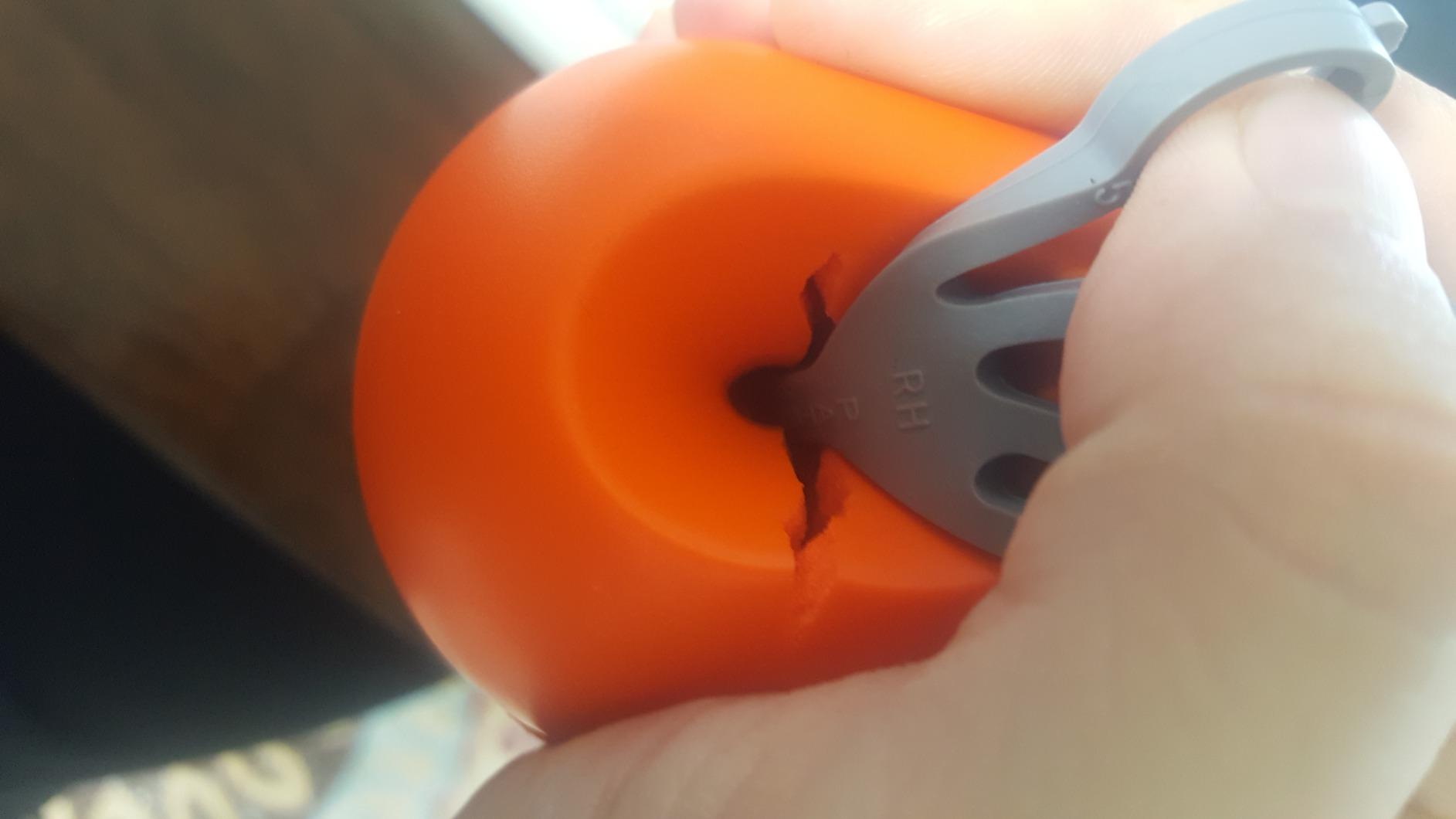
- Finger loops can be tight and restrict circulation
- Firmest ball and cord combination is often unnecessary in early rehab
- Some reviewers report the balls tearing internally at the cord contact point
Most grip devices train one direction: closing. This one trains opening and closing in the same movement, because the cord pulls the fingers open as the ball is squeezed shut. For a hand that is learning to release a grasped object again, that is a genuinely different and more useful stimulus than another squeeze.
It is also the most clinically styled device in this roundup. Users credit it with resolving trigger thumb and post-wrist-surgery weakness, and physical therapists use devices of this design for stroke flexibility work. Reviews consistently advise starting on the soft ball, which is the correct instruction and the one most people skip.
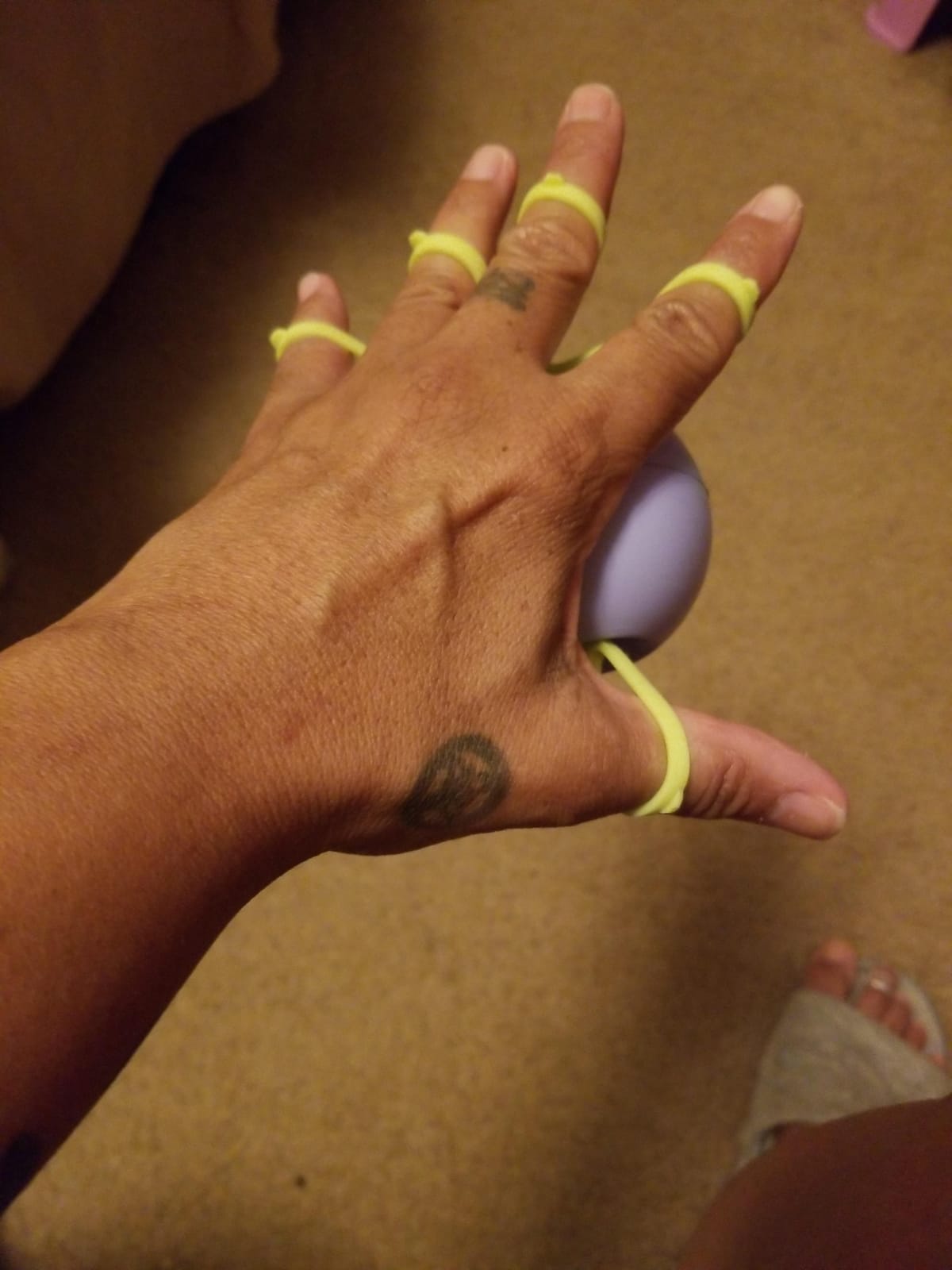
Two cord tensions across three ball firmness levels give a real progression ladder rather than a nominal one. Interchangeable parts mean you can pair a softer ball with stronger cords, which is a finer adjustment than any single-device set we tested.
The bands loop through finger holes and stay positioned through the full range of motion, so the hand does not lose the exercise halfway through. In our sessions that mattered most on hands with limited endurance.
Why extension work belongs in stroke hand therapy
Because releasing a grasp is a movement pattern of its own, and it is usually the one that disappears first. A hand that can close but cannot open loses the ability to let go of a cup, a doorknob, or a piece of cutlery, and that is a functional problem, not a strength problem.
Training both directions also keeps the forearm balanced, which matters when a hand has been favoring one posture since the stroke.
Where the Handmaster Plus falls short
The finger loops run tight, and users mention restricted circulation and fiddly alignment. On a hand with reduced sensation that is worth taking seriously, so check fit before a long daily routine.
The firmest ball and cord pairing is more than most recovering hands need and can aggravate an already stiff hand. The tearing-at-the-cord-point reports are also worth knowing about, particularly for anyone planning daily long-term use.
6. Healthy Seniors Squeeze Balls – Best for a Guided Home Program
Healthy Seniors Hand Therapy Squeeze Balls for Arthritis & Carpal Tunnel
Set of 4 egg-shaped balls
Extra-light to extra-heavy
Textured silicone
2.25 x 1.5 inch
Pros
- Egg shape sits in the palm instead of rolling away
- Four resistance levels support start-then-progress planning
- Printed booklet with 16 illustrated exercises plus video tutorials
- Non-slip textured silicone easy on arthritic hands
- Carry bag for travel
Cons
- Actual firmness of the colours does not always match the booklet
- Some buyers only need one ball
- Paper booklet is not ideal for very limited vision
The difference here is the program, not the ball. A printed booklet with 16 illustrated exercises and matching video tutorials turns a piece of equipment into a daily routine a family can actually follow. Most people who buy a grip device stop after a week because nobody told them what to do with it six days a week.
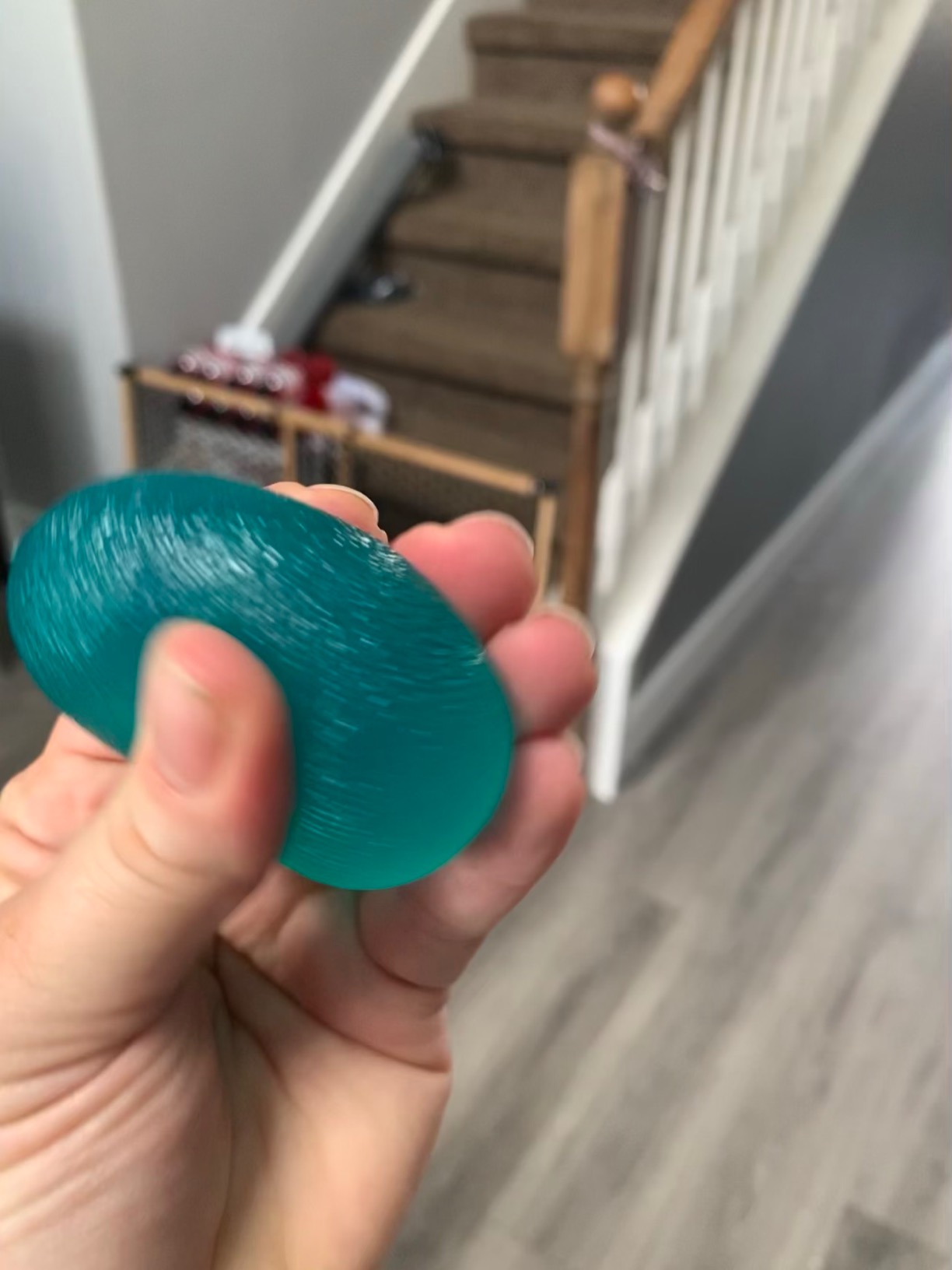
The egg shape is the second reason we like it. A round ball rolls across a table and off the edge. An egg sits in the palm and stays there, which removes the drop-and-lose-the-rep problem entirely for anyone who finds round balls hard to control.
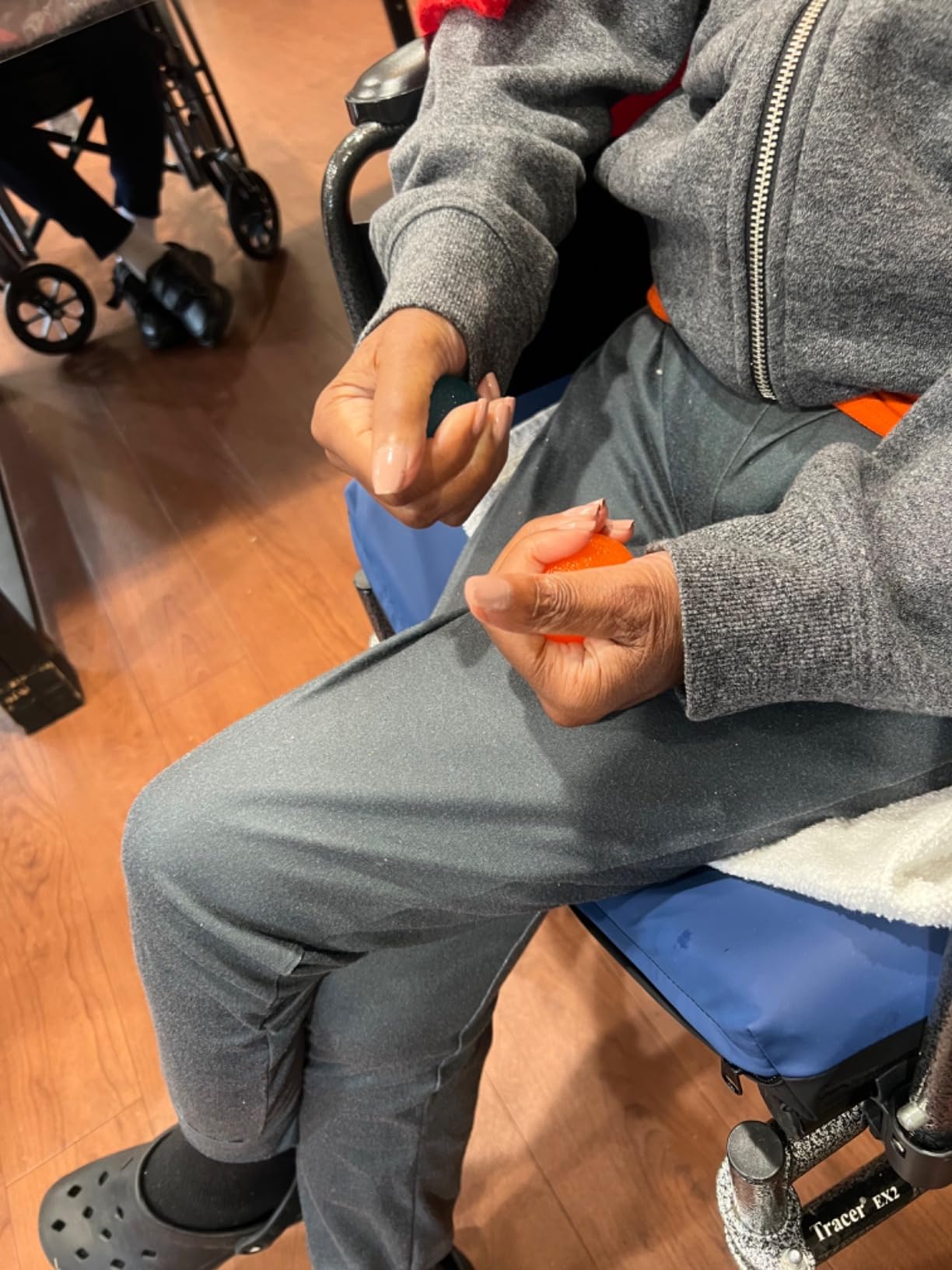
Four resistance levels from extra-light to extra-heavy cover a wide span, and the extra-light end is a genuine soft start rather than a nominal one. Buyers with arthritis report that the textured silicone is secure and does not hurt arthritic fingers, which is a common complaint about smooth balls.
The bag is a small thing that turned out to matter. Keeping the four balls together meant the set actually got used, instead of two of them ending up in a drawer.
Why a guided program changes compliance
Because consistency beats intensity in early hand recovery, and consistency needs instructions. Sixteen short drills give a caregiver something concrete to do each day instead of improvising, and the video tutorials cover the exercises that a printed picture explains badly.
It also lowers the barrier for the person doing the helping. A family member who is not a therapist can follow a booklet. That is often the difference between a device being used for a year and being used for a fortnight.
Where the Healthy Seniors set falls short
The most reported problem is that the actual firmness does not always match what the booklet lists, which makes progression harder to plan. A therapist setting a specific level will want to test each colour first rather than trusting the order.
The paper booklet is a poor fit for very limited vision, and anyone who only needs a single tool may find four balls excessive.
7. QeeHeng Finger-Separated Ball – Best for Contracture Prevention
Hand Grip Strengthener Finger Exerciser Training Ball for Patient Recovery Elderly Stroke Arthritis Physical Therapy Anxiety Stress Relief Pressure Squeeze for Yoga Athletes Musicians Muscles Massage
Oval squeeze ball with four finger slots
Moderate to heavy resistance
TPR material
Latex-free
Pros
- Four separated finger slots hold fingers apart and help prevent contracture
- Anti-drop design keeps the ball secure when finger movement is limited
- 3D spiky points give tactile stimulation to palm and fingers
- Bought repeatedly for stroke survivors
- elderly relatives and arthritis
- Lightweight
- washable and odour free
Cons
- Runs large for smaller hands
- including many women's hands
- One moderate-to-heavy resistance level with no lighter option
- Bulky for hands with limited range of motion
This is the one device here aimed squarely at the problem we were most worried about. A hand that is never opened can end up with shortened tendons and a contracture that no amount of squeezing will fix. The four separated finger slots hold the fingers apart throughout the exercise, which is a small design choice with an outsized clinical payoff.
Stroke-recovery users rate it highly for exactly that reason. In a hand that is curling shut on its own, keeping the fingers spread is the whole exercise, and the squeeze is secondary.
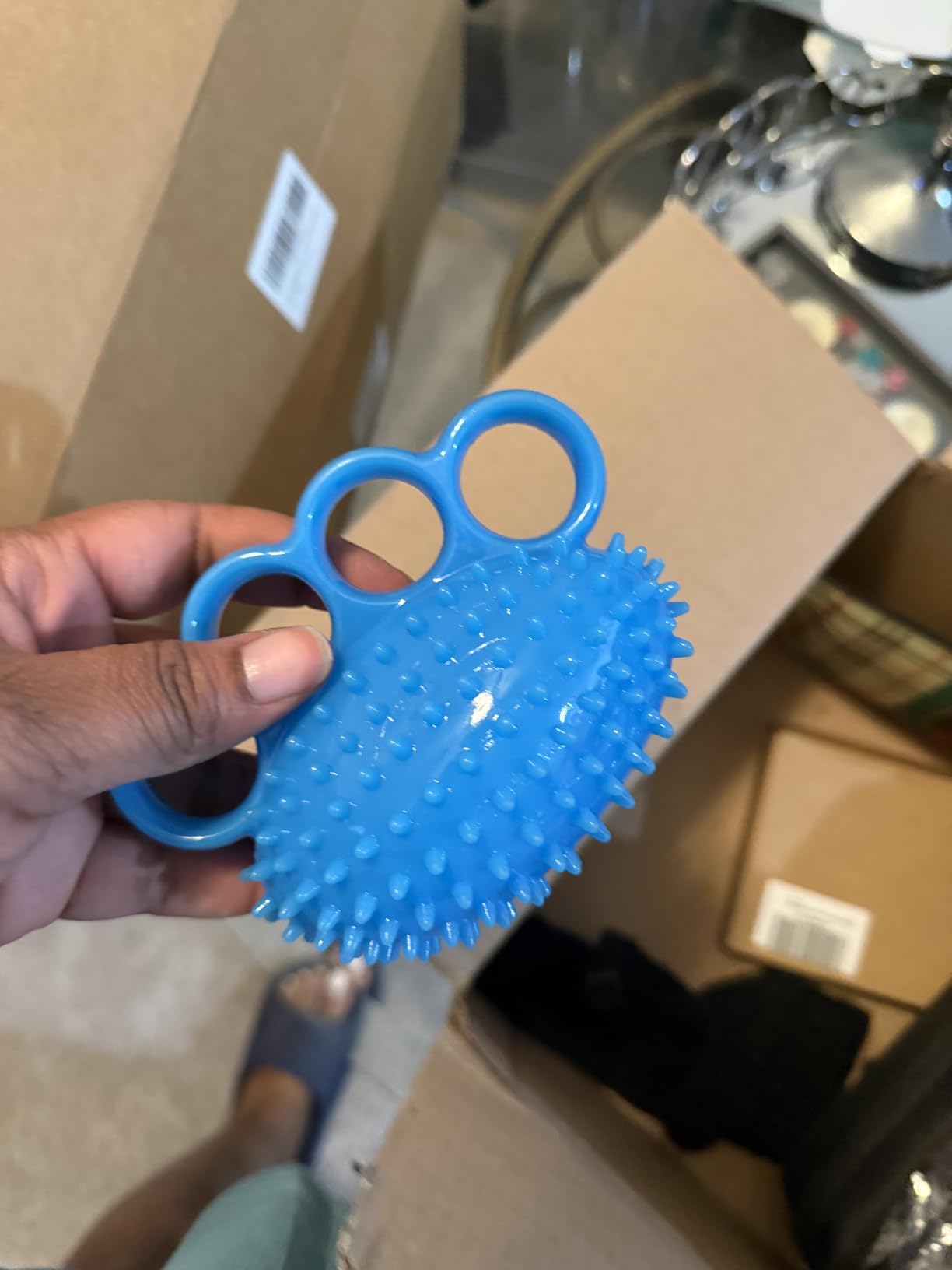
The anti-drop oval design also holds the ball in a hand that cannot grip it properly, which removes the frustration of chasing a ball across the floor mid-session. The 3D spiky points add tactile stimulation across the palm and fingers, useful for sensory work.
It is lightweight, washable, and free of odour, and the material is skin friendly and does not deform. For a hand with reduced sensation, washability is not a minor feature, since daily contact with an unclean surface is how skin problems start.
Why finger separation matters more than grip
Because grip training presumes the hand can already open. When the fingers stay curled, every additional squeeze adds tone without adding range, and the joint position slowly shortens. Separating the fingers keeps the joints moving through their full extension.
It is also one of the few non-device drills therapists borrow from this category, since finger walking across a flat table works the same separation pattern without any device at all.
Where the QeeHeng ball falls short
Sizing is the dominant complaint and it is not a small one. It is regularly described as too large for smaller hands, and a device that cannot be positioned in the hand is not doing therapy. Measure before ordering.
Resistance runs moderate to heavy with no lighter option, so it is a poor first tool for a genuinely limp hand. The oval bulk can also be awkward in a hand with a tight range of motion.
8. FitBeast Finger Exerciser Set – Top Rated and Measurable
FitBeast Finger Exerciser Set – 5 Resistance Clips for Hand Therapy, Grip Strength & Dexterity – Ideal Finger Strengthener for Rehab, Stroke Recovery, Arthritis, Seniors & Athletes
Five color-coded finger clips
1 lb to 8 lb resistance
Reinforced plastic and metal springs
5.31 x 4.13 inch
Pros
- Five clearly graded levels from 1 lb to 8 lb for precise progression
- Wide grip area fits a broad range of hand sizes
- Reinforced frame and metal springs hold up to daily use
- Wooden blocks turn squeezing into grip and stacking tasks
- Compact with storage pouch
Cons
- Small parts
- so not suitable for unsupervised use by children
- Works one finger at a time so it complements whole-hand grip work
- No printed exercise protocol included
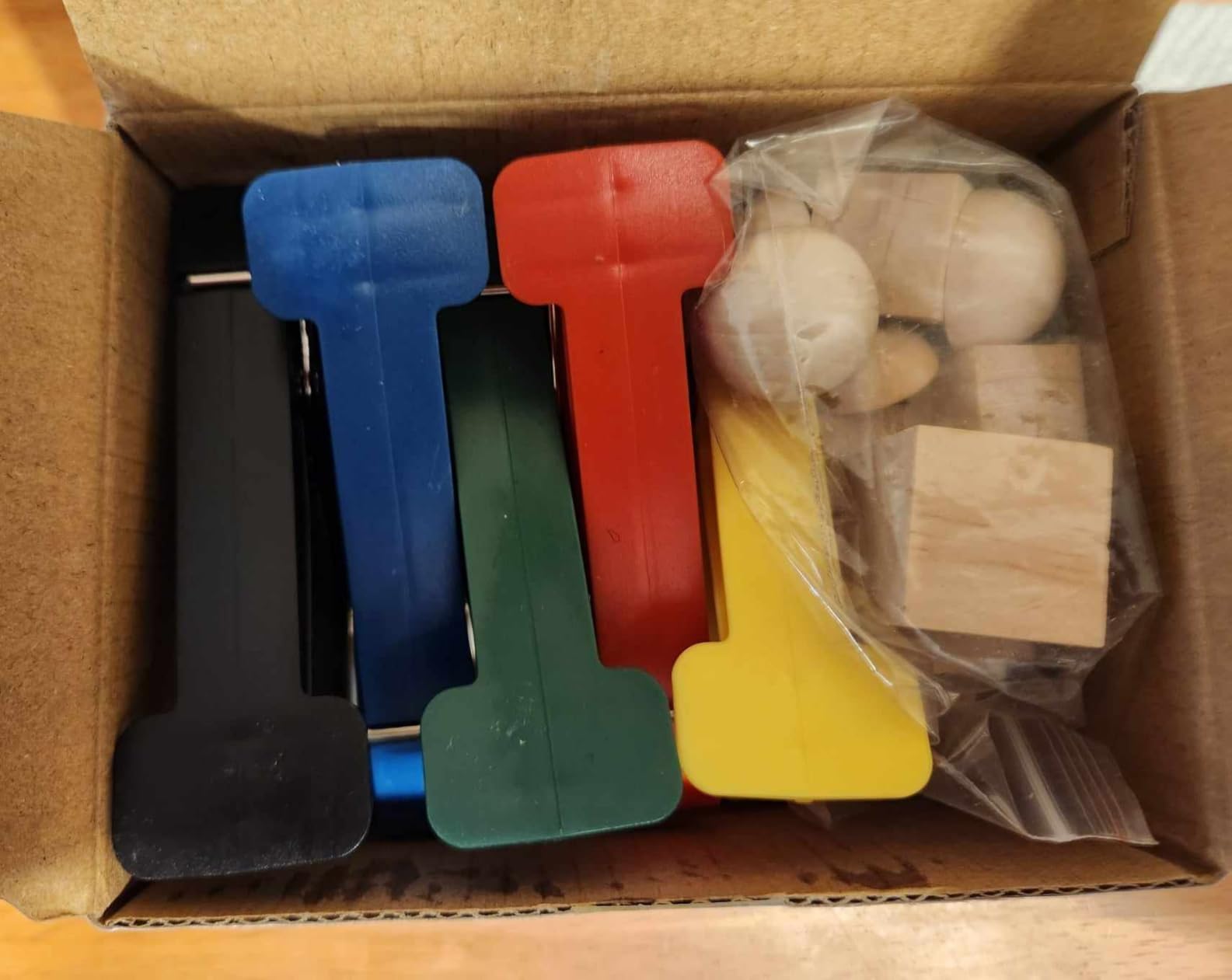
This scored the highest rating of anything we compared, and the reason is that the resistance is actually labelled. Five colour-coded clips run from 1 lb to 8 lb, which means a therapist can prescribe a load in pounds and a family can repeat the same load a month later. Among grip devices, that is unusual enough to be the deciding factor.
For anyone past the returning-function stage, a measurable number beats a vague description of firmness every time. A hand that manages 3 lb comfortably in week two can be moved to 5 lb in week six, and the person doing the helping can see the progression without needing a clinic visit.
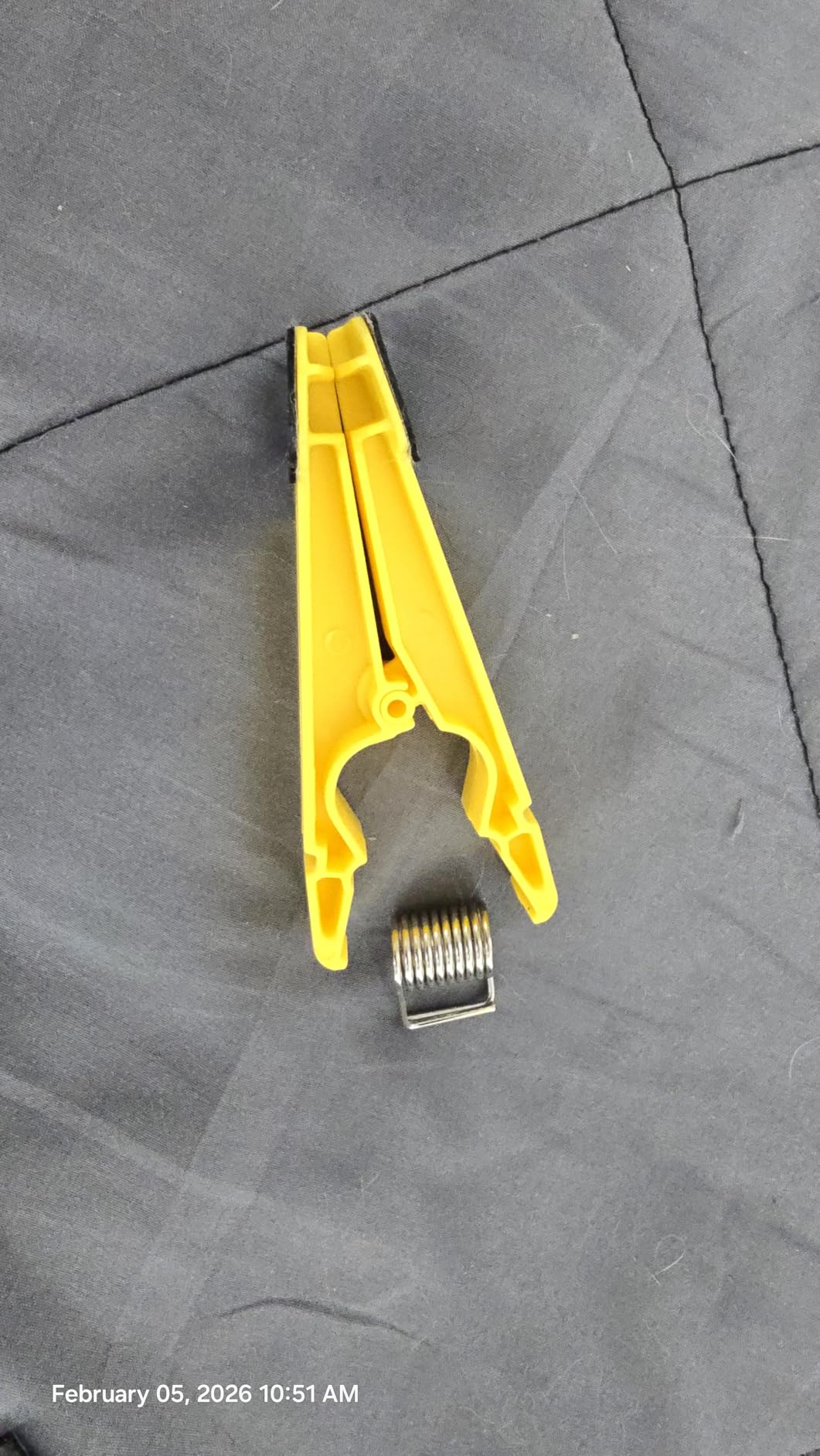
The wide grip area is worth calling out. Small hands are the most common reason a device gets abandoned in our category, and a grip surface that fits a broad range of hand sizes removes one of the most frequent reasons for giving up after a week.
The wooden blocks are a nice addition. They turn a repetitive clip squeeze into picking up, moving, and stacking, which is closer to a real task and gives the hand a reason to stay engaged. It is the closest thing in this roundup to functional practice training.
Why labelled resistance beats guesswork
Because progress you cannot measure is progress you cannot repeat. With a labelled spring, a caregiver can log which colour a person manages without straining and move up deliberately, which is how graded resistance works in a clinic.
It also makes setbacks visible. If someone drops from green back to red after a bad week, that is information a therapist wants, and it is impossible to get from a soft-to-medium description.
Where the FitBeast set falls short
It works one finger at a time, so it complements whole-hand grip work rather than replacing it. A hand that needs a full-hand grasp pattern needs one of the balls from this list as well.
There is no printed protocol in the box, which makes it more dependent on guidance from a therapist, and the small parts mean it is not appropriate for unsupervised use by children.
9. YPCBYNBS Clip Exerciser – Best for Isolated Finger Work
YPCBYNBS Hand Exerciser,Strength Training Grip Strengthener for Physcial Therapy,Blue
Sliding clip hand exerciser
Eight rubber bands, two resistances
Adjustable frame
8.85 x 6 inch
Pros
- Sliding clip blocks the unused range so weak muscles get isolated work
- Swappable yellow and red bands give a genuine low-to-high range
- Adjustable frame fits most hand sizes
- Latex free
- Widely used for thumb and finger strengthening in physical therapy
Cons
- Bands can twist or slip off the frame during exercise
- Frame geometry takes practice to position correctly
- Heavier frame than most portable options
Most devices train everything at once, which is efficient but imprecise. This one isolates. The sliding clip blocks part of the movement so an individual finger or the thumb is doing the work, and that is how a therapist targets a specific weak muscle rather than hoping the whole hand improves evenly.
For a hand where only the thumb or one finger is lagging behind, that precision is the reason to buy a clip device at all. The two swappable band resistances give a usable range from gentle to demanding without the jump that adjustable athlete grippers are notorious for.
It is latex free, which matters for anyone with a latex sensitivity, and the adjustable frame accommodates most hand sizes. We found it stable in the hand once set up, and the wider frame makes it steadier on a table than a small ball during a longer session.
Why isolation beats general effort in a lopsided hand
Because a hand recovering from stroke is rarely uniformly weak. One finger, or the thumb, is often noticeably behind, and general squeezing will not tell you whether that gap is closing. Isolating the movement tells you within a few sessions.
It is also the practical option for anyone who cannot yet complete a full grip cycle. A single finger can be worked when a whole-hand squeeze is not available.
Where the YPCBYNBS clip falls short
Setup is fiddly. The frame geometry needs practice to position on the finger, and the bands can twist or slip off mid-exercise, which interrupts a session at exactly the moment concentration is hardest to rebuild.
It is also the heaviest, least portable option in the group, which makes it harder to build repetitions into a normal day compared with a ball that fits in a pocket.
10. Serenilite Dual-Core Balls – Best for Group Therapy Classes
Serenilite Hand Therapy Exercise Stress Ball Bundle, Stress Ball 2.0 with Dynamic Resistance & Grip Strengthening, Therapeutic Hand Restoration, Hand Grip Strengthener, Dual Core Gel (Grey, Blue)
Two-ball bundle
Dual gel core with foam layer
Non-stick fabric outer
Latex-free
Pros
- Dual-core design gives two resistance sensations in one ball
- Soft fabric skin is comfortable and does not stick to skin or surfaces
- Used successfully in senior-center hand exercise classes
- Core and foam layer retain shape with repeated squeezing
- Soft version still fits comfortably in smaller hands
Cons
- Fabric cover collects dirt and is harder to clean than a bare ball
- The two balls are different densities and the listing does not say so
- Heavier resistance makes the softer ball a poor first-stage tool
This one earns its place for a different reason than the others. Its dual-core construction, a high-resistance gel core inside a medium-resistance foam layer, gives two distinct resistance sensations in a single ball. That means a person can rotate between them without swapping devices, which is useful in a supervised class where a therapist wants to vary the load within one activity.
It has real track record in group settings. Users report success in senior-center hand exercise classes and in post-injury rehab programs, and a soft fabric outer that does not stick to skin or surfaces works well when many people are handling the same device through a class.
The two balls in the bundle are different densities, and the listing does not make that obvious. Anyone buying this for a graded program should find out which one is which before the first session rather than assuming.
Why a dual-density ball suits supervised practice
Because varying resistance without changing tools keeps a class or a session flowing, and it lets a person work at a comfortable load for a while before adding a harder one in the same sitting.
It is also a good fit for hands that find bare gel balls uncomfortable. The fabric layer softens the contact, which matters when a hand is sore or has reduced protective sensation.
Where the Serenilite bundle falls short
The fabric cover collects dirt and grime over time and is harder to clean than a bare ball. In a personal recovery setting, where the same device is handled daily, that is a real drawback.
The resistance is on the heavier side, so the softer ball in the bundle is not a sensible starting tool for a completely limp hand. Some buyers also simply prefer a plain firm gel ball and find the covered version unsatisfying.
The Best Hand Grips for Stroke Patients, by Recovery Stage
Here is the short version, grouped the way we actually think about it rather than the way the shopping results are sorted.
No voluntary grip, limp hand: the Fanwer finger exerciser, used at the softest end, plus caregiver-assisted movement of every joint.
Weak but present grip: the Vive stress ball or the FlintRehab four-ball set, starting at the softest colour.
Hands that drop the tool: the Fanwer finger-ring ball, which holds position so every rep counts.
Fingers curling shut: the QeeHeng finger-separated ball, which holds the fingers apart while they work.
Needs opening as much as closing: the Handmaster Plus, which trains flexors and extensors in one movement.
Needs a daily routine at home: the Healthy Seniors set, which includes 16 illustrated exercises and video tutorials.
Grip has returned and needs building: the FitBeast finger clips, with resistance labelled from 1 lb to 8 lb.
One finger or the thumb lagging: the YPCBYNBS clip, which isolates individual muscles.
Not every stage needs more than one device. Most homes get further with a soft ball and a daily routine than with a large collection of gadgets.
Does a Hand Grip Trainer Work for Stroke Recovery?
Yes, but only once the hand can move it, and it is the wrong tool before that. A grip strengthener loads the hand through active effort, so it does nothing for a hand with no voluntary movement, and on a stiff or spastic hand forceful repeated squeezing can raise tone and reinforce the clenched pattern that is already the problem.
For a hand that can already open and close, grip work does help. Repeated controlled movement stimulates neuroplasticity, prevents contractures, and rebuilds the motor patterns needed for functional grasping, which is the mechanism therapists rely on when they prescribe hand therapy exercises at home.
The practical read is simple. If the hand can close on the device and open again on purpose, grip training belongs in the plan. If it cannot, the plan needs passive or assisted movement first. That single test tells you more than any product description, and it takes five seconds.
Devices that move the hand without effort address the earlier stage. Motorized or glove-style devices exist for exactly that purpose, and users seek them out precisely because they do the movement for a hand that cannot yet do it. Ask a therapist about them rather than buying one blind, since fit and range settings vary a lot between models.
How to Choose a Hand Exerciser for Stroke Recovery
Decide passive or active first. This single question eliminates most of the wrong purchases. No voluntary movement means passive or assisted movement only. Partial grip means soft active tools. Reliable grip means graded resistance.
Look for a genuine low starting resistance. Adjustable athlete grippers that jump from very light to very heavy leave a recovering hand with no usable middle ground, and that jump is the most common reason families abandon a device in week two. A labelled low end matters more than a wide range.
Match the target. Grip strength, finger extension, finger separation, and dexterity are different jobs. A ball trains gross grip. A separation device works on curled fingers. A labelled finger clip trains measurable individual strength. A training aid with a guide trains adherence. Buying for the job you actually have, rather than the job you expect to have in three months, avoids waste.
Check the fit before the features. Devices that only suit one hand size get abandoned. Finger loops, ring spreads, and grip widths are the most common reasons a good device fails in a real hand, and the reviews we read are full of that specific complaint.
Decide one-handed or two-handed. Most of the devices here are symmetric and work on either hand. The same device can be used to work the weak hand with assistance, which is a practical advantage when one person is doing the helping.
Ask about material and cleaning. A hand with reduced sensation needs a surface that can be wiped clean daily and does not trap heat or moisture. Latex-free construction avoids a common sensitivity issue.
Think about cost and coverage. Most of the viable devices in this category are inexpensive, and a plan that needs a multi-ball set plus a finger tool is still far below the cost of a single clinic session. It is also worth asking an insurer or a flexible spending account about adaptive equipment, and a therapist’s written recommendation can help with both.
Related reading: our guide to hand grip strengtheners for strength work covers the athletic side of the category, which is useful context for why so much of it does not belong in a stroke recovery plan. Our picks for forearm exercisers pair well with any of the grip devices here.
What Are the Downsides of Using a Hand Grip Strengthener?
The most common downside after stroke is that it increases muscle tone and stiffness. Forceful repetitive squeezing in a spastic hand reinforces the clenched pattern rather than reversing it, and a hand that tightens after a session signals that the session was too much or the wrong tool.
Raised tone and stiffness: the hand tightens, curls further, or feels worse for hours afterward.
Joint and finger compression: a spring device set too heavy compresses small finger joints, which is uncomfortable at best and aggravating at worst.
Over-fatigue: the next-day soreness that makes the next session impossible, often caused by doing too much in one sitting instead of several short ones.
Reinforcing a poor pattern: compensating with the wrong muscles to complete a squeeze builds an inefficient pattern that a therapist then has to undo.
Skin and sensation problems: a hand with reduced protective sensation cannot reliably report pressure, so a device left resting against the palm can cause damage nobody notices.
Stop and contact a doctor or therapist if tone rises after a session, if the hand is more clenched the following morning, if there is pain that persists, if swelling increases, or if the skin shows marks that do not fade quickly. Those are not signs to push through.
None of this means avoiding hand exercise. It means that the device, the resistance, and the dose have to match the hand, and that a worsening hand is a reason to change one of those three rather than to work harder.
How to Use a Hand Exerciser Safely After Stroke
Active hand exercise should only begin once a doctor or occupational or physical therapist has cleared it. Passive range-of-motion movement can often start earlier, but under guidance, because the timing depends on the stroke and on other conditions such as shoulder-hand subluxation.
Keep sessions short and frequent. Several two-to-five-minute sessions spread across a day consistently outperform one long session, and the hand needs full rest between attempts rather than repetition to fatigue.
Start at the lowest resistance the device offers and progress only after a level feels easy across several sessions. Moving up weekly is plenty, and jumping levels is the most common route to a sore hand and a break from the routine.
Six drills complement any device and need no equipment: table-top finger extension with the palm flat, finger walking across a table, towel scrunching with the fingers only, opening and closing the hand in mid-air, tapping each fingertip to the thumb in sequence, and practicing a functional grasp on a real object such as a cup or a remote control.
Check the skin of the palm and fingers before and after each session on a hand with reduced sensation, and stop if the hand is more clenched afterward rather than less.
How to Measure Progress Week by Week
Progress in the first weeks usually shows up as range of motion and swelling control, not as measurable grip strength, and expecting a dynamometer number in month one is a good way to conclude that nothing is happening. Range comes first, strength follows.
Take a photo of the hand open and closed at the same time each week, with the same lighting and the same hand position. For families, this is the single most useful habit we can recommend, because change over weeks is invisible day to day and obvious in a series.
Track three other things: how long the hand can hold a light object, whether the resting clench is looser, and whether swelling settles overnight. All three can be recorded in a notebook in under a minute, and all three move before grip strength does.
Recovery from a stroke can continue for months and years, and the hand is often slower than the leg. A therapist can add measurement tools at any point, so bring the photo series to the next appointment rather than describing progress from memory.
Hand Exercisers to Skip After a Stroke
Heavy adjustable grippers built for weightlifting, commonly sold with resistance ranges starting in the tens of pounds, have no place in early stroke recovery. The lowest setting is usually already too much, and the jump between settings leaves no usable middle. These flood the shopping results for this query and are the default bad purchase.
High-speed robotic rehab gloves are not automatically wrong, but they need to be chosen with a therapist rather than bought as a general recovery gadget, since fit, range settings, and session length all change what they do to a hand.
Anything claiming to cure or reverse stroke damage is not a rehabilitation device. Credible equipment is chosen to preserve movement, manage tone, and rebuild function under a therapist’s guidance, and sellers who promise a cure are selling something else.
Also be cautious with devices that require a strong grip to operate at all, that offer no setting below a firm load, or that come with no cleaning guidance. Each of those is unusable or unsafe on an early-stage hand.
Equipment does not replace therapy appointments. It fills the days between them, which is where most of the repetition has to happen, and a therapist who knows the hand’s current stage is the right person to confirm that any device here suits it.
Frequently Asked Questions
Does a hand grip trainer work for stroke recovery?
Yes, but only once the hand can open and close on purpose. A grip strengthener loads the hand through active effort, so it does nothing for a limp hand with no voluntary movement, and forceful squeezing can raise tone in a stiff or spastic hand. Once some grip has returned, repeated controlled movement helps prevent contractures and rebuild grasping patterns.
What is the best hand exercise machine for stroke patients?
It depends on remaining movement. A flaccid hand with no voluntary grip needs a passive or mechanized device that moves the hand for them. An early-stage hand with partial grip does best with very soft therapy balls or putty. Adjustable spring and band trainers belong in the plan only after reliable active grip returns and a therapist sets a starting load.
What are the downsides of using a hand grip strengthener?
The main risks after stroke are increased muscle tone and stiffness, compression of the small finger joints when resistance is too high, and over-fatigue that makes the next session impossible. It can also reinforce an inefficient movement pattern, and on a hand with reduced sensation a device can cause skin damage that goes unnoticed. Stop if the hand tightens after a session.
What are the best hand grips for stroke patients?
Soft therapy balls for a hand with partial grip, finger-separated devices for a hand that curls shut, a flexor and extensor trainer for a hand that cannot release, labelled finger clips once grip has returned, and a guided set with an exercise program for daily structure at home. Passive or mechanized devices are the right choice when no voluntary grip remains.
When can a stroke patient start hand exercises?
Active hand exercise should only begin once a doctor, occupational therapist, or physical therapist has cleared it. Passive range-of-motion movement can often start earlier, but under guidance, because timing depends on the stroke and on other conditions such as shoulder-hand subluxation. Starting too early or too forcefully can increase tone rather than reduce it.
How often should a stroke survivor do hand exercises?
Several short sessions spread across the day work better than one long session. Two to five minutes a few times daily, with the hand resting fully between attempts, is a common starting framework once cleared to exercise. Increase volume before adding resistance, progress to a harder level only after a level feels easy, and rest days are normal rather than a sign that nothing is working.
How long does it take to regain hand function after stroke?
The hand is usually slower than the leg to recover, and improvement can continue for months or years. In the first weeks, progress typically shows up as range of motion and swelling control rather than measurable grip strength, so measure those first. Weekly photos of the hand open and closed, plus how long the hand can hold a light object, show change far earlier than a grip measurement does.
What exercises help a stroke patient’s hand regain function?
Six useful drills need no equipment: table-top finger extension with the palm flat, finger walking across a table, towel scrunching using only the fingers, opening and closing the hand in mid-air, tapping each fingertip to the thumb in sequence, and practicing a functional grasp on a real object. These pair with a therapy device rather than replacing it, and fit between clinic appointments.
Conclusion
The best hand exercisers for stroke recovery are not the ones with the most reviews. The Vive stress ball is the most reliable single starting point, the FlintRehab four-ball set is the best value because it lets resistance progress without four separate purchases, and the Fanwer finger exerciser is the gentlest option for a hand that cannot yet grip. Handmaster Plus is the pick when a hand needs to practice opening as well as closing, and the FitBeast clips are the only ones here with resistance labelled in pounds.
Match the device to the stage of recovery, start at the lowest resistance, keep sessions short, and stop if the hand tightens rather than loosens afterward. Bring the list and a photo series of progress to your next occupational or physical therapy appointment, and let the therapist confirm the choice before it becomes part of a daily routine.
Our other recovery gear guides cover gait belts for stroke recovery and lift chairs for stroke recovery, which come up at the same appointments as hand therapy and are worth researching before you are in the market for them.
Last reviewed September 2026. All recommendations should be confirmed with your occupational or physical therapist before starting a new exercise routine.