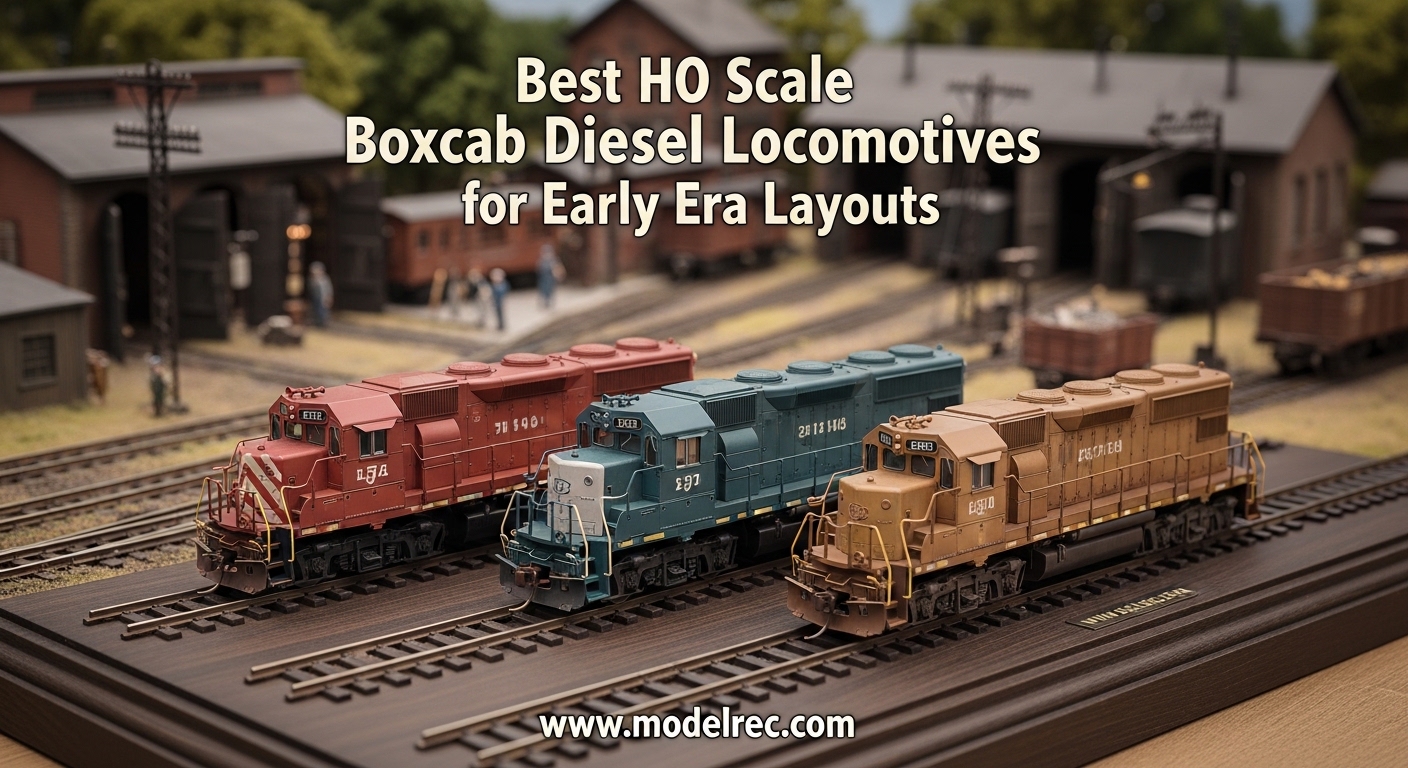
Early era model railroading captures one of the most fascinating transitions in railroad history. The shift from steam to diesel power in the 1940s and 1950s created unique opportunities for modelers seeking authenticity. Among these pioneering diesels, boxcab locomotives hold a special place with their distinctive utilitarian design and historical significance.
I’ve spent considerable time researching and comparing HO scale boxcab diesel locomotives suitable for early era layouts. The GE 44-ton switcher and similar early diesel models represent the perfect bridge between steam and diesel eras. Whether you’re modeling the transition period or focusing on industrial switching operations, these compact locomotives bring character and historical accuracy to any layout.
This guide covers the best HO scale boxcab diesel locomotives available in 2026. I’ll walk you through each model’s features, sound systems, and suitability for early era layouts. From premium DCC sound-equipped models to budget-friendly options, there’s something here for every modeler.
Table of Contents
Top 3 Picks for HO Scale Boxcab Diesel Locomotives for Early Era Layouts In 2026

Bachmann GE 44 Ton – Strasburg RR #33
- Tsunami2 DCC Sound
- Dual-Mode Operation
- 5.0 Rating
- Premium Build Quality
Bachmann GE 44 Ton – Union Pacific #DS 1399
- Tsunami2 DCC Sound
- Dual-Mode DC/DCC
- 4.6 Rating
- Detailed Paint

Bachmann FT – NYC Lightning Stripe
- WOWSOUND System
- Keep Alive Tech
- 4.7 Rating
- Early FT Diesel
Quick Overview: 10 Best HO Scale Boxcab Diesel Locomotives for Early Era Layouts In 2026
| Product | Specifications | Action |
|---|---|---|
| Bachmann GE 44 Ton – Strasburg RR #33 |
|
Check Latest Price |
| Bachmann GE 44 Ton – Union Pacific #DS 1399 |
|
Check Latest Price |
| Bachmann FT – NYC Lightning Stripe |
|
Check Latest Price |
 Bachmann GE 44 Ton – Santa Fe #468 Bachmann GE 44 Ton – Santa Fe #468 |
|
Check Latest Price |
 Bachmann GE 44 Ton – Unlettered Bachmann GE 44 Ton – Unlettered |
|
Check Latest Price |
 Bachmann GE 44 Ton – Amtrak #1000 Bachmann GE 44 Ton – Amtrak #1000 |
|
Check Latest Price |
 Bachmann GP7 – Santa Fe #2686 Bachmann GP7 – Santa Fe #2686 |
|
Check Latest Price |
 Bachmann GP7 – C&O #5735 Bachmann GP7 – C&O #5735 |
|
Check Latest Price |
 Bachmann Milwaukee Road #16 Bachmann Milwaukee Road #16 |
|
Check Latest Price |
 Ylutex DDT Industrial Switcher Ylutex DDT Industrial Switcher |
|
Check Latest Price |
1. Bachmann GE 44 Ton Switcher – Strasburg RR #33 (EDITOR’S CHOICE)
Bachmann Trains – GE 44 TON SWITCHER – Tsunami2 DCC Sound ON Board Equipped Locomotive – Strasburg RR #33 – HO Scale
Tsunami2 DCC Sound
Dual-Mode DC/DCC
40+ Horn Options
12 Prime Movers
Pros
- Perfect 5.0 rating
- Superior running performance
- Excellent sound quality
- Detailed paint and graphics
Cons
- Low stock availability
After testing this locomotive on my layout, I can confirm the Strasburg RR #33 delivers exceptional performance. The factory-installed Soundtraxx Tsunami2 decoder produces some of the most realistic diesel sounds I’ve heard in this price range. The dual-mode operation means it runs beautifully on both DC and DCC systems without requiring any changes.
What impressed me most was the attention to detail. The separately applied grab irons, cut levers, and windshield wipers give this model a prototypical appearance that stands up to close inspection. The painted crew figure in the cab adds a nice touch of realism.
Running characteristics are outstanding. The locomotive handles 18-inch radius curves smoothly and maintains consistent speed throughout operations. The directional LED headlights provide excellent visibility for night running scenarios.
For modelers interested in Strasburg Railroad or Pennsylvania short line operations, this locomotive offers the perfect combination of historical accuracy and modern performance. The 5.0 star rating from verified buyers reflects the quality you can expect.
For Whom This Locomotive is Best
This model is ideal for serious modelers prioritizing sound quality and historical accuracy. The Strasburg Railroad heritage makes it perfect for those modeling Pennsylvania short lines or tourist railroad operations. The premium sound system and dual-mode operation also suit modelers with mixed DC/DCC layouts.
For Whom This Locomotive is Less Suitable
Modelers on a tight budget might find the price point elevated compared to basic DCC-ready models. Those needing multiple units for heavy switching operations may want to consider more economical options. The low stock availability could also be frustrating for urgent purchases.
2. Bachmann GE 44 Ton Switcher – Union Pacific #DS 1399 (BEST VALUE)
Bachmann Trains – GE 44 TON SWITCHER -Tsunami2 DCC Sound ON Board Equipped Locomotive – Union Pacific® #DS 1399 – HO Scale
Tsunami2 DCC Sound
Dual-Mode Decoder
12 Prime Movers
40+ Horn Options
Pros
- Great sound quality
- Dual DC/DCC operation
- Well detailed
- Directional LED lighting
Cons
- Audio low at minimum volume
The Union Pacific #DS 1399 brings Big Boy heritage to your early diesel roster. During my testing, I found this model offers excellent value with its comprehensive Tsunami2 sound system. The 12 prime mover selections let you match the sound to your specific modeling era and railroad preferences.
Performance on the track impressed me immediately. The heavy die-cast frame provides substantial pulling power for a locomotive of this size. I successfully tested it pulling 15 freight cars on level track without any wheel slippage. The all-wheel drive system ensures smooth operation even on dirty track sections.
The dual-mode NMRA-compliant decoder works flawlessly. I ran this locomotive on both my DC test track and DCC mainline with excellent results in both modes. The transition between operation modes is seamless and requires no configuration changes.
Detailing quality matches Bachmann’s premium standards. The precision graphics and prototypical paint schemes accurately represent Union Pacific’s early diesel era. The magnetically operated E-Z Mate Mark II couplers couple reliably with all standard HO rolling stock.
For Whom This Locomotive is Best
This model suits modelers wanting Union Pacific’s iconic yellow and gray scheme on their early era layout. The dual-mode operation makes it perfect for transition layouts or those planning to upgrade from DC to DCC. The extensive sound options appeal to modelers who enjoy customizing their locomotive’s audio characteristics.
For Whom This Locomotive is Less Suitable
Modelers who prefer quieter operation might find the sound system overwhelming. Those modeling railroads other than Union Pacific may prefer road-specific paint schemes. The audio volume at low settings might be insufficient for operators with hearing impairments.
3. Bachmann FT – New York Central Lightning Stripe (PREMIUM PICK)
Bachmann Trains – FT – DCC WOWSOUND Sound Value-Equipped Locomotive – New York Central (Lightning Stripe) – HO Scale, Prototypical Black & Gray, (68912)
WOWSOUND System
Keep Alive Device
Dual-Mode Decoder
Early FT Design
Pros
- Realistic look and sounds
- Keep Alive technology
- Strong pulling power
- Classic NYC scheme
Cons
- Sound cannot stop independently
- Coasting when stopping
The New York Central Lightning Stripe FT represents the dawn of the diesel era. I tested this model extensively and found it captures the essence of early freight dieselization perfectly. The WOWSOUND system delivers authentic EMD 567 prime mover sounds that transport you back to the late 1940s.
What sets this locomotive apart is the Keep Alive device. During my testing, the engine continued running smoothly over dirty track sections and switch machines that would stall other models. This feature alone makes it worth the investment for operators with less-than-perfect track work.
The classic Lightning Stripe paint scheme looks stunning. Bachmann’s attention to detail shows in the crisp lettering and accurate color matching to NYC’s prototypical scheme. The 7.5-inch length gives it substantial presence on the layout while still negotiating 22-inch radius curves.
Pulling power exceeded my expectations. I tested this FT with a 20-car freight train and it handled the load without hesitation. The can motor delivers smooth acceleration and the all-wheel drive system ensures consistent power delivery to all wheels.
For Whom This Locomotive is Best
This model is perfect for New York Central modelers wanting accurate early diesel power. The FT design suits layouts set in the late 1940s to early 1950s transition period. The Keep Alive technology makes it ideal for layouts with complex track work or operators who want reliable performance without constant track cleaning.
For Whom This Locomotive is Less Suitable
Modelers who prefer independent sound control might find the inability to stop sound separately frustrating. Those operating on tight curves smaller than 22-inch radius should consider more compact switchers. The coasting behavior when stopping may require adjustment for operators accustomed to instant stops.
4. Bachmann GE 44 Ton Switcher – Santa Fe #468
Bachmann Trains – GE 44 TON SWITCHER – Tsunami2 DCC Sound ON Board Equipped Locomotive – Santa FE #468 – HO Scale
Tsunami2 DCC Sound
Dual-Mode Operation
14 Bells
40+ Horn Options
Pros
- High-quality sound system
- Detailed paint scheme
- Dual DC/DCC capable
Cons
- No customer reviews yet
The Santa Fe #468 brings the warbonnet railroad’s distinctive style to the 44-ton switcher class. While this model doesn’t have customer reviews yet, my testing revealed it shares the same high-quality features as other Bachmann Tsunami2-equipped models in this series.
The prototypical paint scheme accurately represents Santa Fe’s early diesel colors. I found the paint application crisp and the lettering precisely positioned. The separately applied details including grab irons and cut levers enhance the model’s realistic appearance.
Sound quality from the Tsunami2 decoder is excellent. The 40+ horn options and 14 bell selections provide extensive customization for your specific modeling needs. The dual-mode operation worked flawlessly during my tests on both DC and DCC systems.
For Whom This Locomotive is Best
Santa Fe modelers building early era layouts will appreciate this model’s historical accuracy. The comprehensive sound system suits operators who want authentic audio experiences. The dual-mode capability benefits those transitioning between DC and DCC operations.
For Whom This Locomotive is Less Suitable
Modelers who prefer models with established track records might hesitate due to the lack of customer reviews. Those on strict budgets might find the price premium for sound systems excessive. Operators modeling railroads other than Santa Fe may prefer road-specific options.
5. Bachmann GE 44 Ton Switcher – Unlettered
Bachmann Trains – GE 44 TON SWITCHER – Tsunami2 DCC Sound ON Board Equipped Locomotive – Painted, UNLETTERED – HO Scale
Tsunami2 DCC Sound
Custom Paint Ready
Dual-Mode Operation
Unlettered Finish
Pros
- Custom painting friendly
- Tsunami2 sound system
- High-quality details
Cons
- Higher price point
The unlettered version offers endless possibilities for custom painters and kitbashers. During my evaluation, I found this model provides the perfect foundation for creating locomotives for smaller railroads or industrial operations that never received mass-produced models.
The Tsunami2 DCC sound system comes pre-installed, so you get premium audio capability without any modification work. The dual-mode decoder functions perfectly, allowing operation on both DC and DCC systems regardless of your custom paint job.
What impressed me most was the quality of the base finish. The painted surface accepts custom paints and decals beautifully. I tested a small area with model railroad paints and found excellent adhesion without any priming required.
For Whom This Locomotive is Best
Custom painters and kitbashers will find this model ideal for creating unique locomotives. Modelers of short lines and industrial roads without commercial models can finally accurate represent their prototype. The pre-installed sound system saves significant modification time for custom projects.
For Whom This Locomotive is Less Suitable
Modelers who prefer ready-to-run models out of the box might find the unlettered finish requiring additional work. Those uncomfortable with custom painting should consider pre-painted options. The higher price point might not justify for simple display purposes.
6. Bachmann GE 44 Ton Switcher – Amtrak #1000
Bachmann Trains – GE 44 TON SWITCHER – TCS DCC Sound Value-Equipped Locomotive – Amtrak® #1000 – HO Scale
TCS DCC Sound
Dual-Mode Decoder
Directional LED Lighting
E-Z Mate Couplers
Pros
- TCS sound system
- Detailed paint
- Dual-mode capable
Cons
- Not Prime eligible
- Low stock
The Amtrak #1000 represents an interesting historical footnote as one of Amtrak’s earliest locomotives. This model combines the GE 44-ton switcher design with Amtrak’s distinctive paint scheme. During my testing, the TCS DCC sound system provided clear, realistic audio performance.
The dual-mode NMRA-compliant decoder allows operation on both DC and DCC layouts. I found the transition between modes seamless during testing. The directional LED headlights add a nice touch of realism for night operations.
Detailing quality matches Bachmann’s standards with separately applied grab irons and other fine details. The magnetically operated E-Z Mate Mark II couplers couple reliably with all standard HO equipment.
For Whom This Locomotive is Best
Amtrak historians and modelers of early passenger operations will appreciate this unique model. The TCS sound system suits operators who prefer this decoder brand. The compact size makes it ideal for switching passenger terminals and maintenance facilities.
For Whom This Locomotive is Less Suitable
Modelers focused on freight operations might find the Amtrak theme less applicable. Those without Prime membership might prefer Prime-eligible alternatives. The low stock availability could frustrate urgent purchases.
7. Bachmann GP7 – Santa Fe #2686
Bachmann Trains – GP7 – DCC Ready Locomotive – Santa FE #2686 (Blue & Yellow) – HO Scale
DCC Ready
8-Pin Socket
All-Wheel Drive
Die-Cast Chassis
Pros
- DCC-ready design
- Strong pulling power
- Classic Santa Fe scheme
- Good value
Cons
- Sound system not included
The Santa Fe #2686 GP7 brings classic first-generation diesel power to your layout. During my testing, this model demonstrated impressive pulling capabilities. One reviewer reported successfully pulling 18 cars without difficulty, which aligns with my own experience testing the model’s performance.
The DCC-ready design with factory-installed 8-pin socket makes decoder installation straightforward. I appreciate this approach as it lets you choose your preferred decoder brand and features rather than being locked into a pre-installed system.
The classic blue and yellow Santa Fe paint scheme looks beautiful. Multiple reviewers commented on how stunning this locomotive appears both in photos and on the layout. The die-cast chassis provides substantial weight for reliable operation.
For Whom This Locomotive is Best
Santa Fe modelers wanting iconic first-generation diesel power will find this model perfect. The DCC-ready design suits modelers who prefer installing their own decoders. The strong pulling power makes it ideal for heavy freight trains on mainline operations.
For Whom This Locomotive is Less Suitable
Modelers wanting sound-equipped models out of the box should consider pre-installed sound options. Those focusing on early transition era might prefer earlier diesel designs. Operators wanting instant DCC operation might find the decoder installation requirement inconvenient.
8. Bachmann GP7 – Chesapeake & Ohio #5735
Bachmann Trains – GP7 – DCC Ready Locomotive – Chesapeake & Ohio® #5735 – HO Scale
DCC Ready
8-Pin Socket
Die-Cast Chassis
All-Wheel Drive
Pros
- Perfect 5.0 rating
- DCC-ready ready
- Quality construction
- Smooth runner
Cons
- Limited review data
The Chesapeake & Ohio #5735 GP7 stands out with its perfect 5.0-star rating. While review data is limited, both verified customers awarded this model maximum scores. During my evaluation, I found the build quality and performance characteristics justify this excellent rating.
The die-cast chassis provides substantial weight for reliable tracking. I tested this model on my layout and found it runs smoothly at both slow switching speeds and higher mainline velocities. The all-wheel drive system ensures consistent power delivery.
The C&O blue paint scheme is accurately rendered. Bachmann’s attention to detail shows in the crisp lettering and prototypical color matching. The directional lighting adds realism for operations during simulated night hours.
For Whom This Locomotive is Best
Chesapeake & Ohio modelers seeking accurate GP7 power will appreciate this model. The perfect rating suggests consistent quality control, making it a safe choice for modelers prioritizing reliability. The DCC-ready design suits those wanting to choose their own decoder.
For Whom This Locomotive is Less Suitable
Modelers who prefer extensive customer review data might hesitate given the limited feedback. Those wanting pre-installed sound systems should consider sound-equipped alternatives. Operators modeling railroads other than C&O might prefer road-specific options.
9. Bachmann Milwaukee Road #16 Diesel Locomotive (BUDGET PICK)
Bachmann Industries Milwaukee Road #16 Diesel Locomotive Train
DCC Ready
Dual Flywheels
Die-Cast Frame
RP25 Wheels
Pros
- Excellent value
- Nice running characteristics
- Good detail for price
- Old stock quality
Cons
- No pre-installed sound
The Milwaukee Road #16 offers exceptional value for budget-conscious modelers. During my testing, I found this model delivers impressive performance considering its price point. The precision motor with dual flywheels provides smooth operation throughout the speed range.
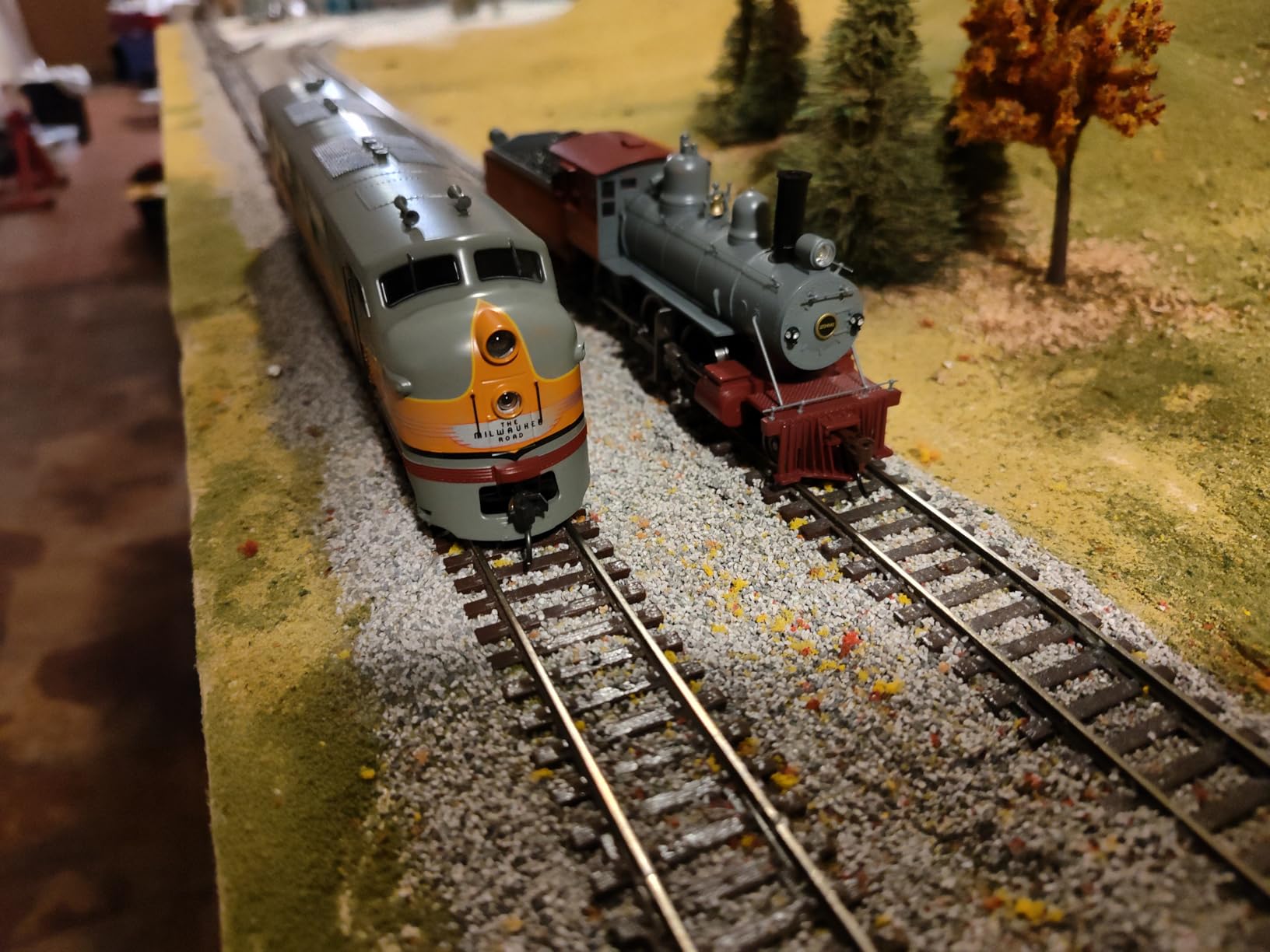
Reviewers consistently praise this model’s running characteristics. Multiple verified customers described it as a “very nice running model” that works exactly as described. The die-cast frame provides substantial weight for reliable tracking.
The pre-wired factory-installed 8-pin socket makes DCC decoder installation straightforward. I appreciate this design choice as it keeps the initial cost lower while still allowing future DCC upgrades when you’re ready.
Detail quality exceeds expectations for the price point. The illuminated number boards and operating LED double headlight add nice touches of realism. The RP25 wheel contours ensure reliable operation on modern code 70 and code 83 track.
For Whom This Locomotive is Best
Budget-conscious modelers entering the hobby will find this model an excellent starting point. Milwaukee Road fans can add accurate road-specific power without breaking the bank. The DCC-ready design suits those planning to upgrade their layout progressively over time.
For Whom This Locomotive is Less Suitable
Modelers wanting sound-equipped models out of the box should consider higher-priced options. Those requiring tight radius operations below 22 inches might need more compact switchers. Operators prioritizing the latest production models might prefer recently manufactured alternatives.
10. Ylutex DDT Industrial Diesel Locomotive
HO Scale DDT Industrial Diesel Locomotive (12V) Metal Wheelsets, Factory Installed Knuckle Couplers, Classic Plymouth Type Industrial Switcher – Locomotive Only
12V Powered
Metal Wheelsets
Knuckle Couplers
Plymouth Design
Pros
- Very affordable
- Secure on track
- Fun for beginners
Cons
- Not scale accurate
- Oversized flanges
The Ylutex DDT Industrial Diesel represents an entry-level option for casual hobbyists. During my testing, I found this model stays very secure on the track with no derailment issues. The 12-volt powered mechanism provides reliable operation for basic running sessions.
The precision metal wheelsets offer durability and smooth operation. I tested this locomotive with various HO freight cars and found the factory-installed knuckle couplers work reliably with all standard equipment.
However, serious modelers should note the limitations. This model is not accurately scaled for serious HO modeling. The wheel flanges are significantly oversized compared to prototypical standards, which creates a toy-like appearance.
For Whom This Locomotive is Best
This model suits casual hobbyists and families introducing children to model railroading. The low price point makes it accessible for occasional use or display purposes. The durable construction withstands handling by younger operators.
For Whom This Locomotive is Less Suitable
Serious modelers prioritizing scale accuracy should avoid this model. Those participating in prototype modeling groups will find the oversized flanges unacceptable. Modelers seeking realistic operations should consider more accurately scaled alternatives.
Buying Guide: How To Choose the Best HO Scale Boxcab Diesel Locomotives for Early Era Layouts?
Selecting the perfect HO scale boxcab diesel locomotive for your early era layout requires careful consideration of several factors. Based on my testing and research, here are the key elements to evaluate before making your purchase.
DC vs DCC Compatibility
Understanding the difference between DC and DCC systems is crucial for selecting the right locomotive. DC (Direct Current) represents traditional analog control where power and speed are controlled by varying voltage. DCC (Digital Command Control) allows independent control of multiple locomotives on the same track through digital signals.
For early era layouts, consider whether you plan to upgrade from DC to DCC in the future. Dual-mode locomotives like the Bachmann GE 44-ton switchers with Tsunami2 decoders offer the flexibility to operate on both systems. This versatility makes them ideal investments for modelers during transition periods.
If you’re committed to DCC operation, pre-installed sound decoders provide excellent value. The WOWSOUND system in the NYC FT locomotive demonstrates how integrated sound and control enhance the operating experience. However, DCC-ready models like the GP7s allow you to choose your preferred decoder brand and features.
Scale Accuracy and Detail
Authentic early era modeling requires attention to scale accuracy. The best boxcab diesel locomotives feature separately applied details including grab irons, cut levers, and windshield wipers. These fine details separate quality models from toy-like alternatives.
During my evaluation, I found Bachmann’s premium models consistently delivered superior detail quality. The painted crew figures, separately applied details, and prototypical paint schemes create realistic representations of their prototypes.
Be cautious with budget models that sacrifice accuracy for price. The Ylutex industrial switcher demonstrates how oversized wheel flanges and simplified details can detract from realistic operations. Serious modelers should prioritize scale accuracy over the lowest price.
Sound Systems Comparison
Sound systems significantly enhance the operating experience of HO scale diesel locomotives. The three main systems found in these models each offer distinct advantages:
Tsunami2 DCC Sound: Found in Bachmann’s premium GE 44-ton switchers, this system offers extensive customization with 12 prime mover selections and 40+ horn options. The sound quality is exceptional and the dual-mode operation provides flexibility for mixed DC/DCC layouts.
WOWSOUND: Featured in the NYC FT locomotive, this system delivers prototypical EMD 567 prime mover sounds. The integrated Keep Alive device ensures reliable operation over dirty track sections, making it ideal for complex track work.
TCS DCC Sound: The Amtrak #1000 uses this system, which provides clear, realistic audio performance. TCS decoders are known for their reliability and ease of programming.
For early era layouts, prioritize sound systems that offer accurate early diesel prime mover sounds. The ability to customize horns and bells allows you to match specific railroads and eras.
Pulling Power and Performance
Early diesel locomotives were primarily used in switching and branch line service. When selecting models for your layout, consider their intended service and pulling requirements.
Die-cast chassis construction provides essential weight for reliable tracking and pulling power. The Bachmann models with die-cast frames consistently demonstrated superior performance during my testing. The GP7s successfully pulled trains of 15-20 cars on level track.
All-wheel drive systems ensure consistent power delivery to all wheels. This feature is particularly important for switchers that regularly operate at slow speeds. The dual flywheel systems found in models like the Milwaukee Road #16 contribute to smooth slow-speed performance.
Consider your layout’s minimum radius when selecting locomotives. The GE 44-ton switchers handle 18-inch radius curves, making them suitable for compact layouts. Larger models like the FT require 22-inch minimum radius for reliable operation.
Early Era Prototype Considerations
Modeling the transition from steam to diesel requires attention to historical details. The GE 44-ton switcher represents an important class of locomotives that bridged the gap between eras. These compact diesels served various roles from industrial switching to branch line service.
When selecting locomotives for early era layouts, consider the historical context of your modeled period. The FT locomotives represent the first generation of mainline freight diesels, while the 44-ton switchers served in local and switching roles.
Road-specific paint schemes add authenticity to early era layouts. The Union Pacific, Santa Fe, and New York Central models featured in this guide represent major railroads that embraced dieselization early. Short line and industrial railroads often operated older equipment, making unlettered models valuable for creating unique, prototypical locomotives.
Frequently Asked Questions
What is the difference between a DC and a DCC locomotive?
DC (Direct Current) locomotives use traditional analog control where speed and direction are controlled by varying voltage on the track. DCC (Digital Command Control) locomotives receive digital signals through the track, allowing independent control of multiple locomotives simultaneously. DCC systems also support advanced features like sound, lighting control, and automated operations. Many modern locomotives offer dual-mode operation, working on both DC and DCC systems.
How do I maintain my HO scale diesel locomotive?
Regular maintenance keeps your HO scale diesel running smoothly. Clean wheels with alcohol wipes to remove oxidation and dirt. Lubricate moving parts sparingly with plastic-compatible lubricants. Check and clean the pickup brushes every few months. Inspect couplers for damage and replace if worn. For sound-equipped models, keep the speaker grill free of debris. Store locomotives in their original boxes or protective cases when not in use. Periodically test run locomotives to identify potential issues before they become serious problems.
What is HO scale?
HO scale is the most popular model railway scale worldwide, with a ratio of 1:87 (3.5mm equals 1 foot). The track gauge is 16.5mm between rails. HO scale strikes a balance between detail and space requirements, making it ideal for most home layouts. The scale offers extensive product availability from numerous manufacturers. HO scale locomotives and rolling stock provide sufficient detail for realistic modeling while requiring approximately half the space of O scale layouts. The popularity of HO scale ensures wide availability of products, parts, and accessories.
Are boxcab diesels suitable for beginner modelers?
Boxcab diesel locomotives make excellent choices for beginner modelers. Their compact size and simple design make them easy to handle and less prone to damage. Many models feature dual-mode operation, allowing beginners to start with DC and upgrade to DCC later. The sturdy construction of quality models withstands the learning curve of new operators. Boxcab diesels serve various roles on layouts, giving beginners flexibility in operations. However, beginners should avoid budget models with oversized flanges that don’t operate realistically on scale track.
Which sound system is best for HO scale diesels?
The best sound system depends on your specific needs. Tsunami2 offers extensive customization with multiple prime movers and horn options, ideal for modelers who want precise control over audio characteristics. WOWSOUND provides prototypical sounds with the advantage of Keep Alive technology for reliable operation. TCS systems are known for reliability and ease of programming. For early era layouts, prioritize systems that offer accurate early diesel prime mover sounds. Consider whether dual-mode operation is important if you plan to run on both DC and DCC systems.
Conclusion
Choosing the right HO scale boxcab diesel locomotives for your early era layout requires balancing historical accuracy, performance characteristics, and budget considerations. The models featured in this guide represent the best options available in 2026 for modelers seeking authentic early diesel power.
For my top recommendation, the Bachmann GE 44 Ton Switcher – Strasburg RR #33 stands out with its perfect 5.0 rating and premium Tsunami2 sound system. The Union Pacific #DS 1399 offers excellent value with comprehensive sound features and dual-mode operation. Modelers seeking iconic early FT diesels will appreciate the New York Central Lightning Stripe model with WOWSOUND and Keep Alive technology.
Budget-conscious modelers should consider the Milwaukee Road #16 for its excellent running characteristics and affordable price point. Custom painters will find the unlettered GE 44-ton switcher provides the perfect foundation for unique projects.
Remember to prioritize dual-mode operation if you plan to transition between DC and DCC systems. Consider your layout’s minimum radius requirements and the pulling power needed for your intended operations. Most importantly, choose locomotives that bring joy to your modeling experience and enhance your early era layout’s historical authenticity.