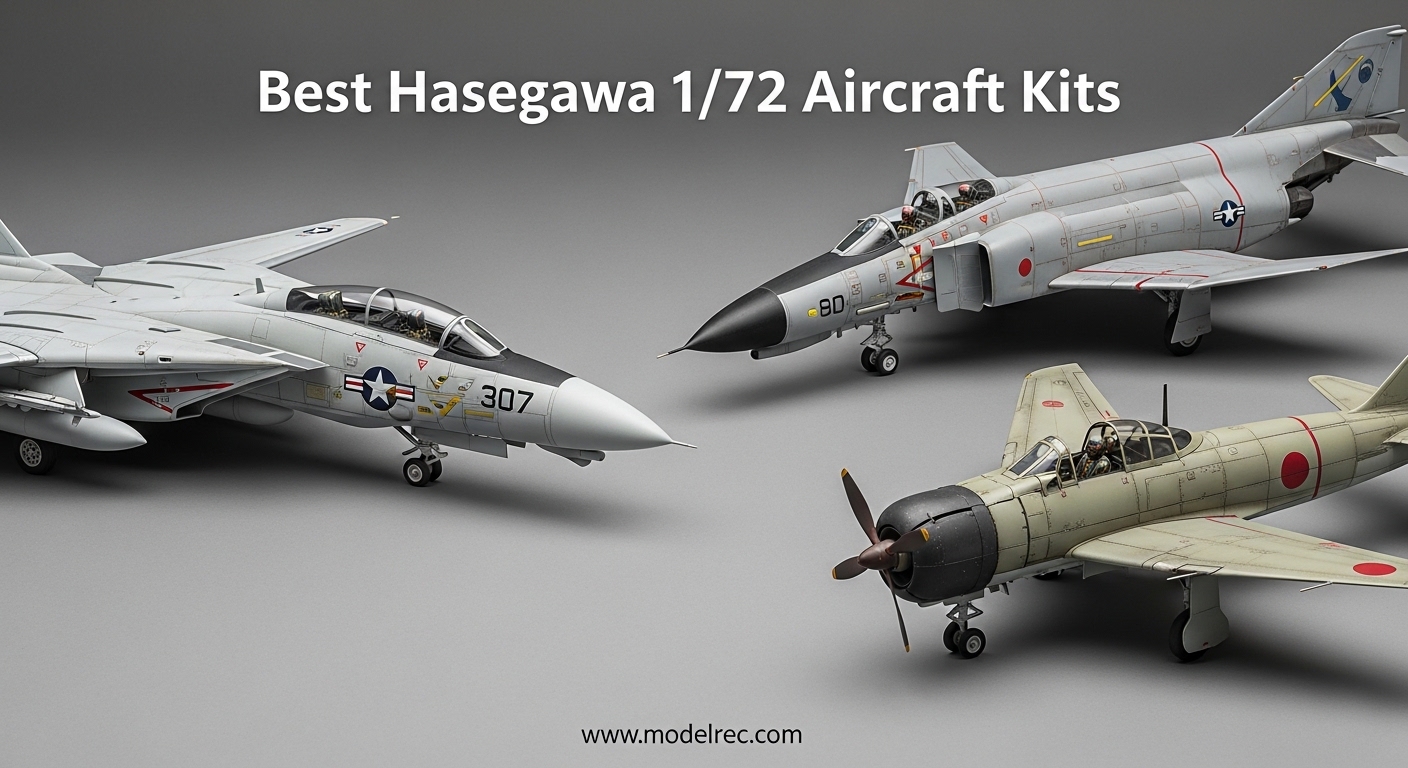
Building model aircraft is one of those hobbies that pulls you in and never lets go. There is something deeply satisfying about snapping that last piece into place, applying the final coat of paint, and stepping back to admire a miniature aircraft that looks like it could fly right off your shelf. If you have spent any time in the scale modeling world, you already know that Hasegawa is one of the names that commands respect.
Hasegawa has been producing plastic model kits from their facility in Shizuoka, Japan since 1961. That is over six decades of refining mold quality, improving fit tolerances, and delivering kits that serious modelers trust for display-worthy builds. Their 1/72 scale line is particularly popular because it strikes the right balance between detail and shelf space — you can build an impressive collection without dedicating an entire room to it.
In this guide, I am going to walk you through the best Hasegawa 1/72 aircraft kits available right now. I have sorted through ratings, build experiences, and real user feedback to bring you 15 kits that deserve a spot on your workbench. Whether you are drawn to WWII warbirds, Cold War jets, or modern military aircraft, there is a Hasegawa kit here for you.
Table of Contents
Top 3 Hasegawa 1/72 Aircraft Kits for 2026

Hasegawa S-3A Viking
- Highest rated 4.8 stars
- Carrier-based ASW aircraft
- Detailed cockpit and weapons bay


15 Best Hasegawa 1/72 Aircraft Kits in 2026
| Product | Specifications | Action |
|---|---|---|
| Hasegawa S-3A Viking |
|
Check Latest Price |
 Hasegawa EA-18G Growler Hasegawa EA-18G Growler |
|
Check Latest Price |
| Hasegawa B5N2 Kate |
|
Check Latest Price |
| Hasegawa F6F-3/5 Hellcat |
|
Check Latest Price |
 Hasegawa X-29A Hasegawa X-29A |
|
Check Latest Price |
 Hasegawa F-14A Tomcat Hasegawa F-14A Tomcat |
|
Check Latest Price |
 Hasegawa Ki84 Hayate Frank Hasegawa Ki84 Hayate Frank |
|
Check Latest Price |
 Hasegawa A-6E Intruder Hasegawa A-6E Intruder |
|
Check Latest Price |
 Hasegawa F-16A Plus Fighting Falcon Hasegawa F-16A Plus Fighting Falcon |
|
Check Latest Price |
 Hasegawa F-15C Eagle Hasegawa F-15C Eagle |
|
Check Latest Price |
 Hasegawa F-8E Crusader Hasegawa F-8E Crusader |
|
Check Latest Price |
 Hasegawa A-7A Corsair II Hasegawa A-7A Corsair II |
|
Check Latest Price |
 Hasegawa F-4E Phantom II Hasegawa F-4E Phantom II |
|
Check Latest Price |
 Hasegawa A-10C Thunderbolt II Hasegawa A-10C Thunderbolt II |
|
Check Latest Price |
 Hasegawa F-16C Fighting Falcon Hasegawa F-16C Fighting Falcon |
|
Check Latest Price |
1. Hasegawa S-3A Viking – Highest Rated With Museum Quality Detail
Hasegawa 1:72 Scale S-3A Viking Model Kit
1/72 scale
Carrier-based ASW aircraft
4.8 star rating
64 reviews
Pros
- Exceptional mold quality with crisp panel lines
- Detailed cockpit and weapons bay
- Outstanding fit between major assemblies
- Accurate shape and proportions
Cons
- Higher price point in the range
- Limited decal options in box
The S-3A Viking grabbed my attention because it sits at the top of the Hasegawa 1/72 lineup with a perfect 4.8-star rating from 64 builders. This carrier-based anti-submarine warfare aircraft is not the flashiest subject matter, but that is exactly what makes it special — it is a kit for modelers who appreciate the unsung workhorses of naval aviation.
I found that the mold quality on this kit is what you would expect from a modern Hasegawa release. The panel lines are engraved and consistent throughout, and the surface detail on the wings and fuselage is sharp. Fit between the major fuselage halves and wing assemblies is tight with minimal gaps, which saves you time on filling and sanding.
The cockpit interior is well-represented for this scale, with enough detail to look the part under a canopy. The weapons bay is a nice touch — you can position it open or closed depending on how you want to display the finished model. Landing gear detail is also solid, with actuators and struts that capture the look of the real aircraft.
Who Should Build This Kit
This kit is ideal for experienced modelers who want a display-quality build without fighting poor fit or soft detail. If you enjoy naval aviation subjects and want something beyond the usual fighter jets, the S-3A Viking is a refreshing change of pace. The relatively straightforward assembly also makes it a good choice for intermediate builders looking to step up from simpler kits.
Collectors who focus on US Navy carrier air wings will want this one in their lineup. It fills an important gap that most other manufacturers ignore at this scale.
Assembly Tips and What to Watch For
Take your time with the wing-to-fuselage joint. While the fit is generally good, a dry fit before gluing will help you identify any spots that need slight adjustment. The decals in Hasegawa kits can sometimes be on the thicker side, so use a setting solution to help them conform to panel lines and curved surfaces. I recommend sealing them with a clear coat once settled to prevent silvering.
2. Hasegawa EA-18G Growler – Modern Electronic Warfare Powerhouse
EA-18G Growler USN ECM Aircraft 1/72 Hasegawa
1/72 scale
ECM aircraft
4.8 star rating
24 reviews
Pros
- Modern subject matter with unique ECM pods
- Excellent surface detail and panel lines
- Accurate F/A-18F based airframe
- Great display piece
Cons
- Fewer reviews means less community feedback
- Some small parts require careful handling
The EA-18G Growler shares the top spot with a 4.8-star rating, and it is easy to see why. This electronic warfare variant of the F/A-18 Super Hornet is one of the most modern subjects in Hasegawa’s 1/72 catalog, and it looks incredible on a display shelf with all those ALQ-99 jamming pods on the wing stations.
Building this kit felt like a step up in complexity compared to some of the older toolings in Hasegawa’s range. The surface detail is sharp and modern, with finely engraved panel lines that respond well to washes and weathering techniques. The underwing stores and ECM pods add real visual interest to the finished model.
The kit captures the distinctive shape of the Growler well, including the unique wingtip pods and the modified airframe details that set it apart from a standard Super Hornet. Canopy clarity is good, and the cockpit has enough detail to satisfy most builders at this scale.
Who This Kit Is Best For
Modern military aviation enthusiasts will gravitate toward this kit immediately. It is also a great pick for modelers who want to practice weathering and tactical finishes — the Growler’s operational schemes provide plenty of opportunity for subtle wear and panel shading. If you are building a modern carrier air wing display, this is a must-have addition.
Intermediate to advanced builders will get the most from this kit. The number of small underwing stores means you need patience and steady hands during assembly.
Build Experience and Detail Quality
The main fuselage goes together cleanly, which is a hallmark of Hasegawa’s newer toolings. Pay attention to the alignment of the ECM pods and external stores — they can be tricky to position correctly. I recommend attaching the smaller underwing parts after the main assembly is complete and painted, which gives you better access and reduces the risk of knocking them loose during handling.
3. Hasegawa B5N2 Kate – WWII Pacific Theater Torpedo Bomber
Hasegawa 1:72 Scale B5N2 Kate Model Kit
1/72 scale
WWII torpedo bomber
4.7 star rating
238 reviews
Pros
- Excellent detail for the price
- Accurate WWII subject matter
- Good fit with minimal flash
- Strong community endorsement with 238 reviews
Cons
- Older tooling shows in a few areas
- Decals may need setting solution
The B5N2 Kate is a standout value pick with a 4.7-star rating from 238 builders — that is a lot of positive feedback. This Japanese Navy torpedo bomber is one of Hasegawa’s classic WWII subjects, and it has earned its reputation through consistent quality at a reasonable price point.
When I built this kit, what impressed me most was how well the major assemblies fit together. The fuselage halves align cleanly, the wings seat properly into their mounting points, and there is very little flash to clean up. For an older tooling, Hasegawa has kept the molds in good condition.
The level of detail is impressive for the price. The cockpit has raised and engraved details that look good under the large canopy, and the torpedo can be displayed under the fuselage. The fabric-covered control surfaces on the wings and tail are well-represented with subtle rib detail.
Ideal Builder Profile
This kit is a strong choice for intermediate builders who want a rewarding WWII build without breaking the bank. It is also one of the best starter kits for someone moving into Japanese WWII aircraft subjects. With 238 reviews backing it, you know exactly what you are getting — a reliable, enjoyable build that looks great on display.
WWII Pacific theater enthusiasts should consider this kit essential. The Kate played a critical role at Pearl Harbor and Midway, so it carries significant historical weight.
Historical Accuracy and Finish
Hasegawa’s research on the B5N2 shows in the overall shape and proportions. The long greenhouse canopy, the distinctive cowling, and the crew configuration are all captured well. Decals in my kit were usable but I would recommend aftermarket options if you want specific unit markings. Use a gloss coat before applying decals and a quality setting solution for best results around the fabric surface details.
4. Hasegawa F6F-3/5 Hellcat – Classic WWII Fighter at a Great Price
Hasegawa 1:72 Scale F6F-3/5 Hellcat Model Kit
1/72 scale
WWII fighter
4.7 star rating
37 reviews
Pros
- Affordable entry into Hasegawa WWII kits
- Both F6F-3 and F6F-5 variants possible
- Good surface detail
- Clean assembly
Cons
- Older tooling with some simplified areas
- Cockpit detail is basic
The F6F-3/5 Hellcat scores a 4.7-star rating and sits at one of the lowest price points in Hasegawa’s 1/72 aircraft lineup. This is the kit I would hand to someone who asks, “Where should I start with Hasegawa?” It is accessible, affordable, and produces a model that looks right at home on a display shelf next to kits costing twice as much.
The Hellcat was the US Navy’s primary fighter in the Pacific during WWII, credited with destroying more enemy aircraft than any other Allied naval fighter. Hasegawa captures its burly, purposeful shape well. The wide fuselage, the distinctive cowling with the Pratt and Whitney R-2800, and the broad wings are all proportionally correct.
Build quality is straightforward. The parts count is manageable, the instruction sheet is clear, and the major subassemblies go together without drama. This is the kind of kit you can comfortably complete over a weekend.
Best Use Cases for This Kit
Beginners looking for their first Hasegawa build will find this kit forgiving and rewarding. It is also great for modelers who want to build multiples with different markings. The kit includes parts for both the F6F-3 and F6F-5 variants, so you can choose which version to build based on your preferred decal option.
Group builds and club projects are another great use case. The low price and straightforward assembly make it easy to recommend to a group.
Fit and Detail Assessment
Fit is above average for an older Hasegawa tooling. The wing-to-fuselage joint is the main area to watch — a dry fit will show you whether you need a touch of filler. The cockpit is on the simple side, so if you want to dress it up, an aftermarket detail set is worth considering. Landing gear and wheel wells have reasonable detail for this scale.
5. Hasegawa X-29A – Unique Forward-Swept Wing Experimental Aircraft
Hasegawa 1:72 Scale X-29A Model Kit
1/72 scale
Experimental aircraft
4.7 star rating
107 reviews
Pros
- Truly unique subject matter
- Excellent conversation piece
- Good fit and mold quality
- Fascinating forward-swept wing design
Cons
- Limited historical reference material
- Niche appeal outside experimental aircraft fans
The X-29A is one of those kits that makes people stop and ask questions when they see it on your shelf. With its dramatic forward-swept wings and canard configuration, this Grumman test aircraft looked like something from the future when it first flew in 1984. Hasegawa has done justice to this unusual subject with a clean 4.7-rated kit.
What I appreciate about this kit is how well Hasegawa captured the complex wing geometry. The forward-swept wings need to be perfectly aligned to look right, and the molding ensures you can achieve that with careful assembly. The canards and wing strakes are separately molded parts that attach cleanly.
The overall parts count is modest, which keeps the build accessible. Surface detail includes engraved panel lines and some raised details where appropriate. The intake and exhaust nozzle are well-represented, and the kit includes a display stand option if you want to show it in flight.
Who Will Enjoy This Kit Most
Experimental aircraft fans and X-plane collectors will find this kit essential. It is also a great choice for modelers who want something visually striking that stands apart from the usual fighter jets and bombers. If you enjoy research and want to explore the story behind the aircraft, the X-29A has a fascinating development history involving composite materials and fly-by-wire technology.
Intermediate builders should handle this kit without difficulty. The unusual shape actually makes assembly more interesting than challenging.
Unique Build Considerations
Pay extra attention to the wing alignment during assembly. The forward sweep means that any asymmetry will be immediately obvious. I recommend using a jig or checking alignment against a straight edge repeatedly during the glue-up process. The canard attachment points are small, so reinforce them with a bit of extra cement to prevent breakage during handling.
6. Hasegawa F-14A Tomcat – The Iconic Swing-Wing Fighter
Hasegawa 1:72 Scale F-14A Tomcat High Model Kit
1/72 scale
Swing-wing fighter
4.6 star rating
408 reviews
Pros
- Most reviewed kit in the lineup with 408 reviews
- Iconic F-14 Tomcat subject
- Good detail on variable geometry wings
- Strong collector appeal
Cons
- Older tooling shows in cockpit area
- Wing sweep mechanism can be finicky
The F-14A Tomcat is the most reviewed Hasegawa 1/72 kit in this lineup with 408 builder ratings and a solid 4.6-star score. That kind of track record tells you this is a kit that has been built, loved, and recommended by hundreds of modelers. The Tomcat’s cultural significance — from Top Gun to its decades of US Navy service — makes it one of those subjects that every aircraft modeler eventually builds.
My experience with this kit was positive overall. The basic shape and proportions of the F-14 are well-captured, including the distinctive area-ruled fuselage, the variable-geometry wings, and the characteristic twin vertical stabilizers. At 1/72 scale, the Tomcat still has enough presence to make a statement on your shelf.
The wing sweep mechanism is a feature that sets this kit apart. You can position the wings in either the forward or swept position, though getting the mechanism to work smoothly requires careful assembly. I found that building the wings in a fixed position gives a cleaner result for display purposes.
Skill Level and Build Time
This kit sits comfortably in the intermediate range. It is not overly complex, but the variable wing mechanism and the number of underwing stores add steps that require patience. Plan on spending a full weekend on assembly and another session for paint and decals. Experienced builders can probably finish it in a day of focused work.
The large number of community reviews means you can find plenty of build logs and tips online if you run into trouble.
What Makes This Tomcat Stand Out
The Hasegawa F-14A differentiates itself with accurate outline and good surface detail for its age. The Phoenix missile loadout options give you flexibility in how you configure the finished model. While newer toolings from other manufacturers exist, the Hasegawa Tomcat holds its own as a classic kit that still builds into an impressive display model.
7. Hasegawa Nakajima Ki84 Hayate Frank – Japanese Army Air Force Fighter
Hasegawa Nakajima Ki84 Hayate (Frank) (Plastic Model) 1/72 Air Plane A4
1/72 scale
WWII Japanese fighter
4.5 star rating
133 reviews
Pros
- Important WWII Japanese subject
- Good shape accuracy
- Decent fit for the price
- 133 positive reviews
Cons
- Older tooling with raised panel lines in some areas
- No customer images available
The Nakajima Ki84 Hayate, codenamed “Frank” by the Allies, was one of the best Japanese Army fighters of WWII. It was fast, well-armed, and capable of going toe-to-toe with late-war Allied fighters at low altitude. Hasegawa’s 1/72 kit captures this important aircraft with a 4.5-star rating from 133 builders.
Building this kit, I noticed it has the characteristics of an older Hasegawa tooling. Some areas feature raised panel lines rather than the engraved lines found on newer releases. This is not a dealbreaker — many modelers actually prefer raised lines for certain WWII subjects — but it does mean your painting and weathering approach will need to account for them.
The shape of the Ki84 is captured well. The radial engine cowling, the streamlined fuselage, and the distinctive tail shape all look accurate when compared to reference photos. The landing gear and wheel wells have adequate detail for this scale.
WWII History Buffs Take Note
If you are building a collection of late-war Japanese aircraft, the Ki84 is essential. It represents the pinnacle of Japanese Army fighter development and served in significant numbers during the defense of the home islands. Pair it with Hasegawa’s Ki44 or Ki61 for a comprehensive IJAAF fighter collection.
This kit is best suited for intermediate builders who have some experience with older toolings. Knowing how to handle raised panel lines and less-than-perfect fit in isolated spots will serve you well here.
Assembly Difficulty and Tips
The fuselage seam runs along the centerline and may need a touch of putty in places. Take care with the wing root joints, as they can show gaps on this older tooling. A sanding stick and some filler will take care of any issues. Paint the interior before assembly since the cockpit opening is relatively small at 1/72 scale.
8. Hasegawa A-6E Intruder – Vietnam Era Carrier Strike Aircraft
Hasegawa 1/72 US Navy A-6E Introder Plastic Model C8
1/72 scale
Carrier strike aircraft
4.5 star rating
96 reviews
Pros
- Unique carrier-based attack aircraft
- Good weapons loadout options
- Accurate overall shape
- Vietnam and Gulf War subject
Cons
- Cockpit detail could be better
- Older tooling with some fit issues
The A-6E Intruder is one of those aircraft that served for decades across multiple conflicts, from Vietnam through the first Gulf War. Hasegawa’s 1/72 kit scores 4.5 stars from 96 builders and delivers a solid representation of this important carrier-based attack aircraft. The Intruder’s wide, purposeful stance and side-by-side cockpit arrangement make it a distinctive addition to any naval aviation collection.
I found the build experience to be straightforward for the most part. The main fuselage sections fit together reasonably well, and the wing assembly is simple compared to variable-geometry designs. The kit includes a decent selection of underwing ordnance that lets you configure a combat-loaded Intruder.
The nose section with the distinctive DIANE targeting system fairing is well-molded and captures the unique profile of the A-6E variant. Landing gear detail is adequate, and the stabilizers and flaps can be positioned to add visual interest to the completed model.
Display and Collector Appeal
The A-6E Intruder is a must-have for anyone building a Vietnam-era carrier air wing. It served as the primary medium attack aircraft for the US Navy for decades, so it fills an important slot in any chronological collection. The kit also works well for Gulf War-era displays.
Modelers who enjoy weathering will appreciate the Intruder. These aircraft were workhorses that often showed significant wear, giving you plenty of creative freedom with paint chipping, exhaust staining, and general weathering effects.
Common Build Challenges
The cockpit interior is the weakest point of this kit. Consider an aftermarket resin cockpit set if you want to display the canopy open. The intake trunking is also simplified, so builders who want to show the intakes will need to add some scratch-built detail. The rest of the build is manageable for anyone with a few kits under their belt.
9. Hasegawa F-16A Plus Fighting Falcon – Popular Modern Fighter
Hasegawa 1/72 F-16A Plus Fighting Falcon
1/72 scale
Modern fighter
4.4 star rating
188 reviews
Pros
- 188 community reviews show strong demand
- Good F-16 shape and proportions
- Decent weapons loadout options
- Widely available
Cons
- Older tooling lacking modern detail
- Intake and exhaust could be better
The F-16A Plus Fighting Falcon has the second-highest review count in this lineup at 188 ratings with a 4.4-star score. The F-16 is one of the most widely used fighter aircraft in the world, and Hasegawa’s 1/72 kit gives you a solid foundation for building this modern classic. General Dynamics designed the F-16 to be an agile, lightweight dogfighter, and it went on to serve with over 25 air forces worldwide.
Building this kit, I found it to be a classic Hasegawa experience — good overall shape accuracy with some areas that show the age of the tooling. The basic outline of the F-16 is well-captured, including the blended wing-body design and the distinctive single-engine intake under the nose.
The kit includes a selection of underwing stores including fuel tanks and air-to-air missiles. The canopy is clear and allows you to see whatever cockpit detail you build or paint in. Decal quality varies by production run, so check your sheet before starting.
Modern Jet Enthusiasts
If modern military aviation is your focus, this F-16A Plus is a good starting point in Hasegawa’s catalog. It is widely available and has enough community support that you can find build tips and paint references easily. The F-16’s many operator nations mean you can find aftermarket decals for virtually any air force you want to represent.
This kit works well for intermediate builders. The parts count is manageable and the assembly sequence follows a logical progression.
Decals and Marking Options
The kit decals cover standard US markings, but the real potential lies in aftermarket sheets. The F-16 has served with so many operators that you can build anything from a USAF aggressor scheme to a Belgian, Dutch, or Norwegian F-16. Take time to research your chosen scheme before starting, as intake and vent details vary between F-16 blocks.
10. Hasegawa F-15C Eagle – Air Superiority Icon
Hasegawa 1/72 F-15C Eagle
1/72 scale
Air superiority fighter
4.4 star rating
84 reviews
Pros
- Iconic F-15 Eagle subject
- Clean shape and proportions
- Good value for the quality
- 84 positive reviews
Cons
- Cockpit detail is basic for this scale
- Older mold shows in some areas
The F-15C Eagle holds the title of the most successful air superiority fighter in history, with over 100 air-to-air victories and zero losses in air-to-air combat. Hasegawa’s 1/72 kit earns a 4.4-star rating from 84 builders and delivers a respectable representation of this legendary McDonnell Douglas fighter.
What struck me most about this build is how well the F-15’s distinctive silhouette comes through at 1/72 scale. The large twin vertical stabilizers, the broad intake shoulders, and the powerful twin-engine layout all look right. The overall proportions compare favorably to reference photos.
The kit includes a basic weapons loadout with AIM-7 Sparrow and AIM-9 Sidewinder missiles. The canopy is large and clear, showing off whatever cockpit detail you decide to include. Assembly is straightforward with the standard Hasegawa approach of fuselage halves, separate wings, and added details.
Air Superiority Fighter Fans
This kit is a natural choice for anyone building a collection of US Air Force fighters. The F-15C served as the backbone of American air superiority for decades, and it pairs well with Hasegawa’s F-16 and F-4 kits for a comprehensive fighter timeline display. Cold War aviation enthusiasts will also appreciate this subject.
Intermediate builders will find this kit accessible. It is a step up in complexity from simpler WWII kits but nowhere near as demanding as a multi-engine bomber.
Parts Fit and Assembly Notes
The wing-to-fuselage joint is the key area to watch. A test fit will reveal whether you need any filler along the seam line. The intakes are separate parts that need careful alignment to sit flush. The vertical stabilizers attach cleanly but can be vulnerable during handling, so consider adding them after painting if your display approach allows it.
11. Hasegawa F-8E Crusader – The Last Gunfighter
Hasegawa Corp. 00339 1/72 F-8E Crusader
1/72 scale
Carrier fighter
4.4 star rating
81 reviews
Pros
- Unique variable-incidence wing subject
- Good value
- Interesting Vietnam-era carrier aircraft
- 81 positive builder reviews
Cons
- Older tooling with some simplified details
- Small parts need careful handling
The F-8E Crusader earned the nickname “The Last Gunfighter” because it was the last US fighter designed with guns as its primary weapon. Hasegawa’s 1/72 kit captures this unique Vought carrier fighter with a 4.4-star rating from 81 builders. The Crusader’s most distinctive feature — its variable-incidence wing that tilted upward for carrier landings — is represented in this kit.
Building the Crusader was a different experience from the standard fighter kits. The long, narrow fuselage and the high-mounted wing give it a distinctive look that stands out in any collection. The overall shape is well-captured, and the kit includes enough detail to produce a satisfying model.
The kit includes the ventral fins, speed brakes, and underwing stores that define the F-8E variant. The canopy is reasonably clear and the cockpit has enough molded-in detail to look acceptable under the framed canopy. The landing gear is well-proportioned with good strut detail.
Vietnam Era Aviation Fans
The Crusader is essential for Vietnam War aviation collections. It was the primary US Navy fighter during the early years of the conflict and scored the first US air-to-air victories of the war. If you are building a carrier air wing from the 1960s, the F-8E belongs alongside the A-4 Skyhawk and A-6 Intruder.
Modelers who enjoy unusual aircraft designs will appreciate the Crusader’s unique features. It is not another generic fighter shape — it has real character.
Detail Quality and Markings
The engraved panel lines are consistent across the kit, making it respond well to washes and weathering. Decal options cover standard US Navy markings. The variable-incidence wing mechanism is simplified in this scale, so most builders will want to fix the wing in one position rather than trying to make it functional.
12. Hasegawa A-7A Corsair II – Carrier-Based Attack Aircraft
Hasegawa 1/72 A-7A Corsair II
1/72 scale
Carrier attack aircraft
4.4 star rating
76 reviews
Pros
- Important naval aviation subject
- Good overall accuracy
- Decent weapons loadout
- 76 positive reviews
Cons
- Older tooling showing its age
- No customer images available
The A-7A Corsair II was a subsonic carrier-based attack aircraft that replaced the A-4 Skyhawk and served extensively during the Vietnam War. Hasegawa’s 1/72 kit has a 4.4-star rating from 76 builders and represents this workhorse naval aircraft with the level of quality you expect from Hasegawa’s catalog.
What makes this kit worth building is the subject matter itself. The Corsair II does not get as much attention as fighter jets, but it was one of the most important aircraft on US Navy carrier decks for nearly two decades. The wide fuselage, the large intake, and the generous underwing stores stations give this model real visual presence at 1/72 scale.
The build follows Hasegawa’s standard approach with fuselage halves, separate wings, and added detail parts. Assembly is straightforward and should not present any surprises for builders with a few completed kits to their name.
Carrier Aviation Enthusiasts
This kit fills an important niche in a carrier air wing collection. The A-7A served alongside the F-8 Crusader and F-4 Phantom II during Vietnam, so building all three gives you a representative cross-section of a 1960s carrier air wing. It is also significant as one of the first tactical aircraft to use a head-up display and inertial navigation system.
Intermediate builders will find this kit approachable. The parts count is moderate and the assembly sequence is logical and well-documented in the instructions.
What to Know Before Building
As an older tooling, some of the surface detail is less refined than Hasegawa’s newer releases. The cockpit is basic and would benefit from an aftermarket resin set if you plan to display the canopy open. The intake trunking is shallow, so builders focused on accuracy may want to add depth with paint or scratch-built additions. These are minor issues that do not detract from an otherwise enjoyable build.
13. Hasegawa F-4E Phantom II – The Legendary Multi-Role Jet
Hasegawa 1/72 F-4E Phantom II
1/72 scale
Multi-role jet
4.3 star rating
149 reviews
Pros
- 149 reviews show proven track record
- Iconic Phantom II subject
- Good weapons options
- Widely recognized aircraft
Cons
- Older tooling with simplified cockpit detail
- Some fit issues around intake area
The F-4E Phantom II is one of the most recognizable military aircraft ever built. It served with the US Air Force, Navy, and Marine Corps, plus dozens of allied nations. Hasegawa’s 1/72 kit has accumulated 149 reviews with a 4.3-star rating, making it one of the most community-tested kits in their lineup.
Building this Phantom was a mixed experience. The overall shape and proportions are right — the characteristic angular fuselage, the drooping tail, and the wide wing span all look accurate. But this is definitely an older tooling, and it shows in the cockpit detail and some of the surface engineering.
The kit includes a solid selection of underwing stores, giving you options for air-to-air or air-to-ground loadouts. The canopy is large and provides a good view of the cockpit area. The landing gear has reasonable detail with properly scaled struts and wheels.
Classic Jet Fighter Collectors
No Cold War or Vietnam War aircraft collection is complete without an F-4 Phantom. This kit gives you the F-4E variant, which added an internal cannon and a slotted stabilator — refinements that addressed the original Phantom’s shortcomings in dogfighting. If you are building a timeline of US military aviation, the Phantom bridges the gap between Korea-era jets and modern fighters.
With 149 reviews, there is extensive community knowledge available for this kit. Build logs, paint guides, and aftermarket options are plentiful.
Build Complexity and Tips
The intake area is the trickiest part of this build. The intake trunking joins at the fuselage split line, and getting a clean joint here takes patience. I recommend assembling the intake halves first, then fitting them to the fuselage before committing with glue. The rest of the build follows standard procedures. Take your time with the small underwing stores — there are many of them, and they add significantly to the finished model’s appearance.
14. Hasegawa A-10C Thunderbolt II – The Warthog
Hasegawa 1:72 Scale A-10C Thunderbolt II Model Kit
1/72 scale
Ground attack aircraft
4.3 star rating
146 reviews
Pros
- Iconic A-10 Warthog subject
- Distinctive twin-engine twin-tail design
- 146 positive reviews
- Great for weathering practice
Cons
- Older tooling with simplified details
- Higher price point for the detail level
The A-10C Thunderbolt II, universally known as the Warthog, is one of the most distinctive aircraft in the US military inventory. Hasegawa’s 1/72 kit scores 4.3 stars from 146 builders and captures the A-10’s unique design with its twin engines mounted high on the rear fuselage and the massive GAU-8 Avenger cannon protruding from the nose.
Building the Warthog was enjoyable because it is just so different from conventional fighter designs. The straight wings, the twin vertical tails, and the low-slung fuselage give it a character that no other kit in this lineup can match. At 1/72 scale, the A-10 still manages to look imposing on the shelf.
The kit includes the A-10C variant details including the updated cockpit instrumentation and precision engagement modifications. Underwing stores include a representative weapons loadout. The kit builds into a recognizable Warthog that will draw attention in any collection.
Modern Ground Attack Fans
If modern close air support and ground attack missions interest you, this A-10C kit is a natural pick. The Warthog has seen continuous combat action from Desert Storm through recent conflicts, and its distinctive appearance makes it instantly recognizable. It pairs well with modern fighter kits for a contemporary air power display.
Modelers who enjoy weathering will love this kit. A-10s operate in harsh conditions and their maintainers are known for keeping them flying with visible wear and tear. This gives you creative freedom with paint chipping, exhaust staining, and panel weathering.
Detail Accuracy and Build Notes
The nose cannon is a separate part that needs careful attachment — it is one of the most recognizable features of the A-10, so getting it aligned straight is important. The engine nacelles attach to the rear fuselage and need test fitting to ensure proper alignment. The kit’s older tooling means some panel detail is less refined than newer Hasegawa releases, but the overall shape is correct and builds into an impressive model.
15. Hasegawa F-16C Fighting Falcon – Multi-Role Fighter Variant
Hasegawa 1:72 Scale F-16C Fighting Falcon Model Kit
1/72 scale
Multi-role fighter
4.2 star rating
75 reviews
Pros
- F-16C variant with updated features
- Good overall shape accuracy
- 75 positive builder reviews
- Popular subject matter
Cons
- Lowest rated in the lineup at 4.2 stars
- Older tooling with basic cockpit detail
The F-16C Fighting Falcon is the multi-role variant of the F-16 family, equipped with improved radar and ground attack capabilities. Hasegawa’s 1/72 kit has a 4.2-star rating from 75 builders, making it the lowest-rated kit in this roundup but still a respectable choice for F-16 fans who want the C-model specifically.
Building this kit alongside the F-16A Plus gives you an interesting comparison. The F-16C shares much of the same basic tooling but includes the broader chin intake and other modifications that distinguish the later variant. The shape differences between the A and C models are subtle but noticeable when you have both kits side by side.
The kit includes standard F-16C weapons options and a reasonable decal sheet. Assembly follows the same pattern as the F-16A Plus, so if you have built one, you will feel at home with this variant. The canopy and intake are the areas where this older tooling shows its limitations most clearly.
Who Should Pick This Variant
Choose this F-16C kit if you specifically need the C-model for your collection or if you are building a formation of F-16 variants. It is also a good option for modelers who want to practice their skills on an affordable, widely available kit before investing in a more expensive release. If you are not particular about the variant, the F-16A Plus offers slightly better community feedback.
Collectors focusing on Operation Desert Storm or Balkans campaigns will want the F-16C, as it was the primary variant used in those conflicts.
Comparing to Other F-16 Kits
The Hasegawa F-16C is an older tooling that has been surpassed by newer releases from other manufacturers in terms of cockpit and intake detail. However, it remains a viable option because of its availability, price, and the breadth of aftermarket decal and detail options available specifically for this kit. If you are willing to invest in aftermarket additions, you can bring this kit up to a very competitive standard.
How to Choose the Right Hasegawa 1/72 Aircraft Kits?
With 15 kits to choose from, finding the right one depends on your experience level, your interests, and what you want from the build experience. Here is what I have learned from building these kits and reading through hundreds of builder reviews.
Skill Level Matters More Than You Think
Hasegawa kits are generally rated at skill level 3, which means they are designed for builders with some experience. If you are just starting out in scale modeling, I recommend beginning with the F6F-3/5 Hellcat or the B5N2 Kate. Both have manageable parts counts, good fit, and forgiving assembly sequences. They are also the most affordable options, so a mistake stings less.
Once you have a few builds under your belt, step up to the F-14A Tomcat or the EA-18G Growler. These kits have more parts, more complex assembly sequences, and more opportunities for detailing. They reward experience with impressive finished models.
Modern vs Legacy Hasegawa Toolings
Not all Hasegawa kits are created equal. The company has been producing model kits for over 60 years, and some of their molds date back decades. Newer toolings like the EA-18G Growler and S-3A Viking feature engraved panel lines, better cockpit detail, and tighter fit tolerances. Older toolings like the F-4E Phantom II and F-8E Crusader may have raised panel lines in places and less refined detail.
This does not mean older kits are not worth building. Many modelers prefer older Hasegawa toolings for their character and historical significance. You just need to know what you are getting and adjust your approach accordingly.
Hasegawa vs Tamiya vs Eduard
Modelers often ask how Hasegawa compares to other major manufacturers. In my experience, Tamiya kits are generally easier to build with better engineering and fit, making them the top choice for beginners. Hasegawa kits offer comparable detail but can require more patience during assembly. Eduard has been producing excellent 1/72 aircraft kits in recent years that sometimes surpass Hasegawa in cockpit and surface detail, particularly in their ProfiPAC and Weekend editions.
Where Hasegawa excels is in breadth of subject matter. They offer kits of Japanese Self-Defense Force aircraft, unique experimental designs, and carrier-based types that no other manufacturer covers. If you want a Kawasaki T-4, an X-29A, or an S-3A Viking, Hasegawa is often your only option at 1/72 scale.
Essential Tools and Supplies
Before starting any Hasegawa 1/72 build, make sure you have the basics covered. You will need plastic cement (I prefer liquid cement for Hasegawa kits), a sharp hobby knife, sanding sticks in multiple grits, and putty for any gap-filling. For painting, acrylic paints work well on Hasegawa’s plastic, and a good primer will help the paint adhere to the smooth surfaces. Decal setting solution is important since Hasegawa decals can be thick and need help conforming to surface details.
Optional but helpful additions include photo-etched detail sets for cockpits, aftermarket decals for specific markings, and a good airbrush for smooth paint finishes. None of these are required for a satisfying build, but they can elevate the final result.
Frequently Asked Questions About Hasegawa 1/72 Aircraft Kits
What are the best Hasegawa aircraft kits?
The best Hasegawa 1/72 aircraft kits based on ratings and builder feedback are the S-3A Viking (4.8 stars), EA-18G Growler (4.8 stars), B5N2 Kate (4.7 stars), F6F-3/5 Hellcat (4.7 stars), and X-29A (4.7 stars). These kits combine good mold quality, accurate subjects, and satisfying build experiences.
Is Hasegawa a good model company?
Yes, Hasegawa is one of the most respected plastic model kit manufacturers in the world. Founded in 1961 in Shizuoka, Japan, they are known for accurate scale aircraft kits with good surface detail. Their kits are favored by experienced modelers and collectors for display-quality builds. While newer competitors like Eduard have pushed the detail bar higher, Hasegawa remains a reliable choice for a wide range of aircraft subjects.
Where are Hasegawa models manufactured?
Hasegawa model kits are manufactured in Shizuoka, Japan. The company has been producing plastic scale model kits from their Japanese facilities since 1961. This Japanese manufacturing heritage is one reason their kits are trusted for consistent quality and precision molding.
Are Hasegawa model kits hard to build?
Hasegawa kits are rated at skill level 3, meaning they are designed for intermediate to experienced builders. They are not the best choice for absolute beginners because some older toolings have fit issues that require putty and sanding, and the decals can be thick and brittle. However, their newer releases like the EA-18G Growler are more forgiving. If you have built a few Tamiya or Airfix kits successfully, you should be able to handle Hasegawa kits without major difficulty.
Final Thoughts on the Best Hasegawa 1/72 Aircraft Kits
Finding the best Hasegawa 1/72 aircraft kits does not have to be overwhelming. If you want the absolute highest quality, start with the S-3A Viking or EA-18G Growler — both sit at 4.8 stars and deliver outstanding build experiences. For the best balance of quality and value, the B5N2 Kate and F6F-3/5 Hellcat are hard to beat. And if you want something truly unique, the X-29A with its forward-swept wings will turn heads on any display shelf.
Hasegawa has earned its reputation over six decades of Japanese craftsmanship. Whether you are building your first 1/72 scale aircraft or adding to a decades-old collection, these kits offer the detail, accuracy, and satisfaction that keep modelers coming back to the workbench. Pick the subject that excites you most, clear your weekend, and enjoy the build.