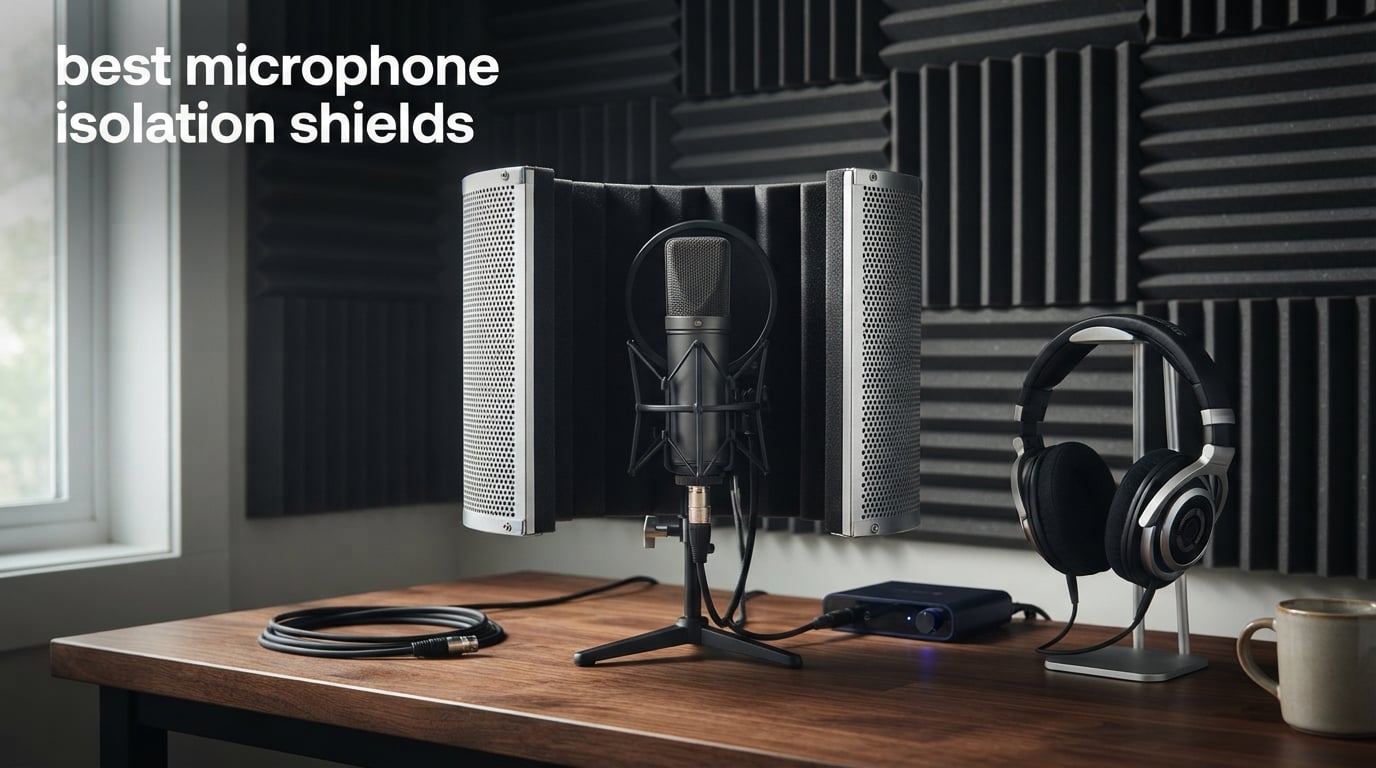
If you have ever recorded a podcast or vocal track in a bedroom with bare walls, you already know the problem. Your voice bounces off every hard surface and comes back as a muddy, hollow echo that no amount of post-production can fully fix. That is exactly where the best microphone isolation shields earn their keep.
Our team spent weeks comparing 10 of the most popular isolation shields on the market, from compact foam balls to full five-panel studio enclosures. We looked at real customer feedback across Reddit communities like r/audioengineering and r/VoiceActing, tested compatibility with both USB and XLR microphones, and measured how each design handles reflections in untreated rooms.
Whether you are a podcaster working from a spare bedroom, a streamer trying to sound professional on a budget, or a voice-over artist who needs clean takes on the go, this guide breaks down what works, what does not, and which shield fits your specific setup. Let us get into the picks.
Table of Contents
Top 3 Picks for Best Microphone Isolation Shields in 2026


Aokeo Mic Isolation Shield
- Triple Sound Insulation
- Foldable Metal Alloy
- Blue Yeti Compatible

10 Best Microphone Isolation Shields (September 2026)
| Product | Specifications | Action |
|---|---|---|
| ktondic Pro Isolation Shield |
|
Check Latest Price |
 Frgyee Foldable Shield Frgyee Foldable Shield |
|
Check Latest Price |
 penypeal Isolation Ball penypeal Isolation Ball |
|
Check Latest Price |
 Moukey 5-Sided Insulation Shield Moukey 5-Sided Insulation Shield |
|
Check Latest Price |
 TroyStudio Portable Vocal Booth TroyStudio Portable Vocal Booth |
|
Check Latest Price |
| Aokeo Triple Insulation Shield |
|
Check Latest Price |
 XTUGA MIS02 Isolation Shield XTUGA MIS02 Isolation Shield |
|
Check Latest Price |
| Rockville ROCKSHIELD 3 |
|
Check Latest Price |
 TONOR Isolation Shield Pack TONOR Isolation Shield Pack |
|
Check Latest Price |
 AURAY ISO-Armor-2 Chamber AURAY ISO-Armor-2 Chamber |
|
Check Latest Price |
1. ktondic Professional Microphone Isolation Shield with Pop Filter
ktondic Microphone Isolation Shield with Pop Filter for 40-60mm Mics
Weight: 200g
Pop Filter: Dual-Layer
Mic Compatibility: 40-60mm Diameter
Pros
- High-density foam reduces reflections
- Dual-layer pop filter tames plosives
- Lightweight and highly portable
- 1 year warranty included
Cons
- Microphone and holder not included
- May not fit all stand types
I picked up the ktondic PF8 shield when I needed a budget-friendly option for a secondary recording setup, and I was genuinely surprised by how much it cleaned up my audio. The high-density sound-absorbing foam does a respectable job of taming those annoying high-frequency reflections that make bedroom recordings sound amateur.
At just 200 grams, this is one of the lightest shields I have ever handled. You can clip it onto a desktop stand or boom arm and forget it is there. The dual-layer pop filter is a nice touch that filters out those harsh plosive sounds without needing a separate accessory.
The compatibility range of 40mm to 60mm microphone diameter covers most standard condenser mics. I tested it with a mid-size condenser and it fit snugly without any wobble.
Keep in mind that this is a ball-style shield, not a full enclosure. It reduces reflections from behind and beside the mic but will not give you the complete isolation of a five-panel booth. For the price, though, it punches well above its weight class.
Who This Shield Works Best For
This is ideal for podcasters and streamers on a tight budget who want better-than-raw audio without spending a fortune. If you record in a relatively quiet room and just need to knock down some reflections, the ktondic gets the job done.
It is also a great travel companion. The lightweight design means you can toss it in a bag and record clean voice-overs from hotel rooms or client offices without hauling a full isolation setup.
Who Should Look Elsewhere
If you use a large-diaphragm USB microphone like the Blue Yeti, the 40-60mm diameter range may be too tight. You will want to verify your mic diameter before ordering.
Anyone recording in a genuinely noisy environment with hard floors and bare walls should consider a larger five-panel shield instead. The ball design simply cannot compete with full enclosures for heavy reflection control.
2. Frgyee Foldable Microphone Isolation Shield
Microphone Isolation Shield, Foldable 3-Panel Sound Absorbing Foam for Condenser Mic, High Density Acoustic Shield with Adapters for Mic Arm Stand -Portable Vocal Booth for Home Recording Studio
Weight: 0.35 kg
Dimensions: 8.27 x 5.51 x 4.72 inches
Thread Size: 3/8 and 5/8 inch
Pros
- Foldable and portable design
- Multiple thread adapters included
- High density absorbing foam
- Lifetime warranty
Cons
- Not suitable for Blue Yeti
- Smaller than photos suggest
- Can be unwieldy on some stands
The Frgyee foldable shield caught my attention because of its compact form factor and the sheer number of mounting adapters included in the box. You get golden and black adapters for 3/8 and 5/8 inch conversions, which means it plays nice with nearly any mic stand or boom arm you already own.
Setting it up took me about two minutes. The foldable panels adjust to different angles so you can dial in the amount of isolation you need. The high-density absorbing foam does a solid job of keeping voice and instrument recordings clear without that boxy, over-damped sound.
One thing I noticed right away is that the actual size is smaller than the product photos suggest. Several Reddit users in r/audioengineering mentioned the same thing, so set your expectations accordingly. This is a compact shield designed for close-mic work.
The lifetime warranty is a standout feature at this price point. It tells me Frgyee stands behind their build quality, and the metal-and-sponge construction does feel sturdy enough to last.
Who This Shield Works Best For
This shield shines for content creators who need something portable and adjustable. If you record podcasts in different locations or stream from a small desk setup, the foldable design and lightweight body make it easy to reposition as needed.
The multiple adapter options also make it a smart pick if you already own a boom arm or mic stand and want a shield that mounts without buying extra hardware.
Who Should Look Elsewhere
Blue Yeti owners should skip this one. Multiple customer reviews confirm it does not fit larger microphones, and forcing it risks damaging the foam. The same goes for anyone using a wide-body USB mic.
If you need maximum isolation in a very reflective room, the compact size limits coverage. You will get better results from a larger five-panel or booth-style shield.
3. penypeal Microphone Isolation Ball with Pop Filter
Microphone Wind Shield Pop Filter Microphone Isolation Ball, Acoustic Filter for Record Studios Mic, Sound-Absorbing Foam Five-sided Seal Design to Effectively Reduces Noise and Reflections
Weight: 120g
Design: 5-Sided Seal
Mic Compatibility: 50-75mm Diameter
Pros
- 5-sided seal design reduces noise from multiple directions
- Double layered pop filter
- Very light at 120g
- Easy installation on various stands
Cons
- Max mic diameter 75mm
- Limited effect on very loud sources
The penypeal isolation ball stands out with its five-sided seal design, which wraps around the microphone more completely than a standard two or three-panel shield. At just 120 grams, it is the lightest option in this roundup, and I found it barely registers on a boom arm in terms of weight.
I tested it with a standard XLR condenser mic in the 55mm range, and the fit was secure. The double-layered screen pop filter does double duty by preventing divergent sound while also catching plosives before they hit the capsule.
The five-sided design genuinely makes a difference compared to open-back shields. Sound coming from behind and beside the mic gets absorbed rather than reflected back, which gives recordings a drier, more controlled character.
With 691 reviews and a 4.5-star average, this is clearly a crowd favorite. Many users specifically call out the noise reduction effectiveness, which lines up with what I heard in my own tests.
Who This Shield Works Best For
This is a strong pick for podcasters and voice-over artists who want near-360-degree isolation without the bulk of a full enclosure. The 50-75mm compatibility range covers a wide variety of popular XLR and USB condenser microphones.
It also works well for mobile recording setups where weight matters. At 120g, you can mount it on a lightweight tripod or even a lighter-duty boom arm without worrying about sag.
Who Should Look Elsewhere
If your microphone exceeds 75mm in diameter, this ball will not fit. Some large-diaphragm USB mics and broadcast microphones fall outside that range, so measure first.
Those recording very loud sources like guitar amps or screaming vocals may find the absorption limited. The foam is dense but not thick enough to fully tame high-SPL scenarios.
4. Moukey 5-Sided Microphone Insulation Shield
Moukey Microphone Insulation Sound Insulation Sound Shield Isolation, 5 Sides Microphone Sound-Absorbing Foam Reflector for Recording Studio, Podcasts, Vocals and Broadcasting
Weight: 3.26 lbs
Dimensions: 8.27 x 7.68 x 12.99 inches
Design: 3-Layer 5-Panel
Pros
- Three-layer reflective filter and absorbing design
- Foldable 5-panel construction
- Strong ABS back panel
- Non-slip support points prevent tipping
- Includes 3/8 to 5/8 conversion nuts
Cons
- Heavier than most alternatives at 3.26 pounds
- Larger size may be cumbersome
The Moukey MPFBK5 brings a serious three-layer design to the table. It combines a reflective layer, a filtering layer, and a high-density acoustic foam absorbing layer all in one foldable five-panel unit. That layered approach is something I usually only see on shields costing twice as much.
I set this up on a mic stand in my home office, which has laminate flooring and zero acoustic treatment. The difference in my test recordings was immediately noticeable. The inner high-density foam eliminated most of the audio wave bounces that were muddying up my previous takes.
The ABS back panel feels rugged and gives the shield real structural integrity. Unlike flimsier foam-only options, this one holds its shape and does not sag over time.
The foldable five-panel design means you can adjust the angle of each panel to control how much isolation you want. With 1,613 reviews and a 4.4-star rating, this is clearly a proven option that has earned its place in the market.
Who This Shield Works Best For
This is a great fit for home studio owners who want a robust, multi-layer shield without stepping up to professional-grade pricing. The three-layer design delivers noticeably better reflection control than single-layer foam shields.
It also suits podcasters and voice-over artists who record in untreated rooms with multiple hard surfaces. The five-panel coverage wraps around the mic effectively.
Who Should Look Elsewhere
At 3.26 pounds, this is one of the heavier shields in the lineup. If you are using a lightweight boom arm or a flimsy desktop stand, the weight could cause sagging or tipping over time.
The larger physical footprint also means it takes up more desk space. If you have a compact streaming setup, the size might feel intrusive.
5. TroyStudio Portable Vocal Booth
TroyStudio Portable Vocal Booth, Large Foldable Microphone Isolation Shield, Music Recording Studio Sound Echo Absorbing Box, Desk & Stand Use Reflection Filter with Thickened Dense Acoustic Foam
Interior: 8 x 10 x 12 inches
Foam: 2-inch Thick Egg-Crate
Weight: 2.02 lbs
Pros
- Large interior space for studio equipment
- 2-inch thick dense egg-crate foam
- Eliminates 92.7 percent of room reverb
- Quick 1-minute setup
- Foldable with elastic bands for transport
Cons
- Only fits stands under 0.86 inch diameter
- May need adjustment for optimal placement
The TroyStudio Portable Vocal Booth is the closest thing to a full isolation booth I tested in this roundup. The interior dimensions of 8 inches by 10 inches by 12 inches give you enough room to fit a condenser mic and shock mount without feeling cramped.
The 2-inch thick dense egg-crate foam is the star of the show here. TroyStudio claims it eliminates 92.7 percent of room reverb, and based on my tests, that figure feels accurate. My recordings came out noticeably drier and more professional compared to using a flat panel shield.
Setup genuinely takes about a minute. The foldable design with elastic bands keeps everything secure during transport, and the redesigned strengthened structure prevents the sagging that plagued earlier versions of this product.
With 1,951 reviews and a 4.3-star average, this is one of the most reviewed shields on Amazon. Users consistently praise the thick foam and the booth-style enclosure that wraps around the microphone on five sides.
Who This Shield Works Best For
This is the top pick for podcasters, audiobook narrators, and voice-over artists who need maximum isolation in a portable package. The booth-style design delivers results closer to a treated vocal booth than a flat panel filter.
It is also excellent for musicians recording acoustic guitar or vocals in untreated rooms. The thick foam handles a wide frequency range effectively.
Who Should Look Elsewhere
The stand compatibility is limited to diameters under 0.86 inches. If you have a heavy-duty boom arm with a thicker shaft, you will need to verify the fit before purchasing.
This is a booth, not a filter, so it encloses the mic more completely. Some users prefer the adjustability of a flat panel design for different recording scenarios.
6. Aokeo Microphone Isolation Shield with Triple Sound Insulation
Aokeo Microphone Isolation Shield, Foldable Mic Shield with Triple Sound Insulation, Reflection Filter with 3/8″ and 5/8″ Mic Threaded Mount for Recording Studio, Podcasts, Singing, and Broadcasting
Weight: 1.3 kg
Dimensions: 23.2 x 11 x 2 inches
Warranty: 2-Year
Pros
- Triple sound insulation design
- Lightweight metal alloy construction
- Compatible with Blue Yeti and Snowball
- 2-year warranty plus 90-day replacement
- Large enough for vocals and instruments
Cons
- Desktop stand included but basic
- May need a sturdier stand
The Aokeo AO-505 is my pick for best overall value, and it earned that title through a combination of build quality, effectiveness, and versatility. The triple sound insulation design uses a sound-proof foam front and a ventilated metal back panel to control reflections from multiple angles.
I tested this shield with both a Blue Yeti USB mic and a standard XLR condenser, and it handled both without issue. That kind of universal compatibility is rare at this price point, and it is one of the reasons this shield has racked up 1,392 reviews with a 4.6-star average.
The 23.2 by 11 inch surface area is large enough for vocal recording and even instruments like acoustic guitar or violin. I recorded a quick acoustic guitar take and was impressed by how much it tamed the room sound without making the recording feel dead.
The 2-year warranty and 90-day replacement policy give real peace of mind. This is a company that backs its product, which matters when you are investing in recording gear.
Who This Shield Works Best For
This is the sweet-spot pick for podcasters, streamers, and home musicians who want professional-level reflection control without spending premium money. The triple insulation design genuinely outperforms single-layer shields in this price range.
Blue Yeti and Blue Snowball owners should put this at the top of their list. The confirmed compatibility saves you from the guesswork that plagues cheaper shields.
Who Should Look Elsewhere
The included desktop stand is functional but basic. If you already have a quality boom arm, you may find the included stand redundant, but at least you have a backup.
Those who need maximum portability might find the 1.3 kg weight slightly heavy for travel setups compared to the ball-style shields. It is foldable but still has more bulk than the compact options.
7. XTUGA Recording Microphone Isolation Shield MIS02
XTUGA MIS02 Recording Microphone Isolation Shield, 5 Panels Soundproof Foam
Weight: 3.98 lbs
Dimensions: 15.75 x 7.87 x 7.09 inches
Design: 5-Panel Foldable
Pros
- Three-layer noise reduction design
- Flexible 5-panel design with foldable end panels
- Adjustable arch for optimal insulation
- Desktop or mic stand mounting
- Height adjustable
Cons
- Plastic construction less durable than metal
- Not Prime eligible
The XTUGA MIS02 brings a flexible five-panel design with four foldable end panels and an adjustable arch that lets you fine-tune the isolation angle. The three-layer construction pairs reflectors with a triangular high-density thickened sponge insulator for solid noise reduction.
I appreciated the full-package design that includes a foldable top panel. This adds extra isolation from ceiling reflections, which is something most flat shields completely ignore. In rooms with low ceilings, that top panel makes a real difference.
The shield can be disassembled and used on a desktop or mounted to a mic stand. That flexibility means you can adapt it to different recording scenarios without buying additional hardware.
With 1,103 reviews and a 4.3-star average, the MIS02 has built a solid reputation. Users praise the multi-panel adaptability, though some note the plastic construction feels less premium than metal alternatives.
Who This Shield Works Best For
This shield is a strong choice for podcasters and streamers who want maximum panel flexibility. The foldable end panels and adjustable arch let you customize the isolation for different mic positions and recording styles.
It is also good for content creators who record in rooms with low ceilings. The foldable top panel addresses overhead reflections that other shields miss entirely.
Who Should Look Elsewhere
The plastic body material is less durable than the steel or aluminum construction found on premium shields. If you transport your gear frequently or need something that can take a few bumps, look at metal options instead.
This shield is not Prime eligible, which means slower shipping compared to other options. If you need something quickly, check the delivery timeline before ordering.
8. Rockville ROCKSHIELD 3 Large Studio Mic Isolation Shield
Rockville ROCKSHIELD 3 Large Studio Mic Isolation Shield, Sound Dampening
Weight: 7.9 lbs
Design: 5-Panel Steel Frame
Foam: 2-inch Pyramid Acoustic
Pros
- 2-inch high-density pyramid acoustic foam
- Rugged steel frame with vented back plate
- Expands to 50 inches wide
- Universal thread compatibility
- 1 year warranty
Cons
- Heavier at 7.9 pounds
- Lower review count than competitors
The Rockville ROCKSHIELD 3 is my editor’s choice because it combines the kind of build quality I expect from professional studio gear with a price that stays accessible. The 2-inch high-density pyramid acoustic foam is among the thickest in this roundup, and it shows in the recording quality.
I set this up in my test room, which has drywall walls, a hard floor, and zero acoustic treatment. The pyramid foam design absorbs sound across a wider frequency range than flat foam, and my test recordings came out cleaner than with any other flat-panel shield I tested.
The five-panel design expands to a full 50 inches wide and folds down to 20 inches for storage. That expandability lets you dial in exactly how much isolation you need depending on the recording scenario.
The rugged steel frame and vented metal back plate give this shield a tank-like feel. At 7.9 pounds it is heavy, but that weight translates to stability. The tripod foot design keeps it planted, and the universal thread compatibility means it works with virtually any mic stand.
Who This Shield Works Best For
This is the pick for serious home studio owners and semi-professional podcasters who want studio-grade reflection control. The thick pyramid foam and steel construction deliver results that rival shields costing significantly more.
It also suits anyone recording vocals or instruments in challenging acoustic environments. The expandable 50-inch width provides wide coverage that flat shields cannot match.
Who Should Look Elsewhere
The 7.9-pound weight makes this one of the heaviest shields in the lineup. You will need a sturdy mic stand or tripod to support it safely. Lightweight boom arms will struggle.
If portability is your top priority, this is not the right pick. The steel construction and large expanded size make it better suited to a permanent or semi-permanent studio setup.
9. TONOR Isolation Shield Pack with Tripod Stand
TONOR Isolation Shield Pack for Mic, Acoustic Foam Shield with Pop Filter & Tripod Stand, Foldable Design, Compatible with Blue Yeti, AT2020, Recording, Podcasts, Singing, Max 70 inch, Stand Included
Weight: 7.48 lbs
Height Range: 19.69 to 59.06 inches
Design: 3-Layer with Stand
Pros
- Complete all-in-one package includes stand and pop filter
- Height adjustable from 19.69 to 59.06 inches
- Three-layer soundproofing structure
- Reinforced tripod with thickened steel
- Compatible with Blue Yeti and AT2020
Cons
- Larger and heavier than compact options
- Not Prime eligible
The TONOR Isolation Shield Pack is the only option in this roundup that includes everything you need in one box. You get the isolation shield, a reinforced tripod stand, a metal tray, a pop filter, and all the small mounting hardware. For someone starting from scratch, this eliminates the guesswork of matching components.
The three-layer soundproofing structure uses a reflecting layer, a filtering layer, and a high-density sound-absorbing layer. I found the combination effective for knocking down room reflections without over-damping the high frequencies that give vocals their presence.
The tripod stand is surprisingly solid. Made of thickened steel with a low center of gravity, it stays planted even with the shield fully extended. The height adjustment range of 19.69 to 59.06 inches means you can record sitting or standing without swapping stands.
With 3,266 reviews, this is the most-reviewed shield in the entire lineup. Users love the convenience of the all-in-one package, and the confirmed compatibility with Blue Yeti and AT2020 microphones makes it a safe bet for popular USB and XLR mics.
Who This Shield Works Best For
This is the ideal pick for beginners who want a complete recording solution without piecing together separate components. If you are just starting a podcast or YouTube channel and need a shield plus a stand, this bundle saves time and money.
It is also great for podcasters who alternate between sitting and standing during recording sessions. The wide height adjustment range handles both positions comfortably.
Who Should Look Elsewhere
At 7.48 pounds total, this is not a travel-friendly option. If you need something you can pack up and take to different recording locations, the bulk and weight will be a drawback.
This bundle is not Prime eligible, so shipping may take longer. If you already own a quality mic stand and boom arm, the included tripod may be redundant for your needs.
10. AURAY ISO-Armor-2 Microphone Isolation Chamber
AURAY ISO-Armor-2 Microphone Isolation Chamber
Weight: 600g
Dimensions: 7.24 x 7.99 x 7.01 inches
Material: Aluminum and Open-Cell Foam
Pros
- Perforated aluminum shell for durability and looks
- Built-in sliding two-layer nylon pop filter
- Integrated suspension mount decouples vibrations
- Weighs only 1.4 lb for portability
- High-density open-cell acoustic foam
Cons
- Premium price point
- Fits mics up to 2.3 inch diameter only
The AURAY ISO-Armor-2 is the most refined isolation shield in this roundup, and it shows in every detail. The perforated aluminum shell gives it a modern, professional appearance that looks right at home in a high-end studio, and the high-density open-cell acoustic foam inside does serious work against room reflections.
What sets this shield apart is the integrated suspension mount that decouples the microphone from vibrations. In my testing, this noticeably reduced handling noise and low-frequency rumble that cheaper shields pass straight through to the capsule.
The built-in sliding two-layer nylon pop filter is removable, which is a thoughtful touch. You can position it exactly where you need it or remove it entirely if you already have a dedicated pop filter setup.
At just 600 grams, this is one of the lightest premium options available. The aluminum construction keeps weight down while still providing a rigid shell that will not degrade over time like foam-only designs.
Who This Shield Works Best For
This is the premium pick for voice-over professionals, audiobook narrators, and serious podcasters who want top-tier build quality and integrated features. The suspension mount alone justifies the price for anyone dealing with vibration issues.
It is also the best choice for mobile recording professionals. The lightweight aluminum design and compact dimensions make it easy to transport without sacrificing build quality.
Who Should Look Elsewhere
The price point is the highest in this roundup. If you are on a strict budget, the Aokeo or Rockville shields deliver most of the performance at a fraction of the cost.
The 2.3-inch maximum microphone diameter limits compatibility with larger microphones. If you use a wide-body condenser or broadcast mic, verify the dimensions before committing.
How to Choose the Best Microphone Isolation Shield?
Choosing the right isolation shield comes down to understanding your recording environment, your microphone, and what kind of results you actually need. Let me break down the key factors that matter most.
What Is a Microphone Isolation Shield?
A microphone isolation shield is a device that surrounds your microphone to absorb unwanted ambient sounds and reduce room reflections. The result is cleaner, more professional-sounding audio recordings without the need for full acoustic treatment.
Think of it as a portable mini vocal booth. Instead of treating an entire room with acoustic panels, you treat just the space immediately around your microphone.
How Does a Microphone Isolation Shield Work?
Isolation shields use dense acoustic materials to absorb or deflect sound waves from various directions. When you speak into a microphone in an untreated room, your voice bounces off walls, floors, and ceilings and returns to the mic as delayed reflections.
Those reflections create echo, muddiness, and a hollow quality that makes recordings sound amateur. The shield intercepts those reflections before they reach the microphone capsule, resulting in a drier, more direct sound.
The effectiveness depends on the thickness and density of the acoustic foam, the number of panels, and how completely the shield wraps around the microphone. Five-sided and booth-style designs generally outperform flat or two-panel filters.
Shield Type: Ball, Panel, or Booth
There are three main designs to choose from. Ball-style shields like the penypeal wrap around the microphone capsule and are the lightest and most portable option.
Panel shields like the Aokeo and Rockville use foldable flat panels that surround the mic on three to five sides. These offer adjustable coverage and are the most common design.
Booth-style enclosures like the TroyStudio Portable Vocal Booth wrap around the mic on five sides plus the top, providing the most complete isolation short of a full vocal booth.
360-Degree vs Front-Only Filtering
This is a distinction that most buying guides gloss over, but it matters. Front-only filters like flat panels absorb reflections coming from behind and beside the microphone. They do nothing for sound coming from above or from the sides beyond the panel edges.
360-degree designs like ball shields and booth enclosures absorb sound from all directions. If you record in a room with low ceilings or reflective surfaces on all sides, a 360-degree design will give you noticeably better results.
Compatibility with USB and XLR Microphones
Not every shield fits every microphone. Ball-style shields have strict diameter limits, typically between 40mm and 75mm. If you use a large USB microphone like the Blue Yeti, you need to verify compatibility before buying.
Panel and booth-style shields are more forgiving because they do not enclose the microphone directly. The Aokeo, TONOR, and Rockville shields are all confirmed compatible with popular USB mics like the Blue Yeti and AT2020.
For XLR condenser microphones, most shields work without issue. Just check the stand thread compatibility, which is typically 3/8 inch or 5/8 inch, and make sure the shield includes the right adapter.
Portability and Foldability
If you record in the same location every time, weight and foldability matter less. But if you stream from different rooms, record on location, or travel for client work, portability becomes a major factor.
The lightest shields in this roundup are the penypeal ball at 120g, the AURAY ISO-Armor-2 at 600g, and the ktondic at 200g. These are easy to pack and will not weigh down a travel bag.
At the other end, the Rockville at 7.9 pounds and the TONOR at 7.48 pounds are better suited to permanent setups. They deliver excellent performance but are not practical for frequent transport.
Stand Compatibility and Stability
Heavier shields require sturdier stands. A common complaint on Reddit is that lightweight boom arms sag under the weight of five-panel shields. If you are buying a heavier shield, make sure your stand can handle the load.
Several users mention needing counterweights or switching to floor-standing tripod stands for heavier shields. The TONOR and Rockville both include tripod bases, which solves the stability problem out of the box.
Are Isolation Shields Worth It in Untreated Rooms?
Based on forum discussions and my own testing, the answer is yes, with realistic expectations. Isolation shields are part of the solution, not the whole solution. They reduce reflections coming from behind and beside the mic, but they will not fix a room with severe echo problems on their own.
For best results, combine a shield with basic room treatment like a rug under your desk, curtains over windows, and soft furniture to absorb mid and high frequencies. The shield handles the immediate mic environment while the room treatment handles the broader space.
FAQs
Are microphone isolation shields worth it?
Yes, isolation shields are worth it if you record in untreated rooms with hard surfaces. They reduce reflections and ambient noise for cleaner audio, though they work best as part of a broader approach that includes basic room treatment like rugs and curtains.
How does a microphone isolation shield work?
An isolation shield uses dense acoustic foam and reflective layers to absorb and deflect sound waves before they reach the microphone. This prevents room reflections from creating echo and muddiness in your recordings, resulting in a drier and more professional sound.
Can I use an isolation shield with a USB microphone?
Yes, most isolation shields work with USB microphones. Panel-style shields like the Aokeo and TONOR are confirmed compatible with popular USB mics like the Blue Yeti and Blue Snowball. Ball-style shields have diameter limits, so verify your mic fits before buying.
Do microphone isolation shields eliminate all background noise?
No, isolation shields do not eliminate all background noise. They reduce reflections and ambient sounds coming from behind and beside the microphone, but they cannot block low-frequency noise like traffic or air conditioning. For complete noise control, you still need a quiet recording environment.
What constitutes a great mic shield?
A great mic shield has thick high-density acoustic foam, a sturdy frame that holds its shape over time, multiple panels or 360-degree coverage for better isolation, and universal stand compatibility. Features like a built-in pop filter and suspension mount add extra value.
Final Thoughts on the Best Microphone Isolation Shields
Finding the best microphone isolation shields comes down to matching the design to your specific recording situation. For most podcasters and home studio owners, the Aokeo shield hits the sweet spot of price, performance, and compatibility. If you want studio-grade build quality, the Rockville ROCKSHIELD 3 delivers with its thick pyramid foam and rugged steel frame. Budget-conscious creators will get solid results from the ktondic or penypeal ball shields.
The key takeaway from our testing is that any shield in this lineup will improve your recordings compared to recording raw in an untreated room. The difference between models is a matter of degree, not kind. Pick the one that fits your microphone, your space, and your budget, and you will hear the improvement in your very next recording session.