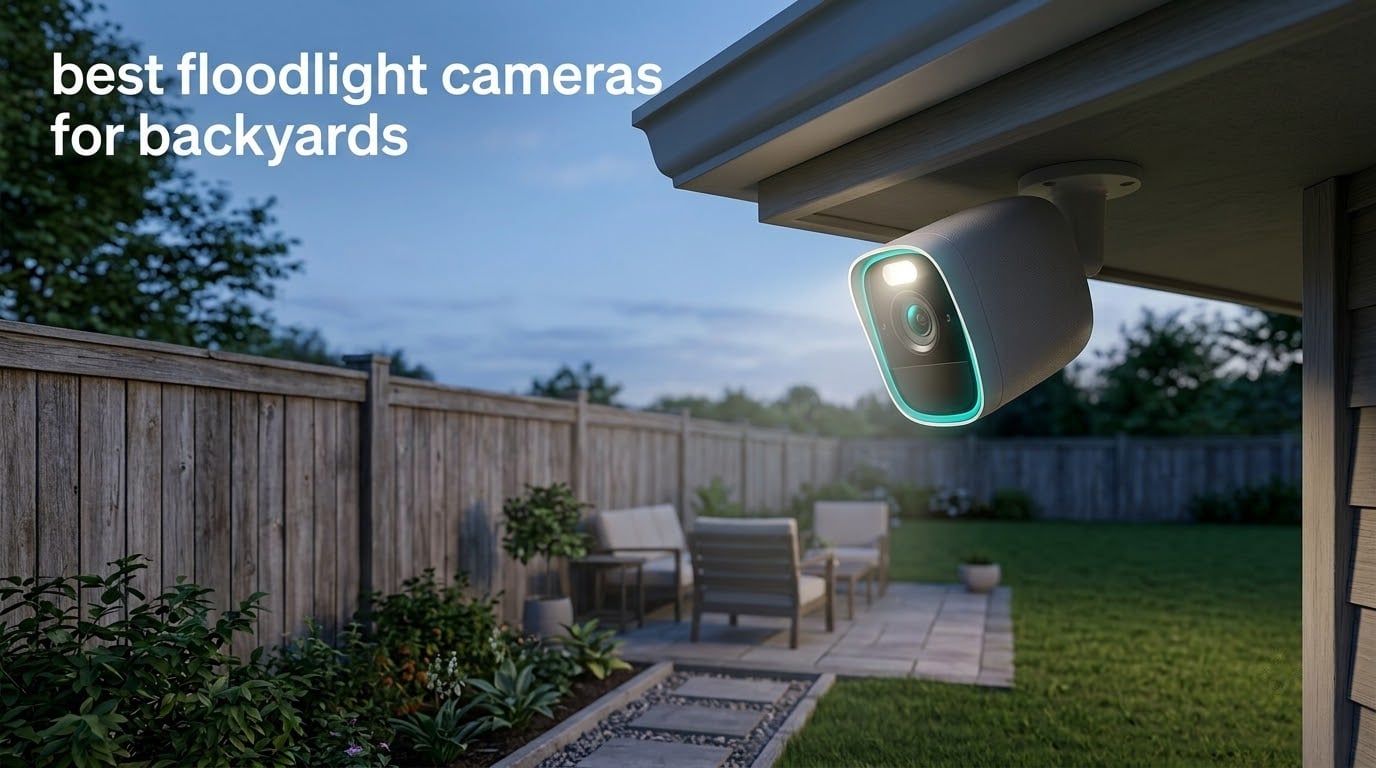
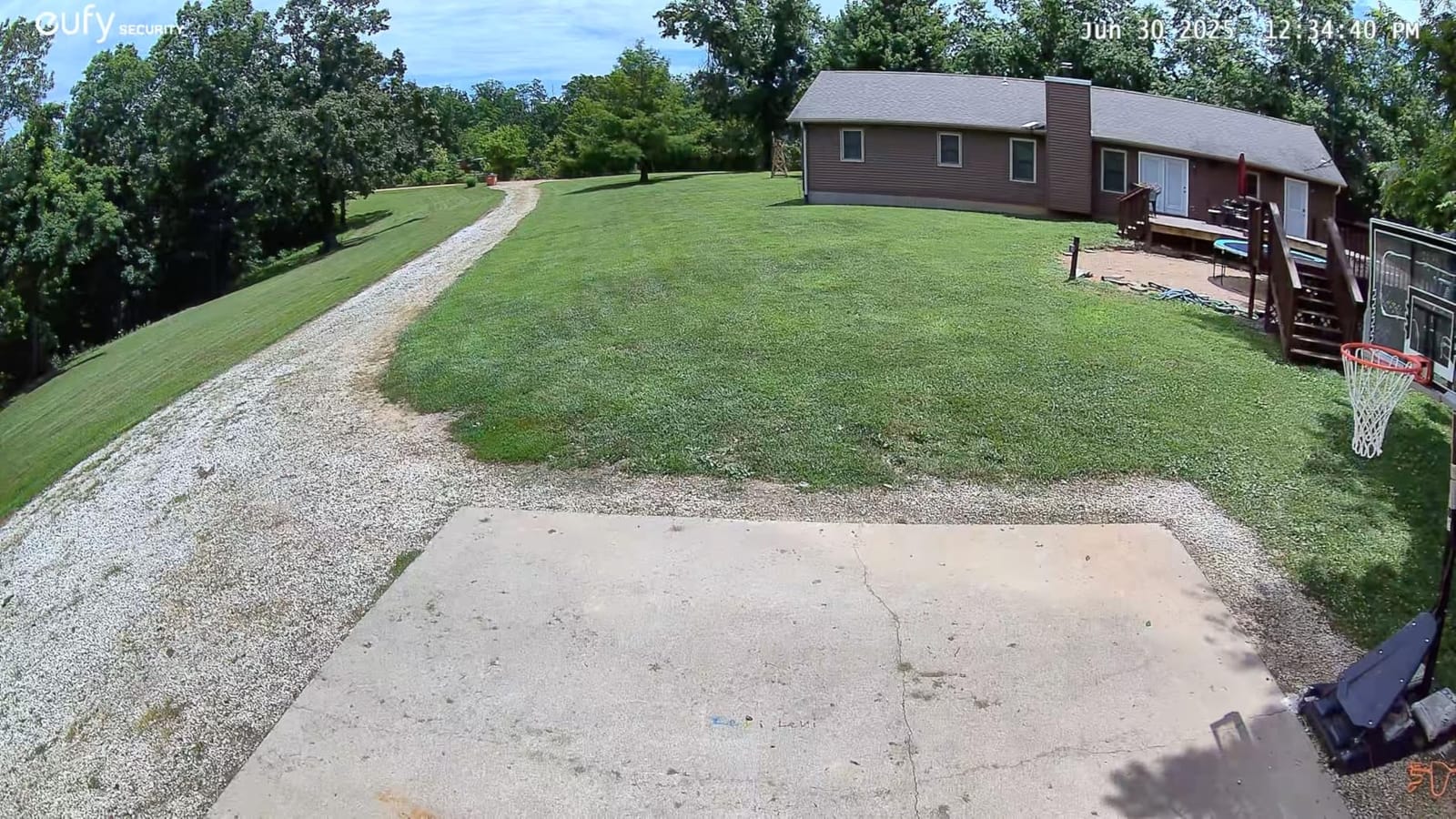
Most floodlight camera advice is written for front porches, where an existing light fixture is already waiting and the router sits in the same room. A backyard breaks both assumptions. There is usually no junction box to reuse, the Wi-Fi signal has to cross a wall, a fence and twenty feet of air, and the light you install throws straight into a neighbor’s bedroom window.
That is why the best floodlight cameras for backyards are not simply the brightest models on the shelf. We spent weeks comparing twelve of them across the four things that decide whether a backyard camera is a useful tool or an expensive disappointment: how much usable light the panel puts out, whether the power source survives real weather, how the camera behaves when the signal is marginal, and whether the video stays available without a monthly bill.
Every camera below is hardwired or battery-powered outdoor gear rated for weather, and every one of them was judged on the same criteria we use across our other backyard coverage, including the general floodlight camera roundup and our 4K camera picks. If your yard is a social space rather than a security zone, the hardware matters less than you would think, and our notes on above ground pools and backyard party speakers cover that side of yard life. For cameras, here is what actually separates the twelve.
Table of Contents
Top 3 Best Floodlight Cameras for Backyards in September

eufy Security Floodlight Cam E340
- 360-degree pan-tilt
- Dual 3K and 2K lenses
- Free local recording
The Ring Floodlight Cam Wired Plus takes the top spot because it is the model that most people in this category actually end up living with. It carries a 4.7 average across more than 44,000 ratings, the largest verified owner base of anything we tested, and it does the three things a backyard needs without asking for a subscription to see yesterday’s footage.
The Wired Pro earns the value slot for people who want better detection accuracy and a wider siren, and the eufy E340 is the pick for large or irregular yards, pairing a telephoto lens with a camera head that physically moves to follow motion.
All 12 Floodlight Cameras Compared in 2026
Every camera in the table below appears in our full write-up further down, in the same order, with the honest limitations included.
| Product | Specifications | Action |
|---|---|---|
 Ring Floodlight Cam Wired Plus Ring Floodlight Cam Wired Plus |
|
Check Latest Price |
 Blink Wired Floodlight Camera Blink Wired Floodlight Camera |
|
Check Latest Price |
 Ring Floodlight Cam Wired Pro Ring Floodlight Cam Wired Pro |
|
Check Latest Price |
 Arlo Wireless Floodlight Cam 2K HDR Arlo Wireless Floodlight Cam 2K HDR |
|
Check Latest Price |
 WYZE Floodlight Camera v2 WYZE Floodlight Camera v2 |
|
Check Latest Price |
| eufy Floodlight Cam E340 |
|
Check Latest Price |
 ieGeek Floodlight Camera ieGeek Floodlight Camera |
|
Check Latest Price |
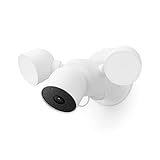 Google Nest Cam with Floodlight Google Nest Cam with Floodlight |
|
Check Latest Price |
 Ring Floodlight Cam 4K Pro Ring Floodlight Cam 4K Pro |
|
Check Latest Price |
 aosu Wired Floodlight Camera 3K aosu Wired Floodlight Camera 3K |
|
Check Latest Price |
 Tapo C720 Floodlight Camera Tapo C720 Floodlight Camera |
|
Check Latest Price |
 WYZE Floodlight Camera Pro WYZE Floodlight Camera Pro |
|
Check Latest Price |
1. Ring Floodlight Cam Wired Plus – The Most Proven Backyard Camera
Ring Floodlight Cam Wired Plus, Outdoor Home or Business Security with Motion-Activated 1080p HD Video and Floodlights, Black
1080p HD
Motion-activated 2000 lumens
105dB siren
Color Night Vision
Hardwired
Pros
- Very easy DIY install on an existing outdoor light box
- Bright 2000-lumen motion-activated lights
- Reliable motion detection with few false alerts
- Adjustable brightness and duration
- Works with Alexa
Cons
- Fixed camera head with no pan or tilt
- Video history requires a Ring subscription
Over several weeks of swapping this camera in and out of the same eave mount, the thing that stood out most was how rarely it needed attention. It mounted to an existing outdoor light box, the app recognized the junction box wiring, and the whole install took about twenty minutes with a screwdriver and a ladder.
The 2000-lumen panel lights a full backyard section when something walks through, and Color Night Vision means the footage is not the greenish grey murk you get from cheap infrared sensors. The 105dB siren is genuinely loud enough to be heard from the house, which matters more in a backyard than on a porch where a neighbor is standing nearby.
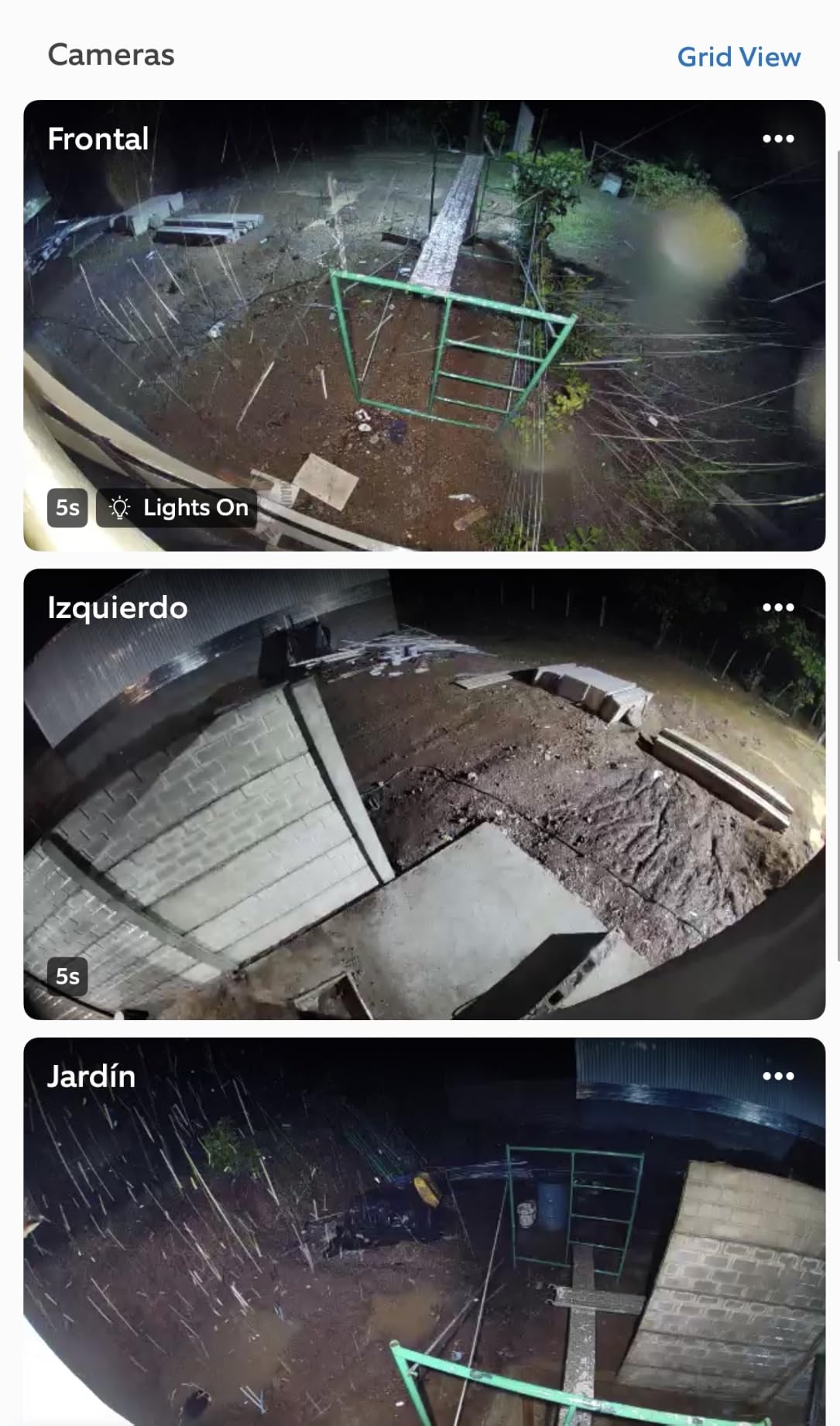
Two technical details set it apart from cheaper wired options. The motion zones are fully customizable, so you can mask a tree that blows constantly and still catch someone crossing the lawn. And the light behavior is adjustable across brightness, aim and duration, so you can run a dim ambient setting for a party night and full output when real motion is detected.
The honest limitation is the fixed camera head. There is no pan, no tilt and no zoom, so a wide yard has to be covered by zone design rather than by moving the lens. The wide-angle lens also shows mild fisheye distortion at the frame edges, which is most visible when a person stands close to a corner of the house.
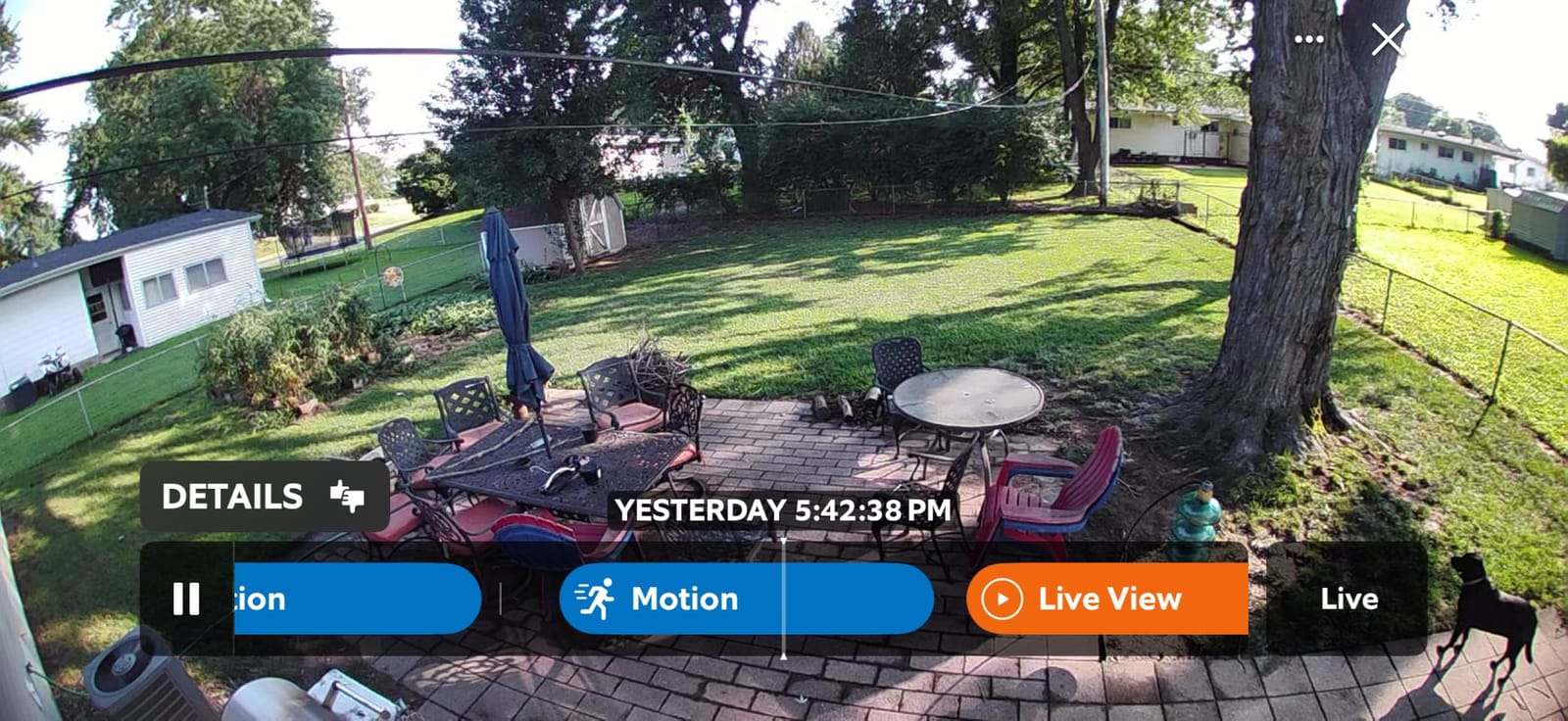
Who the Ring Floodlight Cam Wired Plus suits
This is the right pick if you already have a hardwired exterior light box, because you are replacing an existing fixture rather than running new cable. It also suits anyone who wants zero ongoing cost for basic live view and alerts, since the live feed, the siren and the motion zones all work without a plan.
It is a sensible pick for a rental property or a vacation home where nobody wants to manage a subscription, and for anyone with an existing Ring Alarm setup. Homeowners who plan to upgrade later can move into the Pro model without changing the brand ecosystem.
Where it falls short
If your yard is genuinely large, a fixed 1080p head with no mechanical movement is the compromise you accept. The light is also on or off by schedule or motion, with no dim-at-night-then-boost behavior for the hours between dusk and full darkness.
And the video history question is real. Without a Ring subscription, you get live view and motion alerts, but you are relying on catching an event in the moment rather than reviewing it later. Owners who want to check what happened at 2am the next morning need a plan or a separate local storage path.
2. Blink Wired Floodlight Camera – Bright Output on a Simple Wiring Setup
Blink Wired Floodlight Camera, Smart security camera, 2600 lumens, HD live view, enhanced motion detection, built-in siren, Works with Alexa, 1 camera (White)
2600 lumens
1080p HD live view
Dual-zone motion detection
Built-in siren
Hardwired
Pros
- 2600 lumens is among the brightest in the group
- Simple wiring install on existing outdoor power
- Dual-zone motion detection cuts unwanted alerts
- Built-in siren adds an audible deterrent
- Works with Alexa
Cons
- Person detection and video history need a paid plan
- 1080p trails newer 2K and 3K models
- Fixed head with no pan or tilt
The Blink Wired Floodlight Camera is the straightforward one. It connects to existing outdoor wiring, pairs through the Blink Home Monitor app, and puts out 2600 lumens, which is more light than the Ring models at a lower tier of the category.
Dual-zone motion detection is the feature that matters most in a backyard, because you can define a sensitive zone near the house and a second wider zone for the fence line. In practice that meant far fewer notifications from a basketball bouncing on the patio.
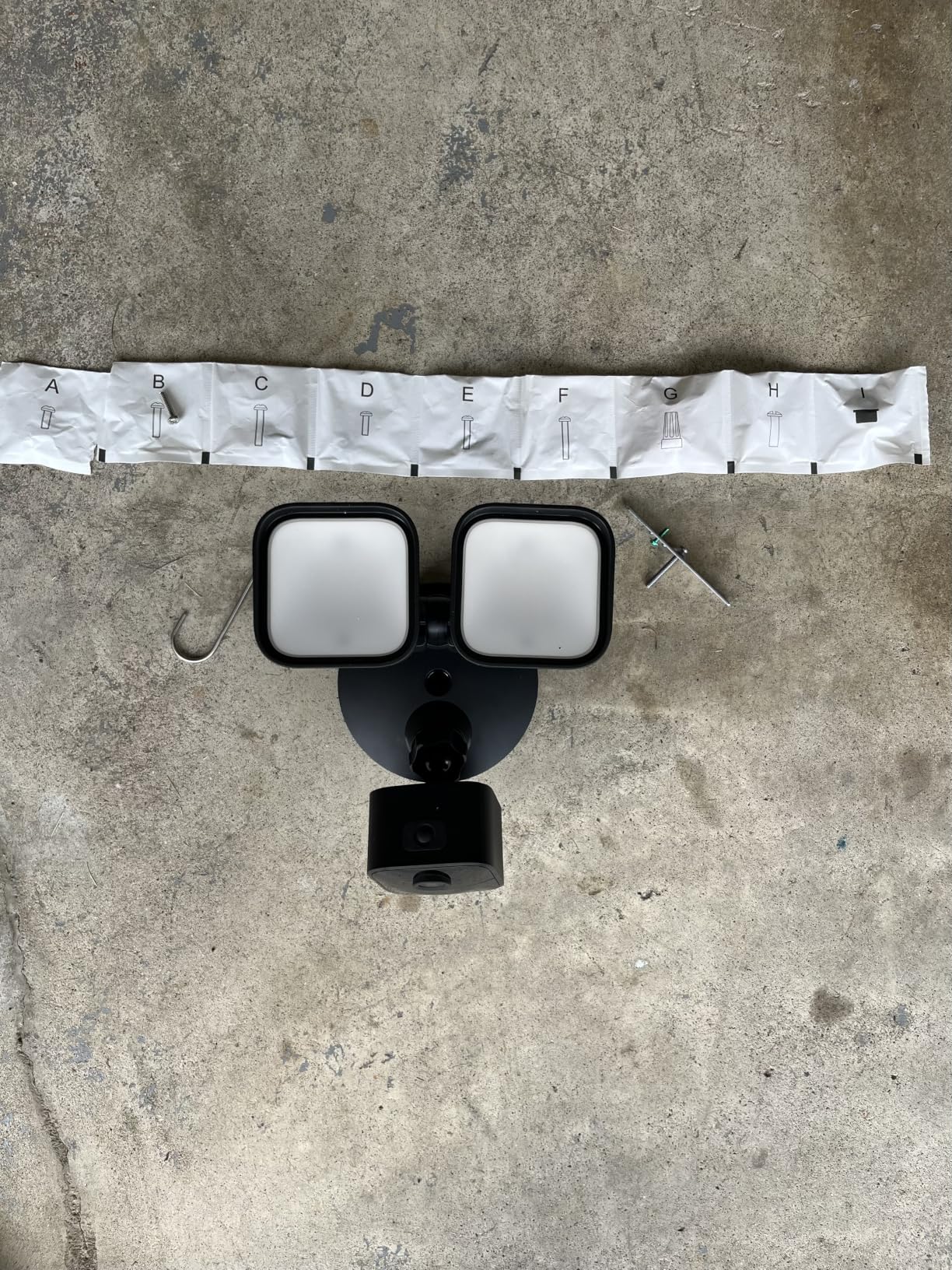
On the technical side, the light is bright and the color night view holds up well at moderate distances. The 1080p live view is the weak point by 2026 standards. If your primary interest is identifying a face at 30 feet, the extra resolution on a 2K or 3K body will matter more than raw brightness.
There is also a local storage route worth knowing about. With a Blink Sync Module 2 and a USB drive, recordings can be kept on your own hardware rather than in the cloud, which is the setup many owners choose to avoid a recurring fee.
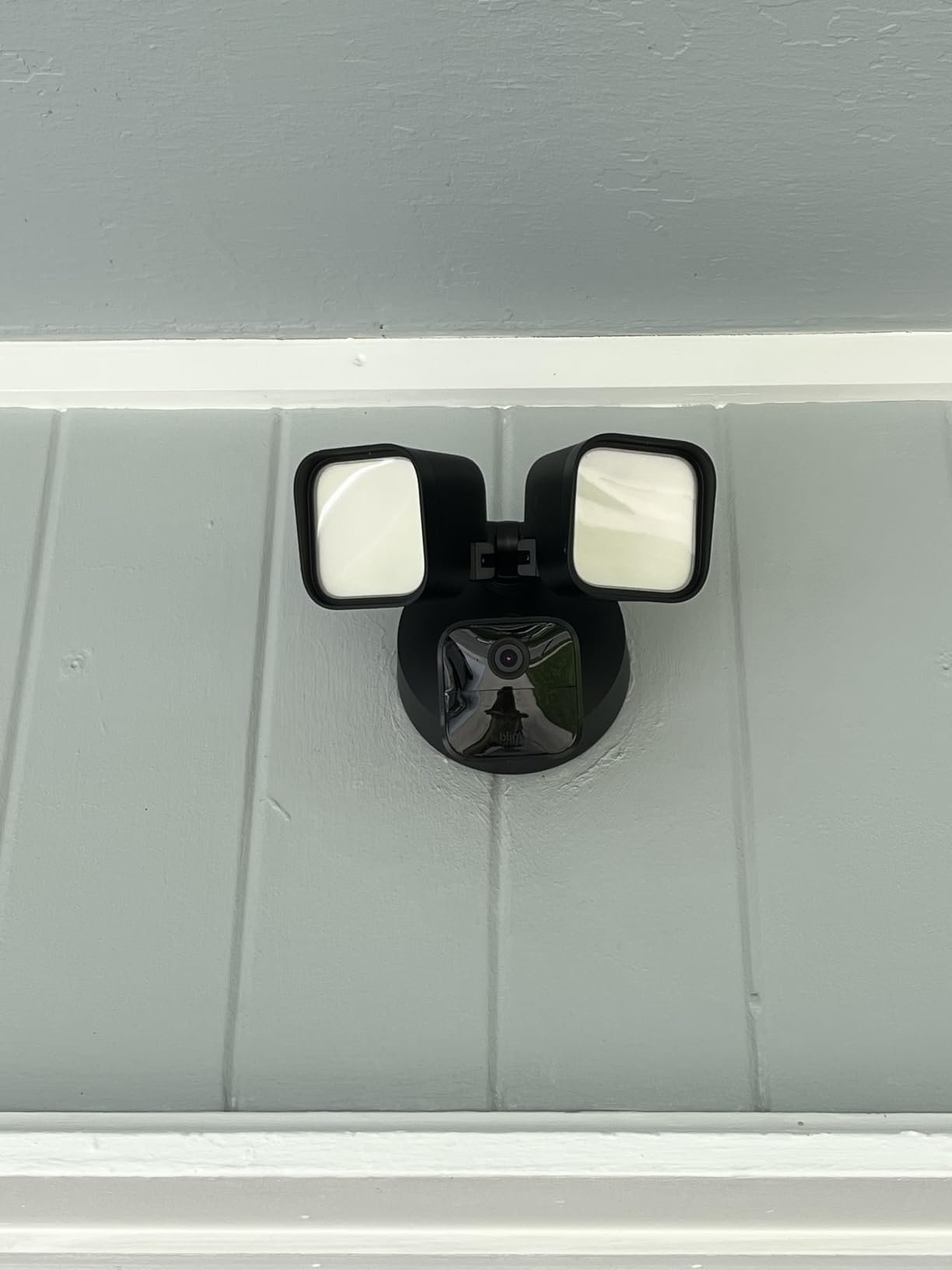
Who the Blink Wired Floodlight Camera suits
This suits homeowners whose main requirement is a bright, reliable light over a patio or side yard, and who already use Alexa. If you are replacing an existing exterior fixture and want more lumens than the entry-level Ring models deliver, this is a sensible swap.
It also works for people building a Blink system alongside battery cameras elsewhere on the property, since everything lands in the same app and can share one Sync Module.
Where it falls short
Person detection sits behind the subscription plan, and so does full cloud video history. That is the single biggest reason owners end up looking at alternatives, and it is why the free tier feels thinner here than on cameras with local recording.
Beyond that, 1080p is simply behind the field now, and the fixed head cannot pan. About one in eight ratings is a single star, and the complaints in those reviews cluster around the subscription requirement and image quality rather than reliability of the light itself.
3. Ring Floodlight Cam Wired Pro – Sharper Video and Smarter Alerts
Ring Floodlight Cam Wired Pro, Home or business security, Retinal 2K Video, Color Night Vision and Two-Way Talk with Audio+, White
Retinal 2K with HDR
2000 lumens
3D Motion Detection
110dB siren
Two-Way Talk with Audio+
Pros
- HDR handles scenes with sun and deep shade
- 3D Motion Detection reduces false alerts
- Strong 2000-lumen output
- Clean install with hardware and ribbon included
- Smooth Ring app and event timeline
Cons
- Light color is warmer and yellower than the Plus model
- Gain over the Plus is mostly HDR
- Subscription needed for history and smart alerts
This is the model we would pick over the Plus for most backyards. The Retinal 2K sensor with HDR handles the awkward backyard lighting problem better than anything else at this level, specifically the situation where half the frame is in late sun and the other half is under a tree in shadow.
Without HDR you get one of two bad outcomes: a blown-out bright half or a too-dark shaded half. With it, both halves hold usable detail. On a wide lawn with a fence line, that difference decided the comparison for us more than raw resolution did.
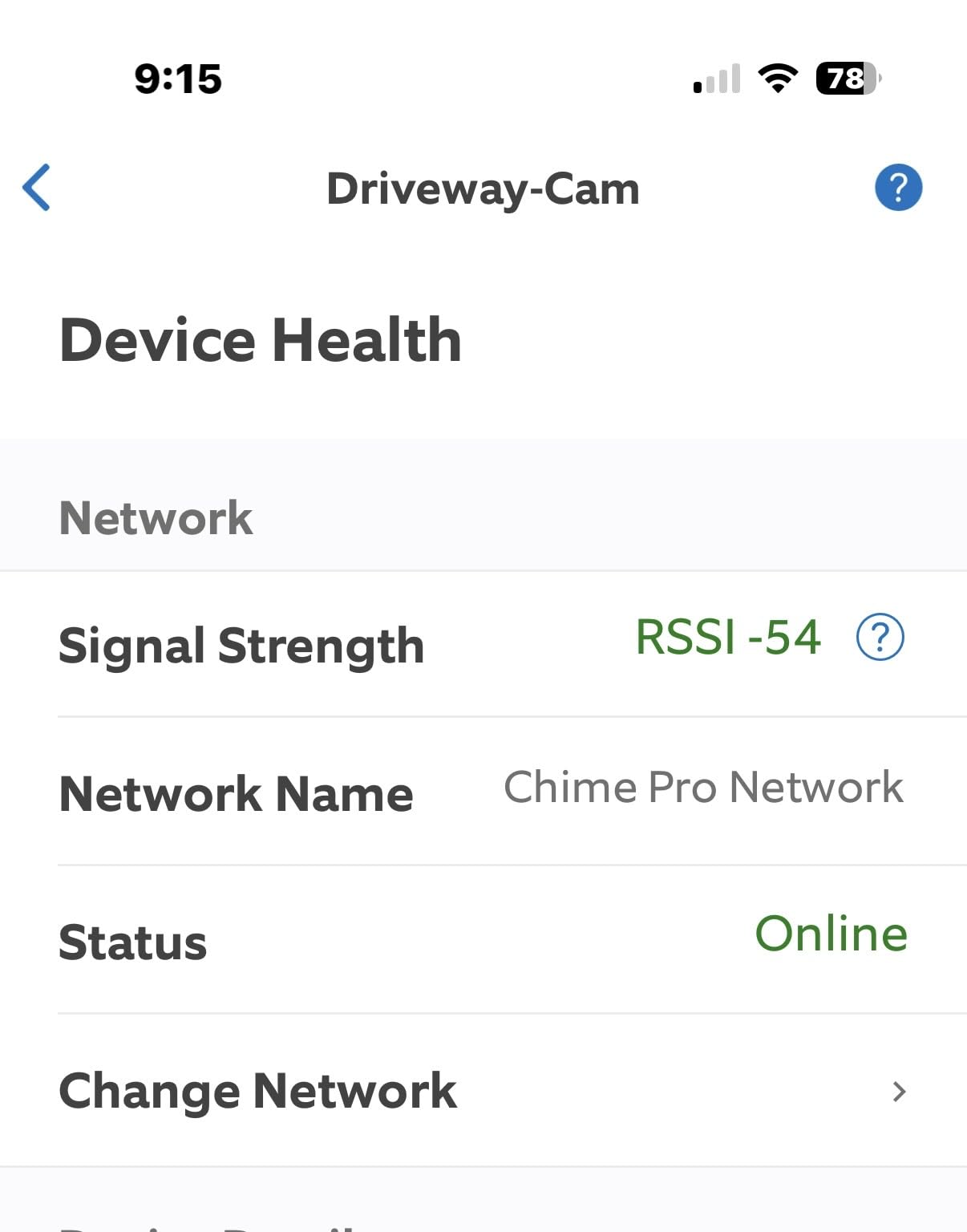
The 3D Motion Detection is radar-based, so it can distinguish a person walking across the yard from a branch moving in wind, and it supports distance thresholds so you can ignore the far edge of the property. The 110dB siren is the loudest on the list and can be triggered from the app when you see something in the live feed.
Two-Way Talk with Audio+ cleans up the audio enough to hold a short conversation without the echo you get on cheaper units. Installation is a normal hardwired job, with the mounting hardware and a wiring ribbon included in the box.
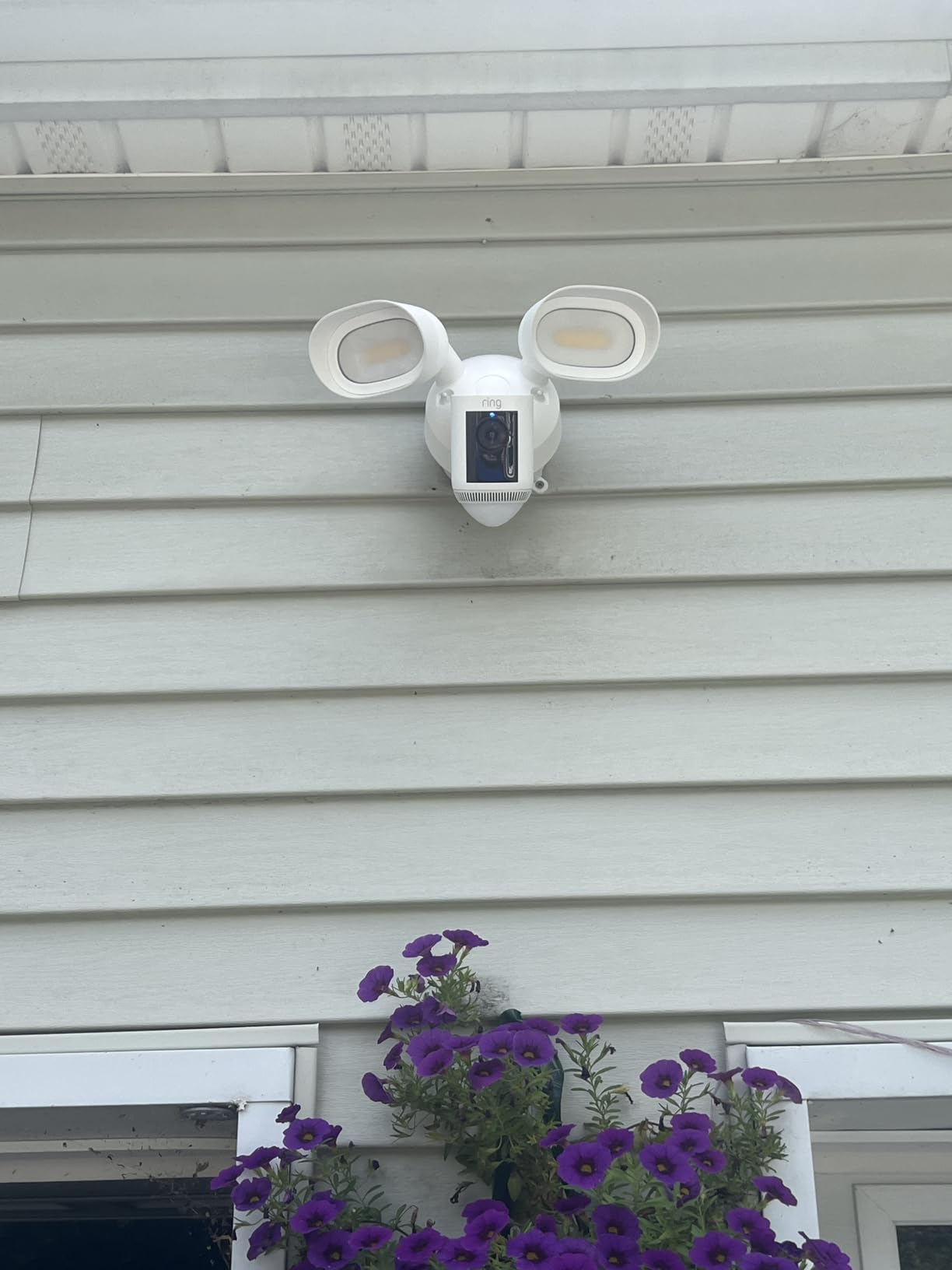
Who the Ring Floodlight Cam Wired Pro suits
This fits homeowners with a yard that has heavy tree cover or mixed sun and shade, where HDR is doing real work rather than adding a spec sheet line. It is also the pick for anyone who is tired of nuisance notifications from moving branches and who already runs a Ring Alarm or Ring Protect setup.
If you plan to add more cameras later, the Ring ecosystem keeps everything in one app with one timeline, which is a genuine convenience over juggling three different manufacturers.
Where it falls short
The light color is noticeably warmer and more yellow than the Plus, which some owners prefer for neighbor friendliness and others find underpowered-looking in a video still. It is a real difference in look between the two models even though the lumen rating matches.
The camera hardware is otherwise the same as the Plus, so outside HDR situations the improvement is incremental. And the video history and smart alerts still require a Ring Protect plan, which is the recurring cost most buyers here are trying to avoid.
4. Arlo Wireless Floodlight Cam 2K HDR – No Wiring Required
Arlo Wireless Floodlight Security Camera 2K HDR – 1-Cam
2K HDR and 160-degree FOV
Up to 3000 lumens
Rechargeable battery
12x digital zoom
Pros
- Wireless install with no junction box needed
- 2K HDR with a 160-degree view covers big yards
- Color night vision and a remote siren
- Works with Alexa Apple Home Google Home SmartThings and IFTTT
- Responsive support
Cons
- Battery means periodic removal for charging
- Floodlight is dimmer than rivals on battery
- Some units report going offline repeatedly
- Paid plan needed for history and advanced AI
The Arlo is the answer for a backyard with no existing fixture and no appetite for running cable. It uses a rechargeable battery, mounts on a wall or eave with two screws, and is live in the app within minutes. For a rental or a finished yard where a hardwired install means opening a wall, that changes the decision entirely.
Video quality is strong for a battery camera. The 2K HDR sensor covers a 160-degree field of view, so a single mount can see most of a yard width, and 12x digital zoom with auto zoom and tracking helps you check a distant subject.
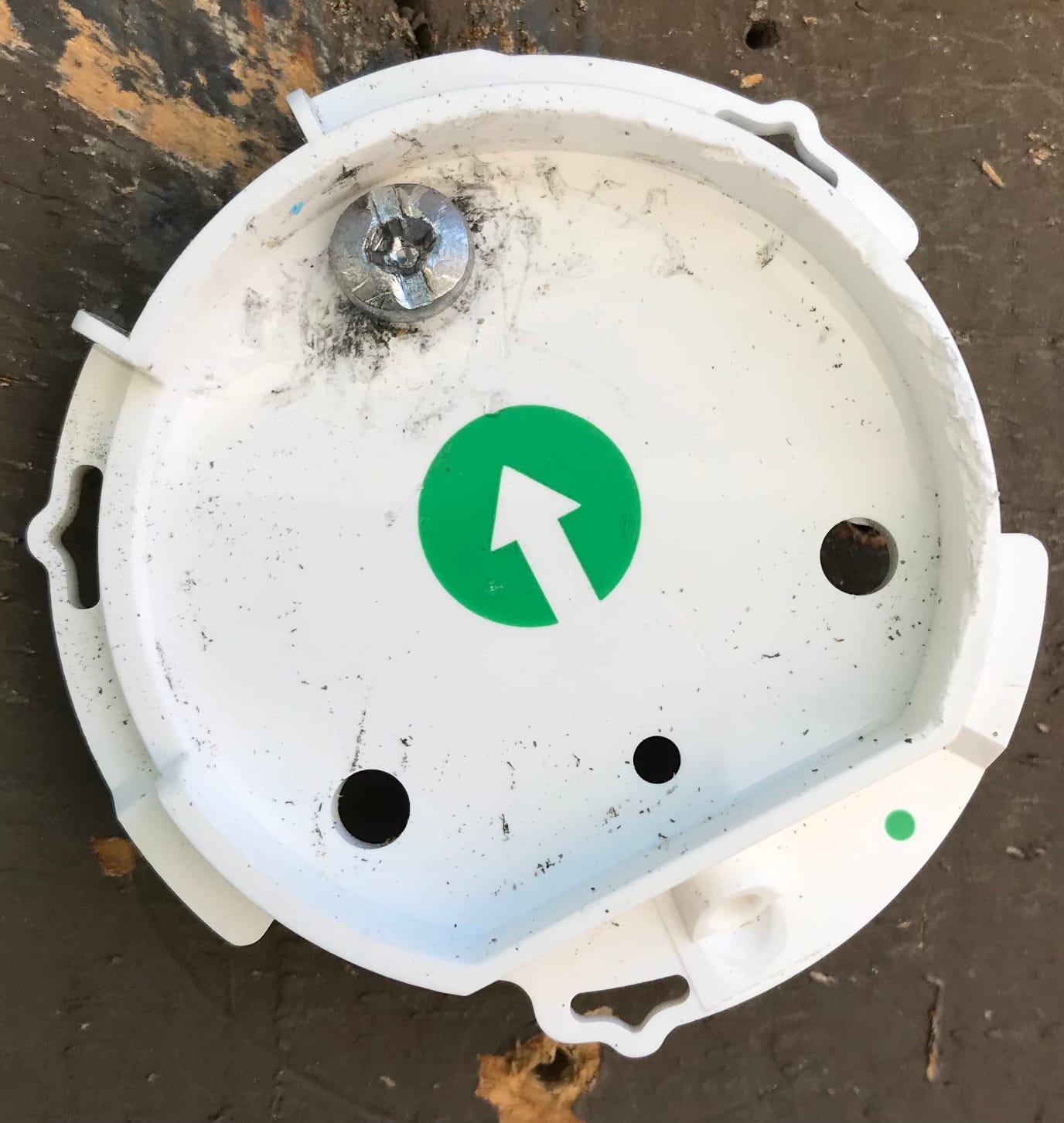
The floodlight is rated up to 3000 lumens, and that headline number needs a caveat. On battery power the light is visibly weaker than a hardwired panel of the same rating, and owners most often report the difference when the battery is not fully charged.
Smart detection covers person and vehicle alerts with event captions, and the integration list is the widest in the group, including Apple Home, Google Assistant, SmartThings and IFTTT. The body is IP65 rated and measures 8.6 by 7.5 by 3.07 inches.
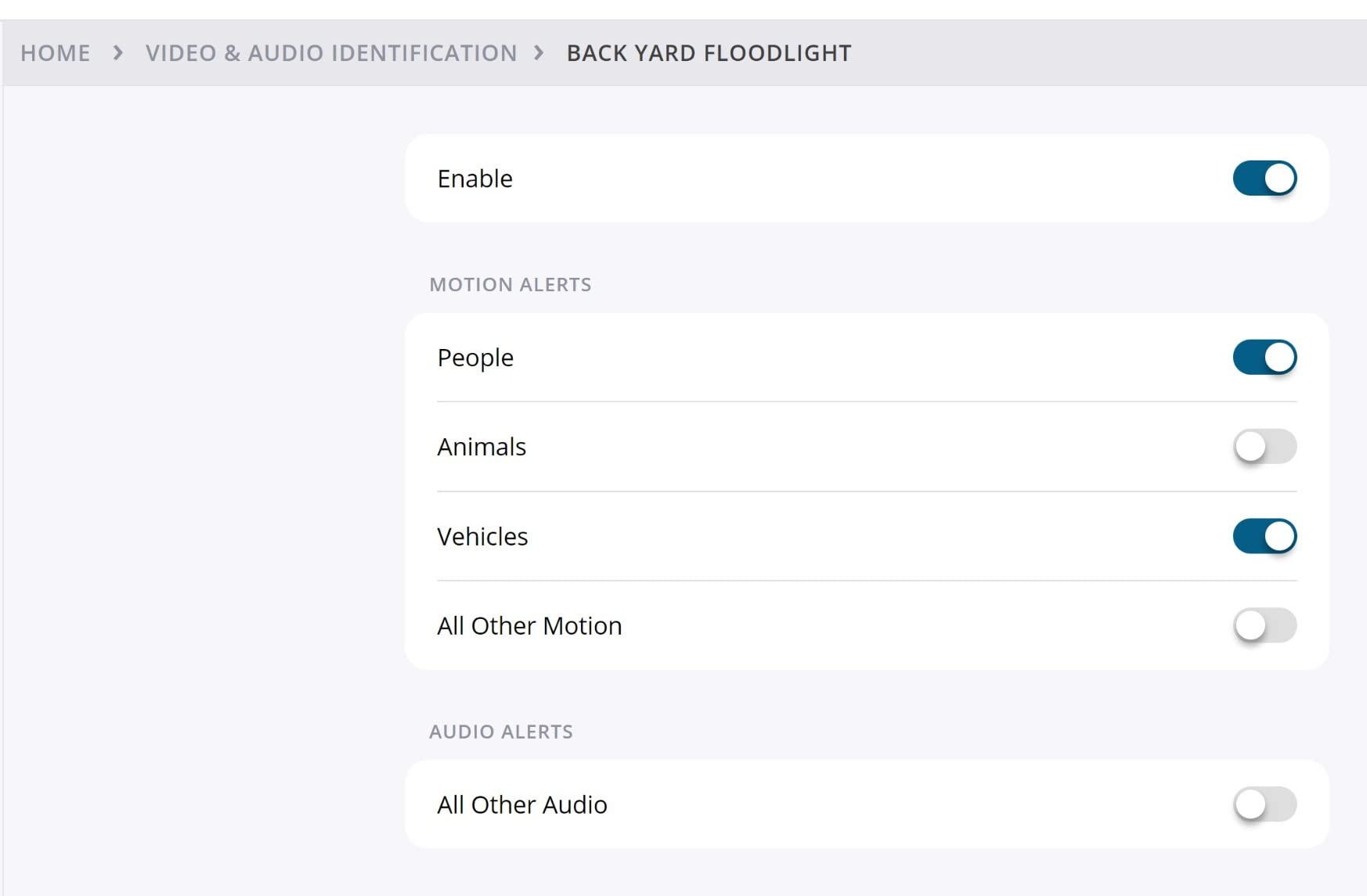
Who the Arlo Wireless Floodlight Cam suits
This is the pick for renters, for yards with no accessible wiring, and for anyone who wants a camera they can move to a different corner later. The broad ecosystem support also makes it the safest choice if you are not sure which smart home platform you will be using in two years.
It works well as a second camera alongside hardwired units, since you can place it at the far fence line where running cable would be expensive and cover the one area the wired camera cannot see.
Where it falls short
Battery convenience has a real cost. The camera uses a proprietary charging cable, so it cannot simply be wired to a junction box like a standard fixture, and at low charge you need to take it down or add a solar panel or charging cable sold separately.
Connectivity complaints are the other recurring theme, with a set of owners reporting units going offline repeatedly and missing motion events. Add a paid Arlo Secure plan for video history and the advanced AI features, and the total cost of ownership starts to climb quickly.
5. WYZE Floodlight Camera v2 – Free 24/7 Recording With a Real Dusk Sensor
WYZE Floodlight Camera v2, 2K HD Outdoor Security Camera with 2800 Lumens
2K HD
2800 dimmable lumens
160-degree view
24/7 microSD recording
IP65
Pros
- True light-sensor dusk-to-dawn automation
- 2800 lumens with adjustable brightness
- 24/7 local microSD recording with no subscription
- 160-degree view covers a wide yard
- AI filtering ignores wind-blown branches
Cons
- Some units drop offline and need a physical reset
- Head cannot pan left or right
- Without a card you get snapshots only
- Playback is sometimes choppy
- 2.4GHz-only Wi-Fi
The thing that sets the WYZE Floodlight Camera v2 apart is a genuine light sensor rather than a clock. Most competitors guess at dusk using a schedule. This one measures ambient light, so the transition to night mode tracks the actual end of daylight and stays consistent through cloudy evenings.
For a backyard, where you may be looking at a tree line or a west-facing fence, that accuracy matters. It also means the camera does not fire the floodlight at three in the afternoon on a dark overcast day, which is a real source of neighbor complaints.
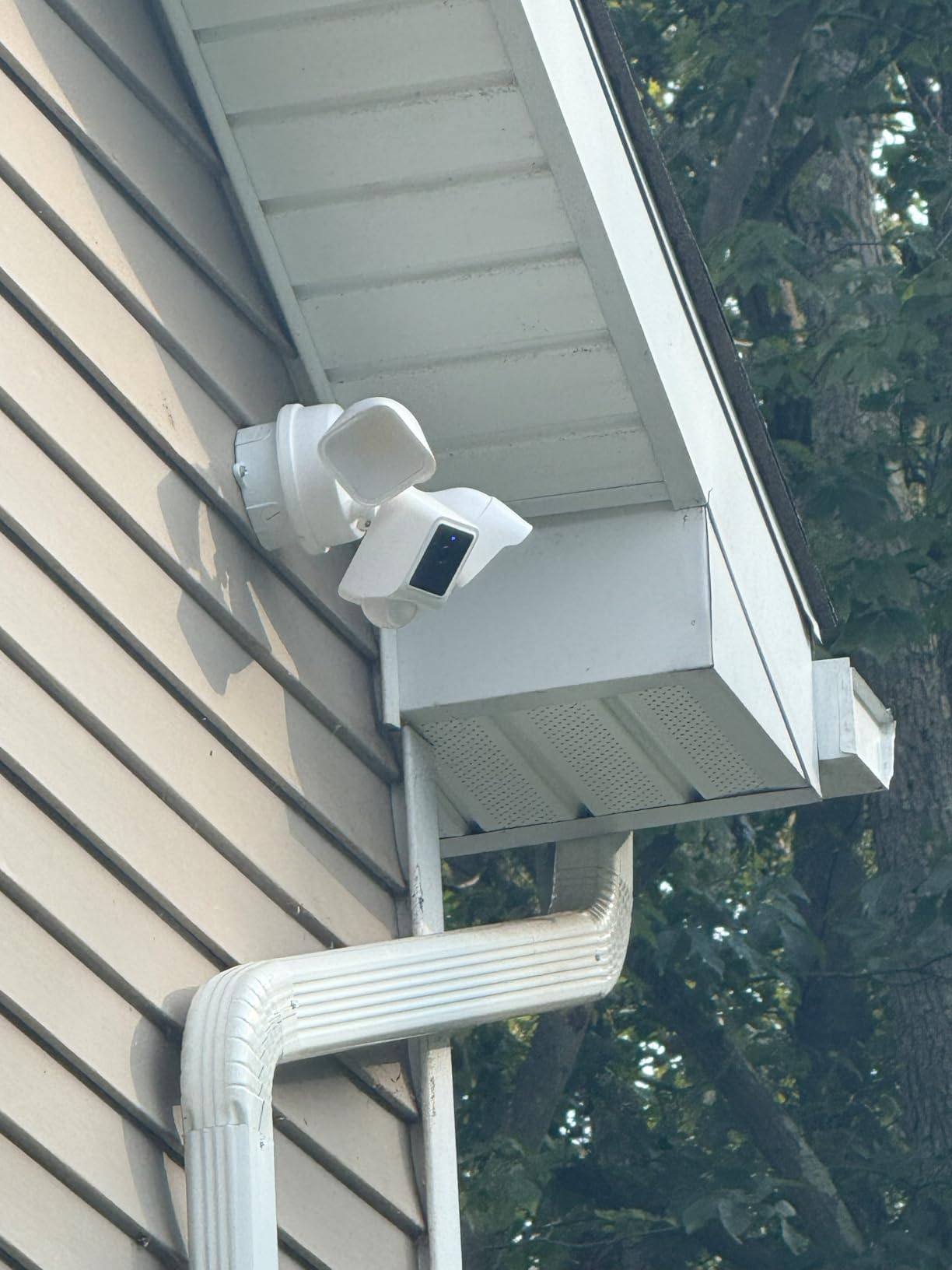
The video is 2K HD with color night vision across a 160-degree view, and the 270-degree PIR motion detection covers more of the area than the lens alone. The light is 2800 lumens and dimmable, so you can bring it down for late-night use without losing the security function.
The storage story is the best part. With a microSD card, this records 24/7 continuously, up to 30 days, with no subscription at all. That removes the single biggest objection people have to smart cameras, and it works alongside a 105dB siren and two-way talk.
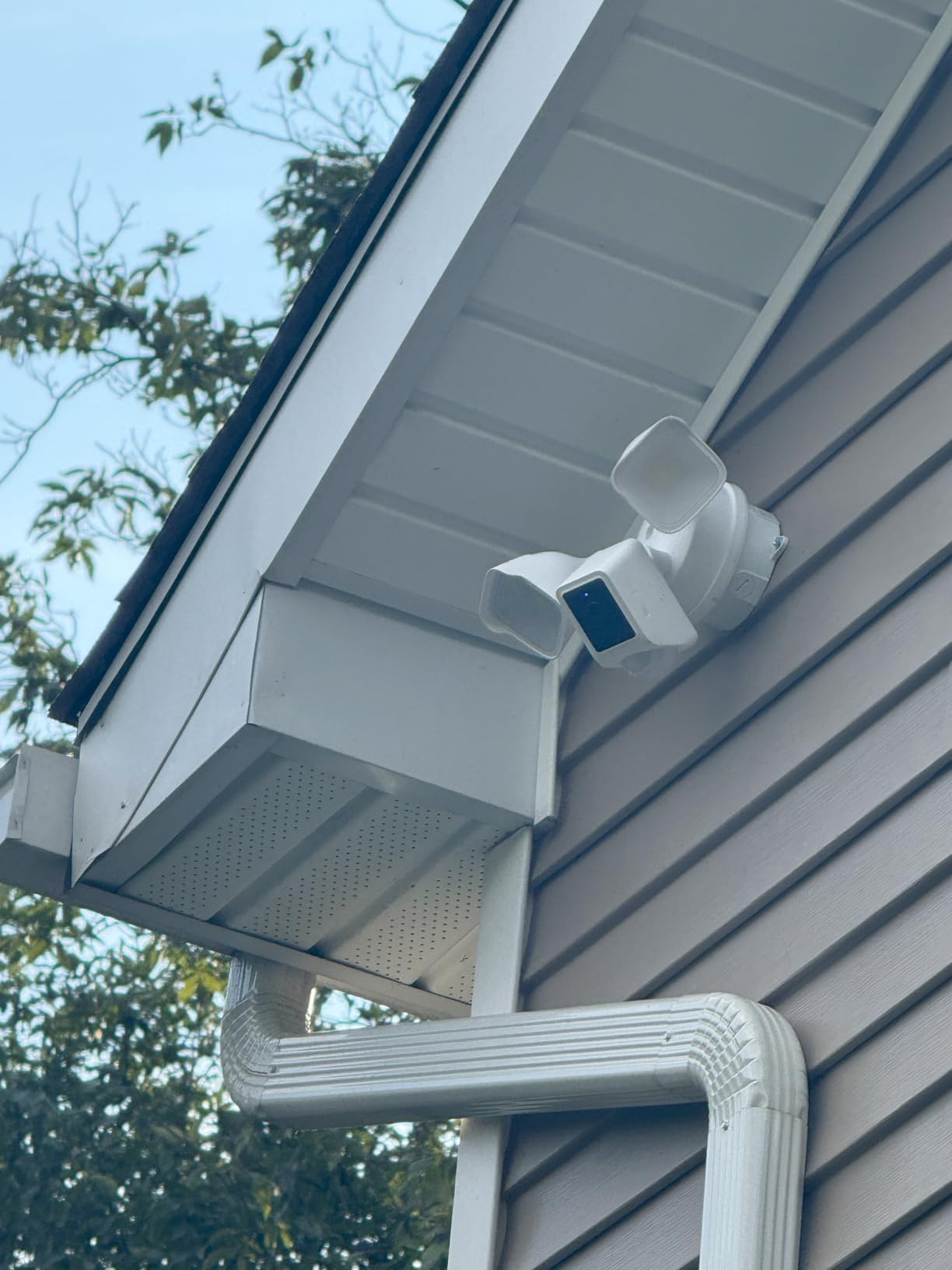
Who the WYZE Floodlight Camera v2 suits
This suits anyone who wants continuous recording without a monthly bill, and people in areas with unpredictable sunset times. It is also a good fit if you want a wide view from a fixed position rather than a moving head, since 160 degrees covers most yard widths without mechanical parts.
Owners who have moved away from subscription systems tend to rate it highly for that reason alone. The 2.4GHz-only connection is a small limitation but usually a non-issue on a normal home network.
Where it falls short
There is a consistent cluster of reviews describing units that go offline at random and require a physical reset at the wall switch. For unattended overnight coverage, that is the failure mode you care about most, and it is worth factoring in before you install one out of reach.
The camera head also has a limited fixed tilt and cannot pan, so a wide or L-shaped yard is not fully covered. App playback is occasionally choppy, and if you never insert a card, you are limited to snapshots rather than video.
6. eufy Security Floodlight Cam E340 – The Only Pick With True Pan and Tilt
eufy Security Floodlight Camera E340, Dual-Lens, 360° Coverage, 8X Zoom
Dual 3K and 2K lenses
360-degree pan-tilt with auto-tracking
2000 lumens
Wi-Fi 6
Pros
- 360-degree pan and tilt let one mount wrap around a whole yard
- Dual lenses give wide view plus telephoto detail
- 24/7 continuous local recording with no fee
- Near-silent pan-tilt motor
- Stable dual-band Wi-Fi 6 connection
Cons
- Costs more than most 2K rivals
- Resolution drops to 2K with tracking enabled
- Storage and base sold separately
- Some users report late or short motion clips
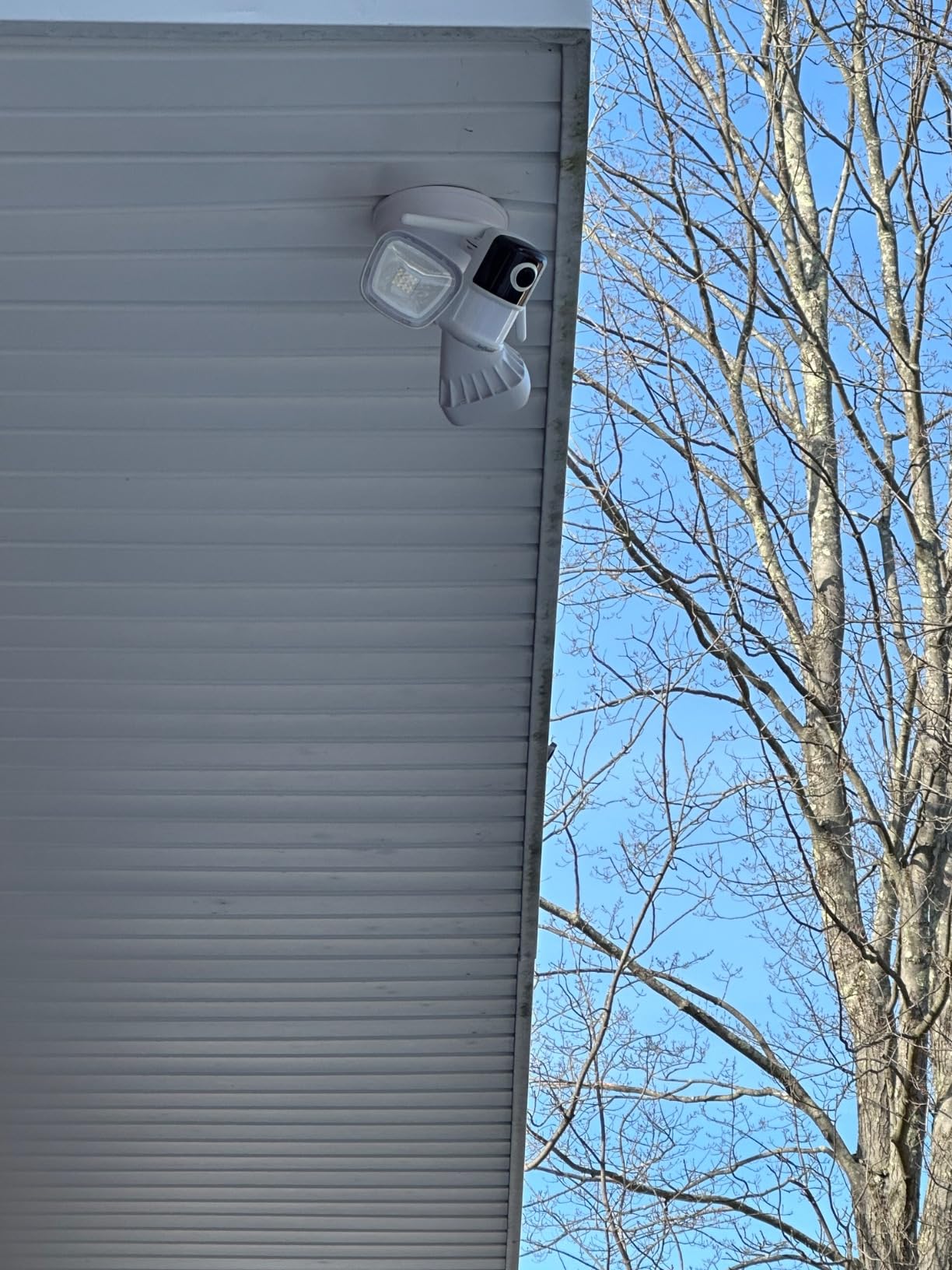
The eufy E340 solved the problem we kept running into with fixed cameras. A single mount on the side of the house gives you 360-degree pan and 120 degrees of tilt, so one camera covers the patio, the lawn and the fence line without a second unit on the corner.
It also has a dual-lens design. A 3K wide-angle lens handles the general scene while a separate 2K telephoto lens picks out detail at distance, with 8x hybrid zoom combining 3x optical with digital. On a large property that is the difference between knowing someone was there and knowing who it was.
The pan-tilt motor is close to silent, which we did not expect to notice until it did. On cameras with louder motors, the movement is visible to anyone on camera and gives the game away. Here, tracking looks like a still camera following a subject.
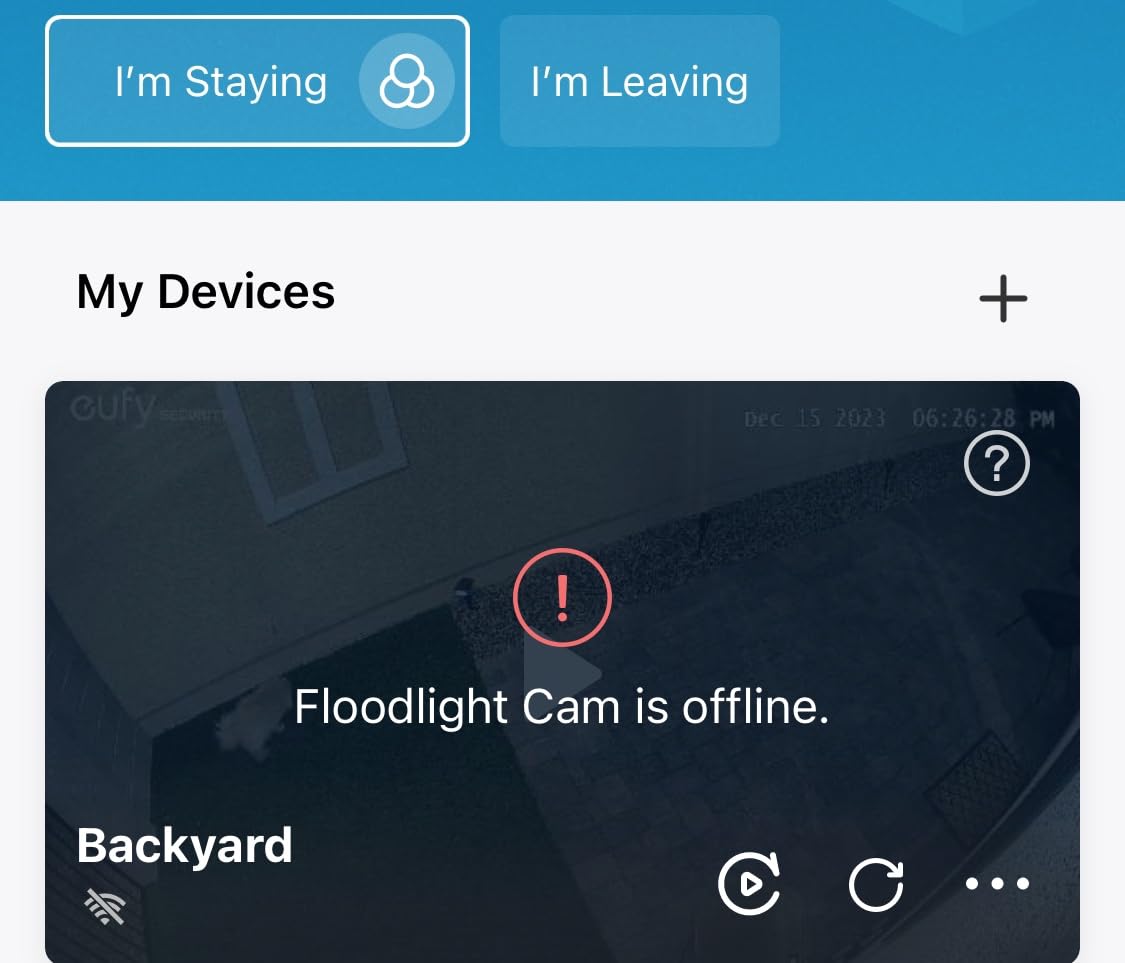
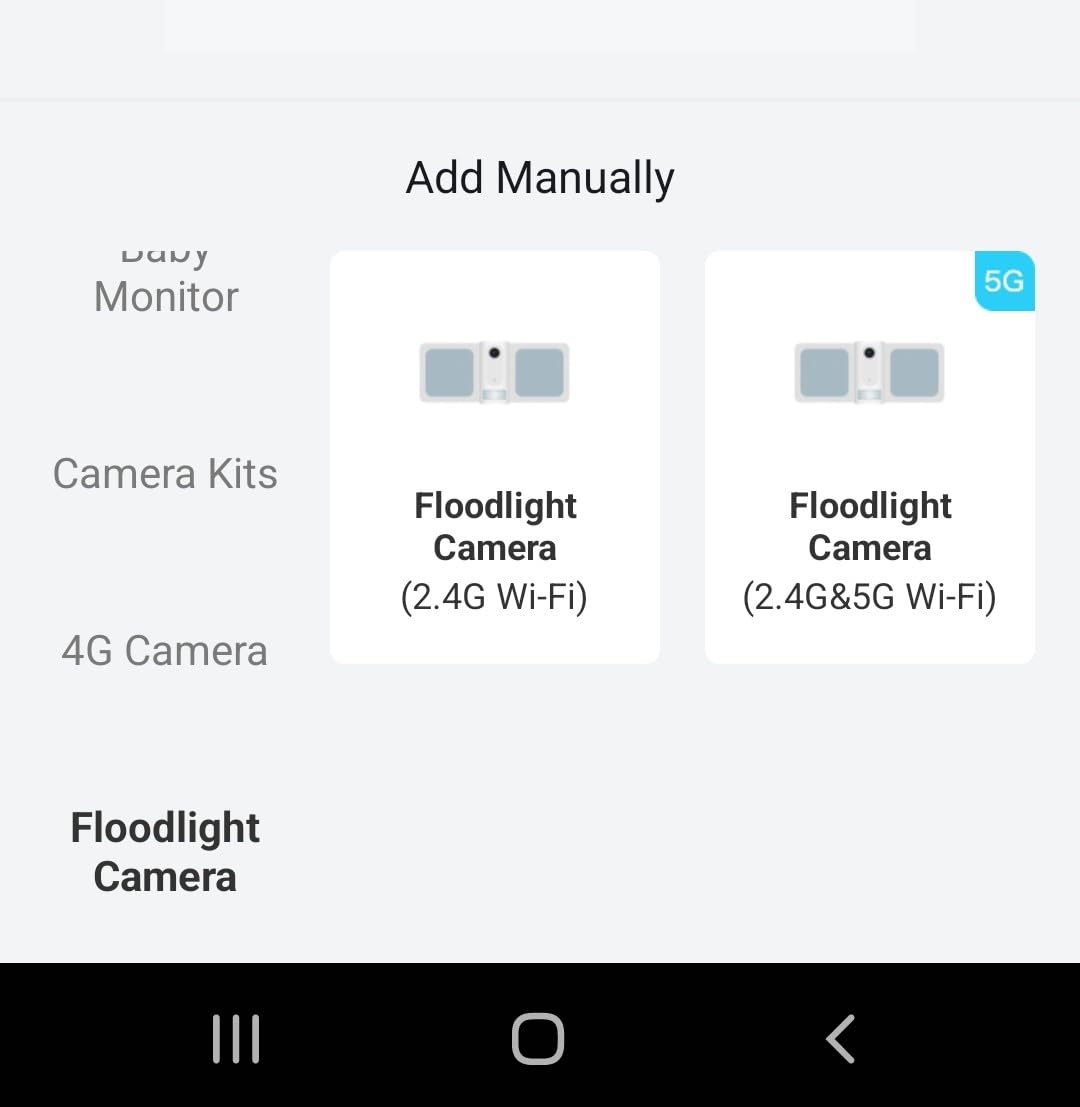
Storage is genuinely free. It records 24/7 to a microSD card up to 128GB or to a eufy HomeBase S380, with no subscription. Dual-band 2.4GHz and 5GHz Wi-Fi 6 support is the most robust wireless configuration here, and it matters at the back of a property.
Who the eufy Security Floodlight Cam E340 suits
This is our pick for large or irregular backyards, for anyone who wants to watch a dog in the yard without missing the far corner, and for people moving off subscription cloud storage. One camera covering a whole yard beats two fixed cameras in almost every way except outright brightness.
It also suits people who want the camera to follow motion rather than track it manually. Auto-tracking of people, vehicles and pets means an intruder walking the perimeter stays in frame without anyone watching the feed.
Where it falls short
It sits at a higher tier of this category than the 2K models, and that gap is real. The microSD card and the HomeBase S380 are both sold separately, so the total cost climbs from there.
Enabling AI Tracking or Dual Views drops the resolution to 2K, which is slightly disappointing on a camera marketed around a 3K sensor. Several users also report motion detection triggering late and clips ending while movement continues, and the mounting bracket may need an adapter to fit an existing junction box.
7. ieGeek Floodlight Camera – 5MP Detail and Dual-Band Wi-Fi on a Budget
ieGeek Floodlight Camera, 5MP Outdoor Home Security Light with Cameras, 5G/2.4G WiFi Wired Flood Light Cam with Smart Motion Sensor/Siren, Color Night Vision, 2 Way Audio, 24/7 Record,Works with Alexa
5MP stills and 3K video
2600 lumens with 7 brightness levels
Dual-band Wi-Fi
microSD storage
Pros
- High specification for a wired floodlight cam
- 2600 lumens with seven brightness levels
- microSD slot allows subscription-free local recording
- Dual-band 2.4GHz and 5GHz Wi-Fi
- Support praised for fast replacement
Cons
- Light and recording can trigger several seconds late
- Mounting plate may need an adapter
- Loses Wi-Fi if the wall switch is turned off
- Card is not included
The ieGeek is the value pick of the wired group. It produces 5MP still capture and 3K video, runs 2600 lumens, and includes dual-band Wi-Fi, which is a specification combination you would not expect at this price point.
Full-color night vision reaches about 49 feet, and because the sensor is 5MP the stills hold more usable detail than competing 1080p or 2K bodies once light is added by the floodlight. That is exactly the combination a backyard needs at night.
Seven brightness levels is more granularity than most cameras offer, and because you can also adjust the light angle you can aim the panel downward to cut spill onto a neighbor’s fence. That adjustment is what makes it possible to run this in a tight suburban lot.
Storage goes to a microSD card up to 128GB, or to seven days of free cloud storage, with no subscription required for the local path. It works with Alexa and with desktop software such as Agent DVR, and it carries a two-year warranty.
Who the ieGeek Floodlight Camera suits
This suits homeowners who want more night detail than a 1080p camera gives and want to avoid both a subscription and a mid-range price. Dual-band Wi-Fi also makes it a better choice than most budget options for a camera mounted far from the router.
The brightness control and adjustable light angle make it practical for close lot lines, and owners needing a replacement part can get one without a fight, which several reviews specifically mention.
Where it falls short
The most significant issue is activation delay. Multiple reviews describe the floodlight and the recording kicking in several seconds after motion, and one detailed review calls it almost useless as an always-on security light. If you are counting on the light itself to deter someone, that matters.
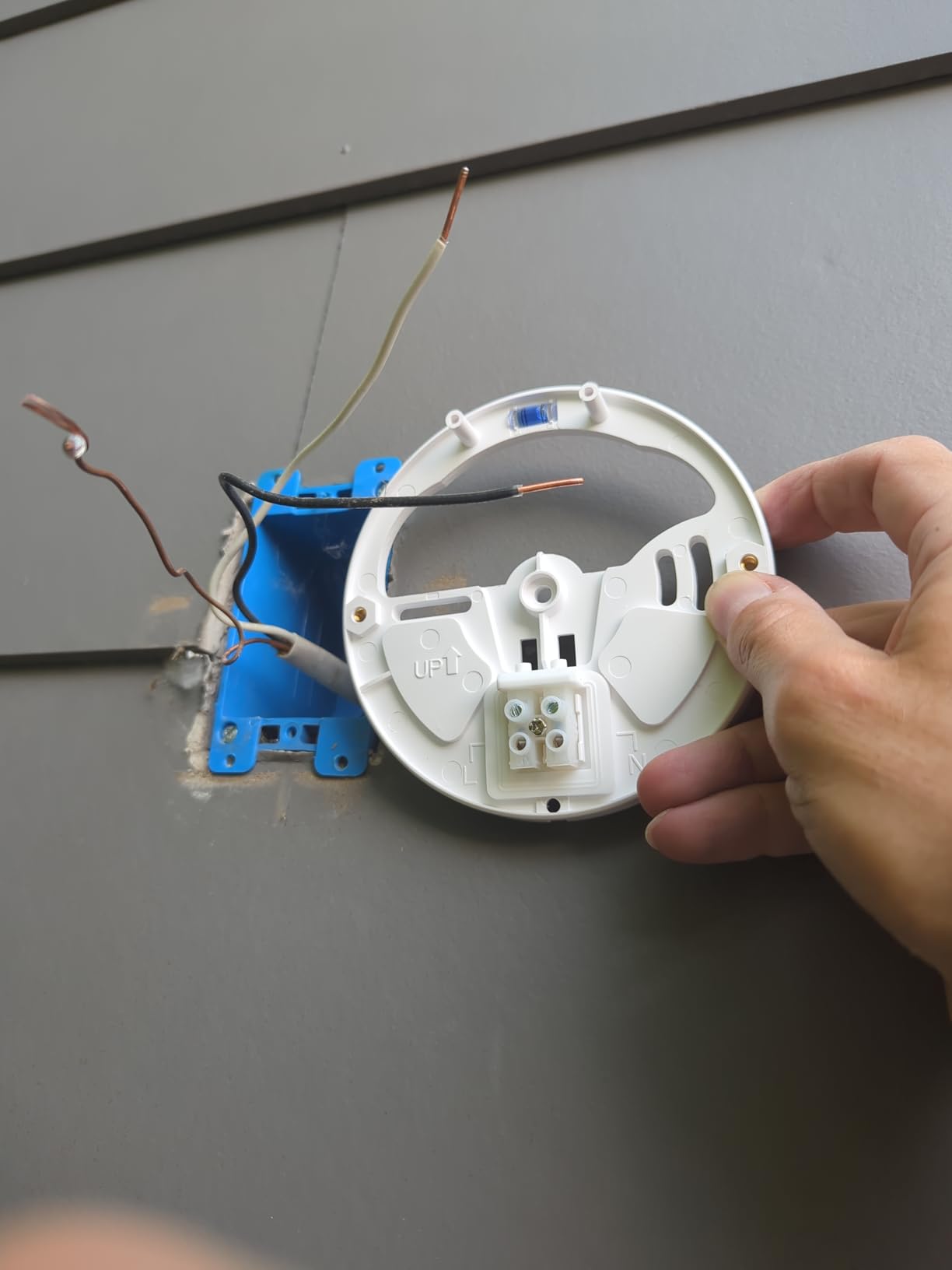
The mounting plate may not bridge the gap from an existing junction box without an adapter, the microSD card is not included, and the camera loses its connection if the wall switch is turned off, which can be surprising if anyone in the house flips that switch.
8. Google Nest Cam with Floodlight – Best Detection Without a Subscription
Google Nest Cam with Floodlight – Outdoor Camera – Floodlight Security Camera, White, 1 Count (Pack of 1)
1080p HDR
Battery powered
Person animal and vehicle detection
Local event buffering
Pros
- Separates people animals and vehicles on-device
- Light activates only for important activity
- Buffers up to an hour of events during outages
- Clean Google Home integration
- Two-way talk with speaker and mic
Cons
- 1080p and a 130-degree view trail newer rivals
- Only 3 hours of event history included
- Advanced features are subscription-gated
- Higher tier price than most rivals
The Nest Cam with Floodlight is the smartest about what it should light up. Because detection runs on the device, it can tell a person from an animal from a vehicle, and the floodlight only switches on for activity that actually warrants it. A raccoon at the bird feeder does not light up your whole yard.
That distinction matters more in a backyard than in a front yard, where a passing car or a pedestrian can be the only thing that ever triggers a light. In testing this was the quietest and most neighbourly of the twelve.
The other standout feature is outage buffering. If Wi-Fi drops or power cuts out, the camera stores up to an hour of recorded events locally and uploads them when the connection returns. For a camera whose job is to record what happens at night, that is one of the most useful behaviours in this list.
The floodlight is battery powered, so there is no wiring, and it is IP65 rated. Familiar faces detection and emergency calling do require a Nest Aware subscription, and the free tier gives you three hours of event history.
Who the Google Nest Cam with Floodlight suits
This is the pick for households already living inside the Google Home app, especially anyone with a Nest Hub display who wants voice control. It also suits people whose main frustration is lights firing at nothing all night, because the detection logic is the most selective here.
If you want a camera that keeps working through an internet outage and you already use Google devices, the buffering behaviour makes it more dependable than most cloud-only competitors.
Where it falls short
The imaging is the weakest in the group. At 1080p with a 130-degree field of view, it gives you less detail and less width than the 2K and 3K models, and a large backyard will need a second camera sooner.
Three hours of event history is a short window, and familiar faces, emergency calling and longer history all sit behind Nest Aware Plus. The price also sits at the higher end of the wired comparison, which is hard to justify next to models with more resolution.
9. Ring Floodlight Cam 4K Pro – The Sharpest Image on the List
Ring Floodlight Cam 4K Pro (newest model), Wired, Retinal 4K with wide-angle video, 10x Enhanced Zoom, and 2000 Lumen Floodlights, Black
Retinal 4K wide-angle
10x enhanced zoom
Floodlights adjustable 200-2000 lumens
Low-Light Sight
Pros
- Highest resolution here with 10x zoom for distant detail
- Brightness adjustable from 200 to 2000 lumens
- Low-Light Sight gives color video with lights off
- Wired so there is no charging to plan
- Reliable install and fast playback
Cons
- Owners upgrading from earlier Ring models see small gains
- Bulkier body with less articulation than earlier models
- Light color is more yellow
- 85dB siren is quieter than competitors
The 4K Pro produces the sharpest footage here, and 10x enhanced zoom lets you pull detail out of a far corner of the property from a single fixed mount. On a large yard where you cannot cover everything at close range, that zoom is the argument for the price.
Two features stand out for backyard use. The floodlight output is adjustable from 200 to 2000 lumens, so you can run a soft ambient level for most of the night and go to full output on real motion, and Low-Light Sight produces usable full-colour video in near-darkness even with the floodlights switched off.
That second feature is genuinely useful. It means the camera is not a single point of failure: if someone disables the light, you can still identify shapes and colours rather than switching to black-and-white infrared.
3D Motion Detection is radar-based and behaves the same way as the Pro model below it in the range. The 85dB siren is the quietest on this list, which is a deliberate trade since a siren that loud in a backyard is a siren your neighbors will also hear.

Who the Ring Floodlight Cam 4K Pro suits
This suits owners of a large property, a long driveway or a yard where the interesting activity happens far from the house. The adjustable output range also makes it the most flexible option here for shared lot lines, since you can dial the light down for late hours.
If you have an existing Ring system, the install and app experience will feel familiar, and wired power means there is no battery schedule to manage through winter.
Where it falls short
Long-time Ring owners upgrading from earlier Floodlight Pro models report only marginal real-world clarity gains and occasional pixelation, and some note the floodlight colour is more yellow than previous generations. The body is also bulkier with less articulation than the units it replaces.
Motion detection is reported as slightly weaker than the first-generation model by some owners, and the price sits at the top of the wired group alongside the Google unit despite similar core hardware.
10. aosu Wired Floodlight Camera 3K – 360-Degree Coverage With Patrol
aosu Wired Floodlight Camera 3K 2600-Lumen 24/7 Recording
3K UHD and 6x zoom
2600 lumens
360-degree pan and 90-degree tilt
24/7 hardwired recording
Pros
- 3K clarity with 6x zoom at a mid-range tier
- True 24/7 continuous hardwired recording on a card
- Three PIR sensors give a 270-degree detection area
- 360-degree pan and 90-degree tilt with scheduled patrol
- 2600 lumens reaching about 33 feet
Cons
- 20 fps frame rate makes fast motion choppy
- Card sold separately with 128GB maximum
- Newer brand with a small review base
- Alexa and Google support varies by app and region
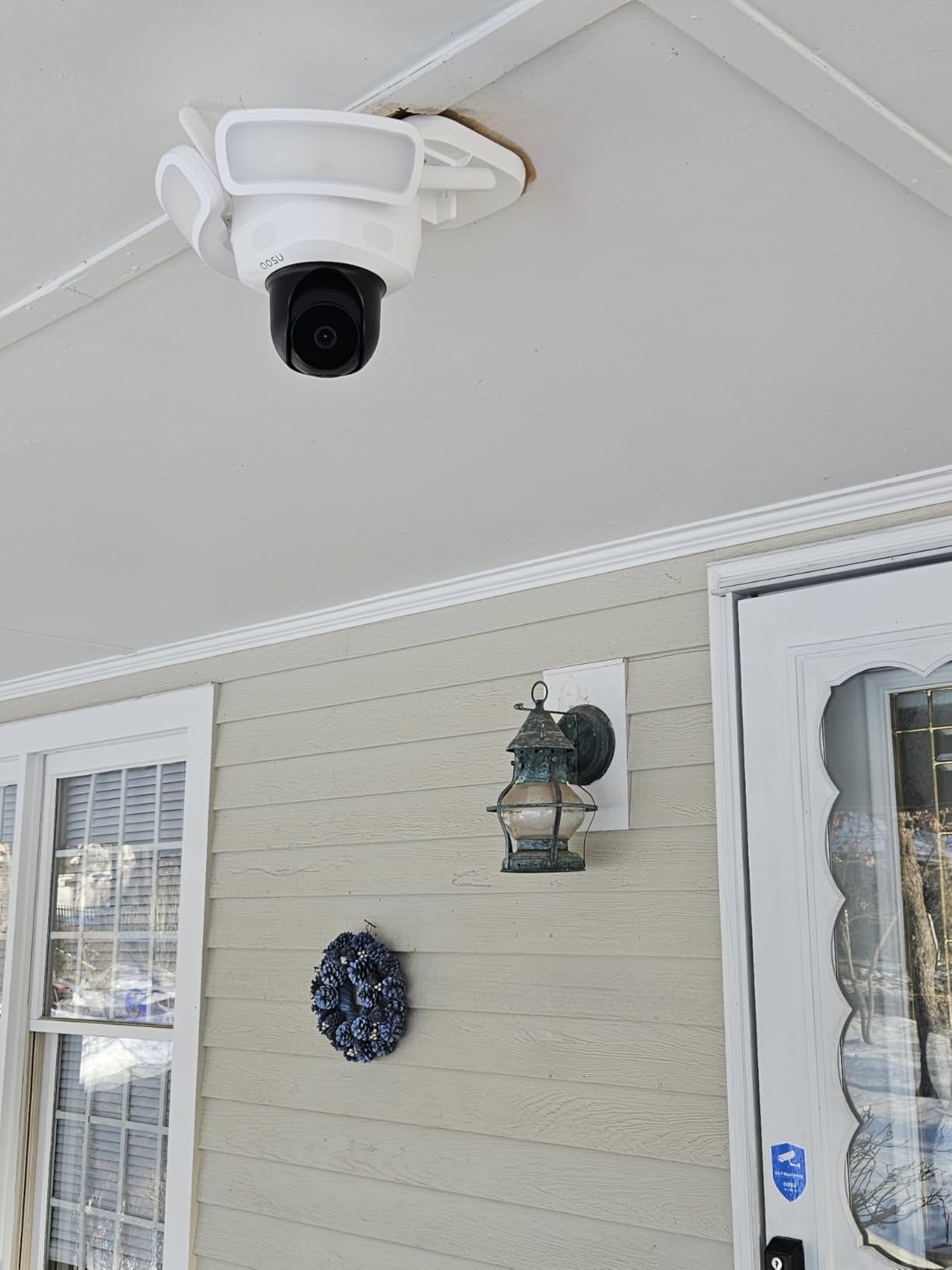
The aosu L5P is a mechanical pan and tilt camera at a tier where that is unusual. It gives you 360 degrees horizontally and 90 degrees vertically, plus a scheduled patrol mode that walks the head through preset positions so the camera surveys the yard on its own.
Patrol mode is a feature most backyard owners do not think they need until they see it. It covers the blind spots between a fixed camera’s zones without adding hardware to the corner of the house.
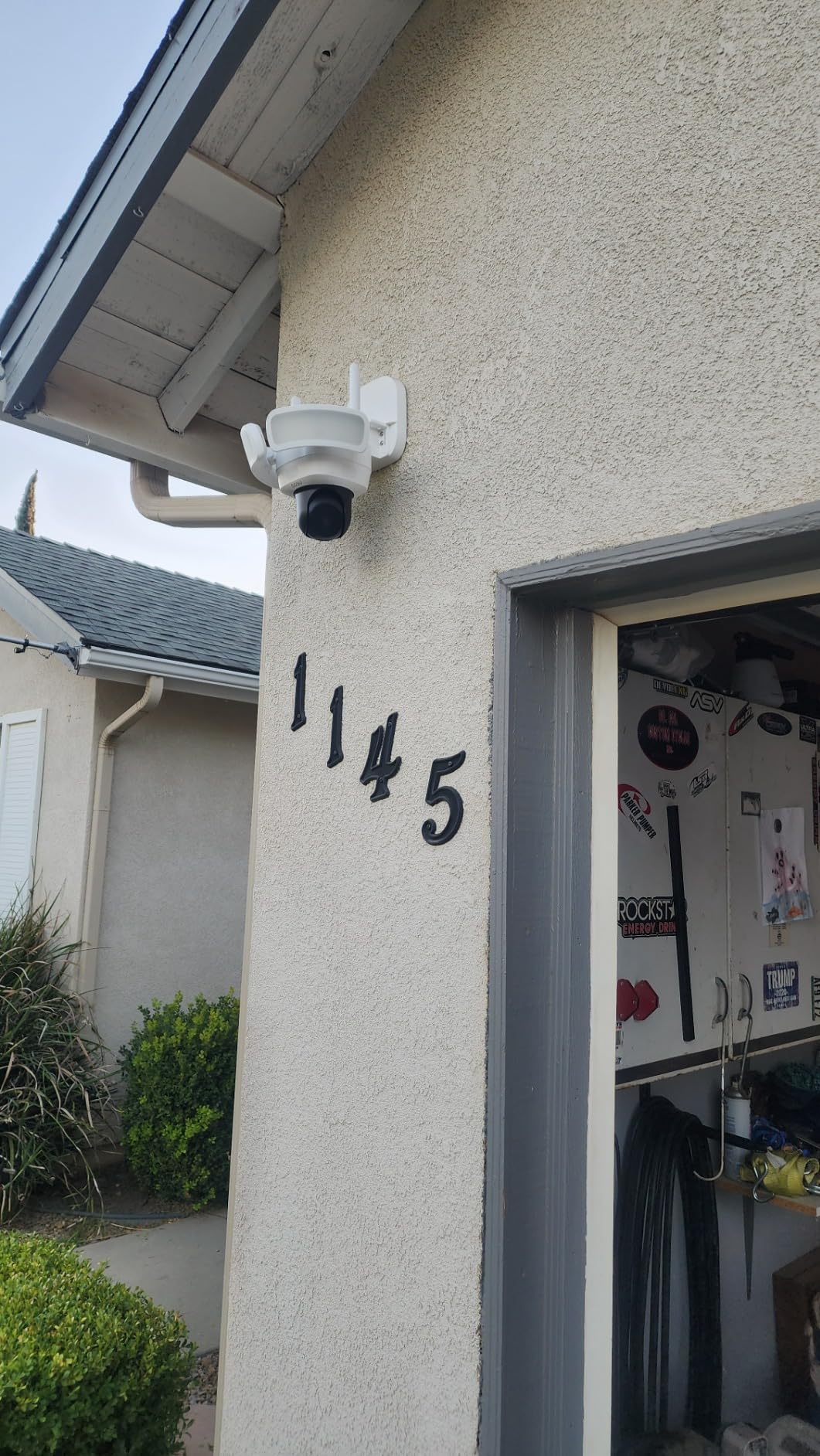
The detection design is unusual in a good way. Three PIR sensors create a 270-degree detection area, wider than the camera itself can see, and the lens auto-tracks toward motion outside the direct view. That means someone crossing a side path still brings the camera around.
Video is 3K UHD with 6x digital zoom, the floodlight puts out 2600 lumens reaching roughly 33 feet, and there is dusk-to-dawn activation alongside schedulable lighting. Recording is genuinely 24/7 hardwired to a microSD card with no subscription involved.
Who the aosu Wired Floodlight Camera 3K suits
This suits homeowners with a wide yard who want moving coverage but do not want to pay for the top tier of the category. The 270-degree PIR detection and the patrol function both help in yards with side paths and gates that a fixed lens would miss.
It also suits anyone who wants continuous local recording without a plan and prefers a mechanical head to a very wide fixed lens, since a wide lens shrinks distant subjects and makes identification harder.
Where it falls short
The 20 fps frame rate is lower than most of the field, and you can see it when something moves quickly across the frame, which in a backyard means a pet or a child running.
The card is sold separately and tops out at 128GB. More significantly, this is a newer brand with a much smaller review base than Ring, Arlo or Google, so there is less long-term reliability history to lean on. Smart assistant compatibility also depends on the app and region.
11. Tapo C720 Floodlight Camera – Clean AI Filtering for Busy Yards
Tapo 2K+ Outdoor Wired Floodlight Security Camera, C720, 2800LM
2K QHD
2800 dimmable lumens
270-degree detection zone
AI person pet vehicle detection
Pros
- Bright 2800-lumen light with 2K detail and 30 ft color night
- 270-degree motion zone covers a wide yard
- AI classification meaningfully cuts false alerts
- 24/7 local recording works without a subscription
- Lightest body here at 0.69 kg
Cons
- Smallest and newest review base of the group
- 2.4GHz Wi-Fi band only
- 153-degree view is narrower than 180-degree rivals
- 2K trails 3K and 4K models
The Tapo C720 is the one to consider if your yard is busy with false triggers. Its AI detection classifies people, pets and vehicles separately, and on a yard where a dog crosses the lawn several times an hour that is the difference between alerts you read and alerts you ignore.
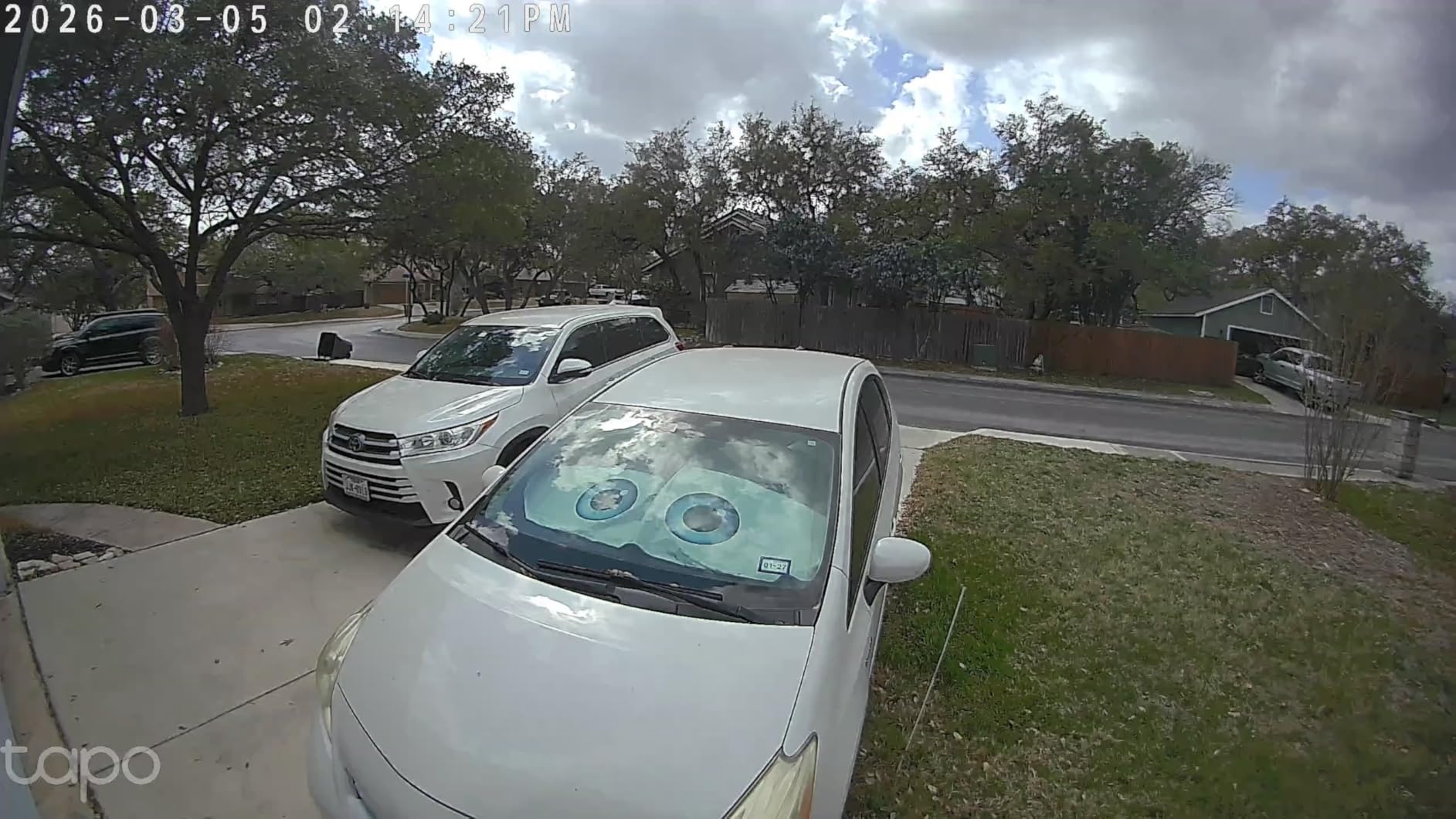
The light is 2800 lumens and fully dimmable, and the motion-activated lighting covers a 270-degree zone. Colour night vision reaches 30 feet, which covers a typical mid-size backyard from a side-of-house mount.
Storage is subscription-free with 24/7 local recording, and an optional cloud plan is available if you want off-site copies. Brightness, schedules and trigger controls are all in the Tapo app, and it works with Alexa and Google Assistant.
At 0.69 kg it is the lightest body in the group, which matters if you are mounting high on an eave or handling a ladder. The body is IP65 rated and the floodlight is wired, so there is no charging to plan around.
Who the Tapo C720 Floodlight Camera suits
This suits pet owners who want to watch a dog in the yard without being notified every time it moves, and families where a neighbouring car or a streetlight reflection would otherwise set off the camera all evening. The 270-degree zone means one mount can guard a wide space.
It is also a strong pick for anyone who wants free continuous recording and good AI filtering without committing to a subscription, and it integrates cleanly if your home already runs on Alexa or Google Assistant.
Where it falls short
The review base is the smallest in this group, at just over 400 ratings, and the model is new. That means less long-term reliability history, and it is worth setting expectations accordingly if you are choosing between brands you have never owned.
It is 2.4GHz only with no 5GHz support, the 153-degree view is narrower than the 180-degree models here, and the resolution sits below the 3K and 4K options available at similar or higher tiers.
12. WYZE Floodlight Camera Pro – Widest View and Three Aimable Light Panels
WYZE Floodlight Camera Pro, 2.5K HD Outdoor Security Camera 3000-Lumen LEDs
2.5K HD
180-degree view
3000 lumens across 3 panels
Color night vision to 50 ft
Pros
- Widest fixed field of view here at 180 degrees
- Three separately aimable light panels
- 2.5K video with strong colour night vision
- 24/7 local microSD recording
- Spoken recording warning plus 105 dB siren
- Desktop web portal for viewing on a computer
Cons
- Two-way talk draws heavy echo and feedback
- Event clips are short and often cut off
- AI classification mislabels animals and misses pets
- Motion sensitivity slider is hard to tune
- Reports of the camera going offline
- App menus described as confusing
The WYZE Floodlight Camera Pro has the widest field of view of anything we tested, at 180 degrees, and it gets there without a single moving part. For a rectangular yard you want covered from a single mount, a wide fixed view is often the simpler answer than a mechanical head.
The light is the standout. Three separately adjustable panels total 3000 lumens, and because you can aim them independently you can point one at the patio door, one at the fence line and one down at a path. On a yard with several distinct dark corners, that flexibility is genuinely useful.
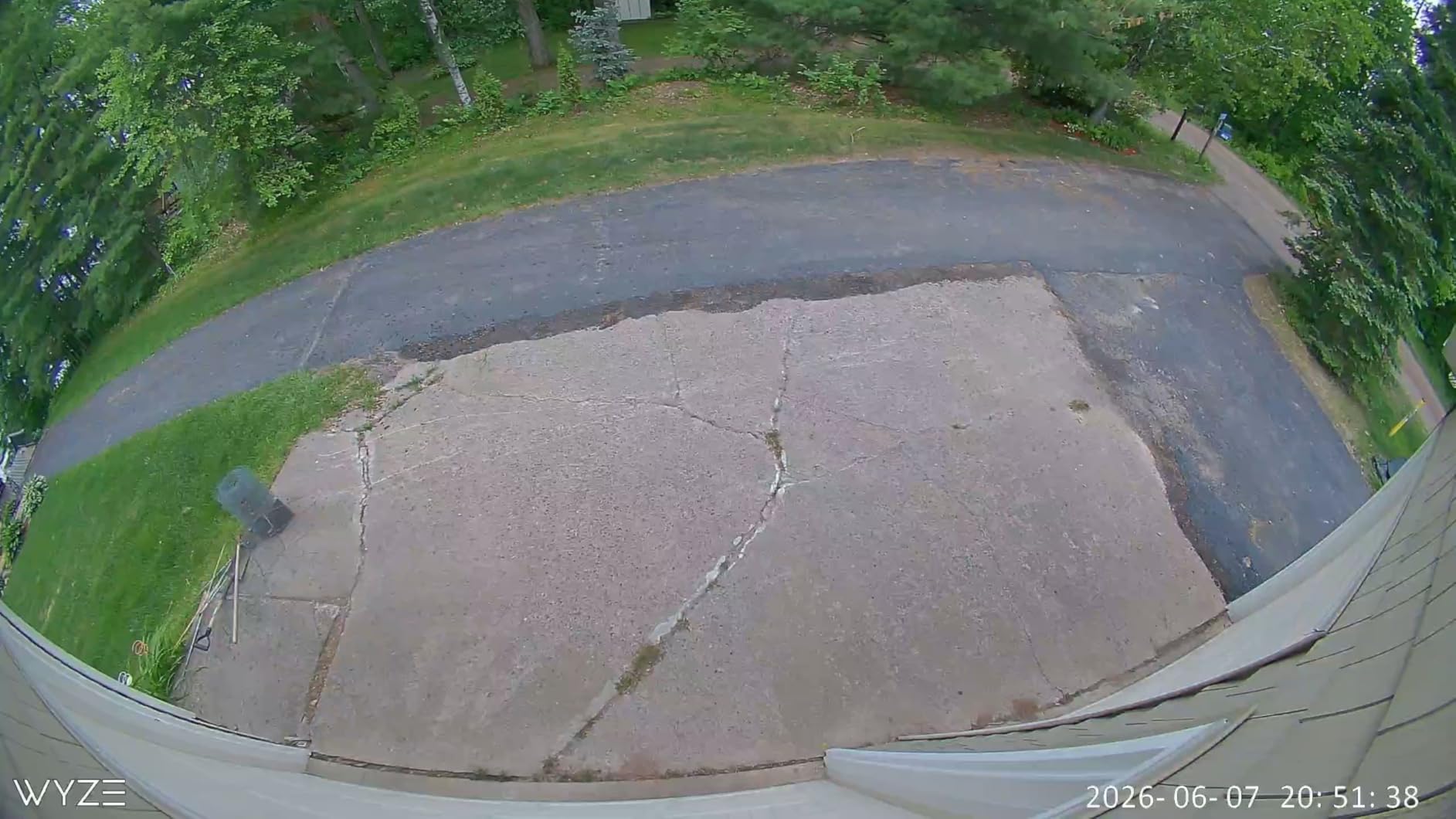
Video is 2.5K HD with colour night vision reaching 50 feet, which is the best night range here and pairs well with the AI detection that covers people, vehicles, pets and packages. Recording is 24/7 to a microSD card up to 256GB, and the desktop web portal is unusual among competitors.
The deterrence side is well handled too. A motion-activated spoken warning tells someone they are being recorded before the 105 dB siren goes off, and Ambient Light Mode keeps a low glow on without flooding the yard.
Who the WYZE Floodlight Camera Pro suits
This suits owners with a wide, open backyard who want maximum coverage from one mount and who want to light several separate areas rather than one broad wash. The 3000-lumen output and 50-foot colour night range also make it a candidate for the largest yards in this group.
People who want to avoid a subscription but still like the idea of optional cloud backup fit well here, as does anyone who prefers reviewing footage on a computer rather than on a phone.
Where it falls short
Two-way talk is the clearest weakness. Owners report heavy echo and feedback that make it effectively unusable without a headset, which is a real loss on a camera you might use to speak to someone at the gate.
Event clips are short and often cut off before an event ends, the AI detection misclassifies animals and sometimes misses pets entirely, and the motion sensitivity slider swings between over-triggering and missing events. A recurring set of reviews also reports the camera going offline and needing a full network power cycle.
Floodlight Camera Buying Guide for Backyards
How much light a backyard actually needs
Lumens measure total visible output, and the numbers on floodlight cameras are honest. Most residential floodlights sit between 2000 and 3000 lumens, and for a typical suburban backyard that is the useful range: enough to light a patio and a section of lawn, enough to identify clothing colours on video, not enough to turn your yard into a car park.
What matters more than the headline number is control. The 4K Pro, which adjusts from 200 to 2000 lumens, and the ieGeek, which offers seven brightness levels, give you the ability to run a soft ambient level and boost on real motion. Cameras that are simply on or off by schedule are harder to live with, especially with a fence nearby.
Wired versus battery in a real yard
Wired cameras win on reliability and light output. They run continuously, they do not care about January temperatures, and their floodlights do not dim as a battery drains. If you have an existing exterior light box, replacing it with a wired floodlight camera is usually the simplest project available.
Battery cameras win on installation flexibility. The Arlo and the Google Nest both mount without any wiring at all, which matters for rentals and for finished walls. The trade is the periodic recharge, the dimmer output on battery, and the proprietary charging cable that means you cannot convert to wired later.
One practical rule: if you can hire an electrician and the run is short, go wired. Owners who have run both consistently report that hardwired cameras hold up better over a multi-camera installation, with wireless units being described as fine for a single camera and frustrating at four.
Storage and the subscription decision
Cloud storage means your footage is available from anywhere and survives a stolen camera. Local storage means a microSD card or a base station keeps the video in your house and costs nothing ongoing. The cameras here that support the subscription-free path are the WYZE v2, the WYZE Pro, the Tapo C720, the aosu L5P, the eufy E340 and the ieGeek.
The Ring and Blink models put their video history behind a plan, and Arlo’s advanced AI features require one as well. Google gives you three hours free and buffers an hour locally during outages. If you are deciding on the basis of a three-year cost rather than day one, the local-storage models come out well ahead.
What you give up is off-site backup. A camera in a backyard is exposed, and local storage is a physical asset that can be removed. A reasonable middle ground is local recording on the camera plus a low-cost cloud plan for a single camera.
Placement: eaves, corners and fence lines
Mounting height changes everything about a backyard camera. At 8 to 10 feet on an eave or soffit you get the widest possible view of the yard and reduce the chance of someone tampering with it, but faces become harder to identify at close range. Lower mounts near a door give better detail on visitors and a worse overview.
Corners are the highest-value position. A corner mount can cover two boundaries at once, which is where most backyard intrusions happen. Fence posts and side-yard walls work for filling a specific blind spot, such as a side gate, but they are the hardest to power.
Check your junction box spacing before you buy. Several brands in this group have a mounting plate that does not bridge the gap from an existing box, and the fix is a specific adapter part rather than any generic bracket.
Neighbor-friendly lighting
Backyard lights point at other people’s property, and complaints about spill are one of the most common consequences people report. Four things reduce it. Aim the panel downward and away from the fence. Keep brightness adjustable so you can drop it for late hours. Use a warmer setting where the model offers one, since warm light reads as less harsh and throws further with less glare. And rely on motion activation rather than all-night output.
The Google Nest Cam is the most restrained in practice, because it only lights for activity it classifies as important. The 4K Pro offers the widest adjustment range, and the ieGeek’s seven levels plus aim control give the finest tuning of the budget group.
Pet and dog monitoring
Watching a dog in the yard is a real use case, and it changes what you should optimise for. Detection accuracy on animals matters more than raw resolution, because a camera that alerts on every squirrel is one you will mute. The Tapo C720 and the eufy E340 both classify pets explicitly, and the eufy auto-tracks them.
Two things to check. Whether the camera supports pet tracking or just person detection, and whether the yard has enough light for a colour image at the range you care about, since colour detail is what tells you whether the dog is limping.
Wi-Fi reach and outage behaviour
Backyard mounts are often the weakest point on a home network. Dual-band support helps, and three models here have it: the eufy E340 with 2.4GHz and 5GHz Wi-Fi 6, the ieGeek with dual-band, and the Arlo as a battery option. The 2.4GHz-only models are usually fine, but they will struggle more if the signal has to pass through two walls.
During a power cut, most of these continue to record if they are on battery or on local storage. The Google Nest Cam buffers up to an hour of events locally and uploads them once the connection returns, which is the clearest implementation of that behaviour in this group. A camera that is purely cloud-dependent loses whatever happened during the gap.
Frequently Asked Questions
Which outdoor camera with floodlight is the best?
The Ring Floodlight Cam Wired Plus is the best all-round choice for most backyards because it combines a proven 2000-lumen light, 1080p color night video, a 105dB siren and hardwired power with a very large base of installed owners. The eufy E340 is the better pick if you need 360-degree pan and tilt coverage on a large yard, and the Ring Floodlight Cam Wired Pro is worth the step up when HDR video matters more than cost.
What is the best floodlight for my backyard?
For a typical suburban backyard, look for 2600 to 3000 lumens with adjustable brightness, a color night sensor, and dual-band Wi-Fi. Choose a fixed 160-degree or 180-degree view for an open rectangular yard, or a mechanical pan and tilt model for an irregular one with side paths. If you want to avoid a subscription, pick a camera with a microSD card slot for 24/7 local recording.
What are the best security cameras with flood lights?
Our shortlist in order of use case is: Ring Floodlight Cam Wired Plus for overall reliability, Ring Floodlight Cam Wired Pro for HDR and accurate detection, eufy Floodlight Cam E340 for 360-degree coverage on large yards, Arlo Wireless Floodlight Cam 2K HDR where no wiring is possible, WYZE Floodlight Camera v2 for free 24/7 local recording, and Tapo C720 for pet and vehicle filtering. Each is reviewed in full above.
Which brand of flood light is considered the best?
There is no single best brand, but Ring has the widest install base and the most consistent app experience, eufy leads on subscription-free local storage, Arlo offers the broadest smart home compatibility, and Tapo delivers the most reliable pet and vehicle filtering. The right choice depends more on whether you already own a smart home ecosystem than on the camera alone.
Do floodlight cameras require a subscription?
Not all of them. The WYZE Floodlight Camera v2 and Pro, Tapo C720, aosu L5P, eufy E340 and ieGeek all record to a microSD card with no plan required. Ring, Blink and Arlo put video history behind a paid plan, and Google includes only three hours of event history free. Check the storage path before you buy if you want to avoid a recurring cost.
How bright should a backyard floodlight camera be?
Between 2000 and 3000 lumens covers most residential backyards, which lights a patio and a good section of lawn and is enough to identify clothing colours on video. Adjustable output matters more than a headline number, since being able to run a dim ambient level and boost on motion prevents both wasted energy and complaints from neighbours about glare.
The Best Floodlight Cameras for Backyards in 2026
After comparing all twelve across light output, power source, detection reliability and storage, the Ring Floodlight Cam Wired Plus remains our pick for the best floodlight cameras for backyards. It is hardwired, bright, quiet to install and backed by the largest installed base of any camera here.
Step up to the Ring Floodlight Cam Wired Pro if HDR and radar-based detection matter on your property, choose the eufy E340 for a large yard where one moving camera has to cover everything, and pick the Arlo or the Google Nest Cam if there is no wiring at all. Whatever you choose, check your Wi-Fi signal at the mount point and confirm your junction box spacing before the ladder goes up.