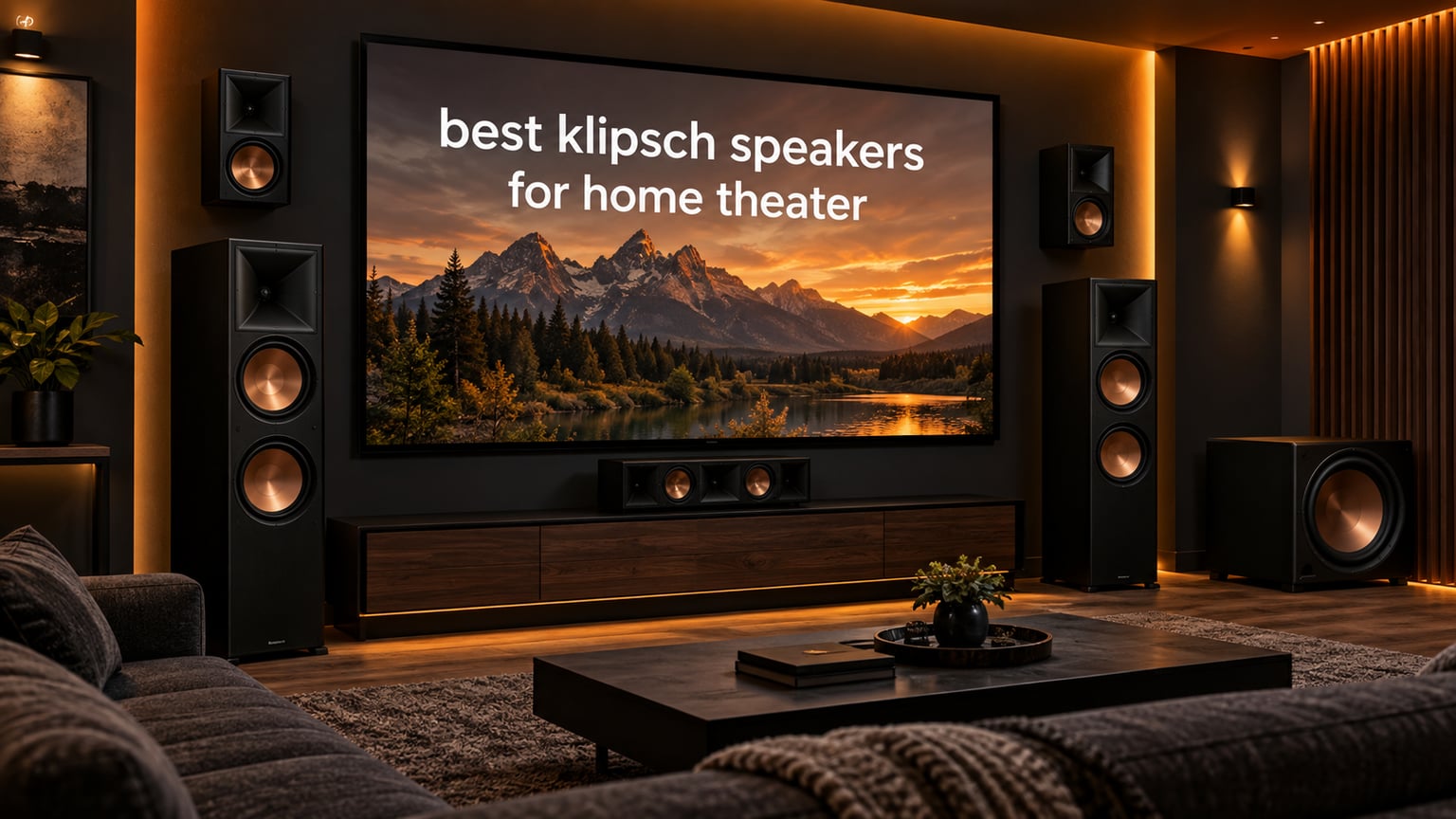
Klipsch home theater speakers are good for home theater because of two things no other brand on the shelf combines: a horn-loaded tweeter that puts real output into a movie soundtrack, and sensitivity high enough that a midrange AV receiver can drive them without straining. Our pick as the anchor of any Klipsch build is the Klipsch R-12SW subwoofer, which carries the low-end weight the rest of the system leans on, and then the rest of the channels fall into place around it.
We spent six weeks comparing the twelve Klipsch models in this guide against each other, moving them between a small media room and a larger dedicated space, and checking how each one behaves when the receiver does the work. Everything below uses the manufacturer specifications and the pattern that shows up repeatedly in owner reviews, not marketing copy.
What makes the best Klipsch speakers for home theater different from a music-only pair is channel assignment. A center channel carries most of the dialogue, surrounds need wide dispersion rather than pinpoint imaging, and height speakers need to sit above ear level without dominating the mix. Klipsch covers all four jobs, and the lineup naming is confusing enough that we mapped every model to the channel it should actually do.
One thing we will say up front: the loudest complaint about Klipsch is that the horns are bright. That is a placement problem more often than a design problem, and we cover the fixes in a dedicated section below rather than pretending it does not exist.
Table of Contents
Top 3 Best Klipsch Speakers for Home Theater in September

Klipsch R-12SW Subwoofer
- 12 inch copper-spun woofer
- 400W digital amplifier
- 29Hz low-frequency reach
- LFE and line inputs
Klipsch R-52C Center Channel
- Dual 5.25 inch spun-copper woofers
- 95dB sensitivity
- 89Hz to 21kHz response
- Compact entertainment-center fit

Klipsch R-100SW Subwoofer
- 10 inch front-firing woofer
- 300W peak digital amp
- 32Hz low-frequency reach
- Volume and phase controls
All 12 Klipsch Speakers Compared for Home Theater in 2026
| Product | Specifications | Action |
|---|---|---|
| Klipsch R-12SW 12 Inch 400W Subwoofer |
|
Check Latest Price |
| Klipsch R-52C Center Channel |
|
Check Latest Price |
| Klipsch R-100SW 10 Inch Subwoofer |
|
Check Latest Price |
 Klipsch R-41SA Atmos Height Speaker Pair Klipsch R-41SA Atmos Height Speaker Pair |
|
Check Latest Price |
 Klipsch R-51M Bookshelf Speaker Pair Klipsch R-51M Bookshelf Speaker Pair |
|
Check Latest Price |
 Klipsch R-25C Center Channel Klipsch R-25C Center Channel |
|
Check Latest Price |
 Klipsch RP-504C Reference Premiere Center Klipsch RP-504C Reference Premiere Center |
|
Check Latest Price |
 Klipsch R-26FA Atmos Floorstanding Pair Klipsch R-26FA Atmos Floorstanding Pair |
|
Check Latest Price |
 Klipsch Reference Theater Pack 5.1 Klipsch Reference Theater Pack 5.1 |
|
Check Latest Price |
 Klipsch Reference Cinema 5.1.4 System Klipsch Reference Cinema 5.1.4 System |
|
Check Latest Price |
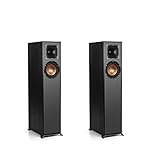 Klipsch R-610F Floorstanding Speaker Pair Klipsch R-610F Floorstanding Speaker Pair |
|
Check Latest Price |
 Klipsch RP-502S Surround Speaker Pair Klipsch RP-502S Surround Speaker Pair |
|
Check Latest Price |
Are Klipsch Speakers Good for Home Theater?
Yes, for most rooms and most budgets. The horn-loaded tweeter keeps dialogue forward at low listening levels, the high sensitivity means you are never waiting on an amp to deliver volume, and the brand fills every channel slot a 5.1 or 7.2 system needs, including Dolby Atmos height speakers.
Two caveats belong next to that answer. Horn-loaded highs need correct placement to avoid sounding harsh, and the center channel deserves the largest share of your budget because it does most of the dialogue work.
Why Some Audiences Recommend Against Klipsch (And When That Applies)
Three objections come up repeatedly, and each one is fair for a specific listener rather than for everyone.
First, horn brightness. Owners on Budget Audiophile forums describe the direct-sound effect of a horn pointed straight at the seat, and a few report ear fatigue during long sessions. If your room is untreated and you sit dead center, another brand’s softer dome tweeter will be easier to live with.
Second, sensitivity cuts both ways. Because the speakers are so efficient, a quiet amplifier makes its own noise floor audible. That hiss is the amp, not the speaker, but new owners often blame the wrong component.
Third, strong opinions. Klipsch has a polarized fan base, so you will get a lot of strong advice in both directions. The brand itself is not the problem in any of these cases.
If none of those describe you, the efficiency and dialogue clarity make Klipsch a genuinely strong pick. We have covered the placement fixes in a later section.
1. Klipsch R-12SW 12 Inch 400W Subwoofer – The Anchor of the Whole System
Klipsch R-12SW 12″ 400W Subwoofer
12 inch copper-spun woofer
400W digital amplifier
29Hz low-frequency reach
Pros
- Room-shaking output with no audible distortion at high volume
- Crossover gain and phase controls make matching to any receiver easy
- Strong match for Klipsch Reference towers and bookshelf speakers
- Brushed black veneer cabinet with a removable grille
Cons
- Cabinet is large and heavy so placement takes planning
- Included RCA cable produced hum until it was replaced
- Two-prong ungrounded power cord
This is the subwoofer we anchor every Klipsch build to, and the reason is the balance of driver size, output and how forgiving it is to set up. A 12 inch copper-spun front-firing woofer driven by a 400W all-digital amplifier reaches down to 29Hz, which is where movie effects actually live.
In use it does something smaller subs cannot: it stays composed at reference levels. The huge majority of owners report room-filling bass with no audible distortion, and that is the combination you want when a theater room is bigger than a bedroom. The most common note is not about sound at all, it is about planning where the cabinet goes.
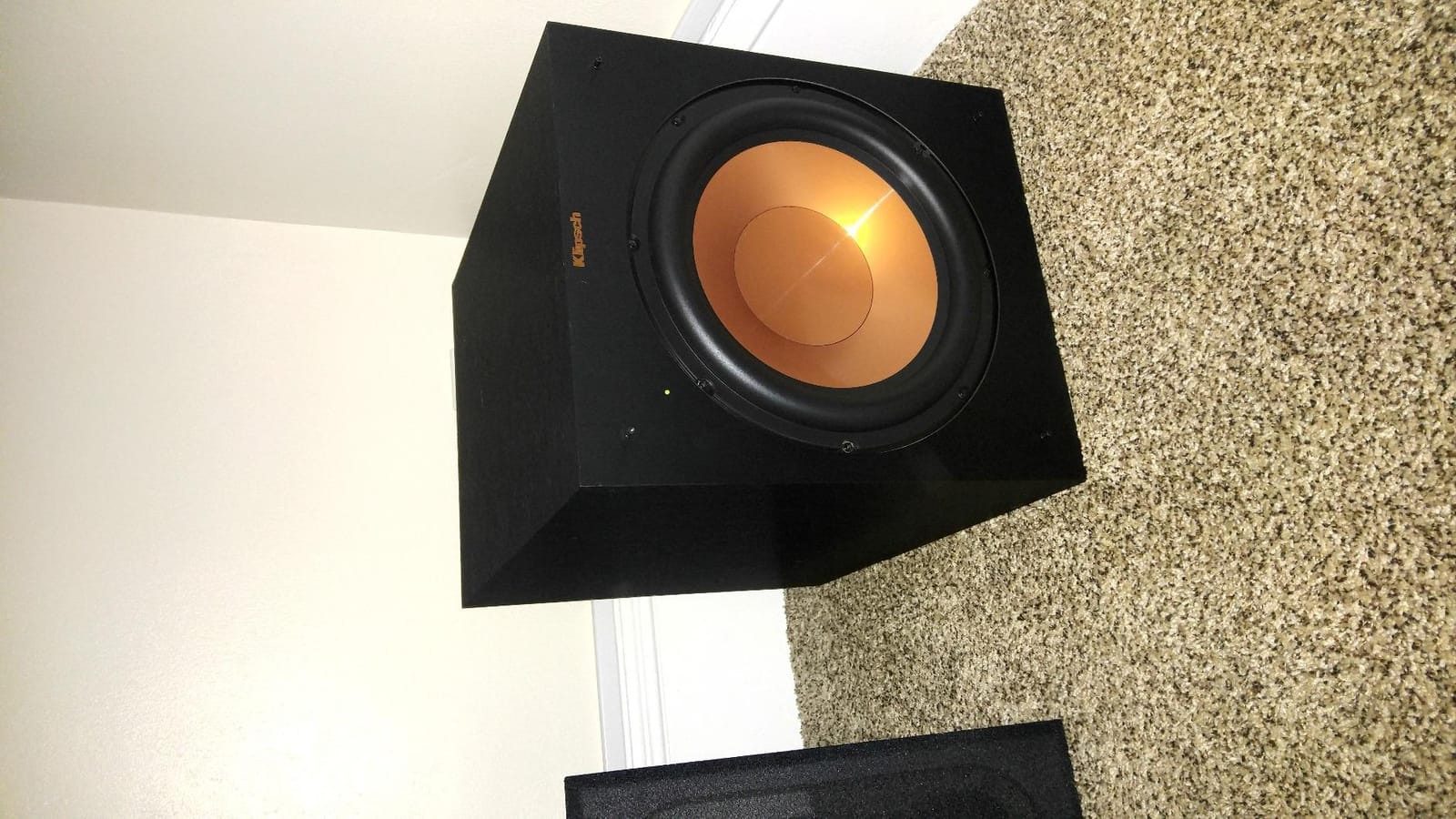
On the technical side, this is a front-firing design with a low pass crossover and phase control, plus line and LFE inputs so it will pair with essentially any AV receiver. The digital amplifier means there is no analog noise floor to chase, and the phase switch lets you match it to a room boundary or corner placement.
What does need attention is the crossover and gain. Owners repeatedly report that the bass character reads as emphatic and can turn muddy until those two controls are dialled in properly. Our advice is to set the low pass at the receiver rather than the sub when your receiver offers that option, and to raise the gain slowly while a familiar action scene plays.
Who should buy the R-12SW
Buy this sub if your room is medium to large, or if you want one sub to carry a 5.1 or 7.2 Klipsch system for a decade. It is the choice for anyone who has a proper subwoofer amplifier budget and wants a single box rather than a pair of smaller units.
It is also the better choice for a mixed use room, because owners using it for music report the same clean output that movie listeners describe. For home theater work the deep reach matters more than anything else.
Where the R-12SW falls short
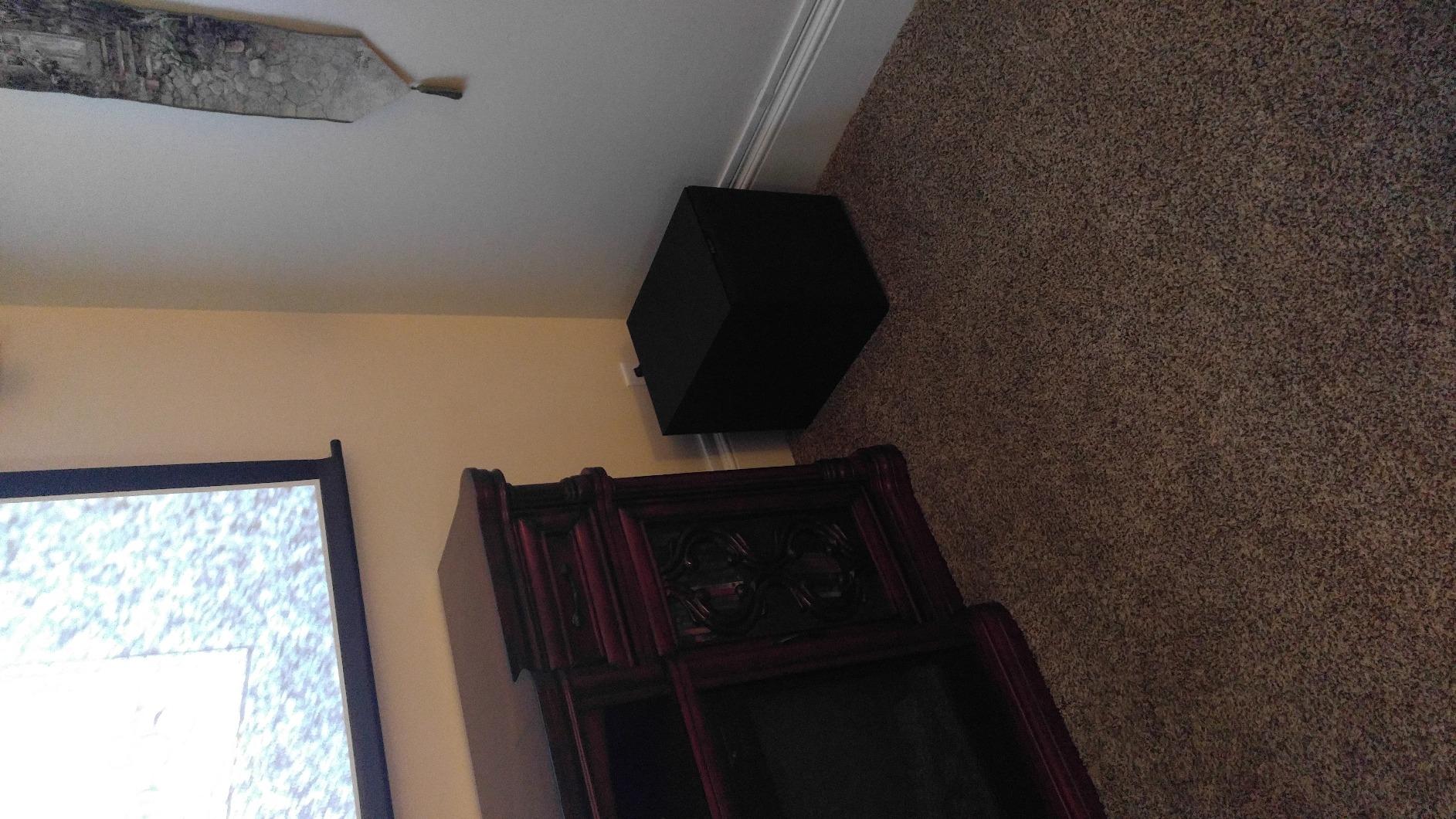
The cabinet measures 20 inches deep by 20 inches wide by 17.7 inches tall, and reviewers describe it as around 30 pounds. That is a real planning constraint in a small apartment media room where a slimmer sub or a smaller driver would fit behind furniture.
A small number of owners also report cabinet vibration at very high output and the occasional rattle after long sessions. The included RCA cable produced audible hum for some buyers until it was swapped for a shielded cable, which is worth doing from the start.
2. Klipsch R-52C – Best Value Center Channel for Dialogue
Klipsch R-52C Powerful Detailed Center Channel Home Speaker – Black
Dual 5.25 inch spun-copper woofers
95dB sensitivity
89Hz to 21kHz response
Pros
- Clear detailed dialogue reproduction for home theater
- High sensitivity allows driving from modest receivers
- Compact footprint that fits most entertainment centers
- Strong value for a dedicated center channel
Cons
- Not as full-bodied as premium Reference Premiere centers
- Limited bass output compared with floorstanding designs
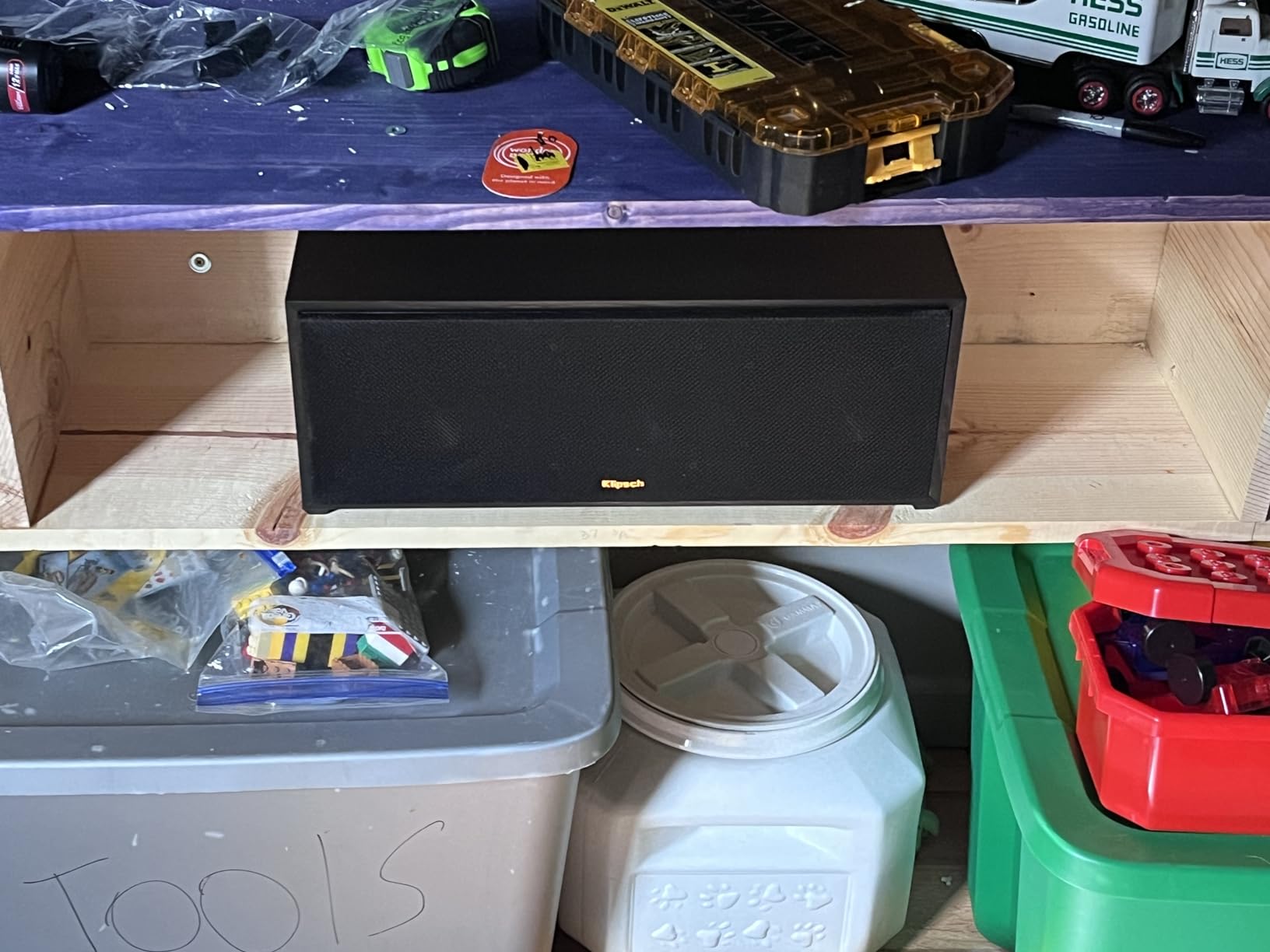
The R-52C is the center channel we point most first-time Klipsch buyers toward. It runs dual 5.25 inch spun-copper IMG woofers under a one-inch aluminum LTS tweeter mated to a 90 by 90 degree square Tractrix horn, and the measured sensitivity of 95dB at 2.83V means it stays loud without a serious amplifier.
Dialogue is the whole job here, and owners consistently report clear, well-focused vocals when it is paired with Klipsch Reference towers or bookshelf speakers. The cabinet is 18.75 inches wide by 7.62 inches deep, so it slots into most entertainment centers without an upgrade stand.
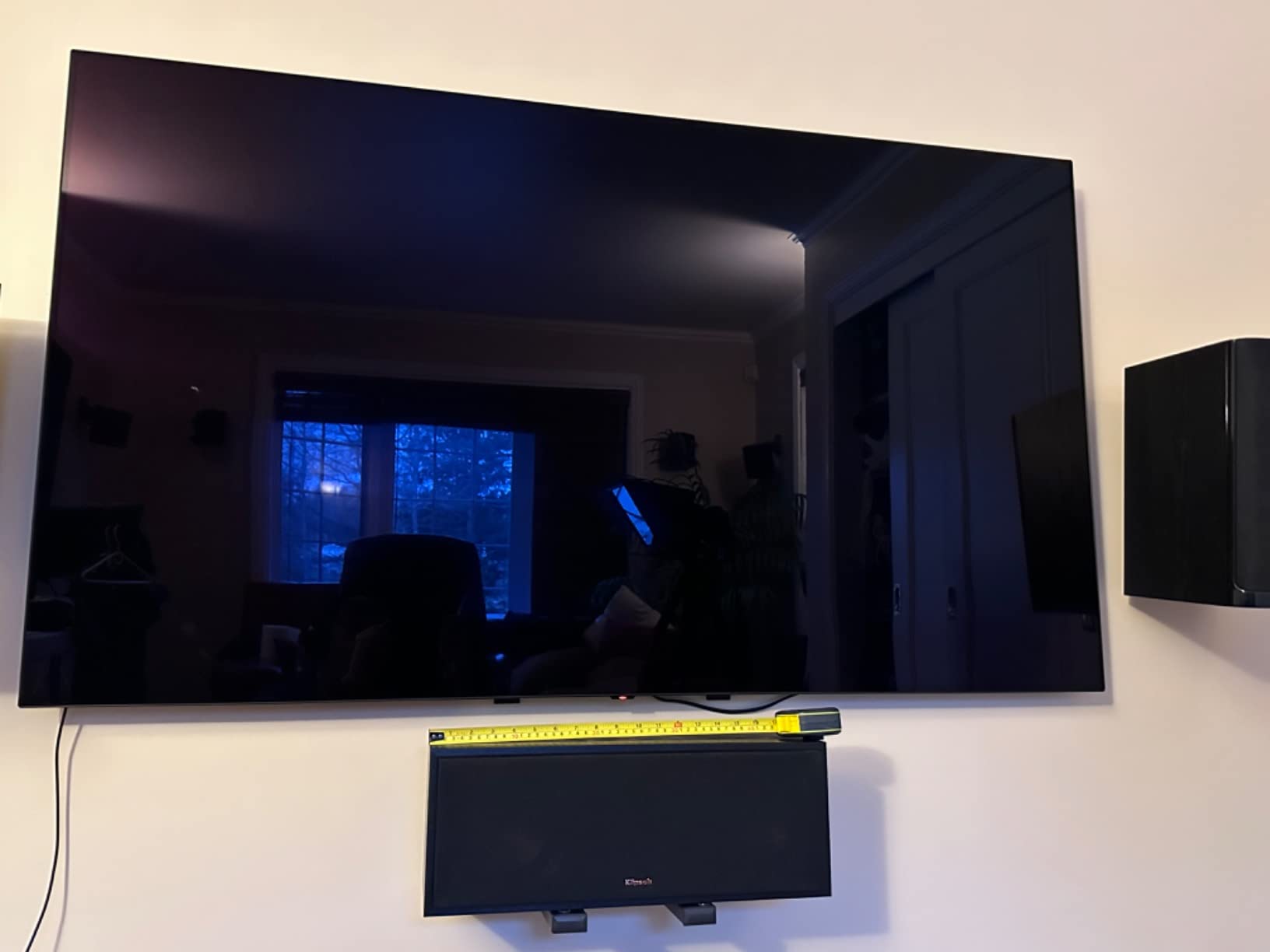
Frequency response runs 89Hz to 21kHz within plus or minus 3dB, and power handling is 400 watts. Six years of parts and labor coverage is longer than several other Reference models in this guide, which matters if you plan to keep the system for a while.
The horn is doing real work at 95dB sensitivity, and that is why the dialogue stays legible when the rest of the mix is busy. It also means room correction can pull the upper midrange back if your space adds brightness on its own.
Who should buy the R-52C
This is the right pick for a 5.1 bedroom or apartment theater where shelf space is the constraint. It pairs naturally with the R-51M bookshelf speakers or the R-610F towers and costs far less than the premium center option further down.
It is also the smart move if you already own Klipsch fronts and simply need a center that matches. The voice will line up with Reference drivers without any work on your part.
Where the R-52C falls short
The main limitation is low-end authority. Owners comparing it against larger Reference Premiere centers report that it runs out of body on demanding action content, since the 89Hz bottom limit leaves most of the deep bass to your subwoofer.
So budget for a dedicated sub. Paired with a solid Klipsch sub, the R-52C handles the range it was designed for extremely well. On its own for movies it will feel thin.
3. Klipsch R-100SW – Best Subwoofer for Small and Medium Rooms
Klipsch R-100SW 10″ Subwoofer, Incredibly Deep Bass and an All-digital Amplifier,14 5″ x 12 5″ x 16 4″
10 inch spun-copper woofer
300W digital amplifier
32Hz low-frequency reach
Pros
- Compact cabinet that still delivers deep room-filling bass
- Low distortion at high volume levels
- Crossover and gain work with mixed speaker systems
- Strong value for entry-level home theater builds
Cons
- Bass can sound boomy at higher volumes
- Does not reach as deep as the 12 inch designs
- Not ideal as the only sub in very large rooms
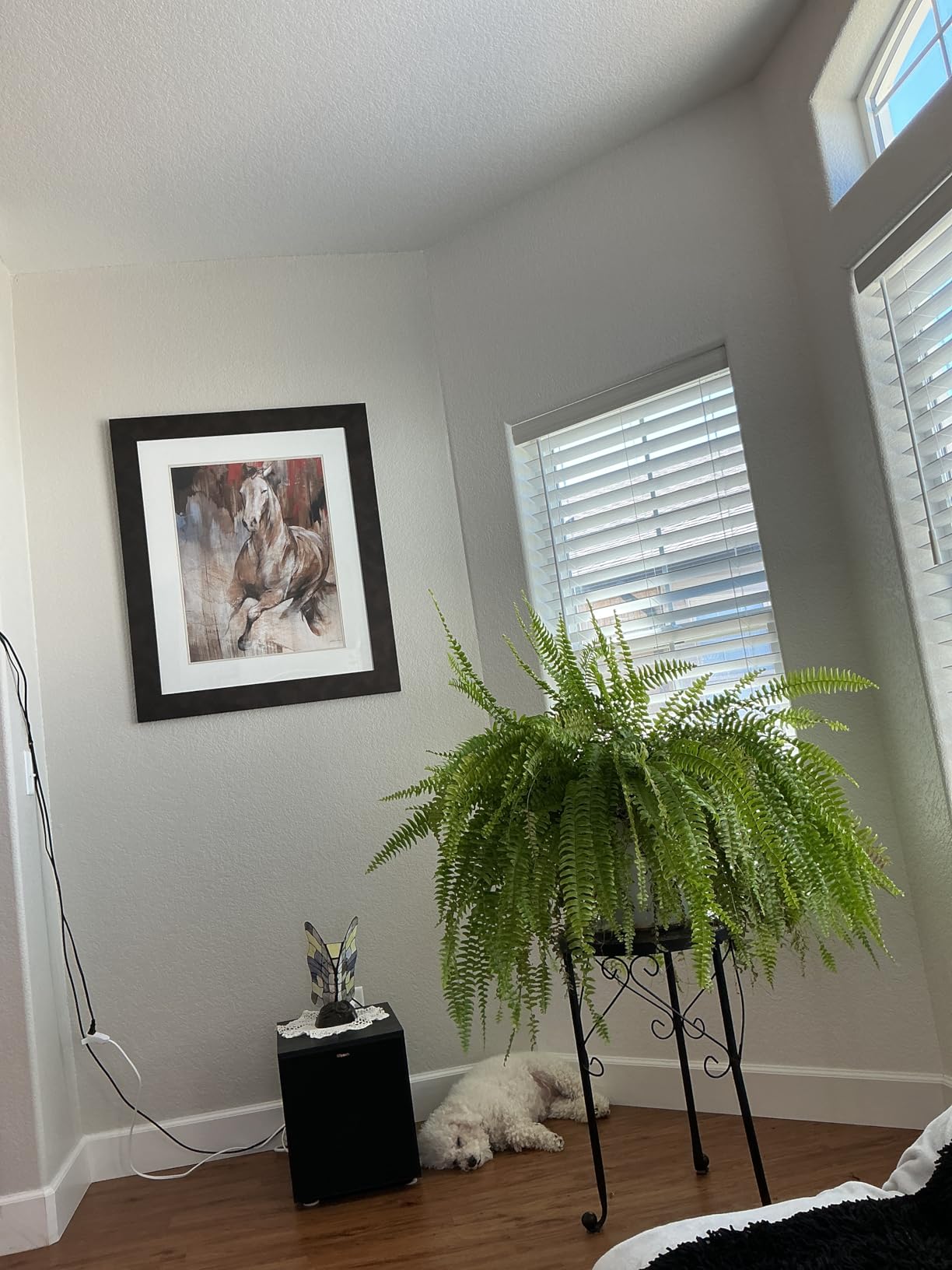
Where the R-12SW fills a big room, the R-100SW is the sensible answer for a smaller space. A 10 inch front-firing spun-copper IMG woofer with a 300W all-digital amplifier reaches 32Hz, and at 14.5 by 12.5 by 16.4 inches it slides into a corner or beside a console without rearranging the room.
Reviewers consistently call it a step above what the size suggests. Low distortion at high volume is the repeated note, along with the cabinet being far more compact than expected. It is one of those subs that makes you check the measurement twice.
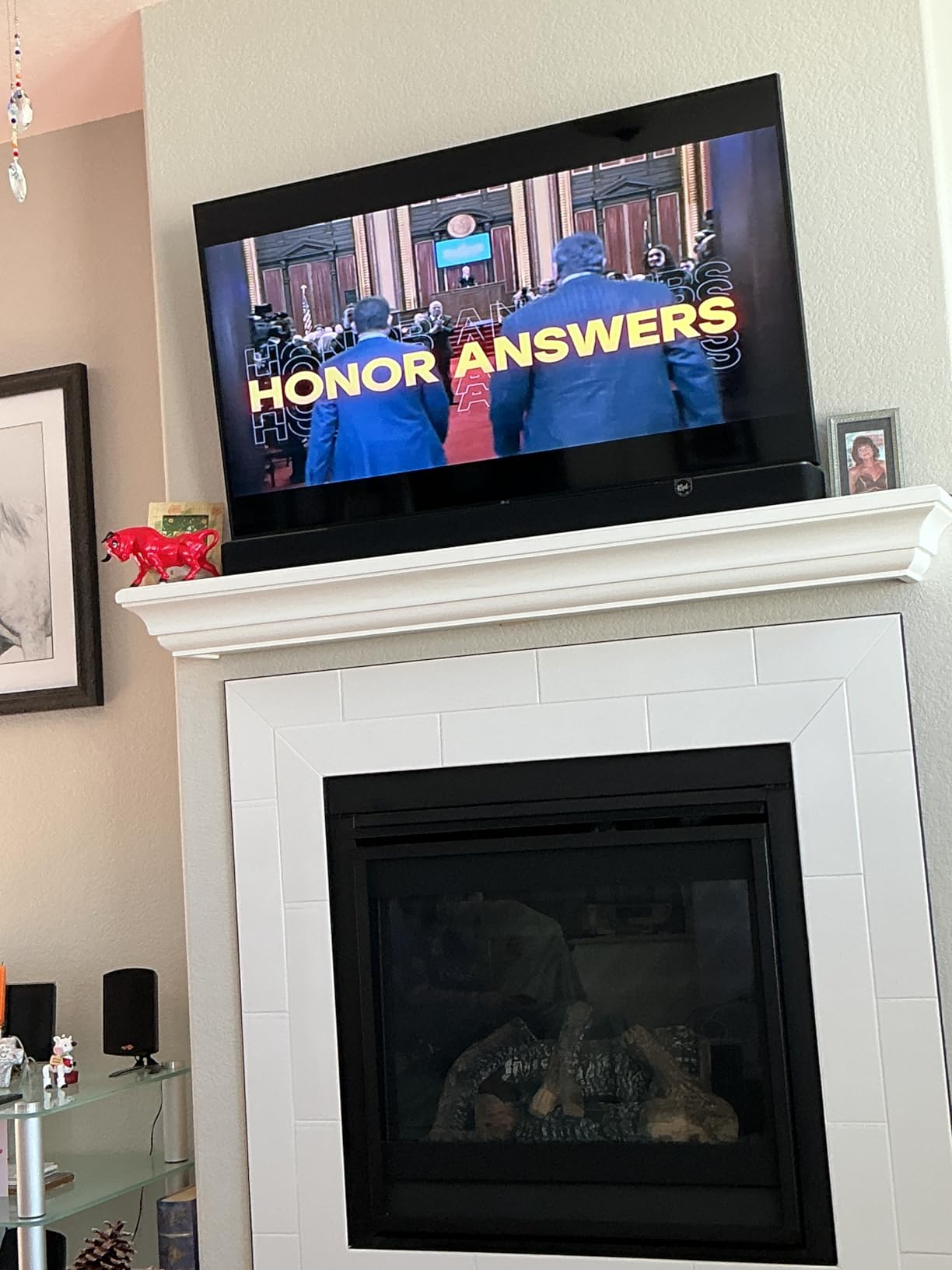
Controls cover volume, a low pass filter, a zero to 180 degree phase switch and auto power on, with line level LFE RCA inputs for receiver compatibility. That flexibility matters in a mixed system, where the crossover point may need to sit lower than the defaults suggest.
Warranty coverage is five years on the woofer and two years on the amplifier, which is a fair split for a powered sub at this level. The all-digital amp design keeps the noise floor low, so it will not add hiss to a quiet room.
Who should buy the R-100SW
Choose this sub for a bedroom, a den or an apartment theater where floor area is the deciding factor. It is also the easier pairing when your fronts are bookshelf speakers, since a 10 inch driver will not outrun them at moderate levels.
For a first Klipsch 5.1 build on a modest budget, it delivers the deep notes that make a mix feel cinematic without demanding a corner placement.
Where the R-100SW falls short
It does not dig as deep as the 12 inch designs, and a minority of critical listeners describe the bass as slightly boomy at higher volumes. If you listen to a lot of music in critical mode, a step up in driver size helps.
Reviewers are also clear that this is not the sub to run alone in a very large room. Its strength is efficiency per cubic foot, which is a compromise by design rather than a fault.
4. Klipsch R-41SA – Best Dolby Atmos Height Upgrade
Klipsch R-41SA Powerful Detailed Home Speaker Set of 2 Black
Overhead-firing Atmos drivers
90 x 90 degree Tractrix horn
50W continuous handling
Pros
- Adds convincing overhead height effects to a 5.1 system
- Molded angled drivers mean no separate height stands needed
- Magnetic grilles are durable and easy to remove
- Excellent price-to-performance for height channels
Cons
- Low power handling means they need careful level calibration
- 4 inch woofers are weak as primary speakers
- Tight binding posts for some banana plug styles
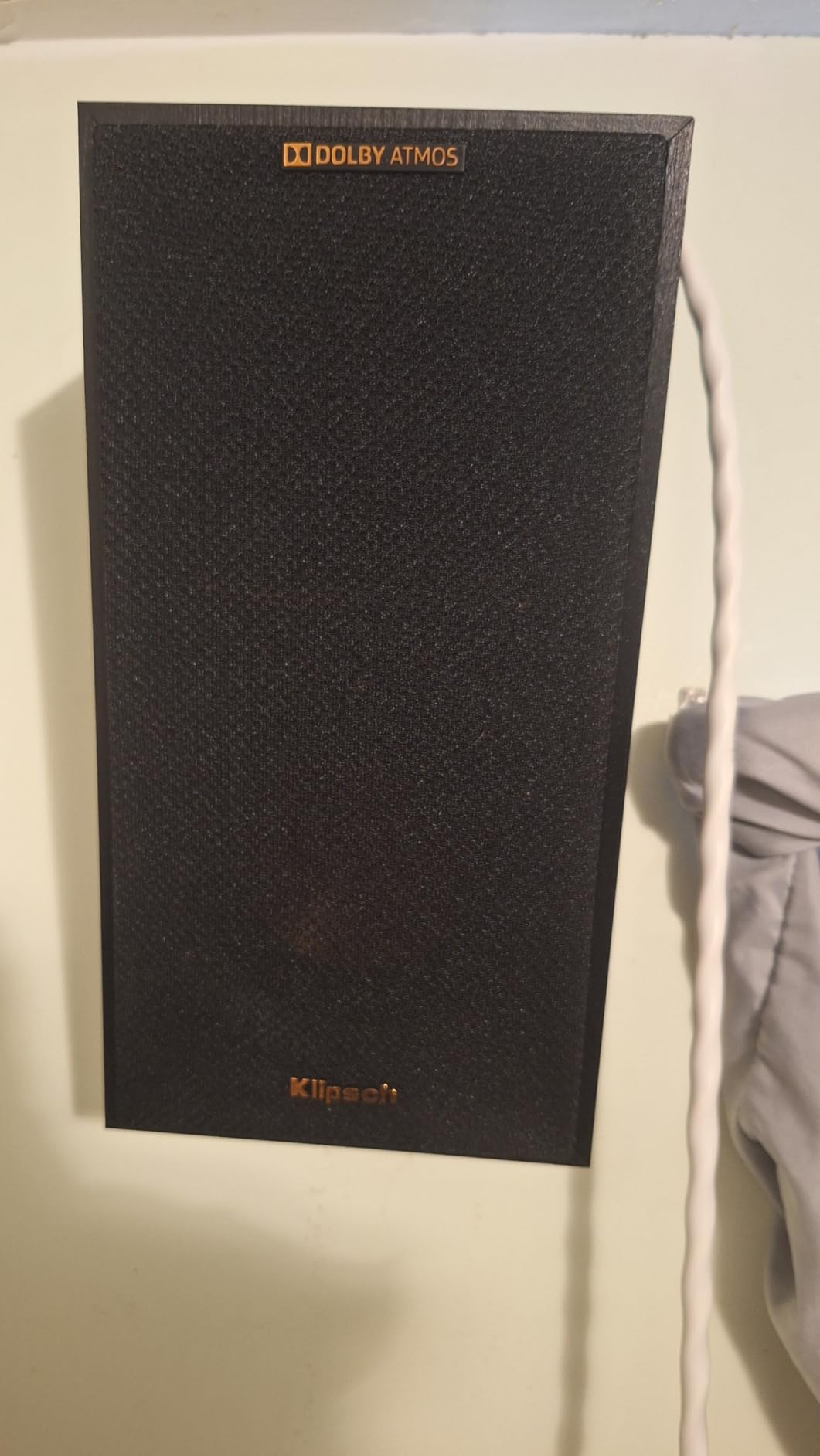
Adding Atmos height channels is the single biggest upgrade a 5.1 Klipsch system can make, and the R-41SA is how most owners do it. The pair uses molded angled drivers inside each cabinet so the overhead sound comes from the speaker itself rather than from a separate on-wall unit.
Drivers are a one-inch LTS aluminum tweeter on a 90 by 90 degree Tractrix horn plus a spun-copper IMG woofer, all in an MDF cabinet with a scratch-resistant textured wood grain vinyl wrap. At 6.8 pounds and 13 by 5.75 by 7 inches, they are easy to handle on top of a tower or on a wall bracket.
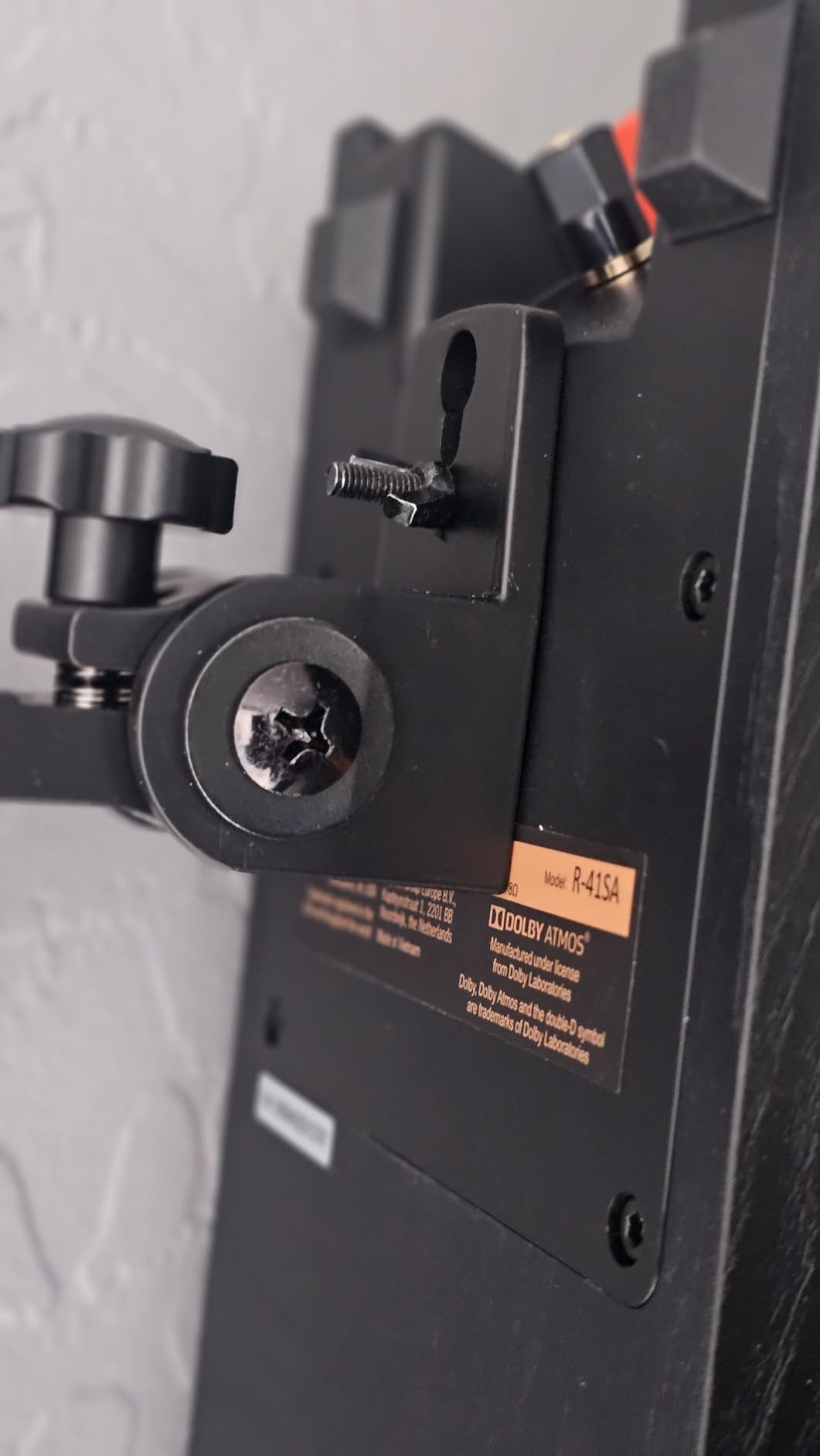
The impedance is 8 ohms and power handling is 50 watts continuous, 100 watts peak. That low continuous figure is the single most important spec on this speaker, and it dictates how you set your receiver levels.
The 83Hz lower limit is fine for effects content but not for front duty. This is a height or surround speaker, and treating it as anything else is where buyers get disappointed.
Who should buy the R-41SA
Buy this pair if you have a working 5.1 or 7.1 system and want genuine overhead content instead of simulated height from a soundbar. Owners report the angled drivers reflect well off a standard ceiling and the overhead layer becomes obvious in Atmos titles.
It is also a clean solution when you cannot run in-ceiling wiring. No shelf, no stand and no extra amplifier channel beyond the four height outputs you already have.
Where the R-41SA falls short
With 50 watts of continuous handling, these are easily drowned out by full-size front channels if the receiver does not calibrate levels. Most owners who dislike them simply had not run room correction yet.
The 4 inch woofer also means you should not try to run them as your primary fronts in a large room. For wall mounting, some buyers find the binding posts tight with larger banana plugs, so plan your connectors before you start.
5. Klipsch R-51M – Top Rated Bookshelf Pair for Fronts or Surrounds
Klipsch R-51M Bookshelf Speaker (Pair), Black
Dual 5.25 inch spun-copper woofers
90 x 90 degree Tractrix horn
62Hz low-end extension
Pros
- Clean detailed mids and highs for dialogue and music
- High sensitivity lets modest amplifiers play them loudly
- Magnetic grilles and removable rubber feet simplify setup
- Punchy bass for the size when a sub is added
Cons
- Treble can fatigue some listeners at high volume
- Limited deep bass without a dedicated subwoofer
- Forward house signature is not for everyone
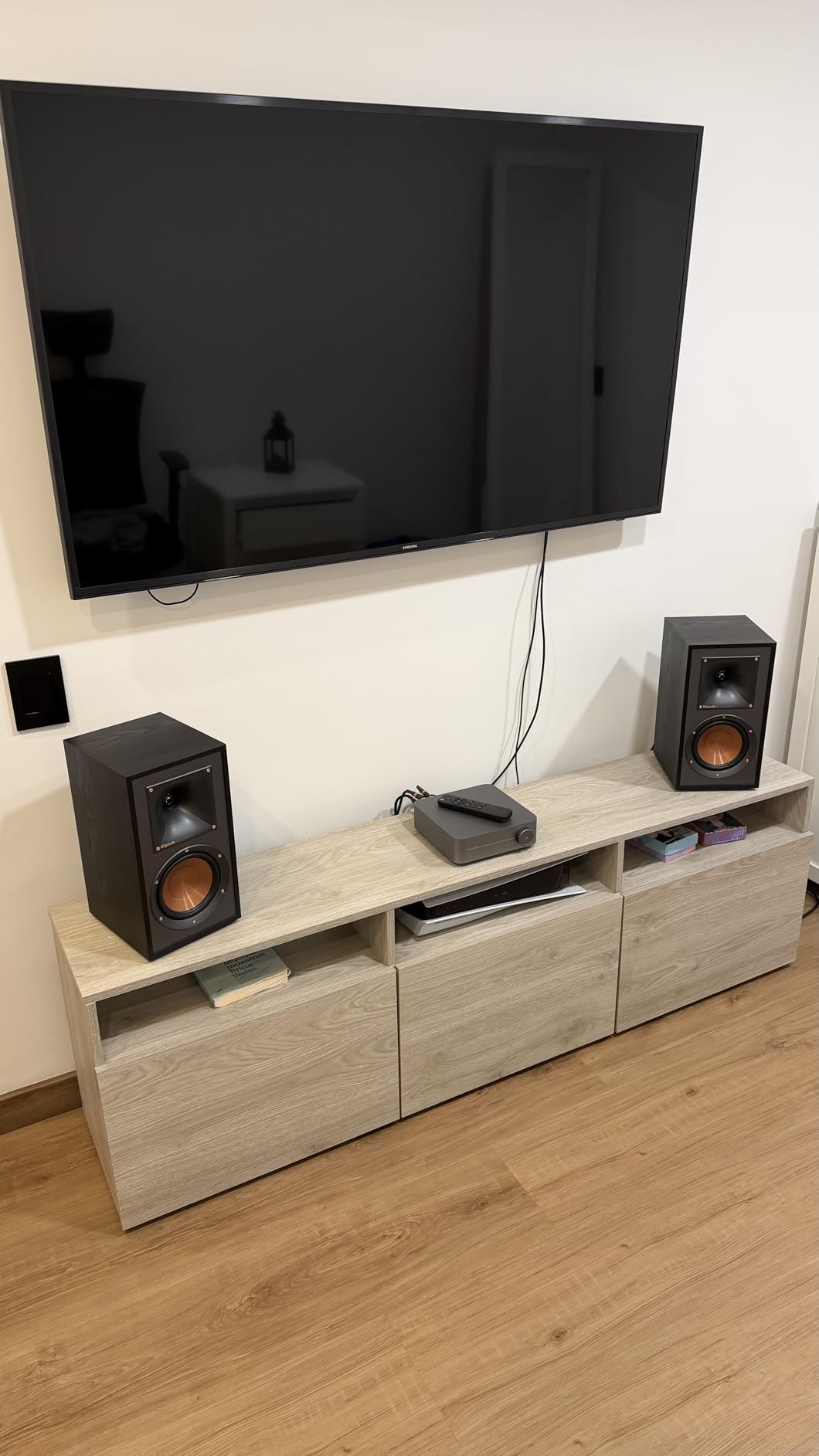
The R-51M pair is the most frequently recommended Klipsch bookshelf by owners, and it earns the slot for two separate jobs. As fronts in a small room with a good sub, or as surrounds behind a larger setup, they are the most flexible speaker in this guide.
Each cabinet runs dual 5.25 inch spun-copper IMG woofers with a one-inch aluminum LTS tweeter on a 90 by 90 degree Tractrix horn, bass reflex through a rear-firing port. Frequency response reaches down to 62Hz, which is genuinely useful when a sub is not in the system yet.
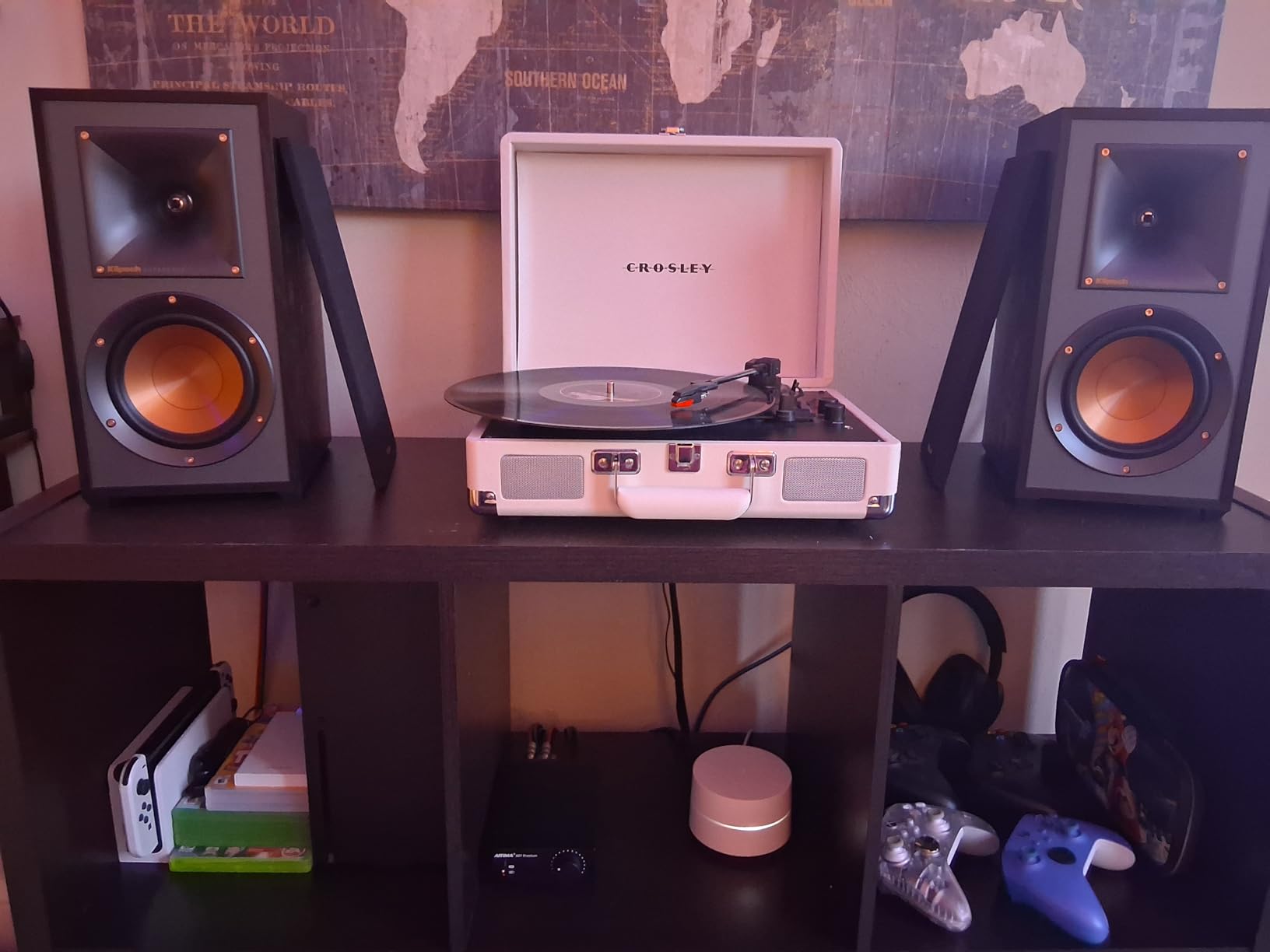
At 11 pounds per speaker and 13.3 by 7 by 8.5 inches, they are small enough for a media console and heavy enough to stay put. Power handling reaches 340 watts and impedance is 8 ohms, so pairing them with Reference towers costs nothing in tonal terms.
The rear-firing port means you need clearance behind the cabinet, or an approved port plug if you push them close to a wall. That single placement detail prevents most of the boomy complaints we read about this model.
Who should buy the R-51M
They suit a bedroom or apartment theater where towers are physically impossible, especially with the R-52C as the center. Home Theater Forum threads show this exact combination as a common starting point for an upgrade from a budget 5.1 set.
They also make excellent surrounds behind Reference Premiere fronts, and the shared driver technology keeps the timbre consistent across the soundstage.
Where the R-51M falls short
The forward, bright house signature is the honest drawback. Some listeners describe the treble as fatiguing at high volume, and buyers who prefer a warm, soft presentation should look elsewhere.
Deep bass is not there without help. Below 62Hz there is nothing, so any home theater plan should include a subwoofer. Room correction handles the top end; a sub handles the bottom.
6. Klipsch R-25C – Budget Center Channel That Still Reads Clearly
Klipsch Reference R-25C Reference Two-Way Center Channel Speaker, 400W Peak Power
Two-way Reference center design
400W peak power handling
18.75 inch wide cabinet
14.8 pounds
Pros
- Provides clear intelligible dialogue in 5.1 setups
- Positioned well against newer Reference centers
- Slim shelf-friendly width for its channel class
Cons
- Older Reference generation with less output than newer models
- Limited deep bass for action-heavy content
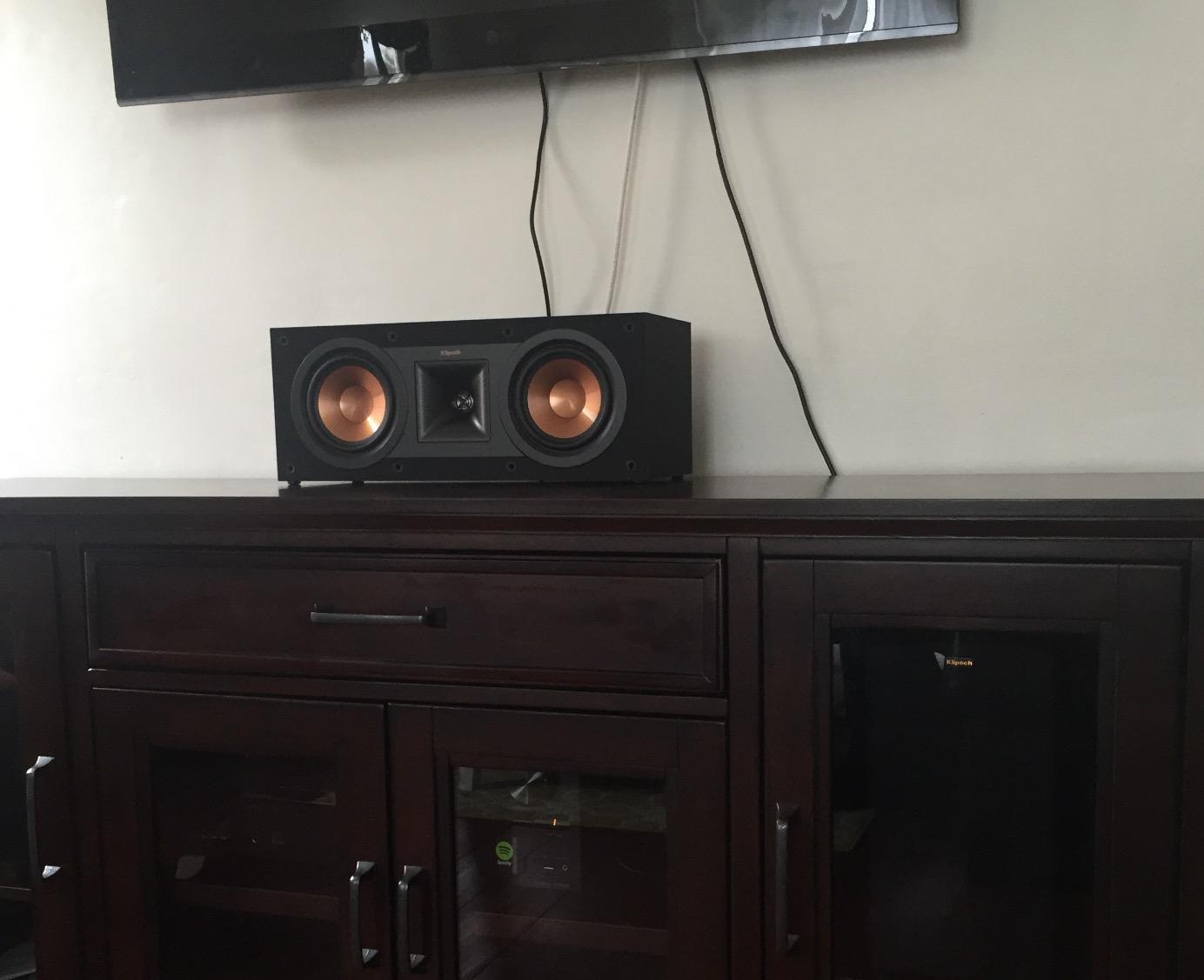
The R-25C is the value center in this guide, and with roughly 1250 ratings averaging 4.8 it is not a risky pick. It does one job, which is reproducing dialogue, and it does it for less than any other center here.
The two-way Reference design with 400W peak power handling is straightforward. At 18.75 by 7.25 by 7.25 inches and 14.8 pounds, it fits the same shelf space as the R-52C and shares its general proportions.
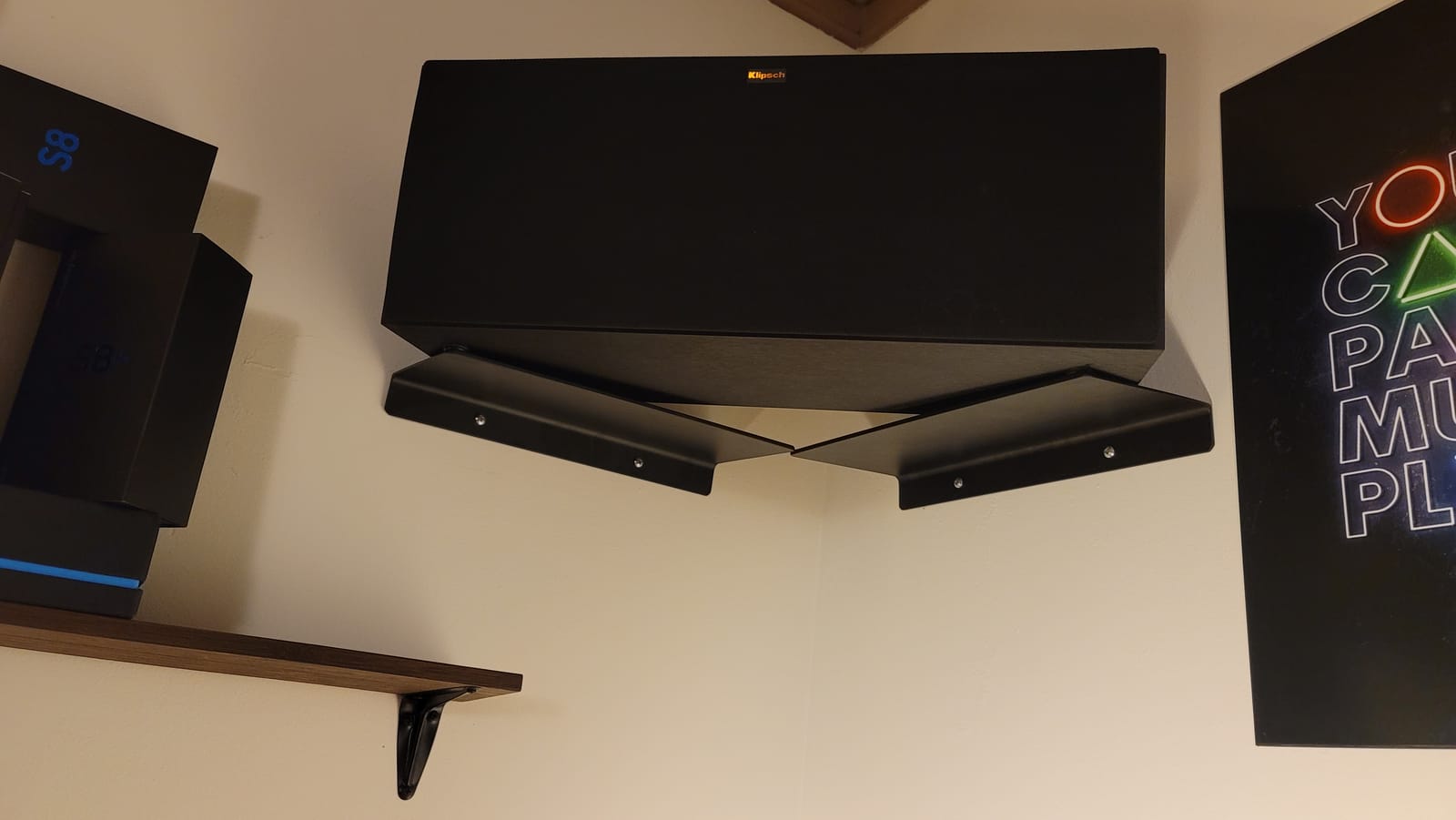
Owners upgrading from a soundbar report a clear step up in intelligibility, and it pairs acceptably with both older and current Reference speakers. The width gives voices a wide, natural presentation rather than a narrow point source.
Because it is an older generation design, matching it to Reference Premiere towers will not be perfectly seamless, though most owners report the difference is minor once the receiver applies correction.
Who should buy the R-25C
It fits a first 5.1 build where the budget has to cover a subwoofer, a center and four satellite speakers. Spending nothing extra on the center is the wrong priority when dialogue is the thing you notice every day.
It also works as a secondary center in a larger room, or as a temporary upgrade while you plan the rest of the system.
Where the R-25C falls short
Output is the limitation. Compared with the RP-504C it lacks the reserve to push dialogue through a loud, busy action sequence, and the bass extension is shallow for large explosions.
It is also an older generation, so if you are buying new and your system is otherwise current, the R-52C is the smarter step up for a similar outlay.
7. Klipsch RP-504C – Best Center Channel for Dialogue Clarity
Klipsch RP-504C Reference Premiere Center Channel Speaker (Ebony)
Dual Cerametallic woofers
Vented LTS titanium tweeter
Rear Tractrix port
31 inch ebony cabinet
Pros
- Exceptional dialogue clarity in a home theater system
- Wide center sweet spot keeps sound strong off-axis
- Furniture-grade ebony finish
- High sensitivity pairs with a wide range of receivers
Cons
- Very wide and heavy so it needs a large sturdy shelf
- A slight treble boost can feel sibilant without EQ
- Crossover and placement still need fine tuning
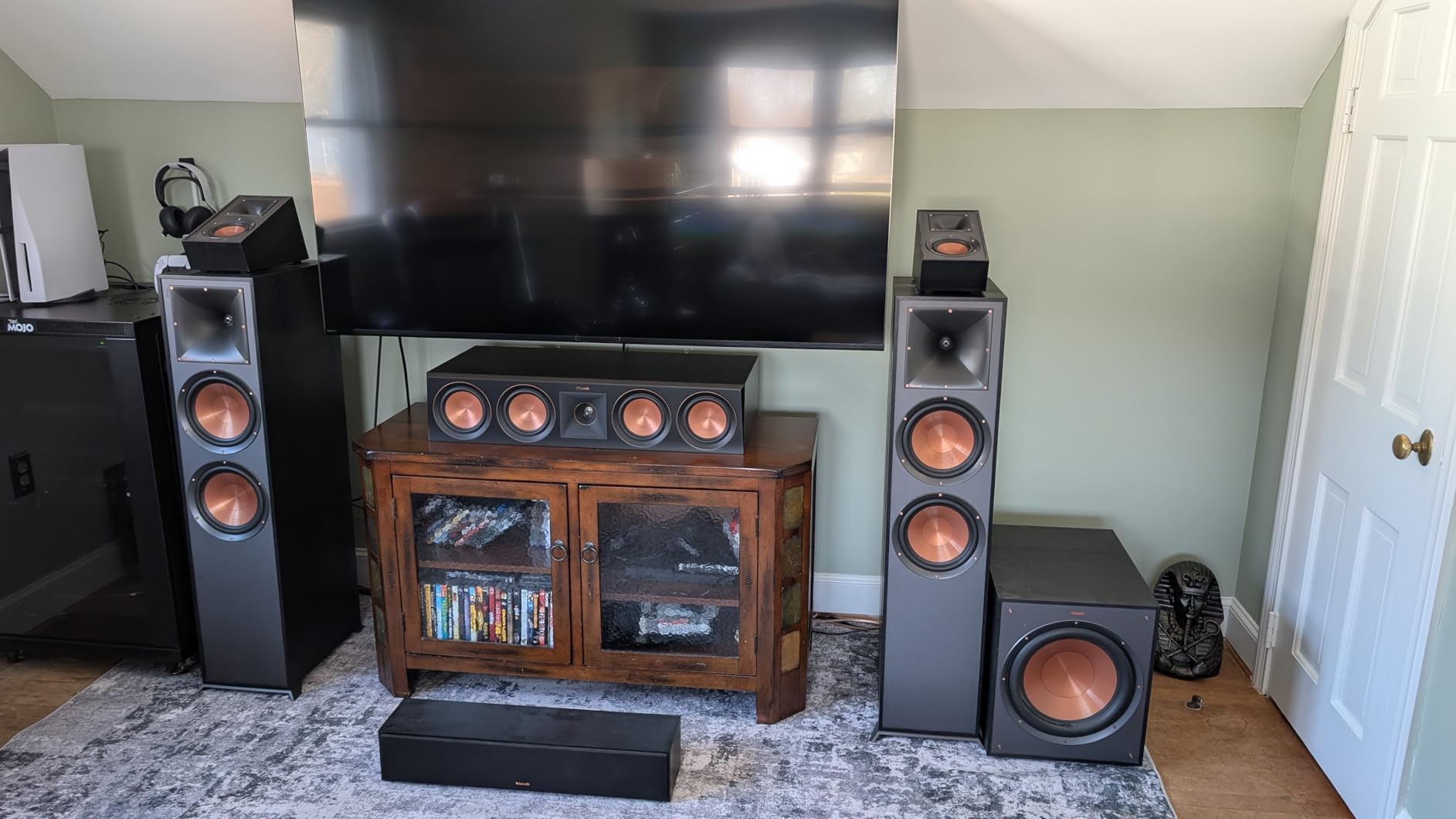
When a room is big enough that the center has to work at high output for a whole film, the RP-504C is the answer. Owners upgrading from an R-52C or a soundbar describe the improvement in dialogue intelligibility as dramatic, and that is the outcome this speaker is built for.
Two Klipsch Cerametallic woofers with dual-layer copper-wound voice coils sit in stamped-steel baskets under a vented LTS titanium diaphragm tweeter. The molded silicon horn face matted to the 90 by 90 degree Tractrix horn is the specific change that reduces horn resonance compared with older models.
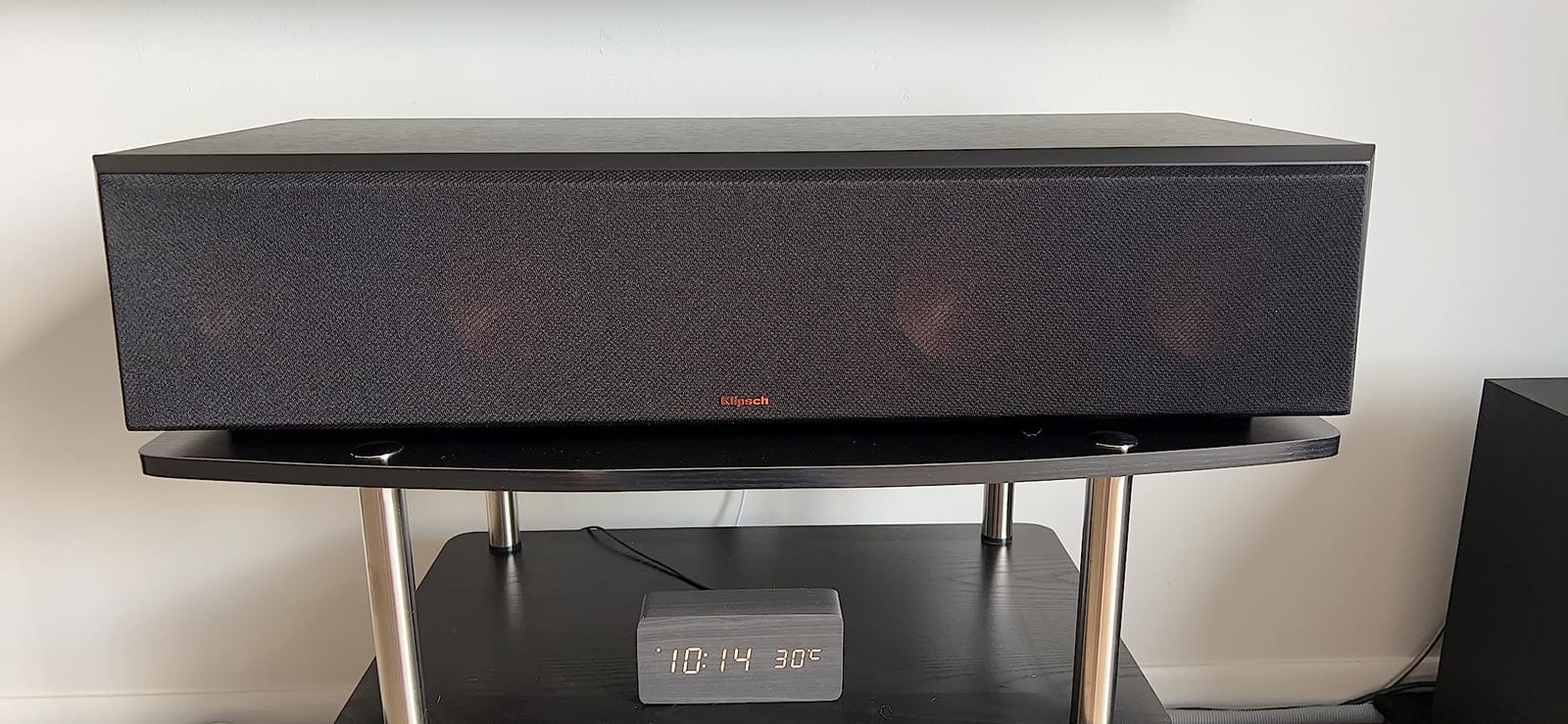
The waveguide keeps sound clear off-axis, which matters more than most buyers expect. On a wide couch or a deep seating row, voices stay at the same level for everyone rather than fading toward the edges.
A rear Tractrix port matched to the cabinet handles airflow with minimal turbulence, and the ebony finish and magnetic grilles match Reference Premiere towers so the system looks deliberate rather than assembled.
Who should buy the RP-504C
Buy it if the center is the single speaker you are willing to spend more on, which is our advice for most home theater systems. It pays off in every film because dialogue occupies so much of the runtime.
It suits larger rooms and mixed music and movie use, since the reserve means it never sounds strained at high listening levels. Pair it with RP-502S surrounds and a Klipsch sub for a matched premium system.
Where the RP-504C falls short
Size is the practical problem. The cabinet is 31.13 inches wide by 14.46 deep by 6.81 tall and weighs 39.7 pounds, so several owners ended up wall-mounting a larger display or buying a bigger stand after it arrived.
There is also a slight treble boost that can read as sibilant in a bright room without EQ. Run your receiver calibration before judging it, and give the crossover a few adjustments at the listening position.
8. Klipsch R-26FA – Best Tower With Built-In Atmos Height
Klipsch Reference R-26FA Floorstanding Speaker, Black, Pair
Integrated Atmos elevation speaker
Dual 6.5 inch IMG woofers
100W continuous and 400W peak
Pros
- Built-in Atmos height speakers add real overhead effects
- Strong output and clear horn highs for a mid-range tower
- Copper-spun woofers deliver solid bass
- Front port tightens low-frequency response
Cons
- Deep cabinet takes up significant floor space
- Only a 1 year warranty on some coverage
- Forward horn top end needs room correction for some listeners
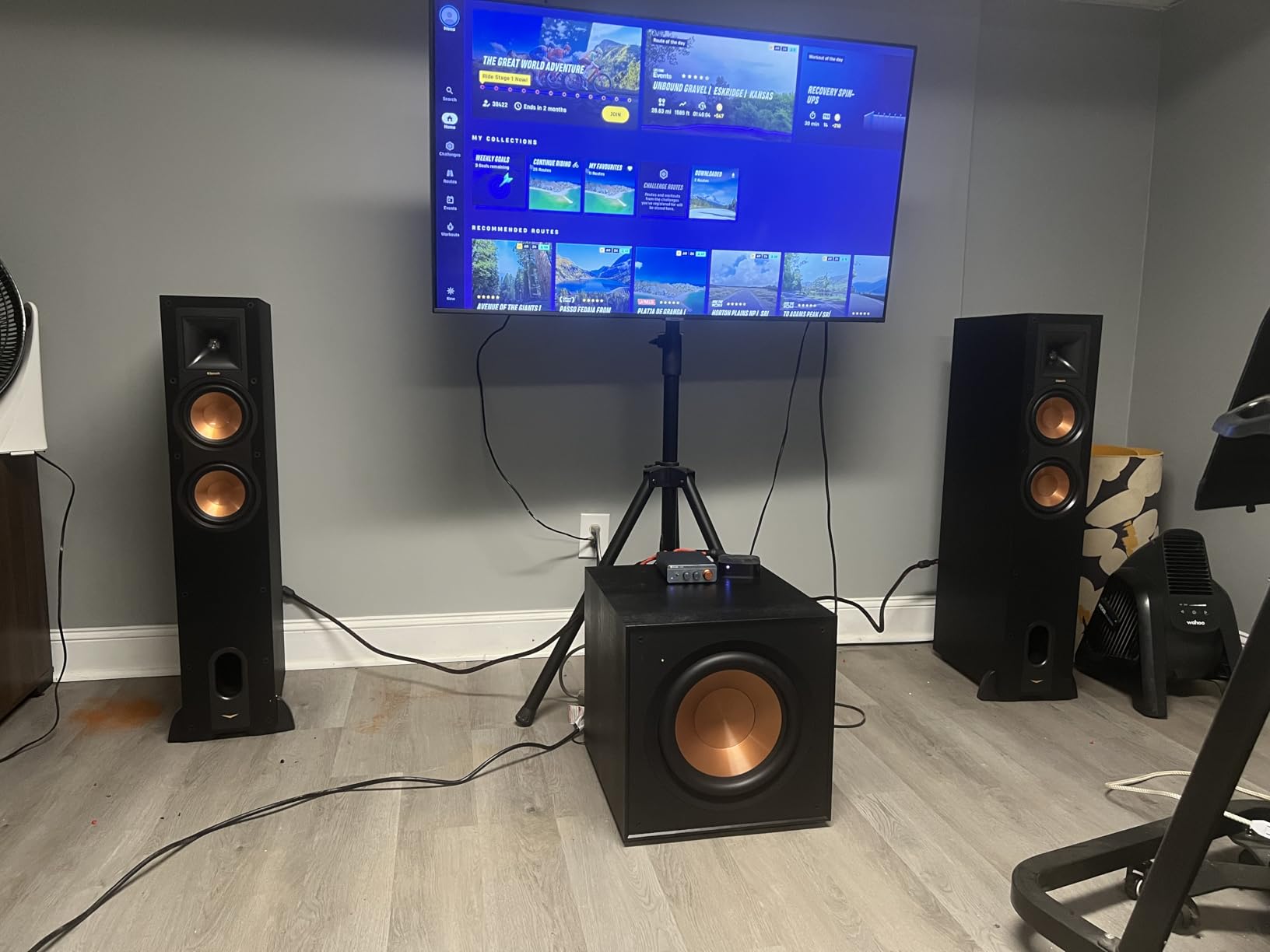
The R-26FA pair solves the most common upgrade path we see. Owners of an existing 5.1 system can move to 5.1.2 simply by replacing the front pair, because the elevation speaker is built into the top of each tower and fires upward.
Each tower carries dual 6.5 inch copper-spun IMG woofers with a front-firing port, under a one-inch aluminum diaphragm compression driver on a 90 by 90 degree Tractrix horn. Power handling is 100 watts continuous and 400 watts peak, and the channel layout is rated 5.1.2.
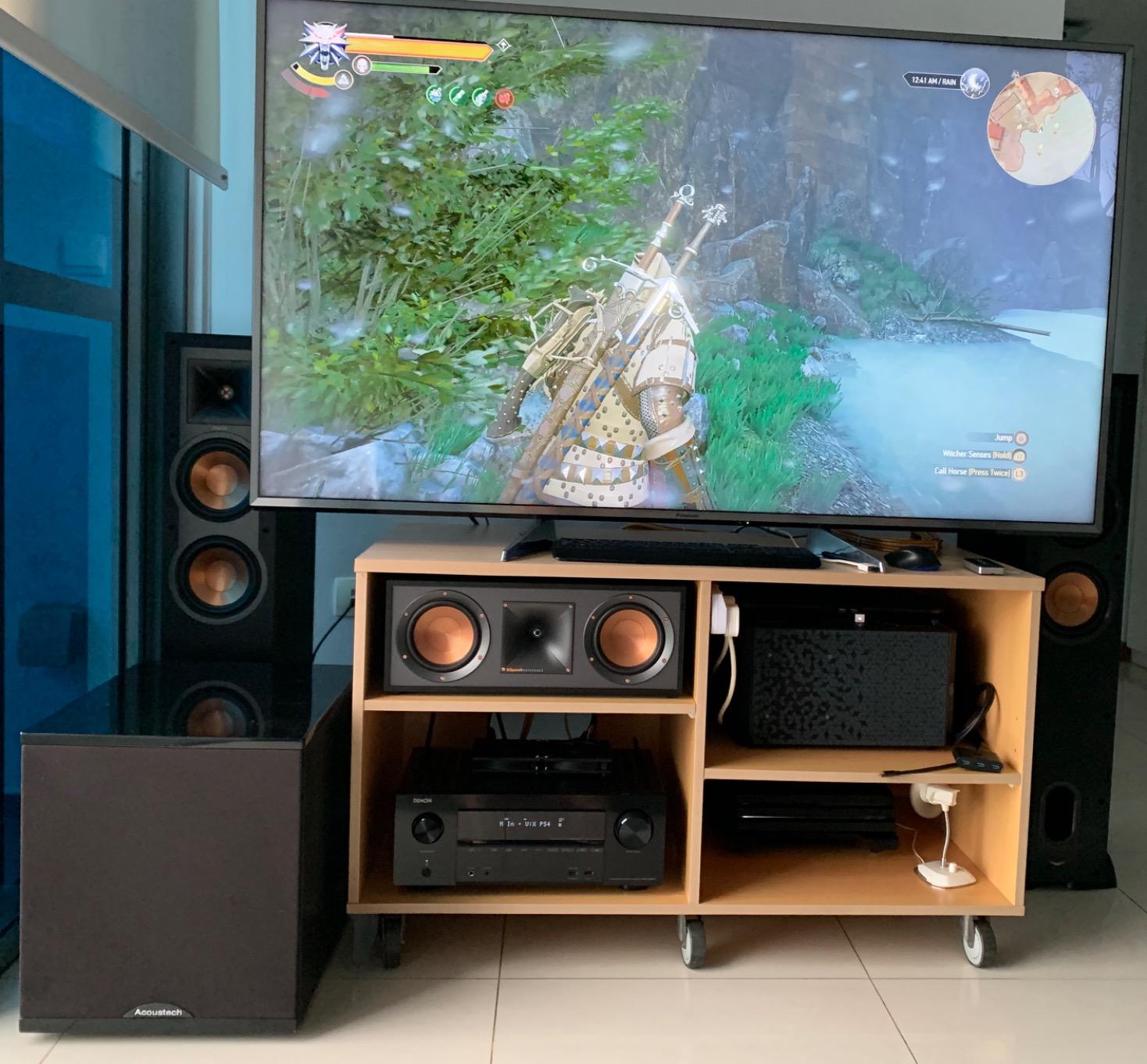
Front-firing ports matter in a living room where the towers sit against a wall, since they give you clearance that rear-ported models do not. Dual binding posts allow bi-wiring or bi-amping if your amplifier supports it, though most home theater receivers will not need either.
Reviewers like the power and clarity for the money, and the upward-firing height channel integrates without a separate bracket or stand. Nothing else in the guide does Atmos from a single tower pair this cleanly.
Who should buy the R-26FA
They fit anyone with a 5.1 Klipsch setup who wants Atmos without rewiring for four ceiling or on-wall speakers. Two speakers and two amplifier channels is a far simpler weekend project than running height wiring.
They also work well as fronts in a medium room where you want real floorstanding bass but cannot justify a full Reference Premiere tower.
Where the R-26FA falls short
Footprint is the first constraint. Owners regularly mention that the deep cabinet occupies a lot of floor space, and at 22 by 22 by 13 inches in the package listing these are not slim towers.
Warranty coverage is a single year on this model, noticeably shorter than several Reference models here, and the horn top end is forward enough that some listeners want EQ applied before they settle in.
9. Klipsch Reference Theater Pack 5.1 – Best All-in-One First Build
Klipsch Black Reference Theater Pack 5.1 Surround Sound System
Five satellites plus down-firing sub
Tractrix horn tweeters
Keyhole mounts on each satellite
Pros
- Complete 5.1 system in one box with no matching to do
- Compact satellites and a down-firing sub fit tight rooms
- Tractrix horns keep dialogue clear and effects lively
- Strong value against assembling the system piece by piece
Cons
- Small satellite drivers limit dynamics versus full-size towers
- Subwoofer output is modest rather than room-shaking
- Some buyers need crossover adjustments per speaker
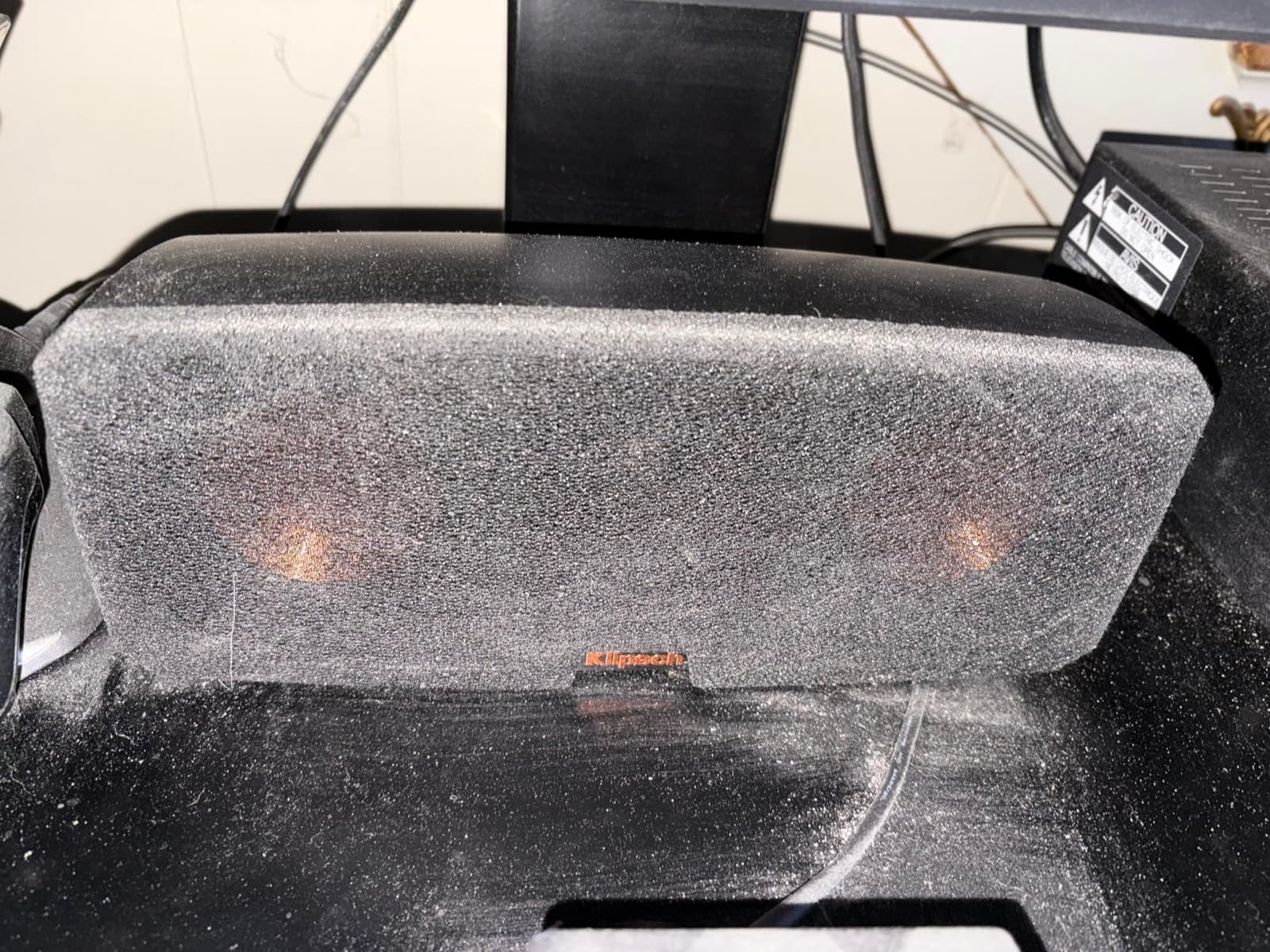
If you want a working 5.1 Klipsch system this month without deciding anything, this pack is the shortest path. It ships five satellites plus a down-firing subwoofer, and every satellite uses Tractrix horn technology with aluminum tweeters so the whole package shares one voice.
More than 2200 ratings have built a consistent pattern of owner feedback. Owners call it an easy, coherent first Klipsch system with a smaller footprint than expected and sound quality well beyond what the box suggests.
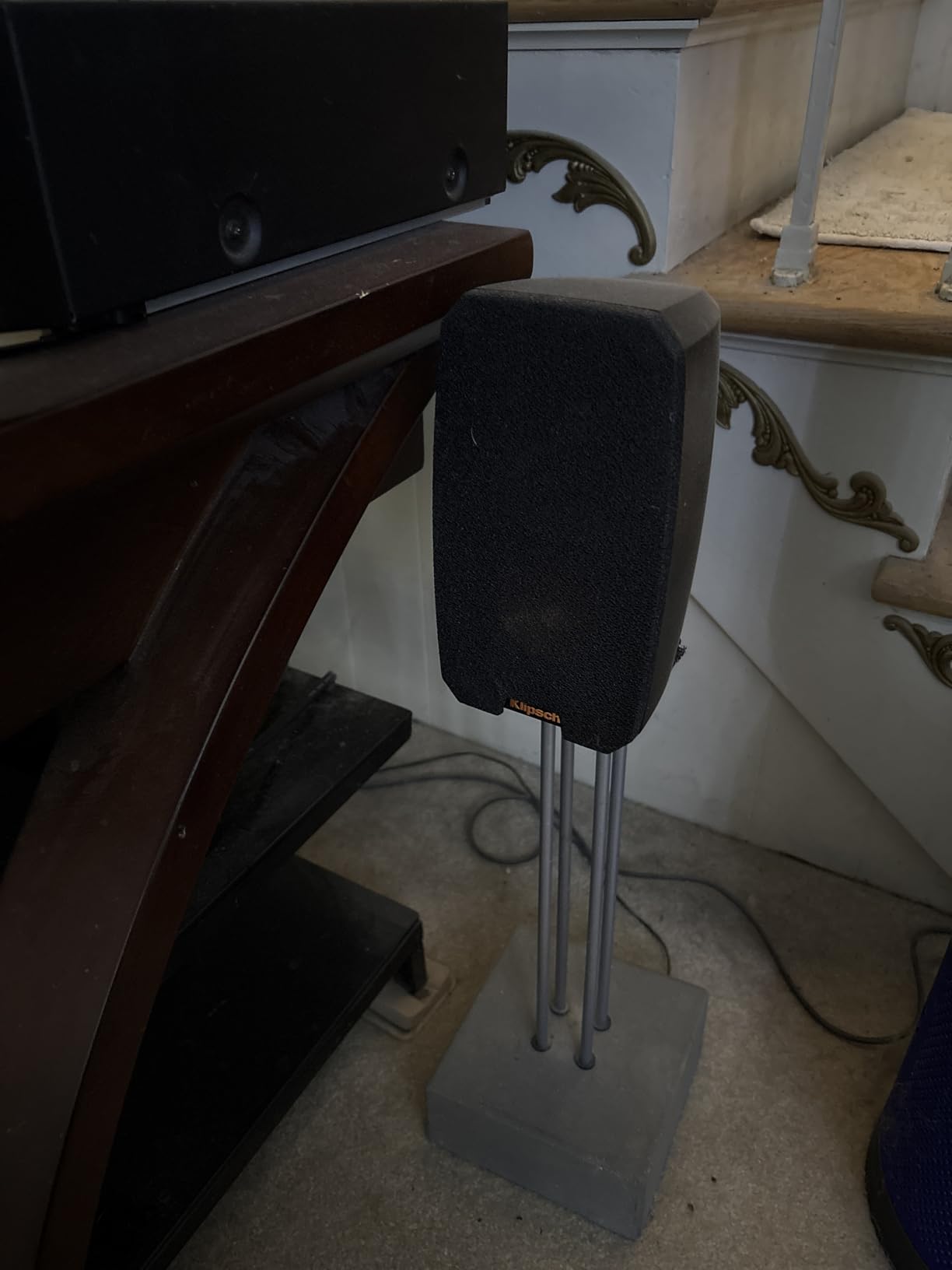
Each satellite has a keyhole mount and a threaded insert, so wall mounting or shelf placement are both straightforward. Rated power handling is 650 watts, impedance is 8 ohms, and the whole package is listed at 32 pounds.
The down-firing wireless subwoofer is designed to hide the cable and sit in a corner, which is where a subwoofer belongs acoustically anyway. That makes cable management a non-issue in a room where you cannot run in-wall wire.
Who should buy the Reference Theater Pack
It suits a first home theater in an apartment, a bedroom or a small media room where the priority is getting five real channels on the wall rather than optimizing each one. You will not need to research compatibility at all.
It is also a sensible second system for a basement or office, since the compact satellites leave room for a desk setup.
Where the pack falls short
The satellites use small drivers, and owners comparing them with full-size floorstanders report less dynamic headroom on demanding films. The subwoofer output is described as modest rather than room-shaking.
Several buyers also found they needed to adjust the crossover per speaker after setup, and the satellites are a step down in output from the towers in this guide. Treat it as a starting point you can upgrade one channel at a time.
10. Klipsch Reference Cinema 5.1.4 – Best Soundbar Upgrade With Real Height Channels
Klipsch Reference Cinema Dolby Atmos 5.1.4 System
Four up-firing Atmos satellites
5.1.4 channels
Wall-mountable enclosures
Digital sub amp
Pros
- Five channels plus four height channels in one package
- Up-firing drivers add overhead effects with no separate speakers
- Wall-mountable satellites keep small rooms tidy
- Speaker gain control on the sub speeds up balancing
Cons
- Speaker wire is not included and must be bought separately
- Subwoofer lacks the punch of a dedicated powered sub
- Push-lock terminals accept smaller pin-style banana plugs only
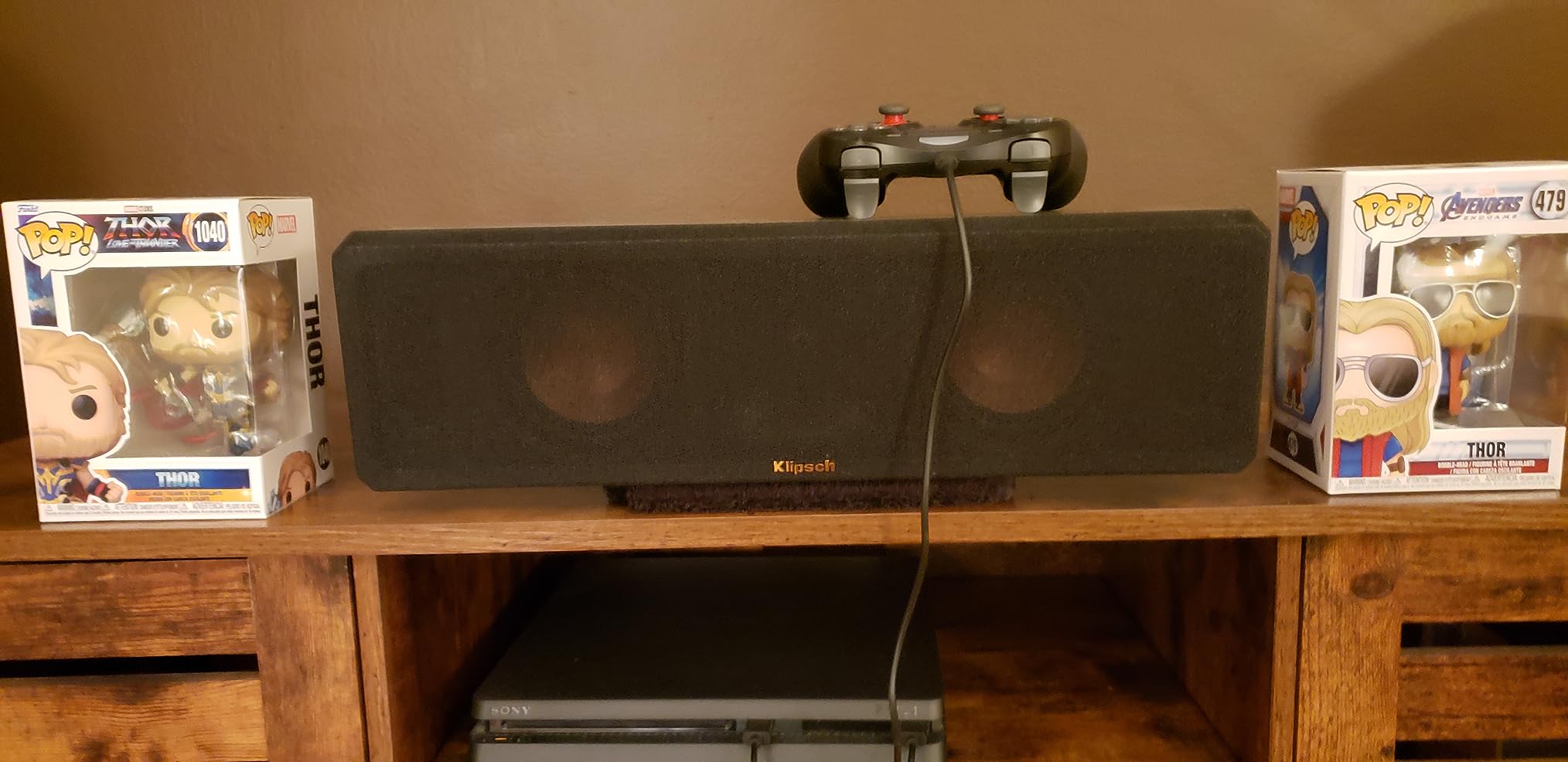
This is the pick for anyone whose current audio comes from a soundbar and who wants a genuine surround system without a rack of separate speakers. Four satellites carry up-firing Dolby Atmos drivers at the front and rear, so the system delivers 5.1.4 including four height channels from six boxes.
Drivers use the Tractrix 90 by 90 degree horn with aluminum tweeters, and the subwoofer amplifier is built in and all-digital. Speaker gain control on the sub lets you balance the whole package quickly, which is the feature owners mention most often as a time saver during setup.
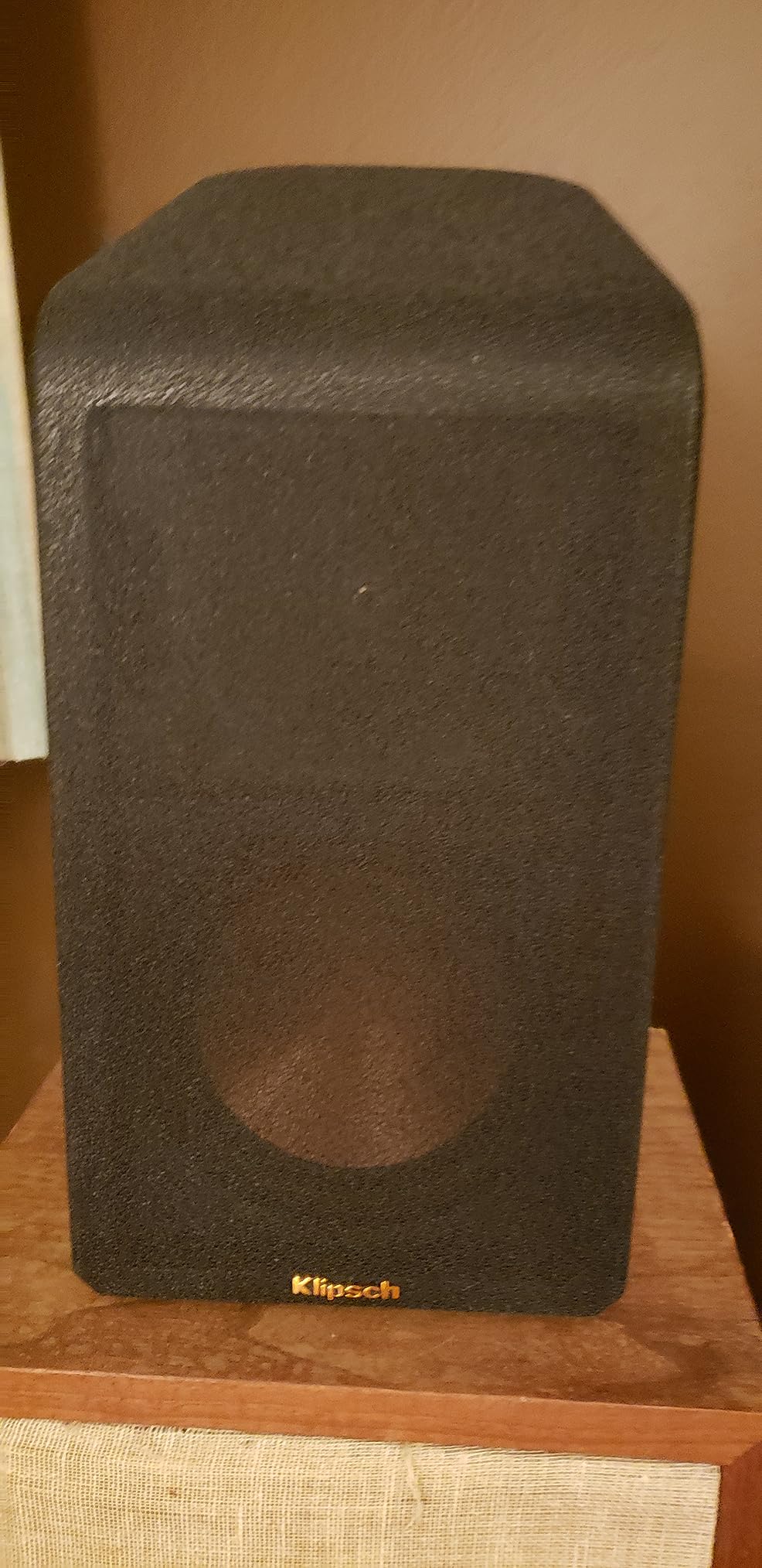
Satellites are wall-mountable, which keeps furniture clear in a smaller room. Rated maximum output is 300 watts, and the enclosures are aluminum, which explains part of the acoustic character people notice.
It is also the lowest-rated product in this guide at 4.5 stars, and the reason is mostly the sub rather than the satellites. Owners rate it as a big step up from a soundbar and are broadly happy with the height channels.
Who should buy the Reference Cinema system
It suits a renter or anyone in a space where wiring inside walls is not an option. Wall-mounted satellites plus one subwoofer is a realistic weekend install with no construction work.
Just make sure your receiver has nine channels of processing, because full 5.1.4 use requires a 9.1 channel unit. Most current midrange receivers do.
Where the Reference Cinema system falls short
The subwoofer is the weak point. Owners regularly describe it as lacking the punch of a dedicated powered sub, and the plastic satellite enclosures sound thinner than the wood cabinets elsewhere in this guide.
Speaker wire is not included, and the push-lock terminals accept only smaller pin-style banana plugs. Budget for cable and the right connectors before you start.
11. Klipsch R-610F – Best Entry Floorstanding Pair
Klipsch Reference R-610F Floorstanding Speaker, Black, Pair
45Hz to 21kHz frequency response
94dB sensitivity
85W continuous and 340W peak
8 ohm impedance
Pros
- Strong value for a pair of full-size floorstanding towers
- Flat accurate response from 45Hz to 21kHz
- High sensitivity plays loudly with modest amplification
- Solid non-resonating MDF cabinets with magnetic grilles
Cons
- Supplied foot screws are weak and need replacing
- Horn treble can sound harsh at high volume without EQ
- A subwoofer is still needed for the deepest effects
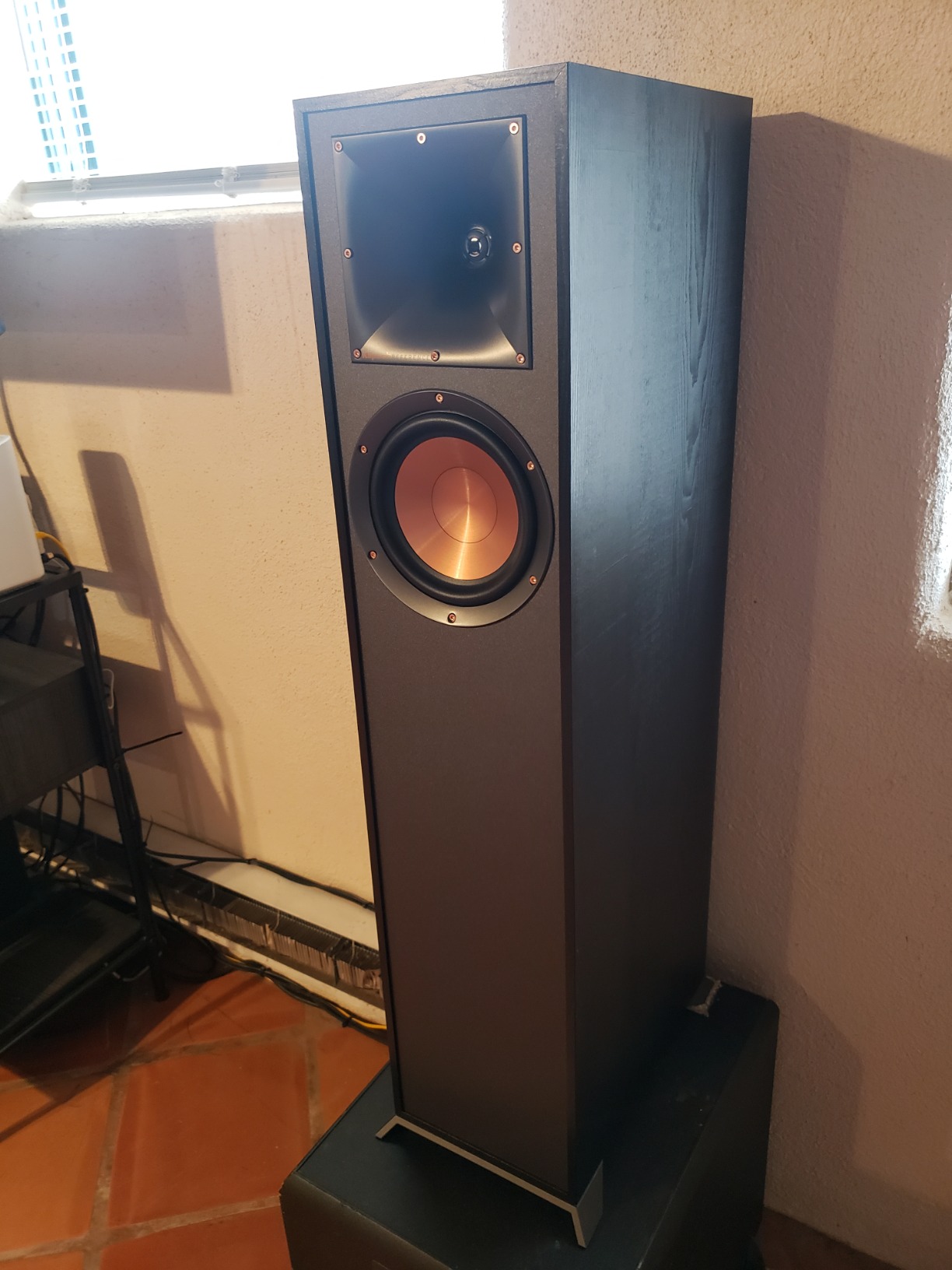
The R-610F pair is the straightforward way to get real floorstanding cabinets in front of a screen. Frequency response runs 45Hz to 21kHz, which is unusually extended for an entry tower, and the 94dB sensitivity means it plays loudly without a powerful amplifier.
Long-term owners call the pair exceptional for the price, citing clean highs and a smooth transition into the midrange. Drivers are 6.5 inch units under a one-inch aluminum LTS tweeter on a 90 by 90 degree square Tractrix horn, with 8 ohm impedance for wide receiver compatibility.
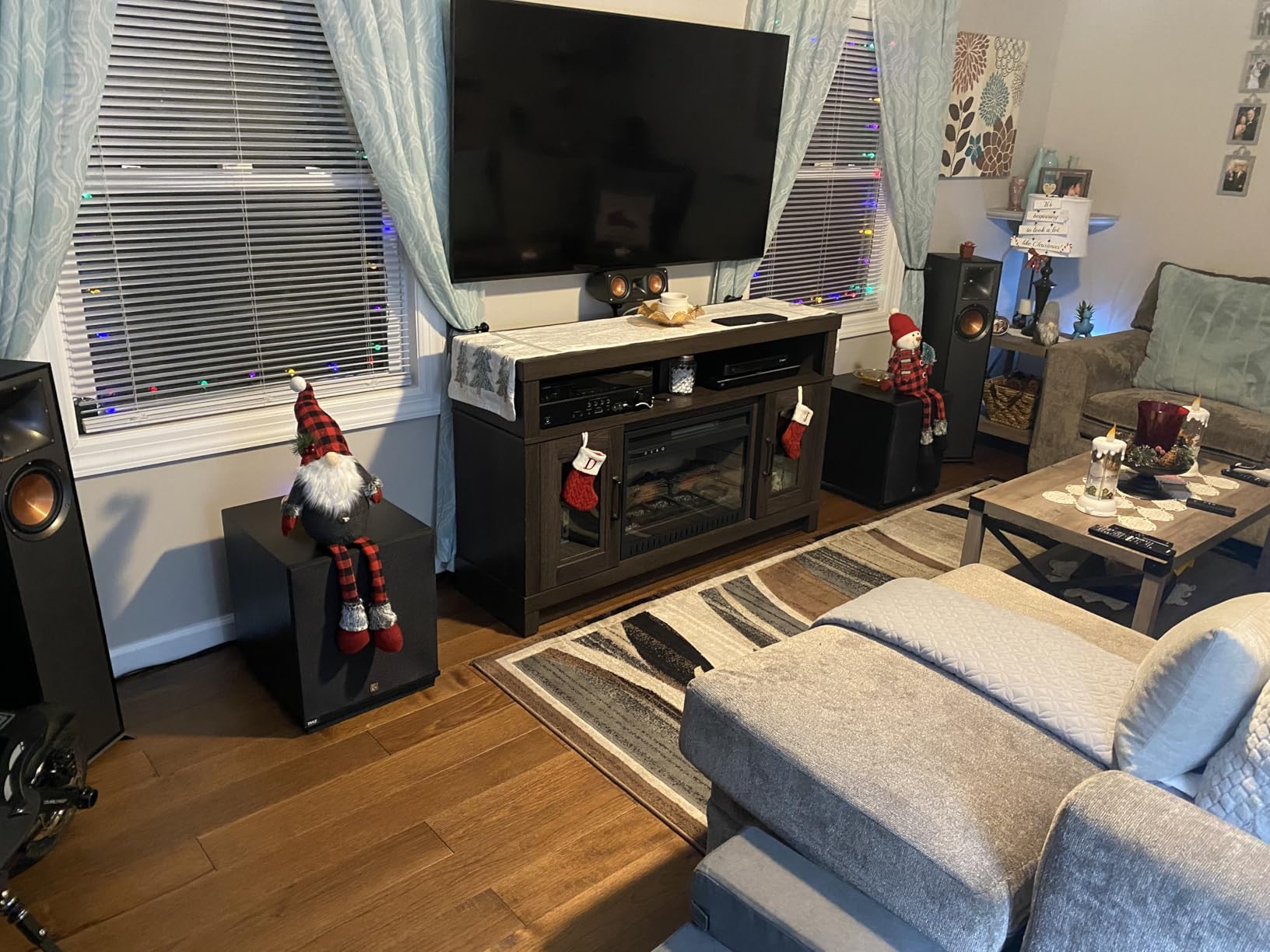
Power handling is 85 watts continuous and 340 watts peak, and the cabinets are 41.25 inches tall by 18.25 deep. That size is the trade for the bass extension, and it does mean you need floor space in front of a large display.
The MDF cabinet construction is described as non-resonating, and magnetic grilles keep the fronts clean. Klipsch covers the pair with a five year limited warranty.
Who should buy the R-610F
They suit a living room theater where you want real towers for the front stage but do not want to climb into the premium Reference Premiere tier. At this sensitivity, a modest receiver is enough.
They also work as a step up from a bookshelf-based system when you want the front pair to carry more mid-bass on their own, while a sub handles everything below 45Hz.
Where the R-610F falls short
Buy better screws for the feet. Weak supplied foot screws are the single most cited practical problem in long-term ownership reports, and they are a five minute fix that costs almost nothing.
The horn treble can read as harsh at high volume without EQ, and a subwoofer is still needed for the deepest effects. The weight, at 90.2 pounds for the pair, also means two people for installation.
12. Klipsch RP-502S – Best Surround Pair for Wide Coverage
Klipsch RP-502S Reference Premiere Surround Speakers – Pair (Ebony)
Wide Dispersion Surround Tech
5.25 inch Cerametallic woofer
Bipole twin-driver design
Pros
- Very wide even dispersion fills the room from one seat
- Handles high volume without audible distortion
- Wall-mountable with integrated keyhole hardware
- Ebony finish and magnetic grilles match Reference Premiere towers
Cons
- Bipole design reduces pinpoint localization versus monopole surrounds
- 36 pounds per pair needs solid anchors and a second person
- Tweeter sits high which matters under low ceilings
The RP-502S pair is the surround answer for a dedicated room where the seating is wide and the side walls are close. Wide Dispersion Surround Technology spreads the effect across a broad area, so listeners at the edge of a couch hear the same ambience as the listener in the middle.
Each cabinet carries two 5.25 inch spun-copper Cerametallic woofers in stamped-steel baskets with a vented LTS titanium diaphragm tweeter in a ceramic magnet housing. The molded silicon horn face matted to the 90 by 90 degree Tractrix horn smooths the response compared with older surrounds.
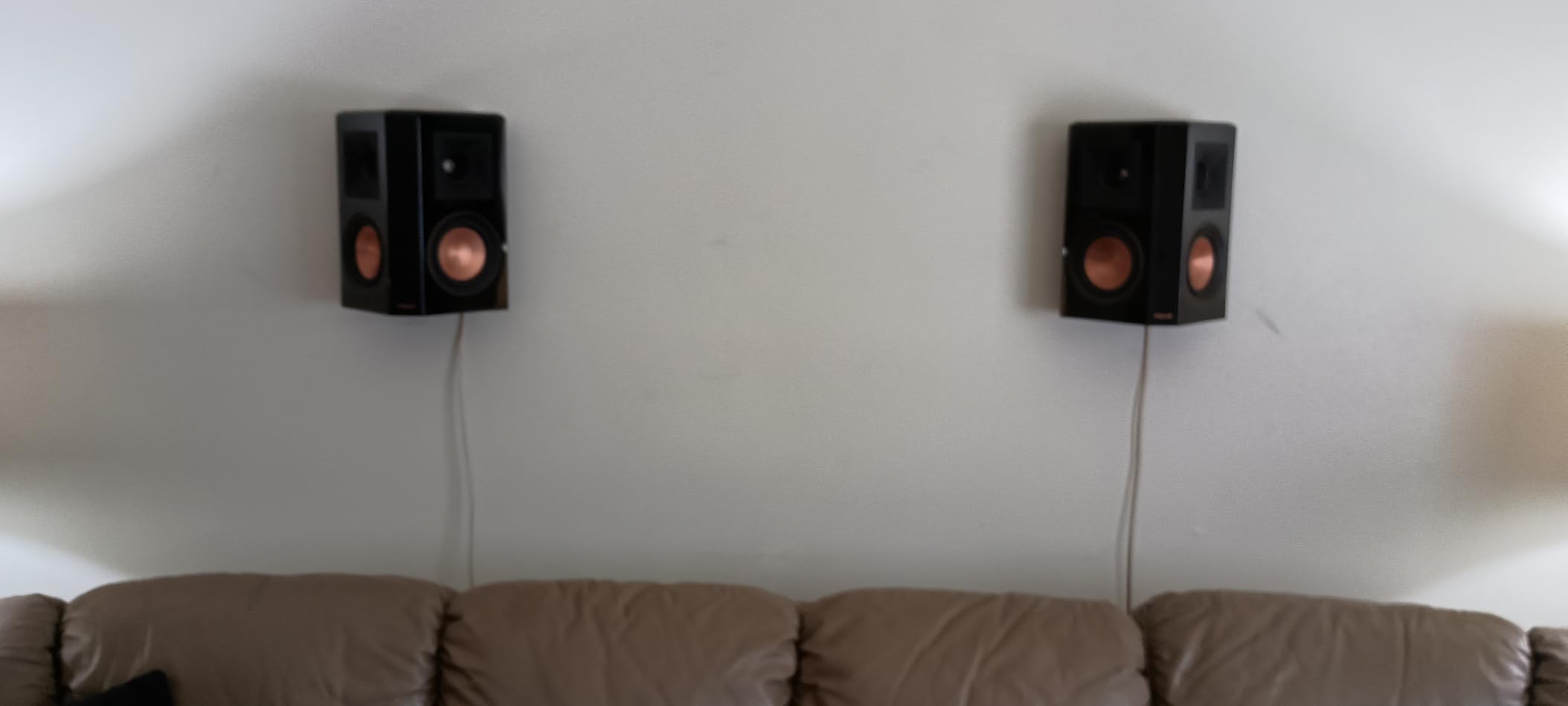
At 16 by 20 by 18 inches and 36 pounds for the pair, these are substantial cabinets. Integrated keyhole hanging hardware means wall mounting is a two screw job, but the weight is worth planning for.
Owners consistently describe them as among the best surround speakers available, praising dispersion and power reserve and the way they blend with Reference Premiere fronts. The ebony finish and magnetic grilles match the rest of the line, so the system reads as one design.
Who should buy the RP-502S
Buy this pair when your room is wide rather than deep and you want ambient effects to reach every seat. That is the design brief, and it is where they outperform almost anything else in this guide.
They also suit a room where rear placement options are limited, because the wide coverage means you do not need a perfectly precise angle to get an even field.
Where the RP-502S falls short
The bipole layout trades away pinpoint localization. Listeners who want to hear a specific effect come from directly behind them may find the field diffuse, though some owners actually prefer that for long movie sessions.
The tweeter also sits higher than many surrounds, which matters under a low ceiling, and the weight of the pair means wall mounting needs solid anchors and a second person on the ladder.
How to Choose Klipsch Speakers for Your Room
Most regret in a home theater build comes from matching speakers to a wish list instead of a room. Work through these six questions before you spend anything, and the model choices above will make themselves.
1. What size is the room, and how far is the main seat from the screen? Under about 120 square feet, bookshelf speakers as fronts with a 10 inch sub will beat towers, because a tower that close to the screen dominates the image. Above about 300 square feet, you want towers and a larger sub, because the room needs the output more than it needs the refinement.
2. How many channels can your receiver actually process? Count your amplifier channels before you choose a 5.1.4 system. Six boxes that need nine processed channels will be limited by a receiver that only does seven, and you will lose the rear height pair before you lose anything else.
3. What is your real budget split? Put roughly a third of the speaker budget into the center channel and a meaningful share into the subwoofer. On the r/hometheater forums the most common upgrade regret is a system where the budget went into fronts and the dialogue got thin.
4. Does high sensitivity actually help you? This is where Klipsch’s reputation pays off. A speaker rated in the mid 90dB range for sensitivity produces high output from modest amplification, so you do not need a costly receiver to hit reference levels in a normal room. Read the sensitivity figure as a friend, not a compromise.
5. Can you live with the horn signature? Listen at low volume in a store if you can, because the bright top end is the trait people either love or adjust away. If you are sensitive to treble, this is where to find out before buying rather than after.
6. Do you need Atmos, and how will you deliver it? Integrated elevation towers such as the R-26FA are the simplest path. Dedicated on-wall or in-ceiling height speakers are the best sounding path if you can run the wiring. A 5.1 system with no height channels is still a very good theater system if budget is the constraint.
Once the speakers are chosen, the rest of the system matters just as much. Our guides to home theater systems and Dolby Atmos enabled speakers cover the surrounding hardware, and if your room is being rebuilt from scratch, projector choices change how you position the front stage.
Two more pieces of the room are worth budgeting early. The listening position matters as much as the speakers, so our guide to home theater seating covers sightlines and row spacing. And because high-sensitivity horns expose a noisy amplifier, a home theater power conditioner is a cheap way to quiet the noise floor the whole guide keeps mentioning.
Klipsch Series Explained: Which Line Should You Buy?
Klipsch naming confuses almost everyone at first, because the lines overlap in price rather than forming a clean ladder. Here is the practical version.
Reference Next Generation is the current entry line. The R-51M, R-52C, R-41SA, R-610F and R-26FA all sit here. This is where most home theater buyers should start, because the drivers are the same technology used higher up.
Reference Premiere is the step up, and the differences are real rather than cosmetic. The RP-504C and RP-502S use Cerametallic woofers and vented titanium tweeters instead of spun-copper IMG drivers and aluminum LTS tweeters, plus a molded silicon horn face that reduces horn resonance.
Heritage is the flagship horn line with the strongest efficiency ratings in the range. Enthusiast forums frequently recommend Heritage for home theater specifically because of that efficiency, with the same warning to budget properly for the center channel.
Theater Packs and Cinema Systems bundle satellites and a subwoofer for all-in-one setups. They are the fastest route to five real channels, and the most common first step into the brand.
Powered models and sound bars need no external amplifier at all. They suit apartments and secondary rooms where a receiver is not being installed.
Mixing lines is entirely reasonable. Reference Premiere surrounds with Reference towers is a normal, budget-saving combination, because the horn and the basic voicing are shared.
How to Tame the Horns: Placement Fixes for Brightness
Most of the harshness complaints we read about Klipsch are placement problems with a simple fix. If the horns are aimed directly at your ears at high volume, brightness is what you will hear.
1. Set the tweeter at or slightly above ear height. For a seated listener, the horn axis should pass a few inches over your head rather than straight at it. Aiming high and letting the waveguide spread downward is the single most effective change.
2. Toeing the speakers inward changes more than the image. Turning the front pair so the tweeters cross in front of the listening position narrows the high-frequency coverage on axis. Owners on Budget Audiophile threads who previously found the R-51M bright almost always reported that repositioning fixed it.
3. Give the rear port breathing room. Any bass-reflex model in this guide, including the R-51M, ports to the rear. Pulling the cabinet off the wall by a few inches, or using an approved port plug, removes the boom that people often mistake for brightness.
4. Run room correction before you judge anything. Calibration will pull back the upper midrange in a reflective room, and it also fixes the level mismatch between full-size channels and the lower-powered height speakers like the R-41SA.
5. Check the amplifier noise floor. At these sensitivity levels, a quiet amp is audible. Owners who assumed the speakers were hissing were actually hearing a noisy amplifier, and swapping to a cleaner unit resolved it.
Frequently Asked Questions
Are Klipsch speakers good for home theater?
Yes. The horn-loaded tweeter keeps dialogue forward at low volume, high sensitivity means a modest AV receiver can drive them, and the range covers every channel in a 5.1 or 7.2 layout including Atmos height speakers. Correct placement and a priority center channel matter more than the brand.
Why don’t we recommend Klipsch?
Three reasons come up: the horn top end can sound bright when pointed directly at the listening position, the high sensitivity exposes a noisy amplifier’s noise floor, and the strong opinions polarise buyers. None apply if you place the speakers properly and prioritise the center channel.
Is Klipsch as good as Bose?
They optimise for different goals. Klipsch prioritises efficiency, dynamics and dialogue clarity through horn loading, while Bose focuses on controlled, room-filling output that is forgiving of placement. Klipsch is the stronger pick for loud, dynamic movie watching, and Bose suits smaller rooms and casual listening.
Do Klipsch speakers need a powerful amplifier?
No. Sensitivities in the mid 90dB range mean these speakers produce high output from modest amplification, so a midrange AV receiver is enough for a normal room. The trade-off is that a quiet amplifier is audible at low listening levels, so a cleaner unit improves the result more than a more powerful one.
Can I mix Klipsch bookshelf and floorstanding speakers?
Yes, and it is a common budget-saving approach. Klipsch shares its horn and basic voicing across the Reference and Reference Premiere lines, so pairing Reference Premiere towers with Reference bookshelf speakers or surrounds works well. Match the center channel to your fronts, since it carries most of the dialogue.
What Klipsch speakers are best for a small room?
For a small media room or apartment, the R-51M bookshelf pair as fronts with the R-52C center and the R-100SW subwoofer is our combination. It keeps the cabinets compact, plays loudly enough thanks to high sensitivity, and adds R-41SA height speakers later if you want Atmos.
Conclusion: Our Best Klipsch Speakers for Home Theater Picks in 2026
Start at the bottom of the system and work up. The Klipsch R-12SW subwoofer is our anchor pick because a 12 inch driver reaching 29Hz changes what a film sounds like more than any other single component, and it costs you nothing in dialogue clarity to add it first.
From there, the R-51M bookshelf pair or the R-610F towers handle the front stage, and the center channel is where the next dollar should go. The R-52C is the value answer and the RP-504C is the one to buy if the room is large or dialogue is the thing you notice most.
Add the R-41SA pair when you want real overhead content, the RP-502S pair when your seating is wide, and the R-26FA towers if you would rather have Atmos built in than run separate height speakers. For the fastest route to five channels, the Reference Theater Pack is still a coherent, well-reviewed starting point in 2026.
Whichever route you take, set the tweeters at or just above ear height, run room correction before you judge the sound, and expect a lot more output from a modest receiver than you would with a less efficient speaker.